Apple: The Ultimate Harvester of AI Dividends

Apple's Strategic Layout in the AI Era
📝
This piece offers a sharp, incisive analysis of Apple's strategic positioning in the AI era. The author examines key issues including the new Siri, app "de-skinning," the advantages of Apple's custom silicon, and its data strategy — all through a distinctly Apple-centric lens. While the arguments are pointed and insightful, readers should note this represents one interpretation among many, and does not fully reflect Crossing's editorial stance. We encourage open, critical engagement with Apple's strategic choices amid the AI wave.
Author: Lian (AI entrepreneur, former Special Assistant to Tencent's VP of Technology, Strategy Director), Yifan

Prologue: The Old Man Still Runs This Town
While OpenAI, Microsoft, Google, Meta and others have been frantically racing to build large language models, the world's most valuable company — Apple — has seemed oddly quiet. Is it because Apple is too lazy, too afflicted by big-company disease, to build a top-tier LLM?
The reality: NVIDIA only borrowed the "world's most valuable company" crown for a single day. After Apple's modest announcements at WWDC in June, it snatched the title right back.
In the rising tide of AGI, Apple isn't actually worried at all: hardware stickiness and chip moats are far more durable than large language models. As LLMs increasingly become a commodity that anyone can produce, Apple — with its full-stack hardware + OS ecosystem — need only lower its standards enough to make every LLM company (including OpenAI) and every major app (including WeChat, Douyin, Kuaishou, and Taobao) kneel before it.
Tremble! Before the "Siri Fully Agentic AI-Native OS."
New Siri: The New Mainstream Traffic Gate
Siri has always been useless because it was, fundamentally, an idiot.
It couldn't give flexible, valuable responses, nor could it execute the actions we wanted — which is precisely why voice interfaces have never captured significant traffic.
But Siri supercharged with LLMs will be different: large models will inject intelligence into Siri (and perhaps a soul to go with it). This new Siri won't just chat with you tenderly; it'll serve as a work assistant taking notes, ordering takeout, booking flights.
Of course, delivering these capabilities isn't easy. Beyond conversational AI, it requires task decomposition, app/API invocation — precisely the agentic capabilities that OpenAI and the industry are currently racing to develop. But genuine agent capabilities still need time, likely waiting on the repeatedly delayed GPT-5.
Implementing this on phones is even harder. Mobile constraints (power consumption > bandwidth ~ compute > memory) mean that for the next 2-3 years, until next-generation SoCs arrive, model sizes will struggle to exceed deeply quantized 7B/13B parameters — and smaller models mean weaker capabilities. This is why mobile AI will follow a "cloud-primary, edge-secondary" technical roadmap for the foreseeable future.
Yet as technology advances, one thing is certain: AI voice assistants will grow increasingly capable and become a mainstream traffic channel. GPT-4's voice demos and Kyutai's voice assistant have already sketched the outlines.
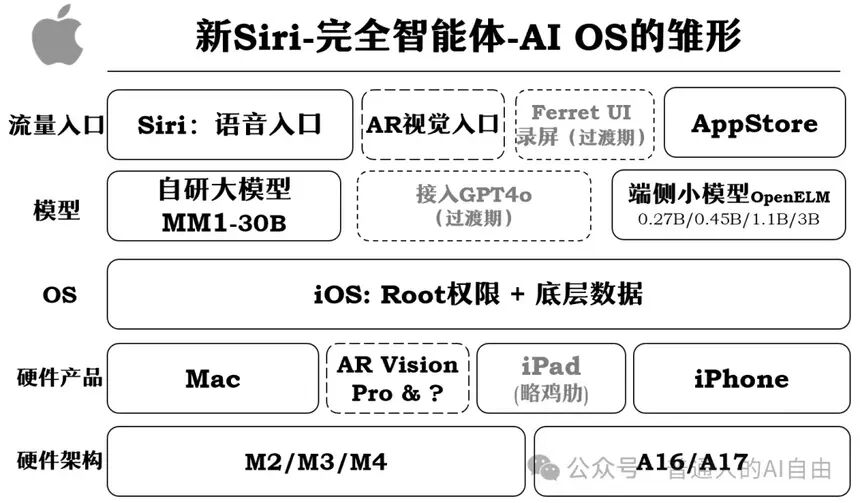
Looking at today's digital ecosystem, most money flows to apps that capture user attention, monetized through advertising. Yet hardware manufacturers for phones and PCs haven't seen much of this pie: traffic entry points and data sit with apps, and without distribution rights, hardware makers get no ad revenue. Voice assistants as a mainstream traffic channel will naturally be controlled by phone manufacturers — and the balance of power will tilt toward them.
Whoever controls the entry point controls the revenue.
Following this "entry point" logic, another natural interaction paradigm is AR. Despite Vision Pro's current weak sales, I believe AR will be the next disruptive hardware platform, because it represents more natural interaction, more efficient human-computer interface. Apple will certainly continue investing here — product form factors may evolve, but the virtual AR world is already close: AI-generated infinite scenes will soon be reality. What remains is whether hardware innovation can solve the final puzzle: refresh rate, weight, and battery life.
App "De-Skinning"
The crucial difference between voice and visual interfaces: voice delivers a single result, while screens present multiple app choices for users to decide.
Imagine a sufficiently intelligent Siri: when we say "order me lunch," which platform gets the order — Ele.me or Meituan — and even what dishes are selected, becomes Siri's call; at minimum, it's a result filtered by the underlying model. In this scenario, Siri could easily demand that Meituan and Ele.me bid for placement. Ride-hailing, shopping, flight booking — all follow the same pattern.
If Siri works well enough, it might not even need to launch the original app, presenting choices directly within the Siri chat interface. This is app "de-skinning." Naturally, different apps are affected to varying degrees:
- No de-skinning risk: content-is-the-app (Douyin, WeChat messaging, mobile games, etc.). Siri would still need to invoke the original app to deliver the service. Though for vague commands like "browse short videos," whether Douyin or Kuaishou gets launched by default depends on who pays more protection money.
- Front-end de-skinned, but back-end services remain stable: heavy offline operations, heavy operations, merchant-dense platforms (food delivery, e-commerce, hotel booking, etc.). Siri could directly call back-end service APIs, presenting results in chat or mini-programs without requiring app downloads. Because operations are heavy, hardware manufacturers won't enter these businesses themselves.
- Apps completely lose value: agentic single-service apps (flight booking, excluding after-sales customer service). Take flight booking: if phone manufacturers negotiate direct airline integrations quickly, Trip.com Group becomes irrelevant.
Apple's greater advantage over other manufacturers is its comprehensive control of iOS. Theoretically, iOS could go further than merely launching apps — directly accessing in-app data and services, bypassing application interfaces to complete user commands. Of course, constrained by ethics and negotiations with app developers, Apple won't casually wield ROOT-level "nuclear options" to grab app data, and third-party developers won't simply hand over everything. Hence we see Ferret UI, a screen-reading solution.
But screen-reading is transitional. Apple will push for greater data and permissions access through other means (permissions for apps to access certain hardware/data, ad revenue sharing, etc.); and the recently released App Intents framework was designed precisely for this.
Custom Silicon: Apple's Trump Card
Custom chip design has extraordinarily high technical barriers and massive investment requirements. A rough comparison:
- GPT-4 training cost = $63 million
- Apple M3 chip tape-out cost = $1 billion
Apple has talked about chip performance more than anything else in recent product launches — this is its greatest source of confidence.
Whether by accident or foresight, Macs have inherent advantages for running on-device models: unified memory architecture can accommodate larger models. And this advantage is something PCs cannot match until a next-generation AI-specific architecture emerges. (Each chip generation takes 2-3 years from design to tape-out to mass production.)
A maxed-out Mac with M2 Ultra (192 GB memory) runs Llama3-70B-FP16 quantization (140 GB) inference tasks with room to spare, potentially surpassing GPT-3.5 capabilities.
Llama.cpp developer Georgi Gerganov ran Code Llama-34B-FP16 on M2 Ultra, achieving 23.8 tokens/second with speculative decoding acceleration — entirely acceptable for conversational scenarios.
Even standard-config Macs with 32-64 GB memory handle impressive AI workloads. By contrast, a maxed-out NVIDIA 4090 PC has only 24 GB VRAM, capable of running only a 7B-FP16 model — still semi-competent.
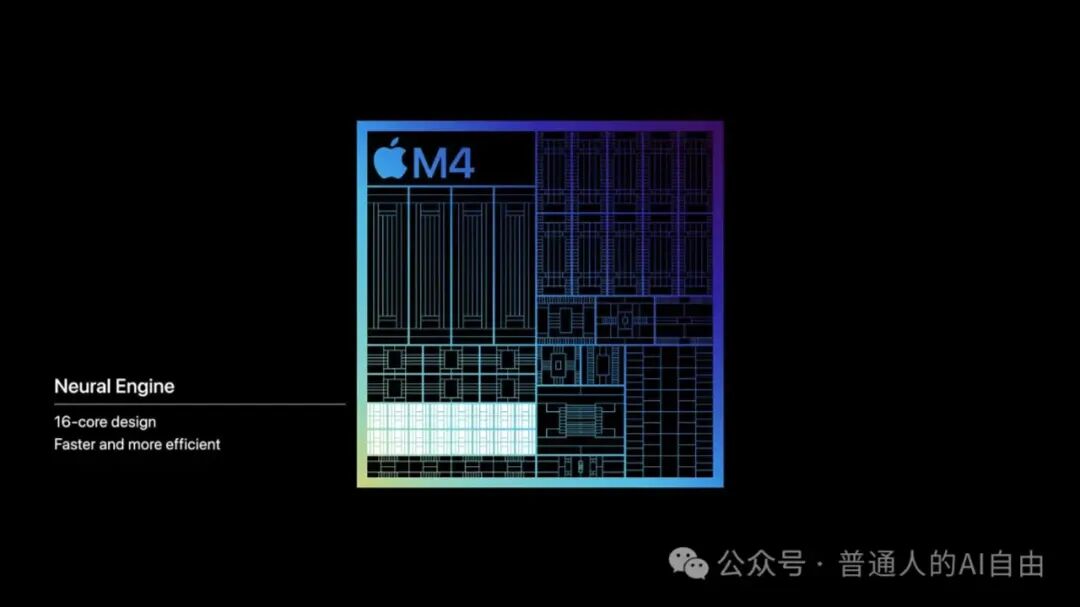
Moreover, examining Apple's M-series and A-series chips reveals the Apple Neural Engine (NUE) — dedicated neural network processing regions. However, third-party developers currently have limited optimization capabilities; wild models running on Mac today use GPU compute, while Apple's native AI applications can properly leverage NUE hardware performance.
Now, AI PCs including Microsoft are shifting to ARM architecture chips. Here, Apple maintains at least a 2-3 year lead: competing ARM chips primarily target baseline M4 performance, while projected M4 Max GPU compute is at least 3x that of M4.
Apple's next-generation Macs are well worth anticipating.
Appendix: Chip performance comparison across manufacturers
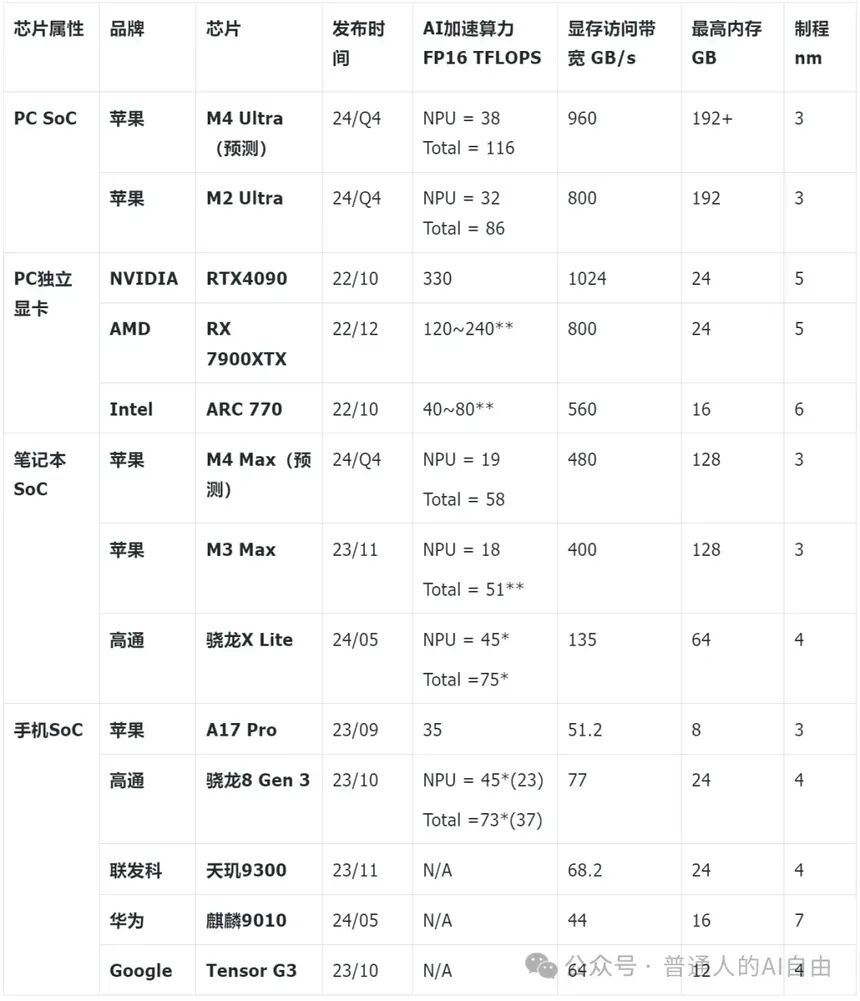
*Precision not specified on official site, estimated as INT8; **Estimated values; Data source: manufacturer websites
Your Privacy, or Apple's Exclusive Data
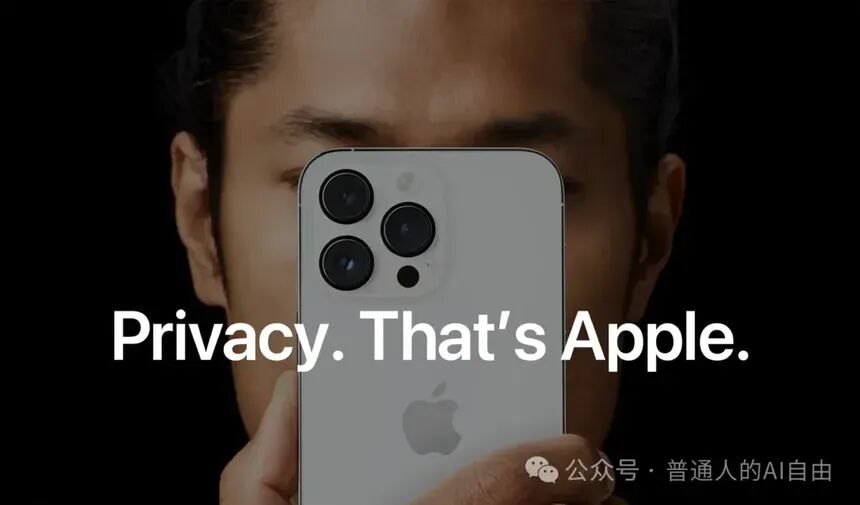
Lately I've seen Apple billboards everywhere touting privacy protections... This "the lady doth protest too much," "thief crying stop thief" approach genuinely impresses me with PR's audacity. Not that Android is better — at least they don't PR about protecting personal data... Apple is "the pot calling the kettle black," and worse, "wanting it both ways."
Setting aside the fact of "Cloud Guizhou" (domestic Apple personal data physically stored in Guizhou's mega data centers). "Big data personalized marketing" — peddling personal data in various guises — is the underlying business model of internet advertising. For all major software and hardware companies, data = profit. Apple has always earned from this too.
As a firsthand witness: years ago, Apple canceled IDFA (ID for Advertisers) under the banner of "protecting personal privacy." The real purpose: bringing "ad attribution," a critical link in internet advertising, in-house, to carve out a slice of the advertising pie for itself. Today, various device fingerprints still play IDFA's original role, and Apple has secured a satisfactory cut... After all the negotiation, no company has ever genuinely cared about personal privacy — Apple included.
New Siri/Apple Intelligence, currently constrained by technical limitations, must use an "on-device model + cloud model" approach — meaning our chat content with Siri, usage information, all get concentrated on Apple servers. This accumulates more personal data at Apple. To make users surrender this data more painlessly and freely, the PR narrative mirrors previous campaigns exactly: "Apple deeply values personal privacy, you can trust Apple, please use Siri with confidence."
But let me translate: "Please use Siri without worrying about data privacy; because Apple will monopolize your personal data and won't freely share it with others; so Apple can make the most money."
From a longer perspective, I believe the "on-device + cloud" model service approach will persist long-term: the deeper reason being this creates a sufficiently large, difficult-to-regulate "gray zone" allowing phone manufacturers maximum use of user privacy data. Thus, even when on-device model technology advances to independently complete tasks, commercial incentives will always conjure several "must-go-to-cloud" justifications.
And please, depend more on Apple — so later Apple can charge you for various "value-added services": more storage space, Siri AI services... But think carefully: you paid for hardware, you pay subscription fees for "value-added services," plus your data gets monetized for ads while you receive nothing. This is sophisticated "eating the fish multiple ways"!
Your data on iCloud has never belonged to you; it belongs exclusively to Apple. Don't believe me? Try downloading this data to store elsewhere? You can't. This data exists on Apple's servers, controlled by Apple's permissions; if you dare fall behind on payments, Apple simply modifies permissions in its own servers, and your data becomes irrelevant to you.
You have absolutely no recourse.
Apple's Character: Full Closed-Loop Monopoly
Apple is a "natively monopolistic company."
Apple's core business model has always been: creating monopoly as top priority, high investment, full vertical integration, then harvesting monopoly profits.
With future Siri's new traffic entry point, this monopolistic capability will strengthen further: apps that were already kneeling will be forced to prostrate entirely. And referencing Apple's playbook with Google Maps, in the short term Apple will use OpenAI or other third-party model services as transitional scaffolding, but ultimately large models will be fully developed in-house for complete vertical closure.
Because only this enables total monopoly: not allowing a single bit of data to flow elsewhere before being taxed.
- Hardware: iPhones/Macs don't truly "belong" to users. Users are merely "users" of the phone, not "administrators." User permissions are subordinate to remote control from Apple headquarters. Yet you still pay for hardware — you're only buying usage rights, not ownership.
- Data: Data within Apple hardware cannot be read by third-party software; users lack supreme authority over their data; and data handling remains entirely under Apple's remote surveillance.
- Peripherals: Apple invented proprietary interfaces and formats specifically to prevent us from buying charging cables/adapters on Taobao or Pinduoduo... forcing us to Apple's official store at 10-100x the price.
- Apps: Apple apps can only be downloaded from the App Store; users cannot install according to their own will. The purpose: complete app control, obedient payment of Apple tax, surrender of data... Of course, the protection money apps pay Apple ultimately comes from users.
Stepping back, as Peter Thiel, co-founder of PayPal and author of Zero to One, said:
"A perfectly competitive market yields zero profit; only 'monopoly' is a good business model."
With "super monopoly" as core competitive advantage, Apple is the world's most valuable company.