At This Year's Imaging Festival, Meitu Used AI to Cultivate a "New Feel"
AI Apps Enter the Knockout Round. Meitu Chooses to Deliver Results.

👦🏻 Author: Ms. Yi
🥷 Editor: Koji
🧑🎨 Layout: NCon

June 17, Xiamen, Fujian — the 4th Meitu Imaging Festival opened.
Over the past year, the buzziest keyword in AI shifted from foundation models to Agents. From image generation to video generation, from programming to design to marketing, AI is taking over more and more workflows. Yet at the same time, a practical problem has become increasingly obvious: models are getting stronger, tools are multiplying, and ordinary users are getting more exhausted.
For most people, learning prompt engineering, researching workflows, and keeping up with model iterations has itself become a burden.
Meitu founder Wu Xinhong opened with a clear stance: "At the last Imaging Festival we talked about AI workflows — essentially still centered on features themselves. This year we want to go one step further and directly deliver results to users."
Behind this statement lies a shift happening at the AI application layer. As foundational capabilities become increasingly commoditized, users are starting to care less about which model or tool is being used, and more about what end result they can get.
This change in user demand is reshaping the competitive logic of the application layer. Over the past six months, the AI app industry has been undergoing accelerated consolidation. A batch of once-celebrated products have gradually exited — Cursor sold itself, Sora shut down, and industry discourse has shifted from "do applications have value?" to "what kind of applications can sustainably create value?"
To some extent, AI applications are moving from "selling tools" to "selling results."
Viewed through this lens, Meitu's evolution at the Imaging Festival becomes even more noteworthy. It isn't joining the foundation model arms race; instead, it's choosing to burrow into vertical scenarios, folding complex creative processes inward, and directly delivering results to users.
So what exactly does Wu Xinhong's "delivering results" mean? This company, born from photo editing software, what gives it the right to pull this off? If more ordinary users aren't even willing to learn AI, would they really be willing to pay for "results"?
A Restaurant Owner Just Wants to Sell Noodles Well — No Time to Study Prompts
At the festival opening, Wu Xinhong shared a crucial research finding:
Learning AI applications is not most people's job; AI iteration speed far outpaces individual learning speed; some users would rather pay for results than become experts themselves.
"Some users say, I've heard AI is great, but I can't keep up with learning it," Wu said. "That statement is so plain, but it really got to us."
This made Meitu realize it may have fallen into an "information cocoon" — assuming everyone should be able to keep up with AI. But the reality is, a restaurant owner just wants to sell noodles well; a musician just wants to write good songs. They don't have time, nor interest, to study prompt engineering.
This insight isn't unique to Meitu.
Not long ago, a16z partner Joe Schmidt called the main battlegrounds of foundation models — code generation, general writing, image creation — the "Yellow Brick Road." He believes these general-purpose tasks naturally belong to model companies; startups have almost no chance of winning.
The real opportunity, he argued, lies in vertical industries — anywhere that requires AI to produce trustworthy results, tie outputs to business outcomes, and deeply embed into workflows. "Models can be swapped out, but industry know-how and work systems are hard to replace."
And this is precisely the core signal Meitu sent this time around.
At this year's festival, Meitu released 8 AI products: four new ones — Picchi, Artflo, MVLAND, MeituHub; and four upgraded ones — ZCOOL, Meitu Design Studio, Kaipai, RoboNeo. The eight products cover multiple creative scenarios from portrait retouching to AI short dramas to music videos.
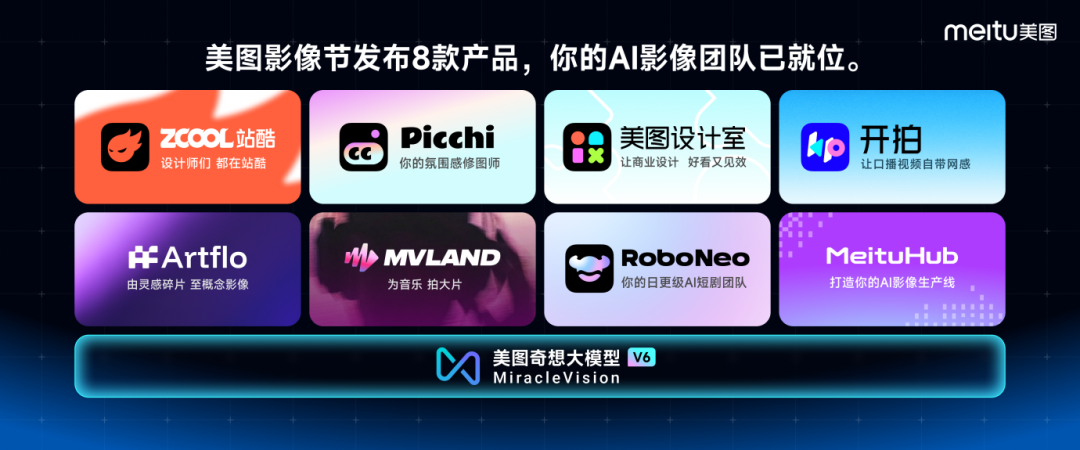
Worth noting: one shared logic underpins all eight products — Agent Teams.
What can Agent Teams do?
Wu Xinhong used autonomous driving as an analogy: traditional tools are manual transmission, Copilot is assisted driving, an Agent can break down individual tasks, and Agent Teams are multiple Agents automatically dividing labor and directly delivering finished products — fully autonomous driving.
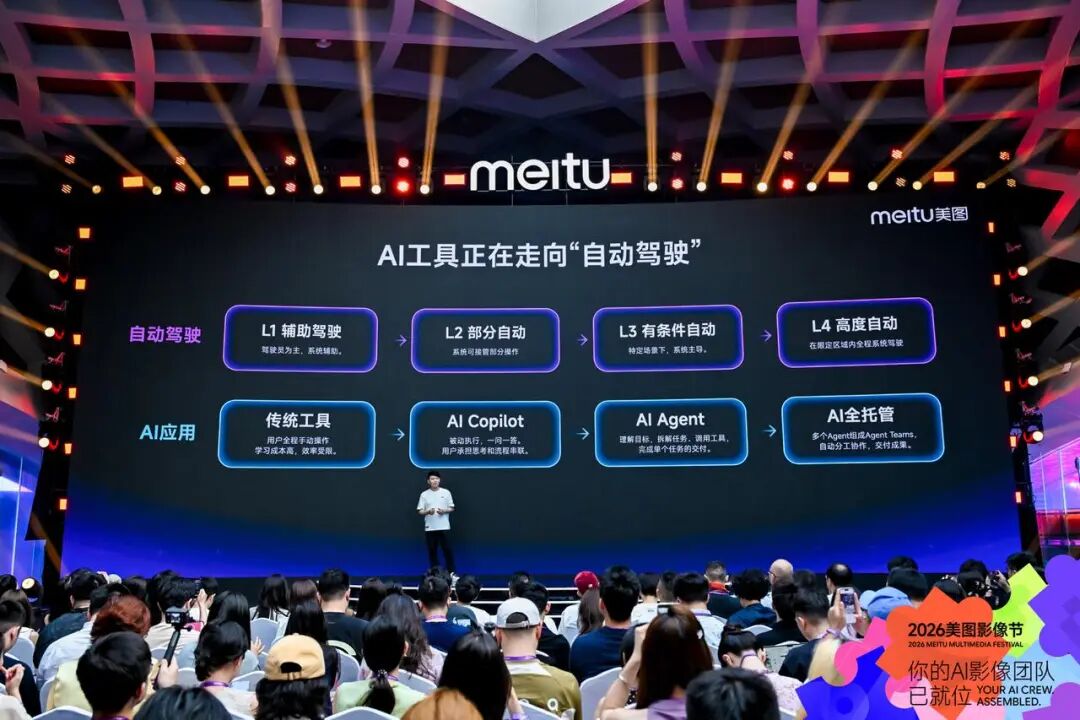
In other words, users don't need to know how many steps retouching takes, how to cut clips to the beat, or how to arrange design layouts. They just say what they want, and the decomposition, division of labor, and execution all run automatically through Agent Teams.
Take Picchi as an example. It comes with five professional Agents built in: color grading master, makeup transformation artist, image stylist, scene lighting designer, and posture manager. Retouching blogger Ojier is Picchi's model partner.
She said a single photoshoot — from selection to finishing — used to eat up three to four hours. "I often wonder, am I actually creating, or am I just a retouching machine?" At the event, she broke down her retouching methodology: the balance of warm and cool skin tones, the layering of eye makeup, the rhythm of contour softening. She described retouching as "experience, intuition, and judgment built up over long accumulation."
That judgment is now injected into Picchi's specialized models. It can handle it for you, giving you back 90% of that time.
Similar logic appears across other products. Meitu Design Studio's AI team includes market insight, content planning, visual creation, and data analysis Agents plus dozens of specialized skills. Kaipai assembles a talking-head video team with marketing, filming, and editing Agents. RoboNeo simulates a real short drama production crew — planning, screenwriting, directing, art, execution, and operations working in coordination.
In an interview, Meitu Chief Product Officer Chen Jianyi broke down the Agent Teams logic:
"We break a set of deliverables into many stages, from planning to topic selection to production, and embed deep industry understanding into each Agent."
Agent Teams' greatest advantage, he said, "is that each Agent can become a senior industry expert, helping users find deep industry insight and form core competitiveness."
At the launch event, he also said something that seemed like a reminder to himself, but also to everyone:
"There's a trap in the AI era — 'doing' has become way too easy compared to 'thinking.' Many people can't resist using AI to produce frantically, creating an illusion that 'I'm creating value.' But we know in our hearts that delivering good outcomes to users, helping users make money — that's real value."
By current numbers, the market is buying into this logic.
In March 2026, Meitu's total AI compute point consumption grew 59% compared to December 2025. Kaipai grew 360%, RoboNeo 316%, Meitu Design Studio 107%. By May, Kaipai's compute point consumption had grown over 7x, and Meitu Design Studio grew 8x over the past eight months.
Behind these numbers, users are genuinely paying for "results" — and willing to pay more for better ones.
Traditional subscription charges by time; compute point consumption charges by actual usage — more use, better output, more payment. And Meitu's revenue is shifting from linear growth dependent on user count to being positively correlated with actual value users receive.
In an interview, Meitu CFO Yan Jinliang noted: existing Meitu Design Studio users can consume over 10,000 yuan in compute points per month; MVLAND's monthly ARPPU is three to four hundred yuan, roughly 20x that of Meitu Xiuxiu. 20x — this means Meitu's valuation logic is moving from linear subscription growth toward the broader space of pay-for-performance.
If these numbers show users paying for results, then another service Meitu launched further reveals the essence of "delivering outcomes."
Notably, for users who "don't want to learn AI," Meitu introduced a seemingly "anti-efficiency" service — human creators. Designers take orders online, offering "design this for me" and "make this video for me."
AI exists precisely to replace human labor, so why bring humans back in?
On the surface, this seems to run counter to AI's efficiency-seeking direction.
In reality, this reflects Meitu's response to "certainty" in business scenarios: an AI error is just a snippet of error code, while a human error can be traced, communicated with, and redone.
Meitu is using an "AI + human" combination to lower the trust threshold for "delivering outcomes," so that even people who don't want to learn AI can still get results.

In the AI Era, What Gives Meitu the Edge for the "Last Mile"?
If Agent Teams solves the "how to deliver results" problem, then another more critical question is:
Why Meitu?
Some industry sources say that behind the direct-results product line, Meitu is betting on the next hit product.
So what gives this veteran company, which has survived from the PC era through mobile internet to the AI era, a shot at creating the next breakout?
Wu Xinhong once said: "If you don't get on the field and do it yourself, you won't develop the feel."
To some extent, this company that has treated "aesthetics" as a core asset for 18 years — its understanding and feel for "beauty" has become a unique asset in itself.
Since its founding in 2008, hundreds of millions of users have taught Meitu what "beauty" is with every retouch, every color adjustment, every click on "looks good."
There are no shortcuts in this process.
In the AI era, anyone can produce designs, but the standards for good design still rest with those who treat design as a profession, as a passion.
Chen Jianyi emphasized in an interview: Meitu's advantages are its accumulated imaging technology and deep understanding of vertical scenarios — going deep into vertical domains and pushing "small but beautiful" to the extreme. Moreover, Meitu's moat isn't lines of code, but over a decade of aesthetic know-how and understanding of users' real imaging needs.
These capabilities ultimately settle into Meitu's MiracleVision foundation model.
At this year's festival, MiracleVision V6 launched. Compared to general foundation models that can generate pretty pictures, Meitu's MiracleVision carries over a decade of aesthetic experience from Asian users — it better understands the nuanced differences between "bone structure beauty" and "vibe aesthetics."
Data shows that from January to May 2026, an average of 96.3% of generative AI feature calls across Meitu products came from MiracleVision.
More importantly, Meitu hasn't handed model training entirely to engineers.
While at most AI companies design teams handle product UI, Meitu's designers have taken the lead in refining model outputs. Designers first create samples for AI, teach it aesthetic standards, then feed user feedback back in.
Notably, among the twenty to thirty videos at this year's festival launch, over 90% were produced by designers using Meitu's own products. For Meitu, this isn't just product demonstration — it's also an internal validation mechanism: designers are both product creators and product users.
Meanwhile, Meitu has adopted a relatively pragmatic model strategy.
Meitu Senior VP of Technology and head of Meitu Data Intelligence Research Institute Yang Minghua discussed the model strategy in an interview:
"Model container strategy means we can quickly integrate external good models, but also fine-tune according to our business characteristics." Meitu VP of Technology and head of Meitu Imaging Research Institute (MT Lab) Liu Luoqi added: "Our self-developed foundation model is more tightly integrated with our business products, serving our own users and deeply customized scenarios. For some relatively fixed scenarios, we may use third-party foundation models."
This means Meitu isn't really competing on base model capabilities, but on how to transform model capabilities into imaging effects that match user needs.
Beyond experience and models, Meitu has a third layer of assets — its designer ecosystem.
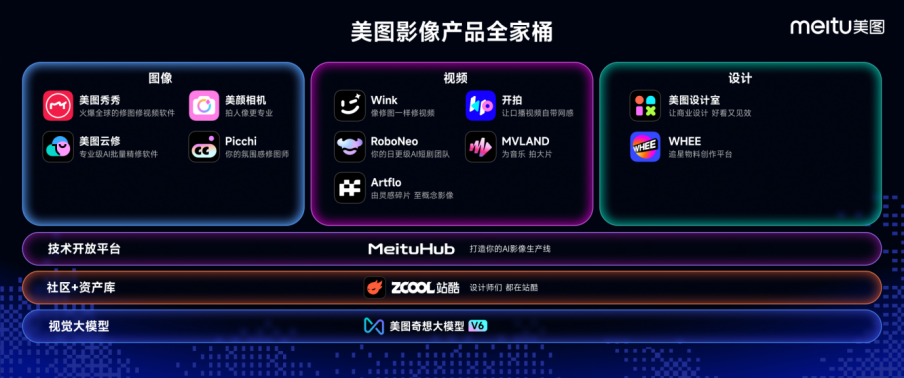
ZCOOL, the community that has accompanied 18 million designers for 20 years, has become Meitu's upstream creative resource pool. In Chen Jianyi's words, ZCOOL sits "further upstream in the content chain." Here, what brands do may not be "find someone to do design," but rather how to activate a "visual creative external brain team on standby."
From aesthetic data, to vertical models, to designer ecosystem, Meitu is building a complete capability system around "visual expression."
And this is precisely why it can translate abstract aesthetic preferences into concrete outcomes, and ultimately complete the "last mile delivery."
And Meitu didn't stop there.
Another 100 Million: Turning Potential Disruptors into Ecosystem Partners
But an interesting phenomenon in the AI era is: the more obvious a company's advantages, the more obvious its capability boundaries too.
Meitu excels at imaging, but can't cover all imaging scenarios; it has models and users, yet can hardly go deep into every niche demand at once.
When opportunities begin growing exponentially, the real question is no longer who owns the most resources, but who can absorb more innovation.
As imaging opportunities in the AI era multiply, can Meitu do it all itself?
The answer is clearly no.
Meitu's most direct threat comes from small startup teams focused on doing one thing in vertical scenarios — cross-border e-commerce product images, medical aesthetics clinic talking-head videos, fitness influencer AI short dramas, musician MV production... Every niche scenario could be eaten by a focused team.
In post-launch interviews, when asked whether Meitu worries about competition from startups?
Wu Xinhong was candid: "In the imaging track, it's not like big companies with traffic automatically win. Globally, most fast-growing products are indeed from startups."
This isn't unique to Meitu — it's the commercial predicament all vertical companies face. Big companies have scale, resources, complete ecosystems, but pay the price of slower movement. Meanwhile, startup teams focused on niche scenarios are using agility to find their opportunities.
Meitu's response: rather than competing head-on across every niche, use capital, traffic, model capabilities, and channel resources to turn potential disruptors into part of the ecosystem.
At this year's Imaging Festival, Meitu announced it would put up 100 million yuan to launch the "Meitu Hatch Catch" product challenge, open to AI developers across the industry.
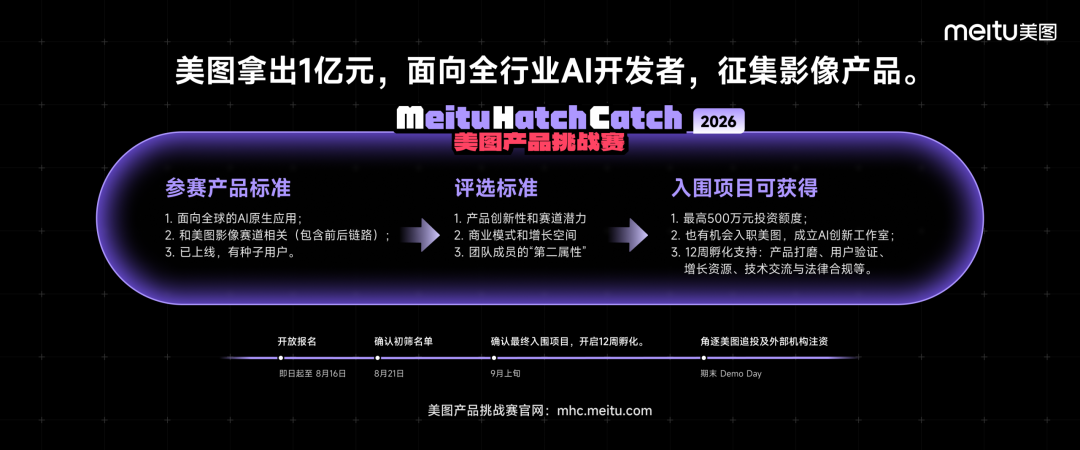
Entry requirements are three: AI-native applications; relevant to Meitu's imaging track; already launched with initial seed users.
Evaluation criteria are three: product innovation and track potential, business model and growth space, and team members' "second attribute."
What's a team's "second attribute"?
Wu Xinhong explained: "I founded Meitu because of my love for photography — photography and design are my second attributes. We value how a team's special skills and hobbies align with what they're building. Only then will they have near-obsessive love for the product, and native user empathy."
In other words, Meitu isn't simply looking for the most technically strong teams, but those most passionate about the scenario.
This standard seems subjective, but behind it lies a real pattern: in vertical scenarios, those who can truly make great products are often those who live in the scenario themselves, who love what they're doing.
Chen Jianyi also added in an interview: "There are many opportunities in imaging products, but people who truly understand imaging are still rare. Most failed projects stem from the project lead not understanding imaging, not having strong visual perception and pursuit of quality."
He believes the first principle of imaging products is pushing effects to the extreme — whether image effects or video effects, effects must satisfy real user needs.
In Meitu's view, loving imaging is the most critical "second attribute" for people who can make great imaging products.

According to Meitu's official introduction, shortlisted teams can receive up to 5 million yuan in investment, and can also choose to join Meitu's internal AI innovation studio. Meitu provides 12 weeks of incubation support, from product refinement to user validation, growth resources, and technical exchange — full companionship.
Additionally, at the final Demo Day, projects have the chance to receive follow-on investment from Meitu and external institutions.
This challenge wasn't a spur-of-the-moment decision.
In April this year, Meitu already had 207 teams compete in an internal product challenge, developing 136 AI product demos. After validating feasibility internally, Meitu brought the experiment external.
As Wu Xinhong said at the launch: "When thinking about imaging products based on MiracleVision, we found there are simply too many opportunities to pursue — we can't possibly do them all ourselves."
From internal innovation studios to external hackathons, Meitu is transforming itself from a closed product company into an open aesthetic creation ecosystem.
And the significance of this shift may be greater than launching several new products. Because it means Meitu is keenly aware of its own capability boundaries, and is trying to cover them through ecosystem means.
Conclusion
Rewind to 2010. Meitu founded its imaging research institute, taking its first step in AI exploration.
Sixteen years later, this company has delivered a new answer:
It's building a complete system — at the bottom, 18 years of accumulated aesthetic data and MiracleVision; in the middle, Agent Teams deconstructing and reorganizing professional workflows; at the top, numerous AI products covering multiple scenarios and an expanding open ecosystem.
For full year 2025, Meitu's total revenue was 3.86 billion yuan, up 28.8% year-over-year; adjusted net profit attributable to shareholders was 965 million yuan, up 64.7%. In Q1 2026, imaging and design product revenue was 852 million yuan, up 34.3% year-over-year.
These are impressive growth figures. Yet more noteworthy than the numbers is what Wu Xinhong said at the festival's close:
"Meitu may have achieved some success in the past, but we don't want that success to become feel, to become inertia."
Entering the AI era, Meitu isn't resting on past laurels. It chose to get back on the field, face competition head-on, and cultivate "new feel."
Today, that feel has become clear — "directly deliver results," so users don't have to become experts, because good tools will handle the professional work for you.
Crossing is looking for independent contributors to write AI product and model reviews.
If you've written articles like: "Hands-on with PixVerse C1[1]", "Hands-on with LibTV[2]", please contact zeo0811@gmail.com. Your email should include: ① personal introduction, ② AI review articles you've written.
We offer competitive compensation. Looking forward to observing and documenting the AI era together 🎪