Silicon Valley Legend Bill Gurley on the AI Frenzy and Listening to Your Inner Voice

Money is chasing founders — and that's the most dangerous signal of all.
As time passes, what truly torments people and breeds regret is always the step they didn't dare to take, not the failure that followed action.

👩 Compiled by: Shirley
🧑🎨 Layout: NCon

In the first half of 2026, the US venture capital market showed extreme polarization. Of every $100 in venture funding, $86 flowed to AI companies, with OpenAI and Anthropic alone capturing more than 40% of global share; meanwhile, inflation-adjusted funding for non-AI startups has fallen below pandemic-era levels.
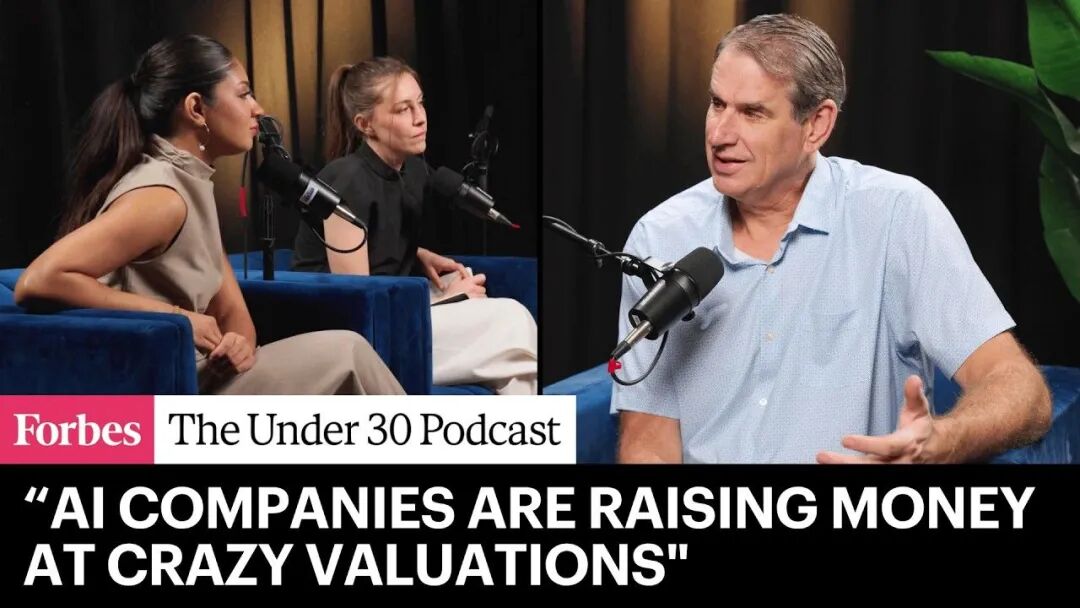
Bill Gurley, partner at Silicon Valley VC firm Benchmark, offered deep reflections on the current AI funding bubble, startup burn-rate traps, and personal career development in a recent Forbes The Under 30 podcast.
Bill Gurley — Early in his career, he worked as a Wall Street analyst and served as lead analyst for Amazon's IPO; after switching to VC, his most famous bet was leading Uber's early funding round, generating hundreds of times paper returns over eight years. OpenTable, Zillow, and Stitch Fix also came from his portfolio. When Uber was mired in scandal in 2017, he worked behind the scenes as a board member to push for reform, ultimately促成 the resignation of co-founder and CEO Travis Kalanick and a management overhaul.
Here are his core arguments:
-
The VC industry has become highly "industrialized" — firms have evolved from passive deal selectors to active door-knockers pushing money on founders. In science, this is called the Observer Effect: the instrument used to measure the experiment is itself changing the experiment.
-
The first cost of taking money you don't need is that you can no longer keep your own books straight. Excess capital inevitably inflates burn rates, masking true unit economics. Companies may fall into the kind of fake growth seen during the dot-com bubble, "selling a dollar for 80 cents."
-
Valuation is not a reward for what you've achieved today; it's discounted future expectation. The higher the valuation, the higher external expectations and the lower the margin for error. And private capital structures, because of liquidation preferences and ratchet provisions, are designed to only move upward. Once you need a down round, things get very ugly.
-
For individuals, don't let sunk costs trap you in a track you don't care about. He himself moved from computer engineering to Wall Street, then to VC — twice leaving paths that seemed secure at the time. He advises young people to follow intrinsic curiosity and avoid the sunk cost fallacy in tracks that lack genuine interest.
-
Investing and career choice are the same problem: don't bet on a hand you can't calculate. Just as companies shouldn't take useless capital in pursuit of surface-level high valuations, individuals shouldn't passively burn out in fields they don't care about. Investing energy in directions with long-term drive is a more rational strategy for navigating uncertainty.
Below is Crossing's compilation of this Forbes interview:
Career Origins, Investment Philosophy, and Gambling with an Edge
🎙️ Host
You've had a legendary career in Silicon Valley. Looking back, what are you most proud of?
👱♂️ Bill Gurley
I'm about to turn 60. Looking back, what I value most is that I not only participated in some successful investments, but also managed to document and share along the way through a personal blog, much like Warren Buffett or Howard Marks. Without the backing of those successful investments, probably nobody would care what I said, but I did leave behind something "a bit professorial, a bit academic" — that's what I'm proudest of.
🎙️ Host
What originally drew you to venture capital?
👱♂️ Bill Gurley
My undergraduate degree was in computer engineering. After diving deep in that direction for two or three years, I realized it wasn't my endpoint, so I went to business school. Then I thought Wall Street would be my next stop, but after three years there, I reached the same conclusion: this wasn't quite it either. I was fortunate enough to find my way to Silicon Valley, and I've been here for 25 years.
I've half-joked that in a utopian society where everyone earned the same salary and could pick any job, I would still unhesitatingly choose to be a VC. It aligns perfectly with my personality, temperament, and curiosity. As a computer engineer, I always felt cut off from the broader business world outside; my brain has something of an ADHD quality, enjoying the simultaneous processing and consideration of many parallel threads, and the service-oriented nature of VC happens to satisfy that.
As for how I got in, there were a few key factors:
First, I read Peter Lynch's One Up On Wall Street and started investing in stocks in my twenties.

Second, my friends and I used to frequent Las Vegas in our early years. Before the MIT card counters became famous — the ones who used statistical tracking to gain an edge in blackjack, immortalized in Bringing Down the House — we were already counting cards at Binion's Casino on single-deck games, which is relatively straightforward mathematically. To avoid casino managers catching us adjusting bets based on card ratios, we developed a strategy: we specifically went to high-roller sections, because the big players absorbed all the managers' attention, allowing us to operate invisibly.
This experience shaped my investment worldview. I enjoy "gambling with an edge" — I am absolutely not the kind of gambler willing to flip a random coin for money.
🎙️ Host
Since you mentioned betting, what do you think of prediction markets like Polymarket, which have grown rapidly recently?
👱♂️ Bill Gurley
During the early internet boom, we invested in a European company called Betfair. They tried all sorts of exotic bets, but never made it work due to friction around outcome adjudication, which left me long skeptical of prediction markets. But Shayne Coplan, Polymarket's founder, has kept grinding away, and trading volume has grown so large that you can no longer view it through the old lens.
However, one must be vigilant: these markets have extremely thin float. For topics with strong predictive nature, like political elections, interested parties can move prices significantly with relatively small capital deployment. So before using prediction markets as a decision signal, you must rigorously examine their volume depth. Buffett said: "In every game there's a sucker, and if you don't know who the sucker is, it might be you."

Additionally, the more exotic and obscure the betting instrument, the higher the house edge typically is. It's like playing the worst-return slot machines at the airport — the odds you get deteriorate in proportion to your appetite for the exotic.
The Industrialization of VC and the Overfunding Trap
🎙️ Host
Many young founders tell us they didn't originally need massive funding, but capital came knocking and directly inflated their valuations. How do you view the current AI funding environment?
👱♂️ Bill Gurley
The VC market is experiencing extreme polarization: AI companies are raising at insane valuations, while non-AI companies can't raise money at any valuation.
Behind this is the "industrialization" of the VC industry — firms are raising ever-larger funds, convinced of network effects and power laws. In my youth, fundraising was founder-driven; companies would plan "we're launching a round in June." But today, investors show up at your door with helicopters and sports tickets, pushing money on you and implying: "If you don't take this, I'll turn around and give it to your competitor."
This active intervention by investors has a name in science: the "Observer Effect" — the microscope used for measurement is itself altering the experimental result. The influx of capital directly distorts the normal rhythm of business competition, creating two consequences for startups:
-
It masks true unit economics: Having taken unneeded massive capital, founders involuntarily inflate burn rates. Once burn rates spike dramatically, it's hard to figure out your true cost and return per user. When competitors raise similar amounts, the battle devolves into irrational cash-burning. I personally witnessed this dangerous dynamic during the Uber-Lyft wars. (Note: Uber survived, burning $2 billion a year back then and now generating over $10 billion in annual free cash flow — but this is survivor bias.)
-
It locks in future expectations: Young founders often don't realize that valuation doesn't represent your current achievement, but discounted future expectation. The higher the valuation, the higher external expectations and the lower the margin for error. Public stocks can go up or down, but private capital structures are not designed to go down (involving liquidation preferences, ratchet provisions). Once you're forced into a down round, it gets very ugly.
Under competitive pressure, this panic spreads not just among founders — many large companies' boards and CFOs face the same anxiety. They feel "everyone else is doing it, if we don't we'll fall behind," causing the entire ecosystem to descend into a prisoner's dilemma where nobody dares get off the bus, collectively galloping toward gray zones.
AI Bubble, Fake Prosperity, and the Red Flag of Circular Revenue
🎙️ Host
In the pursuit of high valuations and business growth, what do you think is the most dangerous move founders are making right now?
👱♂️ Bill Gurley
At the startup level, the most dangerous thing is not being able to keep your books straight, even doing unprofitable deals to fake growth. During the dot-com bubble, e-commerce companies "sold a dollar product for 80 cents" to achieve unlimited growth. I suspect some AI companies are doing something similar now:
Reselling token compute bought from Amazon or Anthropic below procurement cost — absolutely unsustainable. But what I want to warn about more urgently is the extremely opaque financial maneuvering currently happening between tech giants and AI companies.
Circular revenue has always been a clear red flag in financial history. I recently described several recent atypical AI investment transactions to ChatGPT in abstract terms, and whether asked to role-play as an auditor or investor, it immediately connected these operations to the Enron and WorldCom scandals.
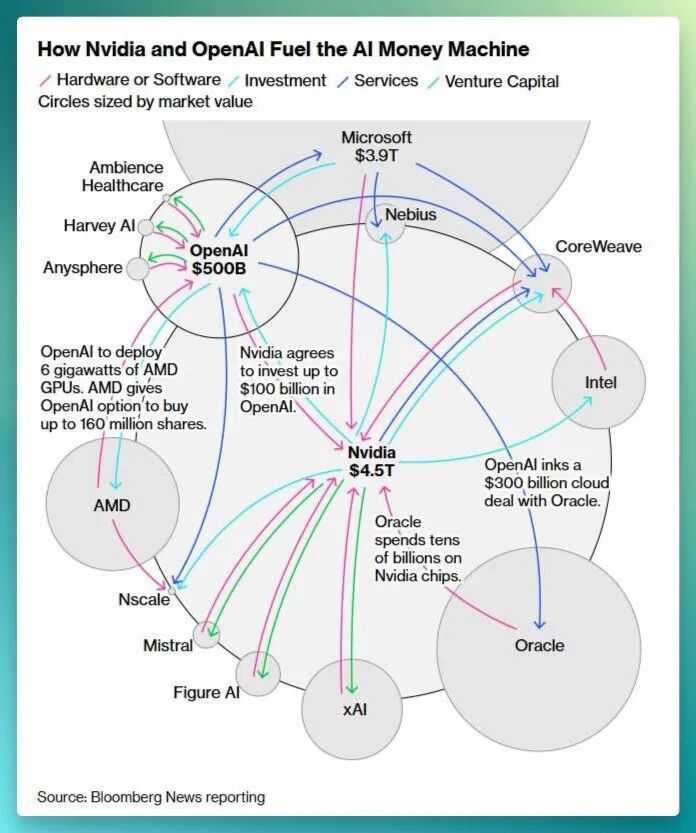
Specifically, three systemic risks are lurking here:
-
Cashless in-kind contributions: Such as Microsoft's early deal with OpenAI. Microsoft invested cloud compute credits as in-kind, which OpenAI then used to purchase Azure cloud services. No actual cash moved through the process, yet it converted into real revenue on Microsoft's income statement.
-
Hidden off-balance-sheet financing: Meta agreed to assume default risk on debt for a data center facility where they hold no creditor claim. Since Meta bears the substantive risk, it makes no difference on paper who holds the debt — this constitutes classic off-balance-sheet leverage. Cisco similarly stumbled during the dot-com bust by extending customer loans to cash-strapped startups in exchange for equipment purchases; today these loans have become even looser equity investments, with risks actually more concealed.
-
Demand-masking floor agreements: In a CoreWeave disclosure, NVIDIA committed to backstop purchases of any unsold idle compute. This not only helped CoreWeave secure more debt financing leverage, more seriously, it makes it impossible for outside investors to judge whether true underlying AI demand has slowed by looking at such companies' performance.
🎙️ Host
Given these irregularities, why is the market still willing to tolerate such massive capital expenditures from tech giants?
👱♂️ Bill Gurley
The numbers have indeed reached unprecedented scale.
But market attitude has its logic. Looking back at 2022, when Meta was spending tens of billions annually on the metaverse, investors couldn't understand what they were building; today, investors tolerate AI infrastructure because they've seen AI's substantive utility in improving corporate profitability and optimizing labor costs.
Also, much talk of SaaS apocalypse, of software being completely disrupted — I think this is overstated. You cannot rely on entirely AI-autogenerated software to run a company's core financial systems, because if audited, you couldn't even explain to the auditor how the system works.
How to Evaluate Founders and Project Potential
🎙️ Host
What does it take to get Bill Gurley to invest in a company? What founder traits do you value most?
👱♂️ Bill Gurley
First, network effects. My entire career has been heavily focused on consumer marketplace platforms. You must prove to me that your system achieves "the 10,000th user derives far more value than the 100th user."
Second, top-tier sales and evangelism ability. Recruiting, closing customers, fundraising — these are fundamentally all sales motions. Adam Neumann (WeWork founder) was one of the most extraordinary salespeople I've ever seen. At the same time, founders need the ability to shape external perception of the company in front of media.
Third, boundaryless determination. I once asked Jeff Bezos how he made those beautiful angel investments. He told me he looked for a specific trait — "no real-world difficulty or rule can stop this person from getting this done."
🎙️ Host
So you invest in founders, not companies?
👱♂️ Bill Gurley
The vast majority of the time, yes.
History is full of excellent founders whose initial projects failed completely, who then pivoted radically to another track and ultimately succeeded enormously. The only exception is when a business's network effects have already taken off — then people become less picky about the founder, because the momentum itself is enough to carry the company skyward.
Career Pivoting in the AI Era and the Sunk Cost Fallacy
🎙️ Host
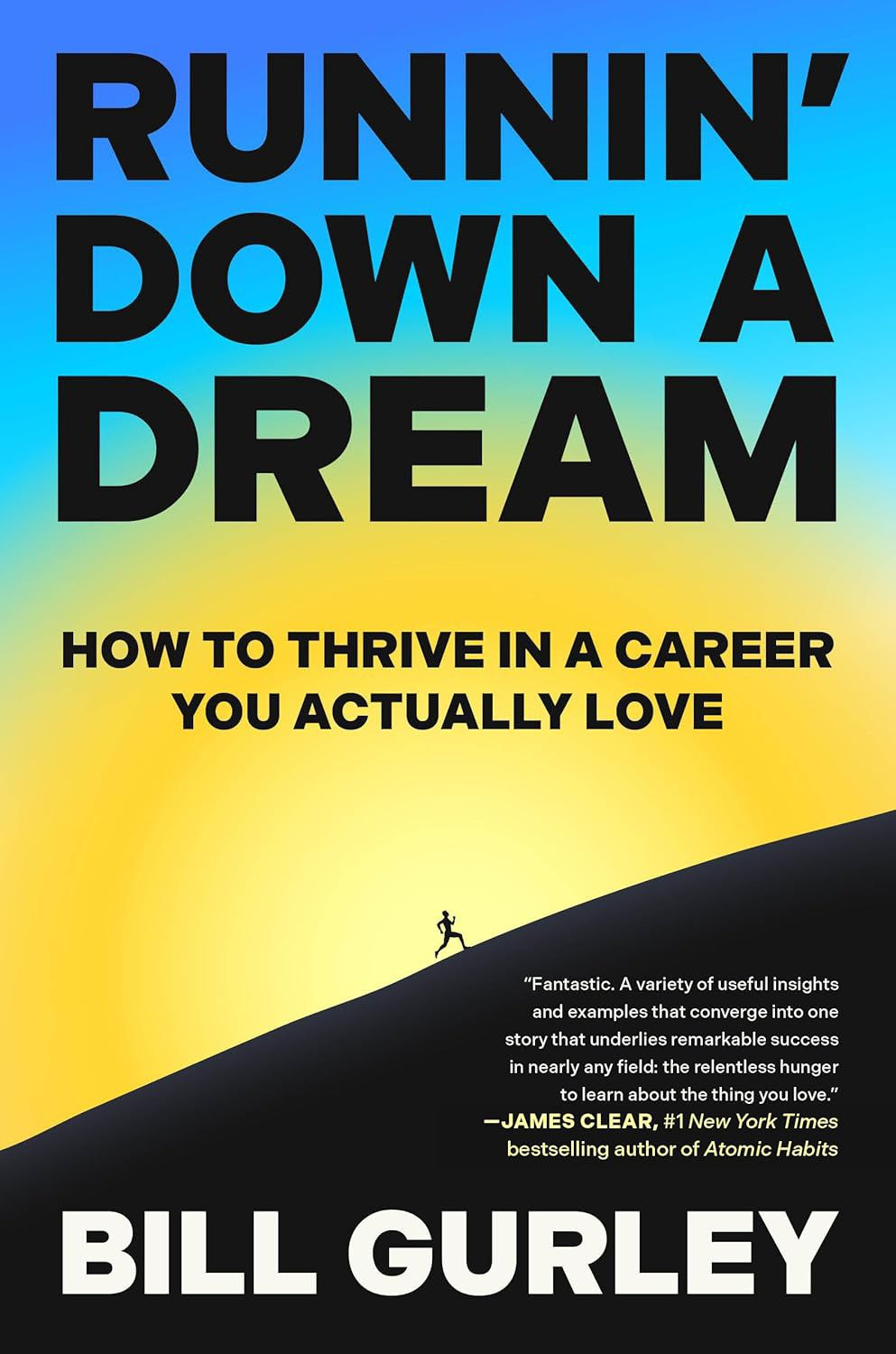
Your new book Runnin' Down a Dream shifts focus from macro investing to ordinary people's personal career development. Why did you decide to spend so much time on a non-finance book?
👱♂️ Bill Gurley
I used to share my views on technology market evolution through blogging. Later I read extensively in biography and found a consistent thread:
People who made enormous impact across industries, regardless of starting point, aligned their careers with what they were most curious about and most fascinated by, and simply didn't care about conventional opinion. But the current education system is killing this possibility. Jonathan Haidt and Greg Lukianoff described it in The Coddling of the American Mind as the "Resume Arms Race." To squeeze into elite schools, parents pack their kids' schedules from sixth grade with cello, Mandarin, and lacrosse, teaching them to "tough it out," yet never give them time to find genuine passion.
Angela Duckworth's research on "grit" points out: If you have grit without deep passion, you'll eventually recognize you're just blindly toughing it out, and severe burnout follows.
Gallup's 2023 workplace engagement survey showed only 23% of people feel engaged at work, while 59% feel dissatisfied. I commissioned a large-sample survey through Wharton for the book, with strikingly consistent results: given a do-over, as many as 60% of respondents would choose a completely different career path.
I wrote these observations into notes, later delivering a lecture to MBA students at UT Austin. The video was posted to YouTube, influenced many people, and received strong endorsements from figures including podcast host David Senra and Atomic Habits author James Clear.
A book on "how to be a better VC" would help only a tiny handful of people; this book can have broader societal impact.
🎙️ Host
For young people who've already invested significant money and time in a major or job they don't like, what advice do you have?
👱♂️ Bill Gurley
Stanford University professors published a statistic: fewer than 40% of people are still working in a field related to their undergraduate major after ten years. Young people, you can always shift gears. Don't let "sunk costs" kidnap you into thinking you must do something for life just because you studied it.
Understand that learning is free. I mean, if you're studying or working in a subject you dislike, it's like a black hole draining your energy; exploring what fascinates you, conversely, continuously replenishes your energy. When you're intensely fascinated by something and put in extra effort, you'll stand out in interviews against 20 people, and external connections, mentors, and opportunities will naturally gravitate toward you.
Especially in the AI era, the best way to avoid being disrupted by technology is to become the most "AI-ified" version of yourself. Those "craftspeople" with extreme curiosity — like top lawyer Neal Katyal using AI to prepare Supreme Court arguments to overturn tariff cases — will only run faster than anyone with new tools.
Regarding fear of career change, Daniel Pink in The Power of Regret proposed "Boldness Regrets":
As time passes, what truly torments people and breeds regret is always the step they didn't dare to take, not the failure that followed action. When Bezos decided to leave high-paying D.E. Shaw to found Amazon, he used the Regret Minimization Framework — imagining himself at 80 looking back, he would never care about losing that year's bonus, but would certainly regret never trying the internet.
Life is a "use it or lose it" proposition. I myself twice completely left originally secure career paths (computer engineering and Wall Street). I encourage everyone to find that thing where the candle never burns down, but burns brighter and brighter.

On Honors and Intrinsic Drive
🎙️ Host
Finally, for young entrepreneurs desperately hoping to make lists like Forbes 30 Under 30, what would you say?
👱♂️ Bill Gurley
I must be direct: absolutely do not hang your objective function on some external judge's criteria.
The relentless pursuit of external validation easily leads people toward narcissism. What's worse, if you scheme your way onto a list only to find no genuine fulfillment inside, you'll fall into a crushing void of "what now? what was the point?"
I don't deny the value of such lists, but I firmly believe that the outstanding young people Forbes ultimately discovers and recognizes were absolutely driven initially by some powerful inner voice pushing them to do things. They were simply focused on solving problems that truly mattered to them, and happened to meet the listing criteria along the way — nothing more.
Objectives must point inward, toward what you yourself truly value.