Brewing tea, making pancakes, practicing Wing Chun — AI robots are better at retirement than I am

What's more, it never ages in the first place.


🔧 OpenAI Rolls Out GPT-4o Customization
🌐 Google Opens HeAR AI Model API
🚀 UC Berkeley Cracks LLM Memory Bottleneck
📢 PICO Unveils "China's Vision Pro"
🤖️ Astribot S1 Robot Makes Stunning Debut
🎬 XinYi Video Foundation Model 2.0
🦄 EliseAI Becomes New York's Latest Unicorn
🛒 Amazon Acquires Edge AI Inference Startup Perceive
📜 The Fair's Will AI: Intelligent Estate Planning

OpenAI Rolls Out GPT-4o Customization
OpenAI recently opened up customization for its powerful AI model "GPT-4o," allowing enterprise clients to fine-tune the model with their own data to better adapt it to specific tasks or domains.
Through "fine-tuning," companies can adjust the AI model according to their needs and optimize its performance. Enterprises can now directly optimize OpenAI's most powerful model without relying on external services or resorting to lower-performance alternatives. Olivier Godement, OpenAI's head of product, said the company aims to simplify operations by working directly with businesses.

Google Opens HeAR AI Model API
Google announced it is opening access to its Health Acoustic Representations (HeAR) AI model to researchers via Google Cloud API. The model, trained on 100 million cough sounds, is designed to assist in tuberculosis screening, diagnosis, and monitoring.
In capturing meaningful patterns from health-related acoustic data, HeAR outperforms other models, achieving high performance with less training data — addressing the challenge of data scarcity in healthcare research. The HeAR model generalizes across various microphones and environments, enabling low-cost, accessible respiratory disease screening. Google is committed to democratizing HeAR technology and supporting the global medical community in developing innovative solutions that break down barriers to early diagnosis and care.
UC Berkeley Cracks LLM Memory Bottleneck
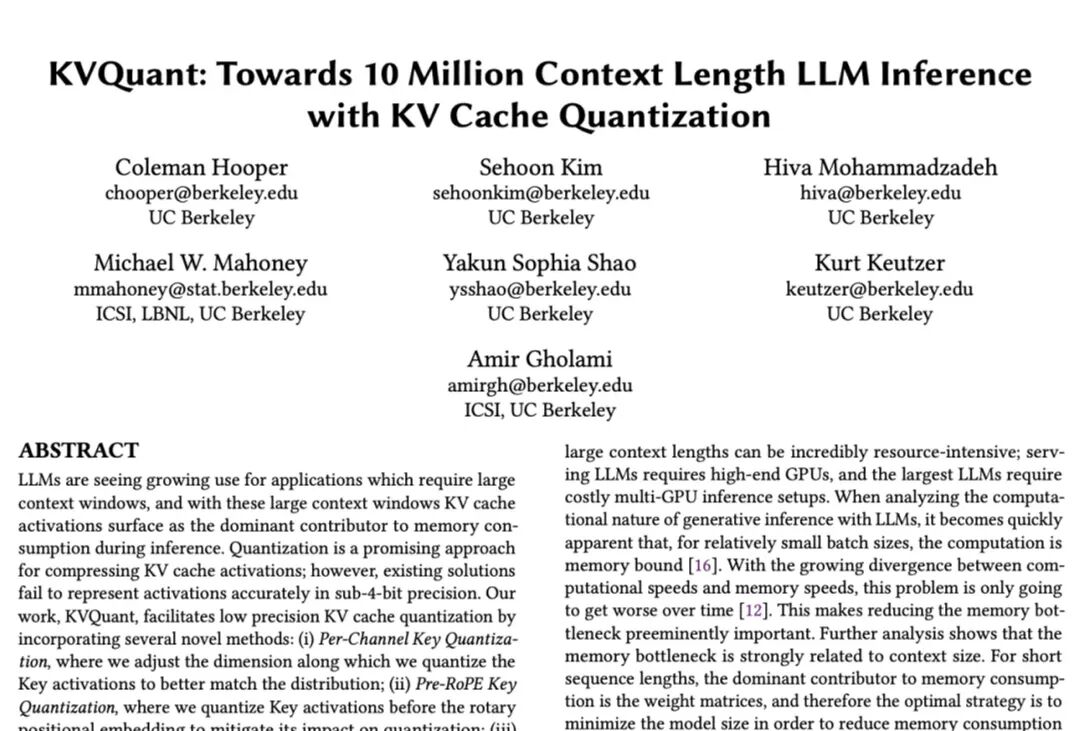
Researchers at UC Berkeley introduced KVQuant[1], a technique aimed at solving the memory bottleneck that large language models (LLMs) face when processing long sequences. Through a series of innovative quantization methods, KVQuant significantly reduces memory footprint while barely affecting model prediction accuracy.
On the Wikitext-2 and C4 datasets, 3-bit quantized LLMs showed perplexity degradation of less than 0.1, outperforming existing techniques. Custom CUDA kernels boosted inference speed for the LLaMA-7B model by approximately 1.4x. With key-value cache compression rates of up to 4.8x, the system supports context lengths of up to 1 million tokens on a single A100-80GB GPU, and 10 million tokens on an 8-GPU system.

PICO Unveils "China's Vision Pro"
ByteDance's XR platform PICO[2] launched its first MR mixed-reality all-in-one headset — the PICO 4 Ultra — featuring significant hardware and AI performance upgrades. The PICO 4 Ultra consumer version is priced at 4,299 RMB, the PICO 4 Ultra Enterprise edition at 7,499 RMB, and the PICO motion trackers at 399 RMB per pair. Pre-orders are now open, with official sales beginning September 2.
Hardware-wise, it packs the new Qualcomm Snapdragon XR2 Gen2 compute platform with 12GB of RAM. GPU performance is 2.5x higher than the previous-gen XR1, and AI performance is 8x better — extending beyond large language models to include environmental perception, semantic understanding, and other advanced technologies. The PICO 4 Ultra also features dual 32-megapixel color passthrough cameras and an iToF depth-sensing camera, supports MR, and introduces a panoramic screen workspace at the system level along with motion tracker support. PICO will continue strengthening voice and multimodal interaction capabilities to enhance user experience.

Astribot S1 Robot Makes Stunning Debut
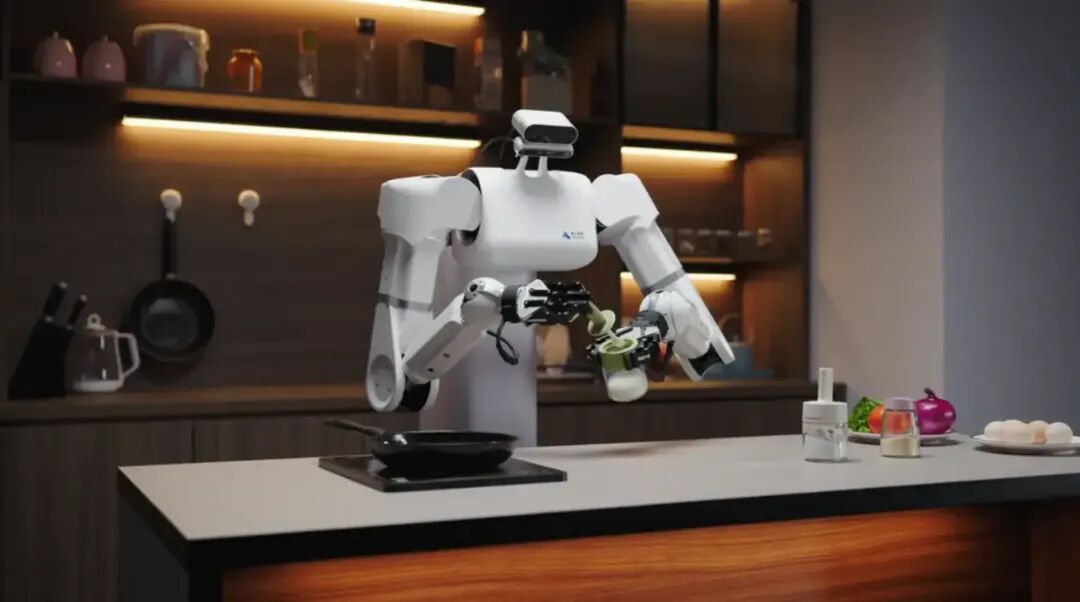
Chinese AI robot Astribot S1 from Astribot showcased its versatility at the World Robot Conference, brewing tea, making pancakes, sweeping floors, feeding cats, and even practicing Wing Chun — drawing widespread attention.
The Astribot S1 features continuous learning and evolution capabilities, improving its intelligence and multi-task generalization through interaction with humans and its environment. Its force and tactile control systems enable precise task execution, such as brewing gongfu tea and playing the yangqin. By 2035, over 100 million robots are expected to be needed to fill labor gaps, and the Astribot S1 could become a capable household assistant.
XinYi Video Foundation Model 2.0
XinYi Technology's latest offering — Video Foundation Model 2.0 — lets users simply input a creative concept, and XinYi's AIGC technology handles the entire production pipeline from script to final cut.
XinYi Video Foundation Model 2.0 features a proprietary script model that generates structurally complete, content-rich scripts, adds realism to character dialogue, automatically matches background music, and provides diverse 3D elements supporting mixed 3D-and-video creation. Using Diffusion Transformer technology, it transforms scripts into detailed storyboards and automatically converts them into high-definition video, supporting 1080P to 4K output.

EliseAI Becomes New York's Latest Unicorn
PropTech company EliseAI recently announced a $75 million Series D round led by Sapphire Ventures, which will be used to expand the team and advance product development. Following this round, EliseAI's valuation exceeded $1 billion, making it New York's newest unicorn.
Founded in 2017 by Minna Song and Tony Stoyanov, EliseAI's AI assistants are widely used in property management, improving communication efficiency between landlords, property managers, and tenants, covering 70% of rental property management companies and owners nationwide. EliseAI delivers services via email, SMS, web chat, and voice. The company has also brought AI into healthcare management — its HealthAI product automates non-clinical tasks such as patient inquiries, appointment scheduling, and billing. Since its Series C, EliseAI's annual recurring revenue has grown more than 2.5x.
Amazon Acquires Edge AI Inference Startup Perceive
Amazon.com Services LLC, a core subsidiary of the Amazon group, will acquire the majority of assets and certain liabilities of Xperi subsidiary Perceive for $80 million.
Perceive is a company focused on edge AI inference software and hardware, adapting to the rapidly evolving edge inference technology landscape. An Amazon spokesperson expressed excitement about the Perceive team joining and the prospects for large language models and multimodal experiences on edge devices.

The Fair's Will AI: Intelligent Estate Planning
The Fair launched a product on the Ghost Festival: "AI Will-Writing," inviting young people to give it a try: thinking about death in advance helps you "live" better.
Writing a will. Don't get the wrong idea — this isn't a "dark joke," and certainly not some malicious curse.
In conventional thinking, the Ghost Festival is a day to commemorate the dead. But it's also a fitting occasion to explore life and death.
We hope that on this day, through the experience of writing a will, we can think together about how to live, and about life itself.
Not writing alone, not writing to family or friends — writing with AI.
You'll need to spend some time in conversation with AI, completing an exchange under its guidance, to receive a "AI Will" that belongs to you.
This is the "AI Co-Written Will Initiative" launched by The Fair in partnership with SiliconFlow (an AI foundation model cloud service provider) and the China Will Registration Center, open to everyone but especially young people. Scan the QR code below to start the experience.


We live in dreams, in poetry, in endless colorful hope.
— The Other End of the Carpet



Editorial Team
Editor: Yuki
Design: Ivan
For business partnerships, add on WeChat: Rwkfbcianvd
References
[1] KVQuant: https://arxiv.org/pdf/2401.18079
[2] PICO: https://www.picoxr.com/cn/