Tencent's Buddy One launches today: the power of an integrated system still wins

Buddy One Work As One.
Buddy One Work As One.

👦🏻 Author: GaKi
🥷 Editor: Koji
🧑🎨 Layout: NCon

At the Tencent Ecosystem Conference on October 29, Tencent unveiled Buddy One — a cross-application AI system for individuals and teams.
According to Tencent's introduction, it covers five products: WorkBuddy, Tencent Docs, Tencent Meeting, ima, and Tencent Cloud Drive.
The system has two tiers:
【1】A free Buddy One ID that unlocks all five products with a single account;
【2】A paid Buddy One VIP that consolidates previously separate membership services into one.
Over the past two years, major tech companies have launched a flood of AI products, each with its own entry point and membership system. Users find more and more AI apps on their phones and computers, and more subscription fees to pay every month.
For users, this creates decision paralysis. After all, without a "subscription benchmark" to reference, it's hard to judge which memberships are worth buying. For the tech giants, the more AI products they have under their umbrella, the more fragmented their subscriptions become — and the easier it is to get slapped with the "internal horse racing" label.
Buddy One can also be seen as Tencent taking another step forward in connecting the context across its AI products and driving interoperability between them. 🚥
In this article, we'll break down three questions:
【1】What exactly does Buddy One connect?
【2】How far can this connection go right now?
【3】Why do AI vendors want to build "One membership" systems, and what's hard about it?
Five AI Products, One System
AI has now penetrated all kinds of work scenarios. Teachers use AI to create lesson slide decks, office workers use it to write weekly reports and organize to-do lists, researchers use it to batch-process dozens of reports at month-end, and e-commerce sellers use it to analyze store sales data.
Even the same person may need to switch between multiple products within a single day.
Here's a typical timeline:
Morning meeting in Tencent Meeting, afternoon proposal writing in Tencent Docs, dipping into the ima knowledge base for reference materials in between, saving source files to Tencent Cloud Drive at the end, then wrapping up with some light Vibe Coding in WorkBuddy to organize and review the day's work. Each of these products covered by Tencent Buddy One has a substantial user base.
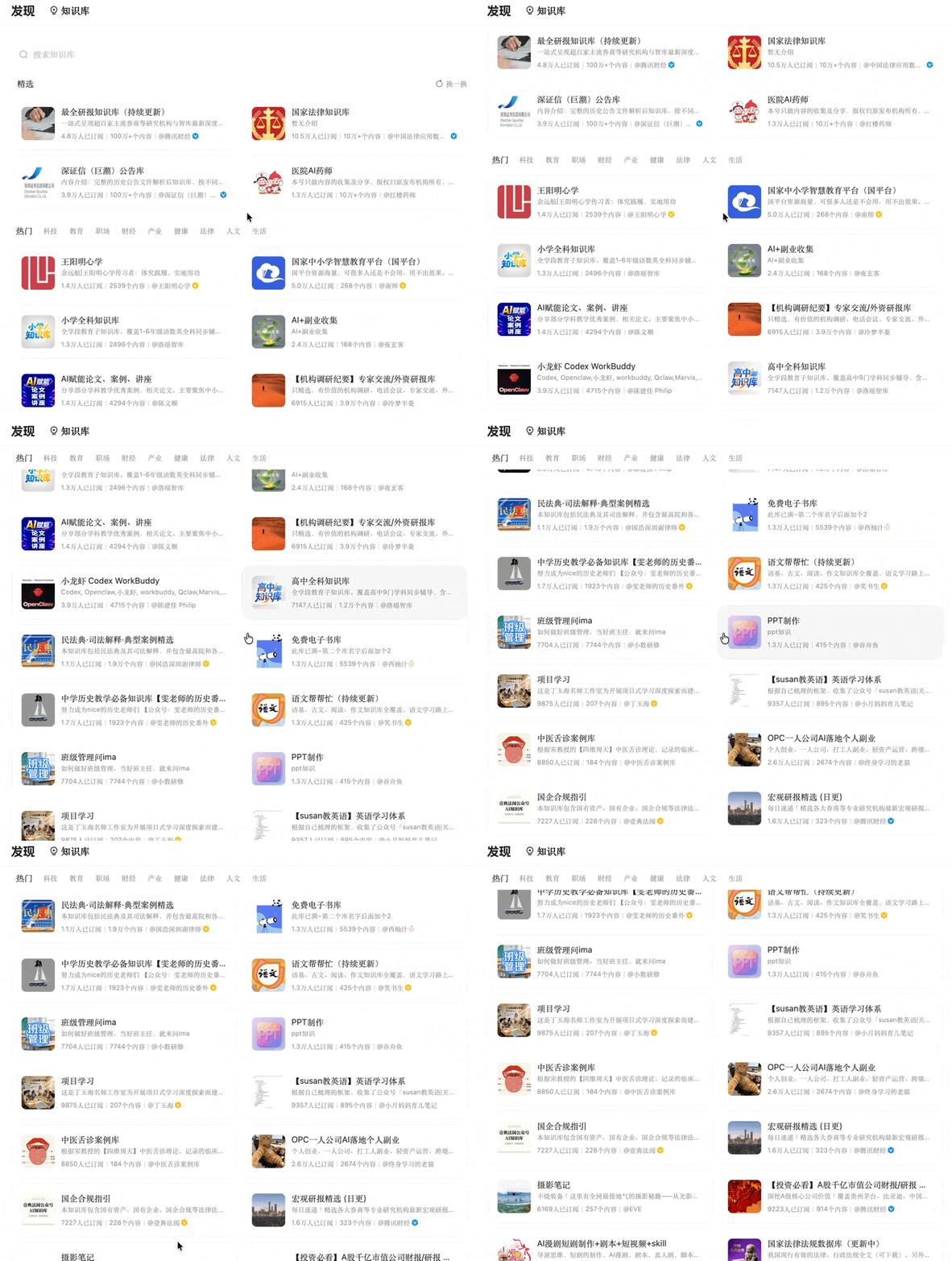 Building up the ima knowledge base
These products have largely operated independently in the past, and users face three very real problems:
【1】Fragmented context
Meeting notes, proposals, reference materials, and engineering files live in different products. When users want AI to synthesize these to complete a task, they often need to manually copy and organize everything first before handing it to the AI. Even with MCP connectors, getting AI to understand all this content simultaneously remains cumbersome.
【2】Fragmented quotas
Each product's AI compute is purchased and consumed separately. When one product's quota runs out, another product's quota may still have plenty left — with no way to transfer between them. This is the easiest thing for users to complain about.
【3】Fragmented billing
To use AI capabilities across several products, users need to subscribe to each one individually, managing multiple bills and renewal dates.
When these three problems occur between products from different companies, users naturally understand. But when they happen between products from the same company, it feels wasteful and generates bad press.
Products from the same company should be able to connect. For this launch, Tencent settled on the tagline "Each excels in its own way, working as one." Each product keeps its original positioning; the changes happen between products.
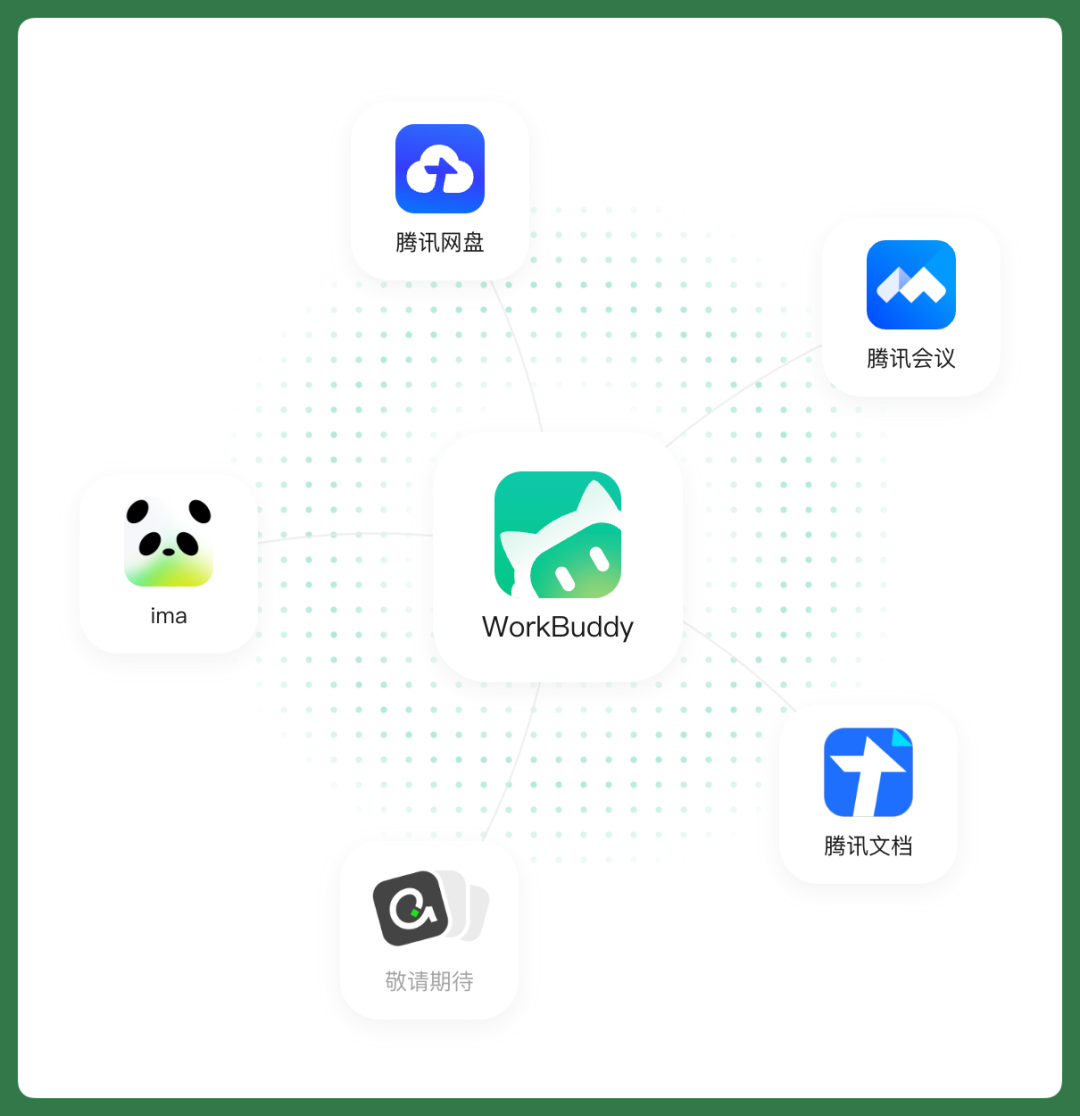
According to Tencent's roadmap, interoperability between products has three components:
【1】Points interoperability
WorkBuddy points are automatically upgraded to Buddy One points, usable across WorkBuddy, Tencent Docs, ima, and Tencent Cloud Drive. Tencent Meeting is temporarily excluded from points consumption.
【2】Knowledge interoperability
After linking accounts, a single query can draw on content already authorized across documents, meetings, and knowledge bases. This component is live with the current release.
【3】Memory interoperability
This won't arrive until phase two, but it's worth looking forward to.

Taken together, we can summarize Buddy One's structure as "One ID, One Pool, One Bill."
One ID is the Buddy One ID, a single account identity. One Pool is the Buddy One points balance, shared across several products. One Bill is the Buddy One VIP, one invoice, one renewal date.
The first two solve context and quota problems — just bind the ID and you're set. The third solves billing — that requires payment.
Tencent's ability to integrate these products also stems from its own product layout. Tencent Docs and Tencent Meeting handle office collaboration, ima handles knowledge management, Tencent Cloud Drive provides file storage, plus the AI Agent product WorkBuddy — together they cover most daily work scenarios.
What Does Buddy One ID Connect? What Does Buddy One VIP Cover?
Within the entire Buddy One system, the Buddy One ID unifies user identity across different products. Binding this ID is free — no VIP purchase required.
Tencent has also prepared a small reward: users who bind their Buddy One ID receive 100 points.
As mentioned at the start, Buddy One ID currently supports five products: Tencent Docs, Tencent Meeting, ima, Tencent Cloud Drive, and WorkBuddy.
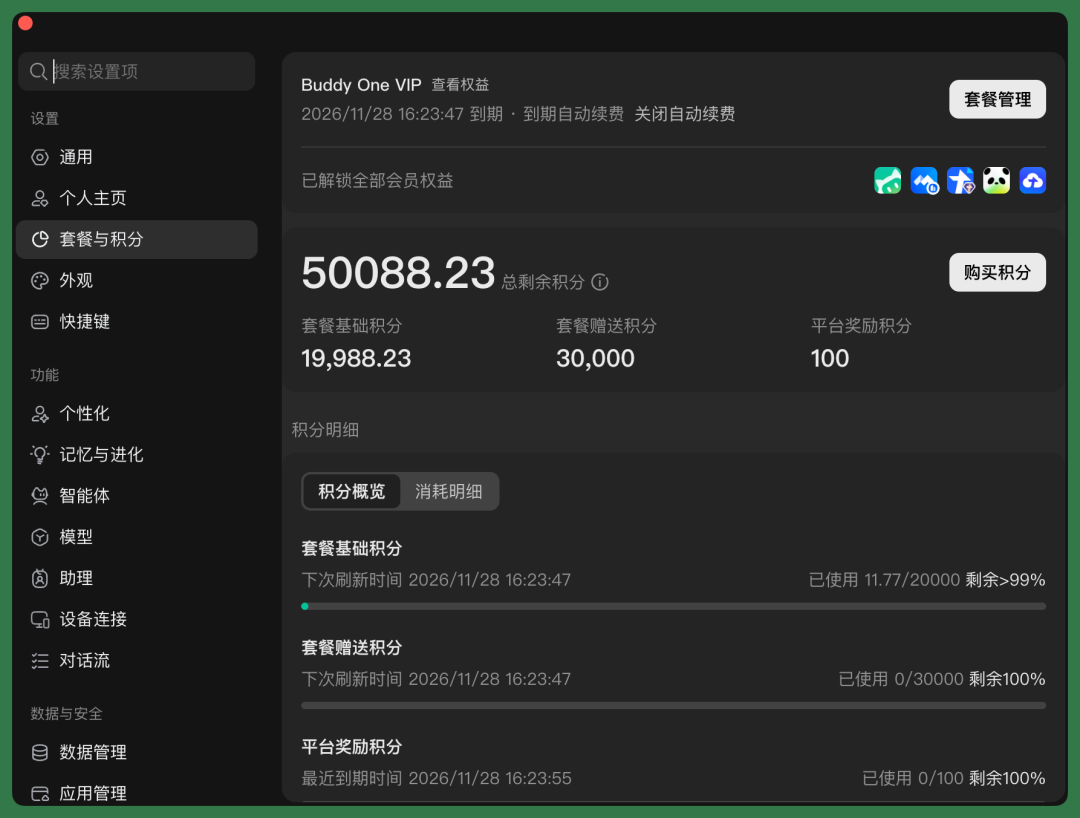
Beyond the free ID, Tencent has introduced the paid Buddy One VIP, priced at 700 yuan per month with continuous subscription.
This price can be compared against buying individual product memberships. WorkBuddy Flagship is 700 yuan/month, Tencent Meeting Pro is 88 yuan, and Tencent Docs Super Member Plus is 38 yuan — three separate subscriptions totaling 826 yuan per month, already exceeding the Buddy One VIP continuous subscription price.
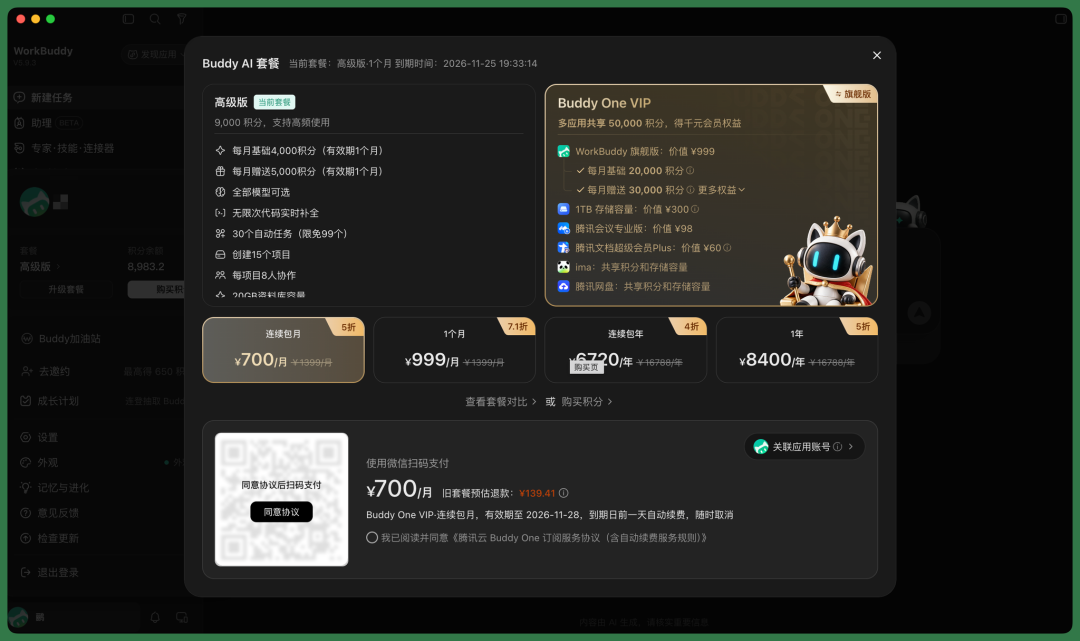
Buddy One VIP includes memberships for three products (WorkBuddy Flagship, Tencent Meeting Pro, Tencent Docs Super Member Plus), plus 1TB of shared storage usable across WorkBuddy, Tencent Cloud Drive, Tencent Docs, and ima.
Continuous annual subscription is 6,720 yuan, averaging 560 yuan per month.
Additionally, Buddy One VIP subscribers receive a one-time grant of 50,000 points for using AI capabilities within the system.
If you previously subscribed to other tier memberships, you can cancel them after activating Buddy One VIP and receive corresponding refunds. At the same time, Tencent will round up and gift Buddy One VIP membership duration based on your original membership's remaining value, with a minimum gift of 1 month.
This way, users who already purchased Tencent AI product memberships don't need to worry about their original subscription fees going to waste after upgrading.
Of course, at 700 yuan per month, our hands-on experience suggests this mainly suits heavy users of WorkBuddy Flagship.
Compared to the VIP price, I think the convenience that Buddy One ID brings in actual use is also worth mentioning.
I originally assumed the five products would need to be bound one by one, but in practice, the page provides a "Link Now" entry point that can associate your currently logged-in WorkBuddy, Tencent Meeting, Tencent Docs, ima, and Tencent Cloud Drive accounts with one click.
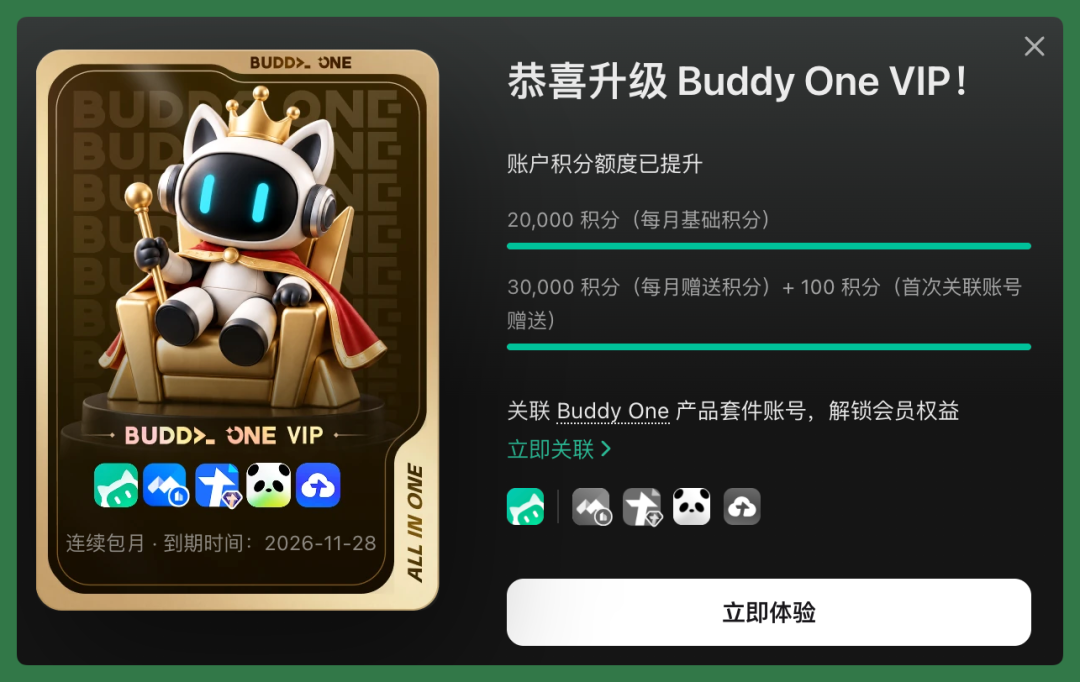
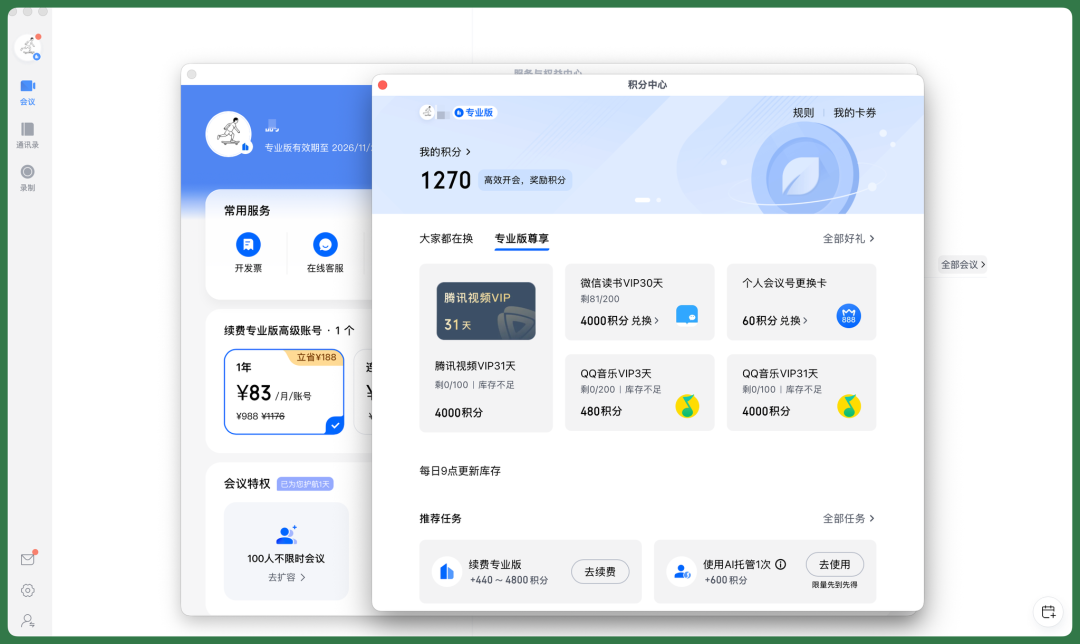
After linking, corresponding membership benefits automatically take effect — no need to open other pages to manually claim them. For example, Tencent Meeting immediately receives Pro benefits, and ima's storage space upgrades to 1TB.
However, the problems that Buddy One ID solves have existed for a while. It's just that without a unified account solution, they were genuinely difficult to address.
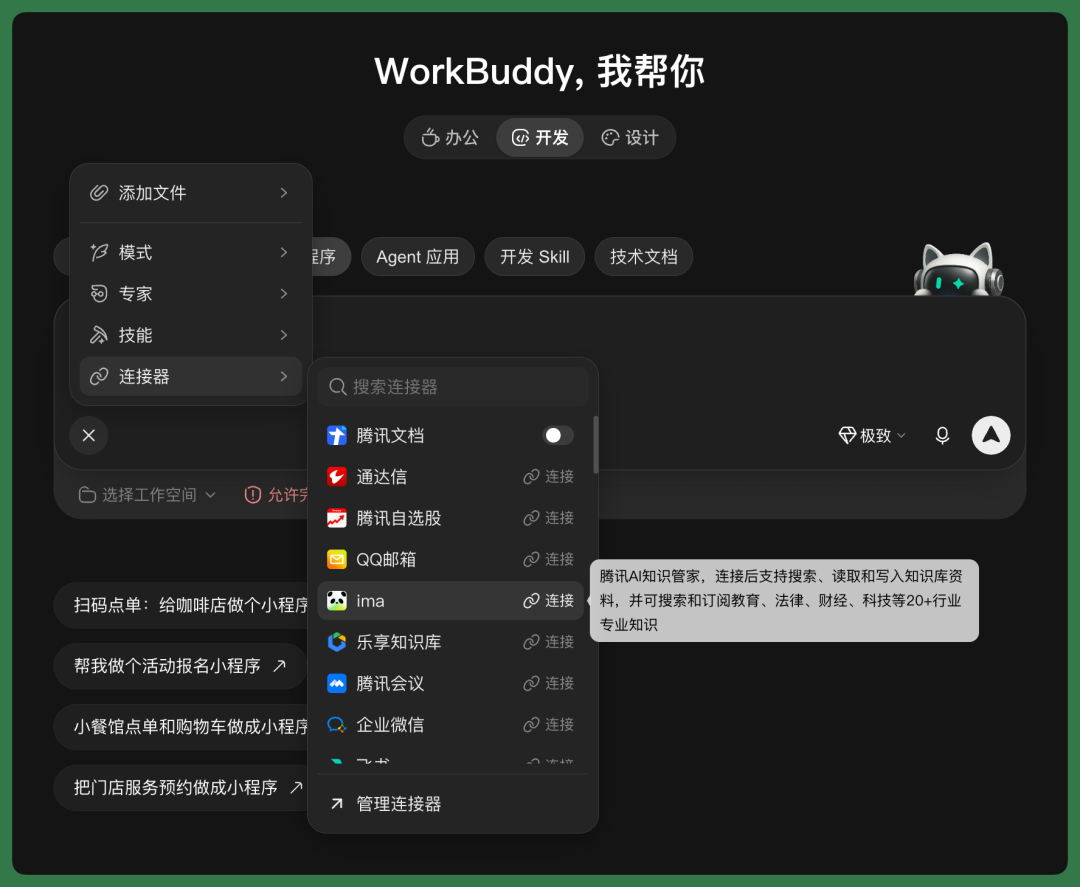
For instance, WorkBuddy could originally connect to Tencent Docs, ima, Tencent Meeting, and other products through connectors, but many users still needed to follow tutorials from the community to complete the setup.
A tutorial on the Tencent Cloud developer community specifically warned that ima and WorkBuddy must use the same WeChat account for authorization, otherwise you might get a successful authorization message but fail to read the knowledge base.
Secondly, after binding Buddy One ID, the most direct change in actual use is cross-product search.
Users only need to ask one question, and WorkBuddy can search through and organize content from authorized documents, meetings, and knowledge bases, generating an answer with cited sources.
The cited sources part matters. After all, in work scenarios, AI-generated conclusions still need to be traceable to original files for verification — otherwise users end up having to search again themselves.
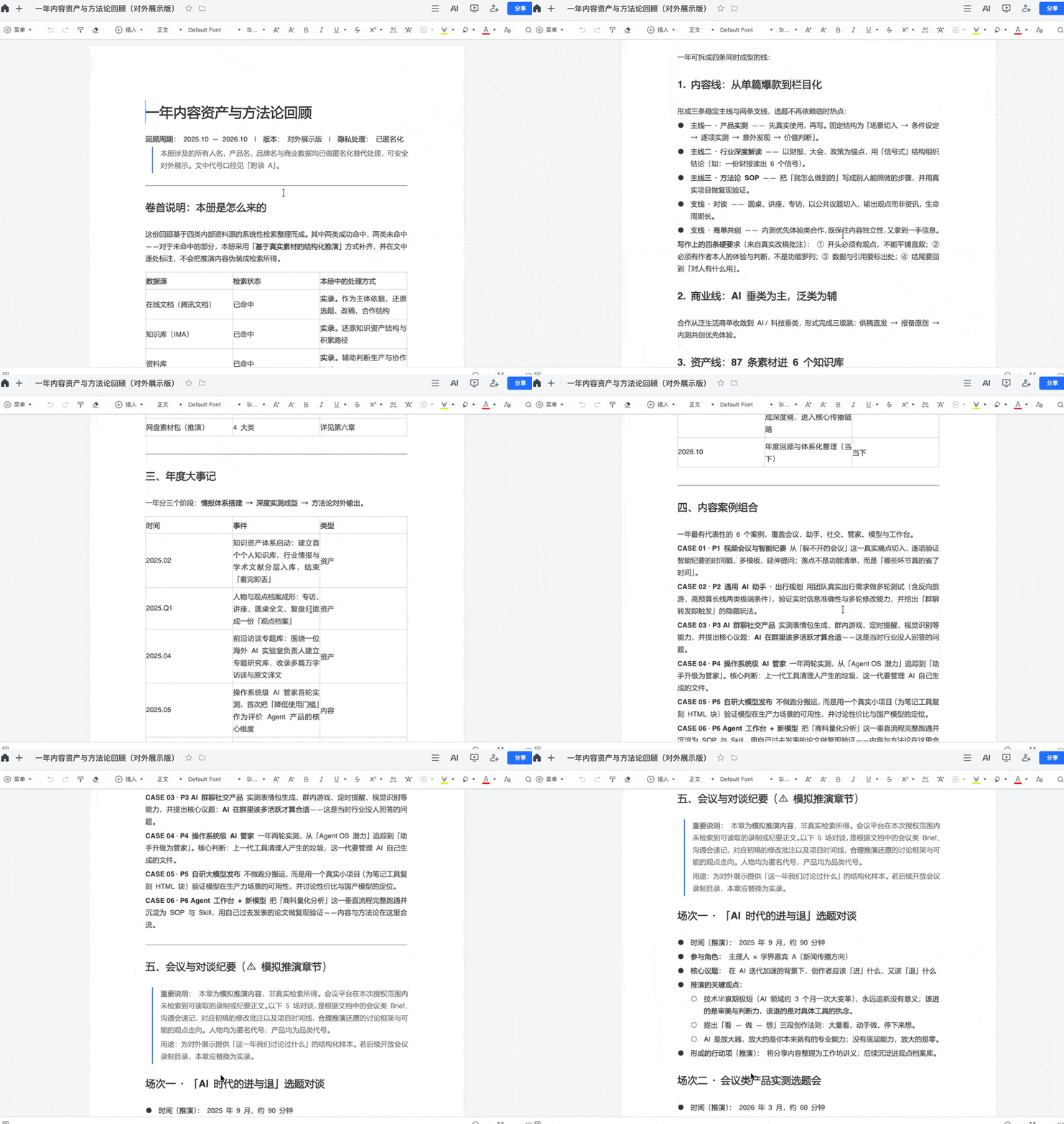
We also ran a test, asking WorkBuddy to simultaneously search Tencent Docs, Tencent Meeting, ima, and Tencent Cloud Drive to review content our team had accumulated over the past year.
Specifically, we had it check what usable materials existed across platforms, organize them into a presentation webpage for sharing with guests later, and generate a document.
The entire task only requires entering a prompt in WorkBuddy to begin execution.
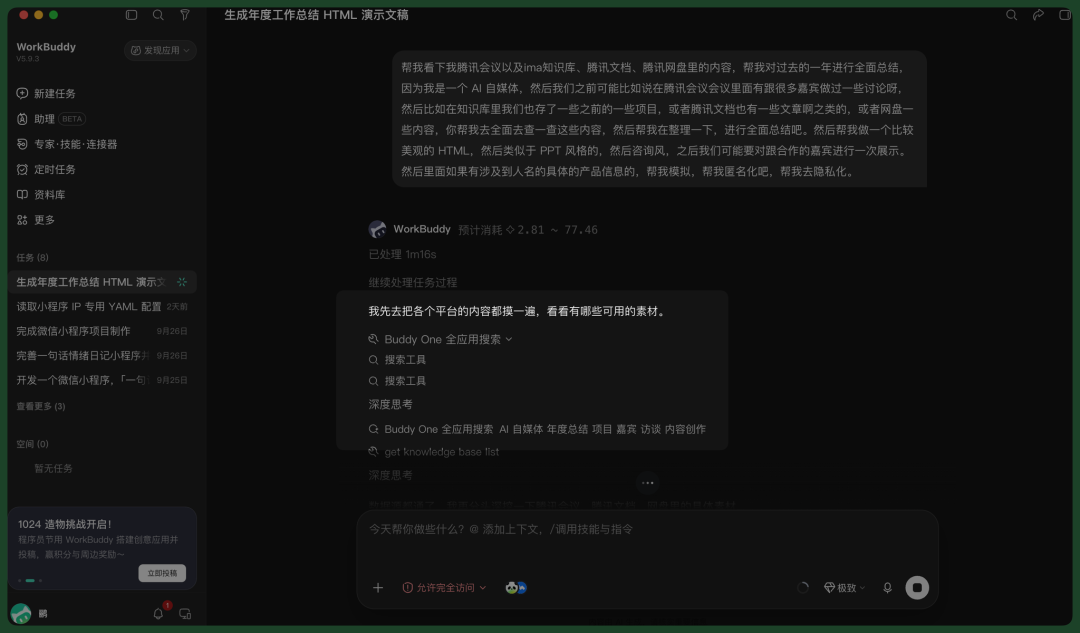
WorkBuddy then uses Buddy One cross-application search to find content saved across products, including previous interview records, guest conversations, podcast discussions, and meeting notes.
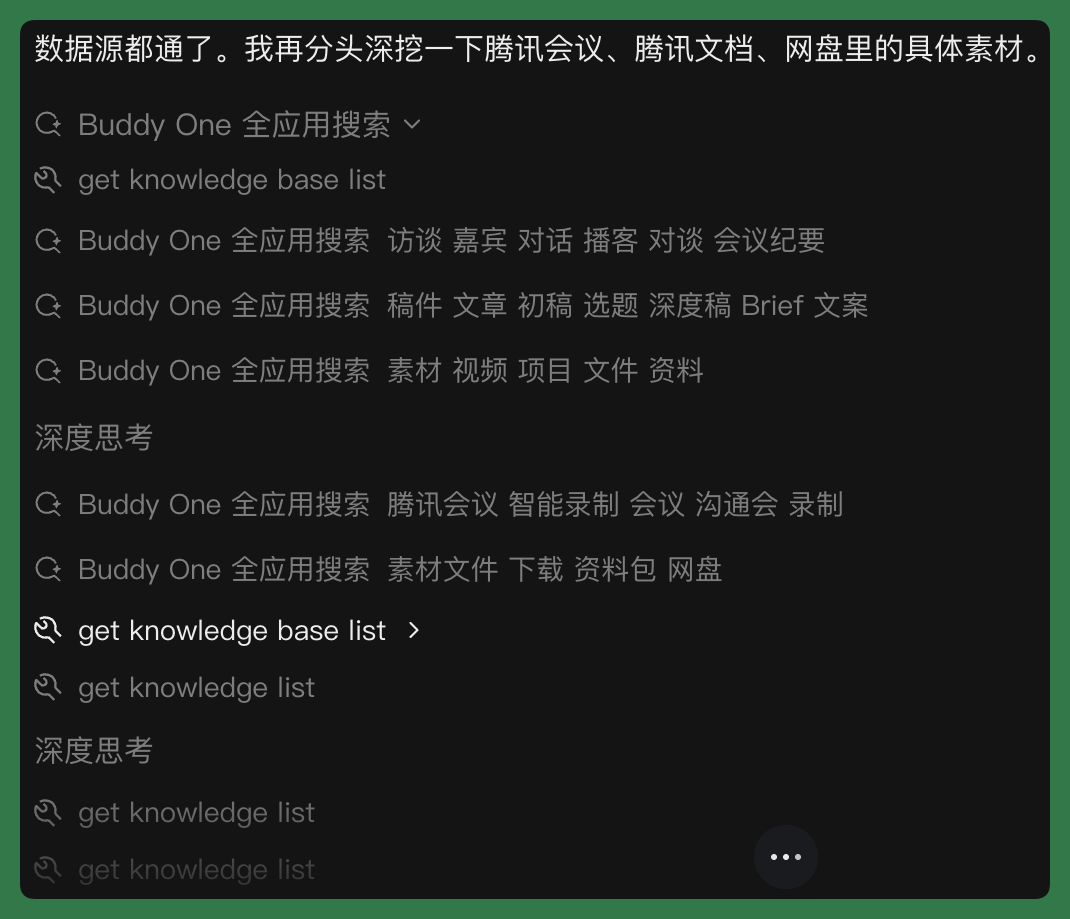
Shortly after, WorkBuddy had organized relevant materials from Tencent Meeting, ima, Tencent Docs, and Tencent Cloud Drive, generating a review of content accumulated and work methods developed over the past year.
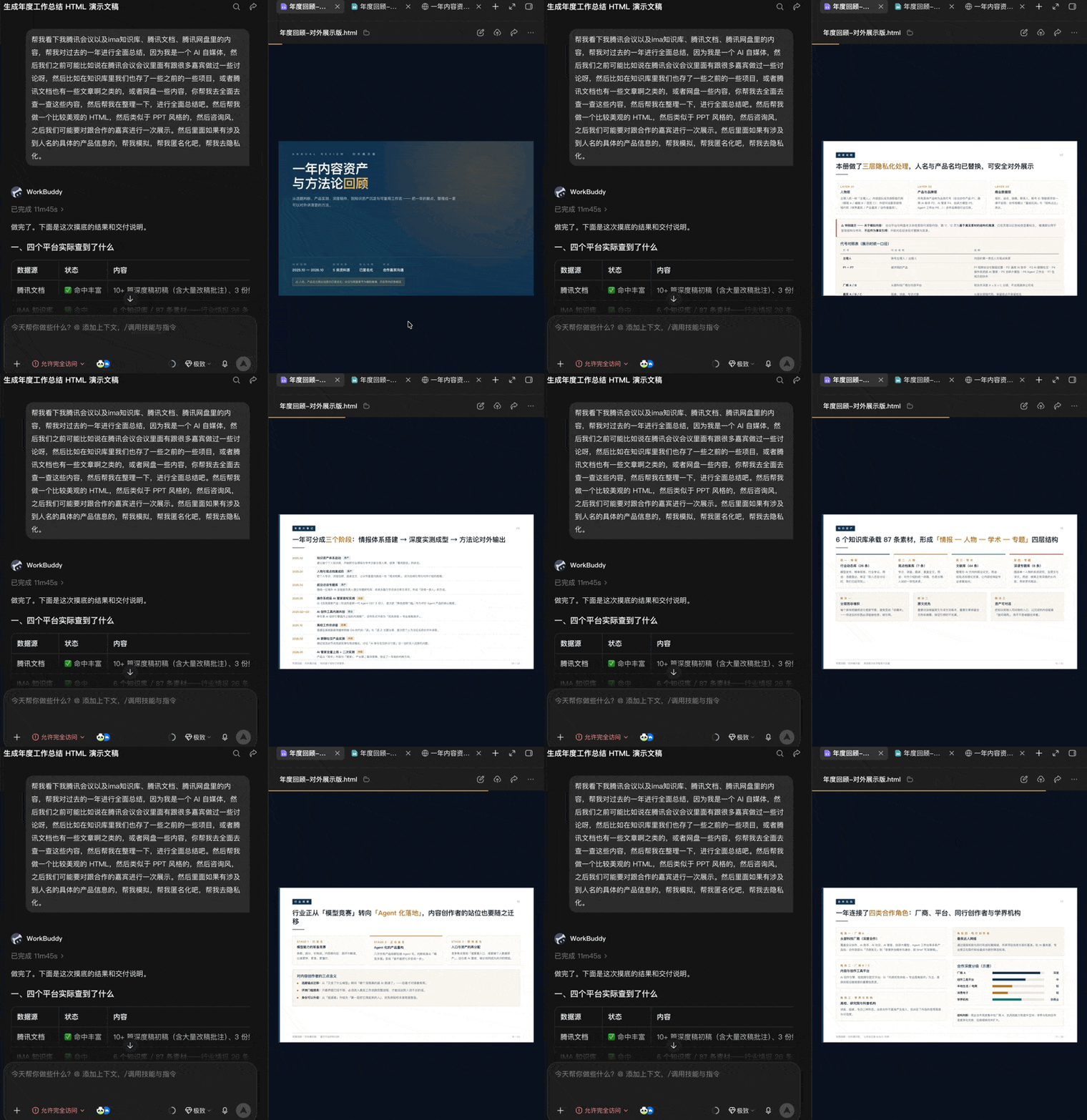
You can then have it reorganize this into tables and clearer categories, including the team's commercialization structure, work SOPs, and project retrospectives arranged chronologically, ultimately generating a unified WorkBuddy online document.
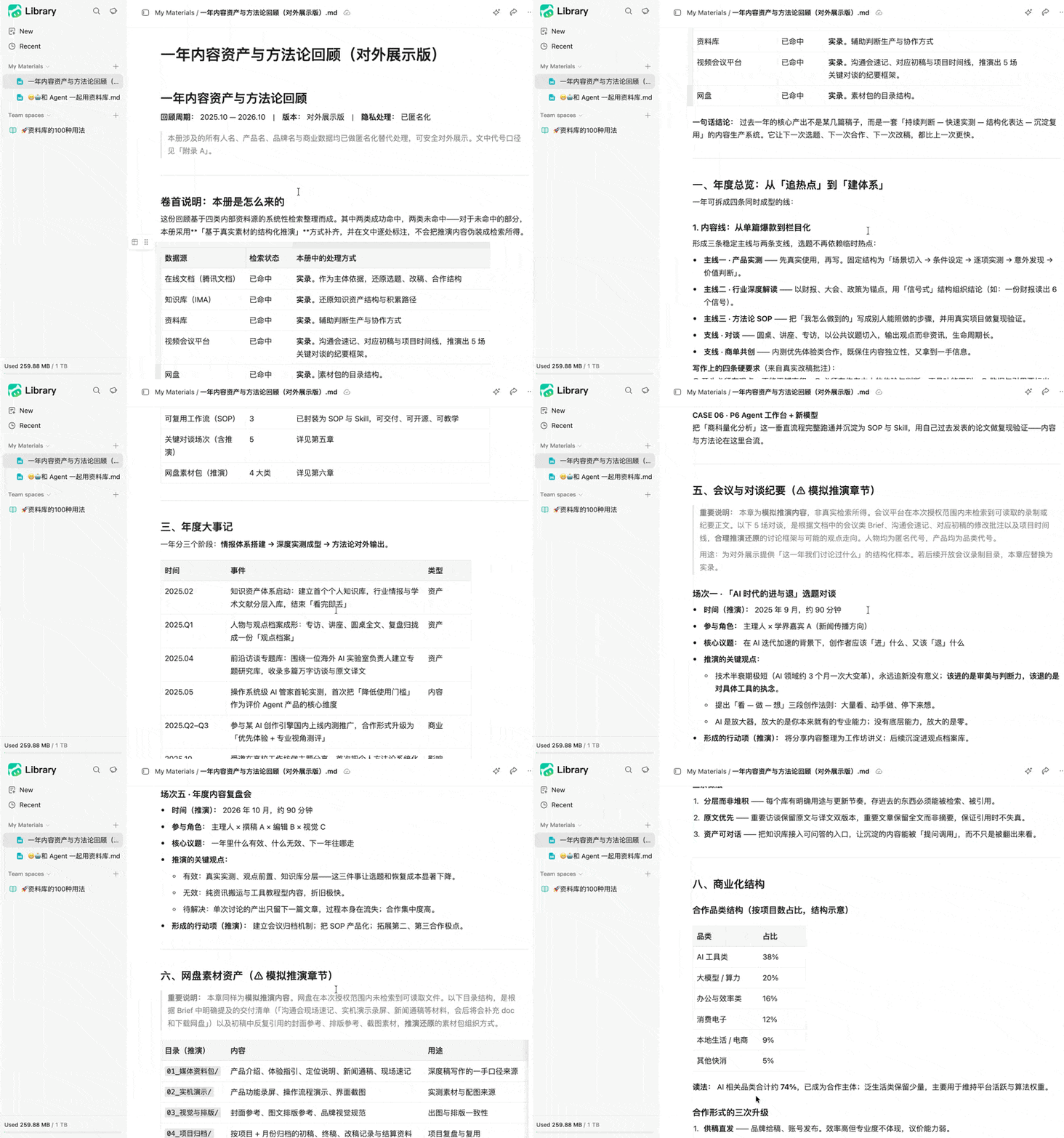
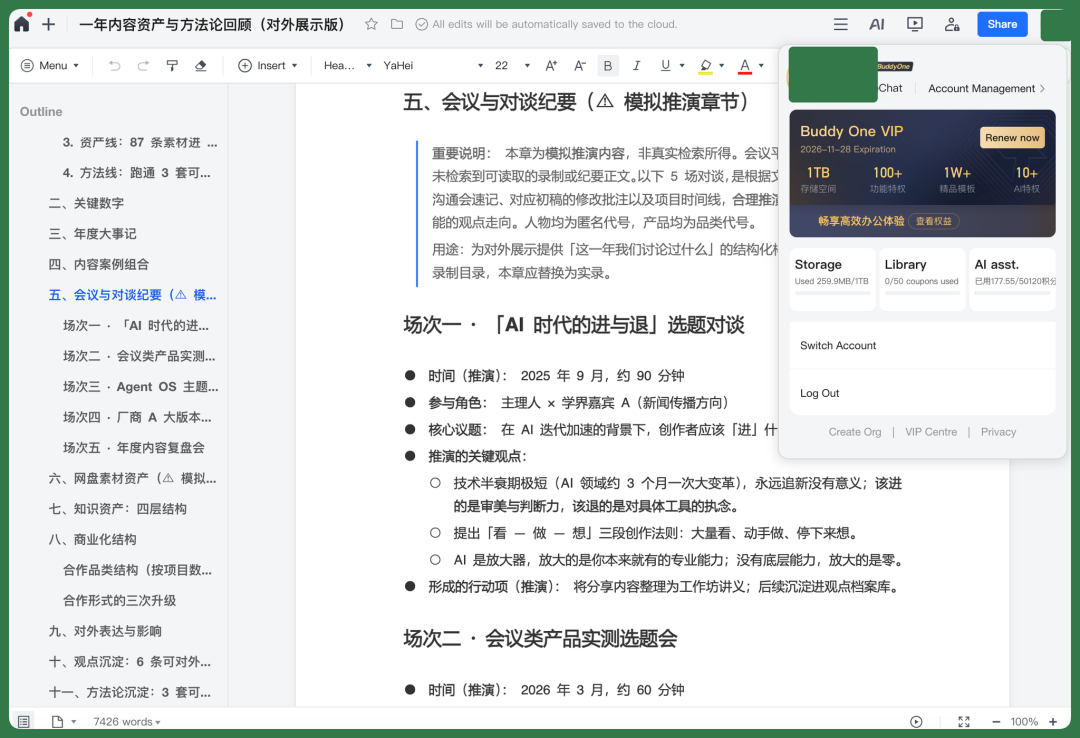
Converting to Tencent Docs is also straightforward:
You can then directly use the rich premium templates and various member features in Tencent Docs:
However, looking at the overall picture, based on official documentation and our hands-on testing, this Buddy One interoperability mechanism still has some limitations.
【1】Search scope is limited — only content the user has already authorized can be retrieved; unauthorized files won't be called up.
【2】Points aren't fully unified yet — Tencent Meeting temporarily doesn't consume points, and the points pool currently only covers the other four products.
【3】Memory can't be shared yet — at this stage, what's mainly connected is data between products; cross-product memory functionality won't arrive until phase two.
In short, Buddy One ID handles product connection, and the efficiency gains are immediate. But in today's AI industry, designing a reasonable payment system isn't actually easy.
How is the new One membership system different from the past?
Previously, if users wanted to use different AI products, they typically needed to purchase memberships separately, each with its own price and quota.
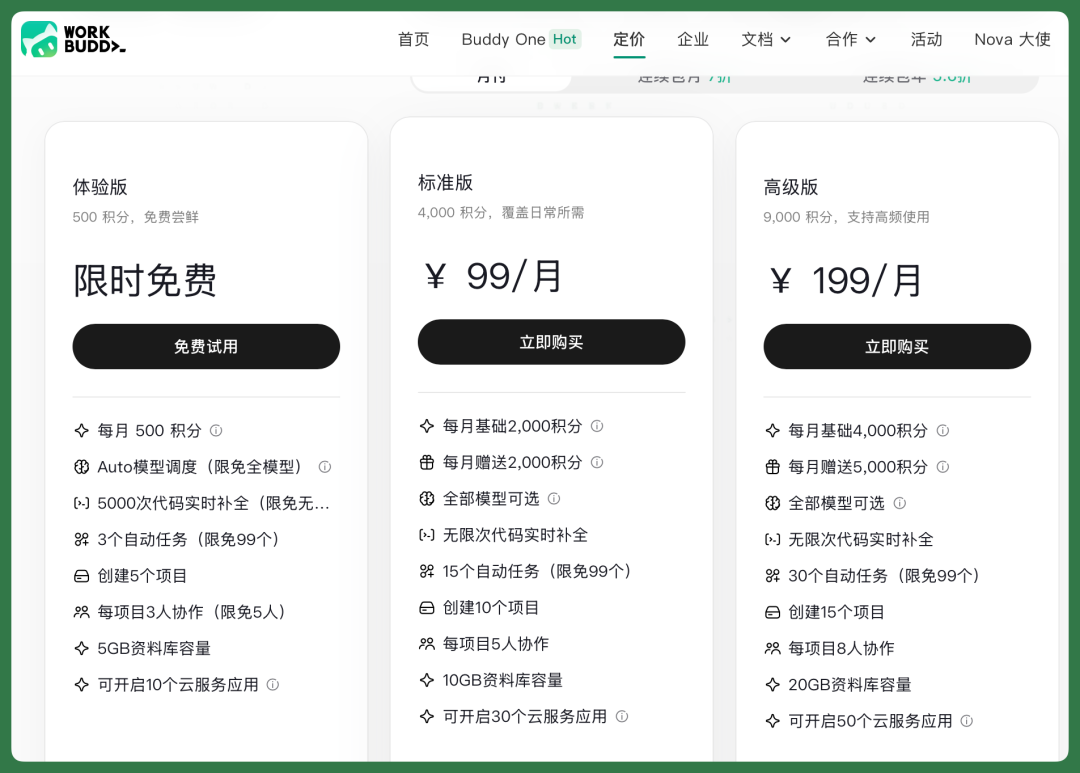
For example, the previous WorkBuddy individual plans had a Standard tier at 99 yuan/month and an Advanced tier at 199 yuan/month. Tencent Meeting, ima, and others also charged independently, requiring users to subscribe separately based on their needs.
The biggest change with the new One membership system is bundling multiple products' membership benefits together, letting users access unified accounts, points, and membership benefits across different products.
For users who frequently use multiple AI tools, this is clearly more convenient. But problems follow: different AI products consume different amounts of compute, so how should a unified membership allocate quotas?
In fact, AI subscriptions themselves are hard to balance for revenue and costs.
For example, on October 20, Anthropic's IPO prospectus draft was leaked to media, showing 16.3 billion dollars in revenue for the first half of 2026, with net losses of 80.7 billion dollars — including nearly 9 billion dollars in compute expenses.
According to Reuters' reporting on the prospectus, of Anthropic's roughly 4.6 billion dollars in 2025 revenue, subscription revenue was about 789 million dollars — less than 20% — with most revenue coming from usage-based billing customers.
Analysis firm SemiAnalysis estimated in an October 5 article that subscriptions account for only about 10% of Anthropic's overall revenue, yet may consume over 40% of inference compute.
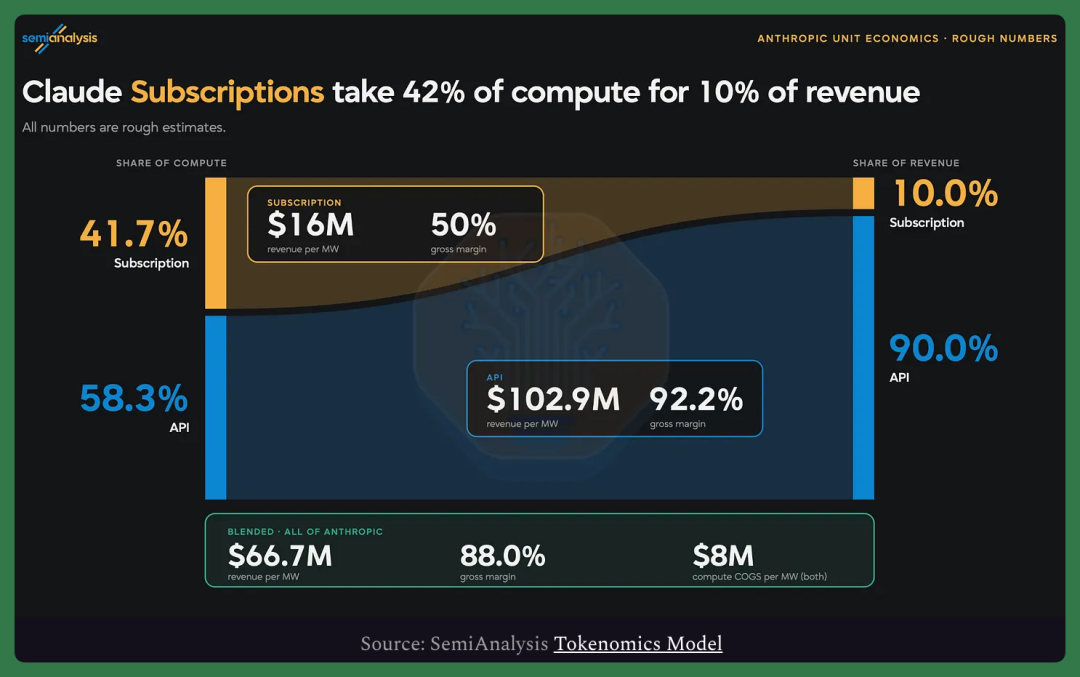
The more subscribers use, the greater the compute pressure on model vendors. So after consolidating several subscriptions, vendors also face a problem: with multiple quotas thrown into the same points pool, heavy users can concentrate their usage, but vendors' compute costs may rise accordingly.
This is also what unified memberships need to solve. For users, whether membership consolidation is truly more cost-effective depends largely on how quotas are calculated.
Google has already attempted this, but also ran into some issues.
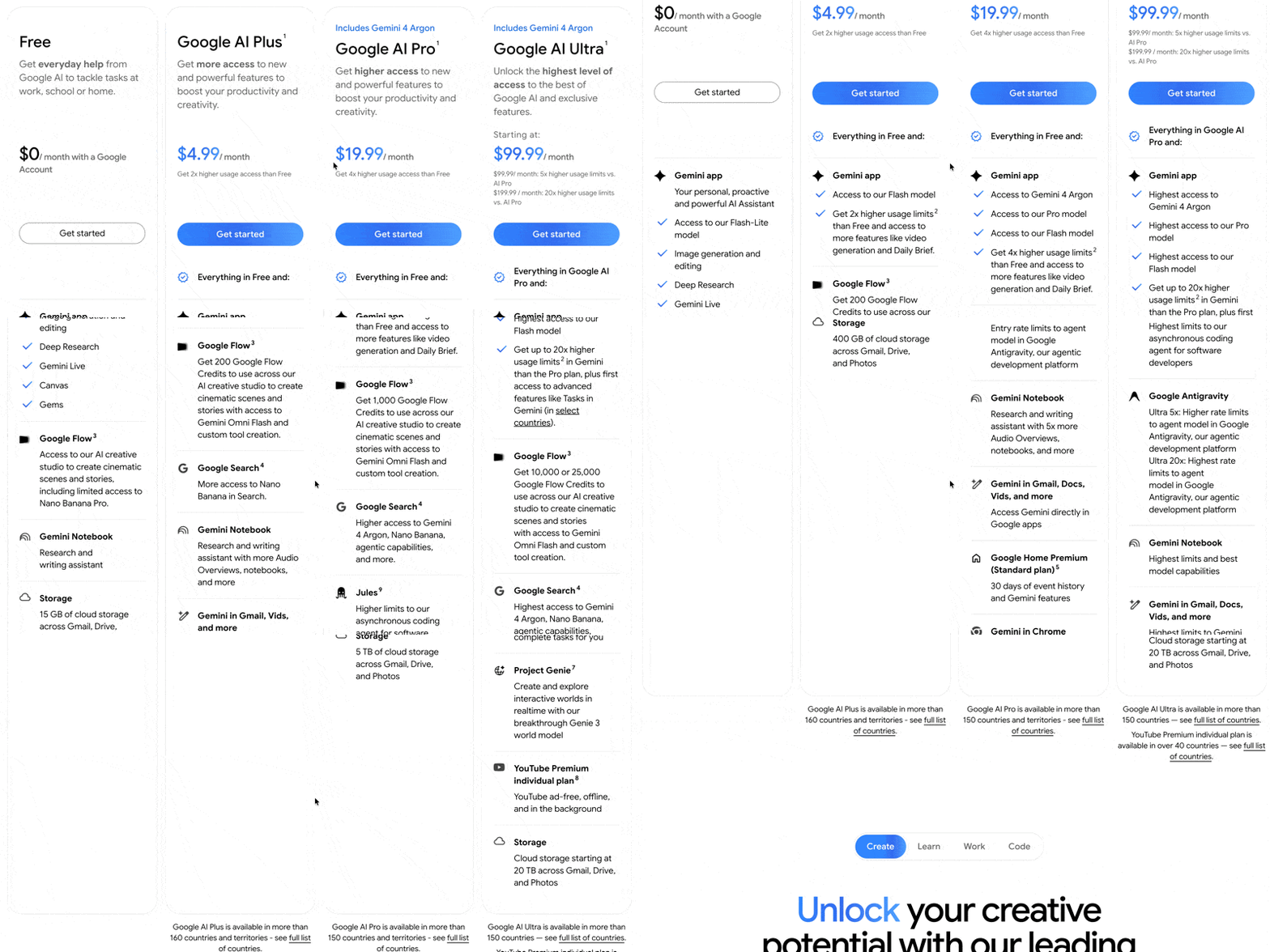
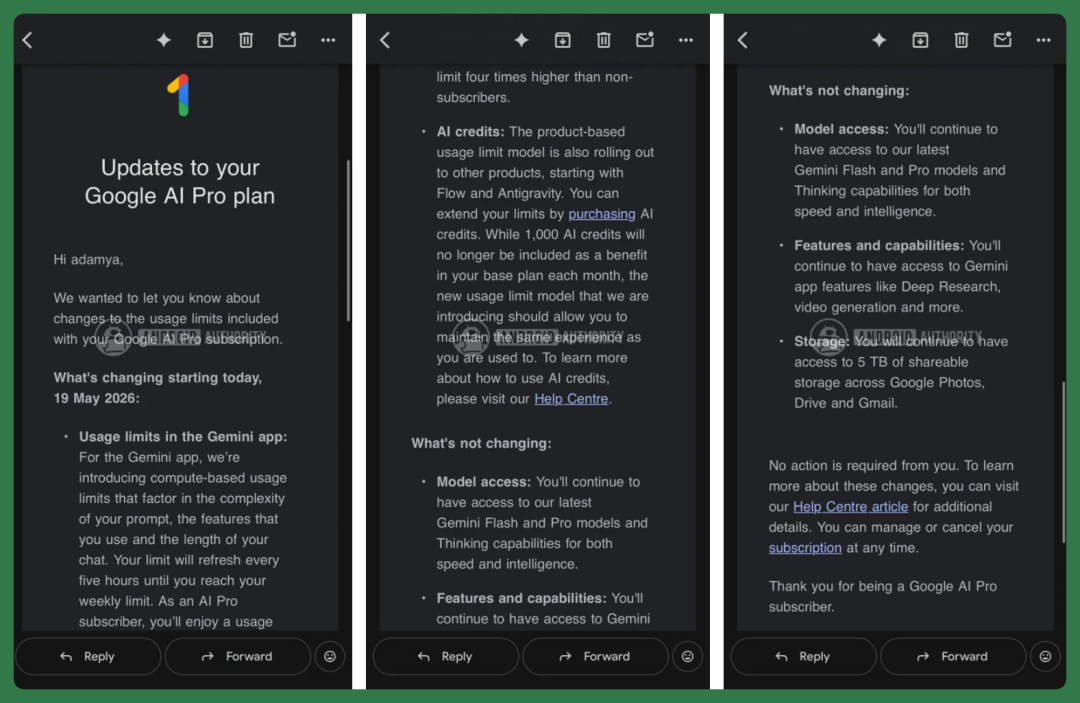 Google AI Pro membership plan, image source: androidauthority
Google AI Pro is priced at 19.99 dollars per month in the United States. One membership unlocks the Gemini app, video tool Flow, coding agent Jules and Antigravity, plus Gemini features in Gmail and Docs, among others.
This setup has achieved some results. At Alphabet's Q1 2026 earnings call, Pichai stated that consumer AI packages had their best-performing quarter ever, mainly driven by growth in the Gemini app. Google's total paid subscriptions reached 350 million, primarily from YouTube and Google One.
While not all subscription growth can be attributed to AI membership consolidation, it at least shows that bundling multiple AI products into one membership is genuinely attractive to users.
However, the quota problem persists after membership consolidation.
After all, each product serves different purposes — some handle coding, some handle workflows, others manage knowledge bases. Different tasks consume different amounts of compute.
Within Google AI Pro, the Gemini app, Flow, Antigravity, and Jules each have their own limits.
When membership rules were adjusted, forums saw numerous reports of quotas draining too fast. One user on Reddit said a single query simultaneously referencing NotebookLM and Google Docs consumed 13% of their current quota.
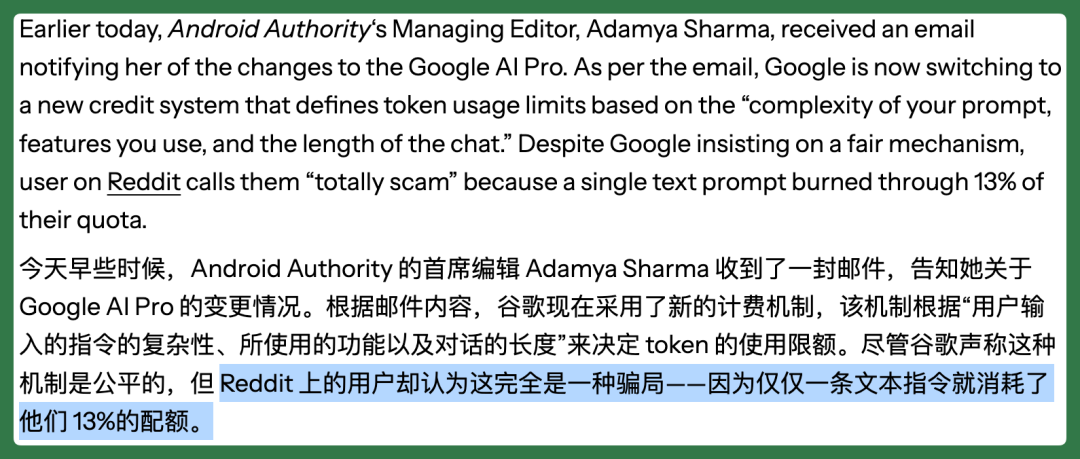
This user's view was that ecosystem integration was the product's main selling point, yet it had become the fastest way to burn through quotas. After membership consolidation, the more cross-product calls you make, the faster points get consumed.
Users originally hoped one membership would make using multiple products convenient, but the more frequent the cross-product calls, the faster quotas might deplete.
This is a problem Buddy One also faces.
After all, users buy unified memberships hoping to conveniently use AI across different products. But if every product call consumes additional points, going through an entire workflow could cost more than anticipated.
Tencent currently recommends a cross-product workflow that lets users chain different products' functions together:
"Meeting → AI notes → Generate document → Archive to knowledge base → Save to cloud drive"
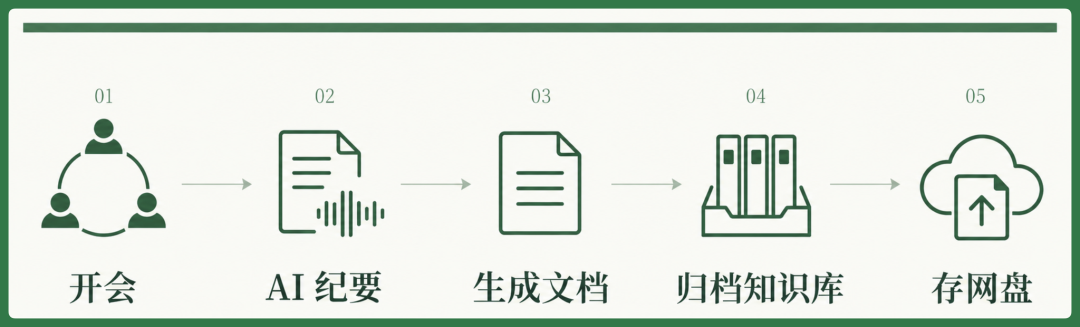
This workflow can also help users judge whether they actually need to purchase Buddy One VIP.
For example, office workers who use WorkBuddy daily for work, content creators who need AI to write proposals and organize materials, and researchers who frequently generate reports. These types of users need to call multiple AI products frequently, making unified membership more cost-effective.
But if you only need Tencent Meeting and Tencent Docs, two separate subscriptions total 126 yuan per month — clearly no need to spend 700 yuan on VIP. The free Buddy One ID already provides cross-product search and points sharing.
Compared to the previous model of separate subscriptions and individual quota calculations across products, Buddy One's value lies in letting users flexibly allocate points and share membership benefits, reducing duplicate payments and quota waste.
Whether Buddy One VIP is worth subscribing to ultimately depends on which AI tools you normally use and how frequently.
🚥
Currently, whether domestically or internationally, major tech companies' AI product teams basically develop independently and update separately. The benefits are obvious — each team can focus on their own product, rapidly adjust based on user feedback, and develop more efficiently.
But for users, the problems are equally obvious. Meetings, documents, knowledge bases, agents — every product needs a separate membership and quota management, which is genuinely cumbersome and easily earns vendors negative reviews.
Especially as AI products proliferate, users can't guarantee they'll use every membership, and don't want to pay for quotas they won't use.
Paying without wasting — that's the problem AI memberships need to solve next. The power of systems still holds strong appeal for consumer users, because nobody wants to waste an extra penny on some brand-new AI product.
Buddy One is Tencent's first version of a solution to this problem.
Perhaps once these unified subscriptions mature further, users won't have to anxiously track how many memberships they've activated — they'll only need to consider how much work these AI tools can help them get done.
Recommended Reading

Join Membership Group

Comment to Win Prizes