Can AI Turn the Tide for China's EV Startups in Their Bloody Battlefield?

AI isn't a cure-all.
AI is not a cure-all.
👦🏻 Author: Jingshan
🥷 Editor: Belulo
🧑🎨 Layout: NCon

The new energy vehicle market has shifted from "feature-driven" to "intelligence-driven."
Major automakers are locked in fierce competition over end-to-end architecture, computing power investment, and talent acquisition, all vying to seize the initiative in this "bloody battlefield."
NIO is attempting to leapfrog end-to-end architecture through personnel changes and the release of its World Model (NWM). Despite massive losses, the company is still seen as capable of staging a comeback.
Xpeng Motors, with its XNGP system and China's first mass-produced end-to-end large model, continues pouring enormous investment into AI computing power and teams, sprinting toward L4-like autonomous driving — fighting its way out of the ICU.
Huawei, with its ADS 3.0 end-to-end architecture targeting Tesla FSD, has brought its "only first place" DNA into the intelligent driving arena.
Li Auto has introduced its MindVLA architecture integrating multimodal AI, aiming at L4 autonomous driving. Its vision as an AI company is meant to accumulate enough technical breakthroughs to break through the siege.
Leapmotor doubled its revenue in 2024, democratizing advanced AI intelligent driving by equipping 100,000–150,000 RMB vehicles with "lidar + end-to-end," attempting to break through on cost-performance.
Xiaomi has made a forceful entrance, rapidly shedding its rookie status. Its Hyper-Autonomous Driving system is iterating quickly, placing it in the top tier.
AI is reshaping the automotive industry at unprecedented speed and intensity: from intelligent driving to smart cockpits, from user interaction to ecosystem services, AI technology has penetrated every aspect of automotive products, even subverting the very concept of "car" as a mode of transportation and transforming it into a "mobile intelligent living platform."
In this transformation, whoever can better leverage AI technology to enhance product experience and service value will stand out in the fierce market competition.
We've selected Wei Xiaoli (NIO, Xpeng, Li Auto), along with the mass-market newcomer Leapmotor, the forceful entrant Xiaomi, and Harmony Intelligent Mobility — deeply partnered with Huawei — as six representative players among the new forces.
In the AI battleground currently drawing the most attention — intelligent driving — let's see whether these new automakers can use AI to escape the "bloody war," or whether they're headed into an even more intense one.
The Personnel Chess Game on the "Bloody Battlefield"
The new forces are going all-in on AI, every single one of them.
The intelligent driving field sits at the very center of what new automakers call the "blood-soaked battlefield," and key personnel moves on critical positions bear this out.
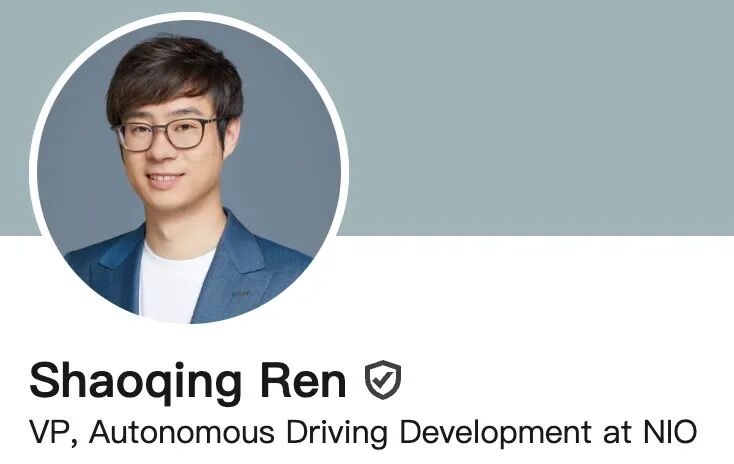
For instance, in late 2024, NIO's intelligent driving large model department changed leadership, with Ren Shaoqing, the company's VP of intelligent driving R&D, taking direct charge. This technical heavyweight was deeply involved in ResNet — the breakthrough technology that "changed the AI world."
ResNet's debut made Ren Shaoqing, one of its authors, a rising star in computer vision.
NIO's personnel shuffle focused specifically on large models and end-to-end capabilities. Because its intelligent driving feature rollout had consistently fallen short of expectations and its end-to-end project had been chronically slow, NIO conducted its second team restructuring of the year in December. Multiple critical positions in deployment architecture also saw new appointments.
Ren Shaoqing's arrival signals that NIO is finally taking a hard look at just how sluggish its intelligent driving R&D has been over the past year.
On the "bloody battlefield," NIO has no choice but to actively respond to rapid technological change.
NIO has long been regarded as possessing the industry's top-tier intelligent driving hardware, yet its end-to-end intelligent driving performance has been disappointing. Online criticism has been rampant, with some even calling it "the most advanced intelligent driving hardware producing the industry's worst intelligent driving system" — but this situation is being rapidly reversed.
Ren Shaoqing's arrival is seen as a personnel move to fully commit NIO's intelligent driving system efforts, fighting to the bitter end in this "bloody war."
On the intelligent driving battlefield, Xiaomi is another manufacturer that changed generals mid-battle.
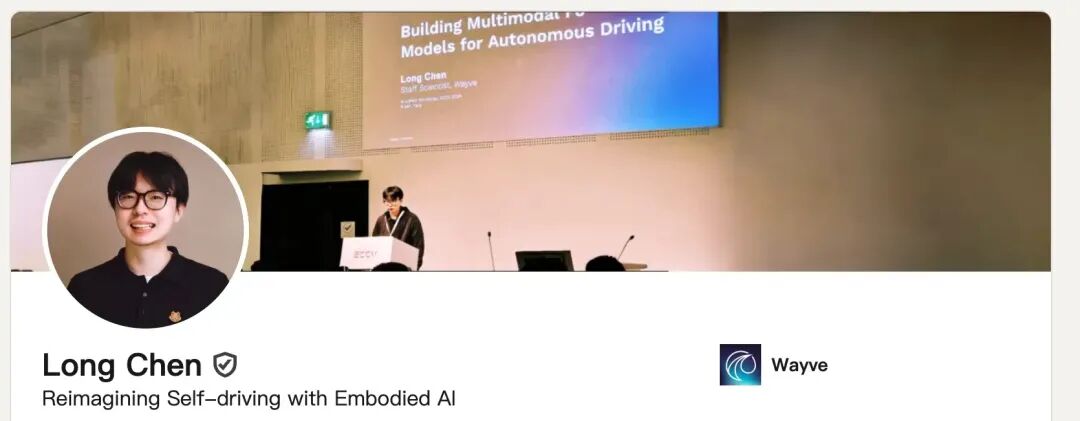
Recently, reports emerged that Chen Long, Staff Scientist at Wayve, has joined Xiaomi's intelligent driving department.
He previously served as Staff Scientist at British AI unicorn Wayve, focused on developing next-generation autonomous driving technology and advancing AV2.0 — building next-generation autonomous vehicles through end-to-end machine learning and vision-language-action (VLA) models.
In both autonomous driving and computer vision, Chen Long is unquestionably a top-tier technical talent.
Beyond NIO and Xiaomi, the other four players have also made a series of major personnel moves, all targeting "intelligent driving." Whoever can claim the right to define this future concept will stand out.
At least, that's what the market believes.
So just how cutthroat is China's intelligent driving scene? Countless capital stories have bloomed and withered here. The losers have gone far away; the winners dare not tell their success stories. There seems to be no real winner.
He Xiaopeng, Chairman and CEO of Xpeng Motors, made a bold claim in mid-2024: "In 2025, Xpeng Motors will deliver L4-like intelligent driving experience in China."

Though the statement came loaded with hedging words — "like" L4, intelligent driving "experience" — casting a fog over any fantasy of Xpeng achieving true L4 autonomous driving.
Still, this was tantamount to declaring: Xpeng will go all-in on intelligent driving in 2025, determined to take a bite out of the very center of this "AI battlefield."
Level 4 intelligent driving is the fourth tier (out of five) in the automation levels defined by SAE International, representing "high automation."
At this level, the vehicle drives itself throughout the entire journey with no human intervention required, only limited oversight.
Yet looking around at China's current new automakers, even full implementation of L3 may prove a difficult hurdle.
Especially with recent frequent new regulations on intelligent driving, the days of playing the market with intelligent driving concepts are over.
Sinking into a New Technical Quagmire? The End-to-End Architecture Scramble
Technically speaking, end-to-end architecture refers to a unified neural network model that goes directly from input (sensor data) to output (driving decisions), eliminating the complex modular workflow (perception, fusion, planning, control) of traditional autonomous driving systems.
In plain terms: from seeing road conditions (input) to deciding how to drive (output, like hitting the gas or brakes), the car relies entirely on one large model, ditching the traditional "modular" architecture.
In this domain, having "end-to-end" capability has become a "line between life and death" for automakers.
Tesla took the lead in December 2023 with FSD (Full Self-Driving) V12 — a major milestone.
Because this meant someone had finally achieved pure end-to-end architecture for the first time.
Looking back domestically, the six players are catching up remarkably fast. But end-to-end architecture isn't some toy sitting by the roadside that anyone can pick up and play with. The gap between theory and reality easily gives observers the impression that "everyone's roadmap looks great, but everyone's actual performance falls short."
Xpeng: Can AI Pull the Top Student Out of the ICU?
Xpeng and Huawei count as the domestic "top students" in this area.
In May 2024, Xpeng Motors released China's first mass-produced end-to-end large model deployed in vehicles, becoming the world's second automaker to achieve this.
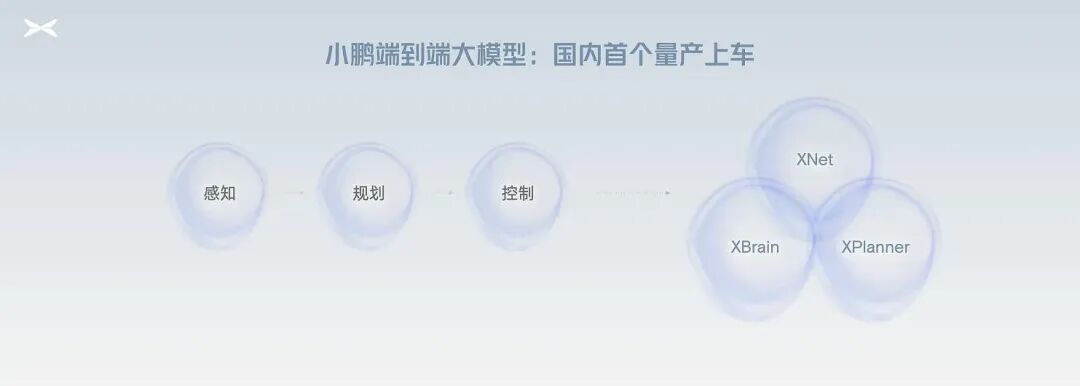
This system comprises: XNet (perception, like eyes), XPlanner (planning, like the cerebellum), and XBrain (reasoning, like the brain). The system claims to iterate every 2 days, with intelligent driving capability improving 30-fold over the next 18 months post-launch.
By early 2024, Xpeng's NGP had already achieved extremely high coverage, backed by Xpeng's massive investment: an autonomous driving team exceeding 3,000 people, annual R&D investment reaching 3.5 billion RMB, accounting for approximately 67% of the company's total R&D expenditure.
Looking back at 2024, Xpeng Motors doubled down on AI intelligent driving: 3.5 billion RMB invested in intelligent R&D in 2024, 4,000 new professional hires, and over 700 million RMB annually for computing power training going forward.
So what about 2025?
In 2025, He Xiaopeng revealed: Xpeng expects to invest approximately 4.5 billion RMB in AI. 2025–2027 will be the "most intense three years" in China's auto industry, the "most critical three years" for Xpeng, and also certainly "the three years with the most opportunity."
This indeed validates Xpeng Motors' declaration: "No AI, no intelligent driving."
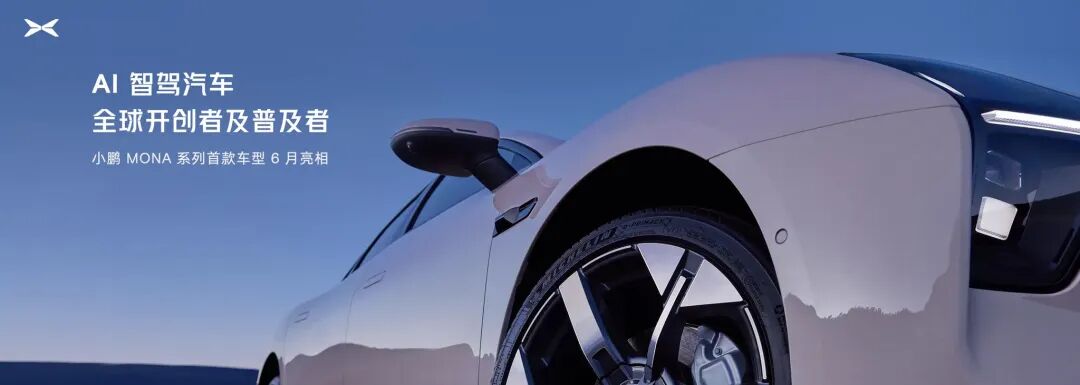
XOS Tianji and XNGP are the two core pillars of Xpeng Motors' intelligent ecosystem.
At last year's mid-year launch event, Xpeng rolled out XOS Tianji system-wide — the operating system for both intelligent cockpit and intelligent driving — marking another frontier in Xpeng's application of AI technology.
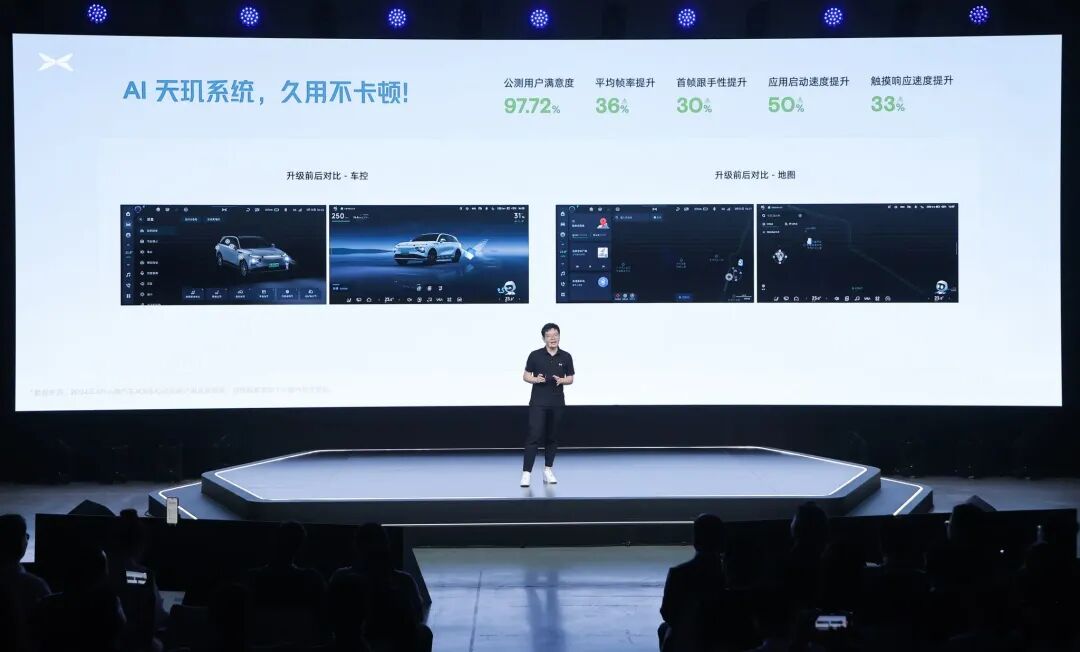
Xpeng's advanced driver-assistance system (ADAS), XNGP, has been hailed in the industry as the final piece of the puzzle in Xpeng's charge toward AI-powered vehicles.
Unveiled in early 2023, XNGP is Xpeng Motors' latest-generation intelligent assisted driving system, evolved from the XPILOT system, with coverage now expanded nationwide to deliver full-scenario intelligent assisted driving capabilities.
In May 2024, Xpeng became the first in China to mass-produce an end-to-end large model, integrated into the XNGP system and covering nationwide mapless NOA. At the launch, He Xiaopeng announced it had achieved full nationwide rollout with "no city limits, no route limits, no road condition limits."
In some online communities, discussions have already emerged around "the pure-vision autonomous driving showdown between China and the US: FSD vs. XNGP." In practical terms, XNGP represents the first major leap forward in Xpeng's vision for AI-powered vehicles.
Entering 2025, Xpeng Motors continues to double down on intelligent driving.
In an internal letter, CEO He Xiaopeng stated: "Xpeng is positioned to be the first to achieve full-scenario Level 3 autonomous driving in the second half of 2025." He likened the arrival of L3 to the "iPhone 4 moment" for automobiles, and firmly believes large models will accelerate the evolution of intelligent driving.
Yet, Xpeng's 2024 financials tell a more complicated story: strong sales, high revenue, but another net loss of 5.8 billion RMB. Though this marks a significant narrowing from 2023's net loss, the reality is hard to celebrate.
He Xiaopeng projected at the time: by Q4 2025, one year later, the company would achieve profitability.
Whether Xpeng Motors has truly walked out of the ICU — only He Xiaopeng himself knows.
The struggle behind it all is not for outsiders to hear.
Harmony Intelligent Mobility Alliance (Huawei): Continuing the Tradition of Being Number One
There's an industry saying about Huawei: Huawei only does first place, and it brings its competitive DNA into every corner of every industry it enters.
In the intelligent driving domain, Huawei's placement in the top tier is hardly surprising.
But every opponent standing on this battlefield has bet everything they have — no one stalls because they see fear in someone else's eyes.
Even Huawei, backed by vast technical accumulation in communications, AI, and chips, and even with its high-profile entry into intelligent driving showcasing technical prowess and market competitiveness, becoming a lasting leader in autonomous driving is no easy feat.
In April 2024, Huawei held its Intelligent Automotive Solution new product launch, officially unveiling the latest-generation Qiankun ADS 3.0 autonomous driving system.
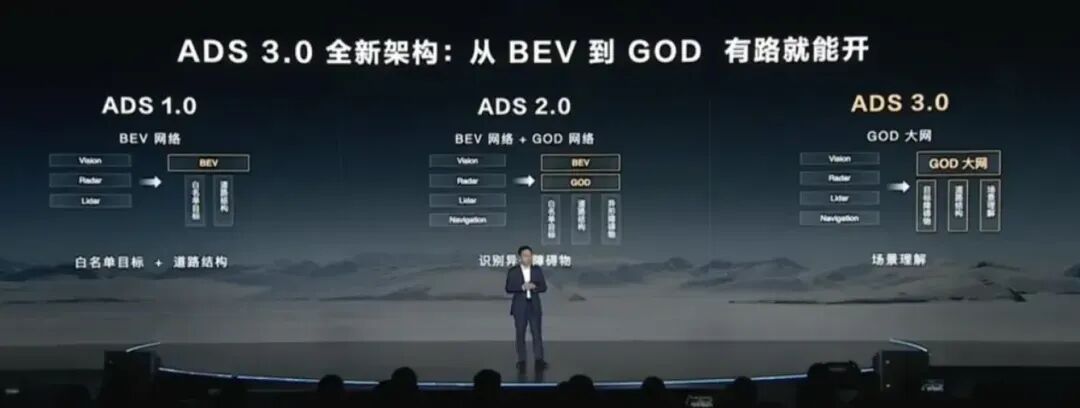
Yu Chengdong, Huawei's Executive Director, CEO of the Consumer Business Group, and Chairman of the Intelligent Automotive Solution BU, put it this way: "I believe Huawei ADS premium intelligent driving is about to rewrite this industry."
ADS 3.0 adopts a new end-to-end large model architecture, fusing multimodal perception with AI real-time modeling. Relying solely on onboard sensors (LiDAR, cameras, millimeter-wave radar) and self-developed algorithms, it generates high-precision environmental models in real time, enabling precise localization and path planning.
On November 7, 2024, Huawei Intelligent Automotive Solution released its Huawei Qiankun Intelligent Driving travel report, showing outstanding performance in October 2024 with total intelligent driving mileage reaching 197 million kilometers.
"Drive wherever there's a road, and the more you drive, the better it gets" seemed to have become reality.
This move made Huawei the first domestic manufacturer to push "end-to-end driving in parking scenarios" into mass production, setting a new benchmark for the industry.
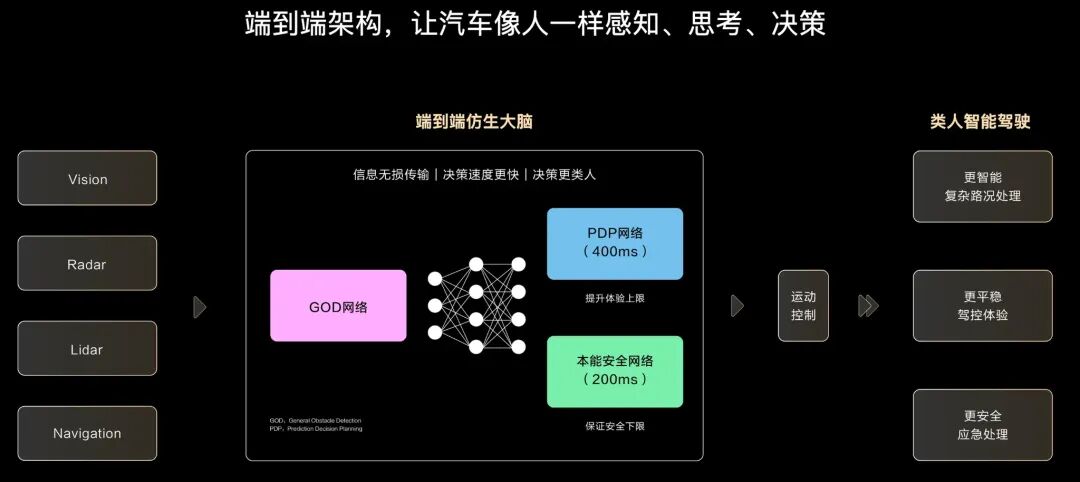
In the second half of 2024, Huawei ADS 3.0 rapidly moved into application testing after launch, iterating quickly and scaling up. By year-end 2024, Huawei's "Harmony Intelligent Mobility Alliance" platform had accumulated over 1.2 billion kilometers of autonomous driving test mileage, with simulation testing exceeding 35 million kilometers daily, and model iteration cycles shortened to as fast as one version every five days.
On pricing, Huawei lowered user acquisition costs to drive mass adoption, aiming to quickly seize the high ground in the intelligent driving market.
The Intelligent Automotive Solution business also delivered a satisfying report card for Huawei: revenue surged 474.4% year-over-year, achieving profitability for the first time in its founding year, with income reaching 26.353 billion RMB.
Though still modest compared to Huawei's overall business, this proved that AI technology will transform the potential of intelligent driving into real returns — and bring unimaginable competitive pressure along with it.
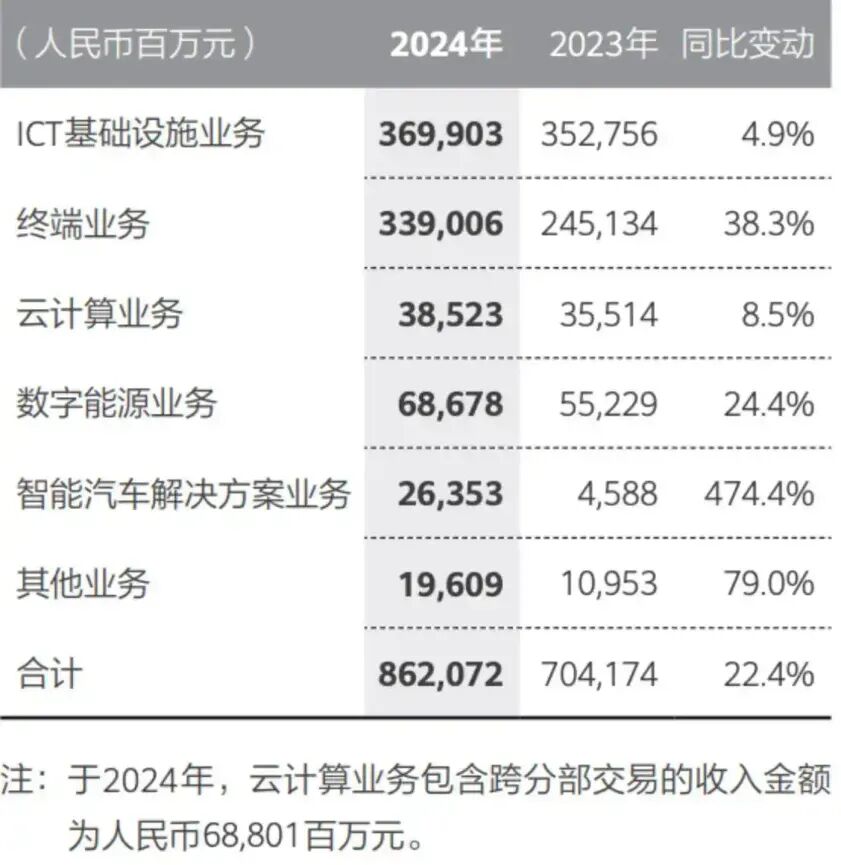
Huawei's aggressive push in intelligent driving could be described as leading and accelerating China's automotive industry technical evolution in a rather "violent" manner.
Huawei ADS 3.0 was the first to adopt an end-to-end large model architecture, aligning with Tesla FSD V12's technical approach and triggering a race among domestic new forces and suppliers to follow suit. By year-end 2024, multiple automakers including Li Auto and Xpeng had launched their own end-to-end driving solutions.
At a recent launch event, Huawei's next-generation ADS 4.0 was officially unveiled, with its architecture introducing the pan-world model concept (world engine and world behavior model). The ADS Ultra flagship edition supports highway L3-level commercial solutions, and has even been hailed as "the highest level of domestic intelligent assisted driving."
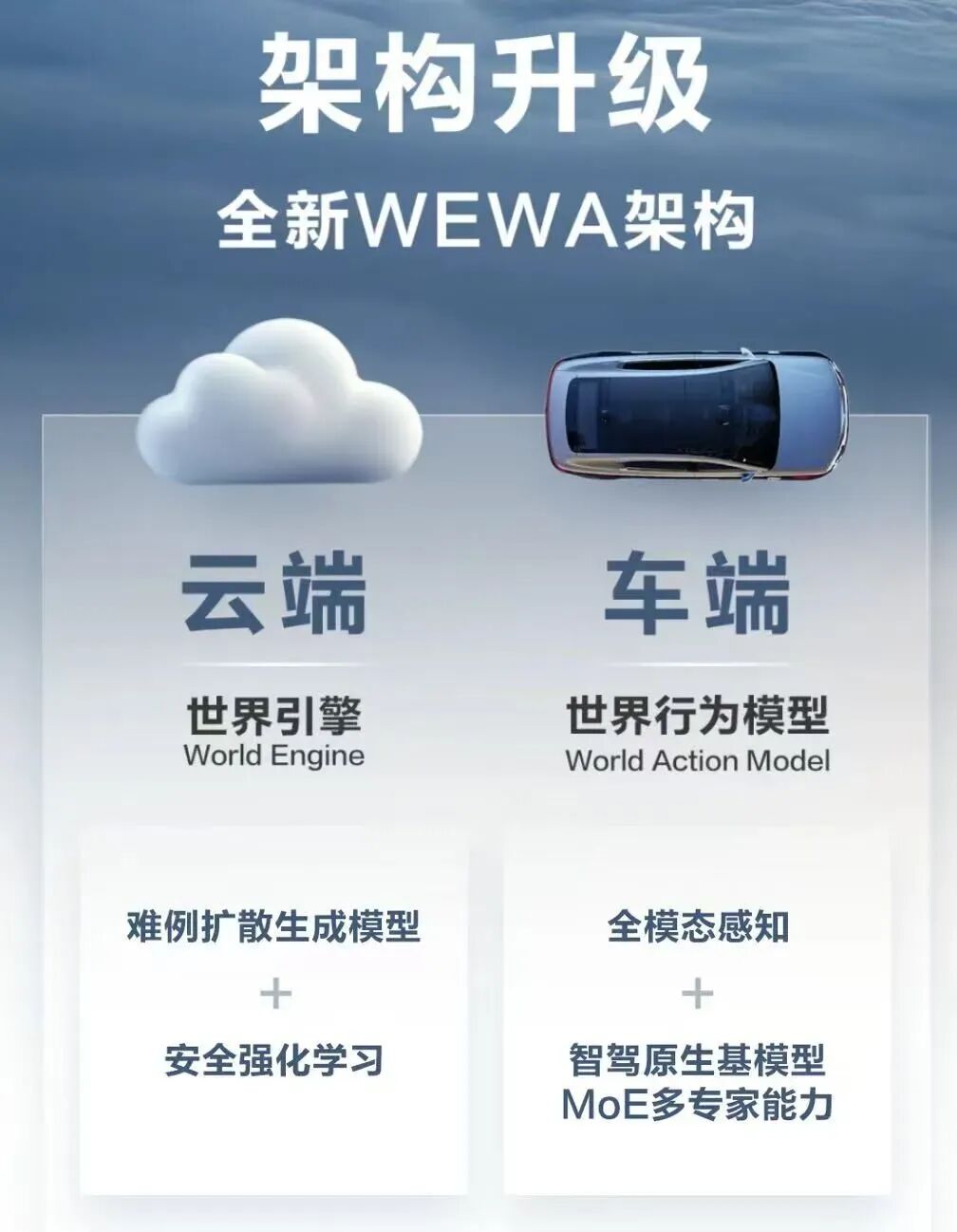
It is fair to say that Huawei has ushered in the era of "full-scale AI end-to-end competition" — on the "intelligent driving battlefield," Huawei will be the competitor that fights to the bloody end.
NIO: The ICU's Most Resilient Regular
NIO's coordination between intelligent hardware and software has long been criticized. Though its hardware platform was laid out relatively early, its autonomous driving iteration speed has been somewhat surprisingly slow.
However, as an old hand among the new forces, NIO founder, chairman, and CEO William Li, together with NIO executives, unveiled the "NIO World Model" (NWM) at NIO IN 2024 on July 27, 2024 — aiming to leapfrog "end-to-end" entirely and achieve an "end-to-end + world model" architecture.
Ambitious, to say the least.
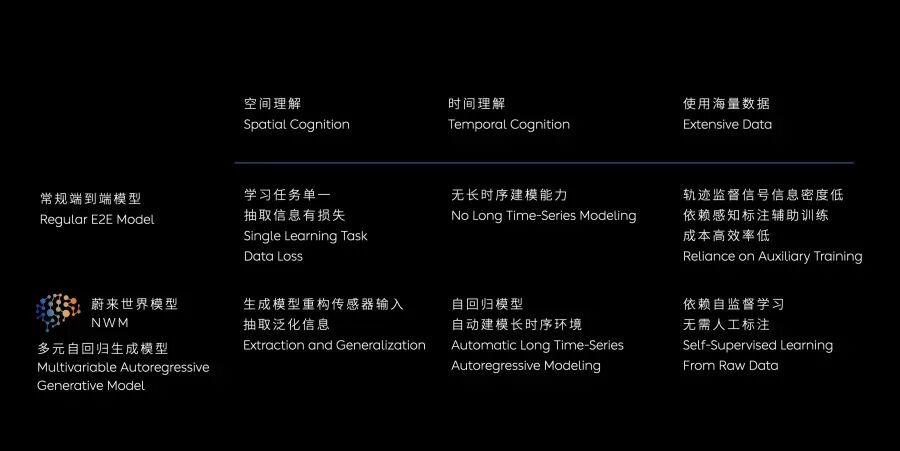
NIO even put forth the vision that "a successful intelligent electric vehicle company must be a successful AI company."
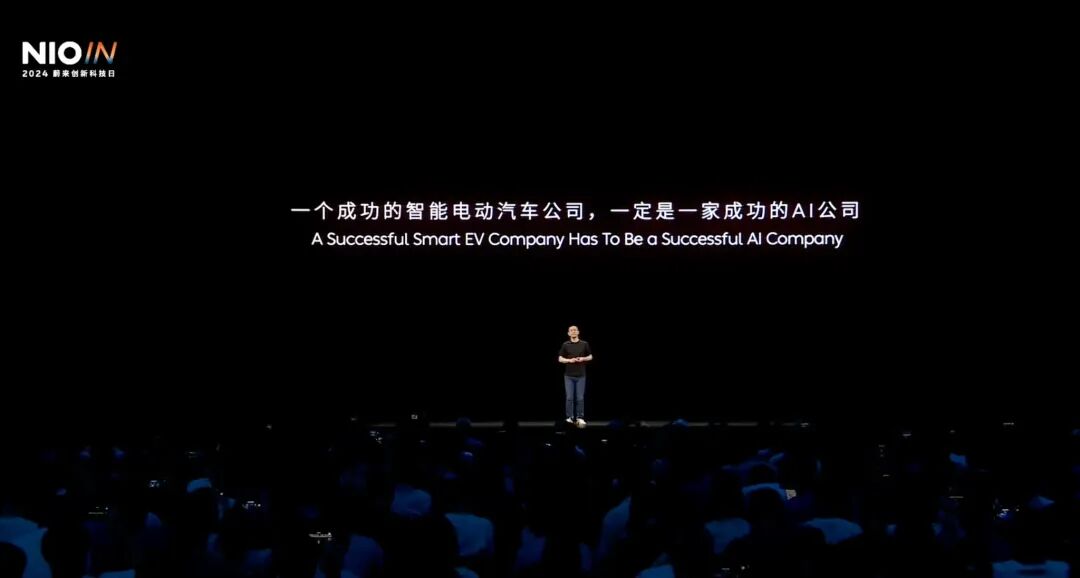
NIO claims that NWM can simulate 216 possible trajectories in 0.1 seconds to find the optimal decision. Then, in the next 0.1 seconds, based on external information input, it repeatedly updates its internal spatiotemporal model and predicts another 216 possibilities. This loop continues, following the driving trajectory with ongoing predictions to arrive at the optimal driving solution.
NIO's "intelligent driving architecture NADArch2.0" upgrades at the algorithm level to an end-to-end architecture incorporating the world model. Many netizens say they await the mass production rollout — however impressive the theory sounds, "hallucinations" in real-world testing don't lie.
Though NIO began independently developing intelligent driving back in 2016, it has remained "relatively conservative" on end-to-end mass production: as of year-end 2024, it had not yet pushed end-to-end driving features to users, lagging behind competitors like Xpeng and Huawei.
Looking at the financials, NIO is still that same NIO — losses barely make news anymore:
2024 financial figures: NIO posted a massive annual loss of 22.4 billion RMB, widening 8% year-over-year. But operating revenue reached 65.73 billion RMB, up 18.2% year-over-year, with cumulative deliveries up 38.7% — the burn-cash-to-sell-cars approach is probably something only NIO can afford to play.
NIO founder, chairman, and CEO William Li once said: "The challenges right now are enormous. Other people's kids have already gotten into college, and we're still repeating a year."
Even amid these massive losses, NIO hasn't abandoned its push to develop high-performance automotive-grade chips in-house. In 2024, it successfully taped out its 5nm intelligent driving chip, the "Shenji NX9031," packing over 50 billion transistors. It's the industry's first 5nm automotive-grade advanced intelligent driving chip, capable of supporting complex AI algorithms and large-model computations.
NIO's determination to pursue independent innovation on both the algorithm and compute fronts has yet to be shaken by its current circumstances.
Li Auto: Actually, We're an AI Company
Among the new EV players going all-in on AI, Li Auto may well be the most desperate.
Xiang Li, chairman and CEO of Li Auto, said: "From a corporate perspective, Li Auto is actually an AI company."
When he uttered those words, they sent ripples through the industry. People were either puzzled or electrified: Where exactly is the AI gene in Li Auto?
When it comes to advanced intelligent features, Li Auto undeniably got a later start.
In the first half of 2024: highway NOA became widespread, and urban NOA began shifting away from high-definition maps. It's equally undeniable that, while still trailing Xpeng Motors for the moment, Li Auto is sprinting hard and making rapid progress.
At Li Auto's intelligent driving launch event in July 2024, the company showcased its HD-map-free NOA capabilities and its next-generation intelligent driving technology architecture.
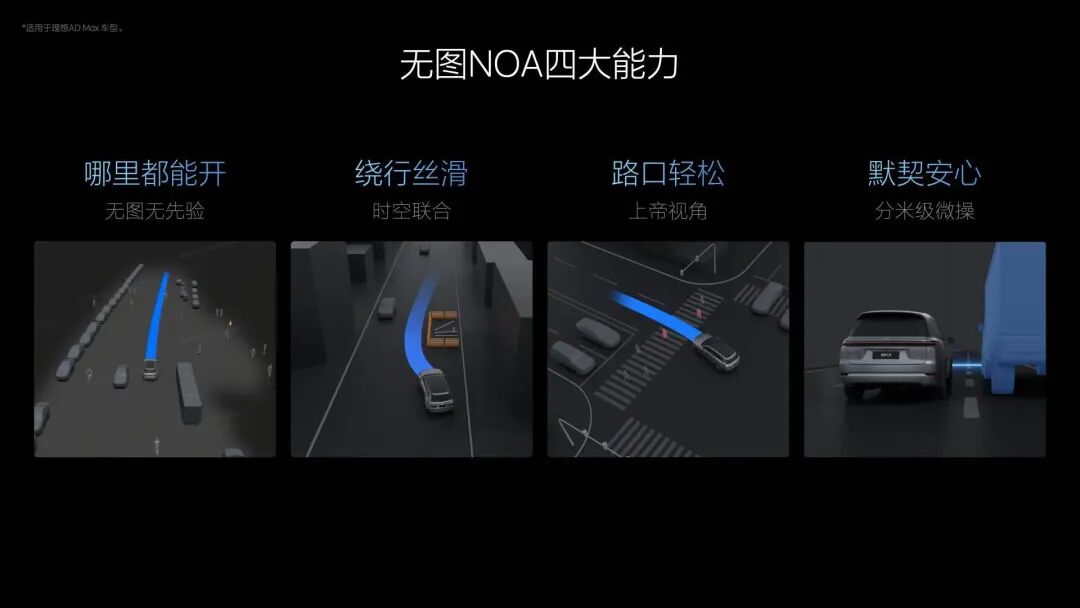
The architecture Li Auto proposed includes: an end-to-end intelligent driving model on the vehicle side, a large-scale vision-language model (VLM), and a cloud-based reconstruction and generative world model.
This means Li Auto is attempting to empower autonomous driving with multimodal large models and generative AI technology.
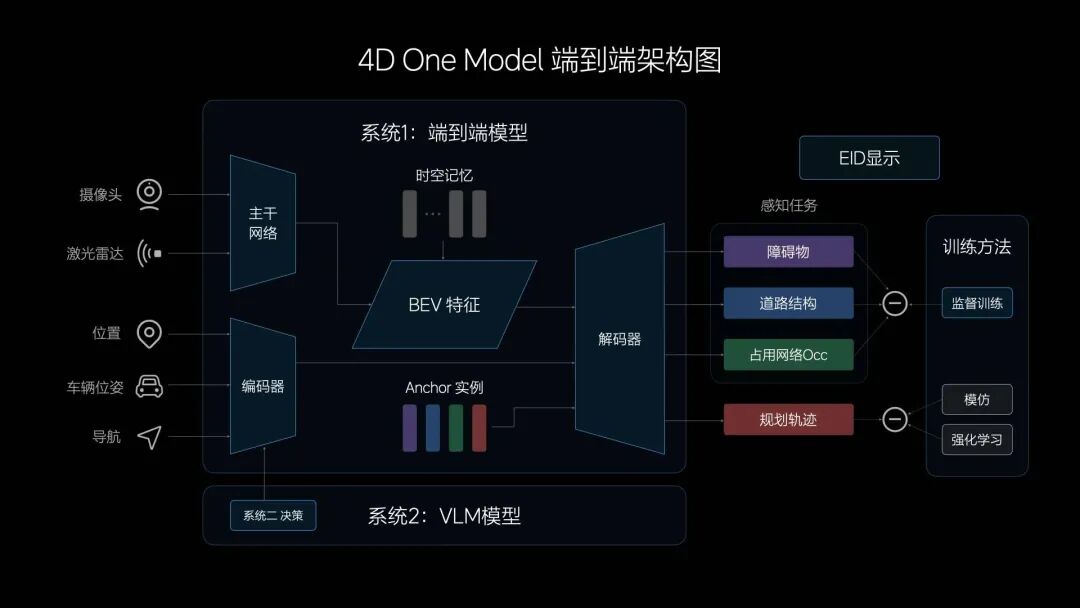
The end-to-end model focuses on handling routine driving behavior, generating driving trajectories directly from sensor inputs through a single model — optimizing information transmission, inference computation, and model iteration efficiency to make driving behavior more human-like.
Meanwhile, the VLM vision-language model demonstrates exceptional logical reasoning capabilities, able to comprehend complex road conditions, navigation maps, and traffic rules, effectively tackling high-difficulty unknown scenarios — effectively serving as a higher-level decision-making brain.
Xianpeng Lang, head of Li Auto's intelligent driving department, revealed in an interview that Li Auto has already begun pre-research on L4-level autonomous driving technology.
CEO Xiang Li also publicly stated that with technological evolution and increased computing power, unsupervised L4 autonomous driving could be achieved within three years.
On March 18, 2025, at NVIDIA GTC 2025, Li Auto officially unveiled its next-generation autonomous driving architecture, MindVLA.
This architecture integrates end-to-end models, vision-language models (VLM), and world models, aiming to drive the realization of L4-level full autonomous driving.
MindVLA fuses spatial intelligence, language intelligence, and behavioral intelligence through a unified model architecture, endowing vehicles with powerful 3D spatial understanding, logical reasoning, and behavior generation capabilities — enabling them to perceive their environment, think, and adapt to dynamic scenarios.
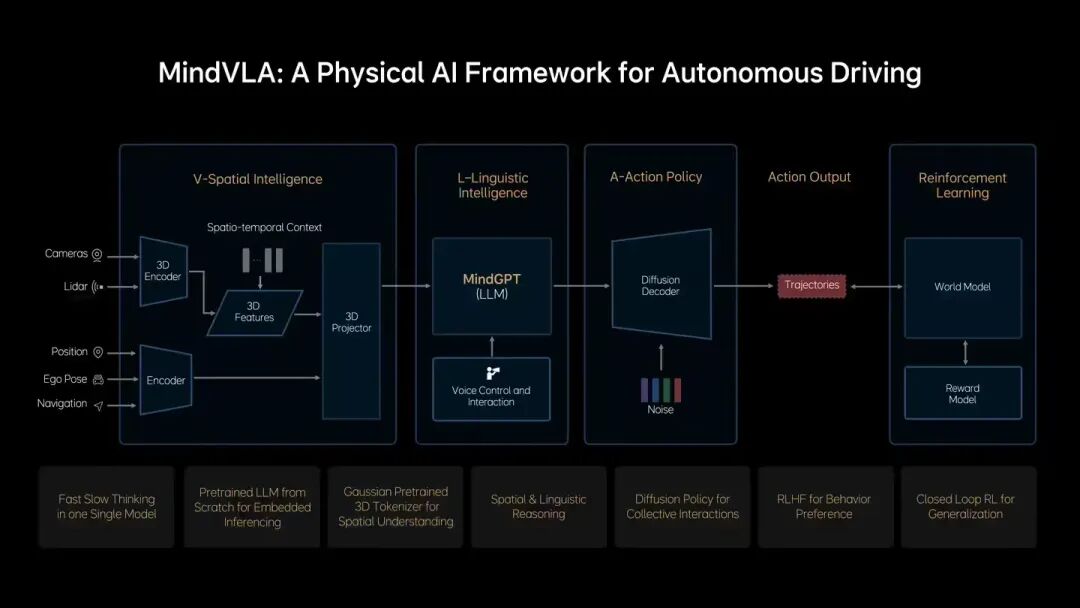
Xiang Li, founder, chairman, and CEO of Li Auto: "MindVLA is a large vision-language-action model, but we prefer to call it a 'robot large model,'"
AI doesn't seem to have made any single automaker stand out; instead, it has democratically pulled everyone into another competitive event.
Peng Jia, head of autonomous driving technology R&D at Li Auto, stated that Li Auto's self-developed VLA model — MindVLA — will transform cars from mere transportation tools into "attentive dedicated drivers" that can understand, see, and find their way.
"We hope MindVLA can endow cars with human-like cognition and adaptability, transforming them into thinking intelligent agents."
Jia's remarks signal that Li Auto has developed a new vision for its autonomous driving architecture, and AI technology is reshaping every corner of this company at an unprecedented pace.
MindVLA is considered a crucial building block on Li Auto's path toward L4.
I find it fascinating that most people haven't realized: "The Year of Intelligent Agents 2025" seems poised to make waves in the auto industry.
Li Auto's ambitions are grand, but its 2024 financials can support this macro-level vision: revenue hit another record high, exceeding 100 billion RMB at 144.5 billion, up 16.6% year-over-year; 2024 net profit reached 8 billion RMB, down 31.9%.
In the intelligent driving "battlefield" where competitive intensity only keeps increasing, these numbers are already fairly decent.
However, in Q1 2025, Li Auto expects revenue of around 24 billion RMB, which would represent an 8% year-over-year decline.
As an "AI" company, Li Auto has already won itself a seat at the table, but achieving the goal of "unsupervised L4 autonomous driving within three years" remains fraught with difficulties.
Leapmotor: Catching Up at Remarkable Speed
As the "budget player" in AI intelligent driving, Leapmotor has paradoxically become the lowest-profile one.
While competitors frantically push advanced intelligent driving on 300,000 RMB vehicles, Leapmotor has been exploring the democratization of advanced intelligent driving, bringing lidar and high-end intelligent driving features down to the 100,000–150,000 RMB price segment.
However, in the smart vehicle track where sticker prices have lost their predictive power, the rollout of cutting-edge AI technology has become the next arena for capturing attention. And in this arena, Leapmotor has been somewhat slow.
From 2019 to 2023, Leapmotor's cumulative R&D investment over five years was just 4.7 billion RMB.
In 2024, although R&D expenses increased to roughly 3 billion RMB, a large portion of this still went toward improving old platforms, with only a small share dedicated to exploring new architectures. On the talent front, Leapmotor's intelligent driving team did expand significantly, growing from 200 people at the end of 2023 to roughly 500 by the end of 2024.
Yet a team of 500 pales in comparison to competitors' teams that routinely number in the thousands. Moreover, in the second half of last year, Leapmotor's dedicated end-to-end R&D team numbered only about 10 people.
This is visibly reflected in Leapmotor's slow progress on end-to-end architecture. For context, in 2024, NIO's R&D investment reached 13 billion RMB, while Leapmotor's was just 2.9 billion — roughly one-fifth of NIO's.
In 2024, Leapmotor explicitly announced it would follow Tesla's end-to-end intelligent driving technology route, aiming to build a seamless system from sensor input to driving decision. No specific mass-production timeline was announced at the time.
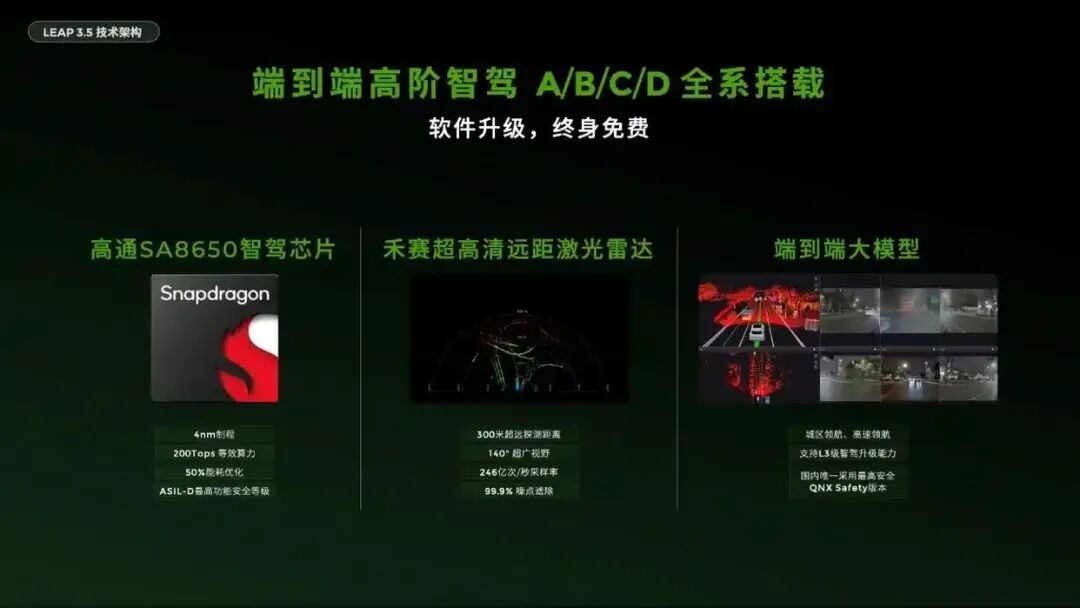
This March, Leapmotor's end-to-end architecture finally debuted, beginning testing in Hangzhou's most complex core West Lake district,主打 "首发 15 万级,'激光雷达 + 端到端' 智驾方案" — lidar plus end-to-end intelligent driving for under 150,000 RMB.
In April, the 100,000 RMB-range Leapmotor B10 officially launched, with its 510 lidar intelligent driving variant already equipped with an end-to-end large model.
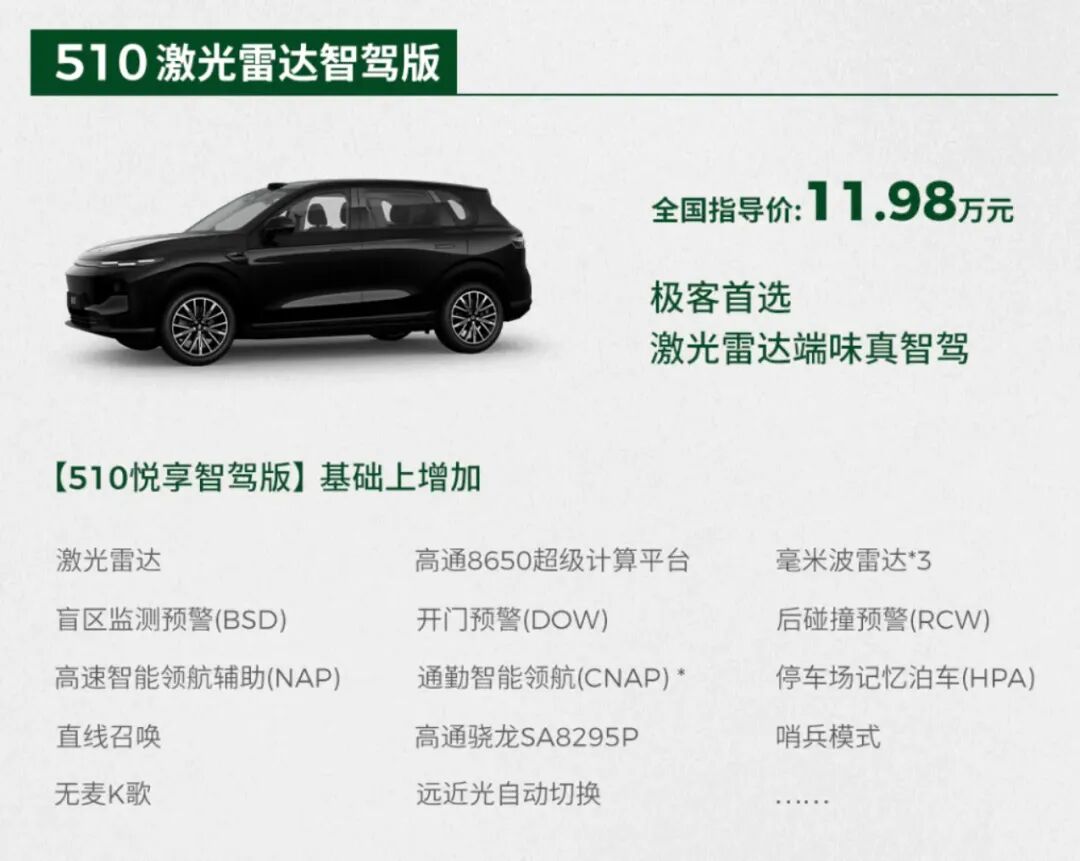
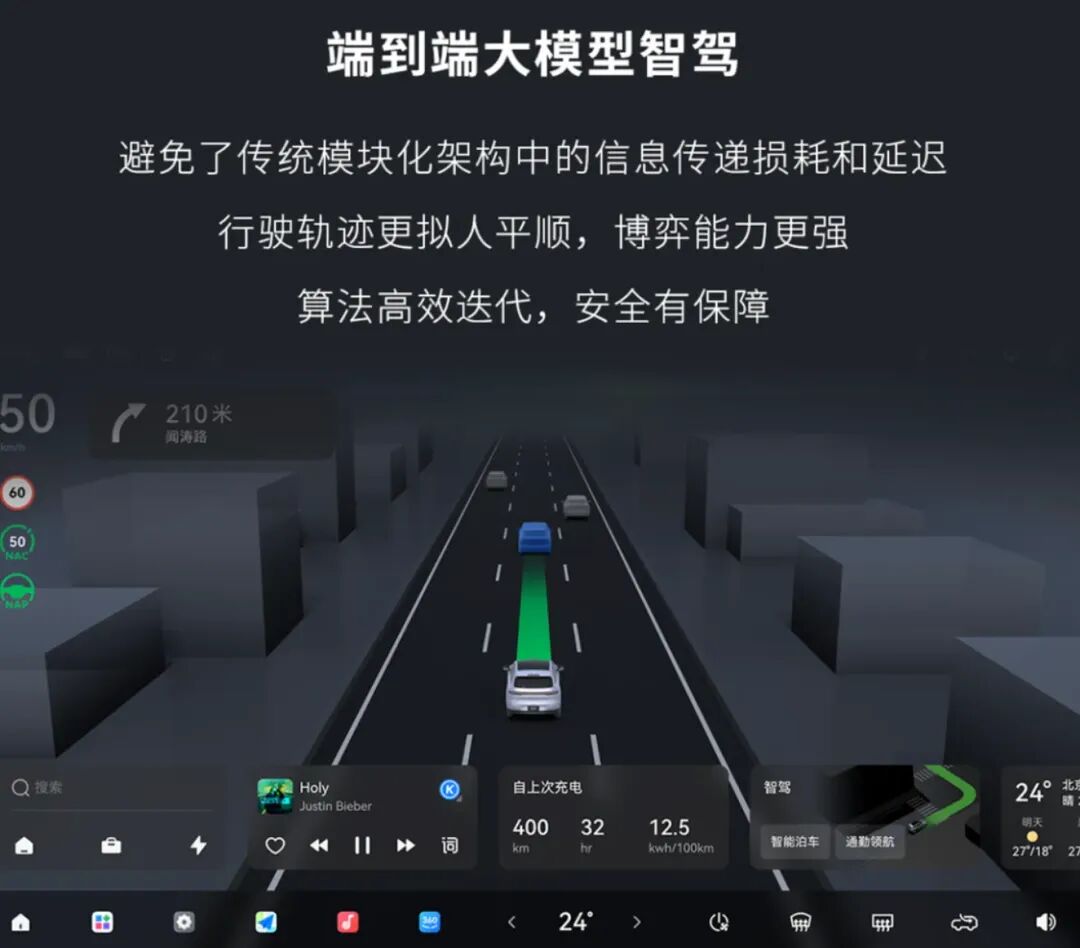
Standard lidar and end-to-end intelligent driving for under 150,000 RMB shocked the market once again, also marking Leapmotor's move to target the 150,000 RMB intelligent driving experience segment — a niche battlefield they can call their own.
Of course, how long this current "blank budget zone" can last is hard to say.
Zhu Jiangming, founder, chairman, and CEO of Leapmotor Technology: "Since last year, we built an end-to-end intelligent driving system in just five or six months. We hope to push urban NOA in Q3 and achieve point-to-point intelligent driving from parking space to parking space next year."
Taken together, no one at the "bloody battle scene" is willing to fall behind.
This also illustrates, from another angle, that the moat from deep AI integration into automotive intelligent driving isn't that deep — we'll once again witness the "LLM development dynamic, where everyone becomes each other's ouroboros."
Leapmotor's 2024 financial performance was exceptionally strong: full-year revenue reached 32.16 billion RMB, up 100%; net losses narrowed 33% to 2.82 billion RMB; Q4 achieved single-quarter profitability of 80 million RMB with a gross margin of 13.3%.
Leapmotor's core strategy is "trading volume for profit" — rapidly capturing market share through high-value-for-money models, then relying on economies of scale to reduce costs. In 2024, Leapmotor's sales surged 103.8% year-over-year, far outpacing the Wei Xiaoli trio.
The routinely "underestimated" Leapmotor is starting to accelerate.
Through the "democratization of advanced intelligent driving technology," the mindset of "AI equality" has already been planted in the market and taken root.
Strong financial figures will become Leapmotor's accelerant on the AI battlefield.
Xiaomi: The Ultra-Aggressive Player
As a tech giant crossing over into auto manufacturing, Xiaomi has brought its technical advantages in consumer electronics and AI into the automotive industry at a "radical" pace.
On March 28, 2024, it officially launched its first electric vehicle — the success of the Xiaomi SU7 quickly freed Xiaomi from the label of "automotive newcomer."
As early as December 2023, at Xiaomi's annual product launch, Lei Jun previewed the SU7 prototype and declared Xiaomi's commitment to building cars. The SU7 was positioned as a mid-to-high-end sedan with advanced intelligent driving capabilities as standard.
Lei Jun stated: "Intelligent driving is the decisive battlefield for smart EVs."
To develop full-stack self-driving technology in-house, Xiaomi invested massive capital and resources, aiming to break into the industry's top tier by 2024. On the team and technical front, Xiaomi assembled a large-scale intelligent driving R&D workforce to achieve its "aggressive autonomous driving goals."
By early 2024, Xiaomi Auto's intelligent driving team had already surpassed 1,000 people, with plans to expand to 1,500 by year-end. Thanks to this human and capital investment, industry observers described Xiaomi's R&D progress as "extremely aggressive and high-speed."
At the 2024 Guangzhou Auto Show, Lei Jun formally introduced Xiaomi's Hyper-Autonomous Driving system — HAD, announcing that internal testing would begin on November 16.
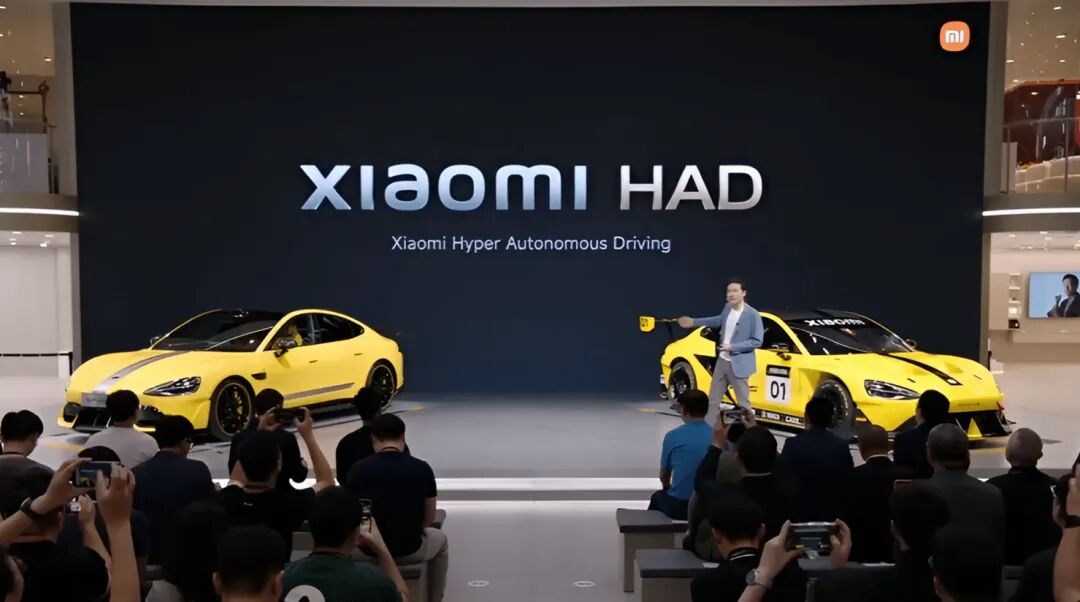
Xiaomi said the system can handle complex environments, including narrow spaces, busy intersections, and roads with obstacles. By integrating a Vision-Language Model (VLM), it processes challenging scenarios like uneven road surfaces, construction zones, and T-junctions more effectively.
Looking back at 2024, the "super-aggressive" Xiaomi did deliver on its promise to join the top tier. Though it started relatively late in intelligent driving, Xiaomi's strong execution and innovative DNA are undeniable.
Over the past few years, Xiaomi's intelligent driving system successfully completed a technical evolution from "HD maps + modular architecture" to "map-free + modular architecture," and finally to "end-to-end architecture."
By February this year, Xiaomi's end-to-end full-scenario intelligent driving feature had already rolled out to all users.
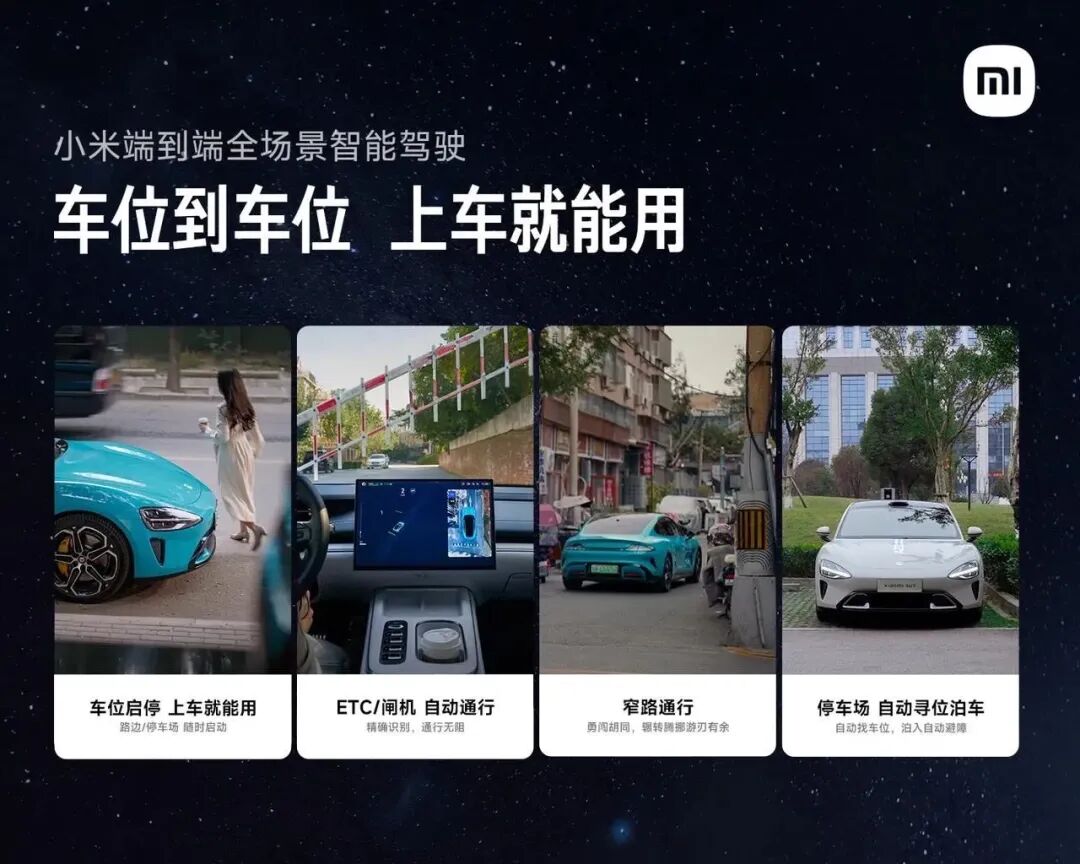
The core of the Xiaomi HAD system is a three-layer physical world modeling framework:
- Perception layer: HD cameras, millimeter-wave radar, LiDAR, and other sensors enable comprehensive awareness of the road environment
- Decision layer: Large-model technology understands complex traffic scenarios, predicts other road users' behavior, and makes safe, efficient driving decisions
- Control layer: Precise vehicle control algorithms translate decisions into smooth, comfortable driving operations
Another major advantage for Xiaomi Auto is its massive smart ecosystem: the Mi family's technical support across different scenarios provides ample foundation for converting Xiaomi's AI technology into automotive services.
It's fair to say Xiaomi's AI-powered cars have already achieved: end-to-end deep learning, full integration of human-vehicle-home ecosystems, balance between technological innovation and cost-performance, and an open ecosystem with user participation.
As a consumer electronics innovation giant entering the AI auto space, Xiaomi's precise grasp of user needs and experience has made it an "industry rising star" — and the "early bird that gets shot at."
🚥
When EV startups play the "self-developed AI end-to-end large model" card and constantly emphasize in-house R&D, they're effectively anchoring their products to AI and binding cutting-edge tech iteration to user mindshare. In doing so, end-to-end architecture and AI technology become the "line between life and death" on the technical side, while also pushing themselves into deeper, more treacherous waters.
A simple example: automakers are now competing across the board on self-developed compute, algorithms, and data. L3 autonomous driving technology isn't even fully mature yet, and L4 is already a strategic target.
The AI-driven intelligent driving battle is far from over. Here's hoping the EV startups of tomorrow continue breaking through technical ceilings.
References:
- Dingjiao One, "New Players Don't Dare to Hype Intelligent Driving This Year"
- Weibo Tech, "Xpeng Motors 2025 New Year Letter: Major New Products and Refreshes Almost Every Quarter"
- Hibor Information, "Huawei Intelligent Driving Deep Dive: Business Model, Partnerships, Supply Chain, and Related Companies"
- China Securities Journal, "Li Auto Revenue Hits Record High, Net Profit Declines"
- Qingcheng Finance, "Leapmotor 2025: Intelligent Driving Race Against Time"