How to Become a Less Anxious CEO: A Conversation with Maozhu on Duozhuayu's Eight Years, Darkest Hours, and New Plans

Dejavu Founder Cat Zhu's Eight-Year Transformation
A few days ago, a friend in our listener group mentioned that listening to Crossing makes them feel anxious. They're already exhausted from work, and they'd rather use their commute to relax with music. To this friend, and to anyone who feels similarly: we completely understand, and to some extent, we're the same way.
Our friends, our colleagues — most people feel some anxiety about AI-related news, this sense that they need to keep up. That's partly why Crossing hopes to do more content this year around "standing at life's crossroads and making choices." We want more people to see that in this era, there are many different ways of engaging with information.
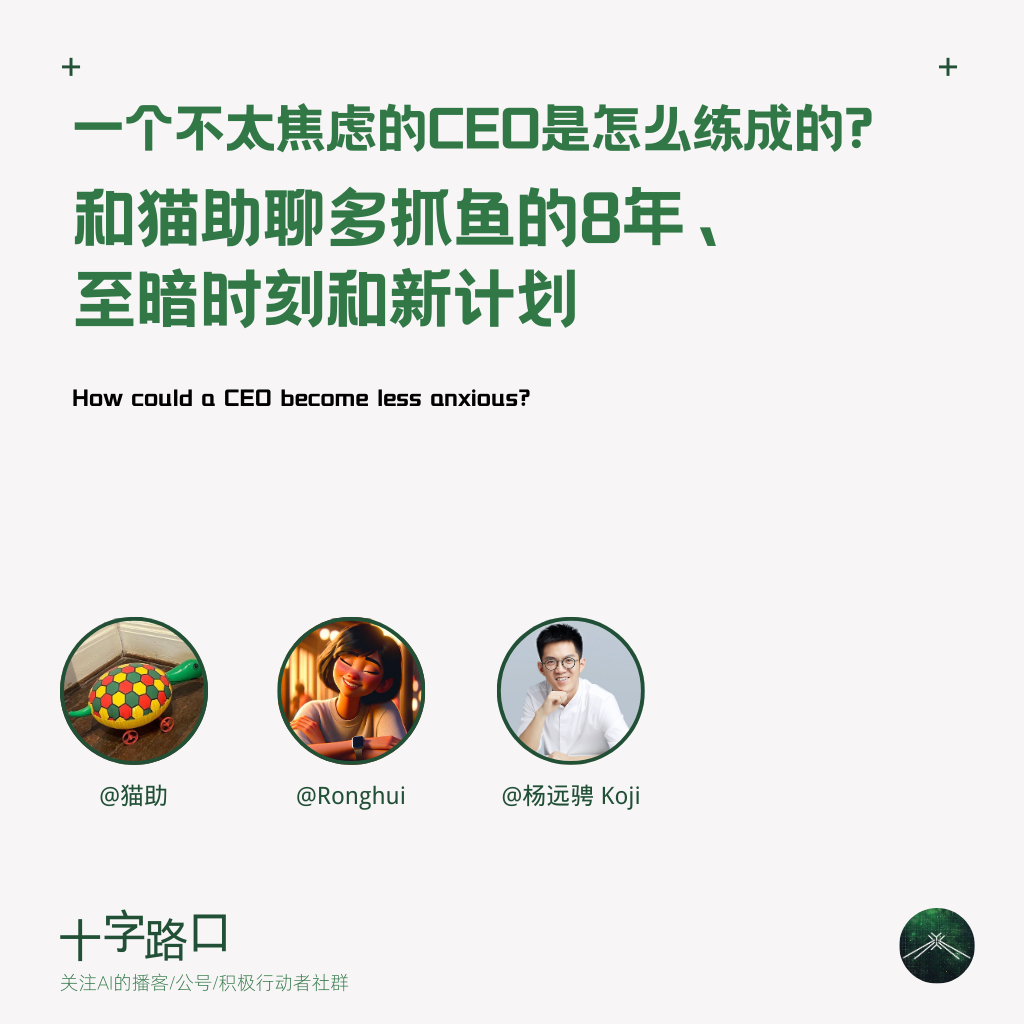
Today's guest, Mao Zhu, founder of Deja Vu, offers one such approach to AI — her own way of "opening the door" to it. In this episode, we talk with her about how Deja Vu thinks about using AI, her personal experiments with it, and how the "elites" she observed at a recent Harvard leadership program discuss AI.
But what we found more valuable is what she shared about her eight-year journey from inexperienced founder to someone transformed and at peace with herself, through team changes, the loss of loved ones, and the pressures of running a company. It's an entrepreneur's coming-of-age story, and also a retrospective on one person's pursuit of happiness.
At the end of the episode, Mao Zhu says she's a CEO who isn't particularly anxious about AI. Of course, this has something to do with the nature of Deja Vu's business. But more than that, it seems to stem from the self-acceptance born of all the experiences and perspectives she shared. We hope this episode can pass her story and insights along to more of you.
Listen on WeChat:
Listen on Xiaoyuzhou:
Deja Vu's Entrepreneurial Journey
🚥 Ronghui
Mao Zhu, could you start by briefly introducing your background for those who aren't familiar, and give an update for those who are?
👧🏻 Mao Zhu
My past eight years have been relatively monotonous — mostly focused on building and developing Deja Vu. My entire thirties, it seems, went into this one thing.
There have been some recent personal changes. In the two to three years since the pandemic ended, my husband and I started living apart — he went to Japan while I stayed in China. This is the first time in my life I've lived alone, which has been personally significant, though not exactly a professional experience (laughs).
For those who've used Deja Vu, you probably know we're a platform for secondhand books and clothing. Recently we've expanded into toys, children's clothes, outdoor gear, and we plan to get into furniture down the line. Overall, we're not focused on luxury goods or asset transfers, but everyday items — clothes, books, toys. I often joke that we're a "tech-powered junk collection company."
I believe these everyday items actually have the biggest impact on environmental problems and waste from idle goods. Few people casually discard Chanel or other luxury items, but can ordinary clothes — say, from UNIQLO — be reused? That used to be genuinely difficult. Similarly, books were mostly recycled into pulp; only out-of-print titles continued circulating. We wanted to change that.
We've recently discovered many advantages to offline retail, and Deja Vu is transitioning from a purely online platform to physical stores. Some scenarios simply can't be solved online, both in terms of experience and cost. For example, if we wanted to sell small home goods, the cost of describing them in detail online with complete photos would be extremely high. Offline, customers can just browse in person and immediately get the full sensory experience of the physical item — something online can't replicate.
We hope Deja Vu's stores can become a kind of general store where young people new to Shanghai or Beijing, with limited salaries but unwilling to settle for a makeshift life, can find what they need for both their spiritual and material lives. That's the direction we're pushing toward now.
AI Technology and Business Applications: The Reality of Cost and Effectiveness
🚥 Koji
While you've been running Deja Vu for eight years, the company has certainly gone through many changes. You started with just books, and now you've expanded from spiritual life into material life.
As an AI-related podcast, I'd like to ask: It's been about two to three years since ChatGPT launched. Have you thought about how to apply AI technology to Deja Vu's business?
👧🏻 Mao Zhu
We have explored various AI applications. Our search system currently uses vector models, which have improved recall accuracy compared to before. In clothing categorization, our team has been using Alibaba's models, trying to identify product types directly from images. But in all business applications, the ultimate consideration is cost.
We once envisioned a scenario:
In reality, readers rarely search for one specific book. More often, they do fuzzy searches.
For example, they want to learn about a certain topic, like "Tang dynasty history" or "Chinese history" — which are popular search terms on our platform. They just want a book that can introduce them to that field.
However, virtually all books are written from the author's perspective, not the reader's. Even when authors claim to write for the market or for readers, the actual creative process is still driven by their own vision. They can't organize content according to each reader's knowledge level and interests. This is one reason why many books go unfinished.
We considered training on all book content — summaries, tables of contents, abstracts, and so on. By analyzing a reader's purchase history, we'd understand their knowledge level, and when they searched for "Chinese history," the system could provide relevant general-knowledge summaries and recommend appropriate books based on their level. Would this be more effective than traditional search?
We spent much of last year thinking about this. The key challenge was high cost versus actual effectiveness. We ran an experiment using our cat mascot as a virtual librarian, claiming it had mastered the knowledge of a million books. Users could consult this "Cat Librarian" — for example, "I'm a freshman and want to learn about Chinese history. Please recommend some books."
Interestingly, we found that answers provided by human operators (the "person behind the character") received high user satisfaction. The operators would check the user's profile to understand their purchase history, gauge their knowledge level, then find suitable books from the backend database (which is more complete than the frontend data) and recommend them. They could also add personalized language tailored to the user — for instance, using more professional phrasing for academically inclined users.
But when we tried replacing this with an AI model, the results were unsatisfactory. The model could only perform basic recall — finding relevant books — but fell far short of human operators when it came to recommending and explaining the value of these books to users. AI struggles to accurately profile users based on just 1-10 books they've purchased. That's the challenge we're currently facing.
👦🏻 Mao Zhu
Regarding the gap between AI applications and traditional methods, while I'm not a technical expert, our practical experience points to two main issues.
First, AI applications for C-end users are very limited in terms of engagement or fun. Second, from a cost perspective, the quality of these applications isn't yet sufficient to support commercialization, and users aren't particularly willing to pay for book recommendations and such services.
These applications can only provide higher satisfaction on top of existing free services. Achieving the kind of quality that would increase revisit rates or word-of-mouth is quite difficult, while requiring significant investment.
By comparison, traditional search or operations provide author-oriented content. While not highly personalized, working through this process changed some of my preconceptions: most people don't actually need highly customized services. They just want to know "what's the best one on the market" — "which novel is the best written," "which history book is the most authoritative." That's all.
And the users who truly need personalized service — people like me who subscribe to ChatGPT Plus — tend to be content producers, not pure consumers. We use AI to draft content, conduct analysis, and so on. If we consider individual producers as B-end users, then AI is indeed a productivity enhancement tool, not an entertainment experience enhancement tool.
On the B-end side, we are using AI, as in the scenarios I mentioned earlier. But on the C-end side, after trying for a long time, we couldn't find suitable applications, so we're currently in a kind of semi-paused state (laughs).
For now, AI mainly helps me write copy and product documents more efficiently, or helps non-technical product managers gain junior engineer capabilities. At its core, it's still a productivity tool.
The Limitations of Chinese Content Digitization and the Value of Out-of-Print Books
🚥 Ronghui
I'd like to ask a market observation question. In the past year or two as AI has become more widespread, have you seen any significant changes in your book transaction data?
For me personally, one of Deja Vu's great values is being able to buy books that are hard to find elsewhere, but now it seems AI can provide that kind of material.
👦🏻 Mao Zhu
Actually, the situation in Chinese is quite different from English.
The digitization of quality Chinese-language content is far lower than we imagine. Many materials don't even exist as PDFs, and when they do, they're often scanned images rather than text.
As a result, for purely Chinese-domain knowledge, the quality of AI responses is generally poor.
For example, early iterations of GPT couldn't even explain the "Twelve Beauties of Jinling" correctly, often mixing in characters from web novels — a clear reflection of training data limitations.
For scarcity created by knowledge barriers, particularly books imported from the English-speaking world, the situation is indeed different. These books aren't scarce abroad; they've simply had their supply artificially restricted in the Chinese market.
The publishing industry has taken a significant hit in the past two years, but I don't think AI is the main cause.
From my personal usage habits, AI has completely replaced my time on Google and Wikipedia. Aside from searching specific websites, I hardly use traditional search engines anymore.
The book market has actually weathered multiple rounds of shocks. First came the death of reference books like dictionaries and atlases, then fiction took a hit from web literature. The remaining market space was already limited, and with the overall decline of the publishing industry in recent years, things have only gotten tougher.
For pure knowledge-acquisition needs, AI does offer a more convenient approach. If you just need to look up a few facts, using a large language model is undoubtedly the fastest route — no waiting for delivery, no flipping through pages. But for deep, academic, or meticulously produced books, I don't think demand has changed much; rather, supply is shrinking.
Out-of-print books are a particularly acute problem. Over time, these books become increasingly scarce. They keep getting bought and collected, yet can't be reprinted, so supply keeps dwindling. We've tried reissuing some out-of-print titles, but face numerous challenges. ISBNs in China are expensive, while the market for an out-of-print book might only be a few thousand people — not enough to cover publishing costs. Publishers typically ask, "Why print a book that can't break even for just two thousand readers?"
We've also considered digitization or using book content to train models, so users could access information from authoritative knowledge bases. Similar attempts include projects that connect to academic paper databases to provide AI responses. But these projects face a common dilemma: high costs, low user demand, low willingness to pay — making a sustainable business model difficult to achieve.
The state of China's publishing industry is genuinely embarrassing. Every time I visit Japan or the United States, I envy their publishing freedom. There, whether it's a single sheet of paper or a simple folded leaflet, you can apply for an ISBN and sell it for $10–20. This market freedom might look like inefficient waste from a planned-economy perspective, but it genuinely fosters more innovation and new things.
Some books I've recently found in the US are outstanding in layout, printing, and overall quality. They're not cheap — typically $20–30 (roughly 200 RMB). By contrast, it's hard to find similar practical books in China that combine economic development with environmental practice and aren't boring.
I've bought many such books — ones about how coastlines have changed throughout history due to climate effects, about rural school buildings, and so on. These richly illustrated, solidly researched books are niche abroad but can sustain a high-price, small-audience business model. Yet this model is nearly impossible in China, which is the universal dilemma facing out-of-print books.
I'm currently compiling Deja Vu's out-of-print book inventory, because physical books really are becoming fewer. I plan to build a lending space in Beijing for Deja Vu's longtime users, collecting out-of-print books in several fields I consider valuable — content that's hard to access through other channels and is of high quality. It will mainly cover popular science, economics, sociology, anthropology, history, historical evidence, and documentary literature.
I hope to create a real space for knowledge in the physical world, avoiding the generation of even more fictional content from already fictional information.
🚥 Koji
So you have some out-of-print books that even the National Library doesn't have?
👦🏻 Mao Zhu
The National Library certainly has these books too. But I think curation has become especially important now.
As a user, you're completely at a loss when facing a collection of nearly ten million volumes. The truly valuable work is telling you: "In this field, these few out-of-print books are exceptionally good — even better than what's currently on the market." Helping you narrow down the screening work from tens of millions to a few thousand — that's an enormously valuable service.
This reminds me of a point about changes in information supply. Our generation of post-80s grew up in an era of information scarcity. We were talking earlier about childhood cartoons — there were only a few, and you'd watch each one over and over because there were no other options.
🚥 Koji
Right, to buy a new magazine, I'd make three or four trips. It came out on the 15th, and I'd start going on the 12th, hoping to get it a day earlier.
👦🏻 Mao Zhu
Yes, the human brain is extremely hungry for information. But now we've entered an era of infinite information supply.
Today, the more valuable work isn't generating information, but screening out content from the entire ocean of human history that still has value for the future, for you. This screening process may be more labor-intensive than generating information.
I recently did a data screening exercise. Starting from a pool of roughly 20,000 candidate books, after coarse filtering maybe 10,000 remained. After careful selection, only a few thousand were truly worth rereading and reissuing. The rest, though out of print, might only suit certain niche audiences.
Some books are hyped to high prices online, but the information they contain isn't actually scarce on the internet — it's just that some older users are accustomed to reading physical books. I won't include these. What I pursue is content with fair, objective value.
Nowadays, the so-called "curator" role is becoming increasingly important — people who help block out ineffective information are more critical than ever.
🚥 Koji
So this out-of-print library you want to build in Beijing also has curatorial qualities.
👦🏻 Mao Zhu
Exactly. We've already secured a space in Langyuan — a two-story building there.
I want to use the first floor to display some new books and publications that would be hard to become Douyin hits but are genuinely good quality. It's actually quite sad that many new books now only need to sell 2,000 copies to be considered bestsellers. Some small publishing brands import works with careful translation and fine production, but because the content is slightly too deep and doesn't lend itself to marketing hype, they often fail to get attention.
The first floor might showcase the quality new publications we believe in, while the second floor would serve as a reading center for out-of-print books. I'd also like to collaborate with CNPIEC (China National Publications Import & Export Corporation), because I have fairly broad horizons in publishing. I travel abroad frequently and know about good recent books in Japan or the English-speaking world. Some don't violate our import policies at all — they're simply too niche to have entered the view of domestic publishers. If we could bring them in through CNPIEC, it would also broaden Chinese readers' horizons.
In today's era of information explosion, what's truly precious and limited is consumers' time.
We may only have two hours a day for reading and information acquisition. If we rely solely on feed recommendations, it's hard to genuinely broaden our horizons. How to break out of algorithm-recommended circles and discover another world — this kind of horizon expansion very much needs the guidance of professional editors.
I've noticed that when China imports English books, the focus tends to be only on already-popular hits, and not even high-quality new publications. Recently I attended a course in the US and visited some bookstores. I found that many new social science books there have a certain slant — exploring topics like "why the world is shifting rightward" or "why being politically nasty makes winning easier" — themes that seem rarely noticed domestically.
This information gap surprises me: people think translation is no longer important, that information is all within easy reach. But I believe translation penetration remains very low.
The biggest barrier to information isn't the firewall — it's browsing inertia. People are constrained by their own reading habits, unconsciously shutting out vast worlds of information.
Business Logic and Entrepreneurial Choices: Decisions Grounded in Personality and Interest
🚥 Koji
Speaking of doing Deja Vu for eight years, listening to you, I actually find it quite enviable.
For projects started in 2015–2016, not many last six months, let alone eight years with increasing stability. Though we're an AI podcast, we're all entrepreneurs here, and before AI entrepreneurship we were all looking for various startup opportunities. I've done content, marketing, and consumer goods myself.
I'm curious — what do you think you got right, or what correct thinking led to this venture surviving eight years and growing healthier?
👦🏻 Mao Zhu
Personality matters enormously, and it becomes more apparent with age. When young, you might think knowledge and skills matter more, but I increasingly believe personality determines a lot.
I'm a tortoise, not someone who acts particularly fast. No matter what I do, I think for a long time first. When I did marketing projects before, even when I appeared confident, that confidence came from having already turned things over in my mind countless times. If an idea isn't mature, I tend not to go public with it.
When I used to do content marketing, I might write dozens of versions of a creative concept, feel "this still isn't right," and switch directions to rethink.
🚥 Koji
So before doing Deja Vu, you also thought for a long time about choosing what direction to pursue.
👦🏻 Mao Zhu
Doing secondhand was indeed something I'd always wanted to do — I've talked about this many times before, so I won't elaborate.
But there are many ways to do secondhand. Like playing chess, if this move doesn't work, you try another. However, my cautious personality also brings problems: the company is healthy but develops very slowly.
But I'm someone who highly values work-life balance. The first few years of entrepreneurship already took a physical toll on me — especially when business suddenly exploded beyond control, requiring nonstop crisis management. During COVID we suffered particularly badly. Every day wasn't about creating or growing, but about managing risk: logistics disruptions, warehouse lockdowns, and so on — daily crises. This state is extremely draining. I also don't want employees' career memories to consist only of overtime and documents (laughs).
🚥 Koji
Then what do you hope they remember?
👦🏻 Mao Zhu
I've always told them that the most important thing is the bonds between colleagues.
Who you meet in your work, what skills you learn that will serve you for life — these are what last. Money and performance eventually fade, but what you gain here, whether new skills or clearer self-knowledge, is what's most valuable.
🚥 Koji
Do you think employees buy into this philosophy? When young people today hear a boss say something, their first reaction is often to judge "is this PUA?"
👦🏻 Mao Zhu
I think this is entirely consideration from their standpoint, so it should still be persuasive.
This shows in how many people start businesses after leaving, and in how easily employees form tight friendship circles. Whatever they go on to do, they can form small circles of mutual appreciation — I think this is quite meaningful.
A company's public duty also shows up in how it serves users. When users complain about poor service, I genuinely feel ashamed and pained. It's a difficult triangular balance to maintain good employee compensation, good user service, and healthy business development: you need to pay employees, provide service to users, users pay you, and the company needs to maintain cash flow and healthy growth. This is hard to solve perfectly — you can only keep adjusting.
For instance, some users said our book acquisition range wasn't broad enough. It's true that some books we acquired were hard to resell (laughs). I ran into this myself when selling books. Some books are excellent but too niche — the cost of finding buyers is extremely high.
🚥 Koji
I understand.
👦🏻 Mao Zhu
But you can't reason with users about this. When a user comes to you, you should provide good service.
Sellers want convenience. If you're not convenient, they'll choose someone else. Buyers want authentic goods at fair prices. This is value delivery to users.
Value delivery to employees matters too. Employees come to work, you pay them, they provide service to users. Once employees complete their delivery to users, you need to complete your delivery to them. You can't say that an employee's delivery to users equals your delivery to the employee — that's wrong. So shareholders (who want the company to appreciate as an asset), employees, and users form three stakeholder groups that need constant balancing.
🚥 Koji
So it sounds like you made this choice more from personality and interest, rather than recognizing a blue ocean or discovering some new model?
👦🏻 Mao Zhu
Personality determines how you do things, and what you end up building will resemble yourself. Interest determines what you want to do, and blue ocean markets belong to the realm of interest-driven pursuits.
I must admit I'm very interested in business. What's interesting is, I find many entrepreneurs aren't actually interested in business itself (in my personal view). Especially in to C business. Now we also recognize that to B is a deeper layer. Simply put, it's an interest in social structure — attention to how various groups live, their difficulties and needs.
Many entrepreneurs don't seem very interested in business or society — they're more passionate about invention and creation. That's also fine, just another style of entrepreneurship. I prefer discovering where business efficiency falls short, improving it through new resource combinations, thereby creating profit and continuing to grow.
The secondhand market was indeed a good space at the time. I've always liked secondhand trading, selling various items at stalls since my student days. But back then the market and soil weren't mature enough — China's secondhand goods mostly had to be imported from overseas, because domestic material abundance was limited overall. It wasn't until the first wave of entrepreneurship passed (2010–2013), as product lifecycles progressed, that first-tier city residents began accumulating idle quality items — this demand truly emerged.
This is similar to the foundation of large language models — it requires massive data accumulation. The rise of secondhand trading wasn't just a few people being far-sighted (like Idle Fish's explosion), but rather society developing to a certain level where this kind of service became naturally needed.
The easiest thing would definitely be building a C2C platform — not hard to think of, like the flea market sections on campus BBS. But after studying Idle Fish, I found that transaction efficiency problems in many categories weren't solved. I used to go to Japan often, and I noticed that Japan's largest-scale secondhand trading wasn't platforms, but specialized secondhand chain stores. This trip to the US, I also found that Second Street has opened many physical stores.
This shows there are some links that C2C can't solve, requiring B-side involvement. For example, pricing systems — this is very important, because people lack fair price references, especially in luxury goods. If the market is full of haggling and randomness, efficiency will inevitably be low.
Second is authenticity guarantee. The book industry has more piracy, but ordinary clothing has less counterfeiting. At ZARA and UNIQLO's price points, it's hard to have knockoffs cheaper than UNIQLO.
Third, and also quite critical, is cleanliness of daily necessities. Japan's C2C developed faster partly because overall hygiene habits are better. In China, where a trust-based society hasn't fully formed, people are generally guarded about strangers' items, assuming secondhand goods might not be good enough or clean enough.
So someone needs to guarantee quality and cleanliness. For ordinary users to handle these links themselves is very costly. If a company can process these links intensively at costs lower than individual users — even low enough to cover additional logistics costs (C2C needs one shipment, C2B2C needs two) — it can create value.
🚥 Koji
Yes, and you all use SF Express, so your logistics are more expensive than average.
👦🏻 Mao Zhu
Exactly. As long as the efficiency provided by the middle links exceeds the logistics cost, saving users more overall, users are willing to give up the price advantage they'd get through C2C.
Duozhuayu's user base all highly values their own time.
Researching market prices, cleaning items, finding authentication services — these can all be done if you spend the time. The question is which users consider that time more valuable than the dozen or so yuan saved, and which users are willing to spend several extra hours handling these things to save money.
🚥 Koji
So hearing this part, it sounds very rational, very business-driven.
👦🏻 Mao Zhu
Yes, I really like business.
🚥 Koji
But on the other hand, we know you're also quite the literary type. We're sitting in your attic right now, and on the bookshelf behind you, nine out of ten books require serious effort just to read the titles smoothly. Like The Moral Animal, Anthropological-Ontological History, Political Order and Political Decay, From the Industrial Revolution to the Globalization of Democracy.
I think this is very much what our podcast Crossing has always talked about: at the intersection of humanities and science, great products are often born.
For friends wanting to start businesses now, especially after DeepSeek's release, many listeners' starting point for entrepreneurship is realizing a new technical variable has emerged. This technical variable might bring new scenarios, unlock new opportunities. But when you built Duozhuayu, there didn't seem to be such a major technical variable.
Can you give some advice to friends who want to start businesses today? Many want to start a business but don't know what to do, how to choose.
👦🏻 Mao Zhu
I'm actually afraid of this kind of "wise teacher" segment (laughs). But actually, I did have major technical changes supporting me at the time.
First was logistics — this was very important. Reverse logistics (C2B) wasn't mature then — how to contract with logistics companies, settlement, etc. were all problems. Now it's very mature.
Second was the popularization of high-definition phone cameras, which made taking photos and scanning codes possible. Scanning codes is actually a relatively new thing — Allen Zhang once said "the QR code is the entrance to everything," and that wasn't even ten years ago. Phone cameras were crucial to our business.
Third was bandwidth improvement, though for us this was a secondary factor.
Think about the biggest difference between Idle Fish and Taobao — isn't it that phones can directly take photos and upload? In Taobao's early days, similar to eBay, users needed to buy separate cameras, then connect to computers to upload after shooting. This comes back to user time cost — some people might find this process fun, but most just find it troublesome.
So there definitely were technical changes. My view is:
Look for things that couldn't be realized because costs were too high, and see which new technologies have reduced those costs. This is the first consideration for entrepreneurship.
Very likely you thought of some business model before, but got stuck because one link's cost was too high to operate. If that cost has now significantly decreased, even to the point of being negligible, that's a typical opportunity. Just like many people now want to build indie products because AI has reduced the cost of the programmer link.
If you're doing frontend applications, AI-generated code should be relatively usable. But for a system with complex business logic like Duozhuayu, having AI add new functions on top of existing code is quite difficult.
Financing and Corporate Governance: The Art of Balancing Multiple Interests
🚥 Koji
You mentioned indie development — indeed, today's entrepreneurs no longer think, as they did ten years ago, that starting a business must mean raising VC funding.
I know Duozhuayu raised funding, and after eight years it should be time for an exit. On one hand, is this topic okay to ask about? How should entrepreneurs handle this situation? On the other hand, if you started over, would you still choose to raise funding?
👦🏻 Mao Zhu
First question, about exit — we fortunately haven't faced particularly intense pressure, because we didn't have especially harsh terms. Early on it was mainly USD funds, but I do hope to give shareholders returns. If shareholders don't want to continue, I hope there's a way for them to exit. So far there hasn't been too much pressure in this regard, quite fortunate. If they want to exit, I myself remain optimistic about the company's equity, and would find ways to raise funds.
About whether to choose funding, I think funding isn't just about obtaining capital, but choosing new business partners.
In every round I hoped to raise the minimum amount, but cared more whether the investor could expand my horizons or provide important resources. As mentioned earlier, money will eventually be spent, but those non-monetary capabilities and resources are what hold long-term value — new business opportunities, access to internal information, etc. After all, most information about business in this world can't be transparent, because business is fundamentally about competition. So I think I would still choose to raise funding.
🚥 Koji
Funding is actually a bond that lets you gain more allies.
👦🏻 Mao Zhu
Yes, I remember we first met at an event organized by Keyi. At that time I had never started a business at all. Keyi said to me, "You need to become a mature entrepreneur."
🚥 Koji
When he said this, he thought you weren't mature, right?
👦🏻 Mao Zhu
I definitely wasn't mature (laughs).
🚥 Koji
From then, "you need to become a mature entrepreneur" until now, in what ways do you think you've become mature?
👦🏻 Mao Zhu
To say it is a bit cruel, but Xiaomin once said something that left a deep impression on me:
"Entrepreneurship is always your own thing; people come here to make you successful." Rather than my original naive hope that the founding team would stay together forever, all friends.
In reality, everyone has their own journey — don't confuse these. In the end, people are just here to accompany you for a stretch; this isn't their destiny, it's yours. Don't be too attached to this.
🚥 Koji
This is also a form of maturity.
👦🏻 Mao Zhu
Yes, I hadn't figured this out before. I always wanted to provide employees with generous compensation and good security forever, but during the pandemic I found I couldn't — cash flow was almost depleted, the company was locked down, there was no revenue, we could only spend what was in the account. 2022 was indeed very hard for many businesses.
This made me think: is my primary task to take care of the whole organization, or the social mission the company was founded with, or what the company should bring to me personally? What is most important after all?
🚥 Koji
This is a very soul-searching question. What's your answer now?
👦🏻 Mao Zhu
Now I think the company as an organization has its own mission. I've always been able to understand this, because I did many projects before — content or brands — that later operated independently of me, still existing in the world today, just with many different people running them.
A company is an organism. You design it to survive, to extract resources from the outside world, to produce things that improve its odds of survival. That's my ideal of building a company — designing a self-sustaining organism that can run on its own.
But my personal contradiction is that I grew up quite lonely, and I've always longed for good friends or like-minded people.
🚥 Koji
A sense of belonging.
👦🏻 Mao Zhu
Right. Sometimes it's hard to achieve both at once.
🚥 Koji
This sounds like a conflict between reason and emotion, or between social purpose and personal emotional needs.
How do you reconcile this? Does maturity mean giving up on certain things?
👦🏻 Mao Zhu
I don't think it's about giving up. It's about understanding how the world actually works (laughs). Since I've decided to build this organism called a company, its greatest responsibility is to itself, not to me or anyone else. I might even be replaceable within it, because it's a company, not a private affair.
If I leave one day, can it keep iterating? There are many non-family businesses overseas that constantly change professional managers and shareholders, yet continue operating. That shows their organizational design is successful. My primary goal is to build such a company, because that's what I'm doing — building a company.
🚥 Koji
Just now you mentioned hoping that from the very beginning, especially the founding team, everyone could stay together forever. That stirred up a lot of memories for me.
When I was building Jiepang, in my early twenties, I carried similar idealism or romantic fantasies. Back then colleagues called me "Principal." Everyone felt it was more like a school than a business organization. Now, 15 years later, we're still good friends, forming little groups here and there. The friendships forged then left deep imprints of youth on dozens of people who were part of it.
What I want to explore with you is this: you mentioned the mature enterprise model of professional manager succession, and the irreconcilability between business and personal bonds. When facing this contradiction and completing this transformation, do you have any stories or experiences to share?
👦🏻 Mao Zhu
I believe that for employees, it should be about empowering people, not achieving things.
Employees aren't shareholders, not owners of the company. So with shareholders you talk interests, not the cause itself. But as a designer, how can I empower both myself and the business?
I've fully recognized that I have genuine passion for business and enterprise. My passion is absolutely not in interpersonal relationships — I'm quite clumsy in that regard. My passion lies in designing structures, whether business structures or internal company structures, that can run themselves. I'm particularly enthusiastic about this, so my primary goal is to achieve things.
In the process of achieving things versus empowering people, I make trade-offs. But I won't judge others whose top priority in my venture is empowering people, because everyone has their own pursuits. Of course, there's inner struggle, wondering "why do we think differently now" or "we all said it was for the company's good, but in the end it was for ourselves." Later I figured it out: this is my company.
A company is the collective effort of many people, but as a designed product, who is the designer? Whether the product itself can endure is what matters most to the designer. But I would never judge others for just wanting to make a quick buck — a company does carry multiple meanings. What I want to build is more of an "organization" or a "self-running system." But a company is just a legal vehicle; some people use it simply to gather talent, where the cause is virtual and the people are real. They haven't figured out what to do, they just want to work together, so they register a company first. This is very common too. I don't judge any of it — everyone has the right to use the company as a tool.
The key is to be clear about your first principle. As the designer of the company, is my fundamental goal to achieve things or to empower people? If empowering people, is it empowering others or empowering myself? This role definition is crucial.
When everything goes smoothly, it's all simple — high growth empowers both people and the cause, relationships are good, shareholders are satisfied. But once you hit turbulence and challenges, you discover that all stakeholders' positions are misaligned. Even with the best relationships, goals may diverge. Then what do you choose?
This thought process is agonizing. When I took classes at Harvard University, I was surprised by how much energy they devote to studying these questions. In East Asian culture, such topics are rarely discussed openly. People prefer to say "we have no problems," "we're harmonious," "our company has only positive history." Failed companies are no longer discussed, or people only talk about how wonderful things were, seemingly unwilling to confront the pain.
🚥 Ronghui
The negative stuff.
👦🏻 Mao Zhu
Or rather, the messy stuff. Eastern culture tends to interpret such issues as social maneuvering, or simply categorize people as good or bad.
But in business management, the focus isn't on judging good or bad — it's on analyzing each person's goals, motivations, and interests, who the key drivers are, what will have impact.
Applying this theory to China may not fit perfectly, because you can't simply transplant classic American company cases. Every case is different. In the end, you must return to the core question: what is the purpose of your company as a vehicle? To make money, to make friends, or to create valuable assets?
I've thought quite a bit about valuable long-term assets. Look at those Scottish distilleries that started in the 19th century — changed hands many times, owners sometimes didn't even understand whisky-making, weren't necessarily people of taste, yet the assets kept appreciating. It's fascinating. Why does an asset fully owned by one person develop in a direction that may contradict that individual's goals?
🚥 Ronghui
If we divide by timeline or different stages of the company, what do you see as the major inflection points for Duo Zhua Yu over these eight years? At these critical moments, what major changes happened to you personally?
Your words remind me of a podcast I discussed with Tech the other day — Lenny's Podcast interviewing the CEO of Dropbox. He appeared on two podcasts: one was Sequoia Capital's Crucible Moments, the other was Lenny's Podcast with the same title. These shows were beautifully produced, telling the company's major transitions. But on Lenny's Podcast, he spent long passages on personal reflections and past mistakes. Lenny said it might be his most precious episode ever, because many founders won't talk about these things.
🚥 Koji
He was indeed a star founder, someone who could share the stage with Mark Zuckerberg, but went through many setbacks.
🚥 Ronghui
Right. He started as a YC star company that blew up, then all the major tech companies launched similar products.
He said that period was emotionally devastating — feeling like everyone was coming for his cake. He sought help from all sides, even became depressed at one point, hiding on a small island in Hawaii, unwilling to return to the company. He also discovered that because talent moved so quickly between Silicon Valley companies, he couldn't retain people. He did various personality analyses, eventually recognizing that his own personality weaknesses were affecting the company's development.
👦🏻 Mao Zhu
Right. Personality determines how you do things; interests determine what directions you choose.
🚥 Ronghui
If we divide by stages, what were the critical inflection points over the past eight years, and how did you yourself change at those moments?
You wrote in your public account, and I agree: entrepreneurship ultimately makes you recognize who you really are.
👦🏻 Mao Zhu
Exactly, for me this is incredibly precious.
Going back to whether Duo Zhua Yu's goals changed many times — actually no. Its organizational goals were so clearly defined that it barely deviated from direction for so long. The biggest change was that I originally wanted too much — as mentioned earlier, wanting to achieve this and that simultaneously, seeing myself as superhuman.
During a period of severe depression, I finally understood:
If I'm not happy, not joyful, if this venture isn't empowering me but destroying me, then I can't empower anyone.
How can you empower others when you're not in a good state? This is easy to understand, but hard to see when you're in it. Founders unwilling to show vulnerability — this is common. For me, perhaps because I'm female, I don't need to maintain a tough image. My problem isn't unwillingness to show vulnerability, but overestimating my own capacity.
Before, at other companies, I'd done extremely high-pressure projects, even to the point of being unable to sleep, but completed them all. So I thought I'd experienced too little failure.
As I wrote in my latest article, my biggest problem was never having failed at entrepreneurship before — my first venture was too smooth. If I hadn't worked at other companies in my twenties but started businesses directly and failed multiple times, I might have understood these truths much earlier. These reflections may seem extremely naive to many people — what exactly to achieve, how to distinguish between career and self, and so on.
Duo Zhua Yu's start was highly idealistic. We became viral with almost no preparation, the first demo was very successful, without going through product pivots. Fundraising was also very smooth — I never wrote a business plan.
🚥 Ronghui
Sounds like you were selecting investors.
👦🏻 Mao Zhu
Indeed, except for Keyi. Because I had never raised funds before, a friend introduced me to Keyi. I talked with him for about 15 minutes and got the money, without approaching any other investors.
I thought very clearly, plus the secondhand market was taking off at that time, Idle Fish was growing rapidly, and I was working at Idle Fish, so everything went smoothly. This wasn't because I had special talent, but because I was the right candidate for that moment.
Many things we did afterward also received great market feedback, including pop-up stores and such. Pre-pandemic development was very ideal. Even the early 2020 pandemic didn't affect us much, because the situation was special and people understood the necessity of prevention measures. The second half of 2020 saw good market conditions — our category expansion, store openings, and other plans all progressed smoothly, targets easily achieved.
Back then I often said arrogant things, like "if you face a dilemma of either A or B, it must be because you lack the ability to find option C." So arrogant (laughs), later reality slapped me hard.
First, in 2021, we planned to raise another round to expand offline stores. We showed store models and fast payback periods — the Shanghai Anfu Road store and other experiments were very successful. We planned to expand offline layout, needing new capital for rapid expansion. Though we could grow through our own profits, a ten-month payback period per store meant gradual expansion if relying solely on ourselves.
However, after the 2021 DiDi incident, United States dollar VC investment attitudes completely changed. Originally many people approached us proactively, no business plan needed; later it became very difficult.
🚥 Koji
You really needed funding at that time, right? Running low on cash?
👦🏻 Mao Zhu
We weren't short on cash then, but couldn't invest in new projects. Though we had money on the books, our cash flow was still negative — business was profitable on paper, but negative after subtracting headquarters R&D costs. However, we burned cash very slowly; our last funding round was in 2018.
🚥 Koji
How much did you raise in total?
👦🏻 Mao Zhu
About 100 million RMB total. The secondhand business doesn't require heavy fixed assets, so it doesn't burn much cash. Now annual revenue exceeds 200 million. So we achieved scale without using much investment.
But later growth slowed because we had to cover all R&D and store investments from operating profits. Previously we could use funding to support these, maintaining lower buy-sell spreads. But later, being self-sustaining, we had to increase spreads, slowing growth, plus the overall economic environment deteriorated.
By 2021, I hit that point where I felt difficulty like never before and needed to pivot fast. Then came escalating lockdowns — restrictions everywhere, logistics paralyzed. Early 2022, the conflict with my co-founder exploded. I was juggling operations and fundraising simultaneously, under enormous pressure, with no bandwidth left for internal team dynamics. The priority was surviving external shocks, adjusting cash flow, getting the books into positive territory.
Fortunately we'd chosen a highly flexible business that could adapt, even if it drew temporary criticism. As revenue scale grew, the spreads we charged users gradually narrowed and things improved. There was a period where we suddenly widened spreads and took heat from users, but we had no choice at the time. Right after I'd stabilized the financials and turned cash flow positive, the mass lockdowns hit again. Nobody in the entire company could work normally.
🚥 Koji
How many people were at the company then?
👦🏻 Cat Assistant
A few hundred including the factory, though many factory workers were outsourced. But they still needed to live. I think we did everything humanly possible during the pandemic — even when factory workers couldn't come in, we kept paying them. As low-income earners, they were surely struggling even more during COVID.
🚥 Koji
So with basically zero revenue during the pandemic, you were still paying salaries for several hundred people every month.
👦🏻 Cat Assistant
Yes, we had no other choice. My mind was consumed daily with these brutal matters. This was the second wave of impact — I'd just stabilized the finances, then the entire company shut down. At that point the company felt secondary. The more fundamental question was whether a person could even survive in this society. I think many people, especially in Shanghai, asked themselves that.
🚥 Ronghui
Did you think about giving up?
👦🏻 Cat Assistant
I never thought about giving up, but I was genuinely lost.
Talking with other entrepreneur friends, everyone said they had six months of cash left. Manufacturing businesses without continuous cash flow simply can't survive — the money in your account will run out eventually.
I wasn't just weighing personal gain and loss. I was questioning at a deeper level whether I could still do something meaningful in this society. For the first time I felt so powerless, like I could do nothing. I'd had so many ideals about social reform and personal aspirations. I was deeply idealistic — wanting employees to feel good, users to feel good, the company to be positive and upward-facing. That formed an impossible triangle. Only in times of economic prosperity could all three goals be achieved simultaneously.
🚥 Ronghui
Because the phase we grew up in was one where rules became clearer, more commercialized, more professional. But later society gradually moved toward more uncertainty and chaos.
The pandemic taught us that rules we used to follow, the rules our lives depended on, could suddenly stop applying.
👦🏻 Cat Assistant
Right. I had this metaphor:
We'd been jumping on a trampoline, never thinking about what was beneath it, just straining upward.
All our experience was jumping up, never falling. Suddenly the trampoline ripped open and you dropped straight through. Everyone was learning to fall. Only then did you see the abyss below — you couldn't see it before.
This made me re-examine my youthful political ideals and attempts at social reform. I'd always been passionate about studying company pricing models. As an amateur economics enthusiast, I loved exploring the relationship between government regulation and free markets. Our pricing was market-based — that itself was an interesting experimental field.
Pandemic Shock and Self-Knowledge: From High-Speed Growth to Survival
🚥 Koji
When you saw that abyss beneath the trampoline, you mentioned once going a full year without laughing.
👦🏻 Cat Assistant
Actually two years. After separating from my co-founder, I went through enormous psychological pain, compounded by the pandemic, the company shutdown, the city lockdown. More painfully, my grandmother who raised me from childhood died because of COVID.
I remember rushing to delegate work in a conference room. Someone asked why I was in such a hurry, and I broke down crying: "Because I have to get tested, otherwise I won't get my report, and I can't go back to Shenyang for my grandmother's funeral." I never got to see her one last time. I completely collapsed then — the company was failing, my personal life was shattered by grief.
After my grandmother passed, my grandfather developed dementia, then caught COVID and died quickly. He was 94, but had had no health issues before. The funeral was rushed too. No proper goodbyes. These were separations that could clearly have been avoided — why did it have to be this way?
I started thinking about what's essential:
Living itself isn't the purpose — it's about pursuing meaning and happiness. Why abandon all happiness just to survive? This thought tormented me.
I felt everything I'd believed in had collapsed — family love and care, bonds with colleagues. When the company hit hard times, as the founder the ultimate responsibility was mine regardless of the reasons. I failed to take care of my colleagues and users. Career, relationships, hope for society's future — all shattered. The pain was unbearable.
At the end of 2022, I decided to travel around the world. Across so many countries, I found every place has its shortcomings. The difference is that in some countries, you can at least express dissatisfaction without it festering inside.
I have a bad tendency to blame myself first, which becomes unbearable. You take too much responsibility onto yourself, as if you're all-powerful.
I don't think that way anymore. I'm just an ordinary person running a small business — I don't need to believe I can change everything. After that trip, I felt less pessimistic about China overall, because I found many communities of shared fate — other developing countries — and also saw developed countries' problems. I still believe the Chinese market is incredibly dynamic, so I came back resolved to run things well.
From after the pandemic through last year, the company genuinely did well. I finally seemed to achieve my dream of designing a self-running machine. Honestly, I'm not a particularly hardworking boss (laughs). Most of the time I don't deliberately keep myself busy, don't need meetings all day. The business keeps running, already broken into well-functioning segments that advance automatically.
But after achieving this, I found myself not knowing what to do, unable to find a new narrative.
🚥 Koji
Is it still like that now?
👦🏻 Cat Assistant
Now I want to try some things, but I won't put too much pressure on myself, won't be fixated on having to achieve some grand goal.
Before, I put enormous pressure on myself, feeling I had to find projects that could impact society or at least the way of life of groups I cared about — thinking too big. I don't have that expectation anymore.
So I seem to no longer have that previous passion, that "reality distortion field." I've become much more realistic. These past few years the company's developed steadily, like a mature, normal enterprise. I've finally become a passing-grade entrepreneur, no longer naive. But the mature world, the adult world — it seems rather boring.
🚥 Koji
Does losing that dream or vision of wanting to change or impact something make you sad?
👦🏻 Cat Assistant
Very sad. What I've lost isn't the dream — it's confidence. Now I realize that the most important factor in getting a group of people to work for you or create things is that "groundless, blind confidence."
Looking at many creators now, sometimes I think "what is this," yet they can present with such confidence and passion. Using their products you might feel nothing special, but seeing that passion and confidence, you suddenly think maybe there's real value there.
Emotional transmission between people is crucial.
All charisma stems from confidence. Someone may be low-key, introverted, but you rarely see someone who has zero belief in what they're doing still attract followers or display charisma. You must have firm conviction in your own words and actions.
After the pandemic's impact, my entire self-identity was shattered. I'm like performing a soul-summoning ritual, gathering the scattered fragments of my soul from across the universe to form a new self. I'm still in that process.
🚥 Koji
You mentioned becoming a "ordinary person narrative."
When I faced difficulties, a friend told me about the "hero narrative" — using his logic to organize my story. He made me realize I was still my own hero, I'd survived. That simple perspective shift was useful for me.
👦🏻 Cat Assistant
I understand that. I often discuss with my husband — objectively, what do I still have to be dissatisfied about?
But the problem is, happiness is always comparative.
Medieval people probably felt happy because they didn't need to access so much knowledge. Like the protagonist in the film Happy as Lazzaro, living in a fake medieval town, singing and dancing daily, feeling happy until entering modern civilization.
🚥 Ronghui
Speaking of which, I'm reminded of Drew Houston's sharing in that podcast you mentioned before. He reflected on his own highs and lows, saying Steve Jobs, Elon Musk — people like that all went through similar paths, we just don't know the details.
After emerging from the "desert," the decisions they made were all different from before. He realized there's no easy path — this path was always hard, always painful. He later understood that you can't escape pain, you can only move closer to it, feel it.
👦🏻 Cat Assistant
Today I feel like I have two psychological healers beside me (laughs). You're absolutely right. Mine is the third perspective — stepping back to observe my own experiences and myself from a distance. I'm grateful for all these experiences.
I've written on my public account that in life, what I pursue are different, deeper experiences, whether joyful or sorrowful. More difficult experiences are often better experiences. Easier things aren't better experiences. Easier things mean returning to childhood — of course everyone wants to return to carefree youth, but I'm grateful for this experience and believe I'll come through it.
At the same time, I know some things can't return — that naive state, that state of not understanding the truth of the world. If you want to truly accomplish something, you need to shed that state, otherwise you can only rely on luck. I'm very clear now that first-time wealth accumulation is basically luck.
If you succeed repeatedly after that, maybe you've found some patterns, but life is short. Sometimes luck lasts 20 years, you make a fortune and retire, thinking you're a winner in life, mocking those who constantly suffer.
I don't want to be that person — that state is also a kind of ignorance. We can't measure everything by a single outcome. What matters more is personal growth and inner harvest. Do you understand more than your past self? Can you withstand the changes of the times and various ordeals better than before?
At least regarding facing ordeals, I now have nothing left to fear. Probably only death remains, beyond that no particular ordeal. Oh, and maybe separating from my husband (laughs).
I'm grateful for who I am now. When I can't find new motivation internally, I look back at who I was eight years ago versus who I am now. I was probably happier then, but I prefer who I am now:
My core is much steadier now. I'm no longer so "moved by external things, grieved by personal setbacks."
Though from 2022 to early 2024, I didn't laugh much — I was genuinely in a state of being "grieved by personal setbacks." I started finding my footing again in 2024. After dissolving my ego on the spot, I no longer have the blind confidence and charm that came from romantic fantasies, that quality that could provoke deep affection in others.
But at the same time, nothing can destroy me now. My core is more stable, no longer swinging wildly — one moment thinking I'm a god of the world, the next feeling utterly worthless. I know what I can do, I can anticipate the consequences of my actions, I know how to respond. This is what it means to be a mature, boring adult. There's certainty, but certainty really isn't very interesting.
Ronghui
I think it's that your perspective on life has become richer. Your vision and your heart are broader than before — you can accept more things.
This reminds me that everything I absorbed growing up was success narratives. Those of us born in the 1980s were fed too many success stories. The entrepreneur stories we read were all about how they succeeded. Though I never became an entrepreneur, these stories really do brainwash you, making you constantly pursue something better.
Maozhu
I'm always thinking about what it means to be human.
Humans are indeed just props of evolution, but as self-aware beings, we need to return to our own subjectivity — what is our own happiness?
This may not have much to do with the inevitable trajectory of the world. The world is destined to change in certain ways, but I can dislike those changes. I have the right to express my dislike.
Ronghui
What you said reminds me of something a friend told me: "Our generation grew up inside success narratives; life was like a checklist of boxes."
Once you've checked enough of those boxes, you don't know what to check next. That's the so-called midlife crisis.
Maozhu
I haven't reached that point yet. There are still many things I want to do. But because of that blow, I've lost some confidence. However, I don't feel I haven't lived enough, because I love history so much and want to expand my horizons — looking as far forward and as far back as possible, studying history and other peoples, understanding other civilizations laterally.
This is also something that has changed in me these past few years. Before, I felt I'd done enough compared to my peers. But now, wherever I go or whatever I read, I often feel I don't know anything — there's no field I understand deeply, or can clearly explain the relationships within, no sufficient conviction or evidence for my own judgments. For example, how much do we really know about Islamic civilization? Not much, it seems. I only know Muhammad (laughs).
Ronghui
That shows you have real curiosity.
Maozhu
Yes, this is probably my purpose in life, and I'm quite certain of it.
Though I just said I've become a mature person, I feel I've never become a worldly person, never become one of those "since you can't conquer the system, become part of it" people.
I used to worry about this a lot, often telling my husband: I'm so afraid of becoming a greasy middle-aged man. He said: "You won't become a man, but you might become greasy." But now I'm quite sure I won't become that. After all, I'm almost 40. If I haven't changed by this age, I probably won't. I'm also fairly certain I'll be about the same when I'm old.
Ronghui
From what you just said, does that mean you haven't fully recovered from the blow in 2022?
Maozhu
I wouldn't call it recovery. Some things have changed forever — they can't be recovered. Like aging. You used to think, "I didn't sleep well yesterday, my eye bags are drooping," then one day you realize they're not going back.
Mindset and Direction for the Future: Finding Motivation in History and the AI Era
Ronghui
Have you fully accepted the fact that "some things are just how they are"?
Maozhu
I've accepted it. What these years have been about is learning to be happy again. Reading history really helps — who said your life should go smoothly for 80 straight years? Your first thirty-plus years already caught the economic miracle. Honestly, being born in China in 1980 and getting into a top university, that's an incredibly lucky probability globally.
Very few people in the world get to change their fate like we did, stepping directly from an agricultural society into the global elite. That's already pretty good (laughs). What reason is there for life to keep being this good?
Whether it's political upheaval, natural disasters, or whatever — shouldn't these fluctuations appear in your life in some kind of cycle? How can you expect to live to 140 while also hoping for no illness or disaster? From a long-term probability perspective, that's unlikely.
Including the changes happening in the world now — everyone thinks AI is valuable, but I don't think its actual impact on ordinary people or on business and the economy has fully manifested yet. Recently I've felt that experiencing history firsthand is truly different from reading about it. This is something that makes me happy as a history reader.
Ronghui
You're inside history yourself.
Maozhu
Yes, being inside history is very different from reading about it.
I love 20th-century history the most, because that century had such rich and rapid change. Think about it — "My great-grandmother was born in 1903, a Qing Dynasty person. When I was little she could still tell me stories about the Qing Dynasty, about the Japanese invasion." Back then the Northeast was still agricultural civilization — there were heated kang beds, people collecting cow dung (laughs). Look at our lives now. How long has it been? Just 30 years. The entire 20th century changed even faster than this — World War I, World War II, both happened in that century. The internet is also a product of the 20th century.
For China the changes were even more dramatic, from the Qing government to now. So I love that period of history. But think about it — as a reader, it's none of your concern, so reading that history feels magnificent and sweeping. Yet the people living through it were all struggling in pain — every regime change, every catastrophe, every war, whether on the side that started it or the side that was attacked, everyone was struggling in pain.
Ronghui
What history book has influenced you deeply or left a particularly strong impression?
Maozhu
I might recommend a TV series — Towards the Republic.
I particularly love Li Hongzhang in it. He has a sense of fatalism. Li Hongzhang said: "I know the Qing government is a paper house about to collapse, but I'm a paperhanger — what can I do? I know it's about to fall, but I can only keep papering over it. This is my fate."
Each generation has its own fate. You only have so much time in life, and you've already chosen a path — then that's that. You are a Qing person, I am a Republic person. Sometimes it's perhaps a matter of temporal misalignment. Take Kang Youwei — why did he seem so innovative at first, then later so conservative? This concerns the shift of eras.
Having your beliefs reshaped is very difficult. In your twenties and thirties, it's normal for your beliefs and values to still be malleable. But if you're already in your fifties or sixties, asking you to change is too hard. You can imagine that struggle.
When you read history, you no longer have simple binary judgments like "this person is good, that person is bad," "this person is backward, that person is progressive."
Who wasn't progressive when they were young? When you're inside history, you can feel this struggle — even if you faced it yourself, you couldn't make wiser choices, and you might not even withstand such a historical environment.
It's like watching wind and rain from a heated room versus walking through a storm with no umbrella — completely different experiences.
Ronghui
So what are your new goals now?
When we were talking about AI earlier, I wanted to ask a possibly somewhat vulgar question. We see many founders whose companies have grown to a certain stage — you might belong to this category — all anxious about "how should my company keep up with this AI wave, how do I seize this opportunity."
I want to understand your plans for your personal life and for Duozhuayu's future.
Maozhu
I'm actually not very anxious, though I was quite anxious at first. What left a deep impression on me was that when ChatGPT first came out in 2022, I was in Silicon Valley talking to several Google product managers. They thought the product was terrible, the results were bad, they'd heard it was quite "mentally challenged." But the situation changed quickly (laughs).
Then in 2023, I felt unable to keep up with the pace — I'd just understood one technology when something new appeared. Later I decided to stop chasing and return to what I'm good at.
The only constant truth in this world is — the fundamental principles of business and economics: social structures, supply and demand, cost control, these are eternal.
What I'm best at is resource combination. I'm neither an inventor nor a technology researcher — why force myself to keep up with the latest technology? This time taking classes at Harvard, I found that even experts in this field can't keep up with all the new developments. Human energy is limited. Spend time tracking others' innovations, and you have no time to think about your own direction.
As a business operator, you should view AI as a factor of production. Buy low when costs are down, wait and see when costs are high.
If people worldwide can't keep up with a certain technology, then there's no need to worry, because society as a whole advances at an average level (laughs). If a technology is developing so fast that most people can't figure out how to use it, that means it hasn't truly matured yet — no need for special anxiety.
I believe AI may one day evolve autonomously, developing in directions different from humans, but humans will still be humans. If a major upheaval occurs that all humanity can't control, then it's like 2022 again — don't add drama to yourself. If everyone faces difficulties, that's just the reality. Accept it.
For me, AI is a great friend and tool. I previously couldn't imagine doing a multimedia magazine by myself. Now I can — layout, editing, translation, proofreading all with AI assistance.
My favorite writing workflow is: I don't use AI for collecting materials or the writing process itself, but after finishing a draft, I have AI evaluate the article and find places where there might be doubts or unclear expression.
I don't accept all its suggestions — some I wrote that way intentionally, some are genuinely good advice and I'll revise. I had this habit before too, but it was showing my work to humans. I think AI does this better than people, because humans often won't be 100% harsh about pointing out your problems. AI is a wonderful close friend.
My new plan now is to return to content creation, possibly under a new name, and ideally to do some high-quality Simplified Chinese content overseas. I had this idea before, but at the time I thought I'd need to hire new people overseas. Now I feel I don't need to.
Koji
Become a super-individual.
Maozhu
Yes, though it's hard to fully achieve — you still need lawyers and such, which can be outsourced. But if you're doing content, the coding is simple, no need to find programmers. That's great.
I'm particularly optimistic that in the future, people with ideas will be able to realize them more lightly.
Ronghui
So what you're going to do next is this magazine?
Maozhu
I haven't figured out the specific content yet — I'll try and see. Also want to republish some good works, and this time try electronic publishing.
The Entrepreneur's Evolution: From Idealism to Mature Understanding
Ronghui
One last question — you mentioned taking a leadership course at Harvard where you heard people from around the world discussing AI and the current situation. Could you share anything you found interesting or surprising?
Maozhu
First, the class composition. Entrepreneurs were actually in the minority. Among them, my company was on the larger side, since the program had an age cap. Most people were high performers within organizations — large corporations, consulting firms, investment banks, or government. Overall, very orthodox elites.
These orthodox elites had definitely fought through fierce competition to get where they are. Like you said, they're the type who check every box — top domestic university, Ivy League in the US, return to China as an elite, keep climbing.
Their top concern was US foreign policy. I got the sense that the Kennedy School leans somewhat left. The guest speakers who came to talk with us were Democratic advisors — people who'd advised Biden or Obama. They certainly didn't have kind words for Donald Trump, but I felt that pure criticism wasn't enough to explain why he got elected. Among the elite, criticizing Trump seems to have become a form of political correctness. I generally avoid all political correctness — when everyone says the same thing, I think in the opposite direction about why that might be.
The second concern was AI. Most people were using AI and found the experience pretty good, yet were deeply worried about its impact. Another subset hadn't used it at all and had misconceptions about large language models. Their knowledge level probably didn't extend to understanding where DeepSeek outperforms other models. We were discussing which model is better for specific use cases, or weighing factors like cost and speed — but these weren't really their focus.
There were also people in the class already doing AI investing or AI startups, and their stance was more neutral or optimistic. But others — say, consulting partners or government ministers — were very worried about AI governance and the possibility of being replaced by AI.
Thinking about it, that makes sense. I've always agreed with Max Weber's understanding of bureaucracy:
Bureaucracy is a machine. It seeks to eliminate all human subjectivity, pursuing mechanization and standardized accountability.
So within any bureaucratic system — using "bureaucratic" broadly to mean any large organization — it really is more suitable to replace people with machines.
No matter how capable you are, within that system you're mainly gathering information, transmitting information, and processing information. Not much creativity required. Things like aggregating the boss's orders and breaking them down for subordinates — work like that genuinely creates career anxiety.
But my ideal has always been to automate these processes. Our company has experimented a lot in this area. Recently my partners and I often discuss how none of us particularly enjoy dealing with interpersonal and management issues. We're thinking about which links can be automated — monthly cash flow reports, financial statements, all built directly into the system so we don't need to rely on the finance department for reports, and can immediately know the business condition.
These were never really jobs well-suited for humans. But people exert tremendous effort, pass through layer after layer of selection to enter the system, learn these skills, become good bureaucrats, turn themselves into precise machines. Does this itself violate human subjectivity and the pursuit of happiness?
The old elite path may no longer apply, so these people genuinely experience a spiritual crisis. I found them all extremely diligent — very different from me. Most of their lives revolve around work.
🚥 Koji
That's a fascinating insight.
In the past, "people" were often treated as the "end." But now we discover AI can better achieve these ends. What are these people-as-ends, especially elites, supposed to do?
The Industrial Revolution solved efficiency problems but also challenged blue-collar workers' survival. Now, that challenge seems to have spread to white-collar workers and elite groups.
👦🏻 Maozhu
Right. I think in any era, here's advice for living without constant anxiety: First, calculate the minimum you can accept — the baseline for surviving and still being reasonably happy. For me, if things ever really went south, I'd actually be willing to live an agricultural life, because I enjoy farming, enjoy growing flowers.
Once you clarify your minimum cost of survival, you actually won't have so much fear about surviving. Many elites now have a lot of fear about survival because their division of labor is too abstract, too precise. They don't need to do any work related to actual daily necessities — food, clothing, housing, transport. They don't know basic survival skills. Everything they have depends on money and purchasing, so once they lose their income stream, they panic.
The second point is return to probabilistic thinking. You originally beat layer after layer of selection to become elite among elites, a winner in competition. You shouldn't have so much fear. If even you don't know what to do, even more people won't know. If even you can't find work to survive on, then human society has a serious problem.
Like I said before, if such a major social problem occurs, don't think it's your responsibility. That's fate, that's how things are.
Understanding these two points, you'll relax, you'll find a minimum baseline for living, and anxiety will decrease. Then you can stop and think about what your subjectivity is — as your own primary responsible party, you want to make yourself happy. What is your true happiness?
The fear of falling from the top of the pyramid is motivated by "fear" as the primary driver — fear of being worse than others. But if you take "happiness" as your primary motivation, you might get a different answer.
I wrote before that the drive of love and the drive of death are two fundamental drives. The force that moves humanity forward is the search for the drive of love. But you first have to overcome the fear of death, then go seek the drive of love.
🚥 Koji
Thank you, Maozhu. Here's hoping that in 2025, all of us can find more of the drive of love.
👦🏻 Maozhu
Find the drive of love!
🚥 Koji
Alright, bye bye. Welcome back to Crossing anytime, Maozhu.
Subscribe to the "Crossing" Podcast
🚦 We follow the industry shifts and entrepreneurial opportunities brought by the new wave of AI technology. "Crossing" is Steve Jobs's metaphor for Apple — standing at the intersection of technology and liberal arts, where great products are born. AI is transforming every industry. We seek out, interview, and bring together "active agents" of the AI era. Together with them, we explore and embrace the changes and new possibilities.
👦🏻 Host Koji: Co-founder of The Fair and Tangdao. I believe technology, especially AI, will fundamentally transform society and empower humanity. Welcome to chat with me, bounce ideas, and connect on what's next. Koji on Jike[1], Koji's website[2]
👧🏻 Host Ronghui: Works at a tech VC, former Silicon Valley correspondent for CBNweekly. Ronghui on Jike[3]
References
[1] Koji on Jike: https://okjk.co/0JSUes
[2] Koji's website: https://koji.super.site/
[3] Ronghui on Jike: https://okjk.co/0cbnYV