New startup opportunities are emerging around Claude Code and Codex | A conversation with Treg


👦🏻 Podcast Interview: Koji
🥷 Edited by: Crossing
🧑🎨 Layout: Zeoooo

🚥 As Claude Code and Codex get stronger, what's left for AI application founders?
This week on Crossing, our guests are Jason Zhou, founder of Treg, and Tianxin Shi, Founding Engineer. Nine months into their startup journey, after multiple pivots, they believe: new entrepreneurial opportunities are emerging within the Claude Code and Codex ecosystem.
For a startup team, how do you find the piece worth building, and how do you keep moving forward as models improve? Treg's story offers a real-time case study.
Listen on WeChat:
Listen on Xiaoyuzhou:

🎬 The video podcast is also available on Koji's WeChat Channels, Xiaohongshu, Bilibili, YouTube, and other platforms
🚥
👦🏻 Koji
Let's start with a rapid-fire round to help everyone get to know Jason and Tianxin.
How old are you two?
🧑🏻💻 Jason
I'm '93, so 33 now.
👨🏻💻 Shi Tianxin
'94, 32 years old.
👦🏻 Koji
MBTI and zodiac sign?
🧑🏻💻 Jason
INTJ, a very introverted INTJ, Virgo.
👨🏻💻 Shi Tianxin
INTP, maybe even more introverted than Jason, Aries.
👦🏻 Koji
Educational background?
🧑🏻💻 Jason
Undergrad at Chongqing University in Thermal Energy and Power Engineering, then went to Australia for Interaction Design.
👨🏻💻 Shi Tianxin
Graduated from the University of Electronic Science and Technology of China in Chengdu.
👦🏻 Koji
Jason, describe Treg in one sentence.
🧑🏻💻 Jason
Treg is basically OpenRouter for data and tooling. You can think of us as a data and API marketplace for Agents.
When you're using Claude Code, Codex, or building Agents, instead of buying subscriptions one by one, you just use our single key to access any data or tools you need.
👦🏻 Koji
What did you both do before starting up?
🧑🏻💻 Jason
I was at an Australian startup called Relevance AI. Over three years ago we were already building fully automated sales and SDR products. I led the product and AI teams there, left to start my own thing at the end of last year.
👨🏻💻 Shi Tianxin
I studied embedded systems in college. Did a six-month internship as a test engineer at Apple China. Later realized the internet was more interesting, then spent about 10 years at Alibaba and ByteDance.
Nine Months, Three Pivots
👦🏻 Koji
Before Treg, you'd been at this for less than a year but pivoted many times. What were each of these pivots, and why did you change direction?
🧑🏻💻 Jason
We started with SuperDesign, basically a design Agent that could help you build frontend designs, posters, and so on.
Then pivoted once around April to June this year to something called Crewlet, a fully automated growth Agent. The idea was: tell us your business, and we'd automatically do SEO, social media, customer acquisition — the whole thing.
Along the way we learned some painful lessons, and that led us to Treg. So roughly three pivots.
👦🏻 Koji
What were the painful lessons?
🧑🏻💻 Jason
Though we pivoted a lot, we learned something each time.
SuperDesign started as a weekend project. I was running a YouTube channel and noticed UI design content got massive traffic — tons of people wanted to learn about it.
So we built an IDE plugin. If you used Cursor — this was right when Cursor was blowing up — you could just tell it what you wanted to design, and it'd generate three or four versions instantly.
We open-sourced it, and within a few months hit over 6,000 GitHub stars.
👦🏻 Koji
Strong numbers.
🧑🏻💻 Jason
Completely organic too. That taught me something important: open source is a crucial marketing tool in the AI product space.
With that traction, I decided to quit my job and go all in. But the first thing I did as a founder was abandon the open source path.
👦🏻 Koji
Why?
🧑🏻💻 Jason
At the time, especially with IDE plugins, we didn't see a clear monetization path.
More importantly, we felt the plugin format had too heavy a prerequisite — users had to already be using Cursor, Claude Code, or Codex. We wanted broader reach and thought a web version would work better, where you just open a page and start designing.
What we didn't expect was that over the next year, everyone would flock to Codex and Claude Code instead.
👦🏻 Koji
Was the decision to drop SuperDesign related to this shift toward Claude Code and Codex?
🧑🏻💻 Jason
Somewhat, but the main factor was that models themselves were getting much better at frontend work. Starting with Gemini 3, all the major labs began competing on frontend capabilities.
👦🏻 Koji
Another case of models eating applications?
🧑🏻💻 Jason
Gemini 3 forced OpenAI and Anthropic to rapidly catch up on frontend skills.
We had to ask ourselves: as models get stronger, where exactly is our value-add?
The second factor was indeed Claude Code and Codex. They're general-purpose Agents, but their base capabilities were improving and their skill ecosystem was exploding. People could combine Claude Code with popular frontend design skills and get great results.
Early this year we were extremely anxious, constantly wondering where the opportunity was.
Then Lobster exploded — everyone was using it. February to June was a surreal period. I'm sure Koji met even more founders than I did; tons of talented entrepreneurs pivoted during that window, and they all rushed into the AI Employee space. Everyone used OpenClaw, felt like the future was coming, that this was how companies would operate.
👦🏻 Koji
From February to June everyone piled in, and lately no one talks about it anymore. You lived through that wave firsthand — why did you shut it down in June?
🧑🏻💻 Jason
After grinding for a few months, we realized it was harder than it looked.
The original inspiration for Crewlet came in February when I saw a product called Polsia. At the time their ARR was maybe $100K or so, but the experience blew me away.
👦🏻 Koji
Blew you away?
🧑🏻💻 Jason
The last time I felt that was my first time using Cursor, when it scaffolded an entire project for me.
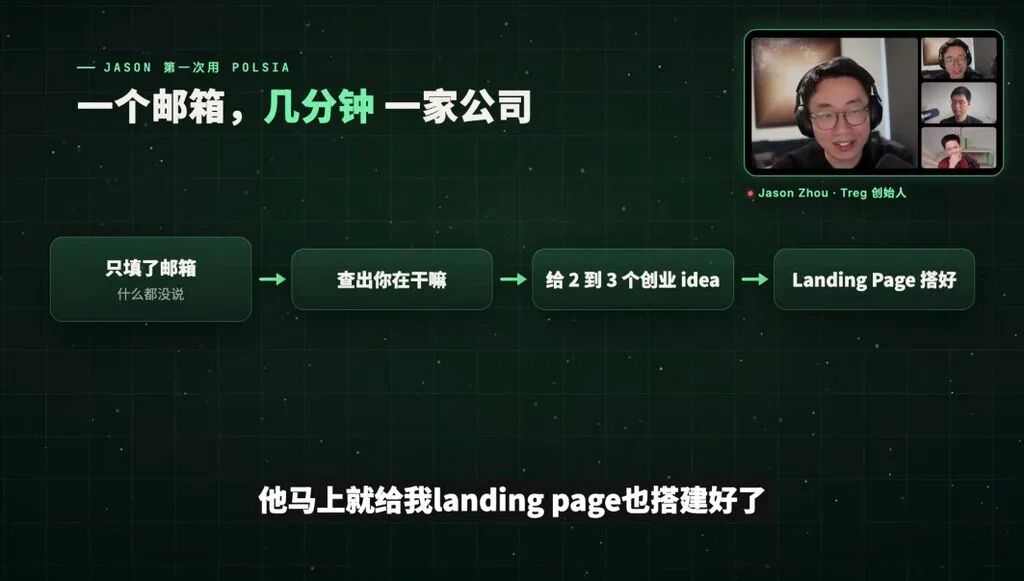
Polsia's concept was using AI to run your entire company. Huge vision, executed with extreme polish. The first time I signed up, I gave it zero information. It saw my jason.zhou email, inferred who I was and what I was doing, then generated two or three startup ideas. I picked one, and it immediately built a landing page.
👦🏻 Koji
What startup idea did it pick for you?
🧑🏻💻 Jason
I honestly don't remember.
👦🏻 Koji
You recommended it to me and I tried it too. It used my email to search my background online and suggested I build an AI podcast backend for podcasters. I thought it was great and immediately paid up to have it build it.
🧑🏻💻 Jason
Two days later I asked how much you'd spent, and you said a few hundred more, upgraded to God Mode, right?
👦🏻 Koji
Yeah, God Mode.
🧑🏻💻 Jason
Did you follow up on it?
👦🏻 Koji
No, it didn't make me money — only helped me spend it.
🧑🏻💻 Jason
Similar experience for me. It built my website, found clients, sent cold emails, and some people actually replied. It felt incredible, like this could really work.
But the product itself was actually very dodgy — nothing like a proper system for real businesses. Any company with actual operations would struggle to hook up their internal product analytics, ad systems, and so on.
We thought, why not build an Agent for real businesses — one that serves founders who already have a business and a funnel, and want to scale it.
Only after building Crewlet did we realize: the smartest thing Polsia did in scaling to millions in ARR within months was sell you a grand vision of AI running the entire stack, while actually delivering results on just that initial setup step. They made that step impossibly smooth.
👦🏻 Koji
So from 0 to 1, it helps you build the website and tools?
🧑🏻💻 Jason
From 0 to 1, unbelievably smooth.
But once you're actually using it, you discover it can't deliver end results — it can't make you money. The moment you enter real business operations, you have to deliver commercial outcomes, and that's extraordinarily difficult.
👦🏻 Koji
So Crewlet was about going into companies with existing businesses and building a fully automated, zero-person growth team?
🧑🏻💻 Jason
Yes.
👦🏻 Koji
How did it actually perform?
🧑🏻💻 Jason
We preset our first client as our previous company, SuperDesign. What does a startup need for customer acquisition? SEO, social content marketing, paid ads. The logic was perfectly sound: look at ad data, increase this budget, decrease that one; plus prospecting, doing every acquisition action you could think of.
After launch, plenty of users wanted to pay. The product wasn't fully ready yet, so we put up a pre-order paywall — and people still bought in.
But the real problem was, delivering results was too hard.
👦🏻 Koji
Why? If you do everything you're supposed to do, there's no insurmountable magic behind SEO.
🧑🏻💻 Jason
Two core pain points.
First, getting absolutely precise data is difficult, and the tools market is extremely fragmented.
Second, there's no silver bullet in marketing. The channels that actually work are usually ones where you tried something others hadn't, that happened to suit you, and you kept doubling down; once everyone piles in, that channel quickly stops working. In that dynamic process, you need human taste everywhere.
👦🏻 Koji
Can you give a concrete example?
🧑🏻💻 Jason
Say you have an Agent do SEO. You give it a workflow: scrape all relevant keywords, see which have high traffic and low competition, then bet on those.
But in reality, most valuable keywords are already taken. What's actually valuable are keywords with low current traffic that you predict will blow up in one to three months. That kind of prediction is something current Agents struggle to do on their own.
👦🏻 Koji
How did you transition from Crewlet to Treg?
🧑🏻💻 Jason
We worked on Crewlet for about a month, onboarded some users, and found it hard to deliver expected results.
We reflected: did we move too fast? We hadn't actually validated whether zero-person companies could work. We just tried OpenClaw and Polsia, blindly assumed this was the future, assumed models would evolve enough within six months.
We decided to pause, stop new product development, and go back to try operating SuperDesign with AI.
SuperDesign still had organic traffic coming in even after months of neglect, and a conversion funnel with huge optimization potential. If you listed it on Acquire.com, it was the kind of business someone would take over and scale.
If we could use AI to validate that it could truly run and grow fully autonomously, we'd have a clear playbook. If it didn't work, we'd face reality and try something else.
👦🏻 Koji
What was the conclusion?
🧑🏻💻 Jason
Over two months we kept building various loops, and arrived at two key insights.
First, full automation does work in some scenarios, but is extremely hard to pull off for growth. Support and bug fixing can be fully automated, but growth requires human taste in too many places.
In the next 6 to 12 months, zero-person companies are definitely not a viable scenario. What's more urgently needed is solving for scenarios where humans and Agents collaborate heavily.

Second, we had to build entirely around the Claude Code and Codex ecosystem.
A Codex Plugin That Unexpectedly Changed the Growth Curve
👦🏻 Koji
How did you arrive at this conclusion?
🧑🏻💻 Jason
We ran a lot of growth experiments in between, and most felt useless.
What actually changed the growth curve was when Tianxin one day shipped a Codex plugin. The moment it launched, the growth curve suddenly shifted — a flood of users poured in.
👦🏻 Koji
How did you get that user attention at the time, what channels did you use for distribution?
🧑🏻💻 Jason
We didn't do any distribution at all.
👨🏻💻 Shi Tianxin
Right, no distribution — I think it's actually a pretty interesting story.
When Codex first released Work and the Codex Plugin Marketplace, there weren't many interesting plugins out yet. SuperDesign hit perfect timing. We barely did anything — we just took our existing CLI plus skills and published them to the marketplace for users to install.
It was a very early market. ChatGPT and Codex already had massive user bases, so users could easily discover your plugin. If the plugin had some appeal, users would try it and convert.
One small thing: I noticed the plugin marketplace was actually sorted alphabetically. We just changed the name from SuperDesign to 01 SuperDesign, and shot straight to first place.
It didn't last many days — they quickly changed the sorting logic. But that tiny move gave us our initial traction.
One lesson for us: these early tools and markets are all worth trying, because you never know which attempt will get you traffic.
👦🏻 Koji
The story goes: you used Crewlet to help grow SuperDesign, then accidentally discovered SuperDesign's Codex plugin was growing incredibly well. How did that lead to Treg?
🧑🏻💻 Jason
After building the plugin, we found growth was excellent — and most importantly, churn from this user segment dropped too.
We realized Codex and Claude Code now have massive user bases, but the native experience isn't great. Building around them as platforms to enhance that experience could be a huge opportunity. A bit like when Facebook emerged, Zynga built games on top of it, and PayPal built payments on eBay.
Looking back at everything Crewlet was doing, the most valuable or transferable part was actually the tooling layer.
What's the difference between one Harness and another? Not much, they're all the same. But to have an Agent do real go-to-market work or any professional work, you need massive amounts of professional data and tools.
We had built an internal middleware service because Crewlet needed to connect various data sources for different users. We realized that part was actually extremely valuable, and decided to spin it out and open it up to users directly. When we launched it, the response was great.
Treg Is Born
👦🏻 Koji
How great specifically?
🧑🏻💻 Jason
About three weeks after launch — specific numbers are confidential — but revenue was already several multiples of SuperDesign's.
👦🏻 Koji
How does Treg charge now?
🧑🏻💻 Jason
Users mainly need to call APIs and access data through Treg. It's purely usage-based billing, no monthly fees whatsoever, completely pay-for-what-you-use.
👦🏻 Koji
What do the highest-paying tools look like right now, scenario-wise?
🧑🏻💻 Jason
Mostly concentrated on Go To Market.
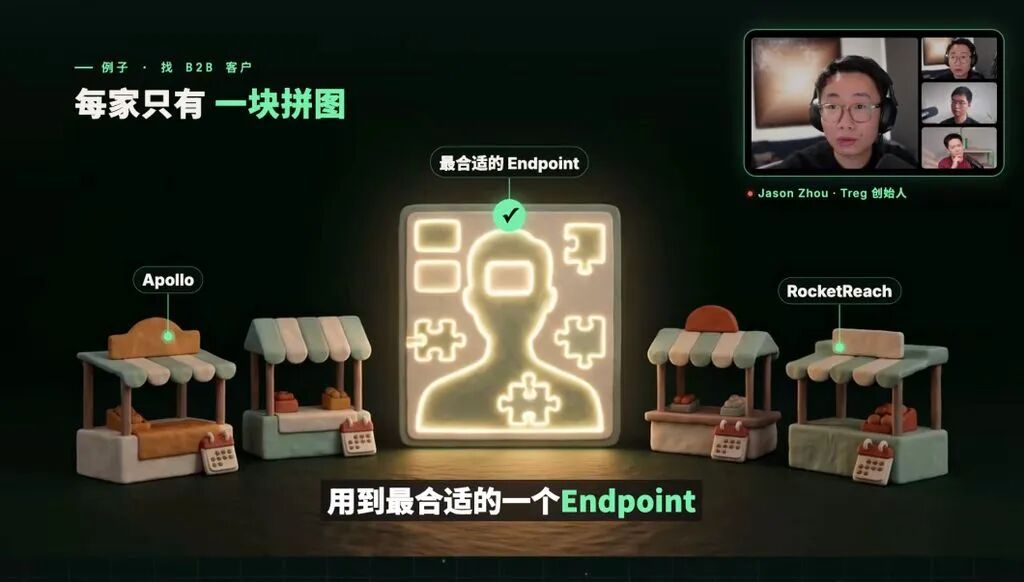
More and more people are starting to use Codex and Claude Code for Go To Market work that used to happen inside SaaS products. Mainly concentrated on finding customers — like overseas B2B prospecting where you need to buy Apollo, RocketReach, and various other vendors.
In that scenario, each data provider previously only covered part of the prospecting picture, and each had monthly fees, forcing you to usually pick just one.
With Treg aggregating all vendors, users can choose the most suitable endpoint for their scenario and industry to find customers.
👦🏻 Koji
Why are these tool providers willing to be integrated by Treg? Couldn't this cannibalize their own revenue?
🧑🏻💻 Jason
Many vertical vendors lack channels to reach end users.
For prospecting, the old path was through platforms like Clay. Most of Clay's underlying data isn't even theirs — there's a whole stack of data providers behind it, and those suppliers were already charging by API call and usage volume. Clay itself was just aggregating and reselling data.
👦🏻 Koji
Besides prospecting, what are Treg's other major use cases?
🧑🏻💻 Jason
There are also SEO and AEO-related capabilities. We've integrated basically every data source we could find to help with SEO ranking and AI visibility.
Then there's social media UGC content. The endpoints for image generation and video generation are all integrated too, so you can complete the entire workflow end-to-end.
🧑🏻💻 Jason
I think there are probably two categories.
One is the model's own knowledge. But specific business work requires real-time data that Claude Code doesn't know out of the box.
Second, sure, it could use a browser to do AI automation and fetch data. But a lot of data simply isn't accessible. For example, finding people isn't something you can just Google. Or for social media — a lot of platforms shut that down.
👨🏻💻 Shitianxin
There are all kinds of Agent Harnesses now, and everyone picks their own. I've noticed something interesting: I have a friend who uses Moonshot AI because it integrated Wind Information's stock trading data, and that data matters a lot to him.
Going forward, each company's Agent Harness might attract users based on what data or unique capabilities it plugs into. That's entirely possible.
What Treg is doing is similar — providing a neutral marketplace where every Harness can access the same tools. So even if you want to switch from Claude Code to Codex, the tool calls and data you've accumulated stay here. You get cross-platform portability.
🧑🏻💻 Jason
The main distinction here is that Koji, your assumption is that there's a dominant provider in this industry that can deliver the best solution. But in reality, every scenario has dozens of different providers, each with different strengths.
For finding people, enterprises need all kinds of different information to locate the right person. For SEO and AEO, there are many data providers on the market, each covering different platforms at different price points.
👨🏻💻 Shitianxin
Jason has been doing outreach on our UGC video generation feature lately. Video models are constantly emerging — Seedance, MiniMax's H3, they all produce great results. But for the average person to experience them, monthly subscriptions are expensive, and the need might be short-term or one-off.
By integrating hundreds of AIGC-related models, we package what each model is good or bad at into skills. We want users to be able to use our platform, paired with a capable Codex or Claude Code Agent Harness, to produce the UGC videos they want.
🧑🏻💻 Jason
Because we've accumulated a lot of user data, there's actually a data flywheel at the center of Treg that lets us launch more services. Shitianxin has recently built a lot of mechanisms around having Agents score each service, so we accumulate a lot of interesting data.
👨🏻💻 Shitianxin
For many of our products, the real user isn't even a person anymore — it's that person's Agent. It has the most authentic feel for our product.
We randomly select some users in the system and have their Agents give us feedback. The system continuously reviews this feedback. Simple bugs get fixed directly. Interesting feature requests get flagged for us to consider adding.
This data flywheel is also a viable approach for application-layer AI startups: since we can't train our own models, we need some data to feed back into our product.
Treg, as an AI tool marketplace, is a bit like Dianping. At certain points we can have Agent users rate every API call — was the returned data useful or not? If useful, which field made the difference? Of course, this is anonymized feedback.
Once that data accumulates, we naturally get an interesting chart: in a given domain, how does every API endpoint score on usefulness and cost-effectiveness? Some of this is objective data, some is subjective Agent data.
We process and display this data for subsequent users, so their Agents can choose the most suitable tools. If you need precision, pick the most expensive, highest-quality endpoint. If you want breadth at a lower price, choose a highly-rated, cost-effective model.
Lessons After Three Pivots
🧑🏻💻 Jason
The biggest realization is that when we were building Agents before, we were trying to cover too much ourselves. We basically built the Harness too — because back then it wasn't clear whether we should use the Claude Code SDK or build our own.
Often we'd also build some infra. Some people even built their own sandbox, or handled Memory too. Every layer you build has a dedicated company constantly optimizing and iterating it.
Our recent iterations have been more about doing one part well and embedding into the Claude Code and Codex ecosystem.
I was chatting with the founder of YouWare the other day. Before this year, it seemed like every profession used different tools — designers had Figma, marketing people used some email sequencing tool. But after this year, everyone's tools have become Claude Code and Codex. It's a major platform shift. There's a lot of room for imagination.
Standing on the Shoulders of Claude Code and Codex
🧑🏻💻 Jason
The fastest-growing company this year is Apify. There's also DataForSEO. DataForSEO is one of the SEO data providers. Apify is an API marketplace where you can find long-tail scraping endpoints. These companies have been around for a while, but they're seeing massive growth this year, almost out of nowhere.
In the design space, paper.design is also growing fast.
🧑🏻💻 Jason
It's the same as what we pivoted to: providing a canvas within your existing familiar workflow, inside Codex, where you can compare different designs and make manual tweaks.
👦🏻 Koji
Does Tianxin have anything to add? What else are you seeing in this ecosystem?
👨🏻💻 Shi Tianxin
For example, Exa, which does search specifically for Agents, has already reached Series C — proof that building good search tools for Agents is a massive use case.
Tools like Composio or Firecrawl, which do web scraping, OAuth authorization, and tool integration for users, have also seen significant growth recently.
🧑🏻💻 Jason
A lot of companies that would traditionally be considered infra are now serving not just enterprise customers in the Agent era, but enterprise plus a huge number of Claude Code and Codex users — because Agents know how to call these APIs.
Before this year, most users were developers. Now the usage is basically split 50/50: half developers, half end users. The end users might be former white-collar workers who don't know how to code. They just know that after connecting Firecrawl, Claude Code scrapes web pages more efficiently, and they don't need to worry about how the API gets called — they connect it and start using it.
👦🏻 Koji
There's also something called Vibe Island. People are now running many threads inside Claude Code or Codex, and it's easy to lose track — which thread finished, which one is waiting for review.
What it does is use the MacBook Dynamic Island. Every time a task completes, it expands the Dynamic Island slightly, with a cute pixel character and sound, letting you operate from the Dynamic Island. The design is really beautiful.
This was the winning product at a Sunday hackathon hosted by AI Hacker House. After launching on X, it blew up and sold a ton of copies — it's a paid tool.
🧑🏻💻 Jason
Both of us paid for it.
👨🏻💻 Shi Tianxin
Yes.
👦🏻 Koji
Another one is Orca, a product by Jinjing that Jason introduced me to. It's called ADE — Agent's IDE.
People are now using Claude Code, Codex, and even more tools simultaneously. It helps you manage multiple tools at once. Why do you sometimes need to use both? To arbitrage both sides. If Codex's quota runs out, you can smoothly transfer a half-finished task directly to Claude Code.
Many users feel its experience is really smooth, with great aesthetic UI. It already has 80,000 GitHub stars and is growing very fast.
🧑🏻💻 Jason
Their users, from what I know, aren't running 10 sessions simultaneously anymore — some are running 50, 100 sessions.
Seeing this kind of usage, what new forms of human-Agent interaction can be provided? This is a scenario that the Codex and Claude Code teams haven't focused on yet.
👦🏻 Koji
At the beginning of our conversation, you mentioned that although you've been founding for less than a year, you've been pivoting constantly. Jason also said that after OpenClaw came out in February, it felt like all application founders kept pivoting for the next four months. What was that feeling like?
🧑🏻💻 Jason
For me, the most rewarding part of founding so far was actually the two months when we weren't building products, using SuperDesign as an experiment. Didn't do any development — just thought about what it would look like to operate this company with AI.
Those two months helped me clarify some convictions about the future: what's worth doing, what isn't. A lot of startups see things others haven't realized yet, experience it, feel certain it's the future, then productize and scale it.
"Zero-Person Companies" Don't Work
👦🏻 Koji
Of the futures you saw during those two months, some might happen and some won't. Can you talk about both?
🧑🏻💻 Jason
Two things I'm relatively certain about:
First, zero-person companies won't work in 6 to 12 months. What we need to solve are scenarios where humans and Agents collaborate.
Second, the Codex and Claude Code ecosystem is a massive opportunity. When building Crewlet and SuperDesign, we built our own harness. Those two months, we told the team to drop all baggage and assume we were a new team choosing the best tools on the market.
Very instinctively, we chose Claude Code and Codex. After using them, the experience was so much better than the Agents we built ourselves. Through that process, including releasing plugins, we gradually realized this ecosystem is a massive opportunity.
These two convictions were enough to help us believe what's worth doing and what isn't. Otherwise we'd probably still be iterating on Crewlet, wondering if our skills weren't good enough, if prompts needed tuning, or if the direction was wrong.
When you encounter too much uncertainty in founding, pivoting is extremely painful. But if you have some relative certainty, it's much better.
👦🏻 Koji
Back during the Polsia era, including when building Crewlet, a buzzword that trended for a week or two was Loop Engineering. What's your take on that now?
👨🏻💻 Shi Tianxin
I really like the word "loop" — it sounds attractive, like making things happen automatically.
But if you divide founding into two parts: innovation and operations, innovation obviously can't be completed by loops. Otherwise I could just say "build me a startup" and it would happen — clearly not there yet.
But on the operations side, there are still many solid things loops can do. Running a company is a very complex system. I really like a book called Thinking in Systems, about how to build systems that run stably and robustly. There's a lot of nuance, like building open-loop or closed-loop feedback.
Loop is a very effective tool in the Agent domain. Before founding, I never thought I'd need to deal with large-scale hacking attempts. Once SuperDesign, Treg, and others had incentive mechanisms — like inviting new users to get credits — hackers would attack nonstop.
If a 4-person team spent energy on this every day, it'd be excruciating. But if you have a loop that continuously monitors the system for risky behavior and plugs small vulnerabilities directly, it works quite well and stably, saving the company massive effort.
Often loops can't be built too complex from the start. Short, refined loops are more useful. For example, one loop only monitors the DB for security risks. Another only tidies up code. Each does something very small — small enough that it's unlikely to err.
When you've built a dozen such small loops, they naturally form a complex system that gives the system some robustness. If one loop finds a bug and pushes it live, the online monitoring loop catches it and alerts you. The coordination between these small loops — that's what makes them actually work well.
👦🏻 Koji
In the last two or three months, has your way of working with AI changed?

🧑🏻💻 Jason
The biggest difference is I'm running way more sessions simultaneously than before. Especially after models like Fable came out, I basically have 5 to 10 different sessions open at once, and the quality they complete on their own is already very high.
Second, I used to be purely local. Recently, after Grok Bot launched, there's now a very smooth cloud-plus-local hybrid experience where you can swap context anytime.
👨🏻💻 Shi Tianxin
Before, it was more about opening sessions one by one and talking to different Agents inside them. But for one person, there's a processing bottleneck with an upper limit.
I saw a share by senior engineer Kun on YouTube. He built a tool called Firstmate. The idea is: as the captain, you only need to assign tasks to the first mate, and he talks to the other coding sessions. I didn't end up using this project directly, but I absorbed the concept.
For example, using next-generation terminal management tools like Herdr, letting Agents talk to each other, or having a main Agent do the first mate's work and relay tasks to other Agents.
👦🏻 Koji
Which do you use more now, Claude Code or Codex? Any clear preference?
🧑🏻💻 Jason
A few months ago I was a heavy Claude Code user, and it was hard to migrate me away. Until the Astra model came out recently — then I switched to Codex. Mainly because the model is genuinely strong.
Another part is that our team's marketing often uses Hyperframes to create marketing videos, and it works much better under Astra.
Once I directly gave it a video, and it really one-shot 1:1 replicated it completely. The shocking part was that making videos requires assets — the model was even smart enough to screenshot from the original video, crop to the right style, and recreate it in the new video.
👨🏻💻 Shi Tianxin
I tend to use both. Neither has established absolute dominance — maybe Fable is stronger one day, then Astra immediately overtakes it. Keep using both long-term. Have both models do some things simultaneously, and pick the better version.
In this era, you need to be consistently using the best models in the world, feeling their differences and the advantages they bring.
👦🏻 Koji
Beyond Claude Code and Codex, what other products are you using?
🧑🏻💻 Jason
I use Grok Bot quite a lot. After OpenClaw came out, no other product really got mass adoption. Grok Bot may not have that much innovation, but it made the sandbox cloud experience extremely smooth.
We moved all our loops onto Grok Bot. The stability is really good, and you can check on it anytime.
One more thing — Grok Bot acquired Cursor. After using Grok Bot, I realized how much sense that makes. The thing Cursor does best is its sandbox, ensuring every coding task gets its own dedicated sandbox. That's hard to achieve locally; at most you can set up different worktrees, but testing five or six different environments is tough.
I've started doing a lot of coding work in Grok Bot, especially simple frontend tweaks and bug fixes — you can just open it up and test directly. There are also links in the PRs, so you can click in anytime and test in the sandbox environment.
👦🏻 Koji
Besides Fable 5.1 and Astra, do you use models from DeepSeek, Moonshot AI, Zhipu AI, or MiniMax? In what scenarios?
🧑🏻💻 Jason
We tried using Moonshot AI as our main model during a SuperDesign iteration — its design capabilities are quite strong.
We've also integrated MiniMax, not for coding but for their video generation model H3. The quality is high and the pricing is good.
A lot of people say DeepSeek is great, but my personal experience with it has never been particularly good.
👨🏻💻 Shi Tianxin
Domestic models are actually very strong in frontend development, especially Moonshot AI and MiniMax.
I personally really like DeepSeek 4.1 Flash — it's efficient and extremely fast. I had this idea of replacing SuperDesign's first-layer agent with DeepSeek. For now, Claude seems more stable in most cases, so we haven't actually switched over in production.
🧑🏻💻 Jason
The Jev model that blew up this week is pretty interesting. Other models either compete on price or on capability in specific scenarios. But Jev is fast enough and its use cases are simple enough that it enables some scenarios that previously seemed impossible — scenarios that only this model can handle right now.
👦🏻 Koji
Is there anywhere in your current work where you could use Jev?
👨🏻💻 Shi Tianxin
I just started looking at Jev today, and my first impression is very impressive.
Treg generates a lot of data for us, and there are things that were previously difficult for LLMs to do, starting with anything where speed matters. For example, when every endpoint comes in and needs to be routed — waiting several hundred milliseconds would be a huge waste. In that case, having a fast System 1 intuitive model that can do good routing is ideal.
On the other hand, when you have large-scale data that needs filtering — say filtering 2,000 or 3,000 items, doing recall and then wanting to clean it once before presenting to the user — if you have an intuitive model that can directly compare items one by one, it would make an excellent recall engine. Much faster than other LLMs, and the quality isn't bad either.
I Had to Bury My Talent in Yesterday
👦🏻 Koji
Did you see that article recently? A DeepSeek researcher wrote "I Had to Bury My Talent in Yesterday."
👨🏻💻 Shi Tianxin
For me, the first 10 years of my career as a programmer and frontend developer — what I was good at was writing React and building frontends. But starting last year, you could clearly tell that this skill just doesn't mean as much anymore. Unless you're among maybe the top few hundred people in the world, you probably don't have the motivation to keep going; if you can't reach that level, that skill becomes obsolete very quickly.
At that point I thought carefully about what I wanted to do for the next few years or even the next decade, and without hesitation I joined the SuperDesign team to start doing something interesting with Jason and the others.
👦🏻 Koji
Could you expand a bit on how you made that decision?
👨🏻💻 Shi Tianxin
A lot of people are at a crossroads in life right now. The path you were on might not be viable or might not exist anymore. What you choose to do at that crossroads could make a big difference in your life — it's a pretty important decision.
Fact is, as a programmer, you'll never out-code AI at this skill anymore. But there are more things worth trying and exploring. For me, that meant joining a startup and doing something more challenging and more interesting.
🧑🏻💻 Jason
Going forward, it's more about cross-domain capabilities being fully unleashed.
Before starting my company, I had a somewhat unusual background. I was a designer, but I never really liked tweaking pixels — I preferred looking at things from a product manager's perspective, and I could write frontend code myself. It's actually people like that who are more likely to be unleashed.
Fail Fast: Let Directions That Are Doomed to Fail End Quickly
👦🏻 Koji
You've pivoted so many times in less than a year of entrepreneurship. You mentioned feeling very anxious during this process — working hard on a product only to have it declared dead within a month. Did you ever think about giving up?
🧑🏻💻 Jason
Yes, definitely.
The Crewlet period was pretty rough. There was so much uncertainty, thinking every day about what to do next. I'd think and think and not come up with any great answers, but you still have to keep moving.
My own pivot process at that time was generally: what can I actually do right now in this direction that would genuinely change our situation? If I can't think of anything, then maybe I need to change direction; but if I can think of things to try, we keep going.
There were many moments of wanting to quit. I used to run a YouTube channel — honestly, living a comfortable middle-class life would have been pretty easy. There were definitely times I wanted to give up. But usually, after getting through it and coming up with a new direction that seemed very promising, the rush from that was huge.
👦🏻 Koji
In all things, the beauty of hope.
🧑🏻💻 Jason
Especially discovering that you're constantly learning and evolving — I think that's a great feeling.
👨🏻💻 Shi Tianxin
I've also experienced some pretty crushing times. Working on something with no growth for a long time, constantly facing setbacks — like waking up one day to find $4,000 in credits had been stolen, feeling like the sky was falling.
But one good thing is our team has always been looking for other directions and opportunities. Every time a darkest hour arrived, we could always find something that looked like dawn, and work toward that. Having that opportunity made it feel less unbearable, or like we couldn't go on.
And sometimes if something is going to fail fast — if you know it's really going to fail, better to let it fail quickly and try something new. You might get some unexpected surprises.
If You Believe AGI Is Coming, Why Still Start a Company?
👦🏻 Koji
I met a friend the other day who said he's looking for a certain kind of entrepreneur: someone who believes AGI will come, and believes this AGI will arrive through model evolution, yet is still starting a company. Do you two consider yourselves that kind of person?
🧑🏻💻 Jason
AGI coming is a necessary condition, but there are too many paths to get there.
Everyone on our team is a heavy AI user, including myself. Because I create content, I basically try everything new that comes out. Keeping yourself immersed in where the latest frontier actually is gives you good intuition about where the biggest opportunities will be in the next 6 to 12 months. Working along that trajectory, I think it's not that pessimistic. Otherwise, if models just do everything directly, there's no opportunity left.
👨🏻💻 Shi Tianxin
I think even if AGI arrives, doing cost-effective things remains very valuable.
Even if there's an omnipotent model, it still needs its own tools, still needs to find the data it needs. If it spends $1,000 in tokens to ultimately get a piece of data, but we can get it that data for $100, it might just choose us.
So building the right tool for the model, finding your own positioning, and continuously refining the results on that foundation — that's also important.
👦🏻 Koji
In an era where AI applications are universally seen as a bloodbath, this podcast recording suddenly ended on a note of optimism and positivity. Thank you, Jason and Tianxin, for the confidence you've brought us. Wishing your entrepreneurial journey ever smoother, ever upward. Thank you both, we'll stop here for today.
🧑🏻💻 Jason
Thank you.
👨🏻💻 Shi Tianxin
Thank you.
Comment to win prizes