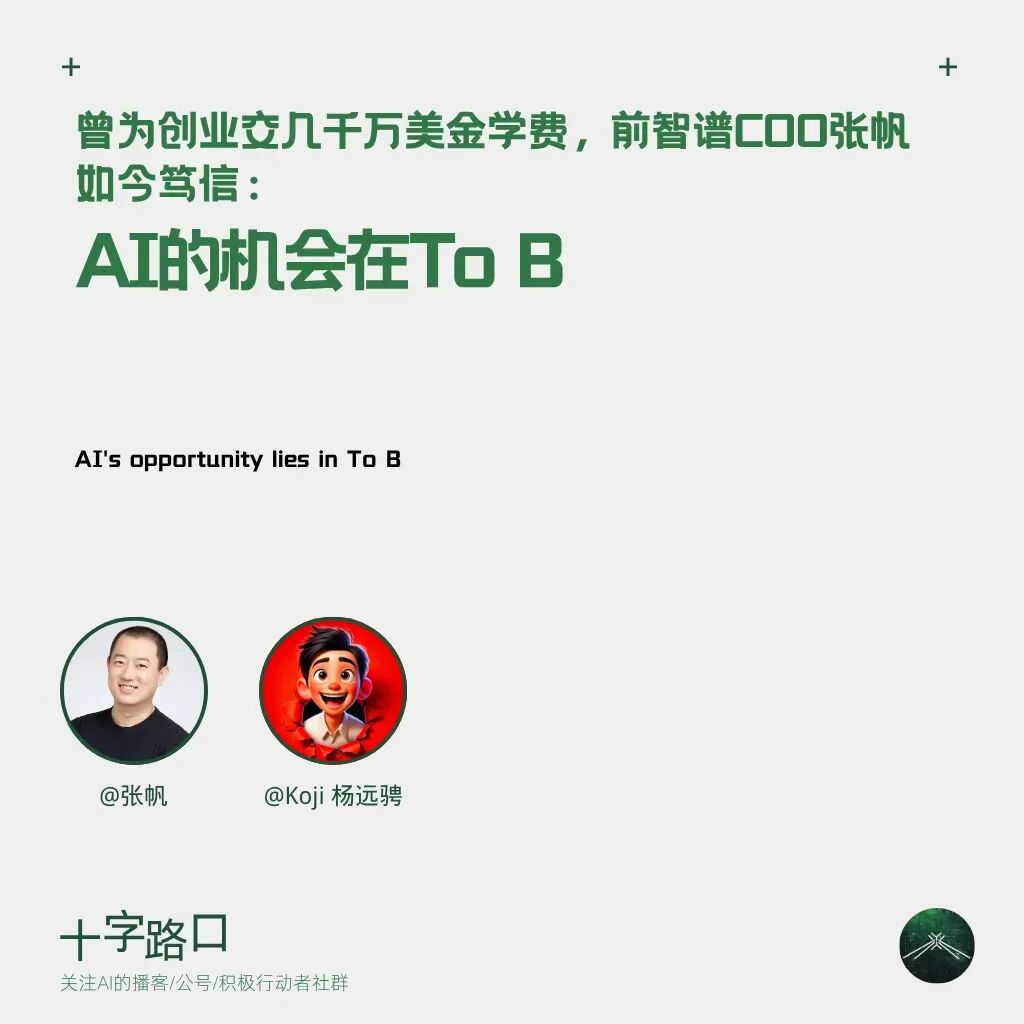
What Did He See? | A Conversation with Zhang Fan: Former COO of Zhipu AI, Founder/CEO of Yoolee AI — Why He's Convinced AI's Opportunity Lies in ToB

"Treat AI as a person.
"You have to treat AI as a person."

👦🏻 Podcast interview: Koji
🥷 Editing: Crossing
🧑🎨 Layout: NCon

Chinese entrepreneurs and VCs generally feel a kind of "visceral fear" toward B2B. But this week, Crossing's guest Zhang Fan is swimming against the tide.
Zhang Fan was formerly COO of Zhipu AI, and recently left to found Yoolee AI with an $8 million angel investment from BlueRun Ventures, taking enterprise services as his entrepreneurial direction and committing to business reinforcement learning to provide companies with digital workers that can genuinely create business value.
Zhang Fan paid tens of millions of dollars in "tuition" for his first startup, Miaoji Travel. He also served over a thousand enterprise clients at Zhipu AI. In his view, today's consumer-facing (ToC) entrepreneurship is an "asymmetric war" against giants, while B2B has encountered entirely new opportunities because of AI.
In this podcast episode, Zhang Fan shares his story as someone standing at the very forefront of China's large model wave.
You'll hear about his passion and regrets as founder of Miaoji Travel before diving into AI: how he raised tens of millions of dollars over five years, only to "pay tuition" because he failed to understand the essence of the industry. You'll also hear how, as COO of Zhipu AI, he led his team to frantically serve over a thousand clients, witnessing Chinese companies' hunger and confusion about embracing AI — an experience that ultimately solidified his decision to start again, this time in B2B.
We hope this content offers you fresh perspective and inspiration.
Listen on WeChat:
Listen on Xiaoyuzhou:

🎬 Video podcast will also be available on @Koji's WeChat Channels, Xiaohongshu[1], Bilibili[2], Youtube[3] and other platforms
As the full interview is quite long (13,700 words), here's a table of contents:
🟢 Counter-consensus: Why is ToC "an asymmetric war"?
"I'm always thinking: what's the counter-consensus today? The current consensus around entrepreneurship actually worries us a bit."
- Why can't we use the "old map" of the internet era to find the "new continent" of the AI era?
- Why would an AI travel agent with superior experience still be no match against a giant like Trip.com Group?
- Experience advantages can be closed in a year, but supply chain and operational moats may take a decade.
- In today's world where "online is full too," what's the real difficulty for startups building effective barriers?
🟢 What did I learn after paying tens of millions in "tuition"?
"When you shift attention from external reward models (fundraising, media) back to business reward models (retention, satisfaction), you see very different things."
- First startup "Miaoji Travel": an AI travel project technically perfect but commercially failed.
- "The Wrong Reward Model": VC hype and media buzz — why are these "positive feedbacks" the most dangerous illusions for founders?
- Core lesson: Travel is fundamentally a supply chain problem, not a product problem. "Advanced information" that can't be delivered is worthless.
- The power of trends: Why was it easy to raise tens of millions in 2014, yet in 2022, with 10x the capability and better preparation, fundraising was actually harder?
🟢 Reflections from Zhipu
Human brain capacity hasn't changed in 5,000 years, yet productivity has grown 1,000x. How? Education, division of labor, tools, and collaboration. This is exactly where AI is headed next.
- The real reason for leaving the Zhipu COO role: not bravery, but seeing the certainty of AI's second half.
- Seven client meetings a day, serving thousands of enterprises over two years — what chaos and hunger did he see in the market?
- Foundation model intelligence has evolved from 60 to 110 points, reaching a "critical point." The value of further IQ gains is diminishing.
- New mission: Building "social forms" for AI, becoming a "training institution for models" — turning smart general models into specialized "professions."
🟢 The divide between old and new worlds: AI is a colleague, SaaS is zero-sum
Chinese enterprises will pay for productivity outcomes (human outsourcing), not for processes (software tools). AI's true benchmark isn't the software market, but the labor market.
- Why doesn't SaaS work in China? When "conversion capability" is treated as fixed cost, SaaS becomes zero-sum with employees — and employees are non-negotiable.
- AI's disruptive power: it directly acts on "conversion capability" itself, creating positive-sum games with bosses.
- Stop viewing AI through old coordinates: model "hallucinations" aren't bugs, they're features; like humans, the key is how to harness them.
- Required CEO course: understanding "Model-Nature," like understanding human nature — this is a business problem, not a technical one.
🟢 Survival rule: Build ships, not lighthouses
Foundation models are a rising sea; building "lighthouses" (applications) on top will soon be submerged. What you really need is to build a "ship" (business moat) that rises with it.
- How do startups build their own "ship"? The answer is the "50% model content" rule.
- Why can Notion ride the waves while Jasper quickly fell?
- The biggest misconception: "I have lots of data." Data itself isn't a moat; the "business scenarios" that continuously generate data are. You want a field, not a pile of crops.
- Individual best practices vs. industry best practices: why vertical agents are just compromises, and finding each enterprise's own optimal solution is the future?
🟢 The last $3 million — who gets it?
- A surprising choice: why he would invest in a low-profile company — Thinking Machines Lab?

Counter-consensus: Why is ToC "an asymmetric war"?
👦🏻 Koji
Chinese entrepreneurs and VCs, when it comes to B2B, all have this visceral fear. But our guest today is going against the current. Zhang Fan, you were previously COO of Zhipu AI, and recently chose to start a company in B2B enterprise services. So I'm very happy to have you on Crossing today.
👨🏻 Zhang Fan
Great, thanks Koji.
👦🏻 Koji
So our first question is: what made you so brave, daring to do B2B?
👨🏻 Zhang Fan
I often think about what the counter-consensus is in today's era. The things that are consensus in the market right now actually worry us a bit. And historically, all technologies and business models have emerged from some form of counter-consensus. So I'm always thinking: what's the counter-consensus today?
Indeed, there's a consensus about entrepreneurship today, which is that people believe ToC is the bigger opportunity.
👦🏻 Koji
Especially for Chinese entrepreneurs.
👨🏻 Zhang Fan
Exactly, ToC is seen as the bigger opportunity. B2B is a harder opportunity, especially in China's environment. But I don't tend to draw that conclusion directly. I think that conclusion comes more from inductive reasoning — because in the internet era, many successes were indeed in ToC, while B2B returns were much worse than ToC. But if we look from a deductive perspective, these two eras are somewhat different.
👦🏻 Koji
You think the internet era and AI era are different? Or the SaaS era and AI era are different?
👨🏻 Zhang Fan
It still depends on the environment and variables. One very different thing about the internet era was that offline was already fully built out, but online was completely blank. So as everyone knows, the focus then was on model innovation — rapid land-grabbing, quickly building competitive moats. And online competitive moats were often different from offline ones.
For example, traditional travel agency supply chains were unusable from Trip.com Group's perspective, while Trip.com had the opportunity to build entirely new supply chains. So there was quite a long buffer period and strategic depth for companies to run fast. In that era, I think ToC had great opportunities.
But today, speaking counter-consensus, I think ToC is actually quite difficult. Because we feel that today, not only is offline full, but online is full too — there's no new device emerging. So you find that some moats that were effective online in the past still exist in the AI era.
For example, I could very easily build a very advanced travel agent today, and I'm quite confident it could deliver a very good experience. But think about it — this is an asymmetric war. If an OTA, say a company like Trip.com Group, wants to catch up on experience, maybe it only takes a year; but if you want to catch up to its supply chain and service system, you might need 10 years.
👦🏻 Koji
In reality, what's visible above the waterline — the interface everyone sees — is just the tip of the iceberg. What supports Trip.com Group's empire today is likely the entire supply chain and operations system beneath the surface.
👨🏻 Zhang Fan
Most businesses are like this. So in this context, I think doing ToC is actually a situation where it's very difficult to build effective moats.
👦🏻 Koji
In your career, we know you were responsible for ToB at Zhipu AI, but even earlier than that, didn't you also do ToC? If I recall.
👨🏻 Zhang Fan
Yes, I've actually done both C and B. Let me briefly introduce my background. Everyone thinks I was responsible for ToB and assumes I'm a business person, but I'm actually from a technical background. Only in the last two years at Zhipu AI did I start doing business, and even then half my energy was still on product and R&D.
I studied AI at Paris-Sud University, and back then I also spent some time at the French National Center for Scientific Research doing machine translation. Then I returned to China in 2010, catching the first wave of AGI. I was at Sogou and then Tencent, where I successively led Siri-like products.
👦🏻 Koji
Because after Siri launched, the whole world went crazy for it. Every company was building their own Siri — very much like today.
👨🏻 Zhang Fan
Right, back then everyone thought Siri was a fantastic interaction mode, and wondered if Her was coming. So we were all working on that.
👦🏻 Koji
But it quickly became a total failure across the board. Even today, you can't really say Siri is successful. So what was that experience like?
👨🏻 Zhang Fan
It was actually quite unsuccessful. The technology back then didn't have the generalizable capabilities of today's large models. The approach was still largely structured — we'd categorize things, define dozens of categories, and build separate models for each category to do recognition, deconstruction, API calls. To some extent, it was manual disassembly.
So we were hot for about two years, then everyone realized this path didn't work. First, I felt the problem was harder than I anticipated — maybe not happening so soon. Second, if it were going to happen, it would definitely be a big tech company thing, because this was contested ground for everyone.
So I started thinking: in that case, do we have an opportunity today to apply AI in some vertical domains? So I started a company. Around 2014, I began my entrepreneurial journey. I felt that the efforts I made at big companies gave me less control, so I preferred to try it myself. I didn't understand entrepreneurship back then — I just went for it. My first project was actually AI + travel.
After Paying Tens of Millions in "Tuition," What Did I Learn?
"When you shift your attention from external reward models (fundraising, media) back to business reward models (retention, satisfaction), what you see becomes very different."
👨🏻 Zhang Fan
We built a company called "Miaoji Travel." The logic was simple: use search AI technology layered on top of travel. Early on, what we thought was popular was "Qunar," which we called "first-order meta-search" — you want to fly from Beijing to Paris, it finds you the cheapest ticket across all suppliers.
But from a technologist's perspective, I felt that search space was too small, and the price spreads you could capture weren't large enough. So I wanted to take it up a level — instead of optimizing for a single ticket, could I optimize for an entire travel itinerary? My idea was to make it a "second-order meta-search." What does that mean? If you want 3 days in Paris, 3 days in Madrid, 3 days in Barcelona, but you don't care about the order, and that order can be freely permuted. And that permutation of order means a larger search space, and a larger search space means completely different price spreads and experiences.
👦🏻 Koji
Sounds very logical.
👨🏻 Zhang Fan
So we built something very complex, an AI + travel system based on search logic. You'd input your requirements, and we'd connect flights, hotels, car rentals, chartered cars, attractions, tickets, day tours, and intra-city transportation for you, stringing it all together into an itinerary.
👦🏻 Koji
This is very much a bottom-up demand discovery. I think even today, this demand still holds, and still hasn't been solved very well.
👨🏻 Zhang Fan
Yes. I think a major reason back then was, as programmers doing entrepreneurship, our first reaction was to see travel as a product problem — we needed to build a sufficiently fancy product.
But the reality was, we spent 5 years on it, raised tens of millions of dollars, and ultimately it wasn't successful — we paid tuition. But in that process, we started to realize that travel is fundamentally a supply problem, a supply chain problem. Because if you only provide very sophisticated information but can't deliver on it, there's no value. So the imprint of that previous startup was branded into us.
👦🏻 Koji
So the failure of that previous startup still brought some insights for today.
👨🏻 Zhang Fan
Yes, very important. It transformed us from pure idealistic technology researchers into initially qualified entrepreneurs. We discovered that entrepreneurship isn't just about building a fancy product, but about seeing what value you can bring to an industry.
👦🏻 Koji
And whether you can actually deliver that overall experience. It's not just interface design — behind it is an entire supply chain and operations system.
👨🏻 Zhang Fan
This is a completely different way of thinking.
👦🏻 Koji
But there are also people who would advise entrepreneurs not to choose such complex areas from the start, to instead pick places where innovation is easier.
👨🏻 Zhang Fan
From this perspective, I think entrepreneurs need to be very careful — they're particularly prone to self-reinforcement. When we were doing this, 2014 was a good capital environment, and it was easy for us to do these things. Although we perhaps weren't the most professional entrepreneurs, at the time we still raised a lot of money very quickly, all from top-tier funds.
So back then you'd think, "Hey, seems like I'm getting positive feedback." In today's terms, it was a wrong reward model.
👦🏻 Koji
Very wrong, because fundraising is never the right reward model.
👨🏻 Zhang Fan
Not just that. You'd find people in the travel industry coming to tell you "you're amazing, this is right"; your individual early angel customers would say "I love this direction"; media would call you "the barbarian at the gate of travel," "the bull in the china shop" — creating an illusion that you had chosen correctly.
👦🏻 Koji
So when did you start feeling something was off?
👨🏻 Zhang Fan
When you shift your attention from external reward models to business reward models — looking at user retention, user satisfaction, how completely you're actually solving the problem. When you truly return to a business perspective, you may find you see very different things.

👦🏻 Koji
Actually, a VC recently told me that every time he sees news about some entrepreneur "raising four rounds in one year," a red flag goes up in his mind. And just two weeks ago, another big name — I said I had a friend who really admires you and wants to meet you, he's recently a market deal, very hot, continuously raising round after round. He said: "Oh, I don't like entrepreneurs like that." I think behind this is exactly what you're saying — some people believe that if fundraising becomes your reward model, you enter another wrong judgment standard and forget to look at more important metrics.
👨🏻 Zhang Fan
To some extent, "raising four consecutive rounds" is too consensus — it's definitely not a good money-making opportunity, and the risk-reward may not be balanced. So you still need some contrarian thinking. I don't think we should aim to build a sophisticated product, but rather to build a business that can close the loop.
👦🏻 Koji
Qi Yin has also repeatedly said that all business models that can't close the loop are bubbles. Seems like he was also deeply hurt. So I'm curious: after Miaoji, before Zhipu AI, I know you had another startup — what did you choose then?
👨🏻 Zhang Fan
After Miaoji, one very strong impression was that we still considered ourselves a top-tier technical team, but frankly, being a top-tier technical team is too common. We were a technical team that had spent tens of millions of dollars being deeply polished in an industry — that was our core differentiation, the ability to combine industry and technology, that was our label and gain.
So we joined another company called SouChe. When we joined, it was very hot — a $3 billion company at the time, having raised about $1 billion in cash. It covered the entire automotive industry chain, 17 business lines, including new cars, used cars, secondary networks, finance, insurance, logistics, software, agency operations, and so on. I joined as the group's CTO, with a very large R&D team of nearly a thousand people supporting these 17 business lines. So we made many attempts to combine AI with the automotive industry — used car valuation, automated inspection, dealer matching, and so on — further strengthening our experience in combining AI with industry.
After that, we returned to entrepreneurship. I then started an AI + Data company. Because at SouChe, our data center had a 100-person team that built full-stack technical solutions — including how to do tracking, big data scheduling, data governance, indicator systems, BI, CDP, all self-developed end-to-end.
👦🏻 Koji
What year was that?
👨🏻 Zhang Fan
That was around 2020, 2021. Then when we came out to start a company again, it was around 2022. At that time, I found what I considered a particularly strong contrarian insight.
I realized that the prevailing consensus in the data industry at the time was that only big tech companies had the opportunity to leverage data and build data middle platforms, based on the assumption that only they possessed sufficiently complete data infrastructure. But we found a contrarian insight: big tech companies weren't necessarily the best battlefield for data centers. Their natural weakness was excessive heterogeneity. Because they were large enough, every department built its own systems — often without documentation — making data uniformity extremely difficult. You had to do massive amounts of ad hoc data governance with no possibility of reuse.
But we saw an opportunity: mid-sized companies, or smaller players in certain verticals, had a real shot. Take e-commerce, for instance. E-commerce companies actually had the best degree of informatization, even better than big tech, because various big tech companies had built systems for them. When you looked at where they sold products, it was basically just Taobao, JD.com, Douyin Shop — that was about it. Then there were platforms like Youzan and Weimob, some ERP systems like Jushuitan and Wangdiantong, and content creation tools like Guangyun. You'd find that maybe 50 platforms total covered all of e-commerce, and they were extremely standardized and systematized.
We built an end-to-end solution. If you were an e-commerce company, we'd give you links to 50 commonly used platforms. You just entered your username and password, and we'd automatically aggregate your scattered data, automate governance, generate reports, even give you predictions — you could query it all in natural language. In a sense, we built you a data middle platform.
👦🏻 Koji
Another B2B startup.
👨🏻 Zhang Fan
And at extremely low cost — one or two percent of what a big tech company would charge. For 100,000 RMB, you could have a middle platform. We spent about six months on this, completed our angel round, had a few angel customers, and were preparing for our Series A when ChatGPT was released.
I noticed it immediately. I had studied NLP, so I was sensitive to this. My first reaction was that this was different — not incremental innovation, but disruptive innovation.
At that point, my former boss at Sogou, Zhang Kuo, who had been Sogou's chief scientist and is a close friend of mine — also Jie Tang's junior fellow student — came to me and said, let's do this. So my company was essentially acquired by Zhipu AI, largely for the team. It took me one hour to decide. I wasn't going to keep doing my own thing; I was joining. At that time, it wasn't what people see today — Zhipu hadn't sold a single deal yet, it was still very early.
👦🏻 Koji
So you talked with Jie Tang for an hour?
👨🏻 Zhang Fan
I didn't even talk to Jie Tang for a full hour. I spent an hour thinking and decided this was what I had to do.
👦🏻 Koji
This was really a crossing in life. So Jie Tang didn't actually have to convince you at all.
👨🏻 Zhang Fan
Right. At the time, we seemed to have two choices. One: we had also predicted that this wave of AI would blow up, and given our previous AI experience and years of combining AI with industry, should we continue building on our existing foundation, layer AI on top, and turn it into a new story to amplify our fundraising? The other choice: should we join Zhipu, completely abandon the scenarios where we had already built simple product-market fit, and fully merge into an unknown scenario to do something entirely new?
My thinking came down to this: trends matter enormously. I can explain why I think trends are so important — it's one of my entrepreneurial lessons.
At Miaoji, we were just ordinary programmers, algorithm engineers, with no other experience beyond some product experience and algorithm experience, maybe having led teams of a dozen or two dozen people. At that time, we could raise over $10 million without a single user. In 2014, with major tech companies making us offers — we even turned down some very big ones. Everything seemed to go smoothly.
But by our next phase, AI + Data, fundraising was hard. We happened to hit the Shanghai lockdown during COVID. The year before, fundraising had been incredibly easy — people called it the "Year One of SaaS," with many approaching us saying, "Are you going to start something? We can give you a very high valuation for angel right away." But we didn't think the timing was right. The moment we went out, we hit the Shanghai lockdown. All the funds were interested, but very few actually wrote checks.
Plus, I felt our preparation was extremely thorough. We had grown from pure programmers to people who could manage thousand-person R&D teams. We had handled extremely complex business systems, paid tens of millions of dollars in tuition. We had studied every relevant case on the market. But fundraising wasn't as smooth as expected.
So this gave me a conclusion: In the face of major trends, your ability doesn't matter at all. Maybe my ability was 10x stronger than before, my team 10x stronger, but if the timing is wrong, everything becomes 10x harder. We eventually did raise money, but much harder than anticipated.
👦🏻 Koji
This reminds me of a point from Outliers — that the year you're born matters enormously. Bill Gates and Steve Jobs were both born in 1955. Why did they build the two greatest computer companies? Because during their adolescence, the 1970s, was exactly when personal computers were rising. The most active, most entrepreneurial young people in that cohort had the highest probability of catching this opportunity compared to people three years older or younger. So I also really believe in the importance of timing for entrepreneurship.
👨🏻 Zhang Fan
Right, but you can't control the year you're born — though you can control the year you start a company. So you can understand why I was so decisive in merging my company into Zhipu and starting from scratch. ChatGPT was released in December 2022; we joined around February or March of the following year.
👦🏻 Koji
So you joined Zhipu very early and experienced its journey from zero to where it is today, doing very well. And as COO, when you left, I think many people felt as surprised as I did. Then you quickly started a new venture — which itself felt like a "non-consensus within non-consensus": doing B2B in China. I know BlueRun Ventures invested $8 million. Last time when we met Jui from BlueRun together, he said he saw a kind of courage in you.
👨🏻 Zhang Fan
I think I'm fundamentally someone with very high risk tolerance. First, I believe Zhipu is an excellent company — strong direction, strong technical capabilities, everything going smoothly, and currently in the IPO process. Most people would think, shouldn't you wait until after the listing?
But previous experience told me: if at that moment you feel something is your calling, what you're meant to do, don't wait. I'm inherently someone with higher risk tolerance, so I made this decision resolutely.
So is it courage? I don't think courage is the right word. Courage implies you believe something can't be done but you do it anyway — "knowing the mountain has tigers, yet heading toward the tiger mountain." That's courage. What I felt was: This is the second half of AI, and I want to participate in this second half as early as I participated in the first half.
Reflections at Zhipu
👦🏻 Koji
Was there a particular moment when you decided to start your own company?
👨🏻 Zhang Fan
Not a sudden epiphany — it was a gradual process. At Zhipu, I was mainly responsible for two things: all commercialization, building the commercial system comprehensively from early on; and simultaneously, building commercial products — from the early MaaS platform and all its features, to products like CodeGeeX, the coding tool. I was responsible for all of it.
So I was always in direct contact with the front lines. On one hand, being at a model company was meaningful because you got first-hand knowledge of the evolution of underlying model capabilities. On the other hand, we were meeting customers at massive scale. My two years at Zhipu were busier than when I was running my own startup — this was the choice of the era.
When we first joined in 2023, I was basically having seven customer meetings a day.
👦🏻 Koji
Seven a day?
👨🏻 Zhang Fan
You couldn't stop. One meeting would run over an hour, I'd open my phone, and there'd be 100+ unread messages. All kinds of people reaching out to Zhipu, because at that time only Zhipu had models — everyone wanted to connect, you had to engage. During that period, I'd finish meetings at midnight, then start replying to messages from 12 to 1 AM, two or three hundred of them, then sleep.
So this era made us feel... I don't think we're smarter than anyone, but this choice let us access first-hand model development trends and first-hand user perception earlier than others. That was my gain.
In this process, it prompted us to think. We observed that model development followed this pattern: in the early stage, in 2023 and 2024, the foundation model was everything. Because at that time, any upper-layer construction completely depended on the foundation model. The intelligence, if we use humans as analogy, was maybe 60 or 70 IQ. To some degree, you could see human-like behavior, but actually landing it in specific tasks was still very difficult.
But today, or this year, I find model intelligence has reached 100 or even 110. At this point, various models or the market's models overall have entered a relatively mature stage, and the market paradigm has shifted. I think what's outside the model may now become more important.
Let me give an example. I like using humans as analogy because I think AI is essentially bionics. Look at humans over the past 5,000 years to today — brain capacity hasn't changed, so I assume intelligence hasn't fundamentally changed. But compared to people 5,000 years ago, today's human productivity has probably grown at least 1,000-fold. What accounts for three orders of magnitude productivity increase with an unchanged intelligence baseline?
I think when you abstract it, it's essentially a few things: education, division of labor, tools, organizational collaboration. Just these things rebuilt the world's productivity. But this doesn't happen when your IQ is 60, doesn't happen in animals, because it hasn't reached that critical point.
So from my perspective, foundation models have reached this critical point today. But continuing to push upward from this point — I think the help I can provide is limited. Instead, we should think about how to build social forms for AI, how to build AI's systems of division of labor, education, collaboration, and tools.
👦🏻 Koji
And this is the view that made you think you should start a company now?
👨🏻 Zhang Fan
Yes. I saw Jensen Huang say something similar the other day: people still need to think about what only they can do. If today anyone can do it, you don't necessarily need to spend your time on it. I think this makes People-Mission Fit incredibly important.
I genuinely believe that building a standardized system that can transform foundation-model intelligence into productive capacity — with leverage of three orders of magnitude or more — requires deep model understanding, product capability, and business insight. And virtually all of our previous entrepreneurial experience has been oriented around this direction. So in a sense, I feel this is something I absolutely have to do.

👦🏻 Koji
How long has Yoolee AI been around at this point? Do you have any customers you can talk about? And what kind of services are you providing them, what value are you helping them create?
👨🏻 Zhang Fan
We registered the company around July, so it's been about three months. Our customer selection has been somewhat interesting. First, we don't want to be a custom shop — we want to be standardized. But we also know we can't build in a vacuum. So early on, we have a few angel customers co-creating with us, using a fairly comprehensive service model to help us build the product and ensure it works.
Second, we cap the number of customers. Before Q2 next year, we won't serve more than six. The core logic is that we want to build lighthouse customers together. I want these customers to see clear changes in key business metrics, even their financial models, because of our service. We're trying to create templates for companies transforming from traditional businesses into AI-era companies.
Another interesting point: these six companies are all from different industries. If I want to ensure we're building generalizable, universal capabilities, we have to face different customers and make sure it works — that pushes us to design a universal framework more effectively.
👦🏻 Koji
Can you tell the stories of these angel customers specifically? What are they working with you on?
👨🏻 Zhang Fan
Since I don't have their consent, I won't name them. But I can share our methodology.
If you use reinforcement learning logic: however you define your reward, that's the model you get. Similarly, when we serve customers, we have to define a reward — what are we actually trying to change? Our logic today is that we must be oriented toward the customer's business outcome, not features. The old way was: "You want a knowledge base, I'll give you a knowledge base, guaranteed to hit certain metrics." I think in this new era, we need to explore something different.
Specifically: what's your business composition today? What are the key metrics in that composition? Can I use AI to reshape your entire business process, change your product structure, your cost structure?
Let me make this concrete. We might start heavy, from consulting. Because I think business is the first priority. We typically have one colleague do interviews with twenty or thirty employees across different departments and levels, trying to map out the core processes of the business.
Second, we analyze their cost structure. The financial model essentially represents the key to how a business operates. Take our previous Mioji travel example — the custom travel business chain is very simple, three major links: customer acquisition, production, supply chain.
Then AI comes in. We need to understand where in that business flow there are improvement opportunities. In customer acquisition, there's ad placement, content production, customer communication; in production, it becomes itinerary creation and modification; in supply chain, negotiation, ordering, confirmation, and so on. At this stage, we typically identify thirty or forty AI improvement points within a company.
👦🏻 Koji
Do you engage with every one of those?
👨🏻 Zhang Fan
That's not the end — that's to paint the full picture. Then another key step comes: we filter. We draw a quadrant, with "business value" on the horizontal axis and "technical maturity" on the vertical. We want to find the greatest common divisor of high business value and high technical maturity — the upper-right corner of the coordinate system.
Of those thirty or forty improvement points, not all can be done today. A simple example: in travel, I want to negotiate with supply chain to get a good price — huge business value, but technical maturity isn't there yet. Conversely, some things are technically easy, like daily reminders for customers, very mature technically, but not enough business value. So choosing the right entry point is the first priority for successful AI implementation in enterprises.
Then we move to the next step: our professional engineers come in, take those problems, combine them with existing logs and service processes, and begin model training and Agent building. And each time, the customer feeds back through results.
So looking at this whole logic, it's a very complete flow — from business to technology to implementation, forming a PDCA cycle. And there are chain reactions. If I can truly reduce itinerary production time and cost by 5x, you'll find your entire business model doesn't just cost 5x less — everything upstream and downstream changes. This isn't just solving a current problem, it's reshaping your entire business strategy.
👦🏻 Koji
Then how do you think about generalizability? This still seems like pretty heavy work — the first step requires someone to interview 20 to 30 key employees before you can even start. Every company deserves this. But as Yoolee AI, a B2B startup, how do you generalize it, serve more customers, and grow into a bigger company?
👨🏻 Zhang Fan
As a programmer, when we encounter a sufficiently complex problem, the first reaction is "divide and conquer" — layer it and break it down.
If we rationally decompose what I just described, it breaks into three major actions:
The first is "business understanding" — somewhat consulting-oriented, we need to understand the scenario and make choices. There's no optimal solution here; it can't be done without people communicating offline.
Second, once that's complete, there's "model optimization." We want to train a specialized model corresponding to that business scenario.
Third, we need to turn that specialized model into a vertical Agent, completing the tech stack. The model part is essentially producing data — whether reinforcement or SFT, fundamentally it's training to make it match the business better. The Agent itself adds Prompt, RAG, Memory, Workflow, and a series of engineering components. Just these three things.
From where we stand today, we layer these. We believe the latter two — model optimization and Agent optimization — can ultimately be unified through "business reinforcement learning," completely without human involvement. That's our goal, and I don't think it's far off.
Going up one level: can the human layer be solved by Agent? I think it can solve half of it. Why are we doing such heavy work ourselves today? Because we need to understand how to standardize this service. We're building SOPs ourselves, and empowering with Agents. For simple interviews: who to interview? Could an Agent plan that? Interview outline — could an Agent generate that based on its know-how? Could an Agent conduct interviews automatically? I think all of these help, but they can't fully replace it — you still need people to deliver the service.
If that's the case, I think AI can reduce the barrier and cost of human service by 5x, making this easier. So our next strategic step is to build an ecosystem. We want large numbers of independent workers — individual partners at consulting firms, senior consultants, or people with industry know-how — to be able to use a platform like ours to complete that last-mile delivery.
So following the logic I just broke down, we've turned a complex problem into a systematic structure, done our standardized part, found some partners, and built an ecosystem.
There are two things here. First, all scenarios are heavy on day one. Salesforce, SAP — which of their first angel customers wasn't heavy? Including Horizon Robotics — Kai Yu has shared that early on, he had to go to OEMs one by one, grinding out how to make the chip, before there was generalization today. So if I were still at Mioji, I might have thought I could generalize directly. But today I clearly understand: if you don't walk through this process, you have no foundation for generalization.
Second, as an entrepreneur in this era, you can't think this company will eat everything. You have to choose your ecological niche in the new ecosystem map, and collaborate with ecosystem partners.
👦🏻 Koji
So how do you understand the ecological niche you've chosen?
👨🏻 Zhang Fan
I think the niche we've chosen is what I just described — we hope to be a converter between consulting and foundation models. In a sense, I want us to become a "model training institution."
👦🏻 Koji
A model training institution?
👨🏻 Zhang Fan
Yes. We hope that what foundation models bring today is increasingly smart people, and we want to turn these smart people into more professionally expert in some domain, then send them into a specific company to work. So I think that's the niche we occupy.
In this niche, there are things we don't do: we definitely don't do foundation models, we definitely don't build MaaS platforms, we definitely don't do SaaS, we definitely don't do custom consulting.
The Divide Between Old and New Worlds: AI Is a Colleague, SaaS Is Zero-Sum
👦🏻 Koji
Then how do you understand what's different this time from the SaaS era? Because the physiological fear from SaaS's failure, I don't think has disappeared from our generation yet.
👨🏻 Zhang Fan
I think this era will be completely different from the last one. First, why wasn't SaaS very successful? People easily attribute it to Chinese companies not having a habit of paying, to Eastern and Western cultural differences. There's truth to that, but as entrepreneurs, we can't keep discussing problems we can't solve — we have to look at more fundamental things.
Then Douyin is very profitable. A company has only one objective: value maximization. That's the mission of every company. If we break it down one more layer, what does value maximization equal? My simplified understanding: it equals "traffic × conversion ability." Traffic means how many leads you bring in; conversion ability is how much revenue you extract from each lead.
Now here's the problem. In many cases in the Chinese market, a company's "conversion ability" is a constant — even an industry-wide constant. In this situation, if a company wants to maximize its value, it can only maximize its traffic. So this explains what we see today: why everyone pours money into Douyin, into advertising, into storefronts — because that's the only growth path available.
Okay, so we can understand why they're so profitable. Let's break it down further: what does "conversion ability" equal? Conversion ability itself equals "people + tools." So that means "people + SaaS." And here's our first interesting insight: people and SaaS are in a zero-sum game.
Because in the formula above, companies have already pinned their hopes for maximizing returns on maximizing traffic. So the budget allocated to the "conversion ability" link has been compressed to an extreme constant. At this point, if I need to spend 1 million yuan on a SaaS today, theoretically, why would I pay that extra 1 million?
👦🏻 Koji
But why does this work in the United States?
👨🏻 Zhang Fan
Let me finish this logic first. What you'll discover is that it's a zero-sum game. The scenario we constantly face in B2B is this: you tell a team, "I spent 1 million yuan on a SaaS for you, so can we cut 1 million yuan worth of people?" That person immediately says, "I won't use the SaaS." And at this moment, people are mandatory; SaaS is not. So inherently, the existing organizational structure creates resistance to SaaS adoption. This is also why you need strong customer success.
So why do I think AI's logic is different this time? Because I believe AI isn't benchmarking against tools. This is also a foundational value judgment at Yoolee AI today: we believe AI is not a tool; AI is your colleague.
If AI is your colleague, what you're dealing with isn't a tool — it's "conversion ability" itself. If it's conversion ability itself, that means you've transformed from a "zero-sum game" with your team to a "positive-sum game" with the boss. So the story becomes completely different. AI's benchmark isn't the software market; AI's benchmark is the labor market.
Look at the Chinese market — while people don't buy much software, China has a particularly booming market called BPO (Business Process Outsourcing), or human resources outsourcing. So people are willing to pay for results, for productivity, but not for intermediate tools. That's a market dozens of times larger.
👦🏻 Koji
I fully agree with this — people are willing to pay for results. I think this actually holds true everywhere, whether China, the United States, Japan, or Europe. When you tell an entrepreneur "I can help you get better results," that's definitely when they're most willing to open their wallets. Previously, buying SaaS was actually paying for a process. After buying that process, it didn't necessarily bring results — that required some patience and faith.
But I'm still curious about the question from earlier. You mentioned the zero-sum game, employee resistance to SaaS, so it's hard to push in China. But I feel like this human nature exists in the US too — so why can SaaS gain traction in the US, Japan, and Europe?
👨🏻 Zhang Fan
I think the underlying logic is universal. But from another dimension, have you noticed that China's SaaS ecosystem has actually improved compared to a few years ago?
Today, if you took Lark away from me, I couldn't work. This shows I'm gradually transforming from an immature entrepreneur into a mature one. Under today's logic, we purchase a lot of software because I believe it improves our efficiency. But this requires a process — perhaps a generational difference.
The Western informatization process started much earlier than China's. Many managers today, from day one of their careers, were using those systems. That's their communication framework — for example, they can't work without a CRM, just like I can't work without Lark today. If we wait for the next generation, I believe our employees today, if they entered the workforce using Lark, CRM, and ERP from day one, would find it unacceptable if suddenly told not to. So I think this requires a cycle.
👦🏻 Koji
Let's come back to this — you believe AI isn't software, but should be productivity.
👨🏻 Zhang Fan
I think AI is your colleague; you should view it as a person. Today there's a particularly big misconception: people always use old coordinate systems to search for new directions, and I think that's wrong.
For example, the most commonly cited problem with AI is definitely "hallucination." I remember someone saying, as long as machines have even 1% hallucination, humans remain valuable. I think this is completely looking at the new world through an old coordinate system.
👦🏻 Koji
What do you think?
👨🏻 Zhang Fan
The logic is: if machines having 1% hallucination means we need people, then let me ask — do people hallucinate? People do hallucinate, and probably more than 1%.
Why do I call it an "old coordinate system"? Because originally, writing code had no hallucination — code executes exactly as you instruct it. So if we follow the old coordinate system, always wanting to control it, always wanting it to not make mistakes, then it has no generalization ability, none of the benefits that AI brings.
So my view is: you have to accept that AI hallucinates. But how should we harness hallucination? Just like people hallucinate today, yet it doesn't prevent humans from producing highly efficient output. These are two completely different thinking systems. So from this dimension, you should view AI as a person, not view AI as code.
👦🏻 Koji
So in this startup, you're viewing AI as a person — you want to create "enterprise employees" for companies?
👨🏻 Zhang Fan
Yes. Let me first describe the problem I see in today's market. Almost everyone in the market is extremely bullish on AI, but this market is very asymmetric. What you'll find is that nearly all capital, talent, and perspectives are pouring into the supply side — from semiconductor chip clusters to foundation models, which I understand are all supply side.
I think people today are very neglectful of the demand side. You see supply-side metrics rising dramatically, huge investments being made, and whoever buys large clusters and computing power gets positive feedback from the capital markets. That's the good aspect I see. But the bad aspect is that attention and investment on the demand side are very insufficient.
When we previously worked on model commercialization, one of our biggest goals was hoping to consume more tokens. We have such massive supply, all prepared for this. But in reality, this proved harder than we expected. Our original approach was to lower prices, do more business development, get people to apply it. But I feel this path didn't solve the fundamental problem.
It's a bit like: if we invented electricity and light bulbs, and today we took a wire and a bulb to a primitive tribe and told them, "Please use more electricity — see, my bulb is great, just plug it in and it's bright, and I'll give you a discount." But you discover this tribe is already filled with light bulbs; it has no room for growth. It's not that they don't want to use it — it's that they don't know how.
👦🏻 Koji
The primitive tribe needs more appliances.
👨🏻 Zhang Fan
Exactly. So the biggest bottleneck is that people don't know how to apply and consume this intelligence. The more reasonable logic is: our attention today should go to the demand side — can we invent more "out-of-the-box" appliances? If we arrived at this tribe and told them, "I have refrigerators, color TVs, washing machines, air conditioners," and explained how these things connect to their lives.
👦🏻 Koji
Ha, presumably they'd want to buy every single one.
👨🏻 Zhang Fan
Right, and then you wouldn't need to beg them to use more electricity, or beg them "let me make it cheaper" — you'd find that consumption naturally becomes massive.
👦🏻 Koji
So this time, what AI appliance do you want to build?
👨🏻 Zhang Fan
Essentially, it's about how to transform foundation models into productivity. Previously when we measured this, everyone's attention was on "cost-performance ratio," but the approach was very monotonous — everyone thought about how to reduce the denominator (cost), never about how to increase the numerator (performance). All the projections would say, when costs drop another 10x, how much will consumption increase. But has anyone considered: if my cost stays the same but my business value amplifies 10x, wouldn't that achieve the same effect? Today, investment in this area is far too little.
So essentially, there's a massive gap today in transforming base intelligence into productivity. The goal of our startup this time is to solve this massive gap.
👦🏻 Koji
So this time, what do you plan to do? What will be the same and different from your time at Zhipu AI?
👨🏻 Zhang Fan
I think to some extent, Zhipu AI needs new ecosystem partners to complete the "appliances," thereby enabling more model tokens to be consumed. So today, we're still in an upstream-downstream relationship — just supporting Zhipu AI in a different way, helping more people transform models into business capabilities.
To do this, we need two things. First, you need your own hypothesis. If our previous hypothesis was "modeling for intelligence," building the strongest intelligence; then today, my hypothesis is called "modeling for productivity." What is productivity? How do you define it? If you don't define it, you can't solve it. Second, how do you optimize it? Are there more general, more universal methods that let you complete this optimization at one percent, one thousandth of the cost? These are the two problems before us today.
👦🏻 Koji
So how do you plan to do it?
👨🏻 Zhang Fan
First, what is productivity? Let's look at people. A high school student has no productivity, but has intelligence — just like today's foundation models: can do math, read, reason, has common sense. But he's not a productive force.
If we want to transform a high school student into productivity, what do we do? We need to give him division of labor and definition. For example, send him to university, then into a company, become a doctor, a lawyer, even delivering food — he needs an identity. So to transform base intelligence into productivity, there's a particularly good medium, which I think is "job type." This is the first important insight we've arrived at.
So the first layer of modeling is complete. Then the second layer comes: how do we get models to learn to become a job type? The method we use is called "business reinforcement learning."
👦🏻 Koji
Business reinforcement learning?
👨🏻 Zhang Fan
Right. First, it's business. Second, it's reinforcement learning. Why this framing? The core insight is that every job type has its own distinct objectives, making a one-size-fits-all approach impossible. So we have to do what humans do — immerse this digital job type in the real physical world, get real feedback, and turn it into business-objective-oriented reinforcement learning.
Why "business" reinforcement learning instead of general reinforcement learning? Because business RL differs fundamentally from general RL in one crucial way: today's RL requires an extremely clear, explicit goal. Take math problems — when we do a classic "chicken and rabbit in the same cage" problem, there has to be an answer. That answer is a crystal-clear reward. That's why RL has already seen massive, well-documented progress on math problems, coding, GUIs — anything with definitive outcomes.
But connecting this to the physical world, especially commercial environments, is extraordinarily difficult. There are problems we never anticipated: sparse feedback, delayed feedback.
Here's a simple example. Say we're training a salesperson. Unlike a math problem, there's no answer key. This salesperson talks with a customer for an hour, exchanges 100 messages, and the customer doesn't buy. Can we give a negative signal saying all 100 lines were wrong? It's incredibly hard. So this requires deep integration between algorithmic thinking and business environment understanding.
But look at how humans learn. They operate in natural physical environments, interacting with customers, evolving from junior to senior salespeople. So how do we simulate this environment?
Abstracting from this, we believe the optimal standard unit for productive environments today is the "job type." And the method for learning and optimization, we call "business reinforcement learning" — letting it evolve itself within natural commercial environments.

👦🏻 Koji
About two weeks ago, A16Z's Speedrun held demo day for its new batch. From what I observed, a huge cluster of startups in Silicon Valley are doing something called "Agent as a Service" — essentially providing digital employees to enterprises. But I noticed everyone picks a vertical. For instance, several hot companies right now are all doing consumer user research for brands, and they've raised tons of money. There are also earlier companies that chose to do customer service agents, or sales, or HR. But it sounds like you're choosing to build a generalized employee?
👨🏻 Zhang Fan
Yes, this also stems from a different first-principles approach.
First, how do I see the evolution of agents? There's been a clear directional shift. The earliest generation was what people called "workflow-based" agents. This had many problems. Say you want to build a flight-booking agent. The workflow is sequential: ask where you're departing from, then where you're going, then how many people, then book. This requires the customer to play along. If you ask "Where are you departing from?" and they say "I want to go to Shanghai," it crashes. It'll keep repeating "Where are you departing from?" because it has no generalization capability.
There was a workaround at the time — string it into a spider web, connecting every node to every other node at the smallest unit. But then you'd find erroneous flows constantly happening, ballooning into a massive rule system that just couldn't run.
The alternative approach, more popular today, is letting the AI model do its own planning. I see this as the next generation after workflow — building agents in an AI-native way works much better. You tell it in a prompt: "Today you're a flight booking specialist. You need to know departure city, destination, and number of people, then you can book. If they don't say, you ask." That's it.
So generation one was workflow. Generation two is AI self-planning agents.
But I think there's a generation three — and this is what we want to do. The thing about today's generation two agents, including companies like Minus or Genspark, is that they've done an excellent job applying models' native capabilities for generalization. That's a massive breakthrough. But they're all heavily dependent on the model's own planning capability.
Meaning, how Claude does planning — you can't intervene in that. All you can intervene on is context, and that intervention is limited. To some degree, it's overly dependent on the model's inherent capabilities. And if you're dependent on the model's inherent capabilities, it means you only have one solution for every task in the world.
I think this is a current problem. As I mentioned earlier, humans divide labor. The same doctor works differently in different hospitals, different departments. But today, everyone is working within one unified model. So I believe there will be a third-generation logic: beyond context, how do we find ways to intervene in the model itself, so the model natively understands knowledge at our level of abstraction — not information, but how actions at this level should be decomposed, how planning should be done. This seems like the hardest problem today, which is why no one's doing it — fundamentally because no one knows how. And what we just discussed, "business reinforcement learning," I believe is the key to solving this.
👦🏻 Koji
Like the question just now — some people might choose a vertical domain because it's simpler. But it sounds like you're choosing to do digital employees for any domain, any division of labor. What's the thinking there?
👨🏻 Zhang Fan
You'll notice that in SaaS's early days, people loved using a term called "best practices." The logic was: I've studied all the practices in your industry and I'm giving you the best one. But to some degree, "industry best practices" aren't "individual best practices" — they're common-denominator practices.
Before Toutiao, the media we consumed was portals — editors curated for you. If you wanted sports, you read these 20 articles. With Toutiao's emergence, that changed. It aimed to give you "individual best practices."
Returning to the earlier logic. I think many vertical agents today are still doing "industry best practices." It's not fundamentally driven by demand, but by compromise — you can't afford individual best practices, so you choose industry. But I don't think this is essential. The essential logic is: just as we manage information, we need to find each company's own individual best practice.
👦🏻 Koji
So whether it's Starbucks, Manner, or M Stand — different coffee companies, if they all want a digital employee to solve problems in the same domain — you think providing "industry best practices" is inferior to providing company-specific "individual best practices"?
👨🏻 Zhang Fan
Essentially speaking, it should always be individual best practices.
Survival Principle: Build Ships, Not Lighthouses
👦🏻 Koji
Could you walk through a concrete example — say, a recent client you worked with?
👨🏻 Zhang Fan
First, let's return to fundamentals. How do we view models themselves? There's a very popular topic today called "model asymmetry." What does this mean? You find that sometimes a model can win math olympiad gold, but sometimes it can't count how many "r"s are in the word "strawberry."
Most people treat this as a model flaw, assuming stronger models will fix it. But I have a different view: asymmetry isn't a flaw, it's a characteristic. All intelligence is asymmetric. Humans are asymmetric too. It's hard to say whether Albert Einstein is smarter, or Jack Ma, or Chen-Ning Yang. They have different objectives.
If we can agree on this — we believe intelligence is asymmetric — then we need to think about how to leverage that asymmetry.
Taking this further: every enterprise's environment is asymmetric. As mentioned earlier, even among coffee shops — whether Luckin Coffee, Manner, or Starbucks — their customer bases have subtle differences. So I find it hard to believe they'd buy a unified SaaS service to solve all their problems; that would strip them of their distinctiveness. I also find it hard to believe that HSG, IDG Capital, or BlueRun Ventures would buy a unified service to help them decide whether to invest.
Naturally, because environments themselves are asymmetric, intelligence becomes asymmetric. Within every environment, there exists a so-called optimal solution.
Following this logic upward, I don't want to construct some first-principles framework from my own cognition and impose it on all enterprises — I don't think that's essential. The more essential angle is: every enterprise, every job type, every scenario has its own unique environment, and this environment is dynamic, changing every moment. How you sold things two years ago may be completely different from how you sell today.
So if we believe every commercial environment comprises countless independently constituted problems and contexts, that means we need to find a generalizable method for adapting a general model to each unique environment, finding each environment's optimal solution. These are two fundamentally different ways of working.
👦🏻 Koji
Could you specifically introduce what product or service flow you'd provide if a client came to you today, to achieve this effect?
👨🏻 Zhang Fan
Let's say you come to me today wanting an agent to help select interview subjects, or do preliminary pre-interviews. Honestly, I think you'd have a hard time accepting if I sold you something identical to what every similar service uses. You'd have strong, specific know-how.
But this brings us back to the old problem: then I need to customize. And that reverts to software logic — it's not generalizable.
What I'm doing instead is: I'll work with you to construct your problem, your environment. You'll tell me what's good, what's bad, what your current workflow is, how you evaluate this. Once you've constructed such an environment, we believe there's a generalizable way for the machine to learn the optimal solution based on your environment.
This is somewhat like AlphaGo. You saw how AlphaGo worked — they fed the model 30 million historical game positions, and it beat Lee Sedol. But a year later came AlphaGo Zero. It had zero human prior knowledge. Through pure self-play, it surpassed AlphaGo in just a few days.
The core logic here is that human knowledge can sometimes be noise. So our goal isn't to help you label 30 million endgame positions — it's to build your Go environment and reward function with you, then hand it to the machine to find the optimal solution in that simulated environment on its own.
👦🏻 Koji
There's a paradox here though. If you do it this way, you need some customization for every enterprise. How does this scale?
👨🏻 Zhang Fan
I believe the learning process itself isn't customized. The old customization was: I understand your requirements, then I develop software for you. Today's logic is different — you're just doing "environment definition," which you can think of as a kind of prompt. As long as you clearly define what you want to do, it will find you an optimal solution. So I think this is actually a more general, universal way to solve problems.
For example, say you want to train a salesperson. You give me 5,000 sales logs. We'll use these logs to quickly build an experimental field based on your environment — a realistic simulation of your actual environment. Then you put the agent you want to train into this environment, and it will practice tirelessly, communicating, getting feedback, learning nonstop. When it emerges, it's already a salesperson finely tuned to match your logs. That's our goal. I think this is the universal approach.
👦🏻 Koji
When you were at Zhipu AI, you sometimes met with seven clients in a single day at your peak. I did a rough calculation — over two-plus years, you must have engaged with at least 1,000 Chinese enterprises. What was the prevailing sentiment toward AI that you sensed among them?
👨🏻 Zhang Fan
What's interesting is that enterprises today, having been through many cycles, show extreme variation. On one end, there's extreme anxiety — many people feel that with AI arriving, their business might simply cease to exist. On the other end, some are wildly overconfident — they built an internal demo and think "our AI is already working, we've got this figured out."
So if I had to describe it in one word, I'd say today's market is somewhat "chaotic" — it's immature.
You can see "fire and ice." On one side, from the supply perspective, US stocks hit new highs daily, every AI-related earnings report shows rapid growth, and every company's ARR and DAU look fantastic.
But if we calm down and look at the demand side, we see a different picture. Just recently MIT published an in-depth analysis where they interviewed roughly one to two hundred core enterprise executives between January and June. Their conclusion: 95% of POCs failed. This kind of finding isn't rare.
👦🏻 Koji
Does this match what you've observed about AI success rates in enterprise deployments?
👨🏻 Zhang Fan
Over the past two-plus years, we've indeed deeply served roughly a thousand clients. We've done many internal retrospectives. We can see client behavior evolving gradually. But there's a fundamental question we often reflect on internally: we've served so many clients, and we consider ourselves to have done reasonably well in the market. But if you ask me how many clients became AI-driven companies because of our services, or saw clear improvement in their core business metrics? I have to say, very few.
👦🏻 Koji
What's the reason? Is it the client side, or is it us?
👨🏻 Zhang Fan
I think it's multifactorial. This isn't a bad thing — it's the process of an emerging thing gradually maturing. We saw that many executives originally just wanted a knowledge base — when visitors came, having a talking machine in their showroom was enough.
But in real scenarios, a POC doesn't equal actual business deployment. A POC only represents a demo; showing highlights in one or two isolated points is sufficient. But if we truly put it into production workflows, compliance, security, cost, stability — each one is a dealbreaker.

👦🏻 Koji
You've engaged with many Chinese entrepreneurs. What common dilemmas do you see them facing with AI today?
👨🏻 Zhang Fan
Yiming Zhang once said that competition between enterprises is competition of cognition. Because strictly speaking, besides cognition, every other factor can be built: people can be hired, money can be raised, technology can be purchased. But your cognition determines your judgment and strategy.
There was a widely circulated video where a TV station interviewed people about their assessment of cloud computing. Jack Ma believed cloud computing was the future; Robin Li thought it was old wine in new bottles; Pony Ma believed it would take a very long cycle to materialize. In the end, it's clear that Alibaba Cloud has done the best. Was this really because Tencent lacked the technology? Failed to hire talent? No — it was the entrepreneur's cognition.
So all entrepreneurs, don't think about cutting corners. In today's AI era, learning how to understand AI is especially important. Don't treat it as a technical problem. Many entrepreneurs think AI is a technical problem, but I want to say: AI is a business problem.
In many of our discussions, you don't need to know what's behind it... Just like when we discuss a person, you don't need to know their molecular structure or dissect them, but you need to understand human nature — you need to know people's characteristics, predict their behavior.
Correspondingly, we have a term called "Model-Nature," analogous to "Human-Nature." You don't need to know how Transformers work, but you need to know what characteristics models have and how you leverage them. For example, what we discussed earlier — the asymmetry of intelligence, hallucinations, and so on — these concepts aren't technical problems at their core. They're about how we understand model characteristics, so we can harness them and translate them into business.
So every entrepreneur has a responsibility to become their company's AI prophet. It's impossible for anyone else to understand the intersection of AI and your business earlier than you — not a vendor, not a model provider. So you need to understand the intersection of AI and your business earlier than anyone else, and treat it as a mandatory element of your strategy.
As we discussed, you should view the model as a person. Just like understanding human nature, you'll find models have many characteristics different from what we expect. For example, we've seen some overseas papers on model-to-model game-playing. They had one model play Seller, another play Buyer, and had them negotiate. The results were virtually unreadable. The Seller had a cost floor, the Buyer had a budget, and they'd close a deal as soon as those met — nothing of what the researchers hoped to simulate emerged.
👦🏻 Koji
What's behind this?
👨🏻 Zhang Fan
If you truly understand models, this isn't surprising. First, one core characteristic of models is "people-pleasing personality." Because of RLHF training, models are naturally inclined to satisfy the other party. This is a trait brought by training. If you do Multi-Agent in a group, all models' people-pleasing tendencies get amplified, so the deviation becomes even larger. These things have nothing to do with technology, but if you don't understand them, it's very hard to make effective judgments.
👦🏻 Koji
That's quite interesting.
👨🏻 Zhang Fan
I often use an analogy. You can think of the foundation model as an ocean — vast, fluctuating. At this point, you think: I want to beat others, so I need to rise higher than the ocean. I have two approaches: one, I build a lighthouse on top to see far enough. But you need to notice — the sea level rises 100 meters every six months. So your lighthouse keeps getting built, keeps getting submerged, and you have zero accumulated advantage.
Many companies have proven this. For example, early Jasper became a unicorn in just 10 months. But soon after ChatGPT's release, it virtually disappeared. Fundamentally, I don't think it found that boundary.
So my advice to everyone: don't build lighthouses on the sea surface. Build a ship on the sea surface. The logic of a ship is that you're decoupled from the model. As the sea level rises, your ship rises with it, and everything above your ship keeps rising too. So this is a model where you're decoupled from model capabilities.
👦🏻 Koji
Everyone knows ships are better than lighthouses, but how do entrepreneurs actually build this ship — without halfway through realizing they've built a lighthouse?
👨🏻 Zhang Fan
What we believe today is that if you look at it from an industry perspective, we shouldn't use a two-dimensional coordinate system — we need a three-dimensional one. We need to add another dimension: "business logic." No matter how powerful the model is, it can't solve travel supply chains, travel services, or hospital patient care.
So I've set a goal for entrepreneurs: when you're building your business, consider your "model content." Model content isn't better when higher, nor better when lower. Too high, and you're competing head-on with the model, likely to be eliminated quickly; too low, and you have nothing to do with this era.
The ideal model content is around 50%. Meaning, half your competitive advantage comes from your existing business, and half comes from model amplification. The combination of these two is your core moat.
We can actually see two typical cases. One is Jasper — it helped people write ad copy. When GPT-3 came out, before ChatGPT was even released, it very quickly reached tens of millions in ARR, absolutely a star company at the time. But you can see that after ChatGPT's release, it fell rapidly within six months, because the model completely subsumed its business. It didn't build a ship as a moat — it built a 100-meter lighthouse, and ChatGPT's release raised the sea level by 100 meters, so it was quickly eliminated.
But look at another company, like Notion. It also moved very early, releasing Notion AI back in the GPT-3 era. But you can see that AI's value to it has grown larger and larger. In 2023 and 2024, if you look at its financials and revenue per user, there's clear growth compared to before. The fundamental logic is that beyond the model, it has its own existing office software system — something Jasper lacked.
So I think the logic today is: every entrepreneur needs to think about how, in the AI era, to build both business advantage and model amplification if you want to form competitive advantage. Neither can be missing.
There are also many misconceptions here. People typically think data is everything. We've had many enterprises come talk to us, saying "I have tens of millions of chat conversation pairs, I'll give them all to you to train, and then the model will be great, right?" I say: train it, and the model will be ruined.
Data isn't that useful, or at least people shouldn't treat it as so critical. Because in this era, the environment is constantly changing — the answer at any given moment is different. So rather than building data, you're better off building "business scenarios that produce data."
If you have such a business scenario, it will continuously generate data from the real world. You should treat it as a field, not as a fixed pile of crops. If today, within an enterprise, we understand the characteristics of models and the direction of the business, and then build this business scenario — design how it produces data. If you design this well, you'll find that this field will continuously transform changes in the real world into the freshest understanding for you. This is every company's moat, the absolute core of the enterprise.
👦🏻 Koji
So you feel that helping enterprises better improve actual productivity is what Yoolee AI wants to do today. And it sounds like what you're doing is fairly generalized, not cutting in from a vertical domain. But I have a question here — if it can be generalized, won't it end up being a foundation model opportunity, or a big tech company's opportunity, rather than a startup's opportunity?
👨🏻 Zhang Fan
I don't think so. Or rather, big tech will definitely be important participants, but there are several reasons.
First, let's look at the product moat itself. You'll find that foundation models are actually a very difficult thing, because they have no moat — or rather, they're somewhat a domain of latecomer advantage. Early on, everyone believed RLHF would create a data flywheel for models, but looking at it today, this isn't that critical or mainstream.
Why do I say it's a latecomer advantage? Because if I start training models three months after you, my cost might be half of yours. On one hand, compute gets cheaper; on the other hand, I can distill from you.
Moreover, the iteration isn't like before. Take Baidu Search, for example — it has a data flywheel. The logic is that as the business gets used, certain capabilities get strengthened. Originally, if you searched for "Hétáng Yuèsè" (Moonlight over the Lotus Pond), the term could mean a dish, a song, a residential complex, or a restaurant. From a technical perspective, you had no idea which should rank first. But once Baidu launched, you discovered you were getting vast amounts of information you didn't have before. For instance, you found that people in Beijing particularly liked clicking on residential complexes — maybe there's a complex in Beijing called Hétáng Yuèsè; you found Tianjin people particularly liked clicking on restaurants — maybe there's a同名 restaurant in Tianjin. This was information that didn't exist before, so it formed a flywheel: the more it rolled, the more information, the better the results, the harder for others to catch up.
But you'll find this didn't happen with large models. RLHF for large models, after a certain stage, isn't particularly effective. Look at how I use ChatGPT today — it often gives me a 5,000-word response with two versions asking which is better, and I really can't choose.
So the flywheel of foundation models itself hasn't taken off. But you'll find that if you enter the Agent level, things start to change. It's like asking: how does a high school student become a better person? You'll find it's hard because there's no standard. But if I ask today: how does a doctor become a better doctor? This becomes measurable. How does a programmer become a better programmer? This becomes measurable too.
If you move from a general capability to a digital worker in a productivity link, first of all, it comes with a data flywheel. If more and more salespeople use it in this scenario, it means you can harvest more and more knowledge from this scenario. So if today we can take commonly used job types in the market — say, 50 job types — and build sufficiently strong shared prior knowledge for each one, it will actually make all enterprises more efficient when domesticating their own models. So from this point, I think it has a moat.
You'll find, isn't this what should be done in the large model era? Before large models, like in the previous "AI Four Little Dragons" era, it wasn't general AI — every AI was vertical AI. Someone did license plate recognition, someone did face recognition, each was an independent Agent. But you'll find that building this kind of Agent wasn't based on generalization capability. Today, recognizing a new version of an invoice versus another version — tens of thousands of data points needed to be relabeled from scratch.
So to some extent, I think doing vertical things isn't essential in today's era. We hope to find a logic that transforms from individual vertical models to a foundation large model, hoping to have a general method to solve problems. This is the logic of the "general" in AGI itself.
So I don't quite believe, or rather, I think perhaps within a year or two, what we'll see is indeed replicating some human knowledge into machines, letting everyone use an industry's best practices. But I think from a first-principles perspective, this isn't essential. I think the better essence lies in: we must model learning itself, we need a set of general learning methods, so that every model has a unified approach to adapt to each independent task.
👦🏻 Koji
This actually reminds me of your first startup, Mioji Travel. Back then, you very bottom-up found a user pain point. For example, if someone was traveling to Italy and searching for flights, actually Rome, Florence, or Milan would all work. But original platforms only let them search one by one — while with you, they could just say "I'm going to Italy, help me plan the itinerary," enabling a more complex search environment and better results.
But listening to you introduce this startup, Yoolee AI, I feel like it's a different perspective, more top-down. You often talk about what first principles are, what technical foundations we have in this era, and therefore what we should do.
These are two very different entrepreneurial entry points. What changes happened in you?
👨🏻 Zhang Fan
I think these are two different thinking logics. From a more mature perspective, we shouldn't look for features from surface phenomena, because surface phenomena change. We hope to understand what doesn't change within surface phenomena. So this makes me feel that when choosing to start a business today, we always want to find from the bottom layer those unchanging and deterministic directions.
Look at Jensen Huang — very early on, without any revenue, he insisted on investing in CUDA. It consumed enormous capital at the time, and he required CUDA on all graphics cards. The strange thing about this entrepreneurial decision was: there were no application scenarios then, only individual scientists were using it. But he positioned the company's goal on "parallel computing is the future." So from the most fundamental layer, he inferred the future value of parallel computing. Ten years after CUDA launched, AI emerged and produced geometric explosive growth.
This is him not seeing a single-point demand through surface phenomena, but deducing through bottom-layer logic that such a change would definitely occur. So I think today, especially when surface phenomena are so messy and complex, we need to think more deeply to find that trend change.

👦🏻 Koji
In the past two years, what did you used to believe that you no longer believe?
👨🏻 Zhang Fan
I want to share a small point — the opposite of what you asked — something I didn't believe before but believe now. I want to use this to illustrate the change between two eras.
For example, regarding "synthetic data." I didn't believe in synthetic data at first. Because as someone who traditionally worked in NLP, what we called synthetic data was using rules to generate a bunch of data, then training models on it. Standing in our original logic, this seemed inconceivable. Because think about it — if I use 100 rules to generate 10,000 data points, then train the model, why don't I just use those 100 rules directly? It sounds counterintuitive.
In this process, you'd think the model would "overfitting" — that is, overfit.
But later, at some point this year or last year, I suddenly believed in it. I realized I was also standing in an old coordinate system looking at a new problem. I naturally had an assumption: rules must be fewer than data.
People typically think: 100 rules generating 10,000 training examples will overfit. But why does it have to be 100 rules generating 10,000? Why can't it be the reverse — 10,000 rules generating 100 training examples? If 10,000 rules generate 100 training examples, it definitely won't overfit.
But this also sounds counterintuitive: if I have the ability to write 10,000 rules, why not directly label 10,000 training examples?
I think the key lies in "pre-training." We don't need to label those 10,000 data points ourselves. Today's large models are that lever. Today we give a large model a Prompt — if this large model has trillions of parameters, it can mean it has trillions of rules. We add a Prompt, or we train on 100 data points, which actually means all those trillion parameters have been modified. It maps onto humanity's existing wisdom, becoming a larger-scale rule change. So at this point, the training examples I generate can certainly be used — they won't overfit.
I tell this story to show everyone that we always consciously and unconsciously get trapped in our original cognition. And today in the AI field, I think cognition needs to be rapidly upgraded. We must have an empty-cup mentality, exploring these different parts from more first-principles angles. Once I figured this out, I felt very happy.
This is also why today in commercial reinforcement learning, there's massive AI game-playing. Theoretically AI already exists — why generate new knowledge through game-playing? Essentially it's because two game-playing entities, due to two sets of rules, adding two different Prompts, or making two tiny adjustments, let two types of knowledge play against each other to produce some entirely new knowledge. The bottom layer all comes from this first principle.
The Last $3 Million — Who Would You Invest In?
👦🏻 Koji
Final question: if today you were given $3 million to do angel investing, and could invest in three people. Whether they're already entrepreneurs, or someone you believe would do extremely well if they started a company, which three names come to mind?
👨🏻 Zhang Fan
If it's $3 million, what's the goal?
👦🏻 Koji
The goal is to invest in a billion-dollar company.
👨🏻 Zhang Fan
Haha, that's extremely difficult. If today I had $3 million and could invest in any company, I think I'd split it three ways. One portion I'd invest inside big tech, one portion I'd invest in model companies, and one portion I'd invest in this company called Thinking Machines Lab.
It's a company that doesn't get much spotlight, even though it has raised a lot of funding. I see that they have a deep understanding and insight into both business and AI itself — something I find extremely rare. Look at all their research today: it's focused entirely on how to make machines learn more efficiently. They're moving faster along the same path we just discussed. Because they have more money than us, we can't afford to be as aggressive, but I strongly believe in this direction.
👦🏻 Koji
I'm really glad to have Zhang Fan with us today. Best wishes to you and Yoolee AI on this new entrepreneurial journey. I look forward to having you back on Crossing.
👨🏻 Zhang Fan
Thanks, Koji.

References
[1] Xiaohongshu: https://www.xiaohongshu.com/user/profile/548251dce779893bcf3f77bc
[2] Bilibili: https://space.bilibili.com/505301413
[3] Youtube: https://www.youtube.com/@kojiyang