Starting with Microsoft's Copilot+PC Launch: The Drowning Dilemma for AI Entrepreneurs and 3 Promising Directions

I, someone who hasn't felt the slightest pull toward any Microsoft product in 20 years, found my heart racing today.
I've never been tempted by a Microsoft product in twenty years. Today, my heart skipped a beat.
Today Microsoft unveiled Copilot + PC, the official debut of its AI PC — instantly rendering the first wave of AI PCs from other brands, launched just days ago, obsolete.
This launch was actually a warm-up for Microsoft's three-day Build conference, which kicks off next. No one expected the warm-up to drop bombs like this. My wallet is wide awake.
Here are the things about Copilot + PC that hit me hardest:
The most stunning feature of Copilot+PC is "Recall" — like a time machine, and the biggest highlight of the event. AI can find anything you've ever done on your computer. As long as it appeared on your screen, AI can track it down. I have to say, this is one of those features you see and immediately want to use.

MUJI has a love song with lyrics that go: "Watching the scenes you watch, living the time you live." Today, Copilot+PC has essentially made that real. It can read and understand your screen in real time, offering analysis and assistance exactly when you need it. In one demo from the launch event, Copilot transformed into a gaming expert, teaching a user how to craft a sword while they played Minecraft. It could do this because Copilot could directly see the materials in their inventory, understand the on-screen visuals, analyze the task, and deliver the answer.
Real-time translation of audio or video subtitles, currently supporting 40+ languages.

Beyond that, none of the baseline AI capabilities are missing, and the execution looks solid. Users can ask Copilot to analyze local files, spreadsheets, and databases through natural language conversation, summarize documents, or generate images.
Microsoft also redesigned Copilot so it's no longer confined to a sidebar — it can become a standalone window or go full-screen, and supports drag-and-drop file operations. A dedicated Copilot key on the keyboard summons it with a single press, and in the coming weeks it will integrate OpenAI's latest model GPT-4o, enabling natural voice interaction.
Powered by both local small models and Azure cloud large models, Copilot + PC dramatically boosts efficiency when running AI workloads.
Years ago, when Zhou Xun announced her relationship with Li Yapeng, her declaration to the world made headlines everywhere: "He fulfills all my fantasies about men." However cringeworthy that sounds now, at the time, not many people objected — at least not to the young Li Yapeng of that moment.
Today, watching Microsoft launch Copilot + PC, the same line popped into my head: "It fulfills all my fantasies about an AI PC." Saying something this absolute is, of course, begging to be proven wrong... but after sitting through so many AI PC launches from various manufacturers, wading through marketing hype and gimmicky "black tech" until the air felt toxic, Microsoft's approach felt like a return to first principles: just do what needs doing well, explain the user experience and technical boundaries clearly, and you've already "left the competition in the dust."
Right here, right now, generative AI isn't an all-powerful god — but it can absolutely make everyone's life and work more comfortable, more effortless.
Microsoft didn't hold back, calling it "the world's most powerful PC."
At the launch event, they took direct aim at Apple, comparing the new Surface with Copilot+PC against the MacBook Air M3 in a live demo where both machines batch-edited photos simultaneously — the former was nearly twice as fast.
How many years has it been since Microsoft sounded the trumpet this loudly, marching straight into Apple's stronghold? That ambitious fire has been rekindled. Silicon Valley's "Three Kingdoms" showdown is about to begin.
What does this mean for entrepreneurs?
The Drowning Dilemma of AI Founders


In AI entrepreneurship right now, choosing the right direction matters more than effort. One wrong move and your hard work goes down the drain: three categories of giants — large models, PCs, and phones — keep generating tsunamis in the AI era, and startup stories can easily get swept into the waves and drown.
First, large model capabilities keep leaping forward every few months, systematically wiping out the survival space for vertical models and "decorative" startups, and destroying the value of companies trying to achieve vertical deployment through fine-tuning and prompt engineering. Second, PCs and phones — the two most obvious AI super-entrances — with Microsoft leading the charge, delivered a warning shot in today's launch: they can not only Copilot Everything at the operating system level, but also coordinate hardware directly, building truly AI Native products from the underlying architecture up.
Recent drowning stories are piling up. Last week, GPT-4o likely sank Hume.AI, valued at $200-300 million. Today, Microsoft's Recall may drown Rewind, valued at $2 billion, along with various translation apps. AI Chatbots represented by ChatGPT, I believe, also have a decent chance of repeating the Netscape browser story. When users summon AI directly from their operating system, it intercepts third-party general-purpose chatbots. — Of course, it's also possible that operating systems won't execute well enough or cover enough scenarios, leaving some cracks of opportunity for startups to break through.
Three Promising Directions for Entrepreneurs
What can you build that won't get drowned?
What can AI entrepreneurs do to avoid being submerged by the massive waves that large model companies, PC giants, and phone manufacturers keep generating?
-
Vertical SaaS is obviously a strong choice. Recently on the Crossing podcast, we did a five-hour marathon: introducing all 260 AI startups Y Combinator invested in over the past year, hoping to extract patterns and find inspiration from their work. More than two-thirds chose to go to B, providing AI capabilities for vertical industries. As long as the market size can support SaaS in a given niche, there's opportunity to rebuild it with AI, delivering richer value than traditional SaaS.
-
Emotional companionship. A recent Andreessen Horowitz analysis of Gen AI App trends noted a significant rise in AI companion tools. Six months ago, only two AI companion companies ranked in the top 50; today, that number has quadrupled to eight. Beyond AI boyfriends and girlfriends, the companion category is expanding to friends, mentors, playmates, even mental health counseling. One recent paper, for example, found that AI companions reduced suicidal ideation by 3%.
-
Hardware entry points beyond computers and phones — a third and fourth option: glasses and headphones, each with distinct strengths, and likely to coexist in the end. Right now, every friend of mine who's tried the Meta Ray-Ban glasses has loved them; and ByteDance's acquisition of open-ear headphone brand Oladance for hundreds of millions last week, filling out its "AI + hardware" strategy, is hardly a secret. Both fields are still early-stage, the giants' advantages aren't insurmountable moats, and startups still have openings.
Entrepreneurial hope extends far beyond these three points — the above simply reflects my own perspective and circle of competence. If I kept going, I'd also argue that four sub-domains in the AI technical infrastructure layer (compute and foundation models, data processing, deployment tools, and observability/monitoring) contain massive gaps and opportunities; I believe AI will transform IP creation, video production, PowerPoint design, filmmaking, and game development; and of course, there's trying to use AI to reinvent search and take a shot at Google — gotta have dreams, right? What if they come true?
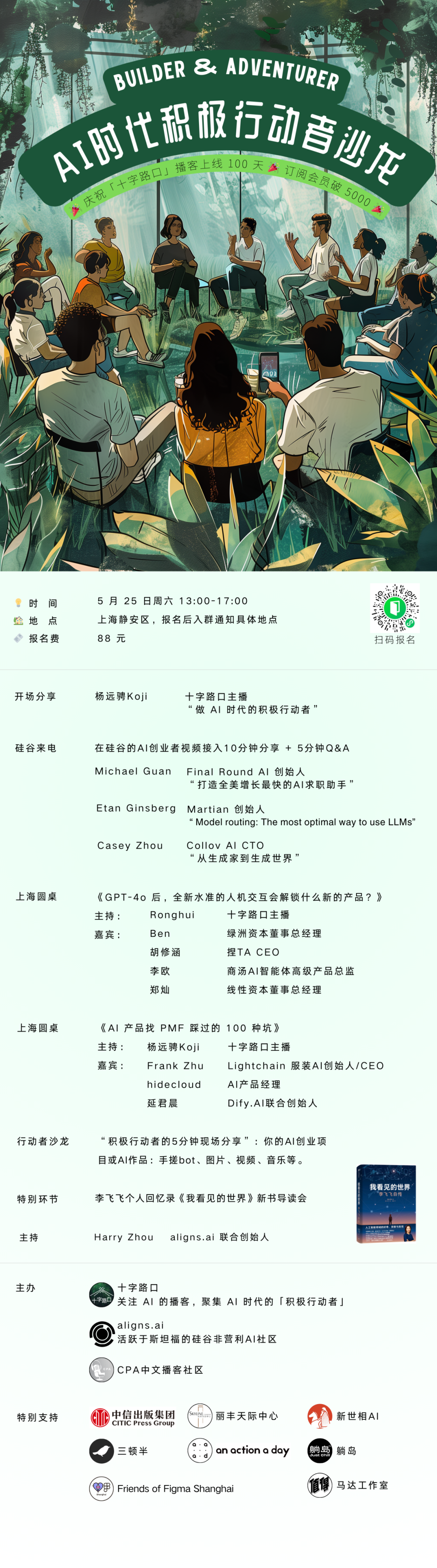
AI Era Active Agent Salon
What can you build that won't get drowned?
This Saturday, we're throwing a "100-day banquet" for the Crossing podcast in Shanghai — an offline salon. Only a few tickets left. Hop on board.