Undercover Inside Cursor for 60 Days
We rarely translate articles from foreign publications. But this one, we had to share.
**
We rarely translate articles from other publications. But this one, we had to share.
 👦🏻 Compiled by: Jingshan
🥷 Edited by: Koji
🧑🎨 Designed by: NCon
 We rarely translate articles from other publications. But this one, we had to share.
Because the author "went undercover" at Cursor for 60 days, documenting the captivating core of this AI unicorn: the stories and details hidden inside its offices.
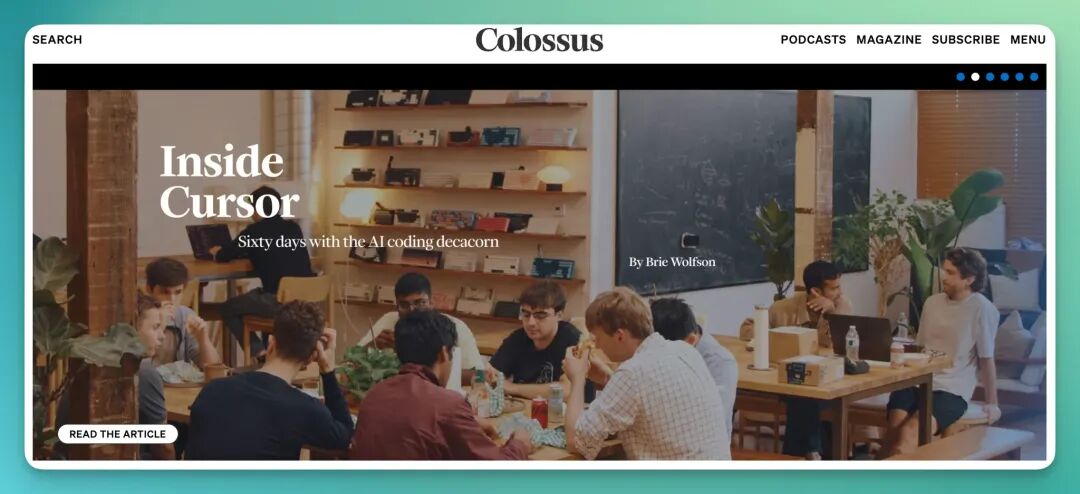
We became obsessed with these stories, so we decided to translate the full piece:
- Why does a company of fewer than 250 people have 50 former founders?
- How did they turn recruiting into a company-wide "hunt"? To land coveted talent, they didn't hesitate to gift vintage Macs or fly to Germany twice.
- What worries the founders most? Not competition or growth, but "the day everyone starts talking about the weather at lunch."
- What is "Fuzz," the company's most important ritual? A collective bug-hunting session where the entire team drops everything for an hour to try to break their own product.
- How did the founders use the Beatles documentary Get Back to describe their team's creative process?
- At a company that champions "constructive friction," why is ❤️ the most frequently used emoji?
And more. Read on for the full story.
Below is our complete translation and compilation of the original:
"Inside Cursor" — 60 Days With an AI Programming Super-Unicorn
Author: Brie Wolfson, November 2025
I first connected with the Cursor team through a former colleague. He said the company was looking for people with "unconventional perspectives on marketing."
We talked for thirty minutes, then I received an invitation to visit their San Francisco headquarters. I assumed it would be a casual chat, but that visit led to several more informal conversations.
I sent over some thoughts, then went about my week. Unexpectedly, I started receiving texts from former colleagues saying the Cursor team was "quietly asking around" about me, discussing bringing me on for a paid role —
and I had no idea I'd ever "applied" for such a position. I found it both amusing and baffling, slightly offended but also rather flattered.
Later I learned this is simply Cursor's typical style. Within two weeks, a company laptop arrived at my door, a Slack invitation appeared in my inbox, and I had a flight booked to headquarters for official onboarding.
My job description was deliberately left vague, but broadly speaking, it was this: use my own observations to help Cursor tell its story.
With support from the Colossus and Positive Sum teams, I took on the project,
for two reasons:
【1】First, after visiting the office and meeting the team, I knew I had to join. I'd been at Stripe and Figma in their early days, and I caught that same scent at Cursor. Those who've experienced it know — it's addictive.
【2】Second, the AI era hasn't yet produced a truly "epoch-defining" company, and I believe Cursor has that potential. Their leadership is attempting to build an entirely new kind of startup narrative.
I wanted to witness it firsthand, and to participate in shaping that culture.
The outside world harbors many mystical imaginings about Cursor.
Over the past two months, some things matched my expectations; far more completely exceeded them. This is what I've seen at Cursor so far, and what has surprised me most.
Next, I'll share Cursor's story:
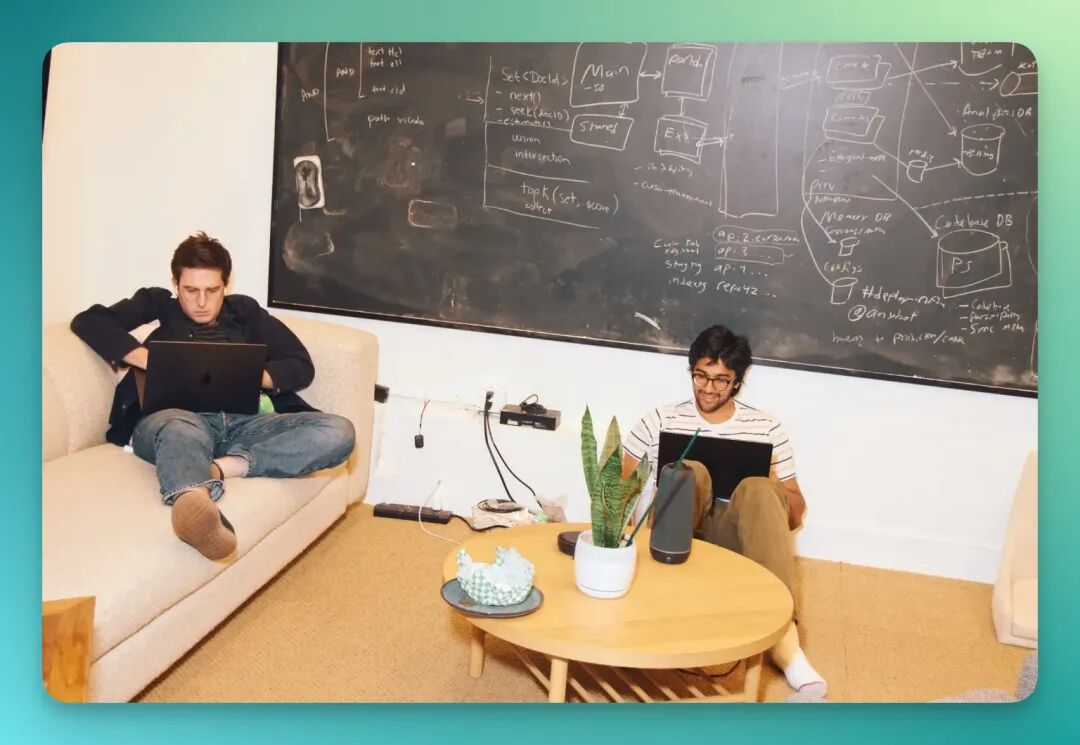
The San Francisco office is perfectly suited to Cursor-style work.
To truly understand Cursor's culture, you need to visit its headquarters in North Beach. There are hardly any other startups in that neighborhood, and the office atmosphere resembles a university common room or cafeteria. If you didn't know what Cursor was in advance, you'd never guess what this place was.
Because there's no logo outside, no corporate slogans on the walls, no one wearing company T-shirts, and barely any stickers on laptops.
In their place, you find people heads-down working, or in groups of two or three discussing something.
They use chalkboards instead of whiteboards (Oskar Schulz can happily talk your ear off about "which chalk works best"), and the furniture is European vintage he sourced from a retired engineer in the Bay Area.
Books are stacked along the walls, many of them textbooks, more often the kind with creased covers from being read and re-read.
On one of my first visits, I happened to run into three clients from a Japanese bank. They wore suits and high heels, stiff and proper, while a twenty-something Cursor salesperson led them around, continuously grabbing snacks from Cursor's "snack tower" to offer them — protein bars, chips, pretzels, popcorn.
The whole scene was a bit like kids playing grown-up, but also remarkably sincere and unpretentious.
Cursor is almost entirely in-person.
Eighty-six percent of employees work from the San Francisco headquarters or the new New York office. Here, the most effective way to get someone's help is to tap them on the shoulder.
Slack messages might go unanswered, meetings are rare. Most collaboration happens spontaneously: around a chalkboard, squeezed next to a desk, a few sentences and the direction is set.
They care deeply about protecting "deep work" time, and don't like packing the day full. When I asked if there was documentation I could reference, the response was: we're more of an "oral culture" here.
Starting in early September, I went to the office every other week. I have to admit, working together in person is completely different. When working from home, I often lament how brutal in-person work is; but once I'm in the office, I feel there's nothing more efficient than working shoulder-to-shoulder with colleagues.
They're already discussing opening a third office. I imagine that as the team becomes more distributed, a new communication style will inevitably form.
But for now, the energy that comes from face-to-face interaction is genuinely addictive.
Every day at 1 p.m., six days a week, the company's soul — chef Fausto — serves lunch on the dot. Everyone gathers around long tables, chatting about work and life, lively and relaxed.
Apparently, there was a period when Fausto almost quit, because dreaming up new menus every day while the team nearly doubled every few weeks was too much pressure.
So someone built him an AI menu generator to help him through that "expansion phase." Now Fausto hangs out in Slack too, posting new dishes daily, basking in compliments on his classics, and collecting requests for "what do you want to eat."
At Cursor, even the chef demands autonomy.

Lunch and dinner table conversations mostly revolve around work, though the range is broad. People seem to enjoy getting to know each other through discussion — talking about recent projects, ideas they're mulling over, or views on the product and industry's future.
When I'm in the office, I often sit at a table just listening. I don't have many thoughts myself, but asking questions is interesting enough. In a thirty-minute meal, it's common to see: someone gets up, someone joins, new ideas keep emerging.
From 2015 to 2017, when I was at Stripe, I often felt this too. The difference is, at Cursor, there's always someone at the table I don't know, because people love to invite "smart" friends to drop by.
I asked co-founder Sualeh Asif what he worries most might go wrong as the company grows.
He thought for a moment and said: "The day everyone starts talking about the weather at lunch."
But so far, I haven't seen any sign of that.
Cursor's approach to hiring operates on an entirely different plane.
Their secret is: treat the atomic unit of recruiting as "people," not "roles."
Most companies hire like this: identify business need → open position → build candidate list → several rounds of interviews → extend offer → start two months later.
At Cursor, it goes like this: someone mentions a "promising candidate" in the Slack #hiring-ideas channel → the team immediately swarms to investigate → a series of eclectic interviews → if both sides feel it's right, start next Monday.
Hence, Cursor's team has expanded explosively.
This time last year, they were under 20 people; now they're approaching 250. I spent roughly a quarter of my time helping with recruiting, which is quite encouraged at the company. The #hiring-ideas channel always has new names popping up.
Cursor's "people search" isn't the LinkedIn keyword-by-title-or-company, add-to-spreadsheet approach. It's more like genuine curiosity: who is the most promising candidate right now?
They found Eric Zakariasson because he ran his own Cursor studio in Stockholm. They discovered Ian Huang because system monitoring showed him coding in Cursor until the early morning hours every night.
Wherever talent pools emerge — like New Computer shutting down or Meta layoffs — the Cursor team collectively heads out to "sweep" for the best of the bunch. If someone spots a great product launch, tweet, or blog post, they'll immediately drop that person's name in the channel with: should we poach them?
Once people agree a candidate looks promising, they create a new Slack channel to strategize how to reach them. Common discussion questions:
"What does this person most want to do?"
"What are they best at?"
"What at Cursor would most motivate them to perform?"
Then they list Cursor's most exciting, most challenging projects as bait. After all, the best people love a challenge. As for the back-channel digging on candidates — the team does that too, and they don't give advance warning.
This part, honestly, leaves me conflicted.
I once asked co-founder Sualeh what he worries most the company might become.
He thought for a moment and said: if one day people start talking about the weather at lunch, that would be bad.
Once a candidate is locked in, someone on the team volunteers or gets tapped to lead the hunt.
This person becomes the hub of the entire process, but the candidate simultaneously feels attention from multiple Cursor members. (No knock on recruiters, but from the candidate's perspective, not dealing directly with HR feels completely different.)
One of Cursor's classic lines: not looking to switch jobs right now? No problem — want to try a small project together first? Another frequent move: want to swing by headquarters sometime?
They know too well that the moment a candidate steps into the office, they often fall in love.
One Cursor colleague calls this the "lightning-bolt surprise interview."
Every time I visit the office, I run into familiar faces: smart, capable, industry-known people. Some casually claim they're just there for coffee; others text me afterward: please, don't tell anyone you saw me there.
Despite Cursor's relentless external recruiting, their acceptance rate remains extremely low — elite university admissions look casual by comparison.
Many companies pay lip service to talent being paramount; few actually grit their teeth and execute. Cursor is the exception. Rejecting a "good enough" person when tasks are piling up is no easy thing.
A founder friend put it well: they're pre-paying the pain. Every hire at Cursor goes through the leadership team personally, and I suspect this strict gatekeeping will last a long time.
At Cursor, not only can everyone refer candidates — everyone is responsible for closing candidates too. Sometimes the other party already has an offer but hasn't said yes. (As a side note: at Cursor, passive poaching is the norm — you might get an offer even when you're not job-hunting.)
The team's obsession with this has reached another level.
Ryo Lu, an early designer at Stripe and Notion, is a die-hard Apple fan. Cursor sent him an early-edition Macintosh. Programmer Lukas Möller once wrote a cold email expressing his love for coding and Cursor that impressed the founders. They even flew from California to Germany to recruit him in person, but he turned them down on the spot.
Oskar smiled at the time and said: in our world, "no" is just the beginning of a conversation. A year later, they flew to Germany again, and this time Lukas came back with them to San Francisco.
Then there's Jordan MacDonald. She was genuinely happy in her job. When Cursor came knocking, she wasn't interested. Six months of coffee chats later, she still hadn't budged, even as more and more talented friends around her joined Cursor.
During one conversation, the team learned she had just moved into a new place. So they quietly contacted her interior designer to ask what gift might move her. A few days later, an espresso machine arrived at her new home. In October, she officially joined.
That said, Cursor's recruiting isn't perfect. In product and engineering, the female ratio remains low. This is a "serious bug" that the team openly acknowledges internally, and it's been flagged as p0 to fix.
Strong mission + hard tech + hypergrowth + elite recruiting = absurd talent density
Generally, a young company struggles to gather top talent early on. But Cursor has almost every ingredient for the chemical reaction, so it could attract first-rate people from the start.
On the product and engineering side, they're sitting right at the hardest intersection of UX and machine learning.
The development of Cursor 2.0 is an example — proprietary models, new Agent workflow interfaces, all built in-house. On the commercial side, they're among the fastest-growing companies by revenue: from zero to $100 million ARR without ever building a sales team.
The newly formed sales team's goal is to add another zero by end of 2025.
In Slack's #closed-won channel, deal alerts ping almost every few minutes. What they're doing also carries a sense of era. In a world where every step of software development is about to be reshaped by AI, Cursor's mission proves deeply attractive.
More importantly, writing software is shifting from a programmers-only skill to something designers, product managers, founders, and industry experts can all participate in. The market ceiling is essentially unlimited.
The company now has 50 former founders, making up one-fifth of total headcount.
Nearly 40% of employees come from MIT, Harvard, Columbia, Cornell, Carnegie Mellon, Stanford, UC Berkeley, and Yale — though no one mentions their alma mater.
Some are fresh graduates; others hail from Figma, Stripe, Segment, Plaid, Notion, Vercel, Dropbox, GitHub, Uber.
The place very much resembles an "entrepreneurial crucible." So what's this talent density actually feel like? My most direct impression: everyone is highly capable, but no one performs capability.
In other words, at Cursor, you don't see obvious incompetence. Everyone knows what they're doing, and does it well.
Here's a small but telling detail: to reach the desks, you climb a very steep staircase with no handrail. When I asked why it was designed this way, the answer was: everyone knows how to walk.
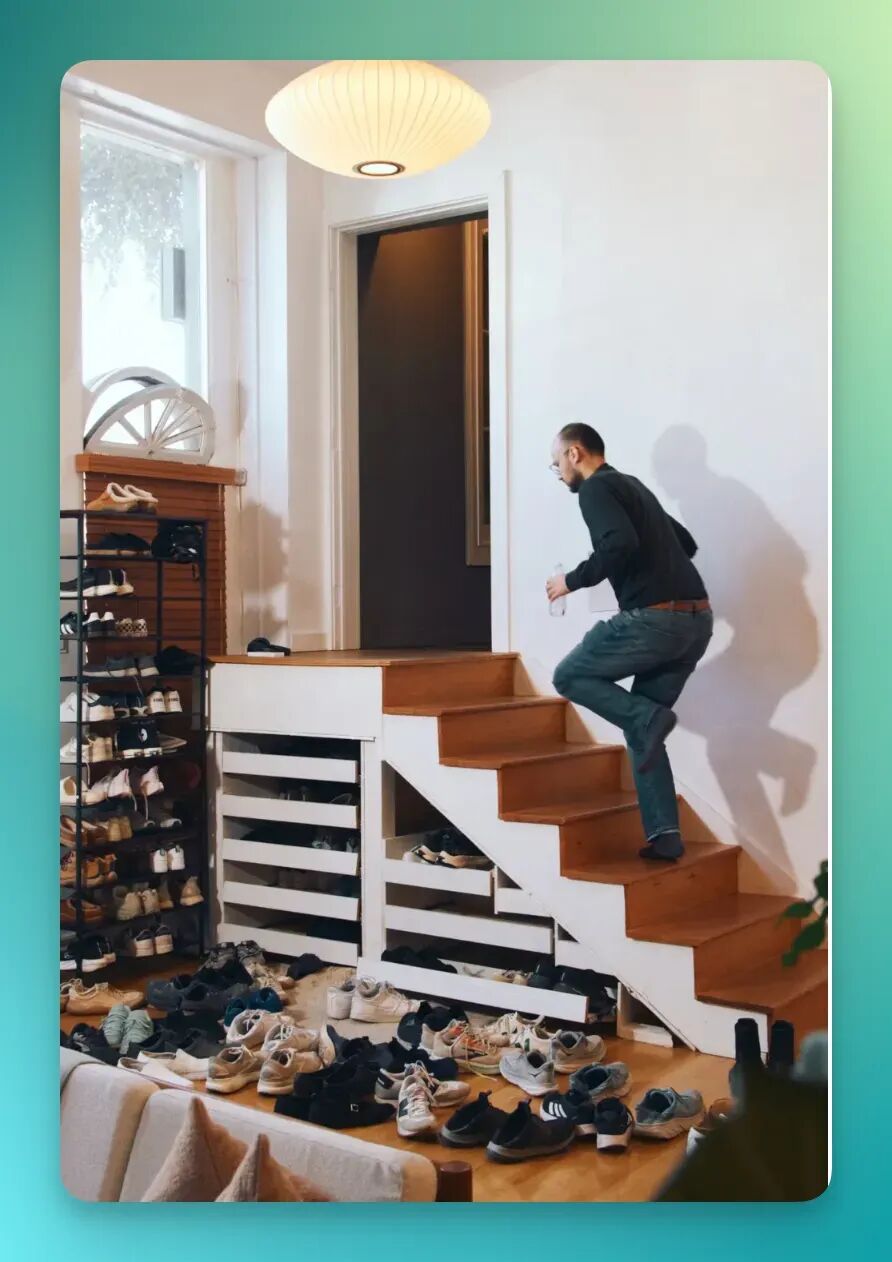
Michael often says he wants Cursor to become a haven for self-driven individuals. So far, they've delivered. In this home for individual contributors, people push things forward through passion and execution rather than waiting for leadership to assign tasks.
Here, ICs (Individual Contributors) matter — they're a Top Level role attribute.
Co-founder Aman Sanger remains an IC to this day. My impression of him: he's often tucked in a corner of the office, coding all day, barely disturbed.
There's a healthy unspoken agreement: whoever gets ignited by a problem, just goes for it. Even for very difficult tasks, regardless of seniority or team affiliation, one person can take full ownership and be left to see it through.
A new sales hire said: at my last company (a very hot startup), it took 30 days before I was allowed to talk to customers; at Cursor, I was on calls in under 30 hours.
Another example from engineering: someone asked whether the browser could enable Cursor to do cooler things, and a group spontaneously decided to ship it over the weekend.
The team included: Ian Huang, a founding engineer barely out of school; Andrew Millich, a former founder and author of Notion Mail; Lukas Möller, the savage who wrote the Cursor CLI in 10 days; and Baltazar Zuniga, an engineer known for making decisions with code, not meetings.
Andrew later recalled: we dropped everything else, entered full focus mode, and worked in the office together until it was done. That might have been the most exhilarating collaboration of my career.
Things like this happen at Cursor almost every day.
All of this works not just because the people are strong, but because there are too many problems and too few people. I still remember a flashy company slogan plastered in Stripe's bathroom in 2018, which Patrick Collison (Stripe's founder) immediately questioned as a sign of team bloat.
At Cursor, by my observation, no such sign has appeared yet.
"Old-fashioned" young people
Being described as young in a professional setting usually means one of two things: either you're not very good, or you're very good but too flashy.
I had assumed I'd encounter at least the latter at Cursor.
The opposite turned out to be true.
Though the team skews young overall, they're sincere, polite, dress well, speak clearly, like making eye contact, and will proactively replace the toilet paper when it runs out.
What surprised me more: these twenty-somethings frequently use Silicon Valley history, world history, pop culture, art, even examples from other industries to express their ideas. Their references span wide, but the common thread is: they're observing the world, not just understanding it through their own experience.
This lets them come up with unusually good and "elegant" solutions to complex problems.
To share these observations and reflections, many employees run their own brain channels on Slack to log personal thoughts. No one demands responses or engagement, but if the content is interesting enough, it easily gains traction.
The most popular channels have almost nothing to do with reporting results or pleasing superiors — they're mostly pure thinking and reflection.
Recent examples include:
-
An essay asking whether CMS is a pre-AI relic
-
A deep synthesis of multiple customer visits
-
A detailed experience log of a Cursor product still in testing
These young people think in a remarkably mature way, yet remain full of curiosity and enthusiasm.

For me, the most striking thing is that there's almost none of that performative "bro, that's insane" hype flooding the channels, nor do people spam emojis and reaction GIFs.
A few recent "non-work messages" that stuck with me: an invitation to hear the San Francisco Symphony perform The Four Seasons; post-run photos from night runs in New York and San Francisco; someone roasting a terrible AI article in The New Yorker; a dedicated #laundry channel (complete with a weekly laundry standup bot report); a debate about the proper way to fold bed sheets; and a poll on which humanoid robot would be first to make our beds.
No one breaks character. No one performs too hard.
The most-used emoji at the company is ❤️. No one talks out of turn, no one panics, no one freaks out when something goes sideways. The vibe in one word: mature.
There was an incident recently — servers went down.
The person responsible posted in #general on Slack: Sorry everyone, I did all the prep I could and executed the change as safely as possible.
The comments were all ❤️.
The first reply read: Good thing we had the rollback ready. We'll do a postmortem. These kinds of changes are inherently risky — let's think about how to make them more stable going forward.
This isn't to say people don't care. Everyone takes things seriously and reflects deeply.
It's just that when you genuinely trust your colleagues' competence and intentions, minor incidents don't spiral into the all-hands anxiety and blame-shifting you see at other startups. No one gossips about company problems, no one vents about management behind closed doors.
Even with fierce competition, discussions about rival products stay objective and professional — more about ideas than panic.
Visitors often remark on how calm the atmosphere feels. Employees laugh and say: that's the duck illusion. Meaning: serene on the surface, paddling furiously underneath.
The Myth of "996" Doesn't Apply to Cursor
In Silicon Valley circles, many people's first reaction to Cursor is: I heard they're intense. Some even call them a 996 company (9am to 9pm, six days a week).
The reality is nothing like that. The company has never mandated such hours. It's just that many people, out of genuine passion and care, voluntarily work more and longer.
The pace and level of commitment are entirely self-driven. No one has ever asked me to work nights or weekends. Have I done so? Of course. (As I write this, my ten-month-old is asleep upstairs.)
There are stretches when Slack, email, and meetings all go quiet — and those are often my most productive hours. Plenty of people do this every week. I fall into it too, especially when I genuinely want to nail something, half out of enthusiasm, half because I want the brilliant people around me to think I'm not half bad.
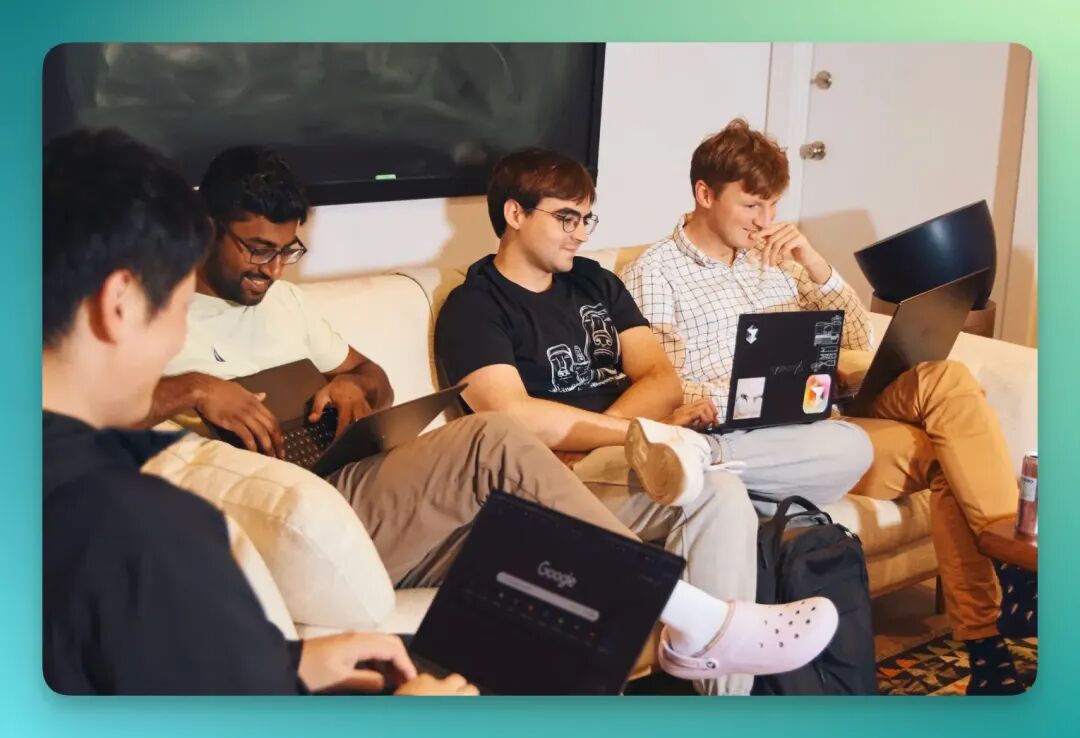
Honestly, my first few weeks at Cursor, I could barely breathe. Every remotely important thing went straight onto my to-do list, the pile kept growing, time was never enough.
I couldn't tell if I was doing the right things, whether my output was good enough, whether my impact was large enough, or even who to ask.
Many new hires go through this phase. Later I realized this "panic" actually stems from the company's deep trust in individual capability. They assume you're excellent — a continuation of that rigorous hiring filter.

As you acclimate to the company's rhythm, that anxiety transforms into confidence. The feeling is genuinely addictive. I've done culture consulting for several companies, and I can say with authority: pace and work ethic are the most contagious things there are.
If colleagues move fast, you move fast; if they respond to Slack instantly, you respond instantly; if they go home for dinner, you go home; if they come into the office on Saturday, you probably show up too. At Cursor, the default pace is "fast."
More importantly, no one is forced — people genuinely enjoy it.
Dogfooding
An early Cursor culture doc contained this line:
Cursor may be the company where the average employee spends the most weekly hours using their own core product. The only possible contender is probably Apple.
Indeed, everyone uses Cursor. Almost constantly. This makes the product roadmap remarkably "bottom-up" — anyone can file a request. The most legitimate reason to build a feature is often simply: I want to use this myself.
And Cursor's user base is extraordinarily passionate.
On X, Reddit, LinkedIn, and HackerNews, they constantly suggest improvements, sometimes DMing employees directly with ideas. People joke that we have to be careful on social media now — someone will start giving you product feedback at any moment.
When an idea gets internal buy-in, someone might demo it at the weekly product showcase, or they might not wait at all and just build it. Occasionally two people end up working on similar features,
but the version that ultimately ships usually incorporates the best ideas from both.
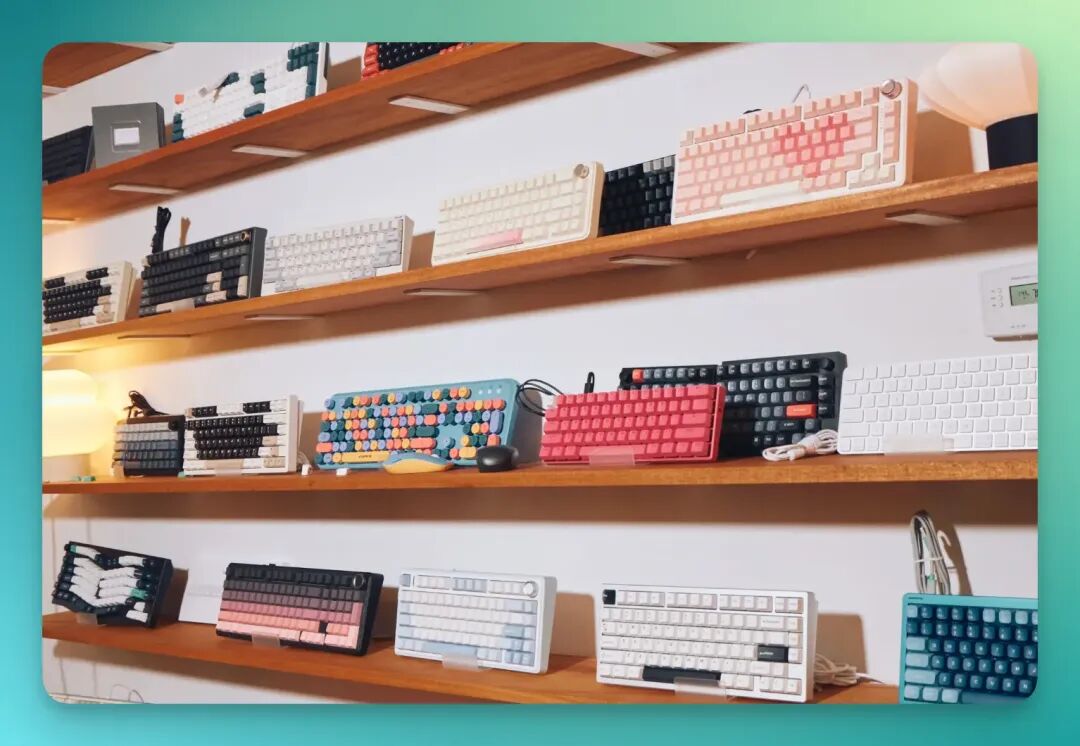
When a new feature is built, the team first deploys it to Cursor's internal build to see if people actually use it, gather improvement suggestions, or quietly watch it die.
Because Cursor employees are themselves the ideal users, they run "PMF" tests internally first,
using themselves to validate which features genuinely matter.
Features beloved by users like Tab, CmdK, Agent, Bugbot, and Background Agent were all built this way.
One of my favorite Slack channels is #braintrust, which includes all employees. People post what they're working on to solicit feedback,
most commonly through emoji voting.
A real example:
"cmd k – edit full file – 🟢 = delete it 🔴 = I use this, don't touch"
"cmd k – edit full file – 🟢 = REMOVE and 🔴 = 'I use this and need it.'"
Results: tons of votes, heated debate. But it's remarkably effective — simple, direct, and sparks genuinely useful discussion.
Cursor's stance is clear: while other companies focus on lowering barriers, we focus on raising the ceiling.
This deep self-use culture has another benefit: Cursor is unusually good at pruning old features and updating defaults. The product discussion channels on Slack are constantly surfacing questions like:
"Is this setting still needed?"
"Can we reduce clicks here?"
"Can we smooth out this flow?"
"Anyone using this? Can we kill it?"
Honestly, most companies are pretty bad at this. And because of this constant experimental rhythm, the internal Cursor build typically runs a full three months ahead of the public release — new features get "poison-tested" internally first.
And it's not just product and engineering using Cursor. The business team's technical skills are surprisingly strong — they use Cursor for website redesigns, data dashboards, even internal tools.
The #built-with-Cursor channel on Slack is like a creative showcase: someone built a badminton court booking system, someone made a wedding website, someone built a Cursor shortcut visualizer, a snack-feeding game for the office dog, and Metguessr, a geography guessing game using Metropolitan Museum of Art collections.
None of this was mandated. No one was required. People just genuinely enjoy it — the pleasure of using Cursor to tinker with Cursor.
Fuzz, My Favorite Cursor Ritual
Whenever a major release is coming — whether a new client or a website update — the entire company gathers to do one thing: try to break it as hard as possible.
Usually the product lead posts in a public Slack channel: Stress testing for Project X starts now.
Sometimes they lure people with donuts or bagels, but most don't need convincing.
Everyone treats keeping bugs away from users as their own responsibility, willing to personally do the most granular testing.
The early Welcome to Cursor doc put it clearly:
We own our bugs. Because mistakes happen, but every bug found by a user is a disappointing experience. Users spend all day writing code in Cursor — when bugs or lag hit, it's easy for them to switch to another tool.
So every Fuzz session feels like a collective battle. No one wants their code to be the weak link.
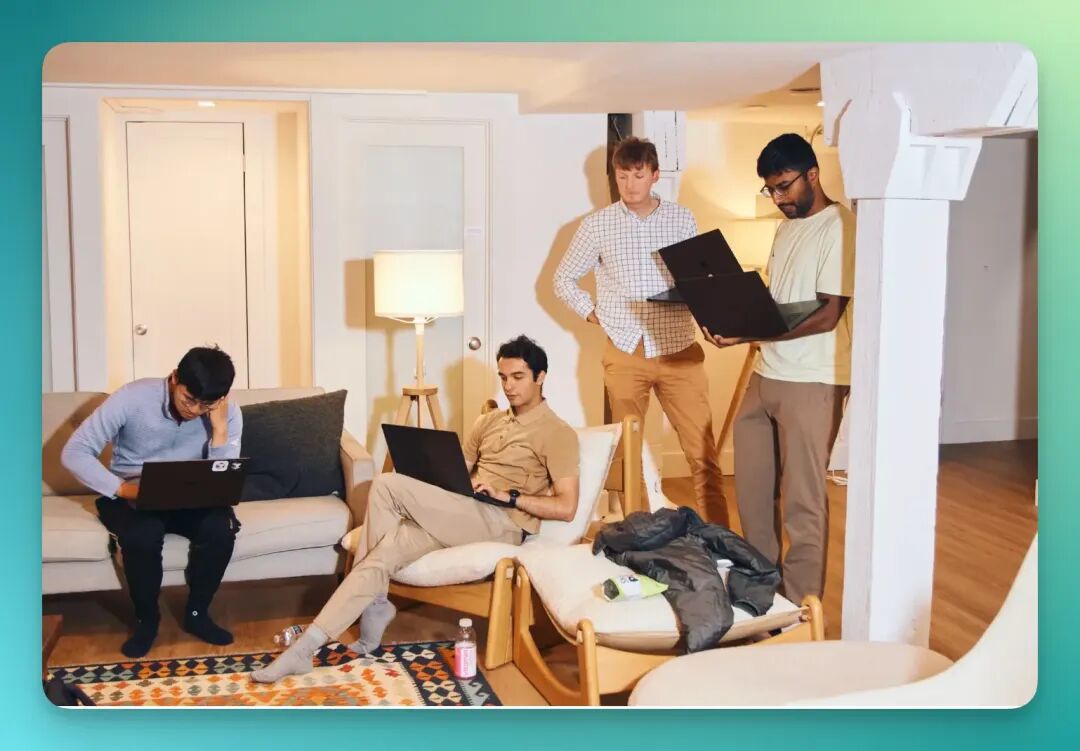
When Fuzz begins, the devs arrange themselves in the largest available space in a circle. Early arrivals grab chairs; latecomers sit cross-legged on the floor, squeeze onto couch arms, or drag chairs from their desks, laptops balanced on their knees, ready to go.
The product lead drops the latest test build link and instructions, then one line: start truffle hunting. (They jokingly call themselves "truffle pigs," sniffing out bugs.)
For the next hour, the room holds nothing but keyboard sounds.
No chatting, no goofing around. Everyone silently hunts bugs, spots UI micro-issues, tests edge cases, or identifies details that still don't feel quite right,
fixing and posting issues to Slack as they go. Occasionally people argue over solutions, sometimes launching Slack polls to pick the best implementation.
When the hour ends, there's usually a very long bug list. All of it must be fixed before the official launch the next day.
Then the product team genuinely thanks everyone who participated, and gets to work pulling an all-nighter — and the people who filed bugs often stay to help fix them too.
Constructive Friction
At Cursor, people constantly nitpick each other's work. For those unaccustomed to this culture, it can feel jarring at first. But those who truly understand product have a sense for what "feels right," and they tend to express their opinions bluntly.
They'll point out where something falls short, then actively help you make it better. This culture reminds me of Stripe in its early days. My former boss and partner Eeke gave that atmosphere a name: micro-pessimist, macro-optimist.
Cursor is the same way.
People are brutally exacting on execution details, yet firmly believe: we're building something that actually matters. When discussing problems, the tone is "this can work," not "this definitely won't work" — and this starts with the founders.
Michael (Michael Truell, Cursor co-founder) always encourages "sharp questions" at company Q&As, sitting himself in the spotlight and getting grilled without issue.
Sualeh (Sualeh Asif, Cursor co-founder) prefers to DM employees a single question: What are you most worried about right now?
Of course, this culture sours quickly if office politics, ego, poor communication, or emotional volatility creep in. I've seen plenty of brilliant people who treat finding flaws as sport, with zero interest in actually solving them.
At Cursor, the critics are also the fixers. The "friction" here stays healthy because everyone genuinely wants to make the product and team better.
Once I asked Michael what feeling he wanted Cursor to evoke. He didn't answer directly — he asked me: Have you seen that Beatles documentary? (He does this, answering questions with questions.)
He meant Get Back.
To sum it up: the world's most famous band locks themselves in a studio, under a three-week countdown, grinding out the legendary album Let It Be. The film has those spine-tingling moments: Paul McCartney sitting with his bass, humming nonsense syllables, and almost casually stumbling into the melody and structure of "Get Back."
There are tense moments too: George Harrison finally pushing back against Paul for forcing the exhausted band to record yet another take. The studio is filled with pressure from fans and the record label, alongside a group of people gritting their teeth and pushing forward.
What makes the documentary so moving is how fully it reveals the ups and downs and chaos of creation.
You can see that real "magic" isn't inspiration — it's the day-to-day, mundane collisions. Great work is essentially built from these small sparks.
This is craftsmanship at its extreme: a group of people fully committed, trying and failing repeatedly, hands always on the "instrument," fumbling until it takes shape.
Michael never said it outright, but I could feel this is what he wants Cursor to be. So far, Cursor is indeed becoming more and more like that studio.
"Ceiling-Raising" as Conviction
Cursor has consistently held that its ideal user is the most elite software engineer. This is somewhat controversial, because plenty of non-developers use Cursor too — and are among its most enthusiastic fans.
Cursor has never dismissed these users, nor does it oppose the goal of making programming more accessible.
But its stance is clear: other companies can lower the barrier to entry; we're focused on raising the ceiling.
There's a saying in product:
Be careful which users you attract — they'll determine where your product goes.
Cursor wants to be pulled forward by "the best." They believe this is the only way to truly change how software is developed, rather than patching the old framework.
I admire this choice. "Democratizing programming" is an easy sell, but Cursor would rather abandon a catchy slogan and make the product radically precise.
This "designed for ceiling users" philosophy shows up in the interview process too. Cursor's interviews are notoriously difficult, especially the coding rounds.
I asked the team why the bar is so high. Their answer: overly easy problems actually prevent great people from showing what they can do. And a sharper line: we'd rather miss on good people than hire the wrong ones.
During my time at Cursor, this mindset has influenced me too.
Now whenever I make a decision, I ask myself: what's the ceiling-raising version of this option? Almost every time, this question pushes the thinking further and bolder.
The Mission Itself Is the Motivation
So what drives Cursor's intensity, focus, and momentum? Their "win" is fulfilling the mission.
From the outside, Cursor's story is about boosting developer productivity. The website, media coverage — it's all this narrative. It sounds reasonable, and it makes money.
But what the company actually talks about internally isn't productivity. It's code itself, and how code generation becomes the underlying logic of the world. We already know that nearly everything depends on software to run. But before working at Cursor, I hadn't truly realized: human progress is bottlenecked by our ability to write better software.
Not just SaaS or internet companies. Traffic signals, scientific research analysis, film post-production, hospital records, supermarket supply chains, flight scheduling systems...
Nearly every part of what keeps society running is held up by software.
And if you agree that what we create depends on the experience of creating it, then you understand Cursor's mission is actually about changing how the future gets built.
When the right tools land in the hands of people who want to build lasting, impactful work, the gap between idea and reality might truly be erased.
Many companies shout such slogans, but at Cursor, it's real.
I think this is because even if most people could retire tomorrow, they'd still choose to keep doing what they're doing at Cursor.
Once on a walk, I asked a particularly thoughtful colleague how he understood Cursor's mission. He talked about building useful, reliable, elegant software. About development tools giving creators precise control at every level of abstraction. About the language gap between humans and AI needing to be bridged by a tool everyone can use naturally. About programming deserving to feel more like sculpture or painting — a tactile act of creation.
I used to hear such talk and think it too idealistic. But now, perhaps I've been infected by Cursor's atmosphere — I get that feeling.
From another angle, this company is more like a moonshot. Cursor's greatest risk may not be market competition, but rather commercial success coming too soon and making them forget to keep taking risks.
Michael understands this too. At all-hands meetings, he often reminds everyone:
Growth can mask execution problems. (This reminds me of an old Stripe line: we haven't won yet.)
Honestly though, the team barely needs reminding. While people do applaud impressive revenue, growth, and user numbers, what truly excites them is always the product itself: performance improvements, interface elegance, feature stability, and the details that make Cursor better to use.
When they discuss user growth or revenue, the tone is more like: our understanding of better ways to program is actually being validated.
One early employee recalled the day company revenue crossed $100 million. The #numbers channel on Slack pinged, people dropped a few rows of ❤️s, someone added a 💯, and the office kept running as usual — no one made a fuss.
Perhaps the thing that best illustrates "the mission is the reward": in my months at Cursor, I never once heard anyone talk about getting rich. At Stripe, Figma, or other unicorns, this is the most common lunch table topic: how many times has the stock multiplied? Should I buy a second home? Where to retire?
But at Cursor, even as valuations keep soaring, no one mentions these things. They don't see "dollars" because the work they genuinely love is their ideal "retirement life."
In recent years, we've grown accustomed to examining AI unicorn stories from the outside: valuation, funding rounds, growth curves, ARR, X trending topics.
But sometimes, the truly interesting parts hide in these AI unicorns' conference rooms, Slack channels, and offices where someone's still coding at 2 a.m.
This article comes from Colossus / Positive Sum's new series "Company Dispatches."
Colossus is a knowledge platform founded by investor Patrick O'Shaughnessy, originally built on the podcast Invest Like the Best, and now one of the world's most influential business and investing content networks, often focused on "how great companies are built."
Positive Sum **is Patrick's investment fund, focused on long-term-oriented technology companies.
Its relationship with Colossus is like this: one captures ideas, the other bets on the future.
In this series, they temporarily "embed" inside companies — as employees, investors, or observers — experiencing firsthand how they operate and sharing their real impressions.
It's in these "field notes" that we see the conference room debates, the sparks in Slack channels, and the moments when teams stay creative under intense pressure.
From the inside out, this is what the new generation of builders looks like.