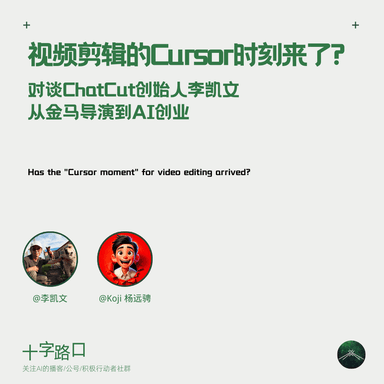

🚥 Will Video Editing Have Its "Cursor Moment"?
After tools like Cursor and Claude Code redefined programming, a harder and less seriously discussed question is emerging: will creative workflows, especially video editing, see a similar inflection point?
This week on "Crossing," our guest is Kevin Li, founder of ChatCut. Before becoming an AI entrepreneur, he was a middle schooler selling bootleg CDs in Anshan, a prodigy at the Rhode Island School of Design, and an advertising and documentary director whose short films were shortlisted for the Golden Horse Awards. He's shot commercial ads and edited vast amounts of unscripted, chaotic footage that demanded finding order slowly, in real time.
That experience gave him a distinctly non-mainstream perspective on "AI + video."
While most people are betting on AI-generated video, Kevin insists on "generating zero pixels." While most AI video tools target professional editors, he chooses to serve people who "aren't editors yet." While most founders talk about models and algorithms, he talks about "alchemist culture" and "the hand of God."
Behind these counterintuitive choices lies an entirely new framework for thinking about creative tools in the AI era.
Welcome to the show.
————————————————
🎬 This is "Crossing's" first experiment with a new video podcast format.
For this episode, we didn't sit across a table. Instead, we split the conversation into two continuous scenes:
Part one: Kevin and I drove to the suburbs together — me at the wheel, him in the passenger seat, talking as we drove for about an hour.
Part two: We arrived at the lakeside suburb where he once spent a year in retreat, and continued the conversation sitting in a pavilion on the water.
🎬 Our video podcast is now live on Koji Yang Yuancheng's channels on Channels, Xiaohongshu, Bilibili, YouTube, and other platforms.
📒 The transcript will be published on the @CrossingCrossing WeChat official account.
🟢 01:59 Lightning round: Age, alma mater, MBTI and zodiac sign, one-sentence description of ChatCut, funding status, team size, pre-entrepreneurship experience
🟢 03:06 Leaving the city center: The hand of God pushes you to build your own 0→1
A sudden fork in life's road. A love-at-first-sight house that made him "extract himself" first, then decide next steps: only by leaving the old identity can a new direction grow.
"Cooking up a move": one year without commercial ads, building something of his own — could be a film, a product, an app. Just let it sprout.
ChatGPT's arrival felt like a "changing of eras": having just tasted the future, returning to Premiere felt prehistoric — and the obsession with "editing video through chat" was born.
He describes founding a company as "taking on God's work": the problem is both simple and hard, and what matters isn't technique but simple yet deep insight into life.
🟢 08:02 The first investor
A VC's value isn't in being "smart," but in making you feel like you can be great too.
During the Golden Horse period, he met Eric, an investor at Antler: give a small sum first, see if you can turn it into something — like betting on "persistence" and the ability to "make things happen."
A rare "empowering figure": sitting next to him, you don't feel small. You feel amplified.
Finding reasons why an entrepreneur will fail is too easy; most things in the world don't work out. What's hard is finding someone willing to seriously ask "why you might succeed."
🟢 09:25 Product first principles: Most editing actually happens in Word documents
Counterintuitive experience: editing seems multimodal, but editors do massive amounts of work in "text" — converting video into editable transcripts first.
Early strategy: "1000 true fans" — small and beautiful.
The metaphor of "poor startup": don't stuff too much money in the kid's bank account from day one.
🟢 11:18 Early adventure muscles: From Anshan to Kent, then to RISD
His "globalization enlightenment" came from bootleg CDs: no internet, no rating systems, aesthetic judgment built entirely on his own.
Turning passion into transaction: hauling a backpack of CDs on spring outings, forcing earphones on people, playing songs over the phone to sell first pressings — a natural product distribution instinct.
Unfamiliar territory? Just try first.
RISD's "alien planet" quality: emphasizing independent thinking, outputting "entrepreneurs with soul" — he took this as the temperament source for his later products.
"Dancing lessons from God": willing to treat life as being pushed to learn dance steps, rather than waiting for a certain path.
🟢 17:08 Director vs. CEO: A film set is like SWAT; entrepreneurship is like long-term investing
Film is a military operation; entrepreneurship is compounding people as assets.
Directing is classic day one: each time from 0 to 1, turning vision into reality through thick skin, repeated persuasion, and complete ownership.
Film organizations "filter, don't train": choosing experienced people for zero-error outcomes; more like special ops teams, where decisions must often be dictatorial.
Entrepreneurship is the opposite: long-term attitude toward people, treating cultivation as investment — you're not using up the team in one go, but letting them grow.
His self-positioning as CEO: the road paver — flattening the path so that ten people's combined force exceeds one genius.
🟢 21:33 Fundraising methodology: Find chemistry, not perfect pitch decks
The chemistry with Yuan Liu came from "cinematic sensibility": people who can maintain innocence and curiosity beyond rationality are rare, and he saw this trait in his investor.
You can't practice a perfect pitch that "hits every time"; what matters is finding people you can share a boat with for a long time.
The only strategy for facing rejection: stay calm, move to the next one; success is usually timing, place, and people — missing one and it won't work.
This is more like the beginning of a long-term relationship, not the end of a transaction.
🟢 25:21 Life leverage: Having something to do is the greatest wealth
Wealthy people envy you not for money, but because you have a "thing" worth throwing yourself into.
The first time he felt "rich people envying me": not that I was richer, but that I had a clear thing I was doing.
Koji's resonant story: when you're doing nothing and no one needs you, depression floods in like tide — from then on, you know you must find something to do.
Directing is a business without leverage, trading time for money; products/software are strong leverage, yet you can still do what you love.
Pain and enjoyment aren't contradictory: what matters is whether you believe this thing has value — the more it hurts, the more you enjoy it.
🟢 30:03 Vision: Stop reinventing wheels, but you have to go through the process of inventing them
The future isn't "disrupting the editor," but making AI an editing assistant that works above the editor.
Video has already been "edited" through WeChat and chat; the future is just systematizing that collaboration.
Premiere / Final Cut / DaVinci / CapCut overlap 99% in editor functionality — the wheel is already round, reinventing it adds little value.
What's truly hard is the abstraction layer: letting AI understand editing workflows, watching footage and proactively offering higher-level assembly suggestions.
🟢 33:34 The hardest problem right now: Where does style come from?
"Good-looking" has no bug to test, so how does AI learn style?
Editing has two layers: first solve right/wrong (verbal slips, cut-off sentences, vertical format), then enter stylization (personal style, rhythm, temperament).
Style isn't "A to B" training but a byproduct of workflow: you follow the process, don't insert ego, and style grows naturally.
"Hard reinforcement learning" is like martial arts gone wrong in wuxia novels: you haven't found the key, just throwing brute force at it.
Next roadmap: break real editors' workflows into multiple agent processes, using checklists and common sense — "things not clearly written in training data" — to raise the floor.
🟢 37:10 Key choice: Don't generate pixels
The world has an AI revolution every day, but the editing in videos people watch on the subway hasn't changed at all.
ChatCut is "blue-collar" AI: the most down-to-earth AI, focused on solving real creators' workflows, not chasing "sexy but hollow" showmanship.
Analogy to Frame.io: even the most niche link in the chain, if solved solidly enough, is a multi-billion business.
Reality check: professional editors are hard to dislodge from their workflows, so they changed target — to serve the vast population who "want to express but can't edit."
Product value judgment: letting novices directly reach 80 points may yield more than making professional editors 1.3x more efficient.
The core of video is human communication; content completely detached from the real world struggles to move people.
🟢 43:00 Technical barriers: Context and multimodal aren't yet mature enough for "editable" video
Video is a token black hole; context limits must be broken.
Multimodal understanding currently isn't precise enough for editing; Gemini is a good start, but still far from "usable for editing."
The difficulty of "Cursor for video editing": not enough open-source "editing code," massive amounts of knowledge lives in people's heads and in common sense.
Split capabilities in half: Verifiable things (cutting verbal slips, auto vertical, Douyin style) — do these fully first, and that's already enough to create massive value. Unverifiable "good-looking or not" — don't force absolute answers for now; the platform's advantage lies in accumulating data and workflow information, continuously tuning prompts and capabilities.
One key tradeoff: better 80% with human override than 90% with no human override — leave control with people.
🟢 45:34 Why is no one taking on "God's work"?
Find that simple recognition of "yeah this works."
He attributes his advantage to documentary: unscripted creation facing chaotic footage, growing rules from disorder — this is exactly the main theme of the self-media era.
Documentary workflow is replicable to Douyin: different in degree, same in essence, both finding narrative lines in chaotic material.
The counterexample is clear: in scripted film, "the best performance take" can't be selected by AI — that's what AI shouldn't touch and can't touch.
🟢 50:23 Don't chase "absolutely correct," cultivate "good habits"
What determines results isn't goals, but habits — AI agents too.
Editing has no absolute right or wrong, full of serendipity; force AI to find the one correct answer and it's always wrong.
More effective approach: build habits — when lacking footage, review; when the story reaches here, find a sound byte; when transitioning, desperately find a transition — micro-points shape macro style.
🟢 52:48 Model dividend
Gemini 2.5/3.0 is "huge help" for the product.
What might have required RAG / vector databases to solve context can now be postponed, product iteration speed directly unlocked.
MG animation capabilities largely come from 3.0.
🟢 56:19 "Those who do for love"
The alchemist is a "dual identity": an obsession beyond engineer/product/designer as side hustle.
In the AI era engineers must also learn alchemy: those who only do homework will be gradually replaced by AI, alchemists won't.
"Alchemy" = Tinker: constantly trying, constantly bumping into accidents, eventually systematizing the manufacture of accidents.
When you can hear the music, whatever you play is right.
🟢 01:04:34 Film won't disappear
Everything done now becomes fuel for future filmmaking.
Film isn't the destination, it's the container: whether you shoot well depends on your understanding of life, not just love of film itself.
Subscribe to "Crossing": 🚦 We follow the industry shifts and entrepreneurial opportunities brought by the new wave of AI technology.
🚦 "Crossing" is Steve Jobs's metaphor for Apple — standing at the intersection of technology and liberal arts, where great products are born. AI is transforming every industry. We seek out, interview, and bring together a new generation of AI entrepreneurs and active agents of the AI era, exploring and embracing new changes and new possibilities alongside them.
👦🏻 Host Koji: I founded Crossing, launched AI Hacker House — a community space for the new generation of AI entrepreneurs, and serve as Venture Partner at ZhenFund. I believe technology, especially AI, is the greatest value creation opportunity of our generation. Koji's Jike, Koji's website
👧🏻 Host Ronghui: I co-founded Crossing, worked at a USD VC, and spent five years as a Silicon Valley correspondent, following tech development and business stories. Welcome to chat and exchange with me. Ronghui's Jike