How Good Is Metaso's Deep Research? | After In-Depth Testing, We Found 2 Standout Features

The competition is heating up — and that's a great thing!
**
The Race Is On
 👦🏻 Author: Jingshan
🥷 Editor: Koji
🧑🎨 Layout: NCon

When it comes to Metaso, many people might see it as a relatively low-key AI team. But within the industry, it enjoys a solid reputation and even has a loyal user base.
Koji once recorded a live podcast episode at the "Ecstasy Podcast Festival" with Shijie Wei, Manqi Cheng from LatePost, and Fei Liu from San Wu Huan. At the time, Manqi mentioned that she used "Metaso Writing Cat" daily to help review content, enthusiastically recommending it to everyone.
Looking back at Metaso's trajectory — from its 2018 Transformer-based translation tool, to Writing Cat's AI writing features in 2021, to AI search and shallow research in early 2024, and then two months ago, breaking through with "Teacher Tazi, What Should We Learn Today," an AI education feature — every Metaso product has worked hard to align itself with the AI space, precisely hitting user pain points.
Today, Metaso quietly launched its own Deep Research feature, sparking attention in tech communities.
🚥
With curiosity piqued, the Crossing team put this new feature through its paces.
Honestly, Deep Research functionality is fast becoming standard across overseas AI chatbot products, but publicly available options in China remain limited. Looking at benchmark performance — such as Xbench-DeepResearch, which comprehensively evaluates AI Agent information mining capabilities — Metaso has posted impressive scores:
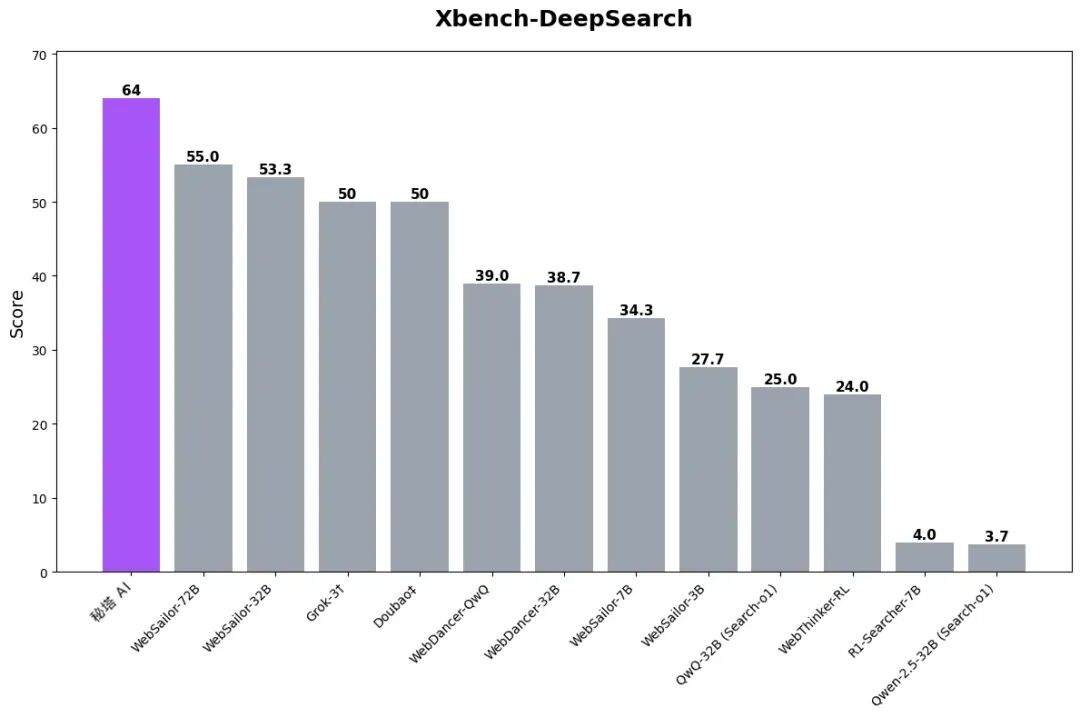
In actual testing, the initial experience was surprising yet consistent with its benchmark performance: through its "research chain of thought" interaction design (detailed below), it immediately delivered an upfront aha moment for users.
Here's our deep-dive review.
Deep Research That Prioritizes Complete Chains of Thought
We found that Metaso's Deep Research scored 45.33 on the BrowseComp-ZH benchmark, a web browsing capability test specifically designed for the Chinese internet environment. Its performance on the English-language BrowseComp test was also solid:
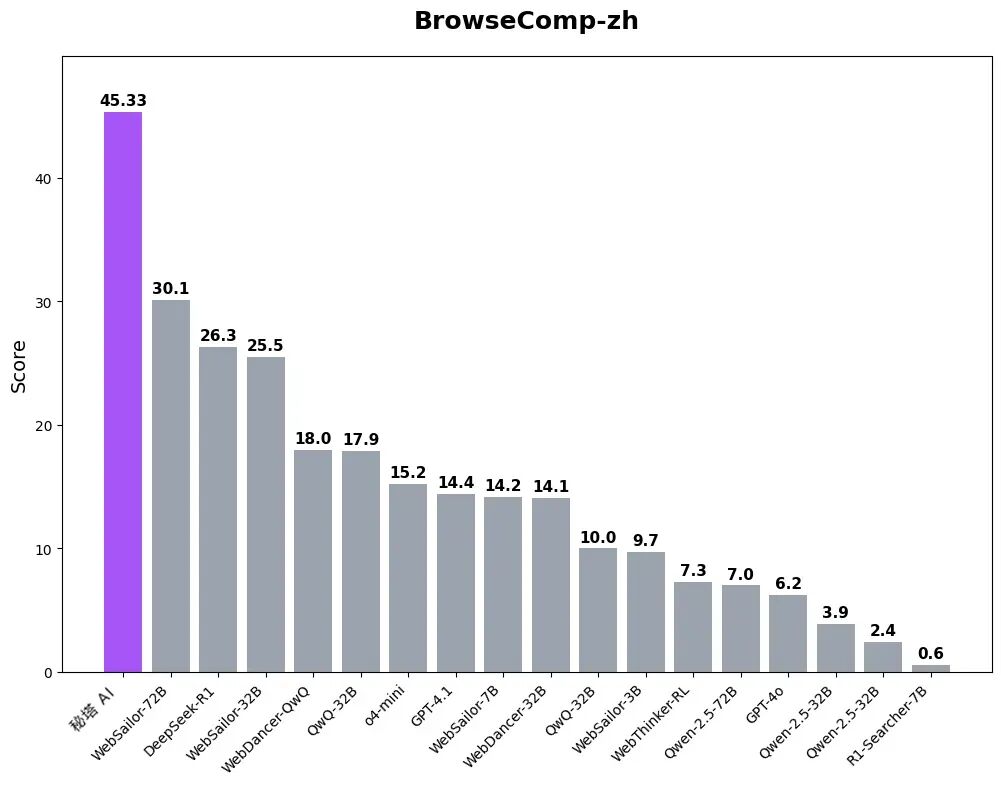
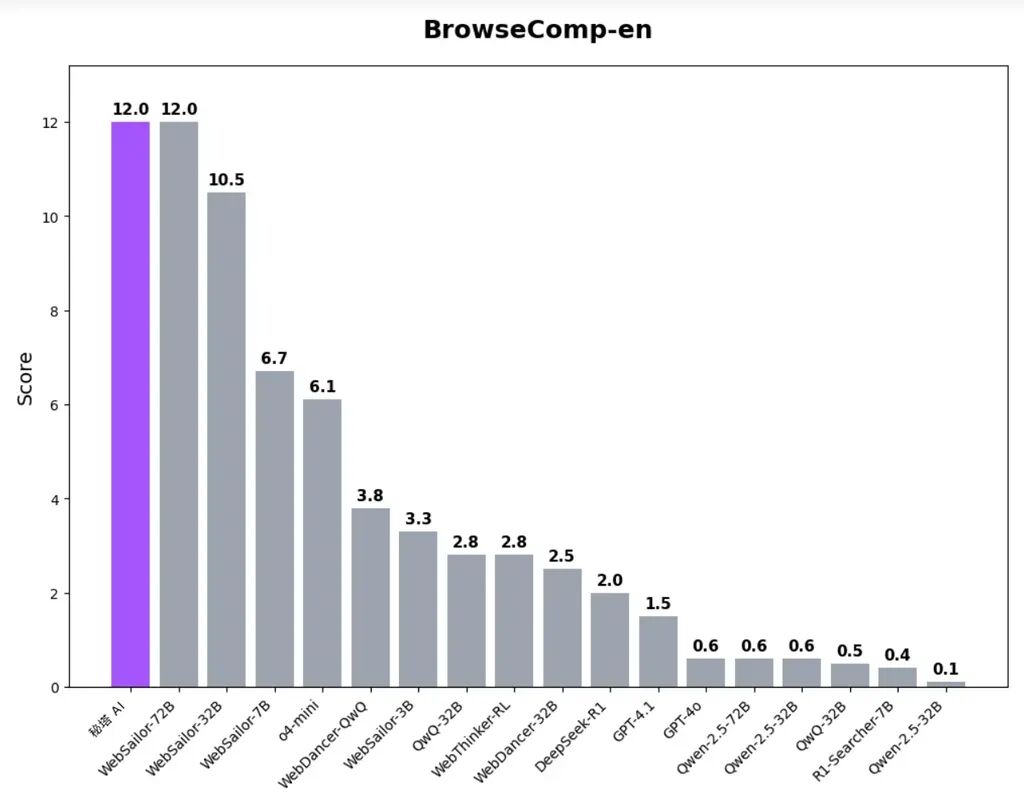
This data translates directly into more logically complete search results, broader search scope, and improved accuracy. It doesn't rush to conclusions after finding a few relevant pieces of information. Instead, it keeps digging until it forms a complete chain of thought.
Let's look at a few research cases in AI-related fields.
1) Case Study: Fraud in Superconductivity Research
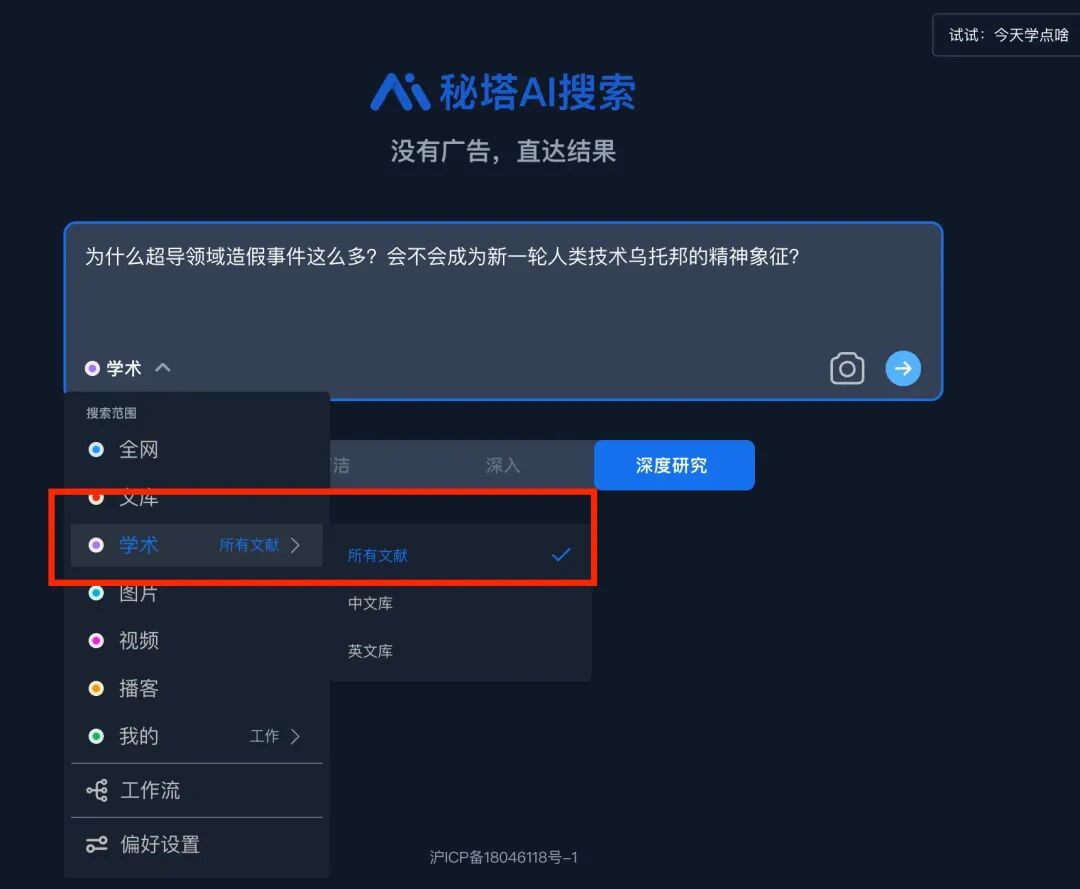
Metaso AI Search offers multiple search scope options. For daily use, simply check "Entire Web." For deeper academic research, there's an "Academic" mode.
"Academic" is actually one of Metaso's standout features. Over the past year, they've continuously expanded their Chinese and English academic resource library.
For instance, in recent years, "humanity's ultimate material dream" — superconductivity — has seen various fraud cases repeatedly trending on social media. Since both superconductivity and AI have become something like "technology myths" in tech circles, I wanted to explore whether there's a connection between the two.
I simply entered this prompt:
Why are there so many fraud cases in superconductivity research? Could it become a new spiritual symbol of humanity's techno-utopian dreams?
The Biggest Highlight: AI's "Research Chain of Thought":
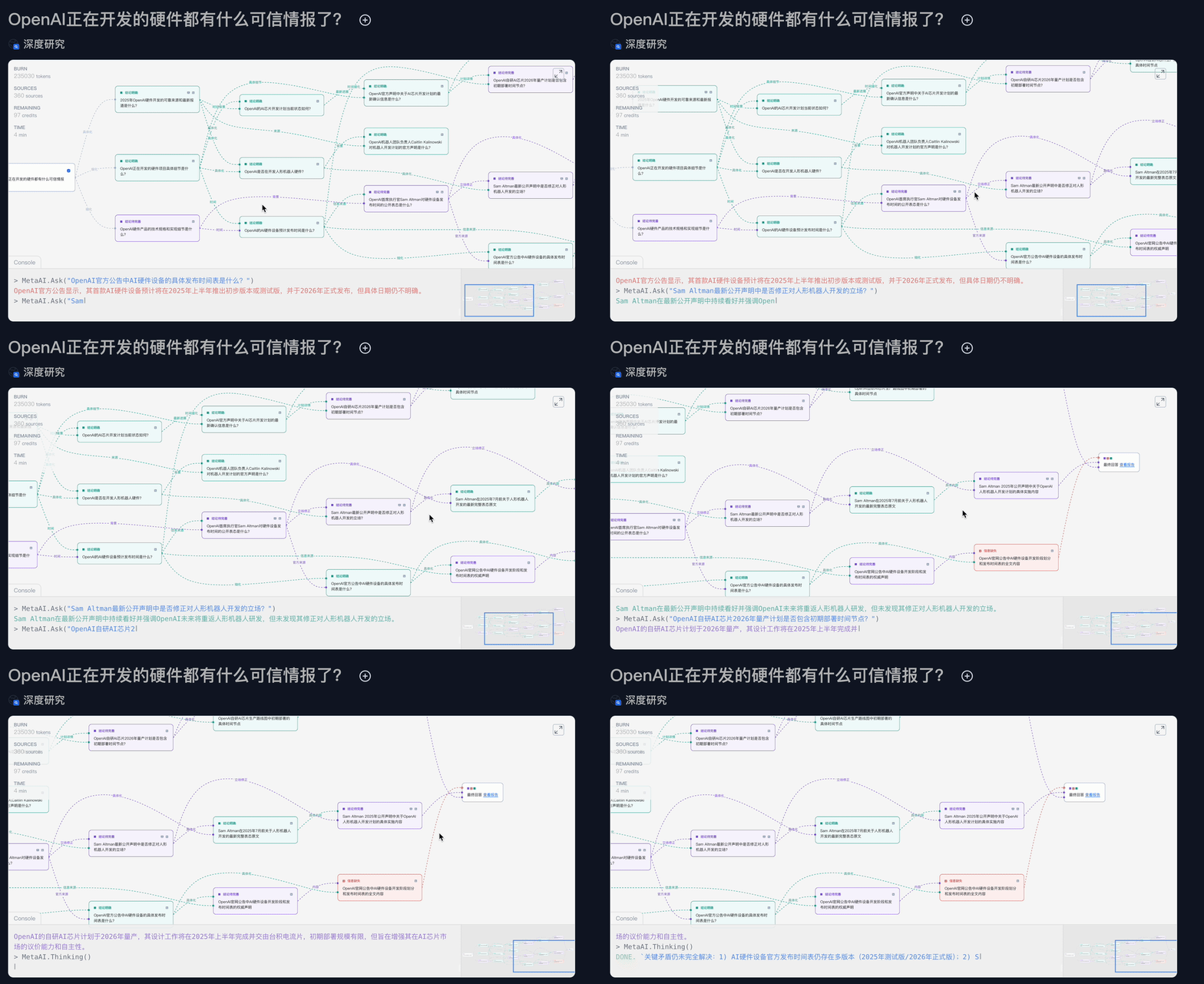
Once Metaso started researching, I glanced up at the screen and noticed that unlike typical deep research features that show a progress bar, it displayed its research chain of thought.
It showed what question it was currently thinking about and what sources it planned to check next.
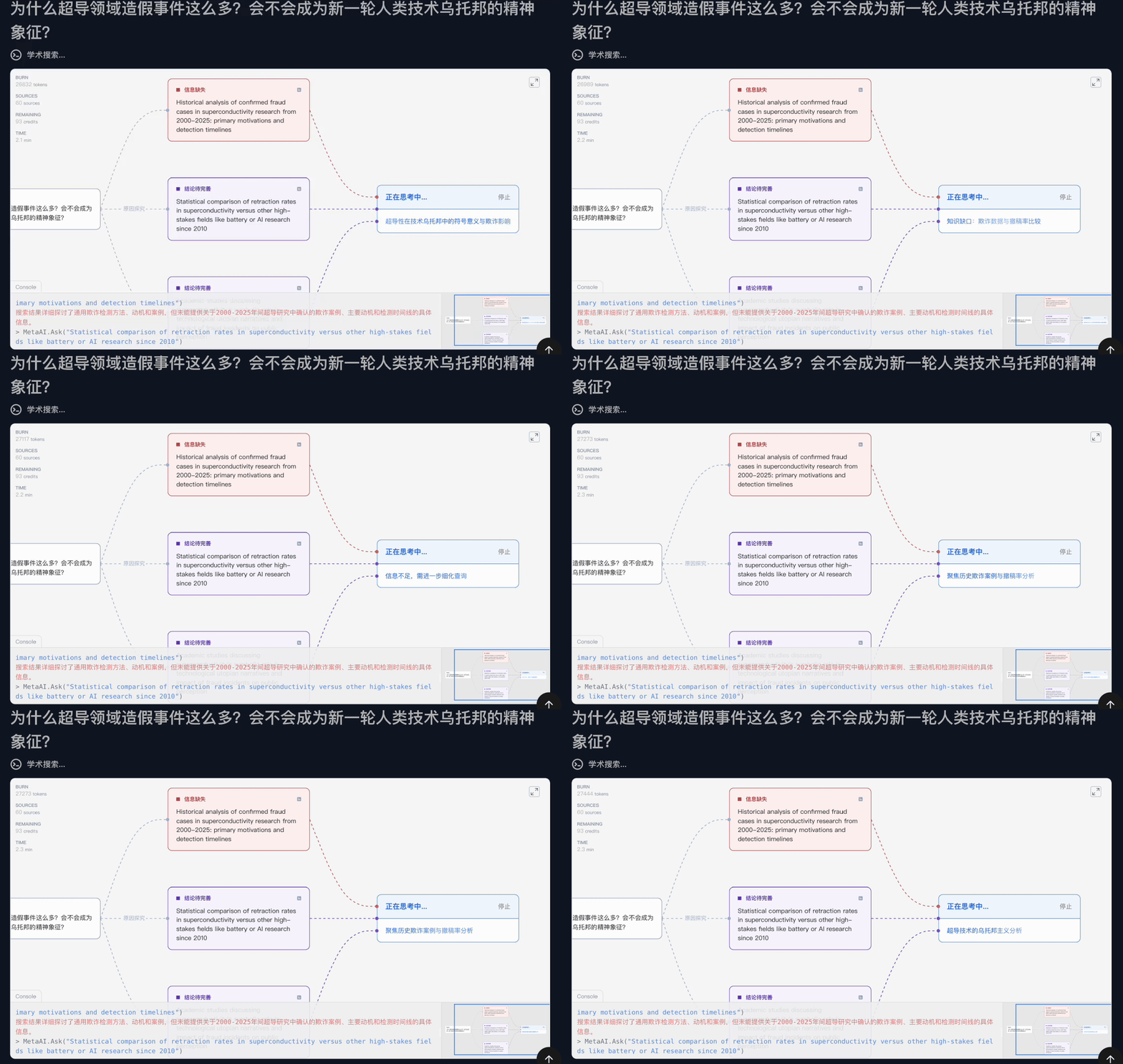
Moreover, for academic questions, I found that Metaso tends to prefer searching English-language sources.
What's more interesting is that the system automatically fills in gaps in the research chain. When it discovers missing key information, it automatically "grows" new branches to fill that void.
You'll notice the entire chain of thought remains in constant flux:
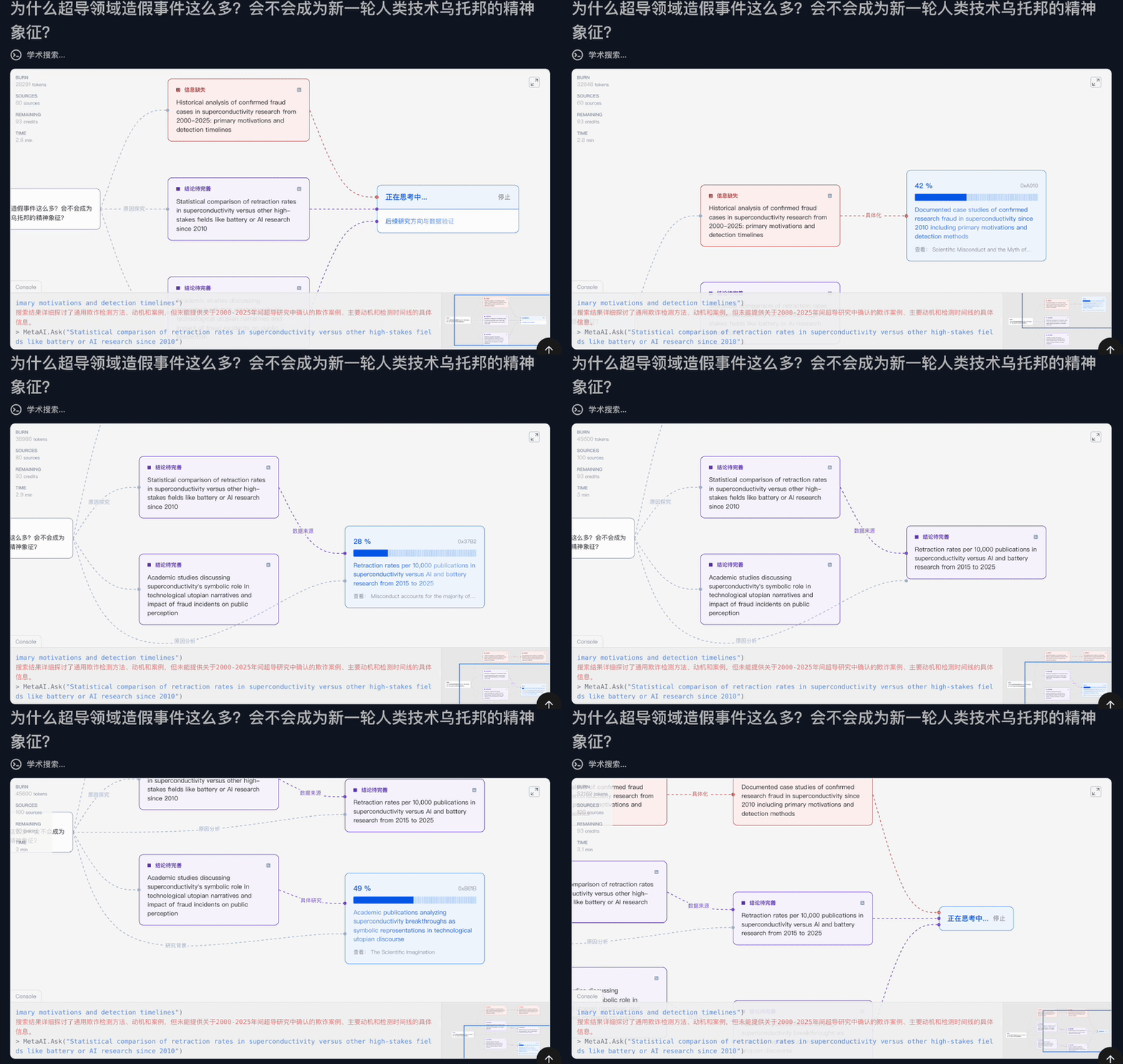
When I examined the "thoughts" in each node of Metaso DeepResearch, I found that from the very beginning, it set an intriguing research direction:
What superconductivity technology represents in people's minds, and the impact of fraud cases.
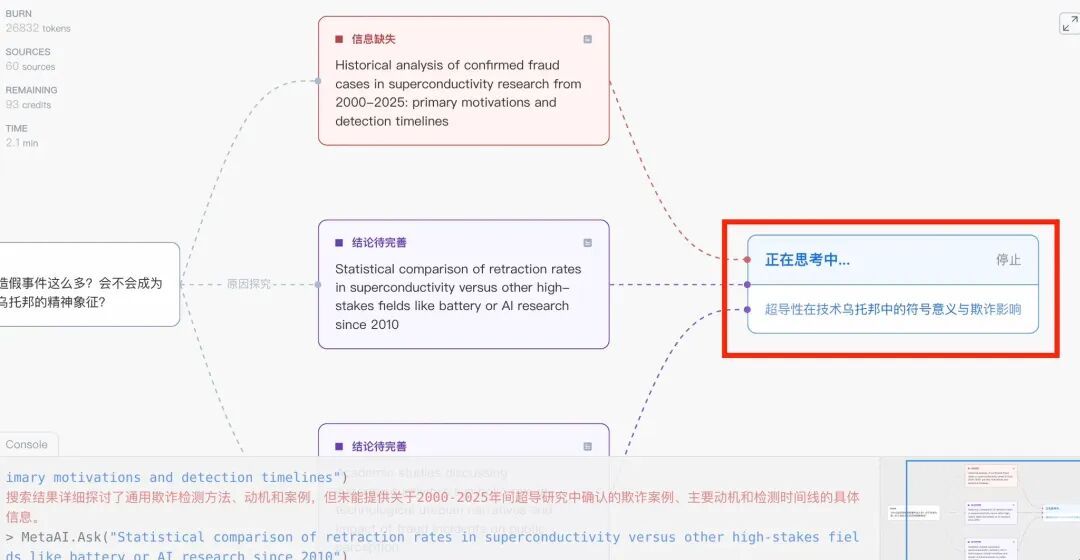
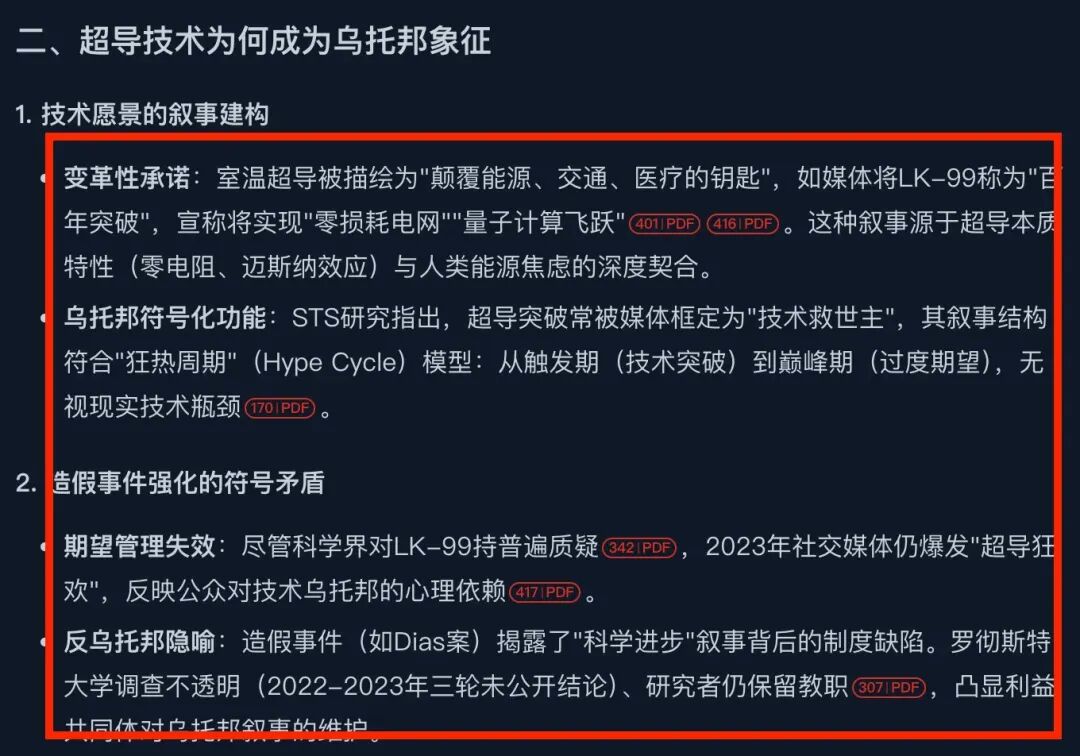
To understand this "research chain of thought diagram," you need to view it alongside the final report.
For example, Metaso DeepResearch acutely seized on the angle of cross-domain symbolic meaning and social metaphor from the start, then systematically developed its analysis.
The AI first identified that superconductivity technology has become a symbol of the "ultimate dream" across multiple fields.
It keenly observed how media packages superconductivity as a "technological savior," stripping away layers of "complex technology" and "specialized academic discourse."
Ultimately, the AI doesn't simply deliver a conclusion. Instead, it uses a dynamic chain of thought to display the complete reasoning process and logical branches.
Users can clearly see the evidence chain at every step. Compared to traditional "summary-style" analysis, Metaso DeepResearch focuses more on logical completeness and deep excavation.
The top-left corner of this deep "research chain of thought diagram" shows that the entire deep research process consumed 234,812 tokens, gathered 420 academic sources, and took only 9.3 minutes — remarkably fast.
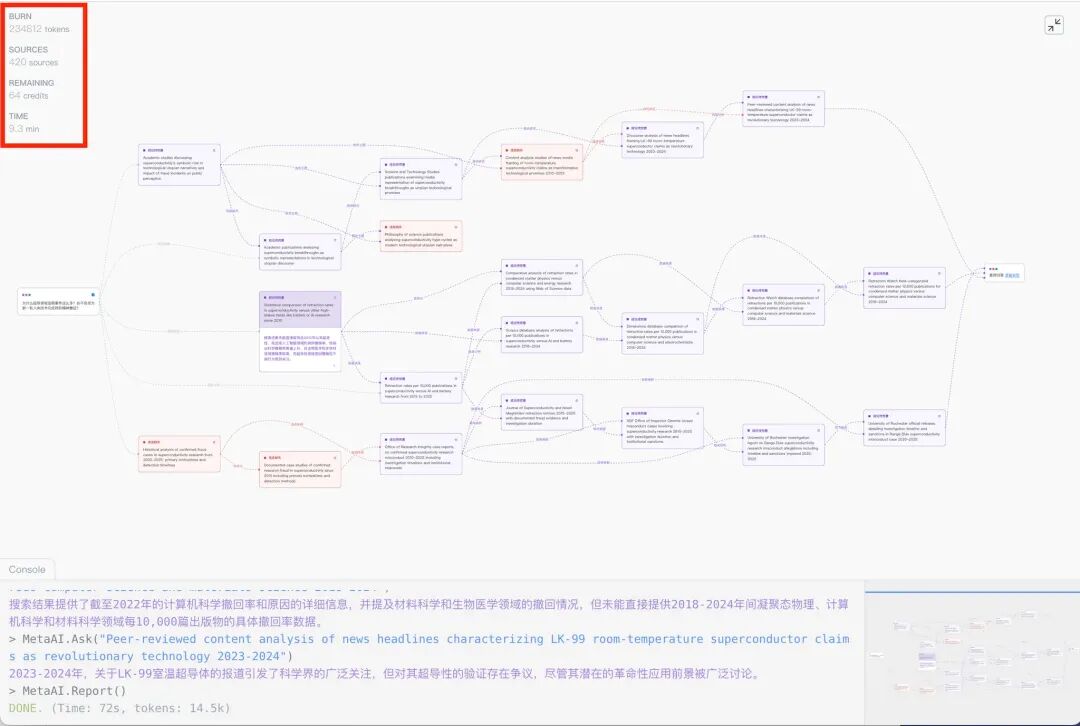
The biggest benefit of visualizing the chain of thought is transparency. Users can clearly see:
【1】Which information sources are abundant and whose conclusions are trustworthy;
【2】Which nodes lack information, potentially affecting accuracy;
【3】Why the AI chose one reasoning path over another.
The visualization of the research chain of thought not only reduces the common problem of "erroneous citations" in research reports but also allows users to directly examine information gaps in the AI's chain of thought.
For instance, before the final research report was generated, several chains of thought had certain information deficiencies:
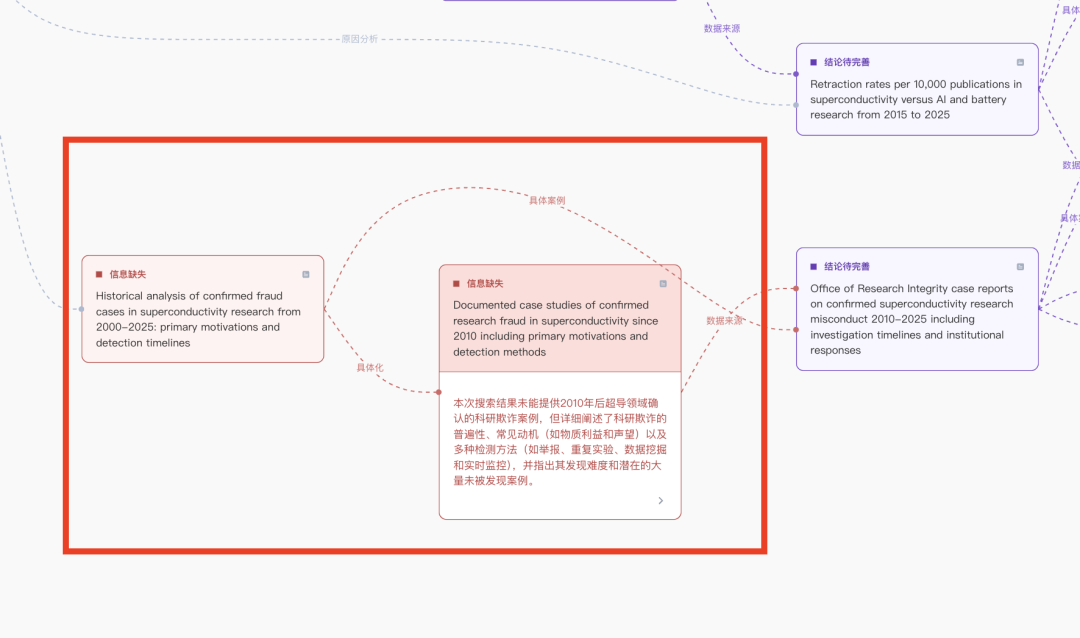
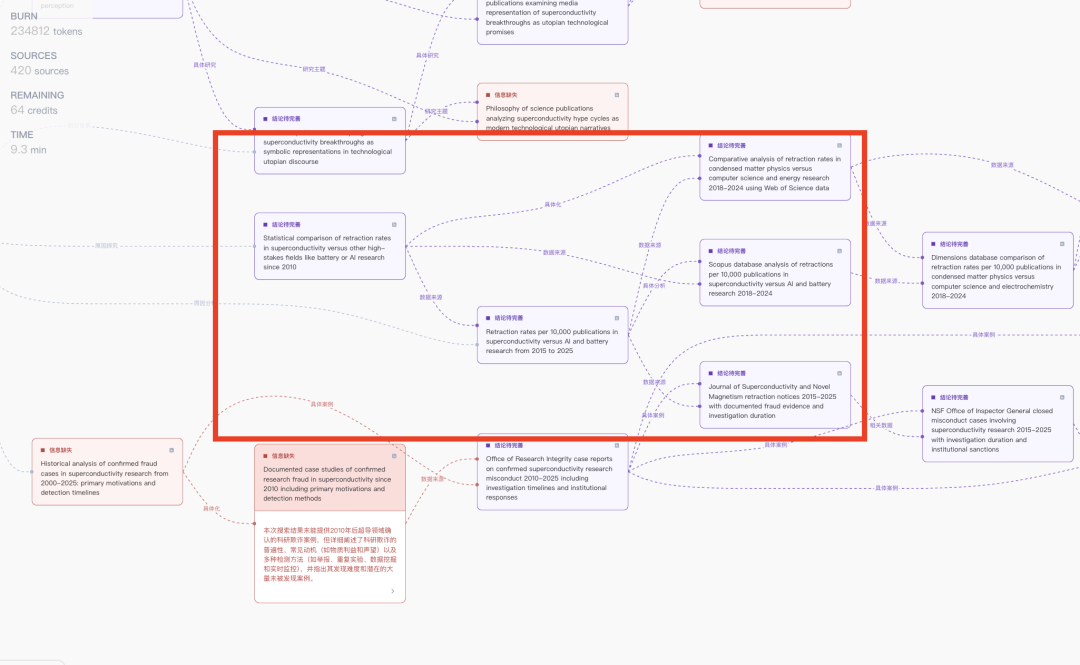
Therefore, the report tends to draw more from the chain of thought shown at the top of the diagram, because this chain has more abundant data sources and higher conclusion completeness.
Finally, Metaso Deep Research produced a report of roughly 2,000–3,000 words, fairly detailed and well-structured, with token consumption in the hundreds of thousands. In testing, when the prompt requested longer output, the text did indeed grow longer and more in-depth:
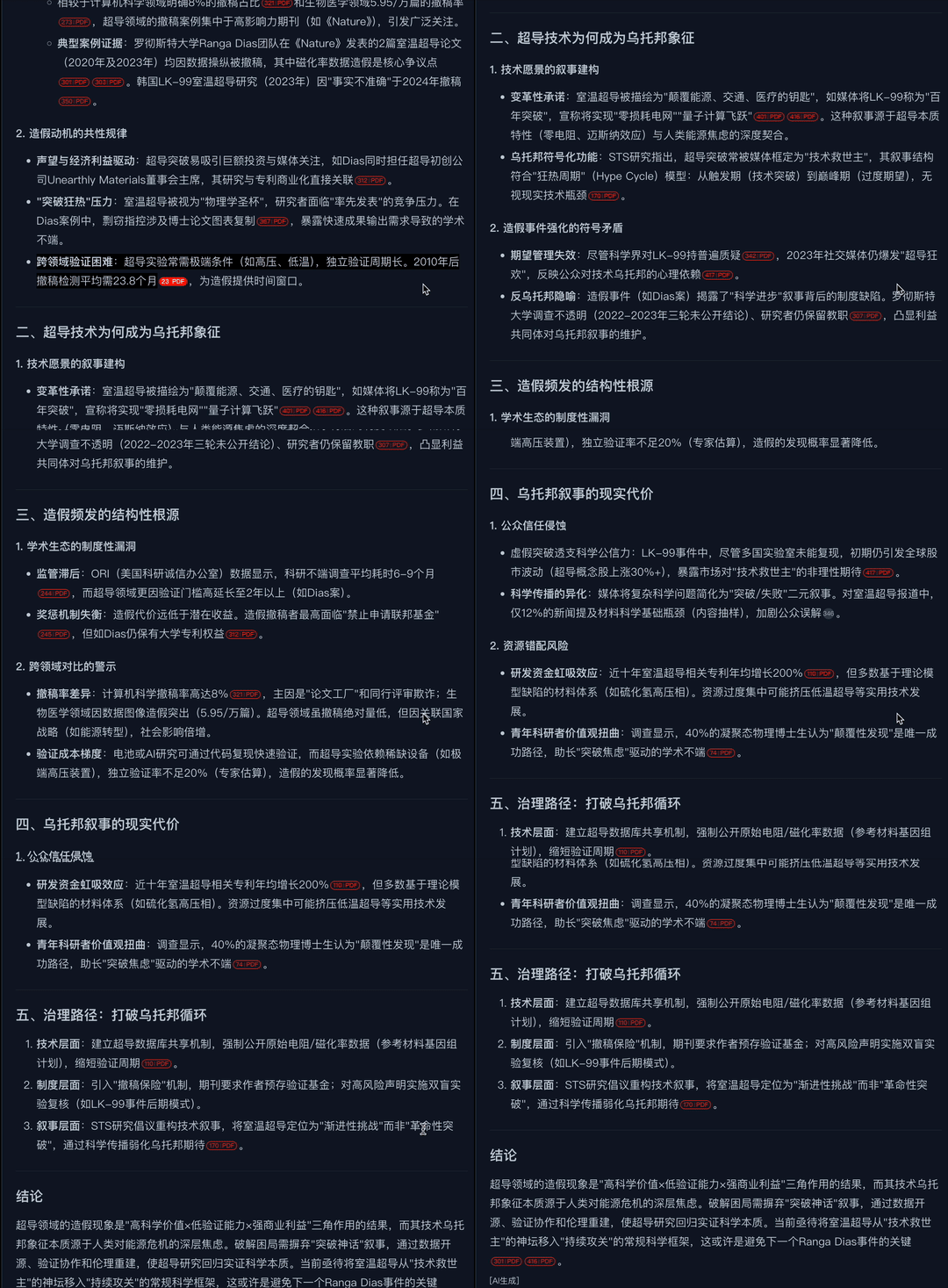
Search Professionalism, Depth, and Breadth Are All Strong: Metaso DeepResearch found 417 academic papers and research report PDFs in one go, mostly from well-known academic databases. Roughly sorting through them, sources included: IEEE Xplore, the ArXiv preprint platform, and top-tier journals like Nature, Science, and PNAS.
I quickly recorded a GIF to直观 show Metaso DeepResearch's formidable capabilities in academic DeepResearch!
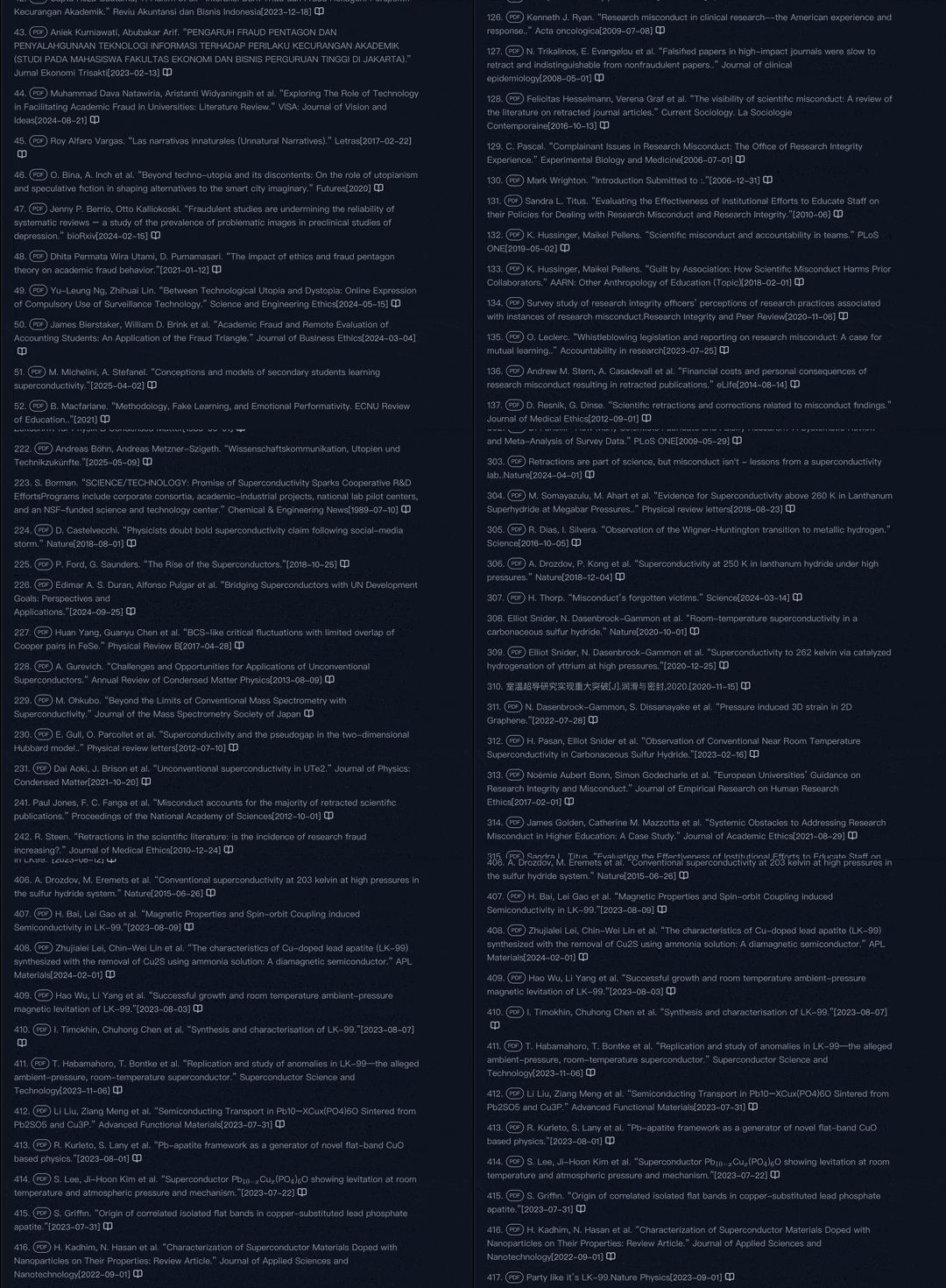
One focal point of this research topic is LK-99 (a compound proposed by Korean scientists in July 2023, later deemed irreproducible).
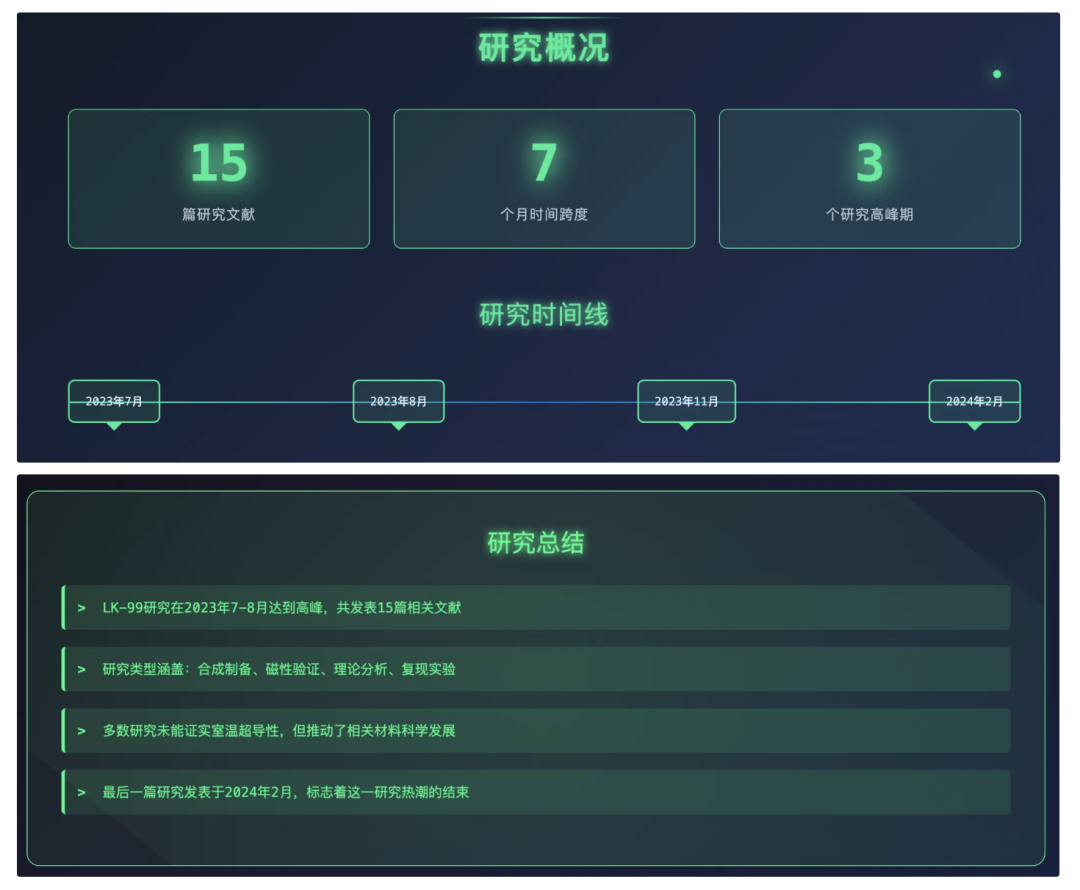
I visualized the papers Metaso DeepResearch found: 15 related to LK-99, spanning the seven months from when the story broke, with important research findings from each stage fully captured:
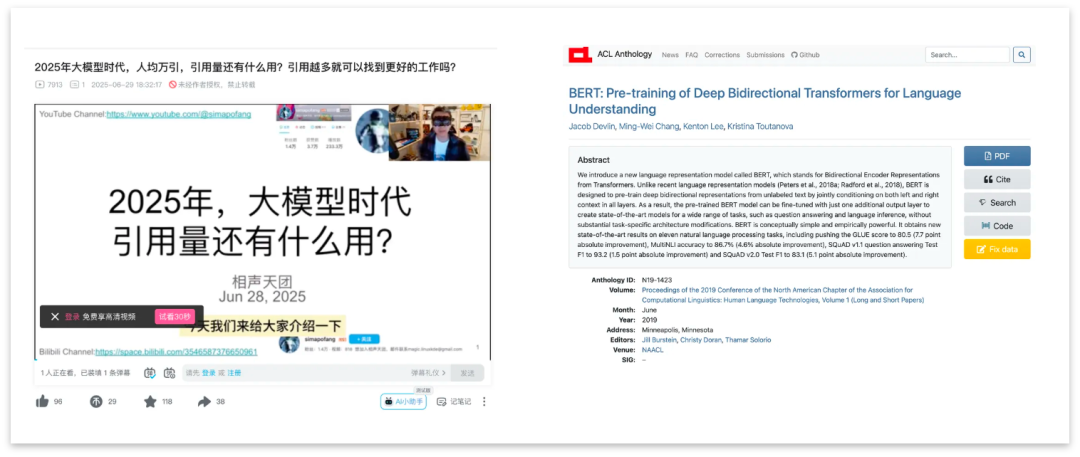
Carrying Over Metaso's AI Explanation Feature: This time, Metaso searched 540 sources — impressively broad coverage, spanning Bilibili videos, academic PDFs, ACL paper repositories, and more.
I recorded a GIF:
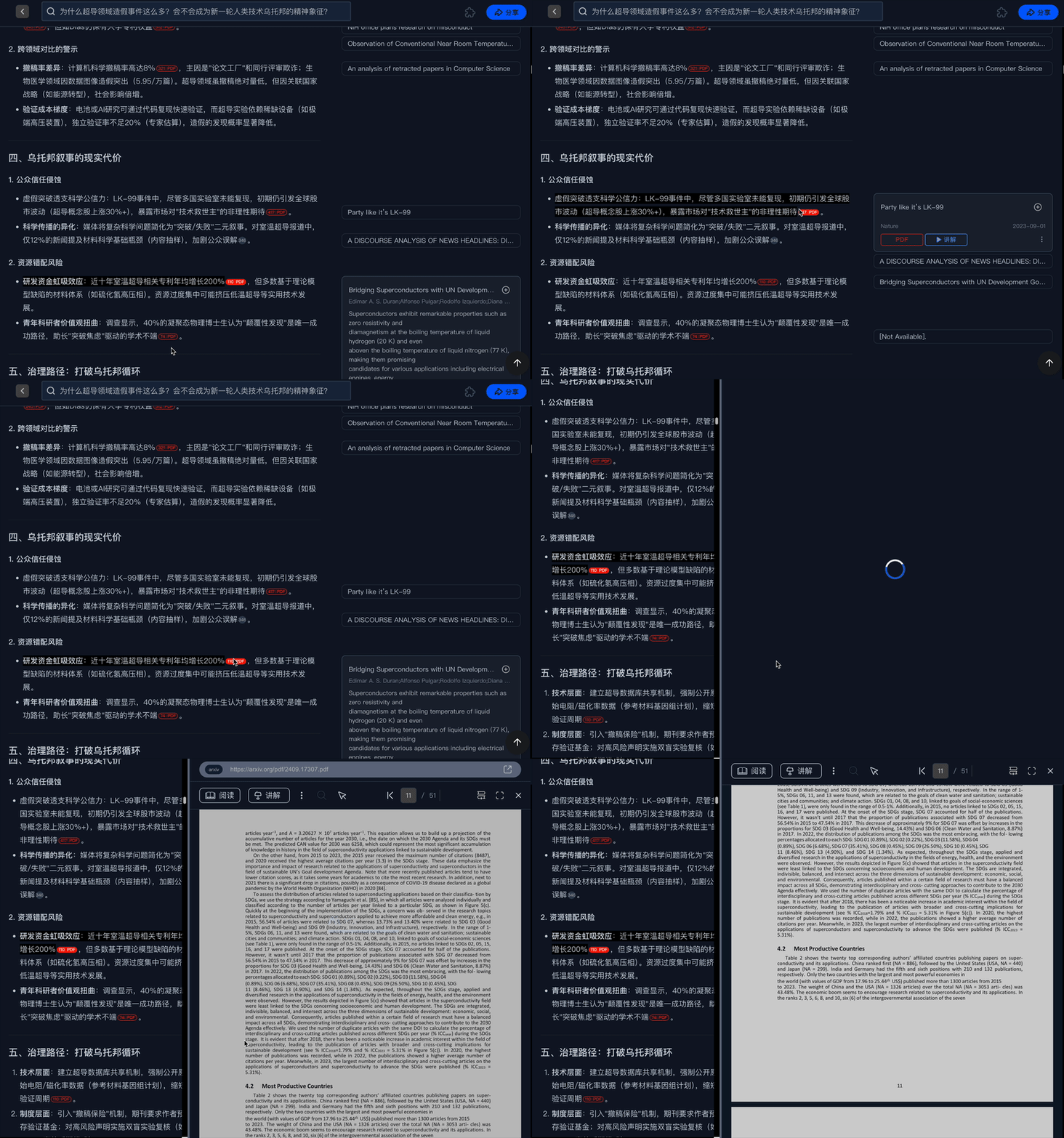
This interaction style has a significant advantage. Metaso's last breakout moment came from its AI teaching feature "What Should We Learn Today." So now, when users encounter "obscure, hard-to-understand" content on the left, they can directly click "Explain" on the right.
Then, users seamlessly enter "Teacher Tazi's Classroom," completing a closed loop of deep learning. Some current AI Agent products are trending in this direction too: starting from deep research functionality to provide users with deep learning scenarios.
From a user experience standpoint, Metaso's interaction genuinely supports "deep learning" — it felt very convenient during my use.
Highly Polished Interactive Webpage: At the bottom of the research report, you can generate a highly structured interactive webpage with one click:
This research report on "Superconductivity Fraud and Humanity's Techno-Utopian Dreams" is highly complete, overall clean and aesthetically pleasing, with well-coordinated color schemes:
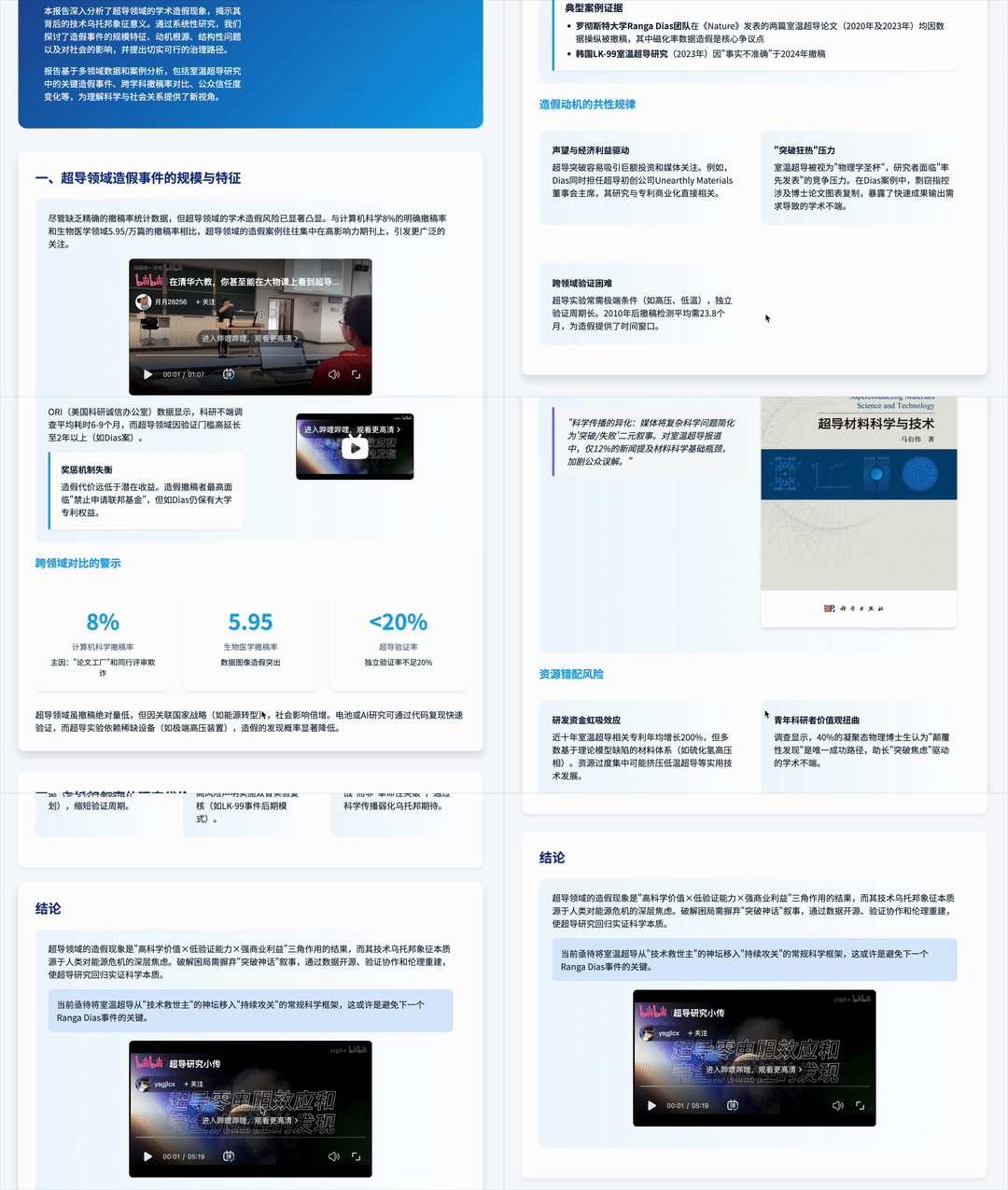
In this visualized research report, I found the quality consistently high, frequently inserting images, tables, and even external video modules:
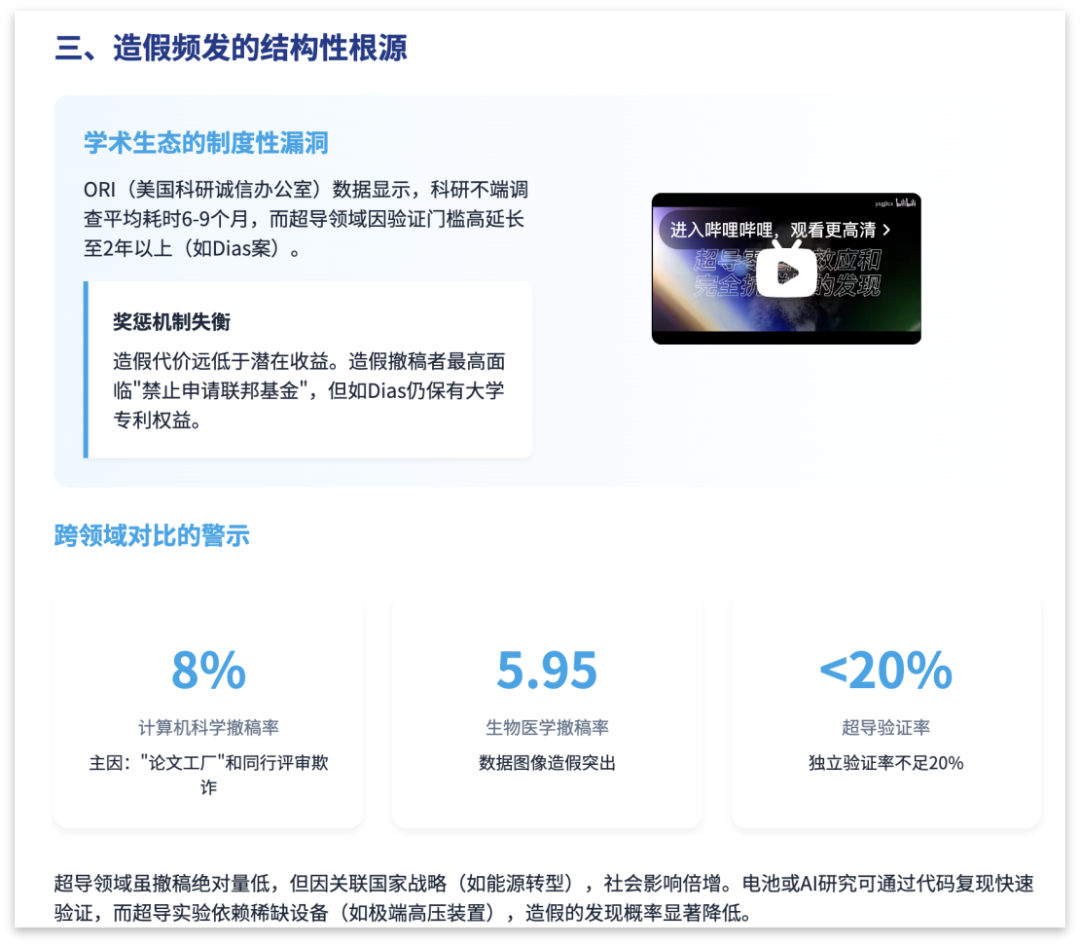
One particularly delightful surprise: when creating visualized reports, Metaso DeepResearch searches for additional relevant materials based on the deep research content — and finds them accurately.
Why do I say this?
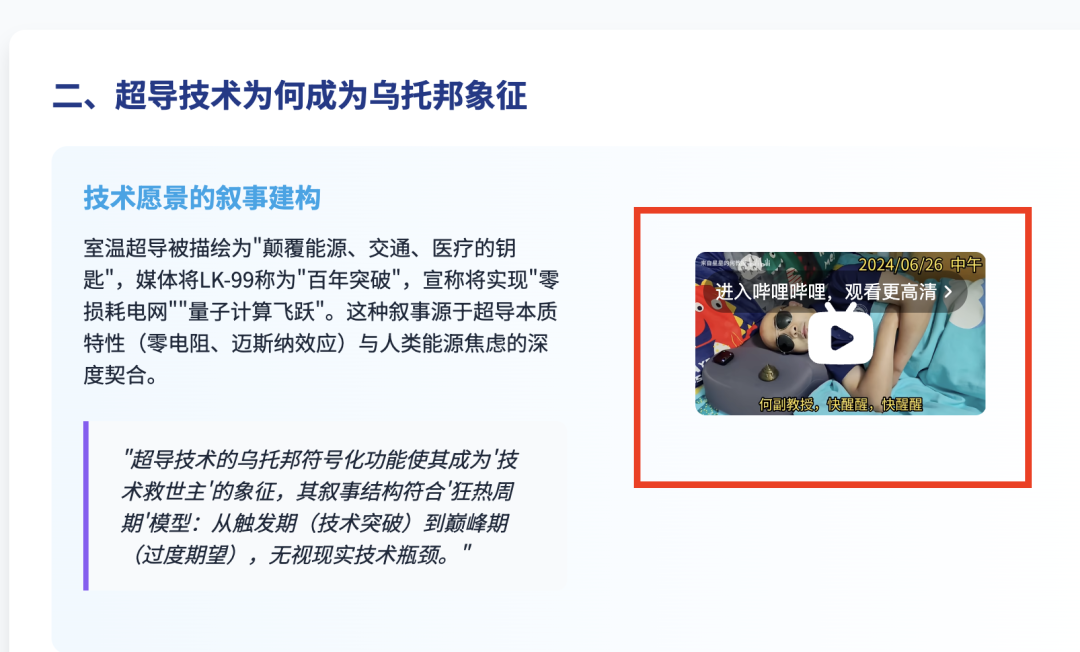
Because when it comes to "superconductivity technology" fraud, the most viral and possibly most entertaining content is Professor He's Bilibili video "From the Stars." The video was inserted at precisely the right spot. And Metaso DeepResearch included several such videos, allowing users to learn while reading the report:
Let's look at a less "academic" case below.
2) Case Study: What Credible Intelligence Exists on OpenAI's Hardware Development?
For general news-type information, Metaso Deep Research's chain of thought digs in hard, prioritizing authoritative sources.
For example, wanting to learn about recent developments in AI hardware that OpenAI has been rumored to be working on, I entered a simple prompt:
What credible intelligence exists on hardware that OpenAI is currently developing?
The overall report structure still demonstrates deep research with breadth, depth, and logic.
For instance:
【1】 In breadth, this report researches in granular detail, covering AI terminal devices, AI chips, humanoid robots, and other key tracks;
【2】 In depth, it analyzes each sub-field thoroughly rather than offering superficial descriptions.
【3】 In logic: consistent with the "chain of thought" displayed by Metaso DeepResearch, it offers progressive analysis with a complete analytical closed loop.
Deep Research Is "Cautious" When carefully reviewing this report, I found that Metaso's Deep Research is quite "cautious." For example, it consolidates authoritative timelines, attaching credible sources to every key milestone.
Moreover, it specifically provides an intelligence credibility analysis.
Interestingly, Metaso indeed conducts comprehensive searches around OpenAI's hardware efforts, because it actually found an official contradiction: OpenAI CEO Sam Altman's famous statement that AI hardware might never launch.
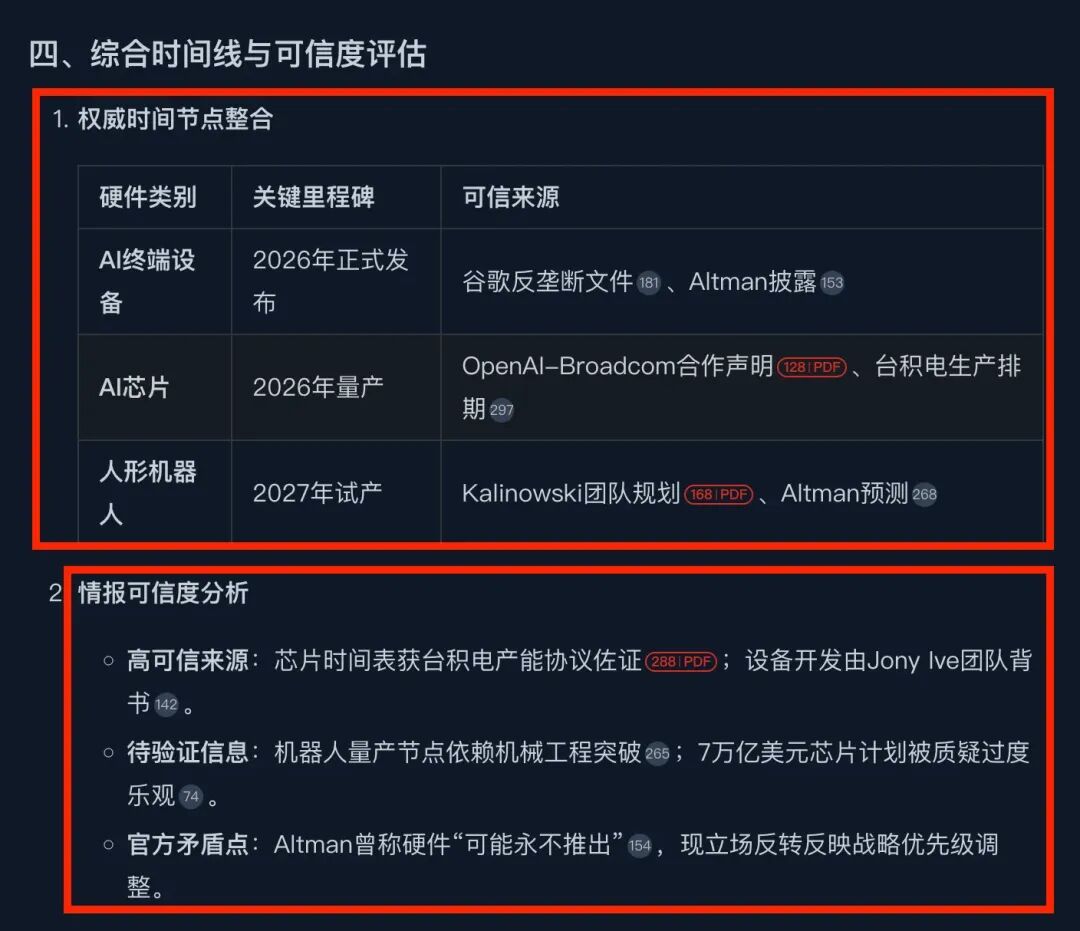
In its visualized report, Metaso uses three-color coding to label these three information types as "high-credibility source," "to-be-verified information," and "official contradiction":

I also traced back to its "research chain of thought diagram" based on this information,梳理 its reasoning logic, and found:
When it needed to query "What are the technical specifications and implementation details of OpenAI's hardware products?" Metaso automatically oriented toward timelines, information sources, then content refinement, and even position correction and specification.
The entire flow is roughly:
Timeline node → Where does the information source come from → How to refine content → How to cross-verify positions → How to conduct specific analysis.
If information comes from official sources, it gets labeled — possibly because Metaso's deep research underlying architecture makes it more attentive to authoritative information:
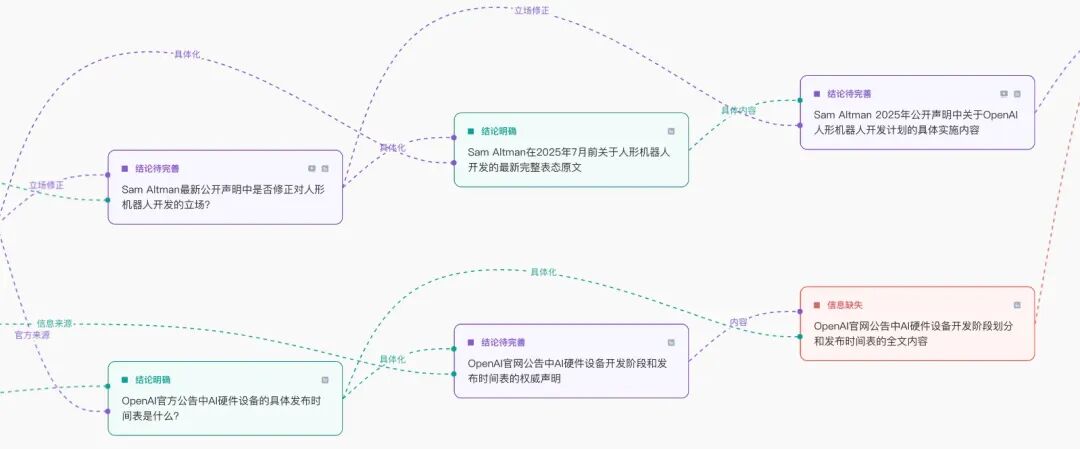
All timelines and partnership information have specific sources (such as Broadcom partnership statements, Altman interviews, etc.).
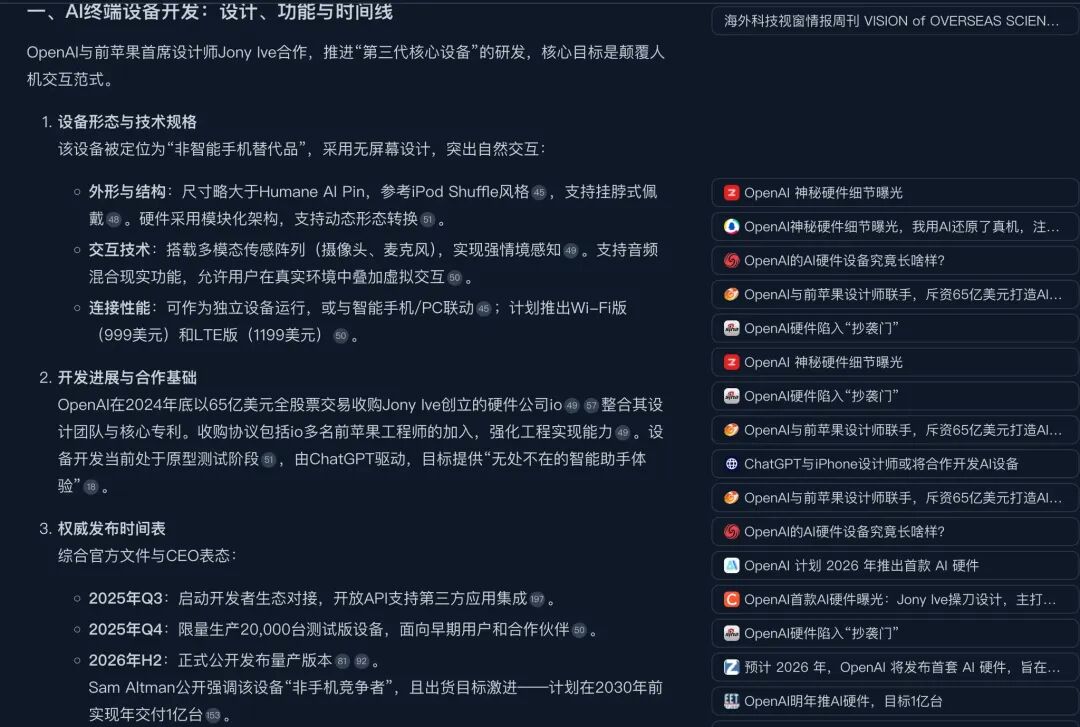
For a vague prompt ("hardware that OpenAI is currently developing"), Metaso categorizes this hardware into three areas: AI terminal devices, AI chips, and humanoid robots.
Each hardware domain has complete analysis of technology, team, partnerships, timeline, and challenges, with tightly interlinked, logically closed-loop performance.
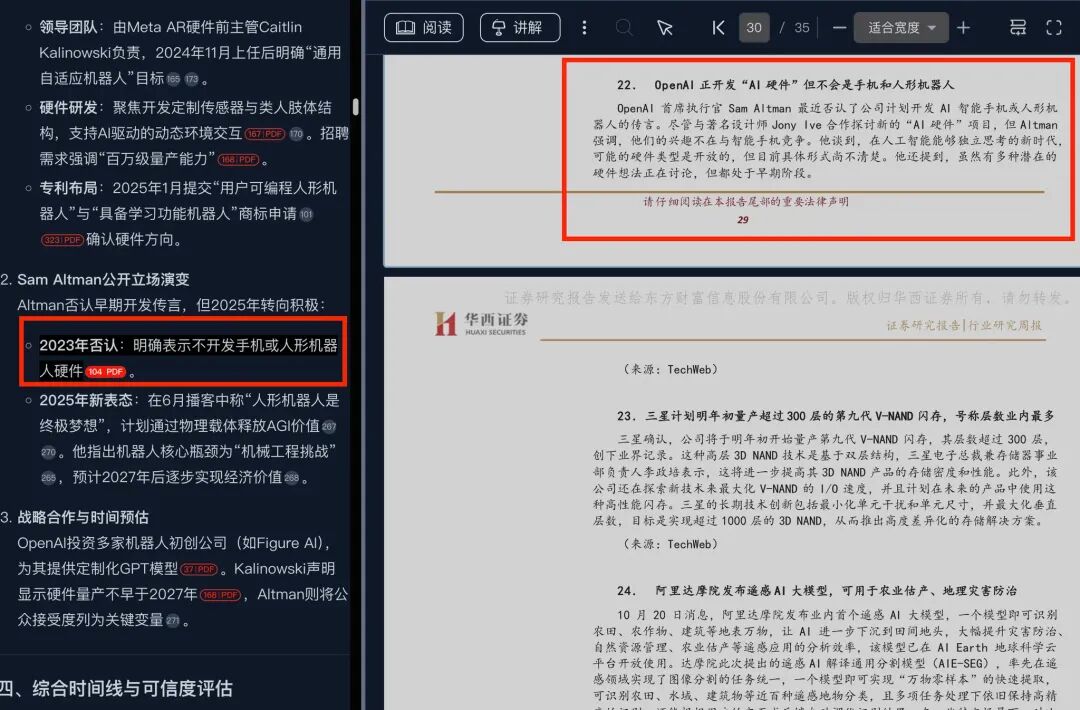
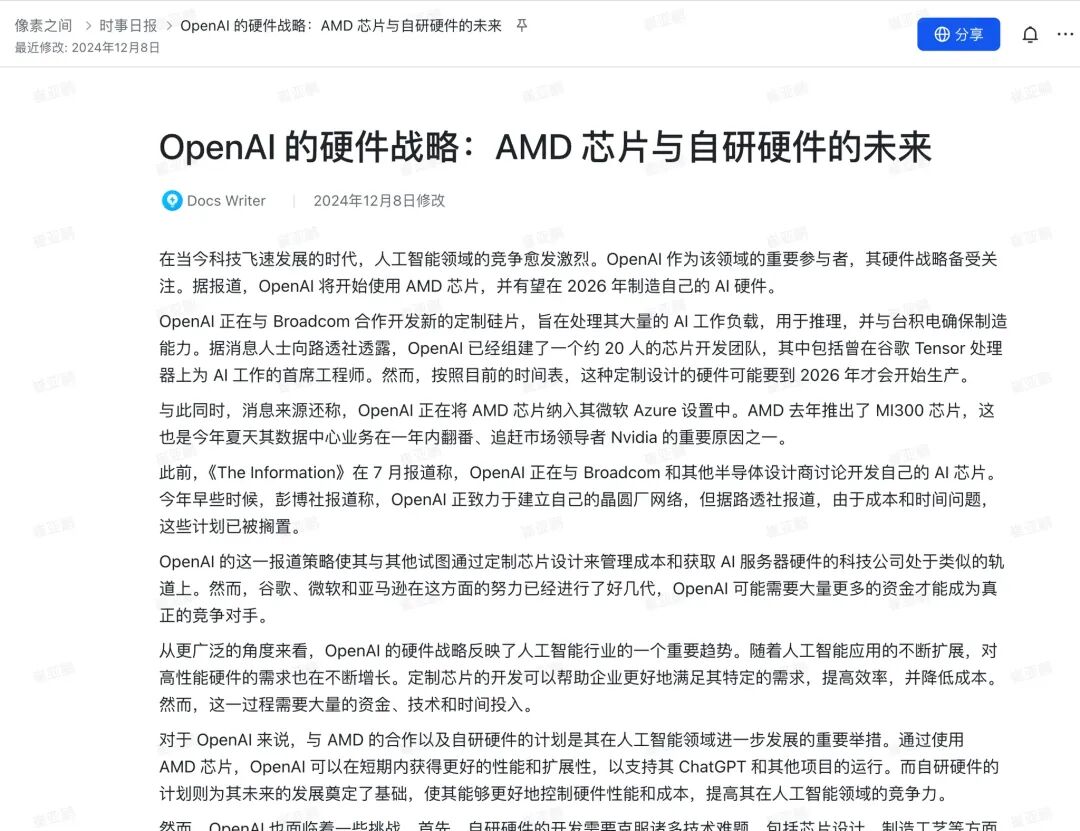
On humanoid robots, Metaso directly associates Sam Altman with OpenAI and fixates on researching shifts in Altman's public positions. It even found a securities industry research weekly report from Huaxi Securities in 2023:
And a Lark document:
This time, Metaso searched 360 sources. I roughly counted — about 58 sources were actually used in the research report.
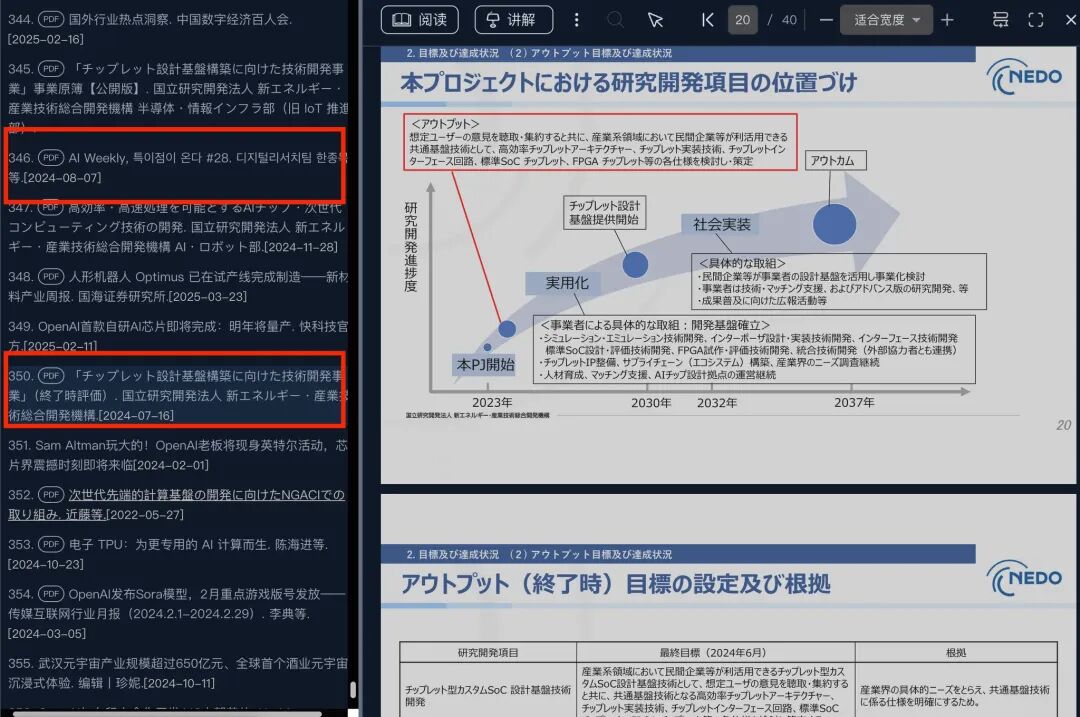
Moreover, information sources aren't limited to Chinese and English. Even in OpenAI's AI chip direction, it involved Japanese and Korean PDF materials:
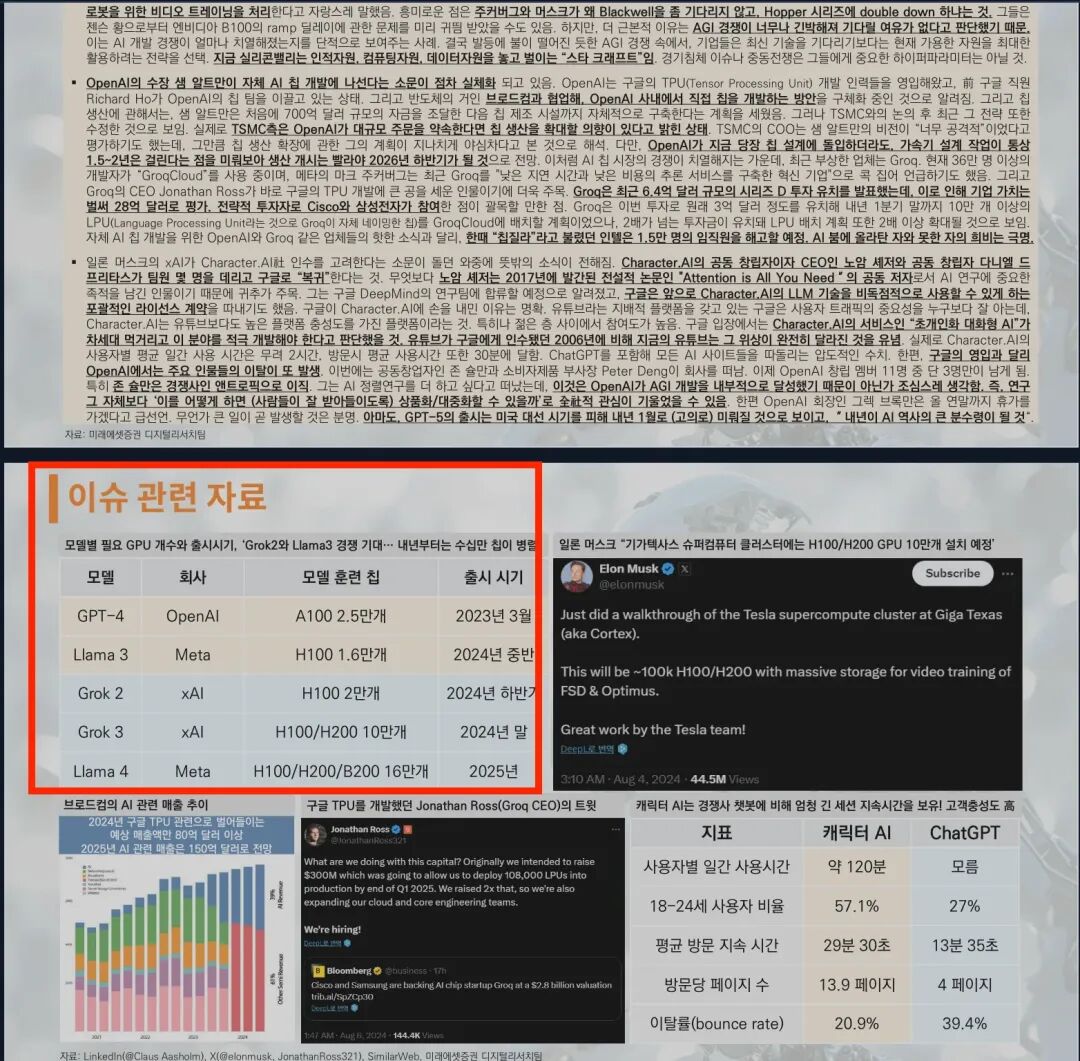
For example, Metaso found relevant information in a Korean PDF about "Mark Zuckerberg and Elon Musk choosing not to wait for the Blackwell (B100) series but instead doubling down on the Hopper series, and OpenAI's Sam Altman throwing himself into AI chips":
Also, looking through Metaso's search sources, there's a "Manage" button at the very top — an older Metaso search feature that's not new but quite useful:
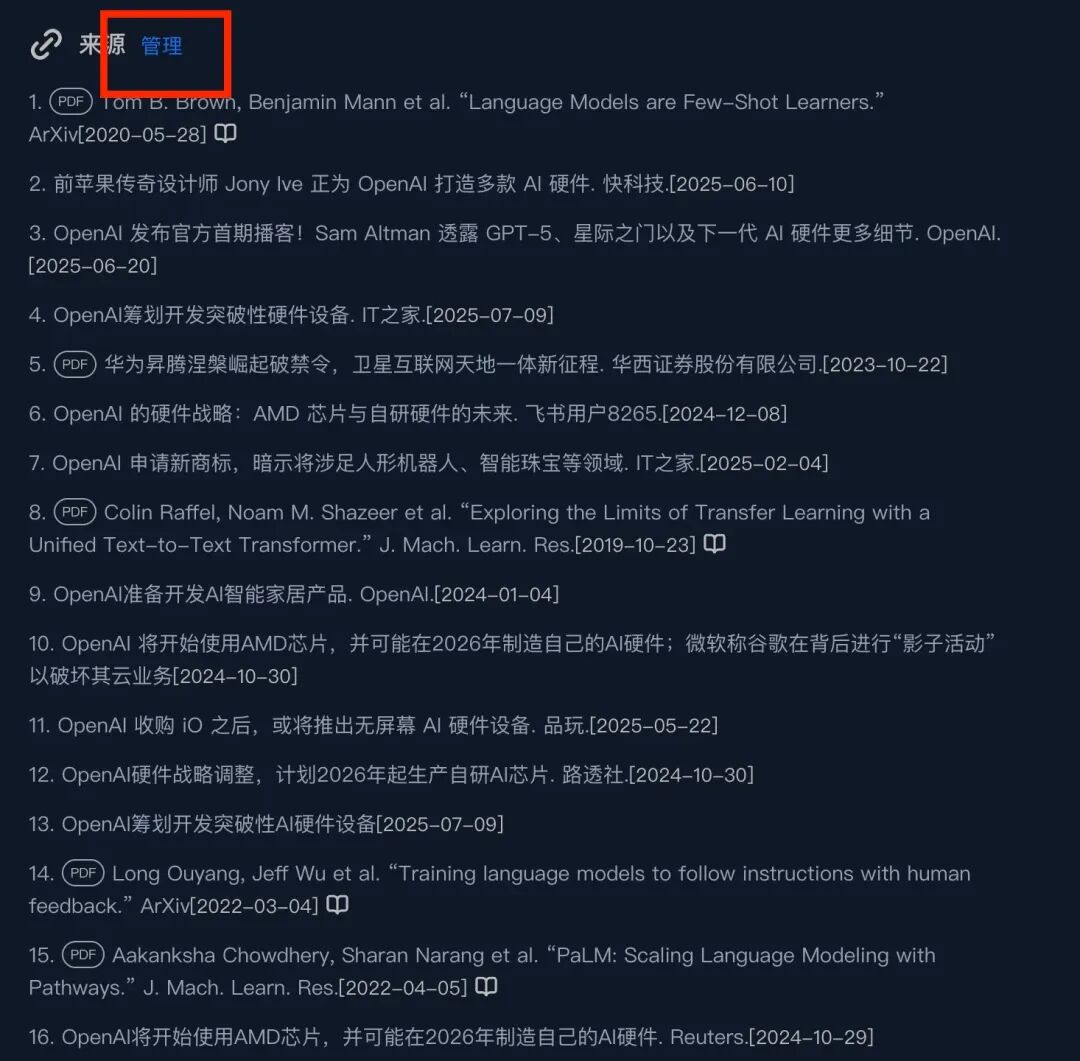
Through this feature, users can customize Metaso AI Search's source preferences, adding "websites you want to see more of" and "websites you don't want to see."
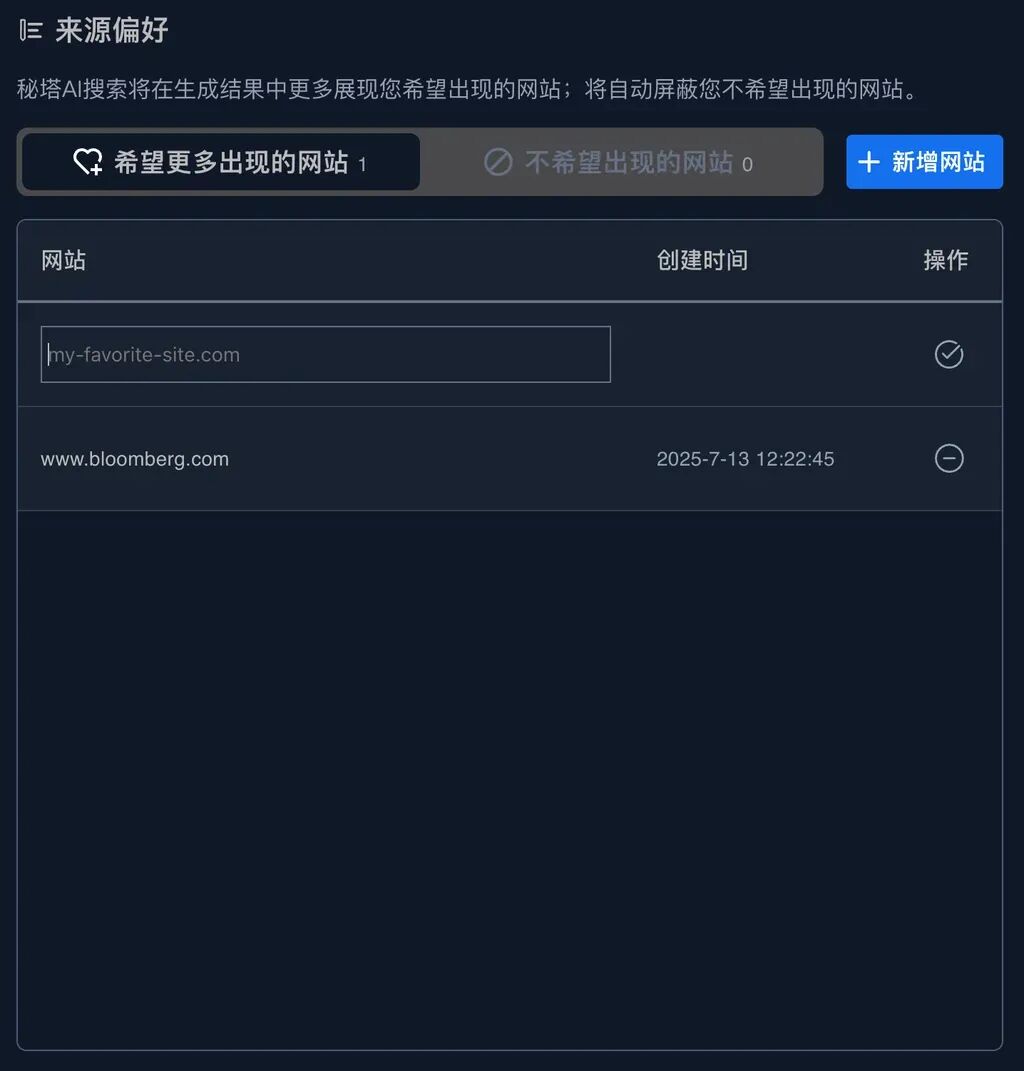
Deep Research is typically used as an auxiliary tool; users usually already have some understanding of the industry. In practice, this problem arises:
Some information sources lack credibility, while others are highly valuable, but AI sometimes misses the authoritative sources users want among similar websites.
This feature lets users guide AI toward more reliable, more customized search directions.
"Deep Research" Still Has Massive Room for Imagination
Let's summarize where Metaso Deep Research performs well:
【1】Benchmark test data is impressive, especially on the Chinese internet;
【2】Research breadth + depth are both strong, with quite broad search coverage and solid information acquisition capabilities;
【3】Logical architecture is clear, with a well-defined overall research脉络, none of that "piling up information for the sake of piling it up" feel;
【4】The "research chain of thought" interaction design is genuinely innovative, with a smoother user experience than we expected.
Overall, Metaso's attempt at Deep Research this time represents some of their own improvements. Looking at Metaso's Deep Research feature feels like watching the latest round of a technology chase.
After ChatGPT and Gemini fired the first shots in Deep Research, everyone has been scrambling to catch up. What we're seeing is a process of rapid iteration and constant trial and error. Metaso's entry may not be the earliest, but they've carved out a differentiated competitive path.
Ultimately, user demand for Deep Research is actually simple and direct, just like its literal meaning:
AI helps me "deeply research," so I can understand this complex world faster and better.