What did DeepSeek release late last night? We've summarized its 5 core advantages and 7 real-world use cases.

DeepSeek is still DeepSeek.
DeepSeek has always pursued a quiet, low-key product release strategy.
Even with this late-night drop — a major iteration upgrading from V3 to DeepSeek-V3-0324 — the company posted no official announcement on X.
Yet the model's breakthroughs on math and coding benchmarks ignited immediate, widespread discussion. On Hugging Face, it racked up 700 likes in just over ten hours.
One X user, @JeffreyJonah5, even commented: "It's the best non-reasoning model."
Its performance now nearly matches Claude 3.7 Sonnet, which has been virtually the only viable option for AI coding. And it's open source (Hugging Face link[1]). It's hard to imagine what kind of influence this will have on the open-source developer community going forward.
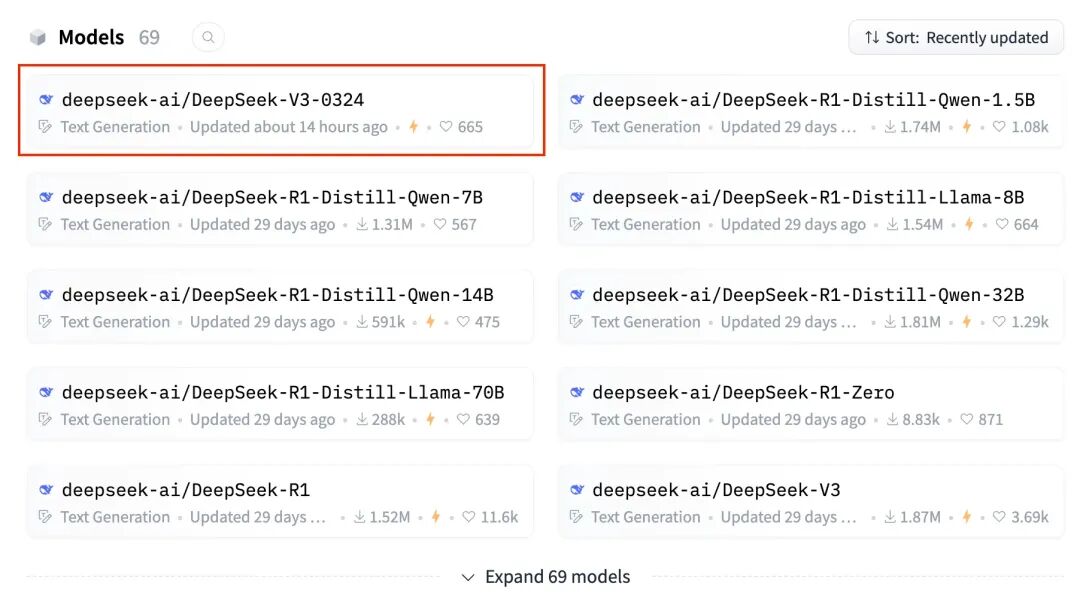
This DeepSeek-V3 update hasn't shipped with a model card yet, so detailed specs remain unavailable from official channels.
⭐️ 5 Core Improvements ⭐️
IDE vendors, as the fastest to deploy, naturally ran the earliest benchmarks.
Here's a summary of DeepSeek-V3-0324's key upgrades over the previous version:
- DeepSeek-V3-0324 uses a Mixture-of-Experts (MoE) architecture with 685B total parameters
- Expert count increased 60%, from 160 to 256
- Enhanced front-end coding capabilities
- FP8 training that doubles compute efficiency
- Post-training optimization for math and reasoning
The increased expert count means more granular task specialization under the MoE architecture. This improves the model's ability to handle diverse tasks, with particularly strong performance in highly specialized scenarios.
Most notably: DeepSeek-V3-0324 adopts FP8 mixed-precision training, directly doubling compute efficiency.
At a time when model iteration has slowed early this year, this resource optimization is a shot in the arm for local deployers.
With the pace of base model releases slackening in early 2025, it points a way forward for researchers: AI GPUs matter, but optimization may matter more. For math and reasoning, the benefits of targeted training improvements are immediate and visible.
💡 7 Real-World Demos 💡
First, one user had DeepSeek-V3-0324 build a water molecule simulation — an interactive demo showing hydrogen bonds forming and breaking, complete with a temperature slider.
Source: X user @pandeyparul[2]
Then there's the classic "spinning hexagon bouncing ball" test for AI coding. The goal is to see whether generated code can properly simulate gravity and friction, with the ball realistically bouncing off rotating walls — a proxy for raw coding ability.
DeepSeek-V3-0324 passed in one shot, adding features like "reset ball," "randomize," and "rotation speed," all adjustable via sliders. Even at extremely high rotation speeds, the ball obeyed physics without glitching.
Source: X user @teortaxesTex[3]
The video below shows how o3-mini and DeepSeek R1 previously performed on this same test. o3-mini basically demolished DeepSeek R1.
Source: @flavioAd[4]
Beyond code and math, DeepSeek-V3-0324 shows major gains in creativity and aesthetics. In the poster below, the left side is Grok's HTML output; the right is DeepSeek-V3-0324's. On visual appeal, this version represents a genuine qualitative leap.

Another example: DeepSeek-V3-0324 can effortlessly produce classical Chinese poetry cards in the style of Xichuangzhu (西窗烛), with noticeably improved typography.

Source: X user @Xsir01[6]
The model also holds itself to high aesthetic standards. When one user asked it to redesign the http://aider.chat[7] homepage, it suggested replacing emoji with cleaner SVG icons (right image).
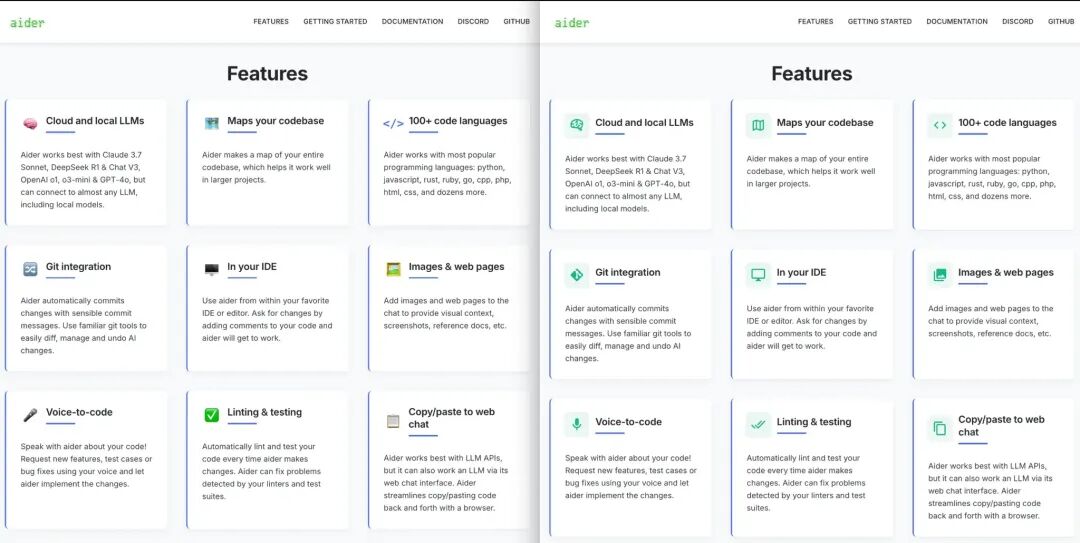
Source: X user @paulgauthier[8]
Moreover, DeepSeek-V3-0324's coding improvements are substantial, particularly in front-end development.
Over the past few months, AI coding's potential has gradually become visible to mainstream users.
With a weaker coding model, you might need to keep re-rolling. But DeepSeek-V3-0324 now delivers more efficient, more precise code generation for front-end tasks — like this weather card with smooth transition animations.
Source: X user @bulletflyx[9]
In late 2024, when DeepSeek V3's research paper first dropped, this Chinese base model company had released an open-source model surpassing the then-best closed-source models — GPT-4o and Claude-3.5-Sonnet — on multiple benchmarks, with exceptional code and math scores.
What made it explode across the internet: DeepSeek V3's training cost was under $6 million. Compared to what OpenAI and Anthropic spent to achieve similar performance, it was absurdly cheap.
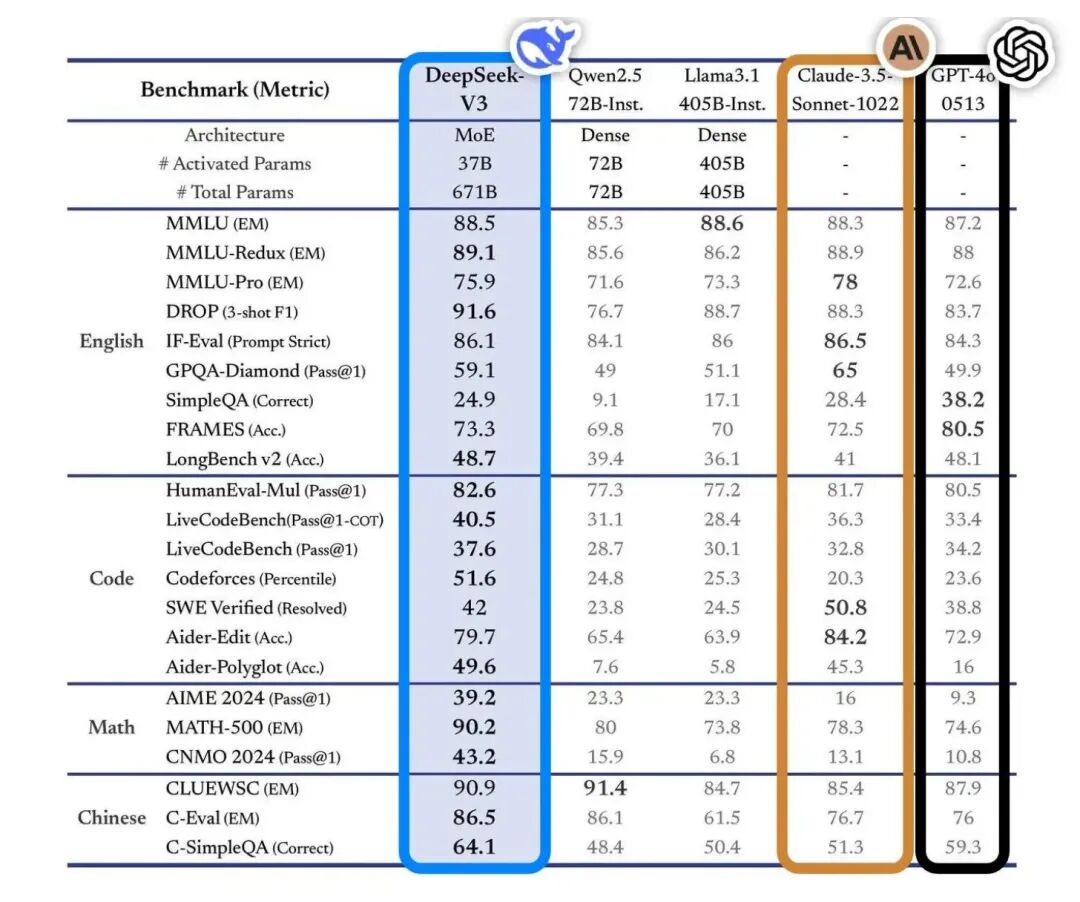
DeepSeek-V3 performance chart
Once again, DeepSeek has doubled down on "cheap but good."
First, architectural optimization:
DeepSeek-V3-0324 activates only 37 billion of its 685 billion total parameters per task. The result: 4x faster response times, significantly lower resource consumption, and more efficient, responsive coding assistance at lower cost.
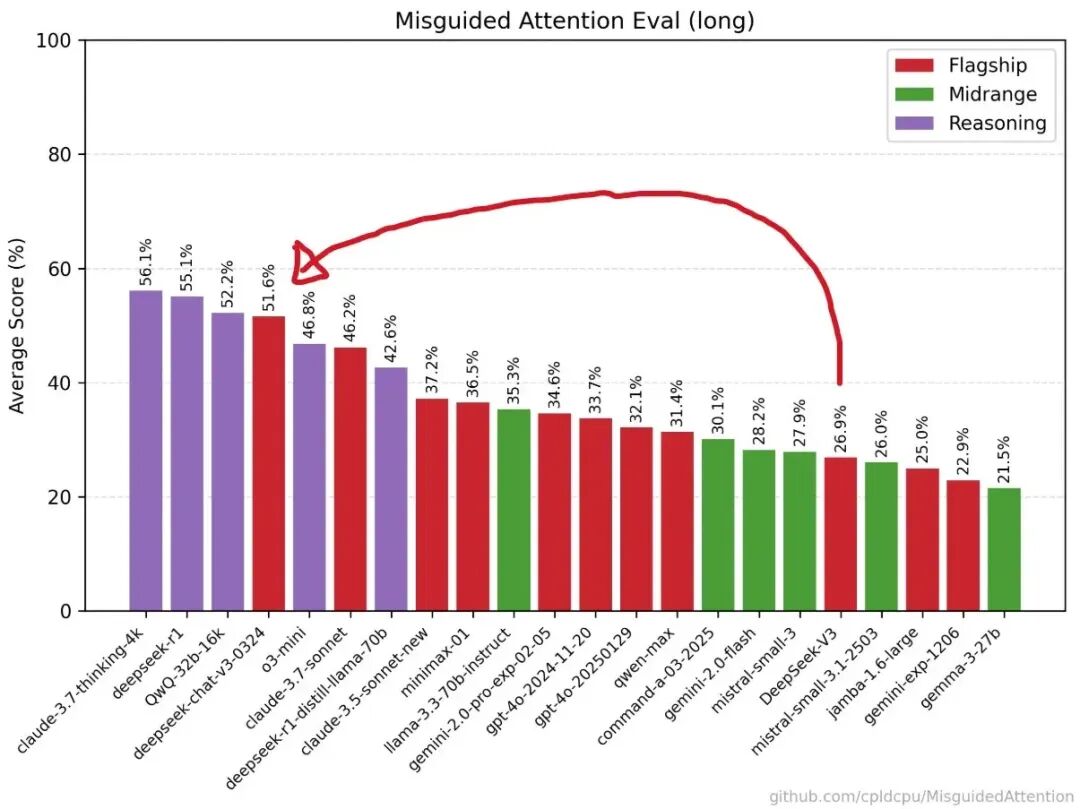
Digging through coverage across the web, I noticed one dimension almost no one highlighted — DeepSeek-V3-0324 is a non-reasoning model. Per user tests, it's now the best-performing non-reasoning model on the Misguided Attention benchmark, improving nearly 100% over V3.
This benchmark is specifically designed to evaluate LLM reasoning by testing whether models can correctly process problems with misleading information, rather than falling back on common patterns from training data.
For a non-reasoning model to achieve this magnitude of improvement suggests genuinely shocking architectural optimization behind the scenes.
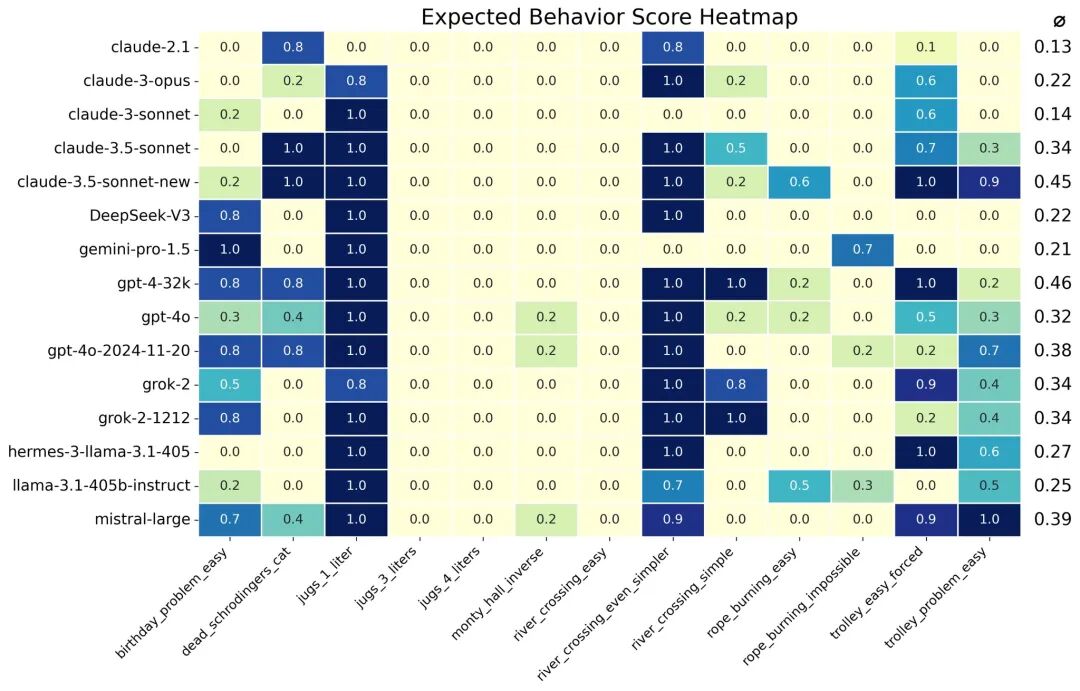
For comparison, here's how the previous V3 scored.
At the time, DeepSeek's results were roughly on par with Gemini 1.5 Pro — decent, not remarkable.
In just a few months, DeepSeek-V3's performance on classic paradoxes and thought experiments has jumped to this level. It's practically a reinvention, demonstrating remarkably strong attention allocation and an ability to grasp key details even when fed misleading information.
Second, the cost dimension that enthusiasts can't stop talking about:
DeepSeek-V3-0324 costs 21x less than Claude 3.7 Sonnet on input, and 53x less on output
- DeepSeek V3-0324: $0.14 / $0.28 per million tokens (input / output)
- Claude 3.7 Sonnet: $3 / $15 per million tokens (input / output)
In open-source circles, matching this performance typically demands massive H100 compute and training time.
But DeepSeek, drawing on accumulated training experience from prior versions like V3 and even R1, has managed further optimizations that significantly boost performance while reducing resource requirements.
DeepSeek's open-source week already demonstrated how deep this company's expertise in large model R&D runs.
No doubt Meta and other Western tech giants will be firing up their "DeepSeek war rooms" once again.
Lately, AI coding and "vibe coding" have only grown hotter.
For ordinary people in this era who want to build a product from 0 to 1, code remains an unavoidable barrier — programming complexity is often an insurmountable obstacle.
But as AI becomes embedded in IDEs, the way code logic gets constructed has fundamentally changed.
Meanwhile, models with weaker coding skills still drag down the user experience, preventing that "vibe coding" flow state.
Anyone who's actually built code with AI knows: while platforms hype "just keep hitting Tab," the reality is that free-tier models are too weak to use, and capable models require expensive subscriptions — your Tab key is already locked behind a paywall.
Inside products like Trae International, Cursor, and Windsurf, the only model that truly works — arguably the only one that works at all — is Claude 3.7 Sonnet. Its high barrier to entry and steep pricing have created a glass ceiling for everyday users.
Against these closed-source alternatives, this DeepSeek-V3-0324 iteration is a reminder:
DeepSeek is still DeepSeek.