Don't underestimate this Totoro

More Than Speed: Meituan's New "Totoro" Model Learns to Think Deeply
Beyond Speed: Meituan's New "LongCat" Model Learns to Think Deeply
 👦🏻 Author: Jingshan
🥷 Editor: Koji
🧑🎨 Layout: NCon

The race for AI foundation models is gradually moving from the lab to the streets. Those "sweeping monks" — grounded in everyday life and steeped in the hustle and bustle of the real world — are also beginning to unlock new entry points with AI.
In late August 2025, a deeply surprising piece of news began circulating in tech circles: a company most people associate only with food delivery, riders, and in-store group deals had suddenly started making waves on open-source platforms.
That company was Meituan.
It first launched LongCat-Flash-Chat, riding a single word — "fast" — to prominence on Hugging Face.
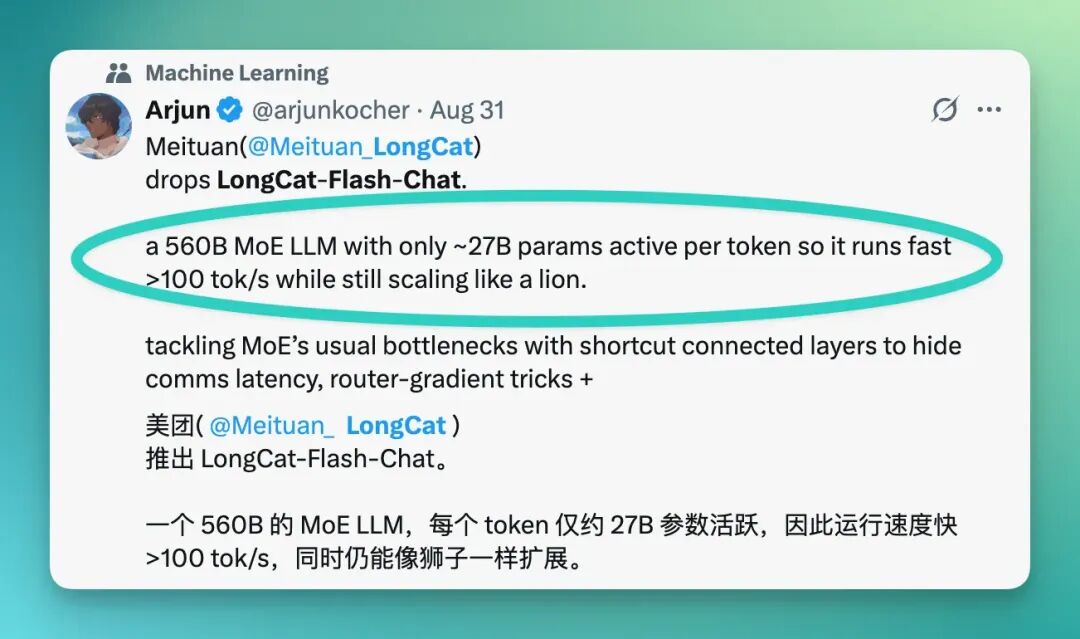
Then it followed up with LongCat-Flash-Thinking, achieving SOTA levels among open-source models on logic, math, and coding benchmarks — even approaching GPT-5-Thinking on some tasks.
This stark contrast instantly ignited curiosity:
Why Meituan? Why now?
Because Meituan's unique advantage lies in its mastery of the richest offline life scenarios. Its vast network of users, merchants, and logistics forms a solid foundation of "real world + physical infrastructure" that purely online companies simply don't possess.
And the value of large models lies precisely in injecting AI into these real-world scenarios — whether intelligent customer service, precise recommendations, or merchant support — with the ultimate goal of building a "life agent" capable of advisory and decision-making.
Next, we'll walk through several test scenarios to break down LongCat-Flash-Thinking, then return to the technical report to examine the underlying logic powering its scenario-based capabilities.
Beyond "Fast," the New LongCat Thinks Deeper
Not long ago, Meituan's open-source LongCat-Flash model drew attention for its generation speed. Recently, the team released a follow-up — LongCat-Flash-Thinking — with enhanced reasoning capabilities.
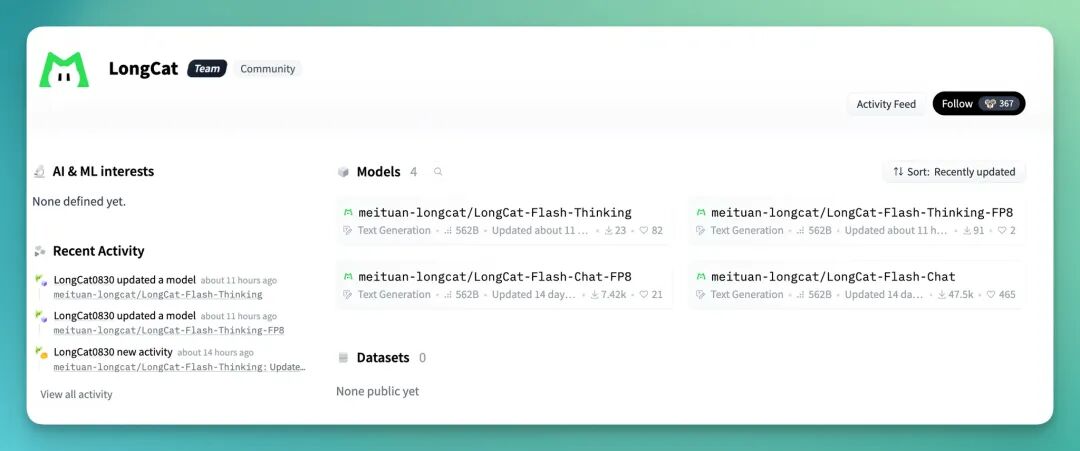
You can already see that downloads for the LongCat-Flash models are quite high.
LongCat-Flash is a non-reasoning base model, but through a "lightweight activation" strategy, its performance already matches mainstream large models. It shines particularly on agentic tasks.
Its upgraded version, LongCat-Flash-Thinking, pushes performance even higher: posting strong results across multiple benchmark suites, with comprehensively improved reasoning capabilities, and open-sourced immediately on Hugging Face and GitHub.

More notably, Meituan once again adopted the MIT license. This means virtually anyone can freely use, copy, modify, merge, distribute, and even commercially repurpose it.
In other words, with MIT-licensed code, you face almost no restrictions on secondary development or commercial use.
Let's run through some scenario-based tests:
"Ultra-Fast" Web Search
First, let's test LongCat-Flash-Thinking's speed and scenario-based capabilities with web search enabled.
The prompt:
Help me find good food near the Bird's Nest.
Compared to the earlier Flash-Chat version, this release maintains "ultra-fast" speed while improving precision and the complexity of web browsing.
I recorded a GIF with no speedup. You can see LongCat-Flash-Thinking's speed for yourself:
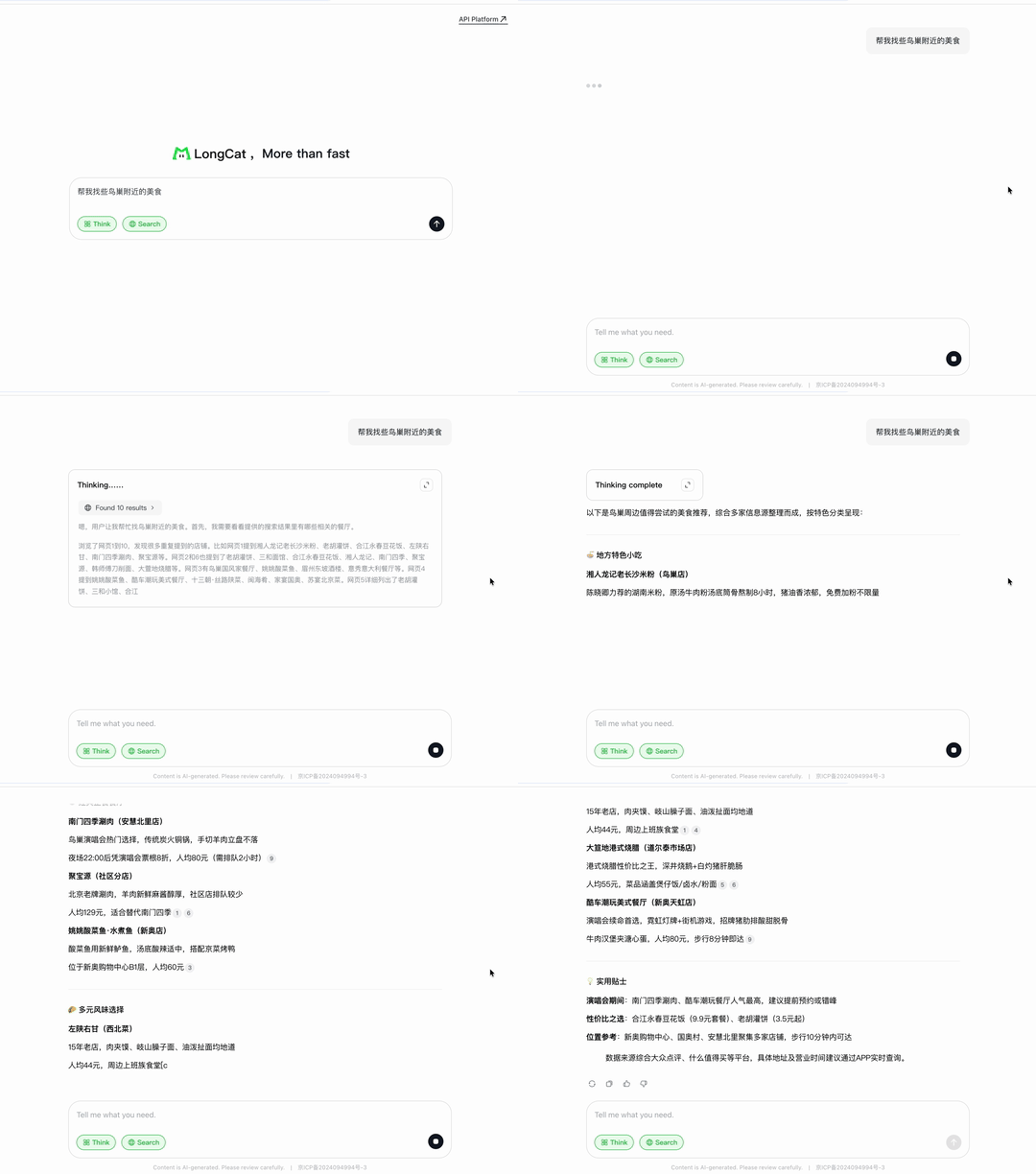
I noticed its chain of thought. Rather than randomly grabbing a few restaurants from the web, it proceeds methodically.
It first scans the search results, noting shop names that appear repeatedly. Then, instead of stopping at a long list, it further categorizes the restaurants. After sorting, it considers price-performance ratio and location — even emphasizing the need to synthesize multiple sources to avoid being led astray by any single webpage.
From this example, we can see that LongCat-Flash-Thinking doesn't just maintain "speed" — its thinking pattern is quite mature:

Additionally, Dianping pages appear naturally among the reference sources:

Next, let's test its coding ability.
Pomodoro Study Timer
Input prompt:
Make a Pomodoro study timer

Personally, I'm not a big fan of the color scheme, so I asked it to revise the front-end UI.
Prompt:
Black and white minimalist style
One thing worth noting: its code revisions are extremely fast.
In just a few seconds, it can complete a full round of code modifications, and the final result is pretty decent:

PPT Card Visualization Capability
Next, I asked it to visualize most of its technical report content in HTML, to see how it handles color and emphasis.
Prompt:
Visualize the following technical report content in PPT card format
You can see it created a single-page scrollable design, with each section displayed as a card containing a title and key bullet points:

In its generated output, all elements — serial numbers, emphasized text colors, main headings, subheadings, card background colors, and PPT card base colors — are handled reasonably well.
Even in its chain of thought, it specifically sought out Meituan's signature orange brand color.
Meituan Merchant Dashboard
Now let's look at a more scenario-specific task: building a backend dashboard for Meituan food delivery merchants.
Prompt:
Build a backend dashboard for Meituan merchants, make it look good.

You can see it uses a dark sidebar with a light main content area, matching common SaaS dashboard conventions.
Four core metrics (total orders, sales revenue, average order value, completion rate) sit at the top, with an intuitive information structure and reasonably highlighted priorities.
The bar and donut charts are clean and clear, with good color differentiation and no information overload. Most importantly, it generates everything very quickly.
Logical Reasoning Test
I recently came across some interesting logical reasoning tests online. Let's use them to compare ChatGPT-5 and LongCat-Flash-Thinking.
The question:
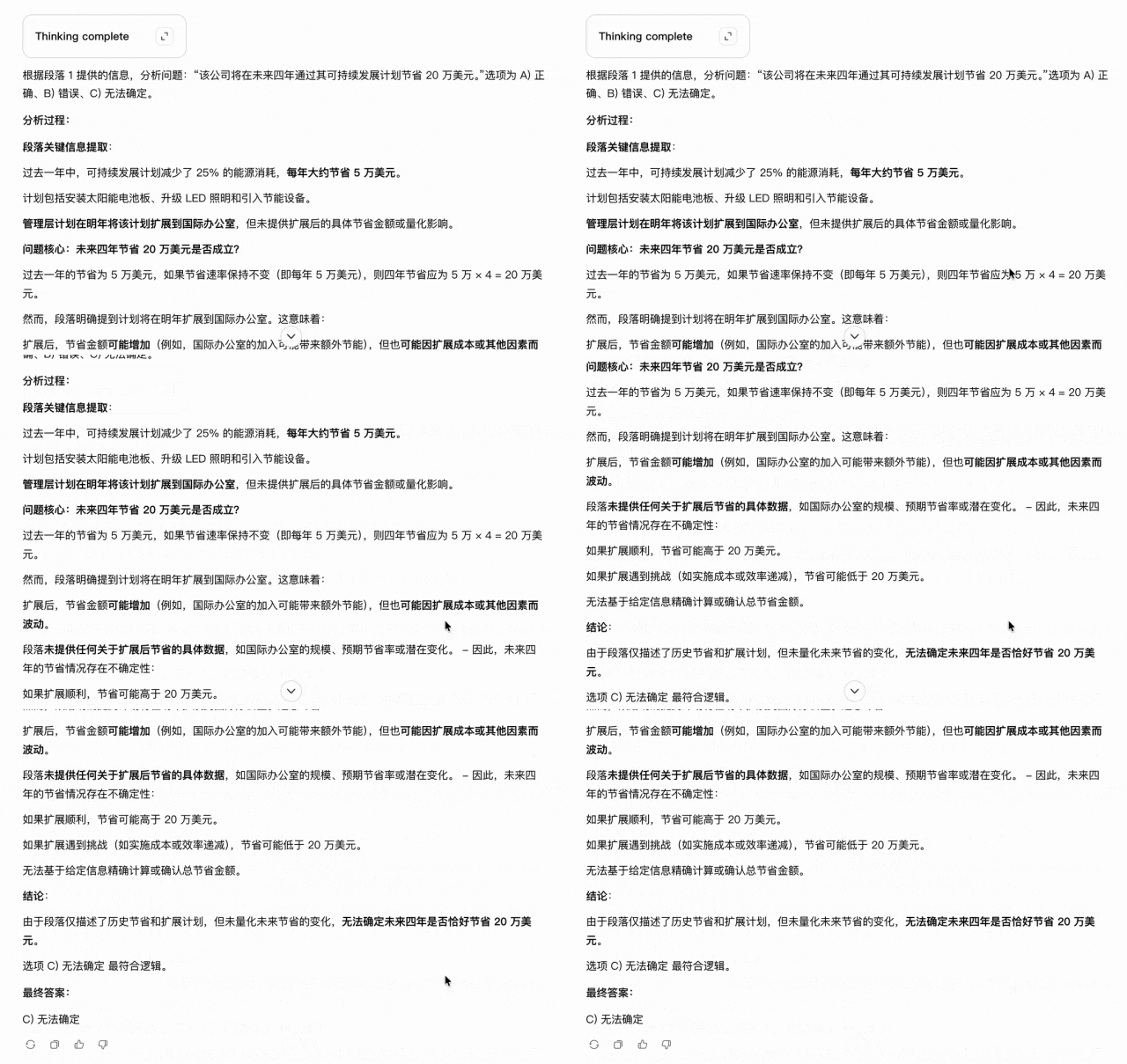
Passage 1: "The company's sustainability program reduced energy consumption by 25% over the past year, saving approximately $50,000 annually. The program included installing solar panels, upgrading to LED lighting, and introducing energy-efficient equipment across all facilities. Management plans to expand the program to international offices next year." Question 1: The company will save $200,000 over the next four years through its sustainability program. A) True B) False C) Cannot be determined
The correct answer is C.
Because although the passage mentions current annual savings of $50,000, we cannot assume this saving will continue for four consecutive years without more information about future performance or planned adjustments.
First, let's look at ChatGPT 5's performance. Perhaps "disdaining" to engage Thinking mode, it got it wrong on the first try (though in subsequent testing, GPT-5 did arrive at the correct answer):

Now LongCat-Flash-Thinking: it produced a nearly complete answer with reasoning in about 3 seconds.
First, it accurately extracted key information from the passage. On this basis, its answer didn't stop at mechanical calculation — it started with the intuitive "$50K × 4 years = $200K," then further noted the uncertainty introduced by future expansion, which could push savings above or below $200K.
This reasoning path is quite clear and complete, considering both known facts and information gaps. Ultimately, it chose "Cannot be determined" as its conclusion, avoiding over-inference:
Three Core Elements in the Technical Report: Data, Training, and Engineering
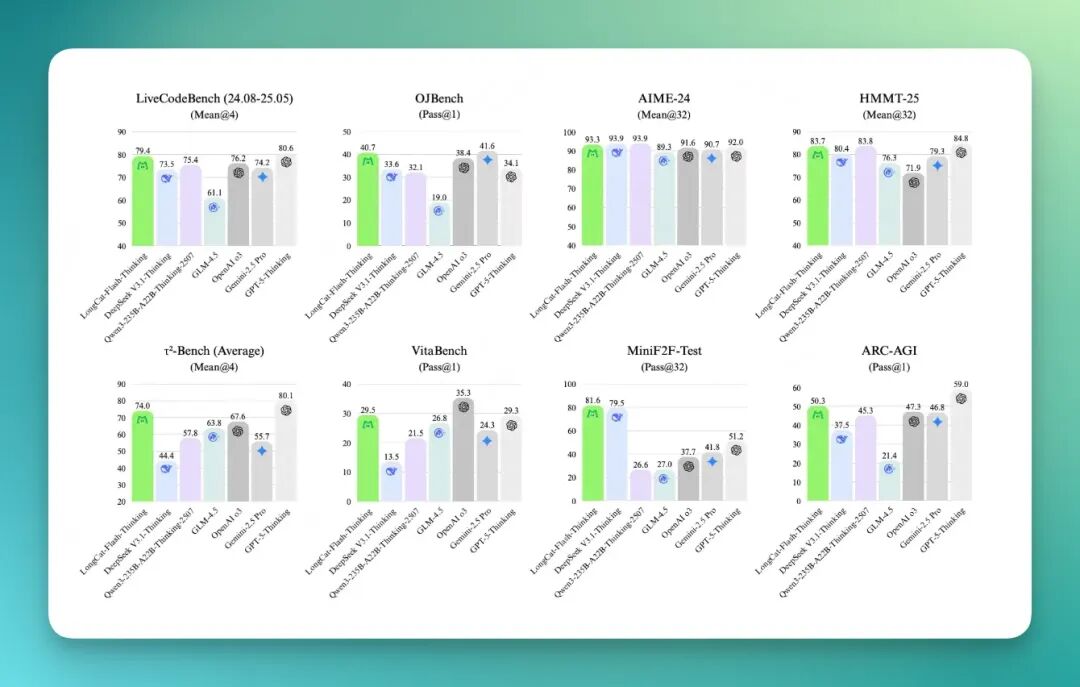
Now let's examine LongCat-Flash-Thinking's performance across various benchmarks. It has already achieved breakthrough results in multiple key reasoning domains.
First, it reached SOTA levels among open-source models on multiple high-difficulty, high-complexity tasks including code, math, agentic reasoning, formal reasoning, and general reasoning — even surpassing leading closed-source models like Gemini-2.5 Pro and GPT-5-Thinking on some tasks.
Moreover, compared to other open-source models (such as Qwen3-235B-A22B-2507-thinking, GLM-4.5, DeepSeek-V3.1), LongCat-Flash-Thinking maintains a fairly clear lead across most evaluations.
So I became very curious about how it achieved such benchmark scores. I dug carefully into their technical report.
Interested readers can also check it out to see how large models are being built today.
Link:
https://github.com/meituan-longcat/LongCat-Flash-Thinking/blob/main/tech_report.pdf
First, their training pipeline is quite interesting.
The core idea is: start with "cold start (don't waste time on invalid data)" to teach the model deep thinking, then use "domain-parallel" reinforcement learning (RL) to make it an expert in each specialized domain, finally fuse these expert capabilities and conduct general capability training to arrive at a powerful, well-rounded model.
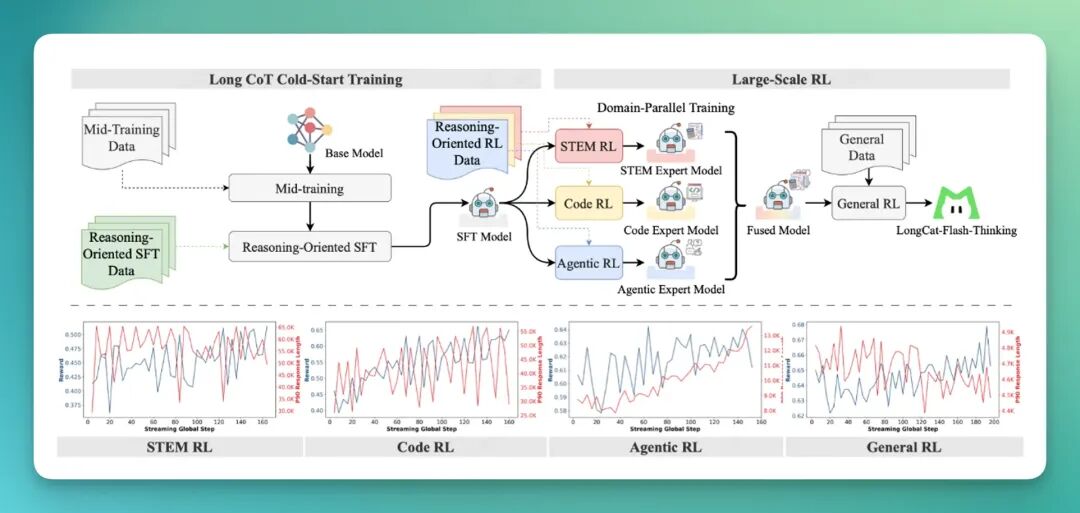 LongCat-Flash-Thinking training pipeline
It's fair to say that LongCat-Flash-Thinking's current performance is no accident. Digging into its technical report reveals a systematic innovation spanning data, training, and engineering.
Here's our summary.
Step 1: Awakening the Model's Reasoning Talent with "Long Chain-of-Thought" A model's capabilities rest on its data.
The report notes that traditional models reason poorly because their "diet" lacks reasoning-intensive content (like STEM and programming) and structured examples of long chain-of-thought.
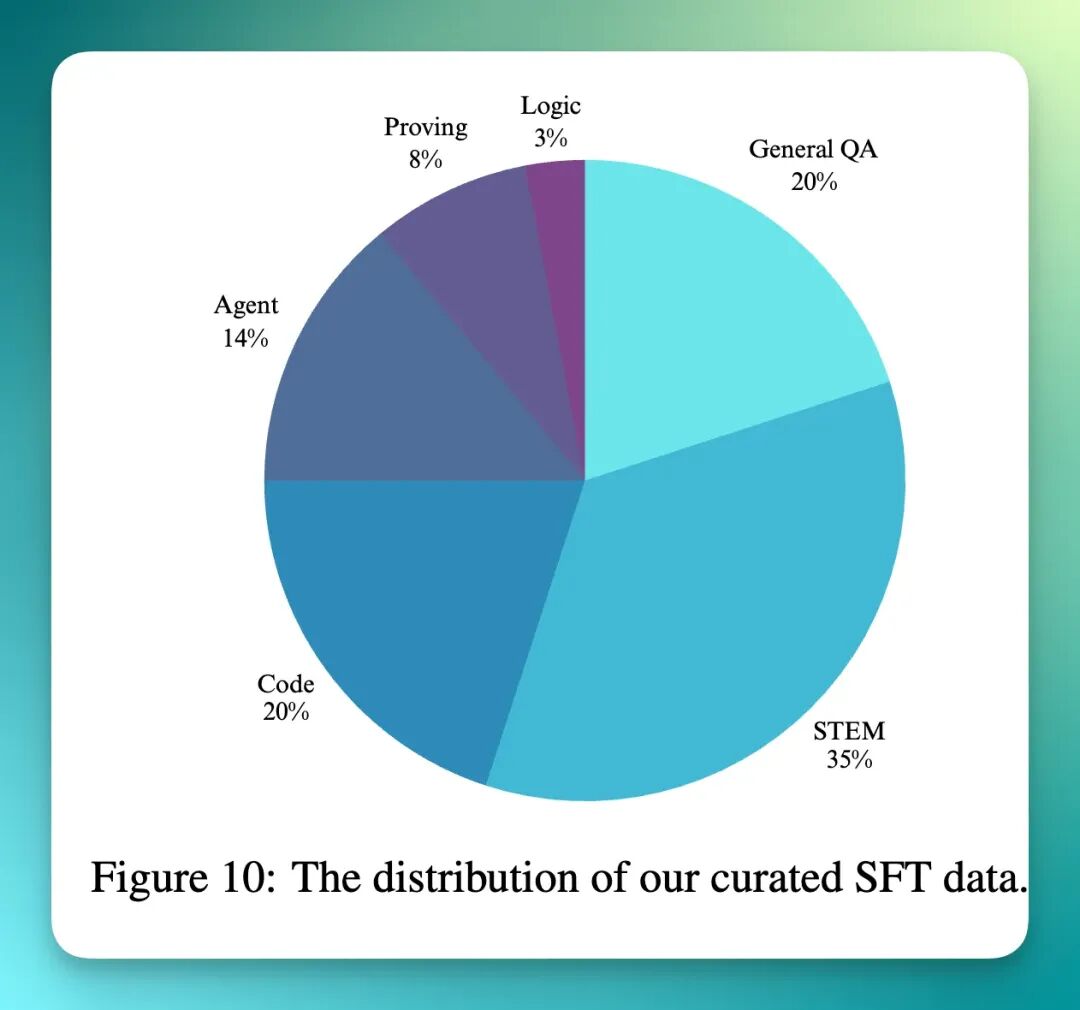
To address this, the team designed a "long chain-of-thought cold start" approach. From the earliest training stages, the model is strategically fed large quantities of difficult math competition problems and programming algorithms, systematically activating its dormant reasoning capabilities.
Below is the data composition diagram for their supervised fine-tuning (SFT) phase:
Building on this, the model learned two additional skills through supervised fine-tuning (SFT):
[1] First, interfacing with a Lean4 proof server to generate machine-verifiable formal mathematical proofs;
[2] Second, through an innovative "dual-path evaluation" process, learning to judge when and how to leverage external tools for difficult problems.
Step 2: Using a "Domain-Parallel" Framework to Avoid "Jack of All Trades, Master of None" With this foundation, the core challenge becomes how to achieve stable improvement in higher-level reinforcement learning.
Traditional mixed training often causes knowledge from different domains to interfere with each other. The Meituan technical team's solution is "divide first, conquer later":
They patiently cultivate three separate "expert models" for the three core domains of STEM, code, and agentic tasks. Once these experts perform well in their respective domains, model fusion seamlessly integrates all "expert skills" into a unified model.
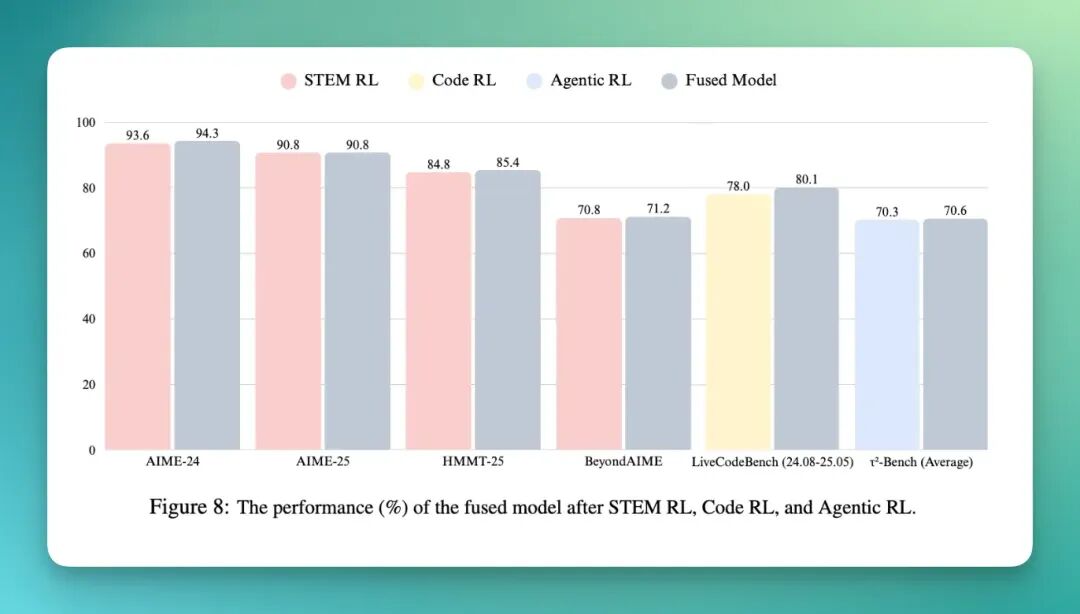 Fused model performance after STEM RL, code RL, and agentic RL (%).
The goal is to create a versatile "all-rounder" that combines the best of all experts, approaching optimal solutions in each specialized domain.
Finally, when Meituan released their new model, many overseas tech forums and users were particularly interested in one point: DORA.
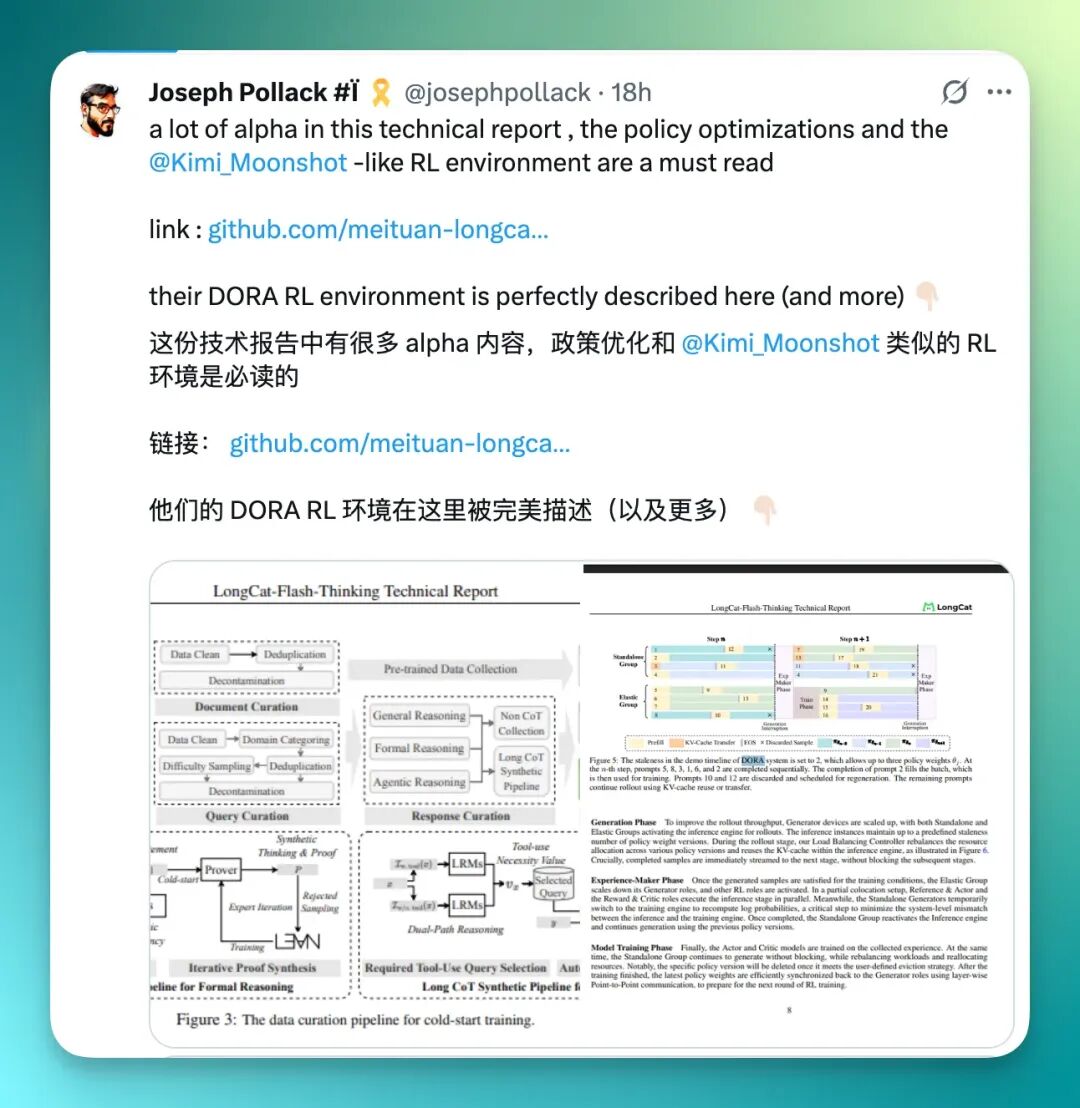
Step 3: The Self-Developed DORA System. Even the best methodology needs robust engineering systems to execute.
Large-scale RL training is complex, with numerous "efficiency killers" like idle waiting between devices. Put simply, training a large model is like having it repeatedly "do problems — correct mistakes — do more problems." But the catch is: if you only use the latest model version to "do problems," efficiency suffers; if devices alternate between idle and busy, resources go to waste.
As I read through the technical report, I found that the Meituan team developed an industrial-grade RL framework called DORA.
Its core is an "asynchronous streaming" architecture — like a never-stopping assembly line, where completed tasks immediately flow to the next stage, completely eliminating "shortest-board" style waiting.
To put it more simply, DORA is a "smart scheduling system" where different machines each play their role while flexibly switching:
[1] Some machines dedicated to generating answers.
[2] Other machines flexibly switch roles: sometimes helping generate answers, sometimes responsible for "scoring" and "correcting mistakes."
Ultimately, this system improved overall training efficiency by more than 3x.
In summary, LongCat-Flash-Thinking's training path is crystal clear:
Use quality data, use smart frameworks, use reliable systems to ensure it all comes together.
LongCat's Agentic Capabilities Deserve Serious Attention
In the latter half of the technical report, I found a chart that stands out as one of the report's biggest highlights.
This chart shows a scatter plot by the Meituan technical team measuring model performance against average token count. On the AIME-25 high-difficulty math reasoning task, it evaluates efficiency across several SOTA AI models along two dimensions: accuracy and computational cost (average tokens).
Most importantly, the X-axis can be understood as the average number of tokens the model needs to generate (or process) to solve one problem. This figure represents inference cost — lower is better.
LongCat-Flash-Thinking (w/. Tool) (green, left side), when equipped with external tools, maintains high accuracy at 90.00% while dramatically reducing average token consumption to roughly 7,000 — even slightly less than GPT-5 Thinking.
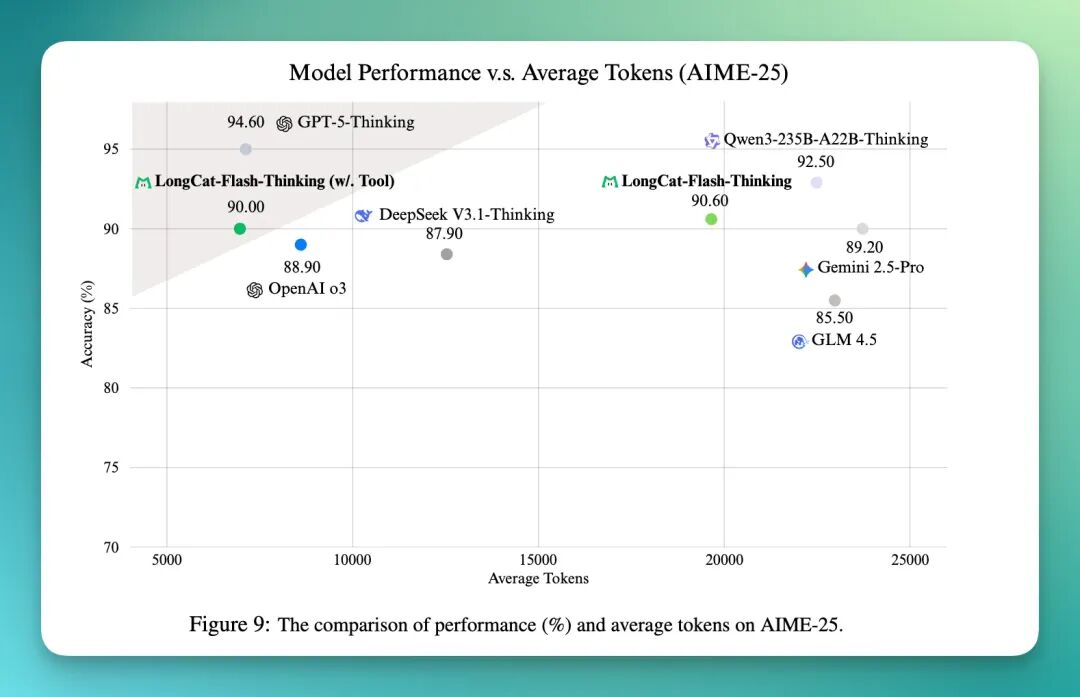
While its performance does lag GPT-5 Thinking somewhat, LongCat-Flash-Thinking nonetheless demonstrates "balance" across these two critical dimensions of performance and efficiency, achieving "fast and frugal."
This is crucial for actually deploying models and controlling costs.
Because what this really reflects is LongCat-Flash-Thinking's potential in agentic capabilities. As the Meituan technical team puts it, they designed a "dual-path reasoning framework" that lets the model learn to judge for itself: when to brute-force the calculation, and when to smartly call in external tools for help.
Precisely because it "uses tools," it can solve difficult problems so efficiently. This is actually a highly scenario-focused capability.
Especially recently, Meituan has clearly accelerated its pace in AI. In just one month, it successively released the LongCat-Flash-Chat model and LongCat-Flash-Thinking model, and quickly deployed large model capabilities to the AI agent app "Xiaomei."
So, putting it all together, through hands-on experience and reading the technical report, you can clearly sense that unlike some explorations pursuing "bigger and more comprehensive," Meituan's rhythm emphasizes: models must be fast, usable, and balanced; AI agents must deliver "new experiences."
🚥
Xing Wang once made an observation: many people tend to overestimate AI's progress in the next year or two, yet underestimate the change it can bring over ten years.
Today's "LongCat" may be just an opening signal.