"Press Releases Are Dead, Long-Form Podcasts Rule" | Lei Jun and Elon Musk's Shared Choice

Podcasts: The New Favorite of Tech Bigwigs.
From Lei Jun to Elon Musk, what have the tech world's biggest names been up to lately? The answer: recording podcasts! And not just any podcasts — marathon sessions stretching three hours or more.
This once-niche audio format is fast becoming tech's new favorite medium. Why are these perpetually busy leaders suddenly willing to sit down for hours-long conversations? What exactly is podcasting's magic?

"Crossing"[1] was the fastest-growing Chinese tech and AI podcast of 2024, and in producing it, we've experienced firsthand the unique connection podcasts create. Through ongoing dialogue and interaction, we've built deep relationships not only with our guests but also a special sense of familiarity with our listeners. Many engage with us on social media, sharing thoughts and reactions that reinforce the medium's intimacy.
We traced podcasting's rise through tech circles to see how it's become a new channel for spreading ideas and building connections — and how you might benefit from the trend.
Podcasting's Rise at Home and Abroad
Lei Jun and AI Pioneers Lead the Podcast Wave
Last week, Xiaomi founder Lei Jun released his only in-depth interview in recent years on the "Gao Neng Liang" podcast[2].
The conversation ran 206 minutes. Lei Jun opened up about Xiaomi's decision to build cars, the enormous challenges involved, and his vision of reaching industry-leading status within five to ten years. The episode became a hot topic across tech circles, drawing intense interest from "Mi fans" and casual observers alike.

Meanwhile, over the past several months, the "Five Tigers of Chinese Large Models" — five prominent founders of major AI models — have each recorded deep-dive podcast interviews. These founders detailed not only their respective models' development journeys but also shared valuable technical experience and industry insights. The trend makes clear that podcasting has become a vital platform for China's tech leaders to share expertise and innovative thinking.
Silicon Valley's Podcast Fever
In Silicon Valley, tech titans eagerly use podcasts to share perspectives and experiences. Elon Musk, Mark Zuckerberg, Sundar Pichai, and Jeff Bezos have all appeared on well-known shows.
Elon Musk joined Joe Rogan's The Joe Rogan Experience[3] to discuss everything from electric vehicles to Mars colonization. He covered Tesla and SpaceX while diving deep into artificial intelligence and future technologies.
The September 2018 episode has surpassed 47 million YouTube views. On the show, Musk argued that despite AI's enormous potential, uncontrolled development could bring catastrophic consequences.
"AI is far more dangerous than nukes, by far, so why do we have no regulatory oversight? This is insane." — Elon Musk's widely debated remarks
In the weeks following the interview, AI-related posts on X jumped roughly 30%, particularly content around AI ethics and morality, sparking broad discussion. These figures demonstrate how Musk's podcast appearances dramatically amplify public interest and understanding of specific technical issues.

On another show, the Third Row Tesla Podcast[4], Musk also laid bare Tesla's history, future plans, and technical innovations, actively responding to fans' and owners' enthusiasm and expectations.
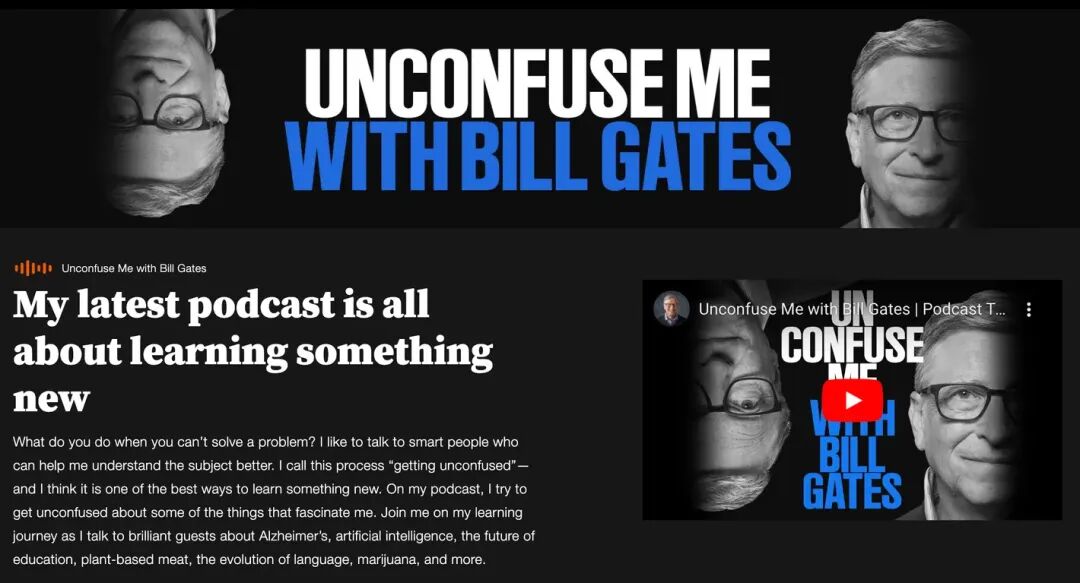
Bill Gates launched his own podcast, Unconfuse Me[5], in 2023, leveraging his wide influence to invite experts across fields for conversations. Covering technology, healthcare, and more, the show reveals Gates's attention to global challenges and potential solutions.
Additionally, Samuel Altman, CEO of OpenAI, sat for a two-hour interview on the Lex Fridman Podcast[6], directly addressing hot topics around OpenAI including board changes, GPT-5's future, and sharing his views on AGI (artificial general intelligence) for the first time.
These in-depth conversations serve as primary sources for how tech giants reveal important information to the world, highlighting podcasting's role as a crucial platform for modern scientific communication.
Three Reasons Tech Leaders Are Flocking to Podcasts
Podcasting's Rapid Growth — The Rise of Xiaoyuzhou
"Those voices that keep you company become 'listening hours' on your Xiaoyuzhou app profile, reminding you that in this vast universe, you're not alone."
Abroad, podcasting has been hot for years, with mature systems and serious investment behind it. Recently, video podcasts as a major trend have attracted many new listeners, with Spotify and YouTube competing fiercely in the space. In China, however, podcasting remains a relatively niche emerging field.
Domestic podcasting's rapid development is embodied in Xiaoyuzhou, a platform dedicated to podcast content. It's now among the favorite communities for creators and listeners alike, with 30 million registered users, 6 million monthly active users, and over 75,000 shows. Beyond these numbers, Xiaoyuzhou is working to connect high-quality content with highly engaged users, striving to make podcasting a lifestyle for urban young people.
Xiaoyuzhou's user profile skews high-income, highly educated, and concentrated in developed regions. Average annual income exceeds 250,000 RMB, over 80% of users are in first- and second-tier cities or overseas, and 85% hold bachelor's degrees or higher. This demographic has strong desire for self-expression and social voice, eager to display attitudes and preferences. This gives Xiaoyuzhou greater diversity of thought and lifestyle, letting niche voices reach wider audiences.
Beyond dedicated podcast apps like Xiaoyuzhou, major music platforms have also gotten in on the action, giving podcasts more prominent placement. Audio platforms like Ximalaya, NetEase CloudMusic, and Apple Podcast have optimized products and user experience, added category entrances, and elevated podcast visibility.
Podcasting's Medium Characteristics — Cross-Scenario, Cross-Channel, Repeat Consumption
Cross-Scenario
Podcasts suit multiple use cases, consumable across different times and locations. More people embrace "lifelong learning" yet lack time to absorb nutrients through reading. Podcasts provide a platform where knowledge and information flow effortlessly into their brains during fragmented moments — commuting, doing chores, working out.
"On Xiaoyuzhou, whether you embrace mainstream culture or belong to subcultures and niche communities, whether you seek information or emotional companionship, you'll always find your fit in the podcast world."
Users can sustain listening across multiple scenarios, with long listening times giving podcasts their uniquely immersive, highly sticky appeal. Whether taking serious notes or simply "having something on," familiar voices become friends' companionship, quality information becomes nourishment for casual conversation.
Cross-Channel
Podcast content distributes across multiple platforms, reaching more users and flexibly serving different marketing strategies. In today's omnichannel, all-scenario internet era, every brand maintains multiple "content drawers," with users consuming content across devices (phone, computer, tablet) and life scenarios. As one such "drawer," podcasts hold content with distinctive characteristics.
Specifically, podcasts run long, often around two hours. In tech, leaders can use these interviews to elaborate views, thinking, and experience in detail, avoiding misinterpretation while delivering higher information density. This lets other industry practitioners and the general public access higher-quality, less one-dimensional thinking that surpasses traditional PR's reach.
Repeat Consumption
Compared to other media, podcasts accommodate deeper, more comprehensive content, becoming preferred creative expression for quality creators including celebrities and thought leaders. Urban young people who love exploring new knowledge and experiences have come to treat podcast listening as a more trusted information source, taking notes while listening and returning for repeat listens, capturing highly educated, high-potential young circles.
For example, under "Crossing" episodes, dedicated listeners frequently share their takeaways in detailed notes.

In short, podcasting's unique cross-scenario, cross-channel, repeat-consumption characteristics make it a distinctive, scarce resource among content formats, increasingly welcomed in tech circles.
Deep Interviews Go Mainstream: The Trust Advantage
Xiaoyuzhou CEO Kyth believes Chinese podcasting's commercial value is underestimated, and trust index directly correlates with commercial value.
Trust index refers to user trust in a given platform or medium. In information dissemination and marketing, it's a crucial metric because it directly influences user behavior like purchase decisions and brand loyalty.
High trust typically means users more readily accept platform information and recommendations, converting to commercial value through higher conversion rates, brand loyalty, and word-of-mouth spread.
Compared to other platforms (social media, TV advertising, etc.), podcasts hold significant advantages in building user trust:
Personalization and Intimacy
Podcasts typically feature fixed hosts, and listeners develop a sense of "familiarity" through repeated listening. This long-term, sustained relationship steadily builds listener trust in hosts.
This intimacy strengthens through direct communication. Tech leaders appearing in person, engaging in lengthy conversation, reveal personality and thought processes, enhancing relatability and trust, building more authentic images.
Imagine Lei Jun chatting with you on a phone call? Skilled hosts not only ask sharp questions but make guests comfortable enough to share more. They voice what most audiences want to know, pressing for details at the right moments. Such conversations reveal interviewees' personalities and thinking while chatting like friends, closing distance with listeners and strengthening relatability and trust.
Depth of Content
Tech leaders speaking directly convey original viewpoints, giving consumers firsthand information. This approach avoids distortion and one-sidedness from secondary transmission, increasing content credibility and authority.
Leaders prefer spending hours on deep interviews over multiple scattered, brief ones. Short interviews are uncontrollable with repetitive questions; hours-long sessions let them fully express views and ideas at once rather than answering a few questions fragmentarily. Though time-consuming, it's efficient for them. From "Gao Neng Liang's" three-hour episode, Lei Jun shared generously, expanding on many interesting stories beyond the host's questions.

On "Crossing," we particularly emphasize depth. For example, we recently invited ZhenFund managing partner Yusen Dai for a 90-minute deep conversation[7]. We explored AI investment strategy, industry trends, Silicon Valley versus China comparisons, and other hot topics. This thorough exchange let Dai share frontline AI investor insights while giving listeners high-quality industry intelligence to better grasp AI-era opportunities and challenges.

In our latest Episode 20, we invited another heavyweight guest: Li Leding[8]. As Baidu's former principal architect, Li has deep experience in search and cloud services, two foundational technical infrastructures. In what I called "our most substantive episode ever," Li accessibly introduced generative AI, interpreted AI entrepreneurship directions, discussed Silicon Valley giants' AI strategies, and comprehensively covered Professor Yann LeCun, world models, AI search, and other industry hot topics. The episode offers not just common knowledge and new learning but abundant inspiration that should deliver tremendous value to listeners.
Afterword
Tech giants' active participation in podcast recording at home and abroad is making podcasting an increasingly vital communications platform. Whether Lei Jun's marathon interview or deep conversations from Elon Musk, Bill Gates, and others, the trend shows podcasting is no longer merely entertainment media but an amplifier of influence and builder of trust.
For entrepreneurs and PR professionals, podcasts aren't just tools for deep audience engagement but platforms to showcase personality, build trust, and spread brand stories.
Choose the right platform, create deep content, distribute across channels, optimize through data feedback... Through these strategies, podcasting becomes an effective communications tool that not only raises brand awareness but builds lasting trust and identification with your brand through deep listener engagement.

🟢 Follow the "Crossing" podcast
If you're interested in tech innovation, AI development, and related topics, follow "Crossing." We'll continue inviting industry leaders and experts to bring you the cutting-edge perspectives and deepest analysis. Find us on Xiaoyuzhou, Apple Podcast, Ximalaya, and other platforms.



References [1] "Crossing": https://www.xiaoyuzhoufm.com/podcast/60502e253c92d4f62c2a9577
[2] Xiaomi founder Lei Jun's only in-depth interview in recent years on the "Gao Neng Liang" podcast: https://www.xiaoyuzhoufm.com/episode/66a9077533ddcbb53c3251de
[3] The Joe Rogan Experience: https://open.spotify.com/show/4rOoJ6Egrf8K2IrywzwOMk?nd=1&dlsi=1d8cf61de5c8457b
[4] Third Row Tesla Podcast: https://thirdrowtesla.com/
[5] Unconfuse Me: https://www.gatesnotes.com/Podcast
[6] Lex Fridman Podcast: https://lexfridman.com/podcast/
[7] Yusen Dai's 90-minute deep conversation: https://www.xiaoyuzhoufm.com/episode/665f398494977a26ef37deea
[8] Another heavyweight guest: Li Leding: https://www.xiaoyuzhoufm.com/episode/6692529b37236c546edd4b2f