GenFlow Cracked Open Baidu's "Walled Garden"

All in One One-Stop AI Agent
All in One: The One-Stop AI Agent

👦🏻 Authors: Xiaoju, Jingshan
🥷 Editor: Koji
🧑🎨 Design: NCon

On August 18, Baidu Wenku launched an Agent product called GenFlow 2.0.
In 2025, a year saturated with Agents, the market's first reaction was likely: "Just another one."
This judgment misses the crucial point: GenFlow can mobilize hundreds of specialist Agents and has integrated with Baidu Netdisk, Baidu Maps, Baidu Wenku, and Baidu Scholar. Among these, three content platforms have accumulated over a decade of massive documents, academic materials, and personal data.
Therefore, GenFlow is not a tool built from scratch, but rather an "activator" implanted into a vast ecosystem of Agents and existing data.
Its true value lies in "one-stop task delivery" achieved through multi-Agent collaboration. Its significance is akin to how the App Store drove a holistic upgrade in mobile experiences. For Baidu, the key question is whether it can efficiently revitalize that long-dormant data "backyard."
Our review will focus solely on this core question:
With the backing of the Baidu ecosystem, how far can GenFlow push the experience of multi-Agent collaboration and complex task completion?
🚥
Here is the comprehensive review of GenFlow by the Crossing team.
GenFlow — The Multi-Agent Synergy That Activates the Baidu Ecosystem Has Arrived
To be honest, in 2025 — the inaugural year of Agents — we've already seen so many excellent ones. Each has demonstrated dazzling capabilities in its own domain.
Against this backdrop, as one of the three BAT giants of the internet era, Baidu's launch of the GenFlow Agent might feel a bit late.
But then again, good things are worth waiting for.
Why do I say this? Baidu's entire digital ecosystem, built over the years, has had its resources mobilized by GenFlow through hundreds of specialist Agent swarms, transforming accumulated data into productive force.
Now, let's look at the specific test results.
100 Agents + Baidu Netdisk Knowledge Base = ?
Suppose I need to "one-stop" generate event materials — a PPT, mind map, poster, and more — for a "Crossing AI Content Creation Meetup" happening this September.
It so happens that I have several past Crossing articles stored in my Baidu Netdisk, so I can ask GenFlow to directly tap into my stored materials.
After all, this 13-year-old cloud storage product already holds vast amounts of our knowledge and data. If it can be extracted and summarized with one click, that would save considerable time.
Meanwhile, this task itself is cross-domain, cross-functional, and cross-modal:
Crossing is hosting an AI content creation meetup, sharing recent characteristics of AI products in our WeChat writing, insights on content creation, and predictions on the future general-purpose Agent market. We need to produce a PPT analyzing past works and their AI products, plus a professionally designed vertical poster with images and text, all in a style consistent with our brand identity.
Currently, GenFlow allows selecting a fairly large volume of Netdisk content — up to 100 documents:
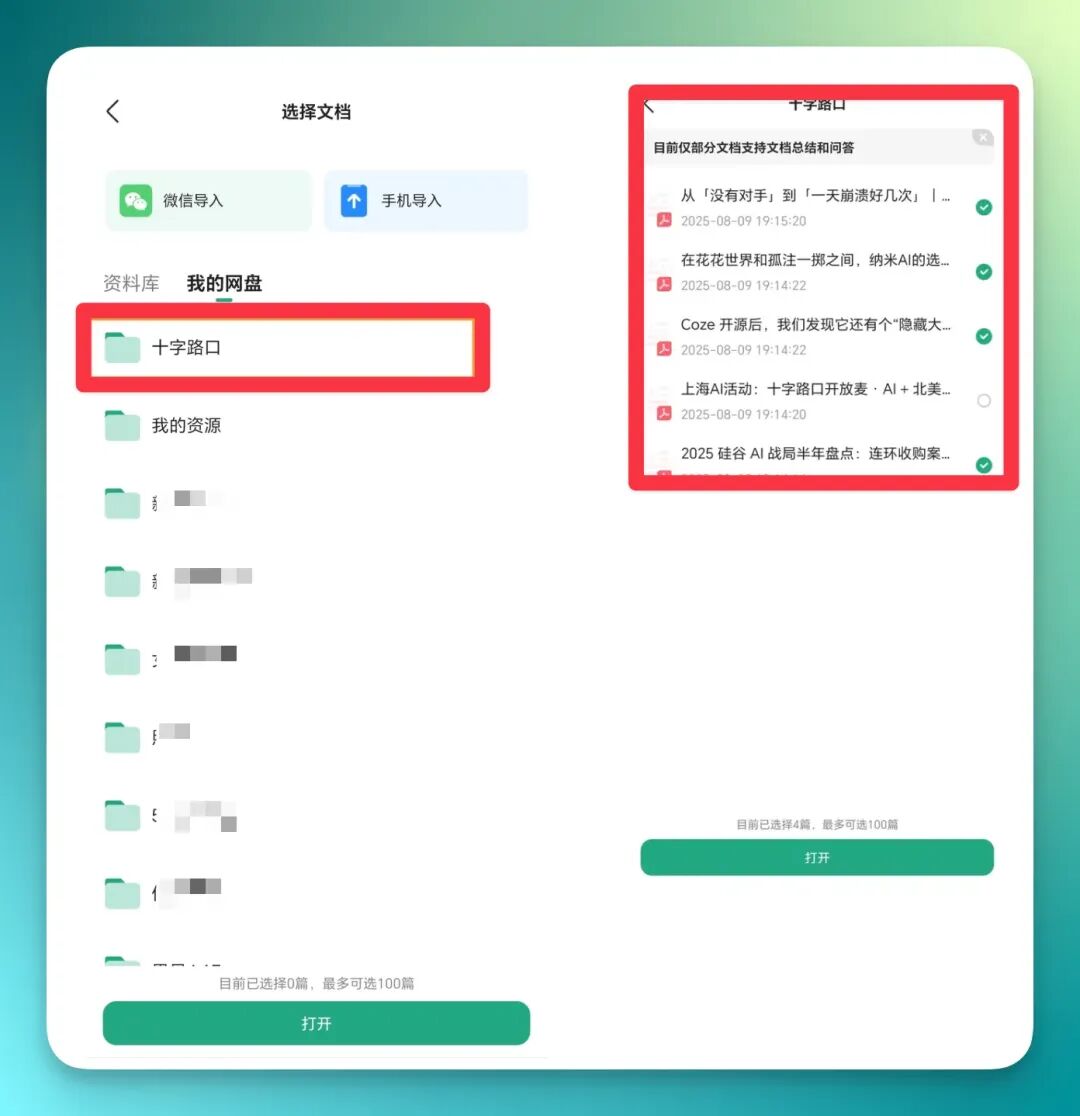
Once the knowledge base content is selected, GenFlow begins one-stop mobilization of multiple Agents to process tasks in parallel. This is different from the serial workflow of traditional Agents.
For example, in GenFlow's task planning, "parsing attachments" and "searching for AI content creation materials" are deemed to have no dependency relationship, so it calls multiple Agents to operate in parallel:
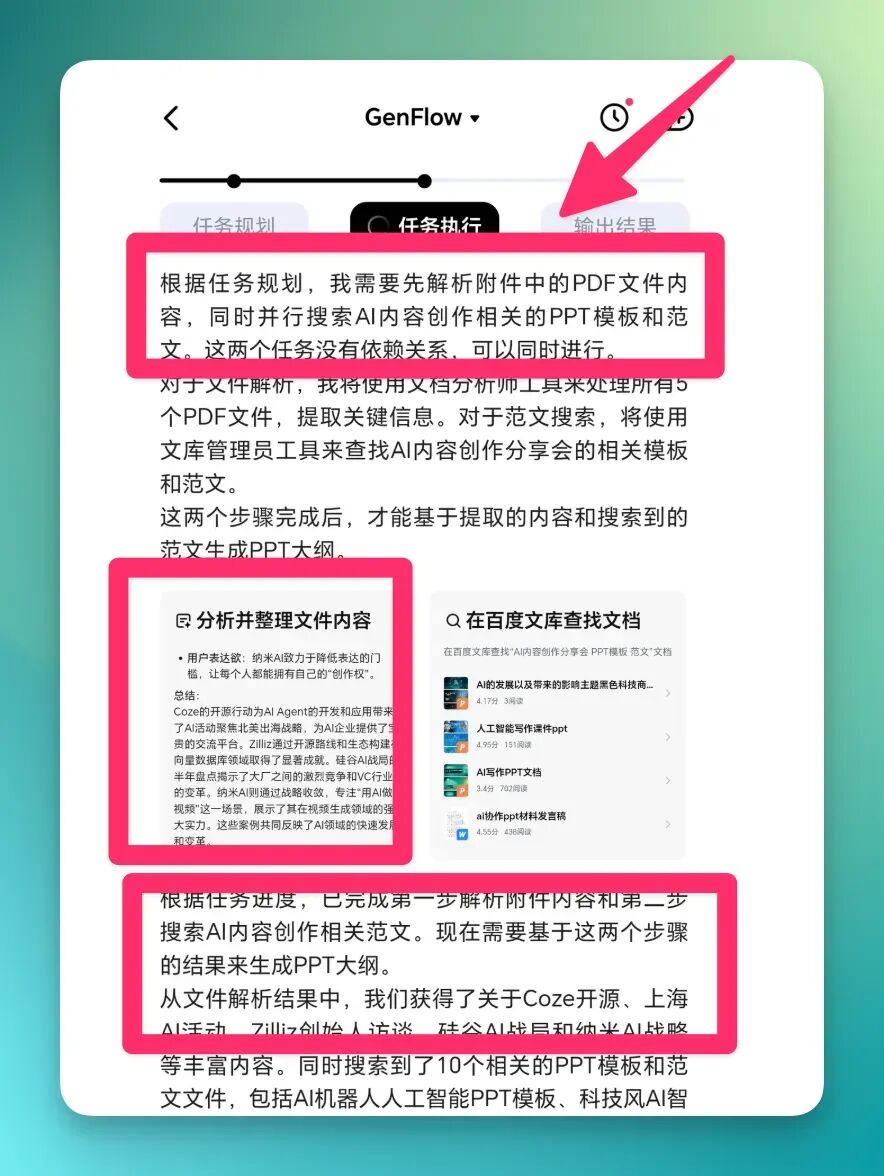
The most immediate feeling this multi-Agent collaboration brings: GenFlow completes tasks very quickly. In roughly seven minutes, GenFlow mobilized the corresponding Agents to finish all work including task planning, article parsing, web-wide search, PPT generation, poster creation, and mind map generation.
Good speed — now let's look at quality.
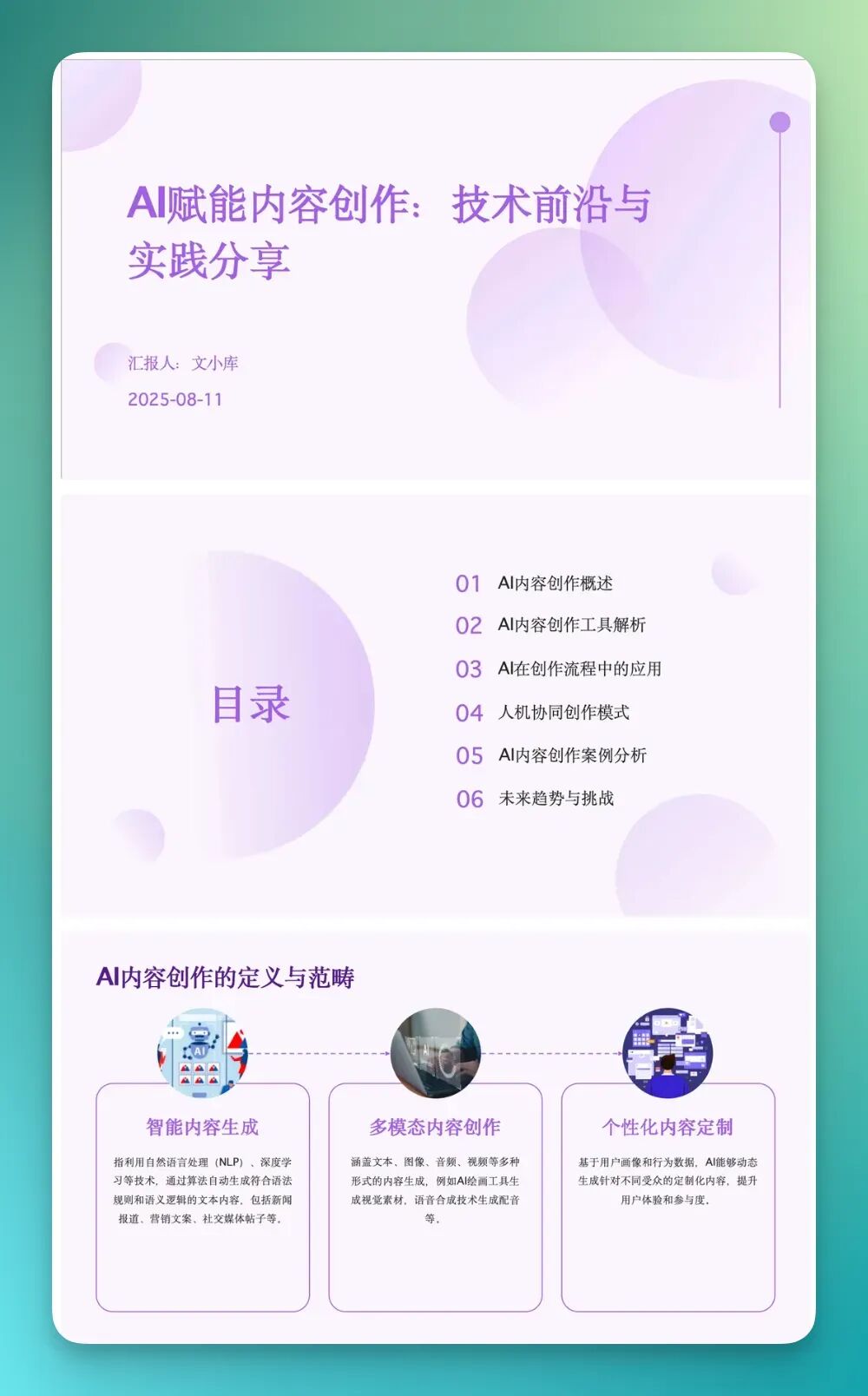
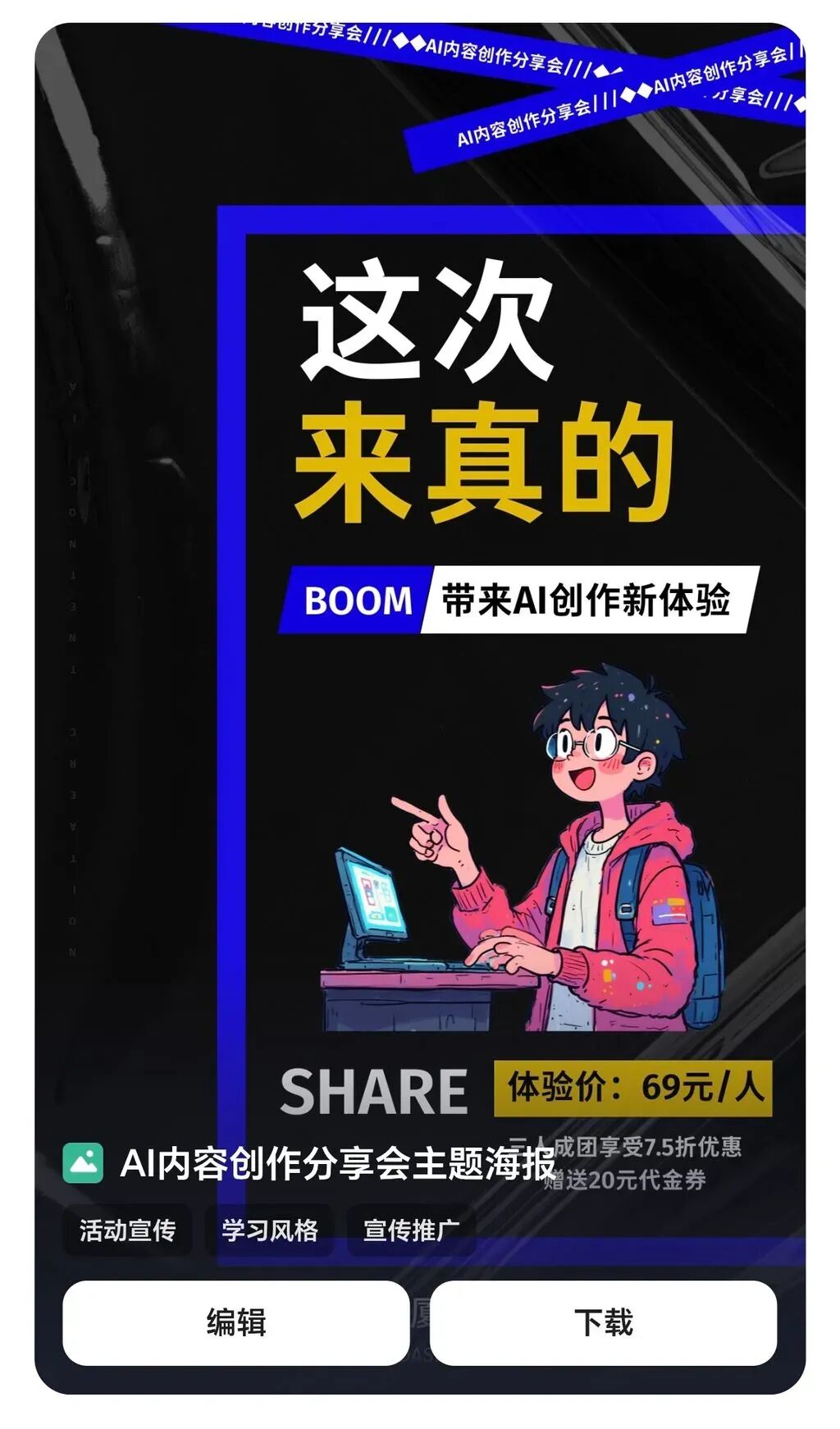
In its first-generated PPT content, GenFlow designed six modules, which fairly comprehensively covered the full AI content creation workflow. However, we felt the light purple color scheme didn't quite match Crossing's style, and six main headings felt like too many. The poster, though, was noticeably better in presentation, with very balanced layout.
Here are the first-generated PPT and poster:
Mind map:
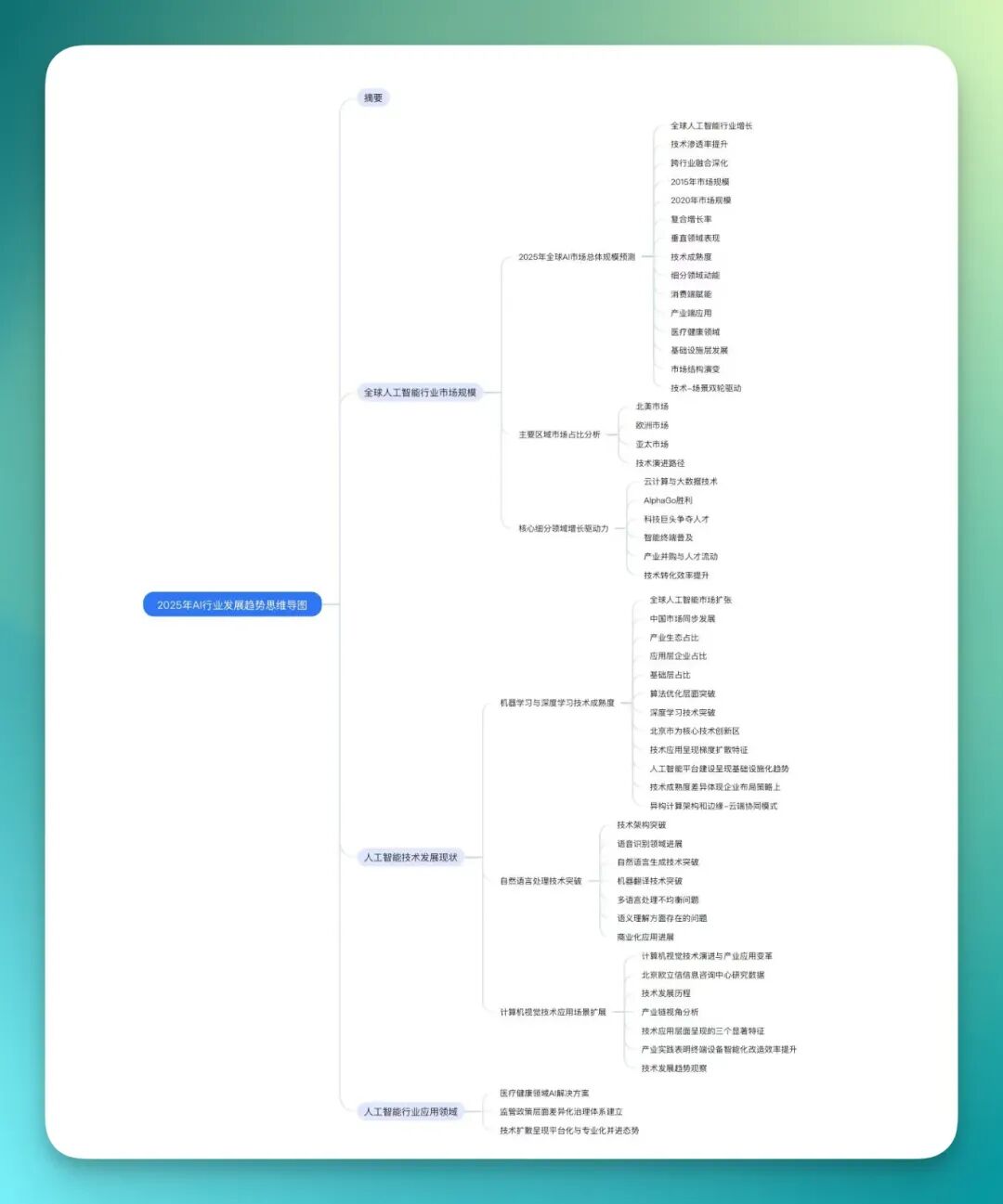
All of these tasks can be placed in a single prompt for GenFlow to execute one-stop.
I recorded two GIFs of the entire workflow — the left side shows GenFlow's "task execution," the right side shows its "output results." You can intuitively sense GenFlow's parallel processing capabilities across multiple modalities and formats:
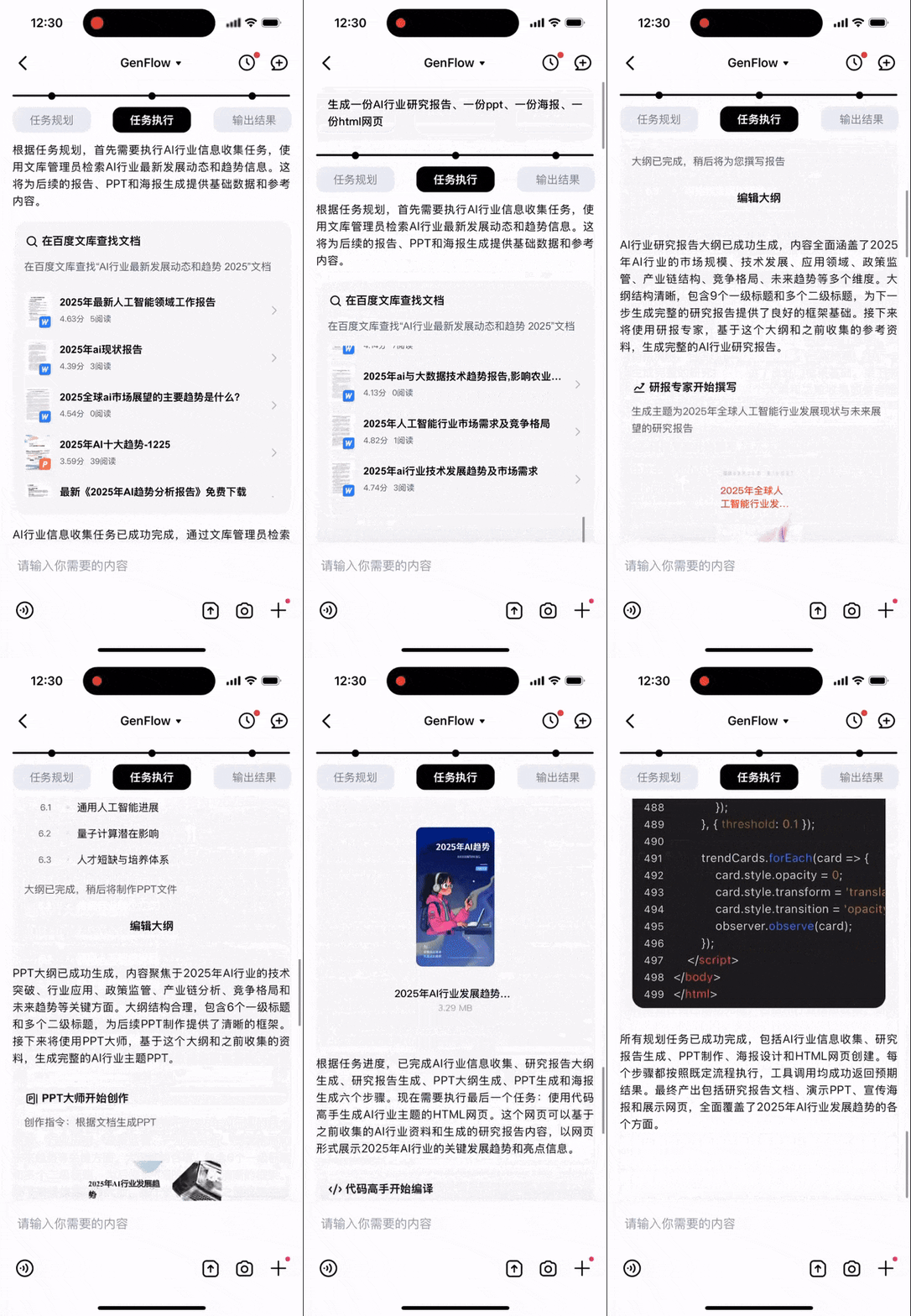
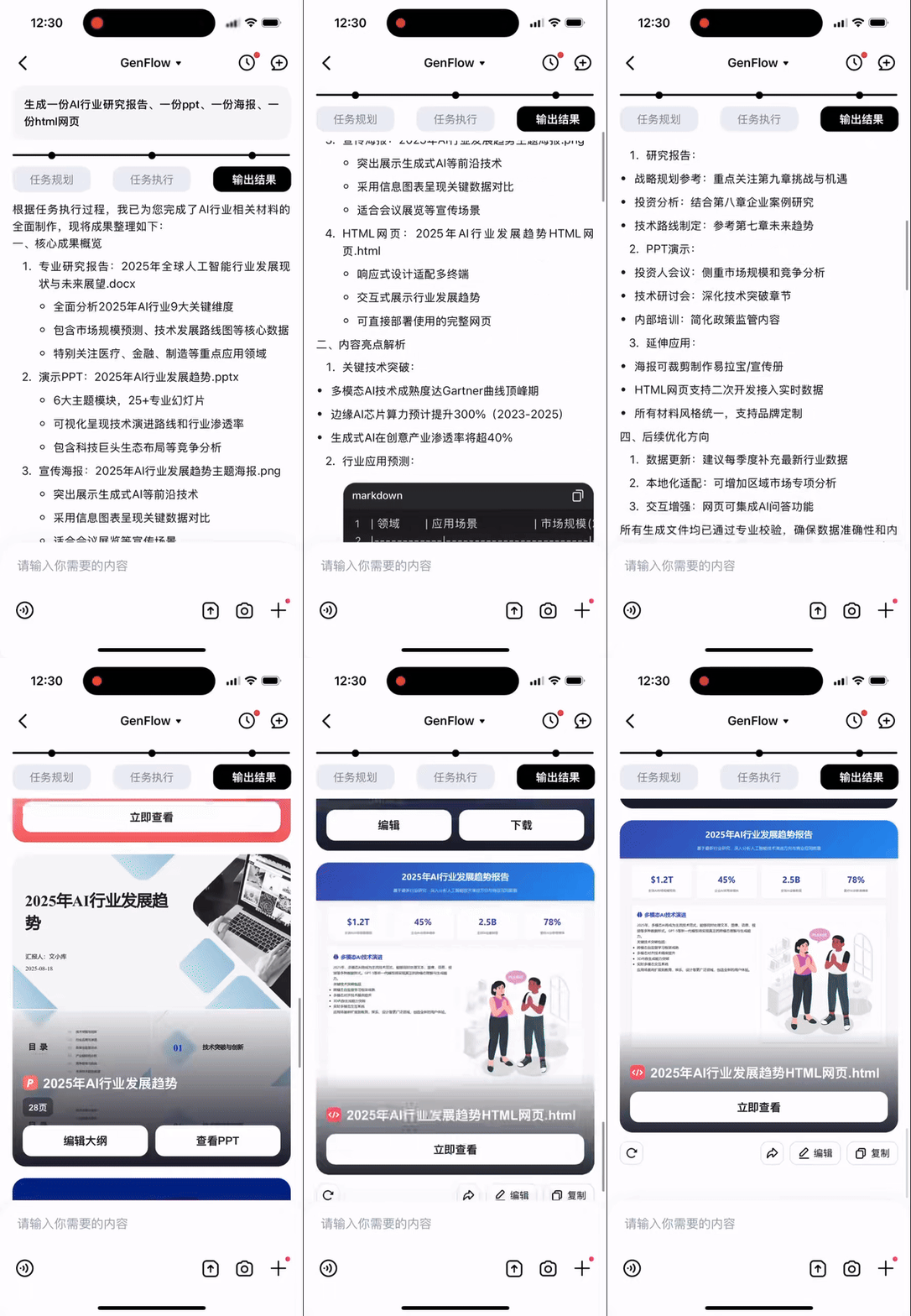
GenFlow provides editing tools for every detail of these generated materials, allowing free editing after content generation with greater flexibility in content creation.
For instance, I can freely modify the outline and have GenFlow regenerate a version; or I can swap out PPT templates according to my aesthetic preferences.
Example: I didn't like the color and style of the first-generated PPT, and the content felt too bloated, so I deleted "03: AI Applications in the Creative Workflow" from the outline, merged it into the first two chapters, and switched the template to a black-and-white color scheme.
This replaceability genuinely made the whole process much more convenient. I recorded a video — here's how the operation flows:
Below is the final PPT product.
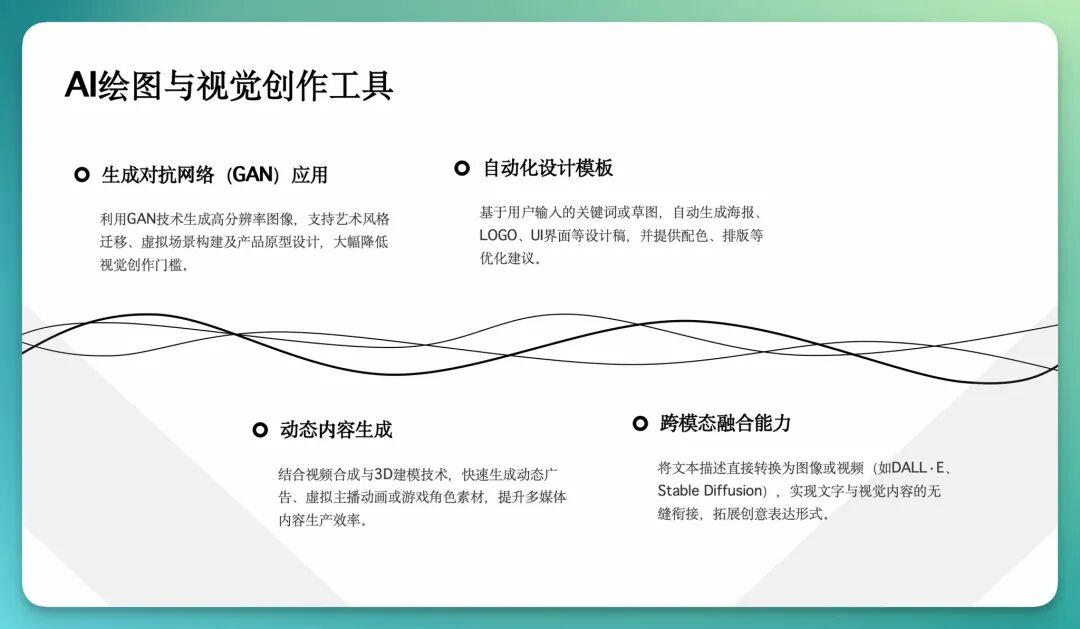
The overall layout is well-coordinated, and I found it quite adept at using various small icons. Each PPT page has relatively clear layout structure, enabling better content delivery.
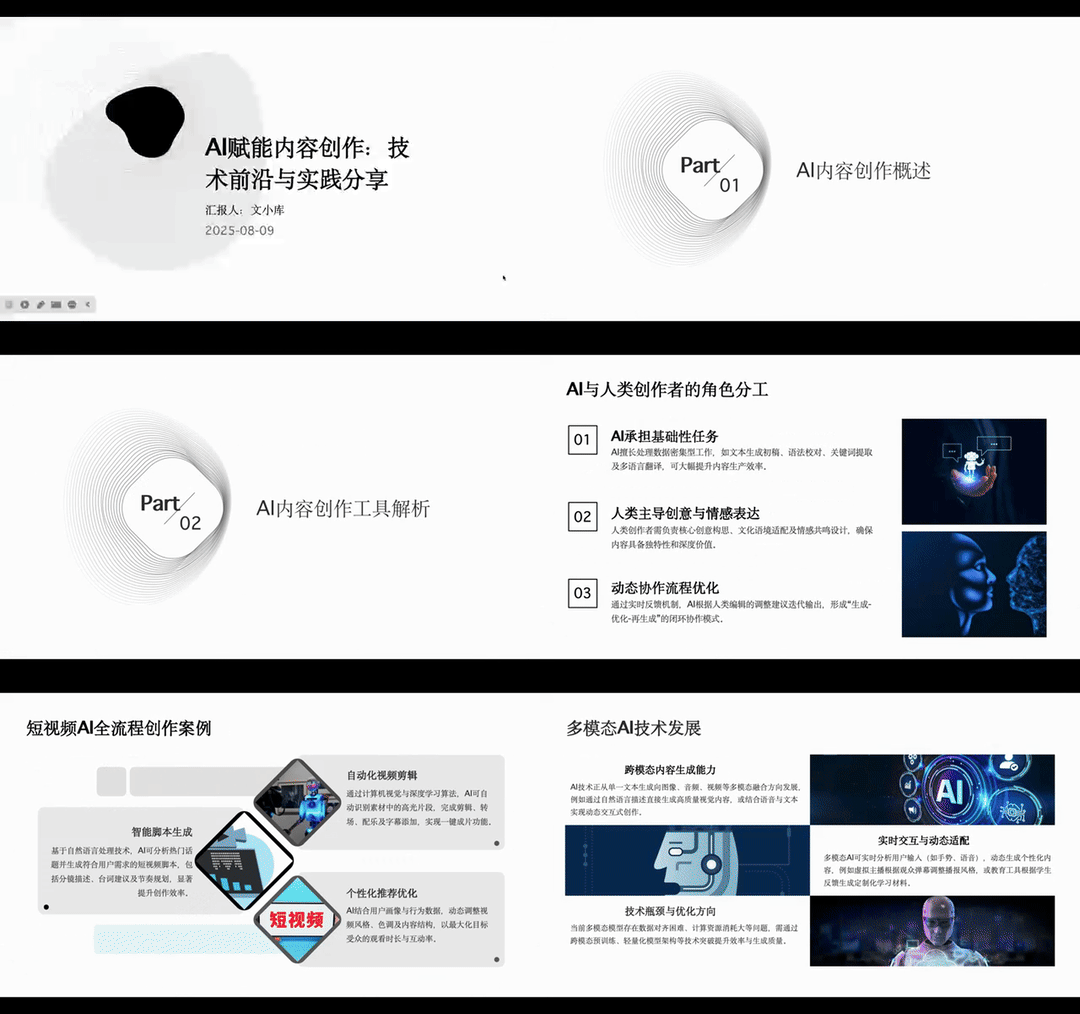
The text generation is entirely based on a user-satisfying framework (since I had already modified it), plus the knowledge base provided internally by "Baidu Netdisk," so delivery efficiency is high and the content balances personalization with professionalism.
In the initial generation, I was already fairly satisfied with the poster it produced — it offered a solid template with mature stylistic elements.
However, it was one step away from being directly usable: I needed to remove "Special Trial Price" (since Crossing's open mic doesn't charge fees) and update the address. Users can also directly adjust the poster on their phones, whether it's image positioning or text content.
After this, I had it generate several more posters in different styles, and the speed was consistently fast. GenFlow handled the styles below quite well.

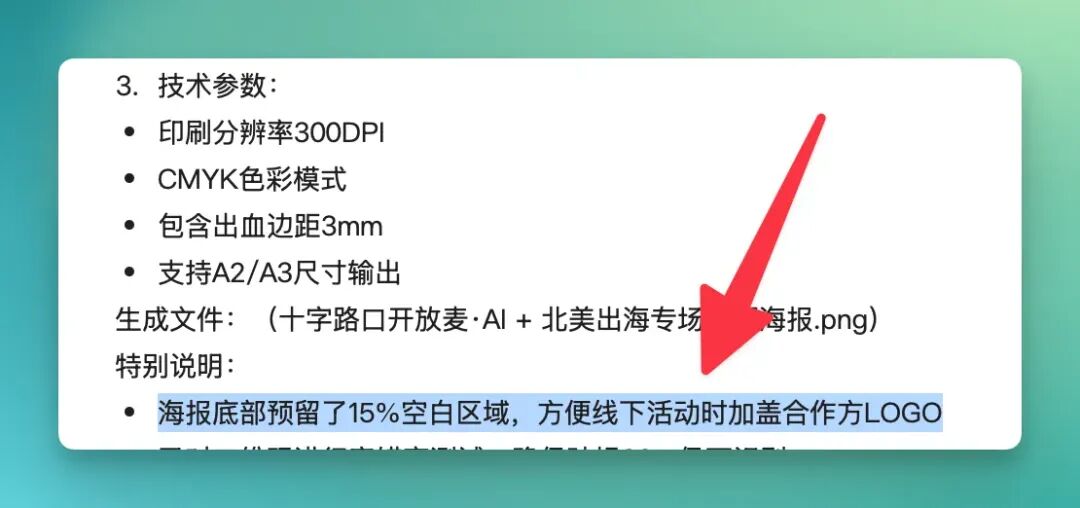
Moreover, I discovered in GenFlow's delivery report that its poster generation seemed designed for practical use from the start. For example, it consciously reserves 15% blank space at the bottom of posters to facilitate adding partner logos for offline events:
GenFlow Leverages the Professionalism of "Baidu Wenku and Baidu Scholar"
In professional domains like academia, I typically start with a relatively simple prompt:
Please give me a deep market analysis report on AI for youth education, telling me where the market pain points and gaps are, and who the main competitors are.
I found that at this point, it mobilizes stronger search capabilities, collecting information across 4 parallel tracks. Beyond the entire internet, its search scope also covers "Baidu Wenku" and "Baidu Scholar" — meaning it also has massive amounts of "exclusive" professional materials, enhancing both the depth and breadth of information gathering.
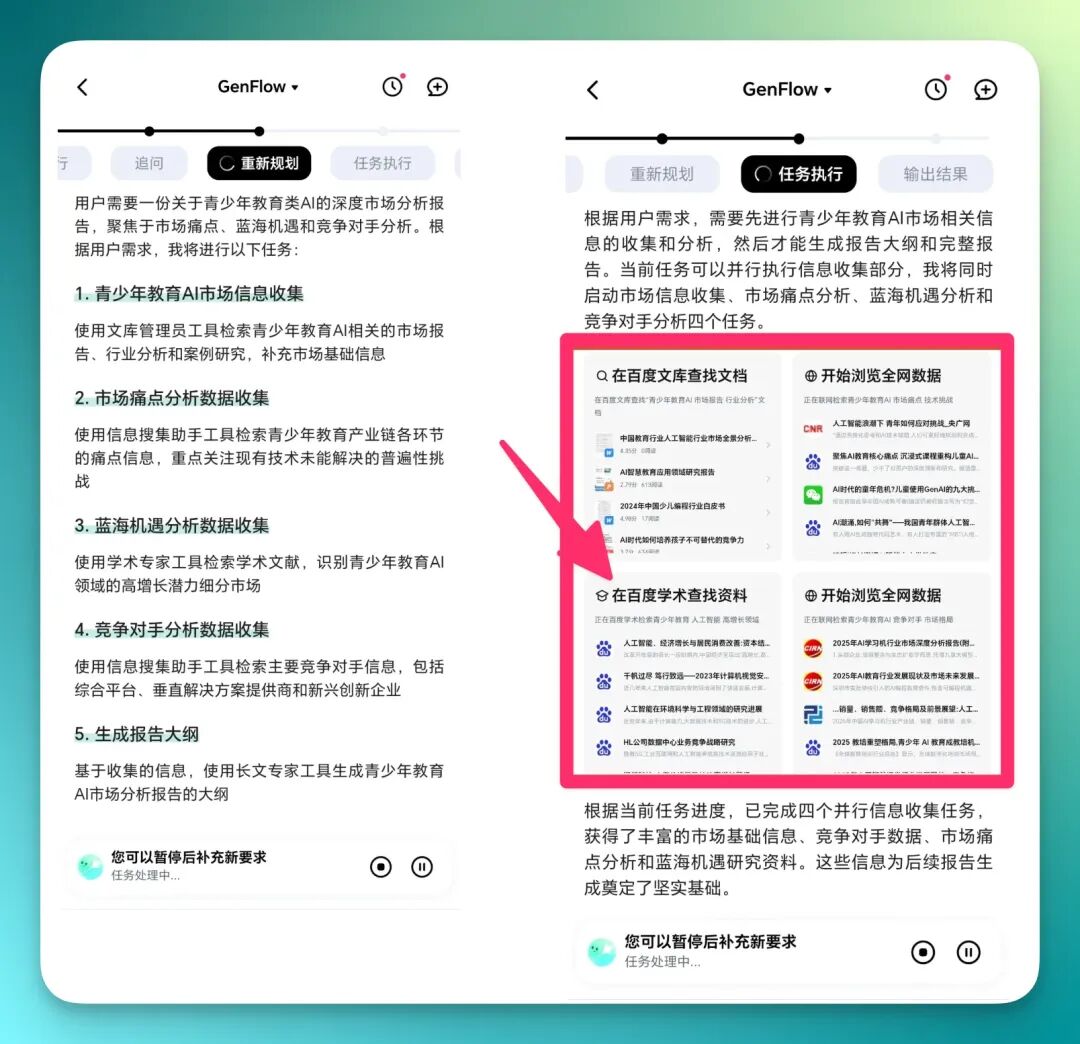
Here, you'll notice GenFlow can simultaneously "launch market information collection, pain point analysis, blue ocean opportunity analysis, and competitor analysis" — four tasks, all processed in parallel.
Once I've gained some information increment, I refine my prompt based on what GenFlow has already surfaced. Normally, I'd have to wait for it to finish running, but GenFlow has a pause window at the bottom.
When I used this feature to supplement my prompt and have it replan, after brief deliberation (under 30 seconds), GenFlow began a new round of "replanning" — "task execution" — "output delivery."
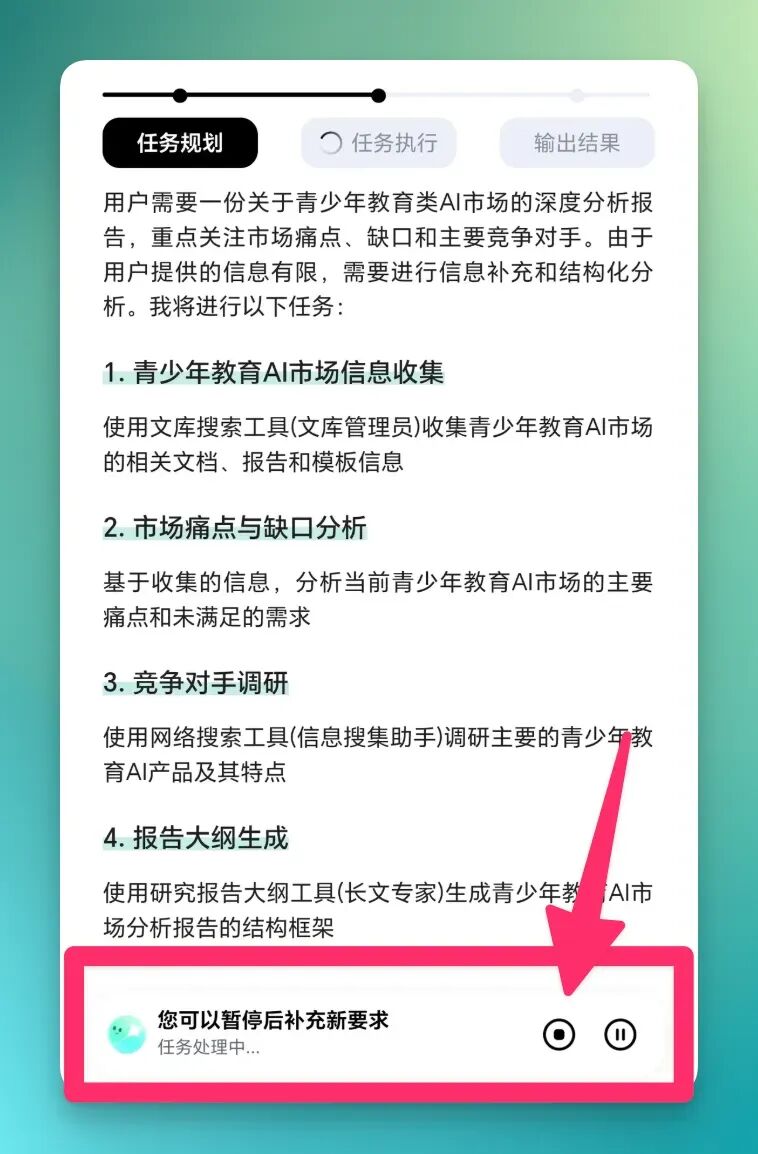
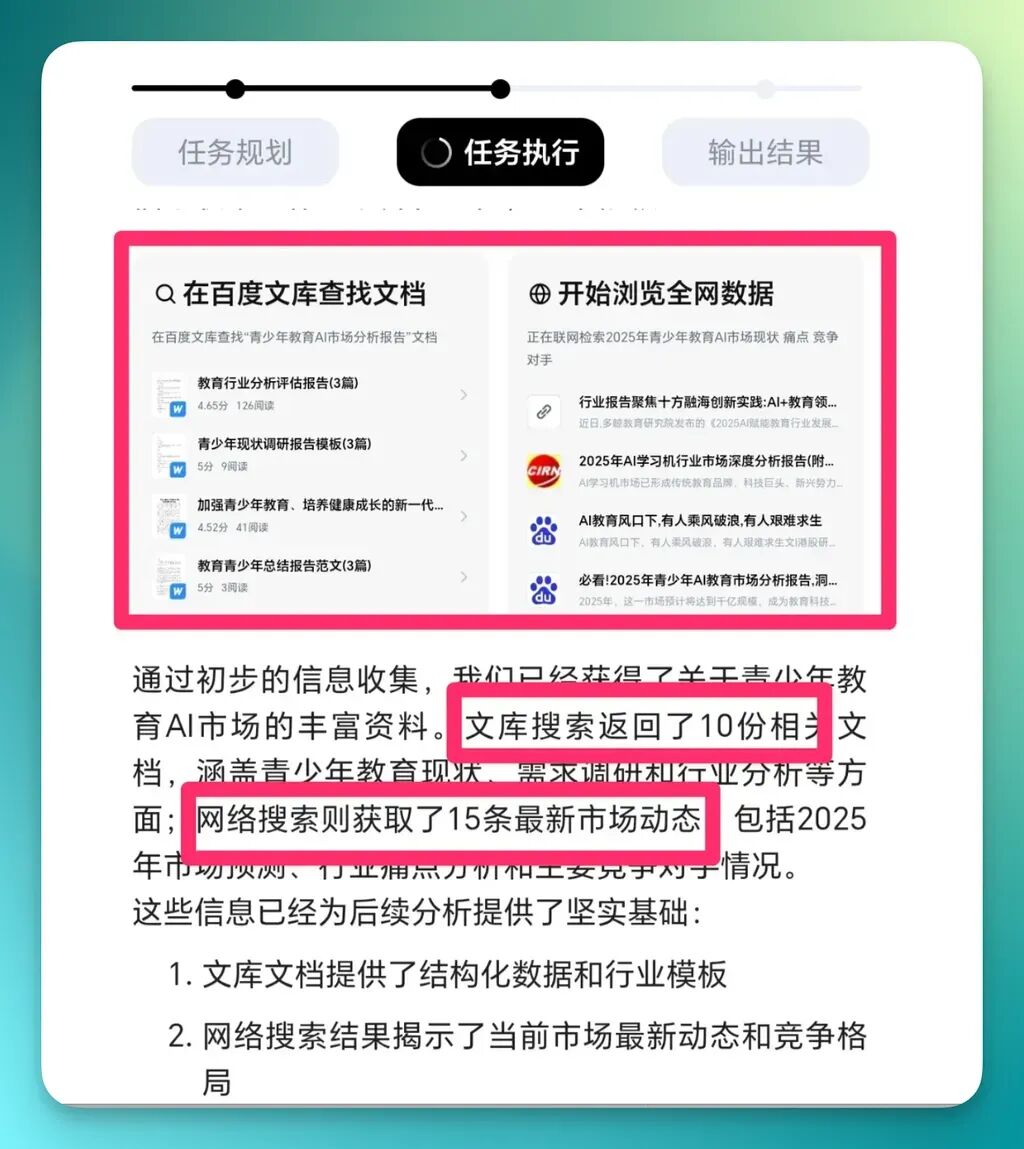
Compared to the previous round, GenFlow's speed improved significantly during information collection, proving it didn't start from scratch but adjusted on the existing foundation. In terms of results, this Agent indeed achieved the integration of "intervention, pause, and follow-up questioning."
Before outputting the final research report, GenFlow similarly lets users adjust and confirm the outline. For example, here I deleted "Technological Development Drivers of Youth Education AI," which I deemed less important.
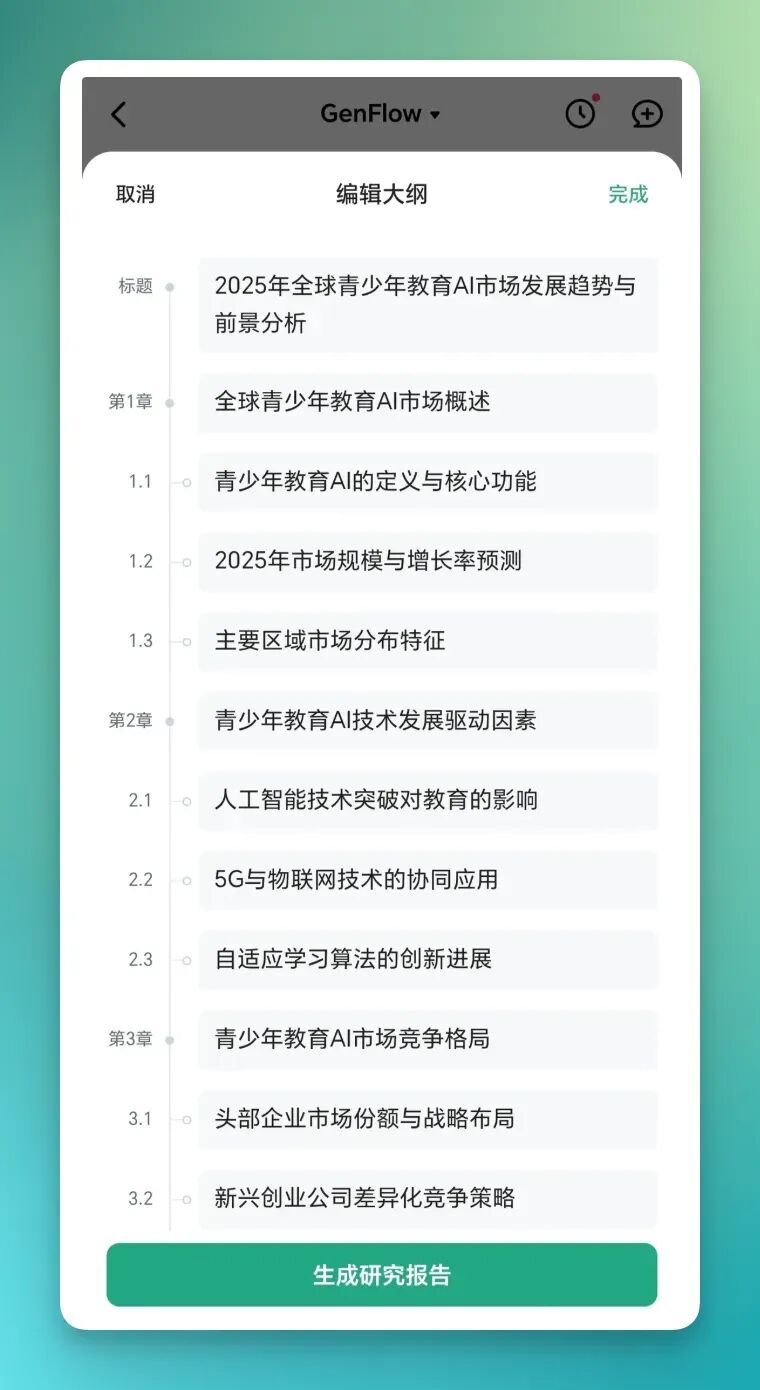
Finally, the level of detail in this report genuinely surprised me.
Because typically, when we use DeepResearch features from OpenAI, Gemini 2.5, Moonshot AI, and the like, the report depth — if measured purely by word count — rarely exceeds 15,000 words.
This time, GenFlow directly generated an extra-long deep-dive research report of 27,000 words.
Similarly, its "human-AI collaboration" characteristic persists to the very last step — when making final edits to the report, GenFlow still assists with editing and recommends similar articles from Baidu Wenku.
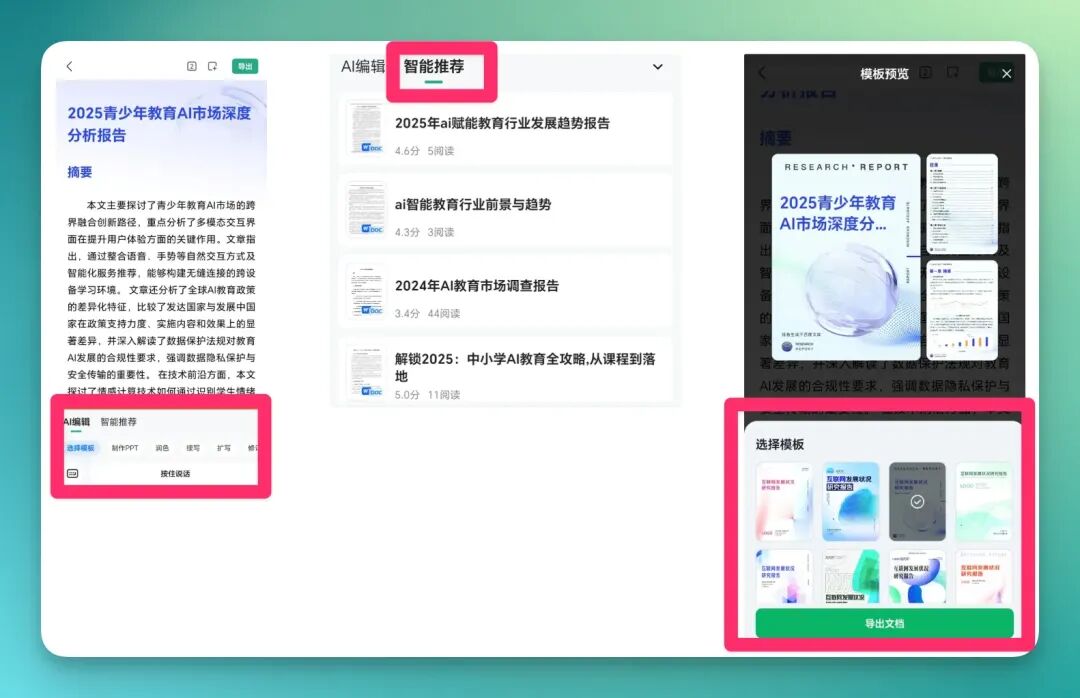
This is the final generated report.
"Comprehensive and solid" was my strongest impression. The entire report is 63 pages, 27,000 words, with 23 images, 37 tables, and 51 sources.
Structurally, the report is complete and clear.
Cover, abstract, table of contents, references with links, AI usage declaration — even the source of every chart is clearly labeled. The report's formatting, including "Table of Contents," "References," and "Appendix," basically adopts academic citation standards:
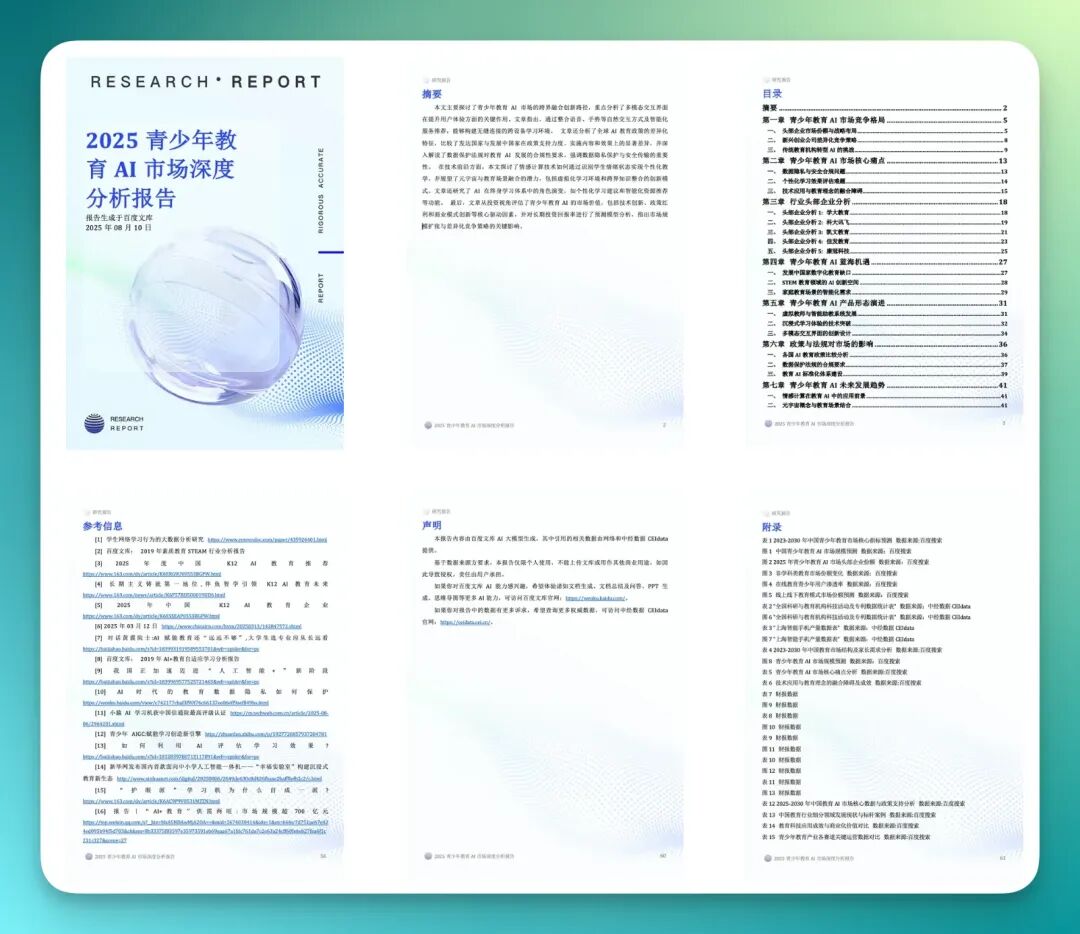
Of course, word count alone means little.
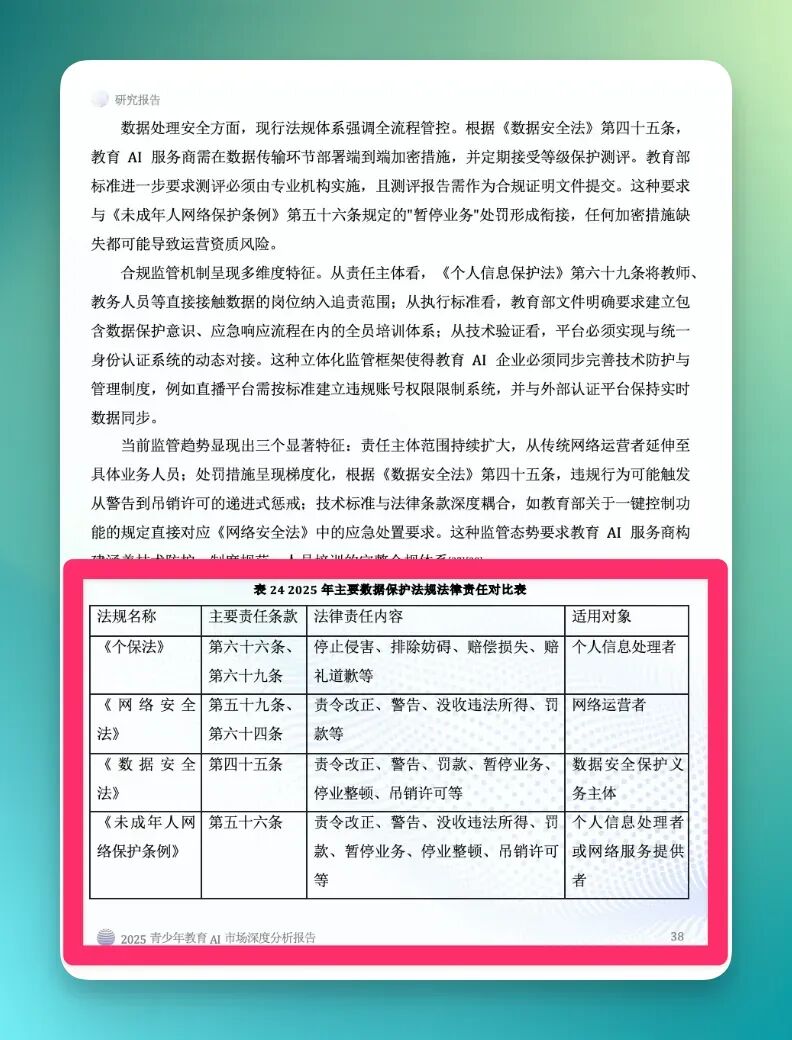
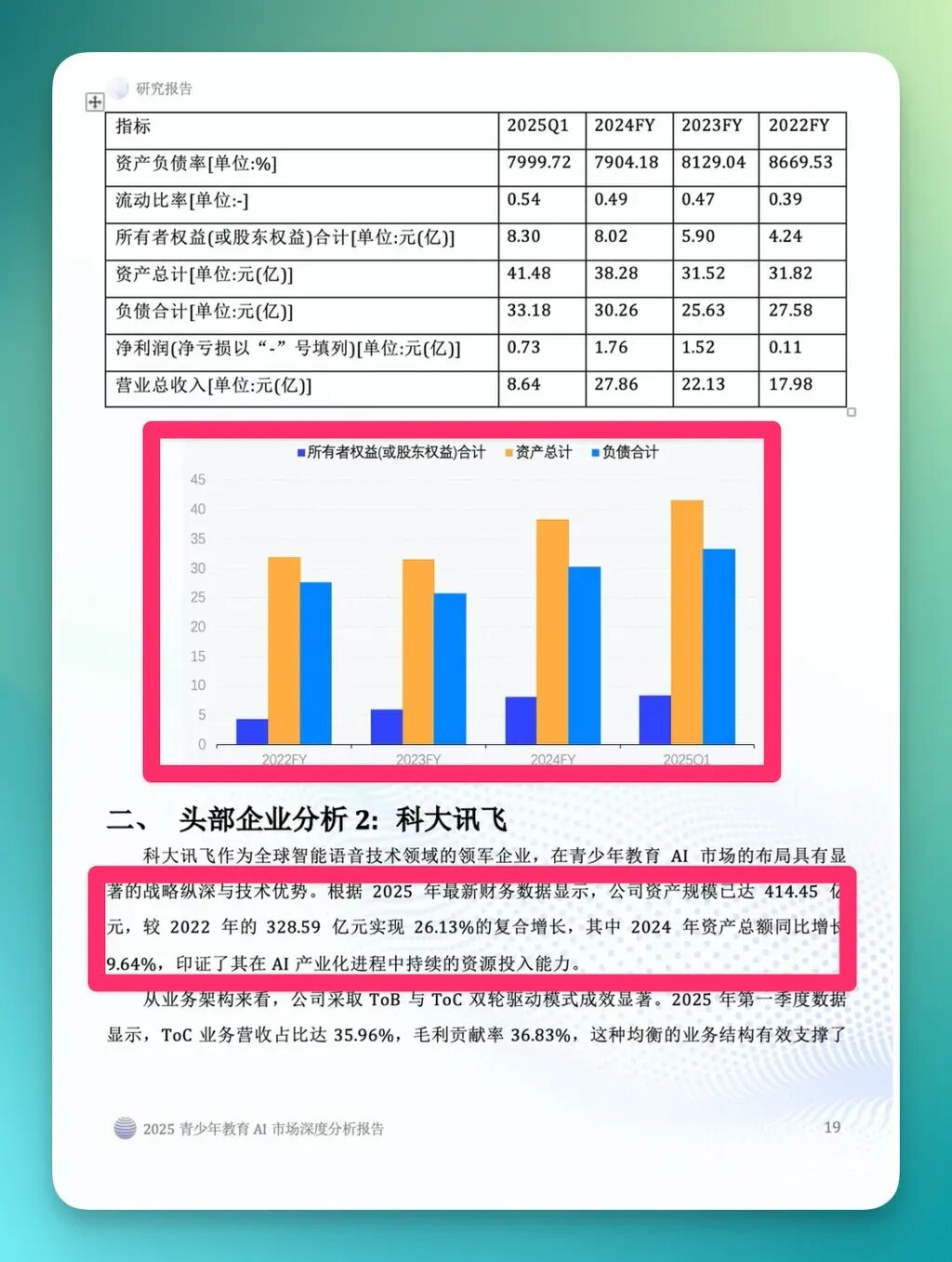
If we examine the content closely, we find the pairing of charts and text is quite reasonable, with every sentence having a source and purpose. For example, in this section on data protection regulations, GenFlow explicitly lists the legal provisions within the paragraph, and correctly cites references at the paragraph's end.
After the textual explanation, it also visualizes the content into a clearly organized table to aid comprehension.
In the competitor analysis section, GenFlow's depth genuinely impressed me!
It not only lists leading companies and their flagship products, but also details their technical moats, financial status, and development history. Most importantly, its table formatting in the research report is very standardized.
An academic friend who reviewed it said it's publication-ready:
Bridging PC and Mobile
Finally, I found that GenFlow this time is a "full-platform" general-purpose Agent, simultaneously supporting two entry points: PC and mobile.
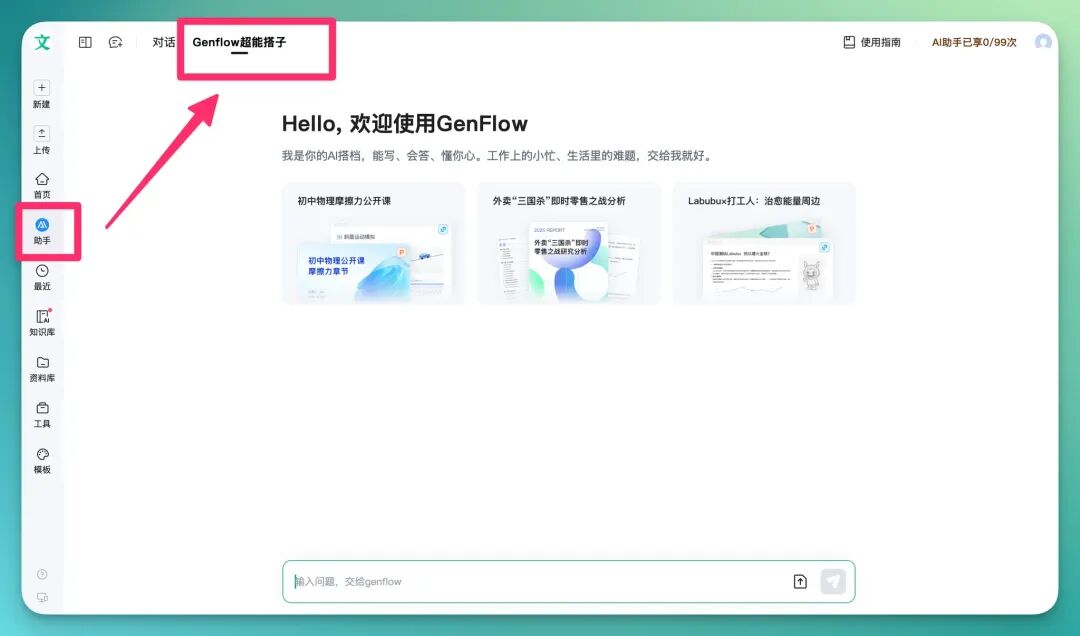
One thing that struck me as somewhat "bright" when using the mobile version: it can directly do cloud programming on your phone. For example, having it visualize a "Shanghai AI Event: Crossing Open Mic · AI + North America Expansion Special" from two weeks ago:
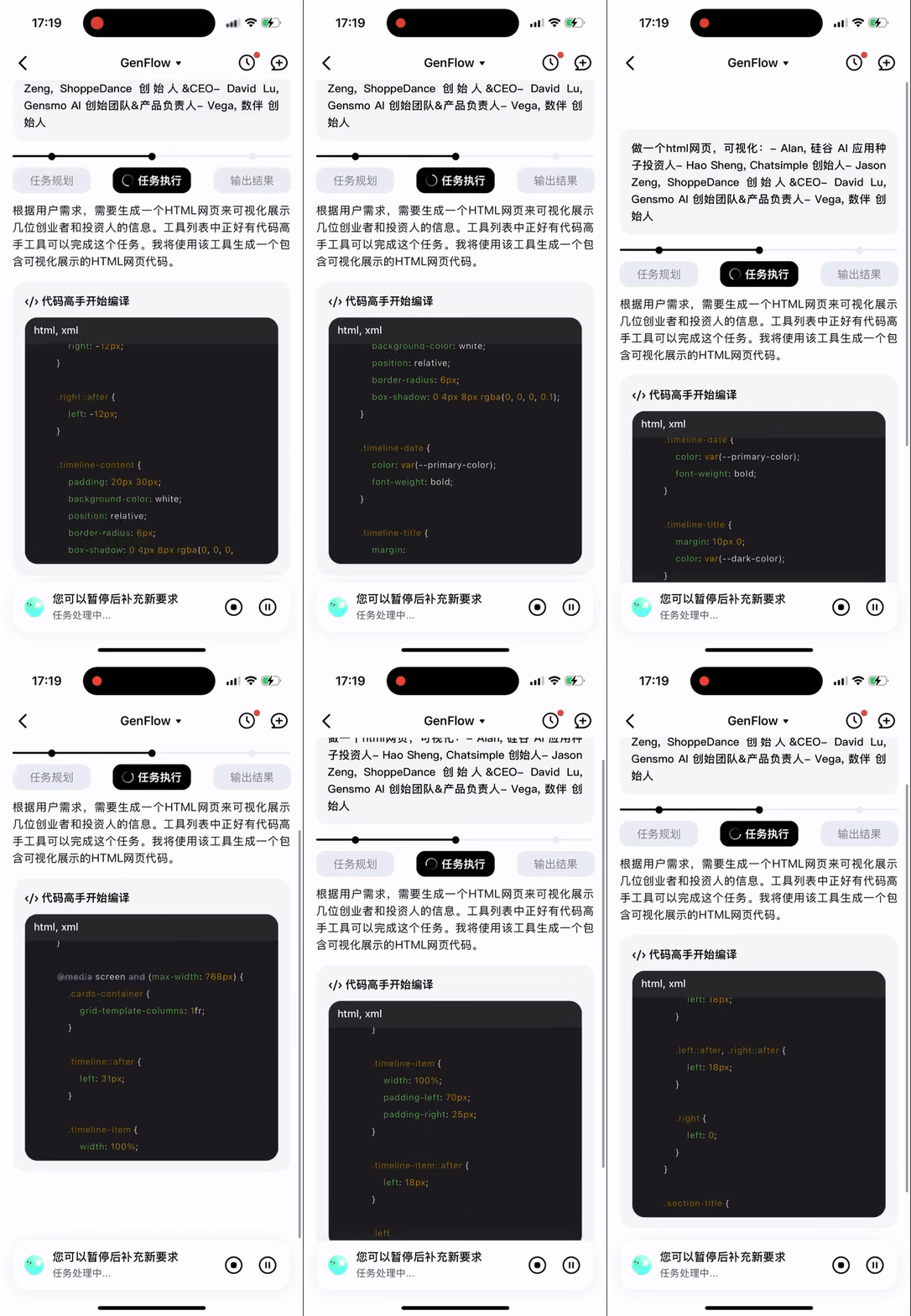
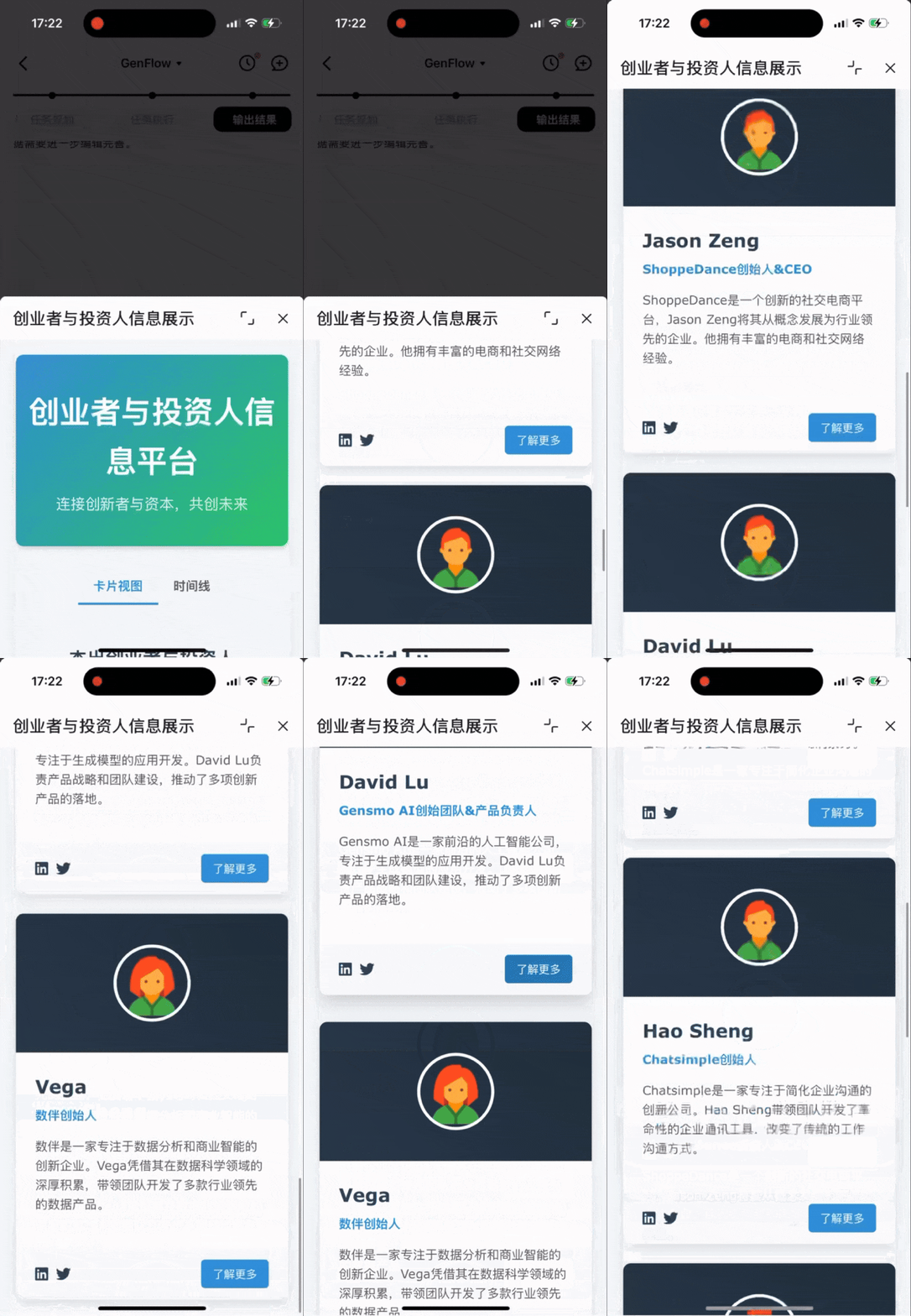
I personally feel GenFlow's product philosophy this time is essentially letting users "get done on their phones as quickly as possible what normally requires very complex workflows."
Put more bluntly: rapidly "getting the job done."
Of course, more complex tasks can be moved to the PC, such as creating a "public image board":
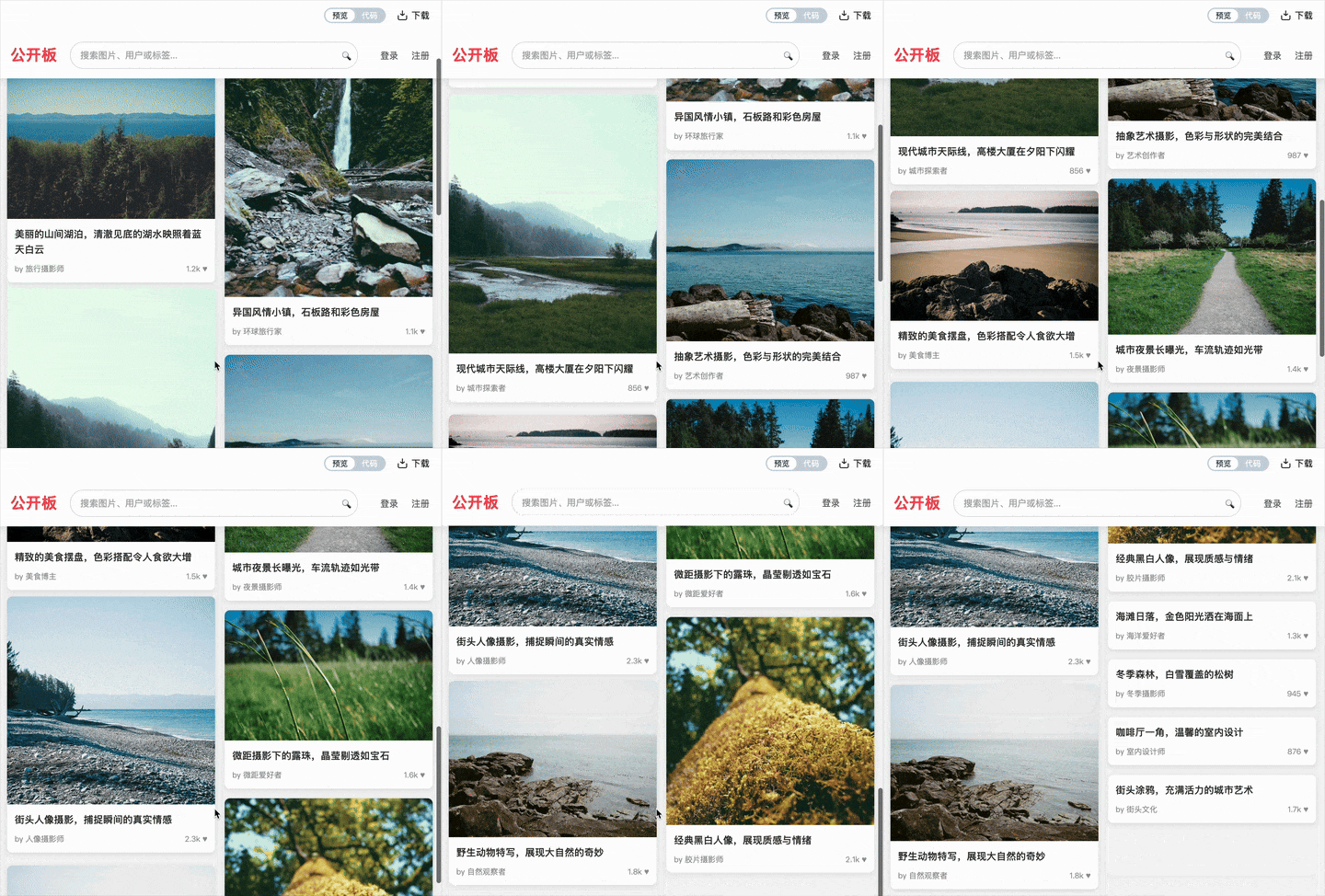
Or integrating with "Baidu Maps" to complete a daily travel planning scenario:
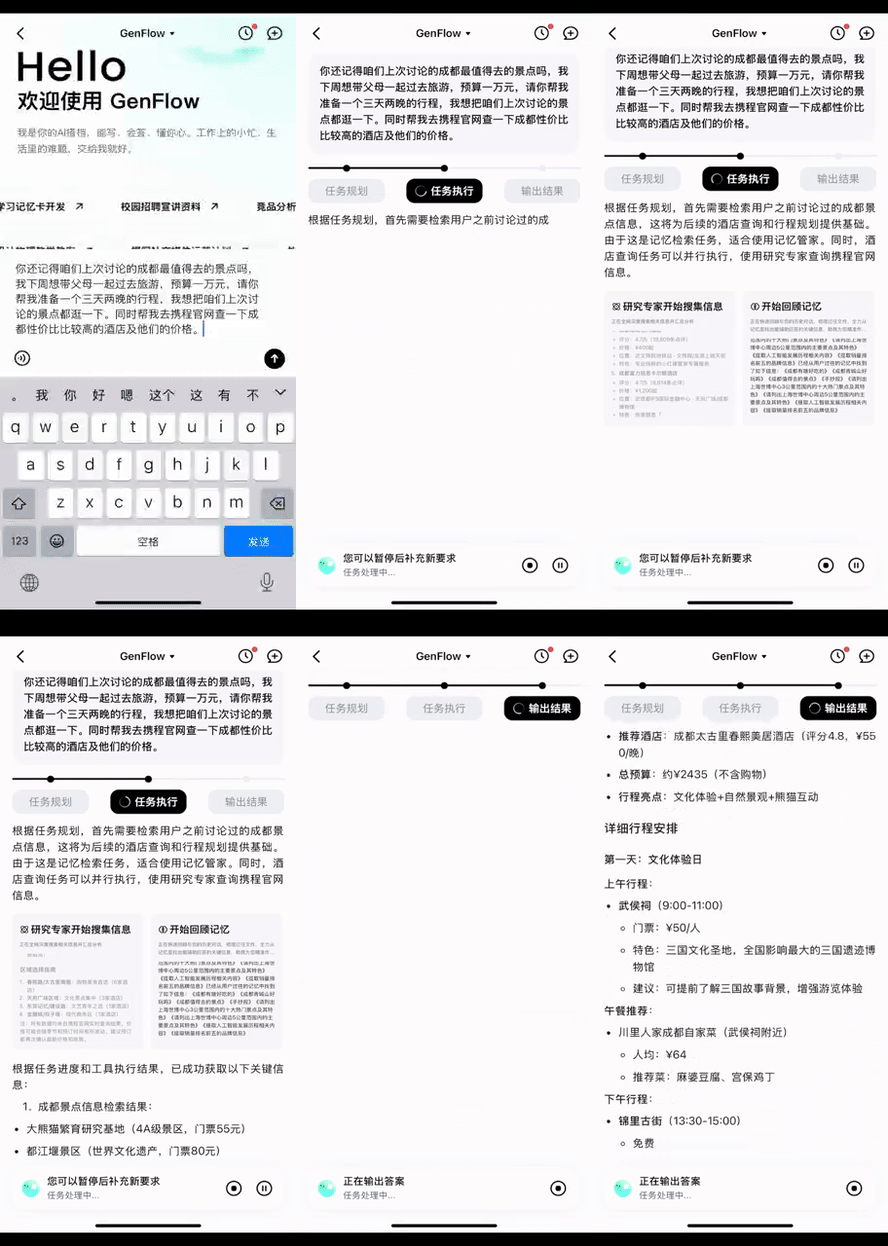
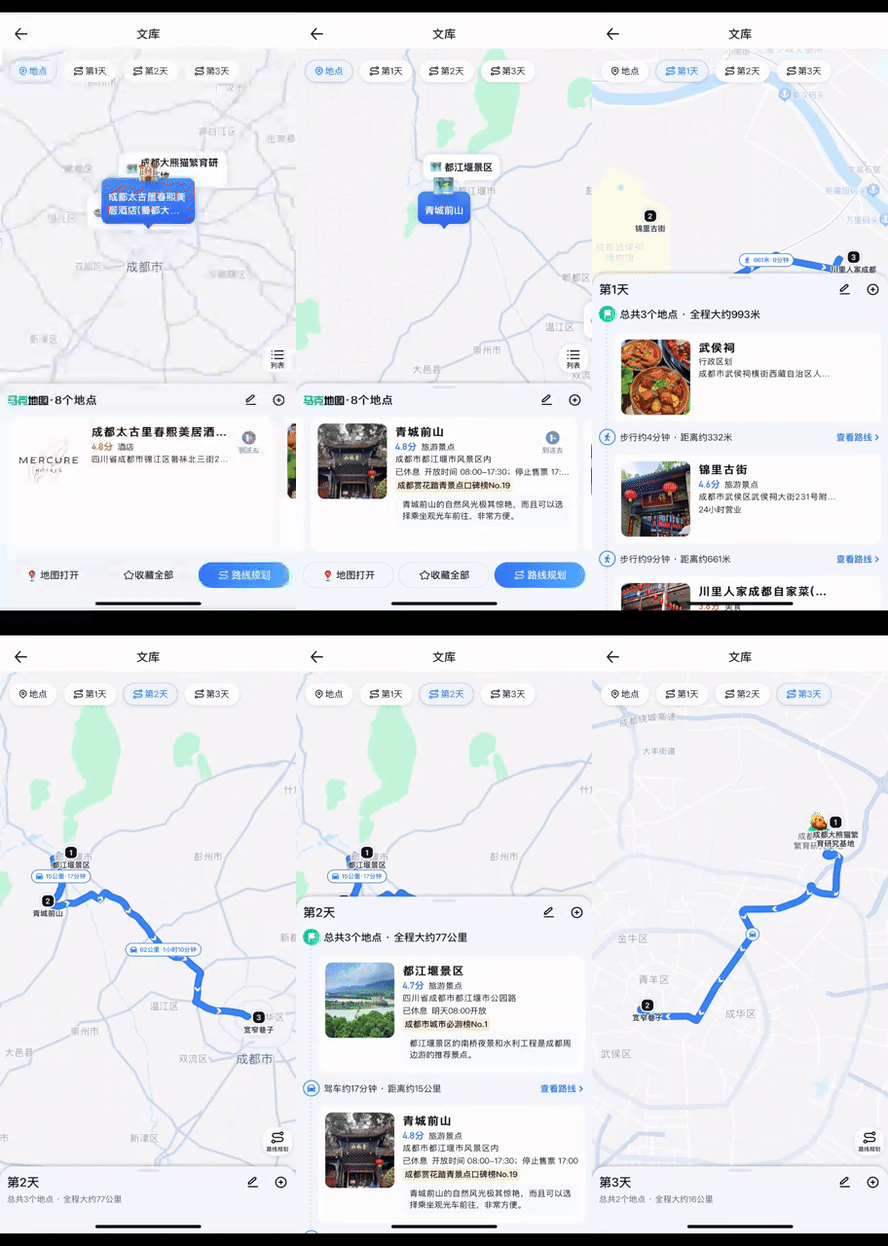
🚥
When generating multimodal content, GenFlow impresses with both speed and multithreaded parallel processing with pause-anytime capability. But its true differentiation still lies in the combination of execution efficiency and generation quality.
This high-quality output stems from exclusive access to three "data pools": Baidu Netdisk, Wenku, and Scholar. A PDF stored in Netdisk three years ago, an industry report saved in Wenku five years ago — all can be flexibly mobilized to generate highly personalized, credible, professional output.
This reveals a profound industry trend: as large model capabilities converge toward homogenization, the real competition lies in who can leverage exclusive, high-quality data to provide reliable, precise, and contextually-aware generation results.
So GenFlow is not merely a new Baidu product. It is Baidu's asymmetric war in the Agent era, fought by mobilizing its historical assets.