GPT-4.1 Debuts Late at Night | On the Eve of the Closed-Source Fortress Crumbling? GPT-4o Finally Gets Its Successor

GPT-4.5 will be obsolete in three months.
Let's rewind to a year ago. In May 2024, OpenAI released GPT-4o, a multimodal language model capable of processing any combination of text, audio, and image inputs and generating corresponding outputs. Its multimodal capabilities were seen as a milestone in OpenAI's development trajectory.
Today, OpenAI released GPT-4.1 — the evolved version has finally arrived.
While everyone was speculating whether the mysterious Optimus Alpha model on the OpenRouter platform was an open-source large model, or whether o3 or o4-mini would come first, OpenAI dropped GPT-4.1 today, a large model first aimed at API developers.
GPT-4.1, in the API, the next evolutionary step
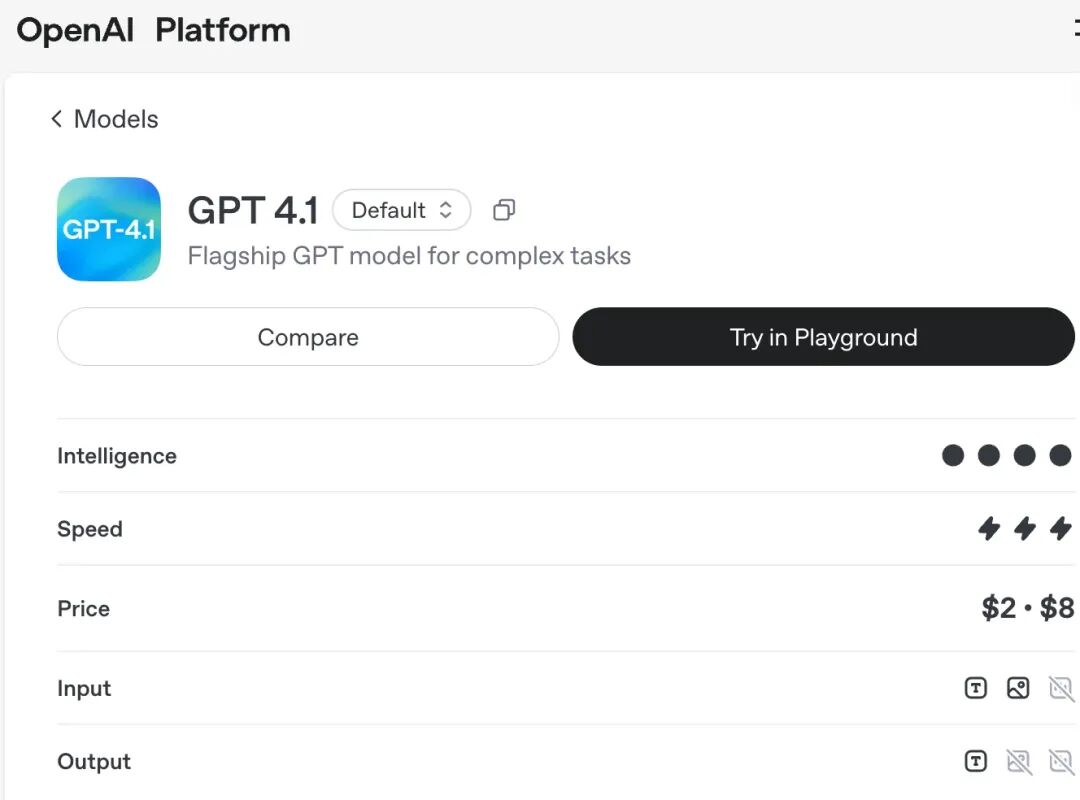
Overall, OpenAI's release this time is a series: GPT-4.1, GPT-4.1 mini, and GPT-4.1 nano, with major improvements in instruction following and coding compared to GPT-4o, plus a much larger context window (up to 1M tokens).
Notably, 4.1 is only available to API developers.
But it's not the revolutionary breakthrough many had anticipated.
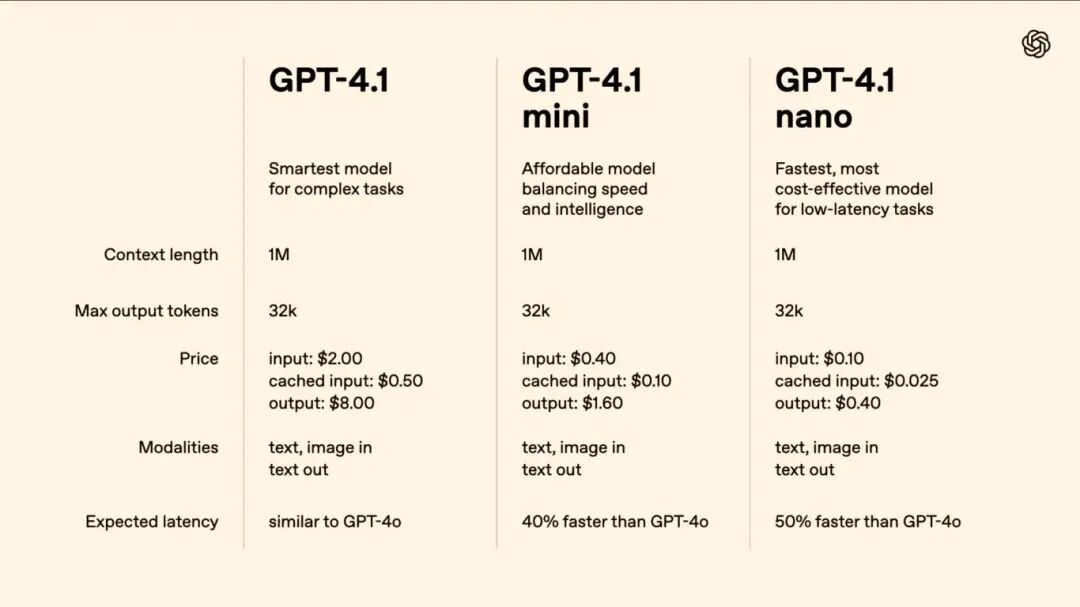
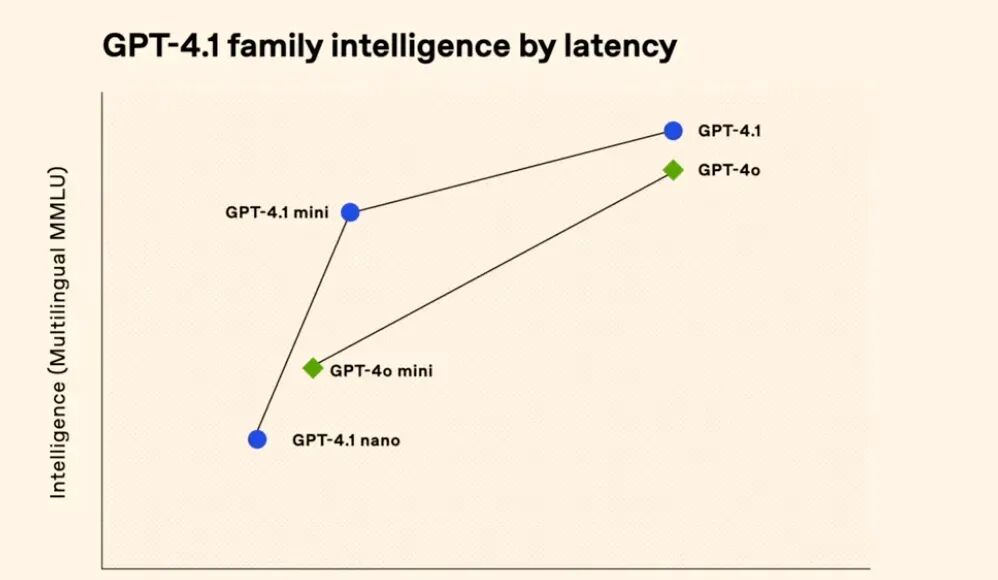
GPT-4.1 shows significant improvement over GPT-4o, while Mini and Nano prioritize speed and lower cost.
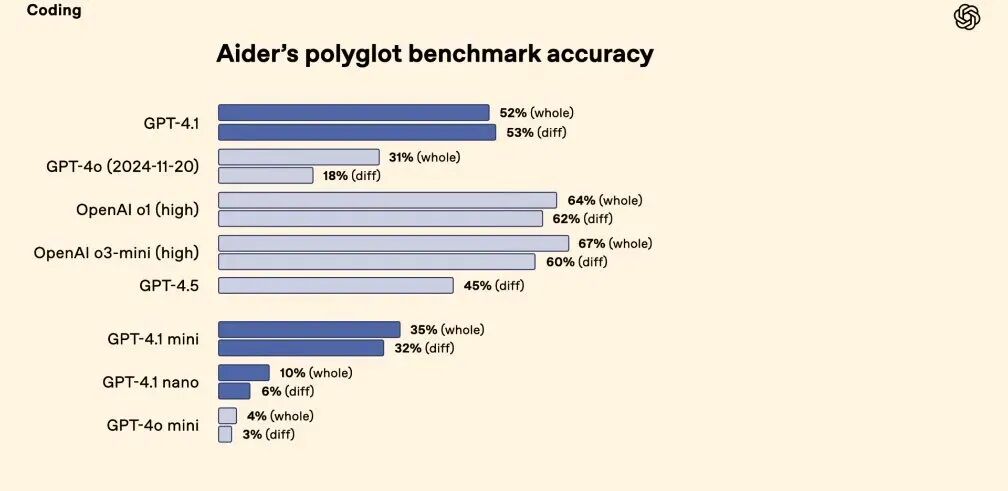
On SWE-bench (a software engineering benchmark for complex tasks like code comprehension, debugging, and generation), GPT-4.1 achieves a verified accuracy of 55%, far outpacing GPT-4.1 mini (24%) and GPT-4o mini (9%), and surpassing GPT-4o by 20 percentage points.
The model is now much better at exploring codebases, completing tasks, and generating code that actually runs and passes tests.
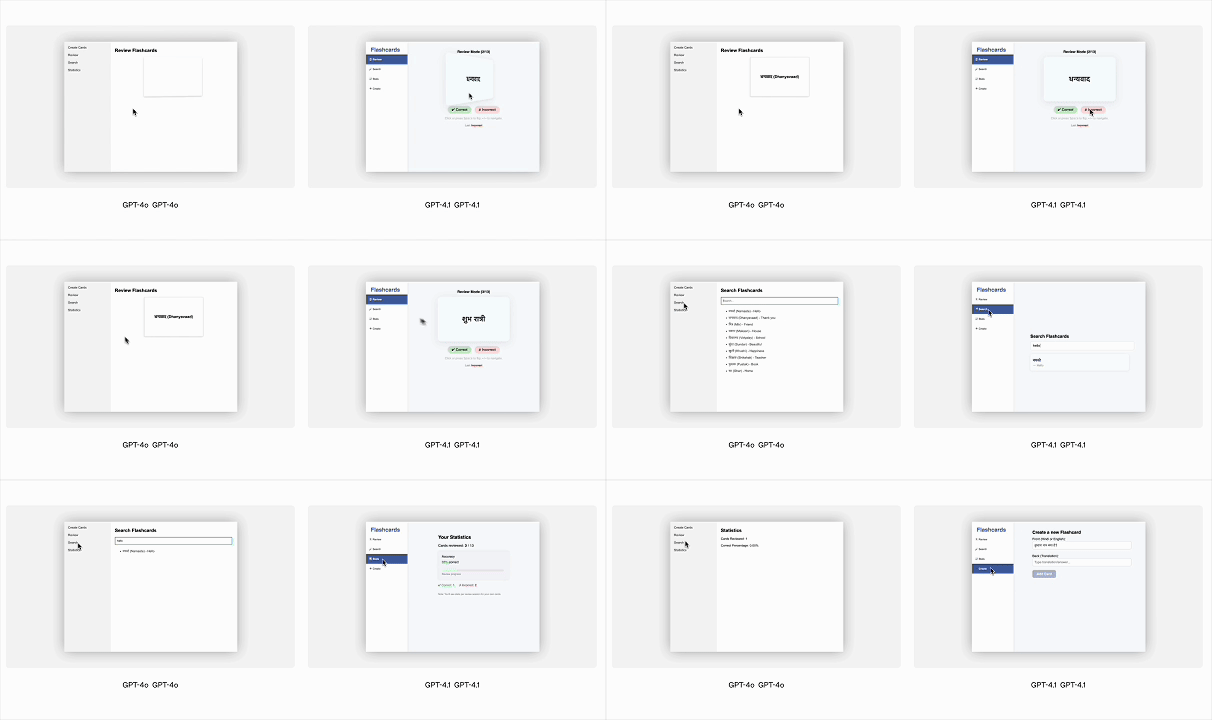
GPT-4.1 is noticeably stronger than GPT-4o at front-end coding, capable of building web apps with better functionality and prettier interfaces. The official demo shows a flashcard interface:
Prompt: Make a flashcard web application. The user should be able to create flashcards, search through their existing flashcards, review flashcards, and see statistics on flashcards reviewed. Preload ten cards containing a Hindi word or phrase and its English translation. Review interface: In the review interface, clicking or pressing Space should flip the card with a smooth 3-D animation to reveal the translation. Pressing the arrow keys should navigate through cards. Search interface: The search bar should dynamically provide a list of results as the user types in a query. Statistics interface: The stats page should show a graph of the number of cards the user has reviewed, and the percentage they have gotten correct. Create cards interface: The create cards page should allow the user to specify the front and back of a flashcard and add to the user's collection. Each of these interfaces should be accessible in the sidebar. Generate a single page React app (put all styles inline).
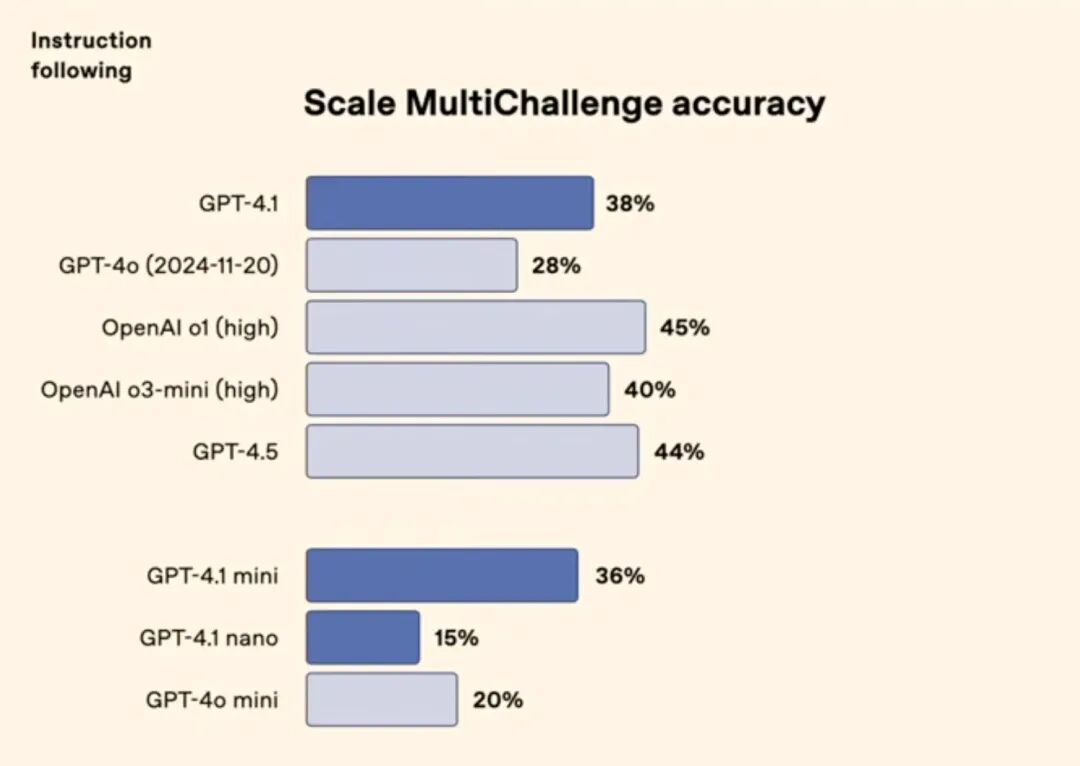
GPT-4.1 also delivers solid performance in instruction following.
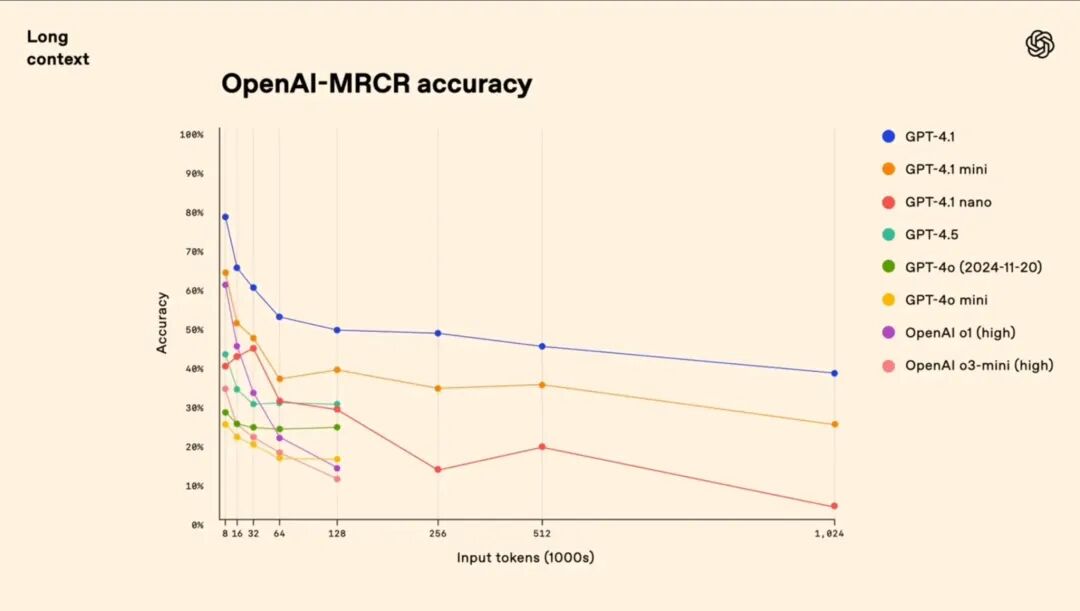
The GPT-4.1 models show significant improvement in long-context processing — put simply, they can pinpoint key information with precision in very long texts.
"Accurate retrieval at all positions and across all context lengths"
This means GPT-4.1 doesn't just find information; it understands the context and judges whether it's relevant to the task.
In OpenAI's public long-context understanding benchmark "MRCR," GPT-4.1 (marked in blue) is almost the only model that maintains high accuracy as token count increases.
At 512k tokens and even 1,024k tokens in ultra-long text scenarios, GPT-4.1 still achieves nearly 50% accuracy — genuinely impressive performance.
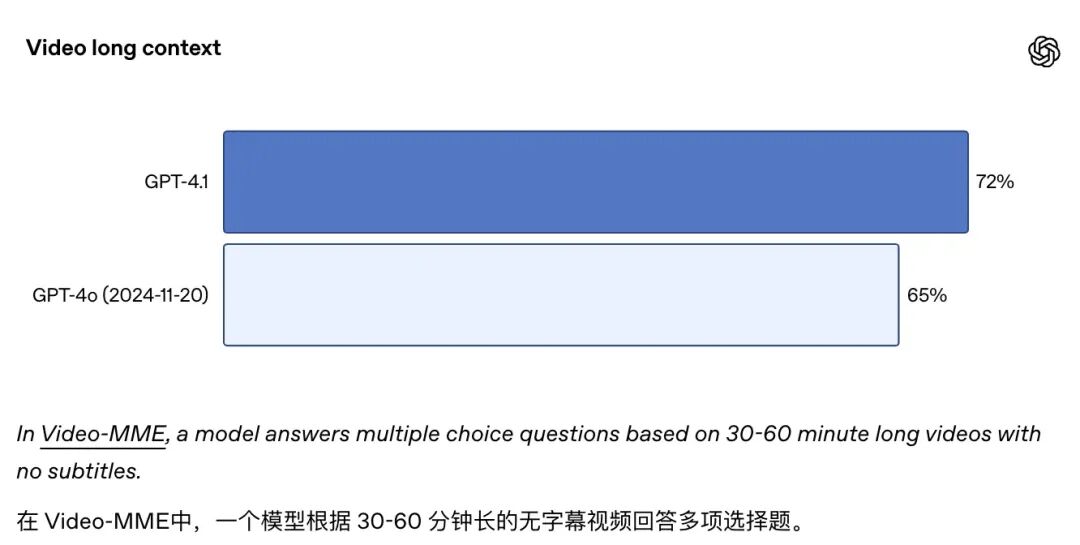
Long-context performance is also critical in multimodal scenarios, such as processing long videos.
In the Video-MME (long no-subtitle) test, models must answer multiple-choice questions based on 30-60 minute videos without subtitles.
GPT-4.1 scored 72.0%, surpassing GPT-4o's 65.3% and setting a new state-of-the-art.
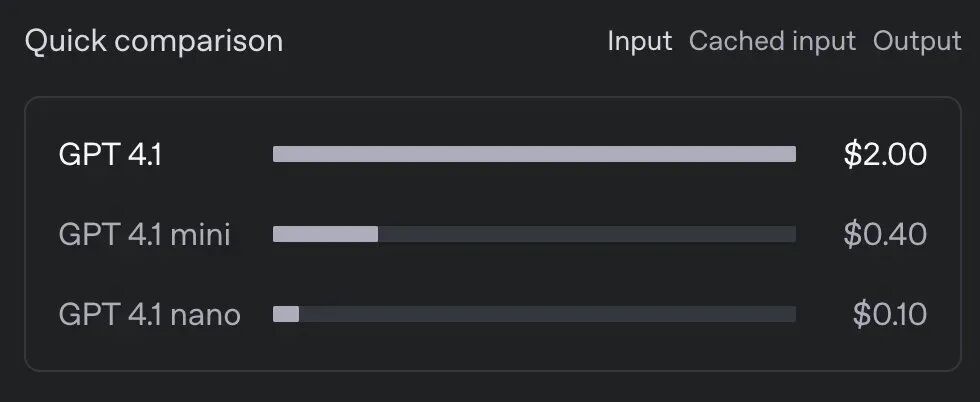
From a pricing perspective, GPT-4.1 nano may be one of the most cost-effective and fastest models OpenAI has released to date. According to pricing information, its input cost is $0.10 per million tokens, cached input at $0.03 per million tokens, and output at $0.40 per million tokens.
Compare that to GPT-4o: $2.50-$3.00 per million tokens for input, $10.00 for output.
OpenAI's GPT-4.1 is now available to most AI coding vendors with API access, including: Copilot, WindSurf, Cursor.
This new flagship model is available in the API to all developer tiers (1, 2, 3, 4, 5).
At the product launch, the OpenAI host was uncharacteristically generous, making the "cheapest, fastest, smartest" GPT-4.1 completely free (for 7 days), with a wave of discounts to follow.
On the flip side, GPT-4.5-Preview will be deprecated in three months and removed from the API on July 14, 2025.
When will OpenAI release a truly open-source large model?
Yet even with GPT-4.1 versions priced lower across the board than their predecessors, the fundamental attribute remains: not open source.
After the DeepSeek upheaval, people are genuinely asking: when will OpenAI release a truly open-source large model?
DeepSeek's moves not only revealed the potential of open-source models but also pushed industry competition to a fever pitch. OpenAI had long dominated the market with its closed-source ChatGPT series.
But the winds have shifted — the verdict that closed-source is inherently superior has evaporated. Openness, flexibility, and community-driven rapid iteration have become the new favorites.
Users, especially developers and enterprises, increasingly want a transparent, cost-effective model rather than a "black box" accessible only through API calls.
In the 2025 Artificial Intelligence Index Report, co-authored by Fei-Fei Li:
Open-source models are already "good enough," closed-source is no longer the only option, and on the Chatbot Arena leaderboard, the lead held by closed-source models has shrunk to just 1.7%.
OpenAI is under considerable pressure to go open source, for several reasons:
- Competition: DeepSeek R2 is coming soon, and Sam Altman has admitted in interviews that OpenAI was a bit late to the open-source game.
- Users: As open-source and small models surge in popularity, enterprises and users with AI hardware or privacy needs have shown strong preference. When users start voting with their feet, open-sourcing may already be too late.
- Community influence: DeepSeek and Qwen have proven that open-source models can thrive on community collaboration with fast updates.
- Market: Anthropic, Cohere, and others aren't sitting idle on open source either.
In short, competition, demand, community, regulation, and market forces are all pushing OpenAI toward open source.
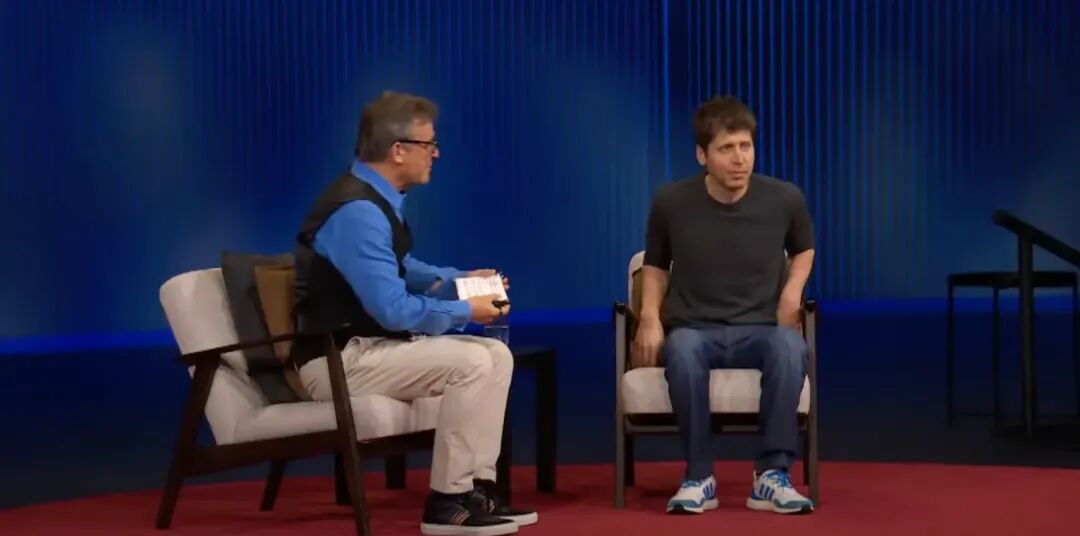 Sam Altman admitted in an interview that "OpenAI has been a bit slow on open source"
The entire internet is now watching OpenAI, waiting to see when they'll pull out this "truly open-source large model."
Will OpenAI drop a bombshell, or just another marketing play?
Either way, when OpenAI's open-source large model arrives, AI startups will once again find themselves showered with opportunity. OpenAI's entry would mean open source has become a "re-evaluation criterion" for social value among AI large model companies — whether by active choice or market pressure.
OpenAI finally needs to figure out how to respond to the open-source wave ignited by DeepSeek, Qwen, Meta, Mistral, and others — and we will all see where this tide ultimately flows.