Weekly Miscellany: I Launched a Podcast; What Is GPT-5; My 10 Reading Tips; Wishing Us Ordinary-Day Joy
In this fleeting age of electric fireworks, today is the rarest gift of all.
❶
My Podcast: "Crossing"
Standing at the intersection of technology and the humanities
Ever since Xiaoyuzhou came along, I've been a daily active podcast listener. I've also had the pleasure of appearing on friends' shows — "San Wu Huan" (episodes 38, 62, 93, 103) and "Feng Tou Quan" (episode 81). I've been itching to start my own, and last weekend I finally did it — released the first episode in one burst of energy.
My good friend Ronghui co-hosts with me. She was previously a tech reporter for CBNweekly based in Silicon Valley. The one thing we have in common is that we're both "cross-boundary" people. So our podcast is called "Crossing" — a show about the fusion of technology and the humanities, supported by The Fair's Sound Forest Podcast Plan.
We're looking at how new-generation AI technologies, represented by ChatGPT, will impact consumer products, marketing, content media, and other industries. We'd love for you to stand with us at the intersection of technology and the humanities and see what's happening around us:

In our first episode, we talked about Coca-Cola's new AI-crafted flavor, an AI packaging design service used by over 860 brands in Japan, and direction advice for AI entrepreneurs from Sam Altman and Andrew Ng, plus Fred Wilson's predictions for 2024, among other topics.
I decided to start recording because I've been deeply influenced by the Feynman Technique lately — more on that in next week's miscellany.

Crossroads in manga style, by MidJourney
❷
"Starting with What GPT-5 Is"
Jason, author of the WeChat public account "Information Equality," listened to 4-5 interviews that OpenAI CEO Sam Altman gave at Davos and extracted Sam's comments on GPT-5, bringing the much-anticipated GPT-5 slowly into view.
The article is information-dense, with follow-up expansions by the author. I'm excerpting some parts here, but I recommend reading the full piece:
- "Current GPT-4 has too many flaws. It's much worse than the version we'll have this year, and even worse than what we'll have next year."
- "If GPT-4 can currently solve 10% of human tasks, GPT-5 should be at 15% or 20%."
- "The most important thing isn't the specific problems it solves, but that general-purpose utility is increasing."
- "More powerful models and how to use existing models well are two multiplicative factors, but clearly more powerful models matter more."
- "Access to specific data, making AI closer to actual work — there will be great progress on these fronts this year. The complaints people have now, like it's too slow, not real-time, those will get better this year. Precision on longer, more complex problems, ability to do more things — that will improve too."
- "I think the most important thing about AI is that it will massively accelerate the pace of scientific discovery, making new discoveries increasingly automated. Of course this isn't a near-term thing, but once it happens, it's a very big deal."
- "As models become smarter and better at reasoning, we need less training data. Just like no one needs to read 2,000 biology textbooks — you just need a small amount of ultra-high-quality data, and to think deeply and chew on it. The model will work harder at thinking through a small amount of known high-quality data."
- "As AI becomes more powerful, it may even discover new scientific knowledge, even do AI research automatically. The pace of world development will exceed our imagination. I often tell people, no one knows what's coming next. Staying humble about the future is very important. You can predict a few steps, but don't make too many predictions."
- "When cognitive costs drop by a thousandfold or a millionfold, and capabilities are massively enhanced, what impact will that have on the world? If everyone in the world had a company composed of 10,000 extremely capable virtual AI employees, experts in every field, who never tire and keep getting smarter — what would the world look like? The timing of this is unpredictable, but it will stay on an exponential growth curve. How much time do we have to prepare?"
- "I don't think smartphones will disappear, just as smartphones didn't replace PCs. But on the other hand, I don't think AI is just a simple computing device like a phone plus a bunch of software. I think it might be something with much greater significance."
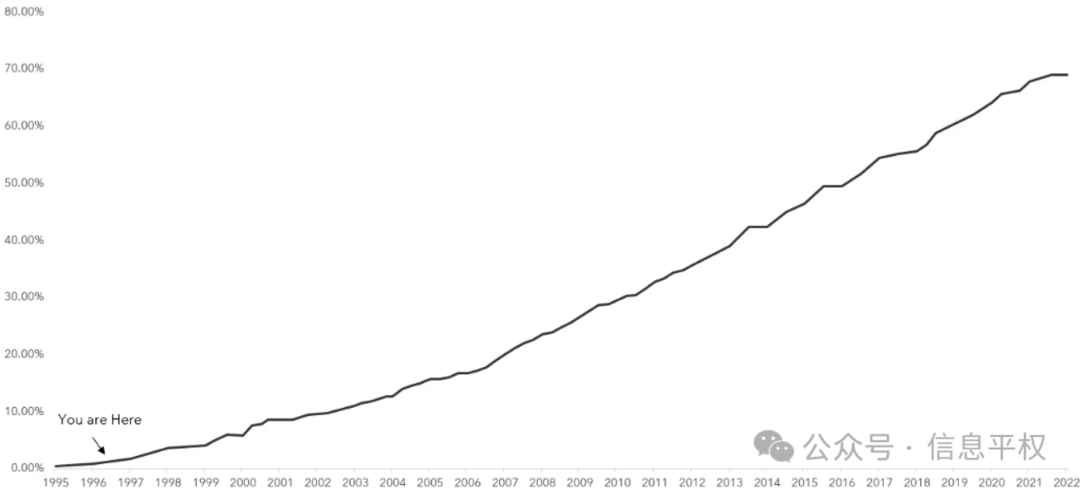
- From the perspective of paying user penetration (closer to real commercial value), AI today is only at 1996 in internet era terms:
- If AI drives the cost of social intelligence to zero, how much value is that? The greatest commercial value in the world may be social intelligence. Once intelligence can be replicated at zero cost in bulk, a huge portion of human capital value will be converted into AI capital value. Elon Musk once said, "The economy is producing entities times productivity — that is, labor population times per-capita productivity. If the population can expand infinitely, where is the ceiling of the economy?"
- From the perspective of motivation and potential returns, the weight of AGI is such that any rational, capable commercial organization or nation will fight to the bitter end to pursue it, because no one would abandon the massive lottery ticket or option of "building god." In 1847, British railway investment at its peak reached 7% of GDP; in the five years after the 1996 Telecommunications Act took effect, telecom companies invested over $500 billion in fiber optics, switches, and wireless networks (over $1 trillion in today's value). Why? Faced with a productivity revolution full of unknowns and infinite possibilities, an entire generation of humanity will collectively FOMO.

Crossroads in Disney style, by MidJourney
❸
My 10 Reading Tips
Tsk tsk
Trapped in the cycle of "buying books like a mountain collapsing, reading them like pulling a thread," I've been collecting tips on how to read faster.
Combining my own practice, here's my attempt at 10 tips:
- Find good books you're genuinely interested in — that's the only way to read voraciously. I have an excellent channel for book recommendations: Bill Gates and Naval's annual reading lists, published on their blogs and Twitter.
- If you can't get through a section, skip it. Don't get stuck re-reading. You don't have to understand every paragraph and every page. This tip comes from Zhang Wei, founder of The Fair, and it helped me enormously with reading speed. If after skipping a page or two you feel like you've missed too much and your mind is blank, go back and re-read. But don't get hung up on one sentence or paragraph.
- Create focused time and space for yourself. You can: loop instrumental fast-tempo music, hold a pen and point line by line at where you're reading, and always be ready to take notes.
- Read the introduction and table of contents first. Understand the book's framework first. It's like having a map in your mind — reading becomes lighting up the map. You get a sense of pacing and the satisfaction of watching the map gradually illuminate. I recently tried the "AI Outline" feature in the WeRead app's TestFlight beta — even more efficient than reading the table of contents. Worth looking forward to.
- Read several books at once. Your energy fluctuates. Read books requiring intense concentration and cognition when you're high-energy; flip through social science, history, or short stories when you're low-energy.
- Dare to quit. Bad books — abandon them decisively. There are plenty of fish in the sea. Most books you find incomprehensible or unenjoyable are probably poorly written or poorly translated. They have high online ratings? Could still be marketing-inflated.
- Make sure everything you read is high-rated. My standard: Douban 8+, WeRead 9+. Follow people you respect on Douban and WeRead — their post-reading ratings are also valuable references.
- Before starting a book, read a few online reviews first. You can preliminarily understand the author's thinking, viewpoints, argumentative framework, and controversies. And several times I've found that after reading a few reviews, there seems to be nothing new in the book itself — the reviews already covered it comprehensively. No need to waste more time then.
- Make good use of note-taking tools. Imagine you're the book's editor — use mind-mapping tools to organize the author's framework. Dare to scribble all over the book. Underline any sentence that yields insight. Finally, use flomo to organize and save all the golden sentences.
- The Feynman Technique. While reading, constantly imagine you're about to explain this book to a complete beginner. — More on this in next week's miscellany.
Finally: Boldly, actively share what you're reading. And share your takeaways. You'll get opportunities for discussion and more recommendations in return.

Crossroads in James Turrell style, by MidJourney
Well then, let me share 4 books I'm currently reading:
- The Next 5000 Days is Kevin Kelly's new book about the future, exploring how AI, biotechnology, environmental change, and other fields will impact and challenge human society.
- The Cuckoo: Cheating by Nature — a book about deception and trickery in the natural world, exploring how certain plants and animals survive and reproduce through camouflage, deception, and mimicry.
- The Psychology of Money — a book exploring the relationship between money and human psychology, covering how money affects people's decisions, satisfaction, happiness, and the complex relationship between people and money. Especially psychological biases and behavioral patterns around money, with some practical strategies and perspectives.
- Decisive — a book about decision-making and resolve, exploring psychological and behavioral factors in the decision process and providing some practical strategies and perspectives.
Pessimists Aren't Always Right
Bread, butter, and flying cars — we'll have them all!
Whenever innovation appears, it faces widespread skepticism and ridicule. There's a famous saying in VC circles: pessimists are often right, optimists are often successful. After all, without optimism there's no courage to take the risks of innovation and entrepreneurship.
Recently I saw someone compile a greatest-hits of pessimists getting it spectacularly wrong. Reading through it, having a laugh — it makes you believe more in technology and creativity, in the power of wild imagination.
- "High-speed railway trains are impractical because passengers would suffocate, unable to breathe at such speeds." — Dr. Dionysus Lardner (1793–1859), Professor of Natural Philosophy and Astronomy, London
- "Fooling around with alternating current is a waste of time. No one will ever use it." — Thomas Edison, 1889
- "The horse is here to stay, but the automobile is only a novelty — a fad." — President of the Michigan Savings Bank, 1906
- "I think there is a world market for maybe five computers." — IBM, 1943
- "After the first six months, television won't be able to hold onto any market. People will soon get tired of staring at a plywood box every night." — Darryl Zanuck, 20th Century Fox executive, 1946
- "There is no reason anyone would want a computer in their home." — Ken Olson, president of Digital Equipment Corporation, 1977
- "Mobile phones won't replace fixed-line phones." — Marty Cooper, 1981
- "I predict the Internet will soon go spectacularly supernova and in 1996 catastrophically collapse." — Robert Metcalfe, 1995
- "No 3G support, high manufacturing cost, and it failed even the most basic drop test. Unlikely to pose a threat to Nokia." — Nokia engineer's assessment of the first-generation iPhone, 2007

Crossroads in Kandinsky style, by DALL·E
Olympic Records Are Broken Every Day
Ten days in AI, ten years in the human world
This week I came across two more AI applications that pushed the limits again. Like Olympic records — broken by Xiaoming yesterday, broken by Xiaohong today — there aren't enough headline slots to go around.
First, InstantID, which can generate remarkably consistent results with minimal input — as little as a single image.
I just uploaded one photo each of my older daughter, younger daughter, and son, and the results stunned me (if you know my kids, you'd know how much they look like them!). Especially the first one — my younger daughter already looks quite like me, and after InstantID's interpretation, I feel like the image looks even more like me than she does in person.



Interested friends can play with it on Hugging Face:
https://huggingface.co/spaces/InstantX/InstantID
Second, CapCut's "Clone Voice" — just upload 5 seconds of recording and it can clone someone's voice. You can see the author's own attempt in this article.
New things are in explosive emergence, and my information intake is limited, so while these two record-breaking applications stunned me, they may well no longer be record-holders. What a fleeting, electric, fireworks generation!
So next, let me share a song with everyone.
Wishing Us Ordinary-Day Happiness
Today is the most precious
In 2017, Stefanie Sun released the album A Dancing Van Gogh, which includes a song called "Ordinary-Day Happiness."
Before Spring Festival, we all like to count down the days, looking forward to the long holiday for some proper happiness. But — please don't wait for holidays to be happy. We should be happy on ordinary days too.

While everything stays in place, each in its own beauty
A toast to this life
Wishing us ordinary-day happiness
Being ordinary people
In this fleeting, electric, fireworks generation
Today is the most precious
Give the song a listen. Ordinary-day happiness 🧑🏻🌾
"The Catalyst" is Koji's personal WeChat public account. A catalyst is a fascinating thing — though tiny, it holds enormous energy, capable of accelerating chemical reactions. I hope that through sharing and writing, I can provide catalysts that spark myself and others; I also hope that catalysts can help me build more meaningful relationships and grow together.
Welcome to add me on WeChat: YuanchengYang
Or see you in town on Jike: @koooji