"One Person Taking Out the Entire Marketing Department" | A Conversation with Kay, Founder of Head AI

The horse-drawn carriage was never a match for the automobile.
The horse-drawn carriage was never the automobile's rival.

👦🏻 Interviewer: Koji
🥷 Editor: Belulo
🧑🎨 Layout: NCon

MarTech has always been a high-stakes, fiercely contested battleground in SaaS. Because it's close to the money, ambitious founders looking to build with AI often gravitate toward AI + MarTech first.
Head AI has been drawing serious attention since its launch. It bills itself as the "World's First AI Marketer." After securing investment from Jinqiu Fund and GSR Ventures, Allen Zhu has mentioned and endorsed Head AI at multiple events, his enthusiasm for the team and product unmistakable.
Today, Crossing sat down with Head AI's Gen Z founder Kay Feng for an in-depth interview. From "how do you calculate ARR?" to "what's your moat?" — she answered everything we threw at her.
👦🏻 Koji
If you had to pitch Head AI in one sentence, how would you introduce it?
👧🏻 Kay
Just tell Head your budget and your website, and it automatically handles influencer marketing, affiliate marketing, and cold email — like a sleepless AI growth lead that single-handedly replaces your entire marketing department.
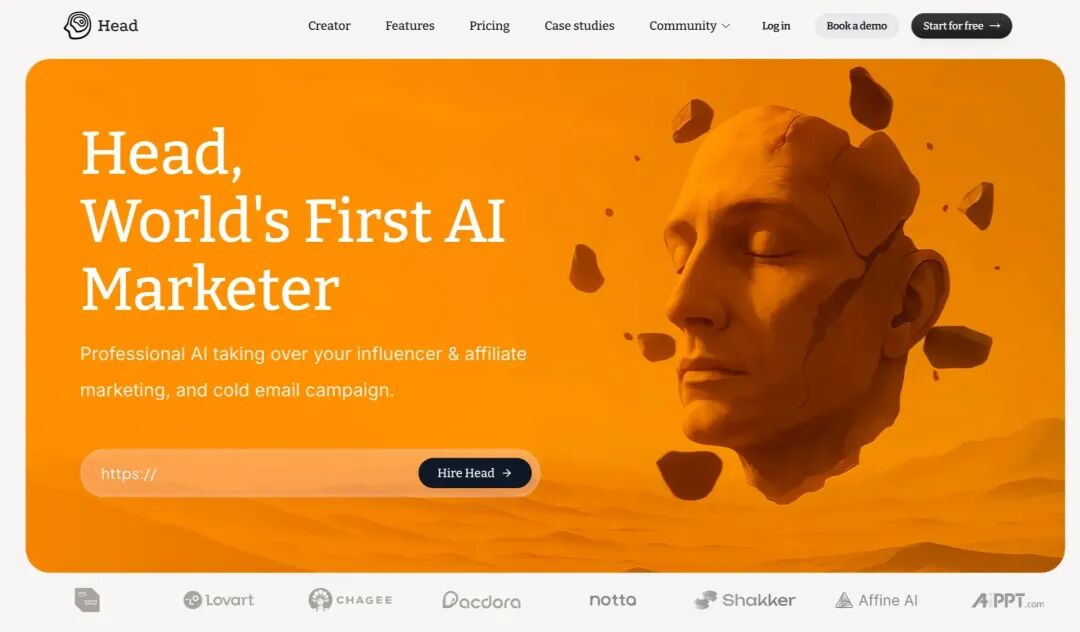 Head AI website (https://headai.io/)
👦🏻 Koji
Who is Head AI's target user? What problems does it solve for them?
👧🏻 Kay
Head's target users fall into three categories:
First: startup teams and early-stage brand founders.
They know they need to scale, but they're short on people and can't afford much trial and error.
For them, we provide an AI that actually delivers results. You plug in your URL and budget, and you don't have to worry about the rest — sourcing resources, writing content, negotiating with influencers, running campaigns. Head handles it all end-to-end. What used to require hiring several people now needs maybe one person checking in occasionally.
Second: big brands with existing teams.
Their problem isn't lack of resources — it's too many people, too much process, and execution that can't keep up.
Launching a new product, just getting through approval takes a week. By the time everyone's coordinated, the traffic window has closed.
With Head, they plug content production, influencer negotiation, and cold-start distribution directly into an automated pipeline. One campaign runs multiple versions in parallel, then automatically converges on the most effective strategy to scale¹.
The feedback from these clients is blunt: "Head doesn't just make us more efficient — it straight-up eliminates a department or agency for me."
Third: agencies, including service companies that used to deliver through manual labor.
They used to rely on teams to manually negotiate with influencers, launch campaigns, collect data, and compile reports — heavy, messy, low-margin work.
Now they hand that entire segment over to Head to run, and focus only on "client service" and "the parts where human value actually matters."
They're essentially outsourcing delivery to AI while keeping the highest-value last mile for themselves.
From manual outsourcing to AI-powered intelligent service — efficiency and margins both multiply.
These three user types look different on the surface, but the essence is the same:
They're all transitioning from "relying on people" to "relying on systems," wanting growth to become lighter, faster, and more certain.
And what we're doing is making that AI growth system actually work — so any brand, any service provider, any team can start from zero and have an automated, self-optimizing, self-scaling AI growth engine.
👦🏻 Koji
Head AI received investment from Jinqiu Fund, and it's also a company Allen Zhu invested in and frequently talks about. How did you originally pitch them?
👧🏻 Kay
Rather than how we pitched them, I'd say they genuinely understood what we're building.
This isn't a project you invest in through "consensus" — understanding it has a threshold. Marketing is an industry full of pitfalls. If you don't look deep enough, it's easy to step on landmines. Many institutions get burned and never touch it again. But as Allen Zhu said: Chinese investors have never made money through consensus.
We genuinely love our investors. We're on the same wavelength, and they've been incredibly helpful.
Jie Yang, Tianyu, and Zhiyuan at Jinqiu Fund — their entire team has deep understanding of influencers and commercialization. Our first conversation, Jie Yang gave us a term sheet in under 30 minutes. It was the accumulated experience from their previous company that let them spot the opportunity immediately.
Allen Zhu is even sharper. He understands social media and marketing so well — he's often the first to send me trending industry posts, constantly online, always active on the front lines. Daisy is the same: precise judgment, fast action, truly standing with founders.
👦🏻 Koji
What was the most impressive or surprising question you encountered during fundraising?
👧🏻 Kay
The two questions that surprised me most were:
"Will not going to college affect your work?"
"You're so young — will your team respect you?"
Honestly, neither has been a real problem.
If "being young" and "not going to college" were actually barriers, the bar for this world would be shockingly low.
These are precisely the choices I'm proudest of — I've always walked by my own judgment.
The real difficulty isn't writing a standard resume.
It's producing results in extremely short timeframes, while ensuring this direction still holds up in 5 or 10 years.
Someone asked me recently:
In that piece How to Spot Someone Worth Investing In at Age 20, was that 00s kid who treated herself like a co-founder and later started her own company — was that you?
Yes, it was me. I know many people didn't get it back then. But I never expected to be understood from the start.
For real entrepreneurs, surface-level "disadvantages" are never the problem.
Sometimes, they're actually your advantage in this arena.
We're used to carving paths out of adversity, doing what others think impossible.
I want to leave this for young people still on the road:
Many people are already old.
They don't understand you — that's not your problem.
You don't need to be understood from the start.
You just keep running. Eventually someone will catch up and hear you.
Ning Wang, us, everyone who was once underestimated —
if you truly do the right things, you win in the end.
The world's mass evaluation system is:
If you're not famous, it's a sin. Once you're famous, everything you do is right.
Finally, I want to share a passage from Yu Hua for those still on the journey:
At eighteen, you set out on the road, destined to clash with this world, even if you end up bruised and battered.
In the quiet of night, take your heart out from your chest, stitch it up yourself, sleep, and wake up the next day doubly confident.
It doesn't matter if no one asks after you, if you're not as good as others.
Try to quiet down. The heart can rest, but the hands cannot stop.
What needs doing, keep doing.
True growth isn't never breaking — it's continuing forward through the breakdown.

Before things got busy, I often went rock climbing and ran Spartan races.
Not to beat anyone, just to force myself to confirm again and again: I'm not someone who easily accepts fate.
My hands and feet were always injured, but the more it hurt, the clearer my mind became.
What I'm addicted to isn't victory — it's that feeling of being about to give up, but climbing anyway.
👦🏻 Koji
Sequoia Capital's recent trend discussions mentioned outcome-based pricing for AI-era B2B products, which Head AI has also adopted. What led you to this approach?
👧🏻 Kay
Head has insisted on "Pay for Outcome" from day one. This is a strategic path we actively chose, and it stems from my core needs as a former marketing lead.
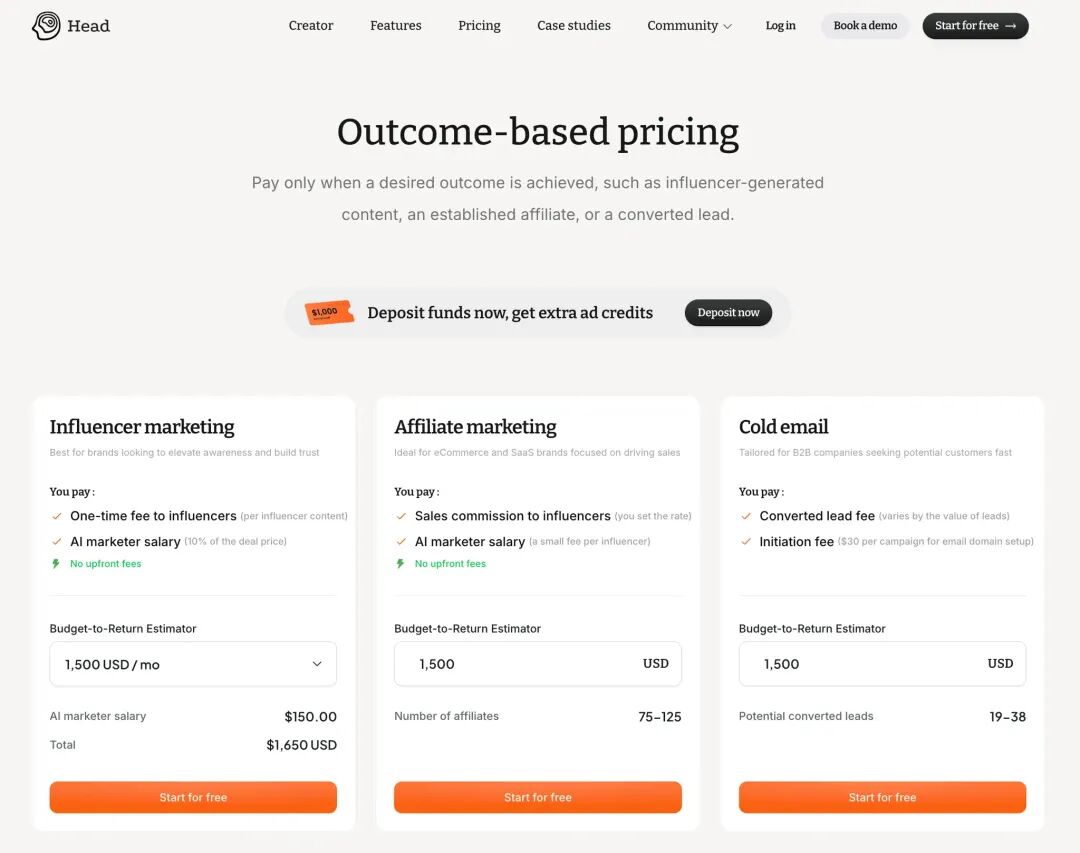 Head AI pricing model
Because I know too well the pain points of traditional SaaS tools: you pay, then you still have to assemble a team, pull data, find resources, run campaigns — and the results aren't guaranteed.
What marketing leads actually care about is just one thing — "can you get me results?"
So when we built Head, we set one standard:
Clients aren't here to rent software. They're here to hire an AI that can drive growth.
We're doing automated execution, not assisted operation. If we can actually run the full pipeline, we should be accountable for results.
If we can't, we shouldn't take the money.
The underlying logic is confidence —
we know we're building an AI marketing system that can complete tasks.
It can actually find influencers, generate content, negotiate prices, and run campaigns end-to-end. We have this capability, so we dare to use results as our pricing anchor.
From a business perspective, this model also binds us more tightly to clients:
The better they convert, the more we earn. If they can't get results, we don't get paid.
This is the relationship we actually want to build — not "vendor and purchaser," but "growth partners sharing outcomes."
👦🏻 Koji
With this outcome-based model, do clients mostly support or oppose it?
👧🏻 Kay
The vast majority support it. In fact, it's precisely why many choose Head.
The core problem with traditional SaaS is: you pay, but you still have to produce the results yourself.
With Head, "pay for outcome" actually gives clients confidence, because it means:
- You'll be accountable for results — 100% refund if ineffective
- I don't need to prepay trust — I can pay after seeing results
- You have the confidence to deliver results, or you wouldn't use this model
Especially brands with traditional campaign experience understand this better. They've lived through buying platforms, hiring teams, finding KOLs, and still failing to get results — so they're more willing to try Head's approach: I put up the budget, you run the results, and we scale up once it works.
👦🏻 Koji
In Head's pricing model, you emphasize that "outcome-based pricing + public pricing" is a revolutionary breakthrough. I see you've put specific actions on the price tag — "one successfully triggered automated task," "one qualified lead produced" — which is indeed attractive for product-led founders.
But I'm curious — Sierra chose not to publicize pricing to accommodate enterprise clients, complex goal definitions, and high-value deal flows. By comparison, can Head standardize because the product itself is smarter, or because you're actively avoiding those complex but high-value use cases?
👧🏻 Kay
Sierra doesn't publicize pricing because they only serve large enterprises — high ACV, low frequency, heavy service. Head's client structure is completely different. We serve everyone from SMBs to public companies, across 200+ countries and regions globally, growing extremely fast.
At this volume and pace, without standardization, we simply couldn't run.
So we had to decompose complexity at the product level, truly going deep on "abstraction." This isn't because we're avoiding complex use cases — it's because we actively transformed complex problems into product capabilities.
Today, whether you're a small team like Lovart, a fast-growing company, or a listed brand like CHAGEE, you can get satisfying results on Head. Small clients can self-serve; KA clients have VIP channels. We have tiers in process and service, but the pricing system is unified — transparent, public, outcome-based.
We genuinely despise marketing that relies on relationships, connections, and gray areas to make money. It doesn't match our values. I want marketing to be less murky, cleaner. As a platform company, this is our basic responsibility and commitment.
So we chose this pricing approach. It's not just strategy — it's our fundamental judgment and values about this industry.
Of course, this also means more people will criticize us. But we dare to publicize pricing, dare to take the heat, dare to be questioned, and dare to keep optimizing.
👦🏻 Koji
Do you think Head's public pricing model can extend to Enterprise use cases like Sierra's? Or do you believe future agents simply shouldn't take the customization route?
👧🏻 Kay
We believe Enterprise doesn't equal "customization" — it means "complex needs met through system capabilities." We've already achieved preliminary validation: many public company clients have chosen us long-term, and we take KA clients very seriously.
Head isn't incapable of Sierra-style Enterprise use cases — we just choose a different method: not piling on human services, but relying on stronger product abstraction and AI agent autonomy.
Future agents shouldn't be "customized tools" that need retraining and reconfiguration for every client. They should be "strategy entities" that understand goals, autonomously decompose tasks, and execute flexibly within a universal framework.
So even the most complex Enterprise clients can start with Head's standardized entry point and pricing, then extend their专属 paths through APIs, VIP channels, and strategy rules — but the underlying logic remains unified. This is how we can scale fast and serve users in 200+ countries globally.
We believe future intelligent agents will ultimately be like cloud computing — low barrier to entry, strong usability, complexity absorbed internally by the platform rather than transferred to clients.
👦🏻 Koji
I saw Head AI hit $2.5M ARR in 14 days — congratulations! But there's been considerable debate lately about ARR calculations. Could you elaborate on how Head AI calculates it?
👧🏻 Kay
Thanks! Many friends have asked about this number.
Our ARR calculation is actually quite conservative — our weekly revenue has stabilized above $50K for the past several weeks, so we simply multiplied by 52 weeks and rounded down to $2.5M ARR. No intentional inflation — just real user spending.
We chose to disclose ARR because it represents real product value better than DAU or registered users — whether people are willing to pay, and keep paying, is a more fundamental indicator.
Of course, Head is still very early and iterating rapidly. We believe that as long as the product keeps delivering results for clients, growth follows naturally.
👦🏻 Koji
Who do you consider Head AI's competitors?
👧🏻 Kay
Head AI has no "competitors." We're killing an old way of working.
We're not competing with any particular tool. At least today, we haven't seen any company with the same vision as ours.
We're here to evolve the entire marketing department as an organization.
You could say we're in the same space as Jasper, Icon, and other well-known marketing tools, and neighbors to influencer SaaS and cold email SaaS.
But fundamentally, we're not on the same path.
They're still "helping humans be more efficient." We're already having AI directly "take over responsibilities."
Our opponent is the entire growth system that still relies on thousands of people manually sourcing resources, writing scripts, and monitoring campaigns.
Not tool versus tool, but species versus species.
Just as the horse-drawn carriage was never the automobile's rival. The automobile's rival is: you still thinking you need a horse-drawn carriage.
So we're not fighting a SaaS war.
We're challenging a mindset, an organizational form, a backward default way of thinking.
👦🏻 Koji
I met an entrepreneur last week who mentioned that after using Head AI, the KOL options he received weren't very satisfactory. What's the current adoption rate among clients for the KOLs Head recommends?
👧🏻 Kay
Actually, I'd really like to know which client mentioned this so we can investigate and optimize.
Head is a company less than a year old. The product has only been live for 15 days, yet we already have tens of thousands of users, growing very fast and very viral.
As a general-purpose AI marketing product, spanning industries, knowledge bases, and languages, satisfying everyone from day one is unrealistic.
Let me cut to the chase: we definitely still have many imperfections.
Growing too fast creates imbalance. Not every client is satisfied today.
But as founder, this is precisely what I focus on most.
I still spend time reading every piece of user feedback. I know the problems, and I take them very seriously.
As a B2B company, our foundation isn't fancy technology — it's whether clients actually get results.
To collect feedback, to get more people to challenge us, I give my email to all clients. Everyone can book a meeting with me directly. We're using every possible way to listen: what users think, how they criticize us, what to change.
I completely understand when clients criticize us — growth and marketing are too important to companies. People only criticize what matters. So we should do our absolute best on what matters most.
We've messed up many things, especially with our first 100 clients — probably 80 were unsatisfied.
But it was precisely that "dissatisfaction" that helped us clear pitfalls, find direction, and get the product to where it works today. Maybe 30 clients are still unsatisfied, but we're improving. We iterate fast every week, solving problems every week.
We're especially grateful to those first 100 clients. Without them, there would be no us today. Including public criticism — I'm grateful for that too.
I always believe:
The best response isn't words — it's getting it right.
We even have clients who've given us three, four chances in a year to keep trying, keep optimizing.
With that trust from people who truly understand innovation. I just hope we can run even faster, to not let down those who always give us time.
For example, on influencer recommendation hit rate you mentioned — current client adoption averages 30-50%. There are indeed bad cases, and we investigate and rapidly optimize each one.
Differences across countries, industries, budget stages, and user preferences are huge. We're continuously tuning models, mechanisms, and response processes.
What we're doing isn't "searching for influencers" — it's having AI actually run a complete campaign.
No one has truly accomplished this before. We've made initial progress, but it's far from perfect.
Current unoptimized repeat purchase rate is 60%.
For a B2B product live just 15 days, that's not low.
But we're not satisfied. We want to build a system that's reusable and compounding over the long term.
More importantly, many of our users are themselves CEOs, marketing leads, growth experts, business owners.
They constantly give us feedback, challenges, suggestions. Some feature ideas, some judgment corrections — they helped us build those together.
We never feel like we're "serving" clients. More often, we're fighting alongside people who truly understand innovation.
That's why we're willing to keep going — because this is hard, but it's worth it.
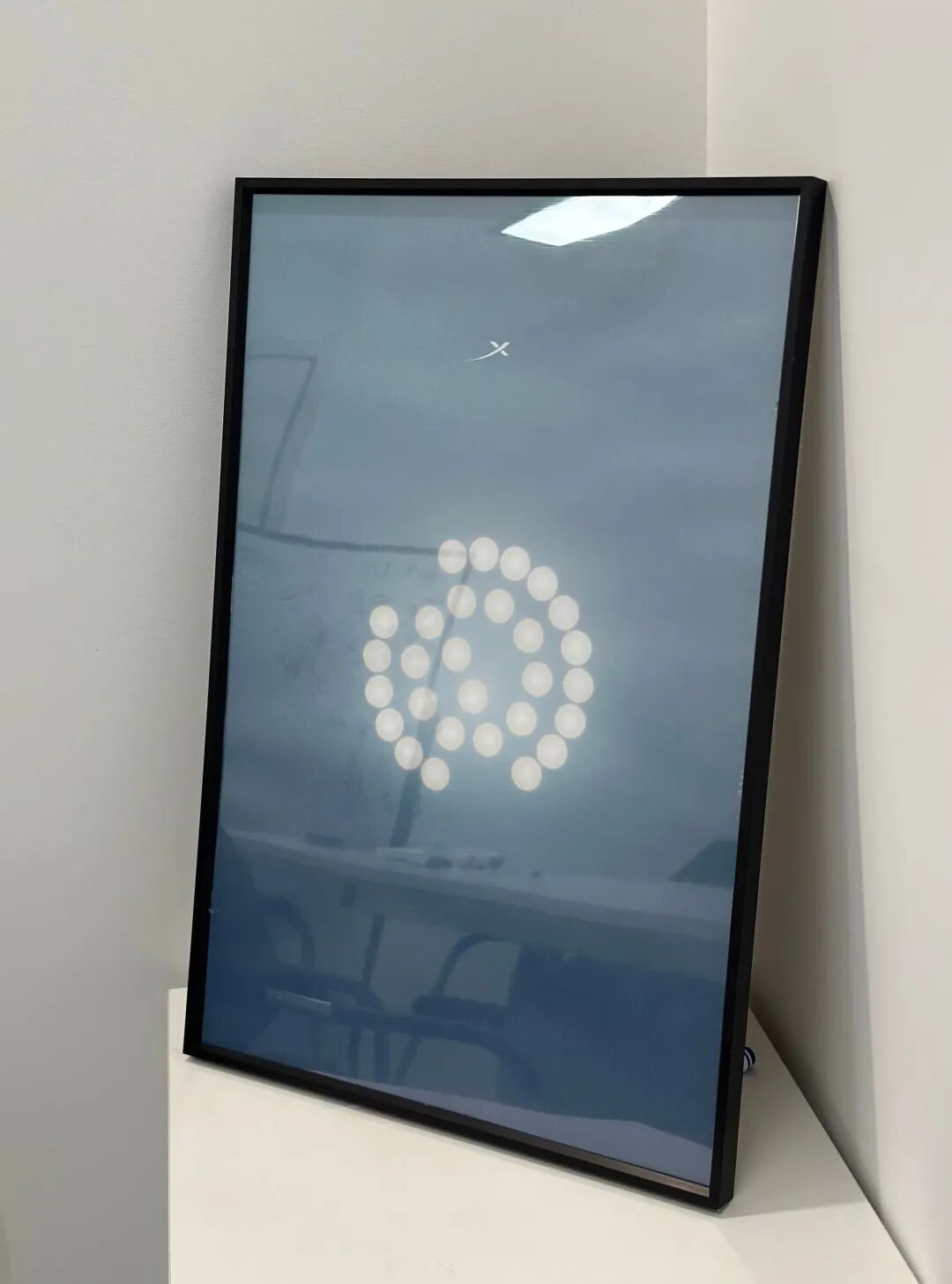
On our office wall hangs a photo of a SpaceX Raptor engine. That ignition failure — the engine didn't fully light, ultimately exploded. We've kept that photo.
Not to commemorate failure, but to remind ourselves: the shame isn't in the explosion, it's in never daring to ignite. That's how Head began.
Not about being foolproof, but about igniting everything, facing失控 head-on.
Because all true propulsion begins with失控.
👦🏻 Koji
What is Head AI's moat? How does it relate to AI?
👧🏻 Kay
- Two-sided network structure (brands + KOLs)
We're not a tool company — we're a platform driven by both AI and network structure.
On one side: continuous campaign spend and repeat purchases from brand clients. On the other: tens of millions of influencers and creators globally.
In the middle, AI plays matchmaker, bidder, negotiator, and delivery agent — continuously optimizing match quality, lowering acquisition costs, improving campaign ROI.
This gives us platform-level defensibility:
- More brands → more training → more accurate targeting
- More influencers → stronger negotiation → lower prices
We're simultaneously a decision engine, a traffic entry point, and a博弈 scheduler.
- Closed-loop decision capability (AI goes from goal to result)
Most AI tools generate content or assist with strategy — humans still execute.
Head's AI goes from "here's your budget and product link" all the way to "find influencers, write scripts, set prices, launch campaigns" — forming a truly closed-loop execution entity.
The moat here is:
- We've打通 the information structure of people, goods, and场景
- Built decision models adapted to campaign execution logic
- Introduced博弈 and ROI optimization mechanisms
- Data flywheel & self-evolving system
Every campaign execution generates real behavioral feedback data:
Did the influencer accept? Did the script pass? What was the final conversion?
This data isn't passively recorded — it feeds directly into our model training and match optimization, forming an inner loop in the decision engine.
This means:
- Models get more accurate over time (recommendations and pricing better fit scenarios)
- Systems get faster over time (less repetitive work, higher conversion rates)
And all of this can only be captured and learned by an AI system capable of "decision through delivery."
👦🏻 Koji
You dropped out of high school to start a company. If you could do it over, would you make the same choice?
👧🏻 Kay
I would.
I think entering the real world early has only benefits, no drawbacks.
While others were memorizing textbooks, I was already doing growth on the front lines, earning my first bucket of gold.
Many assume not going to school means not learning. But true learning never needs a classroom or supervision.
I learn faster than anyone because I want to produce real results.
Learning isn't obligation — it's personal interest.
So I never feel like I gave up anything. I just chose a more intense growth path.
If I could do it again, I'd choose the same road —
just this time, I'd run faster and bet bigger.
👦🏻 Koji
Your WeChat signature is "士亦视有益于世否耳" — which I understand as expressing a sense of responsibility to the world. I'm curious when and how this vision came to you?
👧🏻 Kay
It wasn't a sudden realization.
It accumulated gradually through my entrepreneurial journey.
I've always felt like a very lucky person. Though this path involves extreme pressure, constantly running at high speed, constantly breaking through, I've genuinely witnessed the winds of the era, caught a红利 that belonged to me, and truly benefited from it.
But I never take this as理所当然 luck.
So the luckier I feel, the more I feel I should give back.
Since I've received, I should do something valuable and return it to the world.
From my first year as a founder, I often told people around me: "I hope what I do is meaningful."
Many didn't understand back then, thinking I was being too abstract, too premature.
Until one day, I came across a content creator quoting Liu Tongxun, a Qing dynasty chief grand councilor: "士亦视有益于世否耳."
That moment truly shocked me.
Like someone across centuries had articulated, in one sentence, the obsession I'd been unable to express all these years.
"Will this world be even a little better because of me?"
If the answer is "yes," then all the hardship, the choices, even the solitude, become worthwhile.
👦🏻 Koji
How many people are on the Head AI team? What's the composition?
👧🏻 Kay
Our team is under 20 people.
Besides me and my co-founder, we have 11 engineers (covering AI, backend, frontend, infrastructure), 3 product designers, and 2 members handling growth, operations, and support.
The entire team is lean — everyone can independently own a complete module from requirements to delivery.
Our company has a very high淘汰 rate. Not to create pressure, but because we have rigorous standards for whether someone can actually "fight."
We look at two things:
Do they have an entrepreneurial mindset? Can they get things done?
We don't look at resumes, don't look at titles — only whether you can solve problems.
Recently, we sat in the office watching Head launch its own product发布会.
I sat in a corner and took a photo. That moment felt surreal —
like watching a life you created with your own hands step onto the stage alone for the first time.
That wasn't code. It was the continuation of human will.
Watching a group of twenty-somethings sit together, excited, focused, shining,
standing at the rapidly changing crossing of this world,
I just thought: having this group walking together is wonderful.
👦🏻 Koji
Do you consider yourselves an AI Native company/organization? Why?
👧🏻 Kay
We are a company built for AI from day one.
From the very beginning, Head wasn't about "AI assisting human work" — it was the reverse.
We're having humans assist AI in getting things to work.
AI decides campaign strategy. AI leads influencer selection and price negotiation. AI executes campaigns. Humans do only one thing: set goals and budgets.
We don't treat AI as a tool, but as a new decision-making subject, a new species.
We released a promotional video overseas called Think Beyond, and the core idea is this:
AI isn't a tool. It's a new species. Rather than having it obey human commands, hand over the power and see what it can achieve.
This is our fundamental difference from "AI-enhanced tools" on the market:
They're preserving old organizations. We're building new ways of working for a new species.
This is true AI Native — not just using AI, but fundamentally recognizing its independent intelligence.
👦🏻 Koji
You're a founder and CEO at 20 — I assume you're the youngest on your team? How do you manage colleagues older than you?
👧🏻 Kay
At Head, no one earns respect through age or seniority. We have one standard only: who can get things done.
I never saw "older than me" as a management challenge. I've always viewed it as a mutual selection.
People willing to join a 20-year-old CEO aren't looking for a boss — they're looking for direction and a battlefield.
They're not waiting to be assigned tasks. They're actively charging, fighting together, winning together.
I don't "act mature" or imitate management routines.
My role isn't someone standing above giving orders. I'm the one making judgments and bearing results amid chaos.
Actually, I've never "managed" people. I only attract people who don't need managing — who only care about results.
As for those who don't fit, I don't hesitate.
At 18, at my previous company, I was already carrying the pressure of pushing a team forward. No CEO title then,
but I still had to drive everything, mobilize everyone. When you can influence people without authority — that's real influence.
So today this business card that says "CEO" just stamps official recognition on responsibilities I've already been bearing.
Others win trust through resumes. I prefer to win it through results.
I think I have a pathological craving for "getting it done."
It drives me to go all in, and it drives others to believe in me.
👦🏻 Koji
In AI, what do you believe will definitely happen in 2025?
In 3 years?
In 5 years?
👧🏻 Kay
2025 — definitely happening:
AI is no longer just an advisory tool — it's directly running marketing.
Writing copy, negotiating with influencers, running cold email, buying ads — AI can execute in closed loops. Not "assisting humans" but "replacing actions." Within marketing departments, multiple roles can already be replaced. Bosses will do the math: one AI agent does what a team used to do in a week, with no sick days, no resignations, no inefficient meetings. For SMBs, this isn't a tech wave — it's a survival imperative.
3 years (by 2027):
Companies without AI-native structure will face a life-or-death gap.
Like brands that missed the social media era gradually falling behind, companies in the future without an AI-native growth stack (automatic decision-making + automatic execution) will sink into a trap of "low human efficiency + expensive budgets + slow decisions." AI won't be an efficiency tool anymore — it will be "structural红利" that widens the growth ceiling. This isn't a choice; it's a forced重构 that comes sooner or later.
5 years (before 2030):
Organizational structure will be fundamentally重构 around AI.
Future companies won't be "one role, one person" but "AI + a few humans as optimizers." One Head AI can replace most repetitive actions in a marketing department. Companies will only keep the most critical roles: strategic judgment, quality control, model tuning. AI is the execution主力; humans are辅助 roles. Organizations will become flatter, faster, more automatic.
🚥