How Smart Entrepreneurs Go Global in E-Commerce? Alibaba International's AI Toolkit: Completely Free, Use It to the Fullest!

AI's got your back, going global won't make you crack.
In recent years, cross-border e-commerce "going global" has become a critical avenue for countless small and medium-sized enterprises (SMEs) seeking new opportunities and growth engines. With AI emerging as a transformative technological variable, several pressing questions have surfaced across the industry:
As a small merchant, how should one interpret the development and future impact of large language models and AI technology?
As an e-commerce platform, how can AI and large model capabilities be tightly integrated with concrete business needs to help merchants smoothly "go global"?
With AI's explosive rise, what fresh possibilities can cross-border e-commerce unlock?
Alibaba International has answered these questions with striking performance, successfully cracking the Morse code of AI-empowered SME globalization.
Currently, Alibaba International serves 500,000 merchants and 100 million product listings. AI capability calls on its platform have surpassed 50 million, doubling every two months. This business segment, which saw limited growth due to pandemic impacts as recently as 2022, embarked on a rebirth starting in Q2 2023.
Through precise AI execution, international retail has become Alibaba's fastest-growing business domain over the past three years. Specifically, year-over-year growth rates for all four quarters of 2023 reached 41%, 60%, 73%, and 56% respectively.
From "Mom-and-Pop Shop" to Category Leader: AI's Cross-Border E-Commerce Magic
Imagine being a small cross-border e-commerce shop owner, running everything solo. Faced with complex global market dynamics and platform rules, wouldn't you feel somewhat overwhelmed?
In this industry, many such "one-person shops" and "mom-and-pop stores" grapple with crushingly tedious workloads. For instance, even the most fundamental task of producing "e-commerce images" can entail high production costs, time-consuming design workflows, and a shortage of international design talent and multilingual expertise.
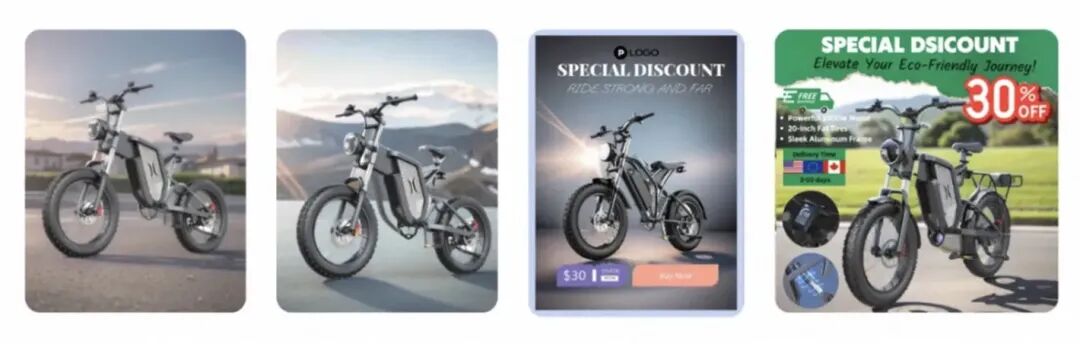
Yet some small shops have cracked this code. AliExpress seller "Zeuslap," a monitor brand, began using Alibaba International's AI image generation capabilities in November 2023 for store decoration banners, product scene images, detail pages, and social media cover graphics.
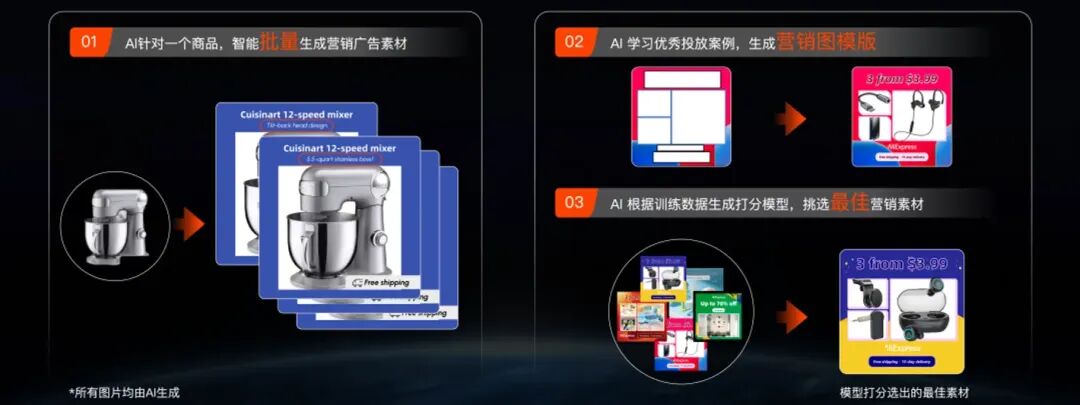
AI-generated marketing materials boost ad performance and reduce placement costs. Source: Alibaba International
Another "mom-and-pop" operation — Zeuslap's proprietors Mary and her husband — similarly leveraged AI image generation to dramatically liberate productivity. Now they simply select templates and upload products to generate quality product images. Beyond this, their platform Alibaba International provides white-background images, marketing graphics, detail page translation, model images, virtual try-on, video translation, digital humans, and more. These tools not only accelerated Zeuslap's growth but propelled it from a "mom-and-pop shop" to the platform's top-ranked brand in its category.
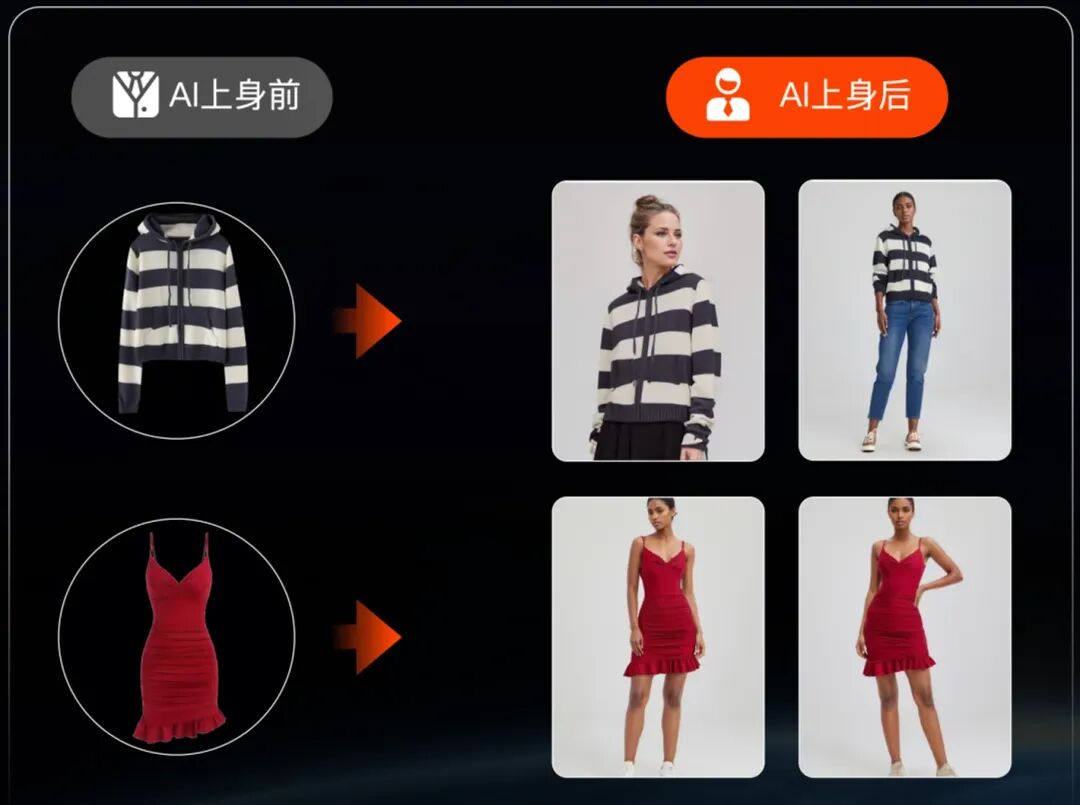
AI provides virtual model try-on effects for apparel categories. Source: Alibaba International
At an AI-themed sharing session held by Alibaba International on July 16, Kaifu Zhang, Vice President of Alibaba International Digital Commerce Group and head of AI business, revealed that Alibaba International has tested AI capabilities across 40+ scenarios, empowered 500,000 SME merchants, and optimized 100 million product listings. Over the past six months, merchant AI call volume has doubled roughly every two months. "The smaller the merchant, the more they benefit from AI applications," Zhang said.

Source: Alibaba International
The "AI uselessness" sentiment previously circulating in industry circles focused largely on large models' commercial predicaments and application scenarios. The birth of Alibaba International AI Business identified the optimal intersection point between AI and e-commerce — AI is becoming the ultimate assist for enabling "mom-and-pop shops" like Zeuslap to tackle cross-border e-commerce challenges.
Large Model "Private Customization": The AI Evolution of Cross-Border E-Commerce
Where do e-commerce large models come from?
The historical dilemma: despite having large models, their lack of e-commerce scenario data severely degraded usability. Translation accuracy fell short; achieving "thousands of faces for thousands of people" in ad placement remained elusive. Addressing this, Alibaba International's AI business head Kaifu Zhang noted at the communication session that AI Business is not merely a foundational model training team, but rather starts from business needs and flexibly selects tools. If excellent open-source models exist that, after SFT (Supervised Fine-Tuning) and RAG (Retrieval-Augmented Generation) adjustments, meet expectations, these are prioritized. For scenarios where specific needs remain unmet, the team pivots to self-developed models or proprietary deep optimization.
Source: Alibaba International
In self-development and optimization, Alibaba International focuses on three core domains. First, they revolutionized multilingual text generation technology. Taking translation as an example: early reliance on small models yielded low efficiency and utilization. Now, multiple languages are consolidated into a unified large model, MarcoPolo, reducing server deployment counts and boosting service utilization — as if assembling multiple small boats into one large vessel that sails faster.
Second, they introduced the multimodal large model MarcoPolo-VL, developed specifically for e-commerce scenarios encompassing image recognition, optimization, completion, and generation. Its underlying architecture, Ovis, transforms visual features into structured visual embeddings, making intelligent recognition and content generation more efficient. This design resembles converting images into readable "language," making them easier for machines to comprehend.

Source: Alibaba International
Alibaba International constructed a general model service PaaS platform called Spark. This platform integrates numerous modules — from application builders to model workbenches — aiming to provide complete end-to-end technical support for e-commerce scenarios. Through prompt engineering and instruction fine-tuning, self-developed models can be optimized while open-source and partner models are integrated, enabling resource sharing and efficiency gains. In essence, the e-commerce large model logic is a continuous optimization and iteration process, combining ready-made model applications with deeply customized R&D paths, all ultimately pointing toward better serving business needs through technology.
AI Gets to Work: The "Emergency Remedy" for Cross-Border E-Commerce
How to identify must-have scenarios in e-commerce operations and develop corresponding AI tools?
This precise distillation of e-commerce business essentials represents another elegant answer Alibaba's team has delivered.
At the end of 2023, Alibaba International began piloting AI tools across its AliExpress products and invested subsidiary Lazada — select merchants received early access. After nearly two months of testing, AI tools rolled out to all products and all regional merchant interfaces in early 2024. By H1 2024, Alibaba International's AI tools covered 40+ scenarios including search, ad placement, and customer service.
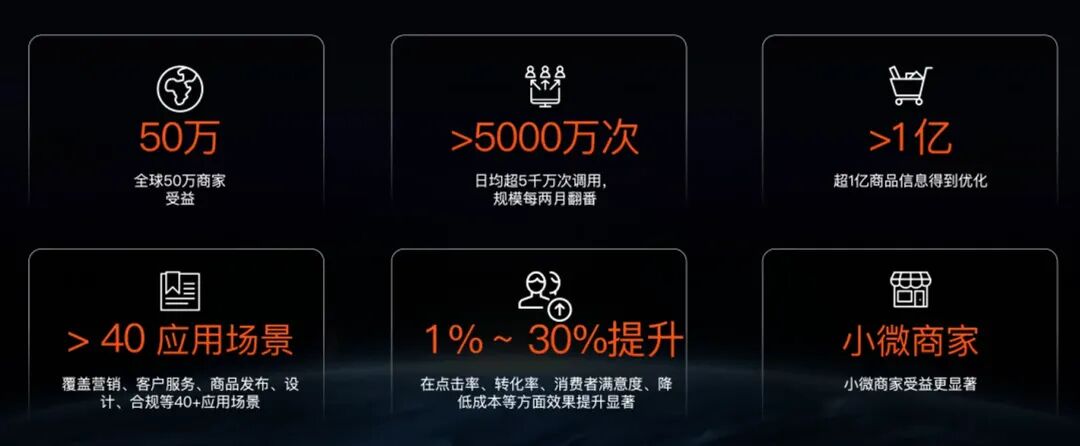
Alibaba International AI achievements over the past year. Source: Alibaba International
Weihua Luo (alias: Wenzhang), algorithm lead for Alibaba International AI business, noted that for must-have e-commerce scenarios, the market lacked recognized excellent multimodal models, prompting the team to pursue a new approach — developing Ovis. A gap exists between general-purpose large model foundations and actual business needs; his team's work is to bridge that gap.
Kaifu Zhang, Vice President of Alibaba International Digital Commerce, emphasized that identifying suitable scenarios was a highly empirical process, with the team focusing on summarizing which operational segments could most benefit from AI-driven efficiency and conversion improvements.
For example, "refunds" and "chargebacks" have long been core pain points for merchants:
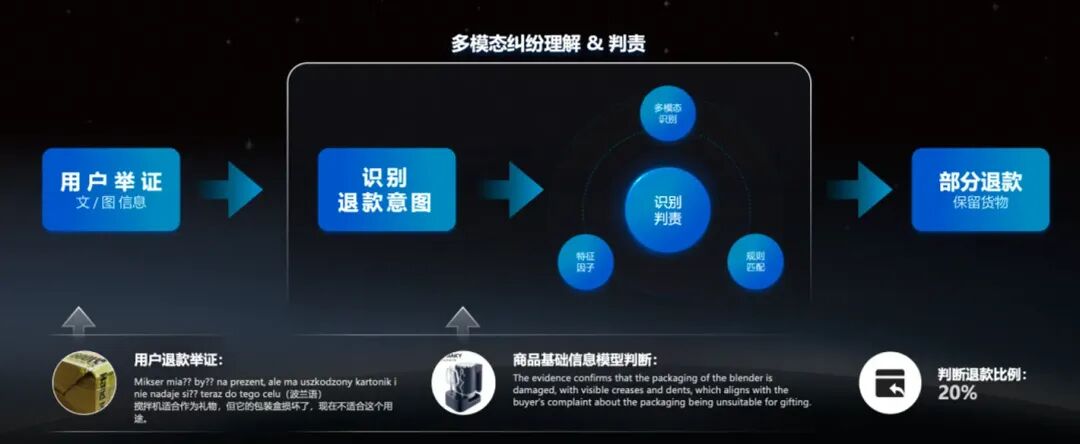
In refund scenarios, shipping goods back from overseas often costs more than the item itself, and failed returns create significant inventory losses. Addressing this, Alibaba International employs multimodal large model technology for dispute reason identification and credential verification, processing diverse data to calculate partial refund amounts and offering consumers "no-return, partial refund" solutions that maximize customer satisfaction while minimizing merchant costs. Specifically, models are trained to learn and understand user dispute reasons, messages, refund credentials (damage extent), transaction snapshots, and logistics routes, then draw on historical manual adjudication cases to determine "whether to require return" and if not, "how much to refund."
Chargeback scenarios represent another post-sale nightmare that cross-border merchants dread — goods shipped, customer refuses payment. Previously, merchants spent hours preparing documentation and evidence for each chargeback defense. Many SMEs, lacking relevant experience, simply accepted their losses. Now, Alibaba International's AI chargeback defense agent can organize all materials within minutes, automatically generate defense letters, and submit them to overseas credit card institutions, dramatically liberating productivity. Reportedly, this AI chargeback defense agent helps Chinese cross-border merchants across Alibaba International's platforms recover RMB 20 million in losses annually.
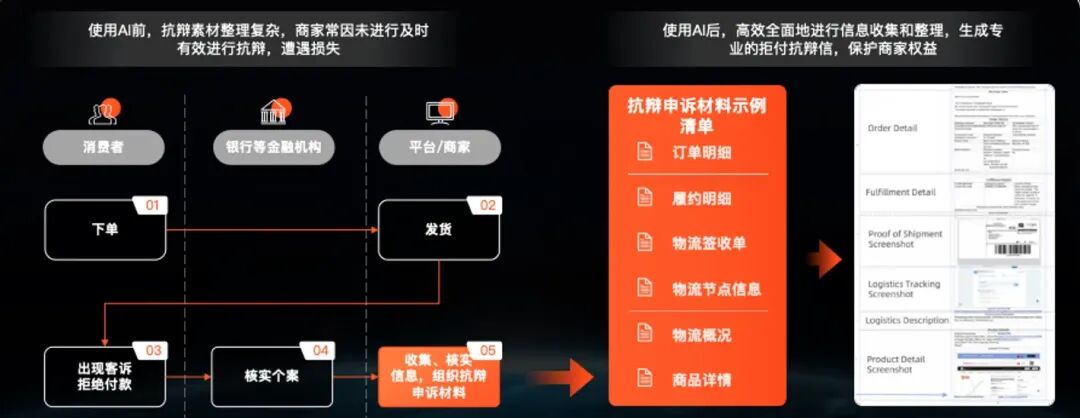
AI chargeback defense agent helps merchants reduce financial compliance losses. Source: Alibaba International
During R&D, Alibaba International AI Business team specifically evaluates tools' business value, particularly their actual impact on cost reduction, efficiency gains, and GMV (Gross Merchandise Value) growth. Zhang also noted that AI tools are completely free in the merchant backend with no special product guidance — the intention is for merchants to discover and use them organically, with natural revenue changes ultimately evaluating AI's return on investment.
According to media analysis of Alibaba International's AI layout, the company relies on Alibaba Cloud for GPU computing power, while AI Business team-provided multimodal large models, translation, and virtual try-on tools allow subsidiaries like AE and Lazada to flexibly call or二次 customize based on scenario needs. It is precisely this flexible and diverse exploration that has gradually matured AI applications for e-commerce operations.
Alibaba International states its AI is now applied across 40+ critical cross-border e-commerce scenarios, including product images and text, marketing, search, ad placement, SEO, customer service, refunds, and store decoration. "We've pretty much mastered the cost-reduction and efficiency game," Zhang said.
These AI features are currently embedded directly in the merchant system backend, meaning extremely low barriers to adoption. For managed merchants, they can even authorize the platform to perform AI operations on their behalf without lifting a finger.
Currently, these AI features remain free for all merchants on Alibaba's platforms.
A Crowded Field: The AI "Arms Race" in Cross-Border E-Commerce
Since last year, AI applications in cross-border e-commerce have become a full-blown "battlefield," attracting major players to enter with supply and innovative services.
In 2023, e-commerce giant Amazon tested the AI waters, with its Amazon Bedrock service offering multiple large model interfaces and tools targeting cross-border e-commerce pain points. In 2024, Amazon doubled down, launching multiple generative AI tools focused on multilingual interaction and user conversion scenarios that caught merchants' attention. More recently, Amazon invested a hefty $230 million to support AI startups,加码 AI logistics, multilingual interaction, and other critical application scenarios.
Latest reports indicate Amazon is accelerating development of advanced language model products with complex conversational capabilities encompassing text and images — undoubtedly another sharp weapon in its AI arsenal. Sources close to Amazon reveal that AI has become the company's trump card in cross-border e-commerce, with both Chinese and European/American local merchants experiencing the convenience of AI tools on Amazon's platform.
Meanwhile, Temu, another heavyweight in cross-border e-commerce, is also making AI moves. Its AI tools have achieved one-click translation, intelligent customer service, and full-chain services,率先 AI-ifying business-critical scenarios and demonstrating sharp insight and rapid execution in AI application.

Kaifu Zhang, Vice President of Alibaba International Digital Commerce Group and head of AI business | Source: Alibaba International
This AI application practice in cross-border e-commerce concerns technology, but even more so strategy. Every major player seeks to seize first-mover advantage and claim their share in this intelligent revolution.
In the foreseeable future, AI will play an increasingly pivotal role on the cross-border e-commerce stage. How Alibaba International will upgrade its AI products and capabilities remains to be seen.
Editorial Team Editor/Design: Ivan
For business cooperation, add on WeChat: Rwkfbcianvd