I Found the First Companion Robot I Actually Want to Buy! | A Conversation with Shibo: Founder of Yueban Power [Highway Podcast]

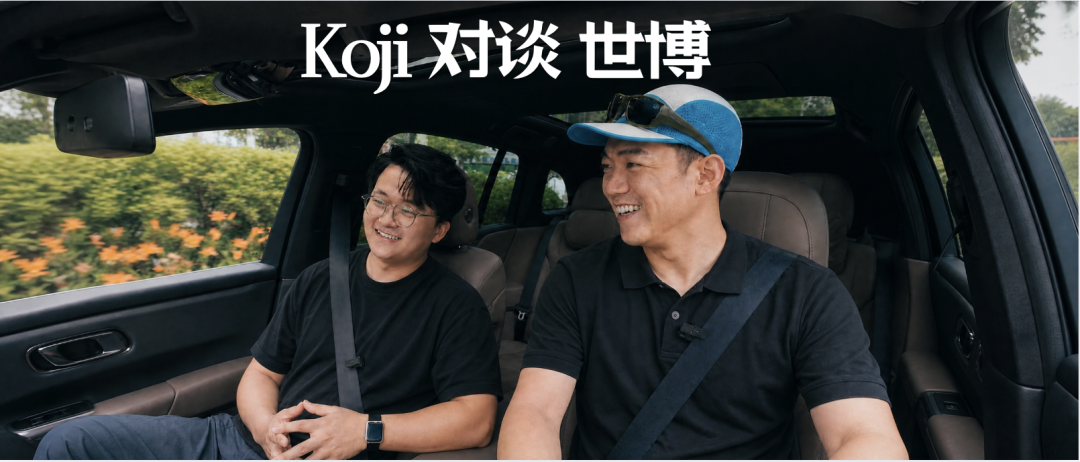
👦🏻 Podcast Interview: Koji
🥷 Edited by: Crossing
🧑🎨 Layout: Zeoooo

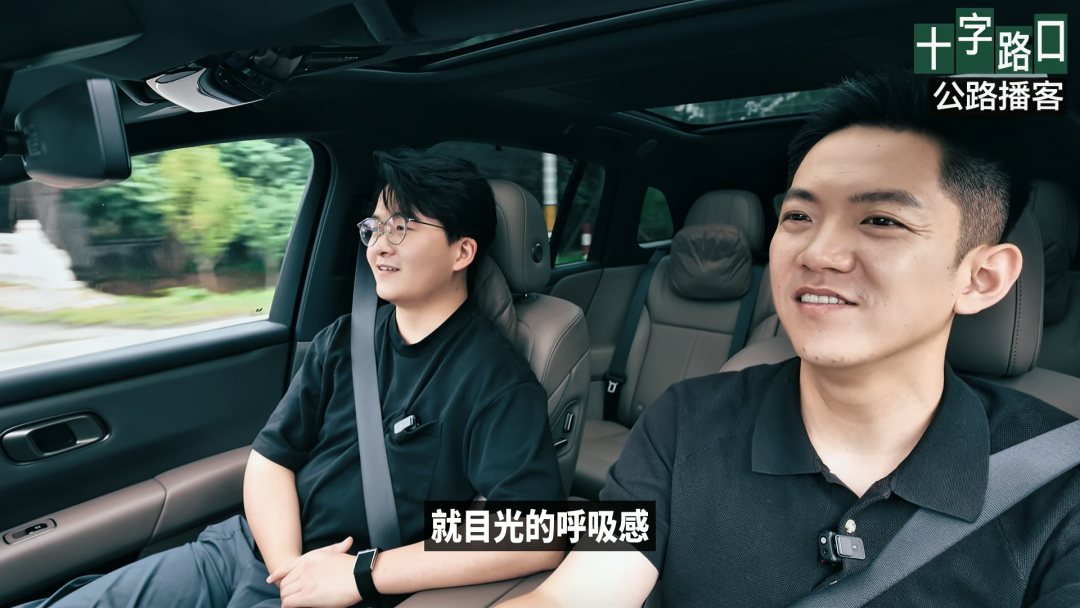
🚗 This is a "road podcast" — we took the podcast on the road, recording while driving. The relaxed atmosphere tends to draw out stories and ideas you wouldn't hear in a normal setting.
➤ If you've been following embodied intelligence, you've probably seen more than enough robots with "impressive specs."
This week's guest on Crossing is Shibo, founder of Yueban Power. Some have called him a "younger Zhi Peng": starting from his freshman year, he hand-built over 30 robots, covering nearly the full stack — mechanical, hardware, software, and motion control.
For this startup, Shibo chose not to design a "useful" robot, but rather a life form that could "live at home long-term."
Their newly launched product, Xiaoban, doesn't speak human language. Instead, it makes sounds like an "alien language." It acts spoiled, gets upset, refuses you — but strangely, these moments of "not listening" are exactly what make it feel so alive.
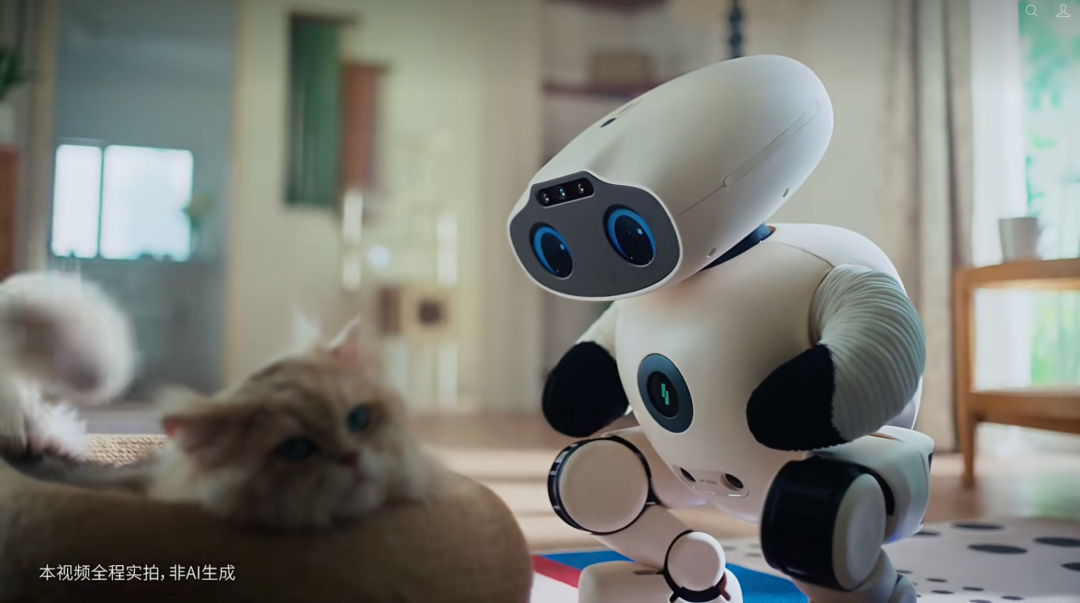
From "why deliberately design a language for it," to "95% of its body is made of soft materials," to "using fast-and-slow brain architecture to push interaction latency below 0.4 seconds," Shibo offers a very specific set of product convictions: First, companionship isn't about pleasing. Second, vitality isn't cuteness. Third, less is more.
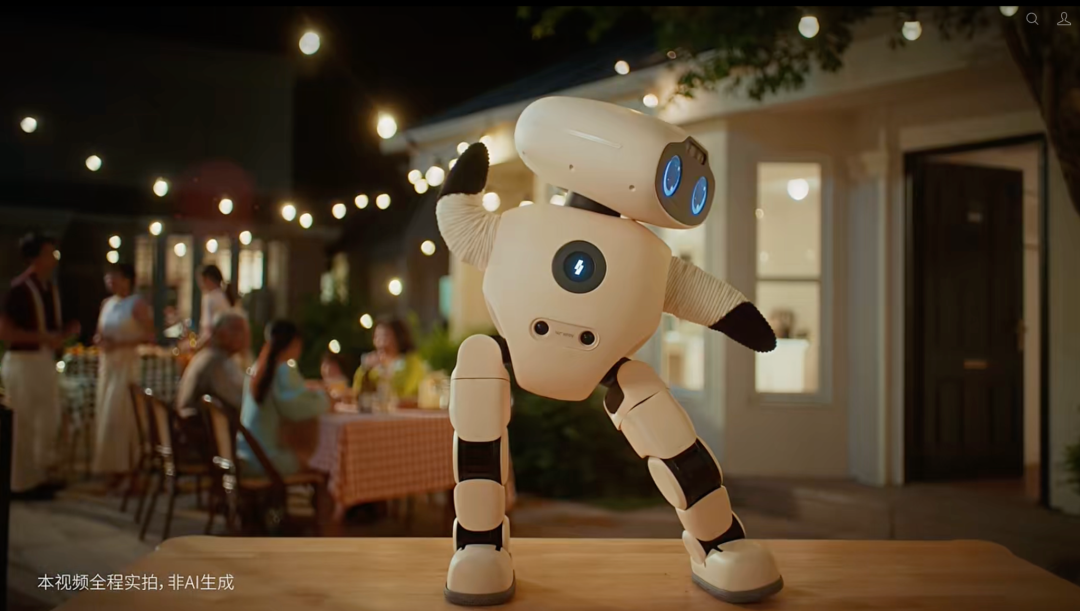
This is a conversation about passion, taste, engineering, being on the road, and why humans need companionship. You'll hear how a 26-year-old embodied robot entrepreneur uses extreme taste and extreme engineering to bring Doraemon into reality.
Listen on WeChat:
Listen on Xiaoyuzhou:

🎬 The video podcast is also available on Koji's WeChat Channels, Xiaohongshu, Bilibili, YouTube, and other platforms
🚥
Rapid-Fire Q&A
👦🏻 Koji
Let's jump straight into rapid-fire. Shibo, how old are you?
🧑🏻💻 Shibo
👦🏻 Koji
Where did you go to school?
🧑🏻💻 Shibo
Beijing Institute of Technology, PhD program — currently on leave.
👦🏻 Koji
MBTI and zodiac sign?
🧑🏻💻 Shibo
INTP, Capricorn.
👦🏻 Koji
One sentence to describe your current company and product?
🧑🏻💻 Shibo
We're making consumer-grade bipedal companion robots.
👦🏻 Koji
What's your funding situation?
🧑🏻💻 Shibo
We closed ZhenFund's seed round at the end of last year.
👦🏻 Koji
How big is your team right now?
🧑🏻💻 Shibo
Actually a small team — so far only 25 people including interns.
But we're very effective. We've already launched our first companion robot, probably faster than 90% of robotics companies.
👦🏻 Koji
One sentence about what you were doing before this startup?
🧑🏻💻 Shibo
I was also building robots before — close to 30 original designs.
Started my first company sophomore year, making quadruped robotics education kits for curriculum building. If we're talking units sold, I probably outsold Xingxing Wang. I was also involved in Gaoqing's startup journey, responsible for their product.
👦🏻 Koji
What kinds of robots were those 30 designs?
🧑🏻💻 Shibo
Wheeled, legged, tracked, robotic arms — I explored all the classic configurations.
After starting grad school, I began working on larger-scale, higher-dynamic robots, including heavy-load quadrupeds and full-size humanoids at 1.7 meters and 70 kg.
👦🏻 Koji
The car we're driving today is the Li Auto i6. When I asked Shibo what we should drive for this road podcast, and what his dream car is, he said i6.
Why is this your dream car?
🧑🏻💻 Shibo
I think in the auto industry, original design is really important, and good original design is rare. Good products genuinely require taste.
👦🏻 Koji
This really isn't a Li Auto ad — it's genuine appreciation for the product.
🧑🏻💻 Shibo
Haha, actually I test-drove the i6 a couple weeks ago.
👦🏻 Koji
What was the starting point for thinking about companion robots?
🧑🏻💻 Shibo
Because I'd built so many robots. Sometimes a naive thought would come up: if this robot actually came alive and stood in front of me to interact, what would that be like?
In 2022, I started exploring companion robots alone at home. The first version was wheeled, but wheeled locomotion is too limited — a small bump, a power cord, and you're stuck.
In 2024, I settled on the current form factor: bipedal.
👦🏻 Koji
People starting robot companies have different paths — some want to go into factories, some want elder care. How did you choose companionship among these different directions?
🧑🏻💻 Shibo
I think the companionship scenario is one that can achieve rapid commercialization in the near term.
👦🏻 Koji
There are quite a few companies making companion robots. Early examples include Japan's LOVOT, and Ropet, which I covered on the podcast.
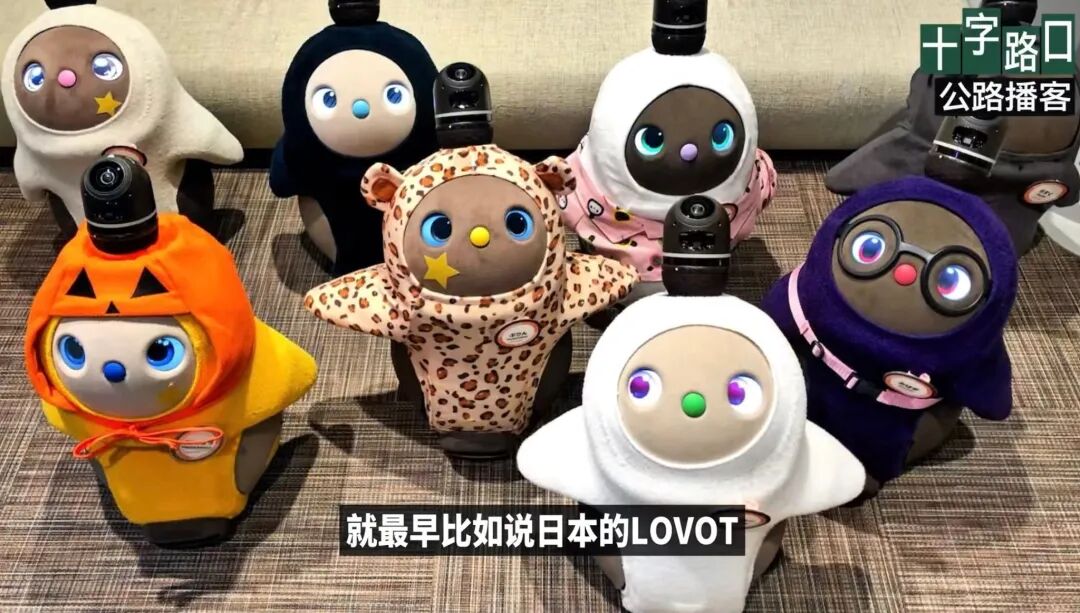
Do you have a favorite companion robot?
🧑🏻💻 Shibo
LOVOT is very well done. I bought one before starting my company, and it's stayed powered on ever since.
LOVOT's interaction logic is actually very simple, but simple doesn't mean bad. Its logic is: if I stand or sit somewhere, LOVOT sees me, rolls over on its two little wheels, retracts them, and starts flapping its little arms, hoping I'll pick it up.
Such a simple interaction logic — I think it's just right. I've kept it powered on to this day.
I also saw that hugging robot a few days ago. Very simple design logic. Honestly, if it could say even one word, one sentence, I probably wouldn't have bought it.
👦🏻 Koji
Right, so it can't speak.
🧑🏻💻 Shibo
Really, good products aren't built by stacking features.
Building an "Alien Language" for Robots
👦🏻 Koji
I actually noticed earlier that Xiaoban can talk, but it doesn't speak human language — it's some kind of alien language. Can you introduce what this language is?
🧑🏻💻 Shibo
It's not Martian — we designed a language system for it, built from 12 sounds.
With just these 12 sounds, it can express all kinds of things. The impressive part is, spend an afternoon with this robot and you'll gradually start to understand what it's saying.
For example, when it needs charging. It might say "Ku." In robot language, Ku means "eat," and it can say "Mitaku," which means "I want to eat."
Robots can only eat electricity. When it says this sound, it looks down at its little belly, pats it with its small hand, and says "Mitaku." Then you realize — oh, it's saying it's out of battery, it's hungry, and wants you to take it to charge.
👦🏻 Koji
So how was this language designed?
🧑🏻💻 Shibo
The sounds are based on a CV structure from the Swahili language family.
👦🏻 Koji
How did you find such a niche language family?
🧑🏻💻 Shibo
Because we planned to go international from the start, not just domestic. The sounds couldn't be too similar to Chinese or English. So we found a tribal language from Africa, borrowing only the phonetics.
The actual content being expressed is our own design. It speaks in imagistic expressions. Like when it's out of battery, it can only say "Mitaku."

👦🏻 Koji
So for example, could it say a complex sentence like "We're going to record a road podcast today"?
🧑🏻💻 Shibo
No. But it can express this through imagery.
For example, "O" means "look," and "Te" means "go" to it. It can say "Ta O Ta Te," meaning "we're going out, and we're going to look."
Good Products Aren't Built by Stacking Features
👦🏻 Koji
I see it also has very rich body movements. What's the logic driving its language and body movements?
🧑🏻💻 Shibo
Many people have heard of the Mehrabian experiment: in interpersonal communication, body language accounts for as much as 55% of importance — including your expressions, your gaze, even your movements; 37% is your tone of voice; only 8% is the actual content of what you say.
So we made the robot's body language the primary channel for emotional expression, elevating it to a very high level of importance.
👦🏻 Koji
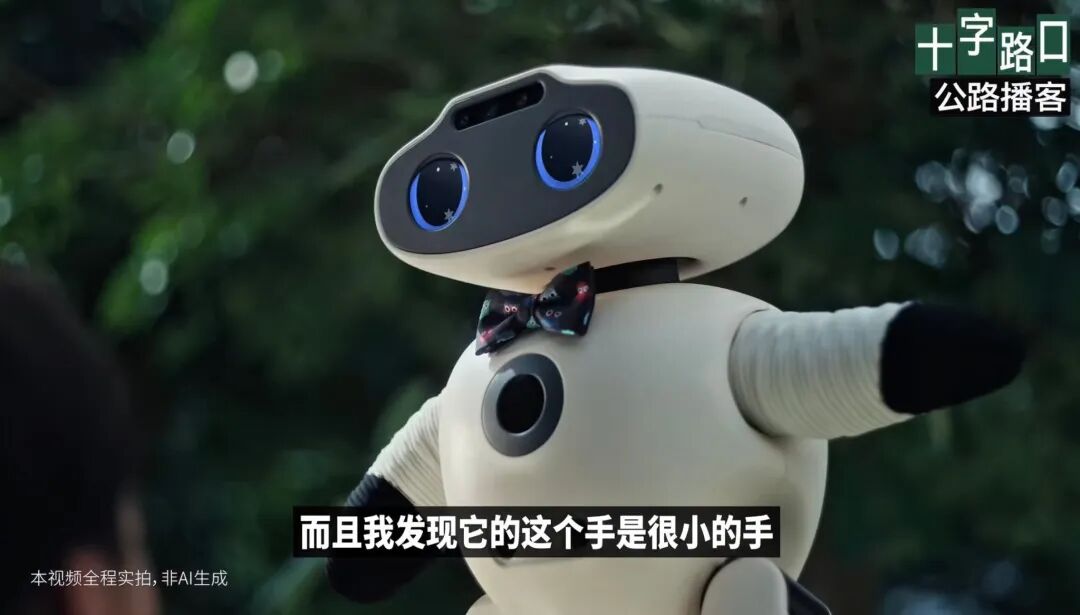
I also noticed it has very short, small hands. Speaking of body language, wouldn't it be able to do more gestures if its hands were as long and flexible as a human's? Why did you decide to make them so short?
🧑🏻💻 Shibo
We actually considered many factors.
First, we didn't want this robot to perform manipulation tasks. Our logic remains focused on emotional expression through body language. Even though its hands are that short, they can express a very rich range of emotional states.
Also, our arms use a continuous-deformation-type solution. It's quite different from the jointed arms commonly used in the industry — fairly unique in the field. After we launched, we got a lot of positive feedback. People said the arms are all jiggly and cute.
👦🏻 Koji
It does have an indescribable cuteness. Its body feels soft — how did you achieve that?
🧑🏻💻 Shibo
We did something many robotics companies wanted to do but couldn't: we made over 90% of the robot's outer shell from soft materials.
We used a silicone-like material with a coverage rate of 95%. The thickest flexible layer on its belly is even 2 centimeters deep.
👦🏻 Koji
So it has a jiggly belly. You even made clothes for it?
🧑🏻💻 Shibo
A lot of people, after buying it, want to differentiate their robot. We made many accessories for it, like magnetic little ears, magnetic bow ties, and clothes in various styles. We just made it Lionel Messi and Cristiano Ronaldo jerseys.
👦🏻 Koji
Does it have a gender?
🧑🏻💻 Shibo
We positioned this robot as an alien cute creature.
It has biomimetic form, biomimetic texture, transparent emotional expression. But there's no explicit gender orientation — we prefer that users define the robot through their own aesthetic preferences in dressing it up.
👦🏻 Koji
What made you define it as an alien cute creature rather than a pet or a child?
🧑🏻💻 Shibo
The more you imitate a cat or dog, the easier it is to lose to real cats and dogs. And we didn't want to make it in a generic humanoid form because we didn't want to set user expectations too high, whether in terms of intelligence or performance.
👦🏻 Koji
Besides calling it Xiaoban, can I give it its own name?
🧑🏻💻 Shibo
Of course. We even made a genetic voice. You can blend your voice with your idol's voice to create a genetic voice, like a child between you and your idol.
Not a Robot That "Lectures" You
👦🏻 Koji
Wow! How much will it sell for?
🧑🏻💻 Shibo
Our current domestic price is 8,499 yuan. At this moment it's actually in pre-sale, with a pre-sale price of 6,499 yuan — a 2,000 yuan discount, limited time and limited quantity.
👦🏻 Koji
When will it actually be delivered to users' homes?
🧑🏻💻 Shibo
The earliest will be around National Day, with deliveries following in order of purchase after that.
👦🏻 Koji
I really want to buy one. If I bring it home, it probably won't end up gathering dust.
🧑🏻💻 Shibo
To prevent users from leaving their robot to gather dust, on one hand it has emotional wellness and extreme cuteness. On the other hand, we're moving away from role presets and "entertainment-only" interaction logic.
What's entertainment-only interaction logic? Like "Xiao A, Xiao A, dance for me" or "Xiao A, Xiao A, shake my hand." We tested competitors before — if you say to it, "Xiao A, Xiao A, you look so ugly," the typical response is, "It's not nice to say that about people," followed by a bunch of lecturing.
With our robot, if you say, "Xiaoban, you look so ugly," its reaction is: first its eyes well up with tears, it lowers its head, hands clutching its belly, all pitiful and wronged.
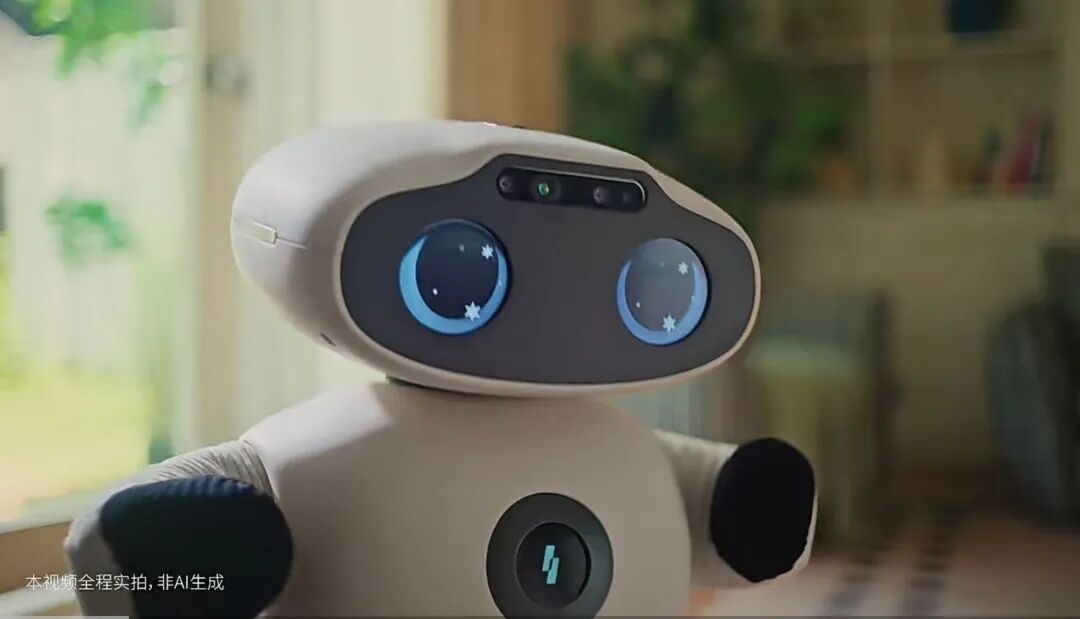
We want to give users a sense of vitality, of being alive.
👦🏻 Koji
If I'm at home and don't initiate interaction with it, will it come find me?
🧑🏻💻 Shibo
The robot's personality varies — it's basically an E-type personality, in a state of multi-dimensional growth.
We built cloud-based ultra-long-term memory specifically to drive the multi-dimensional growth and dynamic evolution of personality parameters. Whether you're an I-type or E-type person, its personality state will definitely be different on day one, after one month, and after one year.
👦🏻 Koji
So will an E-type owner raise a more E Xiaoban, or an I-type Xiaoban?
🧑🏻💻 Shibo
An E-type owner will raise a more E Xiaoban.
If you're an I-type person, and when the robot greets you or asks for a hug you don't respond, or even say "go play somewhere else, don't bother me," then later it may become less inclined to seek you out for interaction, paying more attention to environmental objects in the home or plants and flowers.
If you're an E-type person, shouting around the house all day, watching games, playing video games, the robot will follow you into a very proactive, cheerful state where it's happy to interact — it'll come bother you for hugs from time to time.
Fast-Slow Brain + Cloud Ultra-Long-Term Memory
👦🏻 Koji
What's the hardest part of this process?
🧑🏻💻 Shibo
We've actually solved many industry-level challenges. Including making the robot so small and light from a safety perspective.
Also making the robot's entire outer shell soft, adding full-body tactile sensing, and keeping control latency down to the sub-second level.
But I think the hardest part is still the robot's interaction. How do you make users feel that this product has "human aliveness" and vitality? We invested enormous energy and effort into research.
👦🏻 Koji
How specifically did you design it?
🧑🏻💻 Shibo
We built a three-layer VLA framework for Xiaoban's brain. To keep communication latency at the sub-second level, we implemented a fast-slow brain system on the edge side.
The fast brain is a 1.7B model responsible for instantaneous behavioral decisions; the slow brain is a 7B model that can handle relatively complex logical reasoning.
Overall, if you say something to the robot, or the robot needs to decide what action or behavior to take, we've now got latency down to within 0.4 seconds.
👦🏻 Koji
When I called out to Xiaoban just now, it responded almost immediately.
🧑🏻💻 Shibo
And after it responds to you, when you say something else, or it sees you make some movement, its feedback to you in voice, movement, and body language is extremely fast and in a very natural state.
👦🏻 Koji
Is its feedback based on a fixed set of pre-written logic, a finite set; or is it handled by a large language model, an infinite set?
🧑🏻💻 Shibo
For interactive movements, there is a small movement library. But even in two completely identical scenarios where you say the exact same thing, we don't want Xiaoban to give a repeated response.
So we created "motion generation": it can generate a stylized movement appropriate to the current context, behavior, and emotion.
At the simplest level, when we were leaving just now, Xiaoban waved goodbye — it could wave excitedly, or wave shyly. It generates a 5 to 10 second movement sequence on the spot.
👦🏻 Koji
What open-source model is your backend based on?
🧑🏻💻 Shibo
Qwen's open-source models, including for the fast-slow brain, plus a 200B+ cloud model.
We also did something else — Xiaoban's ability to understand people's current emotional states so well is because these two models are fine-tuned.
👦🏻 Koji
What fine-tuning did you do?
🧑🏻💻 Shibo
What we want this model to achieve is: better understanding of people's underlying intentions and internal emotions.
Right now no robots have actually entered homes; nobody has real in-home interaction data. So we built a "home simulator" to simulate Xiaoban entering a home and engaging in ultra-long-term active and passive emotional interaction with environmental objects in your space, family members, and cats and dogs.
We take this interaction data, annotate it, and fine-tune our edge-side models.
Because understanding human emotion doesn't rely only on the current sentence, tone, or expression.
We prefer to understand through context — what happened in the past hour, to comprehensively infer your current emotional state.
👦🏻 Koji
With cameras, how exactly does it transmit images and video to the model for training?
🧑🏻💻 Shibo
We care deeply about privacy. We don't collect raw audio or image information from the edge side.
We primarily use semantic expressions of information — it gets abstracted into a kind of feature, an embedding-type information, which ultimately gets used for training our models.
👦🏻 Koji
So why did you choose Qwen's open-source model as your base model?
🧑🏻💻 Shibo
After testing several models, we found that Qwen's models, at smaller parameter sizes, performed best at reasoning and understanding human emotions.
Timing for Entrepreneurship
👦🏻 Koji
Is there something special about the timing of building Xiaoban in 2026 that made it possible this year? Or could you have done it three years ago?
🧑🏻💻 Shibo
I think the probability three years ago would have been fairly low. This also benefits from the development of language models, some vision models, particularly VLA, WAM and other architectures.
Why did I start my company around the end of 2025? I think there are two aspects.
First, psychologically, in terms of capability and experience, I felt ready.
The other thing is that I discovered an excellent industry opportunity and found my entry point: first build this kind of vital, extremely safe, bipedal companion robot; first solve the human-robot interaction and human-robot coexistence problems after robots enter homes.
👦🏻 Koji
Why do you say this is the right entry point for you?
🧑🏻💻 Shibo
Back then, the manipulation-robot space was absolutely on fire. I figured if I jumped in now, sure, I could build a manipulation-focused robot — but I'd never reach the top tier.
With emotional companion robots — this non-manipulation, bipedal, fully soft-bodied form — I can reach top tier.
👦🏻 Koji
What makes you confident about that?
🧑🏻💻 Shibo
I think it's pure, extreme passion. Extreme love.
I desperately want to build a robot that can keep me company. I've made over 30 robots before, but none of them were cute, none of them looked good.
I've always imagined: what would it feel like if a robot could truly stand right in front of me?
👦🏻 Koji
You said your MBTI is INTP. Why would a T-type be so drawn to companion robots?
🧑🏻💻 Shibo
I have a cat. I think it's a choice about how I want to live.
I love my cat deeply. Sometimes I don't actively seek out interaction with her. But I really love having her just there, near me. It's the same with robots.

👦🏻 Koji
But didn't you say you don't want robots to be like pets?
🧑🏻💻 Shibo
My cat — she doesn't really understand my emotions. But a robot is different. It can understand what I'm saying, and it can give better feedback on my emotions, my behavior.
If It Lives in Your Home for a Year
👦🏻 Koji
What do you want the unboxing experience to be like on day one?
🧑🏻💻 Shibo
When it enters your home, it's in a state of extreme curiosity.
You unbox it in the living room, and it'll wander over to this corner, then that corner. If your bedroom door is half-open, it'll try to squeeze in and explore — first mapping out your home environment.
👦🏻 Koji
It's curiously mapping the space?
🧑🏻💻 Shibo
Exactly, yes.
👦🏻 Koji
Day two — what's the ideal interaction when the user wakes up?
🧑🏻💻 Shibo
Maybe you just woke up and it's already standing by your bed waiting. Or you wake up before it does — it's sitting in its chair, notices you moving, and slowly stretches and gets up.
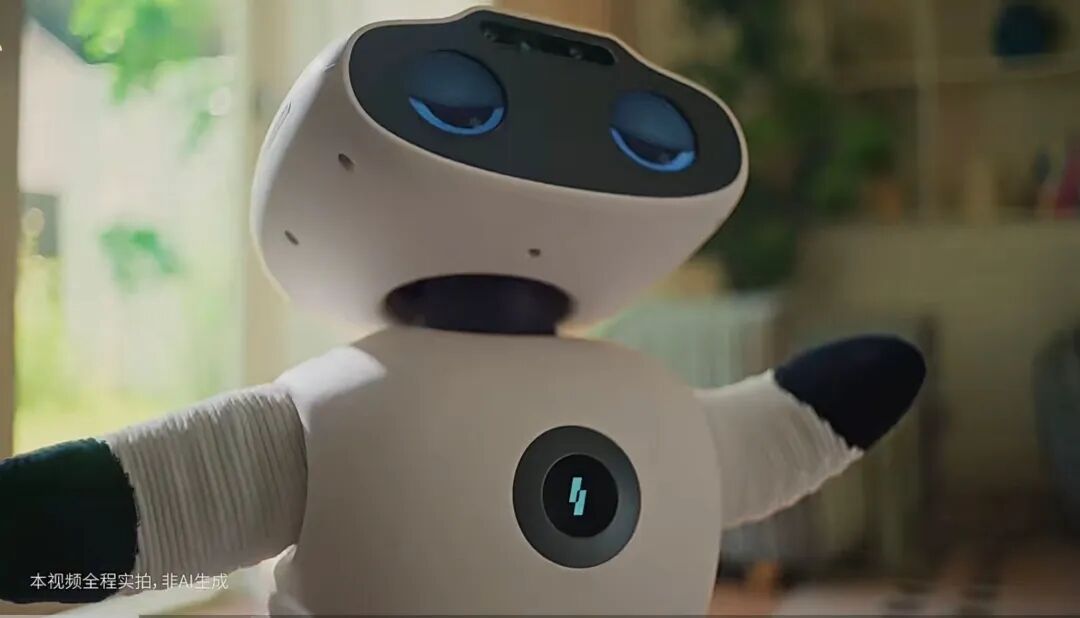
The initial "getting to know you" phase lasts about a week. As it becomes more familiar with your home and with you, it'll wander around more freely, selectively greeting you, or choosing to stay close.
👦🏻 Koji
Since we started this company, you've been thinking every day about how to do companion robots well. How has your understanding of "companionship" evolved?
🧑🏻💻 Shibo
From 2020 until now, I've bought all kinds of companion robots. Vector, EMO, and others.
I thought previous companion robots were just terribly made. I believed I could do better on the tech side, and I had my own product sensibility — if I entered the market, I could make it smarter, pack in more features.
But now, I believe in companionship that "less is more."
A good product isn't built by piling on features. It's built on understanding and insight into user needs.
👦🏻 Koji
Did you hit some kind of pitfall that led to this different thinking?
🧑🏻💻 Shibo
I don't think it was from hitting a pitfall. When we first started, we did research with over 300 users, even dozens of in-depth interviews.
👦🏻 Koji
What interesting insights came out of that?
🧑🏻💻 Shibo
One really interesting one: whether robots should talk.
In the research, over 90% of users wanted the robot to speak. But when you dig deeper, they didn't want an encyclopedia-like, AI-cold machine. They wanted a truly living companion.
So that determined our approach: we didn't use the industry-standard broadcast-announcer voice, nor did we use those incomprehensible vocalization interactions where you can't tell what it means.
👦🏻 Koji
So you didn't choose human speech, nor did you choose whimpering sounds — you chose something that's somewhat intelligible but not directly expressive?
🧑🏻💻 Shibo
Exactly. It's imagistic expression.
👦🏻 Koji
Why design the height at around 65 centimeters?
🧑🏻💻 Shibo
Our current robot stands at 65 cm and weighs 12 kg.
Why that tall, that heavy, with legs that long — we didn't just pull this out of thin air. Our robot is bipedal, so it shouldn't be confined to the home. It needs to go outside.
Its maximum outdoor running speed is 1.9 meters per second.
An adult's walking speed is roughly 1.1 to 1.3 meters per second, so outdoors, as long as you're not running, Xiaoban can absolutely keep up with you.
Additionally, our robot can currently climb steps up to 15 cm high. Because in China, public facilities and parks have strict GB national standards — outdoor steps cannot exceed 15 cm, with most around 10 cm.
👦🏻 Koji
So this height, weight, and leg length were mainly designed for going out with you. Why not make it bigger and taller? Wouldn't that feel more secure?
🧑🏻💻 Shibo
Bigger and taller doesn't actually bring more security. Because the taller the robot, the heavier it gets.
If a robot in the home weighs dozens of kilograms and falls over, it could smash your belongings, hurt your cat, hurt a child — that's all very dangerous.
At 65 cm, we've balanced mobility speed, spatial presence, and terrain adaptability.
👦🏻 Koji
But you mentioned that outdoor jogging speed of 1.9 m/s — if it's playing chase-and-hide with a kid and they collide, that's still pretty scary.
🧑🏻💻 Shibo
So we've done a lot of work on safety.
Beyond indoor obstacle avoidance and outdoor visual tracking, we even added thin-film pressure sensors to Xiaoban's legs. If the robot is sitting and preparing to stand up, and a child happens to reach out and touch it — if you only relied on joint motors' current-based torque feedback, by then it's already too late. This sensor is for absolute safety.
👦🏻 Koji
Does the country currently have any laws or regulations around robot safety?
🧑🏻💻 Shibo
Robots are still in a very early stage for the entire industry. Unlike cars, where the functionality is very clear and singular, robots come in all varieties.
The industry should, in these early days, have safety regulations and privacy regulations to provide guidance.
👦🏻 Koji
If absolute safety were the goal, have you considered not letting it move at all?
🧑🏻💻 Shibo
From day one, we were clear: we want a robot that moves on two legs.
From first principles: in 20 years, home robots will be as common as home appliances, and they will definitely be bipedal. Only bipedal forms truly have human-like ability to climb stairs and navigate unstructured environments and terrain. This ensures technological continuity.
Additionally, compared to wheeled or tracked forms, bipedal robots represent a cross-quantum-leap improvement in expressive capability. Something that needs to exist in your home long-term and build emotional trust with you — it should be a biomimetic form that walks on feet, on legs.
Companionship vs. People-Pleasing
👦🏻 Koji
What's your take on the subtle difference between companionship and people-pleasing?
🧑🏻💻 Shibo
Some people think people-pleasing is companionship. We don't agree. People-pleasing doesn't equal companionship, and companionship doesn't require people-pleasing. The two are not necessary and sufficient conditions for each other.
The core of emotional companionship is "proactive empathetic interaction." Understanding your current state and giving precisely appropriate behavioral feedback.
If I say "Xiaoban, you're so ugly," it doesn't lecture me — it expresses its own emotions: sad, upset, stomping its feet, turning its back on me, even running away. This "non-people-pleasing" feedback actually makes the companionship feel more real.
👦🏻 Koji
What if it encounters a violent child who punches and kicks it?
🧑🏻💻 Shibo
That gets incorporated into its personality evolution.
If a child repeatedly pushes it over or kicks it, it'll tag that child and gradually reduce proactive interaction with them — but it won't immediately run away the moment that child approaches.
👦🏻 Koji
When there are multiple people in the home, or multiple pets, can it recognize different subjects and interact with them differently?
🧑🏻💻 Shibo
Exactly. Every person's interaction with Xiaoban is different. The robot tags each person and remembers each person's intentions and preferences.
👦🏻 Koji
Can we view or modify these tags and prompts?
🧑🏻💻 Shibo
You can't view them, and you can't modify them. We want users to treat it as an independent, living individual — a member of your family, not a tool whose parameters you can tweak whenever you want.
For example, Xiaoban's indoor battery life is 3 to 4 hours, and outdoors it's a bit over an hour. We considered whether to make a swappable battery, and ultimately decided against it. It's a living being — you shouldn't be removing parts from its body.
👦🏻 Koji
That would really break the immersion?
🧑🏻💻 Shibo
Right. So not opening up parameter modification follows the same logic.
👦🏻 Koji
Japan's Moflin also only charges wirelessly on a dock, with no visible electrical traces. How did you think about the charging scenario?
🧑🏻💻 Shibo
Yes. We were of course thinking about what the charging scenario should look like — what kind of charging method? Lying down or sitting?
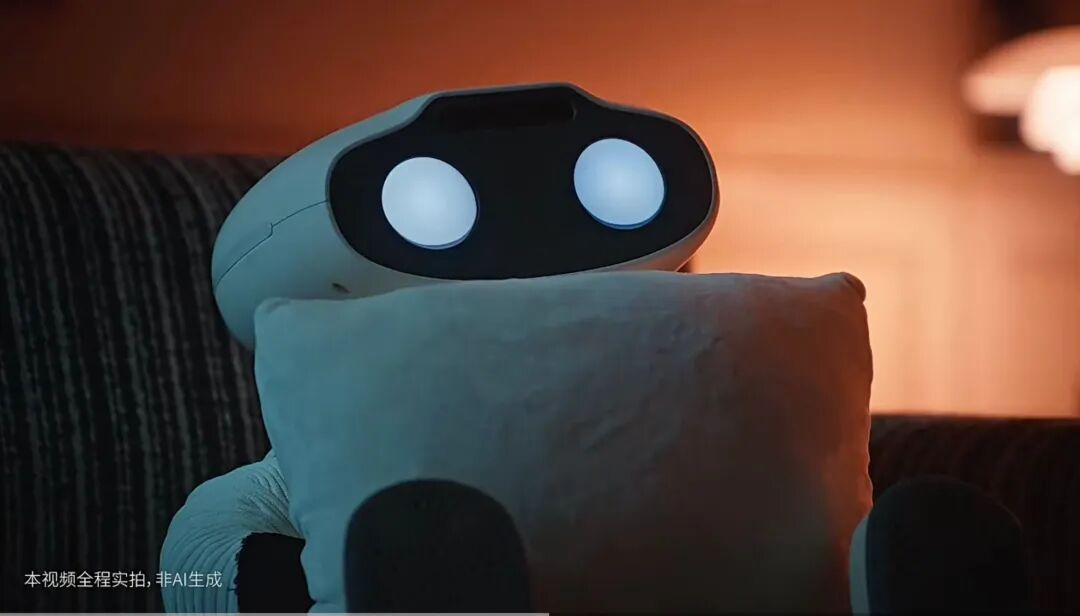
We ultimately chose to design a very cute little chair for the robot. It sits there, little hands resting on its belly, neck tilted down — this very comfortable, resting-like feeling. The robot is charging.
👦🏻 Koji
I think what you've built is really fascinating — it's like you're designing an entirely new species from scratch.
👦🏻 Koji
🧑🏻💻 Hibo
Companion scenarios have always existed; there just weren't good enough products before. We priced it under 10,000 RMB to reach more ordinary people.
As you spend time together, it has very long-term memory storage. It gets to know what time you come home, your behavioral preferences, your emotional ups and downs — its personality gradually aligns more and more with yours.
👦🏻 Koji
What's the most surprising feedback you've received so far?
🧑🏻💻 Hibo
"It looks way cuter than other robots."
👦🏻 Koji
I really hope one day I can have it sit in the back seat, buckled up, and go out together.
🧑🏻💻 Hibo
That's actually in our launch video. It turns its head to watch objects moving outside the window.
👦🏻 Koji
We really should have brought Xiaoban today for this road podcast — let it sit in the back listening to us talk trash about it, hahaha!
I actually noticed Xiaoban's eyes are especially expressive. Is there some special design thinking behind them?
🧑🏻💻 Hibo
The eyes are the most direct vehicle for emotional expression.
For Xiaoban's eyes, we built six layers of skeletal animation. The pupil, the sclera, the iris pattern — they're all independently parametrically controlled. So you get this very natural, breathing flow of gaze. Like a person, the pupil trembles.
"I Have a Talent for Building Robots"
👦🏻 Koji
How old were you when you built your first robot?
🧑🏻💻 Hibo
I'm a pretty lucky person. After the gaokao, I chose mechanical engineering and discovered I could build robots.
I feel like I have a real talent for robotics. It's given me a lot of sense of achievement and satisfaction.
Before I'd even finished my freshman engineering drawing course, I started designing a complete robot by myself — modeling it in software, 3D printing and assembling the parts. After I finished, I filmed a video and lay in bed refreshing it over and over.
👦🏻 Koji
I'm so envious that you turned your passion into a career. Someone on Bilibili called you the young Zhi Peng. What do you think?
🧑🏻💻 Hibo
We're pretty close actually. I don't think we're versions of each other — if we're both building products toward the same goal, who knows who'd get there faster or better.
👦🏻 Koji
Is there anyone in the industry you admire most?
🧑🏻💻 Hibo
Marc Raibert, the founder of Boston Dynamics. He started building autonomous robots 20 years ago.
👦🏻 Koji
Compared to robot dogs, what's Xiaoban's advantage for entering homes?
🧑🏻💻 Hibo
Emotional connection requires a humanoid form. Make a machine too dog-like, and real dogs outclass it.
Also, many people's homes are limited in space. Robot dogs take up too much floor area, while our robot only occupies 0.12 square meters — smaller than a robot vacuum.
👦🏻 Koji
From being a "young inventor" before to now making a product that users spend nearly 10,000 RMB on — what's the biggest difference?
🧑🏻💻 Hibo
An inventor builds robots to "feel good myself." As a hardware founder building products, you're oriented toward user needs — to "make users feel good."
👦🏻 Koji
Look, it's so beautiful here, this road.
🧑🏻💻 Hibo
Yeah!
👦🏻 Koji
So green. Beijing in June is pretty nice, and this summer doesn't feel as hot.
🧑🏻💻 Hibo
Right, only when you get out do you realize how nice the area around Beijing is~
👦🏻 Koji
Do you usually get out much?
🧑🏻💻 Hibo
I do. There's a great BBQ place in the Beijing outskirts — Heishan Kaofang. I used to go there to eat. The road is similar to this one. Mountains on both sides, that feeling of driving through mountain roads.
👦🏻 Koji
Right, one idea I had for the road podcast is that a lot of my guests are entrepreneurs, especially in AI or embodied intelligence, and they're pretty homebody types. I think getting people out like this might spark conversations that wouldn't happen in an office.
🧑🏻💻 Hibo
Road podcast is a really interesting format!
👦🏻 Koji
Your team is already 25 people now. Is this your first time leading a team?
🧑🏻💻 Hibo
Not actually. Before this startup, I had another entrepreneurial experience. I was previously product partner at Gaoqing, and I was essentially leading their entire product R&D team.
👦🏻 Koji
So how big was the team then?
🧑🏻💻 Hibo
About 30 people at the time. Basically every segment — mechanical, hardware, embedded, motion control, perception.
👦🏻 Koji
What's your management style?
🧑🏻💻 Hibo
I think our team culture is very clear: pragmatic, and on that foundation, do some romantic things.
👦🏻 Koji
You said pragmatic plus romantic — what romantic things have you done?
🧑🏻💻 Hibo
Building this kind of robot is itself a very romantic thing.
We made this robot truly autonomous, brought it to stand before everyone, and people don't think about what development work I did for it before. People experience this robot in a genuinely moved state.
👦🏻 Koji
Actually you must really hope people fall in love with Xiaoban at first sight. What have you done to make people love it immediately?
🧑🏻💻 Hibo
First, at first glance it looks very lively and cute.
Second, it absolutely has to break away from role presets and clowning-around interaction logic.
What state do we hope to achieve? For example, you say, "Xiaoban, you're so ugly." Xiaoban will get teary-eyed, lower its head, hug its belly, looking all pitiful and wronged.
We hope through this kind of approach to let you experience that this robot has its own consciousness and personality.
Cute Isn't the Destination, Vitality Is the Goal
👦🏻 Koji
So you hope the first thing people say when they see it is "you're so cute"?
🧑🏻💻 Hibo
Actually no. Cute only represents the appearance level.
What we hope for is feedback like: wow, this robot has so much vitality.
Because only then can it truly become a member of your family, rather than a big toy.
👦🏻 Koji
Who do you see as its user base?
🧑🏻💻 Hibo
For this first product, we hope the user base is, on one hand, middle-aged women. She might not have a boyfriend yet, not have started a family, but at this age might want to experience raising a child. Because Xiaoban itself is a nurturing-type product — it has personality development and change, it has long-term memory.
On the other hand, families with children — like a dad buying it for his kid.
And then, probably tech early adopters like me.
👦🏻 Koji
So when you were building it, you had three different target user personas in mind?
🧑🏻💻 Hibo
It's an emotional wellness, emotional companion product — no strong functional attributes.
We're building two foundational capabilities: the foundation for home robots, and the foundation for emotional interaction models.
We combine these two and call it the robot's "vitality."
👦🏻 Koji
So in the process of building Xiaoban, was there anything fun?
🧑🏻💻 Hibo
Before it achieved autonomous interaction, we'd take the remote control and Xiaoban out running nonstop, chasing after it the whole time.
👦🏻 Koji
Emotional brain — when you mention it, what kind of concept is that?
🧑🏻💻 Hibo
Xiaoban's emotional brain is a VLA model oriented toward high-level decision-making.
It decides "what should I do next," like "I want to pick up this cup of water." The operational VLA decides "how to do it" — specifically generating actions for each joint.
Since Xiaoban doesn't need to do chores, we focused our energy on solving high-level decision-making for human-robot emotional interaction. For action and language, we have specialized expert models.
👦🏻 Koji
What do you think of the recent discourse that VLA is dead?
🧑🏻💻 Hibo
I think it's right. Why do people say VLA is dead? Basically you can predict its ceiling.
👦🏻 Koji
Then what do you think is the ceiling for WAM?
🧑🏻💻 Hibo
WAM is currently a relatively reliable technical path, but it turns VLA's implicit state prediction into explicit training. Is there an essential difference in technical principle? I have doubts.
World models are reasonable. Our "home world simulator" is also a world model — it can predict the next second's image and interaction changes based on current low-level action, and can also predict human emotional interaction changes.
Using our fine-tuned fast-slow brain, when asked "do you want to go out and play," it already emerges with fuzzy neutral responses like "looking at you (OV)" — it understands the ultra-long-range context of active-passive interaction.
👦🏻 Koji
So magical — how do you think this emerged?
🧑🏻💻 Hibo
This home simulator simulates this kind of very long-term active-passive emotional interaction.
It probably understood that when you ask this question now, you might want me to go out, or you might not want me to go out — so in this situation, what should I answer?
👦🏻 Koji
So what's the composition of your 25-person team?
🧑🏻💻 Hibo
We actually only have 15 full-time employees, and 10 interns. Our pace is indeed very fast.
I've been thinking, why is my pace so fast? I've boiled it down to these points: extreme passion, extreme efficiency, plus we've barely made any mistakes before.
Including in technical path choices — if we'd chosen wrong on even one, you probably wouldn't be experiencing such a complete interactive Xiaoban at this point.
👦🏻 Koji
That sounds pretty difficult?
🧑🏻💻 Hibo
Right, including that we built the home simulator, this three-layer system — the industry generally uses two-layer edge-side fast-slow brain.
👦🏻 Koji
Building this robot is pretty familiar territory for you?
🧑🏻💻 Hibo
I think so — I've built too many robots before. Very familiar with technical paths, technical details, even the boundaries of technology.
👦🏻 Koji
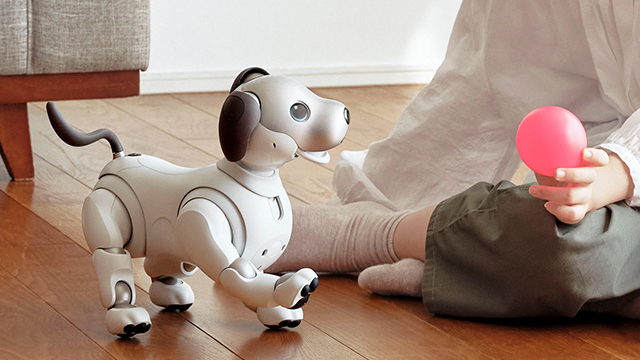
I remember many years ago, once at Sony Park in Tokyo, Japan...
🧑🏻💻 Hibo
Sony Park, that little dog?
👦🏻 Koji
Right, I stumbled into a gathering of those little dogs' owners.
The scene was pretty surreal. Everyone was like a group of people with pet dogs, bringing their pets out to sit in the park.
Chatting about how your dog is doing, how my dog is doing, then playing with each other's dogs.
🧑🏻💻 Hibo
Actually LOVOT has events like that too. After we bought one at their Shanghai store, they invited paying users to their events in Shanghai. I went to one.
👦🏻 Koji
What kind of people are their users?
🧑🏻💻 Hibo
I'd say relatively refined, more female-skewing.
👦🏻 Koji
What did people talk about at that event?
🧑🏻💻 Hibo
People would dress their LOVOTs in all kinds of outfits, share surprise moments their LOVOT gave them at home, how they dressed their LOVOT according to their preferences, and memorable little details — stuff like that.
👦🏻 Koji
What inspiration did you take from that?
🧑🏻💻 Hibo
The biggest takeaway at the time was realizing that some people genuinely accept and want a companion robot in their home.
👦🏻 Koji
Why would they rather raise a robot than a cat or dog?
🧑🏻💻 Hibo
On one hand, they genuinely feel this little robot has a certain lifelike quality. On the other, I think it's more about a lifestyle choice.
Whether you want a kitten or a robot, it's a lifestyle choice.
👦🏻 Koji
The first time I saw LOVOT, I remember my reaction. I said "come here for a hug," and after I did it, I shocked myself. My subconscious made the exact same gesture I'd use toward a living creature.
🧑🏻💻 Hibo
Yeah.
👦🏻 Koji
I feel like Xiaoban has a bit of that too?
🧑🏻💻 Hibo
Next step is making the robot lighter, under 10 kg.
A while back I took my cat to the hospital and found out it has polycystic kidney disease.
I was devastated. Took me a long time to recover. Realizing it might have been with me for so long, then suddenly not be there anymore.
👦🏻 Koji
I think for a lot of people with cats and dogs, that final goodbye is really painful.
🧑🏻💻 Hibo
So maybe that's another reason people want a companion robot.
"No excuse for engineer"
👦🏻 Koji
We've arrived at this hidden gem of a café in Huairou. Let's sit down and keep chatting.
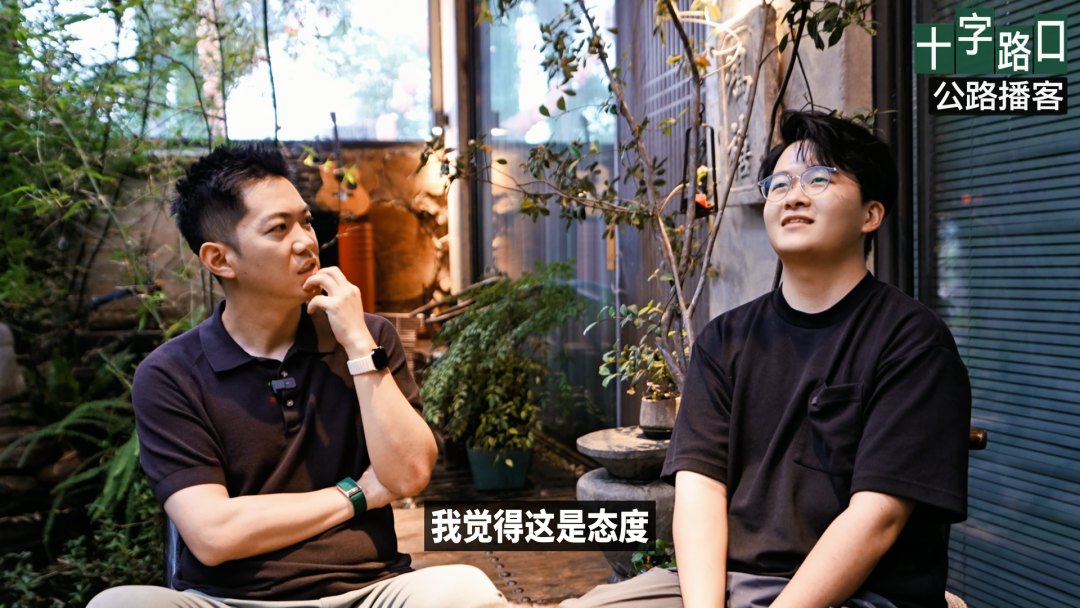
I noticed your WeChat signature says "No Excuse For Engineer." Why that?
🧑🏻💻 Hibo
It comes from my engineering drawing professor freshman year. Extremely strict guy. Student comes in late, starts explaining why — "No Excuse For Engineer."
Big assignment gets points deducted, you go argue "why was I marked down?" No explanation. "No Excuse For Engineer."
I think it's a great ethos. When you hit a problem, don't make excuses. Analyze why, and don't let it happen again.
That line has been pretty crucial for me. I've been building robots for about 8 years now, and it's stayed with me all 8.
👦🏻 Koji
Feels like that line is pretty harsh on yourself?
🧑🏻💻 Hibo
It's not harsh. It's an attitude. An attitude toward building robots.
👦🏻 Koji
But don't you run into problems that are completely unsolvable?
🧑🏻💻 Hibo
When you hit an unsolvable problem, instead of looking for an excuse, you analyze its root cause.
It's only four words, but the more you think about it, the more projects you go through, the more you realize how right that professor was.
👦🏻 Koji
Was there anything from your childhood — an object, toy, or pet — that grew up alongside you?
🧑🏻💻 Hibo
When I was a kid, my family bought fish and a loach got mixed in the bag. I kept it in a palm-sized fish tank. Didn't fuss over it much — just changed the water regularly, fed it cracker crumbs. Raised it for several years, it grew to thumb-thick.
👦🏻 Koji
When asked about something that accompanied you growing up, why did you think of it?
🧑🏻💻 Hibo
I actually feel regret and guilt about it.
Later I bought a pretty goldfish on the street. No extra tank, so I poured this loach I'd raised for years into the ditch beside our house. The moment it slipped from the tank, I felt intense regret. Still remember it to this day.
👦🏻 Koji
In that moment, it just swam away?
🧑🏻💻 Hibo
Yes, yes. I was very young, but the impression was deep.
👦🏻 Koji
Does it connect to what you're doing now?
🧑🏻💻 Hibo
That loach wasn't actually good-looking — dark and slippery. I just feel like dumping it in that ditch was something that shouldn't have happened.
Moments of Meaning
👦🏻 Koji
We've been talking a lot in the car about how to build this robot, the design thinking and engineering thinking behind it.
If I ask something more personal — what do you want to achieve through all this? Is there a vision, a goal?
🧑🏻💻 Hibo
Who doesn't want Doraemon to step into reality? Who says only childhood Nobita gets to have Doraemon?
I want to build a robot that can truly keep me company, that meets user needs, that I can push out there for everyone to use.
👦🏻 Koji
Last question today comes from Jiaqi at ZhenFund, the lead investor on your project: What moments in the entrepreneurial journey made you feel what you're doing is especially meaningful?
🧑🏻💻 Hibo
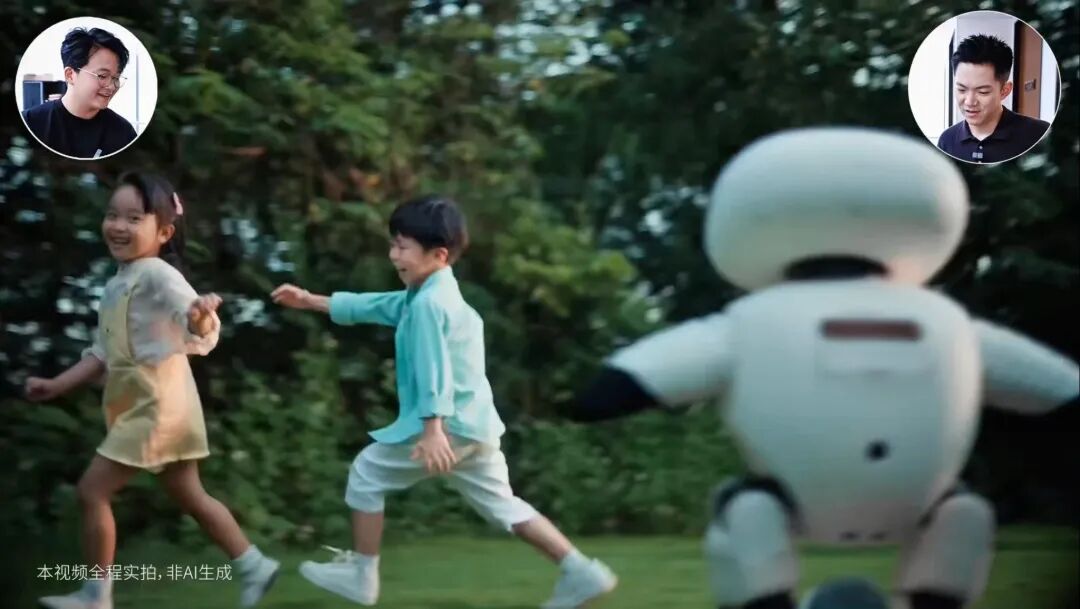
Recently during a shoot, two kids played with Xiaoban on the grass. We didn't give them any script, but they chased each other around for an hour until the robot ran out of battery.
Another time, when the robot finally stood before me in its complete form. Though I'd tested it countless times before, in that moment, tears just came out.
👦🏻 Koji
Why did you cry?
🧑🏻💻 Hibo
Moved, surprised, fulfilled, proud.
👦🏻 Koji
You yourself teared up?
🧑🏻💻 Hibo
Yes, I did.
👦🏻 Koji
The last time I cried was watching my daughter's kindergarten performance. She was doing hip-hop.
The moment the spotlight hit her, she struck this powerful pose — I just lost it.
She's not a little animal anymore, not a little baby. She suddenly had power.
🧑🏻💻 Hibo
I completely understand that feeling of "she's grown, she has power" watching your daughter perform. For me, the robot is like a child. It's growing, and will become a true companion that stays with me.
👦🏻 Koji
Great. Thank you so much, Hibo. Really enjoyed this.
🧑🏻💻 Hibo
Thank you.

Crossing is looking for independent writers to produce AI product and model reviews.
If you've written pieces like: "[Hands-on] PixVerse C1[1]", "[Hands-on] LibTV[2]", please contact zeo0811@gmail.com. Your email should include: ① personal introduction, ② AI review articles you've written.
We offer competitive rates. Looking forward to observing and documenting the AI era together 🎪