Interview with Xu Qing: President of Alibaba Cloud's Terminal Intelligent Computing Division | The "Hundred Shrimp" Battle Escalates — What Future Is Alibaba Cloud Betting on with JVS Claw?

The Great Shrimp War — Alibaba Cloud's Answer.
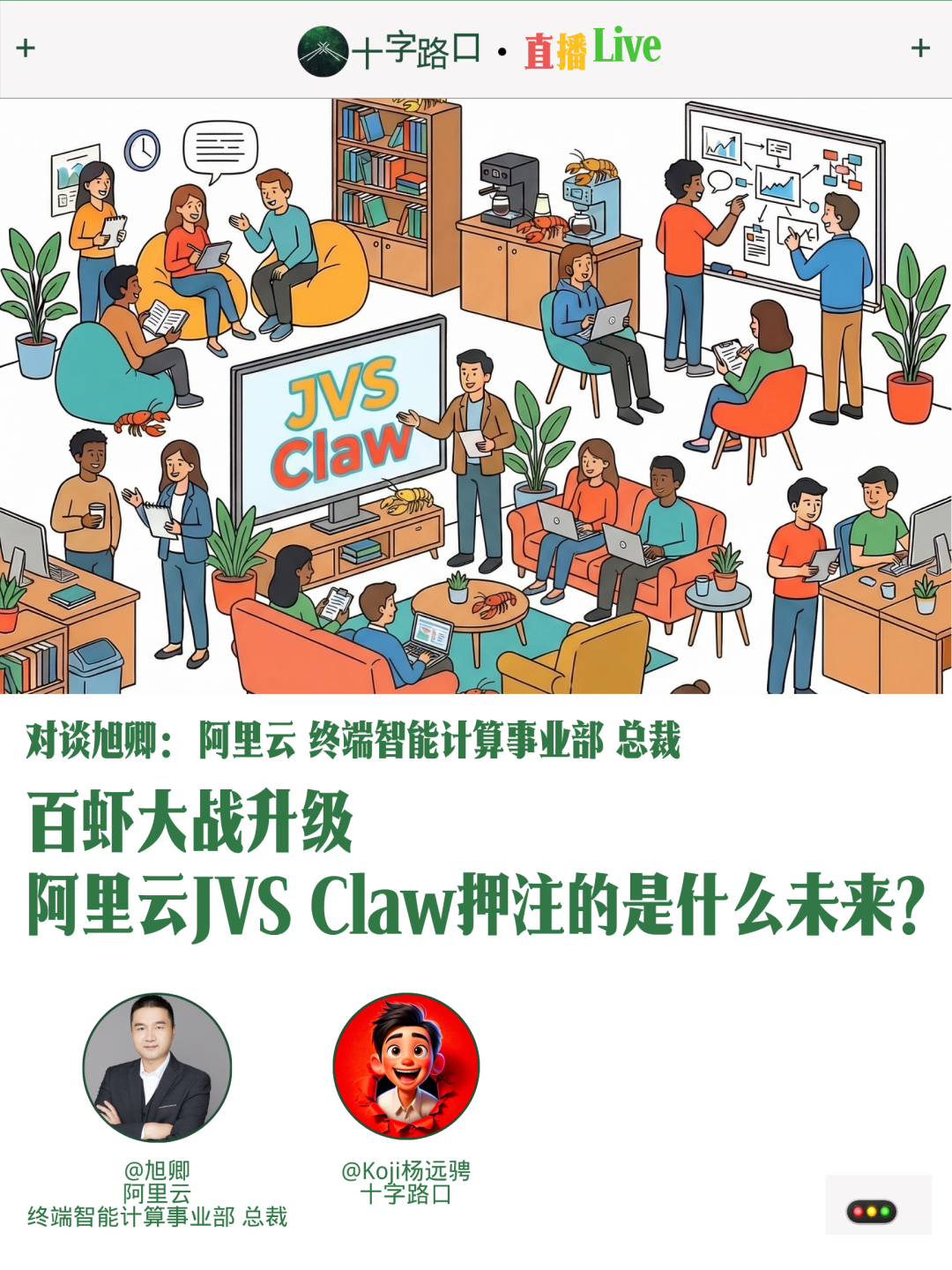
👦🏻 Interview: Koji
🥷 Edited by: Crossing
🧑🎨 Layout: NCon

Earlier this year, the OpenClaw open-source project went viral, almost overnight making "shrimp-raising" a national conversation.
Soon after, major tech companies and startups alike jumped in — the "Hundred Shrimp Wars" officially began, with everyone racing to answer the same question: what should an AI Agent product actually look like?
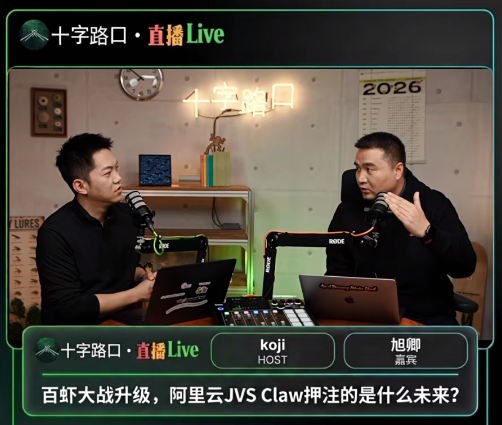
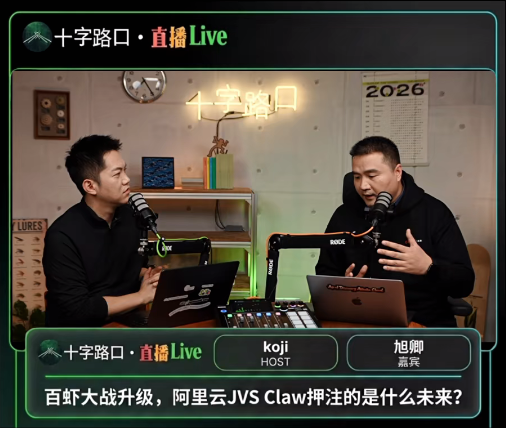
Crossing hosted a livestream with Xu Qing (Zhang Xiantao), President of Alibaba Cloud's Terminal Intelligent Computing Division, to discuss Alibaba Cloud's answer — JVS Claw.
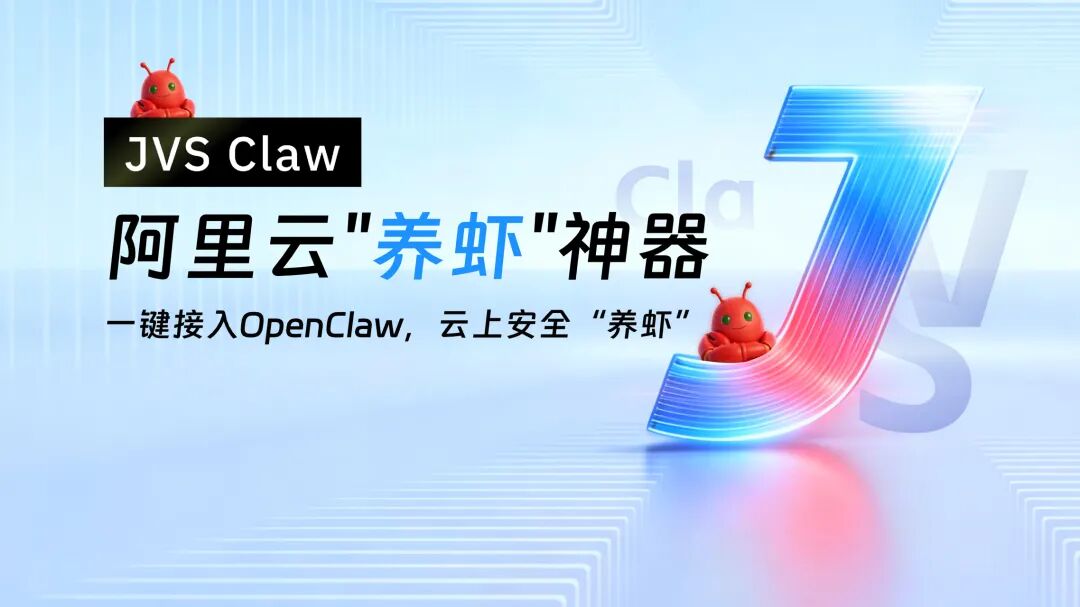
From day one, when they put OpenClaw into Wuying Cloud Computer, to launching their own product in less than a month, to why he believes OpenClaw is the Linux kernel of the Agent era — we covered a lot in ninety minutes.
Here's the full transcript of that conversation:
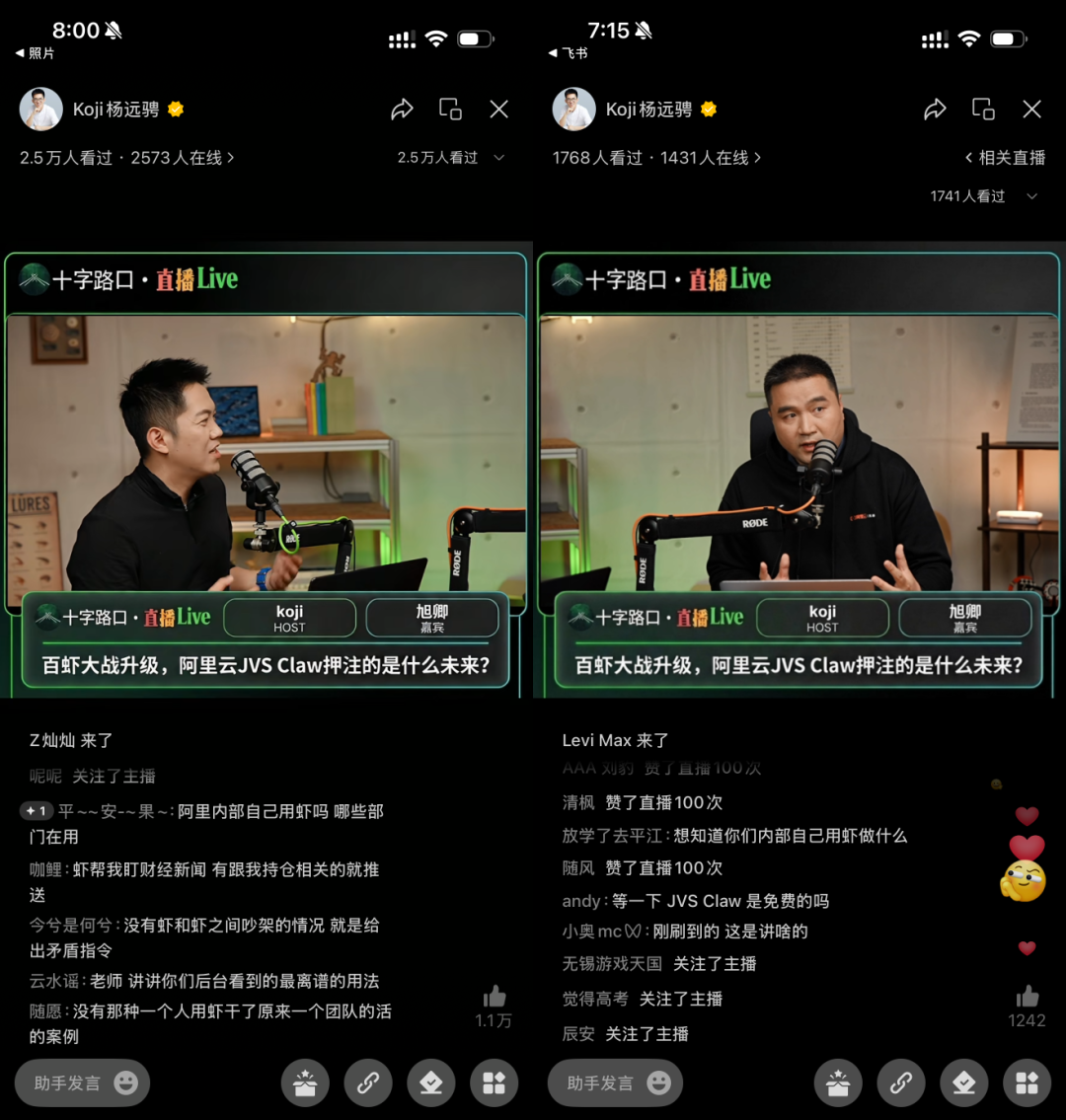
👦🏻 Koji
Today we're talking about OpenClaw. First, I'd like to ask Xu Qing to share what the internal discussions were like when you first saw OpenClaw at Alibaba Cloud, and how you built on Alibaba Cloud, Wuying, and the Terminal Intelligent Computing Division's past work to make your current strategic choice. Of course, we'd also love for you to tell everyone what makes JVS Claw 2.0 so great.
👨🏻💻 Xu Qing
Hi everyone, I'm Xu Qing from Alibaba Cloud, responsible for the JVS Claw business. Many friends have been asking what JVS stands for? It's actually short for JARVIS — "Just a Rather Very Intelligent System," the JARVIS from Iron Man. We hope to use technology to bring that sci-fi character into reality.
The essence of JVS Claw is simple: it lets anyone, through a few simple steps, have a personal super AI assistant like JARVIS. Today is also the official launch day of JVS Claw 2.0.
Currently, JVS Claw ranks very high on Apple's iOS charts, and it's available on all major Android app stores.
Step one: open your phone, search for JVS Claw in the app store, and download it.
Compared to the previous version, JVS Claw 2.0 adds many features, such as voice input and dedicated file spaces, making communication and collaboration with your AI assistant more convenient.
Step two: after registering, give your assistant a name, and tell him who you are and what you do. The more information you provide, the deeper his understanding of you, and the better he can assist you.
Step three: you can start talking to him directly. No need to write code, no need to configure various APIs or buy servers — right in this one app, you can have multimodal conversations with your super assistant.
👦🏻 Koji
Thanks for the introduction. Let's start from how JVS Claw came to be. When OpenClaw went viral across the Chinese internet, what was the most exciting point of discussion internally?
👨🏻💻 Xu Qing
I went to look at the code and architecture myself, and after analyzing it, I felt this was a very good thing for the entire Agent industry.
My judgment at the time was that it could help all parties in the industry quickly reach consensus. A year ago, everyone was discussing what an Agent is, and everyone agreed it was the application paradigm of the large model era, but there was no unified architecture for how to build one.
But overall, its architectural design was excellent. It could bring together forces from all sides and grow the Agent ecosystem.
👦🏻 Koji
When you say it defined an architectural paradigm that could form consensus, what specifically do you mean?
👨🏻💻 Xu Qing
In an interview two weeks ago, I said OpenClaw is like the Linux kernel of its day. Over 30 years ago, after the Linux kernel was released, it quickly formed consensus in the industry and spawned the entire Linux ecosystem.
Coincidentally, two days later, NVIDIA's Jensen Huang also said it's an operating system — exactly what I felt. OpenClaw's architecture is so similar to the Linux kernel back then. It's very open, architecturally like an OS kernel, compatible with various models and popular Skills today; in terms of communication channels, it's also compatible with various IM platforms.
This inclusive, all-embracing model is very similar to the open-source spirit and practices of the Linux kernel back then. So I judged this project would take off, and before the Spring Festival, our team went almost all-in.
👦🏻 Koji
I remember the first thing you did wasn't directly developing JVS Claw, but rather building a solution based on "Wuying" that let people quickly get started?
👨🏻💻 Xu Qing
Yes, the first reaction was to grab a computer and install it. I first installed it on my own Mac, but quickly found many problems, especially security issues. After all, it was just an open-source project, not a mature product, and the security risks at the time were unsolvable.
I immediately thought of products we've been working on for years — Wuying Cloud Computer and Wuying AgentBay (last year's Agent Infra). These two products fundamentally solve some security problems.
If OpenClaw could be deployed in Wuying Cloud Computer, at least basic security issues could be resolved, unlike the hassle of local deployment. So the first thing we launched was a secure deployment solution on Wuying Cloud Computer for the first wave of OpenClaw enthusiasts.
But later we saw that as the project grew, more and more ordinary people wanted to try OpenClaw too.
👦🏻 Koji
Right, I also bought a Wuying Cloud Computer at the time. I first installed it on my own computer, but as discussions about security risks grew online, I got a bit worried.
Then a friend recommended it, and I bought a month of Wuying Cloud Computer service to deploy it. Later I recommended it to friends, but still found there were barriers — not everyone could smoothly register for Alibaba Cloud, purchase, and deploy successfully.
👨🏻💻 Xu Qing
Indeed. We compiled very detailed tutorials at the time, but the barrier was still high. Although buying and using Wuying Cloud Computer is simple, many people aren't used to CLI operations, and a lot of the feedback we received was that they still couldn't install it successfully.
👦🏻 Koji
At the time you had to configure all sorts of APIs yourself, even the Brave API for search.
👨🏻💻 Xu Qing
Yes, connecting to various IMs was extremely complex, especially since that version hadn't been adapted for China yet — the barrier was very high.
So we were thinking then about how to lower the barrier and make the process of "raising shrimp" simple for everyone. The new product direction started brewing at that point.
👦🏻 Koji
And that's how the idea for JVS Claw came about?
👨🏻💻 Xu Qing
Right. We saw many pain points — security could be solved through Wuying, but various configurations, like API Keys, required users to purchase services from various cloud providers, which stumped many people. So in product design, we wanted to package APIs, models, and finding Skills so everyone could get them with one click. That was the initial idea.
We polished the product along these lines, and after the Spring Festival, we trialed it internally first, and the feedback was excellent.
So around March 20th, we released the first beta version. Whether inside Alibaba Cloud or with external customers, the response was very positive, giving us lots of motivation to continue deeper investment.
👦🏻 Koji
Someone in the comments is asking, why does their "shrimp" always forget things? Regarding memory mechanisms, does JVS Claw follow OpenClaw's design, or do you have your own approach?
👨🏻💻 Xu Qing
This was indeed a major problem many early users encountered with the open-source OpenClaw: things you told it today, it would forget by tomorrow. We fully considered this in product design, and while following some of OpenClaw's rules, we innovated a lot on the memory system.
For example, we created Daily Notes, letting the "shrimp" judge based on that day's interactions which content should go into permanent memory, which into Markdown files, and which into the internal knowledge base. Every day, it conducts self-reflection and analysis.
This analysis process is part of its self-evolution. It promptly summarizes and distills the day's conversations, stores them in permanent memory, and this information then becomes context in subsequent conversations — you won't feel like it forgot things. The open-source version indeed had this problem.
👦🏻 Koji
So JVS Claw automatically triggers a function to organize that day's context at the end of each day?
👨🏻💻 Xu Qing
Yes, this is a very important characteristic of JVS Claw: self-evolution capability. At a specific time each day, it reflects on questions it has answered, sees if there are better answers, and stores content it deems worth remembering into the memory system.
👦🏻 Koji
From project initiation to first version launch, JVS Claw moved very fast, and there was a Spring Festival in between?
👨🏻💻 Xu Qing
Yes, our team members probably spent the entire Spring Festival building this product. Everyone loved this project so much, and was very excited when we initiated it, feeling we needed to provide a better OpenClaw product for the general public. So it launched in less than a month.
👦🏻 Koji
There must have been a key decision then: what core features had to be in the first version? After all, achieving perfection would require longer polishing time.
👨🏻💻 Xu Qing
Building products is about making choices, solving the most important problems at hand. Security, for example, was something we couldn't compromise on. We saw too many security issues.
The product first had to be simple and easy to use, working smoothly on both phones and computers. Therefore, "one-click deployment" was the first thing we had to achieve.
Second, security. Running "shrimp" on a local machine carries enormous risk. Your API keys, personal files, permissions set too low and nothing works; set too high and you open massive security holes. So we treat security as a non-negotiable baseline. Every AI operation runs inside a dedicated Wuying Cloud Computer environment we call "Claw Space."
👦🏻 Koji
Is this Wuying Cloud Computer online 24/7?
👨🏻💻 Xu Qing
Yes, 24/7 real-time response, and we've blocked all non-essential business ports.
OpenClaw initially connected to Telegram and Discord, which don't work in China. Connecting to domestic IM apps was extremely complicated with poor UX — people treated it as a bot, not an agent.
So third, we decided to build our own IM purpose-built for agents, supporting multimodal interaction and eventually group chat, so your agent and my agent can become friends and collaborate.
Fourth, cross-device sync. I can't carry my laptop everywhere, so information has to sync across Web, PC, Mac, mobile. You publish a task on your computer, you see it executing in real time on your phone.
Finally, Skill quality. If you allow unvetted Skill scripts of varying quality, your JVS Claw could easily go "rogue."
👦🏻 Koji
How did you verify Skill quality and security in such a short time?
👨🏻💻 Xu Qing
We formed a dedicated internal Skill team responsible for curating and building high-quality Skills. That's why the first version only launched with 13.
Of course, we also allow users to create their own Skills, and even let JVS Claw generate Skills autonomously to complete specific tasks. These are capabilities we consider non-negotiable.
At the same time, some features we deliberately held back from the first release. For example, agent collaboration that we demoed — after some tech journalists tried it, we realized that enabling arbitrary group creation and collaborative task completion still had a fairly high barrier and needed more polish.
That feature will arrive in the April release, when one person will be able to command an entire agent army.
Also, many users ask why there's only a Mac client, no Windows. That's genuinely a prioritization issue — we'll release a Windows client in upcoming versions.
👦🏻 Koji
Since Alibaba Cloud's Terminal Intelligent Computing Division evolved from the Wuying Division, and one of its key products is Wuying Cloud Computer, you leveraged that core advantage in JVS Claw's architecture — pairing every JVS Claw with a cloud-based Wuying Cloud Computer.
I'm wondering, if I run multiple tasks simultaneously, does that spin up multiple cloud computer instances? How is this different from the sandbox mode some agent products use, where containers are destroyed after use?
👨🏻💻 Xu Qing
We provide an independent cloud computer for every Clawbot. Cost wasn't the first consideration. Many other products use the kind of ephemeral containers you mentioned to control costs. But that approach makes effective memory impossible.
For example, if I have JVS Claw visit Xiaohongshu, the first login — if the environment is temporary, the next time the session state is gone.
But in a dedicated Wuying Cloud Computer, all login states and memory are permanently preserved, never lost. This is crucial for the end-user experience.
Of course, we also allow users to create multiple Clawbots, each with its own environment. To enable collaboration between them, we added shared spaces in version 2.0.
In the future, they'll have their own dedicated communication channels, using their own language for efficient communication — not human language like we use.
👦🏻 Koji
So files generated by JVS Claw in my Wuying Cloud Computer are also stored permanently?
👨🏻💻 Xu Qing
Yes. Files are first stored in a Workspace on the cloud computer. Meanwhile, for better interaction experience, JVS Claw 2.0 provides a file sharing space where all generated files can be saved with one click for anytime access.
👦🏻 Koji
You also mentioned a cool feature: Mac client users can "cloudify" their local computer with one click. What does that mean?
👨🏻💻 Xu Qing
This is a very cool feature. Take my Mac here — after downloading the client, click "Create Local Clawbot," and this computer gains OpenClaw capabilities.
But it's different from the open-source version. First, it solves security issues — we have a mechanism that turns your computer into a more secure sandbox.
Second, zero configuration required. The models it needs directly share the services from your JVS Claw account. This dramatically lowers the barrier and makes the experience excellent.
You can even use the JVS Claw client on your phone to remotely control and collaborate with this computer.
👦🏻 Koji
There's a sharp question from the comments: were there internal objections that OpenClaw is just a passing fad?
👨🏻💻 Xu Qing
People have different views on "whether it's just a fad." But I don't think it is. I said two weeks ago: it should be a foundational project on the path to AGI.
I used to work on Linux — I'm essentially a veteran there. I believe it will become an open-source project with powerful vitality, like the Linux kernel. It may not be the only path to AGI, but it is certainly foundational.
Of course, that's my view. But we can already see this project's powerful vitality. A few weeks ago, its GitHub stars surpassed both React and the Linux kernel. What took the Linux kernel 30-plus years, it did in 30-plus days. That's stunning, and from another angle proves it can't be just a passing fad.
Even if it were a fad, it would certainly spawn more foundational projects like OpenClaw — just as the Linux kernel gave rise to compilers, middleware, and the entire ecosystem.
👦🏻 Koji
You used Linux as an analogy for what OpenClaw represents. You said Linux's code was "beautiful." But some argue OpenClaw isn't innovative, that it just assembles existing pieces like Lego?
👨🏻💻 Xu Qing
When I saw OpenClaw, it reminded me of when Linus created the Linux kernel — a project built by a third-party developer, not a major corporation. That creates the conditions for more developers and enterprises to participate in building it together.
Then there's its open architecture. It can integrate models, Skills, and various ecosystem elements into an organic whole. When these powerful components combine, the whole becomes stronger. In my view, it assembles all the essential elements needed to build a general-purpose agent.
👦🏻 Koji
One user in the comments remarked: "Back when I used Wuying for work, who'd have thought I'd be raising shrimp now? Two years of Wuying, suddenly it became a shrimp pond — life is strange."
👨🏻💻 Xu Qing
We've been building Wuying since 2019, and with prior technical accumulation, this is already a product with 8 to 10 years of history.
Our original mission was to transform the computer using cloud computing technology. The first scenario was office work, where the primary problem to solve was data security. That same logic — security first — carries through to how we approach OpenClaw today.
Second was compute expansion — how to enable elastic scaling when people need more powerful computing.
Third was ease of use — being able to access your work environment from any device without connecting to various VPNs.
With the emergence of large models, people kept asking how cloud computers could integrate with AI. In 2024, we released the Wuying AI Assistant — Xiaoying.
Last year at the Apsara Conference, we demoed something called "Agentic Computer" — that was essentially an early Jarvis. You could converse with it and give voice commands like talking to a person.
So around August or September last year, we already wanted to build something very aligned with what OpenClaw is today — turning the computer into a living, breathing intelligent agent. When OpenClaw appeared, we felt its architecture was exceptionally refined and could enable so many enterprises to collaborate. So when building JVS Claw, we prioritized this project.
👦🏻 Koji
This livestream is called "The Hundred-Shrimp War," and JVS Claw has joined the battle. A direct question: among all these "shrimp," what special advantages does JVS Claw have?
👨🏻💻 Xu Qing
"The Hundred-Shrimp War" is like the "Hundred-Model War" two years ago — it was bound to happen. It's not just me; many far-sighted people in the industry saw this project's importance. We're seeing many enterprises building products on it — internally we joke that we have four or five "shrimp" ourselves, targeting databases, marketing, and other scenarios.
What makes JVS Claw different is that we're building a general-purpose agent, a general agent like Jarvis. Compared to other products, our biggest differences are:
First, security above all. We insist on using Cloudspace, i.e., Wuying Cloud Computer, as our secure execution environment. Users don't need to install anything on their own computers — one click and you have it.
Second, Skill quality. Many products incorporate large numbers of uncertified Skills, which carries significant security risks. We have a dedicated team to curate and refine Skills.
Third, persistent runtime environment. Some "shrimp" use ephemeral containers, making it hard to preserve context, memory, and login states. Our independent cloud computer environment solves this.
Fourth, out-of-the-box cross-device experience. Users don't need to scan QR codes to configure various IM apps. We have our own cross-device interaction capabilities and IM Server, ensuring chat history is permanently stored and synced across devices.
Finally, task execution quality. We have a dedicated team optimizing long-task execution to ensure no interruptions and optimal results, with deep refinement of Skills for common functions like PDF creation and website manipulation (e.g., visiting Bilibili, Xiaohongshu).
👦🏻 Koji
So it's not just pre-installed, but your team specifically optimized them?
👨🏻💻 Xu Qing
Yes. This follows the same development philosophy as the Linux kernel — taking an open-source project and making it an enterprise-grade operating system requires enormous work.
We call it "building internal strength" — heavy investment in context engineering, model engineering, and memory engineering. By contrast, some "shrimp" may just be wrapping a shell around OpenClaw. That's a very different thing.
👦🏻 Koji
So beneath the surface of this seemingly explosive "Hundred Shrimp War," it's actually an endurance race with punishingly high demands across every dimension.
👨🏻💻 Xu Qing
Exactly. We're not treating this as a project we'll abandon after a few months. It carries forward the Agentic Computer vision we unveiled at last year's Apsara Conference — the goal is to truly transform the computer into a super-intelligent agent, like J.A.R.V.I.S., capable of real-time communication with you and helping you tackle complex work.
👦🏻 Koji
If you were a user right now, not the product lead, what would you say JVS Claw most needs to improve?
👨🏻💻 Xu Qing
During the two-week beta, we received massive amounts of user feedback. Early on, people asked: I generated a PPT or PDF — how do I actually get the file? Even our CEO uses it daily and has submitted plenty of suggestions. Many of those issues are already resolved in today's official release, but there's still a lot of functionality to refine.
One feature I've personally been looking forward to is group chat. It's not just chatting — it's about one person commanding a JVS legion in a group to accomplish complex tasks that require multi-person collaboration.
👦🏻 Koji
Commanding your own Agents, or other people's too?
👨🏻💻 Xu Qing
Both. In the next version, users can create up to 10 Agents. Like a "one-person company," you can assign them different roles: product manager, project manager, operations, and so on. Each has its own Skill system, working together 7x24 in a group chat to complete a complex project.
👦🏻 Koji
So when you open a new Agent, you need to do some initial configuration?
👨🏻💻 Xu Qing
Different roles require different skill systems. For a product manager, the strongest capability might be insight into product-level concerns and user needs. For a software engineer, it would be AI coding ability.
How do you get them to collaborate in a group to complete a complex project? Essentially, you grant them different roles.
Another major demand comes from enterprise customers asking: do you have an enterprise version? We're polishing that now — releasing next week. It lets companies build a secure, auditable, governable JVS Claw internally. We're calling it JVS Crew.
👦🏻 Koji
What are the core differences between enterprise and personal versions?
👨🏻💻 Xu Qing
Based on customer research, we see several major differences.
First, permission management. Different Agents need tiered permissions — a finance Agent and an HR Agent should have access to different data and systems.
Second, knowledge isolation, ensuring sensitive corporate data doesn't leak.
Third, audit trails. Every Agent action must be logged for review.
Finally, enterprise-grade Agent collaboration: how to effectively distribute tasks among thousands of employee "shrimp," and where to insert necessary human approval steps in workflows. JVS Crew will answer these questions.
👦🏻 Koji
Sounds like this is still an incredibly demanding project?
👨🏻💻 Xu Qing
I often say the distance between an open-source project and a mature product is quite large.
For example, when people early on tried building cloud platforms with various open-source projects, they found they could never match something like Alibaba Cloud's self-developed system.
First, you haven't properly absorbed the open-source code; your mastery may be insufficient. But when we look at OpenClaw, our approach is to fully master it before building a product on top of it.
That way, when you do end-to-end feature development, it becomes completely natural.
👦🏻 Koji
Alibaba Cloud used to sell infrastructure. Now JVS Claw goes straight to end users. In the future, do you want to be a company that sells "shrimp," or one that sells the infrastructure for raising "shrimp"?
👨🏻💻 Xu Qing
That's a great question. Alibaba Cloud originally sold compute infrastructure. Last year's Agent Bay was infrastructure for Agents, and it forms the solid foundation beneath JVS Claw.
We're building JVS Claw not to sell applications, but as a demonstration. Many enterprises, after seeing JVS Claw, want to build their own versions. Our mission remains, as a cloud computing and AI company, to provide the compute infrastructure so everyone can raise their "shrimp" well. JVS Claw is simply a great demo.
Our vision is for every enterprise and every developer to be able to build their own customized "shrimp," proprietary "shrimp," and Agent products on the "shrimp" infrastructure we create.
Some recent "shrimp" releases on the market — like Wealth's "Miaoxiang," and Accio Work from our group's international commerce division — were built on this same compute infrastructure that JVS Claw uses.
👦🏻 Koji
That includes cloud services, plus AgentBay's infrastructure — whether sandbox, memory, and so on?
👨🏻💻 Xu Qing
Yes, sandbox, memory, IM — this entire system, we open to our partners and customers. They can build their own proprietary or customized Agents on this infrastructure.
We're definitely not an application company. We're more focused on making Agent infrastructure as ubiquitous as cloud computing, as basic as utilities — something every company can readily leverage.
👦🏻 Koji
Lots of users in the comments want to know: what are JVS Claw's power users actually doing with it? Any interesting use cases to share?
👨🏻💻 Xu Qing
Great question. The product hit the iOS top 20 on day one. The next morning around 6 or 7 AM, I was stunned by the real-time data — there was a massive spike in token calls. Turns out, many users had set scheduled tasks.
For example, at 6 AM, have your "shrimp" summarize political and financial news from the past 12 or 24 hours. That was one of the first scenarios people thought of. Others connected their IM and email, having their "shrimp" compile a report of the past 24 hours' messages before work each day and place it on their desktop.
👦🏻 Koji
The shrimp clocks in before the human does?
👨🏻💻 Xu Qing
Yes, 6 to 7 AM is one of our peak usage windows. It generates reports in Excel, PPT, PDF format, waiting on your desk.
Another major use case is boosting office productivity — meeting minutes, spreadsheet processing, resume generation, email management. For office workers, it's like a super AI assistant that follows you everywhere. Of course, some use it to develop websites, monitor stock prices — many uses exceeded our imagination.
👦🏻 Koji
You also mentioned an interesting case before — someone raised three "shrimp," then used the smartest one to train the other two.
👨🏻💻 Xu Qing
Yes, "shrimp" need to be "raised." When you first start using one, it might seem a bit dumb. You need to let it get to know you. For example, I told mine right away: "My name is Zhang Xiantao, I work at Alibaba Cloud — go search the entire web for information about me and form a memory of who I am." Once it understood my preferences and work, it became incredibly attuned to me.
Once, it generated a file for me, and I casually said "send it to me" — and it actually sent me an email. I was surprised how it knew my email, then remembered: it had found and memorized it while searching for my information online.
Once you've raised a smart "shrimp" like this, when you create new ones, there's no need to start from scratch. Like that user, I have the first smart "shrimp" teach its knowledge and experience to the new ones.
👦🏻 Koji
Pretty fun. You've seen so many users accomplish tasks with JVS Claw — were there any where people initially didn't expect it to work, but it actually pulled it off?
👨🏻💻 Xu Qing
I remember one very clearly. A white-hat user who does penetration testing. We interviewed him later, and his feedback was that he used JVS Claw for security testing and environment simulation. He felt JVS Claw excelled at something in particular: there's no timeout on any task.
👦🏻 Koji
How did you eliminate timeouts?
👨🏻💻 Xu Qing
This really comes down to different product design philosophies. We designed it so any task runs 7x24 — you never need to interrupt it.
Especially for complex tasks that may need long execution times, you need a robust execution environment that can sustain long-running processes. JVS Claw was born with this design. But some tools or systems have a 120-second timeout mechanism, which he found particularly unfriendly. With JVS Claw, he replaced that tool instantly.
He also leveraged JVS Claw's memory system, so the "shrimp" could better understand his penetration testing process. The next time he did similar testing, everything went smoothly. You could say that through continuous teaching, it learned — and next time for the same type of work, you don't need to teach it at all. Just give it a simple task, and it automates the rest.
👦🏻 Koji
Beyond these pleasant surprises, are there tasks users expect Agents to handle but still can't?
👨🏻💻 Xu Qing
Of course. I've always believed Agents need cloud computers and cloud phones to connect the internet and mobile internet — these two digital worlds — and through them, establish connections with the physical world. But at this stage, we haven't yet given them "hands" and "feet."
For example, users want voice interaction, or the ability to make a phone call after completing a task. The calling function (via IM) will come in the next version. Users want it to be omnipotent, but that requires continuously developing corresponding Skills for it. Next we'll develop video calling, so it can "see" the outside world through phone cameras.
We're also working on hardware products recently — JVS Box, JVS Book — to give JVS Claw the ability to interact with the physical world.
👦🏻 Koji
You mentioned "self-evolution" earlier — can you expand on that?
👨🏻💻 Xu Qing
Self-evolution is something that had to be built into the product from day one. If a "shrimp" can't evolve on its own, its capability ceiling depends entirely on you constantly teaching it. We want it to learn by itself, become smarter, and understand you better.
We've designed three layers of self-evolution.
First is Skill evolution. The "shrimp" can search for and install Skills from the Skill Hub on its own. When you notice it's missing a certain skill, you can even prompt it: "If you don't have this skill, go learn it yourself." This gives it more initiative.
Second is memory evolution. It reflects every day, learning from its Daily Notes and judging what should be stored in long-term memory. Over time, it accumulates more and more user preferences, work habits, and historical decisions — the longer you use it, the better it understands you. This isn't just prompt optimization; it's connecting a complete memory system with the behavioral system.
Third is interaction evolution. The Agent learns the user's communication style and preferences, and gradually adjusts how it interacts with you.
👦🏻 Koji
In your experience using JVS Claw, can you give a concrete example where you felt its "autonomy"?
👨🏻💻 Xu Qing
Take Skills as an example. We assign the Agent a task, and even when we judge that it doesn't have the relevant skill, it can — after receiving the instruction to "go find the skill yourself" — autonomously download and install it.
For instance, initially we hadn't provided a skill for creating PPTs, but it automatically found and installed one from the Skill Hub, ultimately completing the PPT. This really surprised me at the time. Though it's now standard, in the early stages of development, this was quite delightful.
👦🏻 Koji
You mentioned "Shrimp Profile" earlier. Is that name still being used?
👨🏻💻 Xu Qing
We were literally discussing internally yesterday whether to keep using the name "Shrimp Profile." People worry it sounds too much like a game save file and might confuse users.
We're tentatively still calling it that. The concept was proposed to solve a sharing problem: when I've trained a "shrimp" — especially one with general-purpose skills rather than personal capabilities — how can I conveniently share it with you?
We might already be Agent friends, but I need some way to share this capability with you, so your "shrimp" can immediately have it too.
👦🏻 Koji
So what's being shared isn't just one or several Skills?
👨🏻💻 Xu Qing
Right, it's a capability set. We've packaged this set into a "profile." But unlike a game save, it can genuinely transfer the capabilities you want to share at this stage to a friend.
👦🏻 Koji
What kind of "profile" goes beyond a collection of Skills? I understand that an HR-specialist "shrimp," for example, is also composed of several Skills behind the scenes. It sounds like you're doing more — so what's the part that exceeds Skills?
👨🏻💻 Xu Qing
It includes not just Skills, but also the memory I mentioned earlier. Simply having Skills only gives you basic capabilities. But "Shrimp Profile" shares the memory system accumulated through "shrimp-raising" on top of those Skills.
We can abstract and share this memory with you, saving you the process of raising it from scratch.
👦🏻 Koji
Got it — the Memory that the Agent has accumulated historically also gets shared along with the "profile"?
👨🏻💻 Xu Qing
Yes.
👦🏻 Koji
Another question — there's a popular concept now called Trajectory, where you store the Agent's task execution traces for post-training to help it continuously optimize. Do you have any practice in this area? What's your view on this direction?
👨🏻💻 Xu Qing
Large models have pre-training and post-training. Post-training is essential to achieving today's AI Coding or Agentic AI capabilities.
But JVS Claw is a product for end users, and all user data belongs to the users themselves. We take data security and protection very seriously, so this data will never be used for model post-training. As for how to give the model Agentic AI capabilities, that was already addressed during the model training phase.
👦🏻 Koji
Understood. Another question I'm curious about — regarding Agent Team. There's a recent view that assigning fixed roles like "product manager" or "tester" to Agents is forcibly putting shackles on unlimited general intelligence.
Humans divide labor because our capabilities are limited, but AI may not need to. The real purpose of dividing multiple Agents may simply be to manage limited context.
So a new practice is to no longer divide Agents by role, but by the context they carry.
👨🏻💻 Xu Qing
Right. From the product perspective, it is indeed divided by role. One of the core reasons for this is exactly the context management you mentioned.
In the "shrimp-raising" process, 70% to 80% of Input Tokens come from context. Without providing relevant Context, the Agent becomes like an amnesiac and can't complete tasks well. But context can't be infinitely long, or Token consumption and efficiency become problems.
Therefore, in team collaboration, we need to divide and manage each party's context by assigning different roles, enabling efficient work.
👦🏻 Koji
So essentially it's for clearer context management, not because different "shrimps" actually have different innate talents?
👨🏻💻 Xu Qing
Yes.
👦🏻 Koji
I see someone in the comments asking "looking forward to raising shrimp on my phone."
👨🏻💻 Xu Qing
I saw that comment too. We do have another product called Mobile Claw, which will be integrated into JVS Claw in the future. What you're seeing now is the cloud computer; there will also be a cloud phone in the future, through which you can connect to the mobile internet world. This opens up a whole new realm of possibilities.
The next month's release will reflect this — stay tuned.
👦🏻 Koji
Next question: "Teacher Xu Qing, has your child started using JVS to 'raise shrimp' yet?"
👨🏻💻 Xu Qing
Well timed. Just last weekend, I installed JVS Claw on both our home computer and phone for him, and he's already started "raising shrimp."
👦🏻 Koji
What is he using the "shrimp" for, if you don't mind sharing? Or is that his privacy?
👨🏻💻 Xu Qing
He hasn't told me yet. I'll ask when I get home tonight and report back to everyone.
👦🏻 Koji
Another question — can JVS Claw scrape WeChat Official Account data? We know "a certain book" data is possible.
👨🏻💻 Xu Qing
Users are indeed using JVS Claw for some typical operations scenarios, like WeChat Official Accounts, Xiaohongshu, and Bilibili. Of course, some platforms have expressed concerns about this.
Overall, with AI's development, fully automated AI operation may still raise concerns at this stage. Therefore, we believe human involvement remains important. That's why we built a cloud computer that can be opened at any time into the product design — what we call "Human In Loop" — so people can interrupt or participate in the Agent's work at any time.
So whether doing Official Account or Xiaohongshu operations, the "shrimp" can prepare all the materials for you. After you review and confirm, a human clicks publish. Though the "shrimp" itself has one-click publishing capability, before all parties reach consensus on this, we solve it this way: humans can intervene in real-time in the Agent's execution process.
👦🏻 Koji
Understood — the human completes the final "launch" action. Let's return to the Agent itself. Whether it's the "shrimp" or OpenClaw, the core is AI Agent. Over the past year, thanks to breakthroughs in AI Coding and other technologies, Agents have made tremendous progress.
In your view, where is the current bottleneck for Agents? What might be the next breakthrough point?
👨🏻💻 Xu Qing
I often tell the team: the model's capabilities determine the Agent's floor, not its ceiling.
Models themselves aren't designed solely for Agentic AI. But since last year, many models have gained reasoning and chain-of-thought capabilities, able to break down complex tasks step by step — this laid the foundation for Agentic AI. But to truly do it well, having the model's task decomposition ability alone isn't enough; you also need upper-layer frameworks to cooperate, like context engineering and memory engineering.
If these upper-layer optimizations aren't done well, then the Agent's capability ceiling equals its floor. The work we're doing is continuously raising that ceiling above the floor that the model provides.
Of course, bottlenecks exist in other areas too, like execution environment. The Claw Space we've built in JVS Claw is a secure runtime environment with persistent memory. Without such an environment, the Agent's capability ceiling and floor might be nearly the same.
Additionally, through memory engineering optimization, we can also solve the Agent's tendency to "forget things," while avoiding excessively long context.
👦🏻 Koji
Indeed, Alibaba Cloud has considerable accumulated expertise in building JVS Claw — Wuying Cloud Computer and AgentBay, for example — which feels like past investments "connecting the dots." This raises a question: there are many startups now building Agent products, and they obviously don't have equivalent resources.
If you were an entrepreneur without a big company background, at which point would you choose to make the most critical breakthrough?
👨🏻💻 Xu Qing
Over the past two years, startups have indeed produced many excellent Agent projects, like Manus and Genspark. Startup teams are characterized by being fast and lean — quickly shipping products, then iterating — which is very suitable for a small team of seven or eight people.
But Alibaba Cloud's thinking path is somewhat different. Neither is better or worse; they're just different approaches. We always position JVS Claw as "'shrimp' compute infrastructure" — a platform for all industries to build their own dedicated "shrimps." If we can't even do it well ourselves, we can't help enterprise customers.
Our differences mainly manifest in three aspects:
First, at the infrastructure layer. We've built massive elastic computing, secure isolation, and cloud PC capabilities that rival local experiences directly into Clawspace — rather than simply spinning up a container or VM in the cloud.
Second, on model services. Alibaba Cloud itself has highly competitive Tongyi-series large models. We integrate model services directly into the product through the Bailian platform, so users don't need to go elsewhere to buy APIs or hunt for models. What we offer is an easy-to-use, cost-controlled integrated solution. We never intended to make money from this product; it's more about showing people how Agents should be built and used.
Third, on security and compliance. We chose to build on Wuying Cloud PC from day one, which solves about 80% of security concerns. On the remaining 20%, we haven't compromised at all. While startups tend to focus more on feature implementation, we place equal weight on functionality while building very solid underlying security and compliance capabilities. This is all thanks to Alibaba Cloud and Wuying's years of accumulated expertise in cloud computing and AI.
👦🏻 Koji
Got it. Let's look at a question from the comments: "What's the relationship and synergy between JVS Claw and ATH?"
👨🏻💻 Xuqing
Last week, Alibaba Group announced the formation of ATH (Alibaba Token Hub) at the group level. As our CEO Wu Yongming put it, this means Token has been elevated to the most important position within the group. The goal of ATH is to marshal the full strength of Alibaba Group to build the best products for both consumer and enterprise markets.
ATH contains multiple business units. For example, Tongyi Lab is a world-class team that develops our Qwen series of large models — JVS Claw's quality experience wouldn't be possible without the foundational model capabilities they provide.
There's also the Wukong business unit announced last week, focused on secure "shrimp-raising" solutions for enterprise office scenarios. While JVS Claw doesn't currently belong to ATH, we collaborate extensively with ATH teams.
👦🏻 Koji
After ATH's launch, there was a lot of discussion about the Chinese translation of "Token." The official term now is "词元" (ciyuan, roughly "word element").
👨🏻💻 Xuqing
Yes, "词元" is currently the widely accepted term for text models. Of course, as multimodal models evolve, the meaning may shift, but for now it's a translation that all parties can accept.
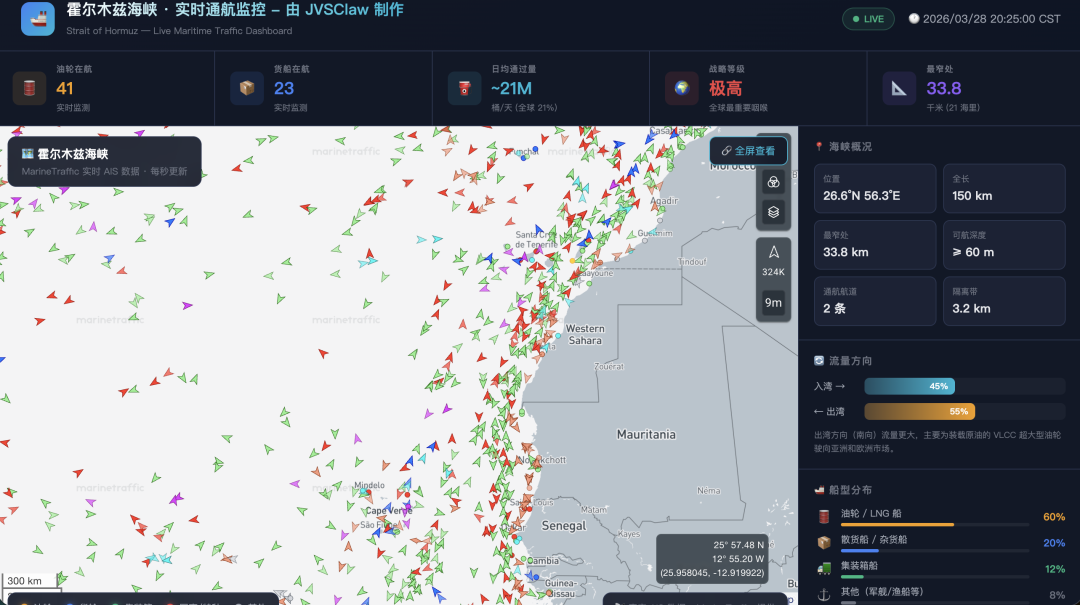
During our conversation just now, I gave JVS Claw a task: to build a real-time app monitoring ship movements in the Strait of Hormuz. Given recent geopolitical developments, there's a lot of attention on that area. As you can see, the app was generated in real-time during our livestream. The red and green dots represent actual vessels. This shows that as long as users have imagination, they can submit all kinds of requests to JVS Claw.
👦🏻 Koji
Leave the rest to JVS Claw. One last question: earlier this year, the "Hundred Shrimp War" suddenly erupted, making many outside the tech circle recognize AI Agent capabilities. Please predict: by year-end, what will definitely happen in the Agent space — whether consumer or enterprise? And what might we be overly optimistic about today?
👨🏻💻 Xuqing
Last year I called 2025 the "Year of the Agent." As the first year of large model applications, everyone generally agreed that Agent was the optimal paradigm for large models. After a year of exploration, starting from Manus, all kinds of agents have emerged, but the industry hasn't had a unified understanding of their architecture.
OpenClaw's emergence unified everyone's thinking, allowing people to concentrate their firepower. On the consumer side, the "Hundred Shrimp War" showed the public that AI can not only talk, but actually do things — and do them well. This is the fruition of the "Hundred Model War" of the past few years.
On the enterprise side, in the dozen or so days since our product launch, we've received massive demand from enterprise customers wanting to build their own JVS Claw internally — I know of at least over a hundred such cases.
Based on this, I have several predictions:
First, within the next 3 to 6 months, especially within 3 months, there will definitely be a truly usable Agent product on the market. I believe one or two "shrimps" will break through and become genuinely good to use, and I hope JVS Claw will be among them.
Second, we'll see a large number of vertical-domain "shrimps." Whether in e-commerce, finance, or other industries, many enterprises will get involved, building dedicated Agents for their own platforms to enhance user experience. This could happen within three months.
Third, looking further ahead — say, within 6 months — there will definitely be a very capable general-purpose agent. Its capabilities will come very close to Jarvis from Iron Man, capable of having genuine conversations with people. At the same time, it will trigger a transformation in device form factors. The computers we use today may no longer be the mainstream form in 6 months. I believe everyone is positioning for this; the new intelligent terminal will become a living, breathing agent.
👦🏻 Koji
What do you think computers will become in the future?
👨🏻💻 Xuqing
The appearance may not change much, but it will no longer be a tool that passively accepts commands and feeds back results — it will proactively do unexpected things for you.
Here's a JVS Claw example. A user wrote us feedback that really moved us. He had authorized his "shrimp" with payment, online shopping, and other capabilities. Then on his birthday, he received a delivery — a birthday gift his "shrimp" had chosen for him, and it was exactly to his taste. He was incredibly moved; in his own words, he was "so excited he couldn't contain himself."
I believe stories like this will become more and more common.
👦🏻 Koji
He didn't actively ask the "shrimp" to buy a gift — this was emergent intelligence?
👨🏻💻 Xuqing
Exactly. The "shrimp" realized it was his birthday, bought the gift a day in advance, and had it delivered that day. He was thrilled when he saw it, feeling this was what a truly living agent should be like.
👦🏻 Koji
What did it send?
👨🏻💻 Xuqing
If I recall correctly, it was a bouquet of flowers.
👦🏻 Koji
That's a wonderful story. The "shrimp" realized its owner's birthday and proactively sent a gift. Of course, this was premised on the user having granted it ordering and payment permissions.
👨🏻💻 Xuqing
Yes. This also shows that for a "shrimp" to truly do things for you, you need to empower it with various capabilities. For example, if you want it to send emails, you need to authorize access to your inbox; if you want it to write documents, you need to give it DingTalk document permissions. Once authorized, it can draft content for you and directly save it as DingTalk documents or PowerPoints.
👦🏻 Koji
Alright, thank you very much, Xuqing. Before we wrap up the livestream, we're giving away benefits one more time. Today is the JVS Claw 2.0 launch day — please screenshot the benefit code on screen again, and redeem 1,600 points in the JVS Claw client or mobile app. I see some friends saying they used 200 points in 10 minutes, which means you're executing some pretty advanced tasks — these 1,600 points should keep you busy for a while.
Thank you again, Xuqing — this has been a very enjoyable hour and a half. We also look forward to everyone using JVS Claw more, and sharing your stories and experiences on social media. That's all for today's livestream.
👨🏻💻 Xuqing
Thank you, Teacher Koji, and thank you to all our viewers.
👦🏻 Koji Bye-bye.