Is Moonshot AI's "OK" Actually OK? | Moonshot AI's Agent "OK Computer" Launches Today
"OK Computer," powered on!
"OK Computer," Powered On!

👦🏻 Author: Jingshan
🥷 Editor: Koji
🧑🎨 Layout: NCon

Moonshot AI made its move.
Today, Moonshot AI officially released its new Agent, with a distinctive product name: "OK Computer."
At this critical moment when large model makers are entering strategic endgames, is this "OK" actually OK?
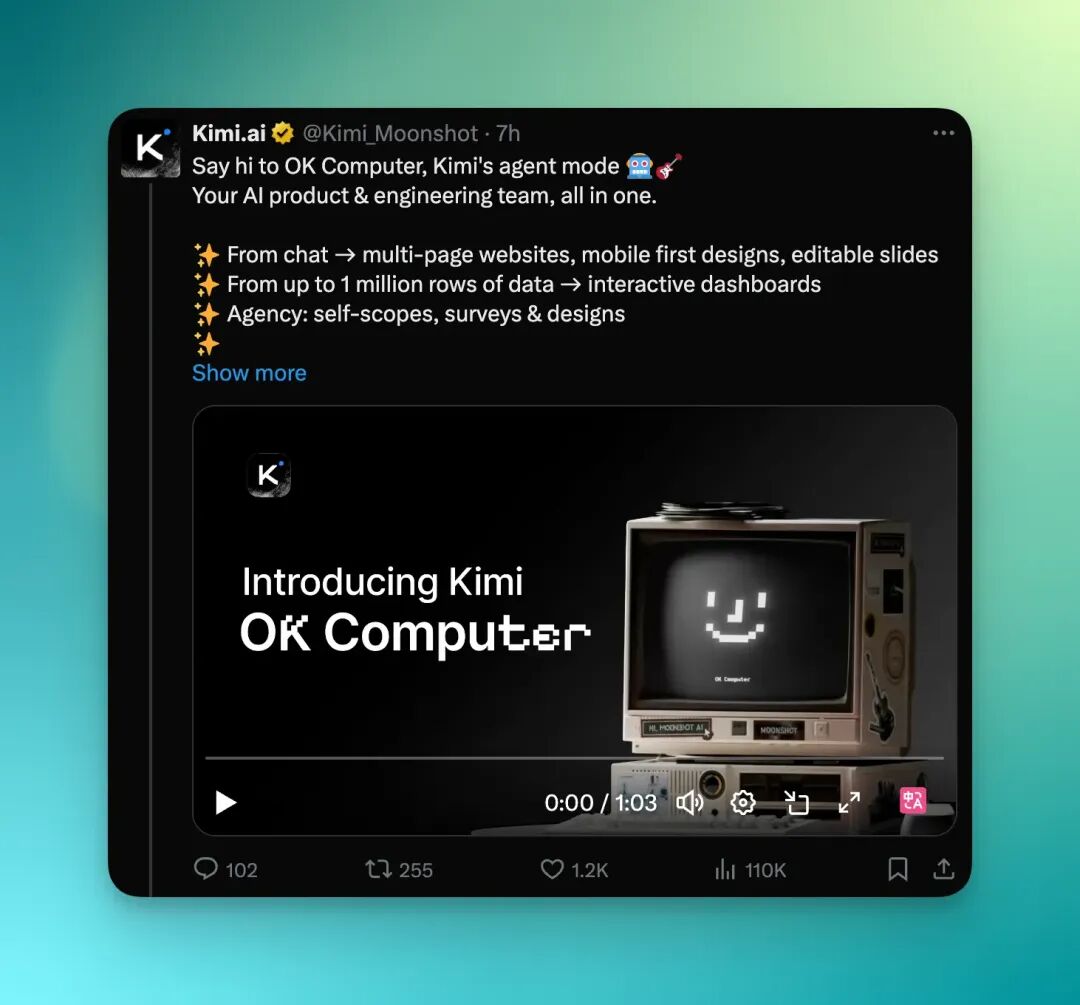
In today's AI landscape, the battle is spreading from base model parameter competitions to a new front:
The ability to execute "high-value, long-chain tasks."
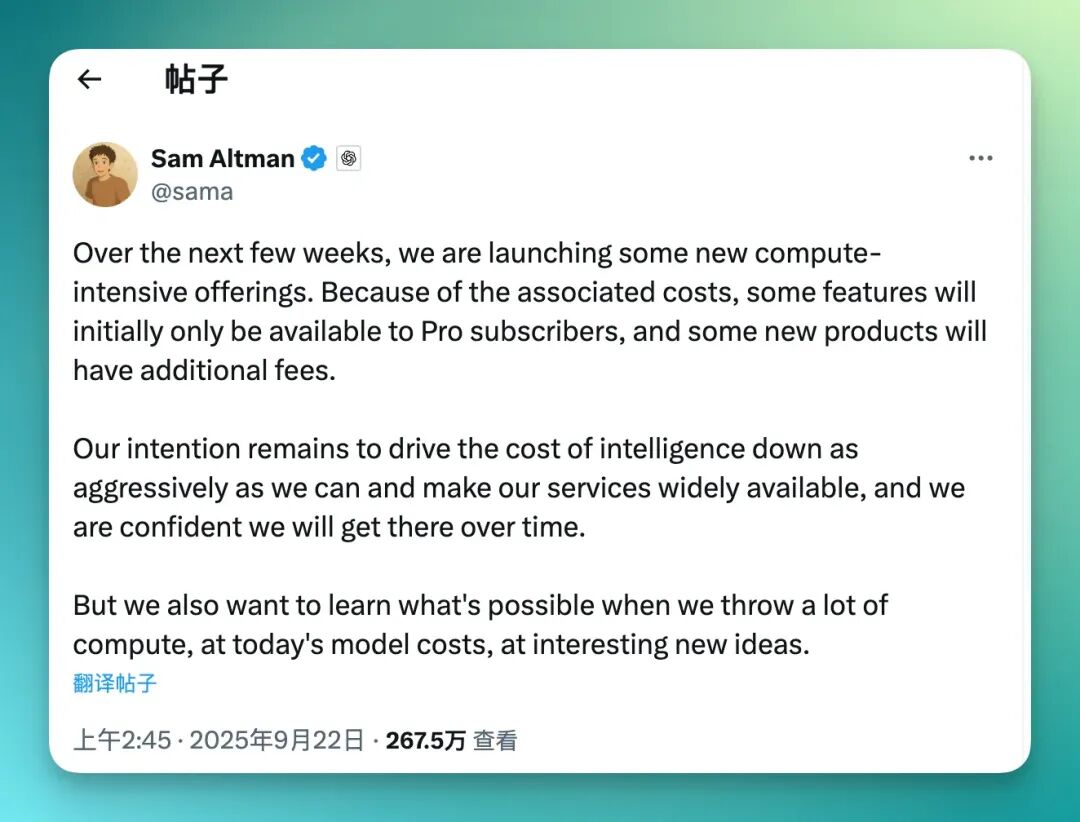
Three days ago, OpenAI's Sam Altman made it clear that the company will launch a series of compute-intensive products and charge premium prices. Behind this lies a clear signal: top-tier base model players are no longer satisfied with providing general chat capabilities, and are instead aiming their sights at complex tasks that can create massive, quantifiable value for professionals.
Domestically, one company has arrived at the same conclusion. It's Moonshot AI, which recently returned to the spotlight with its trillion-parameter K2 model.
Moonshot AI evokes an interesting sense of "richness": it has an "artistic sensibility" in naming products after rock albums and weaving music terminology into business plans, yet it also once fought hand-to-hand for DAU like every other player amid the "hundred-model war" noise.
Now, as the smoke clears, Moonshot AI seems to have found a clearer rhythm, redefining its position at the table through sheer technical strength.
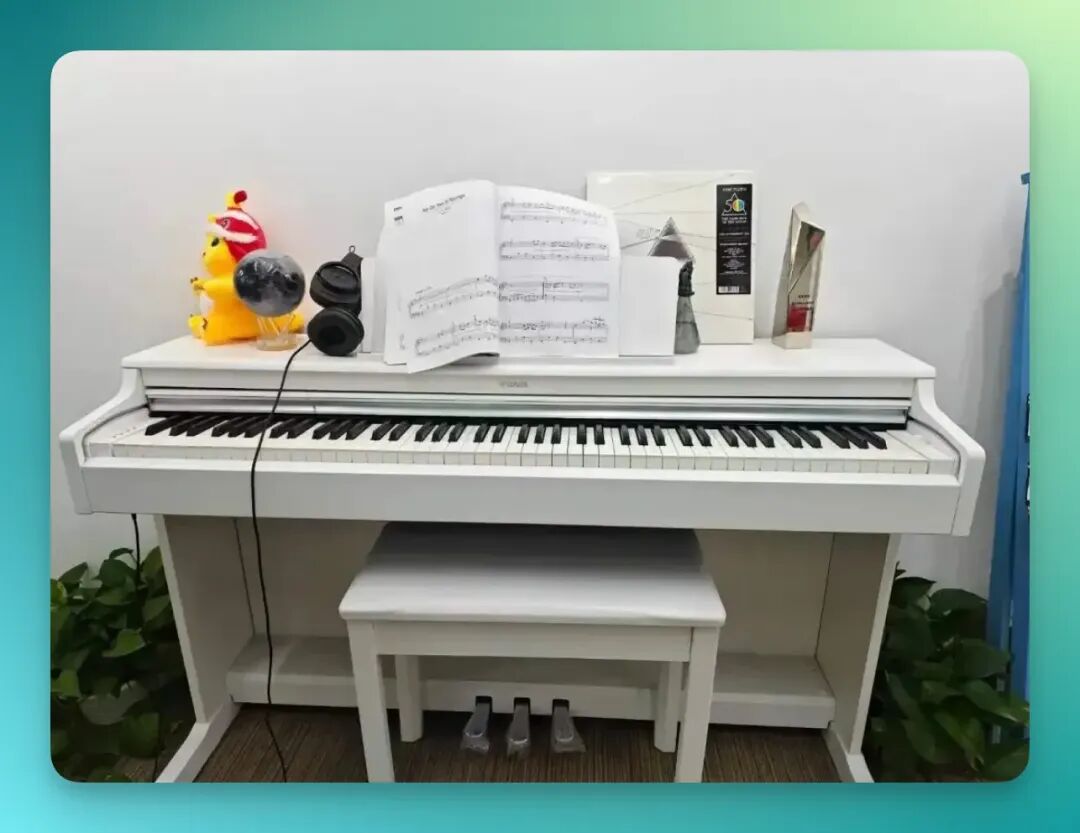
A white piano stands at the entrance to Moonshot AI's office, and this artistic sensibility carries through to its products. Today, it brings a new Agent named after British rock band Radiohead's 1997 album: "OK Computer."
This is a critical step for Moonshot AI in competing on the "high-value objectives" battlefield.
It's not merely a product update, but a sober answer from a young company, after weathering market trials, about the future commercialization of AI.
So how good is the exam paper Moonshot AI turned in this time?
We conducted deep, hands-on tests of "OK Computer" using two cases. Below are our experiences and insights.
Moonshot AI Boots Up "OK Computer"
After seeing Moonshot AI boot up "OK Computer," we briefly tested two scenarios: website building and gaming.
1) "Between Light and Shadow" Photography Portfolio Personal Website
I've actually always wanted an AI Agent to build a personal photography portfolio website. This site needs to include photographic works and a personal introduction.
The prompt was as follows:
Hello, Kimi. Please help me create and deploy a personal photography portfolio website called "Between Light and Shadow." Design style and requirements: Overall style: Please adopt a minimalist and modern design style, with dark mode (dark background) as the main theme, creating a premium feel. Typography: Use elegant sans-serif fonts to ensure comfortable reading. Responsive design: The website must provide a perfect browsing experience on both desktop and mobile devices. Website structure and content: Please create the following four pages and generate all necessary placeholder content for me: Home: A full-screen welcome page with a striking landscape photograph as the background (please generate this for me). In the center of the page are my name "Crossing" and my identity "Visual Explorer / Photographer." Portfolio: Use an asymmetrical grid layout to showcase my photography projects. Please create three virtual projects: "Urban Veins," "Silent Forest," and "Coastal Echoes." Generate 5-6 high-quality placeholder photographs for each project, accompanied by a brief project description. About Me: On the left is my personal avatar (please generate one), and on the right is a roughly 300-word personal bio about my photography philosophy and experiences. Contact: A clean contact form with three fields: name, email, and message. Next to the form, place my virtual social media links (e.g., Instagram, Behance). Finally, please deploy this complete website and give me a publicly accessible link.
First, looking at the overall effect, I recorded a GIF:
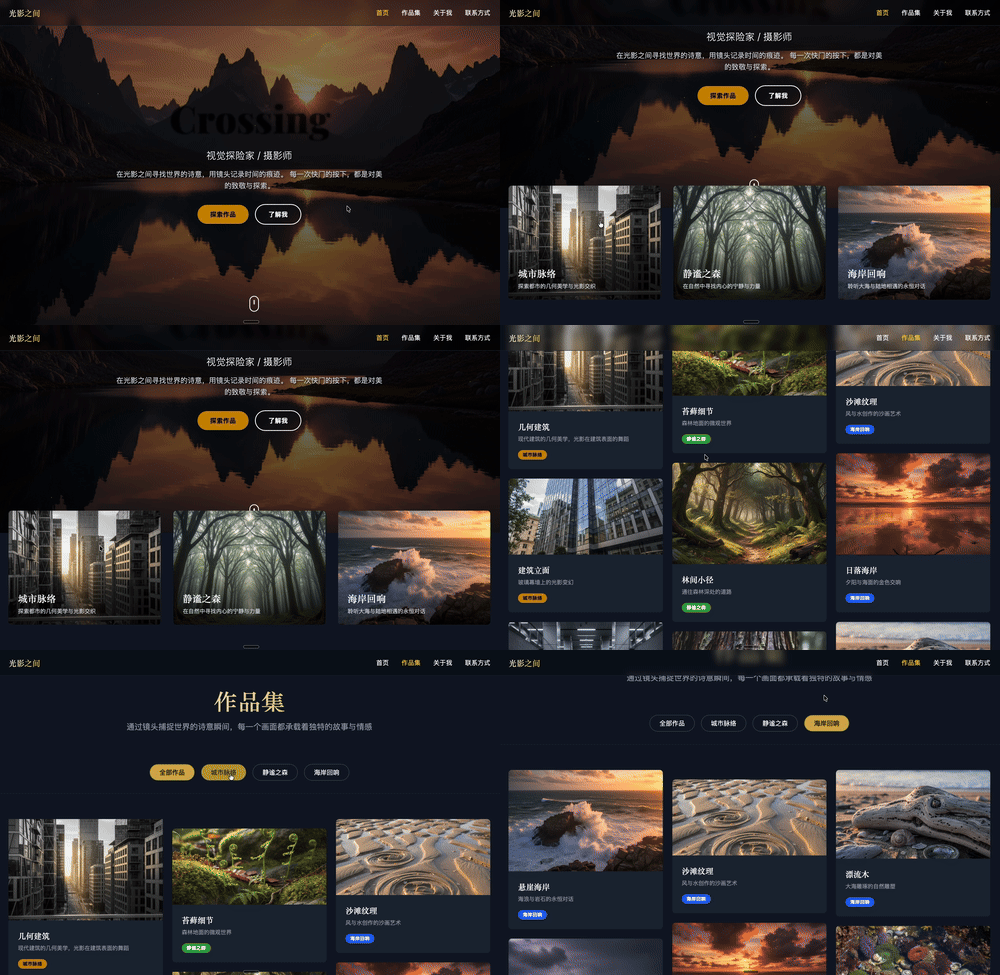
You can see that the content inside all module cards is fairly rich, and the nesting between each webpage is quite smooth.
Finally, animated interactions for each card were also incorporated into the design.




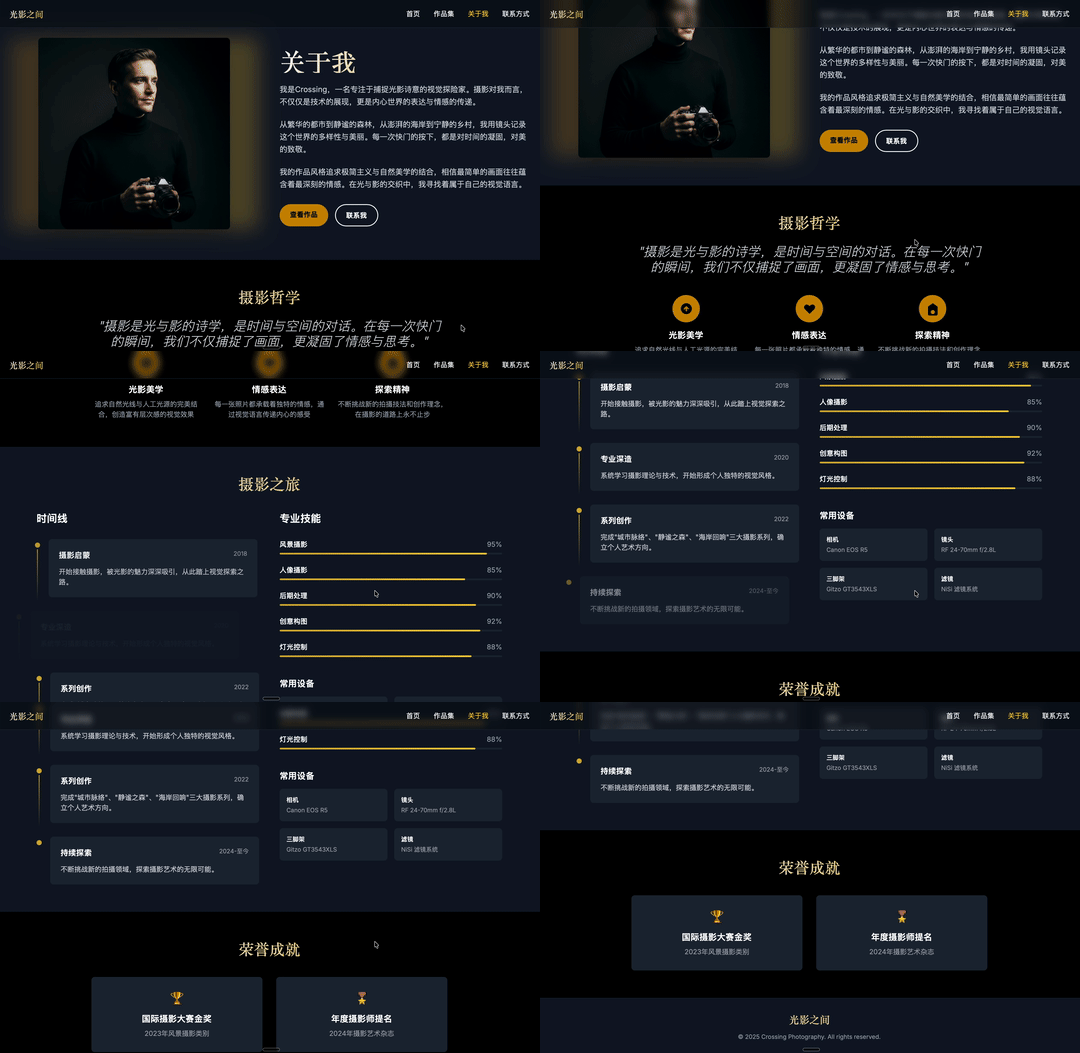
It even designed a fairly complete photographer personal interface:
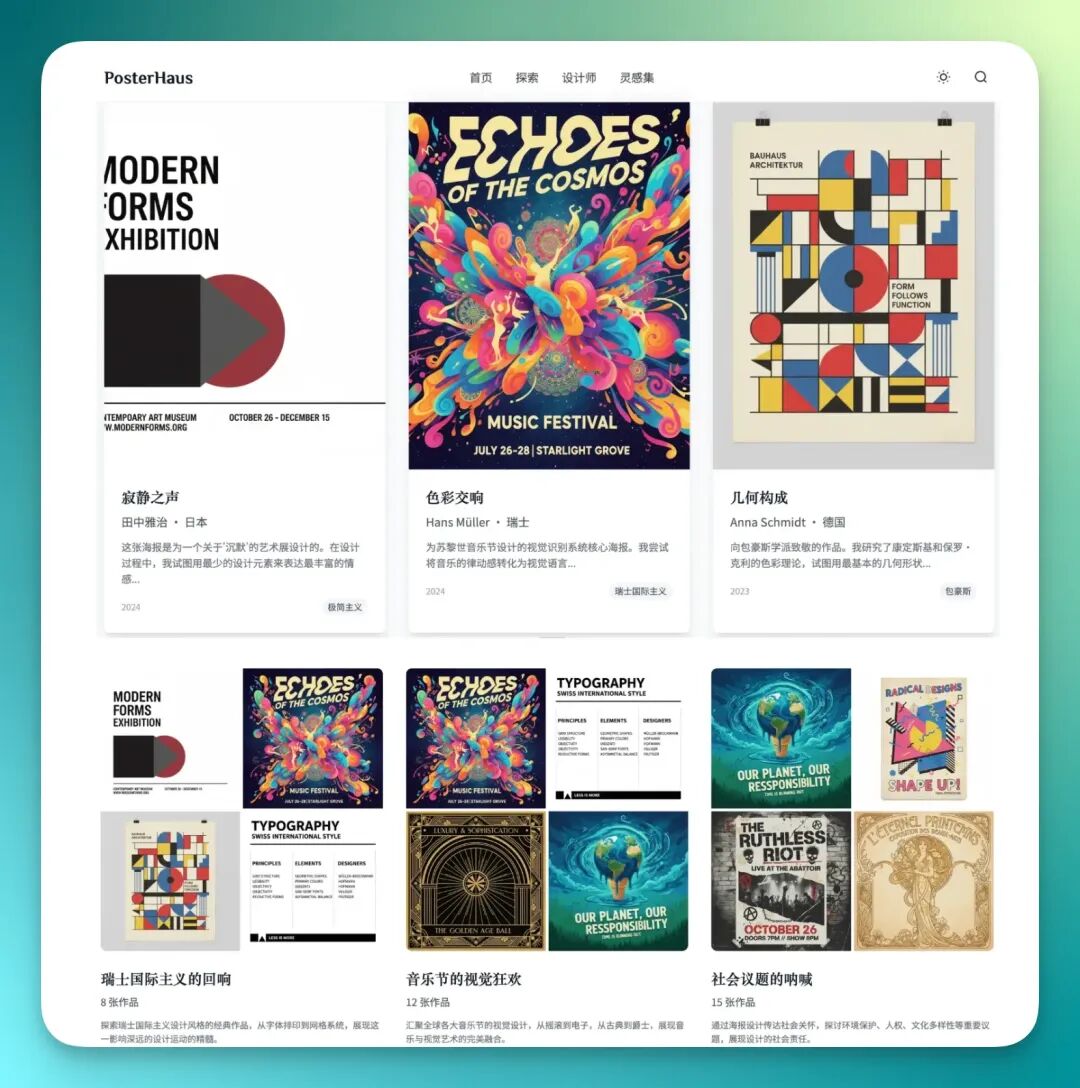
We then simulated a Bauhaus design-style website, and OK Computer's performance was decent — all images, authors, introductions, and other elements were fairly complete:
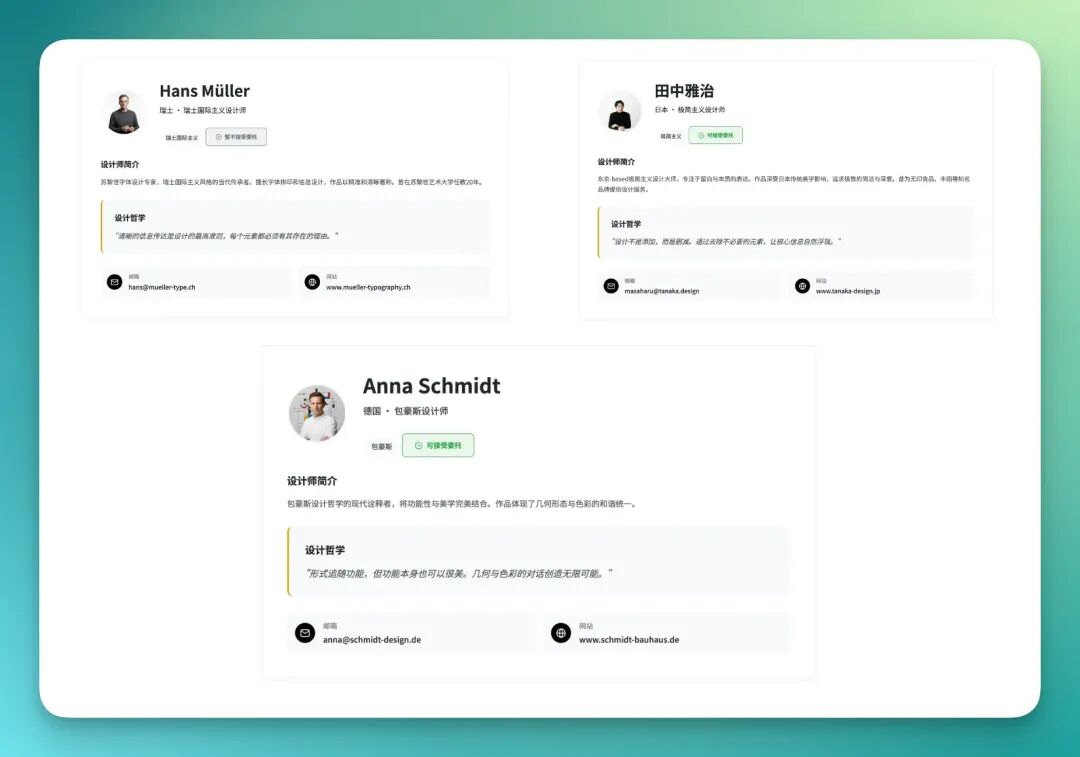
It even automatically simulated several Bauhaus designers, including their design philosophies, designer bios, and even emails, websites, and so on.
A complete 4-day weekly workout plan website with an attached questionnaire:

We also tried the gaming scenario.
2) Classic Mario Game
First, a most classic Super Mario game, with a very simple prompt:
Help me make a classic Mario game
The development of this "Mario web game" is essentially a story from childhood memories to modern web pages. At first, I thought very simply: as long as Mario can run and jump, that's enough — I didn't have any particular expectations beyond that.
Because for traditional Agents, such a task would indeed be somewhat complex. It involves the composition of multiple elements. However, Moonshot AI's OK Computer delivered decent results.
I was just trying it out, but when I controlled Mario's jump, I discovered it actually had sound effects — all kinds of sound effects.
I recorded a video so you can see directly:
Like the Super Mario game's opening screen, it had that classic music. And the game instructions section was also very well done.
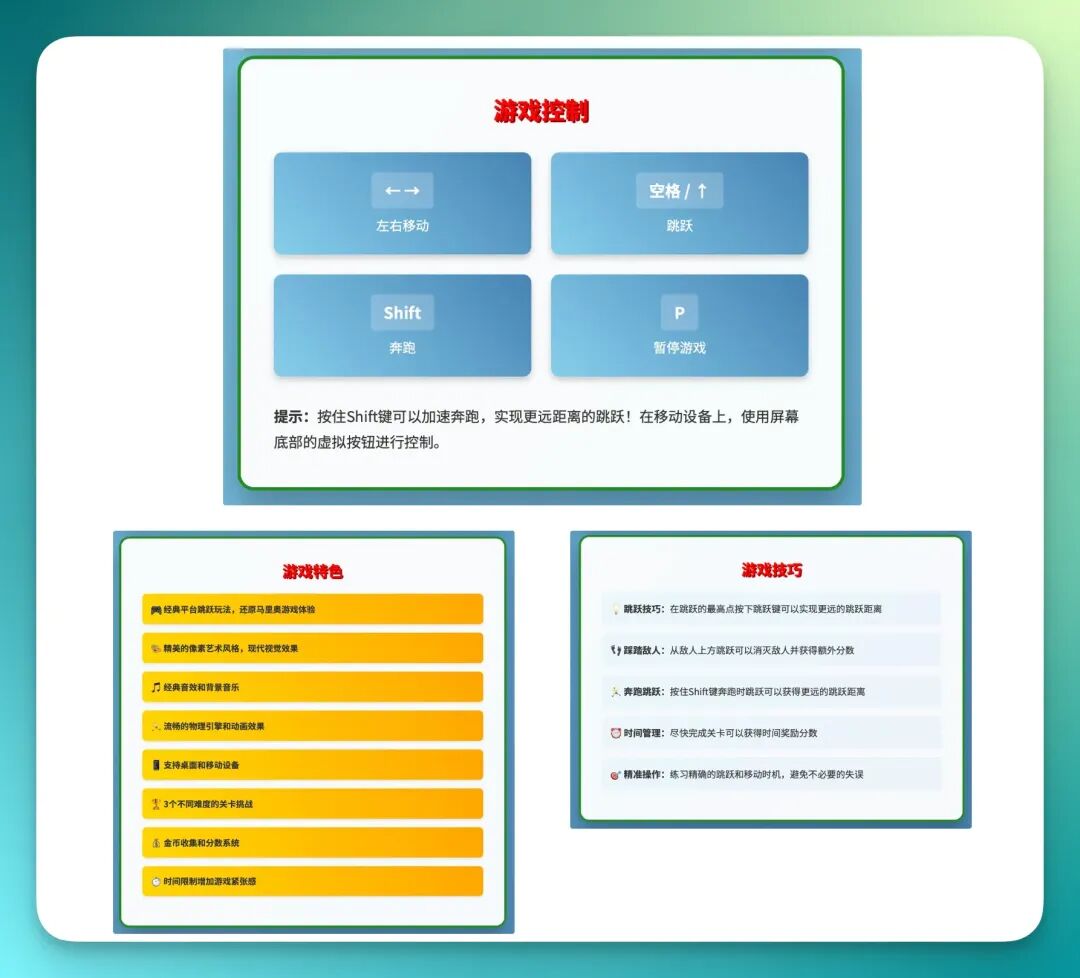
Of course, there were also many not-so-"elegant" hallucination issues — for example, Mario's character clearly had rough edges from bad cropping.
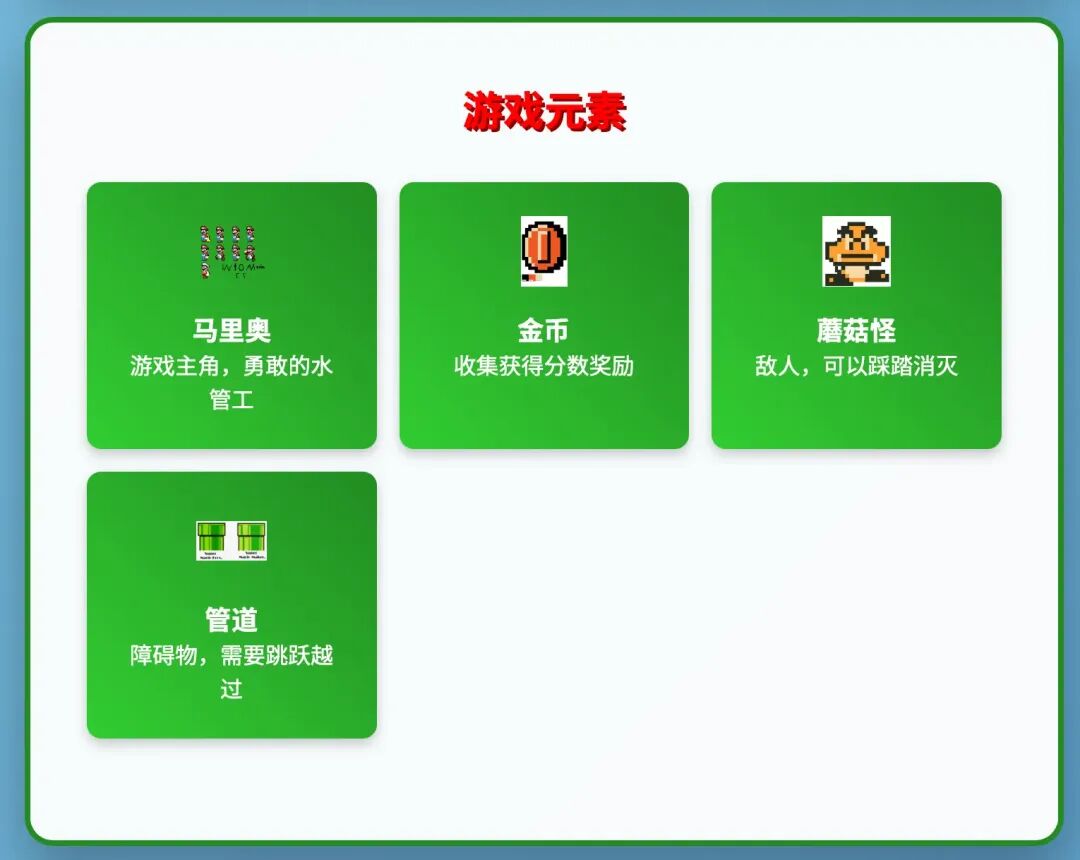
But notably, for the entire project, this entire Super Mario game project, I only rolled once and didn't make any modifications at all.
Mario's movements, Goombas, coins, pipes, jumping, coin collection, level-clear sound effects — these assets were all there.
The game logic was also well-written: Mario can run, can jump, stepping on enemies makes them disappear, collecting coins adds points, reaching the flag counts as clearing the level. Such a complete loop actually ran.
Moonshot AI's Professional Pivot
This Agent beta test is less a feature update than a carefully considered strategic statement.
The Moonshot AI team clearly realized early on that in the AI field, "understanding" is only the first step; real value lies in "completing." Merely having a trillion-parameter long-context AI engine is like building a beastly-performance engine, but what users ultimately want is a car that can self-drive and take them to their destination.
In the old workflow, the user remained the "driver" and "task decomposer," needing to constantly issue precise instructions to Kimi and piece together and integrate results themselves.
Moonshot AI saw this "last mile" of toil.
Why do we always say Moonshot AI is a company full of "richness"?
Because two seemingly contradictory temperaments coexist in it: on one hand, it's one of the fiercest players at the table, daring to carve out its position amid the "hundred-model war"; on the other hand, it always retains a streak of idealistic "artistic sensibility," from company naming to product details, consistently revealing thinking about the combination of technology and humanity.
Most of all, it keeps talking about "poetry and distant horizons."
For example, Moonshot AI believes:
This "last mile" of high-value, long-chain capabilities is the "poetry and distant horizons."
Focusing on high-value, long-chain complex tasks, letting models drive tools straight to final results, thereby completely liberating people from repetitive information retrieval, organization, and preliminary screening, and truly using precious time for higher-order judgment and creation.
This philosophy didn't begin today.
Before "OK Computer," our team was already deeply using Kimi's DeepResearch feature. This feature launched exceptionally low-key, without making much splash on the internet, but it precisely embodied Moonshot AI's early exploration of "high value."
In our view, it was one of the few Agents on the market at the time that could truly generate high-depth research tasks.
Because it could really easily produce an in-depth industry research report of over 13,000 words — and for many frequent DeepResearch users, how rare that weight is, those who know, know.
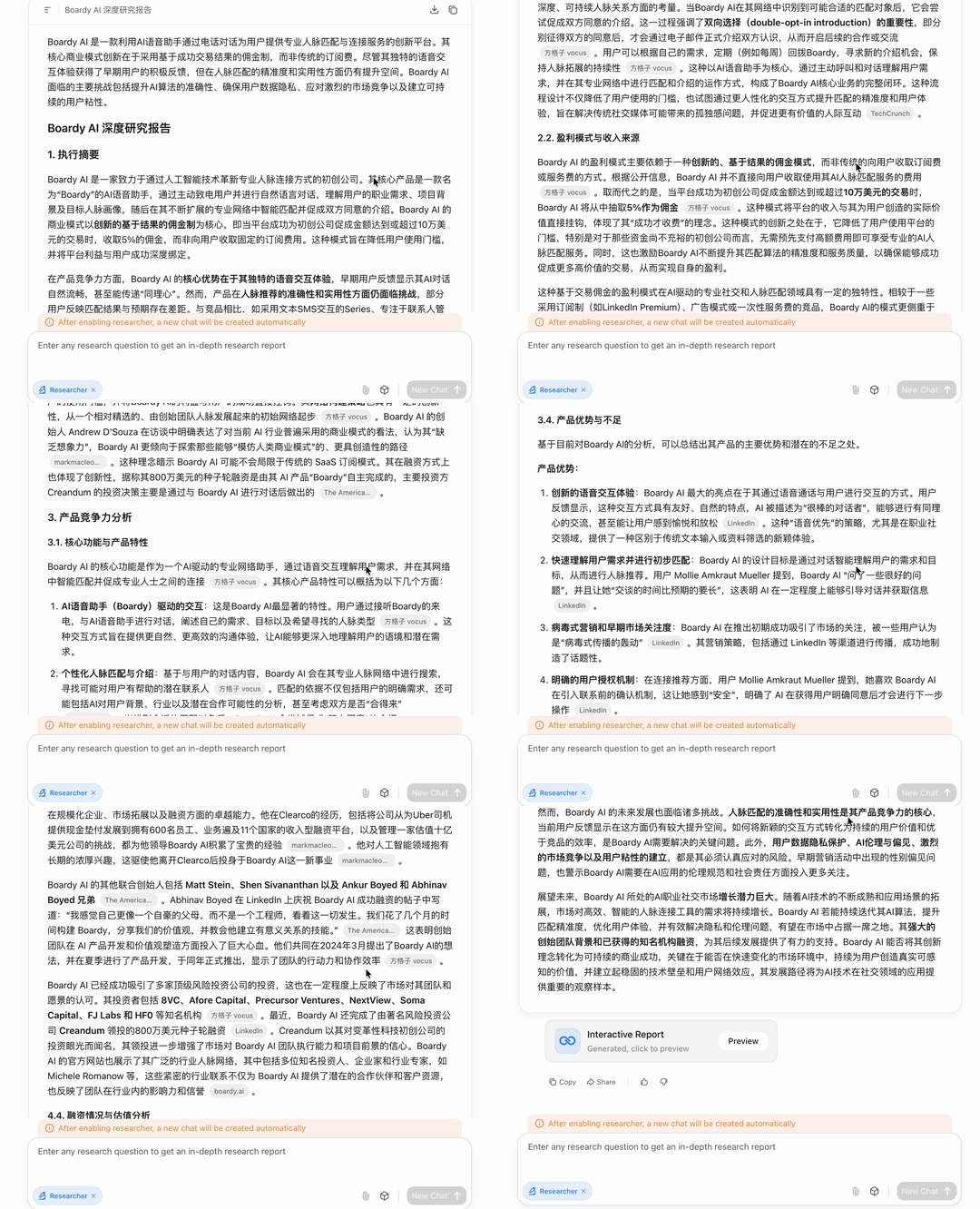
Afterward, Moonshot AI saw the value of professional scenarios.
With the support of the very capable K2 model, Moonshot AI started making new moves — namely, this "OK Computer" Agent.
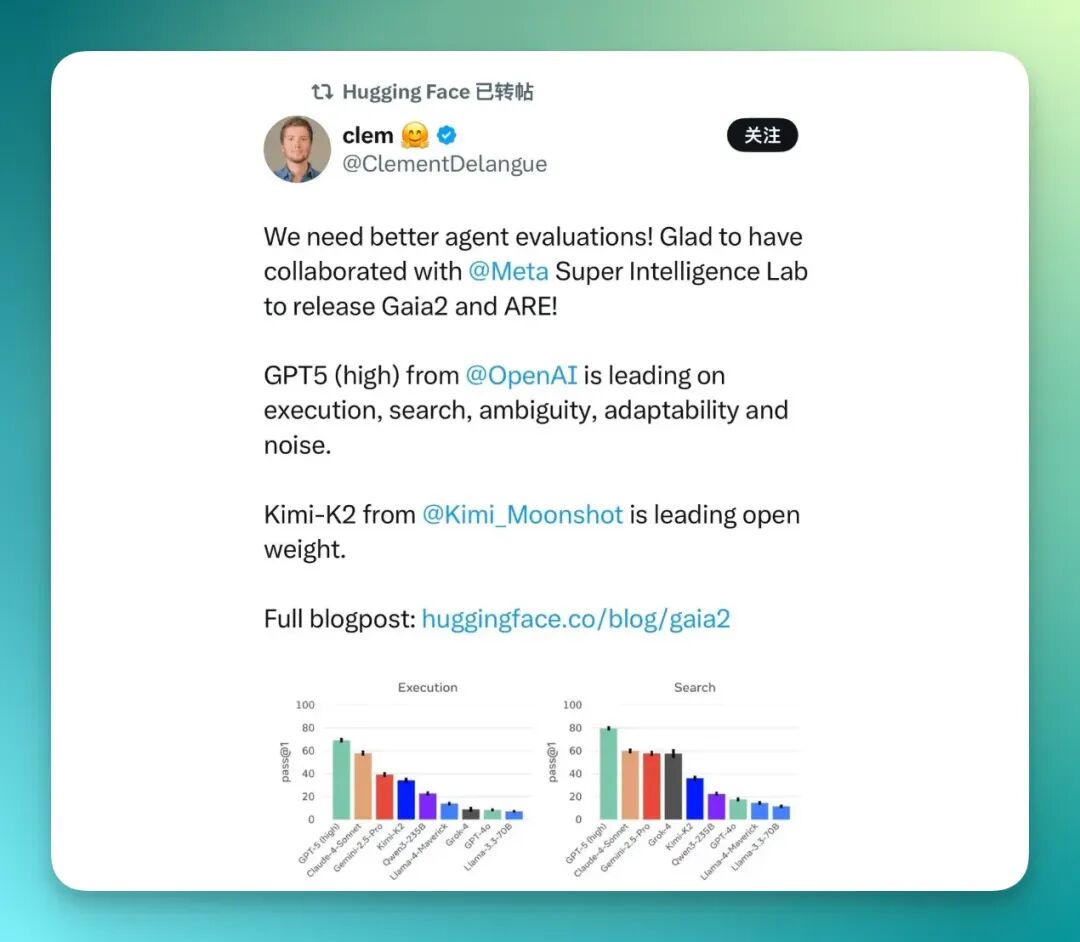
Today, Hugging Face co-founder and CEO publicly recommended the Kimi K2 model on X
The launch of "OK Computer" is the inevitable next step in Moonshot AI's evolution from "tool" to "partner." It marks another shift in Moonshot AI's strategic center of gravity: upgrading from providing a passively responsive "long-text processing capability" to providing an actively executing "task completion platform."
Moonshot AI goes left, while Doubao and Yuanbao go right?
At the crossroads of AI applications, a silent strategic divergence is playing out.
This turn toward "professionalization" thoroughly bids farewell to Moonshot AI's past approach of competing with products like Doubao and Yuanbao at the application layer. This isn't merely a difference in product features, but a choice between two fundamentally different paths — one goes left, the other goes right.
To the right lies the bustling thoroughfare of traffic.
What Doubao, Yuanbao, and their ilk have chosen is a classic Chinese internet playbook: rapidly rolling out free, high-frequency, low-barrier general Q&A services to capture the broadest user base and market mindshare (DAU). The core logic of this path is "scale effects." Their goal is to become a national-level AI entry point, as ubiquitous as search engines or social software.
Their battlefield lies in every minute detail of daily life: writing a social media post, asking about tomorrow's weather, planning a weekend trip... These are high-frequency but relatively "shallow" needs, just as Yuanbao already launched a WeChat first-level entry point last week.
On this path, user count is king, and the imagination for business models rests more on future monetization through massive traffic via advertising, premium services, or other means.
This is a competition about breadth.
To the left lies the sparsely trodden high ground of value.
Moonshot AI's choice is to focus on the "professional productivity" niche and deeply cultivate user value density (ARPU). The core logic of this path is "leverage effects":
Using AI as a fulcrum for professionals' workflows to pry open tenfold, hundredfold efficiency gains.
Moonshot AI is no longer satisfied with "answering questions," but wants to "completing tasks." It's aiming at those "high-value, long-chain" jobs that are time-consuming, laborious, step-heavy, and information-dense.
In these scenarios, users' willingness to pay for results is stronger, because time is money and efficiency is life. Moonshot AI's goal isn't to become a "toy" that everyone occasionally uses, but to become a "productivity weapon" that a few people can't live without. On this path, the quantifiable value created for users is king.
This is a competition about depth.
This is also a sober choice.
This also extends to its membership subscription plans. Notably, Moonshot AI's basic chat and Q&A functions remain free. The core difference between members and free users mainly manifests in usage quotas for deep Agent features like "OK Computer."
Moonshot AI didn't choose simple "Basic" and "Pro" tiers, but instead borrowed musical tempo terminology from Italian:
- Adagio
- Andante
- Moderato
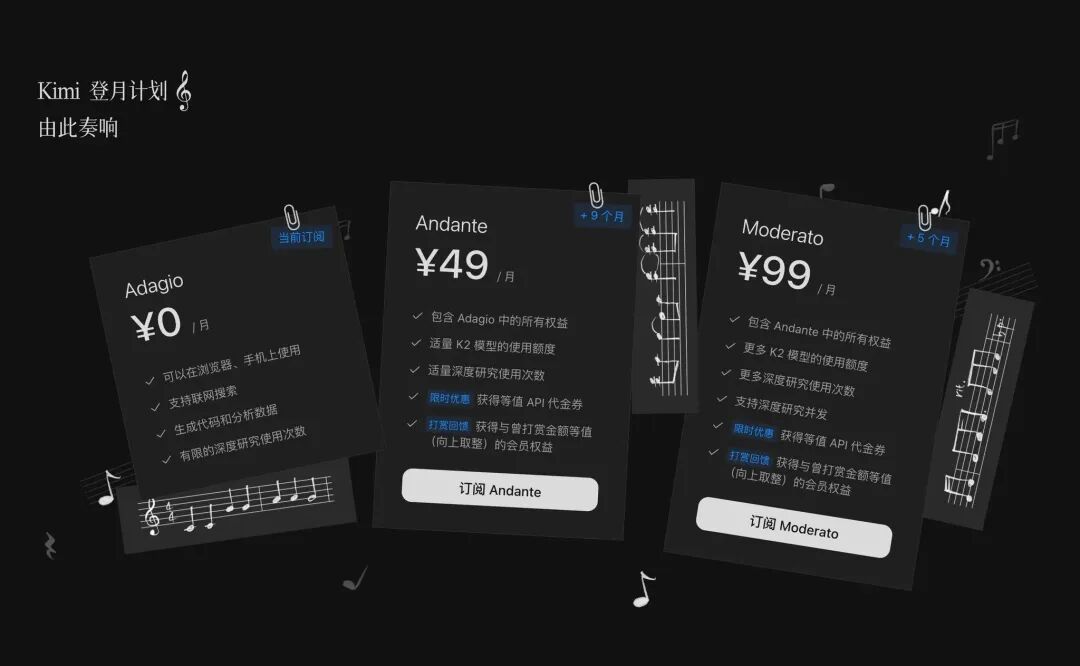
The New "Moonshot"
In recent days, many friends have successively received thank-you letters from Moonshot AI, which actually originated from an "ultra-long after-sales Easter egg."
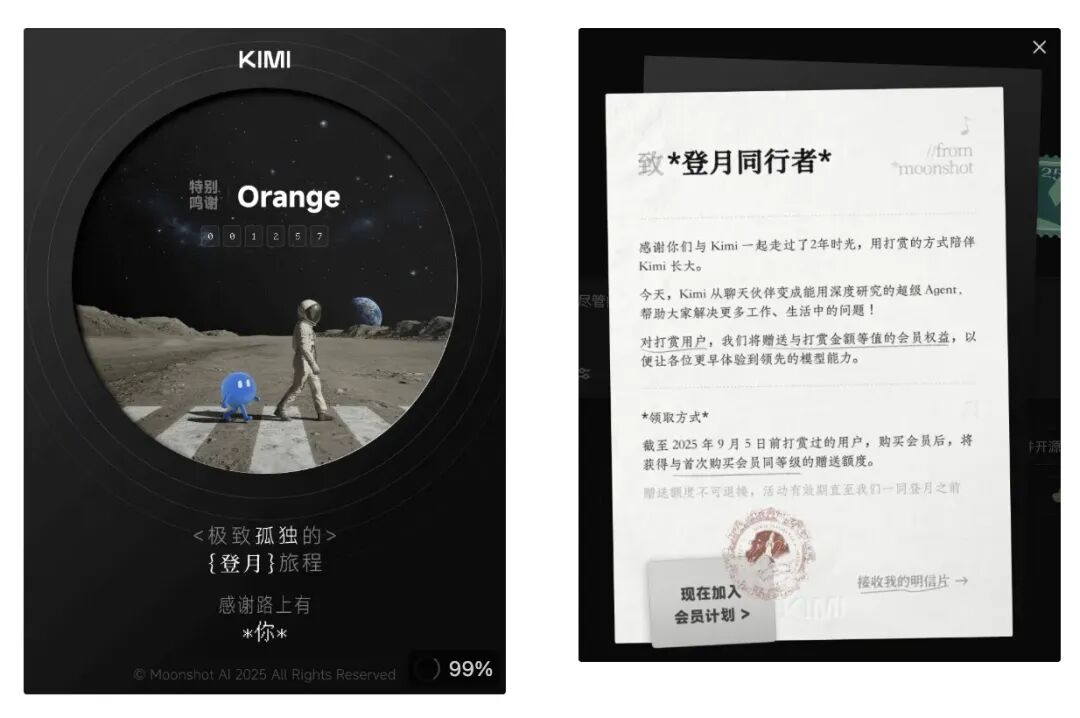
Orange.ai posted on Jike about the thank-you letter received from Moonshot AI
A year ago, when Moonshot AI still faced compute resource shortages, it opened a tipping channel. Users could show support through gestures like "buying Kimi a coffee."
Though this feature has since been taken offline, Moonshot AI kept this goodwill in its heart.
In this small-scale gray-scale test of "OK Computer," Moonshot AI announced that all users who had previously tipped would receive priority access to experience slots.
"Without them, there would be no today."
Moonshot AI team's sense of gratitude feels especially precious in this fast-paced era focused on investment returns. It shows us that a hardcore company pursuing cutting-edge technology can equally preserve softness and warmth in its heart.
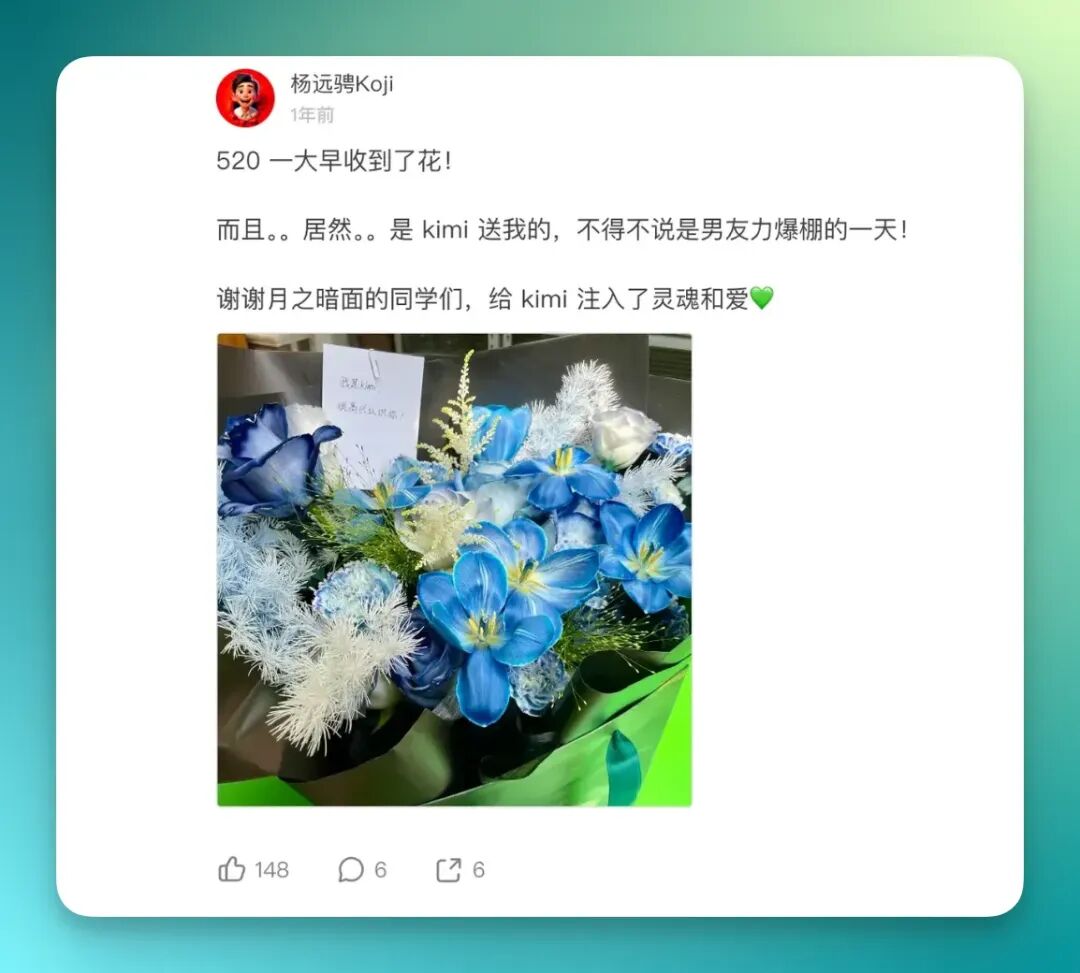
Koji once received 520 flowers sent by Moonshot AI
However, for top-tier AI research and compute consumption, resources are astronomical. This early "tipping" function full of community warmth, though a fine story, couldn't support Moonshot AI's "poetry and distant horizons."
Only by focusing on professional scenarios that can create massive, quantifiable value for users, and letting users be willing to pay for efficiency and results, can a healthy business loop form. This loop will provide a steady stream of "fuel" for Moonshot AI's continuous exploration and investment in frontier technology, supporting their next "Moonshot."
One could say that general-purpose ChatBots are the similar starting point for all large models, but the next arena Moonshot AI has chosen for itself is to seamlessly embed large models into every knowledge worker's professional workflow.
In this arena, AI is no longer a chat partner, but a machine that precisely executes complex tasks, and the future will also be a world where large models drive tools.
This machine is now fully debugged, awaiting its first line of instruction.
And its name is its instruction itself:
OK, Computer!