Mammoths won't survive to see the next era. What is Kingsoft betting on in the age of AI?

Let AI grow Office.
Making AI Grow an Office

👦🏻 Author: Ms. Yi
🥷 Editor: Koji
🧑🎨 Layout: NCon

On the afternoon of July 15, along the Pudong riverfront in Shanghai, at the 1862 Fashion Art Center.
This space, converted from a century-old shipyard, once witnessed the launch of China's first export-class 10,000-ton vessel. Ships were the tools that expanded boundaries in the industrial age; the 38-year-old software giant Kingsoft Office wanted to discuss how new tools in the AI age would reshape productivity.
At the "2026 AI Productivity Conference," Kingsoft Office unveiled two AI office agents: "Lingxi Professional Edition" for individuals, and "WPS Comate" for enterprises. Moving on both consumer and business fronts simultaneously is rare in Kingsoft Office's history.
Over the past two years, AI office assistants have proliferated, but most remain stuck at the "content generation" level. Behind these two products, Kingsoft Office is attempting to bridge the gap from "chatting" to "delivering."
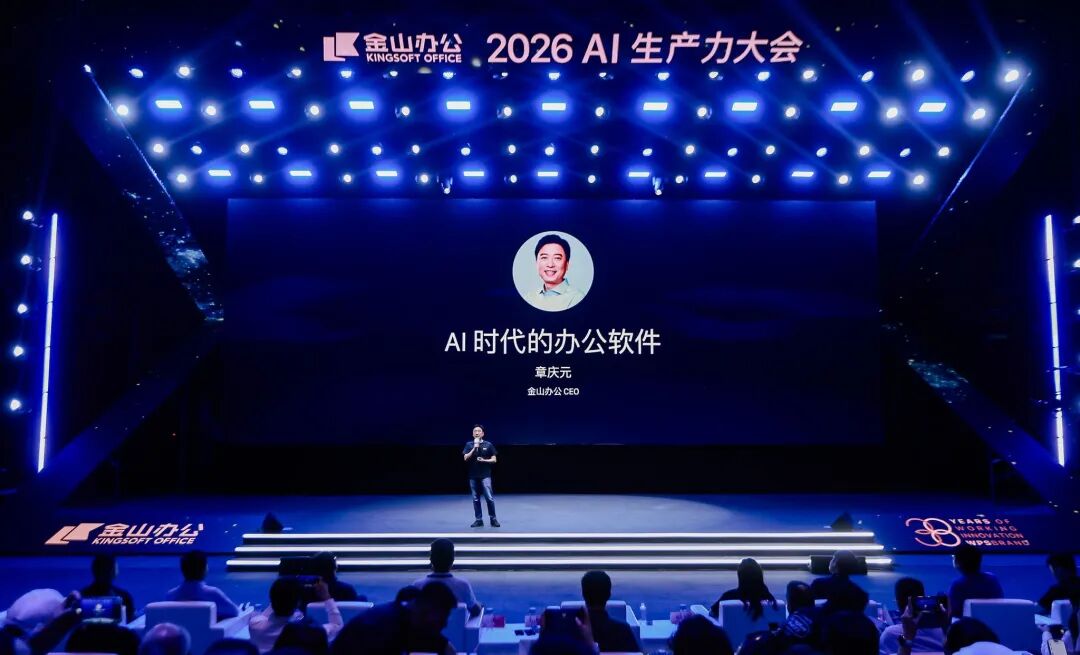
Lingxi: The Office Assistant That Gets You
At the launch event, Tian Ran, Assistant President of Kingsoft Office, captured the industry's true state in one sentence: "There are plenty of AI products that can chat, but not many that can deliver actual results."
This is Lingxi's core starting point. In Tian's view, current products on the market are "still in extremely early stages" — truly helpful assistants that can produce usable work output are few and far between. Lingxi aims to be the exception.
The product logic of Lingxi Professional Edition revolves around three layers:
- Layer One: It Gets You
In his presentation, Kingsoft Office CEO Zhang Qingyuan used his own assistant as an analogy: "He really understands me — knows I like things concise, not wordy. He has similar permissions to me, has my work context. He's smart enough to handle all kinds of tasks."
What Lingxi aims to do is assign every user such a "digital assistant." Lingxi adopts project-based context management, consolidating work conversations, documents, and data into a dedicated memory bank. It doesn't start from a blank dialog box, but continues from whatever project you're working on. Each conversation happens within a project, and projects have different deliverables and skills.
Moreover, Lingxi's product evolution follows a clear path: from early-stage AI capabilities for generation and reading within WPS, to the agent stage with task decomposition and tool invocation, to its 2026 debut as a standalone product. It represents a critical leap centered on projects, work context, continuous revision, edge-cloud execution, and formal document delivery.
It also features a "dreaming" mechanism — using surplus compute power every night for accumulation. Our work might be 5×8, but an assistant's job is typically more demanding. Late at night, they still have to update and iterate on everything from the day. This creates a product dynamic where the longer you use it, the more it aligns with your personal style.
However, the direction is clear, but the road remains long. Tian candidly admitted in a group interview: "Our 'understanding' today is still quite primitive. Standing behind the scenes, to truly make it human-like, we'll need vastly more contextual information in the coming years."
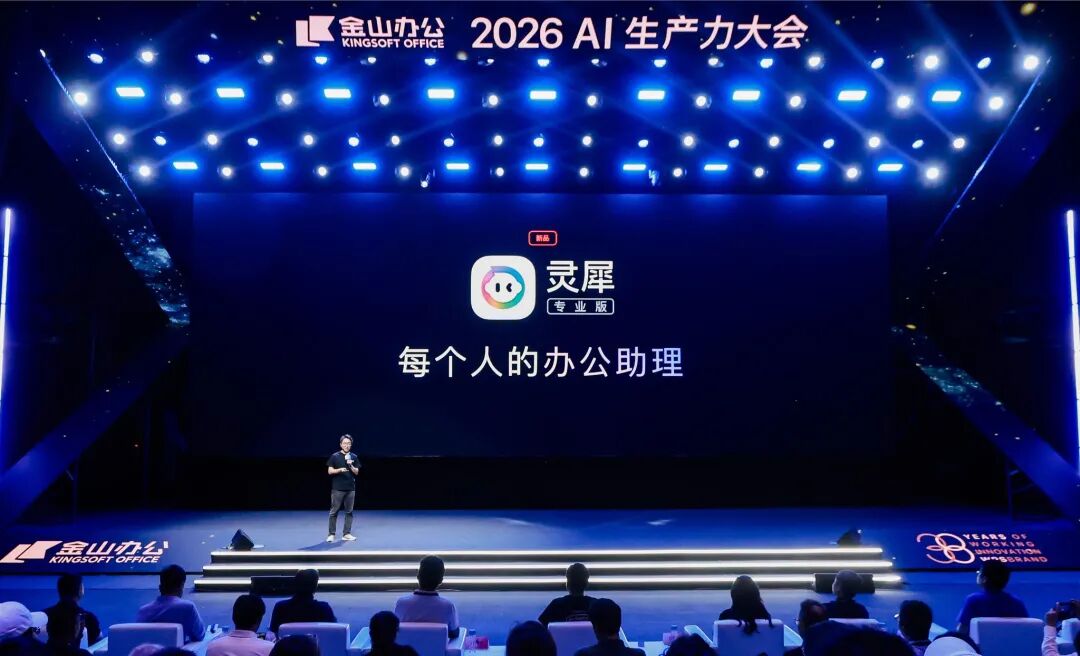
- Layer Two: Finishing the Job
An assistant is an assistant — not a consultant, not someone who merely gives you ideas. They push things through to the end.
This means Lingxi is designed for end-to-end task completion.
In live demonstrations, Lingxi can unify and process revision feedback in multi-person collaboration scenarios, and directly operate browsers to complete cross-system tasks.
For internal expense reimbursement, for example, users simply upload an invoice PDF, and the AI automatically fills out forms and submits them. What might have required an IT team several weeks to develop in the past can now potentially be done in half an hour.
Additionally, Lingxi supports the packaging and reuse of "skills." Users can固化 a repetitive workflow into a Skill, then launch it with a single sentence next time. You don't even need to know code — even without coding ability, you can have Lingxi build software for you, auto-debugging until delivery.
For instance, one-click extraction of embedded tables from Word documents, building a college application advisor, developing internal business management platforms — those personalized needs stuck in workflows can now be realized with zero code.
Kingsoft Office summarizes Lingxi's capabilities as three core elements: understanding your context, high-quality delivery, and professional Office operations.
- Layer Three: Full Office Loop Closure
Full office loop closure is a defining characteristic of Lingxi Professional Edition.
From minimal human input, to AI-generated documents, through continuous interaction, to final delivery — even the last step where you close the AI dialog and take over editing yourself — the entire experience happens in one product, one interface.
Tian gave an example: you tell the assistant "change this here" while looking at its screen, watching it modify step by step. Eventually, you take over the keyboard — and throughout, you're looking at the same screen.
This "never breaking immersion" experience is something many AI office products fail to achieve. Typically, users copy-paste between software, constantly switching contexts, easily losing focus. What Lingxi Professional Edition aims for is completing the entire process from conception to delivery within a single interface.
On delivery quality, Lingxi taps into WPS native APIs, directly producing editable PPTs, formulas-preserved spreadsheets, and documents with review capabilities.
Notably, what Lingxi calls upon isn't open-source libraries, but WPS native components built on Kingsoft Office's 38 years of document technology accumulation.
On format compatibility, it supports doc, ppt, and other legacy formats plus non-standard documents. On Office instruction sets, it can invoke advanced functions like watermarks, tables of contents, and review mode. On runtime efficiency, it directly calls native interfaces in specific scenarios, leveraging component kernels for computation.
At the launch, Tian also addressed an industry-wide question: will documents be eliminated by AI?
His view: the essence of a document is a language — a higher information-density language for human-to-human, human-to-AI, and even AI-to-AI communication. The document medium may change, but in the next 5 to 10 years, it will remain the highest information-density intermediate medium. In other words, from Kingsoft Office's perspective, documents won't die out — they'll become more important because of AI. Because they carry confirmation, approval, communication, and accountability — irreplaceable elements of human collaboration that AI cannot substitute.
Finally, who is Lingxi Professional Edition's target user?
Lingxi prioritizes serving those who frequently deliver formal office output. They may not be AI enthusiasts, but rather those facing scattered materials, numerous versions, and the pressure of formal delivery.
For example: PR professionals writing proposals, salespeople preparing quotes, finance staff cleaning data, small business owners writing company introductions, teachers organizing course materials, and so on.
Lingxi seeks to genuinely help users improve efficiency by intensively refining these high-frequency, formal, repeatedly-revised office tasks.
Not Building Foundation Models, Building "Connectors"
At the strategic level, Kingsoft Office's choices are equally clear.
Zhang Qingyuan made his position explicit: no foundation models. "Kingsoft Office is a 6,000-person company. Objectively, we don't have the conditions to build foundation models. If we did it ourselves, we'd at best produce a seventh or eighth-tier model in the industry. It wouldn't mean anything."
The deeper reason: he believes models are heading toward "democratization."
When OpenAI first emerged in 2023, Zhang was initially stunned, but quickly realized "this isn't something only OpenAI can do." Because talent is mobile. OpenAI people leave to start companies, go to other Silicon Valley firms, and many in Silicon Valley may return to China, joining Chinese companies.
This prediction has been validated.
The AI models used in Kingsoft Office's internal development had all switched to domestic models by June this year. As model capabilities trend toward homogenization, the criteria for model selection shifted from "who's smarter" to "who's more stable, who can provide sufficient token volume."
If models ultimately become general-purpose infrastructure, where does Kingsoft Office's value lie?
Zhang's judgment: "Foundation models provide intelligence, provide smarts. Software's value lies in providing context."
He elaborated: "Every conversation with a foundation model is essentially a rebirth. Because foundation models themselves have no memory. All memory, all context — that actually lives in the software."
Based on this, Kingsoft Office positions itself as a "connector," linking user context, document data, business scenarios, and model capabilities.
Lingxi Professional Edition employs multi-model task orchestration, not binding to any single model vendor. It selects different models and tools for different stages — search, organization, writing, visual inspection — and users can complete complex tasks using default modes.
Zhang emphasized that Kingsoft Office's role in the domestic model ecosystem is "tester" and "accelerator." This means in actual use, Kingsoft Office feeds real-world application issues back to model vendors, assisting their product iteration.
Building on this, Kingsoft Office proposed a broader action framework:
"Office software is entering its third era — from standalone office, to collaborative office, to AI office."
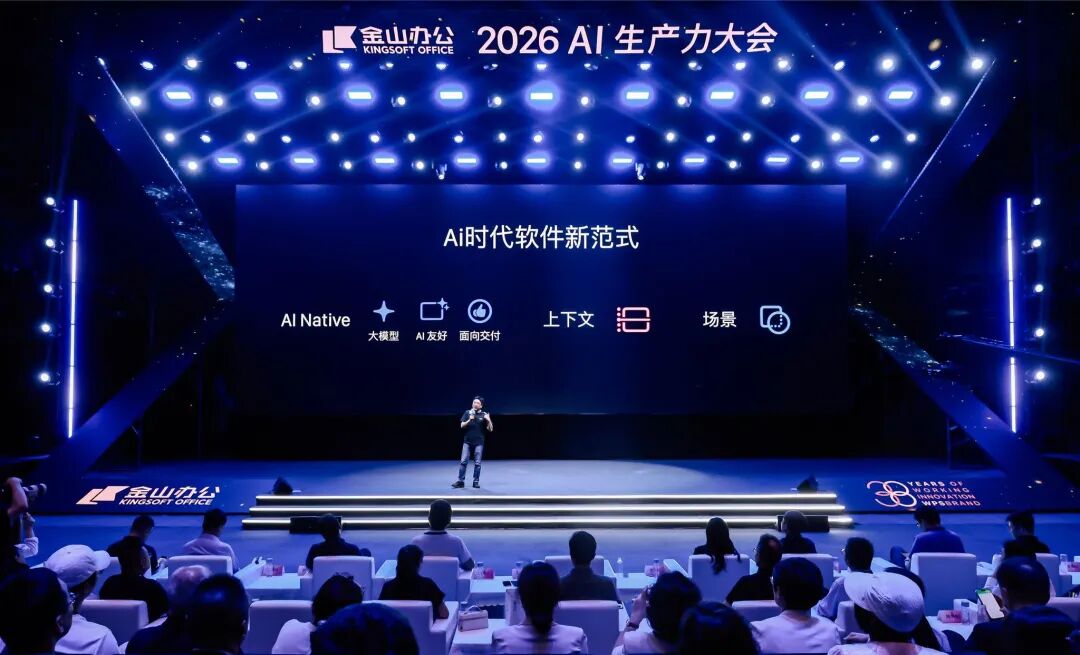
In the standalone office era, domestic software's core goal was compatibility and replacement. In the collaborative office era, product boundaries expanded to meetings, communication, and workflows. Entering the AI office era, the entire work paradigm will be restructured. Within this framework, Kingsoft Office made one thing clear: to create truly AI-native software, three criteria must be met:
-
First, it must be foundation model-driven. In the past, spreadsheets had calculation engines and word processors had layout engines. Future software will certainly have an engine — the foundation model.
-
Second, software design must become AI-friendly. Previously designed for functionality, growing ever more complex. Today it must be designed AI-friendly, providing APIs, CLI, and Skills for foundation models to invoke.
-
Third, product design must orient toward outcomes.
Lingxi Professional Edition is an AI-native product attempt under these three standards.
AI Native: Building Phones Beyond Film
This time, Lingxi Professional Edition wasn't integrated into the WPS client, but launched with its own domain and product form.
Zhang Qingyuan explained:
"If WPS is like a film camera, doing AI modifications on top of it might eventually yield a camera. But what truly killed film cameras wasn't digital cameras — it was smartphones. Lingxi going independent is building a smartphone."
Tian Ran's formulation was more direct:
"Today, facing such a massive transformation, what kind of company survives? It certainly won't be the biggest company from the last era. Mammoths don't survive into the next era."
This is precisely Kingsoft Office's core proposition at the moment.
A consensus reached internally at the company: AI doesn't restructure software features, but work paradigms. In the past, humans operated software; today, humans and AI complete work together.
Accordingly, Kingsoft Office's AI strategy is taking a more aggressive step. From 2023 to 2024, it was Office AI — primarily AI-enhancing Office. From 2025 onward, it enters AI Office — comprehensive AI-native-driven reconstruction.
Lingxi Professional Edition is the first complete implementation of "AI Office."
The company's organizational transformation is also advancing in parallel. Zhang shared a personal story in a media interview: "In 1998 I worked in Shanghai, the company had just 3 people, and as manager I supervised two subordinates. I did everything. Drew icons, made splash screens, wrote documentation, did testing, wrote the most code, even went to customer sites for on-call duty. One person did it all — that efficiency was extremely high."
He told this story to illustrate a change in the AI era — "full-stack engineer-ization."
One person can simultaneously assume multiple roles: requirements analysis, product design, code development, testing and delivery. In the past, excessive division of labor led to efficiency losses, which AI is now breaking down. This shift in organizational logic is precisely the starting point for Lingxi's "AI Native" development model.
2026 is regarded by the industry as the "AI Agent Year," and the office track already has numerous rich products. In response, Tian noted, "Our real advantage is understanding of scenarios — knowing why users make spreadsheets, knowing how to validate data, knowing what makes a good presentation."
"This understanding is what we'll continuously inject into our products over the next 3 years, 5 years, 10 years," he emphasized. In other words, Lingxi's moat lies in time and customer accumulation. Kingsoft Office has spent 38 years in office scenarios — this isn't something that can be replicated in the short term through funding or talent poaching.
Conclusion
From July 17 to 20, Kingsoft Office exhibited at the 2026 WAIC World Artificial Intelligence Conference as an "AI Office Efficiency Partner."
From proposing "All In AI" in 2023, to releasing WPS AI 2.0 in 2024, to launching WPS Lingxi in 2025, to today unveiling two Agent products simultaneously — Kingsoft Office's AI transformation has been underway for over three years.
In an era where AI advances by leaps and bounds daily, this software giant's transformation attitude seems more urgent than ever. Zhang Qingyuan stated at the launch:
"AI is our only and most important opportunity in the coming years. If we mess it up, we're done. If we succeed, we'll achieve even better results."
He predicts that a national-level Agent product will emerge within 5 to 10 years.
This is the time coordinate Kingsoft Office has set for itself. And the悬念 it leaves for the outside world. Can this 38-year-old software company become the "new species" that "crosses into the next era," as it puts it?
The answer may lie within this time window.
Crossing is seeking independent contributors to write AI product and model reviews.
If you've written articles like: Hands-On with PixVerse C1[1], Hands-On with LibTV[2], please contact zeo0811@gmail.com. Your email should include: ① personal introduction, ② AI review articles you've written.
We offer competitive compensation. Looking forward to observing and documenting the AI era together with you 🎪