Behind Manus's Viral Moment: 20 Questions to Understand AI Agent

Here's everything you want to know about Manus & AI Agent.
Three weeks ago, Manus launched and went viral overnight in China. Shortly after, it gained significant attention overseas as well — Jack Dorsey, founder and CEO of Twitter, even posted a rare tweet that was characteristically concise: "Excellent!" The latest issue of The Economist features two articles mentioning Manus, one of them dedicated entirely to the product.
The explosion of popularity also sparked a degree of controversy. In today's podcast, we're not discussing the controversy, because I believe the standard for evaluating products is simple: if the product is good, it's genuinely good.
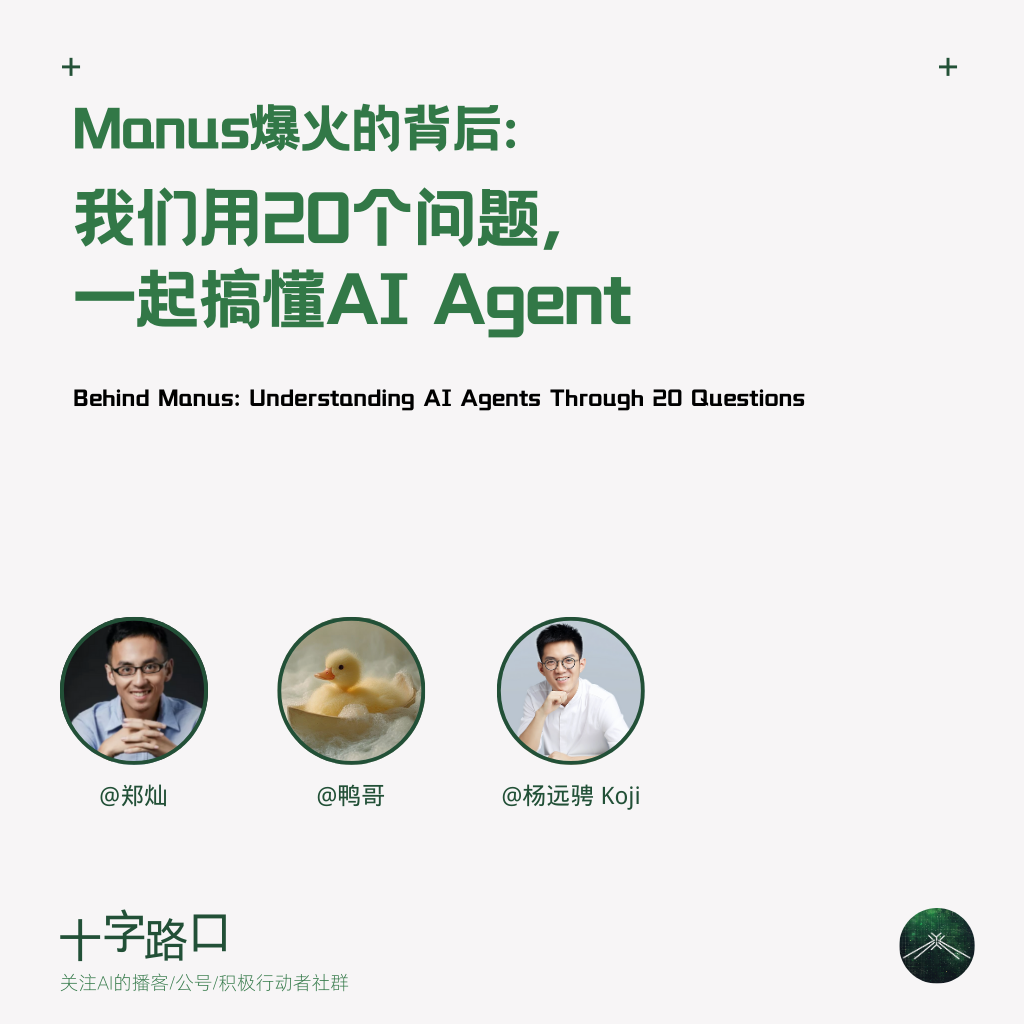
This week, we've invited two friends to join us in exploring one of 2025's hottest topics through 20 questions, starting from Manus: AI Agent. This is also the third installment of Crossing's "20 Questions" column, following previous editions on DeepSeek 20 Questions and AI Video Foundation Models 20 Questions.
Why "20 Questions"? Because when facing explosive products like Manus, and crucial concepts like AI Agent this year, we need a structured thinking framework. These 20 questions aren't simple knowledge primers — they're a carefully designed path of inquiry: from historical context to technical breakthroughs, from phenomenon analysis to future predictions. Through this Q&A format, we hope to help Crossing's audience build clear, systematic understanding of AI Agent amid today's information overload. Especially now, as the Manus hype begins to settle, this discussion allows us to be more rational and comprehensive, untethered from short-term emotions.
👬🏻 Our first guest this week is Can Zhang, Managing Director at Linear Capital. Can began paying attention to AI Agent in the first half of last year and has published numerous perspectives and articles about Agent on Linear Capital's WeChat official account. With his technical background plus frontline investment experience, Can has engaged with a large number of teams attempting to build in the Agent space, giving him firsthand information and insights.
👬🏻 Our second guest is Yan Wang, Applied Scientist at Samsara, PhD from Columbia University, previously at Pinterest and Microsoft, with nearly 40 papers published in top international conferences and journals. Following Manus's launch, Yan wrote multiple high-quality pieces on AI Agent, including "Behind Manus's Viral Success: How Can Agentic AI Products Build Sustainable Competitive Advantage?."
Before this week's podcast begins, a conflict of interest disclosure is needed. Koji is an advisor to Butterfly Effect (Monica/Manus's parent company) and was also an early angel investor in their previous company.
Listen on WeChat:
Listen on Xiaoyuzhou:

The Definition and Essence of AI Agent
🚥 Koji
Thanks to both of you for coming to Crossing to share this硬核 (hardcore) content. Let's start with Question 1: When we discuss AI agent, what exactly are we discussing? What is the definition of AI agent?
👦🏻 Can Zhang
Agent is actually a long-standing concept in the tech world.
From my perspective, the most fundamental capability of an agent is "autonomous" — the ability to act independently. Whether it's a single agent completing tasks on its own, or multiple agents with different specialties collaborating to solve problems, autonomy is the core trait.
To achieve autonomy, an agent needs several key capabilities: perception, to receive external inputs; tool use, to execute tasks; and planning, particularly the ability for long-horizon planning when handling complex problems. These requirements impose a series of demands on the underlying model, including perception capabilities, multimodal output capabilities, tool use capabilities, and long-range reasoning capabilities.
Another important trait is self-evolve capability — the ability to learn from past successes and failures, continuously improving itself. Fundamentally, the requirements for an agent are similar to those for a human. This includes agent capability design and architectural requirements, many of which draw inspiration from human professional specialization.
🚥 Koji
I recall Can mentioned in his June article last year that "there are 1000 kinds of agent in 1000 people's eyes" — it really is an exceptionally broad concept.
Even though Manus's release seemed to define a new paradigm for agent, discussions about agent remain relatively fuzzy. Let's set aside the definition question for now and move to Question 2: Yan, please walk us through the development trajectory and major breakthroughs in the agent space during 2024.
👦🏼 Yan Wang
This is a question of significant importance.
Agentic development in 2024 was mainly reflected in three aspects: maturing definitions, product explosion, and accelerating technical platforms.
From the definition perspective, at the beginning of 2024, the concept of Agentic AI was众说纷纭 (widely debated), just as Can said, "1000 people have 1000 kinds of agent." By the end of 2024, the definition had basically converged on two core elements: tool use capability and autonomous decision-making capability. Although different companies still had varying interpretations, the basic definition was much clearer than at the beginning of the year.
In the product domain, there were mainly two major development directions that attracted significant attention from startups and investors. The first category is research-oriented products, such as Gemini, OpenAI, and Perplexity, all of which launched products named "Deep Research." These claim to simulate human web browsing and provide in-depth analysis through Agentic approaches. The second category is generation-oriented products, including human-in-the-loop agent programming products like Cursor and Windsurf, more autonomous build tools like Devin, and presentation generation tools like Gamma. In 2024, both categories achieved rapid development and scale growth.
At the technical level, tools for building Agentic AI also began to explode, particularly in orchestration. What's interesting is that each tool represents its team's unique understanding of Agentic AI. For example, Microsoft's AutoGen, as the most mature agent development framework, emphasizes expressing all functionality through asynchronous pub-sub message flow patterns; LangChain's evolution into LangGraph emphasizes describing all agents through graph structures; and Hugging Face's SmolAgent particularly emphasizes that all agents can be expressed through coding agents. Whether at the definition, product, or technical level, Agentic AI showed more certainty and vitality in 2024.

GAIA: The Benchmark for Measuring AI Agent Capability
🚥 Koji
Our Question 3: When Manus launched, they mentioned "GAIA," which seems to have become an important standard for measuring agents.
Yan, could you introduce what the "GAIA" standard is, and why everyone has chosen it to measure AI agents?
👦🏼 Yan Wang
This is quite an interesting question. GAIA (General AI Assistant) is a benchmark proposed at the end of 2023, led by Meta and Hugging Face. The name comes from Greek, meaning "Earth."
The background was a trend in AI development at the time, with headlines like "GPT-4 scores high on such-and-such entrance exam" or "passes the bar exam." This led researchers to question: Should AI develop toward becoming an "exam-taking machine"? Does excelling at exams indicate strong memory, the ability to memorize legal provisions and common question types, or does it truly reflect the ability to apply knowledge flexibly and high intelligence? Based on this, GAIA emerged.
GAIA's focus is not on memory, but on emphasizing reasoning capability, multimodal web browsing, and other tool use capabilities.
These tasks are very simple for ordinary people, with accuracy rates reaching 92%, yet the most advanced GPT-4 with tool access at the time only achieved 15% accuracy. Therefore, it became a benchmark for measuring AI intelligence levels, particularly suitable for evaluating the comprehensive capabilities of Agentic AI.
Beyond test design, GAIA also faces the data leakage challenge.
Since AI training is ongoing, publishing test questions and answers risks incorporating them into training data, causing AI to simply memorize answers rather than solve problems through reasoning. To prevent this, GAIA split its 400-plus questions into two parts: 300 test-set questions (questions published, answers withheld) and 160-plus validation-set questions (both questions and answers published). The former is used for final evaluation, the latter for parameter tuning.
To enable automated testing, GAIA uses objective questions that can be verified programmatically without ambiguity. Its design—including question format and data leakage prevention—makes it a high-quality benchmark for measuring Agentic AI capabilities.
This is why numerous companies and products test their Agentic AI on GAIA. However, GAIA is not a perfect benchmark, and several issues merit attention. First, because of the validation/test set distinction, one must be careful about which dataset reported results are based on.
For example, OpenAI and Manus's claimed "world's best" scores were actually on the 160-question validation set. They did not submit test-set results to the official benchmark (i.e., "leaderboarding"), so these scores do not appear on the Hugging Face leaderboard.
This sparked some controversy, but from a corporate perspective it's understandable—leaderboarding is merely a way to understand one's own capabilities or a marketing tactic, not the end goal.
On another front, GAIA tests are relatively simple, mostly solvable in one or two steps, and cannot adequately test the strengths of today's increasingly popular long-memory and large-context-window AI. For instance, directions I personally find promising—like "endless learning" (spending days or weeks thoroughly comprehending complex codebases or knowledge bases)—are beyond GAIA's reach.
👦🏻 Can Zhang
Right, Yan is spot on. Benchmarks like GAIA are fundamentally designed to measure AI's practical ability to solve complex problems.
Compared to the "test-taker" model—scoring high by memorizing all the questions—GAIA was proposed specifically to address the problem of "AI that can take tests but can't do things," or the limitation of "solving seen problems but not unseen ones." GAIA is a relatively complete test set that comprehensively evaluates an agent's multifaceted capabilities, including multimodal understanding, tool use, and long-horizon planning.
Similar to this is the ARC test, specifically designed to evaluate AI reasoning ability. The defining feature of such tests is that they are completely unsolvable through memorization, because every question type is different—yet they are very simple for humans. For example, showing four different shapes and asking you to infer what the fifth should be—like the intelligence tests we took as children. These tests were created precisely to bridge the gap between a model's actual capabilities and its benchmark performance, hoping to measure AI's true ability level.

A Unified Protocol Standard for the Agent Space
🚥 Koji
Alright, let's move on to our fourth question, about MCP. After Anthropic released MCP last November, it quickly became something of an industry standard in the agent space.
There are two questions here: first, could Yan give us a primer on what MCP is; second, why was it able to achieve such rapid success?
👦🏼 Yan Wang
To answer what MCP is, we need to first understand why the Model Context Protocol concept emerged in the first place.
The most direct reason is that there are numerous large language models on the market, but each uses different format standards for tool calling.
For example, OpenAI uses a JSON-based format to tell GPT what tools are available, input formats, types, and so on. Anthropic's format is similar but differs in details—directly migrating OpenAI's code would likely fail, especially regarding safety handling for reasoning models. Gemini, meanwhile, uses a completely different format. This means developers wanting different LLMs to use the same tool must remember and develop multiple incompatible tool descriptions, creating clear pain points and slowing product launches.
To solve this, everyone has been seeking a unified format, hoping for something like the HTTP protocol—a general standard to unify the core interaction of model-calling tools. This is both an entry point for competitive standards and genuinely addresses developers' need to "code once, run everywhere." This is the core motivation behind MCP.
In fact, MCP is not the only such protocol on the market. For example, Open WebUI uses a pure Python-based protocol; PydanticAI implements a protocol through a Python framework. MCP is Anthropic's answer to a standard protocol. To discuss MCP's competitive advantages and disadvantages, we need to first establish the evaluation criteria for such protocols.
Specifically, a successful protocol should cover four dimensions:
- First, appropriate abstraction—the original motivation for tool-calling protocols: hoping to seamlessly adapt to various popular LLMs without code changes.
- Second, expressiveness must be strong enough. Whether using tools, generating prompt templates, or wanting LLMs to receive feedback when calling tools, the protocol needs to support these functions; otherwise developers may choose more flexible alternatives.
- Third, ease of use. Take LangChain as an example—while it does provide abstraction and powerful expressiveness, its abstraction is excessive (over-abstraction), to the point that adding custom functionality often requires tracing through numerous abstract classes to locate modification points.
- Fourth, debuggability, which requires the protocol to have good visualizability or clean structure for rapid problem identification.
MCP's success lies in achieving good balance across these dimensions.
It provides sufficient abstraction without over-abstraction; expressiveness is strong enough, supporting not just resources, prompts, and tools, but also mechanisms like sampling that allow tools to call LLMs in reverse; while remaining clean rather than bloated and unwieldy. Overall, it's a technically competent protocol.
Another important factor is the strong, well-resourced company backing MCP in Anthropic. For developers and ecosystem partners, this means deeper domain insight and more stable support. When no protocol has overwhelming technical superiority, people tend to choose the product with resources and reliability, eventually forming a de facto standard. This is a common phenomenon in standards battles—MCP didn't win because it's technically perfect, but because it seized market timing, consolidated ecosystem strength, and its recognition created a positive feedback loop, securing market leadership.
It's worth noting that despite MCP's wide adoption, there remains room for technical improvement. Excessive abstraction and debugging difficulty are obvious pain points—while it includes an inspector feature, its problem-localization capability still lags behind other protocols. Saying MCP has "won" at this point mostly means it has captured current timing and market consensus, gaining first-mover advantage in competition. If it can continue iterating and listening to community feedback, it may truly solidify as an industry standard; otherwise, other strong competitors could still emerge.

Manus's Core Breakthroughs and Innovations
🚥 Koji
Talking about MCP reminds me of The Box: How the Shipping Container Made the World Smaller and the World Economy Bigger (one of Bill Gates's annual book picks), which tells a thought-provoking story of standardization. The international standard for shipping containers was formed through extensive commercial and political negotiation—a process that began in the 1950s, around the same time as the founding of the People's Republic of China.
Before this, ocean and rail transport were relatively haphazard; goods were often loaded in non-standard forms like burlap sacks. Starting in the 1950s, some companies tried to push uniform container sizes, but every party fought for standard-setting power. After roughly 30 years of negotiation, by the 1980s international freight standards gradually unified. Today ships, trains, and trucks all use the same container specification system. This standardization process, similar to MCP, also resembles Qin Shi Huang's unification of weights and measures—effectively reducing trade friction and driving globalization.
Returning to our topic, the fifth question is for Can Zhang: AI Agent is seen as the interaction paradigm revolution for AI consumer products after chatbots. In your view, what are the key breakthroughs in reasoning capability of AI agents like Manus compared to existing LLMs (such as GPT-4o or Claude 3.7)?
👦🏻 Can Zhang
We first need to clarify several concepts.
Manus, as an agent product, relies on underlying models for all its planning, execution, and verification work; its reasoning capability fundamentally comes from the model itself. This is similar to a common situation when we discuss OpenAI—we tend to conflate the model with the ChatGPT product, but they are actually two different things.
From last year to this year, models have changed dramatically in reasoning capability. At the end of last year we raised the need to strengthen models' reasoning capabilities, and subsequently the market saw multiple strong reasoning models including o1, DeepSeek, and Anthropic Thinking. It is precisely this improvement in reasoning capability that enables products like Manus to achieve long-horizon reasoning—to plan tasks from start to finish, which is clearly visible in its task list.
Of course, today's models still have shortcomings. If each step in a ten-step process has some probability of failure, the overall task completion success rate drops significantly. Manus's important contribution lies in: how to ensure the process doesn't go off track during long-horizon execution. Beyond planning and execution, "reflection" is a critical component—achieving goals in a relatively deterministic way on top of capabilities that are not yet fully certain.
Compared to last year, there has been substantial progress. Last year you might have planning errors, reflection errors, replanning errors—but even if each step's success rate improves by just 5% (say from 85% to 90%), the final failure rate drops dramatically, because this is a product of multiple probabilities multiplied together.

Manus's User Experience and Product Value
🚥 Koji
Minghao had an episode on his podcast The Art of Dragon Slaying titled "Manus Has No Secrets[1]" — the title fits perfectly. From day one, the Manus team actively shared their vision and operational details with the public.
For my sixth question, I'd like to ask Yan: You've mentioned in several places that Manus inspired you. What were those inspirations? Which impressed you most?
👦🏼 Yan
Before answering, I want to clarify which aspects of Manus are not as stunning as some self-media outlets have hyped them up to be.
Manus didn't emerge out of nowhere. In 2024, we already saw two similar product categories: research products like Deep Research, and code-generation products like Cursor or Devin.
From a functional standpoint, Manus essentially fuses these two categories together. But this fusion runs deeper than it appears on the surface — it fundamentally transforms the user experience.
Without Manus, if I wanted to conduct research and visualize the results, I'd need to figure out how to break down the task into sufficiently independent subtasks for AI to handle, which tools suited each subtask, and how to design the interfaces between them.
Specifically, I might assign the research to OpenAI Deep Research, copy the report into ChatGPT to decompose it, generate prompts for Cursor, feed those prompts to Cursor to produce code, and finally run the program to get my visualization.
With Manus, I think far less. I simply submit all requirements at once, focusing my energy on making sure it understands my thinking, context, and goals. The rest — task decomposition and execution — I leave to it. The experience improves dramatically.
On another front, Manus is highly polished. I'd tried similar AI tools for research before, but a major pain point was getting blocked during data scraping by bot detection. Manus, along with products like Devin, overcame this. Even against strict anti-scraping mechanisms like Zillow's, or platforms like Zhihu, it scrapes normally, substantially improving overall usability.
So what impressed me most is how well Manus delivers on the original promise of Agent AI: letting users focus on defining problems while AI executes autonomously, enabling users to reach their goals through the shortest path and simplest workflow — exactly what users care about most.
🚥 Koji
Many people question whether Manus is genuinely innovative. My seventh question is for Can: In your view, does Manus represent innovation? If so, what is its core innovation?
👦🏻 Can
Simply put, fusing numerous tools and capabilities to deliver an unprecedented user experience is itself innovation — and precisely the kind of innovation products most need.
As Yan described, when users face complex workflows, they may need to invoke multiple tools — web scraping, image understanding, image generation, and so on, with scraping potentially involving anti-bot mechanisms and CAPTCHA solving. Integrating these disparate tools and ensuring the process reaches its goal without error demonstrates tremendous product strength.
The core of product strength is letting users achieve exactly the intended outcome through the simplest possible interaction.
First, it shows you what it's doing, reporting progress in detail like a colleague. You can see it thinking, reasoning, executing tasks — even creating to-do lists and checking items off one by one. It gives you the feeling that a colleague is conscientiously handling every detail.
Second, you can converse with Manus mid-task. A task might take 10-30 minutes; if you grow impatient waiting, you can ask how it's going. It won't stop what it's doing — instead, it responds like a colleague: "Don't worry, I'm working on such-and-such, it'll take about this much longer." These two moments genuinely surprised me.
👦🏻 Can
Manus differs from Deep Research in that it doesn't just complete research tasks like Deep Research — it can also execute many other generative tasks.
🚥 Koji
As Yan mentioned in his answer to question 2. Agent products have two main use cases: research and generation. Research tasks like report generation are something both Deep Research and Manus can handle. On the generation side, previously this mainly meant generating code or PowerPoints — now Manus can do that too. This is one reason Manus received such high expectations and praise when it debuted as a general-purpose AI agent.
👦🏻 Can
Indeed, much impressive work inherently requires generative capabilities.

Three Compounding Effects of AI Agents
🚥 Koji
Moving to my eighth question for Yan: Manus demonstrates that AI agents have compounding characteristics. In your article, you mentioned three types of compounding — tools, data, and intelligence. Could you elaborate?
👦🏼 Yan
There are many elements behind Manus worth analyzing, but particularly illuminating is the "compound effect."
Agentic AI attracts attention and investment primarily because of this compounding nature. Compounding typically refers to things with cumulative effects — the earlier you invest, the greater the later returns, growing exponentially.
Agentic AI compounds across three dimensions: tools, data, and intelligence. These three dimensions don't simply add together — they amplify each other multiplicatively.
Tool compounding is the easiest to understand, and also key to Manus's usability. An agent's core capability is tool invocation, but an agent that can call two tools versus one that can call ten deliver entirely different value. When you add a new tool to an agent, if it already has rich supporting tools, the combinations between old and new tools create explosive experience gains. For example, when an agent could only search and write code, adding a report-generation plugin might just repackage existing results. But if the AI already masters visualization, slide creation, website building, and so on, then adding report generation or image search tools can ignite numerous creative workflows — enabling one-stop service from research to content publication. Manus's success owes much to tool compounding.
However, tool compounding alone has a problem: it's easily copied by competitors. This brings us to the second factor: data compounding.
Here, data doesn't refer to the massive tokens used for pre-training large models, but rather the knowledge base accumulated through long-term collaboration between agent and user. Once organized and externalized into explicit documentation, this data lets AI lock onto problems faster in subsequent interactions, reduce detours, and better understand user needs.
This resembles how a veteran factory worker can slap a machine and know what's wrong, while a novice checks parts one by one without necessarily finding the cause. The veteran's accumulated workflows, product history, and solution experience dramatically improve troubleshooting efficiency. For AI, this gives users the feeling that "the AI really gets me, we're in sync" — creating a positive loop: the agent grows smoother with use because it learns more background knowledge, and users become more willing to share more data, further improving output quality. This knowledge base accumulation is a more important and harder-to-build compounding pattern. If a product can fully leverage accumulated data within an end-to-end experience, it naturally forms a core moat.
The final point is intelligence compounding, which is often overlooked but equally important.
An agentic AI's capacity for autonomous thinking amplifies alongside growth in tools and data.
A model with weaker reasoning might mechanically execute preset instructions — search the web, list results, stitch together a report. But with sufficiently strong reasoning and ability to draw inferences, it can adjust strategy based on search results: optimizing keywords, anticipating additional materials and analytical dimensions the user might need, autonomously deciding to uncover more resources. A truly intelligent agent can even correct goals through conversational interaction, understanding that behind the user's surface question A lies their actual concern B.
This higher-level thinking capability has begun emerging in models like o1 pro, acting as a catalyst that accelerates the growth efficiency brought by tools and data. If a company has the capability for this level of LLM research or fine-tuning, it can build a virtuous cycle of tool orchestration, knowledge accumulation, and intelligence enhancement.
Ultimately, these three compoundings spark off each other, creating multiplicative effects. More tools generate more data to be preserved; richer data supports higher-order intelligence training and application; and improved intelligence raises the combination efficiency of multiple tools. Therefore, excellent products in competition should position themselves as far right on the compounding curve as possible — at the node where compounding rapidly manifests — effectively building moats and achieving explosive growth.
🚥 Koji
That summary is remarkably comprehensive. After reading Yan's article, I especially wanted to invite him to record this podcast episode. In a short time, he incisively distilled the key points of how to build moats and competitive advantages in the AI agent space.
👦🏻 Can
Koji, as I understand it, you were an angel investor and advisor at Xiao Hong's previous company. I'm particularly curious — from your perspective, why was it them who made Manus?
🚥 Koji
Actually, I'm not surprised at all. From their initial conception through to launch, the only thing that amazed me was how explosively popular Manus became, triggering so much subsequent discussion.
Why not surprised? Because a post on Jike by someone named Erix (who worked at Butterfly Effect, the company behind Monica and Manus) explained perfectly why it was Xiao Hong's team — hidecloud and Peak as the core team — who built Manus: they've been actively on the front lines, enthusiastically trying every possibility.
Looking back, as Erix noted, they were already experimenting with various agent solutions domestically back in September–October 2023. One of their best practices was using Markdown-formatted to-do lists. Today we see that Manus begins every task with planning and to-do lists, keeping complex tasks organized and meticulously sequenced — like a highly capable professional at work.
In March 2024, the Monica team developed a platform similar to GPTs. Throughout the year they also tried building a browser akin to Arc (though it was never released because they couldn't find a viable competitive angle), but this process accumulated substantial browser-related technology that laid the architectural foundation for Manus's approach of equipping agents with virtual machines to operate browsers. As early as November 2023, Monica had already begun supporting web search, establishing the groundwork for agents to access online information.
In July 2024, the Monica team launched Roast. This may be little-known, but it became a viral marketing campaign overseas — similar to growth projects like Twitter Personality — spreading rapidly through social media. I'm confident the team gained invaluable experience in social media-driven growth. The time from launch to surpassing 1 million UV was remarkably short. I witnessed this process firsthand; it was genuinely exciting, and I hadn't seen such a viral phenomenon in a long time.
These projects were numerous and varied, large and small. Individually they seemed insubstantial — scattered building blocks. But when combined at the current market window, with technology evolving and maturing across dimensions, these boundary pieces came together to create powerful combinatorial innovation. As Xing Wang often says: "Don't play in the boundary; play with the boundary" — don't operate within boundaries, but strive to push at their edges.
This explains why Manus, despite being a "wrapper" product, has value in the wrapper itself. They knew which cutting-edge boundary technologies to adopt as building blocks, constructing a product with excellent user experience and strong problem-solving capabilities. To summarize: the Monica team possesses both forward-looking vision and exceptional execution speed, enabling them to launch such a breakthrough product at this critical window.
Can Zhang
Understood. One interesting point you raised is their development of multiple tools. You can see many tools within the Monica product itself, which must have been enormously helpful in developing Manus.
Manus requires tool-calling capabilities, and the Monica team had already developed and fine-tuned numerous tools — something few other companies could match. That's genuinely a major advantage for them.
Less Structure, More Intelligence: A Product Design Philosophy
Koji
This brings to mind Steve Jobs's famous phrase "connect the dots." After going through many experiences, you look back and realize each thing you did becomes a dot — and at some window in time, those dots suddenly connect, creating a chemical reaction that produces something extraordinary. Truly fascinating.
Let's continue to our tenth question. I'd like to ask Yan Wang: We know the Manus team has a product development philosophy called "Less Structure, More Intelligence." Could you explain this concept and what it means?
Yan Wang
That's an excellent question. This phrase represents one approach to the trade-offs involved in implementing Agentic AI.
On the surface, it means that when we provide AI workflows with fewer structured constraints, the AI demonstrates higher intelligence. For example, during task execution, we rely as much as possible on the AI's own cognition and reasoning capabilities rather than restricting it through pre-scripted logic, flowcharts, or state machines — allowing the AI to appear more intelligent.
But I believe there's another layer of meaning here, a reverse causality:
For weaker models, we may indeed need more structural constraints to keep them from going off track. But as models become more intelligent, we must reduce structural constraints to unlock their potential.
Therefore, depending on the technology (LLM) and product goals, we should make different trade-offs regarding structural constraints.
This is closely tied to the evolution of Agentic AI. In AI's early days, we typically adopted highly structured approaches — RAG (Retrieval-Augmented Generation) being a classic example. Its workflow was predetermined: first retrieve information, second construct the prompt, third have the LLM generate content. This approach of pre-defined prompt templates, step lists, or state machines had clear advantages — more controllable, especially important when early LLMs weren't good at proactively calling tools. But the downside was equally obvious: compared to today's Agentic AI, it sacrificed model creativity and had limited ability to handle open-ended scenarios.
What makes today's Agentic AI effective at its core is allowing AI to autonomously decide its next action: whether to continue searching with different keywords, begin answering based on current search results, or directly inform the user that relevant information cannot be found.
But "Less Structure" doesn't mean that simply providing better structured support will naturally make AI intelligent. Behind it lies substantial work: beyond LLMs more extensively trained for tool calling, there's significant product knowledge involved — memory handling, context window management, providing AI with sufficient information to reasonably select the most appropriate tools — all requiring deep expertise.
Once these elements are in place, user experience rises to a new level, and we naturally move toward "Less Structure." At this stage, users feel they're communicating with an agent capable of independent thinking, rather than interacting with a step-by-step script.
Therefore, "Less Structure, More Intelligence" primarily refers to the natural evolution toward fewer structural constraints as model intelligence and product capability reach certain thresholds, leading to better experiences — rather than forcibly reducing structural support to make a product appear more intelligent. This is fundamentally about balancing trade-offs.
Can Zhang
The continuous improvement of multimodal capabilities actually raises an interesting point for consideration.
We're often asked: as models keep iterating and upgrading, how should application development teams respond? Will applications built today be obsolete tomorrow? The core thinking here should be focusing on unleashing model capabilities rather than restricting or controlling them. Strategically, as model capabilities strengthen and product quality improves accordingly, there's no need for excessive concern about model upgrades.
This philosophy essentially reflects the "less structure, more intelligence" ethos. If you invest heavily in building structural frameworks for how models work, once model intelligence advances to where these structures become unnecessary, your work's value diminishes. Because intelligent models themselves already possess the ability to arrange their own working structures. This is the fundamental insight behind this methodology, and I strongly agree with it.
Koji
As new large model versions keep releasing and capabilities continue evolving, do entrepreneurs feel excitement or anxiety? This is actually an excellent test of whether your product has independent生存空间 beyond the model itself.
Can Zhang
Indeed, Manus itself is a beneficiary of advancing model capabilities. In other words, without the new models released after the Lunar New Year, achieving this level of user experience before the holiday would likely have been impossible.
Koji
We've discussed Manus in Part Two. Now let's move to Part Three, exploring AI Agent competition and industry landscape.
First, I'd like to ask Can Zhang: Between China's tech giants and Silicon Valley's major players, which do you estimate will be first to launch an AI Agent product similar to Manus?
Can Zhang
That's a good question. If we're discussing tool-based AI Agent products for semi-professional applications, ByteDance comes to mind first.
From what I understand, ByteDance may have already released similar products, though I haven't personally experienced them yet. If I had to make a prediction, ByteDance is the most logical choice because they have substantial accumulated experience in semi-professional agent tools — products like Coze fall in this direction.
Another clear trend is that nearly all model vendors have launched their own Deep Search-related products. Not just model vendors — many large AI startups have similar initiatives too. Google launched Deep Research; Perplexity, xAI, and others have corresponding products; OpenAI's tools are essentially research-oriented AI Agents as well. I use Manus primarily for this functionality, so I believe various companies may enter this space.
But for other specific tasks where Manus excels — like beautifying reports, generating charts, etc. — these are clearly not model companies' targets. They're unlikely to deeply pursue these application scenarios. What OpenAI does is merely provide a toolkit, enabling developers to better build such applications. This genuinely shouldn't be the core objective of model companies (especially overseas model companies).
Koji
Indeed, from OpenAI Manus to OWL and other projects, multiple open-source frameworks have emerged, making the market extremely active. I also look forward to seeing more innovative products and breakthrough interaction methods in this space.
Moving to our twelfth question: AI Agents were already receiving significant attention before Manus's launch, and the release will inevitably attract more entrepreneurs. Based on your conversations with startups, what directions are AI Agent startups currently focusing on?
Can Zhang
I've observed several clear directions: coding, the entire sales process, etc. — products like leads generation are very typical examples.
These domains share several characteristics: First, traditional approaches are costly and require substantial repetitive labor, typically demanding specialized expertise rather than tasks ordinary low-wage workers can complete; second, these areas are high-value or directly linked to revenue. Programming may not directly correlate with revenue but holds high value; sales directly connects to enterprise revenue and value enhancement. These are the directions startups are prioritizing.
Another characteristic is ease of verification or a certain degree of fault tolerance. Programming is relatively easy to verify — you can debug to determine quality. And with example generation (say, producing 100 examples), even if 10 are imperfect, the overall result may still be acceptable. Because current models still have substantial room for improvement, there's inherent uncertainty in the output, which means applications demanding extremely high success rates may not yet be suitable, or remain in exploratory phases.
Research and report generation work follows a similar logic. If a report contains certain issues, or one report in a series falls short on quality, users can typically tolerate it because AI has already saved enormous costs — they simply ask for the problematic sections to be redone. These are market-acceptable application directions, and also where we see startups concentrating their efforts.
🚥 Koji
Understood. Moving to question 13: With so many people founding companies in the AI Agent space, what are the core competitive advantages for Agent AI products in the long run? Which elements could constitute genuine competitive moats, and which are insufficient?
👦🏼 Yan Wang
This is an excellent question. I've spent considerable time thinking about it: If I were a Manus competitor, how quickly could I replicate it? If I were on the Manus team, how would I build defenses against replication? The answer comes down to the three compounding models we discussed earlier.
First, from the tools compounding perspective — to gain competitive advantage, you need to build diverse tools early and reach the right side of the curve quickly. But this is easily replicated. Everyone now has agentic programming tools (writing code is easy), and if I have ten times Manus's headcount, copying becomes simple and fast since each tool implementation is independent. Therefore, merely accumulating breadth and quantity of tools cannot build effective competitive advantage.
From the data compounding angle, the moat becomes more effective. Take Manus as an example: when users provide feedback, it records this information in its own database. For instance, if a company's internal visualizations typically use a blue theme, Manus records this knowledge after one correction and automatically applies it next time. After a user has worked with Manus for a while, switching to a competitor feels uncomfortable because they'd need to retrain the product to understand their preferences.
Many details require no explicit instruction — Manus has developed an understanding, it knows what the user needs, while other products know nothing. So if Manus can effectively accumulate data, the more this默契 (tacit understanding) grows, the harder user migration becomes. An AI Agent product truly enters the data compounding stage and builds effective competitiveness only when it can effectively accumulate and externalize user data — personal preferences, team workflows, historical decisions.
Third is the intelligence layer. Whether fine-tuning models or large-scale model inference, both demand substantial resources, capital, and system optimization capabilities — typically dominated by well-resourced companies. But higher intelligence acts as a multiplier factor: even marginal improvements can reinforce data and tools capabilities in reverse. Smaller companies aren't entirely without paths forward — for example, domain-specific fine-tuning is also a viable competitive route.
From the above discussion, it's clear that moats around tools are unreliable, intelligence requires massive resources, and data may be the most accessible and feasible moat-building approach.
But data itself can be copied. Beyond data accumulation, what's more important is accumulating methodologies and processes — how to systematically externalize tacit knowledge, how to structure沉淀 (accumulation) and manage data efficiently. These are difficult-to-replicate capabilities, akin to corporate culture. Once a robust data management and knowledge externalization methodology system forms, even if competitors copy tools or poach talent, they cannot replicate this tacit organizational capability in the short term.
Therefore, in the long-term competition for AI Agent products, the most difficult fortress to breach is not data or intelligence scale per se, but the systematic organizational capability around data and tool usage.

AI Agent Startup Opportunities and Industry Landscape
🚥 Koji
We've now covered the main directions for current AI Agent startup teams, and Yan Wang has shared his thinking on building core competitiveness.
Now I'd like Can Zhang to address question 14: For someone founding a new startup today, how do you seize the AI Agent opportunity? Beyond considering moats, what advice do you have?
👦🏻 Can Zhang
I understand the question is about how to enter the AI Agent space as an entrepreneur. First, for all entrepreneurs — indeed for everyone — the greatest dividend of this era is the abundance of available AI Agent tools, and fully leveraging them is essential. But if we're discussing how to build a company in the AI Agent domain, I have several thoughts.
First, as Yan Wang mentioned, after identifying a specific scenario, think about which steps particularly require human guidance, how to collect that guidance, and how to externalize and embed it into tools as tool intelligence. We often ask: what's the difference between someone with two years of experience in a field versus a newcomer? In what ways is the product unambiguously stronger? The answer usually lies in these specific scenarios.
Another point: many service-providing businesses should now consider transforming their services into Agent-delivered forms, or when searching for scenarios, focus on domains where services were previously delivered through human labor, and consider whether AI Agents could accomplish them today. This is highly meaningful because you're finding commercially validated scenarios — no need to validate business value from scratch.
Some domains are already mature businesses, potentially good ones, but constrained by scarce specialized talent or labor costs, forcing them to offer only partial high-value services. If converted to AI Agent delivery, services originally costing tens or even hundreds of dollars could drop to a few dollars or less — especially as AI advances further reduce costs. This not only delivers faster service at lower cost but expands customer reach and business scope, forming a sound business model. These are directions worth exploring, and we're actively thinking about such questions ourselves.
🚥 Koji
If anyone has startup ideas, feel free to reach out to Can Zhang.
Moving to question 15: Many people have bought NVIDIA stock. What impact do you think Manus has on NVIDIA?
👦🏻 Can Zhang
This is the million-dollar question (laughs). In fact, from a long-term perspective, this is positive for NVIDIA demand; in the short term, the impact is limited — similar to DeepSeek's impact on NVIDIA.
First, model training is still growing continuously, with no clear ceiling in sight, and more efficient architectures remain under research. But we probably won't see NVIDIA usage growing tenfold or hundredfold as in the past. Actually, within a month of DeepSeek's release, overseas H200 GPU rental prices rose 10%.
The reason is simple: everyone needs to deploy DeepSeek. Previously, for equally capable models like OpenAI's products, you could only buy API access; now you can self-deploy and optimize. These distilled models see far more actual usage than the original. We've consistently emphasized that inference is where models truly land — training merely contributes the majority of NVIDIA's revenue during this current phase of model immaturity. In the future AI era, inference volume should be at least ten times training volume.
Products like Manus consume substantial compute through token-based planning and I/O — this is even a practical challenge such products face. But returning to NVIDIA, rather than thinking about how these products affect NVIDIA, one should consider how much of NVIDIA's current valuation is based on delivered performance versus future expectations, and whether current delivery volumes are excessive or insufficient.
Interestingly, throughout the year before DeepSeek's release, GPU rents were actually declining — H200 prices kept falling. It was only in the month after DeepSeek's release that hardware rental prices in both China and the US rose 10%, particularly for H200, because an 8-card H200 machine happens to be exactly what's needed to deploy a complete DeepSeek model.
More worth discussing is that the primary problem current AI Agent products face is inefficient model inference consuming excessive tokens.
We expect this problem to be solved in the future, and I'm confident it will be. Current inference mainly relies on models "talking to themselves" — predicting and generating tokens, then feeding those generated tokens back as context to complete planning. We jokingly call this "spitting it out then eating it back." This is actually quite inefficient because thinking could entirely happen "internally" — it's merely current model architecture design that forces the thinking process to be externalized through tokens before serving as guidance for subsequent steps.
If models could think "internally," efficiency would improve dramatically and costs could drop significantly. While compute consumption might not decrease, efficiency would rise because output tokens also involve IO time. Compared to token costs, time cost may be the bigger problem. Currently, having Manus complete a task might take considerable time, but if all this thinking happened inside the model without conversion to tokens, the required time could be one-tenth or less of current levels. This is the new type of reasoning model we're particularly looking forward to.
🚥 Koji
Actually, our last podcast recording at Crossing was at the end of last year — we did an episode on AI companies going global: a retrospective. Just one quarter later, the changes seem utterly transformative. Back then, there was no DeepSeek, no Manus, Gemini 2.0's thinking feature hadn't launched, let alone the multimodal natural language editing features now available.
👦🏻 Can Zhang
None of those existed then — the only reasoning model was ChatGPT.

🚥 Koji
Three months — so many changes. So question 16 is a more macro-level one: Do you think the Agentic era everyone is talking about is really coming? What kind of era will this be?
👦🏻 Can Zhang
I believe the Agentic era will definitely arrive.
I believed this last year, and I still believe it this year.
The question last year was when models would get better. At the end of last year, I did a review, and one of my hopes for models was that stronger ones would finally make Agents practical — actually capable of completing tasks. When I said that, DeepSeek hadn't been released yet. Since then, various reasoning models have emerged one after another, and now Manus has arrived as well. We're finally seeing this kind of product become reality, and it wouldn't have been possible without continuous model progress.
This era really is getting closer, especially this past quarter, which has dramatically shortened the distance. Going forward, we'll see more Agent products, and potentially implementations across various professional fields, moving from shallow to deep. Certain domains like programming have already become default application scenarios — products like Cursor are basically standard issue now. Products targeting users without programming backgrounds, such as Lovable and bolt.new, are also developing well, becoming products for broader audiences.
In the realm of knowledge work and research, we have Manus and other deep-search products. These are trends and signals we've already seen. Next, we'll see similar products emerge in even more fields.
🚥 Koji
It really is like "a thousand trees, ten thousand trees, pear blossoms opening overnight." Question 17 is related to this: before this wave of Agent products like Cursor, Devin, and Manus were released one after another, AI discussions mainly revolved around chat applications like ChatGPT or Doubao. The new Agent interaction patterns have brought many changes to consumer-facing product forms.
In your view, what are the characteristics of these changes? For entrepreneurs and developers, what opportunities and risks do they imply?
👦🏻 Can Zhang
This is an interesting question. First, chatbots were, for me, a pleasant surprise of AI. It was accidental, but with an inevitability to it — a tool that can talk to you like a person is genuinely appealing. But from the perspective of value that AI delivers, chatbots themselves are an accidental byproduct.
What we originally expected from AI's real productivity落地 was the Agent — though Agent is a very broad term, the main source of AI's value in productivity should be helping complete actually useful tasks. In a sense, this evolution was inevitable. The early limitation to chatbots was because model capabilities were insufficient — you couldn't make it complete real tasks, or if it did, the results weren't reliable. So this change is essentially the result of model capabilities finally reaching the threshold of practical utility.
🚥 Koji
This leads to another interesting topic, and also question 18: as models keep getting stronger, there has been the view that "the model is the product" since the ChatGPT-3 era.
The boundary between technology and product sometimes becomes blurred, but it became clear again after Manus was released. When DeepSeek appeared, people thought the lines had already blurred — that a powerful model had crushed previous products. But once Manus launched, it made people realize product capabilities still matter. In your view, where exactly is this boundary?
👦🏻 Can Zhang
I think what we actually use are all products, so the boundary is actually quite clear. Take DeepSeek as an example: if you view it as technology, its raw model R1-Zero might be the more powerful one, since it was trained through reinforcement learning without alignment. But when it becomes a chat application, it needs alignment — ensuring it says the right things, does the right things, uses fluent language, and so on.
What's interesting is that they mentioned Zero had mixed languages during learning, with unfluent expression but agile thinking. The DeepSeek chatbot we see expresses fluently, which is the result of extensive alignment and optimization. This essentially may have constrained certain capabilities of the model, but this is precisely the product's control over the model — making it controllable, preventing inappropriate outputs, and improving user experience. So what we ultimately use are all products.
The reason "model as product" became a discussion point is that model capability largely determines the ceiling of a product.
Last year, probably no one would have made a product like Manus, because even if they did, it couldn't have achieved today's results. This is why new product forms often emerge alongside breakthroughs in model capabilities — model capabilities made a huge leap this past quarter, and products erupted accordingly.
But never underestimate the importance of productization. Even with the same underlying model, different products can have vastly different experiences — just like electric vehicles using the same batteries and drivetrains, but with huge differences in overall vehicle experience. Essentially, the model determines the capability ceiling of a product, but product strength is needed to ensure model capabilities translate into good user experience. The gap between capability and experience is what we call the productization process.
🚥 Koji
Our last two questions — one about industries, one about individuals.
Question 19 for Can Zhang: Which industries do you think will benefit from AI Agents first, and which are most likely to be disrupted by them?
👦🏻 Can Zhang
I think the scenarios where AI lands, simply put, still follow the principles we mentioned earlier: high-cost scenarios, scenarios close to monetization.
The most typical application domain, though not very relevant to everyday entrepreneurship, is military and defense. These scenarios will spare no effort in adopting any technology that can help, even if the technology isn't mature — they'll use various methods to constrain and optimize it for usability.
In domains we can discuss, programming is a typical scenario. Whether this field benefits or gets disrupted is hard to define, but it is indeed an industry that was originally very high in human cost and knowledge-intensive. Now, we all benefit from it, myself included — we joke that this is "Viagra for middle-aged programmers." Hand speed may not be what it used to be, but the mind is still sharp; using Cursor can greatly improve efficiency, and using Lovable can let programmers who weren't good at frontend build decent interfaces. These are significant benefits.
But from another angle, this industry may also be disrupted. Disruption means a fundamental change in supply-demand relationships — previously you needed professional programmers to write code; today, you may no longer need them. We're already seeing product managers use Lovable to directly build prototypes and tell programmers how to implement them; before long, they may directly release products without programmers involved.
We're even discussing that in the future, anyone with a need could write programs. For example, a coffee shop owner could develop their own online ordering mini-program. Going further, even applications without clear commercial value could be easily built — like making a red-envelope app for Chinese New Year. In the past this would have sounded impractical, but now it's entirely feasible. In the future, we may see a large number of "use-and-discard" programs with no clear economic value. This is precisely what disruption of an industry looks like — a massive shift in supply-demand relationships.
How Individuals Should Adapt to the AI Agent Era
🚥 Koji
Alright, our final question is a lighter one, but something everyone cares about: Please share, Yan Wang, as ordinary individuals in this era, what adjustments or changes should we make to better embrace it?
👦🏼 Yan Wang
This is an excellent question, and I've spent a lot of time thinking about it.
First, I believe the biggest difference between Agent AI and the traditional non-AI era is the change in human responsibility. We need to define problems more (telling AI "What") rather than specifically instructing AI how to work (telling AI "How").
To use an analogy: before the AI era, as a programmer, writing code was like rowing a boat. We needed to learn various programming knowledge, just like learning how to row faster; we needed to refine our tools, like choosing the right paddle materials and shapes to maximize efficiency. This was the traditional talent development system — when companies hired, they assessed candidates' programming abilities, whiteboard coding, GitHub contributions, and so on.
But the arrival of the AI era is like the invention of the steam engine. No matter how skilled humans are at rowing, they can't match the steam engine's speed, nor can they work 24/7 without stopping.
The impact of this is: what society and companies gradually need are no longer people who "row fast," but professionals who can add coal and water to the steam engine. The tools we refined for human rowing also become less important.
What we should pursue are suitable tools for the steam engine — like inventing the propeller. The core responsibility of talent shifts from "rowing the boat" to "making the steam engine row efficiently." In other words, what we need is "AI Enable" capability — enabling AI to perform as much as possible. This is more critical than "rowing" yourself. This is the talent most needed in the future, so to prepare for the future, focus on developing AI enablement capabilities.
However, there's no need for excessive panic. While AI is unprecedented in human history, we've had similar experiences before. The simplest example is the calculator — when we were in school, exams didn't allow calculators; teachers worried that using them would weaken mathematical thinking ability. But after entering the workforce, calculators proved extremely practical, and the feared consequences never materialized. Instead, being freed from tedious calculations allowed energy to be directed toward solving more complex problems.
Therefore, I believe the Agent AI revolution is fundamentally no different from the introduction of automobiles, electricity, or calculators into our lives. Many transitions will happen naturally, but if we have awareness and preparation for future trends, this transition will be smoother for individuals.
👦🏻 Can Zhang
This is indeed an interesting topic. I completely agree that today we need more the ability to find problems, because the methods to solve them already exist, and costs have dropped dramatically.
But AI or Agent AI has one difference from the past: when we talked about technological substitution before, it usually started with low-cost, labor-intensive work — this was the characteristic of previous technologies. What's different today is that knowledge-intensive or skill-intensive domains may benefit or be disrupted first. Benefit to a certain extent leads to disruption — this is easy to understand.
This is a major difference — AI is not disrupting labor-intensive industries, but knowledge-intensive, skill-intensive industries.
In other words, it's actually the more "white-collar" and even professional domains that are changing. And it's relatively general-purpose, applicable to various professional fields: as long as it's a skill that requires time to learn and has textbooks to study from, AI can likely master it. This is why we're excited, and it also makes the ability to find problems even more important.
🚥 Koji
The ability to find motivation in life also becomes especially important.
Previously, most of our actions were arranged for us — as children, we were arranged to study language, math, geography; arranged to learn jump rope, long jump. After entering the workforce, many OKRs were also top-down arrangements. Going forward, how to find the motivation to get up each day, the motivation to work, becomes particularly important in this society.
Recommended: Yan Wang's AI Course
🦆 From Users to Builders — Evolve Yourself and Embrace the AI Era [2] — check it out if you're interested.
Subscribe to the "Crossing" Podcast
🚦 We track how the new wave of AI technology is reshaping industries and creating fresh entrepreneurial opportunities. "Crossing" comes from Steve Jobs' description of Apple — standing at the intersection of technology and liberal arts, where great products are born. AI is transforming every sector, and we seek out, interview, and bring together the "active doers" of the AI era. Together with them, we explore and embrace what's new and what's possible.
👦🏻 Host Koji: Co-founder of The Fair and Tangdao. I believe technology, especially AI, will fundamentally reshape society and empower humanity. Feel free to reach out to chat, exchange ideas, and connect on what's next. Koji on Jike, Koji's website
👧🏻 Host Ronghui: Works at a tech VC; former Silicon Valley correspondent for CBNweekly. Ronghui on Jike
Join the "Crossing" Membership Community
☀️ Firsthand AI news and insights
👫🏻 We encourage you to date, make friends, and find future collaborators
🦀 Add our assistant on WeChat: Rwkfbcianvd, or scan the QR code below


References
[1] Manus Has No Secrets: https://www.xiaoyuzhoufm.com/episode/67d244bbe924d4525a3e15a7
[2] From Users to Builders — Evolve Yourself and Embrace the AI Era: https://www.superlinear.academy/c/ai/
[3] Koji on Jike: https://okjk.co/0JSUes
[4] Koji's website: https://koji.super.site/
[5] Ronghui on Jike: https://okjk.co/0cbnYV