Masayoshi Son: "I'm Ready to Bet Everything on AI, Win or Lose"

Masayoshi Son predicted: "Super AI could emerge within ten years, with capabilities ten thousand times greater than those of humans."

🌐 Google Open-Sources Gemma 2
🤖 OpenAI CriticGPT Arrives
🛠️ Meta Launches LLM Compiler
🏆 OpenAI Model Revenue Far Outpaces Microsoft
🎬 ByteDance's CapCut Introduces 599 Yuan SVIP
📖 Huawei Releases AI Terminal White Paper
📺 CCTV Debuts AI Micro-Dramas
💼 Andrew Ng Plans to Raise $120 Million
🌍 Masayoshi Son's SoftBank Raises $1.86 Billion Overseas
🧠 Language ≠ Thought? Nature Paper Sparks Debate

Google Open-Sources Gemma 2
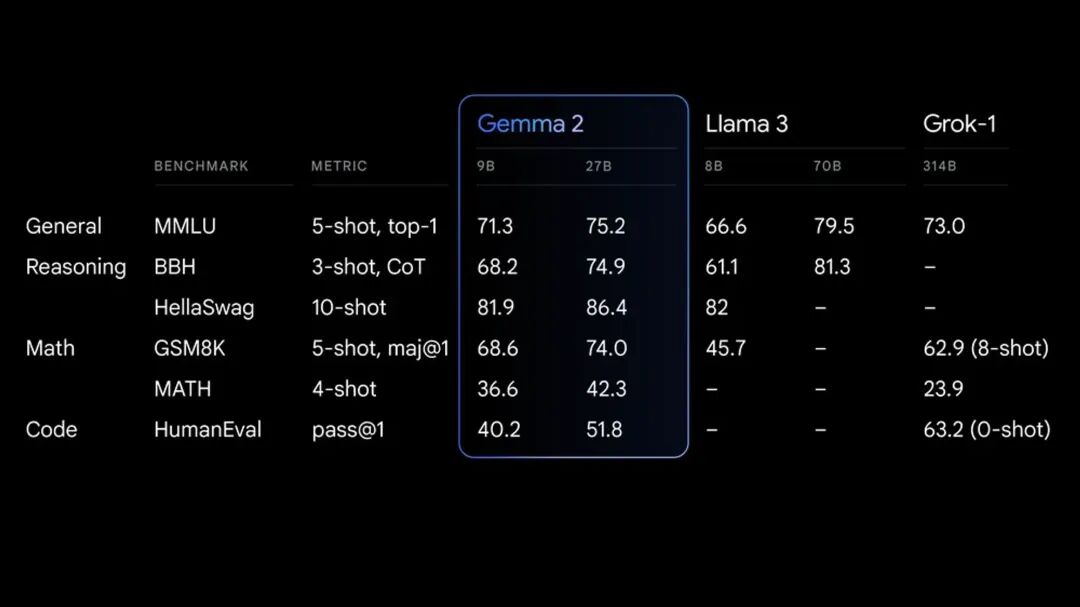
Google has announced that its next-generation AI model Gemma 2[1] is now openly available to researchers and developers worldwide, offered in two sizes: 9 billion (9B) and 27 billion (27B) parameters. The 9B version outperforms leading models like Llama 3 8B. With the 27B version, users can deploy powerful AI capabilities on a single NVIDIA H100 GPU or TPU host at relatively low cost. A 2.6 billion (2.6B) parameter model is also coming soon — compact enough to run on mobile phones.
Gemma 2 is now live on Google AI Studio, and model weights can be downloaded from Kaggle and Hugging Face Models. Additionally, Google has launched the Gemma 2 Academic Research Program, with applications open through August 9.
OpenAI CriticGPT Arrives
OpenAI has released CriticGPT[2], a model trained on GPT-4 specifically designed to review and identify errors in code output by ChatGPT. The inspiration for "using GPT to correct GPT" came from researchers' reflections on the diminishing returns of RLHF (Reinforcement Learning from Human Feedback): as models grow stronger, their outputs become harder to distinguish, with errors growing increasingly subtle. At that point, having humans catch problems becomes inefficient — so OpenAI trained CriticGPT to write critiques instead.
Human evaluators found that code performance improved in 60% of cases when assisted by CriticGPT. The development of CriticGPT marks a significant advance in AI, enhancing models' capacity for self-correction.
Meta Launches LLM Compiler
Meta has announced the LLM (Large Language Model) Compiler[3], built on Code Llama, integrating advanced code optimization and compilation capabilities.
The LLM Compiler was trained on a massive corpus of 546 billion lines of LLVM-IR and assembly code. Through instruction fine-tuning, it significantly improves code size optimization, achieving 77% of the optimization potential of auto-tuning search — providing new momentum for compiler optimization research.
OpenAI Model Revenue Far Outpaces Microsoft
Since forming its strategic alliance with tech giant Microsoft in 2019, AI upstart OpenAI has demonstrated remarkable commercial potential. According to recent internal data from both companies, as of March this year, OpenAI had achieved nearly $1 billion in annualized revenue (ARR) from selling limited access to its large AI models — while Microsoft's own Azure OpenAI Service only recently reached that same milestone.
Notably, OpenAI accomplished this without a dedicated sales team, whereas Microsoft is one of the world's leading enterprise and cloud software sellers.

ByteDance's CapCut Introduces 599 Yuan SVIP
To meet growing user demand for advanced video editing, ByteDance's video editing app CapCut recently launched a new SVIP membership tier. It integrates numerous AI-powered features, including AI translation, highlight extraction, auto-packaging, and digital human synthesis. Members also get exclusive access to premium video templates, effects, music libraries, expanded storage, faster export speeds, one-on-one customer service, and early access to new features. Pricing is set at 79 yuan monthly, 59 yuan with continuous subscription, 599 yuan annually, or 499 yuan with continuous annual subscription.
Huawei Releases AI Terminal White Paper
Huawei recently released the AI Terminal White Paper[4], co-authored with Tsinghua University's Institute for AI Industry Research under the leadership of Academician Ya-Qin Zhang. The white paper proposes an intelligent grading standard for AI terminals, emphasizing that AI should collaborate with and serve humans.
Richard Yu, Huawei's Executive Director, Chairman of the Consumer BG, and Chairman of the Intelligent Automotive Solution BU, noted that AI terminal intelligence should be classified into five levels from L1 to L5: Functional, Task, Collaborative, Guiding, and Autonomous. Huawei hopes to refine this grading standard together with industry partners.
CCTV Debuts AI Micro-Dramas
This morning, three AI micro-dramas produced by China Media Group's Film, Television and Documentary Center — Hero, Love Never Ends, and Fantasy Store — premiered simultaneously on Yangshipin. Hero tells the story of an ordinary person fighting alongside Western Han dynasty general Huo Qubing, with AI technology playing a major role in character creation and storytelling. Love Never Ends combines AI with live-action to deliver a heartwarming family drama. Fantasy Store constructs a futuristic world, using AI to generate virtual characters and animals in a tale about love and being loved.


Andrew Ng Plans to Raise $120 Million
Andrew Ng's AI Fund[5], an incubator supporting small teams using AI to solve critical problems, is planning to raise over $120 million for its second fund. An SEC filing shows that AI Fund II has already secured $69.75 million from 13 partners, with approximately $50 million still to be raised.
Ng founded AI Fund in 2018 with $175 million, serving as the incubator's GP and guiding its strategic direction. Investors include Silicon Valley VC firms NEA, Sequoia Capital, Greylock Partners, and SoftBank.
SoftBank Raises $1.86 Billion Overseas
SoftBank Group Corp. has raised approximately $1.86 billion through USD and euro-denominated bond issuances — the investment giant's first foreign-currency bond deal since 2021. The Japanese firm, famous for early blockbuster bets on Uber and Alibaba, is now embarking on a massive AI investment push under founder Masayoshi Son.
SoftBank stated the funds will be used for debt repayment and to finance the group's investment and business plans. Masayoshi Son said: "I'm ready to bet everything on artificial intelligence, win or lose."
Son predicts: "Super AI could emerge within 10 years, with capabilities 10,000 times greater than those of humans."

Language ≠ Thought? Nature Paper Sparks Debate
A recent paper in Nature has generated widespread discussion in AI circles: a provocative argument from MIT and other institutions titled "Language is primarily a tool for communication rather than thought"[6].
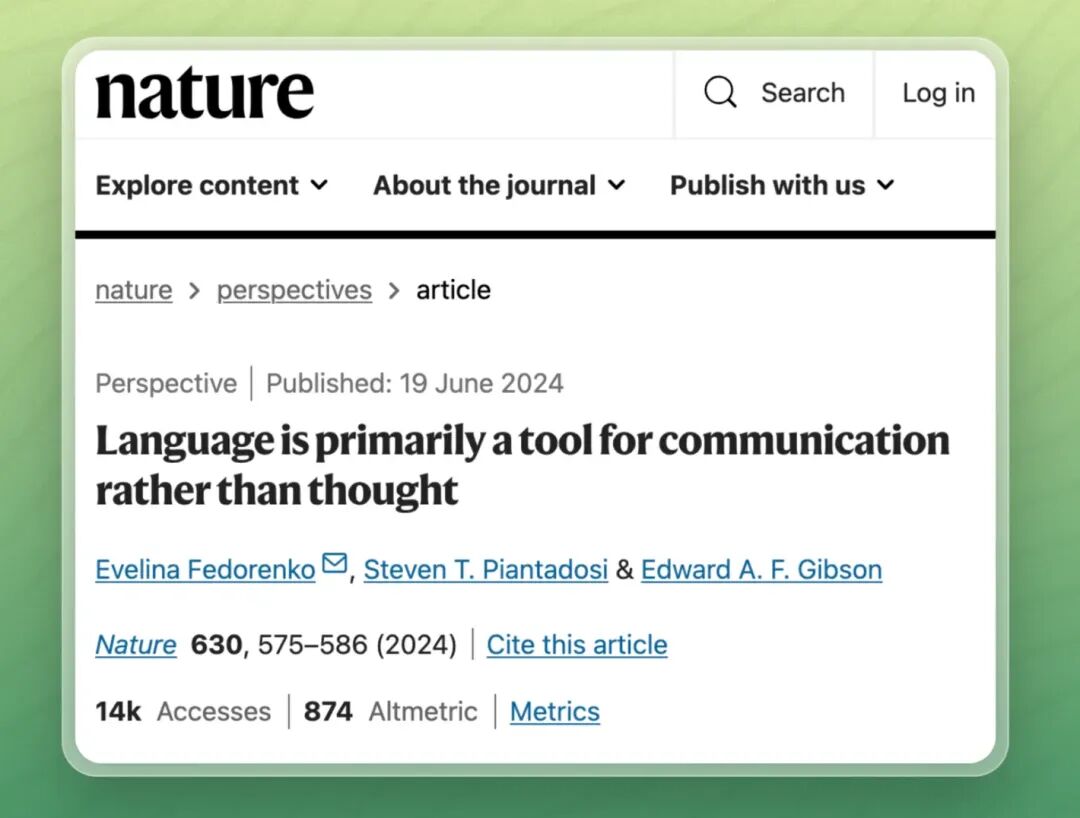
Drawing on the latest evidence from neuroscience and related disciplines, the paper argues that language is primarily a tool for communication, not a prerequisite for thought — revealing the separation between the brain's language network and formal reasoning in humans. This finding suggests that full linguistic ability does not equate to full cognitive ability.
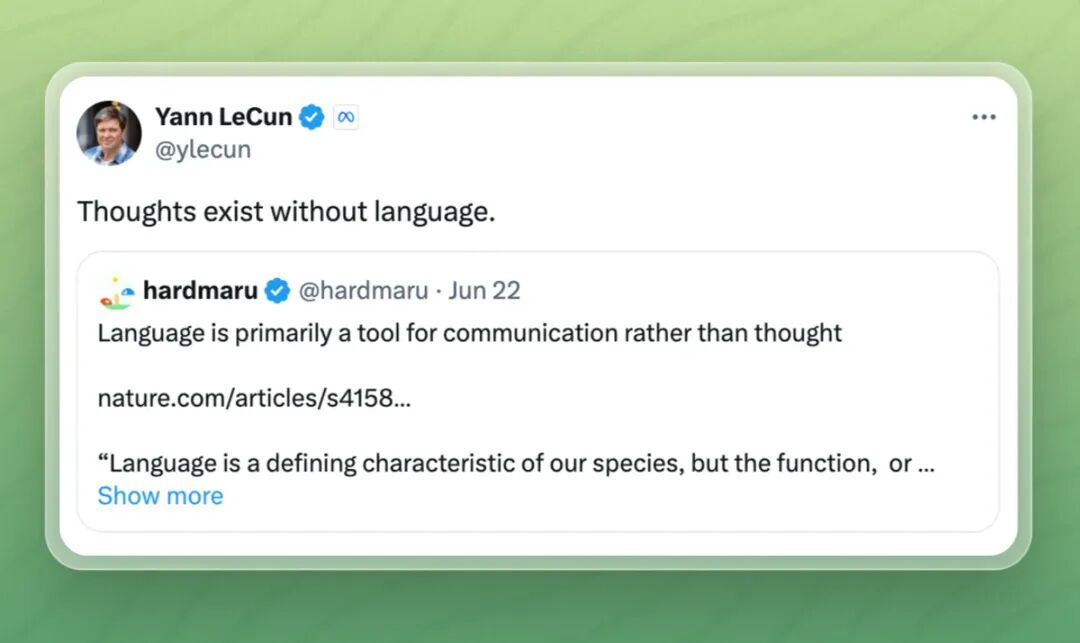
Turing Award winner Yann LeCun expressed agreement with this view.

"Man has the feeling that what he says in his head is clearer than what he utters in words. Whereof one cannot speak, thereof one must be silent."
— Ludwig Wittgenstein, philosopher of logic and language


Editor: Yuki Design: Ivan
For business inquiries, contact WeChat: Rwkfbcianvd

References
[1] Gemma 2: https://blog.google/technology/developers/google-gemma-2/
[2] CriticGPT: https://openai.com/index/finding-gpt4s-mistakes-with-gpt-4/
[3] Meta announces LLM Compiler based on Code Llama: https://huggingface.co/collections/facebook/llm-compiler-667c5b05557fe99a9edd25cb
[4] AI Terminal White Paper: https://developer.huawei.com/consumer/cn/doc/guidebook/terminals-ai-0000001929853698
[5] AI Fund: https://aifund.ai/
[6] "Language is primarily a tool for communication rather than thought": https://www.nature.com/articles/s41586-024-07522-w