How Good Is MiniMax's Agent? | We Tested 7 Cases and Have 3 Takeaways

The competition is heating up — and that's a great thing.
**
The chase is on — and that's a great thing.

👦🏻 Author: Jingshan
🥷 Editor: Koji
🧑🎨 Layout: NCon

Over the past few days, news of Minimax entering the general AI Agent space has drawn considerable attention across various communities. The company also announced a five-day launch week on X, kicking things off with an open-source reasoning model called M1.
When a company with a complete large model technology stack starts building Agent products, what differentiated advantages can they theoretically gain by integrating design at the underlying architecture level?
MiniMax — a player with a full technology闭环 — is about to bring a general AI Agent product, built on native model capabilities, to market.
🚥
Today's review from Crossing offers a comprehensive hands-on look at the MiniMax Agent's capabilities, with particular focus on its recently enhanced features.
We conducted deep testing across 7 cases, and from that distilled 3 key takeaways to share.
Agent is shifting from "what it can do" to "how beautifully it does it"
We're noticing that Agents are no longer just emphasizing what they can do, but increasingly shifting toward how beautifully they do it. This encompasses not just task completion accuracy, but also the aesthetic quality of the output.
Let's start with the simplest simulated case.
1) Birdwatching Record Visualization
Koji maintains a three-year birdwatching record in CSV format, spanning multiple countries with location data recorded in latitude and longitude — complex enough to make for a good Agent visualization test.
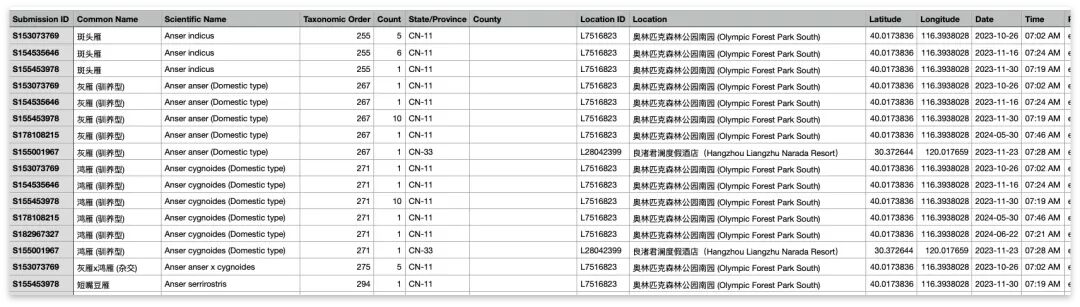
We fed MiniMax Agent the following prompt:
Prompt: Turn my uploaded CSV birdwatching record into a webpage with various data displays, with visual effects similar to Apple's dynamic presentation style.
MiniMax Agent demonstrates strong capabilities in handling long-horizon complex tasks. Beyond the task-planning abilities common to most Agents, it shows remarkable self-critical awareness.
Throughout this multi-turn repair workflow, we identified a standout feature — and this is precisely why MiniMax Agent can deliver complete tasks: it uses Browser Use to autonomously "test/debug" its freshly generated initial webpage.
Even when the webpage design appears basically functional, the Agent still queries all components and performs multiple rounds of self-repair.
The image below shows, on the left, a Chinese translation of its "repair" workflow for easier reading, and on the right, MiniMax Agent's initial workflow:
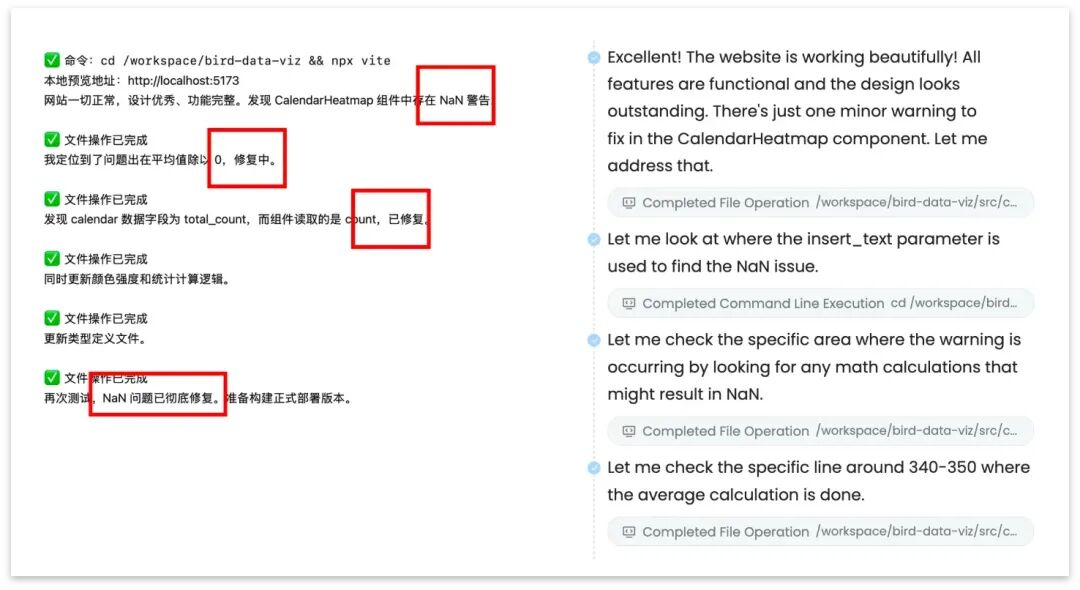
This approach of using Browser Use for autonomous debugging is somewhat unusual — most Agents typically only invoke Browser to understand external websites.
You could say MiniMax Agent isn't quite confident in its "first-round product," or that it's somewhat worried about "user dissatisfaction":
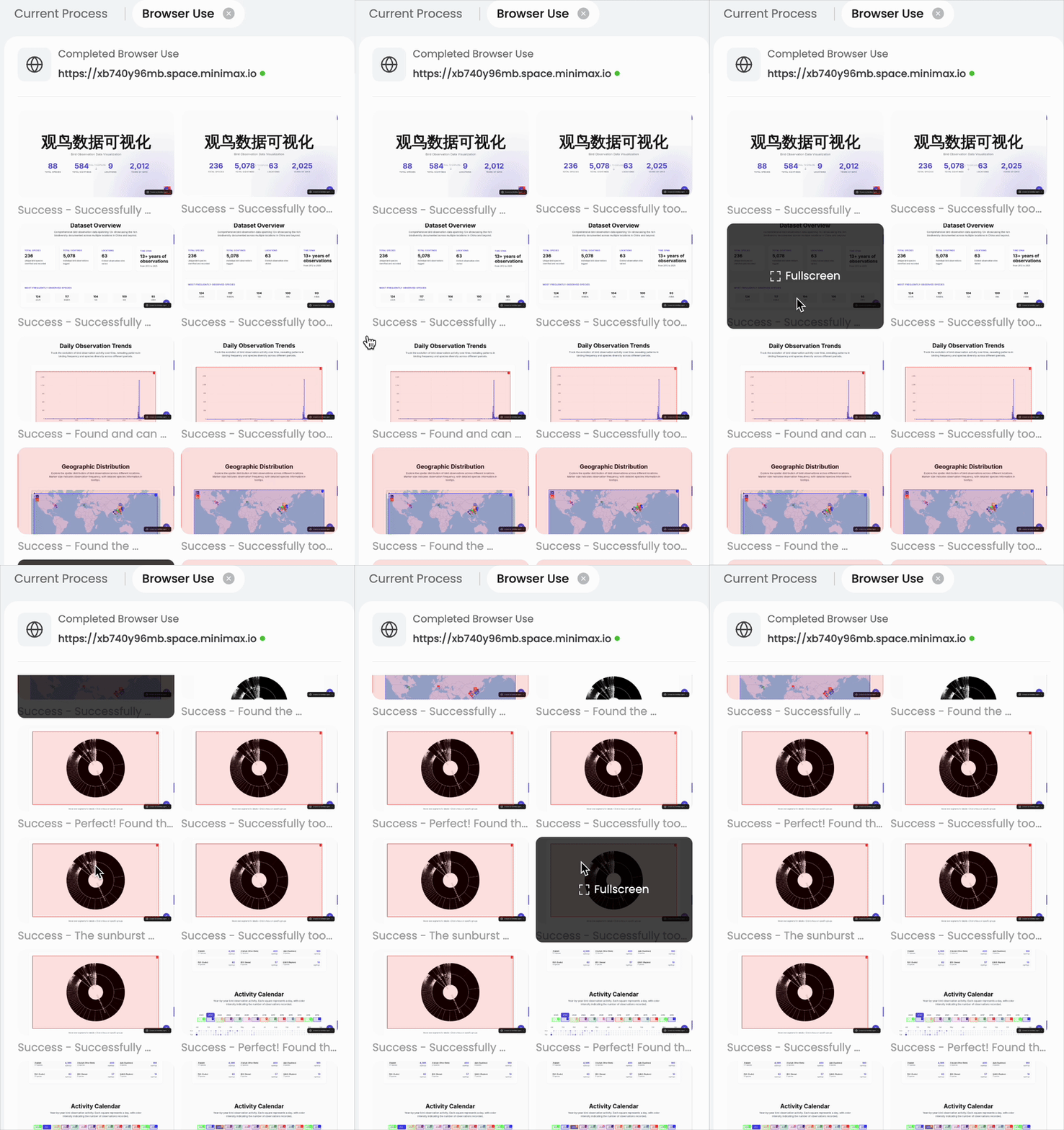
The birdwatching visualization case may have been too easy for MiniMax Agent. I only needed one attempt, and the webpage already demonstrated fairly strong coding ability — clean frontend design with complete functional modules covering form handling, dynamic data interaction, responsive design, and other key components.
I recorded a video so you can see for yourself:
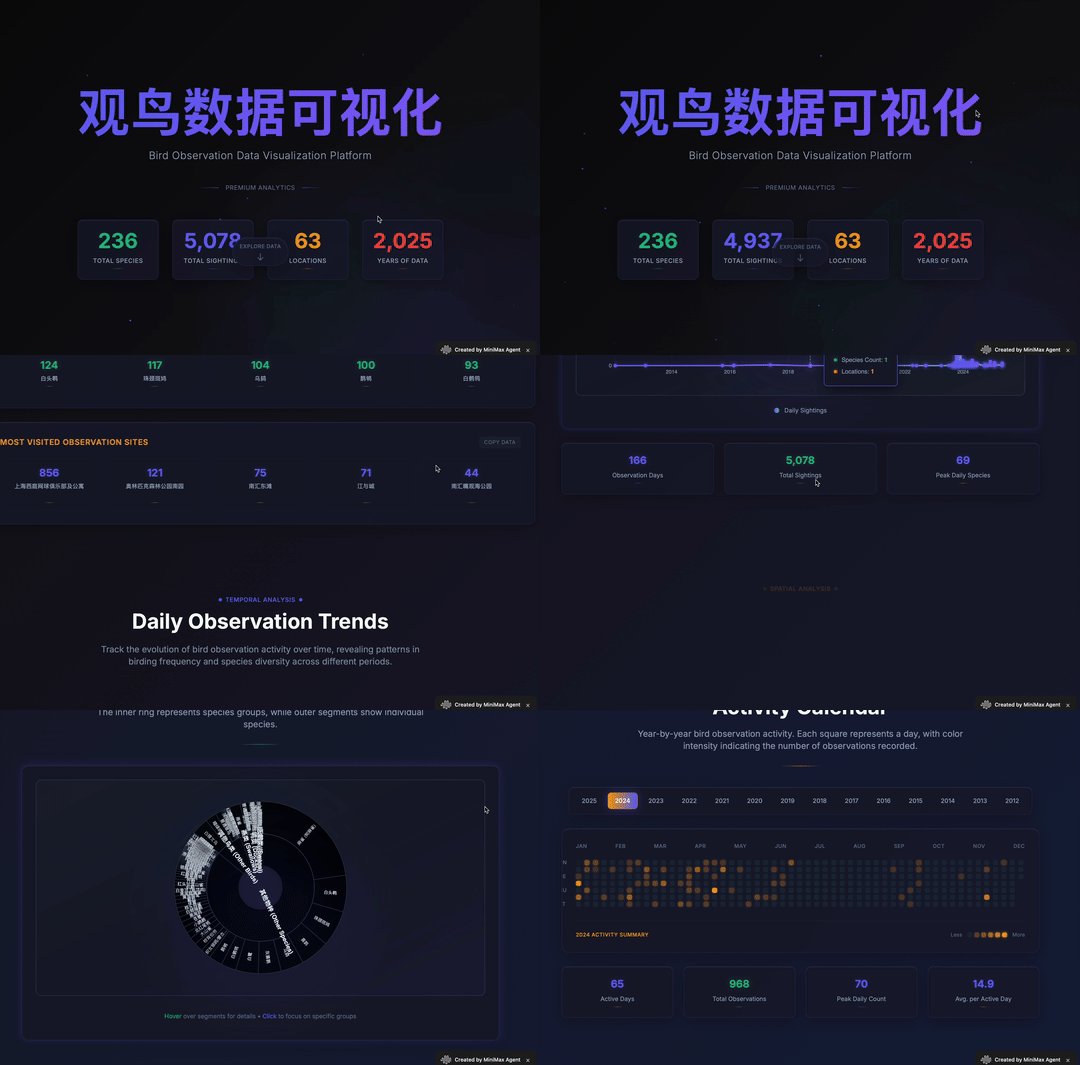
Among the many Agents I've tested, MiniMax Agent showed notably accurate parsing of Koji's complex birdwatching CSV file. For instance, it identified 236 bird species; 5,078 records; 63 locations covered; data spanning over three years; and 166 active observation days, among other details.
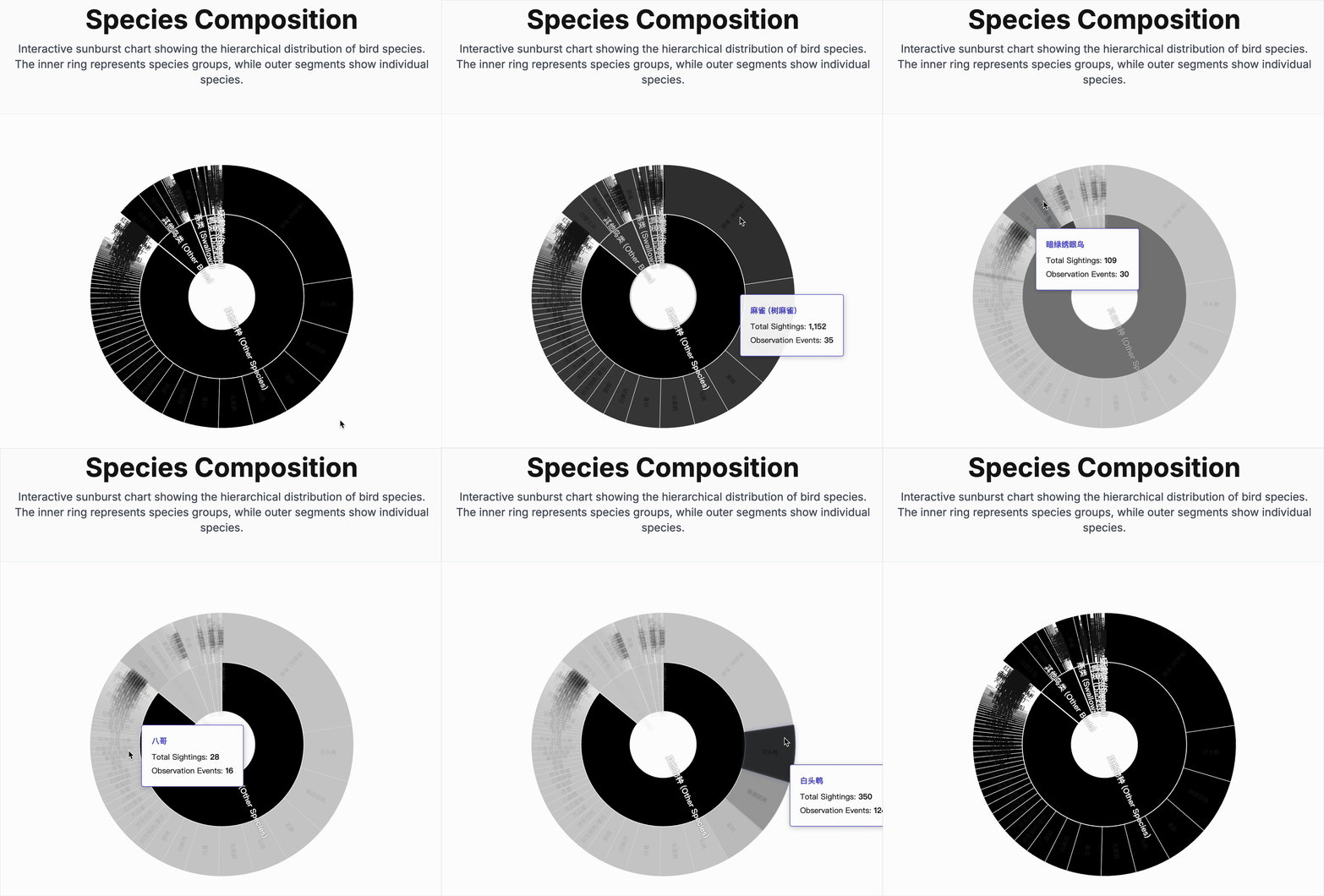
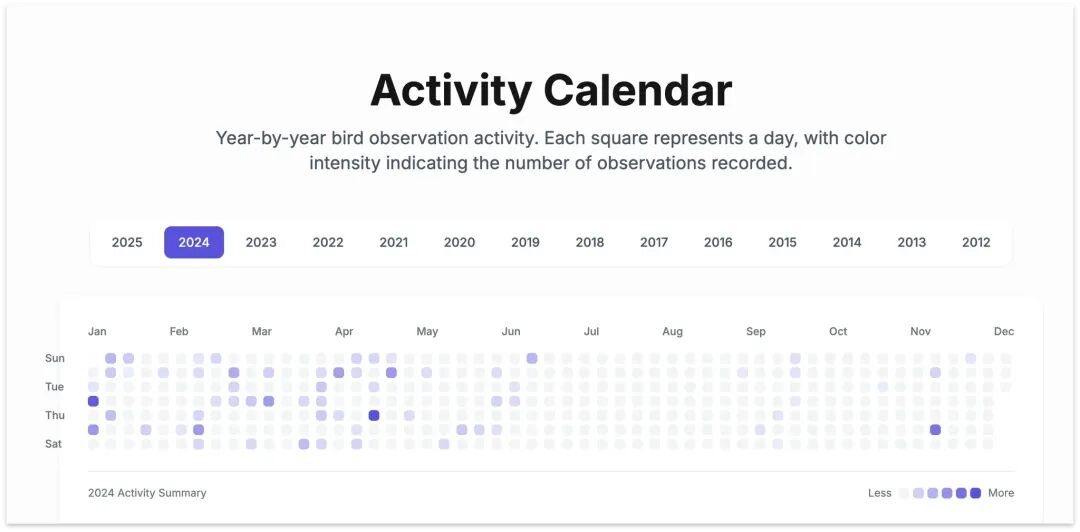
In this birdwatching visualization webpage, I personally found the interactive sunburst chart and activity calendar particularly appealing — both very intuitive.
This may be the whole point of "visualization": allowing people to access data in a way that's genuinely pleasing to the eye:
2) Redesigning with reference to a website's style
Since I discovered during testing that MiniMax Agent's Browser Use capabilities are quite strong, I decided to up the difficulty: having it directly recognize an external website's interaction design and transplant it into the existing birdwatching site.
The prompt simply needed to include the target website:
Prompt: Reference the interaction design of https://wope.com/, such as spotlight-style hover effects and actionable copyable tables. Use Linear design style: against a large dark background, skillfully employ gradients, blur, dynamic light streaks, ultra-thin outlines, micro-noise textures, outer glow, and solemn sans-serif typefaces, combined with fluid, restrained micro-animations to organize and embellish interface elements.
The Agent then began using Browser to enter "https://wope.com/" and started recognizing the site's interaction design.
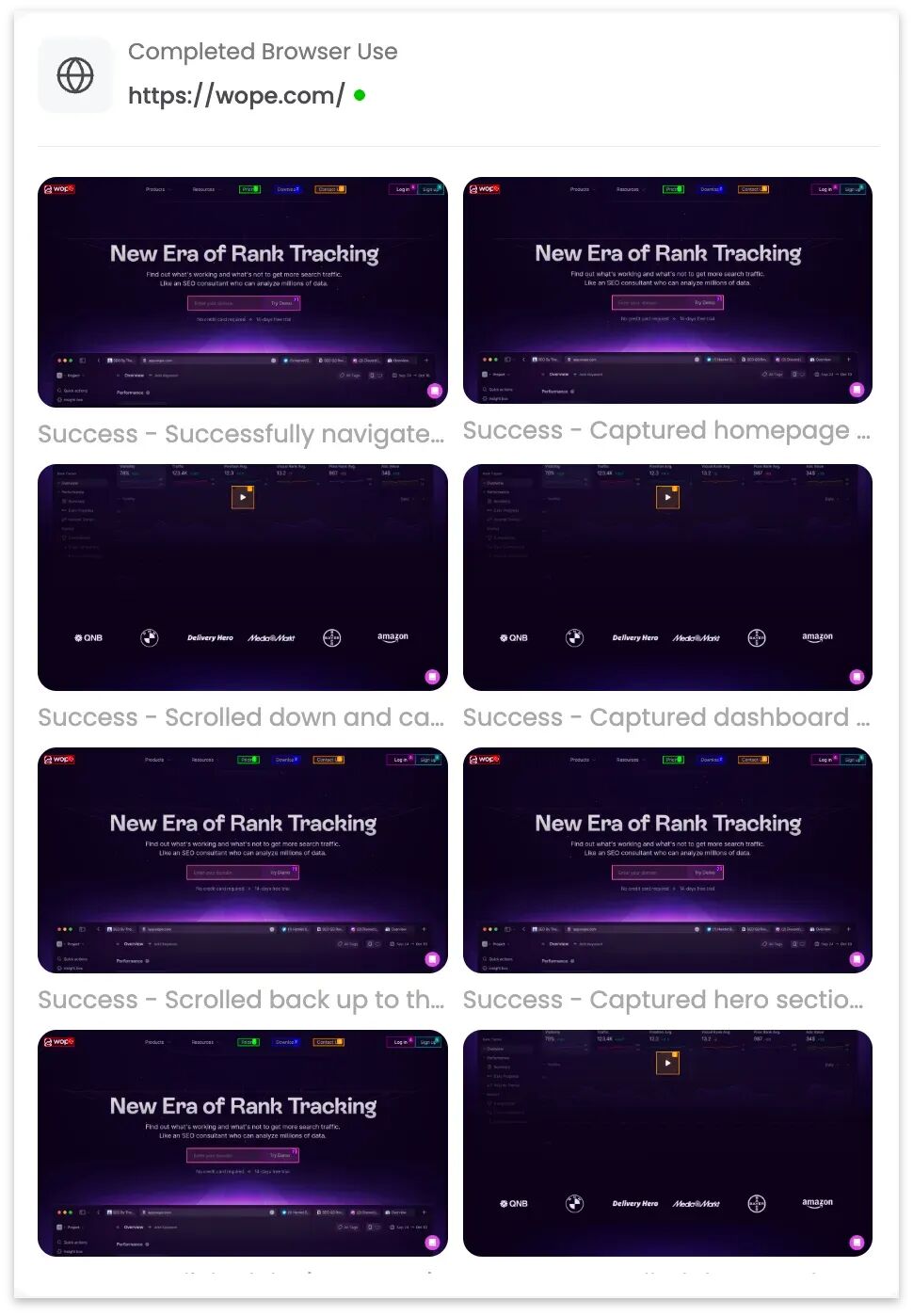
The Agent's understanding of the site's visual elements: premium dark theme, spotlight hover effects, copyable tables, micro-noise texture, refined typography:
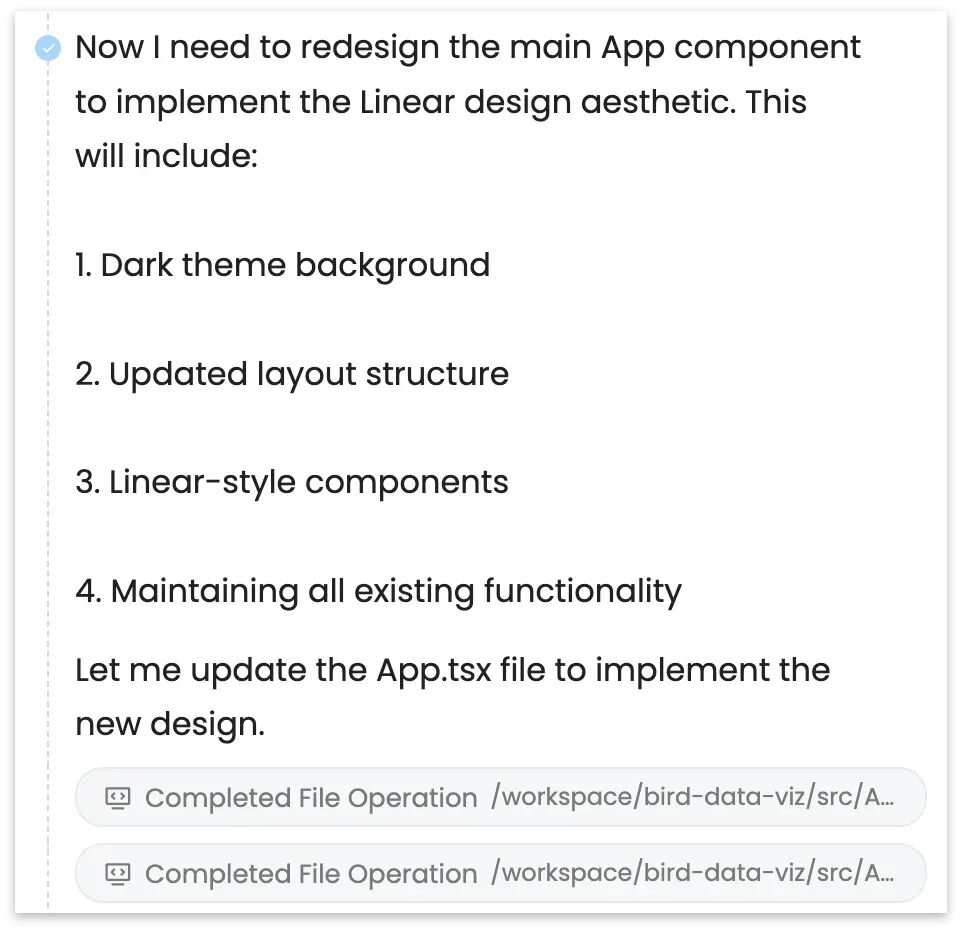
After recognizing the various stylistic effects, the Agent began executing a large volume of update tasks, producing a very detailed update task list:
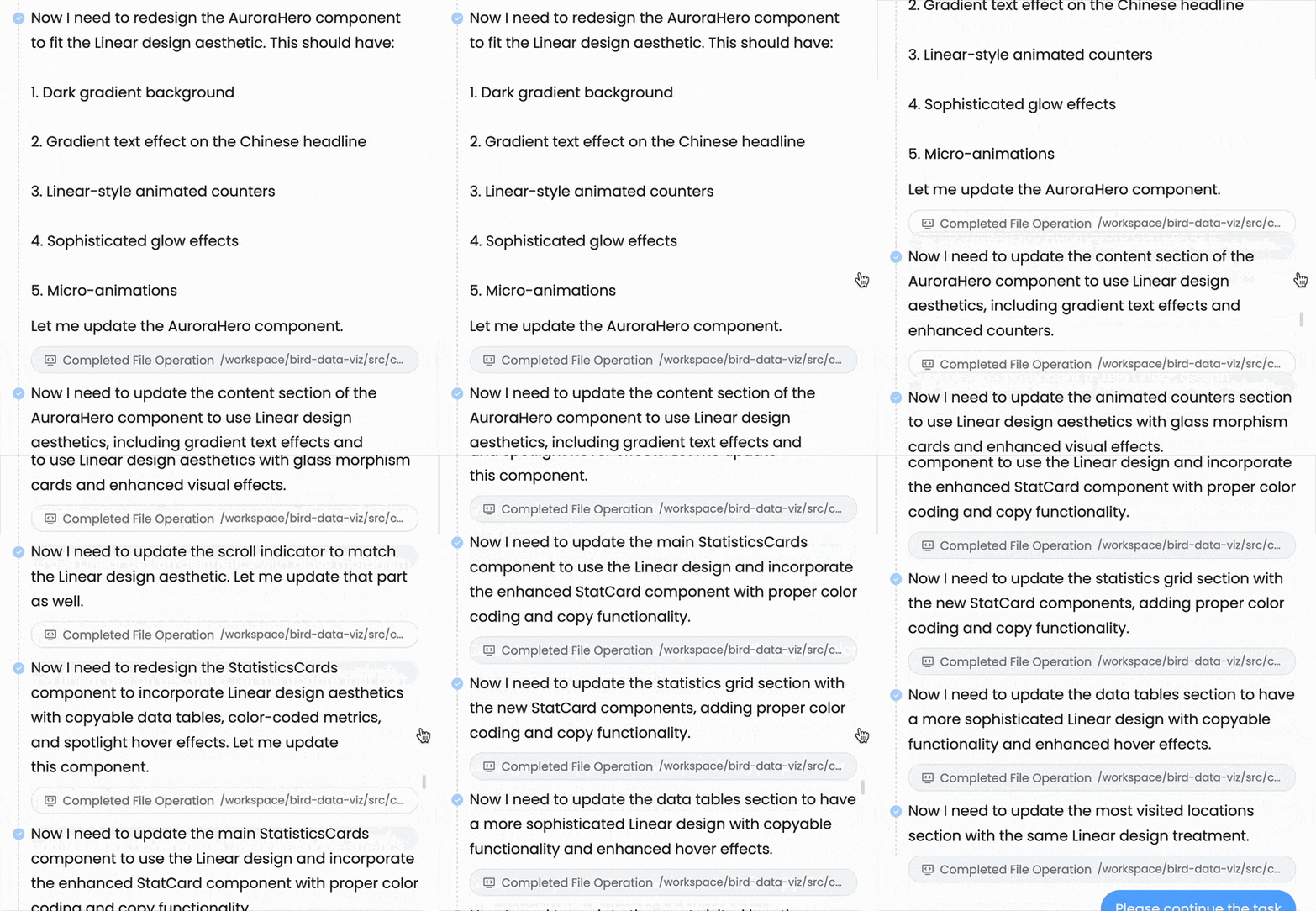
While there's still some gap in text display compared to the external site's visual style, the design sensibility did level up noticeably after referencing the external site for iteration.
Particularly in text color matching and animation effects, the visual impact became much stronger.
3) 12 of the world's most famous AI figures and their quotes
After testing visualization capabilities, I also wanted to see this Agent's multimodal abilities in sourcing images and generating images.
We simulated a case where the Agent would first search for portraits of figures, then "Ghibli-fy" them:
Prompt: We're preparing PDF posters for 12 of the world's most famous AI figures, mainly featuring CEO portraits (Ghibli-style) alongside their quotes about entrepreneurship, with text placed beside the CEO images — needs to feel designed.
MiniMax began large-scale web searching, and I was surprised to discover: it can actually pinpoint and enter X and LinkedIn for searches:
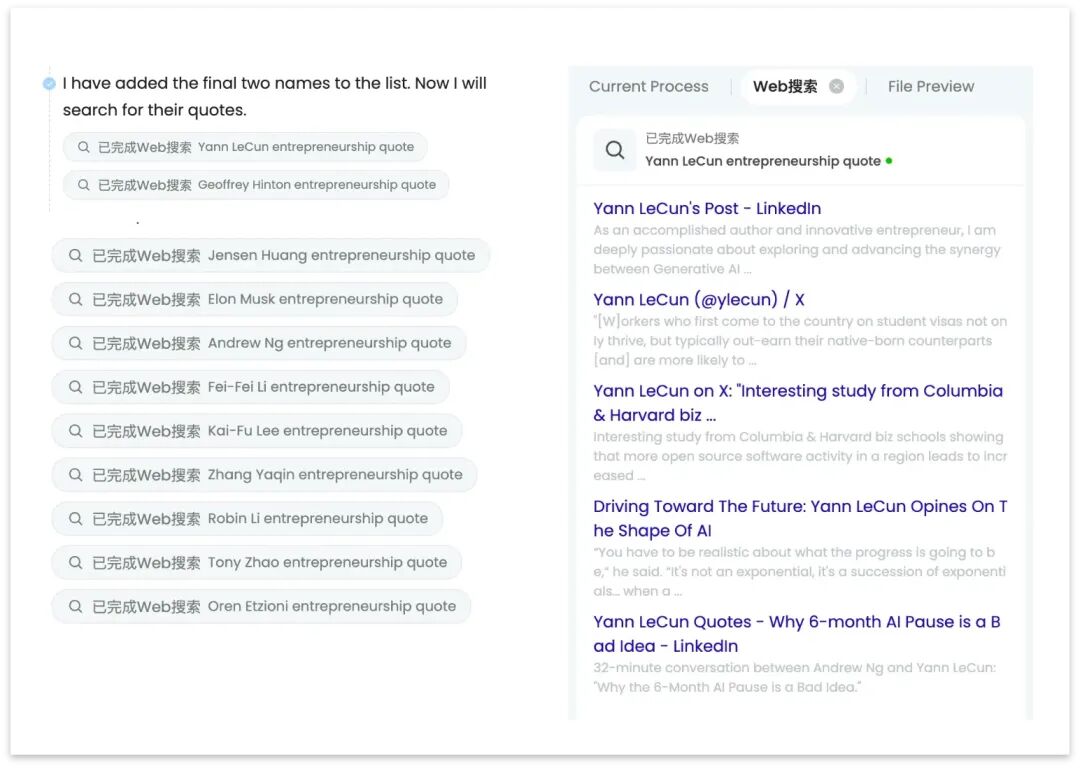
After MiniMax Agent finished searching for AI figures, I carefully reviewed its workflow for generating Ghibli-style results.
I found: this thing is pretty clever.
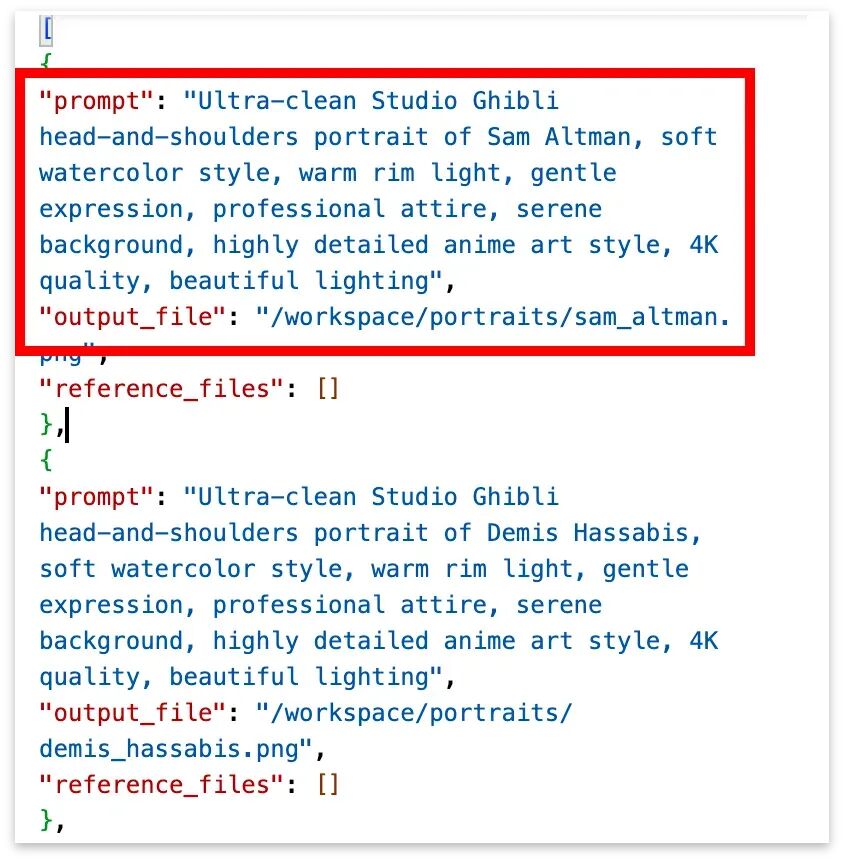
It actually autonomously planned a Ghibli-style prompt for every single figure:
Ultra-clean Ghibli-style half-body portrait, featuring Sam Altman, soft watercolor style, warm rim lighting, gentle expression, professional formal attire, serene background, extremely refined anime art style, 4K quality, beautiful light and shadow.
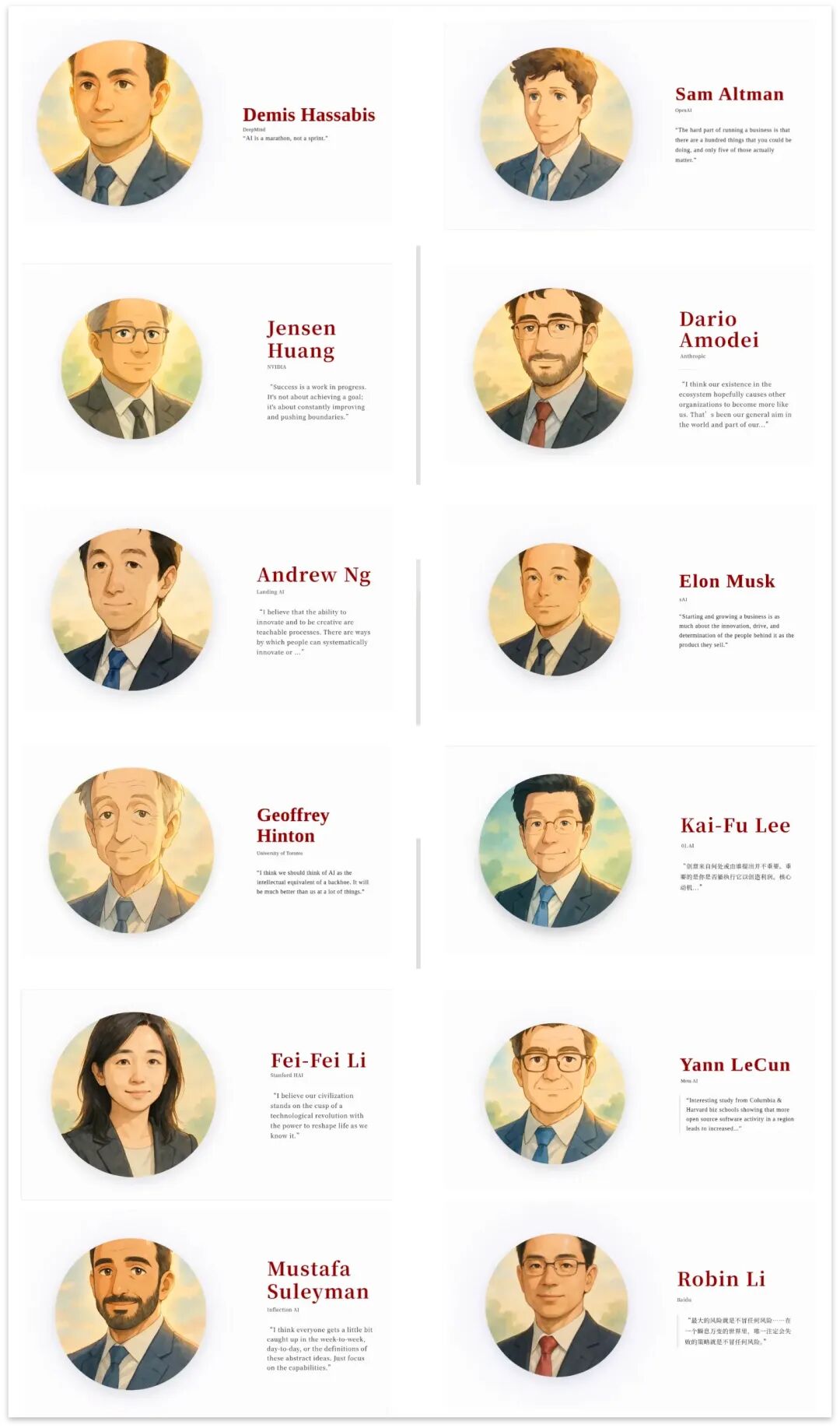
After all this, the PDF file the Agent delivered was remarkably complete.
Compared to other Agents we've tested, where images often fail to insert into the correct positions, MiniMax Agent goes two extra steps: it autonomously gathers extensive information, Ghibli-fies the images, and then places them exactly where they belong.
You can see how consistent MiniMax Agent's output is:
4) Deep-dive PPT report on Apple's "Liquid Glass" aesthetic
Next, let's look at MiniMax Agent's PPT generation capabilities, where it also demonstrated solid precision and visual polish.
For instance, Apple's "Liquid Glass" has been making waves lately, so I asked it to produce a deep-dive PPT report on the topic.
The prompt:
Prompt: Project name: Liquid Glass at Apple Events – Design & Technology Research Report. Objective: Generate an 8-page, 16:9 .pptx systematically analyzing Apple's recently introduced "Liquid Glass" design philosophy, material technology, manufacturing processes, and market impact. Overall style should match Apple Keynote: minimal, semi-transparent, frosted glass.
When MiniMax Agent tackles PPT tasks involving "real-world subjects," information gathering is just table stakes — it does the thorough research as described earlier. But browsing through its workflow, one thing genuinely impressed me: to create Apple's timeline, it specifically locked onto the keyword "Timeline" to search for relevant reference images, rather than simply grabbing Apple's own timeline graphics:
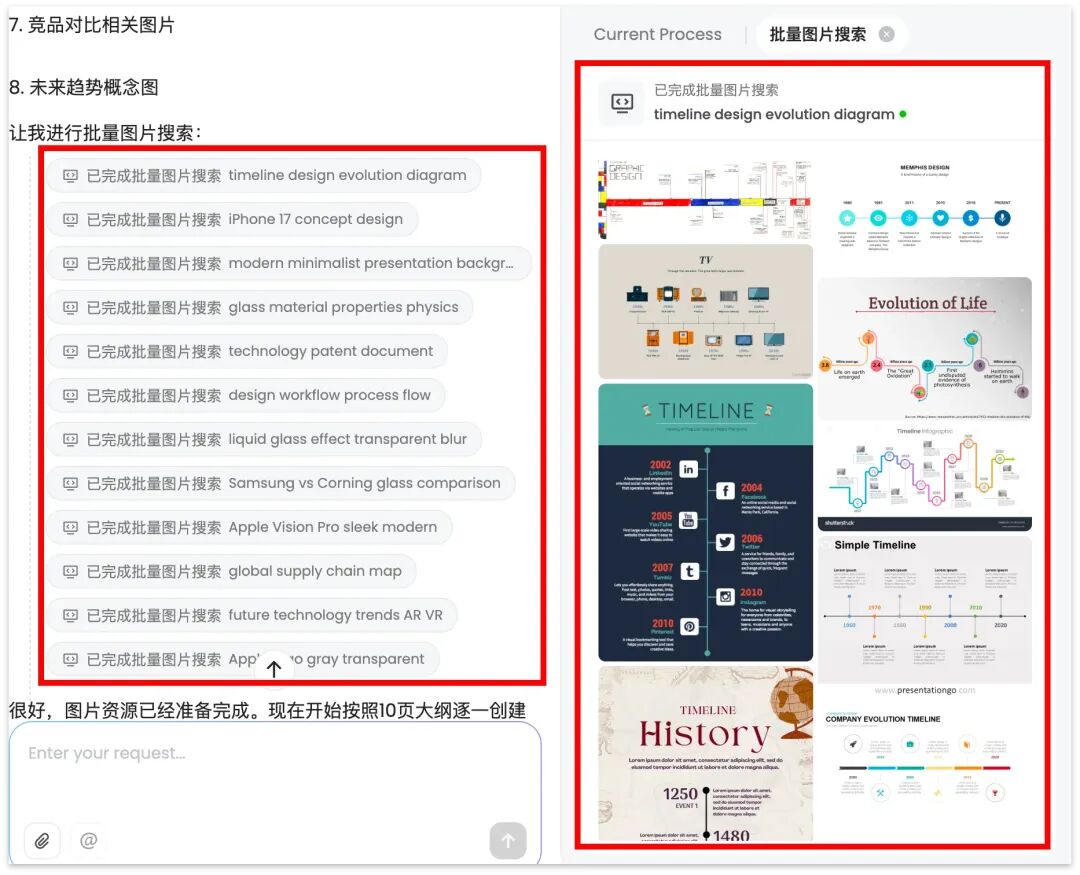
Clearly, MiniMax Agent is borrowing inspiration from these timelines. Here's what it ultimately produced for the Apple timeline:
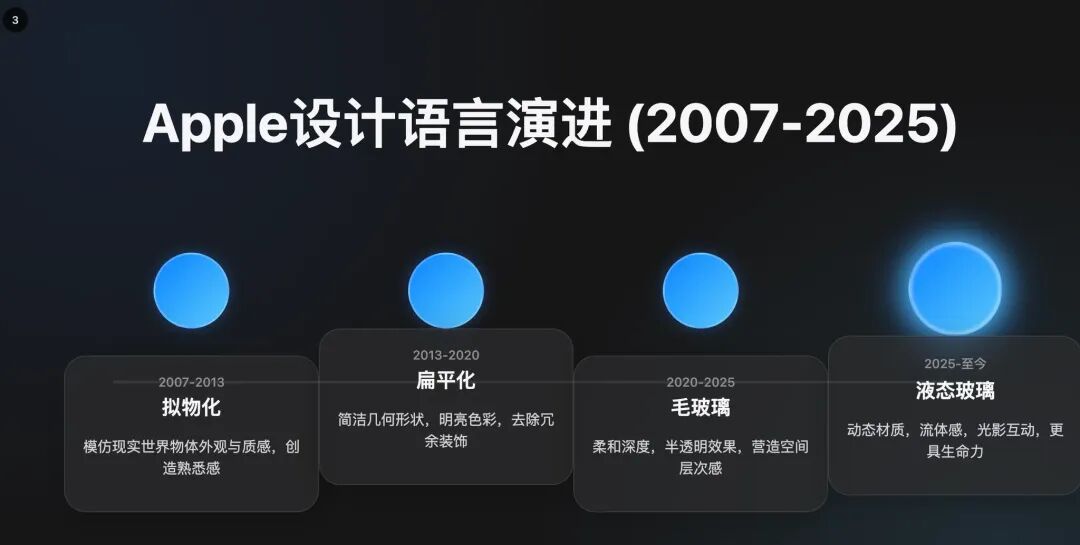
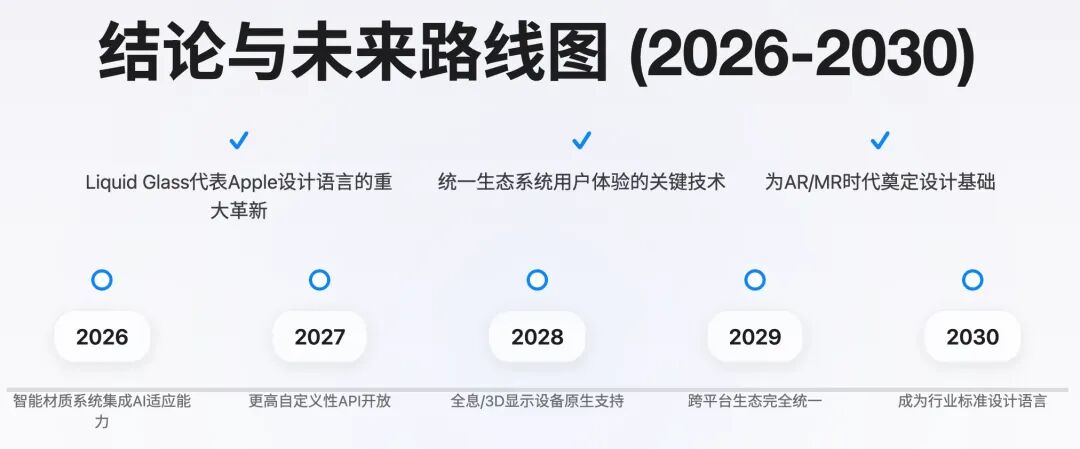
Beyond the interactive effects when clicking into individual slides, the PPT also features animation during playback. The "Evolution of Apple Design Language (2007–2025)" section in particular came out clean, intuitive, and well-designed.
I recorded a GIF so you can see for yourself:

5) Monochrome Masterpieces — A website for ten black-and-white film classics
From the hands-on experiences shared above, MiniMax Agent has already shown strong long-horizon complex task handling and a decent "aesthetic sense." Now let's look at a more direct test of its taste:
Prompt: Create a black-and-white website for Monochrome Masterpieces — Ten Classic Films in Cinema History
The posters MiniMax Agent collected were high quality, with virtually no ad-riddled or watermarked images mixed in.
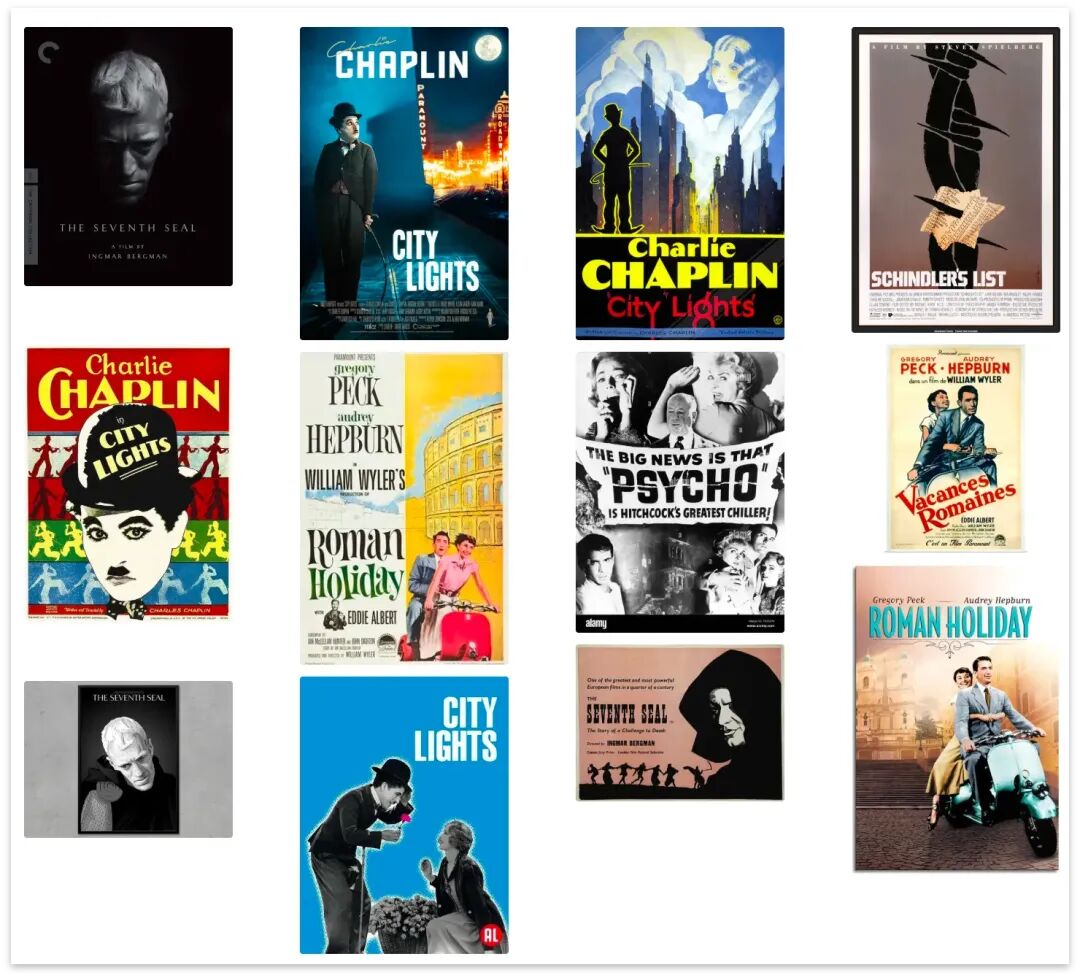
As before, during its first round of web deployment, MiniMax Agent used Browser Use to self-check for issues — standard procedure by now.
The ten films it selected span classics from 1936 to 1960, including Kurosawa's Seven Samurai and Casablanca.
The final result was a fairly complete website with interactive animations and genuinely pleasant visuals:
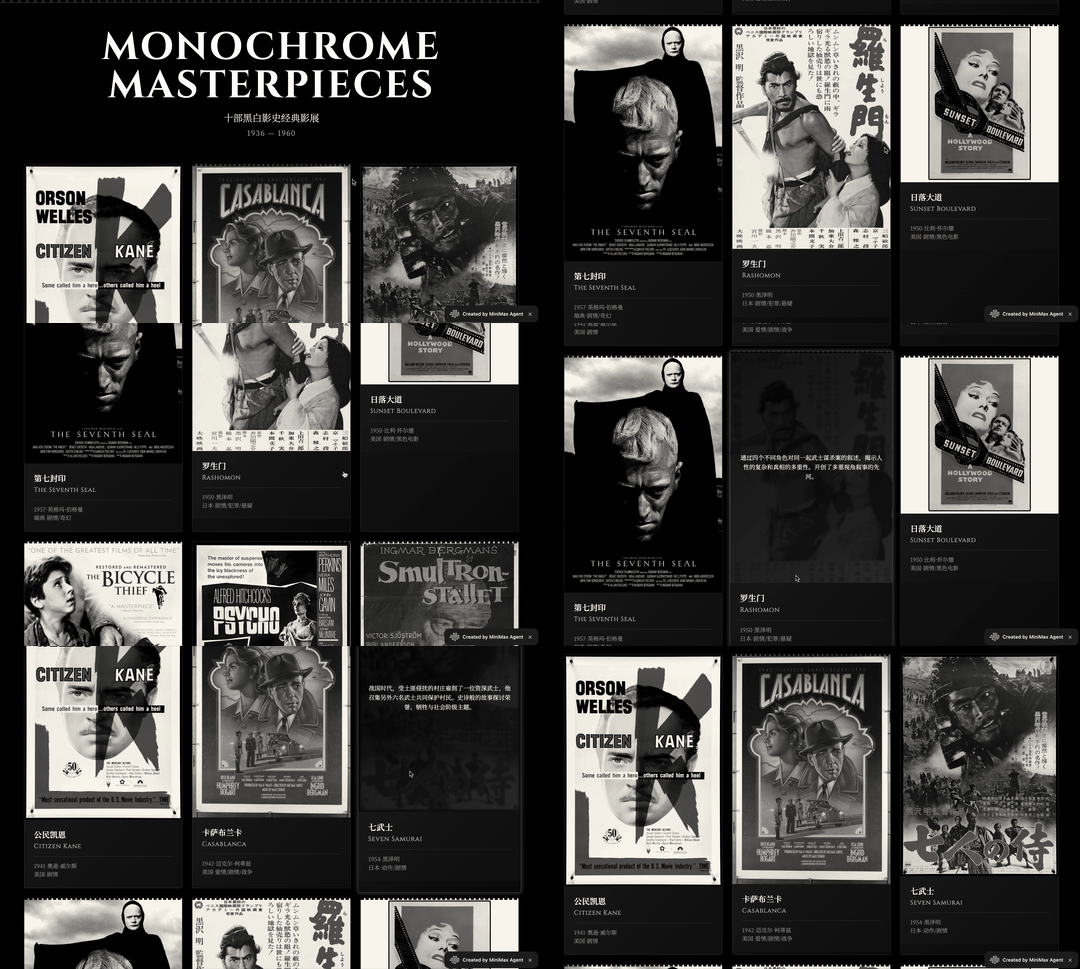
But Agents make mistakes too. In the first-round webpage, it slipped up: it cropped the Psycho poster incorrectly:
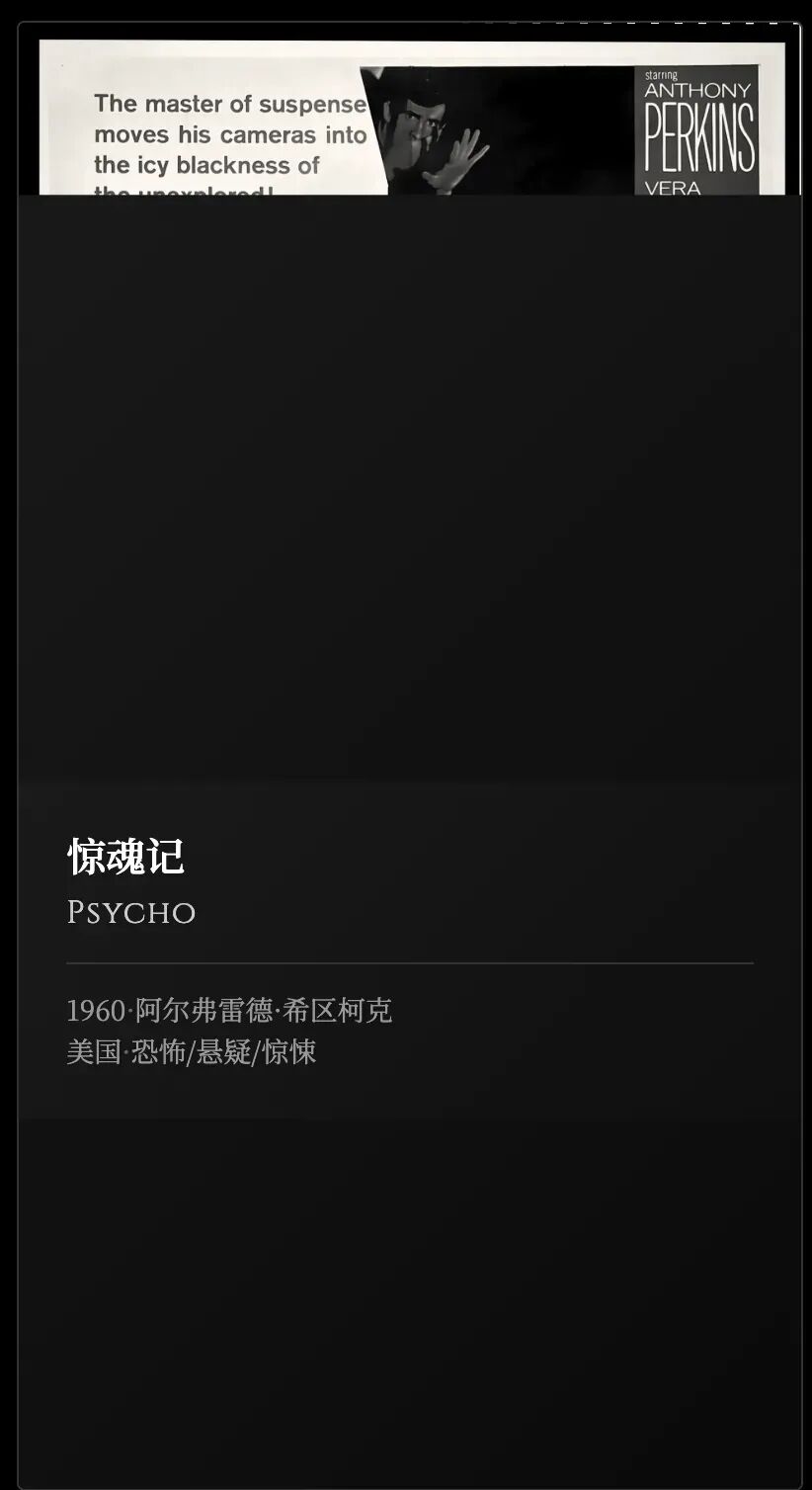
I tried sending this error screenshot back to the Agent to see if it could fix it.
Turns out, MiniMax Agent can already visually comprehend what's wrong in screenshots and accurately locate the problematic element on the webpage. It recognized: the poster was being cropped, and the CSS styling needed fixing.

MiniMax's recently released voice model has been trending across AI product communities, so I also wanted to test whether the Agent could accurately insert an audio clip into a specific position on the webpage and have it play properly.
I entered this prompt:
Prompt: I want to be able to click on each film's poster to enter a more detailed introduction page. And you need to insert an introduction audio on this page, generated using MiniMax.
Note: it's best to include "use MiniMax to generate audio" in the prompt — this maximizes the chance the Agent will call its own MiniMax MCP.
When I initially just asked it to generate audio without specifying, it failed once or twice.
But when I told it to use MiniMax to generate and replace the faulty audio, its performance improved significantly.
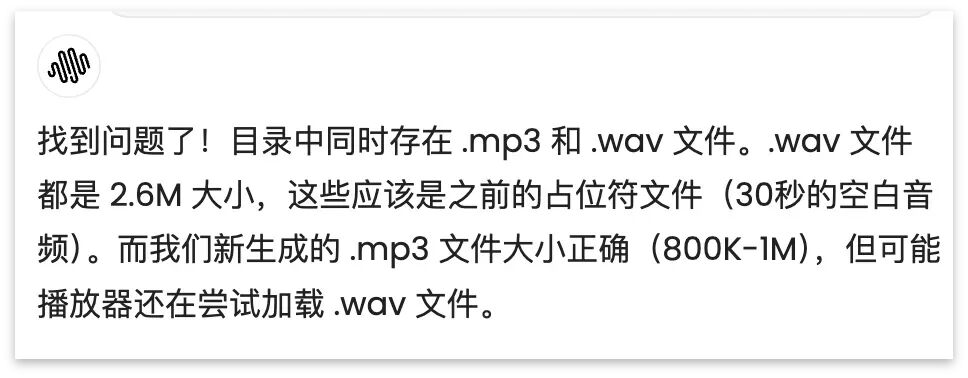
It even used a somewhat clever verification method: judging whether the audio generated correctly by checking file size:
Ultimately, relying on its self-written "script," the Agent produced a fairly complete webpage with detail pages and audio podcast functionality. I recorded a clip — you can see the results and listen to how realistic the Seven Samurai audio podcast sounds:
6) Top 10 Black-and-White Film Posters in the World
MiniMax Agent's ability to insert multimodal files into designated positions is genuinely solid, and its "curatorial" eye for selecting film posters is pretty good too.
Next, I wanted to push it further — testing more complex interaction design by having it generate a "classic black-and-white film gallery":
Prompt: Create a single-page film poster gallery featuring the world's ten most famous black-and-white films, including: 1. A full-screen hero poster at the top. 2. Scroll-triggered progressive reveal animations for posters, with dynamic text, gradient masks, or micro-interactions. 3. Parallax or simple 3D transitions during scrolling to enhance visual depth. 4. Dynamic typography: titles, subtitles, release dates that progressively appear or move with scroll. 5. Performance optimization & responsive layout, mobile-compatible.
This was a more demanding brief for MiniMax Agent, testing its combined capabilities: deep research, synthesis, text-image matching, and complex interaction design.
Unexpectedly, I liked what it produced in the very first round:
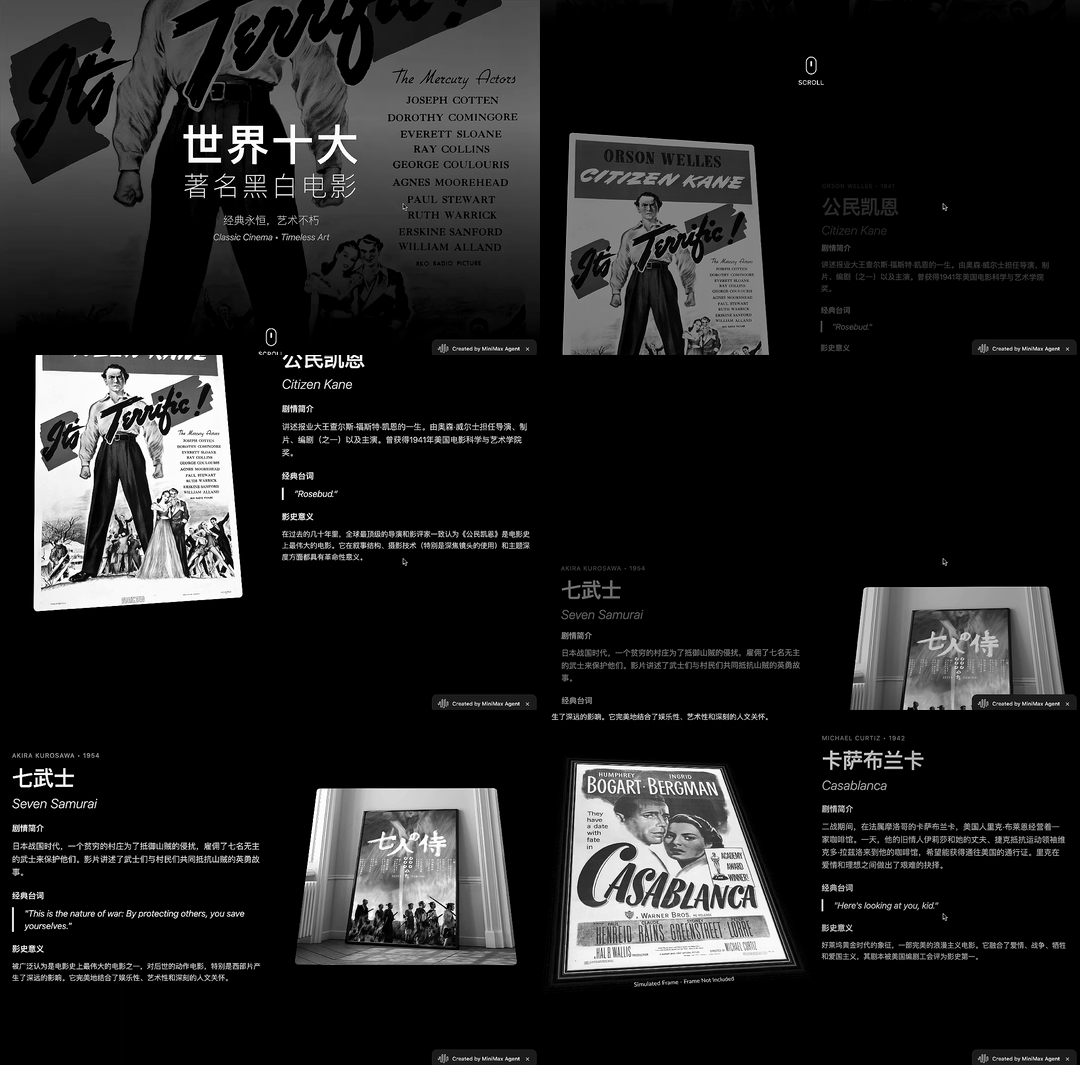
I grabbed a screenshot of a single-page Citizen Kane movie poster as a showcase.
The overall interface is remarkably well-designed, with strong aesthetic sensibility. It incorporates the film's title, synopsis, historical significance, and even classic quotes:
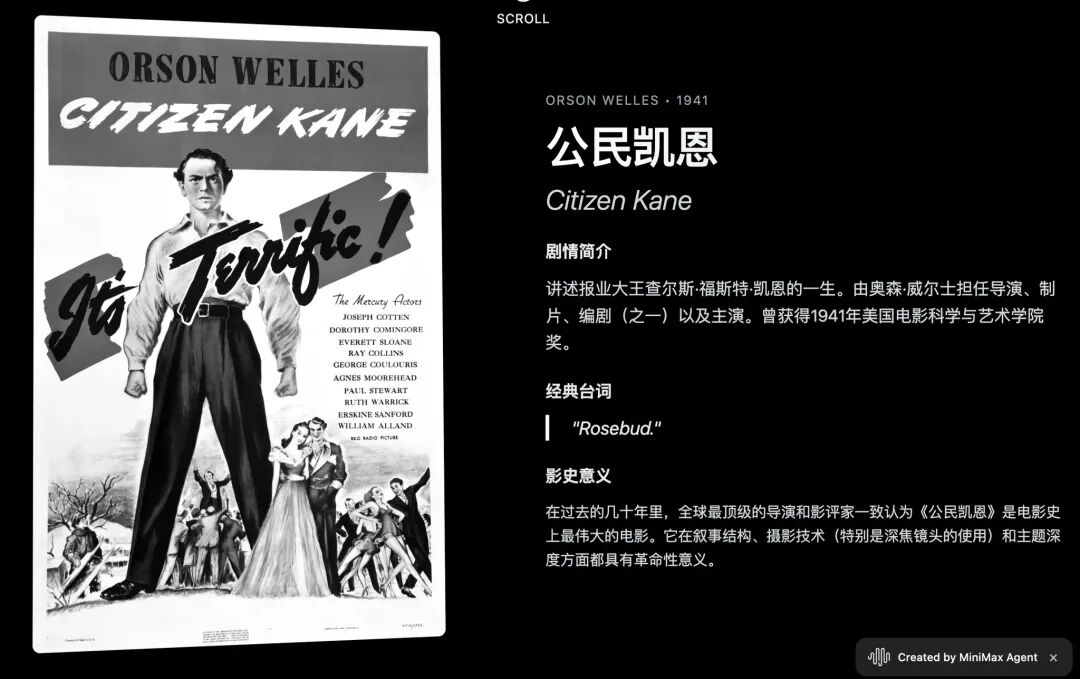
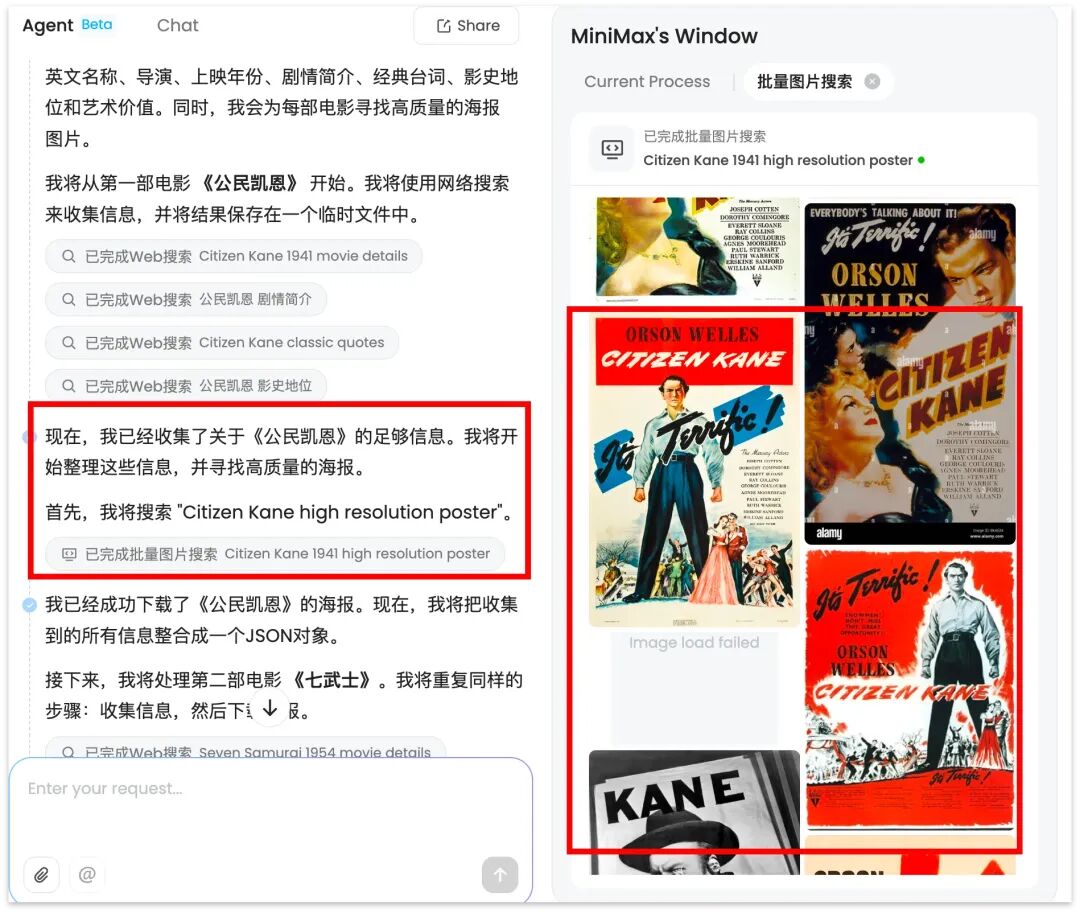
What surprised me most! The Citizen Kane poster wasn't actually black-and-white at first.
When I went back to review its workflow, I found that during the initial batch image search, the Citizen Kane poster was actually in color. The black-and-white version in the final webpage appears to be the result of the Agent autonomously applying a black-and-white filter or performing some other operation:
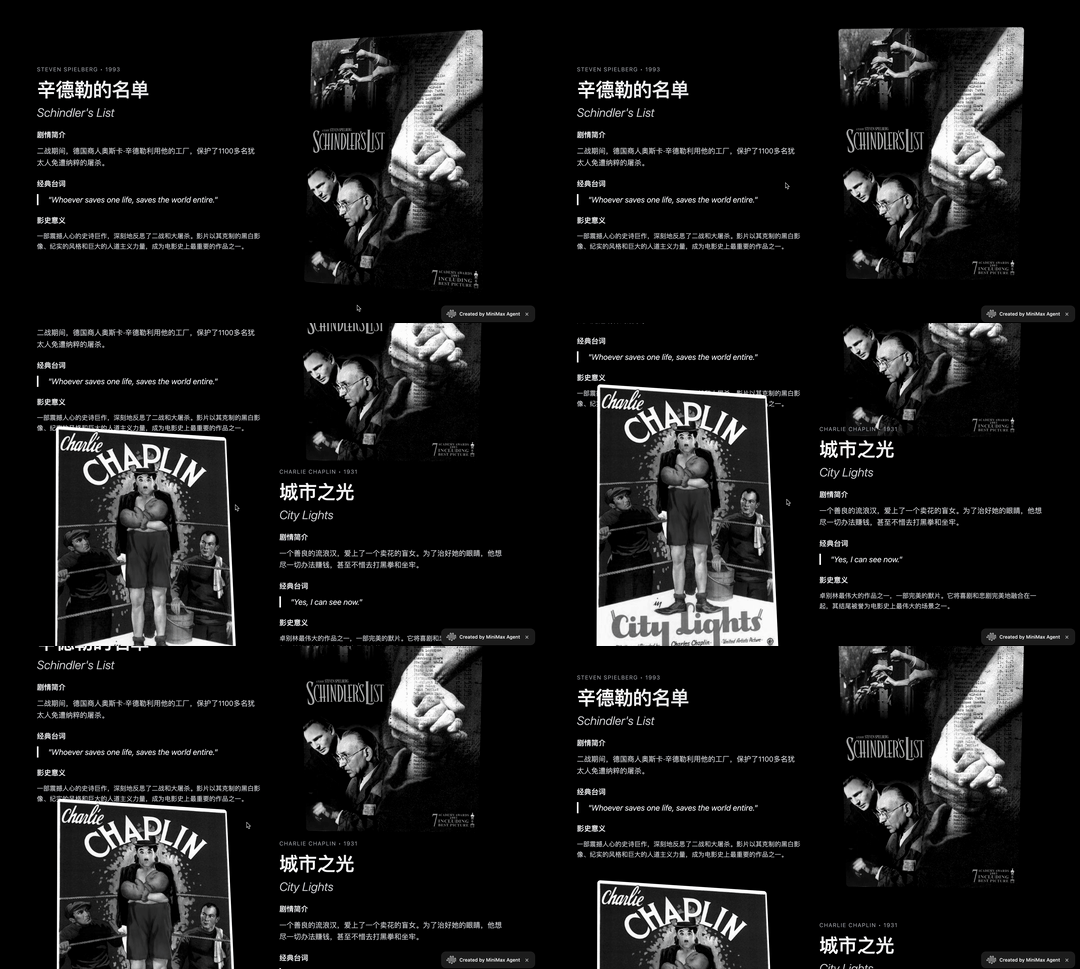
Additionally, the overall webpage delivery quality is high. For instance, this overlapping interaction effect is quite elegant, with well-designed layering and natural transitions between components without any display bugs:
7) Having MiniMax Document Its Own Workflow
Finally, I wanted to fully introduce MiniMax's workflow. But since its complex tasks involve numerous steps and technical terminology, explaining it directly would be difficult. So I had an idea: why not have the MiniMax Agent organize and visualize its own workflow?
The prompt at this point was actually quite simple. I copied its workflow and sent it back, adding a brief instruction and visual requirements:
Prompt: This is the workflow for an Agent product called "MiniMax." Help me visualize and explain it. Requirements: Clear structure. Song typeface. Deep red for Chinese text, white for English.
In its first generation, MiniMax Agent produced a webpage using a card-based grid layout, displaying the various stages of its own workflow.
For example, it states that its own workflow has 75 steps, with a 100% success rate...

In this webpage, the Agent demonstrated different card sizes to create strong visual hierarchy. It included large cards (development efficiency), medium cards (success rate, tech stack), long cards (workflow stages, performance comparison), and more.
The Agent also claimed its development speed improved 10x, using 14 modern tech stacks:

I also had it elaborate on the six core stages of its workflow.
You can see it spent significant time on data processing and frontend development. Another 13.3% of time was concentrated on testing and debugging, with 42 file operations:
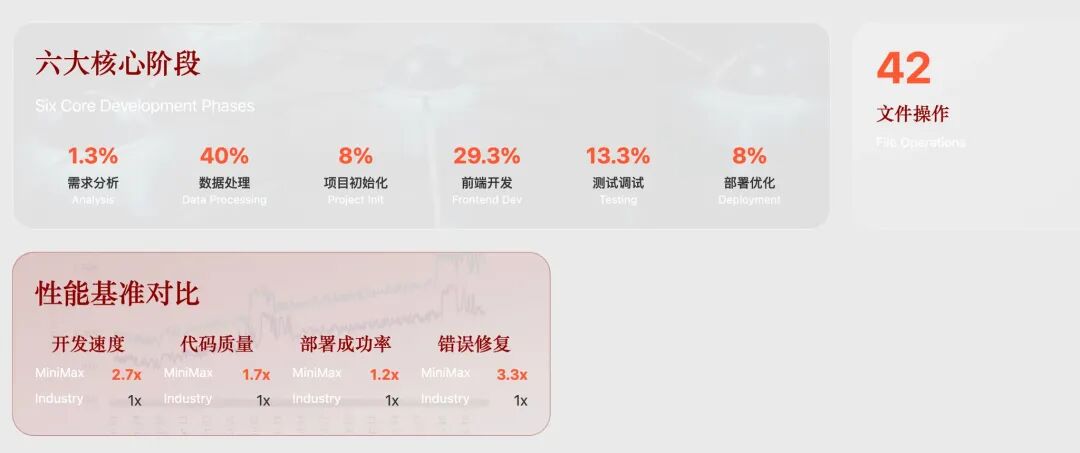
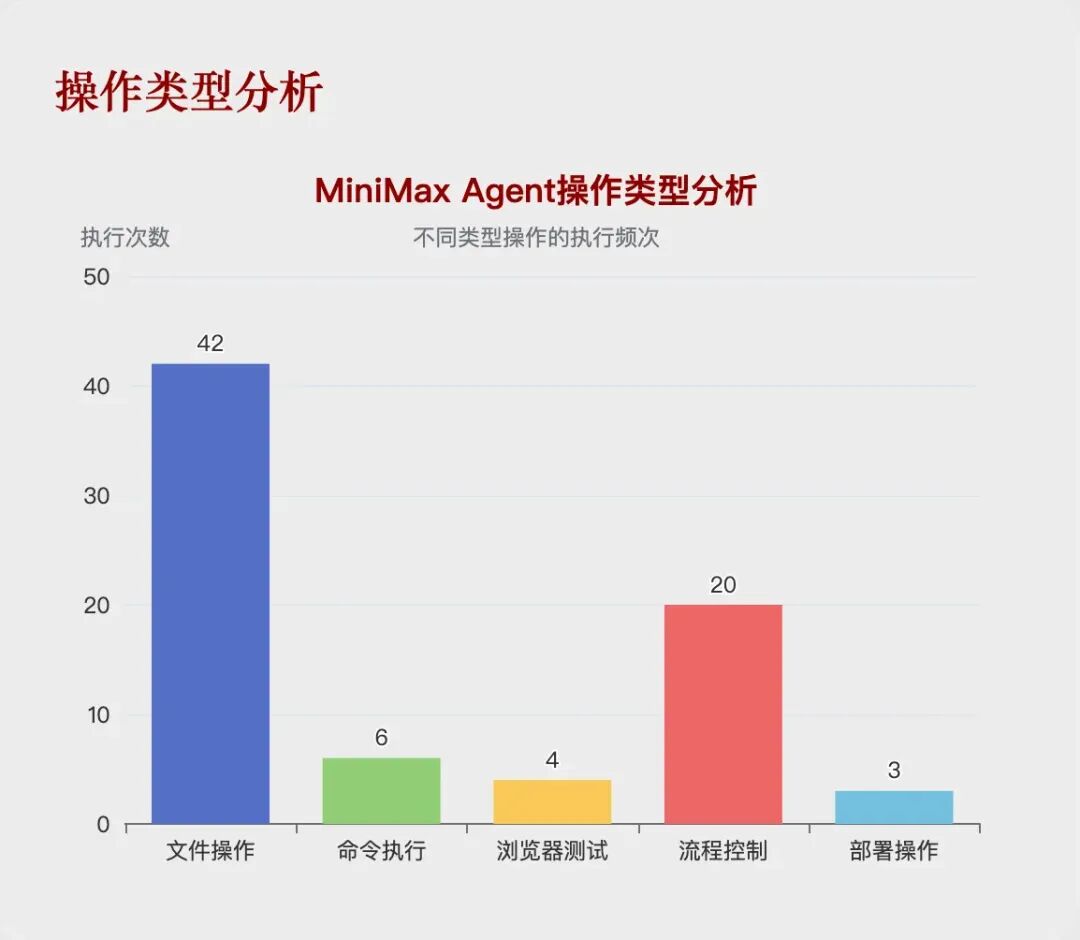

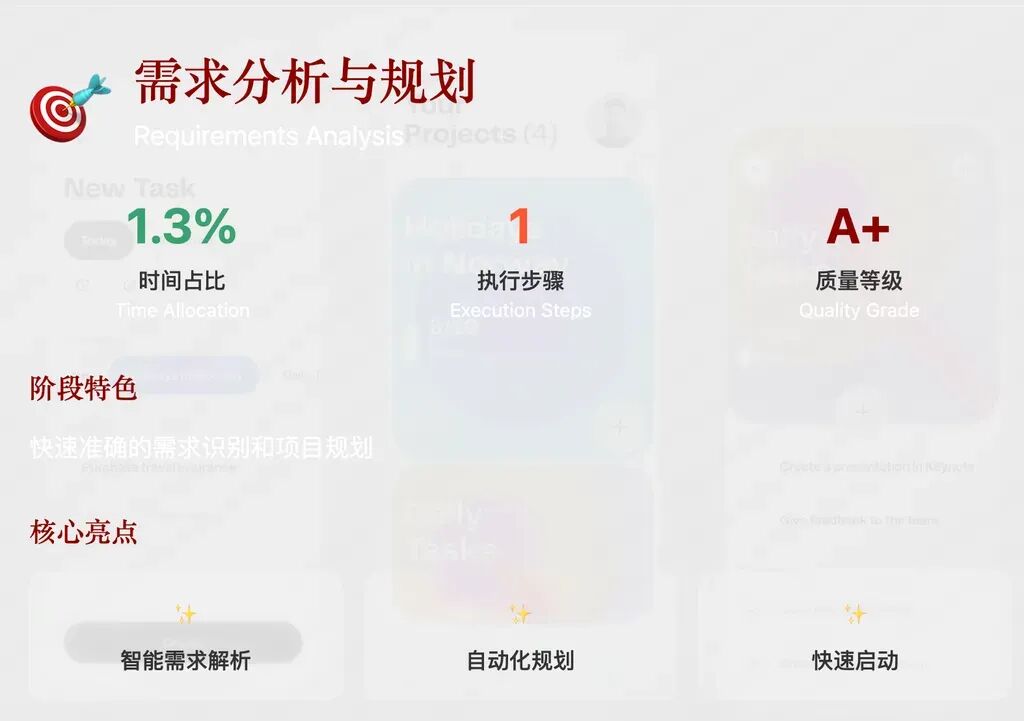
The workflow visualization is as follows:
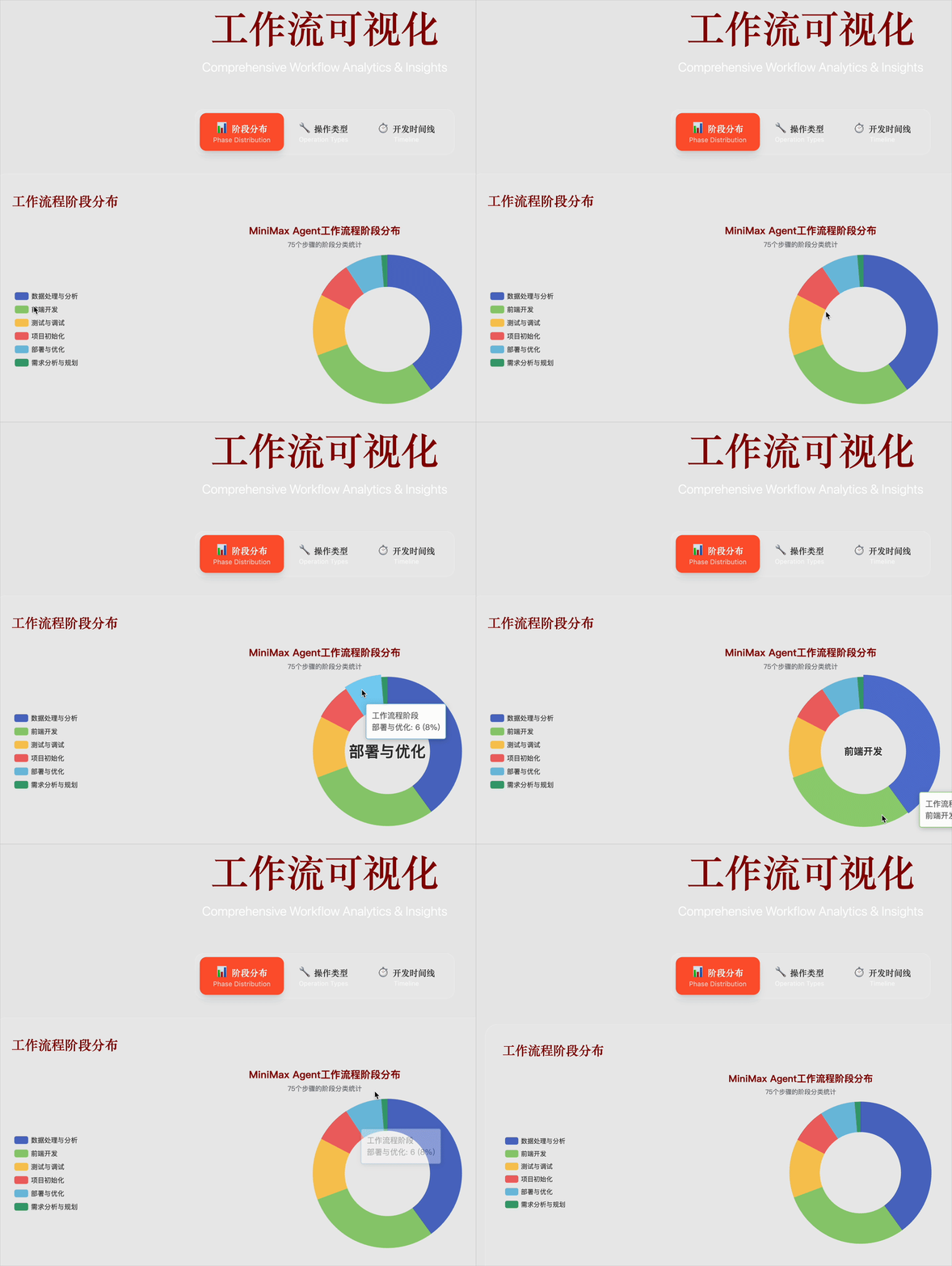
Finally, we'd like to share three reflections from our evaluation process:
1) The Stronger the Multimodal Integration, the Better
For a general-purpose Agent, the ability to understand and process visual information is a bottom-line requirement.
If its multimodal performance falls short, no matter how strong its text capabilities are, the final deliverability will likely be constrained. Especially in complex tasks requiring image-text coordination or interactive content generation, insufficient multimodal capacity becomes a direct ceiling.
This represents a major obstacle to product success beyond mere technical success.
If a native multimodal foundation model company already possesses this capability, it can effectively solve this problem and make the product more compelling.
In this case, for instance, MiniMax leveraged their audio generation capability, correctly positioning audio content in just a few steps.
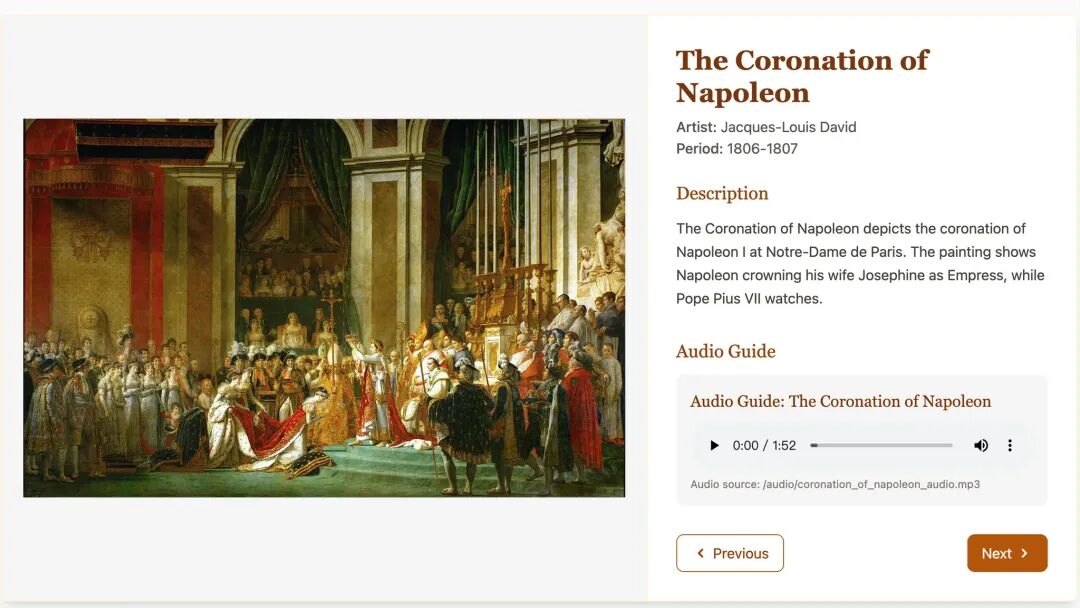
The art gallery showcased officially by MiniMax
This deep integration requires the Agent to genuinely understand the relationships between image, text, and audio, rather than simply calling modules.
For Agents, multimodal capability is a necessity, not a nice-to-have.
2) The Longer the Context Window, the Better
A sufficiently long context enables:
[1] Maintaining conversational coherence, so it doesn't "forget" even after multiple rounds of complex interaction.
[2] It's especially critical for long-horizon complex task planning — sufficient context is needed to grasp the full narrative of a project.
[3] Making smarter decisions based on complete historical information rather than fragmented memory.
"Long enough" context creates sufficient possibilities on both the input and output sides.
It's clear that model providers across the board are moving in this direction. MiniMax's recently open-sourced M1 reaches 1 million tokens in input, on par with Gemini 2.5 Pro; on the output side, M1 hits 80,000 tokens, even surpassing Gemini 2.5 Pro to become the industry leader.

M1's context window in the MiniMax M1 technical report
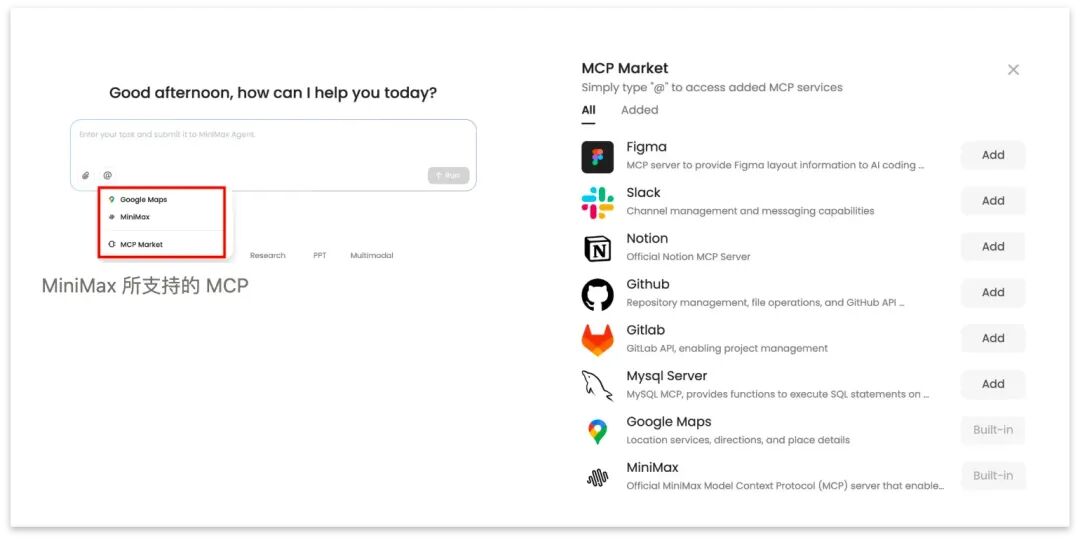
As Agents everywhere are adopting MCP, ample context length on the input side can process complete codebases and support complex reasoning chains through contextual coherence, gradually decomposing user requirements; on the output side, it can organically combine text, images, and audio to ultimately present users with a "truly qualified" deliverable.
3) Taste Matters More and More
As foundational model capabilities converge toward homogenization, what truly sets an Agent apart may actually be "taste."
"Taste" isn't just defined by visual design aesthetics — it's also about the standard of task completion. For instance, at the "last mile" of an Agent's long workflow chain, does it choose to deliver quickly, or have the Agent self-review once more?
"Delivery taste" determines whether an Agent is a "good enough" type or a "truly good" type.
While testing these seven cases with MiniMax Agent, I realized: someday, the technology barrier will gradually flatten. When all Agents can "get the job done," those that can "do it beautifully" will be the ones that stand out.
The stronger AI's capabilities become, the more scarce "taste" will be.
When foundational competence becomes table stakes, an Agent's differentiated value will lie in its understanding of the user and its pursuit of beauty.
This reminds me of something Steve Jobs once said in an interview:
Ultimately it comes down to taste. It comes down to trying to expose yourself to the best that humans have done, and then try to bring those things in to what you're doing.
The name "Crossing" also draws from Jobs's metaphor for Apple — standing at the intersection of technology and liberal arts, where great products are born.
As Jobs put it, everything comes down to taste.
When an Agent transcends its role as a mere task executor and truly stands at the crossing of technology and the humanities, it will be like a designer of refined taste who deeply understands user needs — capable of creating elegance and delight that goes far beyond basic functionality.
Looking forward to that day!