MiniMax H3 Is Now Officially Open Source — Here's What We Found in Our Tests

MiniMax H3 is taking the next step: abandoning the old architecture and building a new tokenizer.
Ditching the Old Architecture, Building a New Tokenizer: MiniMax H3 Takes the Next Step
👦🏻 Author: GaKi
🥷 Editor: Koji
🧑🎨 Layout: NCon

On the last day of July, MiniMax released its next-generation video model, H3.
This follows ByteDance's Seedance series as another video model reaching SOTA levels, signaling that competition among top-tier players has entered a new phase.
From the released information, MiniMax H3 focuses on "omnimodal input + precise editing," enabling the model to directly understand content and produce finished videos. It performs particularly well in post-production and VFX-style videos, especially for UI design, advertising, music videos, game interfaces, AR/redraw effects, and e-commerce scenarios.
More importantly, MiniMax H3 was open-sourced today, with a model size of just 33B.
In the high-cost video generation赛道, combining "SOTA performance" with "open source" is still relatively rare.
🚥
We got access right after H3 launched and ran our own tests. Below is what we found, along with some observations.
【1】Adding Text Layers to a One-Shot Short Film
First, on capabilities: this MiniMax H3 video model is natively multimodal, supporting native multimodal understanding and generation with full-modal input. Text, images, audio, and video can all be used as references.
A major highlight of this model is its relatively strong multimodal precise editing and control.
For example, you can use prompts, or use text, images, and video as references to directly add various elements into a video.
Take this short video below — you've probably seen it many times, it's a popular theme right now. A monkey throws a stone into the air, and the stone keeps transforming, in one continuous shot, eventually symbolizing the progress of human technology, becoming a rocket and landing on the moon.
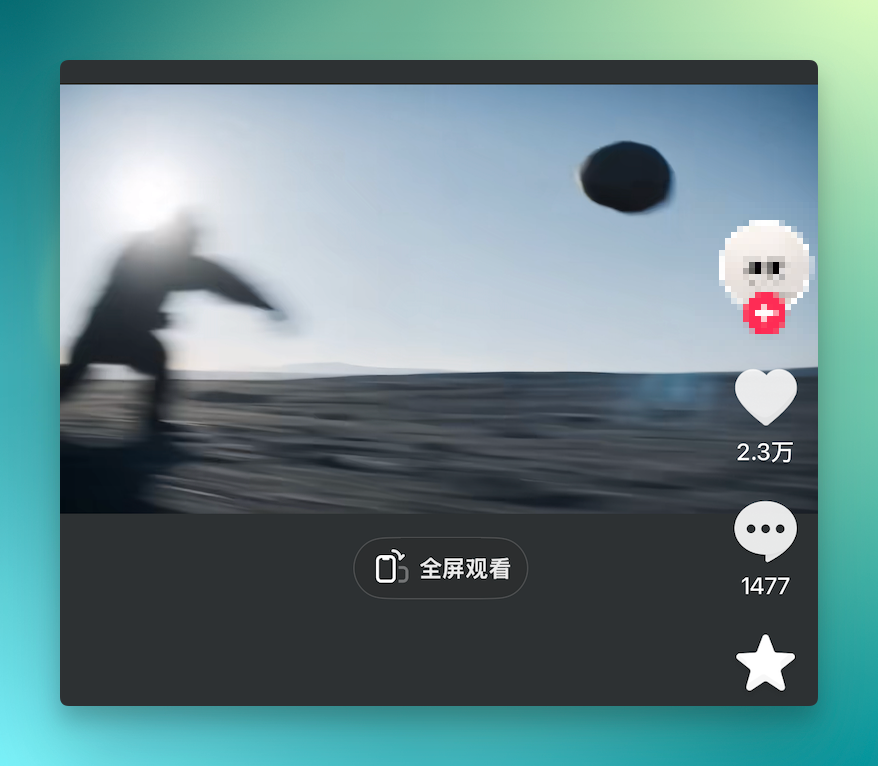
The entire video is one continuous shot, but many such short videos are currently rather crude, with somewhat jarring scene transitions.
We can build on this video and write a detailed, precise prompt. I generally use Claude for prompt writing, defining every shot in the video down to the second; audio can also be generated directly through prompts.
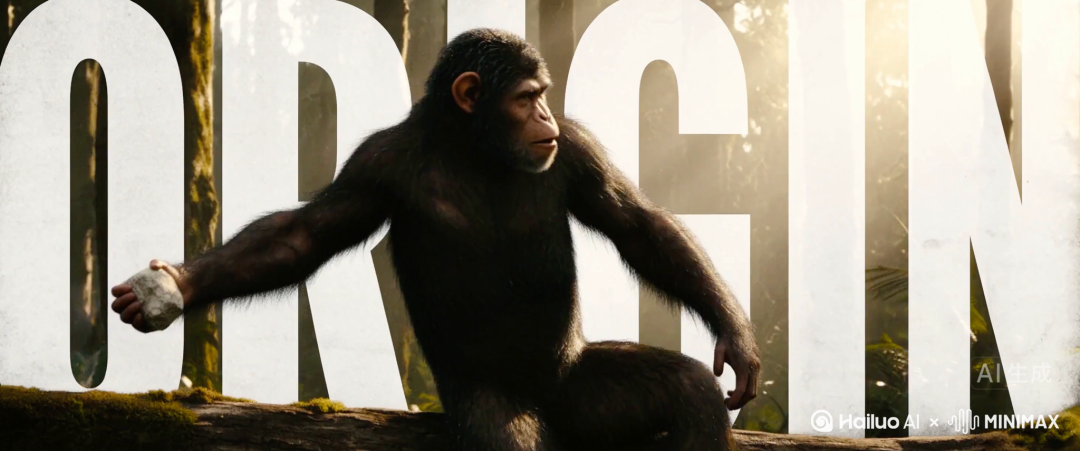
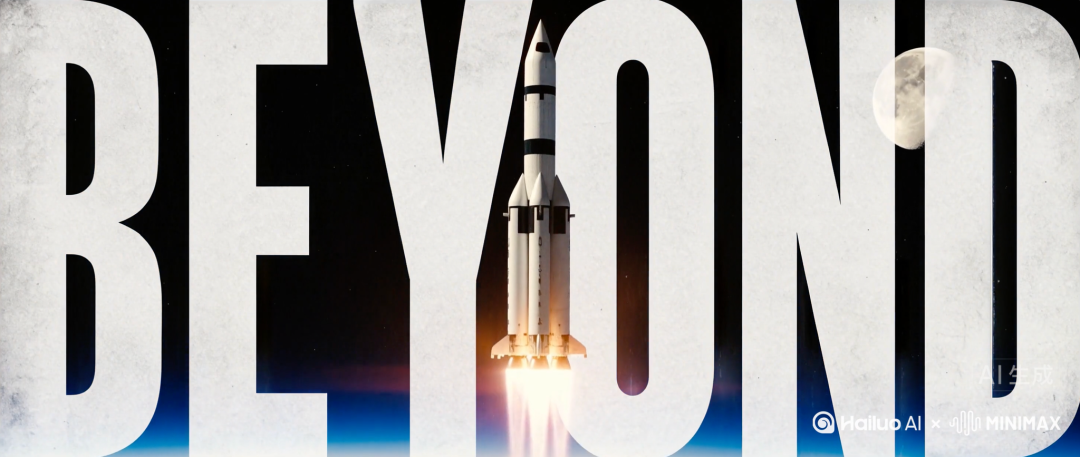
In actual use, it does handle text editing quite precisely — for example, adding text layers. We can add extremely bold sans-serif uppercase letters, define the weight of the font, and have it span the full width of the frame.
The final complete effect looks like this.
The shots in the video are directly defined by the prompt. When the stone is thrown, it's "Origin"; when it becomes a bullet, it's "Fire"; when it finally lands on the moon, it's "Beyond."
All text is embedded as layers into the video's background, with good presentation. Every frame, when captured, has something of a poster feel.

【2】Letting Nailong Star in House of Cards
Another thing: H3 now supports replacing elements in reference videos or images, enabling fairly precise substitution. The example below is more of a meme.
This clip is from a classic silent scene in the American TV series House of Cards: the female lead on the left watches the male lead, and when the camera cuts to him, he's continuously doing seated rowing:

You can directly upload this clip, then upload an image of Nailong, and have Nailong's image replace both characters in the short video. One Nailong watches from the left while the male lead on the right — also replaced by Nailong — keeps doing seated rowing.

The overall effect is decent. Particularly notable are the changes in Nailong's gaze, and when Nailong does the seated rowing, both the movements and sounds are fairly on point.
Looking closely, you'll notice overall lighting transitions — the light falling on Nailong comes from the right side of the frame, which matches exactly the lighting from the right rear of the male lead in the original reference clip.
Now you can use video as a reference and do additional editing on top. For example, I added voiceover to the original clip, having them argue in dramatic American TV-style voices about what to eat.
【3】A Showa-Era Kaiju Toy Commercial TVC
Lately I've been seeing a lot of people on short video platforms imitating Showa-era tokusatsu and Ultraman-style scenes, exercising all kinds of creativity.
That got me thinking of using this filming approach to make a TVC ad: A kaiju appears in Showa filming style, rubber suit style, destroying a city, when suddenly a boy stands before it, pulls out a special camera, takes a photo, and the kaiju is completely shrunk into a toy monster, placed in the boy's hand. At this point, the text "Monster" appears in the background.
I tried it with the H3 model, and the overall effect was actually quite good. Looking closely at the rubber suit texture of the kaiju model, it does match the feel of Showa-era tokusatsu quite well, including the final text display — overall quite smooth.
Many short videos have special effects, and H3 can specify a reference video and apply that video's effects to our original video. For example, a couple days ago I saw a creator post a short video with a rainbow pixel effect, where these rainbow pixels precisely spread downward along the edges of the main subject.
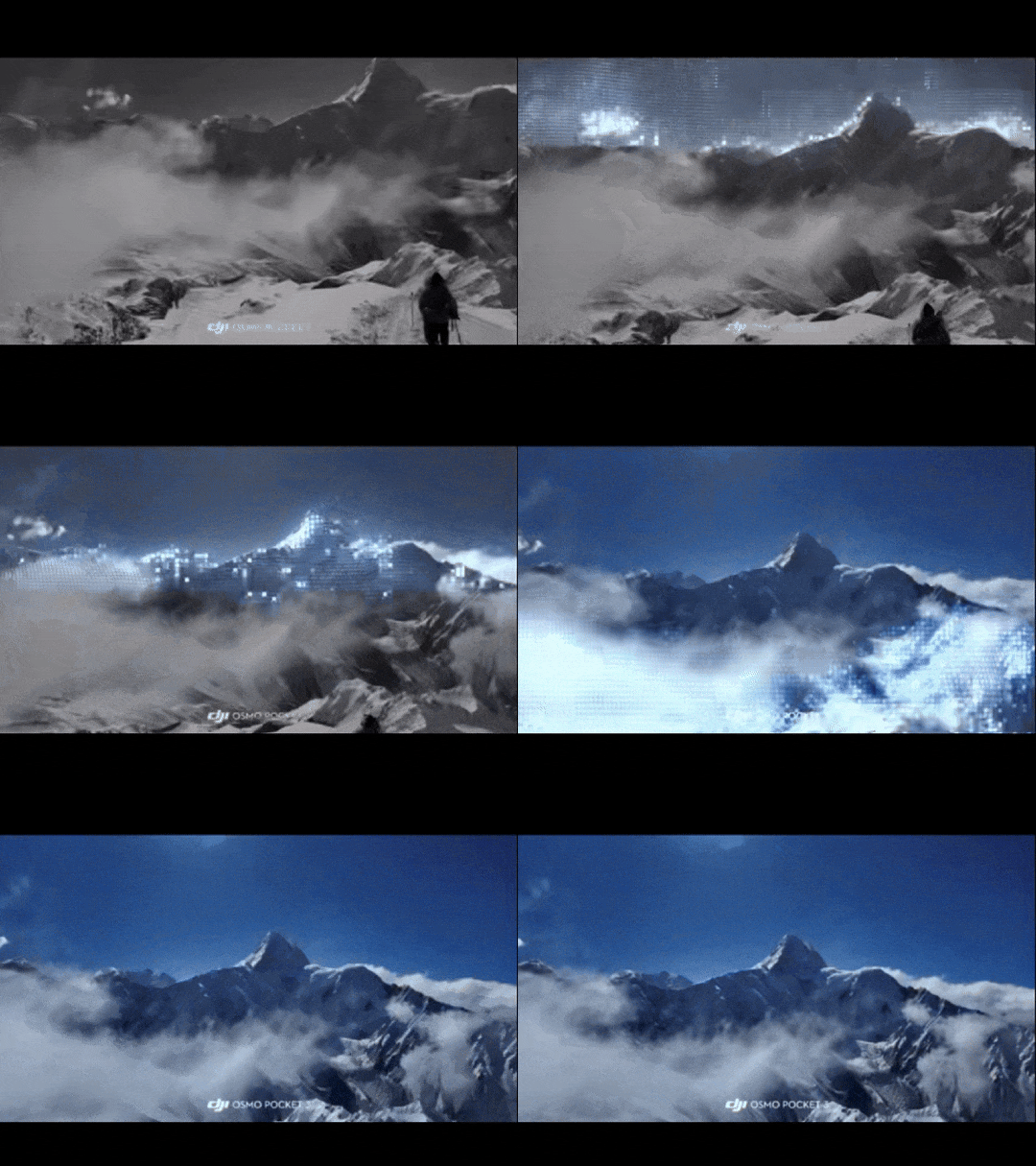
I took the kaiju appearance segment from the original toy TVC, uploaded this rainbow pixel effect short video as well as a reference, and had it apply the rainbow effect to the kaiju's main body, with the rainbow elements even more vibrant.
You can see the rainbow pixels sweep down from the kaiju's head, with strong edge separation and overall precision. No uncontrollable elements appeared — for instance, the rainbow effect didn't extend to other buildings.
The overall effect is quite precise, with no major deviation from the kaiju's original appearance in the short video, and the overall Showa-era tokusatsu rubber suit feel is well preserved.
【4】Splatoon Inkling Battle
In testing, MiniMax H3's use of color is indeed precise enough. Even with multiple high-contrast colors colliding, it maintains their respective color boundaries well, and the texture and traces of color附着 on objects are very clear.
So I directly sent it a reference image from Splatoon and had it generate a MiniMax-style game promo short. The entire clip has relatively intense battle effects, and also reproduces the Inkling image; I also asked it to replace some text in the scene with "MiniMax."
You can see that the overall color application is quite precise, including the ink spraying during battle and the blending effects from ink collisions — all fairly good.
Looking back at these cases, H3 can put text, images, video, and audio into the same context for understanding, then make localized changes based on prompts. Things like adding text layers, replacing character images, or transferring effects from another video — steps that previously required many stages — can now be completed in a single generation, with the boundaries of changes largely controllable.
I still recommend writing prompts that are complex and detailed. The model's ceiling is relatively high; the more complex and finely controlled your prompt, the better the results.
MiniMax H3's technical documentation has also been released, with several core points.
【1】First, H3 possesses multimodal contextual understanding and generation capabilities at the pre-training stage, with good generalization.
【2】To achieve this generalization, they built dedicated models and a full-modal understanding pipeline, with language serving as a generalizable connector and interpreter.
【3】They abandoned the Hailuo-02 architecture and rebuilt the tokenizer. With improved compression efficiency, training and inference costs come down — native 2K resolution becomes viable at this foundational level.
A core section of the technical report mentions their view: For multimodal understanding and generation, the MiniMax H3 team believes language can be seen as a generalizable, scalable computational system, and that multimodal should therefore be closely tied to language, with the two mutually supporting each other.
Taking a longer view, progress in video models over the past year has been extraordinarily dense, but more noteworthy is that industry evaluation standards have become increasingly demanding.
A year ago, discussions centered on prompt consistency, and it was even difficult to precisely control local segments of footage through complex prompts. Today, models can not only precisely replace specific people or objects in a frame without any disturbance to surrounding elements.
Meanwhile, native audio has gone from being a bonus to a baseline requirement — for example, Veo 3.1 already supports 48kHz high-definition voice generation, and mainstream models have generally achieved audio-visual synchronization in a single inference pass.
All of this indicates that video models are accelerating toward becoming productivity-grade tools.
This shift is particularly evident in manufacturers' marketing strategies: a year ago, everyone was competing on gorgeous, spectacular special effects footage, but now they've fully pivoted to practical demonstrations in TVC and commercial advertising scenarios.
On another front, in the multimodal field, video has long been the赛道 with the highest expectations — something of the industry's "eldest son."
It's both closest to ordinary people's daily expression and nearest to commercial and industrial落地. More importantly, as mentioned earlier, it simultaneously leads to the two larger远景命题 of game engines and world models, which explains why even with something as strong as Sora experiencing restructuring or shutdown, industry investment in this direction hasn't contracted but has actually intensified.
Surprisingly, facing a model with both technical moats and cost advantages, MiniMax chose open source.
While the ecosystem effects of open source may take longer to manifest in the market, the feasibility of this path is not without precedent.
Take the overseas open-source model LTX-2.3 as an example: it has surpassed 18 million downloads on Hugging Face, which is sufficient proof that open-source video models have genuine,刚需 demand in the developer ecosystem.
For developers and enterprises, the most practical meaning of open source is having one more controllable option. No longer being locked into a few closed-source APIs. At the same time, this does enable more overseas developers to use technology from Chinese teams, gradually building up the ecosystem.
In any case, seeing a domestic video model reach this position is something worth continuing to watch. And I hope to see more such models appear before everyone.
Crossing is looking for freelance writers to cover AI product and model reviews.
If you've written articles like: "Hands-on with PixVerse C1"[1], "Hands-on with LibTV"[2], please contact zeo0811@gmail.com. Your email should include: ① Personal introduction, ② AI review articles you've written.
We offer competitive rates. Looking forward to observing and documenting the AI era with you 🎪