MiniMax M3.1 Flash Released: Tops Domestic ALE Rankings at One-Tenth the Cost of Opus

When Flash models start comparing themselves to flagship AI.
When Flash Models Start Measuring Up to Flagship Intelligence

👦🏻 Author: GaKi
🥷 Editor: Koji
🧑🎨 Layout: NCon

In the past 72 hours, two domestic model makers released Flash models back-to-back.
On October 17, DeepSeek updated to V4.1 Flash-1017. Two days later, MiniMax released M3.1 Flash. Both drew considerable attention upon launch.
DeepSeek's latest Flash update delivered coding performance on par with large-parameter flagship models.
MiniMax's M3.1 Flash had already been put through its paces by developers on OpenRouter under the pseudonym "Space Bunny" before its official release. The community suspected MiniMax based on tokenizer characteristics and other features — a suspicion now confirmed.
Notably, the officially released M3.1 Flash shows further capability improvements over the early Space Bunny version.
The Crossing team also published an early evaluation in "OpenCode Daily Leaderboard Shaken: Anonymous Model Space Bunny Suddenly Takes Top Spot."
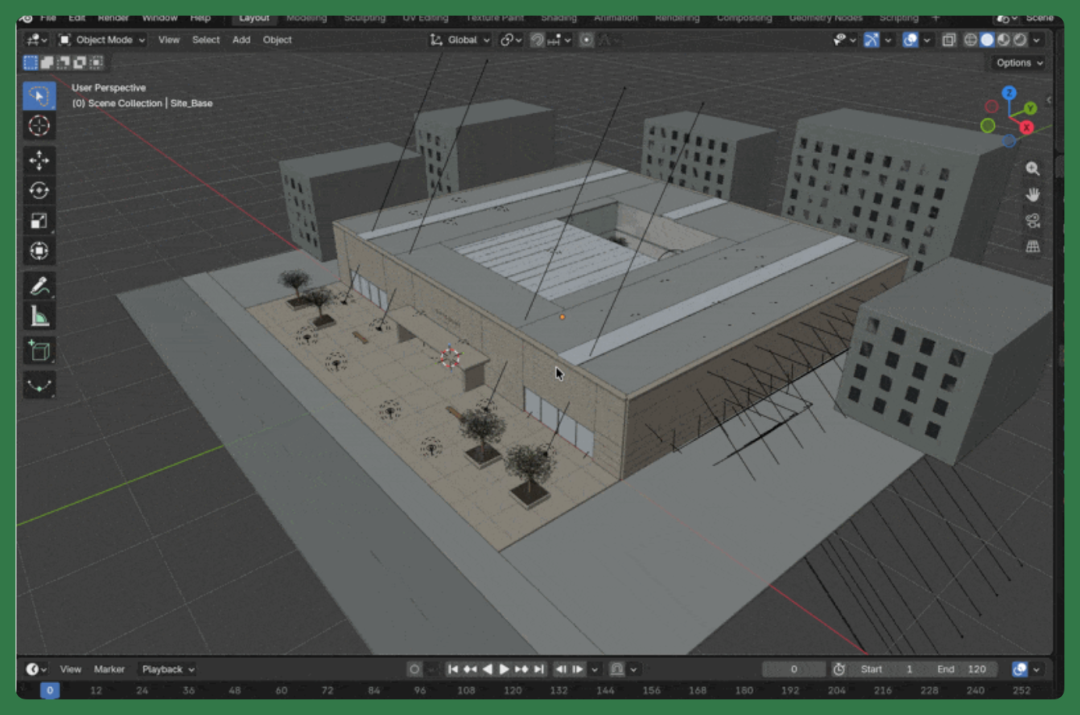
"Light Court Contemporary Art Museum" built with SpaceBunny in Blender
Zoom out to the past month, and the pace of domestic Flash model updates has clearly accelerated. More Chinese makers are shifting focus to the Flash tier, making it one of the most competitive segments in the domestic large model landscape.
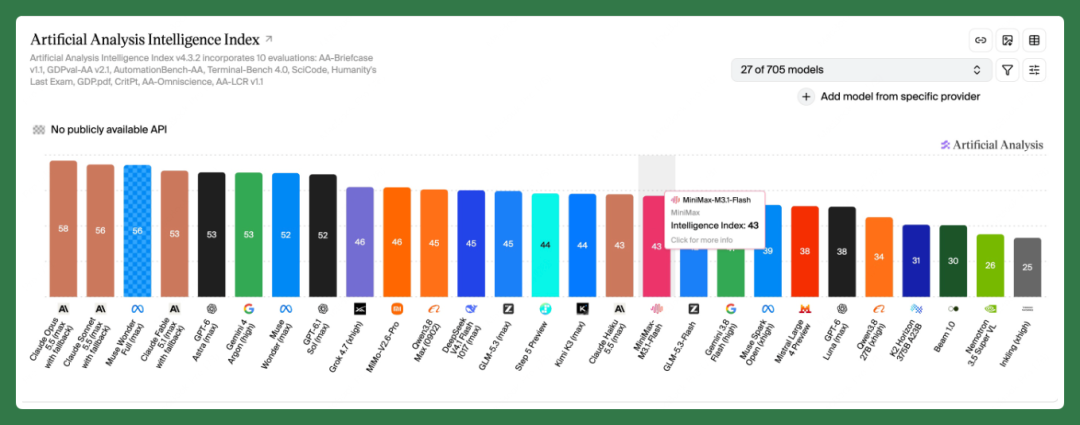
M3.1 Flash's numbers are impressive too — it ranked first among domestic models on the Agents' Last Exam (ALE) benchmark, scored 43 on the Artificial Analysis (AA) composite intelligence index, and can now go toe-to-toe with many large-parameter flagship models.
Historically, "Flash" meant cheap and good enough. This time, both models are posting scores that compete directly with flagships — while their pricing remains firmly in Flash territory.
Next, we ran two hands-on tests with MiniMax M3.1 Flash, then discuss its overall performance alongside broader industry shifts.
Flash Models, Now Benchmarked Against Flagships
A quick overview of M3.1 Flash's scores first.
On Artificial Analysis's composite intelligence index, M3.1 Flash scored 43, putting it in the same band as DeepSeek V4.1 Flash-1017 — with nearby scores mostly belonging to large-parameter flagship models.
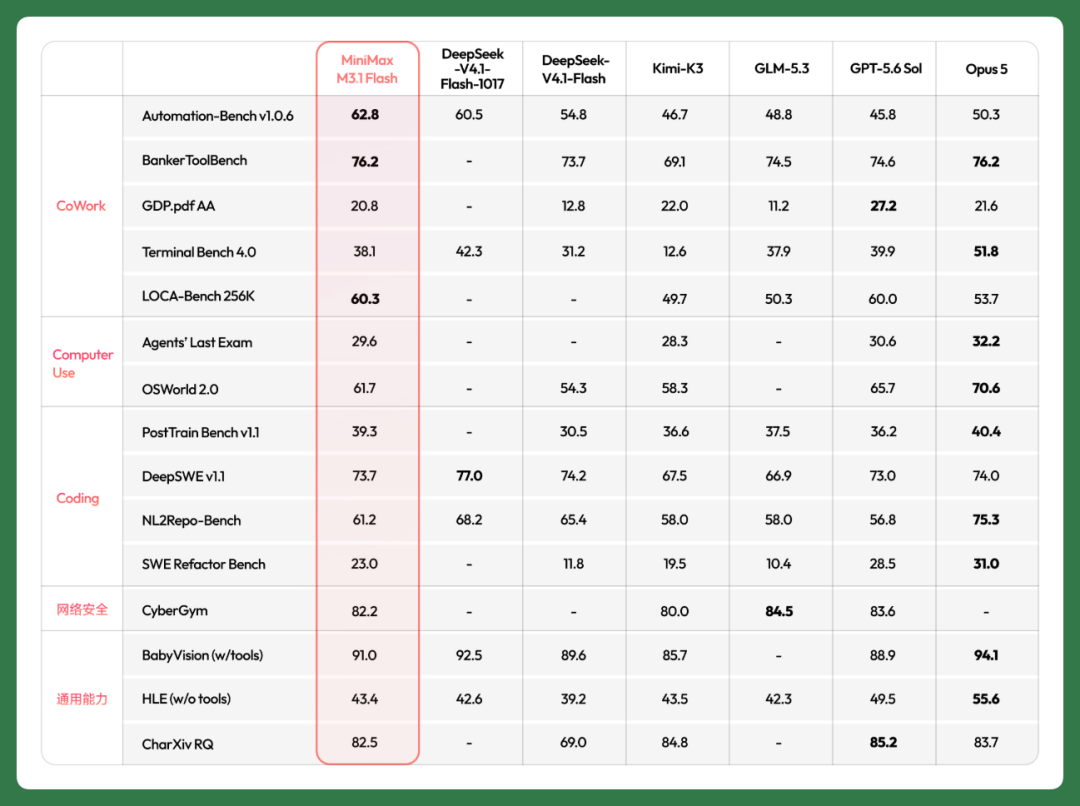
For coding, it scored 74 on DeepSWE, trailing only DeepSeek V4.1 Flash-1017's 77 and beating overseas flagships like GPT-6.1 Sol and Claude Opus 5.
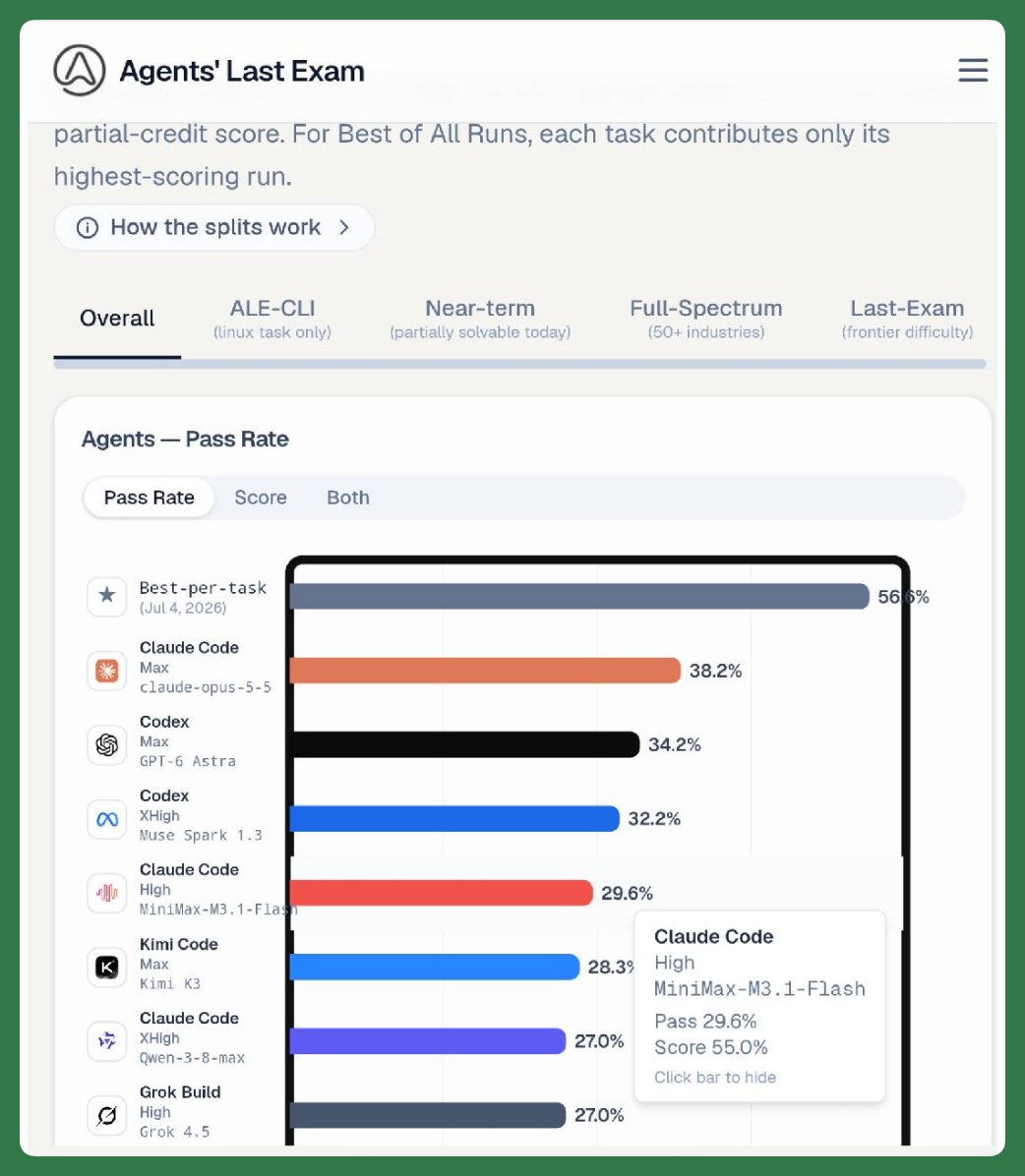
On agent benchmarks, it outperformed some large-parameter flagships on both OSWorld 2.0 and Agents' Last Exam (ALE), with a 29.6% ALE score. On the finance-oriented BankerToolBench, it tied Claude Opus 5 for first place at 76.2.
On pricing, M3.1 Flash's input and output rates are half of DeepSeek V4.1 Flash-1017's peak pricing.
Now, M3.1 Flash's comparisons have shifted from fellow Flash-tier models to large-parameter flagships like Claude Opus 5.
This reflects how Flash models are encroaching on tasks previously reserved for flagships — while maintaining substantial price advantages.
Such comparisons used to be rare.
For a long time, developers followed a default division of labor: flagships handled mission-critical tasks, Flash models took simple, high-volume work. Choosing Flash usually meant budget constraints or low complexity.
So Flash was widely seen as a downgraded version of the flagship.
But DeepSeek V4.1 Flash-1017 already broke that pattern, with coding scores surpassing many large-parameter flagships. M3.1 Flash further confirms the trend.
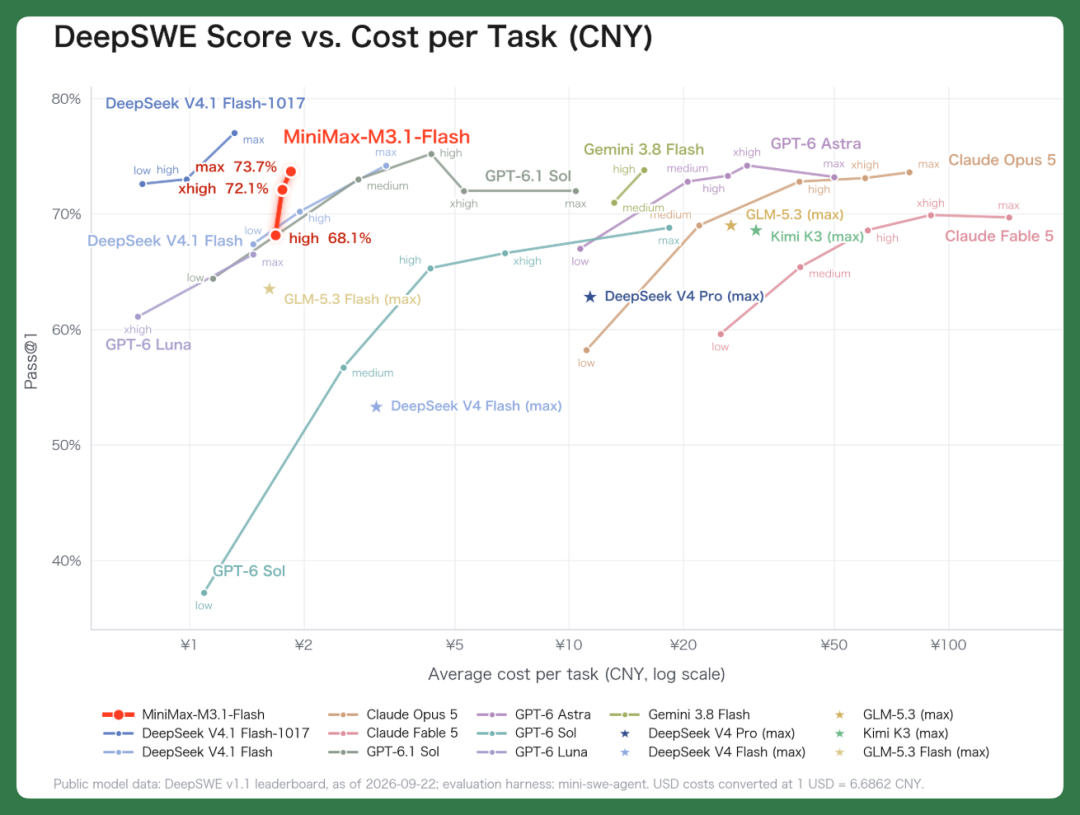
On DeepSWE alone, M3.1 Flash's 74 beats GPT-6.1 Sol, Claude Opus 5, Claude Fable 5, and Gemini 3.8 Flash.
Several of these models cost an order of magnitude more than M3.1 Flash:
Overseas developer feedback has centered on intelligence-per-dollar.
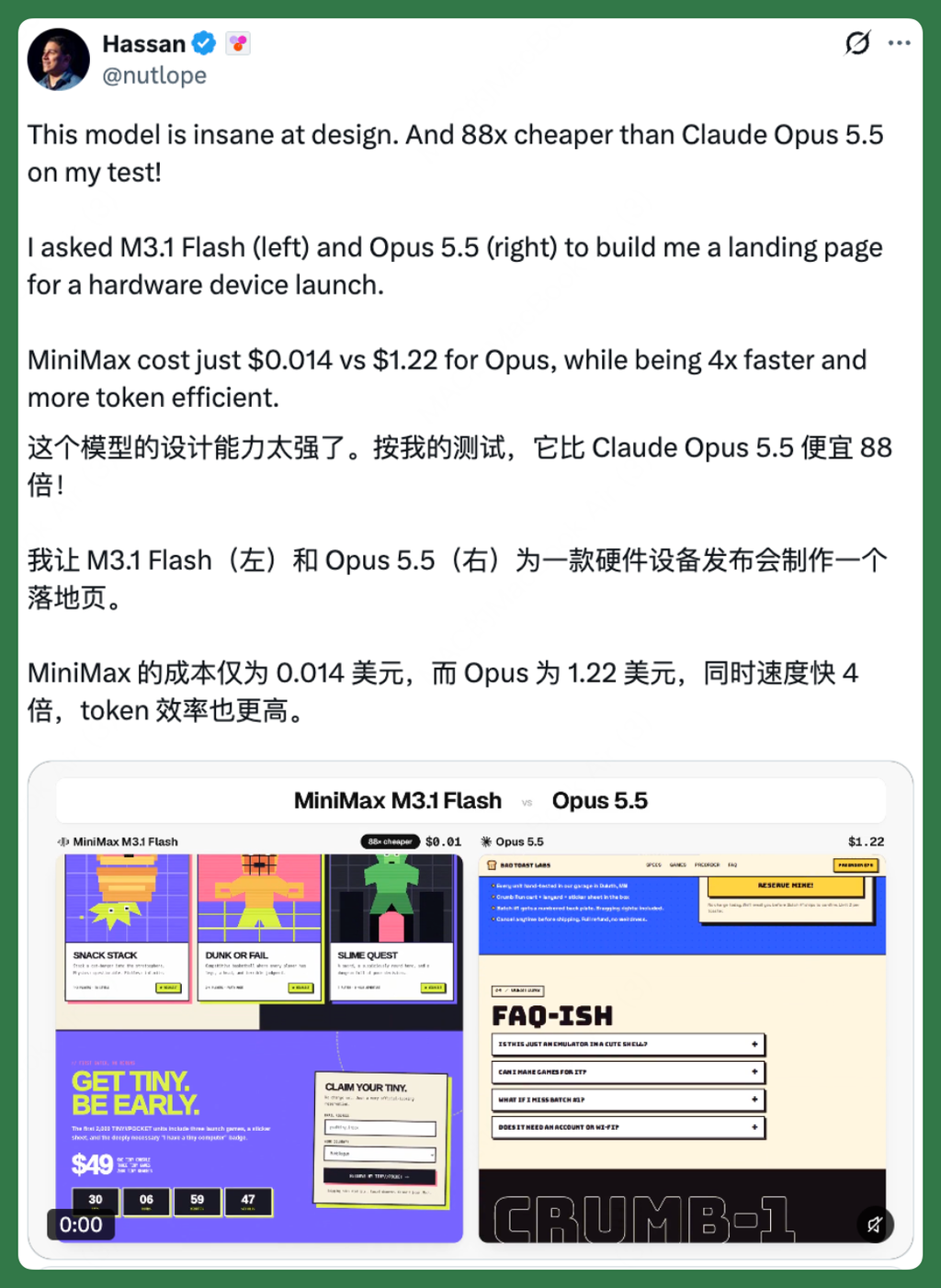
Together AI's Head of Developer Experience @nutlope used the same prompt to have M3.1 Flash and Claude Opus 5.5 each build a hardware launch landing page. M3.1 Flash cost $0.014; Opus 5.5 ran $1.22 — roughly 88x more expensive, and about 4x slower.
His assessment: M3.1 Flash performed quite well on design:
3D scenes drew particular attention.
@seki_anos had M3.1 Flash build Tokyo Tower in Blender to test its automation capabilities, finding surprisingly detailed structure around the main observation deck.

We ran our own test, having M3.1 Flash build an HTML webpage with Three.js r160 — a late-night corner convenience store still open while it's raining outside. These kinds of small 3D scenes have been trending on Xiaohongshu lately.
The overall result was solid — the store and surrounding street were fully built with fairly realistic rendering. Lighting details stood out: interior store lights, streetlamp reflections on wet pavement.
Beneath the scene, a 26×26×4 grid of small cubes formed a "jelly sea" simulating water ripples and movement, which also looked natural.

I then tried dragging the view, zooming in and out to inspect details. Raindrop effects on the ground and the convenience store sign's neon reflection on the water surface both came through convincingly.

It's not perfect, of course, but as a quickly generated 3D scene, it's more than adequate.
At minimum, it's clear that small frontend and 3D projects like this can now be handed directly to Flash models — with genuinely good results.
For more complex projects, developers can also start with a Flash model to prototype and see how it looks, then decide which parts need further optimization with a flagship model. It's cheap and fast, so the cost of iterating through multiple rounds of revisions is basically acceptable.
On Agent Benchmarks, M3.1 Flash Surpassed Some Large Flagship Models
The most notable results for M3.1 Flash this time are actually concentrated in Agent capabilities.
Agent benchmarks measure something different from coding benchmarks. Coding benchmarks mainly test a model's ability to write code, while Agent benchmarks focus more on whether the model can operate step-by-step to complete a task that requires many steps.
Among Agent-related benchmarks, there's a test called OSWorld 2.0, led by The University of Hong Kong's XLANG Lab, containing 108 multi-step tasks across 7 domains. Even skilled humans typically take about 1.6 hours to complete one of these tasks.
Another test is Agents' Last Exam (ALE), led by UC Berkeley RDI and other institutions, with hundreds of industry experts involved in its design, covering 13 industries and 55 sub-fields.
On both of these benchmarks, M3.1 Flash scored higher than some large-parameter flagship models. When paired with Claude Code as a harness, it achieved 29.6% on ALE.
The other two benchmarks measure something closer to everyday enterprise work, and this area has become a key evaluation focus for many model releases.
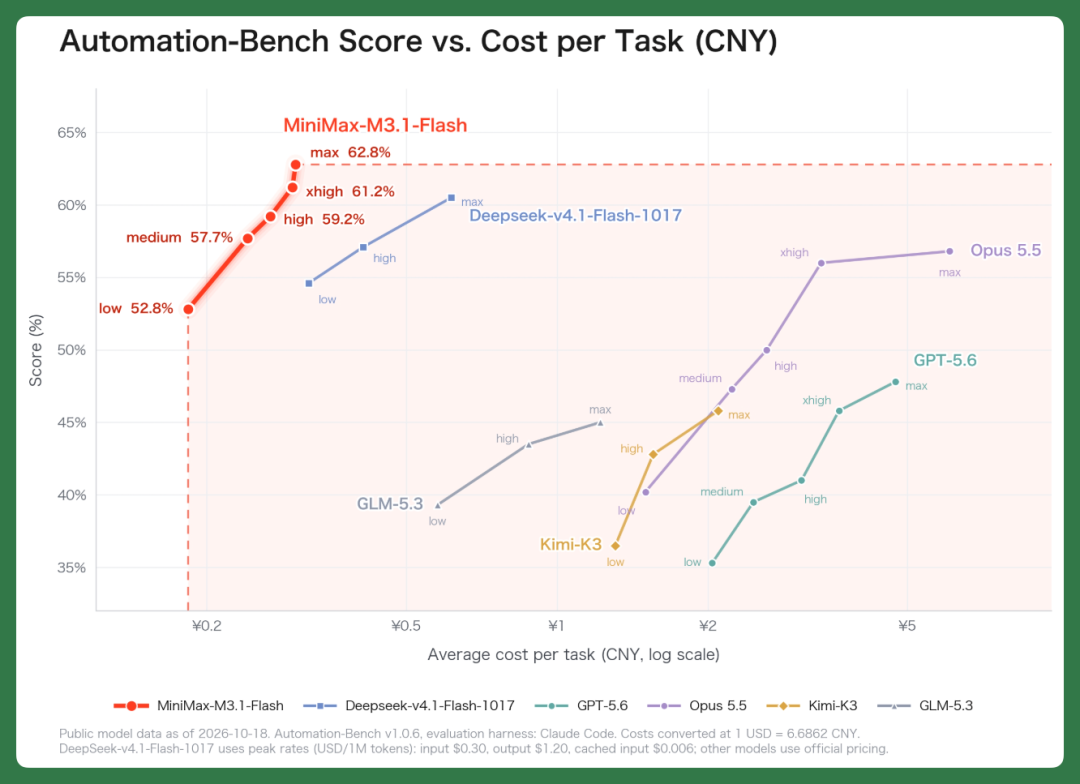
Among them, Automation-Bench was launched by SaaS automation platform Zapier, containing 600 tasks from real enterprises, covering sales, marketing, customer service, finance, and HR operations.
M3.1 Flash scored 62.8 on this benchmark, and completing a task requiring operations across multiple systems cost less than $0.05.
BankerToolBench primarily tests finance-related tasks, such as having the model plan its own operation steps, reconcile data across different documents, and call tools to complete work. M3.1 Flash scored 76.2 on this benchmark, tying for first place with Claude Opus 5.
Now look at this chart:
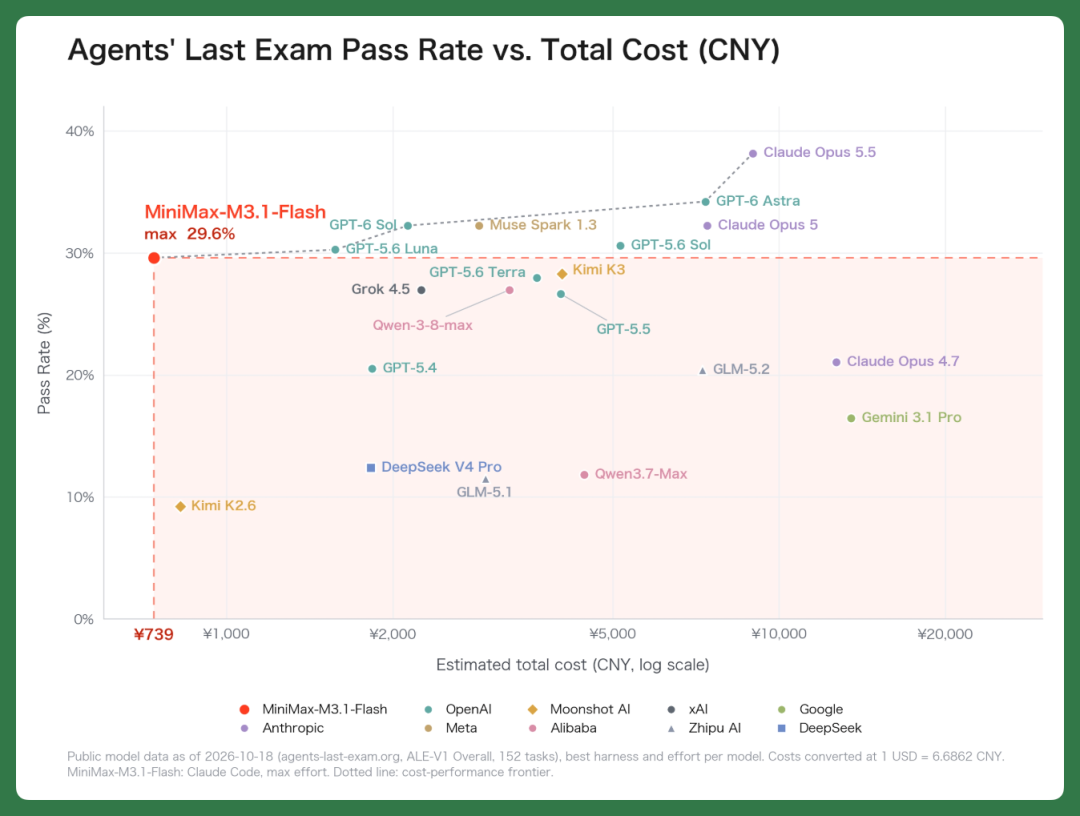
The horizontal axis shows how much it costs to complete the full ALE test; the vertical axis shows pass rate. The further up and to the left, the less money the model spends and the higher its pass rate.
M3.1 Flash is at the far left of the chart, with a 29.6% pass rate and total cost of about 739 RMB, making it one of the most cost-effective models shown.
By comparison, Claude Opus 5.5 and GPT-6 Astra, which have higher pass rates, both cost over 7,000 RMB total. The models in the red-shaded area have lower pass rates than M3.1 Flash but cost more.
So for Agent tasks, higher scores no longer necessarily correspond to higher prices.
The reason Agent performance has become important is that the use of tokens has shifted.
According to OpenRouter, around February this year, tokens consumed by Agents on the platform first surpassed those from human conversations. By early August, Agents accounted for roughly 70% of total platform token volume. A single Agent request consumes approximately 15 times as many tokens as a human conversation.
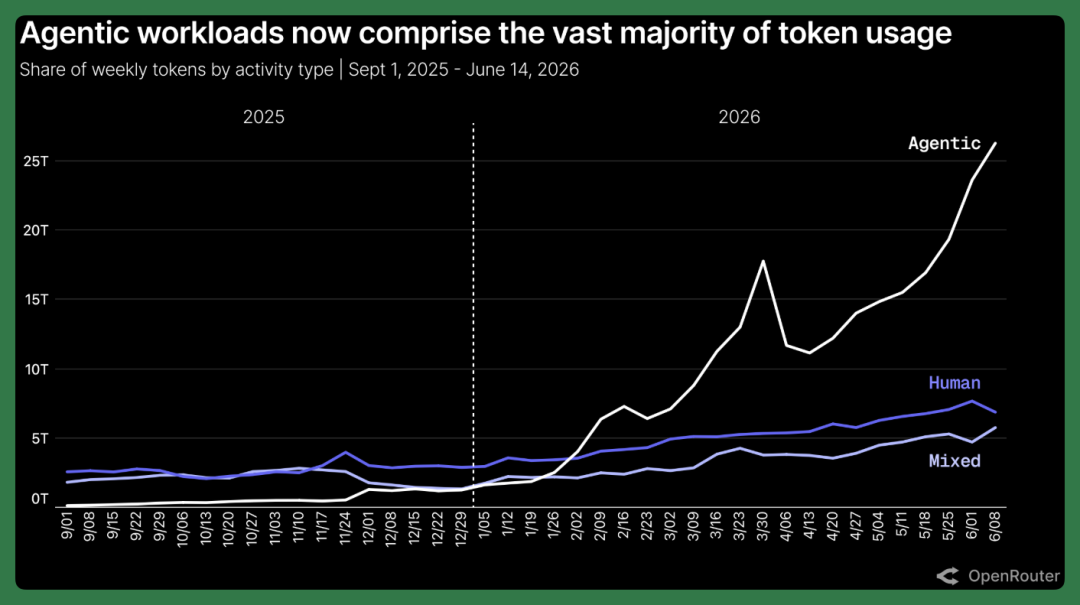
According to OpenRouter statistics, token usage for Agentic Workloads has grown rapidly, far exceeding token usage from direct human interaction.
So competition among model vendors is increasingly focused on Agent tasks. An Agent task typically consists of dozens of step-by-step calls, with each step waiting for model output. If a single step is slightly slower, the entire task becomes much slower.
Beyond low cost, M3.1 Flash is also fast. Even during anonymous testing, it attracted considerable attention for its response speed. According to official information, in everyday scenarios it can reach over 200 tokens per second at peak, with a median speed above 170 TPS.
This means that when running Agent tasks with M3.1 Flash, the wait time for each step can be reduced somewhat. The more calls made, the more pronounced the speed advantage becomes.
Cheap and fast — for Agents that need to call models repeatedly, M3.1 Flash naturally becomes more attractive.
So for our second real-world test, we chose a task closer to a complete project to see how M3.1 Flash performs when executing multiple consecutive steps.
This time, we used M3.1 Flash to build a coffee ordering app demo from scratch, called "Feizhi" (Coffee Journal).
Unlike the simple 3D webpage earlier, this time we integrated M3.1 Flash into our own workflow, making it the main Agent responsible for the entire app's development and revisions.
Because we wanted to build a fairly complete app demo, beyond writing code we also needed to generate some images. So we additionally integrated an AI image generation API that we've been using.
This way, M3.1 Flash could call the API to generate images itself, then classify them based on content and place them in the appropriate positions in the app, ultimately producing a usable demo.
Throughout the process, we also had it continuously revise and refine the app, to see whether it could connect the steps of writing code, generating images, and organizing content to complete a relatively full project.
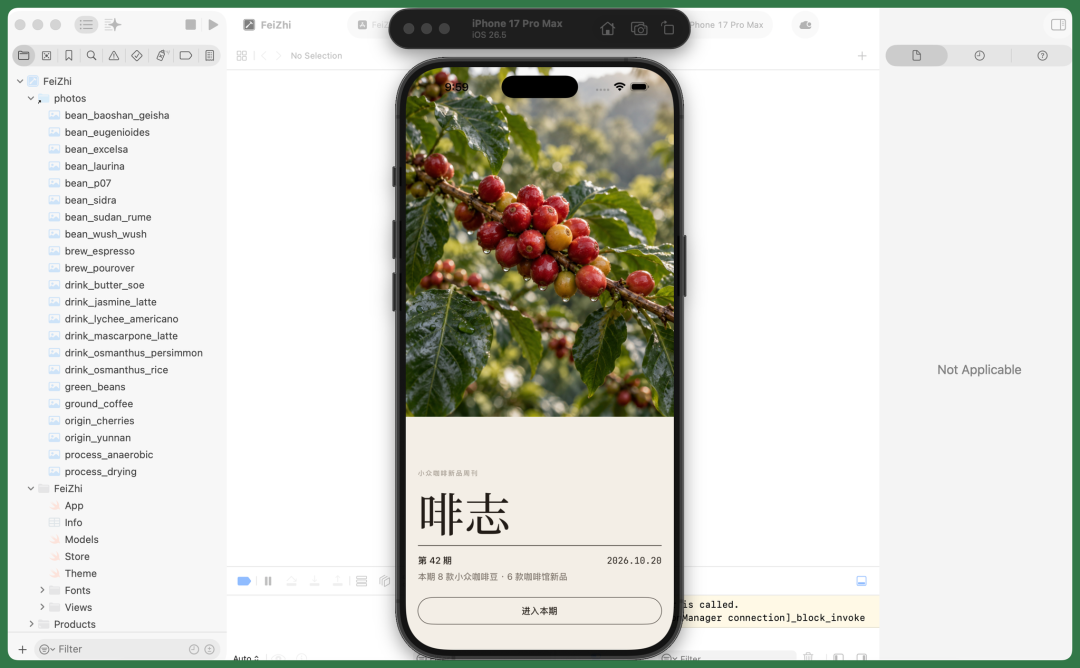
The app's homepage now mainly showcases daily new coffee products. All the images inside are genuinely AI-generated, with no placeholders.
Moreover, these images weren't generated randomly. Before generating images of coffee beans and finished drinks, I first had M3.1 Flash do a round of deep research, studying the characteristics of different coffee products itself, then writing corresponding image generation prompts based on its findings.
Then it would call the image generation API to produce the images and place them in the appropriate positions in the app.
In other words, from researching materials and studying products to generating images and placing them in the app, these steps were all completed by M3.1 Flash itself.
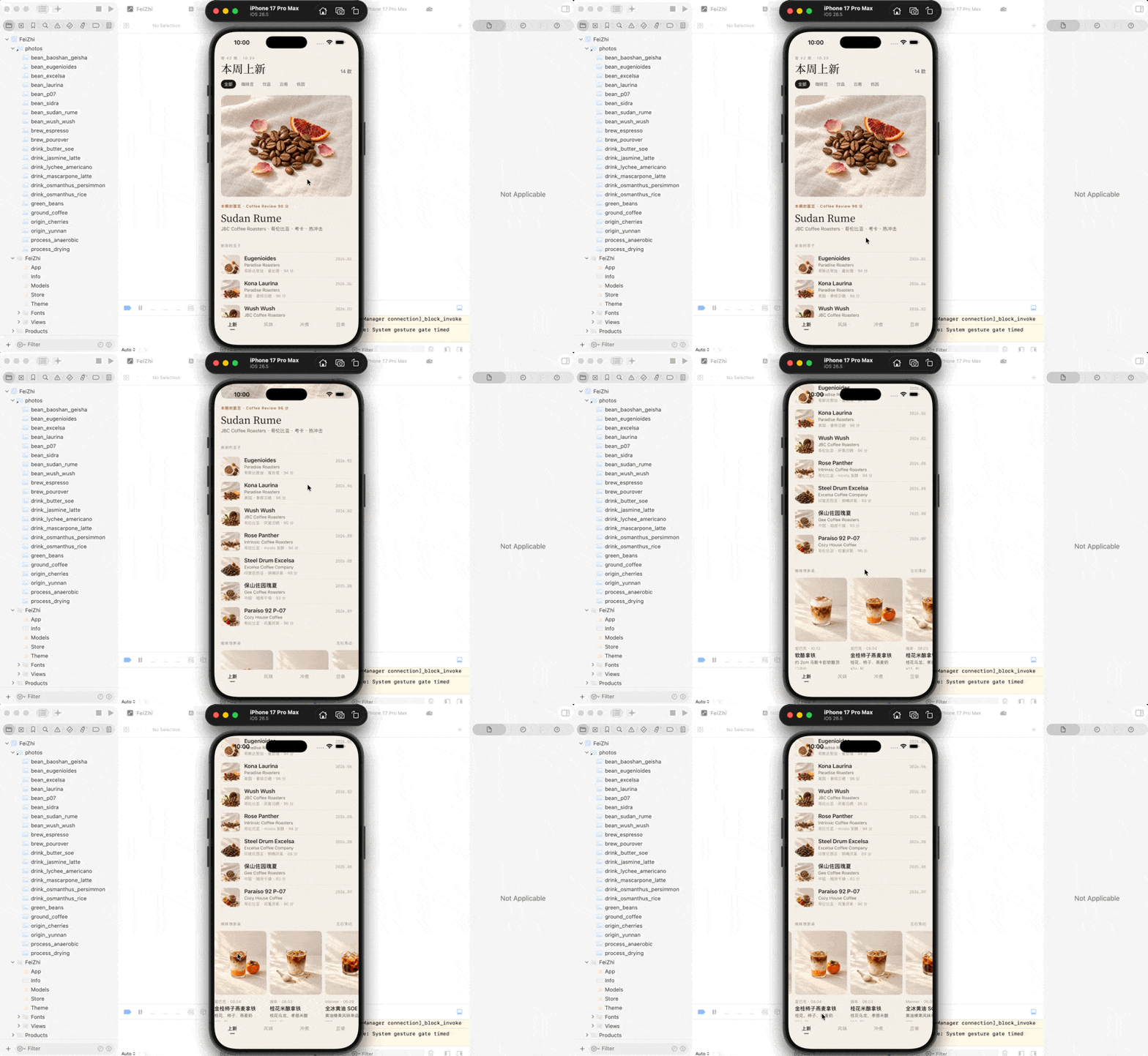
Beyond images of finished coffee and coffee beans, the app's interactive effects are also quite well done.
For example, after clicking on a coffee product, the product detail page expands from the lower right with a fairly natural gradient animation. Continuing to scroll down reveals a dynamic flavor scoring area where you can drag to view different flavor characteristics.
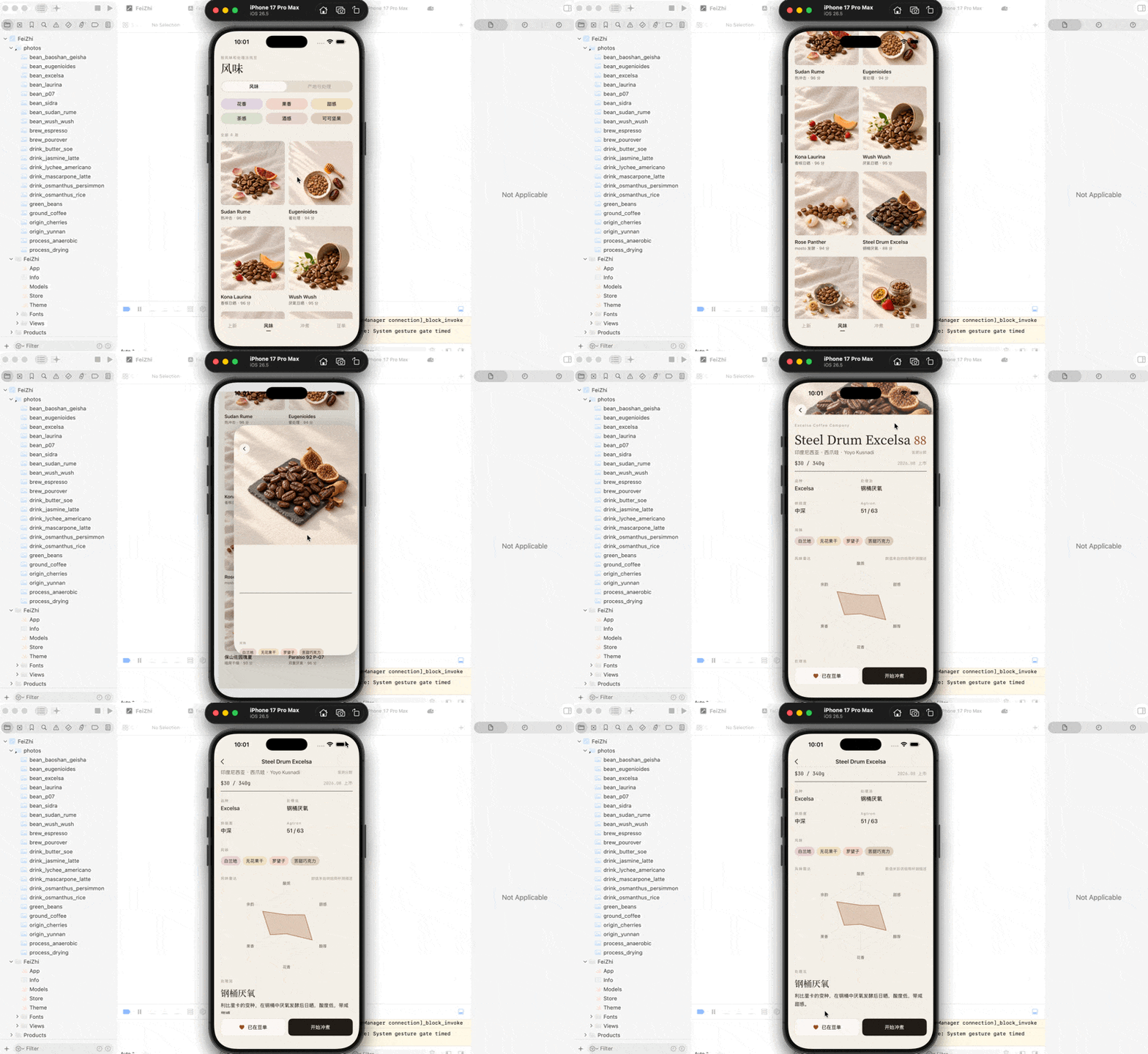
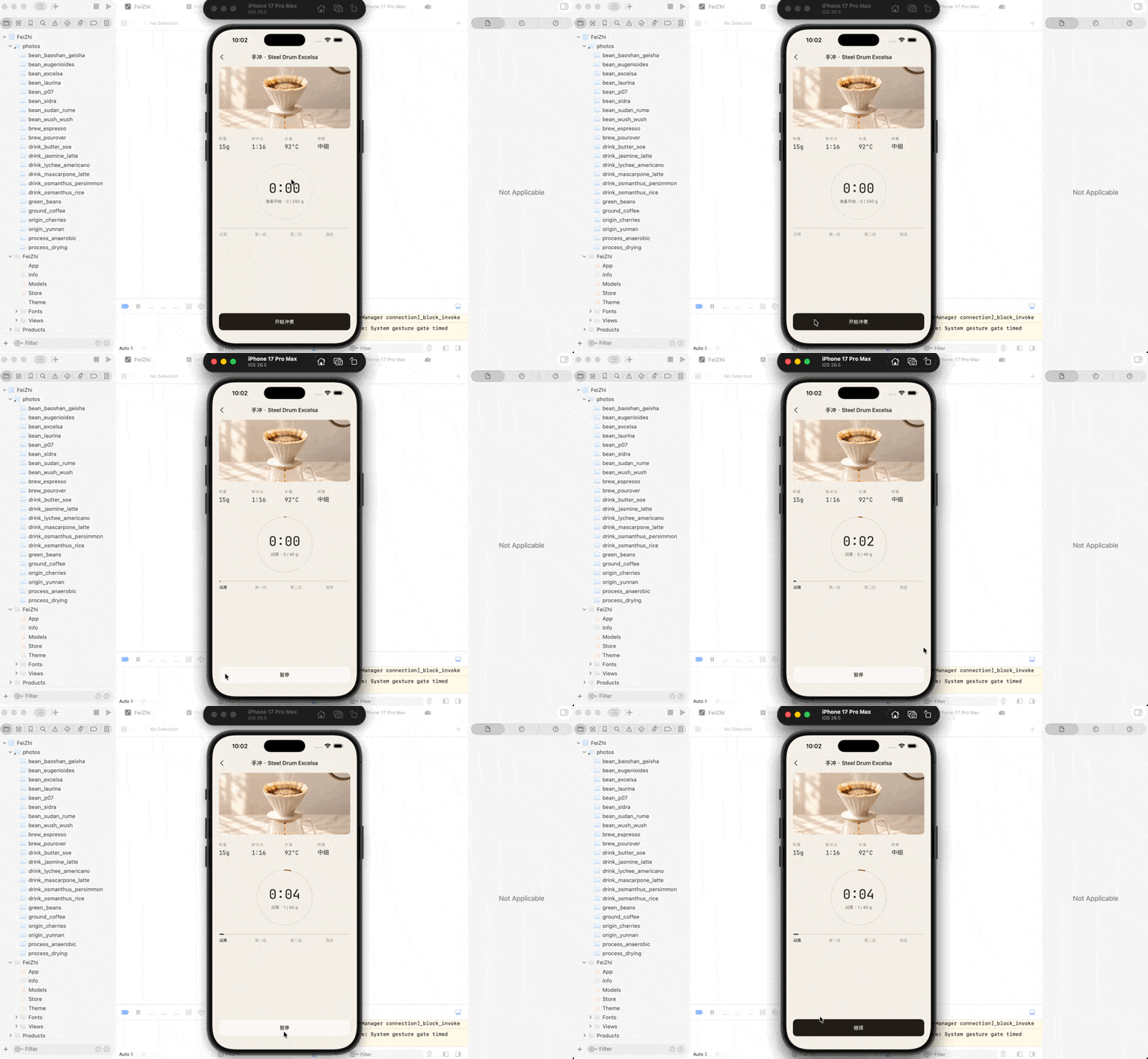
Additionally, the app includes a pour-over coffee timer feature.
For instance, when a user clicks on a pour-over coffee called Stell Drum Excelsa and completes the order, they can directly start the pour-over timer in the app to control their brew time.
Previously ordered coffee beans are also automatically saved to their personal "Bean List," displayed as collectible cards.
Clicking on a coffee bean, such as Gesha, reveals its acidity, flavor characteristics, and recommended brewing parameters.
Actually, this display format is now quite common on coffee bean product pages on Taobao and JD.com. Merchants turn coffee bean flavor, acidity, and brewing parameters into charts to help users understand different beans' characteristics.
So we incorporated this fairly common coffee bean display method into the app, allowing users to check their "Bean List" anytime after purchasing beans.
After using it end-to-end, this coffee app demo feels fairly complete. From the initial research and image generation to page development and adding interactive features, M3.1 Flash handled the entire workflow coherently.
Of course, it's still just a demo — there's plenty of work left before it could actually ship. But this hands-on test at least shows that M3.1 Flash can now continuously complete multiple distinct tasks within a relatively complete development flow.
That said, in real-world development, you don't necessarily have to hand every task to the same model.
Many developers let flagship models handle planning and complex problem-solving, then delegate step-heavy, repetitive work to Flash models.
For instance, Anthropic positions Haiku 5.5 as a sub-agent under Opus and Sonnet. Overseas developers have also placed M3.1 Flash beneath Opus 5.5, specifically for 30-step web crawling loops, PR reviews, and overnight automated research.
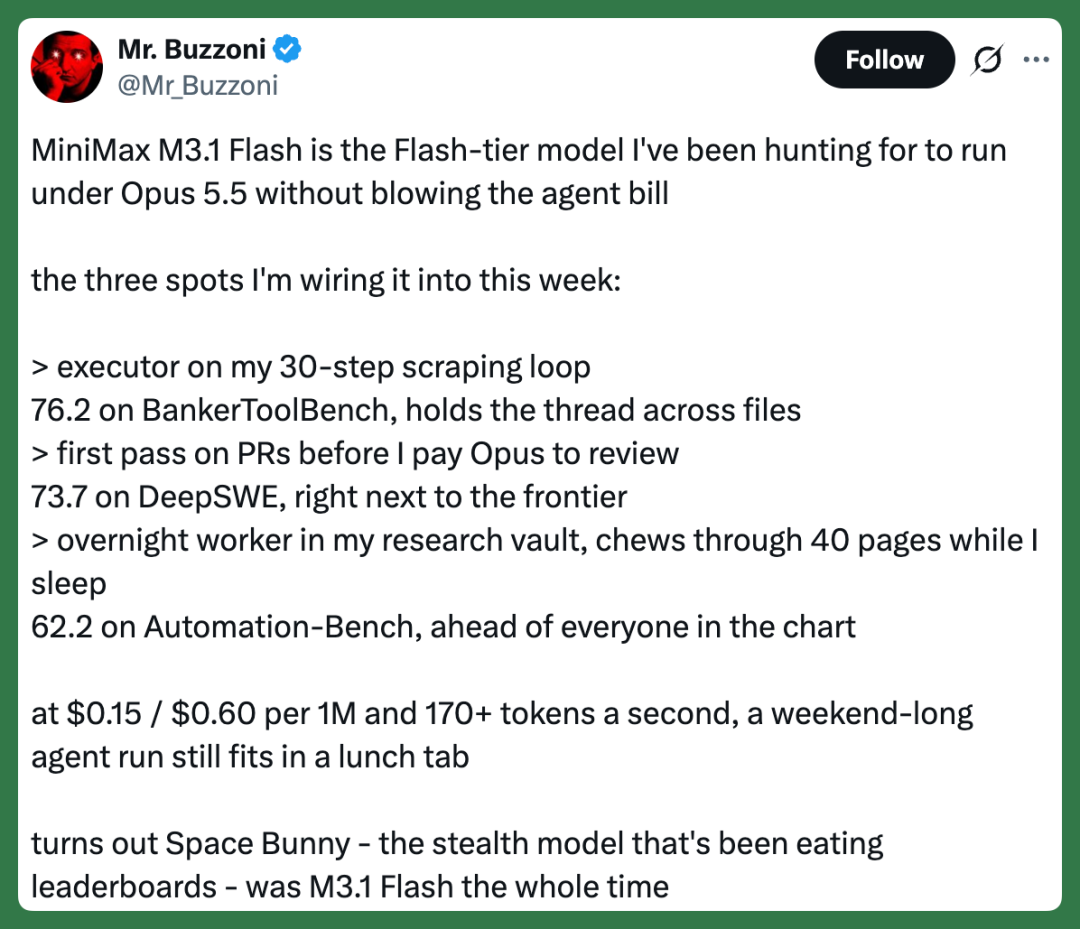
For these multi-call, non-time-sensitive tasks, M3.1 Flash's advantages — low price and fast speed — become even more pronounced.
M3.1 Flash Enters a New Price Tier, Giving DeepSeek a Same-Segment Rival
Now for the pricing that Flash models most easily attract attention for: M3.1 Flash is priced at $0.15 per million input tokens and $0.60 per million output tokens — roughly half of the previous M3 generation, with cache read prices down about 75%.
Taking DeepSeek V4.1 Flash-1017 as an example, that model uses time-of-use pricing: its off-peak rate matches M3.1 Flash, while peak hours double the cost. So M3.1 Flash's price is roughly half of DeepSeek's peak rate.
In other words, the low price that DeepSeek only offers during off-peak hours, M3.1 Flash offers around the clock.
Previously, developers looking to save money would save non-urgent tasks to run at midnight. Now there's no need to wait for nighttime — you can get similar pricing during daytime too.
Chinese netizens quickly turned this into memes. One quip: "Peak-time bunny, off-peak fish" — bunny referring to M3.1 Flash's codename Space Bunny, fish referring to DeepSeek.

Factor in cache hit rates, and the two end up nearly even on price.
This matters for Agents, because when executing tasks they frequently re-read the same code, documentation, and tool outputs — so much of the input can be served directly from cache.
However, token pricing alone doesn't prove intelligence efficiency; you also need to look at how many tokens a task actually consumes.
In Artificial Analysis's testing, M3.1 Flash averaged about $0.22 per completed task, versus $0.26 for DeepSeek V4.1 Flash-1017.
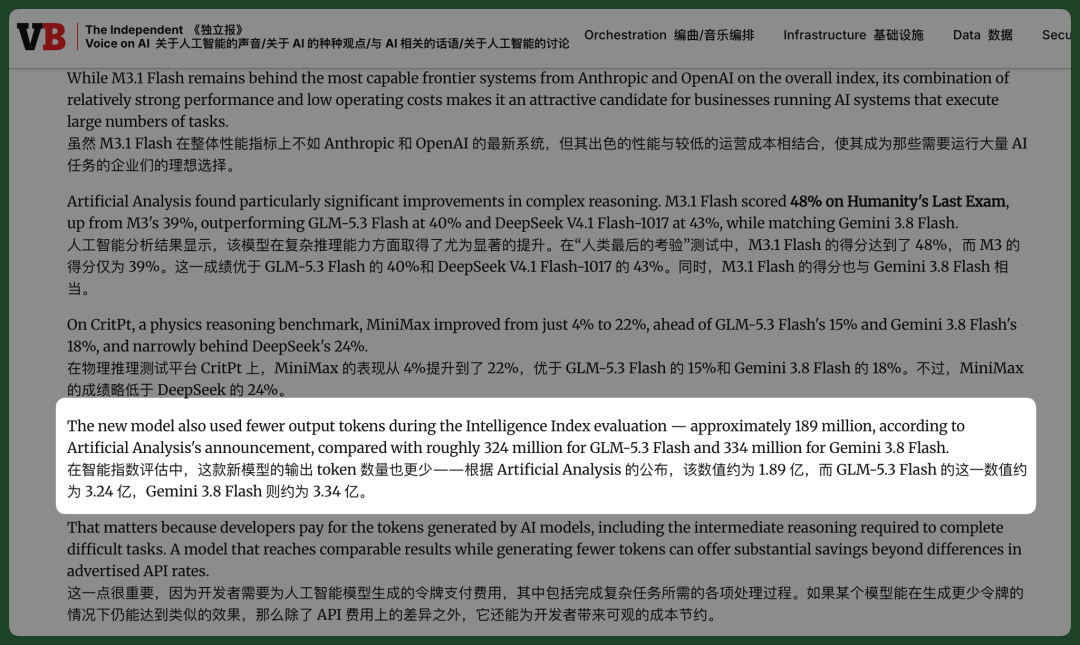
And completing the full test suite, M3.1 Flash output roughly 189 million tokens total — less than 60% of what Gemini 3.8 Flash used.
Below, we've compiled some comparison cases from developers on X:
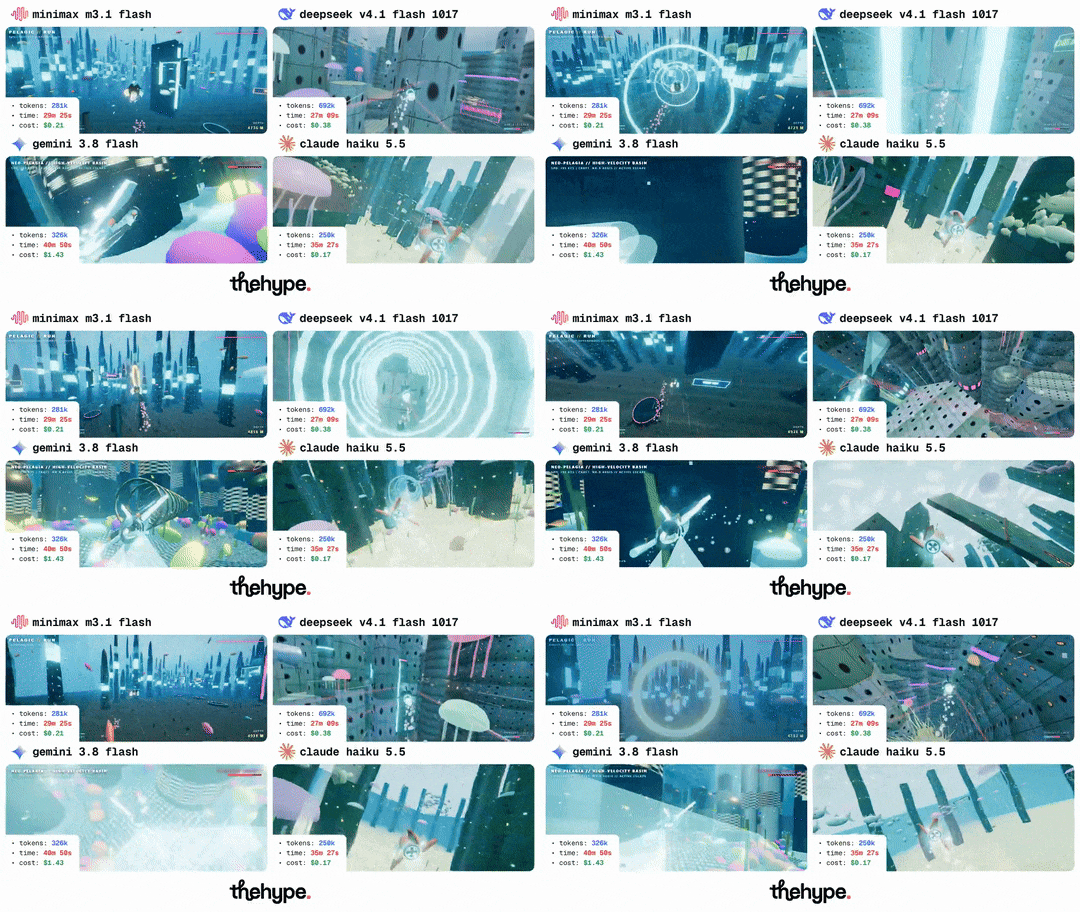
[1] @thehypedotnews built a submarine chase HTML mini-game. M3.1 Flash cost $0.21; Gemini 3.8 Flash cost $1.43.
[2] @domsilvestre had M3.1 Flash and Claude Opus 5.5 each build 3 3D scenes. M3.1 Flash totaled $0.19; Opus 5.5 cost $13.83.
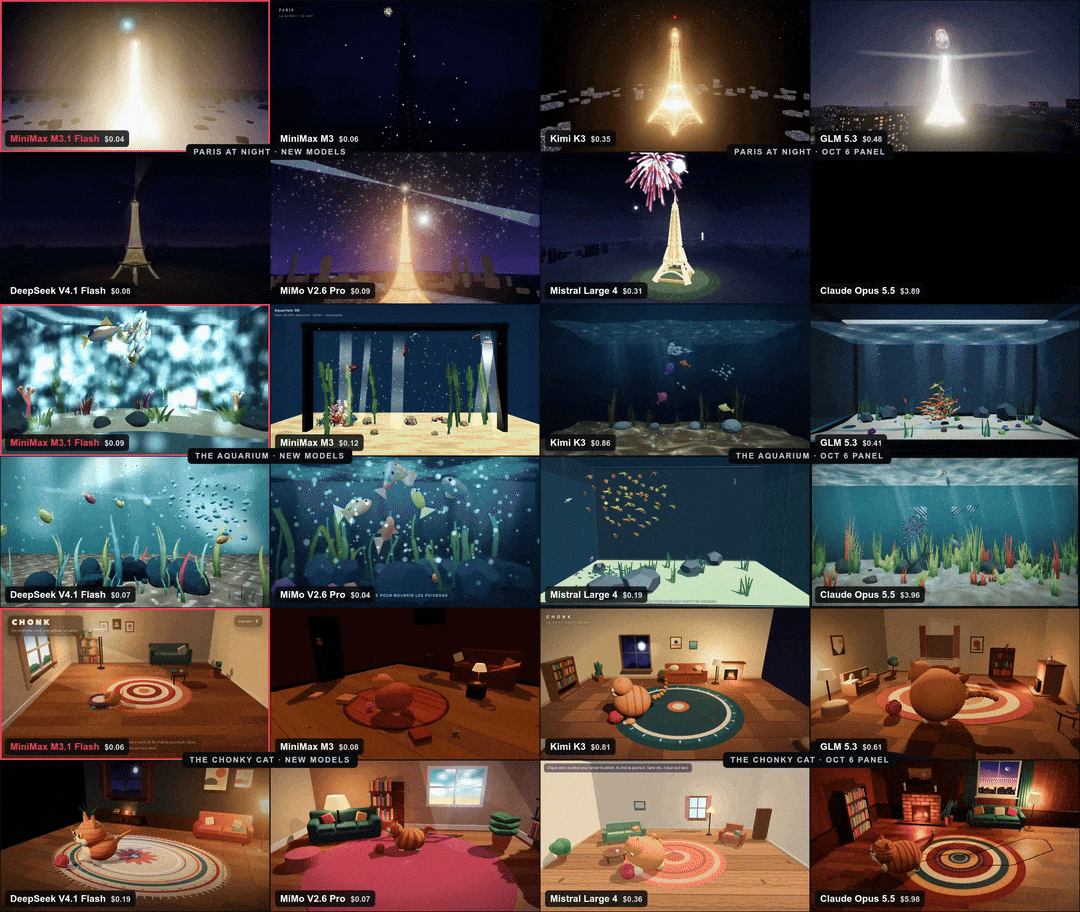
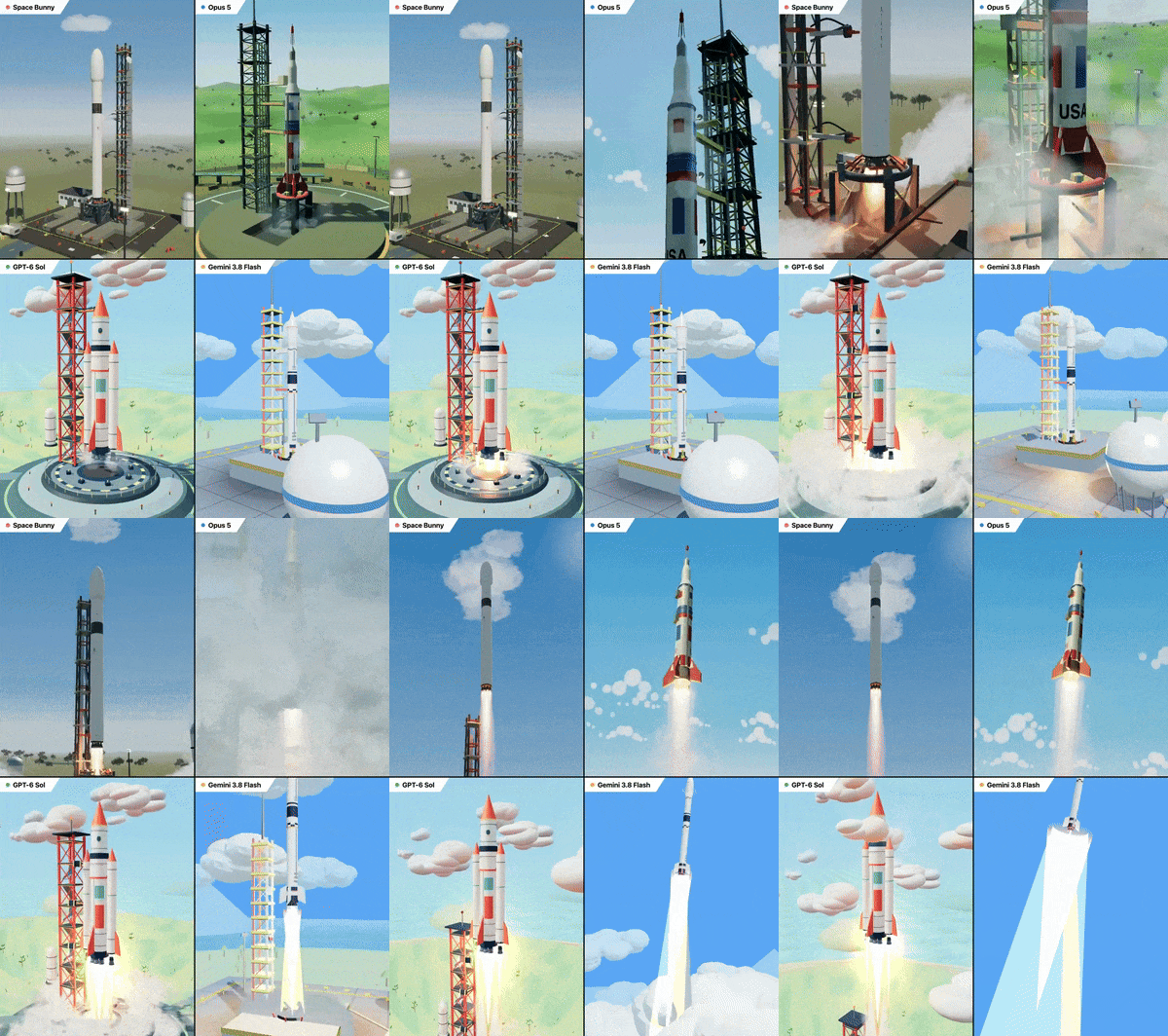
[3] @Bhavani_00007 compared M3.1 Flash, Claude Opus 5, and GPT-6 Sol on the same 3D scene task. His conclusion: M3.1 Flash was faster and produced relatively better results.
Overall, M3.1 Flash performs steadily on programming, Agent, and finance-related tasks. Combined with the positive reception DeepSeek has received lately, these two models actually have distinct strengths suited to different tasks — developers can absolutely use them in combination.
For MiniMax, the M3.1 Flash release has another point of significance worth discussing.
After M3 launched, external reception of MiniMax's text models was actually not great — some even complained that M3's coding ability was practically unusable, feedback easily visible across various communities.

At the time, many believed MiniMax's strengths lay mainly in multimodal capabilities. But now it seems their text models can hold their own too.
Currently, M3.1 Flash shows noticeable improvement over M3 in both benchmarks and hands-on tests. On the AA Intelligence Index, M3.1 Flash scored more than 10 points higher than M3.
This time around, MiniMax also teased a Pro version targeting the intelligence ceiling. If the Flash version already reaches this solid level, the Pro version's performance is something to look forward to.
If you consider the total cost of completing a full task — including spend, wait time, and rework iterations — the flagship + Flash model combination is clearly superior.
Whether it's Opus 5.5 or Fable 5.1, both can use M3.1 Flash as an execution sub-agent and "play" together.
Of course, the real-world effectiveness of these results still needs to be validated by deploying the model into your own actual workflow.
M3.1 Flash is now live on MiniMax API, M Plan, and MiniMax Code — highly recommend taking it for a spin.
Recommended Reading

Join the Member Group

Comment to Win