A Conversation with MiniMax's Junjie Yan: M3, Project 10X, 10T Models, and the Endgame of Intelligence

When intelligence approaches the tipping point.
When Intelligence Approaches the Critical Point.

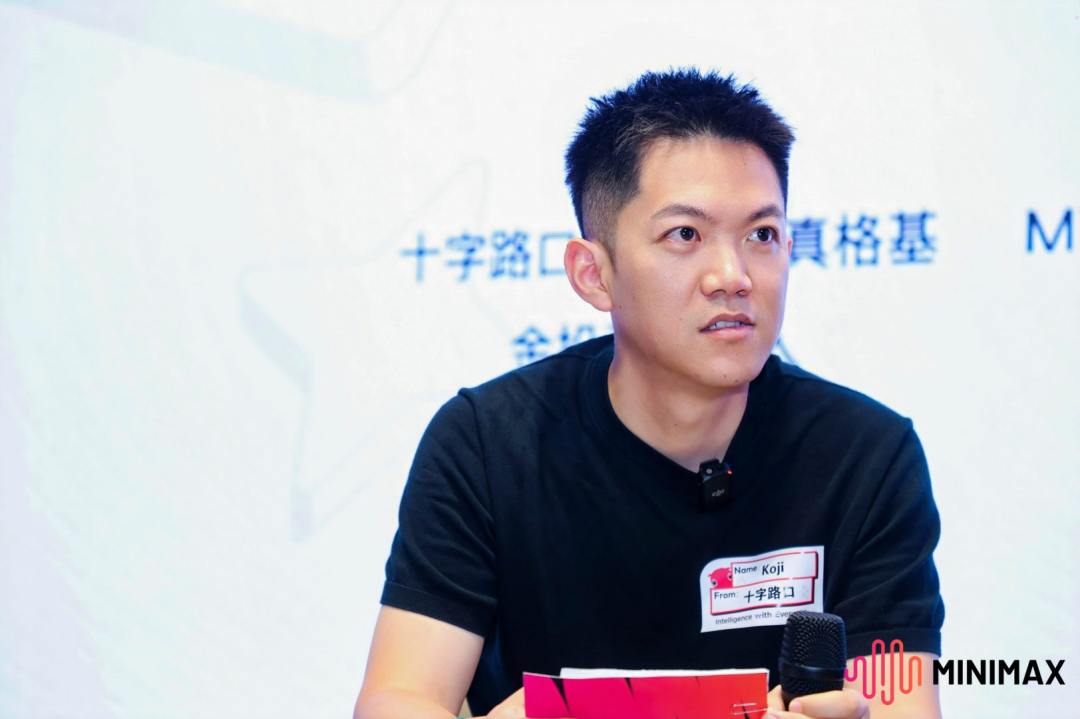
👦🏻 Host: Koji
🥷 Editor: Crossing
🧑🎨 Layout: Zeoooo

Hi, I'm Koji. Last Saturday, I moderated a roundtable discussion at the MiniMax Dev Meetup and recorded a live podcast episode. Our guests included:
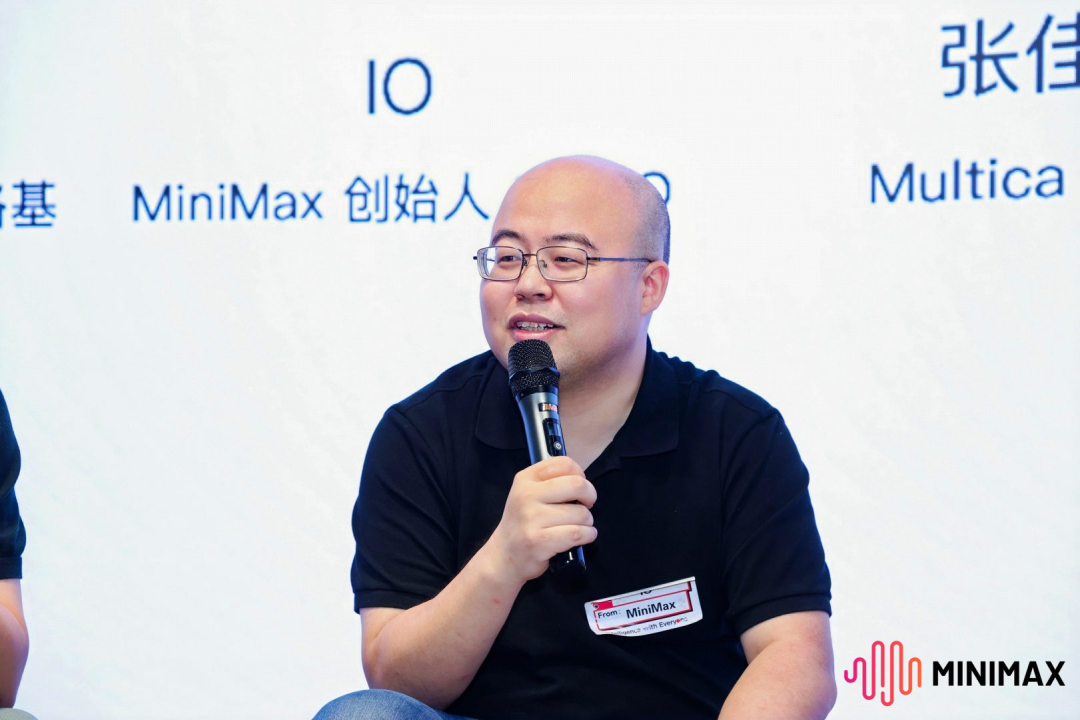
🧑🏻💻 IO Junjie Yan: Founder & CEO of MiniMax
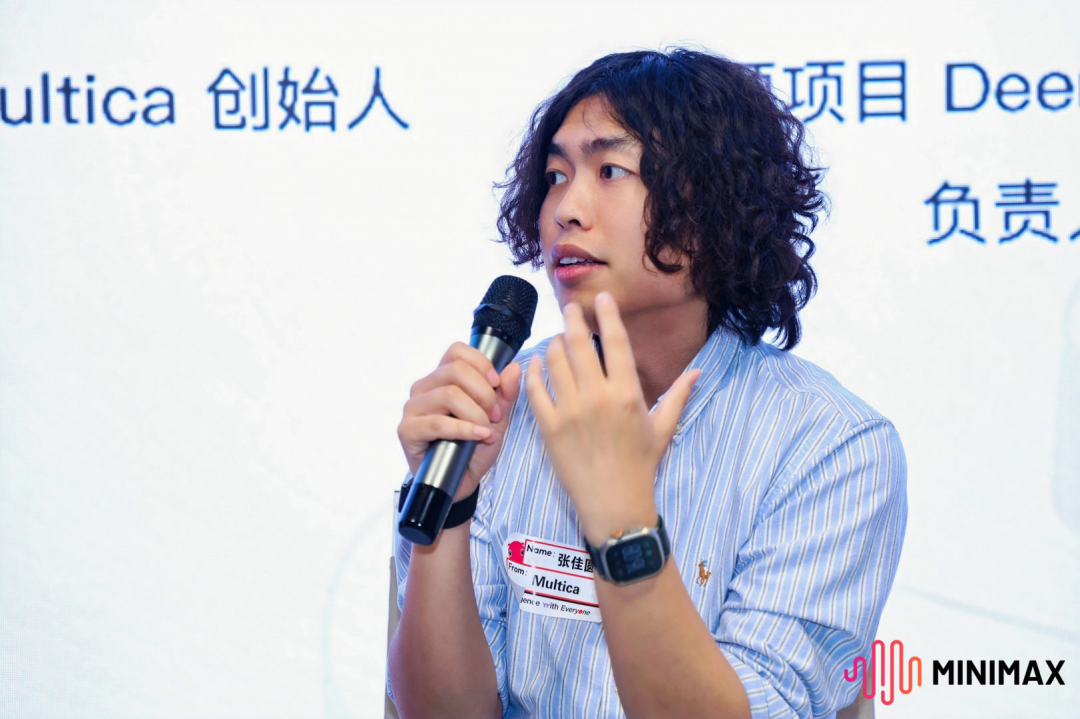
🧑🏻💻 Jiayuan Zhang: Founder of Multica
🧑🏻💻 He Tao: Core lead of DeerFlow
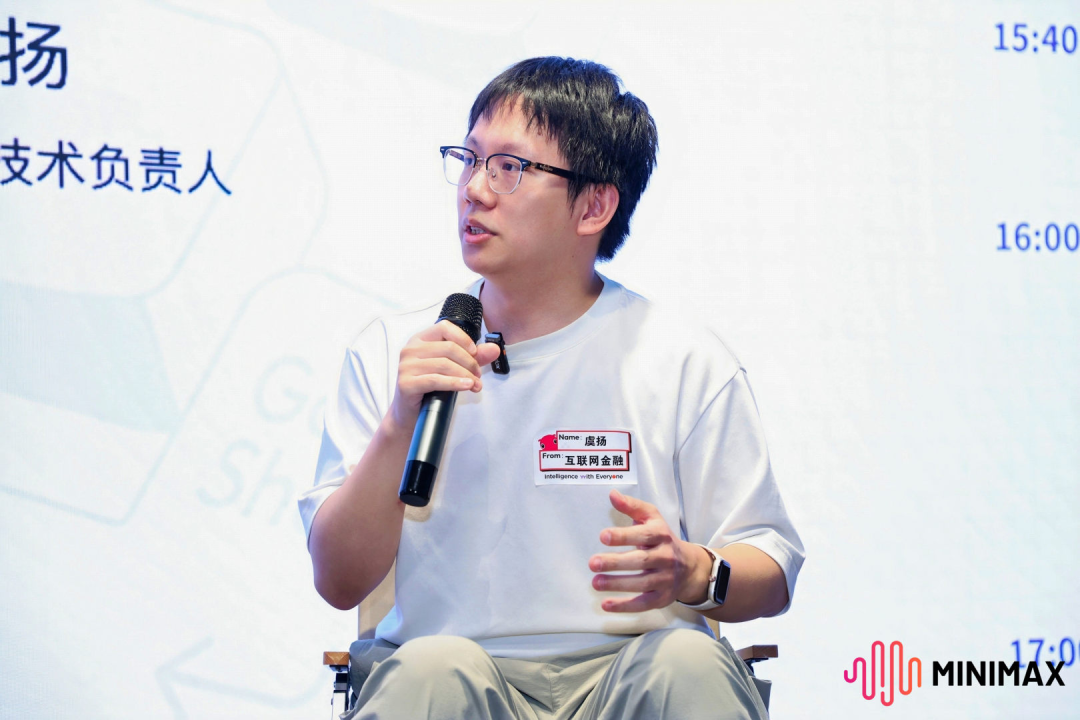
🧑🏻💻 Yu Yang: Tech lead at a listed financial company
The full conversation lasted 60 minutes, followed by another 60 minutes of audience Q&A. This article is the complete transcript of the on-stage discussion.
Video and audio for this episode will be released this week on "Crossing"'s Xiaoyuzhou channel and @Koji's Xiaohongshu, WeChat Channels, BiliBili, and YouTube.
IO Junjie Yan: "We're Already Very Close to This Critical Point"
👦🏻 Koji
Hello, IO! You've rarely made public appearances lately, but you clearly attach great importance to this MiniMax Dev Meetup—I noticed you've been constantly chatting with developers here. So my first question is: why does this event matter so much to you that you're willing to invest this much time in it?
👨🏻💻 IO Junjie Yan (Founder & CEO, MiniMax)
Actually, I should be the one thanking everyone for taking the time to share. Take He Tao here, for instance—he's the author of an outstanding open-source project, DeerFlow, which I believe has around 70,000 Stars now. Jiayuan from Multica has also given us a lot of helpful advice.
Today's event is developer-facing. Two years ago, I asked Wenfeng Liang: are you guys going to do AI coding? He said no.
Because at the time, the consensus was that there were only maybe 1 to 2 million people in all of China who could code—hardly a market broad enough to pursue.
But clearly things have changed. AI coding can indeed give more ordinary people productive capability. What matters most is that there was an initial group of people who genuinely loved this stuff and were willing to get their hands dirty.
I hope to turn this event into something ongoing—to spread that spark to more people.
👦🏻 Koji
From MiniMax M1 to M3, we've seen tremendous breakthroughs. Which of these met your expectations, and which fell short?
👨🏻💻 IO Junjie Yan
I think general consumption volume is a fairly objective metric.
Frankly, the final performance of the M1 model wasn't actually that good, and its consumption volume was quite low. But during M1's development, the moment we first got reinforcement learning to work—that classic "hair standing on end, slumping back in your chair" shock—was absolutely real.
In the second half of last year, the benchmark everyone cared about was LLMArena. Even then, we were very clear internally: we're only doing Coding and Agent.
There was a lot of internal skepticism. Why weren't we addressing conversational scenarios? But we stuck to this path.
For M2, we originally planned that 100 million tokens consumed per day would make us happy. But by M2.7, we suddenly achieved a breakthrough roughly 10 times ahead of that target.
As for M3, we set an even more ambitious goal. While we haven't fully achieved it yet, from a consumption volume perspective it's already exceeded expectations.
On the capabilities front, there were also areas that fell short. For instance, with M2 we wanted to achieve multimodality, but failed. We also hoped it could directly serve as the main engine for programming, which didn't happen either.
But M2 got lucky—later on, OpenClaw and various Agents emerged, and it found its own niche in the market.
With M3, our core goal is to let people use Sonnet- and Opus-level models without limits, without caring about cost. Once that's achieved, combined with the overall growth of the industry, general consumption volume will reach a truly substantial scale.
We're already very close to this critical point.
Multica: No Longer Betting on a Single Perfect Model
👦🏻 Koji
Jiayuan, in Multica's internal Loop Engineering practice, you mentioned using MiniMax M3. In actual development, what do you see as M3's strengths and weaknesses?
🧑🏻💻 Jiayuan Zhang (Founder, Multica)
A large portion of our daily work involves scenarios that can be pipelined.
In practice, not every scenario requires the most advanced model. On our own team, everyone has several Claude Code accounts, plus Codex and Cursor. Individual token consumption can run into thousands of dollars per month.
So one experiment we're currently running is this: instead of hoping for a single perfect model, can we design a system that aggregates the capabilities of different models and different Agents, using the system to compensate for any single model's deficiencies?
For example, M3 can sometimes be verbose, with longer thinking times, and its outputs aren't always completely correct. In cases like this, we can use M3 as the coding model while bringing in something like Opus or GPT to serve as reviewer or mentor.
In practice, this system-level compensation works extremely well—it finds an excellent balance between token consumption and final output quality.
This is still an early experiment for us, but I'm convinced that going forward, every company will need to think about token cost. How to have different work done by different models will be a critically important topic.
DeerFlow: Using Open Source to Slash "Extremely Expensive" Pricing
👦🏻 Koji
Next I'd like to ask He Tao. DeerFlow today has 70,000 Stars—a huge evolution from its earliest versions. Please introduce the current DeerFlow and explain what made it so popular.
👨🏻💻 He Tao (Core Lead, Open-Source Project DeerFlow)
This is my first time answering this question on behalf of the team in a public setting.
Let me start with a straightforward question: why did it blow up?
We weren't actually deliberately chasing virality. A lot of the time, an open-source project going viral feels like God holding your hand to write a line of code, or God holding your mouth to speak a sentence. You share a snippet of code written by Claude Code on X, someone retweets it, and suddenly it explodes.
Actually, DeerFlow has two identities.
First, it's an open-source project. In 2025, we realized that tasks like Deep Research were incredibly expensive—you'd need to buy a $200 ChatGPT Pro subscription just to use it a handful of times. We felt this "extremely expensive" attribute was fundamentally unreasonable. Open source had to drive the price down, and we wanted to set an example using Chinese models.
Our original intention was: to solve in our own way all the problems that desktop users needed solved. At the time we were working at big companies, and our daily work was writing reports, making charts, then turning those reports into high-quality podcasts like the ones Koji makes. And since many of us have kids, we even hoped to one-click generate animated films or soundtracks.
Here I must praise the MiniMax Token Plan. We integrated it on Day 0—multimodality is incredibly compelling. Everyone's daily work is inherently multimodal work.
If I had to identify what DeerFlow got right from the start: we were determined to cover all scenarios for desktop workers. Even if it was incomplete at first, even if we'd get flamed for it—we had to face it head-on.

Second, DeerFlow has become a community. Beyond the 70,000 Stars, the most moving statistic is that we now have over 1,000 contributors, covering virtually every landmass on Earth except the polar regions. People regularly file issues in languages we can't even read.
How to use Agents to manage such a massive open-source community is something we're constantly exploring.
Now that the codebase has grown, some people joke that we're a "mountain of shit" codebase. How to clean up that mountain? That's also part of why being here at DevDay to exchange ideas with fellow developers matters.
Lowering the Barrier in Finance: AI Is More Than Just Filtering Information
👦🏻 Koji
That's the headache every successful open-source project faces. Recently, projects like OpenClaw and NanoBot have also expressed the urgent need to introduce Agents.
Next, I'd like to ask Yu Yang. In the vertical domain of internet finance, as a publicly listed company, how are you currently applying AI or Agents? Which scenarios have already generated direct commercial value?
👨🏻💻 Yu Yang (Tech Lead, Financial Company)
Financial industry users share one trait: they're generally not good at articulating what they want. Most of our users open the app without any idea what they want to do today, but they know their ultimate goal is to make money — that's crystal clear.
Beyond that, they struggle to express their core needs specifically. Take the most common stock-picking scenario. The question users ask most often is: "Help me pick a few stocks." In a traditional setting, whether you ask me or I ask you, we'd have a hard time answering that directly.
I've also observed how peer vendors handle this. When you ask about a specific stock, they mostly help you search the entire web and aggregate information. But after aggregation, there's no follow-through. That's actually a major problem.
At this level, the first step everyone can take is "filtering information" — lowering the barrier for users to access information.
What we're trying to do is the second step: lowering the barrier for professional understanding. We have plenty of professional terminology in our data presentation. What's TTM? Is this number high or low? Most users genuinely don't understand. If you tell them verbatim, they still won't have any concept.
So the problem AI should solve is: not just telling them what the number is and why it is what it is, but also telling them what this number actually means for their investment.
👦🏻 Koji
Let me ask a short, direct question: As the tech lead of a publicly listed financial company, would you let AI directly trade stocks for you?
👨🏻💻 Yu Yang
Due to compliance reasons, I can't trade stocks.
But to be honest, we have a complete internal backtesting mechanism. Every predictive response we generate gets high-precision backtesting internally.
While our public-facing version absolutely cannot contain any investment advice, we run backtests on our internal version to verify approximate win rates.
Personally, I'm incredibly confident in the win rates and data we've produced.
👦🏻 Koji
If you're that confident, what would you do if you suddenly discovered your salary is far less than what you'd earn following the model's investments?
👨🏻💻 Yu Yang
Haha, that's an interesting question.
Stock trading isn't like pure LLM inference — it's not just a text prediction problem. It requires correct information, correct personal profiling, correct analytical state, and all of these are changing in real time.
It takes two steps: first, predicting the likely direction of development and judging whether it's good or bad — that's important.
But more important is the second step: when this thing actually happens, how do you execute?
That's far more important than simply telling you how things will develop.
Models and Agents: Love or War?
👦🏻 Koji
Next question for IO. How do you see the relationship between large models and Agents? Will there still be Agents in the future, or only foundation models?
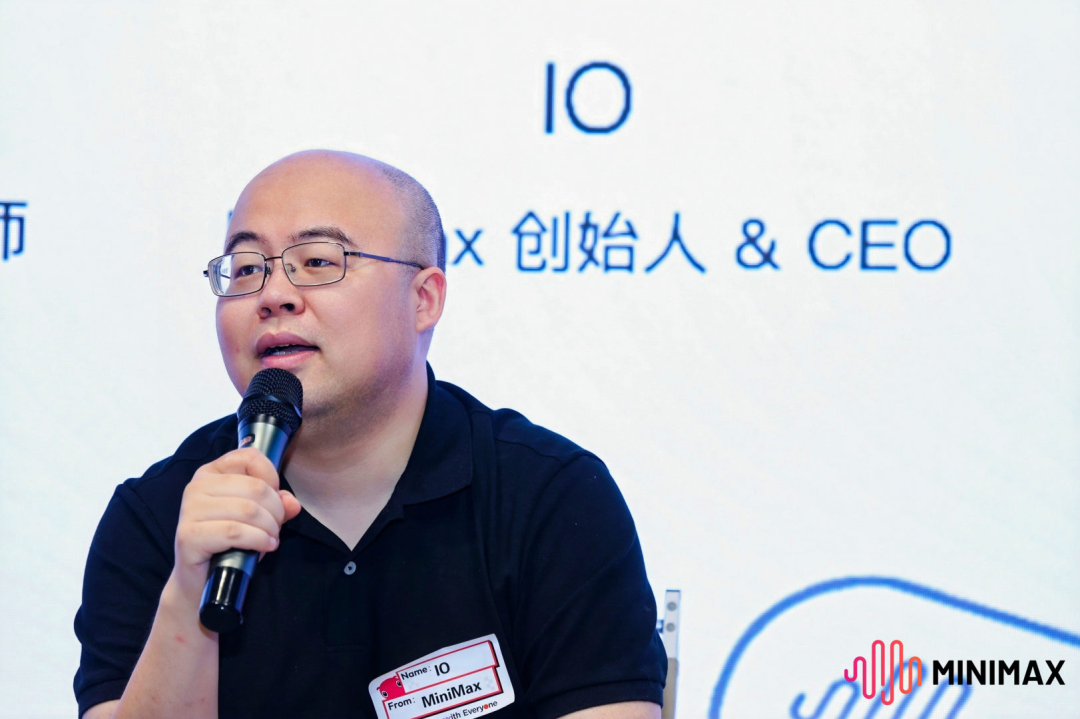
👨🏻💻 IO Junjie Yan
Looking back to this time last year, frankly, I couldn't have imagined what models would become today. Because last year we were still grinding away at M1 — there was no OpenClaw yet, and Claude Code had very few users.
By that logic, what next year will look like is genuinely hard to predict.
That's the magical thing about the AI industry: one year of experience is equivalent to several years of accumulation in other industries.
In this process, model progress and Harness progress aren't mutually exclusive — they advance together. For example, without Claude Code from the start, Anthropic's models might not have become so popular.
Conversely, if OpenAI hadn't developed underlying capabilities similar to GPT-5.5, a complex Agent engineering project like Codex wouldn't be able to function at all.
So these two have a mutually reinforcing relationship.
We can view both "models" and "Harness" as means to achieve higher intelligence. Even as models grow stronger, we should still assume that the ultimate purpose of intelligence is to serve humanity.
Under this premise, models and Harness are our two parallel approaches.
👦🏻 Koji
Indeed, that reminds me of computer scientist Alan Kay's famous quote: "The best way to predict the future is to invent it."
Just now IO mentioned that MiniMax's 10T parameter model must be successfully trained. In this process, where will the biggest bottleneck be?
👨🏻💻 IO Junjie Yan
Actually, there isn't any insurmountable physical bottleneck. The biggest bottleneck is time — the need for massive experience and experimental accumulation.
AI has now become a massive industry. Being an industry means there are no longer any technical chasms that are absolutely uncrossable.
The core challenge is the extremely tedious engineering experimentation and down-to-earth accumulation required to actually build it.
For example, we need to sit together with everyone here and analyze bit by bit what our models should optimize, what needs to get better. This is entirely a process of accumulation.
👦🏻 Koji
What specifically needs to be accumulated? Data, new algorithms, or other engineering elements?
👨🏻💻 IO Junjie Yan
When a model improves by one generation, the parameter count typically needs to increase by 3x or 5x.
As everyone knows, Scaling Law's extrapolation range is limited — at most a few times. If your model scale directly expands by 10x, you'll find that much of your previous extrapolation experience breaks down.
Once extrapolation fails, many experimental conclusions may no longer hold, and training models becomes like opening blind boxes. So this can only be done generation by generation.
Current US models are roughly 10x larger than domestic ones, meaning a two-generation gap. For every domestic company to catch up, they basically need two more generations of improvement: first, truly building out and solidifying a 3T model; then, based on the experience accumulated in phase one, tackling the 10T milestone.
In this process, every scale upgrade brings massive changes in training engineering, compute requirements, training efficiency, and network architecture.
For example, in this M3, compute has come down, but KV Cache is still relatively large. So in the next version, we'll further optimize and squeeze KV Cache for better inference performance.
Meanwhile, larger models require more massive parameter counts. Generally, the amount of high-quality data needed for training is roughly 20x the parameter count. A 10T model means 200T of data. But in reality, there isn't that much existing high-quality data in the world.
As models grow larger, they also become more prone to overfitting noise, meaning larger models demand higher data quality.
High data volume requirements, high quality demands, and simultaneously enormous extrapolation spans for experimental Scaling Law — this is an extraordinarily large systemic challenge, and we can only advance generation by generation.
But fortunately, we're very confident that over the past few months, we've been the ones progressing fastest.
Facing this highly systemic challenge, I'll be honest — I'm somewhat anxious, but I believe we can achieve it.
👦🏻 Koji
When you mentioned at the beginning that we're progressing fastest, the whole room burst into applause. I'm also curious: what's the benchmark for this "fast"? What are the measurement dimensions?
👨🏻💻 IO Junjie Yan
Compared to any domestic model's current intelligence level, regardless of what evaluation dimensions you use, the rate of improvement in our model's capabilities versus their performance three months ago, six months ago — is the highest.
The Vibe Coding Era: Deciding What Not to Do Is Often More Important
👦🏻 Koji
Next I'd like to ask Jiayuan and He Tao. When fully relying on AI to build a complex software project, how should we refine our approach to do software engineering practice better?
🧑🏻💻 Zhang Jiayuan
Let me share my thoughts first.
AI Coding has now been commodified — anyone can write code, have Agents implement things for them. But actually, "Vibe Coding" isn't historically new.
The first generation of Vibe Coding users were actually product managers — they've been doing this all along, except the object they drove and scheduled was programmers, with a relatively long feedback loop.
Now everyone can Vibe Code, which is equivalent to everyone becoming a product manager.
But from a product manager's perspective, what makes a product manager excellent has never been about how much they do, or whether they file enough requirements.
The more core criterion is: how they decide whether something should be done, and at this point in time, "what not to do" is even more important.
Because when you can do anything, the decision criteria for what you choose not to do become the most critical.
Additionally, software engineering has developed over decades with many classic theories. If there are any senior programmers here, you've probably read that 1000+ page book Code Complete.
Its core message is: in an organization or project where complexity scales up, how to avoid architectural失控 and mountain-of-shit code.
How to keep complex projects from becoming shit mountains — this is a problem people have studied for decades.
For example, in our current open-source projects DeerFlow and Multica, we have large numbers of Contributors submitting code every day.
Our approach: core maintainers firmly define the product Roadmap, taste, and clarity on what to do and what not to do.
Meanwhile, we use experiments and user data to measure every decision, and this global Context is something external Contributors generally lack.
So when maintaining open-source projects, we align this Context with external developers. That's some of our experience.
👨🏻💻 He Tao
Jiayuan shared that very well. Let me start with a hot take: Vibe Coding is absolutely not Vibe Engineering.
Writing code is a systematic engineering endeavor, not merely Coding itself. So I really don't want people saying "you're a code monkey" — you should take pride in being a "software engineer."
Engineering has never been defined as a one-time deliverable, but as a product that can be delivered long-term and sustain vitality.
Mainstream benchmark datasets like SWE-Bench or SWE-Bench Pro currently evaluate models on one-shot problem solving.
This easily leads to models becoming hell-bent on completing a single task at all costs. Like an overeager worker — you give them an assignment, they toil away for ages with mediocre results, and when you finally get the code, you realize it's completely unsuitable for any further development.
So there's still much work to be done on benchmarks in the coding space — for instance, defining an agent that understands long-term engineering and knows how to maintain a codebase over extended periods. This means truly injecting human taste for long-term project maintenance into the model.
On the flip side, this is also a demand on us humans. Today's models are incredibly seductive — they easily tempt you into treating them as an all-powerful magic wand.
The model makes a mistake, you tell it so, and it adjusts to your liking. You think it's gotten smarter, but often it's just finding clever ways to pander to you, even when your own reasoning might be flawed.
In this situation, we humans actually need to return to some classical, rigorous engineering baselines. Here I recommend the classic Clean Code — the best practices inside are already exhaustively summarized.
Projects have grown so large that we no longer have the bandwidth to manually review every line of code. But my own approach is to distill and integrate these best practices — like Google's and Amazon's — into the agent's context, harness, and engineering preferences.
Finally, I deeply despise one particular excuse: "This bug was submitted by the agent, so it's not my fault." Any code submitted under your account depletes your credibility and reflects your sense of responsibility and work ethic.
We need to treat AI coding as a rigorous engineering discipline, iterating continuously to get better.
Every technological explosion goes through this phase. When electricity first arrived, people thought it would solve everything — yet we still had a long road ahead.
We need to shift our mindset, exercise more patience, and treat AI as a new tool rather than a magic wand.
Only through this mental shift can we gradually root out these problems.
👦🏻 Koji
I'm also curious — how is AI coding currently viewed internally at MiniMax?
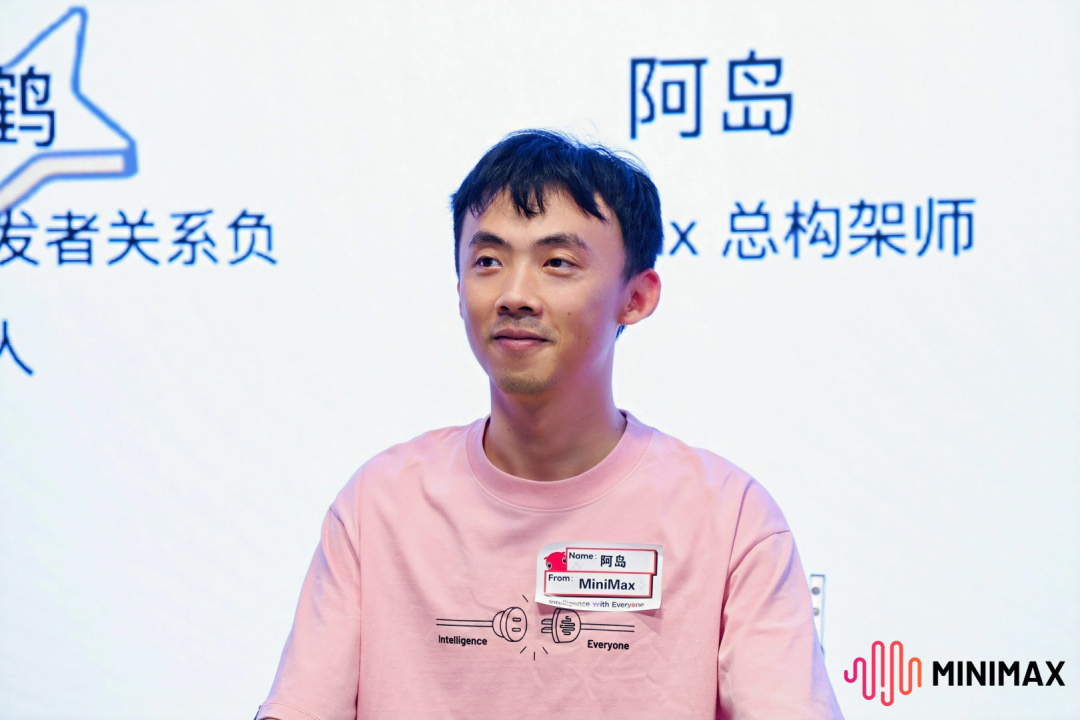
👨🏻💻 A Dao (MiniMax Chief Architect)
We're indeed facing the exact same problem of exponentially rising code complexity from Vibe Coding.
I recently shared at Alibaba — their systems are far larger and more complex, with hundreds of microservices, mostly transaction-oriented.
Their biggest pain point is that in the Vibe Coding era, what used to be one person modifying one code repository has become one person instantly altering a dozen-plus repos and submitting a massive MR.
The functionality gets implemented blazingly fast, but verification hasn't kept pace at all — leaving nobody daring to deploy this code, and the QA department on the verge of collapse.
When I first led teams, I had an extreme obsession with code cleanliness. Every line my team submitted had to pass my personal review. My requirement was that projects had to match my taste, with sufficiently clear structure. Back then, I could basically spot bugs at a glance.
But in today's Vibe Coding context, this kind of meticulous manual review is essentially absent. The productivity ceiling has been massively raised — whether in harness writing or model training, everything is accelerating full-throttle. Yet our capabilities in verification, delivery, and review, whether from models or harness systems, remain far behind.
My view is that once a project reaches a certain complexity, we should invest in verification and delivery with the same magnitude of R&D effort as we put into research and production itself. Otherwise, the project will inevitably spiral toward collapse and death.
Back at the Claude 4 stage last year, people probably felt projects became unmanageable at a few thousand lines of code. Now models can handle hundreds of thousands of lines, but they still eventually collapse — because context has its limits, and human engineering intuition is, to some extent, something machines struggle to replicate.
Our current post-training system is also being driven entirely through Vibe Coding. The workflow is: submit an issue, and it automatically executes in stages until completion — but we hit the same code失控 problems along the way.
We're also trying to address these, for instance by introducing E2E testing, benchmark validation, and other verification methods.
But the most important thing is establishing a set of principles for the project: clearly defining what's permissible and what violates the rules. And this must be implementable by the agent, because humans can't possibly review it all.
Why does Anthropic need nuclear physicists?
👦🏻 Koji
Earlier IO also mentioned something about data. We noticed MiniMax launched its "10x" initiative last month, inviting experts across industries to collaborate or even join full-time.
In IO's sharing just now, there was also a shift mentioned: around this time last year, MiniMax's understanding of training data might have been simply "data labeling," but now you're trying to find domain "expert big brothers" to lead the way.
Could you share how this philosophical shift came about?
👨🏻💻 IO Junjie Yan
AI's core is productivity. The model essentially provides tools — AI can make the thinking and verification process faster.
But what it ultimately confronts are still the most authentic business pain points within industries. These pain points can't be solved by models or algorithm researchers alone.
We deeply felt this when building our coding model. Algorithm researchers were responsible for constructing the model iteration framework, but when it came to fine-grained evaluation, engineering taxonomy, and constructing realistic development test environments — actual software engineers understood these far more thoroughly.
In coding, you only need two roles, with engineers handling only the most critical evaluation and cases. But in more domains, you need collaboration among three roles: algorithm developers, engineers, and truly senior "experts" from that industry. Since the cooperation between the first two roles has already proven itself in coding, the logic now is to naturally add the third role.
This logic of mine is also confirmed by top-tier teams abroad. For instance, we've studied Anthropic's hiring — beyond researchers and engineers, they've recruited large numbers of economists, psychologists, and even nuclear physicists.
Why nuclear physicists? Because when doing model jailbreak testing and alignment, they need professionals to test whether methods provided by the model could genuinely be used to build nuclear weapons.
Six months ago we might not have fully understood why they'd hire people with these backgrounds, but our understanding is now profound. We genuinely need these experts sitting in the same room as our researchers.
Our "10x" initiative is actively engaging with these outstanding vertical-domain experts, and many friends here have already participated.
Going forward, we plan to make heavier R&D investments in deeply vertical domains like cybersecurity, finance, and law — with much greater depth than our current efforts.
Second Half of 2026: What to All In On?
👦🏻 Koji
One last question — actually what I most wanted to ask was for each of you to recommend a stock, but I figure that's probably not happening, haha.
So a compromise question: in the remaining half of 2026, what's something you each most want to all in on?
👨🏻💻 Yu Yang
No stock recommendations. Actually I want to mention two things.
In the era of AI and large models, in vertical application scenarios, what is something that AI absolutely cannot replace?
I think one thing is "companionship."
In this new era, the vast majority of people actually have strong needs for companionship and emotional value. This is actually a domain where large models can deliver tremendous value.
It's the same in our finance world — investing always has its winning moments, but losing is more common, even far more common. In these extremely fragile moments, the value of companionship is irreplaceable.
Second, regarding our internal financial落地 scenarios. Our initial agent mindset was to try every means to "restrict" the model's发挥, preventing it from making strange or out-of-bounds decisions.
But now, as agent technology rapidly iterates, our recent strategy is exploring how to actively "lead" the model. Enabling the model to develop autonomous thinking capabilities, letting it help us reconstruct work in more creative domains.
👦🏻 Koji
He Tao, what do you want to all in on for the second half?
👨🏻💻 He Tao
IO and A Dao have already revealed enough directions, so I think the stock hints are obvious to everyone.
I personally write a column called "How AI Shapes Our Society."
I recently had an extremely visceral realization: current AI is making many people more internally drained and anxious.
I can clearly feel that in 2026, domestic models — whether MiniMax's M series or国产大作 like DeepSeek — have crossed some critical奇点, gaining the genuine ability to enter ordinary people's homes.
MiniMax's recent multimodal updates are like giving the model eyes, opening up vastly more possibilities.
Let me share a personal story: my wife went through a period of intense anxiety and hair loss recently, and she visited a TCM doctor. During this time she consulted a certain domestic chatbot with the highest DAU, chatting extensively. While it seemed to relieve her anxiety at the time, following its调理 methods actually made her hair loss worse.
This caused her extreme anxiety, and she started blaming me, saying our industry harms people and itself, and had even harmed family members.
To prove myself, I built a personal LLM Wiki for her. I imported all her体检报告 from over the years, medical records, tests she'd taken, medications she'd used — even her chat history with that previous chatbot.
Then I directly connected Codex to her Lark, telling her: "Stop using that chatbot from now on, use what I built for you. Trust your husband."
I guided her: "You can ask it what questions you should bring to your TCM doctor next visit, and what the doctor might ask you." She followed this approach, and her subsequent communication with the doctor became vastly smoother.
So my take is this: ordinary people absolutely have the opportunity to use AI to make things better for their families, the people around them, and so much more. It's not about using Vibe Coding to replace some job category — it's about letting good ideas flourish, making the people around you feel warmth, discovering the warmth of human society within cold software engineering.
🧑🏻💻 Zhang Jiayuan
I only invest in myself and my own company, so no stock picks here.
If there's one thing I want to go deep on in the second half of the year, I'm a firm believer in the "AI Arrivalist" camp. After years of deep collaboration with AI, I've become increasingly convinced that AI's future intellectual capabilities will completely surpass human intelligence.
Based on this prediction, if you extrapolate outward, pretty much everyone will face the same situation sooner or later: you may no longer be competing against your own kind, but against Agents. And when it comes to knowledge and intelligence, humans will be utterly unable to compete with AI in the future.
When this technological inflection point arrives, what should society look like? That's something very much worth thinking about.
The other thing is, humans are naturally cognitively lazy. As AI gets stronger and stronger, the phenomenon of completely handing things over to AI, outsourcing your thinking to AI, will become extremely common.
My current approach: I explore together with AI, but I insist on keeping thinking — the most important part — for myself.
👦🏻 Koji
Finally, let's have IO close us out. Are you also an "AI Arrivalist"?
👨🏻💻 IO Junjie Yan
AI as it exists today is still fundamentally a "black box."
Even for those of us in the industry, it's genuinely difficult to predict where it'll evolve in a year or two. We only know that it will keep advancing at a furious pace.
To be honest, sometimes I don't fully understand why Scaling Law exists at all — it's probably become difficult for humans alone to comprehend.
Back when I was doing my PhD ten years ago, I read relevant academic papers with a basic conclusion: when the depth of an artificial neural network exceeds three layers, our current mathematical tools are already unable to analyze its convergence.
Yet this hasn't prevented the industry from progressing to where it is today.
If there's one thing I care about most and most want to spend time exploring, it's a very fundamental bottom-level question: when will we be able to get AI to help humans understand AI itself?
Only then can questions like the safety boundaries of AI, and how far AI can ultimately go, truly find their answers.
👦🏻 Koji
Are you seeing any signals in this direction?
👨🏻💻 IO Junjie Yan
Yes. For example, a lot of recent life science research has found strong correlations between the brain and neural networks.
While the brain's structure doesn't perform matrix multiplication, certain brain region modules operate in ways conceptually similar to matrices; and some mechanisms within the brain can be equivalently mapped to gradient-based backpropagation; the hippocampus in the brain also resembles DeepSeek's memory design quite a bit.
A year ago, we may not have fully grasped the importance of safety. Now, we may not fully grasp the importance of interpretability, but I'm increasingly aware of how crucial it is.
I believe that the interpretability of AI itself will ultimately have to be uncovered by AI helping human hands do the revealing.

Audience Q&A
👦🏻 Audience Member
I work in fintech and also use AI coding myself.
Everyone's noticed that M3's chain of thought is quite long. Will future versions consider adding parameterized configuration for something like "thinking dimensions"? Because many other large models offer this kind of parameter.
Also, although Non-Thinking mode is currently supported, in my actual testing I've found that even with thinking turned off, the token savings and overall time reduction are still relatively limited.
M3's own analysis concluded that even with thinking disabled, it may still embed its thought process directly into the response, resulting in no significant change to overall latency or token count. I'd like to ask what improvements are planned for these two aspects?
🧑🏻💻 Lin Yu (MiniMax Large Model Post-Training Engineer)
The feedback on M3 that we've heard most often is about the lengthy thinking process. We'll make targeted optimizations in the next version.
In the short term we won't be offering thinking level configuration. But in the next version, overall thinking planning and thinking efficiency should see significant improvement.
👨🏻💻 IO Junjie Yan
Regarding the lengthy thinking issue, we've done attribution analysis — there are mainly two causes.
First, inference speed. When M3 first launched it was indeed quite slow, with TPS around 20. Current TPS has improved to 70, with time-to-first-token around 2 seconds.
Next week we should optimize to TPS 80. Among mainstream domestic models for daily use, this is very fast. At the same time, we expect to reduce time-to-first-token from the current 2+ seconds domestically and 3 seconds overseas, down to just over 1 second — this will be top-tier domestically.
Second, thinking length. We've analyzed online trajectories and internal evaluations, and actually M3's thinking length doesn't exceed Opus. The core reason users feel it's slow is still the relatively slow inference speed at launch.
For thinking compute budget, in the next version we'll significantly compress invalid thinking trajectories.

As for finer-grained tiers, we don't think there's much need currently. Most user scenarios are clear-cut: either choose non-thinking for maximum speed, or enable Thinking to approach top-tier overseas model capabilities. We want to focus first on optimizing these two modes to the extreme.
Additionally, Non-Thinking mode still has substantial room for improvement. Even for overseas large models, performance on complex tasks like tool calling degrades in non-thinking mode.
One of our explicit optimization targets for the next version is to get no-thinking mode to perform at the expected level in tool calling and similar scenarios.
👦🏻 Audience Member
Our company mainly does AI application in the aerospace sector. Our product's primary base model is currently M2.7, because M3 was just open-sourced and we haven't had time to deploy it in production yet.
But as an R&D engineer, for my daily development work and some construction projects, I personally use Claude Code paired with M3.
Let me first share my experience with M3. First, I can clearly feel stronger instruction-following and task-completion capabilities. Within 1M context length, it better achieves instruction following in multi-turn dialogue. For example, when I write in Claude.md asking it to develop in a worktree, it captures this very precisely — much better than 2.7.
My first question is, what specific optimizations did we make in instruction following? Was this on the engineering side or the training side?
My second question is, M3 feels quite different from 2.7. For instance, in actual AI coding, sometimes you only need to change one or two lines of code, but it spends a long time writing test code and running test cases — the whole execution takes three or four hours, and in the end it only changed one line of code. (Audience laughs)
For this kind of situation, what are some good usage recommendations?
My final question is about future model plans. Because our clients include some national research institutions, they mainly need private deployment. Given clients' relatively limited compute, will there be smaller-sized models released in the future?
👨🏻💻 A Dao
Why does M3 spend so long thinking even when facing simple problems?
When we trained M3, we placed very heavy emphasis on long-horizon and complex tasks, so we focused our optimization there. But when we later reviewed the distribution of our training data, we found we'd paid relatively less attention to simple problems.
This led to M3 performing exceptionally well on complex tasks, but appearing to overthink on simple ones.
As you all know, traditional SWE might only change a dozen or so lines, and even SWE-Pro might only be around 100 lines. So everyone finds it performs very well on complex tasks.
Regarding chain-of-thought effectiveness, we'll further optimize through reinforcement learning methods in version 3.1. For version 3.0, we did want to get it out to everyone as soon as possible, and some details still had room for improvement.
On specific usage recommendations, I've had some interesting exchanges with overseas developers.
Because M3's instruction-following capability is so strong, some developers put in their system prompt: "You are an efficient thinker, please do not think in loops; for simple problems, please answer quickly." — adding these constraints significantly reduced the lengthy thinking phenomenon.
Additionally, M3 is a 400B-level model, and to make it perform better on long-horizon tasks, it naturally extends inference time for more thinking. This issue will continue to improve in subsequent versions, and will be handled more comprehensively in our new models.
🧑🏻💻 Lin Yu
Let me add a bit more about instruction following.
In previous versions, sometimes insufficient instruction following led to task completion not meeting expectations. In this version, we specifically built a more powerful reward system.
It can give explicit rejection and judgment for various unexpected behaviors. During reinforcement learning training, we used this system to clean out bad thinking trajectories, leading to significant model capability improvement.

👨🏻💻 IO Junjie Yan
Regarding the "spent three hours only to change one line of code" situation — this indeed shouldn't be how a model behaves. But this happens not just in AI coding, also in Agent usage.
The core reason behind this is that we need to apply more process supervision to the model's thinking trajectories. Currently this kind of situation is a low-probability event, and performance is normal most of the time.
These low-probability "freezes" or loops are mainly due to insufficient coverage in reinforcement learning and alignment data. As this version's data flywheel spins up, the next release will see major improvements in both data coverage and diversity.
On the topic of on-premise deployment — we very much welcome it. M3 is already adapted for domestic chips, such as Huawei's 990. If you have relevant needs, feel free to email us directly.
👦🏻 Audience Member
I'm from the financial industry. I have two questions:
First, regarding multimodality. The market currently seems to favor the Coding Plan, because stronger coding capabilities tend to drive higher API call volumes and give companies better API pricing power.
Going forward, will MiniMax treat coding capability as a primary improvement path, or will it continue to prioritize multimodal content generation as its main research direction? If you persist with multimodality, is the goal to capture future markets like e-commerce advertising?
My second question is for IO. Given bottlenecks in chips and compute, if MiniMax wants to match Opus-level capabilities, will it focus more on optimizing the overall algorithm architecture, or will it explore new paradigms beyond the Transformer architecture? Is the company currently researching in this direction?
👨🏻💻 IO Junjie Yan
On multimodality — this is a point where we differ significantly from most domestic model companies. Many peers are currently going all-in on the coding route, while we're one of the few companies investing heavily in both coding and content generation.
We believe the core value of AGI lies in improving societal productivity. And of the work white-collar workers do at their computers, beyond information exchange, it mainly comes down to two things: engineering creation centered on coding, and creative expression centered on content generation.
Therefore, content generation spanning voice, images, and video is equally important to us.
Content generation is essentially also a language model. Our core logic isn't to simply do DiT in isolation, but to treat DiT as a decoder and have the language model drive the generation process.
This gives the model better understanding of the physical world, higher generation quality, and stronger instruction-following capabilities. Hailuo AI will also be receiving a series of updates soon.
As for chip and compute constraints. Objectively speaking, chip export controls are indeed a challenge, but they've also enabled the birth of startups like MiniMax. When money can no longer be directly converted into unlimited compute, the core of AI R&D competition shifts from "capital" to "talent and algorithms."
This insulates startups from being crushed by big tech's capital and resources, putting us on a relatively level playing field.
Moreover, because AI is productivity, not traffic logic — people will simply use the most suitable productivity model — so the core is compute, talent, and model capability, not traffic and funding.
👦🏻 Audience Member
I'm a stock analyst and a heavy MiniMax user.
I frequently encountered a pain point before. When using M2.5, the knowledge engine underlying my Lark group assistant was 2.5, and when calling certain Skills, the model often couldn't accurately judge my intent — it didn't know when to invoke tools, causing tasks to fail repeatedly.
But after switching to M3, this improved dramatically. At least now it can precisely route every one of my prompts.
Besides stock analysis, I also do some Vibe Coding, trying to train my own stock-picking Agent on M3. But in backtesting I ran into two very practical problems:
First, the data in backtesting is too short. Because the model has already memorized all historical knowledge up to the cutoff date during training, it's hard to tell whether it picked a certain stock because my investment strategy actually works, or because it's exploiting known historical outcomes.
Second, the model's inherent "worldview" inevitably leads it to offer investment advice or suggestions. Using a natural-language-logic model to predict stock data with extremely high temporal precision sometimes yields subpar results.
Any good suggestions or solutions for these two problems? Also, will MiniMax launch vertical products for stock-picking or quantitative strategies in the future?
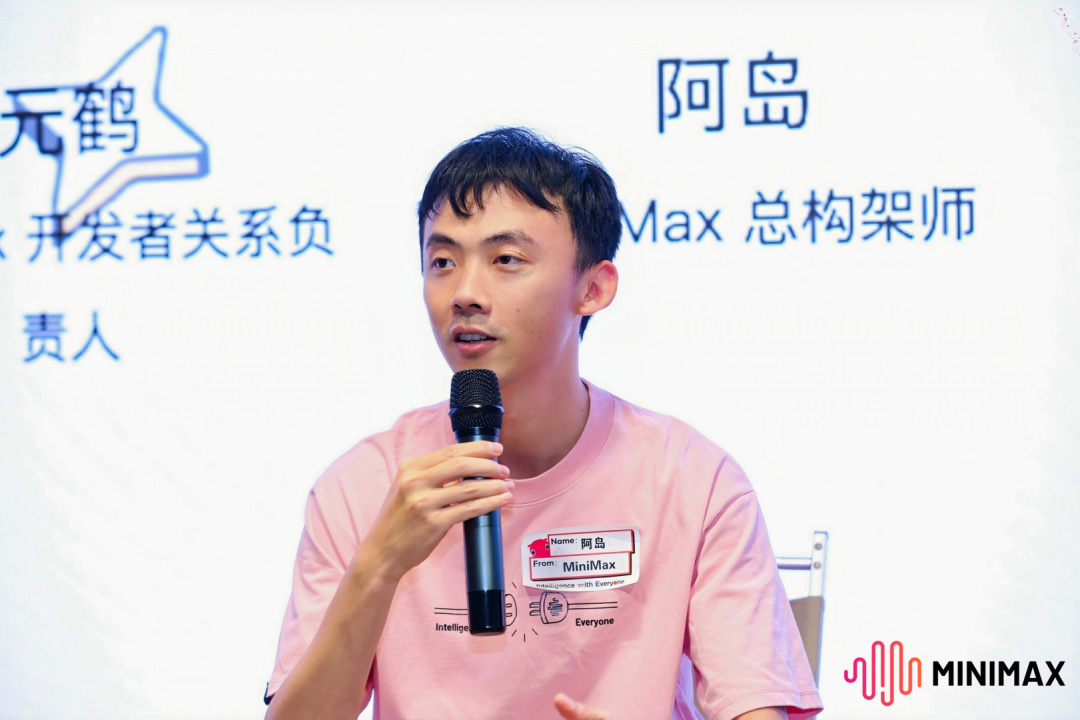
👨🏻💻 A Dao
To be honest, I haven't personally used Agents for secondary market investing — I'm better at betting on a company every few years and earning options with my own skin in the game.
For the two practical issues you raised, my recommendation is that when building an Agent, you must establish strong constraints rather than letting it generate answers based on its internal knowledge.
Every industry has its own SOPs and methodologies. You can turn this methodology into a model Skill or enforce multi-step constraints through Agent mechanisms: require the model to provide evidence for every action it takes, and have that evidence verifiable by external code or tools. This effectively combats model hallucination.
For example, if you ask it "what stocks should I invest in recently," without constraints it might just list stocks it remembers like NVIDIA, but it doesn't actually have access to yesterday's market movements or even the latest SK Hynix data.
If you require it to: "You must follow this analytical framework, first search for the latest data, then perform multi-dimensional verification of the search results." This way it provides reusable reasoning capability and methodology, rather than simply "reciting" historical knowledge.
Regarding product plans, our "10x" project is currently exploring the financial vertical in depth, and we're working with top-tier industry talent on specialized vertical projects. We're very confident in M3's performance in the financial domain.
And our "10x" project will go deep into every industry. Half-jokingly, I sometimes feel like we might be "carbon traitors" — carbon-based lifeforms secretly working for the silicon-based side.
However, we most likely won't build C-end products like stock recommendations ourselves. This involves not just compliance issues, but also the fact that investing is something that requires extreme caution.
👨🏻💻 IO Junjie Yan
Let me add something. Our commitment to multimodality stems from our belief that it's an indispensable part of productivity.
Current model productivity is still in the assistance stage — helping write code, gather information, draft analysis reports. But this is clearly not the limit of intelligence.
The endgame of intelligence is delivering end-to-end results. In cybersecurity, for instance, the model directly discovers system vulnerabilities and fixes them; in finance, the model makes decisions that genuinely create value.
We're currently in a transition window: moving from "only capable of auxiliary work" to "able to deliver end-to-end value."
To make this leap, on one hand we need 10T-scale ultra-large models to provide the technical foundation. We're working in deep collaboration with the industry's top experts to solve the most challenging problems in each industry and bring real change — this is something we strongly believe in, so we're confident we can achieve 10T-scale models.
On the other hand, last year our understanding of data was about hiring people to label data; this year our understanding of data is about finding the top players in each industry to guide us and truly solve the most important problems in that industry. This represents a major shift in our thinking this year.
👦🏻 Audience Member
I'm a green power and compute analyst.
MiniMax's vision is "Intelligence with Everyone." When facing overseas users who are highly sensitive to both cost and accessibility, how do we balance the democratization of productivity with high energy consumption? Do we lean more toward technical approaches to "reduce consumption" (such as sparse attention constraints, adversarial noise training, etc.), or do we prefer to "increase supply" by using more domestic green power compute resources?
👨🏻💻 IO Junjie Yan
The goal for our next-generation larger model is to let people use Opus-level intelligence with essentially no cost constraints.
There was once an engineer who consumed $300,000 worth of tokens in a month using AI models — a cost that ordinary businesses simply can't sustain. Through optimization, we hope to bring the cost of Opus-level capability down to the "low thousands of dollars per month" range within the coming months, so that SMEs can use it freely within their companies, thereby achieving true democratization of top-tier intelligence.
Currently, only a few million people worldwide have actually used Opus-level large models, while there are nearly a billion white-collar workers globally — a massive gap.
As for compute and energy costs, in the short term domestic compute does face challenges, but if we extend the timeline to three to five years, these physical constraints and costs won't be the main issues.
The core remains pushing technical evolution to maximize model efficiency.