Why Did Yahui Zhou Spend His Time "Writing Songs"? | Hands-on with Mureka V8

How is Mureka V8 to use?
**
What's it like using Mureka V8?

👦🏻 Author: Jingshan
🥷 Editor: Koji
🧑🎨 Layout: NCon

At the end of 2025, one piece of news in the AI music space was pretty explosive: Suno's ARR shot up to $200 million.
At the start of 2026, just a few days ago, there was another major announcement: American music legend Liza Minnelli, a living icon, released her first new music in 13 years. The single, titled Kids Wait Till You Hear This, was created in collaboration with AI voice company ElevenLabs — the arrangement and production were all done with AI.

These two events actually point to the same trend: on one side, AI music companies are starting to make money; on the other, real musicians are starting to use AI to create works.
This gives many people an answer to that "classic question":
What kind of AI product can actually close the loop on business and experience first? It's the product that happens to sit at the intersection of "good enough technology" and "demand that has always existed." AI music might just be that thing.
More critically, over the past two years, AI music has rapidly evolved from an experimental technology into an industry with a clear commercial path. Not only are AI-native music products like Suno and BandLab profitable, but the entire sector is accelerating commercialization.
This is happening faster than most people expected.
Yesterday, Kunlun Tech officially released Mureka V8. This update isn't just about model capability improvements — there are other signals around the product that came out together.
Next, we'll combine hands-on experience with Mureka V8 to talk about what specific changes it brings, and where AI music is heading behind these changes.
What is AI actually doing when it makes music?
The problem with AI music these past two years isn't that it can't produce anything — it's that what it produces sits in an awkward spot. Say it's bad? It does sound like music. The melody's there, the rhythm's there, the arrangement works.
But say it's good? A lot of the time, it's genuinely unusable.
This "unusability" is subtle. It's not that the pitch is off or the rhythm unstable — the technical metrics might all check out. But when you listen to the whole thing, you feel something's missing. The melody is right, but you realize it's not going anywhere, just circling the same spot. The arrangement is there — drums, bass, guitar all present — but it sounds scattered, the emotion doesn't build.
The vocals are even more obvious: they're singing, but it never feels like singing a song, more like reciting lyrics.
That's why a lot of AI-generated music always sounds slightly off — because it's hard to hold together as a complete piece.
Mureka V8's breakthrough is right here at the core. It introduces a Chain-of-Thought (CoT) mechanism for music, letting the model understand the overall structure of a song before generating audio.
How to divide verse and chorus, how to push the harmony forward, how to shape the emotion. Like a musician who, when creating, first thinks through what the song wants to express and how to structure it, then gets to work.
The most intuitive demonstration is that Kunlun's Skyworks released an official girl group M:RA's song and MV made with Mureka V8: MCE (Main Character Energy).
The song is already available on domestic music platforms — you can search for M:RA "MCE" to listen.
QQ Music link:
https://c6.y.qq.com/base/fcgi-bin/u?__=UNKlapy0Iy3C
Inside Mureka, there are two ways to generate AI music, both quick to pick up.
The simplest is called "Easy Mode" — just describe what kind of song you want in natural language, like "an upbeat summer pop song," and the system generates it automatically. Slightly more complex is "Custom Mode," which isn't actually that hard either.
You just need to input lyrics, select a style, and choose a vocal gender.
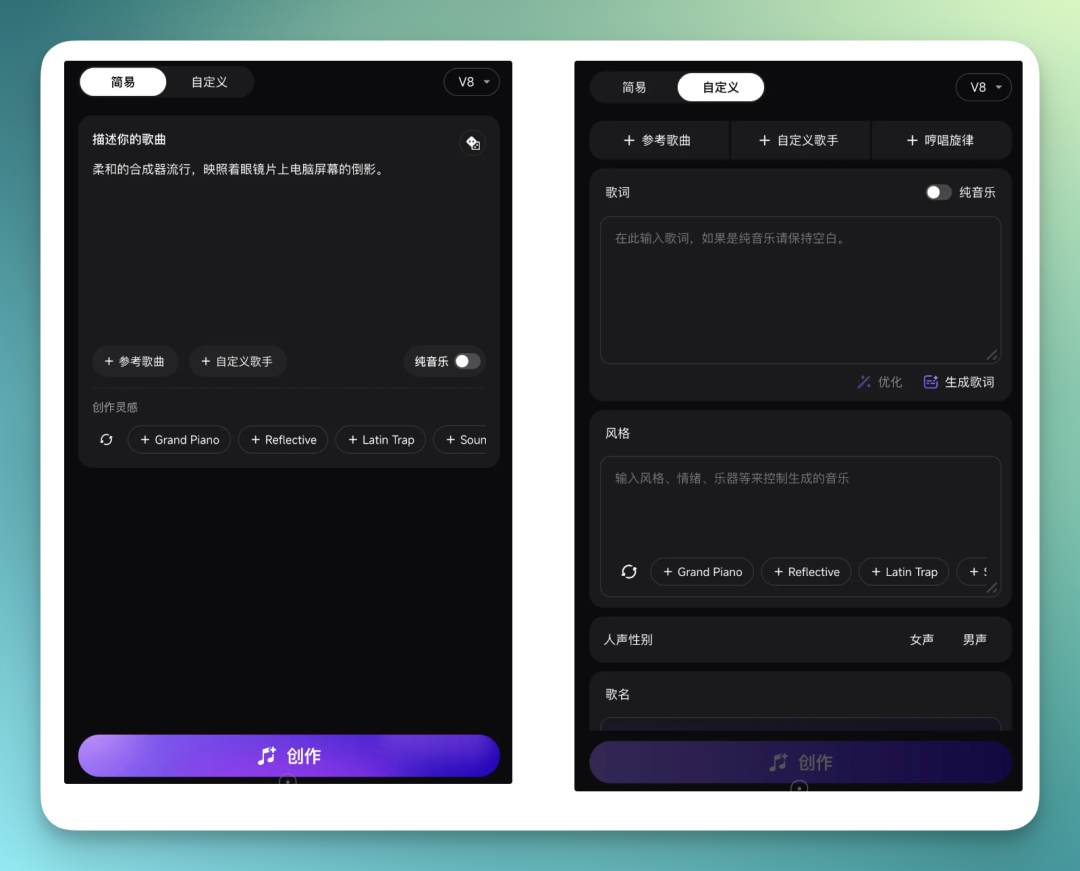
The lyrics section can be AI-generated directly, which is quite practical.
For example, when I asked it to generate a "Chinese ancient-style hip-hop" track, it automatically wrote complete lyrics with verses and choruses properly divided — the structure was very complete.
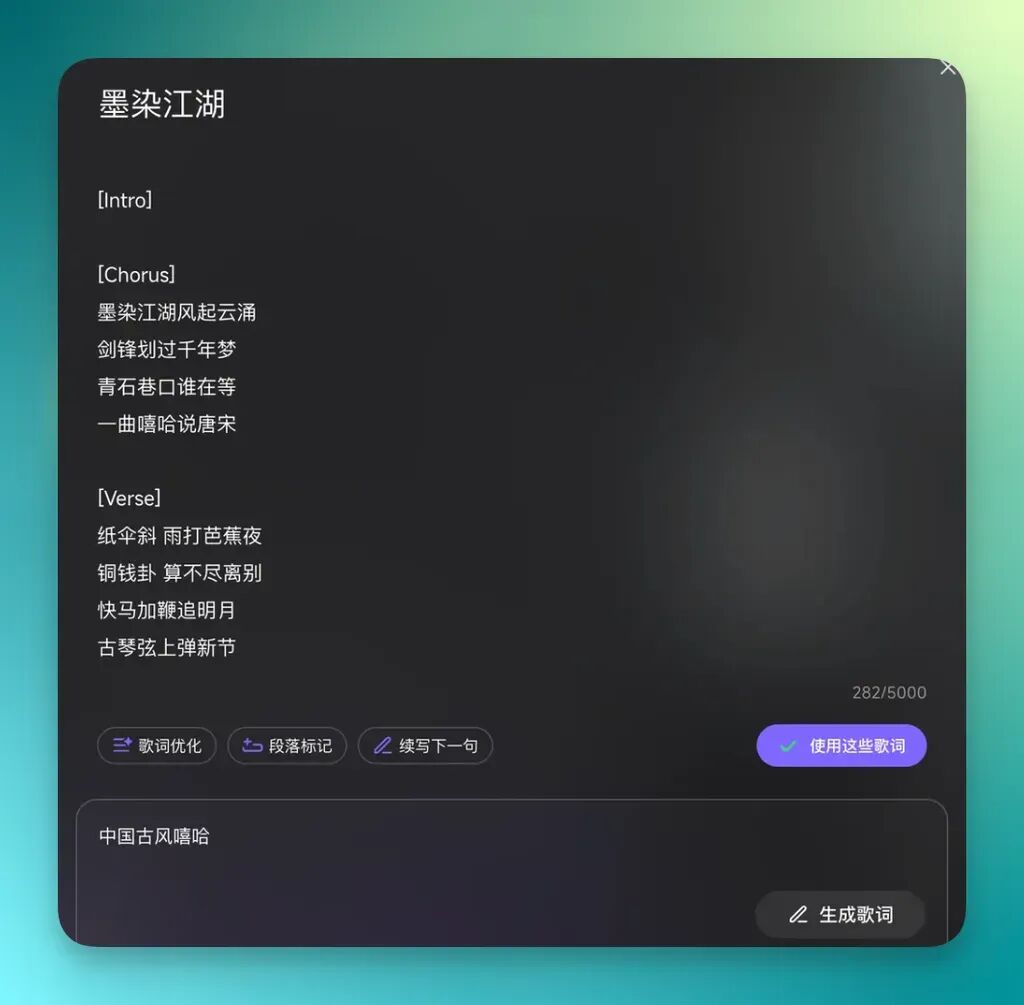
If certain rhymes feel off or you want to adjust the expression, you can ask it to optimize directly.
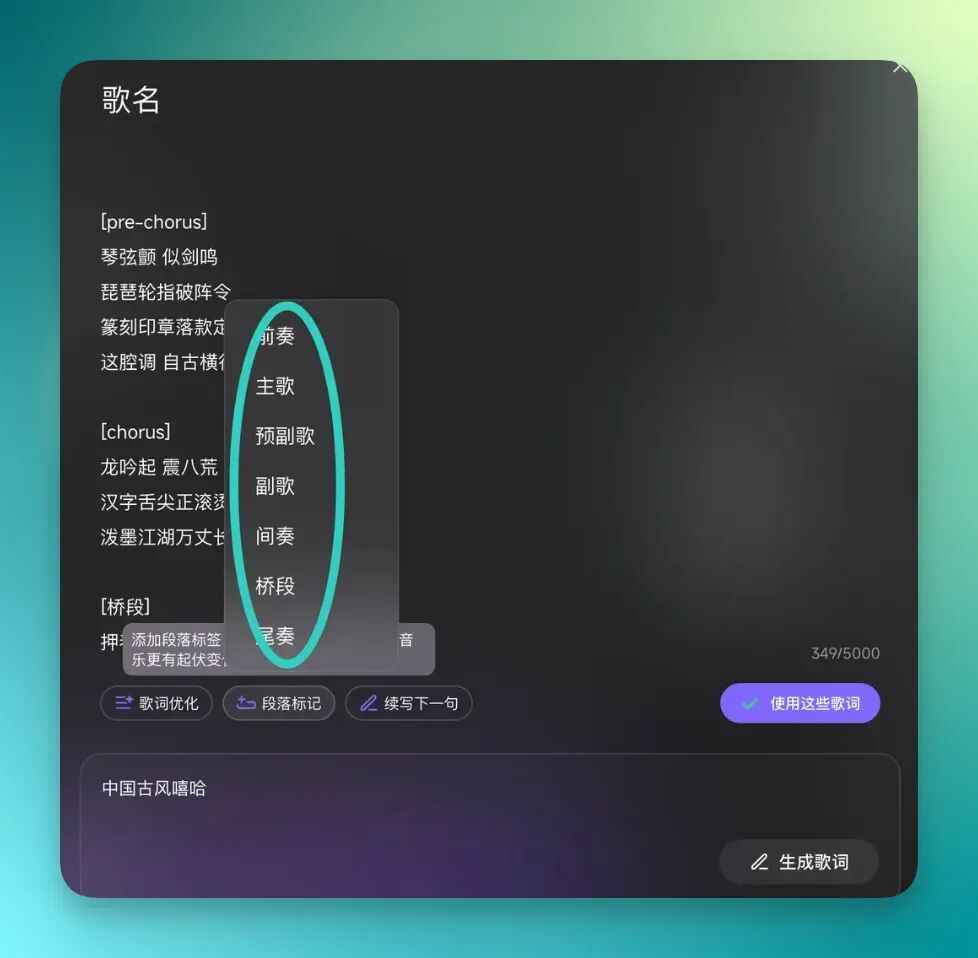
Every character can be edited, every section can be tagged — intro, verse, pre-chorus, bridge — and after labeling, you can keep having the AI adjust things.
I tried it myself and crafted a hybrid of modern R&B and Chinese-style hip-hop.
The arrangement experiments with something interesting: drums using modern hip-hop/R&B syncopated rhythms with strong groove, while the lyrics draw heavily on traditional Chinese cultural imagery — jianghu (the martial world), dragon's roar — creating vivid imagery.
Have a listen:
Listen closely and you'll notice lots of vocal runs, very smooth, flowing delivery — classic R&B handling.
The vocal details are well-executed: loose where it should be loose, controlled where it needs restraint.
In the background you can hear guzheng or pipa plucking — this East-West collision is quite interesting, and pretty much essential for contemporary Chinese-style hip-hop.
Overall, the sound is clear, the timbre has that commercial demo quality, and the song structure is very polished.
Here's a very practical feature. The generated audio can be downloaded directly, and not just as a finished MP3. It also provides stem tracks, lossless WAV format, and even ownership certificates — all quite friendly for post-production.
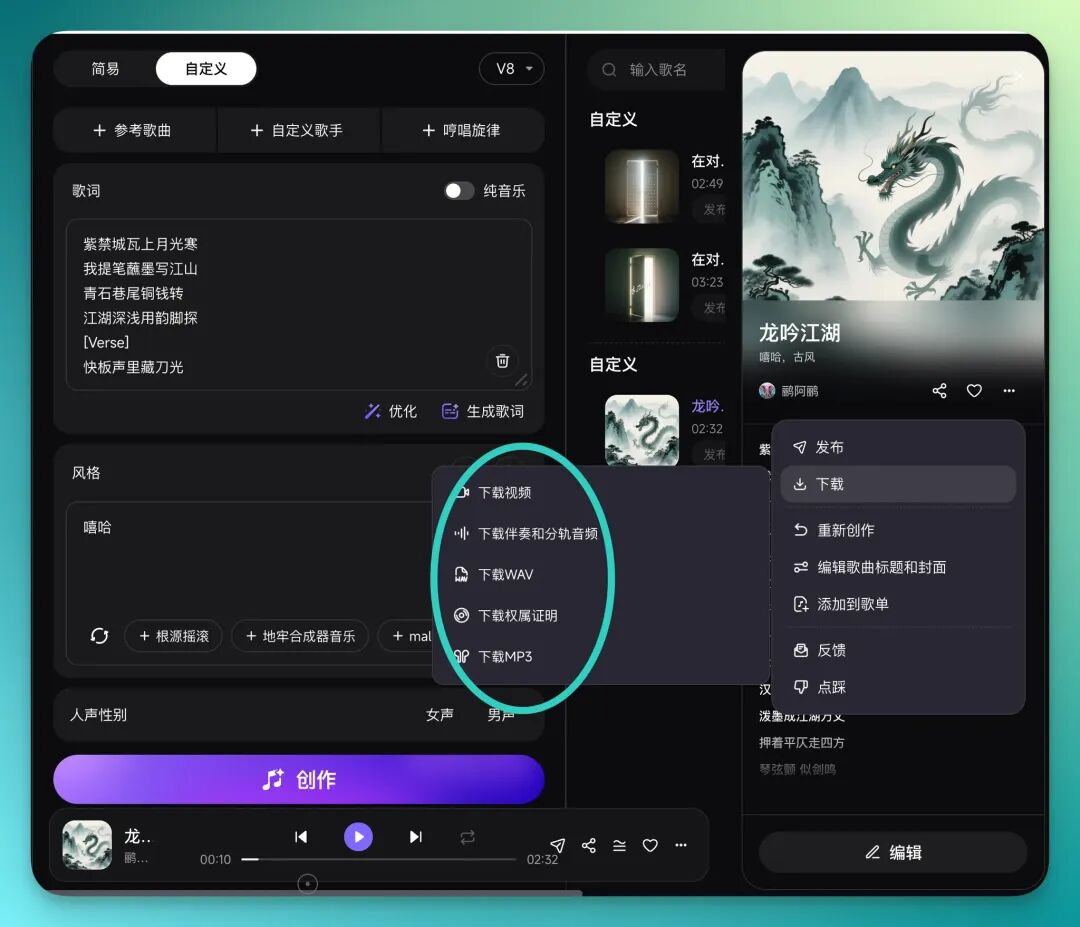
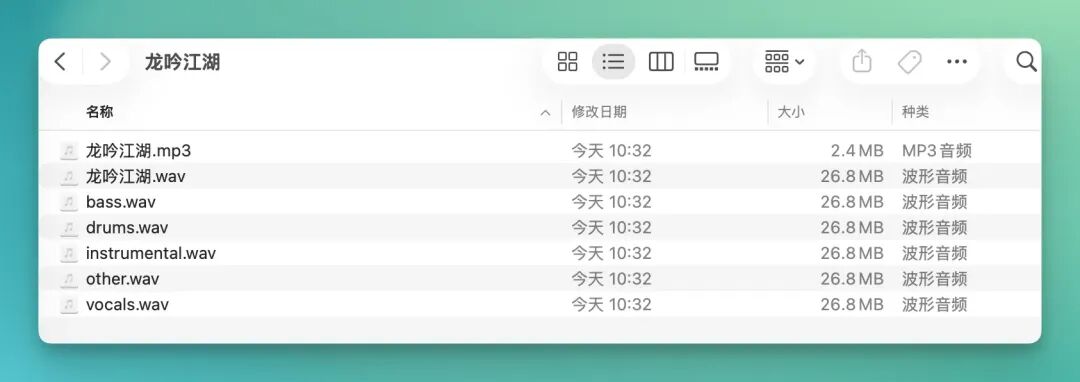
For example, when you download the instrumental and stem tracks, it gives you a zip file containing all the stems: isolated vocals, all drums and percussion, low-end and bass, and instrumental without vocals.
These tracks can all be dragged directly into your DAW and auto-align — no manual timeline adjustment needed.
If you feel the vocals are too prominent, you can later pull the vocal stem down a bit — quite flexible:
Mureka also supports subsequent editing of generated songs, though honestly the editing features aren't particularly rich. If you're not satisfied with a certain section, you can make localized modifications without regenerating the entire song:
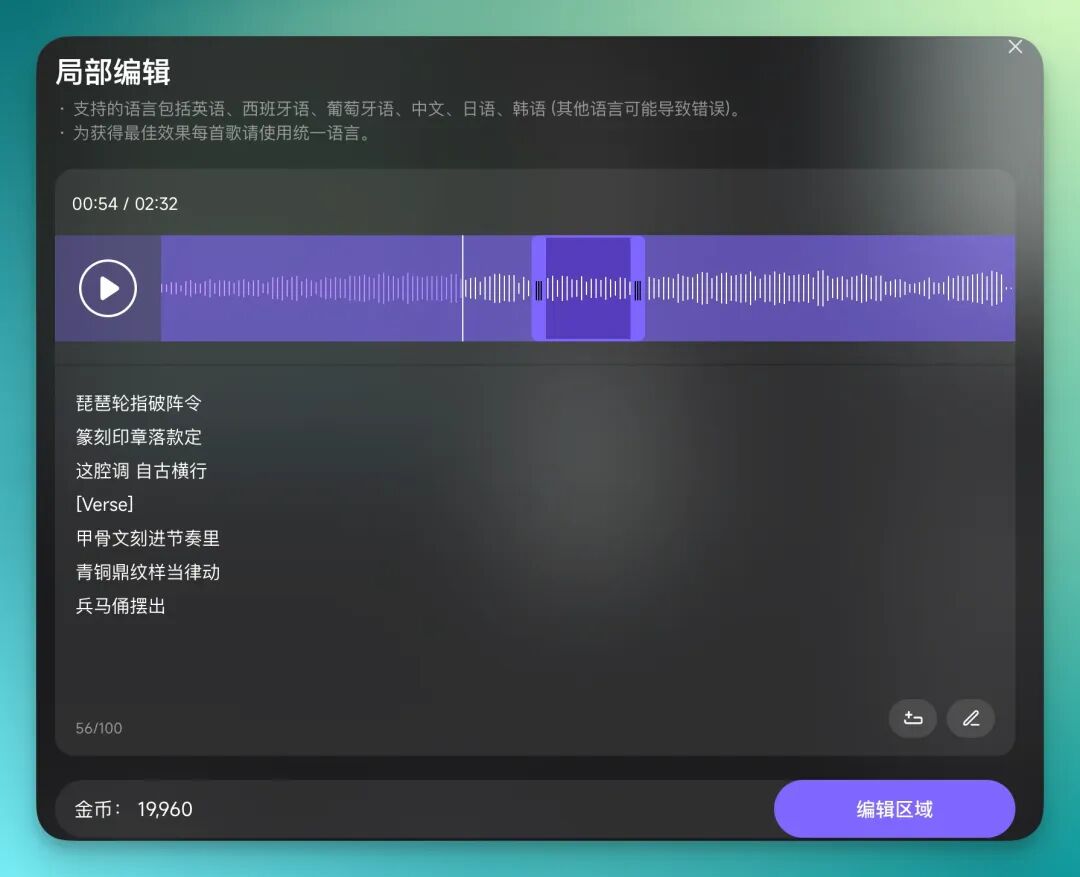
As we mentioned at the beginning with American legend Liza Minnelli, she has a classic Broadway-style song New York, New York (1977), and that song's emotion has always been a personal favorite of mine.

Mureka has a feature: it supports uploading audio files or directly pasting YouTube links as style references.
You can have Mureka learn the stylistic elements from reference music, then generate a new song.
I uploaded New York, New York to the platform, and it automatically recognized the song title and audio information, extracting the stylistic features. Then you just need to select the specific genre and mood you want:
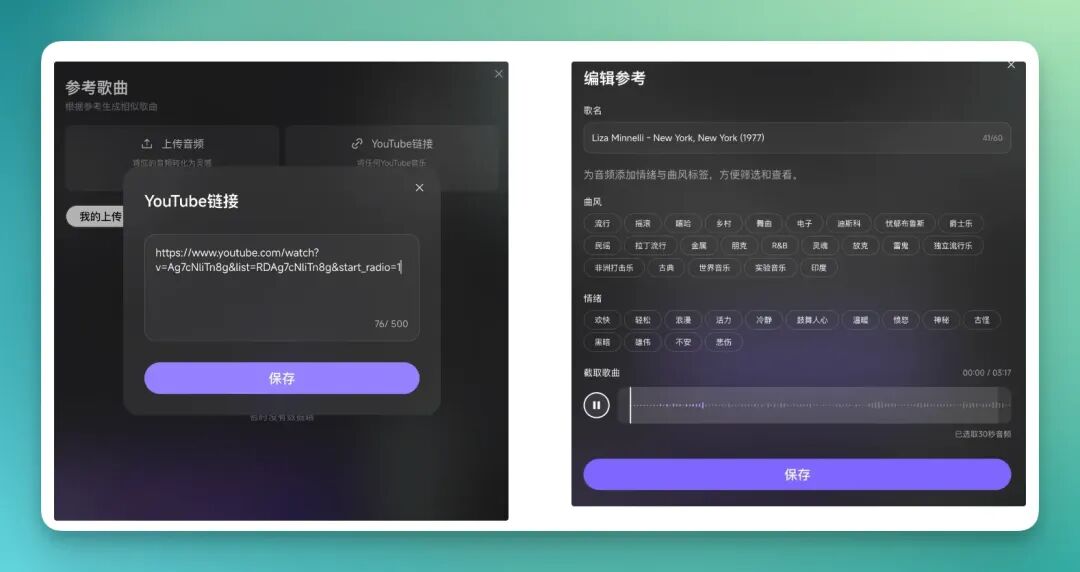
Because many classic elements in Minnelli's songs are "urban versions of country characters," people often reference Minnelli's stylistic elements when making songs.
I also tried going the warm, nostalgic, relaxed route, and ended up generating a song called Hometown in the Rice Fragrance.
This song transforms the genre — not that Broadway feeling. It uses a classic R&B foundation, fused with Neo-Soul guitar.
Listening to it, the drums hit steady and laid-back. And the harmony uses lots of seventh chords — these chords sound rich, warm, with a lazy feel.
Have a listen together:
Listen closely and you'll discover many interesting details. For instance, the guitar strumming throughout is quite well done, very funky. The interlude even has a guitar solo that, on closer inspection, carries some blues string-bending.
In terms of delivery, there's lots of improvisational humming and ornamentation — this really does have that Minnelli flavor.
You could say this is already a complete nostalgic R&B work.
From technical benchmarks, Mureka V8 performs quite well in vocal expressiveness, melodic quality, and arrangement/structure:
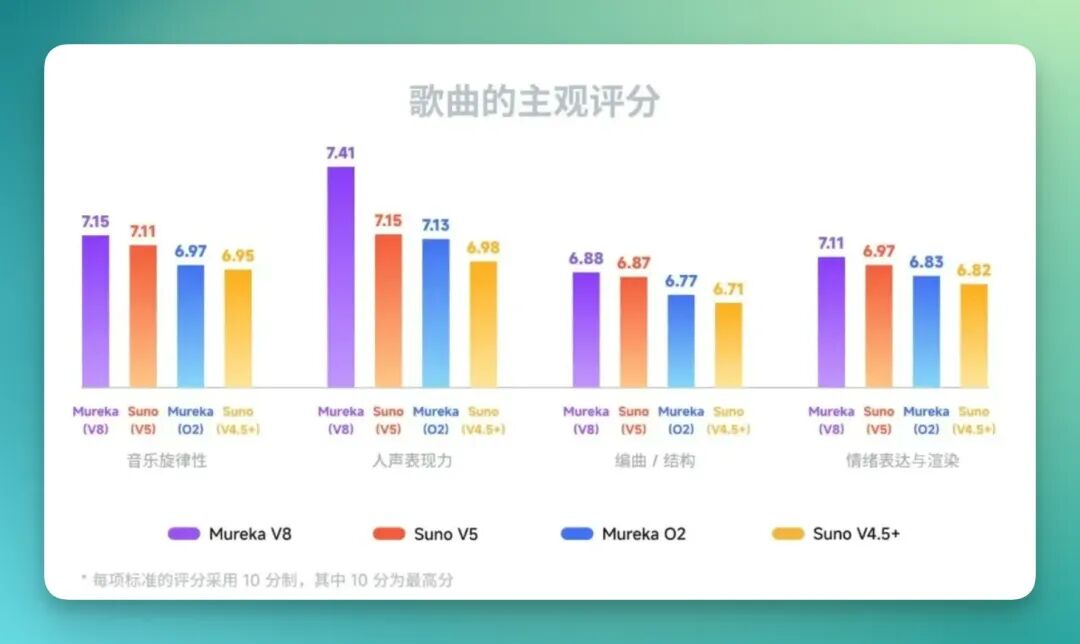
So when we say "AI music quality is now trying to move toward commercialization," what really makes this statement hold is: at the product level, someone has already turned in their answer sheet.
This leads to the next question: with a usable product in hand, how do you turn it into a sustainable business?
Closing the loop isn't one link, it's a system
There's an easily overlooked point here.
A commercial loop isn't about doing one thing well — it requires the whole system to start turning.
When people discuss AI products, they tend to fixate on single points. Is the model strong enough? Is the user base large enough? Is the monetization path clear enough? But business models that actually work are usually several wheels turning simultaneously, pushing each other forward.
Breaking it down, what Mureka is doing now is actually driving two wheels at the same time.
The first wheel is traffic.
Since the release of Mureka O1 and Mureka V6 models at the end of March 2025, Mureka has received widespread praise from global users, with nearly 7 million new registered users. To date, users from over 100 countries and regions worldwide have accessed Mureka, the AI music creation platform under Kunlun Tech.
This traffic isn't just a number — it means enough people are starting to treat AI music as a usable tool.
More importantly, the nature of this traffic has changed for Kunlun.
Before, people might come to play around, generate a few songs, find it novel. Now they're genuinely using it. Using it for video soundtracks, podcast intros, audio for specific scenarios.
When users come to a product with clear intent, that product starts having real value.
The second wheel is monetization channels.
Stepping back from the product to look at platforms, you'll find that NetEase CloudMusic, Tencent Music, Qishui Music — these mainstream music platforms have gradually opened AI channels.
QQ Music launched its "Morning Star · AI Inspiration Songwriting" feature in June 2024, further optimized its self-developed AI assistant in February 2025, and has already begun commercialization, charging 10 yuan per AI-generated song.
Qishui Music launched its "Qishui AI Music Creation Lab" in November 2025, establishing a complete chain from creation, production, distribution, to monetization.
NetEase CloudMusic's Tianyin platform also launched a beta of its AI songwriting feature, where users can input creative inspiration to intelligently generate complete songs.
For these platforms, AI music isn't a threat — it's actually a new growth point.
AI music needs to enter these platforms.
At this launch event, Kunlun's Skyworks officially announced a strategic partnership with Taihe Music. This partnership is essentially solving a problem that AI music has never been able to avoid: what happens after generation?
The previous path was broken. You generate a song on a platform, download it, then figure things out yourself.
Want to release it? Find a platform yourself.
Want to monetize? Negotiate deals yourself.
Want copyright protection? Register it yourself.
This chain was too long, and the threshold was too high for most people.
Now this chain is slowly being connected.
Platforms provide creation tools, Taihe provides distribution channels and commercial monetization methods. After users create, they can directly enter the commercialization process.
The real meaning of a new species
Let's start from 2020.
That year OpenAI released something called Jukebox, which stunned everyone at the time. It could directly generate music with vocals singing, in styles ranging from pop to jazz:
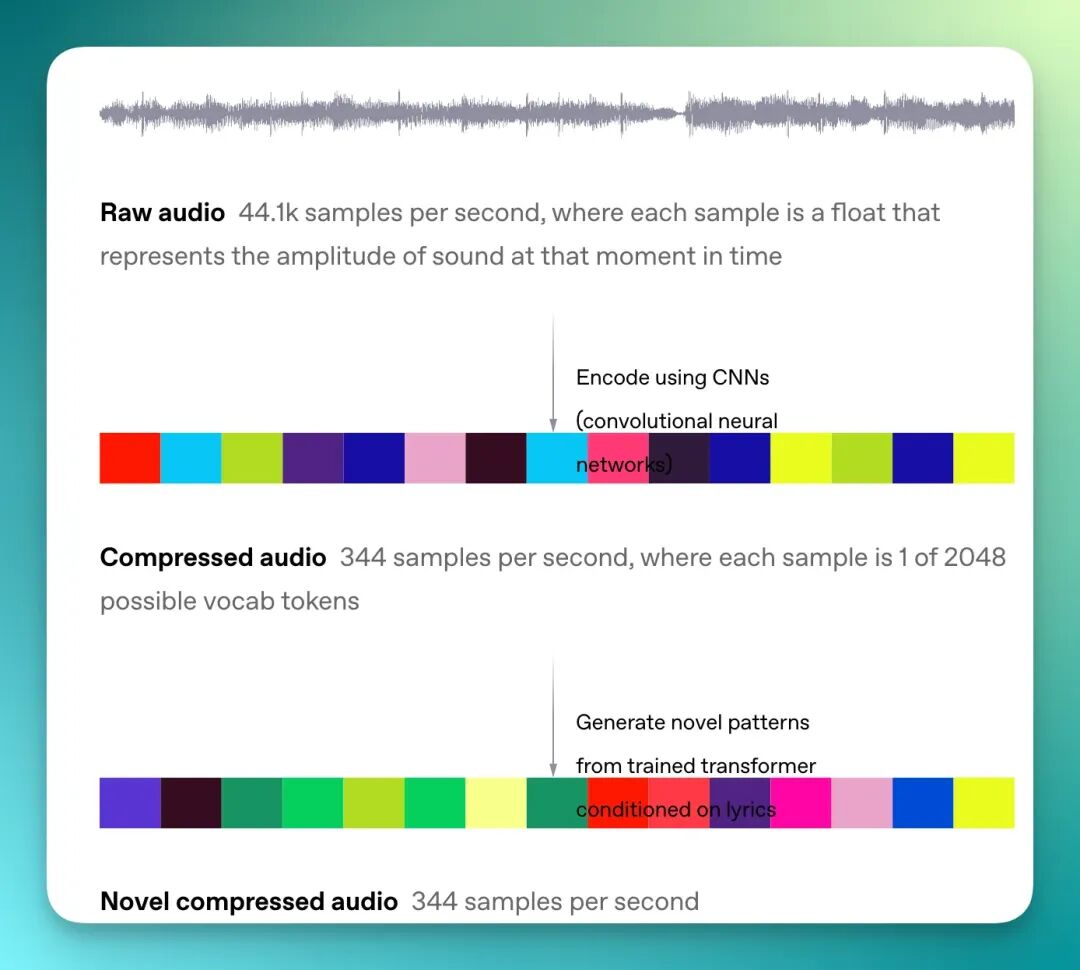
But it had one major problem: it was too slow. How slow? To generate one minute of music, you'd wait several hours.
Yet from that point on, when people discussed AI music, they were already starting to "worry" — either that it would disrupt the music industry and steal professional musicians' jobs, or that it was just an auxiliary tool to help musicians improve efficiency.
Looking further ahead, this new species of AI music kept running faster and faster.
In May 2024, Suno, an AI music generation company, completed its Series B funding at a $500 million valuation, with users growing from 10 million to 25 million. By November 2025, it raised $250 million at a $2.45 billion valuation.
18 months, valuation up 4x from $500 million.
This already proves that AI music as a "new species" is being rapidly validated by the market.
So now we can discuss a bigger question:
What does AI music as a new category actually mean?
It means at least two things:
[1] Lowering cost barriers
In reality, it may be neither replacement nor mere assistance. It opens up a parallel space. This judgment already has actual market data supporting it.
Over the past two years, demand for background music in short video and live streaming has grown substantially. The overall market is getting bigger, with user scale exceeding 1 billion people.
Douyin, Kuaishou, WeChat Channels — massive numbers of creators are looking for soundtracks every day.
Copyright music libraries have plenty of options, but they're either too expensive or too common — once too many people use them, they lose distinctiveness. The gaming industry faces similar situations, with indie developers needing scene music but unable to afford traditional music-to-commercial production costs.
AI music changes this cost structure.
For example, on Suno's platform, a Pro annual membership costs $8 per month, allowing up to 500 songs generated — equivalent to about 0.11 RMB per song. This price makes previously impossible demands possible.
[2] Music As Moment
One of AI music's values often lies in "Moment."
Whether an AI-generated song is good depends on whether it happens to match your need in that moment. It doesn't need to be loved by millions — it just needs to be meaningful to that specific person in that specific scenario.
This is why everyone feels the Music As Moment concept is so important — it has no competitive relationship with traditional music's Music As Art.
In these scenarios, nobody cares whether this track can make it onto trending playlists, nor how high its artistic value is. What people care about is: can it quickly match my need, can it solve my problem, can it create an "exclusive experience."
This is the market AI music is cutting into.
Beyond these two points, as AI music moves toward marketization, more and more imaginative "value points" will inevitably emerge — something to look forward to.
🚥
The moment AI music closes its loop is approaching closure.
Because several conditions have coincidentally aligned: technology has reached the stage where it can produce "usable" products — from "generatable" to "releasable," this is a qualitative change.
Second, platforms like Mureka have accumulated sufficient user bases. The industry is starting to recognize and willing to participate. Taihe Music provides distribution channels, Gao Xiaosong's involvement as co-founder brings traditional music circle participation, moving AI music from the margins to the mainstream.
Major music platforms are fully opening AI channels — the entire field's attitude is shifting rapidly.
For users, choices will multiply and experiences will improve. Just as you can't make videos without editing software now, in the future you may not make music without AI tools — BandLab, Suno, and Mureka have already sent the signal.
AI music won't replace anything, but it will create a new market — one that didn't exist before, but whose demand was always there. Like how photography didn't kill painting, and short video didn't kill film — everyone coexists.
AI music is becoming itself, and this process is accelerating.
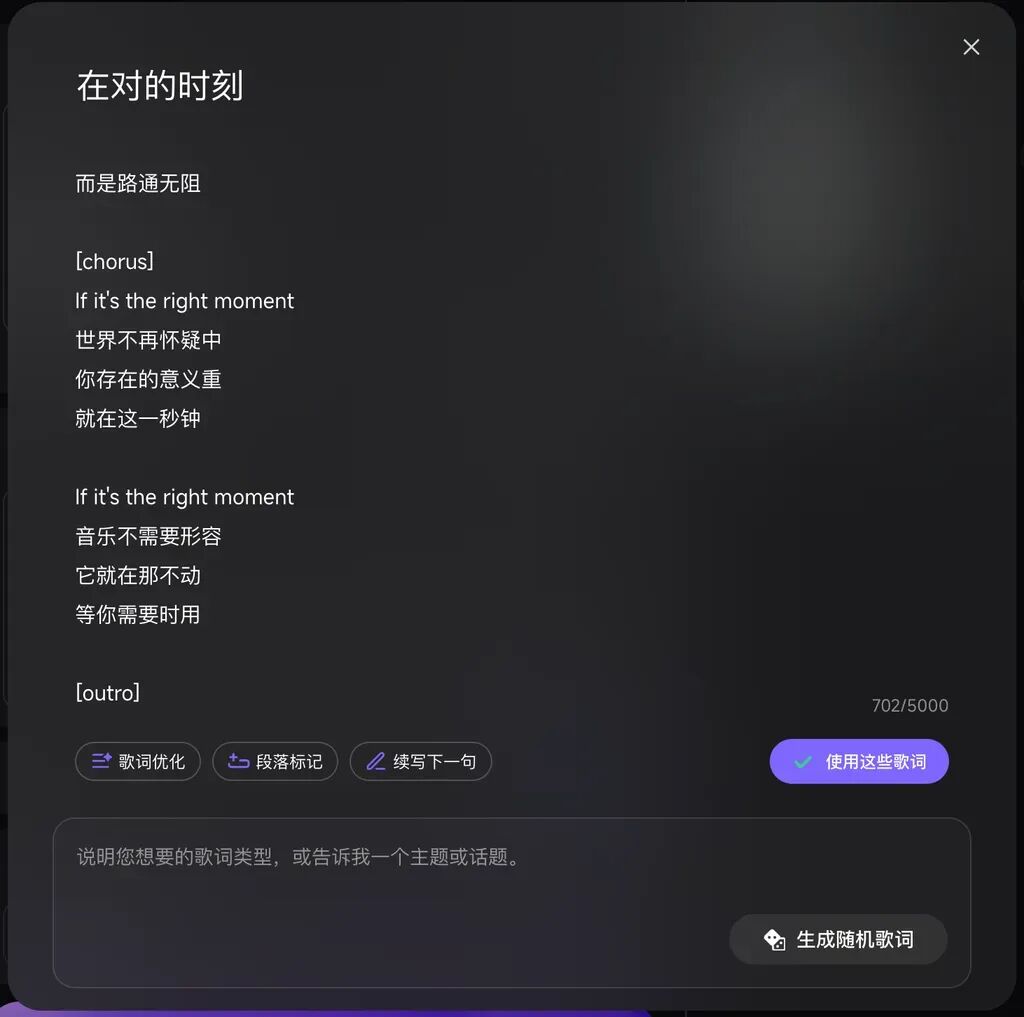
*ps. *Finally, we turned this article into an R&B AI song titled At the Right Moment — welcome to listen~
Mureka experience links:
https://www.mureka.cn/ (domestic)
https://www.mureka.ai/ (international)