Muse Put Agent Shopping on the Map, and DeepLumen Wants to Help Merchants Open a 'Store for Agents'

A2A commerce marathon, just getting started.
The A2A Commerce Marathon Has Just Begun.

👦🏻 Interview: Ms. Yi
🥷 Editor: Crossing
🧑🎨 Layout: NCon

Recently, Meta's AI agent Muse made waves across the industry. It can filter products based on your budget and preferences, negotiate with merchants on your behalf, and even help you recover forgotten subscription fees. Though it sparked controversy over privacy and security concerns, it made agent-driven shopping visible to the mainstream for the first time.
In this newly launched A2A commerce marathon, platforms and payment companies like Shopify and Visa are moving fast. Startups are hunting for "what platforms won't do or can't do well" — things like product fact curation, cross-entry attribution, and operational capabilities for small and mid-sized merchants.
DeepLumen is one of them. What they're building helps merchants' products be accurately understood by agents, and helps merchants' capabilities be reliably called upon and genuinely participate in users' shopping decisions.

Since its founding in December 2025, DeepLumen has completed three consecutive funding rounds, totaling tens of millions of dollars. Its core product, Agentic Page, launched on Shopify in June this year. It has now been installed by nearly 2,000 merchants, generating over $400,000 in attributable GMV. September store-wide data showed AI order share doubling month-over-month; DeepLumen's best-performing furniture client reached 10.7% AI order share.
At this moment when A2A commerce is visibly accelerating, we spoke with DeepLumen partner Xin Xu about his journey from insurance actuary to Douyin E-Commerce to joining this startup — what signals did he see? How does he view Muse's impact on the A2A commerce ecosystem?
Why do merchants need a dedicated product page for agents? How does DeepLumen achieve "attributable" AI orders? DeepLumen wants to become a ledger that merchants trust for settlement — what preparations have they made? How's client reception?

DeepLumen Partner Xin Xu
Below is the full interview transcript, edited and organized.
Rapid Fire
🚥 Crossing
Let's start with rapid fire to help everyone get to know you. Your age?
👨🏻💻 Xu Xin
🚥 Crossing
Alma mater?
👨🏻💻 Xu Xin
Tsinghua University; Mathematics Department.
🚥 Crossing
MBTI and zodiac sign?
👨🏻💻 Xu Xin
INTJ; Capricorn.
🚥 Crossing
One sentence describing your current company and product?
👨🏻💻 Xu Xin
DeepLumen helps merchants build infrastructure for Agentic Commerce.
🚥 Crossing
Funding status?
👨🏻💻 Xu Xin
Since founding in December 2025, we've completed three consecutive funding rounds, totaling tens of millions of dollars.
🚥 Crossing
Revenue and profit?
👨🏻💻 Xu Xin
Agentic Page launched on Shopify in June, with nearly 2,000 merchant installations to date, generating over $400,000 in attributable GMV.
🚥 Crossing
Team size?
👨🏻💻 Xu Xin
About 20 people.
🚥 Crossing
What were you doing before entrepreneurship?
👨🏻💻 Xu Xin
I started as an actuary at an insurance company, then transitioned to internet product roles, and worked at Douyin E-Commerce.
Are Merchants Ready to Sell to Agents?
🚥 Crossing
At the end of 2025, you chose to leave Douyin E-Commerce and join this Agentic Commerce startup. What specific signals drove that decision? What's the core problem you're solving?
👨🏻💻 Xu Xin
While working at Douyin E-Commerce, I noticed something: existing e-commerce, especially interest-based e-commerce, often stimulates purchases through "big promotions" and similar tactics, with many transactions relying on consumers' "impulse buying." I kept wondering: is it possible to match "demand" and "supply" earlier and more accurately, before the purchase decision even happens?
In September 2025, I saw a clear signal: OpenAI launched the Agentic Commerce Protocol. This meant shopping entry points were changing — AI interfaces were no longer just answering questions, but starting to understand products, compare supply, and execute tasks.
Previously, users searched themselves, opened pages, clicked through multiple product detail pages repeatedly, compared products, then completed checkout. Now, users are starting to ask AI assistants directly. The actions originally performed by humans — "find for me, compare for me, complete purchase based on conditions" — are gradually being handed over to agents.
But merchant-side infrastructure remains blank. What merchants built before were pages, ads, and operations for humans. Product facts were scattered across titles, descriptions, images, FAQs, policy pages, and inventory systems — information that agents struggle to stably comprehend. Product expression for agents, call permissions, and performance verification haven't been established yet.
So the core problem we're solving is: filling in the gaps on the merchant side for agent-facing product expression, call permissions, and performance verification, so products and services can be understood, called upon, and ultimately transacted by agents.
We believe this will be a long-term need, and this layer of infrastructure needs to be built ahead of time.
🚥 Crossing
What's the meaning behind the name DeepLumen?
👨🏻💻 Xu Xin
"Deep" means depth, the deep layer. "Lumen" means light. DeepLumen can be understood as "a beam of light in the deep world."
Past e-commerce was designed primarily for human browsing. Humans can look at images, read product detail pages, then find inventory, shipping, and return information. But today, behind these interfaces, a commercial world is forming where agents read, understand, and interact.
Brands and products already exist, customers have real needs, but these two sides aren't necessarily being clearly connected by agents.
So our vision is to become a beam of light: helping brands enter the forming A2A world, making merchants' products accurately understood by agents, making merchants' capabilities reliably callable, and genuinely participating in users' shopping decisions.

🚥 Crossing
Muse has recently caused quite an industry stir. How do you view its推动作用 for A2A commerce?
👨🏻💻 Xu Xin
Muse's big contribution is making agent shopping an experience that people can actually see.
Before, when people heard this concept, it probably felt distant; now that they've actually seen an agent filter products based on user budget, preferences, and shipping requirements, and continue pushing forward with purchases after authorization, it's easier to understand: what shopping tasks can agents actually take on?
But a consumer product generating attention doesn't mean the A2A ecosystem is already mature. Right now, Muse has mainly made more people see the value in this direction, and made more merchants start getting ready.
For DeepLumen, the problems we need to solve next become more concrete: after these agents arrive, how do we help merchants explain their products clearly, catch the demand that agents bring, and help merchants prepare supply, calls, and result verification for this new entry point.
Making an Agentic Page for Products
🚥 Crossing
Let's say there's a North American DTC merchant selling running shoes on Shopify. What concrete changes happen to their business before and after connecting with DeepLumen?
👨🏻💻 Xu Xin
Before connecting with DeepLumen, merchants typically already have Shopify product, inventory, order, and checkout systems. But this product information is organized mainly for human browsing habits. For example: shoe size, foot type fit, cushioning and support, usage scenarios, return conditions, delivery speed — these might be scattered across product descriptions, images, FAQs, and policy pages. So even if an agent finds the product, it might not accurately answer: "is this suitable for me, why is it recommended, can it arrive on time."
After connecting with DeepLumen, merchants can deploy Agentic Page on their existing site with one click.
We help merchants organize product specs, fit conditions, FAQs, and service rules into content that's easier for AI to read, then submit this through appropriate channels to AI platforms.
When new products launch, the corresponding Agentic Page automatically syncs — merchants don't need to re-organize everything one by one.
So for this running shoe store, connecting with DeepLumen makes it easier for AI to figure out: whether this shoe suits them, what the product's features are, and whether it can meet their needs.
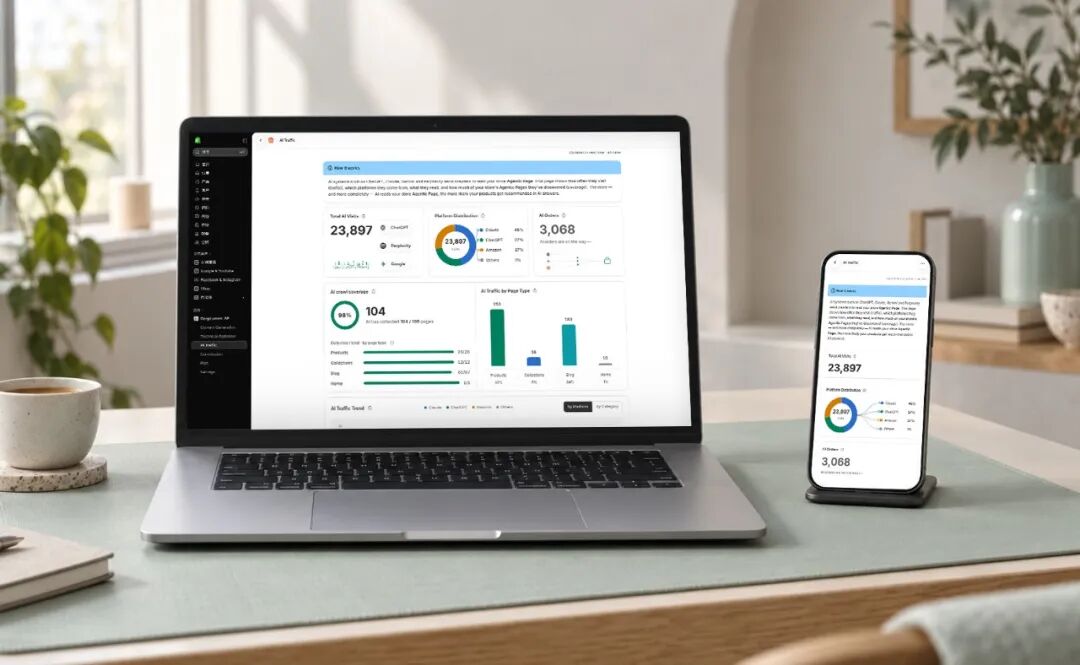
Additionally, we capture the observed traffic paths, connecting AI-sourced visits with order records so merchants can see what's actually happening to their products in the Agent world.
🚥 Crossing
All this information already exists on the original product page, and Agents can read it too — so why do we need a dedicated new page?
👨🏻💻 Xu Xin
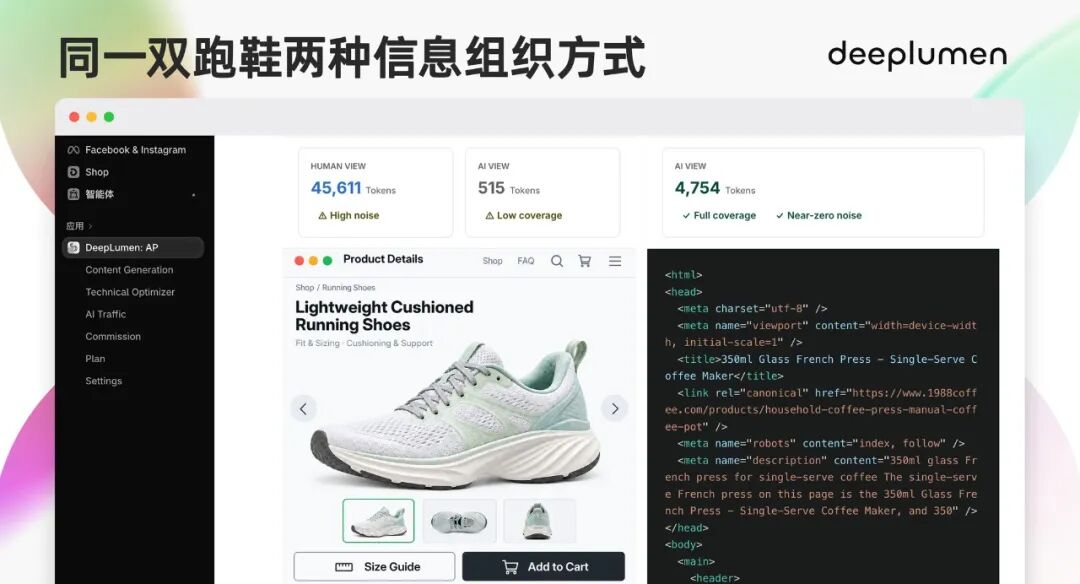
The problem is that humans and machines read pages differently. Humans can wait for pages to load, click through collapsed content, and look at size charts. But many Agent crawling paths only capture the initial HTML, and important information hidden in scripts, images, or PDFs doesn't necessarily make it into their reasoning.
First, what our Agentic Page does is reorganize information merchants already have into a version better suited for AI consumption.
For example, we output semantic HTML that doesn't rely on JavaScript execution, so what the product is, what scenarios it fits, and key specifications are all conveyed in a single read. Then we supplement with summaries, FAQs, spec sheets, and structured data that large models can more easily understand, clarifying the relationships between brand, product, and reviews.
Additionally, a highly valuable part of Agentic Page is converting purchase information from images, videos, and PDFs into searchable text.
Because even if machines have image-reading capabilities, that doesn't mean every product crawling path will invoke it. Take one of our furniture clients' dining table sets as an example: a round table with four chairs, 120 cm wide, 76 cm high, with the product image clearly stating it seats four. But for an Agent to clearly judge this table set's suitability, it needs to read this information — images alone aren't enough.
What we're doing is making these existing facts easier for Agents to accurately extract and compare.
We've also built an engineered A/B testing framework that compares how different content expressions perform on AI visibility and citation rates, then feeds those results back into the next round of content optimization.
There's another important principle here: expression can be reorganized, but facts must have sources. For instance, long marketing copy can be broken into clear, short sentences. But fields like price, inventory, and model numbers are pulled directly from the merchant's backend — we absolutely do not let the model improvise.
For merchants, the change they'll feel is that information originally scattered across different locations becomes easier for AI to find and use when answering specific purchase questions. Further down the chain, we'll also use access and order records to feed back which content actually participated in a transaction.
Crossing
How specifically do you create Agentic Pages for products?
Xu Xin
We automatically extract existing information, organize fields, generate expressions, and then hand off anything needing confirmation to the merchant or their team. Most repetitive work goes to the system.
Different product content can't be processed the same way. For facts with clear sources — price, inventory, SKU, model numbers — we sync directly from the merchant's system. Summaries and FAQs can be organized by models, but we ensure every sentence can be traced back to original materials. If we encounter missing or contradictory source materials, we flag the issues and ask merchants to fill the gaps.
At this stage, we're more focused on: which steps are already automated, which errors affect purchasing behavior, and how quickly we can detect and fix errors after they occur. At the same time, we're working to expand fields and increase merchants' AI-driven order revenue.
Crossing
There are quite a few teams in the A2A commerce space doing similar things. Why do merchants choose DeepLumen?
Xu Xin
I think merchants can evaluate this across four dimensions, and these are also what we can commit to:
First, whether product information has reliable sources. High-risk facts like products, prices, inventory, shipping, and returns should come from merchant-authorized data sources. We don't fabricate selling points for merchants, nor do we let models set prices or make compliance commitments on their own.
Second, whether existing merchant systems can be used. Our Agentic Page is an AI optimization layer that runs on top of the merchant's existing site — we don't ask merchants to abandon their original site. As we gradually open up calling and transaction handoff capabilities, we'll also continue using merchants' existing checkout, order, and after-sales systems.
Third, whether it can adapt to different AI entry points. What we care about isn't just whether a brand appears in a particular AI response, but whether the same set of product facts can adapt to different entry points like pages, Catalogs, Feeds, or APIs, and be continuously maintained across multiple AI channels.
Fourth, whether results can be verified. We distinguish between AI crawls, verified AI-sourced visits, Agent involvement, orders, and refund receipts. We also exclude unqualified results like unclear sources, Google organic search, ads, affiliates, direct visits, and conflicting evidence. We only claim as far as we can verify. For merchants, this matters more than one big impressive "AI impact" number.
We trace all the way back to when a product is mentioned in an AI response, then continue looking: whether the product was accurately understood, whether it drove real visits, and finally whether it resulted in the merchant's own order.
We're truly achieving "attributable" AI orders. And we charge based on verifiable order results, using a CPS model.
Crossing
How specifically do you achieve "attributable" AI orders? What are the challenges?
Xu Xin
The earliest question this had to answer was actually something merchants asked very directly: you say you brought me orders — where can I see them?
If we could only show them our own reports, that answer would be far from enough. So we anchored attribution in the merchant's own transaction records.
We connect where a visit came from, which product page it passed through, and whether it ultimately resulted in an order, then verify against Shopify's visit records, order data, and UTM source tags one by one.
Two things need to be distinguished here: an order passing through an Agentic Page means the AP participated in that purchase path; but only with a clear source like ChatGPT can we further talk about an AI-sourced order. We need to clarify this two-layer relationship so merchants understand why they're paying.

The real difficulty of attribution is actually in the transaction details.
To truly achieve "attributable" AI orders, we maintain ongoing communication with typical merchants, jointly refining attribution, billing standards, and processes.
For example, CPS rates vary because different product categories have different margins. Costs like shipping, taxes, and insurance are negotiated and deducted from the commission-calculating amount. And when users request refunds, order status and commissions need to be adjusted accordingly.
We build all these scenarios into our attribution and settlement rules, ensuring every issue encountered in real transactions can actually be resolved.
What we want to be: ultimately a ledger that merchants dare to use for settlement, not just a pretty growth number.
Crossing
What real cases can demonstrate that DeepLumen's "attribution" is particularly effective?
Xu Xin
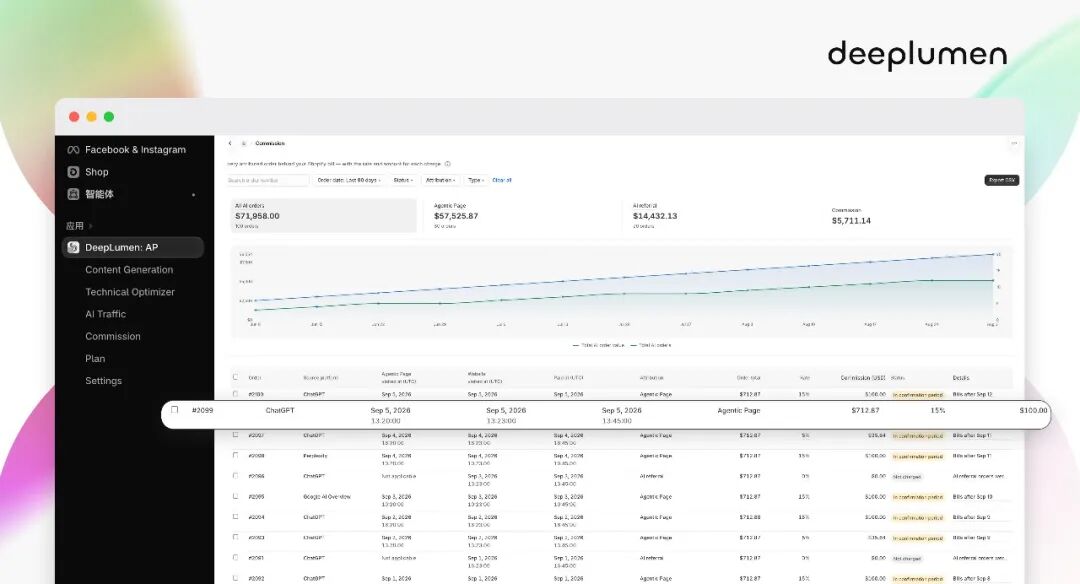
We built our own attribution system, establishing an order-level visit and conversion tracking system for Agentic Pages.
In this system, we reconcile Agentic Page visit logs with Shopify's browsing and transaction records, clearly and completely reconstructing which entry point a user came from, which pages they passed through, and which order they ultimately placed.
Take one of our outdoor camera merchant clients as an example.
We found that on August 31, a user clicked through from ChatGPT to this store's product page, with the purchase path passing through the Agentic Page, then completed the purchase approximately 13 minutes later for $74.22, status paid. In Shopify's visit records, the ChatGPT source, AP tag, and final order all match up — the merchant can reconstruct this purchase process accordingly.
We can clearly explain which orders truly passed through our recommendation, which AI entry point they came from — the chain is closed-loop.
Crossing
If an Agent completes an order but doesn't return a receipt, how do you remedy this?
Xu Xin
It ultimately comes back to the merchant's order system.
If we can obtain an order number, authorized transaction request, and completed session, we trace these records to verify payment and order status. Just having amounts and times that happen to be close isn't enough to confirm it's the same transaction — if evidence doesn't match up for now, it stays in pending verification.
Crossing
What other tricky situations do you encounter?
Xu Xin
Refunds, duplicate requests, price changes — it's the same principle. We trace what actually happened during execution, and ultimately reconcile against the merchant's real order results.
To build long-term trust, the basis for charging must be clear. Our principle: orders we can't explain or verify, we absolutely do not charge for.
Crossing
How many merchants is DeepLumen currently working with?
Xu Xin
To date, our product has been installed by nearly 2,000 merchants, generating over $400,000 in attributable GMV.
Our current customers are mainly distributed across apparel and accessories, 3C electronics, home and garden, health and beauty, and outdoor tools and sports. Among these, apparel merchants have higher order volumes, while home and outdoor categories have higher average order values.
Crossing
Who are your target service customers?
Xu Xin
Brand merchants whose products have inherent value but require consumers to spend time understanding, comparing, and confirming before purchasing — these are all our target customers.
This includes small shops doing around a hundred orders per month, as well as mature brands with stable order volumes. Typically these are brand merchants with their own websites and transaction foundations, starting with the Shopify ecosystem to test the waters.
On the customer service side, we look beyond just industry and average order value — we focus on what operational problem the merchant most urgently needs solved. For example, smaller merchants care more about gaining an additional customer acquisition channel and reducing their dependence on paid ads; mature brands are more interested in whether AI can become a sustainable, long-term channel worth investing in.
Going forward, we'll prioritize verticals based on actual transactions: we'll look at whether the merchant already has a sales foundation, and also at where we can improve how they operate their products.
Crossing
After partnering with DeepLumen, what kind of performance lift can brands expect? Where are AI-driven order volumes at right now?
Xu Xin
Results vary significantly across merchants, depending mainly on the vertical, how complex the product information is, and how much users are querying on AI platforms.
Our best-performing client so far is a furniture merchant. In September, the AI orders we directly drove accounted for roughly 10.7% of their total store orders. For a furniture merchant, that's already reached a level where it deserves to be managed as a standalone channel.
There's also a German luggage accessories brand that was doing about 8,000 orders per month. In their first month with our product installed, they logged nearly 2,000 AI visits, which generated close to 100 AI-channel orders.
The time from installation to first AI order averages about one to two weeks, though some merchants see their first order in just one to two days. For instance, an ergonomic chair merchant generated their first AI order roughly 25 hours after installation.
Of course, what we care more about is whether orders keep coming steadily after that first sale. A single purchase proves the loop works; being able to consistently drive valuable visits and orders is what makes it worth the merchant's long-term investment.
Crossing
What's your current CPS rate?
Xu Xin
Our CPS is charged by product category, with rates between 5% and 15%.
Different categories have different margin structures, average order values, and customer acquisition costs. On the promotion side, we make the first three orders free so merchants can see real orders first; once they're seeing steady orders, we start charging according to the agreed CPS structure.
Crossing
Who are your upstream and downstream partners right now?
Xu Xin
This wave of e-commerce change involves models, identity, payments, storefront-building, and merchant systems — no single company can push it forward alone. We work with two types of partners to advance this:
One is agency channels, storefront builders, and e-commerce service providers who are already close to merchants. They understand how local merchants operate and have built long-term trust relationships.
The other is infrastructure builders like Visa. They solve how Agents get payment authorization and how transaction liability is confirmed; we come from the merchant side, connecting products, supply, and actual transaction scenarios, and integrating Agentic Commerce capabilities into merchants' day-to-day operations.
Crossing
Is this market accelerating noticeably? What changes have you seen in merchant AI order volumes over the past month?
Xu Xin
There are signs of acceleration, and we're tracking it through orders ourselves.
We did a review a few days ago: from August to September, the overall AI order share across our merchant base doubled.
This shows that the AI channel is gradually becoming a meaningful traffic source, and merchants are now at a point where it's worth preparing. Those who move first will be the first to capture this wave of traffic dividends.
Crossing
You mentioned that Agentic Store is what DeepLumen really wants to build. What exactly does that mean?
Xu Xin
When Agents become the direct operators of shopping tasks, merchants need to learn how to do business with this new type of user.
Agentic Page is our first step — solving whether products can be read and understood by AI. Longer term, we'll upgrade this capability into an operational foundation for merchants that is purpose-built for Agents.
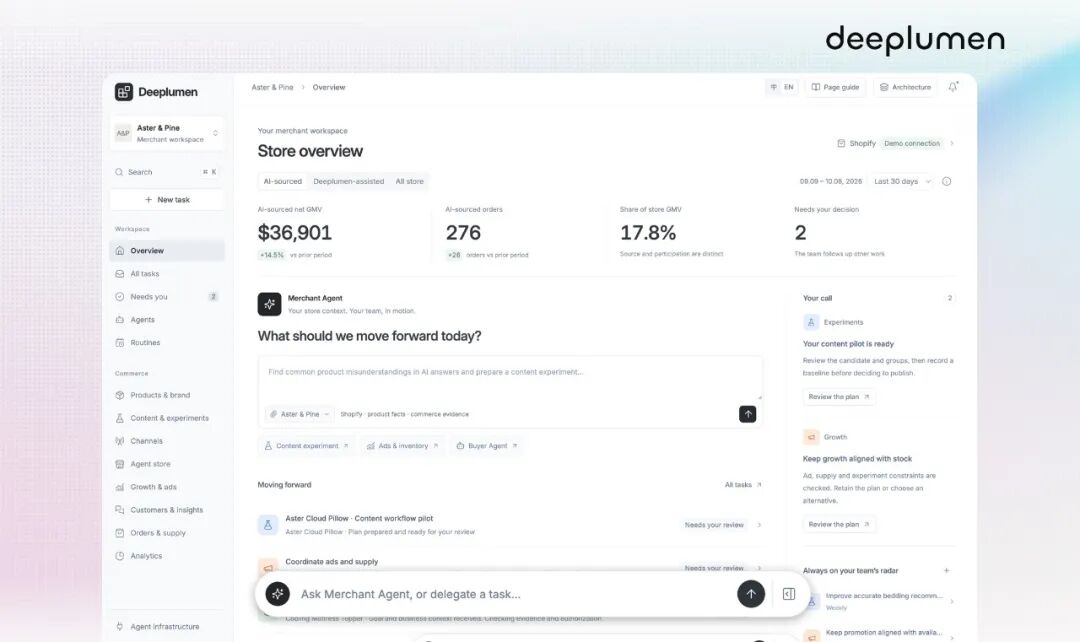
Agentic Store is the full set of operational capabilities we're preparing for merchants, helping them open a store that's better at serving Agents.
In the past, merchants spent enormous effort making a page more attractive; going forward, they'll also need to clearly communicate to Agents "what I can sell, under what conditions I can deliver, and what liability I'm willing to assume." Moreover, product descriptions are relatively static, but a supply that can actually transact is dynamic — things like price, inventory, and delivery range all change, and in Agentic Commerce, someone needs to stay on top of these.
Agentic Store is an operational "back office" we're building for merchants to run Agentic Commerce. We'll build a unified AI sales operations system where merchants can centrally view visits, orders, attribution, and result receipts from different AI entry points, and uniformly maintain product information and service rules. The transactions themselves can continue to flow through the merchant's existing checkout, payment, and fulfillment systems.
🚥 Crossing
Shopify is also building Agentic Storefronts. Will that put you in direct competition?
👨🏻💻 Xu Xin
There will be overlap. Shopify has the product, inventory, order, and checkout systems, and is also working on AI-channel distribution and source attribution.
But we're not competing with platforms for the consumer-facing entry point. Instead, we complement from the merchant side on product facts, cross-entry operations, and result verification.
Large platforms are better suited to solve where consumers initiate shopping, what universal format connects products, and how transactions are completed; merchants still need to solve concrete operational problems.
For example, when entering the same AI gateway, why is one product consistently recommended while another is ignored? Is it because the product itself is unsuitable, or because its fit, specifications, and conditions of use weren't expressed clearly? After the merchant makes changes, does AI understanding and actual conversion improve? These questions require going deep into categories, products, and operational processes, and working on them continuously.
What DeepLumen wants to do is build a sustainably iterative Agent system for merchants, connecting their product expression, how AI selects products, and real order feedback — helping merchants develop day-to-day operational capabilities for Agentic Commerce.
We start from the merchant's overall business, letting them clearly know: whether the same batch of products is accurately understood across different entry points, what orders each channel is bringing in, and where further investment is warranted.
🚥 Crossing
How much funding has DeepLumen raised in total?
👨🏻💻 Xu Xin
Since our founding in December 2025, we've completed three consecutive funding rounds, with total raised in the tens of millions of dollars.
The most important use of this capital is continuous investment in merchant-side infrastructure.
Because the Agentic Commerce market evolves alongside entry points, protocols, and merchants' real needs, we need to both make the current Agentic Page something merchants are willing to use and pay for, iterating with their needs to become a trusted partner; and simultaneously accumulate product, system integration, and transaction experience for the later Agentic Store.
🚥 Crossing
What's the current team composition?
👨🏻💻 Xu Xin
We're about 20 people now. A defining characteristic of our team is this: people who understand AI, and people who understand merchant operations.
Our team members have long focused on AI, data infrastructure, and commercial technology, combining frontier R&D with commercialization capabilities.
The core team has deep technical and science backgrounds, with members educated at Stanford University, Columbia University, University of Wisconsin–Madison, Tsinghua University, Peking University, Shanghai Jiao Tong University, Zhejiang University, and the University of Science and Technology of China, with expertise spanning physics, mathematics, and computer science.
Our team is fairly pragmatic. The core of what we're doing is essentially this: making judgments by putting product understanding, merchant system integration, and transaction results together, while adjusting based on real merchant problems.
🚥 Crossing
What's DeepLumen's market plan for the next six months?
👨🏻💻 Xu Xin
We'll continue serving Shopify merchants while also expanding to DTC merchants using WooCommerce and other storefront solutions — together, we'll seize the opportunities of the Agentic Commerce era.
On market expansion, we'll partner with agencies and service providers who know local markets and vertical categories well. They understand merchant operating habits better and have built long-term trust relationships. We provide product, integration, and performance verification support; together, we'll do a good job training and servicing merchants.
We're also planning joint marketing initiatives with infrastructure partners in payments, identity verification, and related areas.
We'll use concrete scenario-based activities to help merchants more clearly understand: how Agents can participate in shopping; what this means for their business; and what preparations merchants need to make.
🚥 Crossing
We see DeepLumen is recruiting agents. How is that going?
👨🏻💻 Xu Xin
We currently have over 30 agency partners actively working with us.
We've also adjusted our commission structure: the base rate is now uniformly 50%, and it can increase to 60% or 70% upon reaching corresponding partnership scale. We want partners who consistently bring in merchants and deliver good service to share more of the returns.
The A2A Commerce Marathon Has Just Begun
🚥 Crossing
In your observation, what new variables have emerged recently in the A2A agent commerce market that are helping mature the entire ecosystem?
👨🏻💻 Xu Xin
I mainly watch three things: how products get connected; how Agents obtain payment authorization; and how merchants verify the identity of visiting Agents.
Let's start with product integration. Right now, OpenAI already offers product feeds and a Products API, and Shopify is helping merchants connect their products to ChatGPT and complete transactions through the merchants' own checkout systems.
This means merchants now have a clearer way to participate. Of course, once they're connected, there's still more to solve: why a product gets selected, what information needs optimization, and whether it ultimately converts. Our CPS pricing is built on these actual outcomes.
Next, payment authorization. Visa's Intelligent Commerce, Mastercard's Verifiable Intent, and Google's AP2 are all advancing their own capabilities and rules around user authorization. What they're solving is: whether this purchase was actually approved by the user, what the Agent is allowed to buy and how much it can spend, and whether the actual operation exceeded the authorization. With these constraints in place, users can feel more confident delegating specific purchase tasks to an Agent.
Then, identity verification. Visa's Trusted Agent Protocol, along with Cloudflare's Web Bot Auth and Signed Agents, are helping merchants confirm the identity of visiting Agents; Auth0, under Okta, is advancing permission management for Agents. Merchants need to know both who is operating and what it's allowed to do. Of course, verified identity doesn't mean it can simply place orders or make payments directly.
I think one truly noteworthy inflection point is when products, identity, authorization, and payment start connecting around the same transaction.
🚥 Crossing
When do you think the A2A commerce ecosystem will take off?
👨🏻💻 Xu Xin
My read is that in the next six months to a year, we'll see a wave of reusable Agent shopping scenarios emerge. At that point, Agentic Commerce will enter a window of scaled commercial validation.
But for A2A commerce to truly explode at scale, four layers of infrastructure need to come together simultaneously: first, merchant product data needs to be complete and real-time, with reliable sources for pricing, inventory, and policies; second, Agent permission boundaries need to be clearly defined; third, payment, fulfillment, returns, and liability need to fold back into merchants' existing systems; and fourth, platforms need to provide stable access and receipts.
Overall, this evolution will happen in stages: first, users get accustomed to having AI help them compare; then they accept it initiating transactions for their confirmation; finally, users delegate certain well-defined purchase tasks on an ongoing basis, with the scope of authorization expanding gradually as trust builds.
I believe scenarios with "clear demand and easily verifiable outcomes" will be the first to work.
🚥 Crossing
What milestones does DeepLumen need to hit during this period?
👨🏻💻 Xu Xin
Within a year, our goal is to produce a set of merchant cases with sustained usage, while answering this question: which improvements to product information actually changed AI recommendations and selections, and which changes drove real traffic and conversions.
We'll do refined operations based on data performance. Also, different merchants have different priorities — some want higher conversion, some want lower customer acquisition costs, some want an additional sales channel for high-ticket items. We'll address these needs specifically.
In the end, it comes back to profit.
What we care more about is how much this channel actually leaves merchants after deducting product costs, fulfillment, refunds, commissions, and additional operational investment.
🚥 Crossing
If you think of this A2A agent commerce evolution as a 100-kilometer marathon, where are we right now?
👨🏻💻 Xu Xin
Probably around the 10-kilometer mark.
People can see the direction now, and real transactions are starting to happen. The next step is getting consumers more comfortable delegating and enabling merchants to handle that demand reliably.
🚥 Crossing
What's the critical problem to solve next?
👨🏻💻 Xu Xin
The hardest thing right now is stringing together accountability across a single purchase.
The buyer's Agent needs to know its authorization scope; the merchant needs to provide valid pricing and inventory; payment needs to confirm the money was actually authorized. When a transaction hits stockouts, budget overruns, or refunds, there needs to be clarity on who handles it and under what circumstances it needs to bounce back to the user for confirmation.
Getting the model to complete the task is only part of it; what merchants and users actually need is reliability when things go wrong.
For DeepLumen, we'll focus on doing the merchant side well first — enabling merchants to provide reliable product information, connect their supply, clarify their rules, and actually catch real orders.
Join the membership group