NVIDIA and Stanford University Jointly Release New Research: Robot Context Window Expanded to 8K — What Does This Mean?

"Muscle memory" built up over nearly five minutes, with inference latency that doesn't scale with conversation history
Nearly Five Minutes of "Muscle Memory," with Reasoning Delay That Doesn't Scale with History

👩 Author: Shirley
🥷 Editor: Koji
🧑🎨 Layout: NCon

Crossing has been tracking key breakthroughs in AI, embodied intelligence, and frontier technology — especially paradigm-shifting advances that could alter the trajectory of technological development. We aim to consistently highlight work that may not offer final answers, but often signals new directions worth following closely in the next phase.
A robot is assembling a toy car.
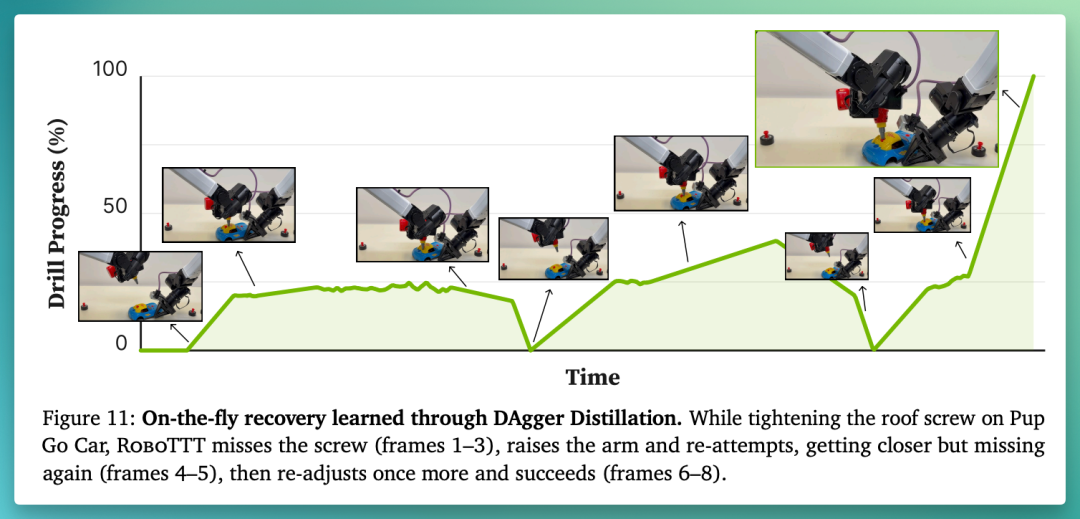
It places the yellow roof onto the body, picks up the electric drill, but the drill bit misses the screw on the first attempt.
A human would immediately recognize the failure, raise their arm again, adjust the angle, and try once more.
But for a robot to do this, it needs not only to see the current frame, but also to remember what it did before, and whether that action succeeded.
On July 15, NVIDIA GEAR, together with teams from Stanford and UT Austin, introduced RoboTTT[1], expanding the visual-action context that a robot policy can directly process to 8,000 timesteps — attempting to give robots visual-action working memory spanning several minutes.
But more important than "remembering longer" is how RoboTTT changes the way robots store and use history.
Why Robots Need Longer Visual-Action History
Today, many robot foundation models use single-step or short-history visual-action contexts, typically predicting the next action chunk based on the current frame or limited historical perception, combined with language instructions and proprioceptive state.
Some systems can also compensate for short policy history through action chunking, high-level planning, subtask prediction, recurrent states, or external memory.
But when the correct action depends on historical information not present in the current frame, single-step or short-history policies hit structural limits.
For example, two visually similar frames might correspond to "hasn't tightened the screw yet" and "already completed this step." Without knowing what it did before, the robot can hardly distinguish which stage it's in based solely on the current view.
Similar problems arise when objects are occluded. A robotic arm might temporarily block a component, yet the next action still needs to reference its previously observed position.
Error recovery and video-conditioned imitation impose more direct demands on history. The robot must let prior failures influence current actions, or let an earlier human demonstration determine what to assemble next.
Thus, for tasks with long temporal horizons, state ambiguity, and partial observability, short-history policies may hit these capability boundaries.
How RoboTTT Works
RoboTTT extends visual-action context to 8,000 timesteps. At the 30 Hz control frequency used in the paper, this equals roughly 267 seconds, or 4.4 minutes — close to what the authors describe as nearly five minutes of "muscle memory."
Here, 8K refers to timesteps in the robot control sequence, not 8,000 text tokens; each timestep may contain multiple visual streams, proprioceptive state, language instructions, and action information.
From History Cache to Learnable State
When Transformers process long contexts, a common approach is to store past information in the KV Cache.
This resembles continuously adding files to a filing cabinet: with each new token, the model saves corresponding Keys and Values; when processing current input, it retrieves relevant information from historical representations via Attention.
This preserves relatively complete historical representations, but the KV Cache grows with context length. The more the model stores, the longer the historical range it must process at each step. For robots continuously receiving multi-stream visual and state information at 30 Hz, retaining several minutes of complete visual-action history creates significant storage and computational pressure.
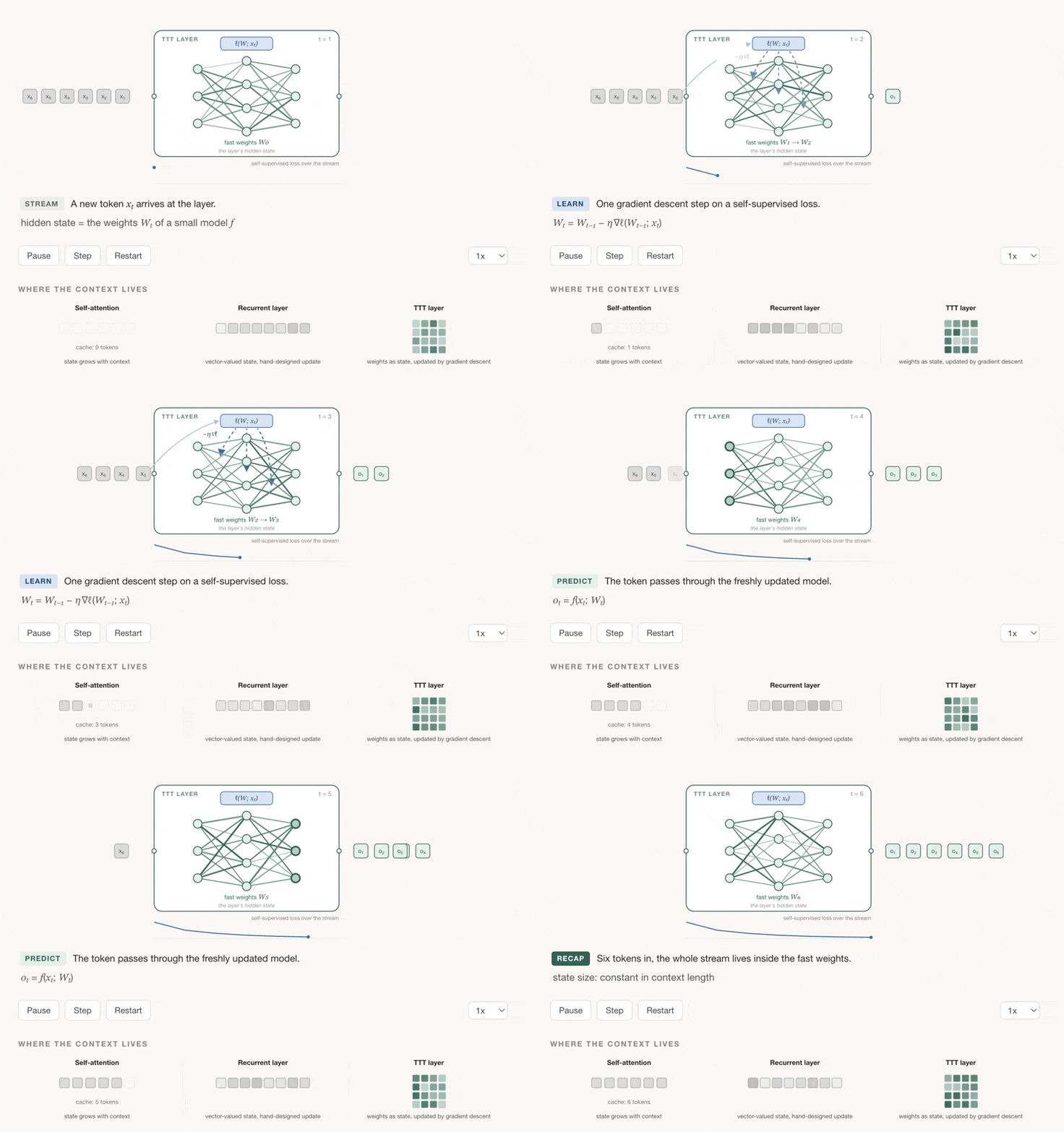
RoboTTT takes a different approach: instead of using a KV Cache that grows along the time axis to serve as long-term working memory, it continuously modifies a fixed-size internal model during robot operation. The variable parameters of this internal model are the Fast Weights.

It's worth noting that RoboTTT doesn't completely remove Attention from the base VLA model. It retains the original Attention branch, but delegates long-term state spanning thousands of timesteps primarily to Fast Weights, then combines outputs from both branches.
What Happens in a Single Timestep
Fast Weights are a set of variable parameters in RoboTTT's internal model, denoted as Wₜ.
They're called "Fast" because they update not only during training, but also during inference as new perceptual inputs arrive. By contrast, the base VLA's ordinary parameters are Slow Weights, typically frozen during deployment and inference.
At each timestep, RoboTTT completes the following process:

The robot first receives the multimodal input xₜ for the current timestep, which may include camera frames, proprioceptive state, and task instructions.
The model then generates temporary Key and Value from xₜ through learned projections: kₜ = Pₖ(xₜ), vₜ = Pᵥ(xₜ). Here, kₜ and vₜ are not historical records appended to the Transformer KV Cache, but self-supervised update signals constructed at the current timestep, determining how current experience should modify Fast Weights.
RoboTTT computes the update direction using Key-Value Binding Loss: ℓₜ = ‖f(kₜ; Wₜ₋₁) − vₜ‖², yielding the gradient: gₜ = ∇_W ℓₜ. This gradient can be understood as an "edit instruction" that current experience sends to working memory.
The model then performs an incremental update on the previous timestep's state Wₜ₋₁: Wₜ = Wₜ₋₁ − ηgₜ. Here, ΔWₜ = −ηgₜ represents the parameter change caused by current input.
Based on the updated Wₜ, combined with the base VLA's Slow Weights, the model performs action prediction: aₜ = π(xₜ; Wₜ, θ). Here, θ represents the base model's Slow Weights.
RoboTTT combines the TTT branch and original Attention branch through a learned Gate: oₜ = tanh(α) ⊙ o_TTT + o_attn. The base VLA continues handling current frame and language instruction understanding, generating actions; Fast Weights provide it with state information spanning much longer durations.
After the robot executes action aₜ, the environment changes, producing new perception xₜ₊₁, and the same process repeats: xₜ → (kₜ, vₜ) → gₜ → Wₜ → aₜ → xₜ₊₁.
Fixed Capacity, Changing Internal Parameters
From W₀ to W₈₀₀₀, the matrix shape of Fast Weights remains constant; what changes are the parameter values inside: W₀ ≠ W₁ ≠ W₂ ≠ ⋯ ≠ W₈₀₀₀. This means during inference, the system need not retain every previous version of W — it only carries the current state Wₜ and continues updating.
However, Wₜ doesn't contain only current input's influence. Since Wₜ₋₁ has already been recursively updated through all previous timesteps, past experience still affects current state through parameter changes: W₀ → W₁ → W₂ → ⋯ → W₈₀₀₀.
Thus, W₈₀₀₀ accumulates influence from the prior sequence, but unlike video recordings or complete KV Cache, it cannot reconstruct the raw content of all 8,000 previous timesteps.
What RoboTTT solves is not how to perform Attention over increasingly long raw history, but how to recursively compress increasingly long history into a fixed-size internal state that can be utilized by subsequent actions.
In traditional inference, context is primarily data waiting to be read by the model; in RoboTTT, new inputs also produce gradients, continuously modifying internal parameters during inference. The differences are summarized below:
| Dimension | Traditional Training-Inference Paradigm | RoboTTT |
|---|---|---|
| Training phase | Update model parameters | Update Slow Weights, and learn initialization and update method for Fast Weights |
| Inference phase | Model parameters typically frozen | Slow Weights frozen, Fast Weights continuously updated |
| Role of context | Data waiting to be read by model | Learning material that modifies temporary model state |
| Long-term state | KV Cache, recurrent state, or external memory | Recursively updated Fast Weights |
| State capacity | KV Cache grows with history; recurrent state typically fixed | Fast Weights matrix shape fixed |
| History fidelity | KV Cache preserves relatively complete historical representation; recurrent state typically lossy compression | History lossily compressed into current parameters |
| After single rollout ends | Depends on system design | In paper's experiments, restart from W₀ |
How the 8K Context Was Trained
Fast Weights solve how long history continuously propagates forward during inference, but to truly extend pretraining context to 8,000 timesteps, one must also address the memory overhead and training stability issues brought by long sequences.
If full backpropagation were performed across the entire long sequence, the model would need to retain intermediate results produced at each timestep, and GPU memory usage would increase with sequence length.
RoboTTT therefore adopts Truncated Backpropagation Through Time (TBPTT), slicing long sequences into multiple shorter segments and computing gradients only within each segment.
At segment boundaries, corresponding gradients are truncated, but Fast Weights continue propagating to the next segment. That is, the robot's internal state still updates continuously along the entire trajectory, while intermediate results that need to be saved during training depend mainly on individual segment length rather than the full 8,000 timesteps.
However, TBPTT controls peak memory during training, not total computation. As sequences lengthen, the model still needs to process more timesteps, so training time and overall computational cost still increase.
Merely enabling long sequences to "train without crashing" is only the first step — the model must also learn "how to utilize" this history.
What RoboTTT learns during pretraining includes not only the base model's Slow Weights, but also the projection parameters for generating Keys and Values, and the initial state W₀ of Fast Weights.
Here, W₀ is not a manually fixed starting point, but meta-learned through outer task loss. Under TBPTT, it directly receives gradients from the first segment, thereby being shaped into an initial state more suitable for subsequent rapid updates.
In other words, during pretraining, the model repeatedly practices how to write continuous experience into Fast Weights, and how to make these state changes serve subsequent action prediction. The longer the pretraining sequences, the more continuous update steps this state update mechanism experiences.
Another key training technique is what the paper calls Sequence Action Forcing.
RoboTTT uses Flow Matching to learn denoising correct actions from noise. If the entire sequence shared the same noise level, all actions might become simultaneously too easy or too difficult, making long-sequence training unstable.
Sequence Action Forcing independently samples noise levels for each action chunk, letting the same sequence contain training targets of varying difficulty. Ablation experiments show that removing Sequence Action Forcing causes the model to fail to stably generate accurate actions, and robots struggle to make effective task progress.
Overall, Fast Weights handle long-term state propagation, TBPTT controls peak memory, meta-learning provides W₀ with a starting point suitable for rapid updates, and Sequence Action Forcing improves long-sequence action training stability. These mechanisms together support RoboTTT's extension of pretraining context to 8K.
What the 8K Context Brings
Completion Performance in Long Tasks
The research team tested RoboTTT on three bimanual assembly tasks: Pup Go Car toy assembly, Circuit circuit component assembly, and Gear Bot remote-control robot assembly.
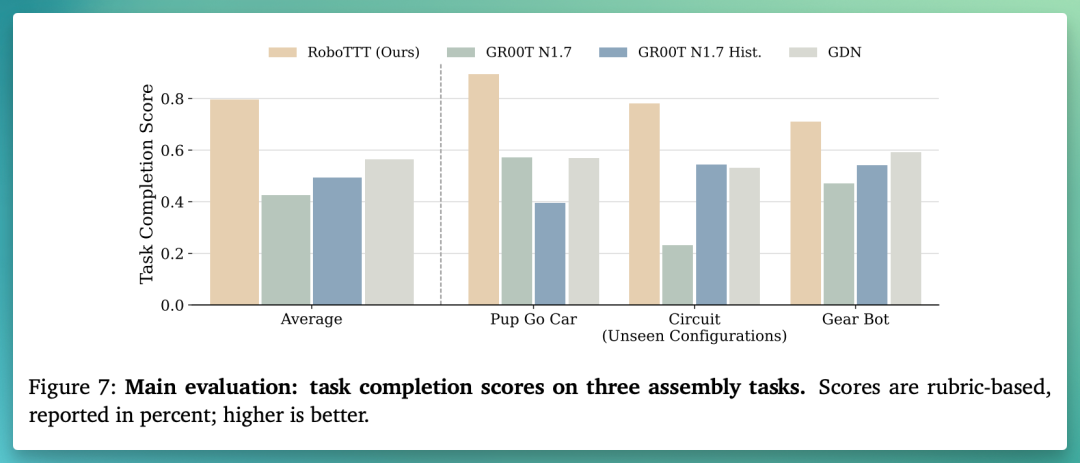
Results show RoboTTT achieved an average task completion score of 79%, compared to 42% for single-step-context GR00T N1.7, 49% for GR00T N1.7 with one frame of history, and 56% for Gated DeltaNet.
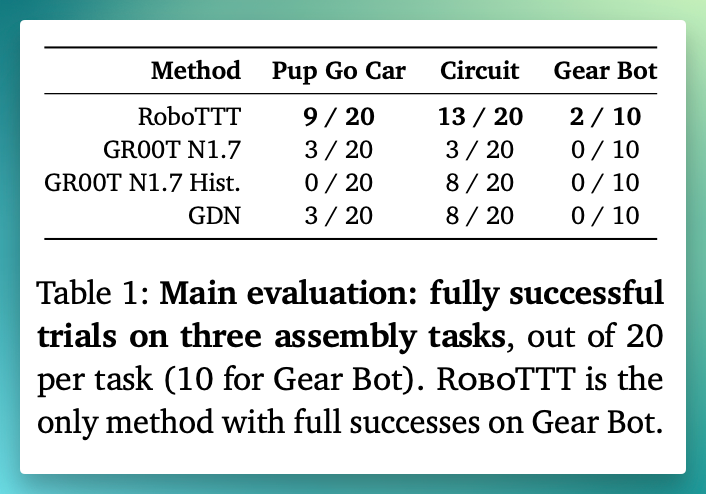
On the Gear Bot task — averaging five minutes to complete with approximately ten stages — RoboTTT was the only model to ever complete the entire task, succeeding fully in 2 out of 10 tests; no other baseline completed the full task.
Beyond the scores, the paper offers two qualitative observations.
First, RoboTTT can distinguish visually similar task stages. In multi-stage assembly, frames for "not yet tightened" and "already tightened" may appear nearly identical, causing baselines to make wrong actions or skip stages entirely; continuously updated Fast Weights retain key features from before, enabling judgment of which step it's currently on.
Second, RoboTTT is more accurate during fine stages like insertion and snapping. The paper attributes this to long context alleviating partial observability: when target components are temporarily blocked by the robotic arm, previous observations can still guide current actions.
These two points correspond respectively to the "state ambiguity" and "occlusion" problems raised earlier.
Another notable comparison is GR00T N1.7 Hist.: simply concatenating one frame of history to GR00T N1.7 actually dropped its Pup Go Car score from 57% to 39.5%. The paper suggests that directly concatenated history introduces spurious correlations, causing the robot to deviate from training distribution during inference.
Beyond overall scores, RoboTTT's long context further demonstrates three capabilities that short-history strategies struggle to fully achieve.
Reading Goals from a Human Video
In the Circuit experiment, all tests used the same language prompt "assemble circuit." The language itself didn't specify which components to choose or the installation order. The target configuration could only be inferred from a human demonstration video; after the human completed the demo, the experimental scene was reset, and the robot needed to reproduce the same assembly result based on the prior video.
In this experiment, RoboTTT achieved a task completion score of 65%, with 6 full successes out of 10 tests; GDN scored 33%, with zero full successes across 10 tests.
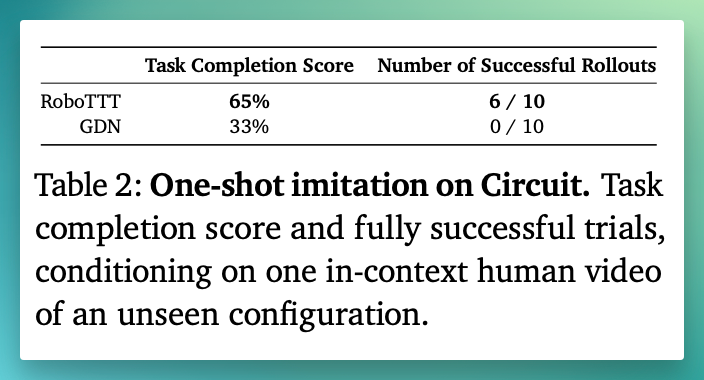
This shows RoboTTT can not only let its own manipulation history influence subsequent actions, but also use prior human demonstrations to determine current task goals.
However, the "One-shot" here doesn't mean the robot watches a video once and masters a completely unfamiliar task category from scratch. It means that within an already-trained circuit assembly task family, the model identifies specific configurations and orders not seen during testing, based on one video.
Readjusting Actions After Failure
RoboTTT learns the relationship between "failure and correction" through DAgger Distillation.
Training data includes both robot execution failures and subsequent human-provided corrective actions. RoboTTT uses failed actions as context, computing imitation loss only on correct human actions.
Thus, what the model learns is not merely "what the correct action should be," but "how to correct after a certain failure." This explains the opening drill scene: after the robot misses the screw on the first attempt, the prior failure has entered history and changed Fast Weights, thereby influencing subsequent actions.
The paper compares different training methods on the same batch of 100 DAgger trajectories.
Standard DAgger fine-tunes only on human corrective actions, discarding the robot's own failed actions. This approach yields only about 9% average improvement across four models, and about 13% on two sequential models.
DAgger Distillation retains failed actions as context. The same data brings RoboTTT approximately 36% improvement.
The paper also verifies a detail: in this experiment, using failed actions as imitation targets brings no additional benefit. Fine-tuning GR00T N1.7 on complete trajectories including failed actions yields the same result as fine-tuning only on human corrections: 57%.
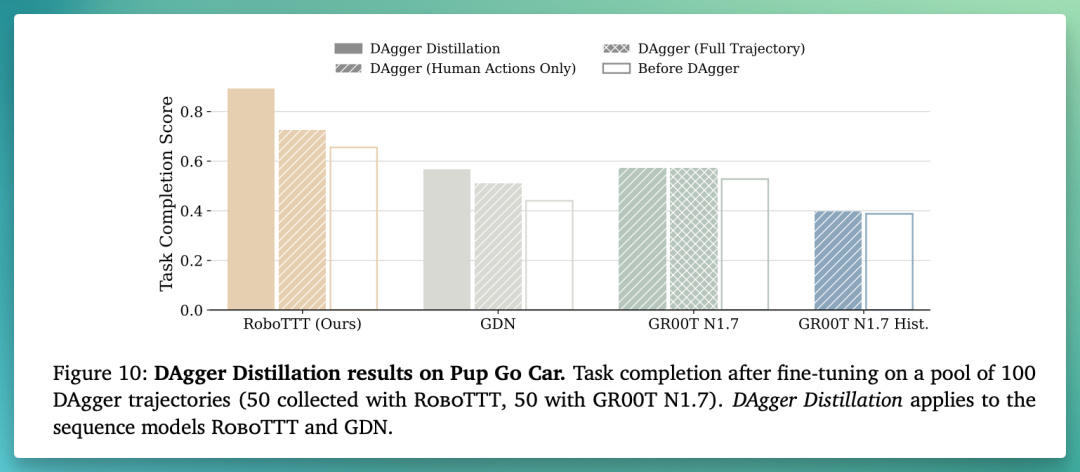
Therefore, the value of failed actions lies not in imitation, but in serving as context to help sequential models learn the relationship between "failure and correction."
Returning to Correct Steps After External Perturbation
DAgger Distillation examines how robots correct their own failed actions. Another class of problems comes from environmental changes: the robot has already completed a step, but task state subsequently regresses.
To test model robustness to external perturbation, researchers in the Pup Go Car experiment remove the yellow roof after the robot installs it, or take away the tire after insertion.
Based solely on the current frame, the policy can hardly distinguish whether a component was never installed or was installed and then removed. Only by combining with prior manipulation history can the model realize task state has regressed, and re-execute the corresponding step.
RoboTTT can leverage the internal state formed in Fast Weights from prior trajectory to return to the appropriate stage and reinstall components. After roof removal, it successfully recovered 15 out of 20 tests; GDN recovered 13; the best short-context baseline recovered only 10. After tire removal, both RoboTTT and GDN recovered 18 times.
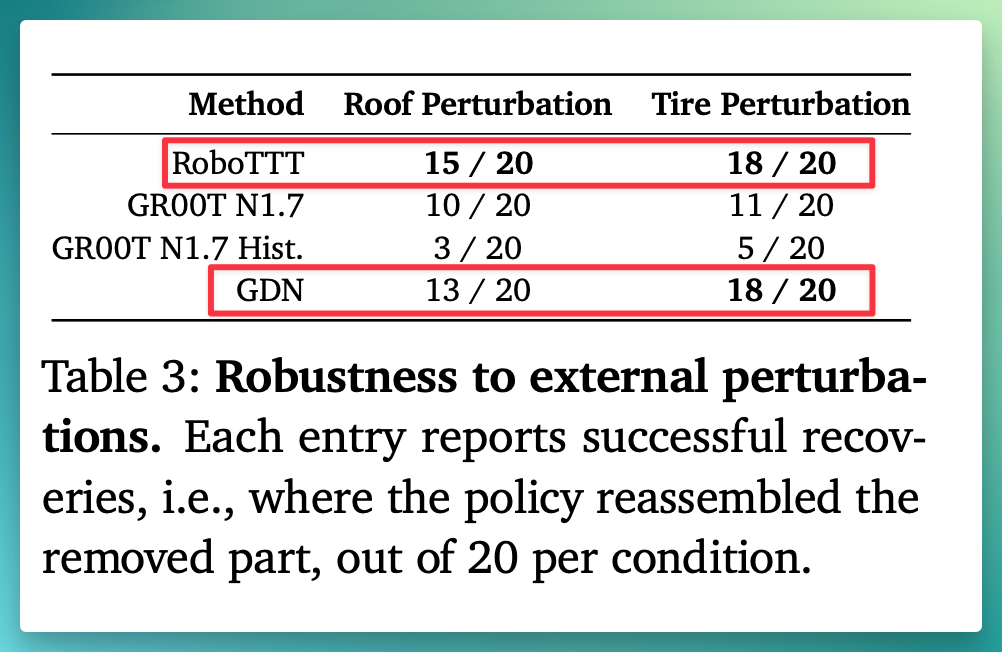
Combined across both perturbations, RoboTTT's recovery rate is 83%; the best short-context baseline is 53%.
However, these results require understanding two caveats.
First, the team additionally collected 30 minutes of perturbation data and co-trained it with original task data. All methods show some recovery ability, which the paper attributes possibly to joint training. Thus, RoboTTT's advantage mainly manifests in higher recovery rates, not in acquiring this capability from scratch without relevant training data.
Second, GDN ties with RoboTTT at 18/20 in the tire perturbation experiment. This suggests that, at least in this experiment, relatively coarse-grained state like "task progress" can be partially retained by fixed-size recurrent memory. Where RoboTTT and GDN diverge more significantly is in one-shot imitation requiring extraction of specific configurations and operation sequences from human video.
Context Length as a Potential New Scaling Axis
Beyond specific task performance, one of RoboTTT's most notable results is that the model's closed-loop performance continues to improve as pretraining context lengthens.
The research team pretrained with 128, 256, 512, 1K, 2K, 4K, and 8K timesteps respectively. Results show the 1K model achieved an average task completion score of 43.9%, while the 8K model reached 71.5% — a relative improvement of about 63%. By contrast, Gated DeltaNet did not show the same sustained growth trend.
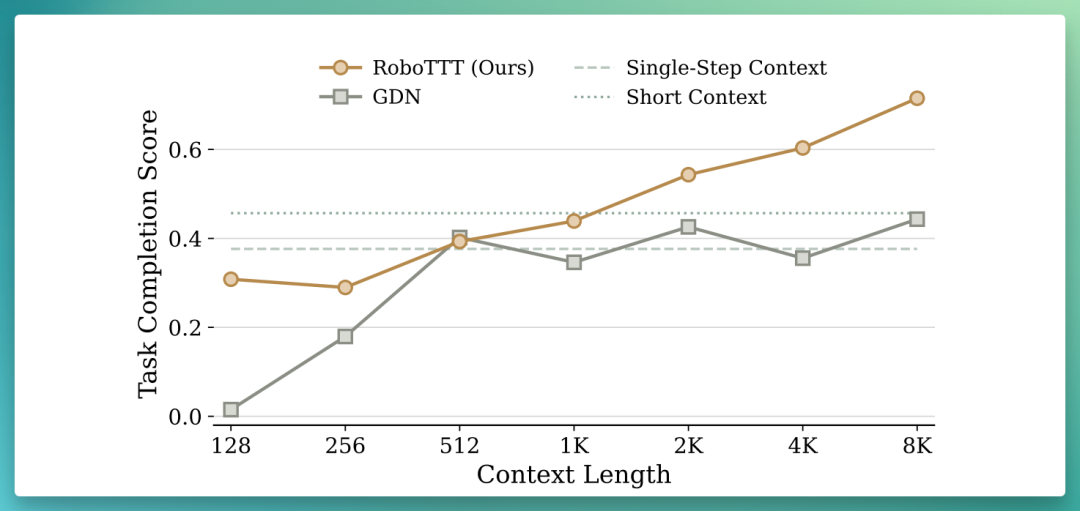
The paper attributes this difference to the two model classes' distinct state update mechanisms.
RoboTTT learns Fast Weights' initial state W₀ and update method through outer task loss; longer pretraining context means this state read-write mechanism gets trained over longer continuous trajectories. By contrast, GDN's linear associative state lacks the same gradient-based meta-learning process, and thus cannot convert longer training sequences into sustained shaping of state read-write capability through the same method.
It's important to emphasize that the 1K and 8K models have identical Fast Weights matrix shapes; what extends is the time span over which the model learns to manage this state set during pretraining, not Fast Weights' state capacity.
These results suggest pretraining context length could become a new Scaling Axis for robot foundation models. However, experiments across different context lengths did not fully fix training token count, batch size, and total computation, so this trend cannot yet be treated as a validated Scaling Law.
RoboTTT's Capability Boundaries
RoboTTT can continuously process longer inputs, but this doesn't mean it has unlimited memory.
Fast Weights' capacity remains fixed; past experience can only exist in lossily compressed form. As new information continuously writes in, new experience may overwrite old experience, similar task states may interfere with each other, and erroneous perception may contaminate current state.
Therefore, the truly important future question isn't whether context can increase from 8K to 1M, but when the model reaches the millionth step, how much important information from the thousandth step remains.
RoboTTT's demonstrated error recovery also has clear boundaries.
Its "failure-correction" capability comes from DAgger Distillation, where training data already contains both robot failure actions and human corrective actions.
Thus, what the model leverages at test time are correction patterns learned during training — not autonomous solution-finding for arbitrary unknown failures.
Moreover, the "constant inference cost" claimed in the paper requires precise understanding.
It means per-step cost doesn't continue increasing with already-processed history length, not that RoboTTT's absolute computational cost is low. RoboTTT increases DiT parameters from approximately 538 million to approximately 690 million, and experimental deployment used a workstation equipped with NVIDIA RTX 5090.
Whether it can maintain the same real-time control capability on low-power edge robot chips remains to be verified.
RoboTTT also hasn't demonstrated cross-task, cross-day continuous learning.
In the paper's experiments, each rollout restarts from the trained initial state W₀; it hasn't yet shown how experience in Fast Weights can be retained across tasks, shared across multiple robots, or audited and rolled back after state contamination.
The experimental scope itself is also relatively limited.
Current evidence mainly comes from the same YAM bimanual robot platform and three tabletop assembly tasks, with each formal test typically comprising only 10 to 20 trials. Whether it can transfer to other robot embodiments, sensors, and open environments requires broader validation.
When Memory Becomes a Learning Process
Returning to that screw that wasn't tightened.
Whether the robot itself missed the screw, or the already-installed roof or tire was removed mid-way by someone, it needs to let prior perception and action continue influencing current decisions, in order to readjust or return to correct steps.
What RoboTTT changes is not just how much history robots can utilize, but how history enters the model:
Long history isn't preserved complete in ever-growing cache, but serves as learning material, continuously rewriting a fixed-size internal state through repeated gradient updates.

References
[1] RoboTTT: https://research.nvidia.com/labs/gear/robottt/#evaluation-results