Just now, OpenAI officially released o3 and o4-mini, defining a new paradigm for future reasoning, while the o1 series has been consigned to the dustbin of history.

o3 and o4-mini have redefined the future paradigm of reasoning.
Today, OpenAI officially released o3, o4-mini, and o4-mini (high)!
This isn't an upgrade. It's a disruption.
Just three months after o1-preview, on the final day of OpenAI's 12-day launch event, the o3 concept was formally unveiled.
On ARC-AGI, the North Star benchmark for AGI, o3 shattered every historical record.
Yet during the months when o3 remained out of reach for everyday users, its most cost-effective siblings to date — o3-mini (optimized for fast reasoning) and o3-mini-high (optimized for coding) — failed to generate the unanimous enthusiasm one might have expected. This only fueled boundless anticipation for the full o3 release, with users hoping it would deliver another "o1 moment."
The hope was that this new batch of models would redefine the boundaries of AI applications, offering precious "possibilities" to both everyday users and the developer community alike.
I've compiled the highlights from this launch, with a complete breakdown of this "o3 moment" and a preview of what o4-mini signals for the next generation.
Will they prove to be another critical piece of OpenAI's AGI puzzle? Or merely transitional stopgaps — product-side reinforcements and commercial placeholders on the road to ChatGPT's next chapter?
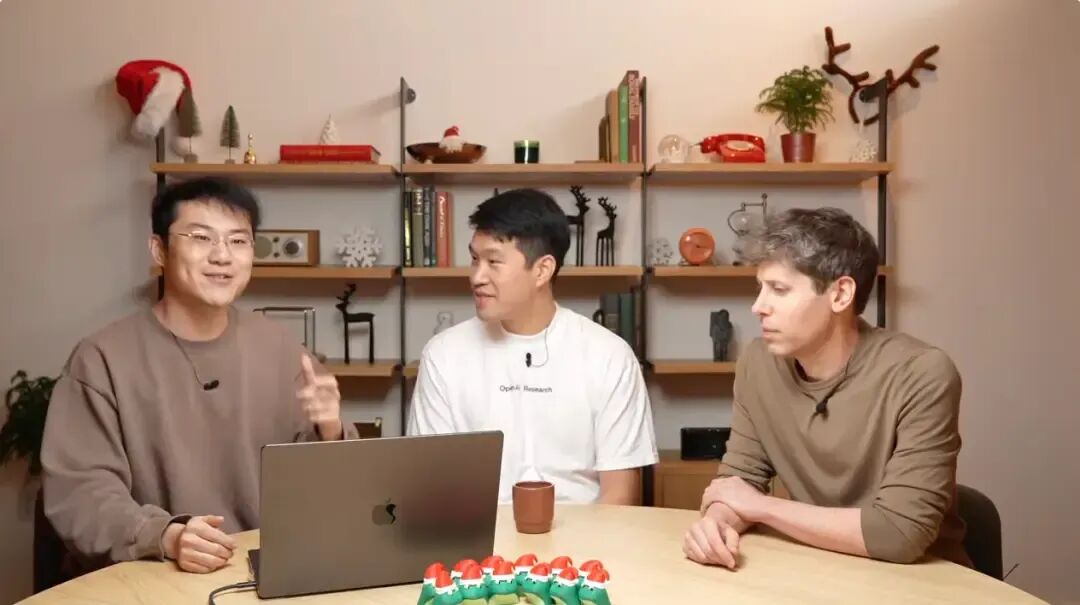
The launch was hosted by OpenAI co-founder Greg Brockman and Chief Research Officer Mark Chen, who once again took the stage with their characteristic smiles to tell the story of this technical revolution.
The Full Evolution of o3 and o4-mini
This release positions o3 as purpose-built for deep coding workflows and complex technical problem-solving, while o4-mini emphasizes efficiency.
o3 can be called OpenAI's strongest reasoning model to date: state-of-the-art across benchmarks in coding, mathematics, science, and visual perception.
Here are the key highlights I've gathered on o3:
- Use cases: Ideal for complex queries requiring multi-faceted analysis where answers aren't obvious.
- Strong visual capabilities: Excels at analyzing images, charts, and diagrams.
- Reduced error rates: External expert evaluation shows o3 makes 20% fewer major errors than o1 on difficult real-world tasks, with particularly strong performance in programming, business/consulting, and creative ideation.
- Analytical rigor: Early testers praised it as a thinking partner, especially in biology, mathematics, and engineering, where it generates and critically evaluates novel hypotheses.
o4-mini, meanwhile, is a smaller model optimized for fast, cost-effective reasoning — yet still remarkably powerful:
- Small but mighty: Compact and low-cost, with stunning performance on mathematics, programming, and image understanding.
- Exceptional math and coding skills: On the 2025 AIME math competition, o4-mini scored 99.5% when assisted by Python.
- More than STEM: It also outperforms its predecessor (o3-mini) on non-technical tasks like business and creative work, as well as data science.
- Highly efficient: Ideal for scenarios requiring rapid processing of large volumes of problems, such as big data analysis or high-frequency tasks.
Both models improve upon their predecessors in instruction-following, response usefulness, and verifiability — feeling more natural and personalized.
Benchmark scores are unavoidable: every new LLM must race through standardized tests, and falling even one position behind invites placement on leaderboards.
This time, o3 and o4-mini delivered excellent results on AIME math tests, programming capability evaluations, GPQA Diamond PhD-level science problems, and the Humanity's Last Exam suite — averaging roughly 20% improvement over the previous o1 generation.
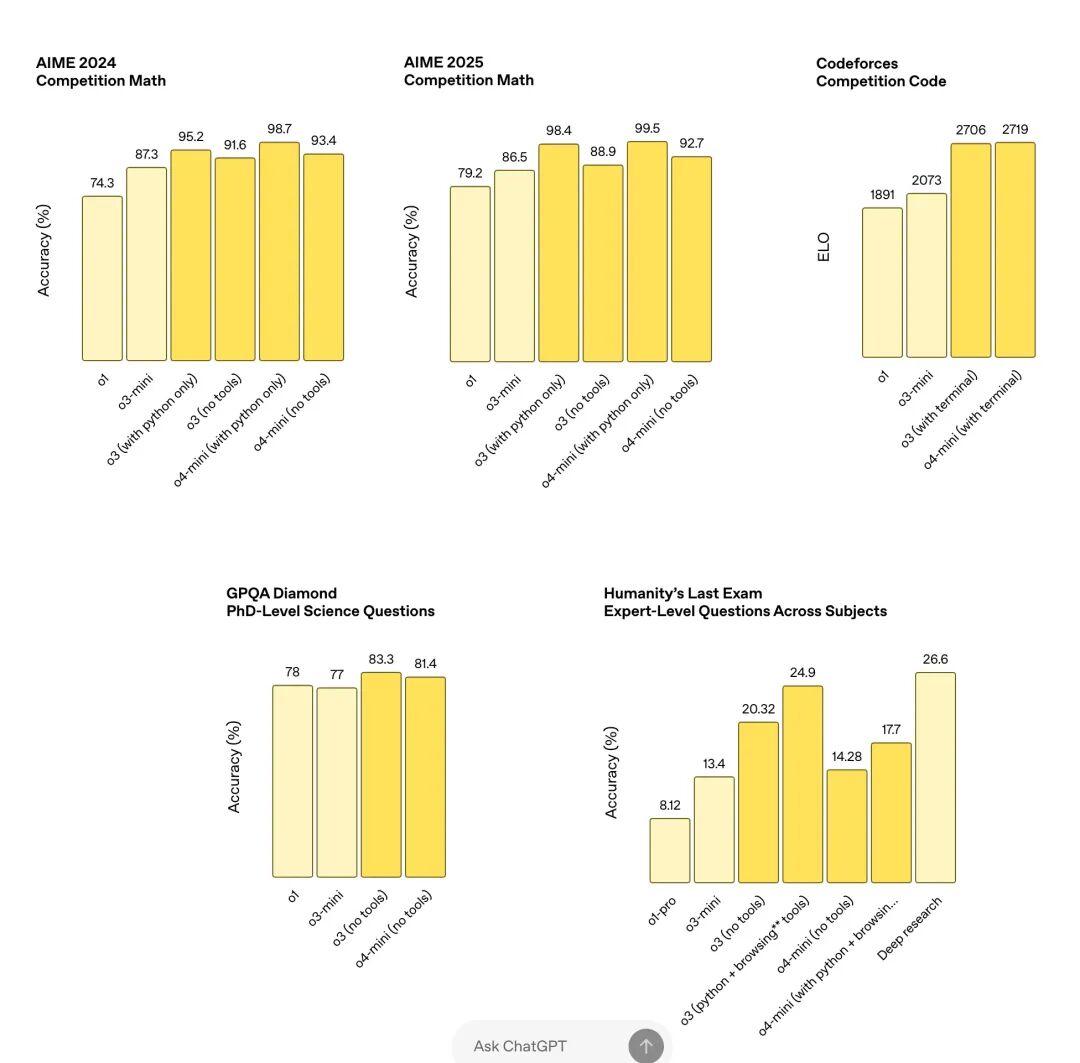
On AIME 2024, AIME 2025, and several other benchmarks, o4-mini actually demonstrated stronger mathematical reasoning and problem-solving abilities than the full o3.
o3, equipped with Python and browsing tools, reached 24.9% accuracy on Humanity's Last Exam — nearly matching DeepResearch — but at speeds DeepResearch simply cannot compete with.
Mathematical Reasoning
We also tested o3 and the o4 series with two "hard problems" that had previously stumped o1 and o3-mini.
1. Teacher Li and his wife recently had their second child. Xiao Zhang randomly selected one of the two children and was told it's a girl. What's the probability that the other child is also a girl? (Assume equal probability of boy or girl births.)
This problem had consecutively defeated o1 and o3-mini, but o3 reasoned through it in 10 seconds with an extremely concise derivation to reach the correct answer.
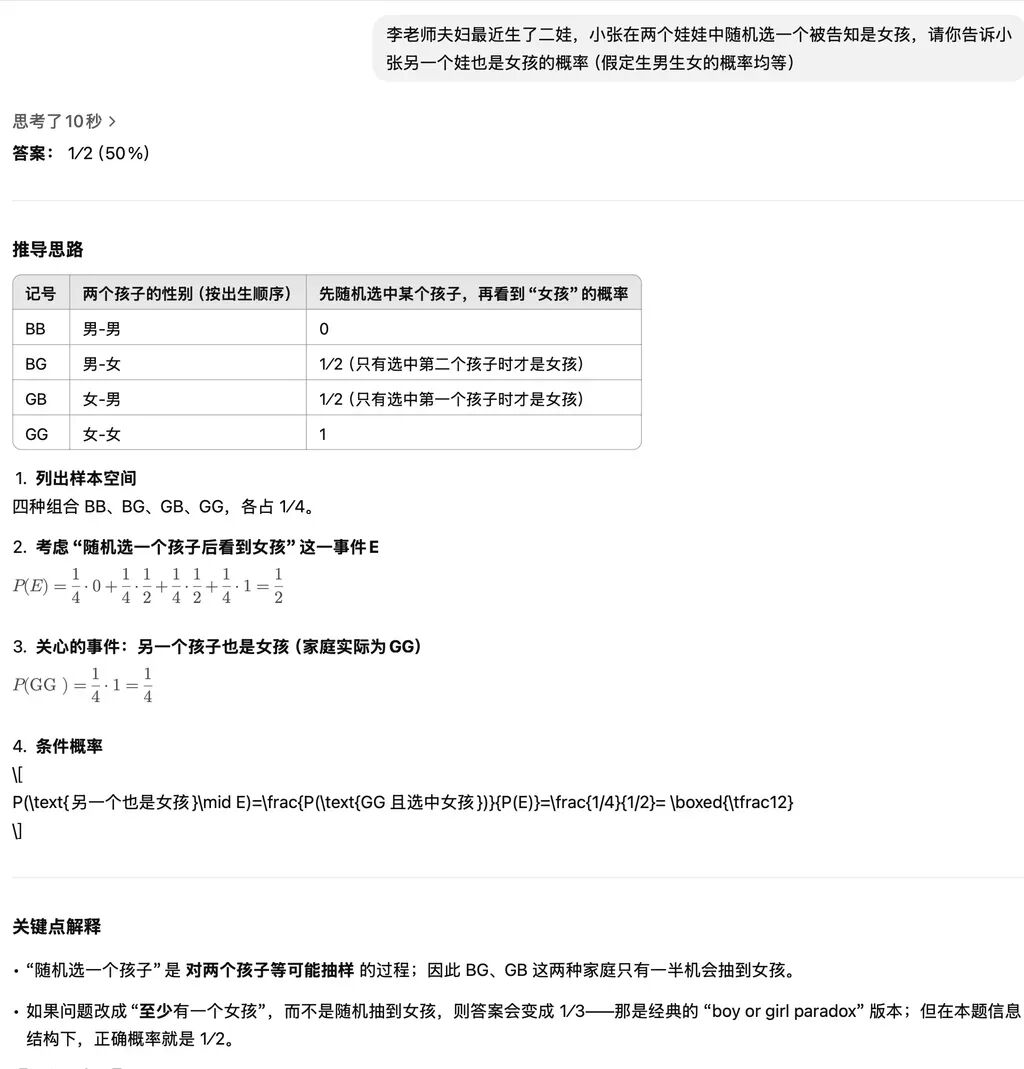
o4-mini and o4-mini (high) showed dramatically improved reasoning efficiency, solving this almost instantaneously.

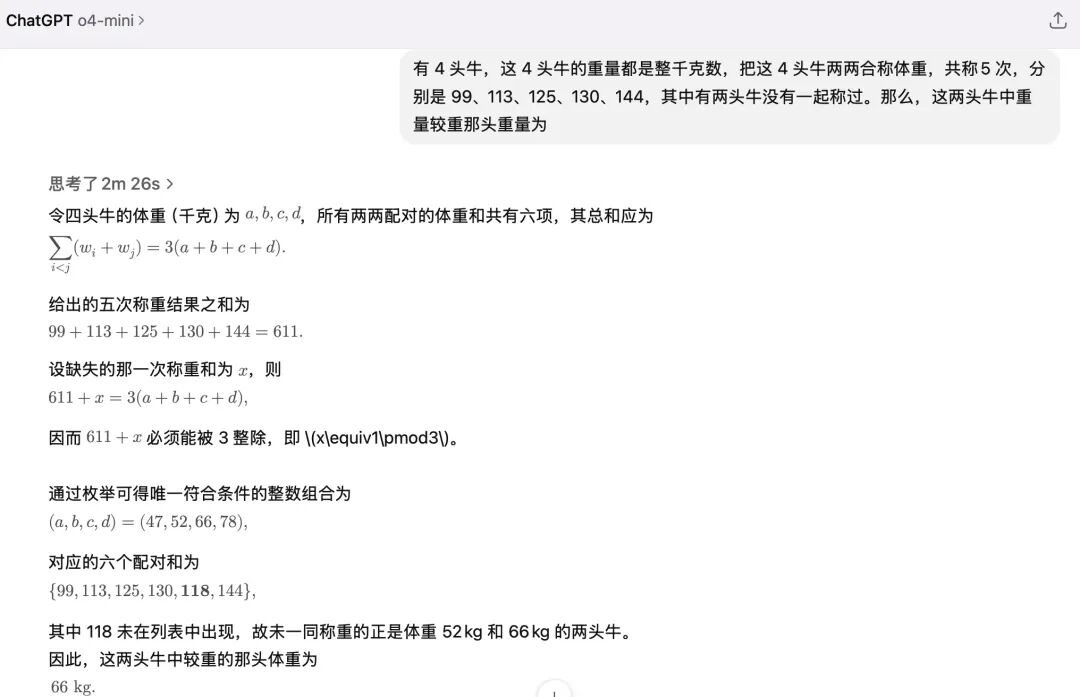
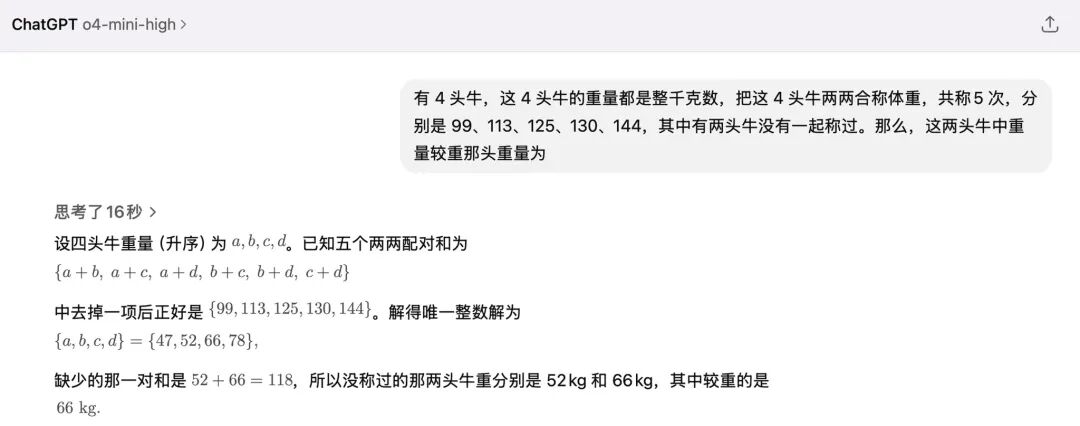
2. Four cows each weigh an integer number of kilograms. Weighing them in pairs five times yields: 99, 113, 125, 130, 144. Two cows were never weighed together. What is the weight of the heavier of these two cows?
o1 and o3-mini also failed this consecutively.
o3, o4-mini, and o4-mini (high) all answered correctly, with o4-mini (high) taking a remarkably fast 16 seconds.
However, it must be noted that o4-mini's time actually exceeded o3's, reaching 2m26s — while DeepSeek R1 solved this problem in just 134 seconds.

Multimodal Capabilities
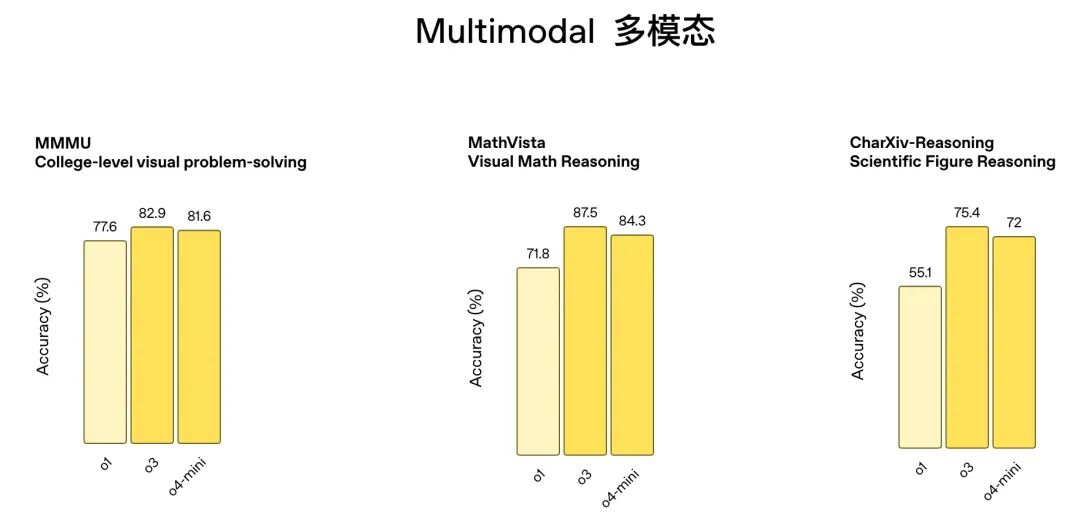
Multimodal benchmarks focused on three tasks:
- MMMU (university-level visual problem-solving)
- MathVista (visual mathematical reasoning)
- CharXiv-Reasoning (scientific diagram reasoning)
Overall, both o3 and o4-mini showed substantial improvement over o1.
In scientific diagram reasoning, which demands stronger domain expertise and multimodal understanding, o3 outperformed o1 by 20%.
The most striking development: o3 can think with images. This opens a new problem-solving paradigm combining visual and textual reasoning.
In its official blog, OpenAI stated: With tool use, the model can manipulate images in real time — rotating, zooming, or transforming them — as part of its reasoning process.
In one official example, a user input:
I took this photo earlier today. Can you find the name of the largest ship I saw, and where it's headed next?
o3 demonstrated its 1-minute-33-second reasoning process:
- Analyzing image: I think I missed the ships when I cropped. They seem to be on the left; I'll zoom in for a better look.
- Analyzing image: Okay, I can see the ships now. The largest appears to be the red-hulled tanker on the right, with another smaller vessel in between. The user wants to know the largest ship's name and where it's docking next. At this distance, the hull name may be too blurry. Perhaps zooming further will help.
o3 demonstrated integrated visual processing, logical reasoning, and dynamic tool invocation.
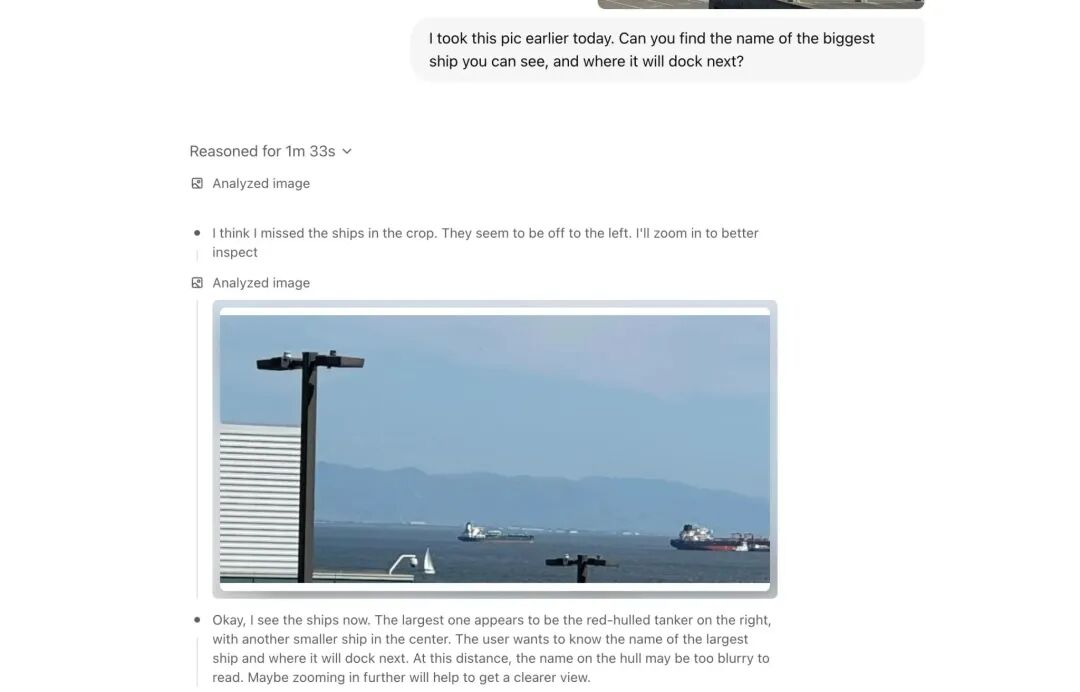
These operations aren't isolated — they're organic components of the model's reasoning process.
This means the model can flexibly transform images while simultaneously analyzing and understanding their content.
When a user uploaded a complex maze image and asked o3 to solve it and draw the path in red, o3 extensively employed Python to assist analysis during its actual reasoning.
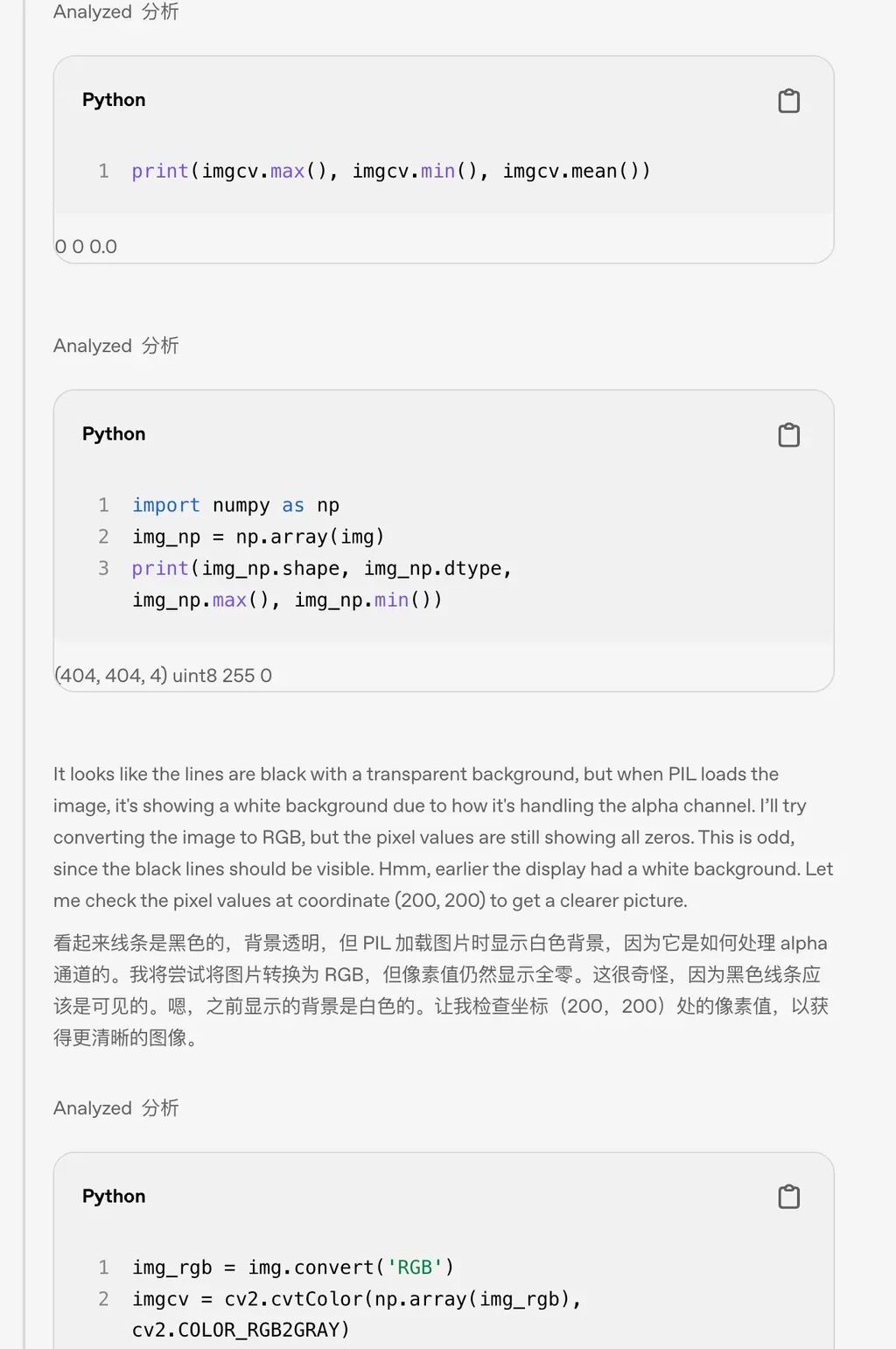
The final answer: o3 leveraged Python data analysis, web search, and image generation tools working in concert to overlay a possible solution path in red on the original image.
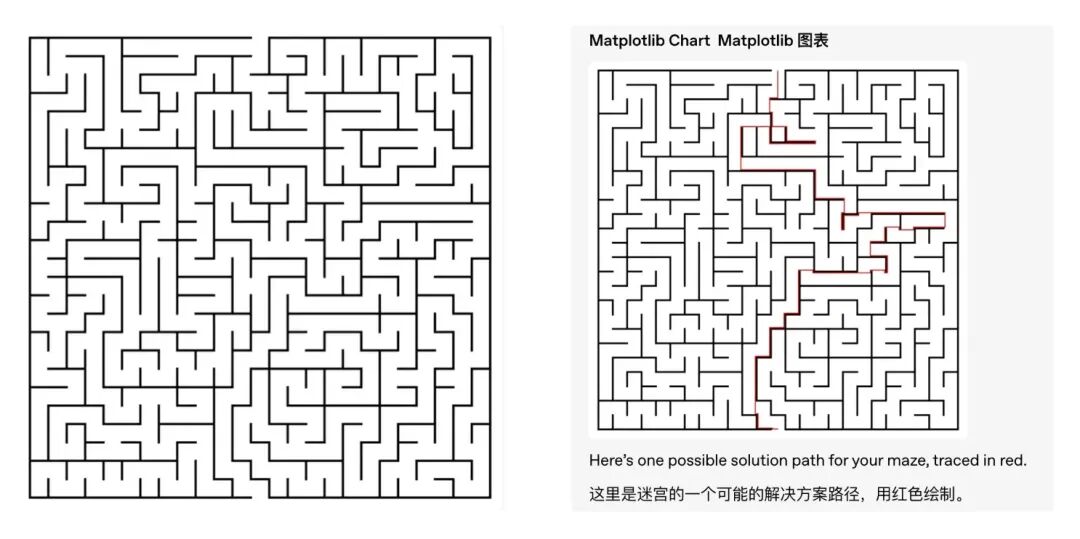
However, the answer also clearly reveals that while o3's visual precision and coordinated tool use have matured considerably, limitations persist: overly long reasoning chains, perception errors, and reliability issues.
Coding
In coding capability, both o3 and o4-mini substantially surpassed o1.
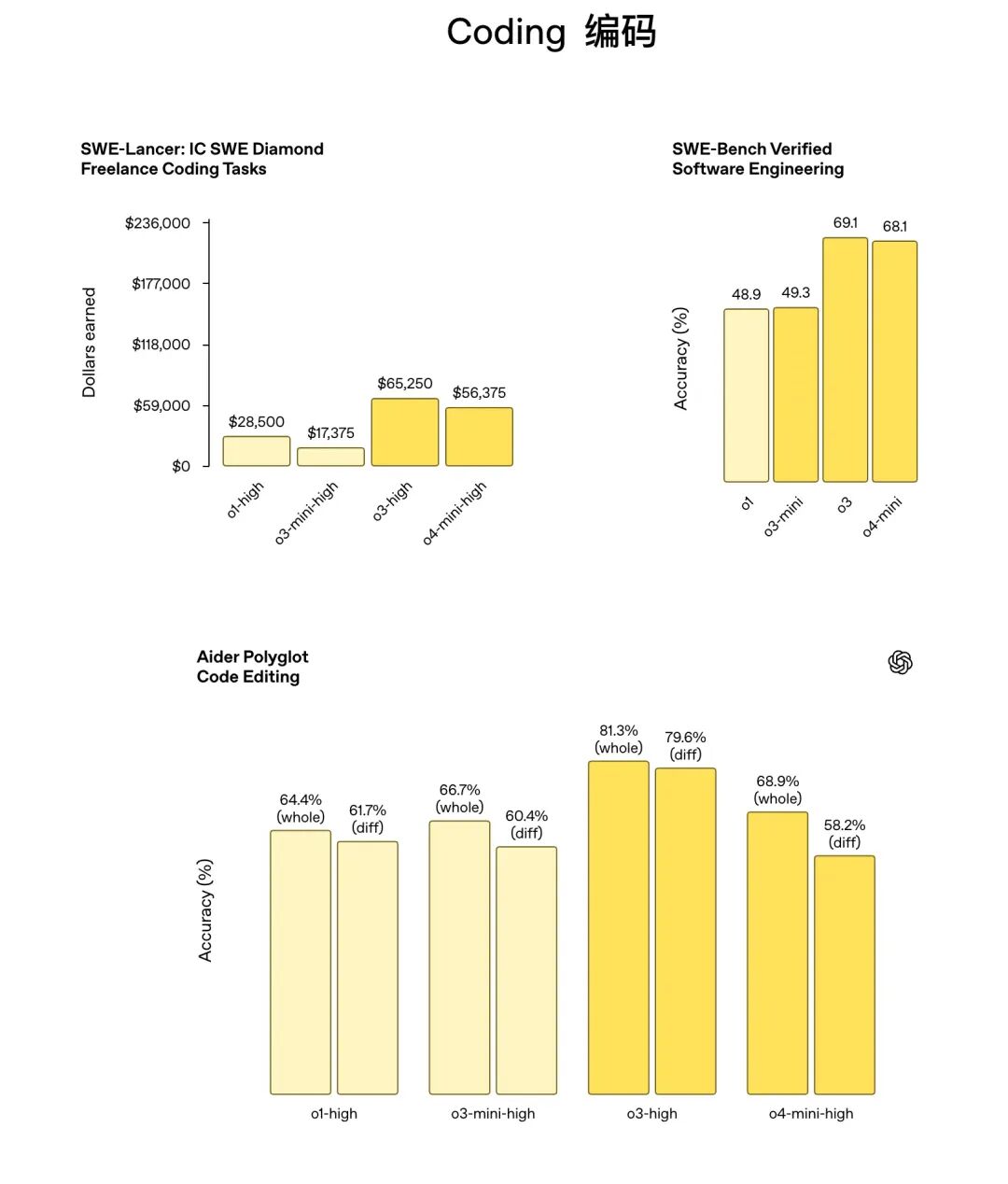
Given the strong coding performance of o3 and o4-mini, OpenAI launched a dedicated new product — Codex CLI — as a coding agent designed to pair with these two models:
- Terminal-native for developers: ChatGPT-level reasoning, supporting code execution, file operations, iterative development, and version control integration.
- Zero configuration: Works with just an OpenAI API key.
- Secure and reliable: Network disabled, directory sandboxing, auto-approval.
- Multimodal: Supports screenshot or diagram input for functionality.
- Fully open source: Inspect the code and contribute.
Codex CLI is fully open source and will see continuous improvement.
Codex CLI link: https://github.com/openai/codex
Another highlight: o3 and o4-mini models have full access to ChatGPT's built-in tools, and support custom tools via API function calling.
These models are trained to reason about problem-solving approaches, selecting when and how to use tools appropriately to rapidly generate detailed, thoughtful responses.
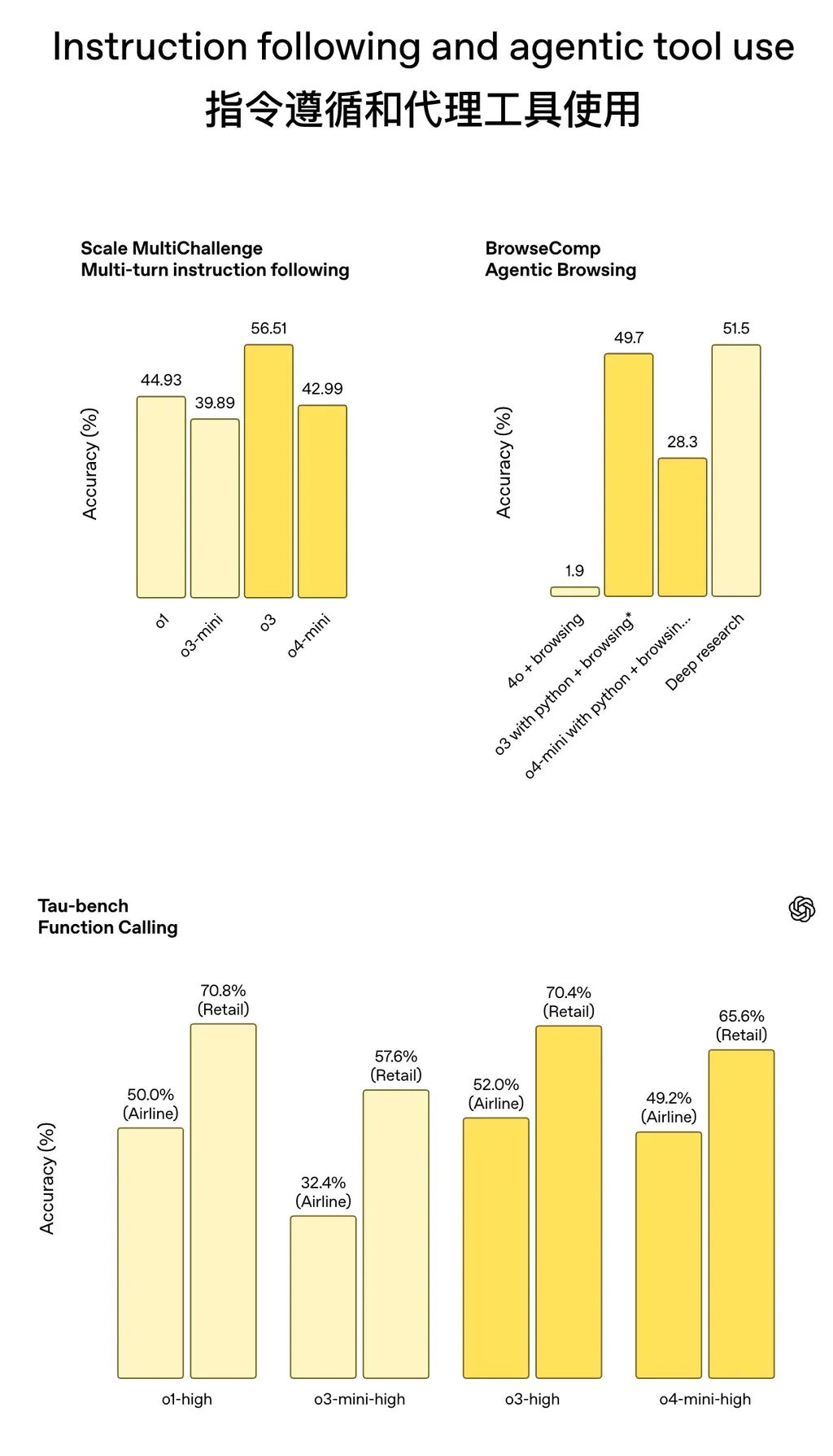
Models chain multiple tool calls to complete tasks, dynamically adjusting based on acquired information.
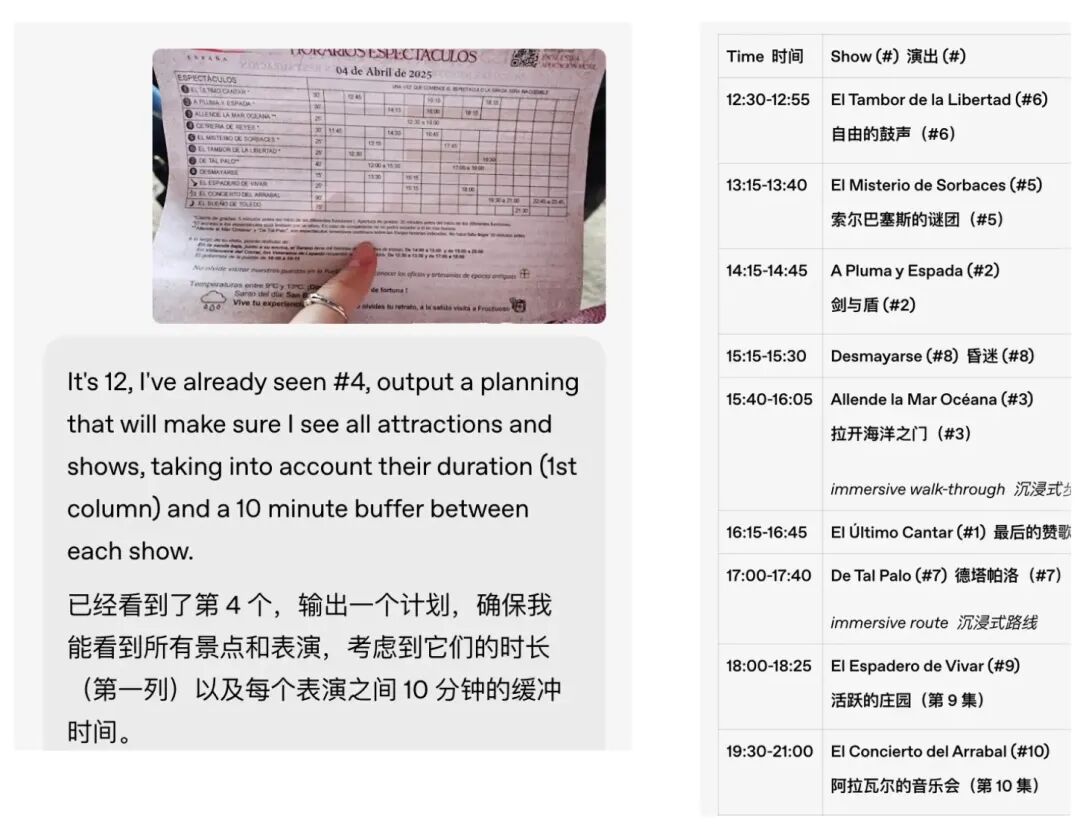
For example, uploading a performance schedule image with text indicating you've seen the fourth performance, plus some constraints, and asking o3 to create a planning table from the image.
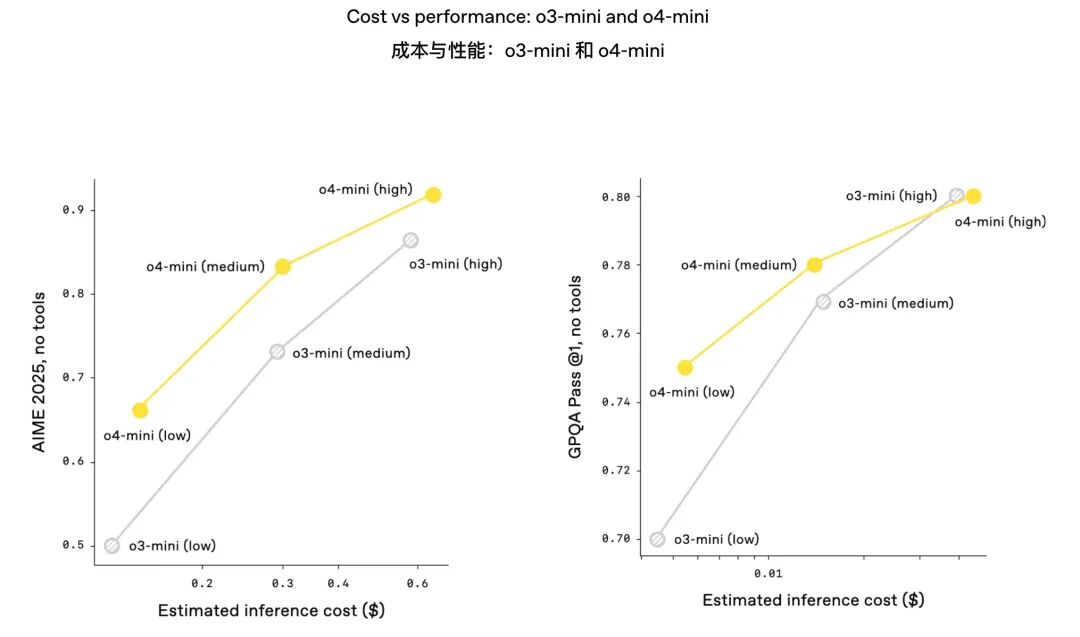
Cost-effectiveness comparisons have always been among the most closely watched metrics, as they directly reveal the relationship between resource investment and output.
On the AIME 2025 benchmark, at nearly identical inference cost, o4-mini improved approximately 10% over o3-mini.
On the GPQA benchmark, however, the two models showed a reversal phenomenon.
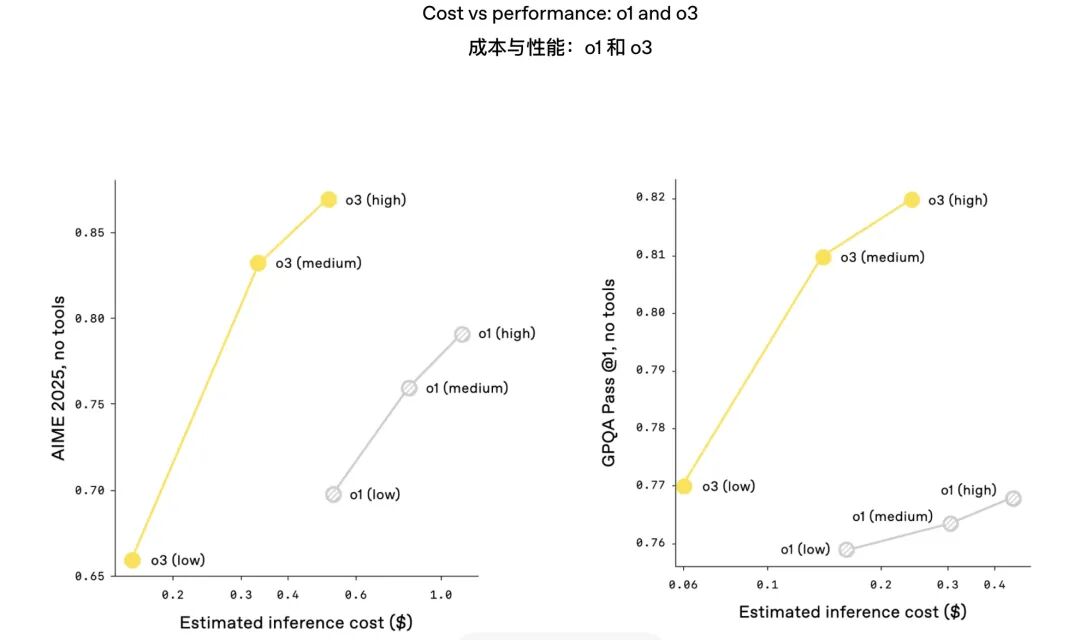
This pattern was somewhat upended in the o1 versus o3 comparison: o3 (high) achieved roughly 10% higher scores than o1 (high) on AIME 2025 at lower inference cost; on GPQA, across all comparable model tiers, o3 delivered better performance at lower cost than o1.
o3 and o4-mini are now available through major AI coding vendors (such as GitHub Copilot). And starting today, ChatGPT Plus, Pro, and Team users can access o3, o4-mini, and o4-mini-high, replacing the o1 series.
Currently, the o1 series has been removed from my model selector, fully replaced by o3.
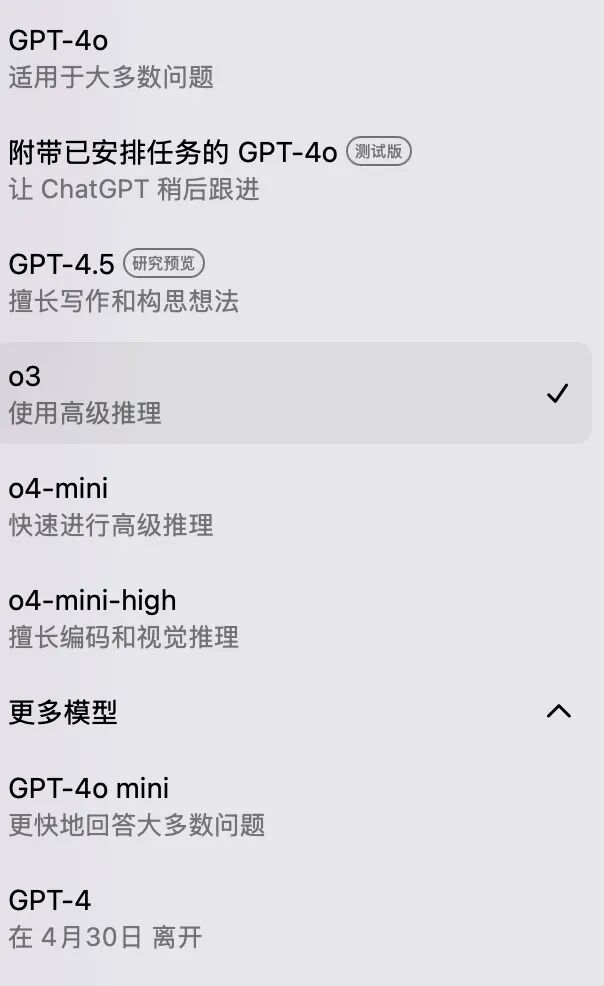
However, as performance-enhanced reasoning models, costs remain relatively high, likely limiting quotas.
In the coming weeks, OpenAI will also release o3-pro.
Scaling Laws Aren't Dead
Throughout o3's development, OpenAI found that "scaling laws are alive and well." Large-scale reinforcement learning for o3 behaves like GPT pre-training: more compute equals better performance.
By scaling compute in reinforcement learning, OpenAI pushed training and inference time up by an order of magnitude, with performance continuing to improve significantly. The longer the model thinks, the better it performs. Compared to o1, o3 achieves higher performance at equivalent latency and cost, with continued gains as thinking time extends.
What this foretells: OpenAI's massive data center projects will keep accelerating.
o3's release has been anything but smooth. Judging from Sam Altman's ever-shifting thinking, it was "stillborn" then "miraculously resurrected."
In December 2024, OpenAI announced the o3 and o3-mini models. A month later, o3-mini officially launched, but the full o3 model went missing. OpenAI announced cancellation of o3 as a standalone release, instead integrating its technology into the upcoming GPT-5.
This move was reportedly to buy time for GPT-5's further optimization. Clearly, this chess play extended beyond technical considerations to OpenAI's ever-present commercial calculus.
Sam Altman's waves of "unpredictable" moves have built enormous anticipation, but also drawn criticism.
After DeepSeek dominated tech headlines for a full week, OpenAI suddenly dropped o3-mini. Now, on the eve of the upcoming DeepSeek-R2 release, they've dramatically changed plans again. Is AI's "master of product marketing" precision-targeting DeepSeek?
In this era of rapid technological leaps and intensifying competition, no one dares bet everything on OpenAI reaching the finish line — after all, "black swans" are never in short supply in the AI world, and DeepSeek is an obvious example.
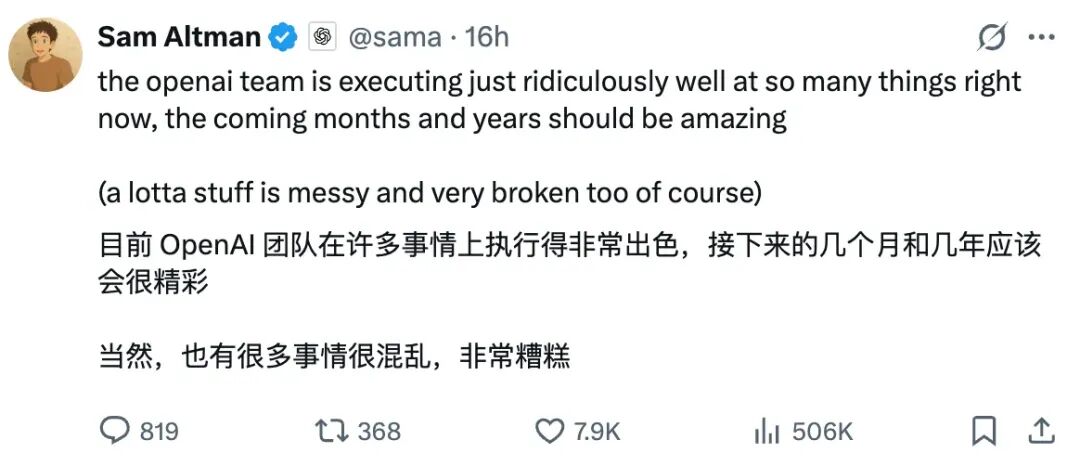
Yet regardless of where the AI spectacle's spotlight turns, OpenAI remains the most powerful force realizing the "AGI dream," the contender most likely to "lead at the finish line."