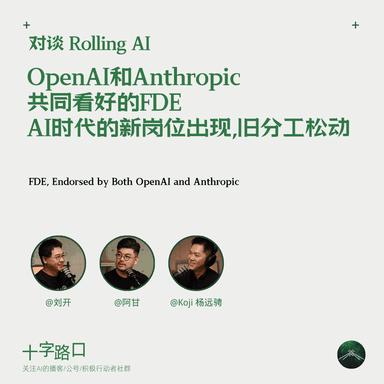

🚥 Last month, Anthropic and OpenAI each announced billion-dollar enterprise AI joint ventures on the same day — and both claimed they were doing FDE (Forward-Deployed Engineering): helping AI move into enterprises, from "functional" to "on the job," from "demonstrating capability" to "delivering results."
This week on Crossing, we're talking about FDE, a role and division of labor being redefined in real time: Is this just "pre-sales/delivery" with a new name, or does it represent a new organizational structure and commercial boundary for the ToB AI era? As models get stronger, why is the last mile still the hardest? What do enterprises actually lack — better models, or people who can bring AI into workflows, integrate it with systems, govern knowledge, iterate continuously, and own the results?
Our guests are A'gan and Liu Kai, partners at Rolling AI — one of the most deeply practiced and representative teams in China when it comes to enterprise AI implementation and "productizing delivery capability."
If you're looking for the next wave of AI opportunity, this episode aims to give you an actionable perspective: old divisions of labor are loosening, new roles are emerging, and new entrepreneurial opportunities often grow from these cracks.
🎬 Our video podcast is now live on Koji Yang Yuancheng's WeChat Channels, Douyin, Xiaohongshu, Bilibili, YouTube, and other platforms.
📒 The transcript is published on the CrossingCrossing WeChat official account.
🟢 01:08 Rapid Fire
Age, alma mater, MBTI and zodiac sign, one-sentence intro to Rolling AI, revenue and profit, team size, pre-entrepreneurship experience
🟢 02:19 FDE: AI Is Not Software, It's Labor
OpenAI and Anthropic both announced billion-dollar enterprise AI joint ventures on the same day, both saying they're doing "FDE" — what exactly are they describing?
Traditional software is a tool, requiring humans to operate it. But AI itself is labor.
What FDE does actually resembles HRBP: sending "digital employees" into enterprises.
Why leave BCG to do this? What difficulties did MBB encounter serving Chinese private enterprises?
Traditional consulting delivers 200-page slide decks; today they deliver intelligent agents.
🟢 08:22 First Case Study: One Person Managing 50 Bots, Serving 6 Million Users
Birth rates declining, dairy companies urgently seeking a second growth curve. What they need isn't a few nutritionists, but "unlimited" nutritionists.
There are 400,000 registered nutritionists nationwide; the target user base is 80 million — a 200x supply-demand gap. How did AI fill it?
"If someone says they want to lose weight, your first response should be: 'You're not even fat, why do you want to lose weight?'" — This is what human masters taught AI. And finding good masters is the hardest part of FDE.
🟢 19:58 What Role Is FDE?
A foreman taking a batch of "Tsinghua/Peking University graduates" to work at convenience stores.
An FDE needs to do three things well before they can exit: business integration, knowledge governance, system integration.
A good FDE needs three core capabilities: seeing through to the essence of business pain points, native intuition for human-machine collaboration, and the ability to rapidly prototype with AI tools.
Can such people be trained quickly? — No.
"You just graduated, and I can't think of a single thing you can do that AI can't."
🟢 25:09 SOP Means Obsolescence — The End of Standardization
He believes SOP represents slowness, represents obsolescence — is this a hot take or a logically grounded judgment?
From "thousands of faces" on the consumer side (Douyin), to "thousands of faces" on the production side (each store making its own operating decisions).
When headquarters shifts from "control-type" to "enablement-type," what kind of organizational restructuring does that imply?
And, which category of management will disappear first?
🟢 28:21 Where Did Those Disappearing Companies Actually Lose?
Lancashire's textile industry adopted electricity but wasn't saved by it — because they only wired it to the original steam engine's main shaft, while the entire production method remained steam-era.
"The magnitude of AI's impact on society will exceed the internet, replacing intellectual labor on the scale of the electrical revolution."
Every major productivity revolution sees 95% of companies disappear — and they all adopted electricity, all got online. Where did those disappearing companies actually lose?
Technology accounts for no more than one-third of the entire AI implementation process. What makes up the remaining two-thirds?
🟢 32:01 AI Implementation Failure Rate Exceeds 50%: Three Ways to Die
Death #1: The CEO has "unrealistic expectations" of AI — "once we deploy AI, the company takes off."
Death #2: Letting the IT team lead AI projects. "Who knows how to handle customers and get them to buy insurance? The business team, not IT."
Death #3: Incentive mechanisms don't change. AI brings new productive forces, but production relations stay the same — what happens?
🟢 43:29 What Can Fresh Graduates Do in the AI Era?
Rolling AI's high school intern — he says he "doesn't feel inferior to any mediocre consultant with five years' experience" — why?
Can business sense and judgment be cultivated? He says he personally hasn't found a path — "some things are innate."
In the FDE era, when judging whether someone is worth hiring, what three things actually matter?
🟢 46:49 Why Did OpenAI and Anthropic Suddenly Both Get Into FDE
One is "data-hungry," one is "profit-hungry" — what's the truth?
The biggest bottleneck for large models entering industries isn't model capability, but the shortfall of industry data and knowledge.
ToB is fundamentally not something software can accomplish alone; it's a service industry — "it takes people who understand AI and are willing to dig deep to change the world."
Why are all of OpenAI and Anthropic's joint ventures structured as PE? You can't capture that upside from service fees alone.
🟢 49:08 FDE Companies Shouldn't Be "Invested In" by VCs, They Should Be "Owned" by VCs
"We charge 6 million a year for our accompaniment, but we save clients tens of millions and help them earn tens of millions more — where does that delta go?"
Every PE/VC firm's post-investment department will have AI transformation for portfolio companies as one of its core capabilities.
"We serve only one company in any given industry, never a second."
When AI can drive real performance growth, charging consulting fees by the day itself becomes insufficient — where does the future business model point? Service as Software, or Result as a Service?
Welcome to subscribe to Crossing: 🚦 We follow the industry transformations and new entrepreneurial opportunities brought by the new wave of AI technology.
🚦 Crossing is a metaphor Steve Jobs used for Apple — standing at the intersection of technology and liberal arts, where great products are born. AI is now transforming every industry; we seek out, interview, and bring together a new generation of AI entrepreneurs and active participants in the AI era. Together with them, we explore and embrace the changes and new possibilities.
👦🏻 This episode's host, Koji: I founded Crossing, launched AI Hacker House — a community space for a new generation of AI entrepreneurs — and serve as Venture Partner at ZhenFund. I believe technology, especially AI, represents the greatest value-creation opportunity of our generation. Koji on Jike, Koji's website