Palantir CEO Slams OpenAI and Anthropic

Five Key Observations from Mid-Year.
Five Key Observations at Midyear.

👩 Author: Shirley
🥷 Editor: Koji
🧑🎨 Design: NCon

Have you ever considered that when companies pour fortunes into AI, they might actually be fattening up their own rivals?
This week, Palantir founder and CEO Alex Karp unleashed during a CNBC interview, taking direct aim at large model companies like OpenAI and Anthropic and declaring the entire industry absurd.
In his words, he was simply voicing the private fury that CEOs across America had been keeping to themselves.
Then the podcast All-In continued the discussion in an episode titled AI Sovereignty Wars, Palantir-Nvidia Deal, SCOTUS Birthright Ruling, Newsom's CA Budget Lie, covering AI sovereignty, the Palantir-NVIDIA partnership, and whether enterprises should hand critical capabilities over to a handful of large model platforms.

Meanwhile, SemiAnalysis founder Dylan Patel also appeared on the Sequoia Capital podcast, dissecting how the AI infrastructure landscape is being reconfigured from the angles of compute supply, NeoCloud, GPU allocation, and model company business models.
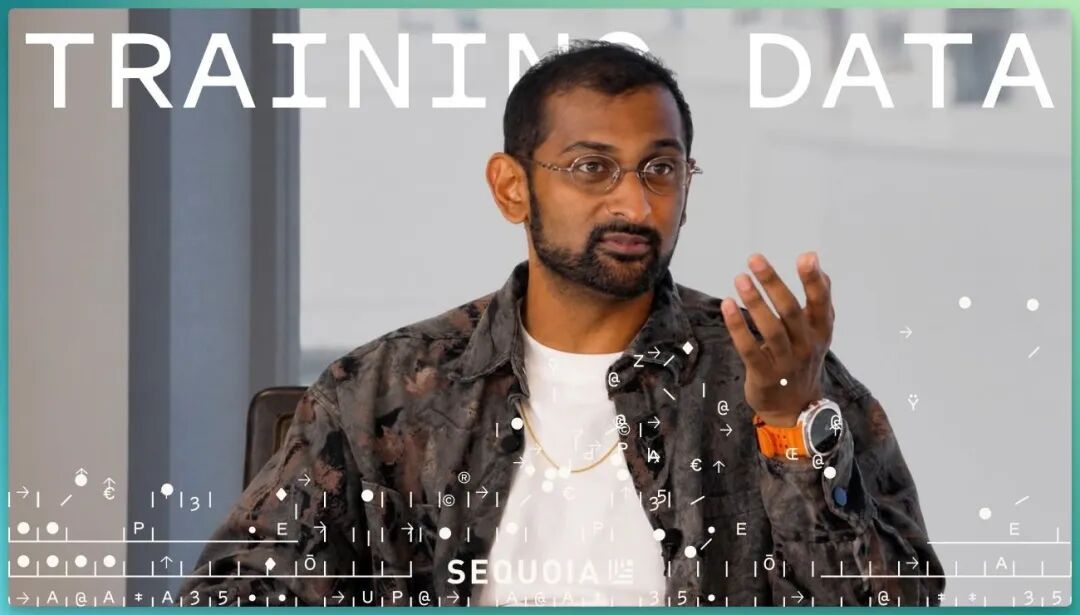
Viewed together, these three conversations mark an important shift at this critical juncture in mid-2026:
The battle among AI giants is moving from "whose model is stronger" to "who controls data, compute, deployment, and business processes."
Today, Crossing distills the highlights from these three outstanding discussions into five key observations — as AI competition shifts from model performance to system control, what enterprises, cloud providers, chip companies, and application platforms are each fighting for.
Observation One: Karp's Fury Is Really About Control Anxiety
Every time you call OpenAI or Anthropic's API, you're feeding your proprietary data to their models; you're spending plenty while fattening up a giant that might turn around and compete with you tomorrow — they're the barbarians at your gate. Karp calls this "paying to cultivate your opponent," reducing enterprises to "free sparring partners" for large models.
The real moat is ownership, not rental. The decisive factor going forward won't be whose model is stronger, but who holds the model weights and data. Hand these "means of production" to a third party, and your unique advantages are surrendered.
Outsourcing national security to Silicon Valley is too dangerous. If military and intelligence capabilities — the lifeblood of a nation — are entirely staked on the "consensus" of a few Silicon Valley companies, that's handing defense over to someone else's commercial interests.
Karp practically slammed the table during the interview:
Are we really going to outsource the battlefield of this country to the consensus view in Silicon Valley? That is effing insane.
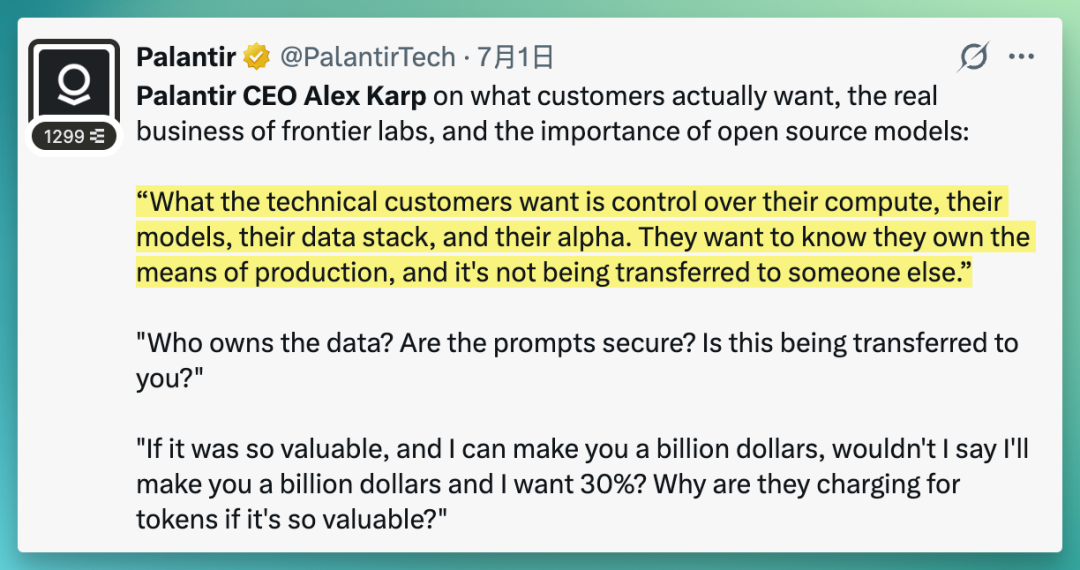
Karp's points are razor-sharp, but he's a stakeholder. The louder his outbursts, the more urgently his alternative solution needs to land.
Just days before this interview, on June 29, NVIDIA officially announced a partnership with Palantir to launch a solution called the "Sovereign AI Operating System." It integrates the open-source model Nemotron into Palantir's systems, accelerated by NVIDIA's underlying architecture. Crucially, customers can use the model and weights in environments they control.
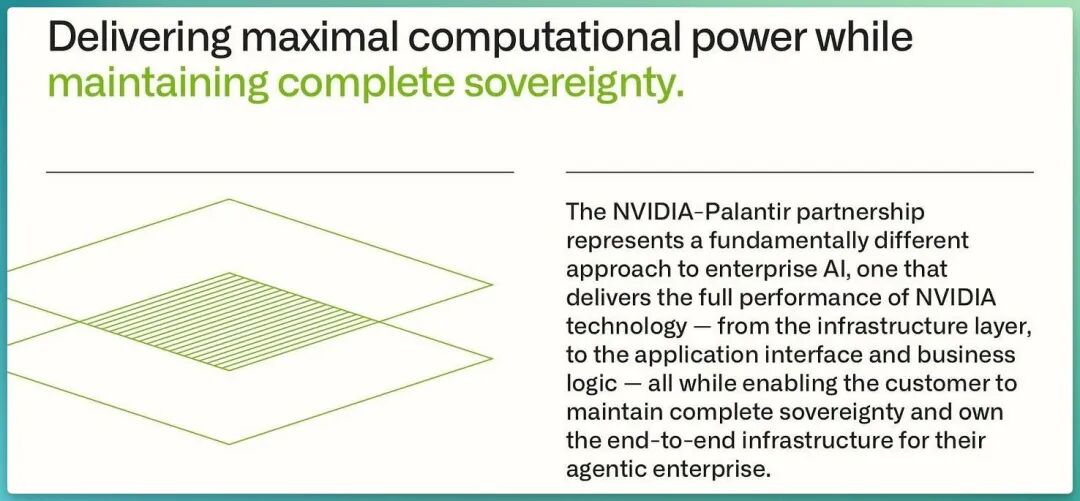
Thus, Karp's anger comes into clearer commercial focus: he criticizes cloud-based large model providers for "selling water," while Palantir wants to sell customers a "well" they can control themselves — data stays inside the enterprise, models and compute deploy in controllable environments, and AI ultimately embeds into real business workflows.
Observation Two: Cracks in the API Business, Enterprises Begin Restructuring AI Architecture
To assess whether Karp's judgment holds, you can't just listen to his emotions — you have to look at what's happening with enterprise procurement and market pricing.
Bloomberg cited Silicon Data's "LLM Token Expenditure Index," which sends an unambiguous signal. The index primarily tracks users' marginal willingness to pay for AI tokens and has now fallen nearly 20% from its May peak.
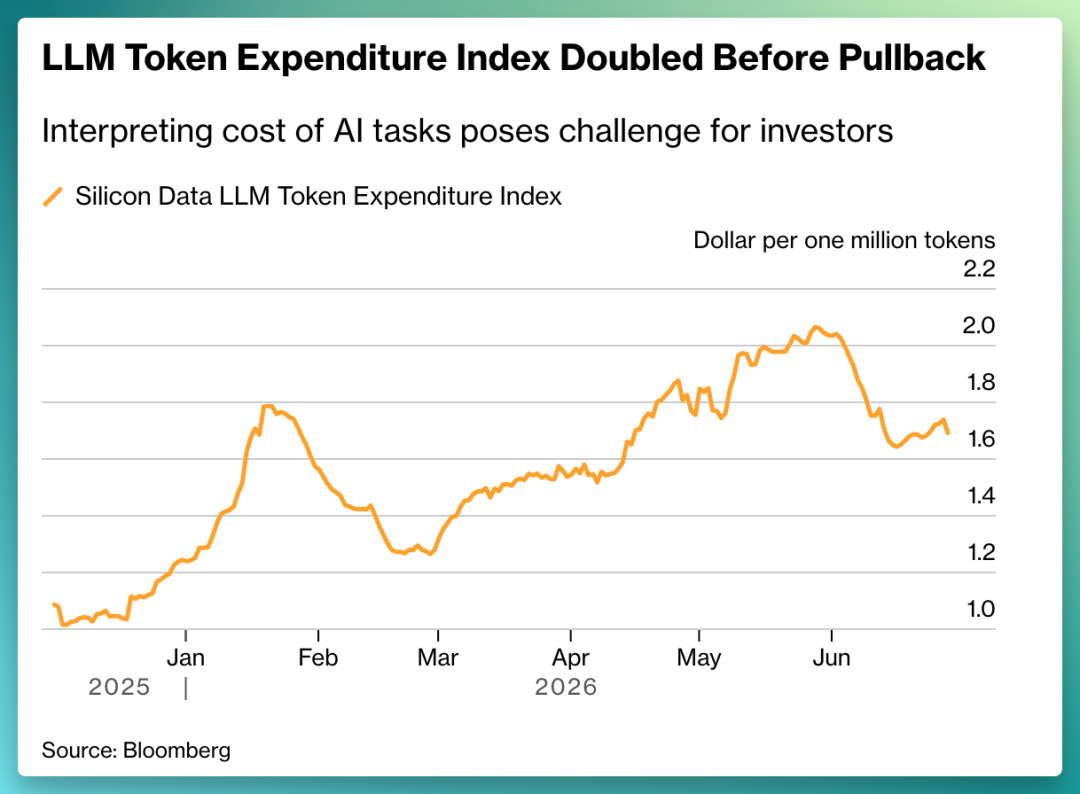
It's worth noting that the decline itself doesn't equate to weakening demand for large models. Rather, it suggests subtle shifts in model pricing, model usage structure, and enterprise sensitivity to AI costs.
The token spending drop likely stems from multiple overlapping factors: 1) price competition among closed-source models; 2) demand actively shifting toward more cost-effective lightweight and open-source models; 3) buyers beginning to re-examine the ROI of AI projects.
For enterprises, procurement logic is indeed shifting.
Previously, many companies directly integrated large model capabilities via public cloud APIs; but as compliance requirements, data governance, local compute improvements, and open-source model capabilities advance, more enterprises are adopting hybrid deployments: keeping sensitive data, repetitive tasks, and internal knowledge processing on-premises or in private environments, while sending only complex tasks requiring strong generalization capabilities to cloud models.
This means future enterprise AI will likely not be "closed-source models replacing open-source models," nor "cloud replacing local," but three paths coexisting:
- Closed-source model + public cloud: suitable for general tasks requiring rapid access to frontier capabilities;
- Open-source model + NeoCloud: suitable for customers with large-scale compute needs who don't want to be fully locked into hyperscalers;
- Open-source model + on-premises deployment: suitable for data-sensitive, highly regulated, or complex edge environments.
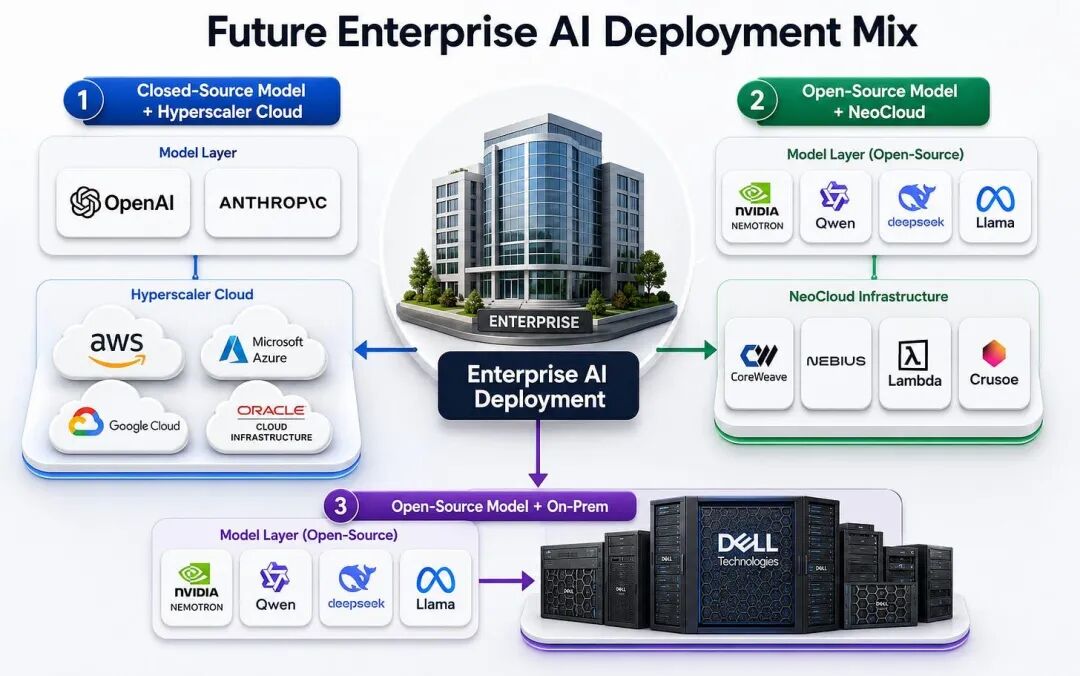
When cost, compliance, performance, and controllability are placed on the same procurement spreadsheet, enterprises are unlikely to choose just one model or one deployment method.
Capital market pricing for different segments is also beginning to diverge: hyperscalers need to prove how massive AI capex translates into returns; NeoClouds, server deployers, and infrastructure suppliers are gaining attention due to more direct demand.
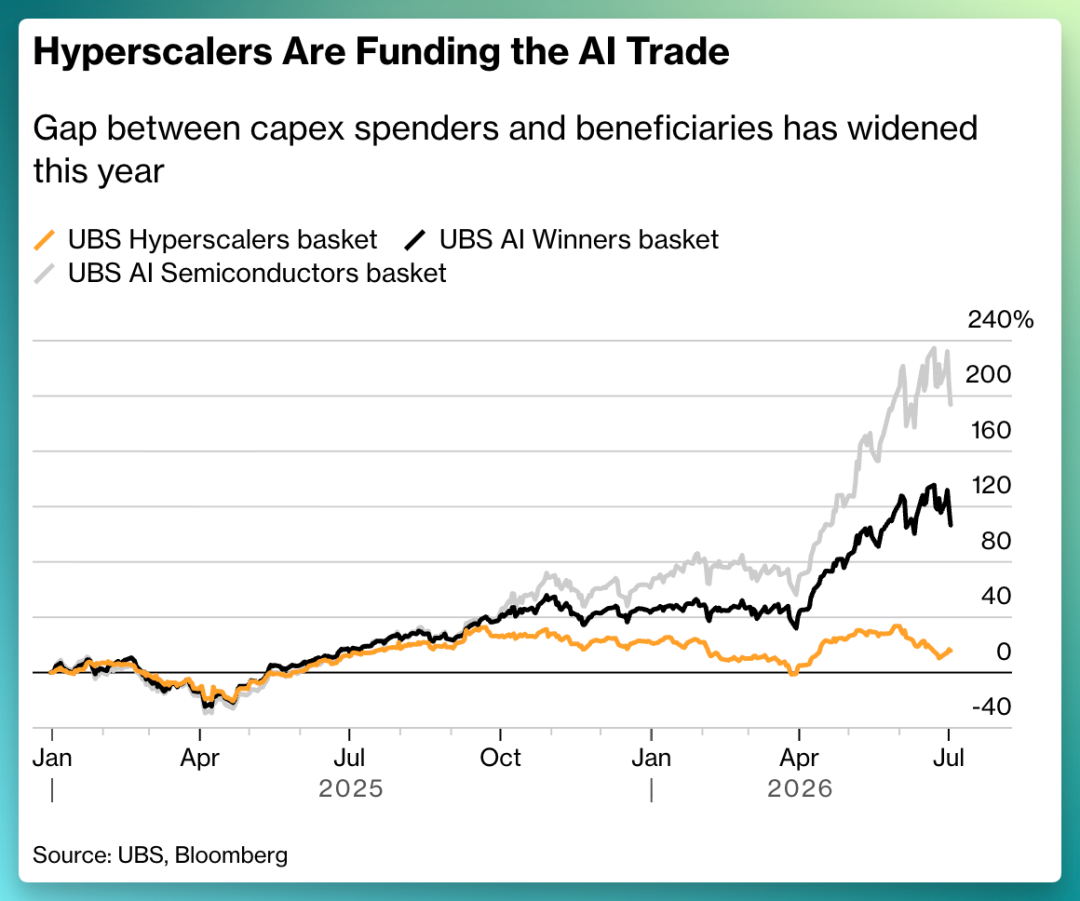
This doesn't mean "smart money" has proven one technical path victorious, but the market is signaling that the AI profit pool is expanding from single-model call fees to compute, deployment, operations, and industry workflows.
Observation Three: NVIDIA Doesn't Bet on One Path — It Offers Ladders for Every One
The coexistence of three deployment paths is a highly favorable situation for NVIDIA.
Whether enterprises choose closed-source models with public cloud, NeoCloud, or on-premises open-source deployment, the underlying layer requires high-performance compute resources. Model and cloud providers may rise and fall against each other, but as long as total AI compute demand keeps growing, NVIDIA remains in a critical infrastructure position.
SemiAnalysis founder Dylan Patel, on the Sequoia Capital podcast, summarized NVIDIA's strategic situation:
He needs to point the allocation gun at NeoClouds... A world where OpenAI, Anthropic and Google models are the only models is one in which he's screwed. A world in which the hyperscalers are the only ones building compute is one he's screwed in.
So NVIDIA is desperately manufacturing a "multipolar world": nurturing NeoClouds, nurturing open-source models, nurturing any force that can disperse the landscape.
At the end of December 2025, through an exceptionally shrewd "non-exclusive technology license + core team acqui-hire" structure, NVIDIA brought Groq's soul figure Jonathan Ross and his entire core team in-house for approximately $20 billion. Ross was the principal designer of Google's TPU.
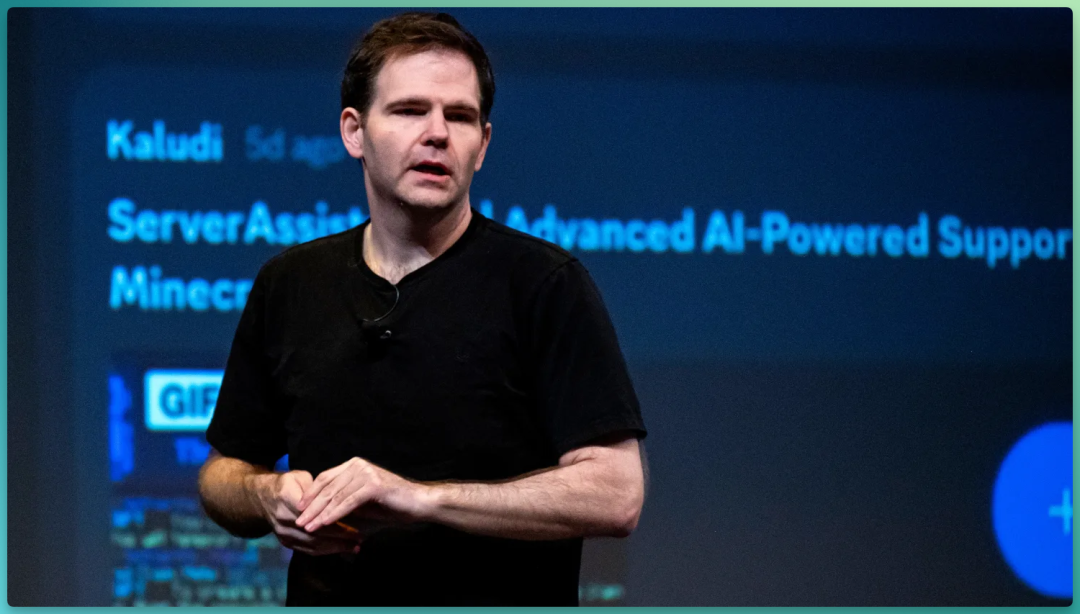
The reason isn't hard to guess: as AI's center of gravity shifts from training to inference, GPUs are most vulnerable to specialized chips precisely in this lucrative segment.
And the NeoClouds that received NVIDIA's allocations aren't winning market share from under the giants' shadows on price alone.
Dylan Patel points out that traditional cloud providers like Amazon built their core competencies — Nitro network card tenant isolation, Graviton custom CPUs — for traditional multi-tenant CPU environments. But once you enter AI workloads with whole-rack interconnectivity and tens of thousands of cards computing in parallel, these legacy advantages become baggage.
New players like CoreWeave, Crusoe, and Nebius simply build bare-metal GPU clusters from the ground up, optimized purely for AI, capturing a window in extreme performance and delivery speed. They provide "turnkey" compute to startups that can't afford top-tier chips or can't get in line at AWS; and every additional chip they purchase objectively helps NVIDIA expand its "multipolar world" territory.
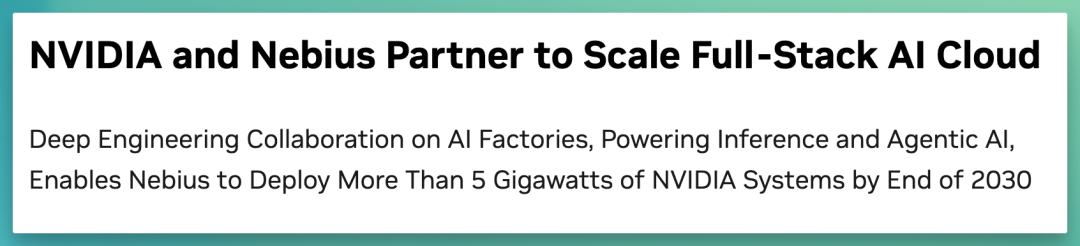
So after a full circle, you realize Jensen Huang has already covered the entire chessboard. Closed-source + public cloud — the compute chips are his; open-source + NeoCloud — the cluster foundation is his; open-source + on-premises deployment — the server slots are still his.
What NVIDIA truly wants may not be for one path to dominate the other two, but to ensure that wherever enterprises go, there's always a place for its underlying compute.
Observation Four: The Profit Pool Spreads from Model Call Fees to Compute, Scheduling, and Entry Points
Multipolar coexistence doesn't just change chip procurement — it forces model providers, cloud providers, and terminal entry points to redefine their roles.
Supply Side: Compute Also Goes on the Rental Market
On one side, model companies are turning around and selling compute.
According to SemiAnalysis, Meta alone signed over 5GW of cloud and hosted compute in the first half of 2026, with capex increasing rather than decreasing. It continues funding Superintelligence Labs to train frontier models, while treating excess compute as a cash flow business: amplifying ad recommendation system complexity tenfold, building an AWS Bedrock-competing Token-as-a-Service platform to sell models externally, and highly profitable short-term compute rentals.
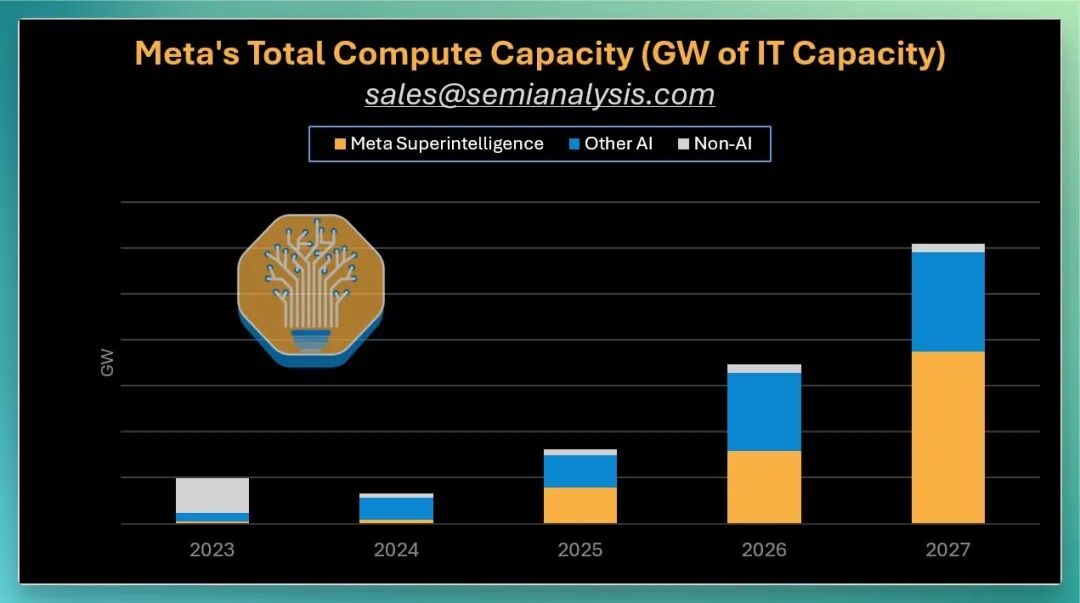
As SemiAnalysis put it, "everything is compute, everyone is a NeoCloud."
A more extreme example comes from SpaceX: short-cycle, large-scale, premium compute rentals priced at 2.6 to 4 times ordinary NeoCloud five-year lease rates, with one Google transaction translating to an astonishing $48 billion per gigawatt.
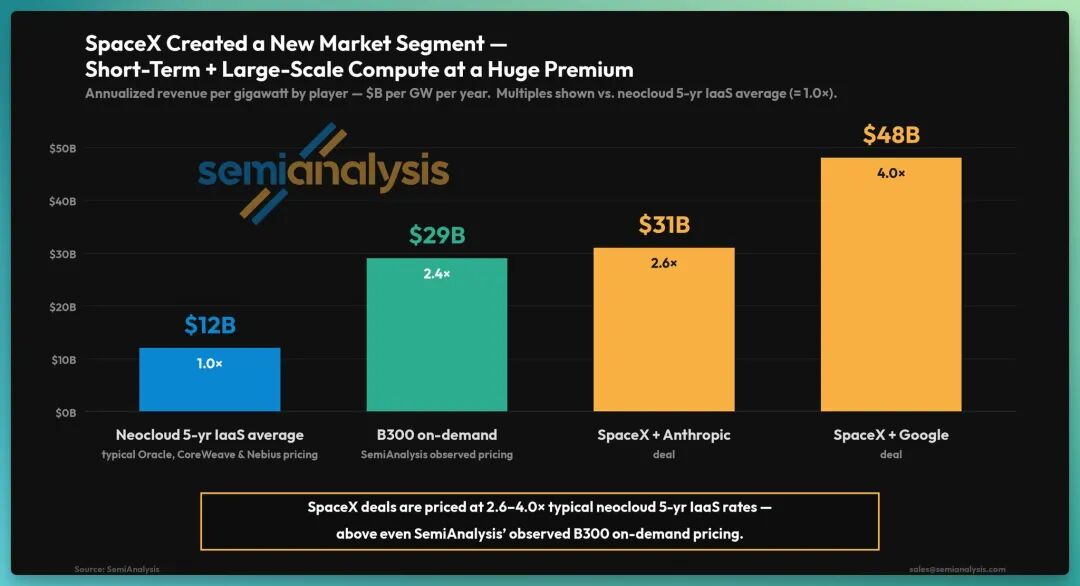
This shows that when compute is scarce, "selling compute" demonstrates more direct monetization power than "selling models."
Entry Side: Don't Bet on Any Single Model Provider
Meanwhile, platforms controlling user entry points refuse to tie themselves to a single model provider.
At WWDC 2026, Apple announced a new Siri integrating a custom version of Gemini: everyday lightweight tasks complete locally on-device with Apple's custom chips, while only complex reasoning is sent to cloud-based Gemini through its Private Cloud Compute (PCC). Throughout the chain, data is hardware-isolated and end-to-end encrypted — neither retained nor exposed to Google.
In other words, Apple treats the model as a replaceable component in its system; users perceive "Siri got smarter," not "I'm using Gemini," keeping brand halo, distribution entry point, and privacy firmly in its own hands.
And Amazon, holding the world's largest cloud computing ecosystem, is actively building a Token-as-a-Service aggregation business.
Bedrock connects over a dozen providers and hundreds of model variants, using Intelligent Prompt Routing to automatically choose among model quality, latency, and cost for users. What it sells is no longer just tokens, but the scheduling capability to "get good enough results at lower cost."
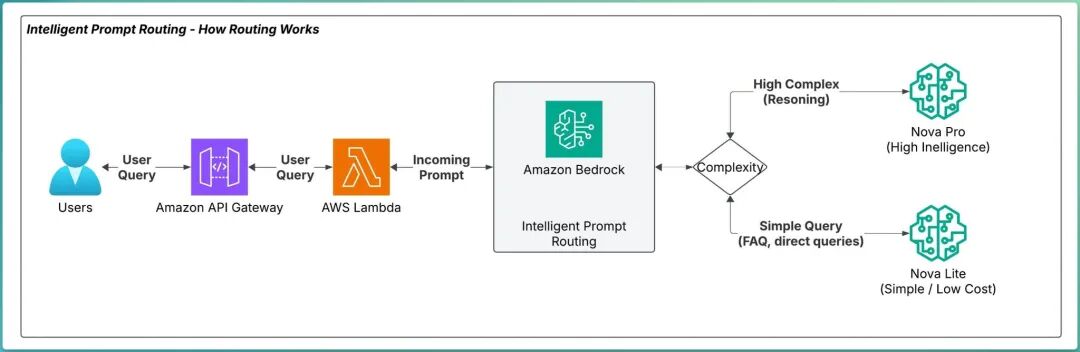
AWS can decide which model a call should route through, but it won't redraw departments, data, and permissions for enterprises. What's truly hard to capture is how the enterprise itself operates. And this is precisely the territory Palantir is trying to defend.
Observation Five: Giants Start "Digging Wells," Palantir's Moat Comes Under Siege
Beyond waving the banner of "data sovereignty," Karp's deeper concern is technological encroachment from the platform layer onto the application layer.
Tech podcast All-In host Jason Calacanis put it bluntly: from Microsoft to Google to today's large model upstarts, the history of technology has seen the "platform swallows application" drama play out for four decades:
There is no free pizza. There's no free beer... Nobody who went to bed with Microsoft in the 80s, Facebook in the 2000s or Sam Altman now in the 2020s did not wake up with their throat slit.
Back then, Microsoft leveraged its Windows operating system monopoly to bundle the Office suite, rapidly marginalizing Lotus and WordPerfect at their peak; early Google took pride in "getting users off-site as quickly as possible," yet with the proliferation of AI Overviews, over 68% of Google searches have evolved into "Zero-Click Searches," with traffic intercepted right on the search results page.
The current commercial path of large model providers follows the same playbook. After watching third-party developer tools like Cursor build AI coding scenarios on Claude API, Anthropic quickly launched Claude Code; and according to TechCrunch, three days before its design tool Claude Design went live, Anthropic Chief Product Officer Mike Krieger had already quietly resigned from Figma's board.
The underlying logic of business never changes: what platform providers want isn't merely selling tokens (water), but to control enterprises' core business workflows (the well) through technological penetration.
For the past two decades, the American company most skilled at "digging private wells for clients" in defense and regulated industries has been Palantir.
Yet now, these Silicon Valley giants who previously only "sold water" in the cloud are also starting to get into the "well-digging" business.
The giants are piling in, but how hard this business is to capture depends entirely on how deep Palantir's "well" has been dug. To measure this depth, we first deconstruct Palantir's technology stack closure, which far exceeds ordinary SaaS software.
Technology Stack Architecture: From Data Integration to Intelligent Decision Closed Loop
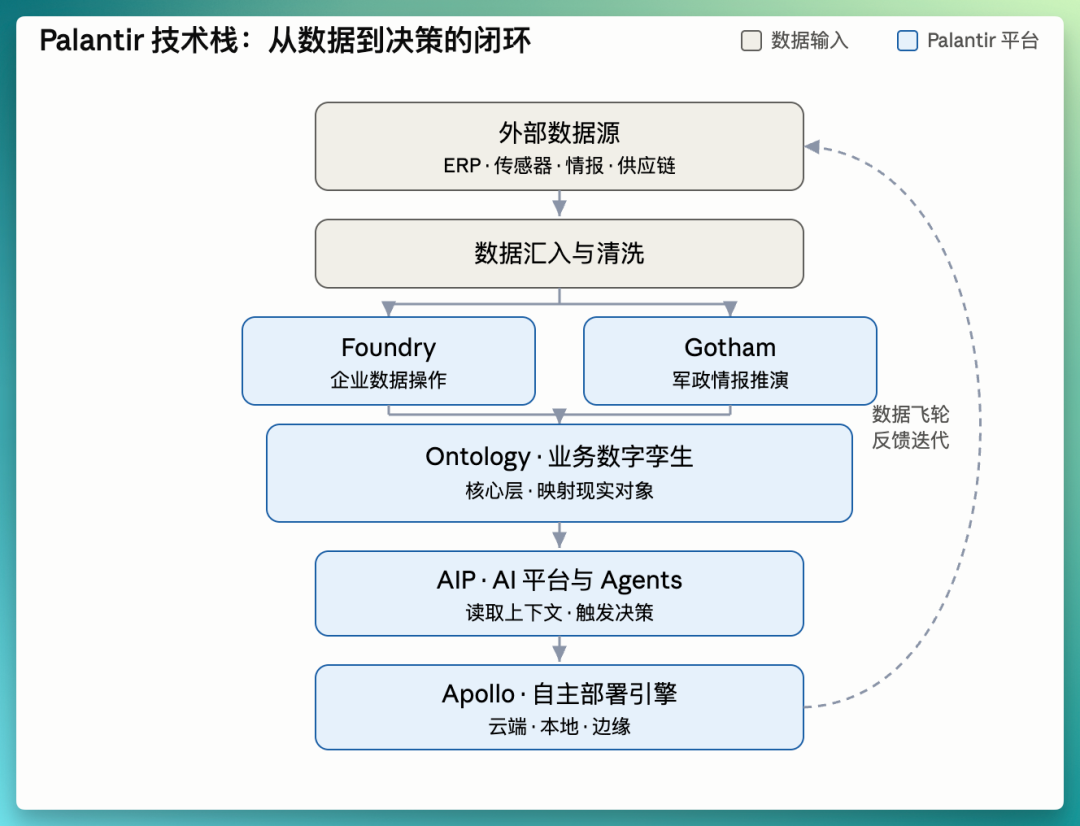
Palantir doesn't simply sell APIs or software subscriptions. Through deep involvement in clients' business processes and Doctrine (an organization's inherent response logic under pressure), it transforms scattered data across departments into visualized entities, relationships, and actions.
The division of labor in this closed loop isn't complex: Foundry serves commercial clients, extracting and automatically connecting data from isolated systems like ERP and CRM; Gotham is designed for government, military, and intelligence agencies, performing correlation analysis and intelligence inference in encrypted and network-constrained environments; Ontology maps them into digital twins of business objects; AIP enables large models to directly read this relationship network and trigger decisions; Apollo handles deployment, updates, and operations across cloud, on-premises, and edge environments.
Example: Reconstructing Business Logic for One Flight Route
Take the scenario of "a large multinational airline responding to severe weather":
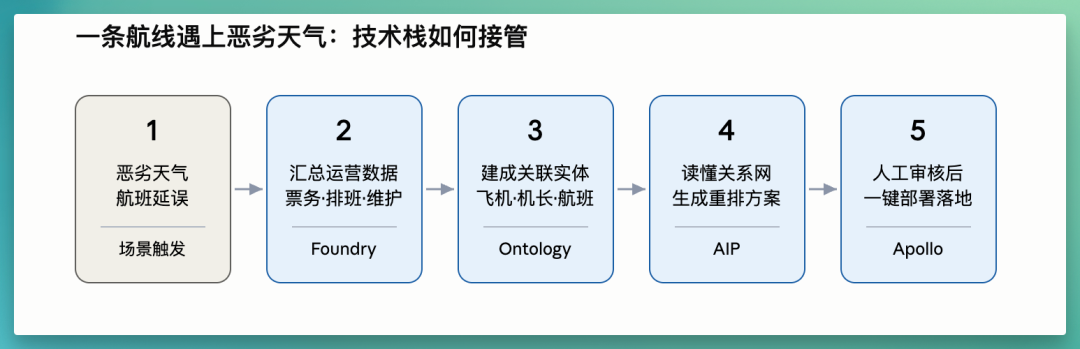
Foundry aggregates ticketing systems, crew scheduling, and maintenance logs in real time; Ontology immediately defines specific "Boeing 787s," "captains," and "San Francisco to Tokyo flights" as digital twin entities. When delays occur, the large model reads the relationship network in Ontology through AIP, automatically generating optimal rescheduling solutions that, once human-reviewed, trigger system changes to passenger itineraries. Finally, Apollo deploys this workflow with one click to ground crew tablets and airport control rooms.
Humans only intervene at the "review solution" step; everything else is system-handled.
Giant Encirclement: Dilution of the Moat
This deep involvement's core barrier isn't just reflected in technical architecture, but deeply embedded in organizational behavior.
Palantir's most unique asset built over two decades is its FDE "on-site well-digging team." Once an organization's decision chain starts running through Palantir, the system gradually becomes its daily muscle memory.
Yet within just a few months, giants are frantically replicating this asset model, challenging the application landing end:
In May, OpenAI established a dedicated deployment company, the OpenAI Deployment Company, and acquired AI consultancy Tomoro, bringing approximately 150 engineers on board; the same month, Anthropic partnered with financial giants including Blackstone and Goldman Sachs to form a joint venture valued at approximately $1.5 billion, to help major financial clients meet their AI implementation needs.
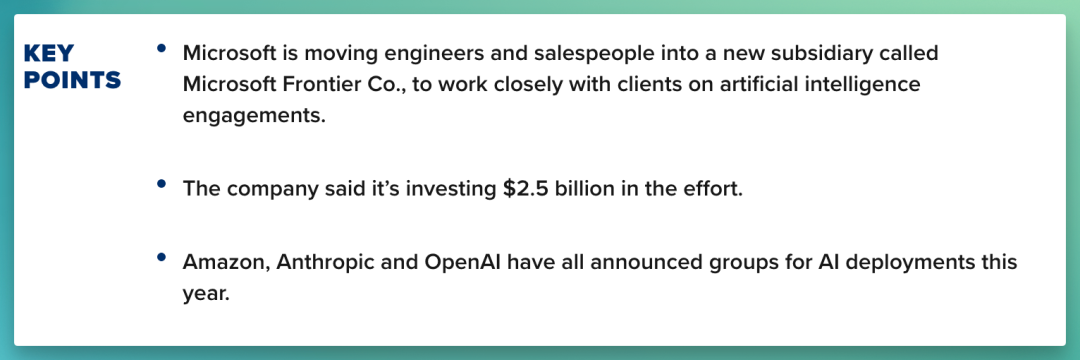
In July, Microsoft announced $2.5 billion to form a new organization, Frontier Company, claiming it would dispatch 6,000 AI experts and engineers deep inside client organizations to build the industry's largest AI implementation engineering organization; simultaneously upgrading Microsoft Foundry on the product side, leveraging the massive Office 365 and Azure ecosystem to send substitution signals to enterprises.
Karp's Paradox: Opposing Platform Lock-in While Relying on High Switching Costs
Karp's fury on CNBC wasn't an emotional outburst, but a stress response from a player with long-term dominance in a specific track, as its moat faces industry-wide dilution.
Karp criticizes Silicon Valley platforms for causing enterprises to lose control over data, models, and alpha; yet Palantir itself relies on deep embedding in client systems — through FDE teams, business ontology, and long-term deployment capabilities — to build high switching costs.
This immovable system stickiness is, in essence, the same game as the "Silicon Valley platform绑架" he excoriates, just with different rhetoric.
The difference is that Palantir tries to build lock-in on enterprises' own data, permissions, and workflows; while the model Karp criticizes has enterprises handing critical capabilities to external models and platforms, which then set the rules, prices, and evolution direction.
The two aren't black and white, but they're fighting for the same position: control over enterprise AI.
In this fierce contest, Palantir is both prey and predator.
The ultimate question remains: who owns the well
In the early AI gold rush, market attention focused on foundation models and GPUs: the former provided intelligence, the latter provided compute.
But as enterprises begin asking about costs, compliance, data sovereignty, and actual returns, the competition's center of gravity is shifting downstream.
Model providers want into workflows, cloud providers want to offer scheduling and deployment, NVIDIA wants all paths to continue consuming compute, and Palantir wants enterprises' core decision systems to remain on its platform.
Karp's rage on CNBC wasn't a mere emotional outburst.
It's more of a signal: as standardized models gradually become replaceable capabilities, what will truly be scarce is comprehensive control over data, compute, deployment, and business processes.

References
[1] CNBC: https://youtu.be/0A3sGymV6kY?si=9GHlewNrz4fse-aS
[2] AI Sovereignty Wars, Palantir-Nvidia Deal, SCOTUS Birthright Ruling, Newsom's CA Budget Lie: https://youtu.be/wgdxSCsmS-Q?si=70_K0f4a3stGvUHa
[3] Sequoia Capital podcast: https://youtu.be/f6D_aiy8qyU?si=R7Ih3ydqFWiAnLfx
[4] Bloomberg: https://www.bloomberg.com/news/articles/2026-07-03/the-ai-trade-is-losing-one-of-its-key-signals-taking-stock
[5] SemiAnalysis: https://newsletter.semianalysis.com/p/meta-compute-everyone-wants-to-be
[6] OpenAI launches dedicated deployment company: https://openai.com/index/openai-launches-the-deployment-company/
[7] Anthropic partners with Blackstone, Goldman Sachs and other financial giants to form ~$1.5B joint venture: https://www.wsj.com/business/deals/anthropic-nears-1-5-billion-joint-venture-with-wall-street-firms-8f5448ee?mod=tech_feat1_ai_pos1
[8] Microsoft commits $2.5 billion, 6,000 employees to new AI implementation unit Frontier Company: https://www.cnbc.com/2026/07/02/microsoft-commits-2point5-billion-6000-employees-ai-implementation-unit.html