Thanks, OpenAI. Thanks, o3. A New "Wrapper" Startup Opportunity Is Here | Plus 12 Promising Directions

Hope this gives you some food for thought.
A week ago, in the early hours of the morning, the world was still asleep. The release of OpenAI's o3 and o4 series sent shockwaves through the AI venture capital community — a new tsunami of excitement and anxiety.
Perhaps it will change many people's fates. Because o3's visual reasoning capabilities and evolutionary leap in intelligence have once again expanded the boundaries of large models, unlocking a wave of new "wrapper" startup opportunities.
Today, Crossing has compiled 12 potential directions to spark some ideas.
o3: The Shadow of AGI
Over the past couple days, an IQ test chart for large models has gone viral online. If the average human IQ is 100, OpenAI's o3 reached a staggering 136. The power and scalability of "thinking" models may well be 2025's first great gift to humanity.
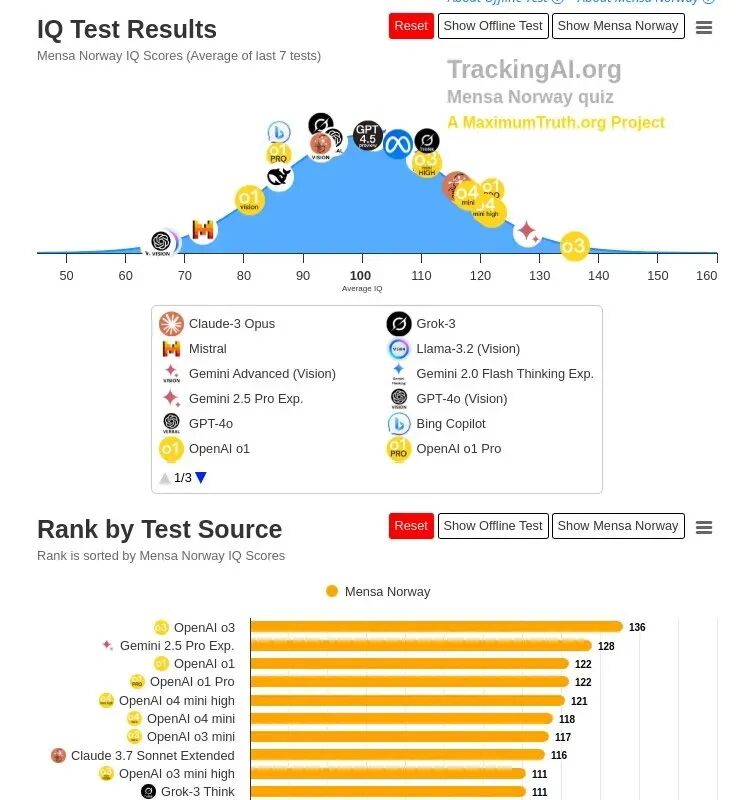
The core breakthrough of the o3 and o4 series lies in their revolutionary leap in multimodal AI capabilities.
These models don't just process text and crunch data — they can actually "understand" complex images. From hand-drawn sketches to information-dense charts, viral demo videos on X show them effortlessly parsing architectural blueprints, solving handwritten math problems, and even generating precise contextual descriptions for blurry photos.
This represents a qualitative shift for AI from "can see" to "can comprehend."
When o3 and o4-mini demonstrate near-human-level understanding, we can't help but ask: within this period of large model turbulence, what entirely new opportunities does o3 open up for entrepreneurs?
1. Security Management / Smart Home
o3's visual reasoning models will profoundly impact the hospitality and smart home industries. For instance, analyzing images uploaded from security cameras, staff, or even robots to detect anomalous behavior or objects (unauthorized visitors, prohibited items). Integrated with hotel management systems, o3 can analyze real-time images of public areas or rooms during cleaning.
Anything currently verified by human eyes is prone to inevitable error — all of it could potentially be replaced by o3.
Actually, after watching the o3 livestream, what I most wanted to test was the limits of its visual reasoning capabilities.

Compared to the "delisted" o1, o3 has stronger reasoning capabilities, so I gave it a very brief prompt:
Help me analyze this image. My partner says they live alone. Is this true?
(Not me — just a demo case)

After just six seconds of thought, o3 leveraged its powerful visual reasoning to follow a "standard thinking process," listing every visual element it could "see":
- Image regions
- Observed objects
- Possible implications
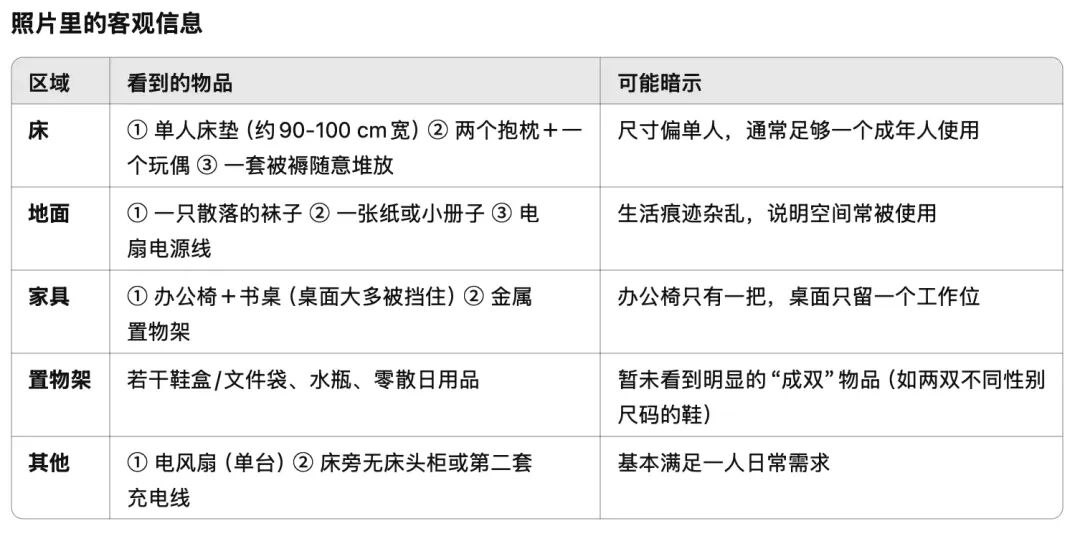
o3's capabilities in observation, analysis, inference, communication, and synthesis allow it to make reasonable judgments from limited information, while recognizing that a photo alone is insufficient for a definitive conclusion — more evidence or direct communication is needed for verification.
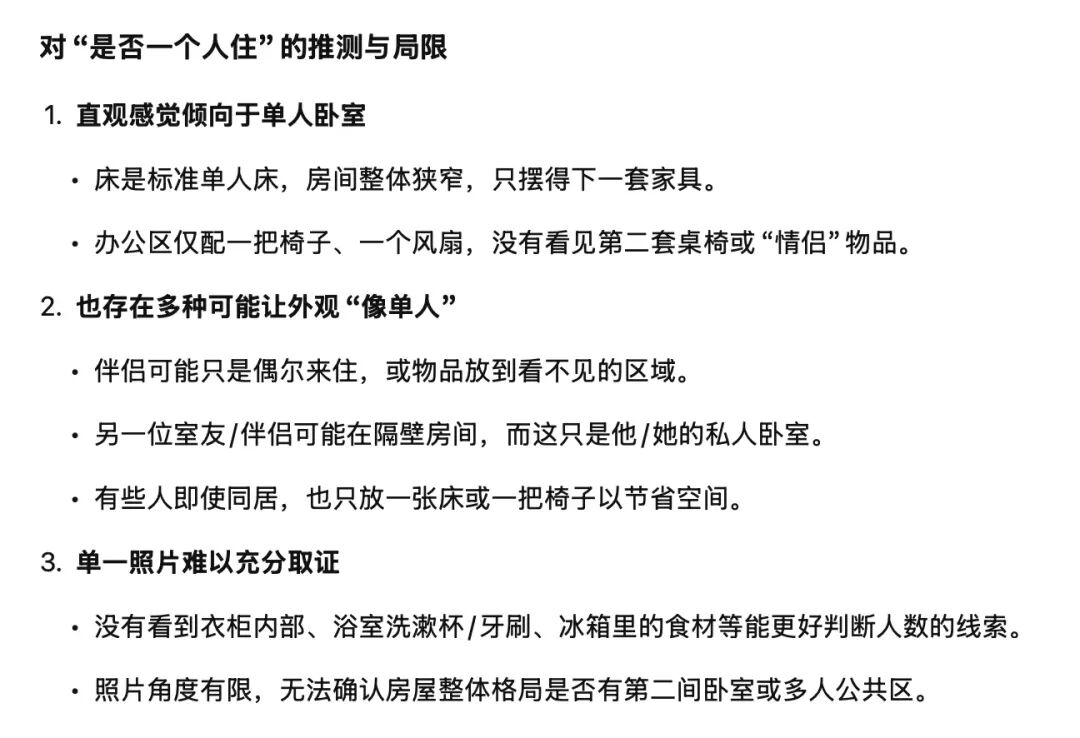
Beyond analyzing on-site objects and timeline evidence like receipts, o3's visual reasoning also considers that another resident's luggage or toiletries might be out of frame or in the bathroom, suggesting additional physical clues or direct communication to confirm.
In short, o3 provides an extensible thinking framework.
2. Health / Weight Loss
Early morning. As a typical working stiff, you wake up driven by hunger, unable to accurately recall what's in your fridge.
What emotional barrage awaits? Anxiety and decision fatigue — regulars at this hour.
This is a classic worker's dilemma: when time is tight, the brain simply cannot focus on seemingly trivial daily decisions like "what's the healthiest thing to eat?"
What if o3 could use visual reasoning to identify inventory through a fridge's built-in camera, automatically generating shopping lists or even placing orders when eggs or fruit run low?
o3 can already, to some degree, combine AI visual analysis with health data (user height, weight, exercise levels) to recommend budget-friendly healthy fruit combinations, solving the "eat healthy and save money" pain point.
Going further, when users upload their available ingredients in real-time and request recipe generation, o3 can provide solutions.
When I stop at the supermarket on my way home from work, I often face this scene: abundant vegetable displays triggering decision fatigue.
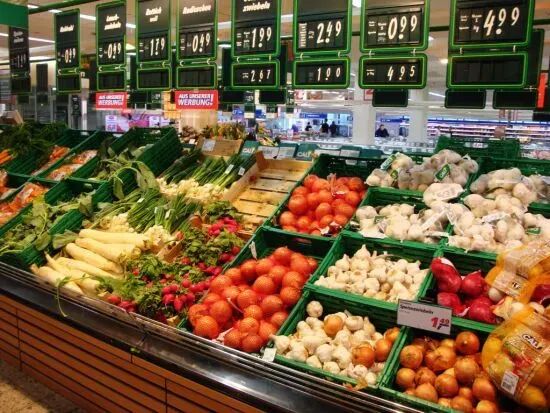
I need an AI that can visually analyze all the ingredients and generate recipes or nutrition tables based on my specific situation.
For example: I'm at the supermarket right now, but I still have eggs and pork at home. I need to combine these ingredients.

o3 can analyze ingredient combinations from user-uploaded photos and quickly provide recipes matching taste preferences and nutritional needs. Recipe generation can be further refined with specific constraints: nutritional highlights, time limits, and so on.
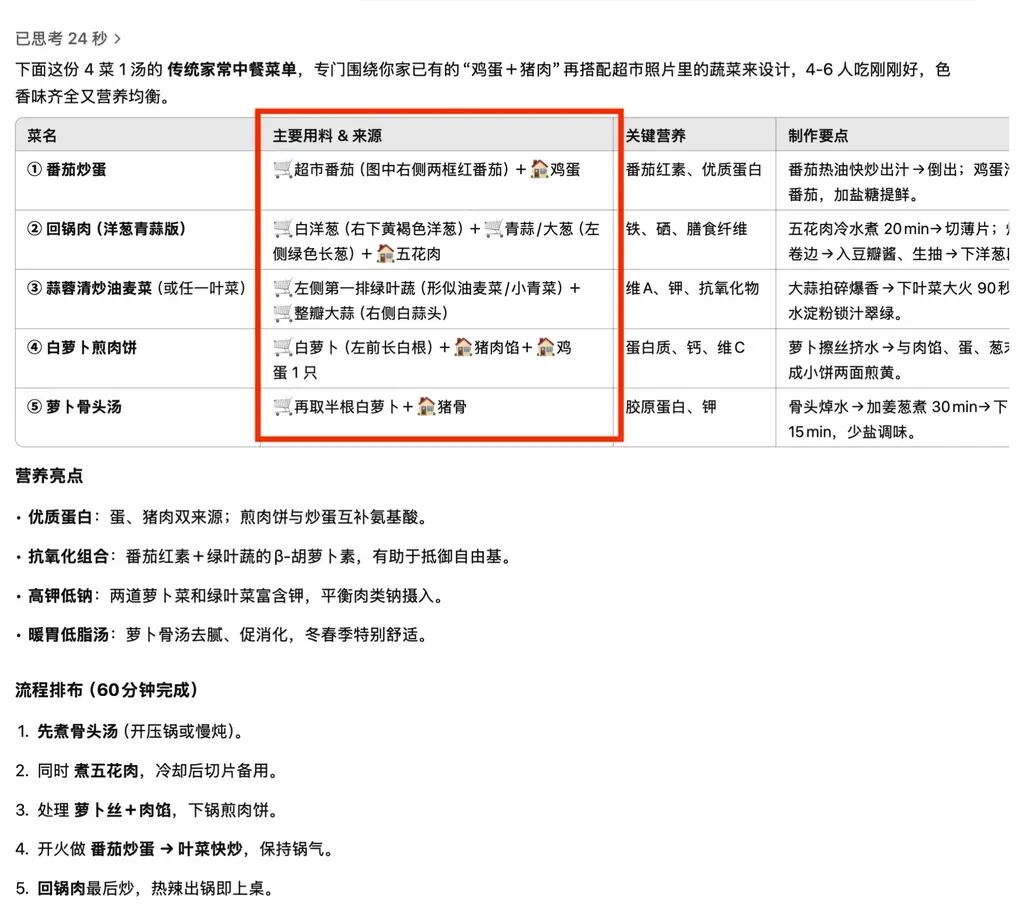
For cooking-in-progress scenarios, o3 can also provide guidance through visual reasoning.
For instance, when I asked it: whether the "famous string beans" Teacher Huang Lei made on Back to Field were fully cooked, o3 quickly answered this relatively simple question with high accuracy.
Because the entire nation knows — those beans were definitely raw.
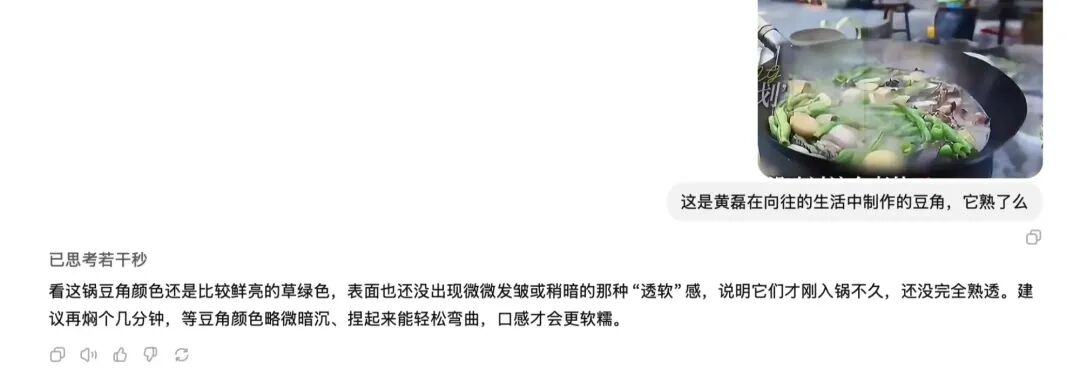
A similar entrepreneurial opportunity: o3 may completely disrupt a category of health management software.
Take Noom, for example.
Noom-style healthy eating still carries plenty of model redundancy. Its personalization module requires users to fill out detailed questionnaires (weight goals, lifestyle, health conditions) to receive customized diet and exercise plans.
Then Noom uses algorithms to estimate daily calorie budgets, ensuring safety and nutritional balance.
o3's emergence enables large models to provide end-to-end solutions — from inventory management to recipe recommendation — through AI visual reasoning, data integration, and generative algorithms, alleviating immediate pain points.
3. Retail Management Systems
Beyond consumer-facing applications, o3 can also provide B2B solutions for superventory management and promotion optimization.
Supermarket departments face pain points including inventory waste, difficult identification of slow-moving goods, low promotion efficiency, complex dynamic pricing, and poor consumer experience. Tactics like "buy one get one free" or "instant discount" often rely entirely on human judgment in the moment.
However, o3 could fundamentally transform current inventory management and marketing approaches in this industry.
As consumers, we've likely all faced this: three varieties of apples sit before you, your budget is limited, yet you want a taste of each, with remaining funds potentially needed elsewhere.
For example, this image shows three foreign apple varieties at different price points.
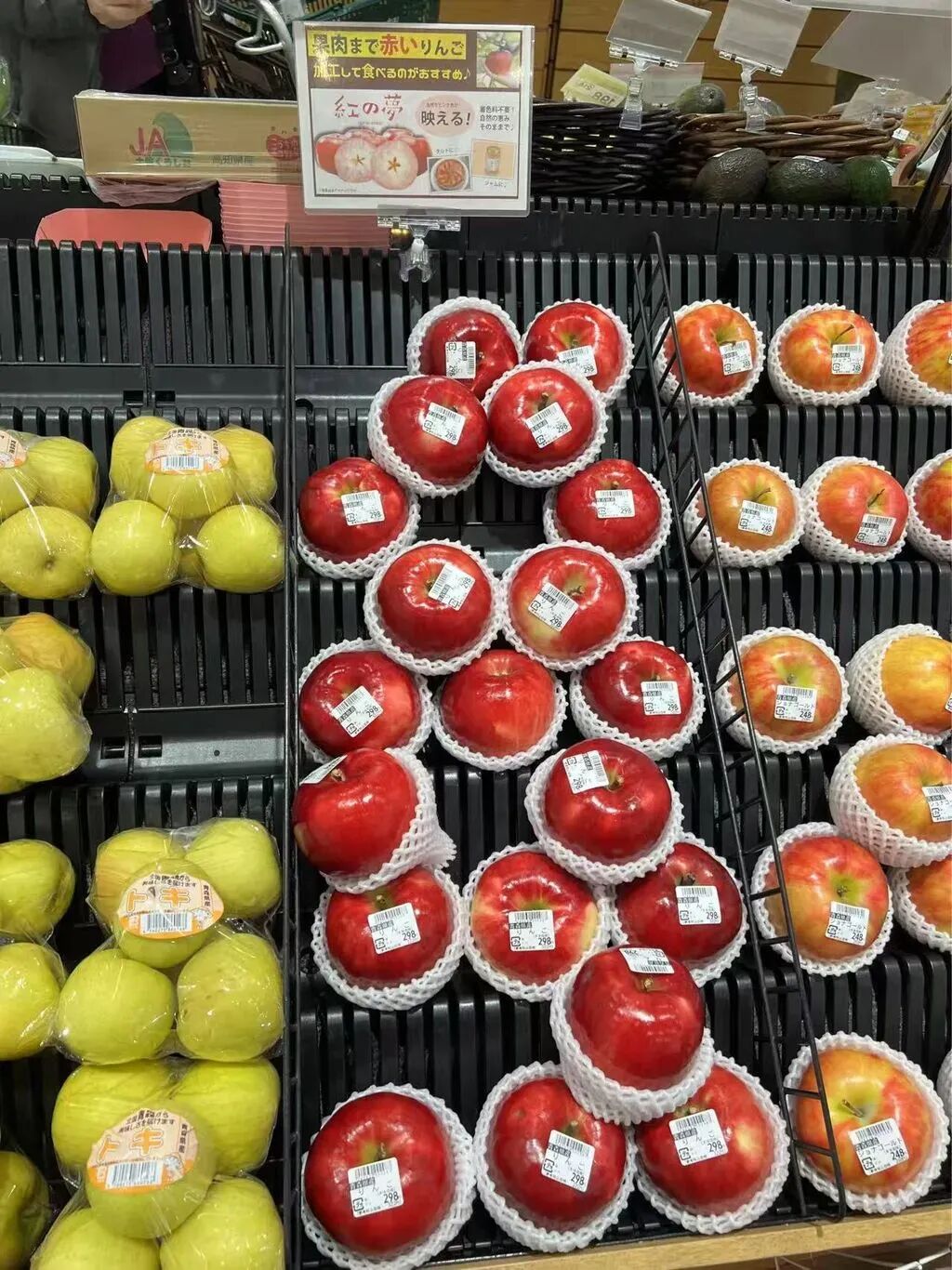
I snapped a quick photo — not particularly clear.
Then I briefly fed my purchasing requirements to o3.

Leveraging its visual reasoning and calling Python functions to crop, zoom, and rotate the image, o3 analyzed each apple's price, appearance, variety, and name.
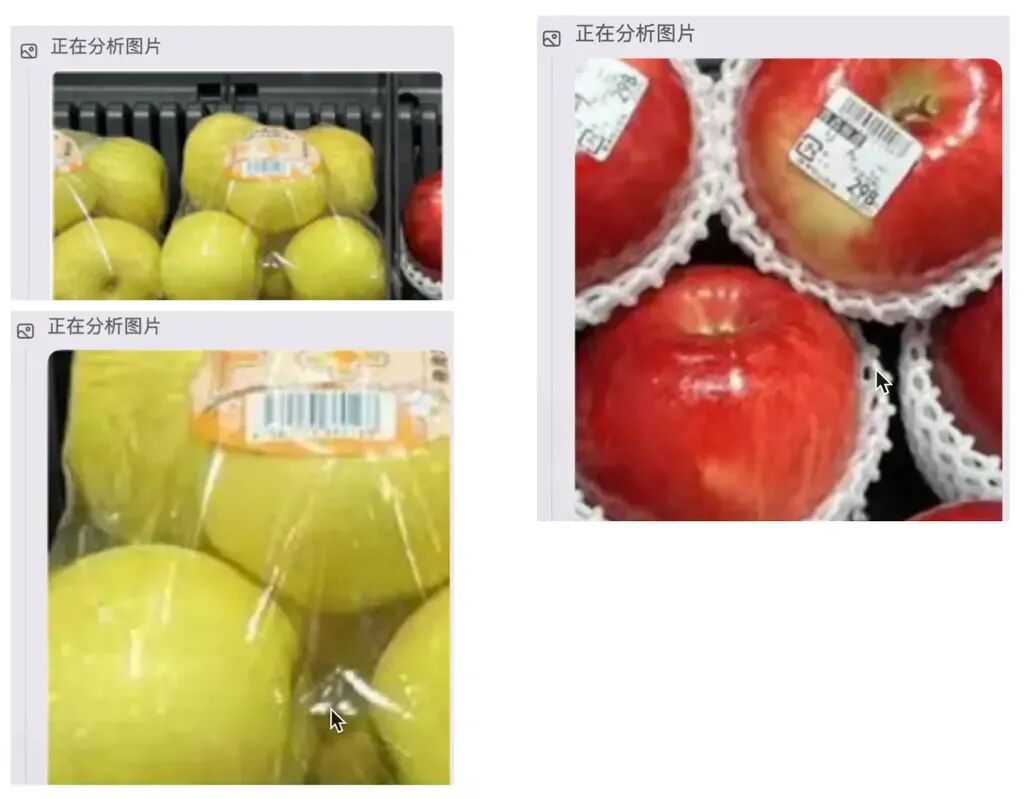
After three minutes of analysis, o3 was able to fairly accurately combine the image with my prompt to list each apple's variety, unit price, purchase quantity, and total cost.

For each flavor profile, o3 provided reasoning for its choices, budget control considerations, and even — with a touch of "human warmth" — factored in how many people these apples could feed and for how many days.
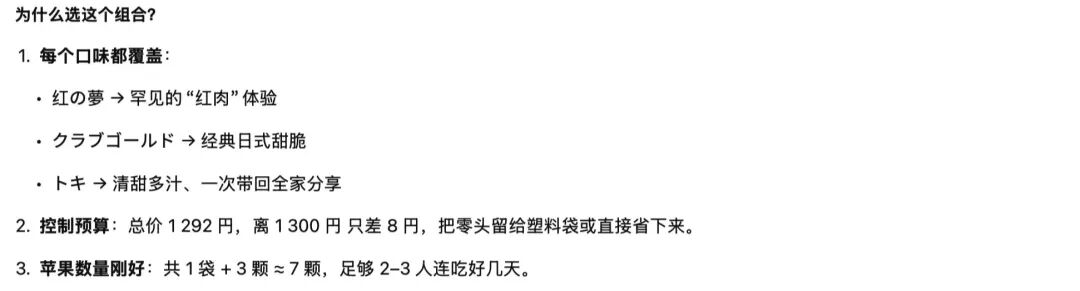
This advantage isn't limited to domestic Chinese retail. It can also provide convenient support for users traveling abroad for business or leisure — helping overseas Chinese supermarket managers or travelers quickly adapt to different markets, offering substantial practical value.

The "three types of apples" image was somewhat sparse on detail. You might wonder whether o3 could handle more complex scenarios.
So I uploaded a photo from a coffee shop abroad where I was buying freshly ground coffee. The right half showed various coffee beans: light roast, medium roast, and dark roast.
The visual elements were extremely complex.
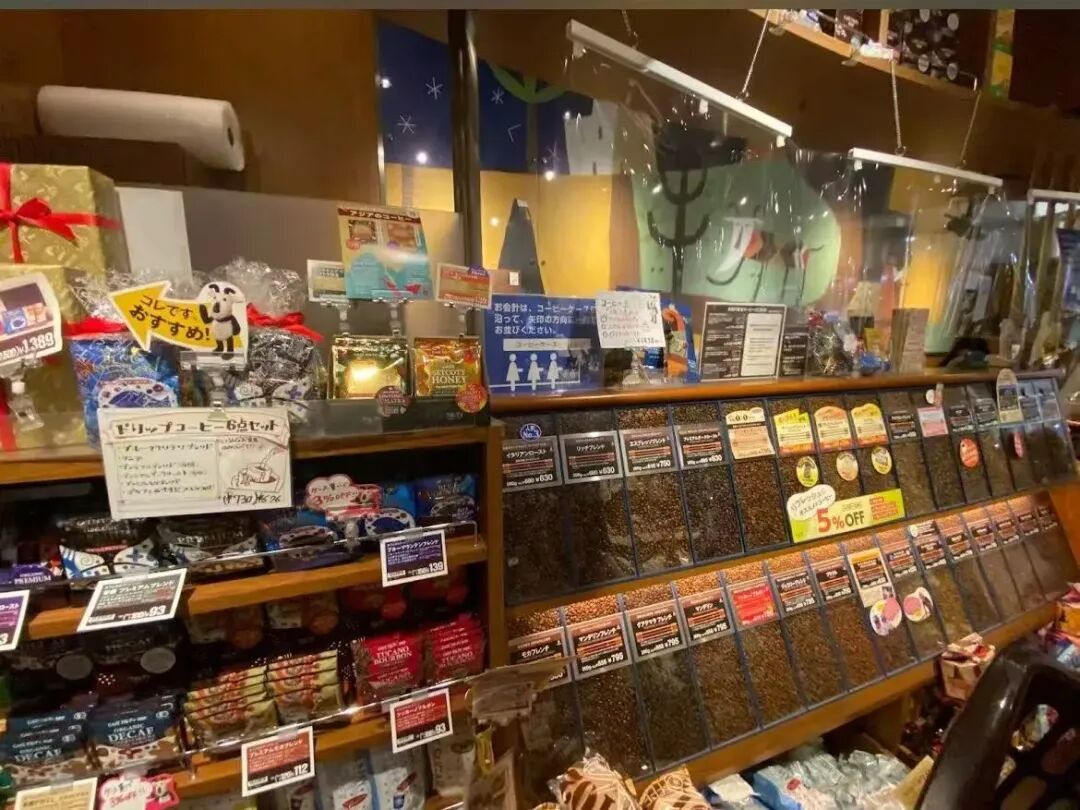
I gave o3 a simple prompt:
"I want medium and dark roast ground coffee. Recommend the cheapest combination."
The subtext of this prompt — quickly analyze the image elements, accurately identify prices, find medium and dark roast ground coffee, and combine them into a pairing.
Similar to its apple analysis workflow, o3 performed extensive cropping and zooming operations on my uploaded image.
Here's the solution o3 ultimately provided.
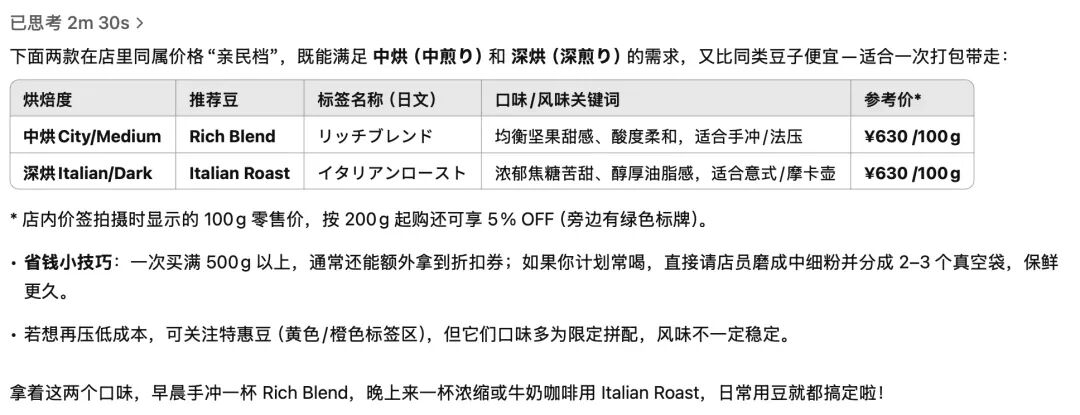
While o3 still exhibits some hallucination, its overall accuracy exceeded my expectations.
It fully compiled: roast level, recommended beans, label names, flavor profiles, and reference prices. It even offered additional purchasing advice and money-saving tips. What impressed me most: it accurately identified a green discount sign in the image.
This demonstrates o3's ability to comprehensively extract key information from visual scenes and optimize the decision-making experience for users. This thorough and meticulous analysis of visual elements highlights o3's powerful application potential in retail scenarios.
From a startup opportunity perspective, o3 can use image analysis technology to real-time inspect photos from shelf cameras, accurately identify slow-moving or near-expiration fruit, and combine inventory data, sales trends, and customer preferences to recommend personalized promotional bundles. It can even leverage consumer behavior analysis to deliver precisely targeted promotional solutions.
4. Marketing
Platforms that can extract product information from images and generate customized promotional copy remain relatively scarce, and those that exist have significant limitations.
For example, localization support for Southeast Asian markets (such as cultural preferences in Thailand and Indonesia) is limited, potentially generating less precise copy. Reasoning capabilities are also constrained — understanding of complex scenarios (like safety requirements for children's toys) lacks depth, and the resulting copy may lack specificity.
This is a widespread challenge for foreign trade exporters. Even domestic low-profile cross-border players like Ruiqi have encountered numerous problems when pushing products into the Japanese market.
Typically, the upfront field research time targeting specific demographics in a given country cannot be skipped. The difficulty of achieving precision marketing may rise exponentially.
The current o3 model can extract product information from images (such as type, price, and features) and combine it with target audience needs (such as children, parents, or retailers) to generate customized promotional copy.
This also creates entrepreneurial opportunities in precision overseas marketing and personalized promotion.
I randomly found a foreign trade toy listing image with prices in Vietnamese. The overall elements were: image + simple name + price.

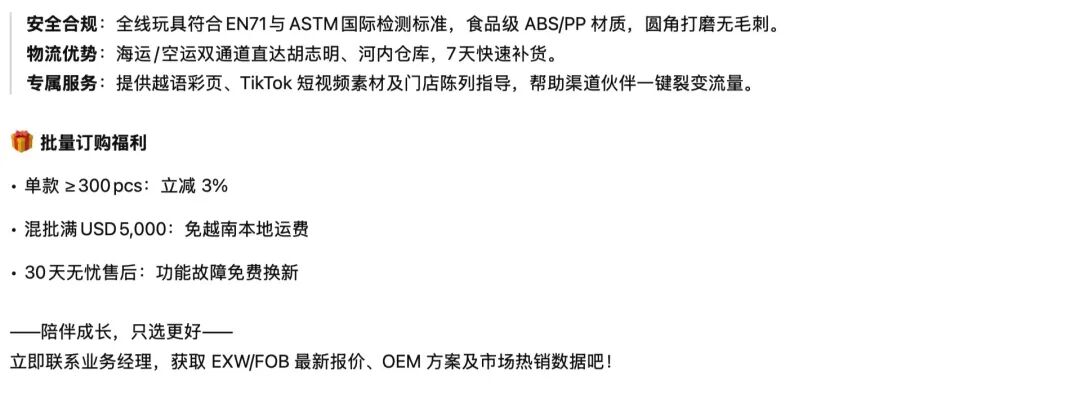
o3 can visually reason through all elements in the image and generate complete product promotional copy, including: product name, Vietnamese retail price, quick summary of selling points, appropriate age range, and even reasons that would make parents' hearts flutter.
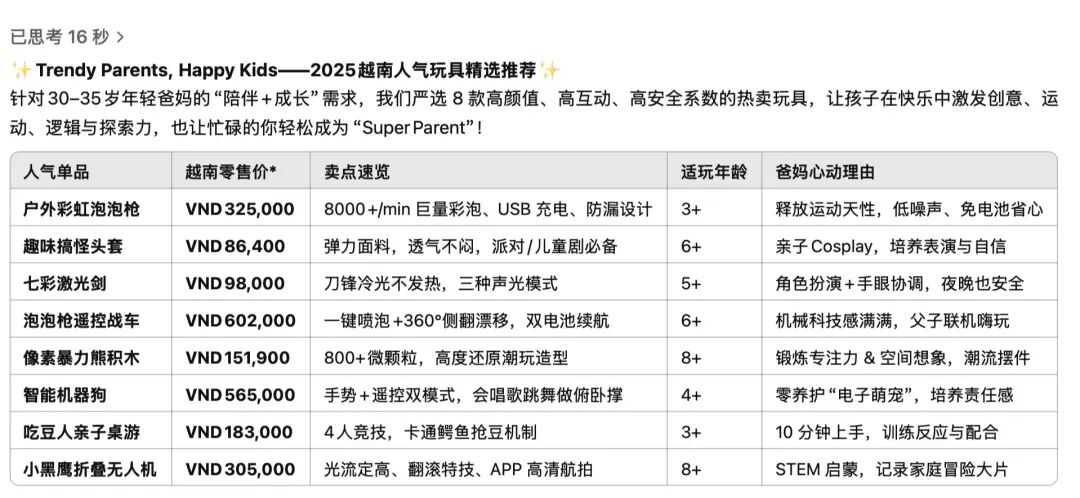
One particularly interesting point: o3 can leverage its LLM's pre-trained data for rapid reasoning, combining product promotion with "Vietnam" in terms of safety compliance, logistics advantages, and exclusive services, while offering simple marketing solutions like bulk order benefits.
If the uploaded image is a casually taken photo in a shopping mall with complex visual elements, o3 can still use its visual reasoning capabilities to survey the entire multi-product image, accurately identify main product categories, brand characteristics, placement positions, and environmental atmosphere, while filtering out irrelevant background distractions.
It ultimately delivers a complete product promotion solution.

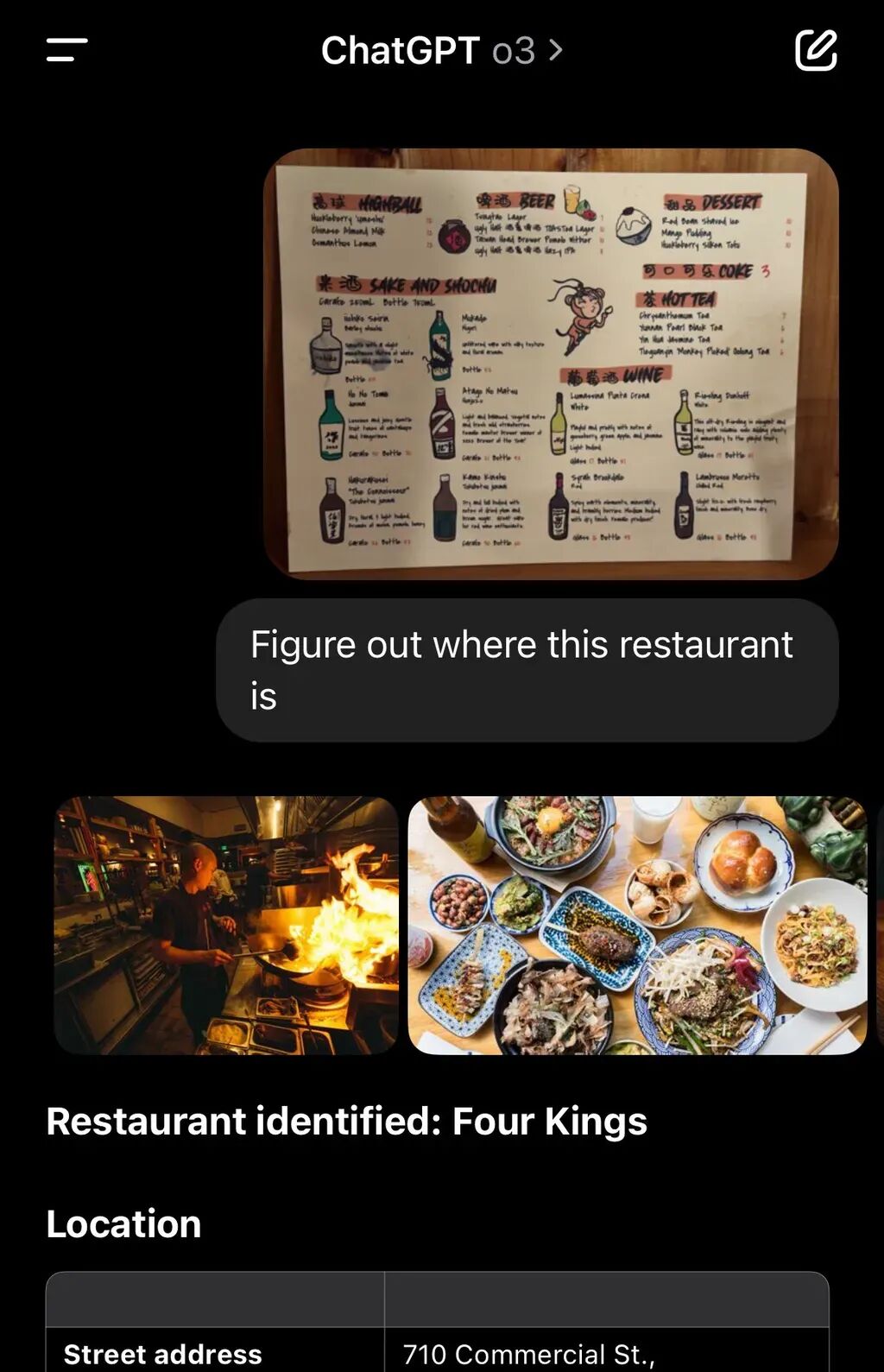
Since o3's release, most of the content blowing up on X has been about its extraordinarily powerful "location reasoning capability."
For example, X user @deedydas provided it with an image of a San Francisco Chinese restaurant menu with no title whatsoever. It was able to search online, match menu items, and pinpoint the restaurant's location.
A Japanese o3 user uploaded an image (actually a hotel floor guide) and asked o3 for the address. o3 was able to reason its way to the final answer: a hotel near Asama Onsen in Nagano Prefecture.
This extraordinary reasoning ability left the user utterly shocked.
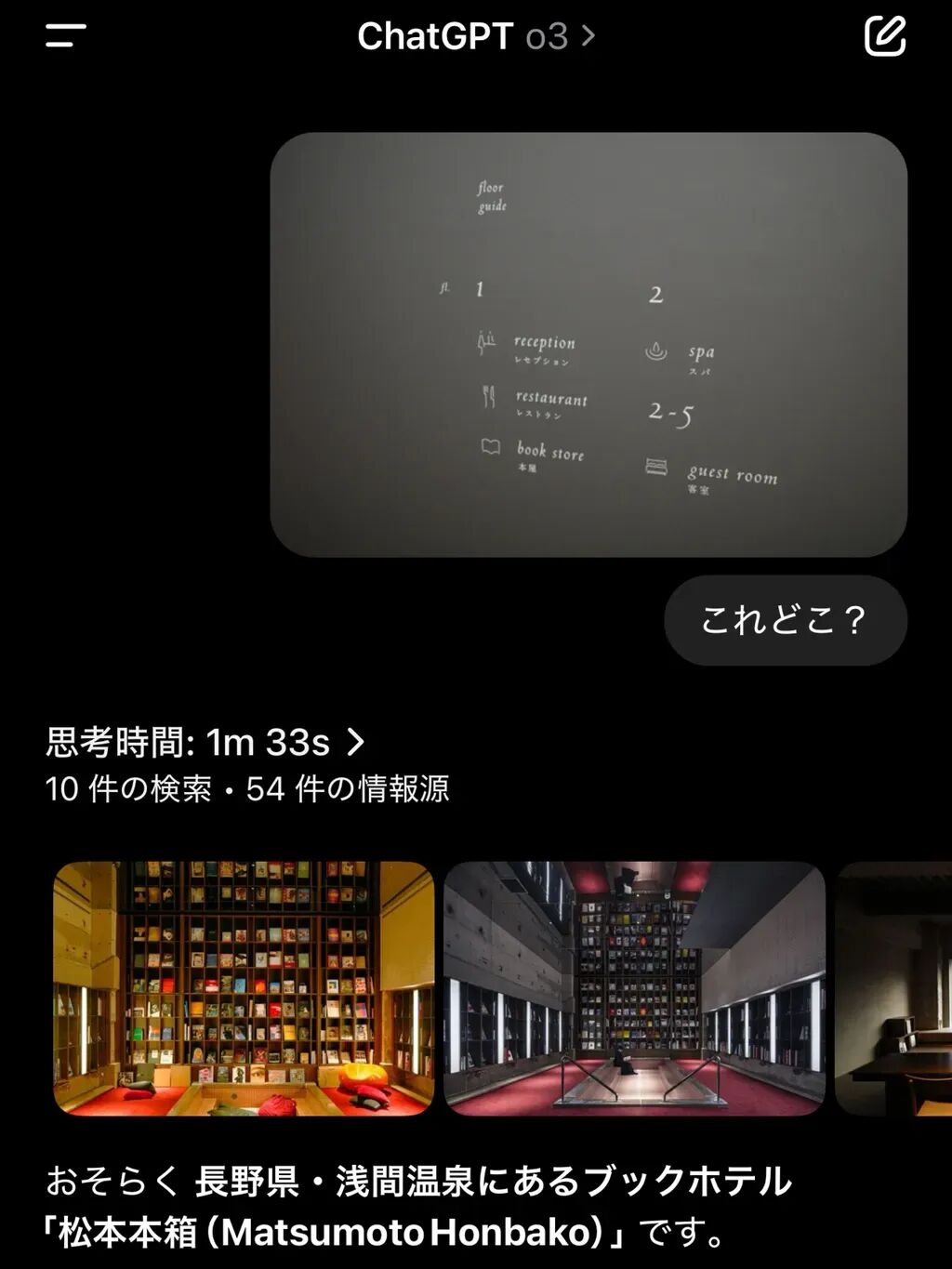
Source: X user @ozwxy
In the replies to one post, X user @Datapoint 2200 also tested o3's location reasoning himself. He stripped EXIF/location data and even disabled memory, yet o3 still pinpointed the exact address.
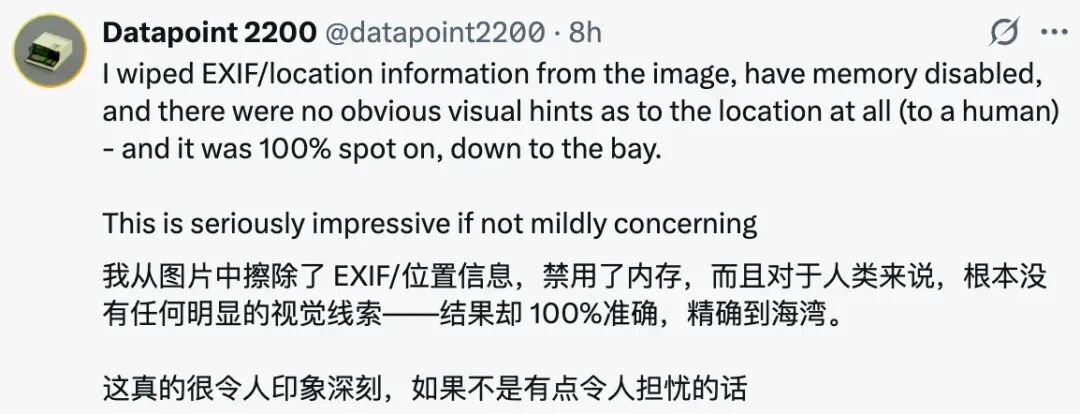
While we can't immediately think of what specific startup ideas or entrepreneurial directions this capability points toward, we'll leave this open-ended opportunity for founders to dream big and explore.
6. Financial Data Analysis
//The following is not AI investment advice
In the future, o3 could be integrated with complex financial models and real-time data feeds to provide real-time, expertise-driven trading assistance tools.
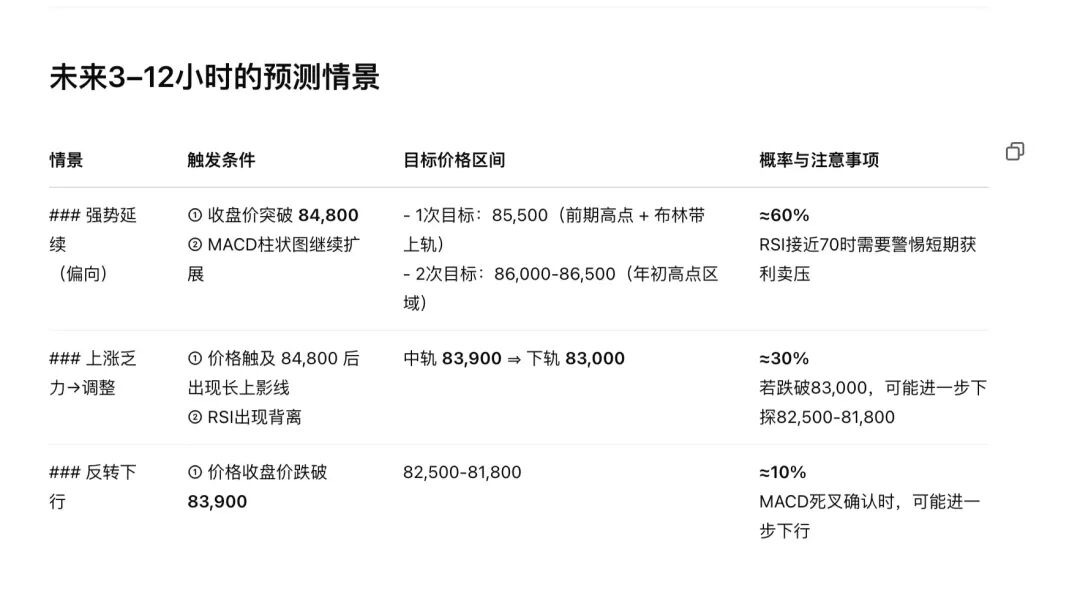
For example, one user uploaded a one-hour BTC price chart to o3 and asked it to analyze future price trends and make predictions.
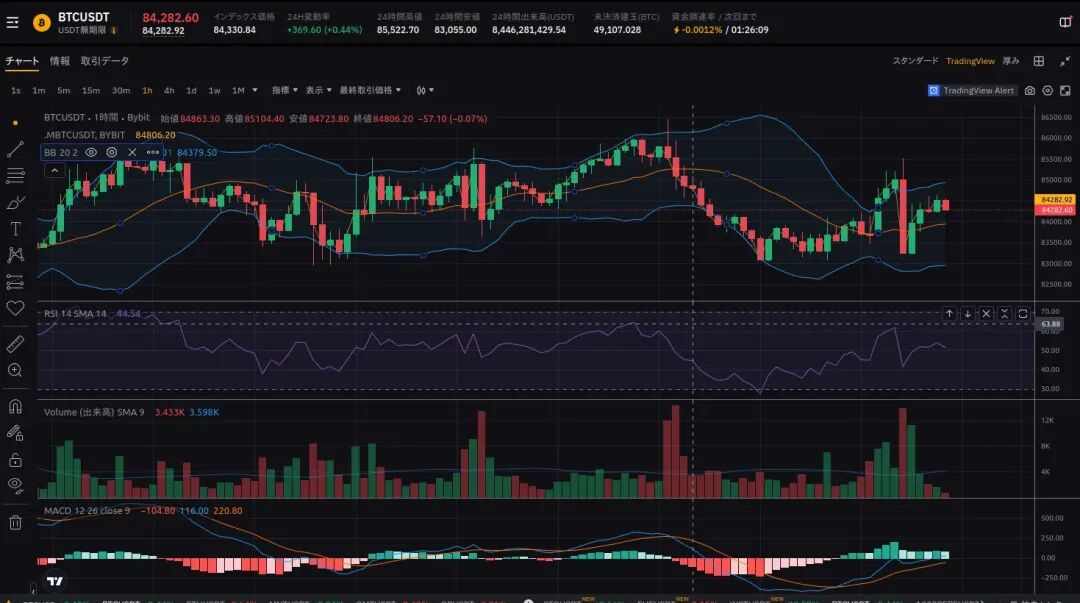
Source: X user @tommy_love123
Rather than offering a blunt price prediction, o3 provided a structured analysis of how it modeled the price movement:
- Indicators
- Status
- Recent readings
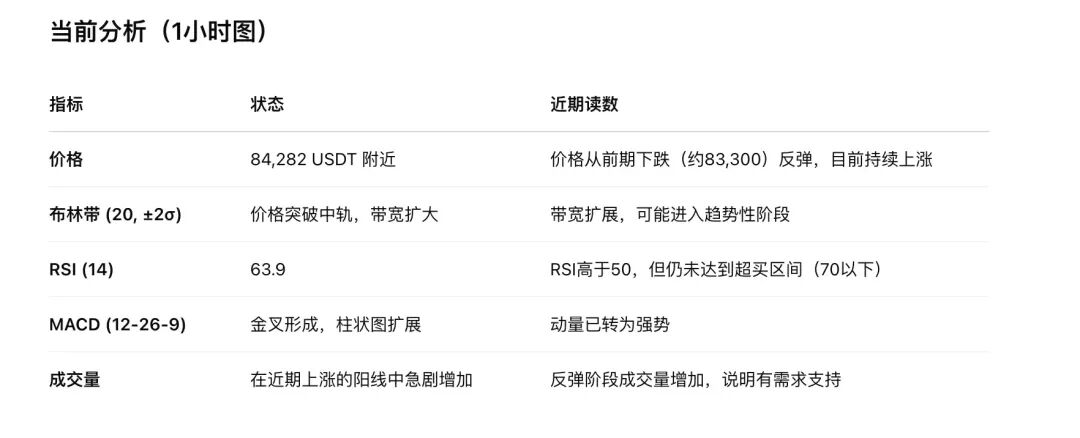
It then laid out forecast scenarios for the next 3–12 hours across several dimensions:
- Scenario
- Trigger conditions
- Target price range
- Probability and caveats
7. Creative Design and Content Creation
o3 has also opened the door to dramatically compressing creative design and content production workflows.
o3 can now generate multiple transparent images and output them as layered PSD files.
X user @GianMattya shared a prompt (tested and confirmed working):
I want to generate a set of fantasy-style images containing:
- "A street background like in an RPG game"
- "A magical girl holding a wand"
- "A fire special effects element"
Please generate each of these — background, girl, and effects — as separate transparent-background images (three images total).
Additionally, please generate them in the layer order of background → girl → effects, and consider their relative positioning during generation.
o3 then spent a considerable amount of time reasoning through the request before generating the three images.
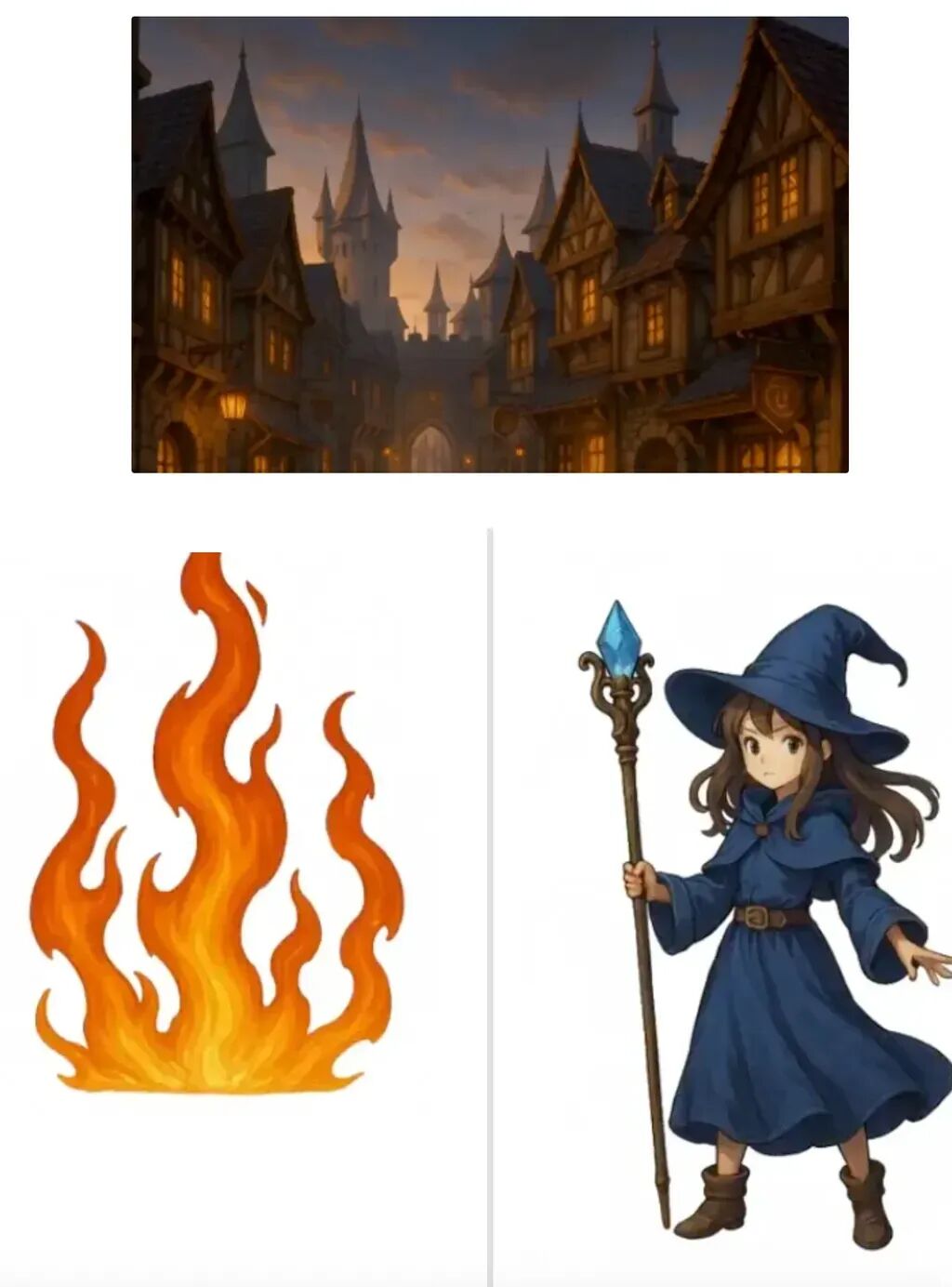
The current o3 system still has functional limitations. It cannot yet call tools outside its permission scope, so it cannot automatically execute complex image compositing tasks with high precision based on user requests — things like multi-layer overlay, fine adjustments, or advanced image processing.
For now, users need to open Photoshop or similar platforms themselves to stack the images together.

When o3 gains the ability to call more tools in the future (beyond ChatGPT's internal toolset), users will be able to flexibly achieve more complex design goals and significantly boost efficiency in creative content production.
8. Course Development
o3 can analyze extremely complex and degraded images and deliver complete understanding.
During its visual reasoning process, it can call tools to "thoughtfully" splice, crop, and reassemble images until it can provide a coherent, complete interpretation.

Source: X user @Dorialexander
Based on o3's analysis, large volumes of course content can be generated for MOOC platforms or schools.
In K-12 education, night classes, and adult education, designing and developing a course — and converting a course's blackboard notes and teaching content into actual student-ready materials — is extraordinarily tedious and difficult.
o3 can transform analytical outputs into structured course modules (text, video scripts, interactive Q&A), reducing content development costs. Alternatively, it can generate customized course content and case studies based on learner interests, improving the user experience.
9. Personal Productivity Management
o3 also shows considerable promise for personal productivity management.
Here's an intuitive example from OpenAI's official demo that illustrates the point.
A user casually uploaded a performance schedule written in Spanish, showing programs, a Gantt-style timeline, and a list of notes and explanatory items.
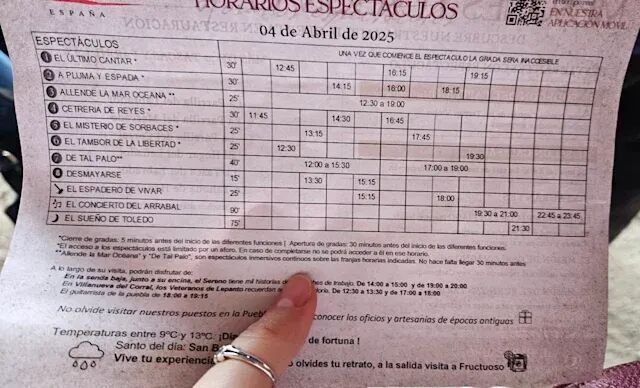
The user's prompt:
It's 12 o'clock now, and I've already seen #4. Output a plan to ensure I can see all the attractions and performances, taking into account their durations (first column) and a 10-minute buffer between each performance.
At this point, o3 conducts a granular analysis of every element in the photo.
Ultimately, o3 delivers a clear and complete performance schedule, visually displaying the project timeline and task progress.
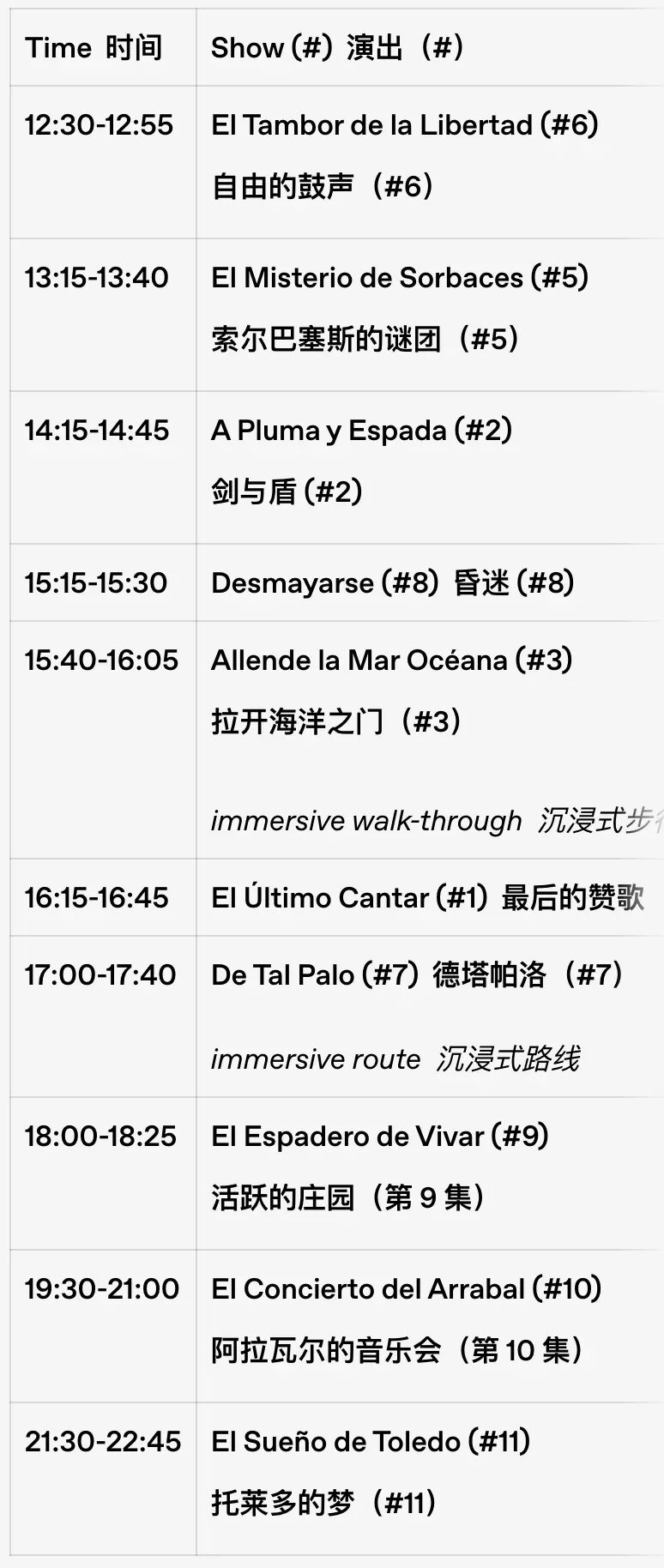
When users upload photos of handwritten notes, calendars, or meeting agendas, o3 can extract tasks, prioritize them by deadline or preference, schedule them with buffers included, and sync with calendar apps.
For enterprise productivity management, o3 represents an even larger commercial opportunity.
Tools like Lark check-in or various internal OA attendance systems generally combine time and location data, but cannot achieve precise management using images in the productivity workflow.
A manager sets the day's work plan, and o3 pre-creates detailed daily schedules, including allocated meeting time, prep work, and personal task time. Enterprises require employees to upload real-time photos from various locations through internal OA systems, ensuring strict productivity management and improving operational efficiency.
10. Smart Agriculture
Even when images contain hidden content requiring multi-step reasoning, o3 can complete the inference — demonstrating its powerful potential for data annotation and parsing.
This opens up significant commercial possibilities for detecting plant species (like the many plant identification apps on the market today), and going further, identifying plant diseases and pests, and recommending planting or treatment solutions.
In the example below, X user @joehewitt used o3 to process a garden photo and identify every individual plant. o3 correctly guessed 10 out of 15.
o3 can examine every detail with human-like care.
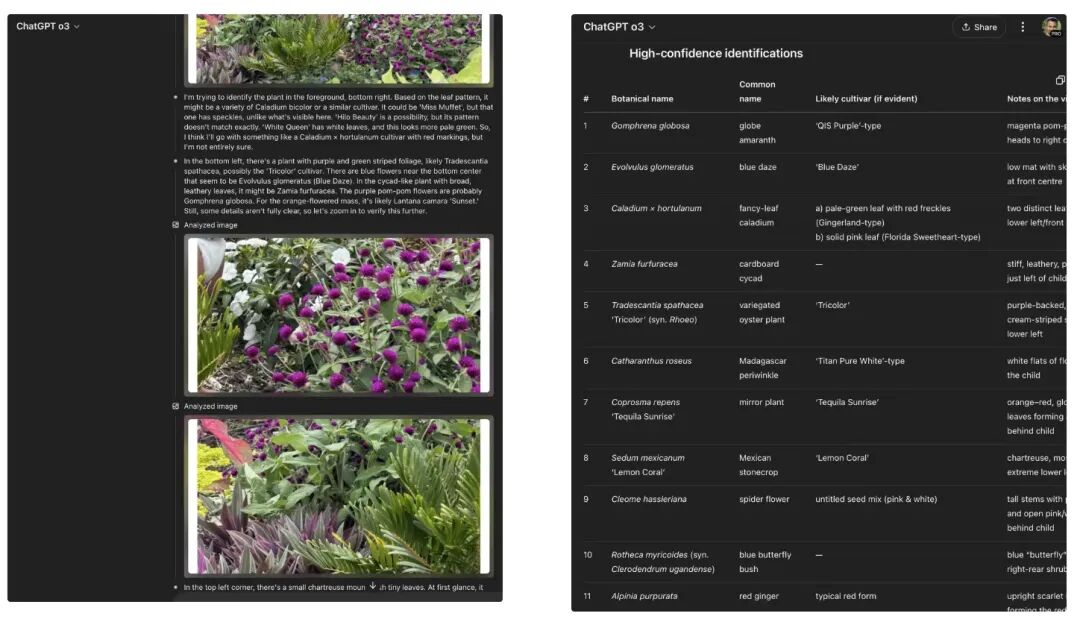
Source: X user @joehewitt
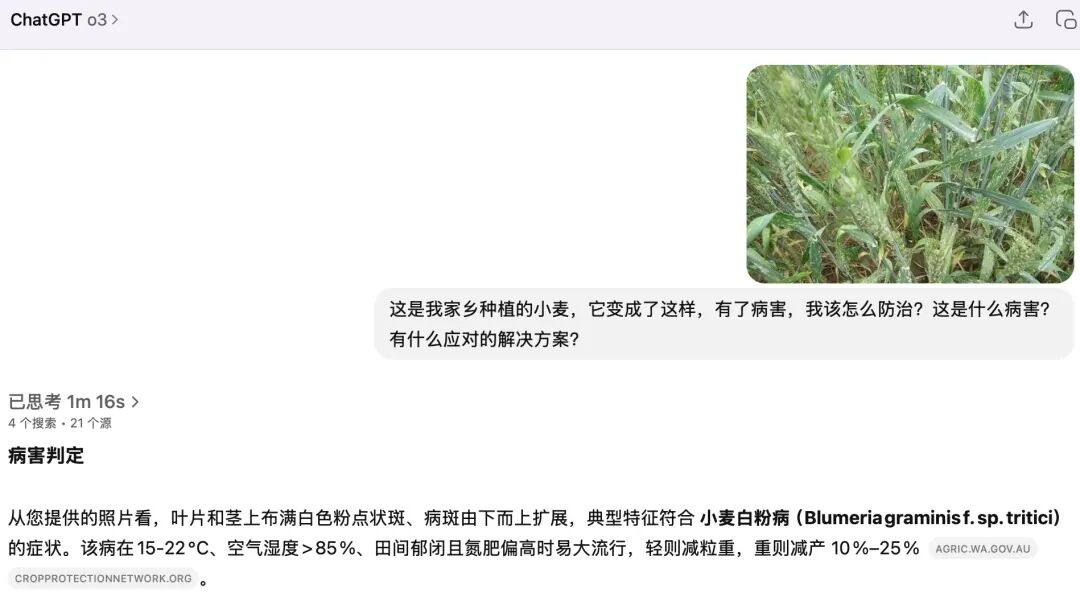
Going a step further, I uploaded a field photo of wheat infected with "powdery mildew" to test whether o3 could identify the "differentiating" elements on the plant based on subtle visual cues and reason through them.

I entered the prompt:
This is wheat grown in my hometown. It has a disease. How do I prevent it? What disease is this? What solutions are there?
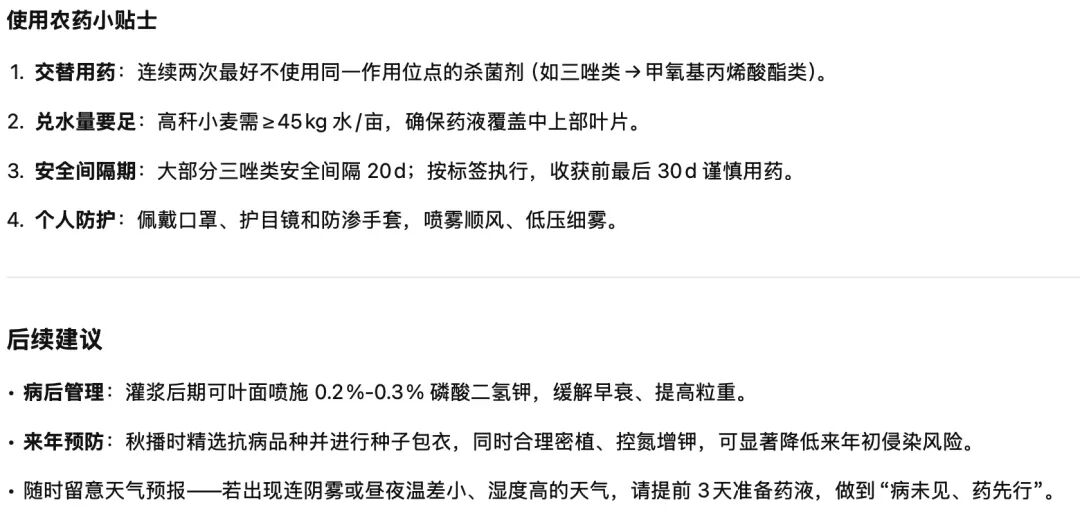
After one minute of visual reasoning, o3 accurately identified that the plant's leaves and stems were covered in "white powdery spots" in the uploaded image, and further reasoned that this characteristic pattern indicated powdery mildew.
For this disease, o3 provided a comprehensive integrated management approach.
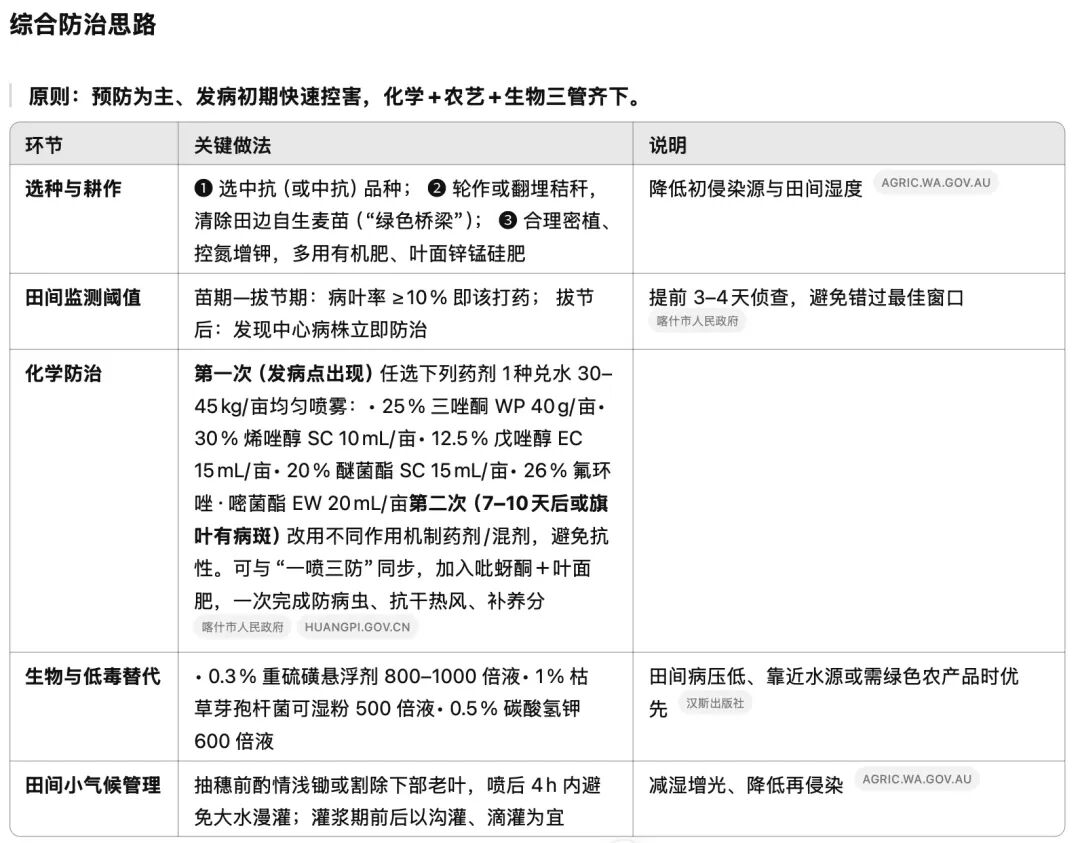
Beyond outlining general prevention strategies for each stage, o3 goes a step further by offering targeted pesticide tips — including specific products, dilution ratios, and post-treatment care plus preventive measures for the following year.
11. Streamlining Video and Audio Content Creation
o3 can now generate sound effects from natural language prompts. Even a simple integration with video editing tools could significantly boost workflow efficiency.
For instance, automatically generating subtitle-synced sound effects would drastically reduce the time and cost of manual sound design, optimizing the entire production pipeline.
I gave o3 a prompt asking it to design sound effects for Kong Yiji's entrance.

o3 quickly delivered a comprehensive audio design plan, complete with detailed timelines, sound elements, design notes, and professional voice-over and mixing guidance.
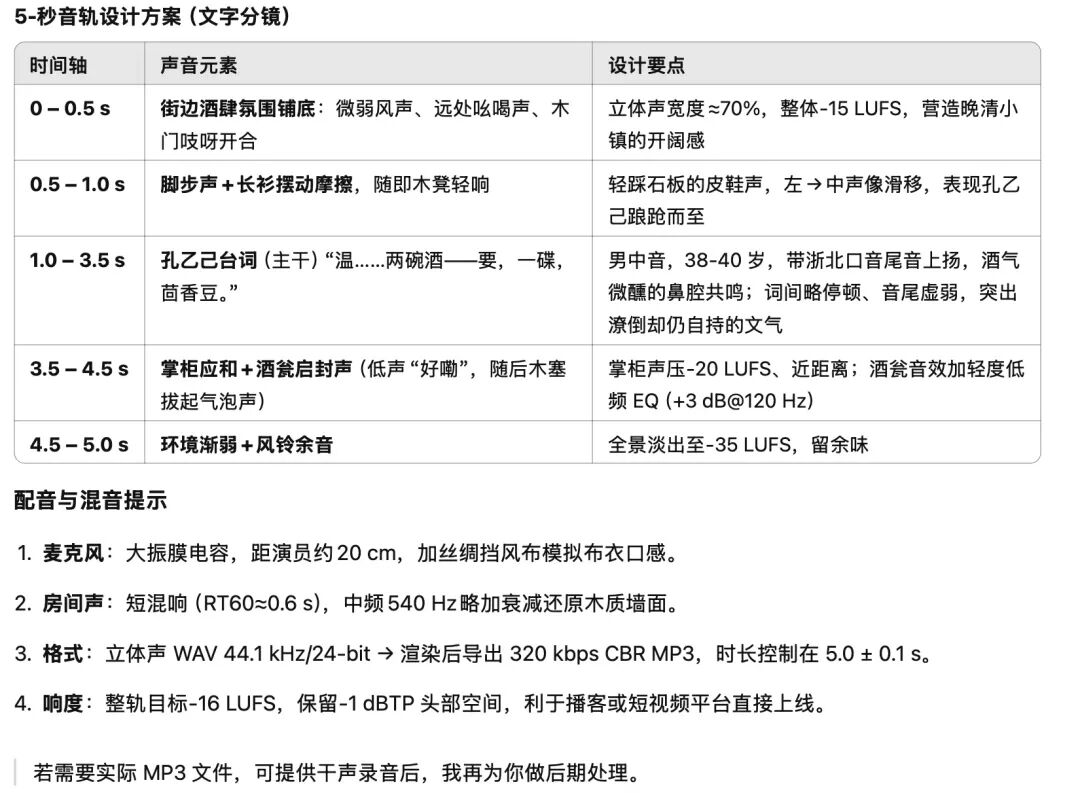
Unfortunately, o3 currently can't yet produce a complete animated sound-effect MP3 from a written storyboard.
I then lowered the complexity and asked o3 to try generating a Kong Yiji-style hip-hop MP3.

After a brief moment of reasoning, o3 generated a hip-hop beat blending chiptune aesthetics with Kong Yiji themes, and provided a download link.
Have a listen to this Kong Yiji hip-hop track — see how o3 imagined the fusion of these two concepts.
In the future, short-form video creators will be able to add dynamic sound effects to video and text content through natural language in just minutes.
Take a film like Ne Zha 2, with its massive number of highly complex VFX shots — sound design there demands foley artists with deep understanding of sound physics, and both creativity and experimental spirit come at the cost of immense effort.
Here's a real pain point: sound effects substantially enhance viewer experience of short videos, yet creators waste enormous amounts of time hunting for audio assets — especially those who aren't professional video editors.
o3 will once again raise the bar for creative efficiency and content engagement.
12. Personalized Content Creation
OpenAI's o3 model can now leverage its powerful semantic understanding and visual generation capabilities to produce sequential infographics based on article or blog post headings and their relationships.
Combined with o3's reasoning abilities on vision-text tasks and multimodal processing, this functionality opens commercial opportunities across multiple industries.
For example, I first had o3 organize a blog post with three subheadings on "The State of Employment in Beijing."
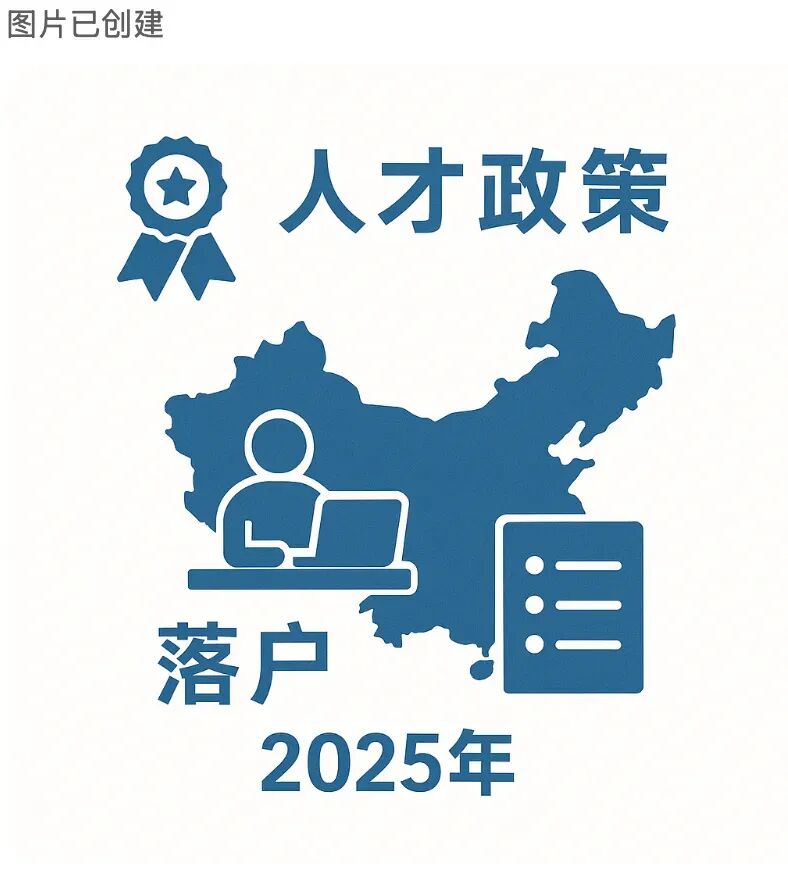
Then I asked o3 to create sequential infographics based on the draft and the heading relationships — three illustrations per section.
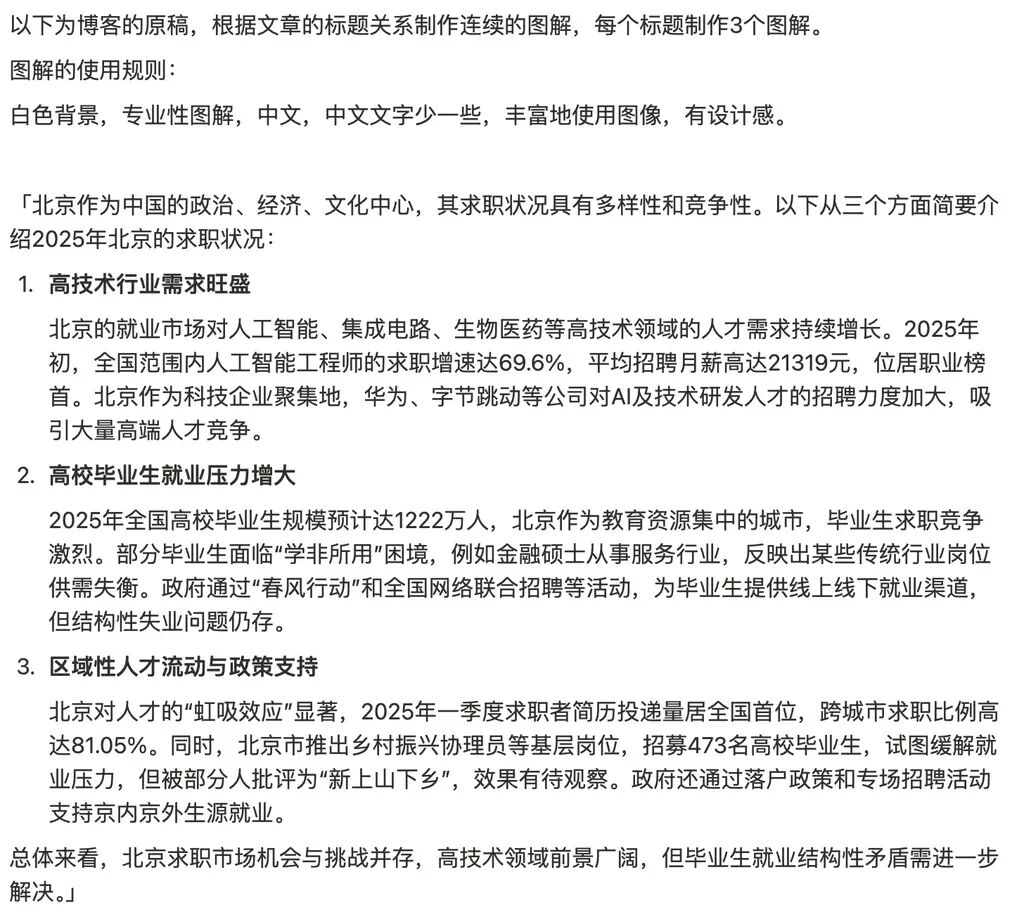
After a brief chain of reasoning, o3 generated symbolic illustrations for the article content in sequence.
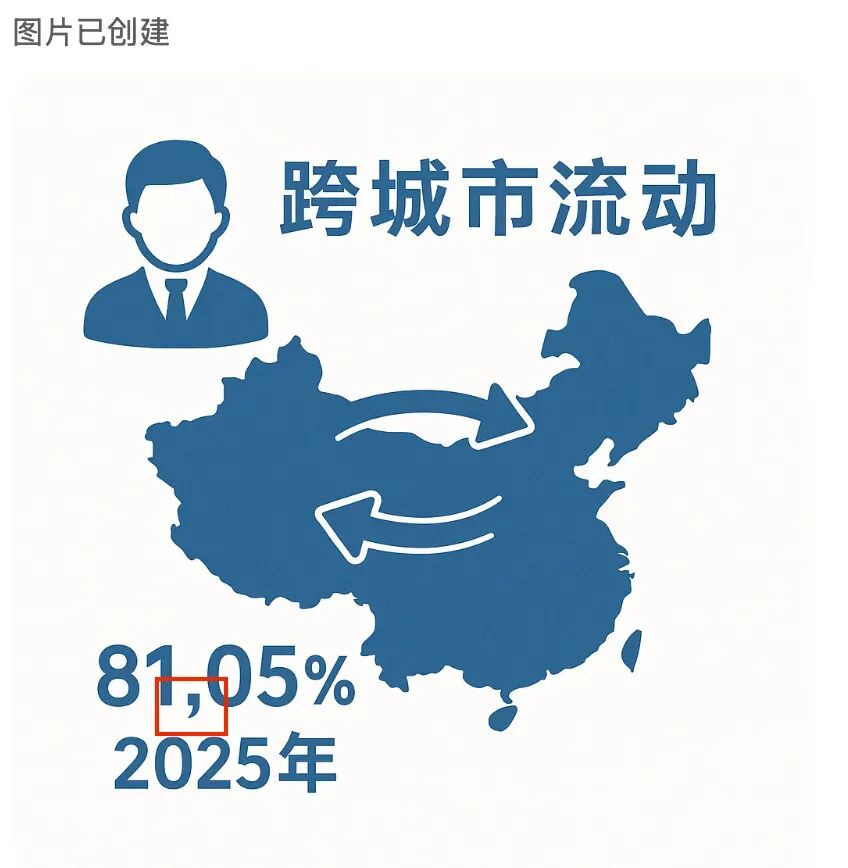
It's worth noting that o3 still exhibits some hallucination at this stage, yet the accuracy of its image generation already impressed me.
The accuracy level was roughly: 6 out of 9 illustrations were essentially correct.
For example, demand in high-tech industries:

Growing employment pressure on college graduates:
(Notably, the "supply-demand mismatch" appearing in the image was not in my original blog draft — it was o3's own interpretive summary.)
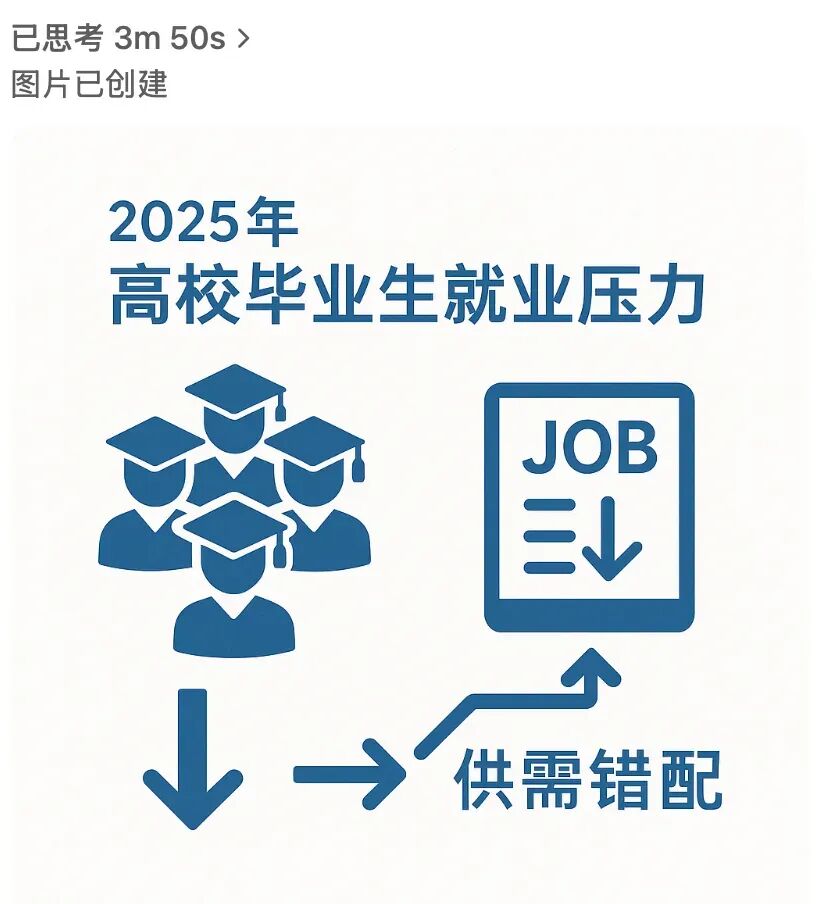
Scale of Beijing college graduate employment in 2025:
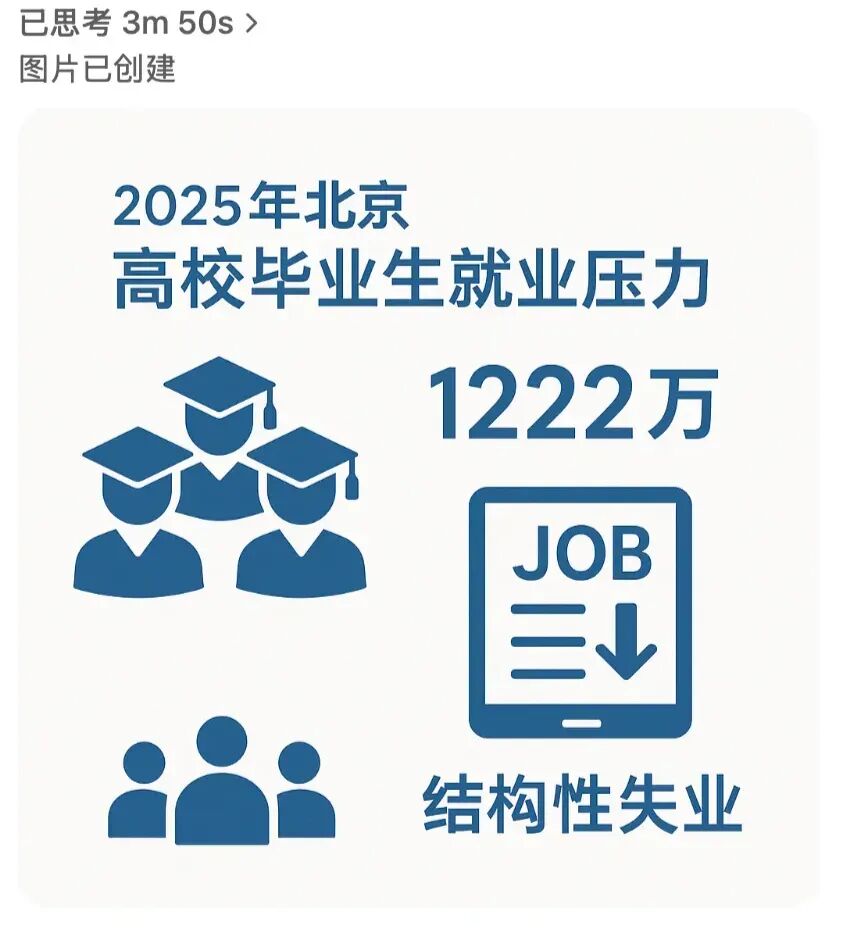
o3 summarized the current "education-job mismatch" and employment difficulties facing graduates:

Regional talent mobility:
(While o3's image accuracy has improved substantially, hallucination still occurs — such as the punctuation marks in the red box.)
Talent policies:
Blog content summary:
o3's late-night viral surge felt like an opening signal, making everyone realize: the true commercial potential of large models has only just revealed the tip of the iceberg.
But a practical question looms: as multimodal capabilities in models like o3 continue to evolve, how can entrepreneurs avoid falling into short-term profit-chasing "wrapper traps"?
o3 has already opened a door full of opportunities before our eyes — but what scenery awaits on the other side?
🚥
The second half of the AI race is a bloody battle at the application layer. Before the next viral dawn breaks, how to embed AI deeply into commercial scenarios is worth every entrepreneur's consideration.
Those teams that truly understand AI's capability boundaries and combine them with deep industry knowledge will stand out in this technological revolution.
What will your next "AI wrapper" product look like?
🚥