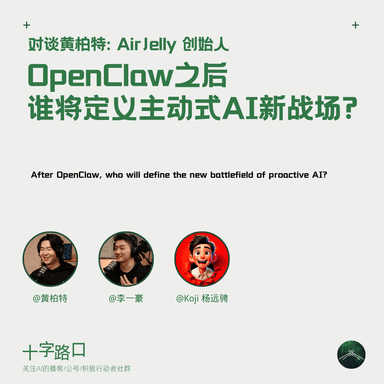
🚥 This week on Crossing, we're joined by AirJelly founder Herbert Huang, and his angel investor, CreekStone partner Yihao Li.
Herbert is 24. At ByteDance, he built the open-source project MineContext, and lived through the harshest lesson of this generation's Agent entrepreneurship: as Claude Code, Cowork, and OpenClaw evolved, many product forms that looked viable on paper were suddenly "swallowed" by stronger foundational capabilities. So where can startups actually build defensible moats?
Recently, with AirJelly's launch, they've gradually found a direction truly worth betting on: the key to next-generation Agents isn't in the chat box — it's in Context. Capturing users' real intent, understanding continuous context across apps, files, and workflows, then intervening proactively at precisely the right moment.
Cursor redefined Tab. Typeless redefined Fn. AirJelly wants to redefine Enter. The three primary channels through which humans express intent — IM, chatbot, browser search — all converge on the same key. Every Enter press is a highlight moment. Rather than full-screen recording, better to capture these nodes precisely: history doesn't record every day, only the moments that truly changed something.
By 2026, "proactive AI" is becoming an increasingly strong industry consensus. We believe the real dividing line for Agent products won't simply be "can it do things, and how well," but "does it know why you're doing this thing right now."
If you're an AI founder, investor, or thinking through next-generation proactive AI / Agent product directions, this episode offers a concrete, genuinely discussable perspective.
🎬 Our video podcast is now live on Koji Yang Yuancheng's channels on WeChat Video, Xiaohongshu, Bilibili, and YouTube.
📒 The transcript will be published on the Crossing WeChat official account.
🟢 00:00:33 Rapid Fire
24 years old; Xidian University; ENTP/Capricorn; AirJelly is an "proactive context-aware companion"; angel round completed; team of 8; previously at ByteDance building MineContext.
🟢 00:01:26 From Recording Tool to Proactive Companion
The real upgrade isn't "remembering more" — it's "starting to act for you." AirJelly organizes memory around events, tasks, and intent. Once execution capabilities were integrated, the product had its first truly magical moment. Moving from "seeing what you've done" to "knowing what you'll do next" — this is a paradigm shift.
🟢 00:03:46 Redefining the Enter Key
Cursor redefined Tab; AirJelly wants to redefine Enter. Every Enter press captures the instant a user expresses intent. The most valuable context isn't screen content — it's what you've decided to do.
🟢 00:07:20 What Should Startups Build to Avoid Being Eaten by Foundation Models?
If Vibe Coding can get you to 80% quickly, it's probably not worth a startup's time. The team tried task engineering but quickly saw it would be subsumed by Claude Code. What's truly worth doing are the things that sound simple but are actually full of edge cases and engineering grunt work. Context acquisition, understanding, and retrieval — this is exactly the kind of hard, dirty work that might actually build moats.
🟢 00:11:22 From Search to Proactive Agent
The real leap isn't "finding information" — it's continuing to push tasks forward along your history and intent. They started using AirJelly to explain code, modify features, and submit PRs for themselves; the product formed its first self-reinforcing loop. True proactivity isn't more reminders — it's simultaneously understanding intent and context, then moving forward along the user's trajectory. Traditional search ends at breakpoints; proactive AI acts like a detective, piecing together historical events, task clues, and next actions. Many products fail to become general-purpose proactive AI not because execution is too weak, but because they can't access broad enough context.
🟢 00:22:15 Memory and Perception Are the Moat
Not recording everything, but capturing key nodes; not executing harder, but first seeing more of the world. Full recording seems complete but is actually noisy; what matters is high-density intent sampling and key node capture. If proactive AI works, what users won't migrate away from may not be any single feature, but the accumulated personal work history and memory system built over time. OpenClaw is like a "lobster" — limited vision, strong execution; AirJelly is like a "jellyfish" — strong perception. They believe proactive AI's ceiling depends first on how much of the world it can see. When a product starts feeling like a "raised" Agent, user relationships, retention logic, and product identity all shift together.
🟢 00:26:30 The Product Boundaries of Agent
The real question isn't "can it do it" but "when to interrupt, how general to be, how many endpoints to connect." The hardest part of proactive AI isn't reminders — it's timing: when users switch applications is often the more appropriate moment to be interrupted and helped. Three lines worth watching in 2026: vertical Agents, Agent Infra, and Agent Hardware — all ultimately about filling in context and execution chains. Being general-purpose isn't indecision; it's avoiding premature workflow constraints. AirJelly is betting users will invent more uses themselves. The team is starting with PC, then gradually adding phone, WeChat, and hardware; the long-term goal is a cross-device, cross-scenario productivity memory system.
🟢 00:39:30 How AI-Native Organizations Emerge
The team emphasizes hiring people who already use AI tools, minimizing inefficient meetings, letting simple questions flow through async communication and complex information systemically accumulate. They want to first make their own company a sample of AI-native organization, not just build an AI product. In this era, what investors provide isn't just money — it's calibration on frontier directions, key talent networks, and resource coordination. Future differences between AI companies won't just show in models and products, but in whether the organizational form itself is AI-native.
🟢 00:45:32 Privacy Is the First Battle
The key to proactive AI isn't just more magic — it's making users feel the privacy trade is worth it. To get more context, you must first answer "why trust us." But privacy isn't just a technical issue; it's an emotional and user-education issue too. One of the most likely failure paths isn't wrong direction, but failing to find balance between privacy and efficiency.
🟢 01:03:35 Entrepreneurship Waits for No One
"Childhood is the illusion of peacetime." The AI-era startup window has compressed to 1–2 years; "preparing a few more years" may just be a security illusion left over from the old era. It's not about being ready before starting — the era no longer allows waiting. This is why this generation of AI founders carries a stronger sense of racing against time.
🟢 01:05:13 The Phase Transition Is Still Ahead
OpenClaw is just the opening; stronger computer use, long-horizon task capabilities, and agent collaboration will continue breaking through. Setting no ceiling for 2026, because 2025 already far exceeded expectations. The most valuable thing in this episode isn't AirJelly itself — it's a preemptive read on the next paradigm shift.
Subscribe to Crossing: 🚦 We track the industry changes and entrepreneurial opportunities brought by the new wave of AI technology.
🚦 Crossing is Steve Jobs's metaphor for Apple — standing at the intersection of technology and liberal arts, where great products are born. AI is transforming every industry. We seek out, interview, and bring together a new generation of AI founders and active participants in the AI era, exploring and embracing new changes and possibilities together.
👦🏻 Host Koji: I founded Crossing, launched AI Hacker House — a community space for the new generation of AI founders — and serve as Venture Partner at ZhenFund. I believe technology, especially AI, is the greatest value-creation opportunity of our generation. Koji on Jike, Koji's website
👧🏻 Host Ronghui: I co-founded Crossing, worked at a dollar-denominated VC, and spent five years as a Silicon Valley correspondent, following tech development and business stories. Feel free to reach out and chat. Ronghui on Jike