After Raising 2.98 Billion, PixVerse Is Betting on a Bigger Story

In the past, video was an endpoint; in the future, it will be an entry point.
In the past, video was an endpoint; in the future, video is an entry point.
👦🏻 Author: GaKi
🥷 Editor: Koji
🧑🎨 Layout: NCon

In the first half of 2026, money in the world models space was running hot.
Forbes reported at the end of June:
"VCs Pour $3 Billion Into AI's Next Big Bet: World Models."

In this direction, World Labs (founded by Fei-Fei Li) raised $1 billion at a $5.4 billion valuation. AMI Labs, founded by Yann LeCun after leaving Meta, took in $103 million in seed funding — a European AI seed record. Decart closed a $300 million Series B at a $4 billion valuation. Runway raised $315 million in its Series E at a $5.3 billion valuation.
But look closely at this list and you'll notice that a substantial portion of the companies landing large rounds were originally AI video model shops.
After releasing its world model GWM-1 at the end of 2025, Runway repositioned itself from "AI video" to "world models." Keling AI's spin-off financing is also pitching a world models story. OpenAI shut down Sora's consumer product this March but kept the Sora team, with its direction now pointing toward world models.
AI video companies are pivoting en masse to world models because, for video model vendors, the smoothest path to world models runs through interactive gaming.
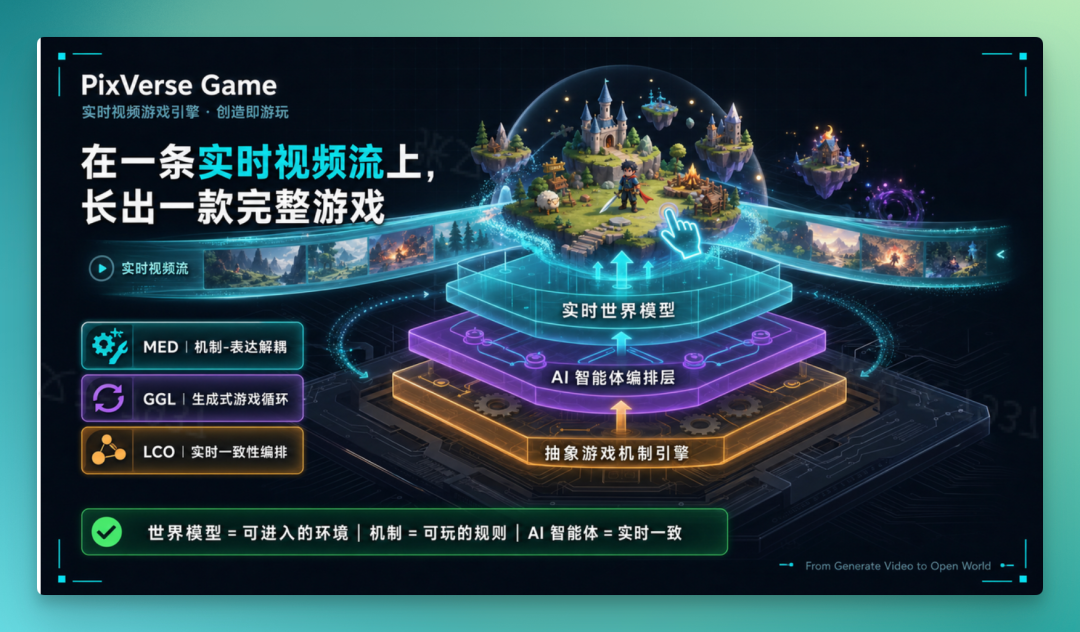
Against this backdrop, AI video company AISphere (PixVerse) recently completed its overall Series C financing, totaling 2.98 billion RMB, with Alibaba leading the C+ round. Simultaneously, it launched PixVerse Game, a game engine powered by real-time video models.
🚥
Below, we share our observations on this direction and our hands-on experience with the product.
Hands-on: What It Can Do Right Now
We tested the PixVerse Game platform and tried making a game called Whispering Woods Romance — a fantasy forest setting with a Japanese-influenced art style.

PixVerse Game's entry point shares some similarities with conventional AI video tools: you land on a prompt input box. The difference is that you don't need lengthy prompts to constrain the generation direction — a single sentence suffices.
The platform currently offers three game modes: exploration, strategy, and battle. Next to the input box, there's also reference image upload and prompt inspiration recommendations:
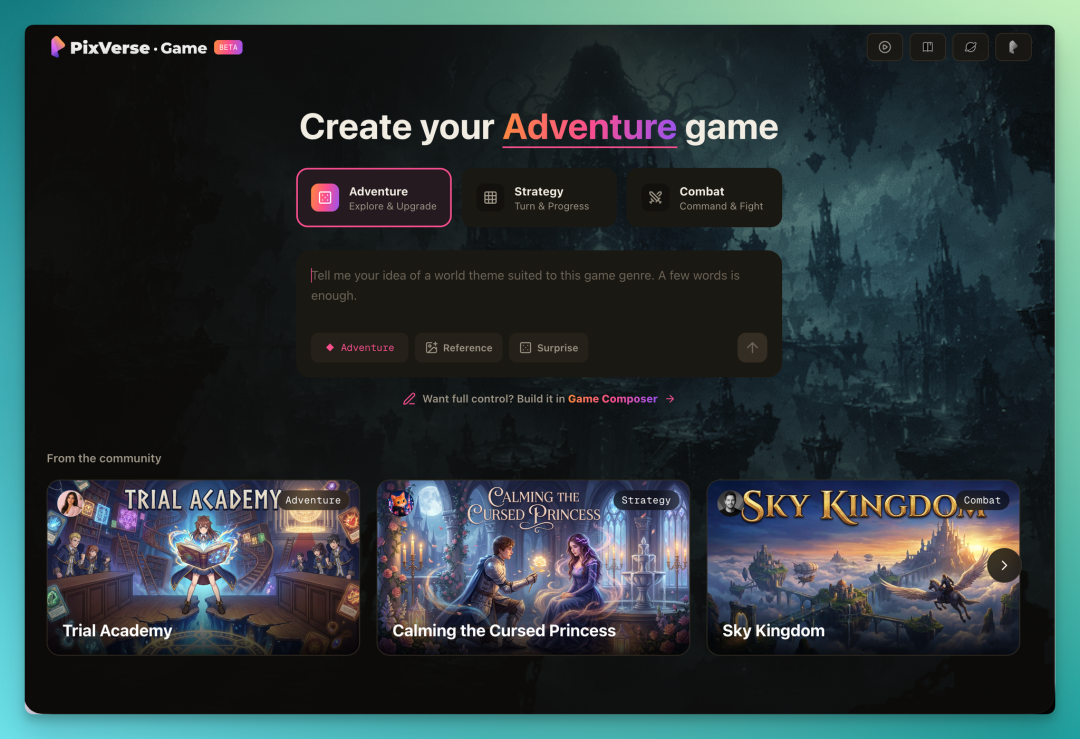
Each game type comes with a complete stat system, including ability panels, quest systems, character leveling, item collection, and history records.
After entering your prompt, it takes about 10 to 15 seconds to enter the game. First comes the character selection screen, where PixVerse Game auto-generates three characters with different attribute distributions and stat panels:
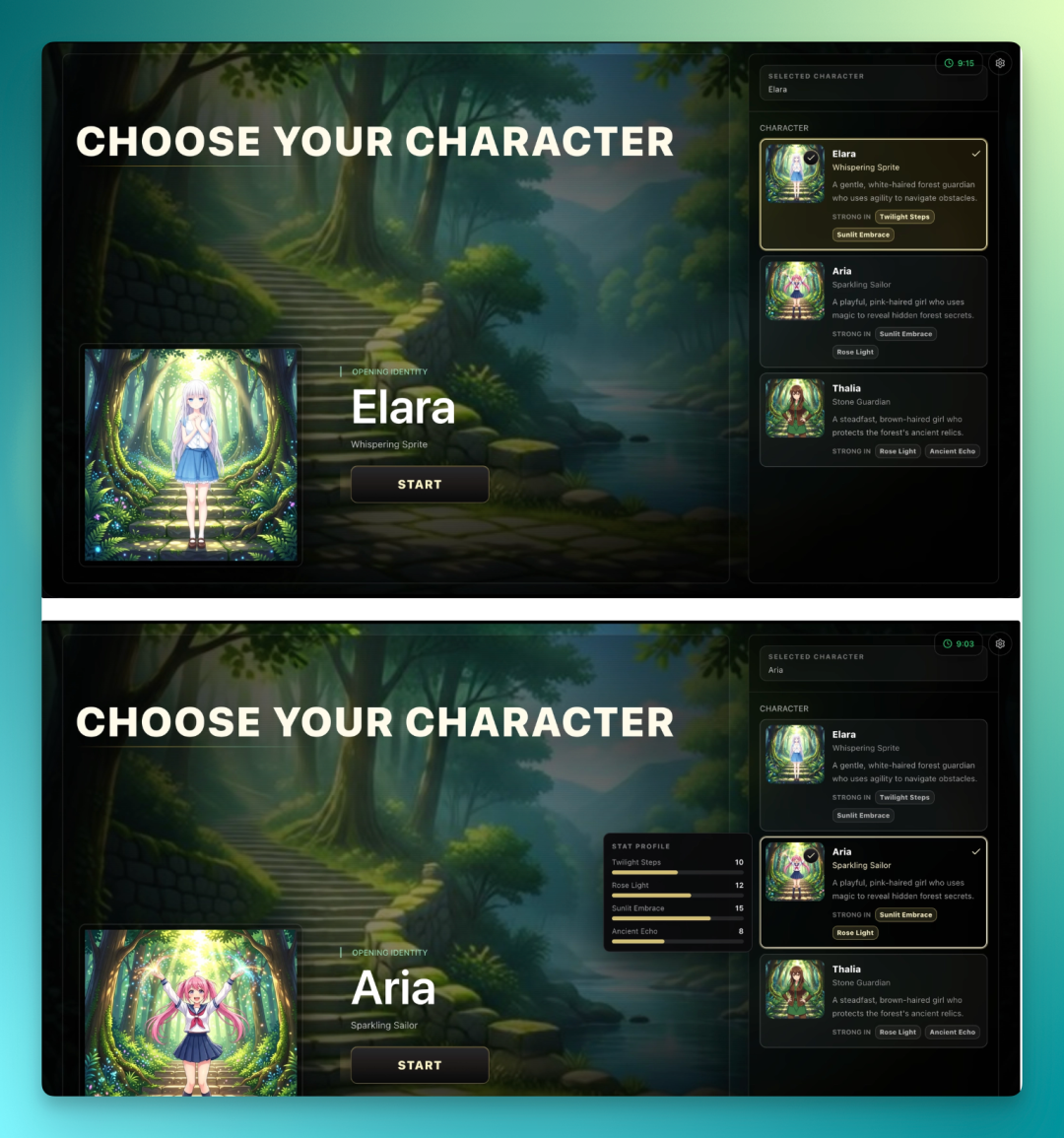
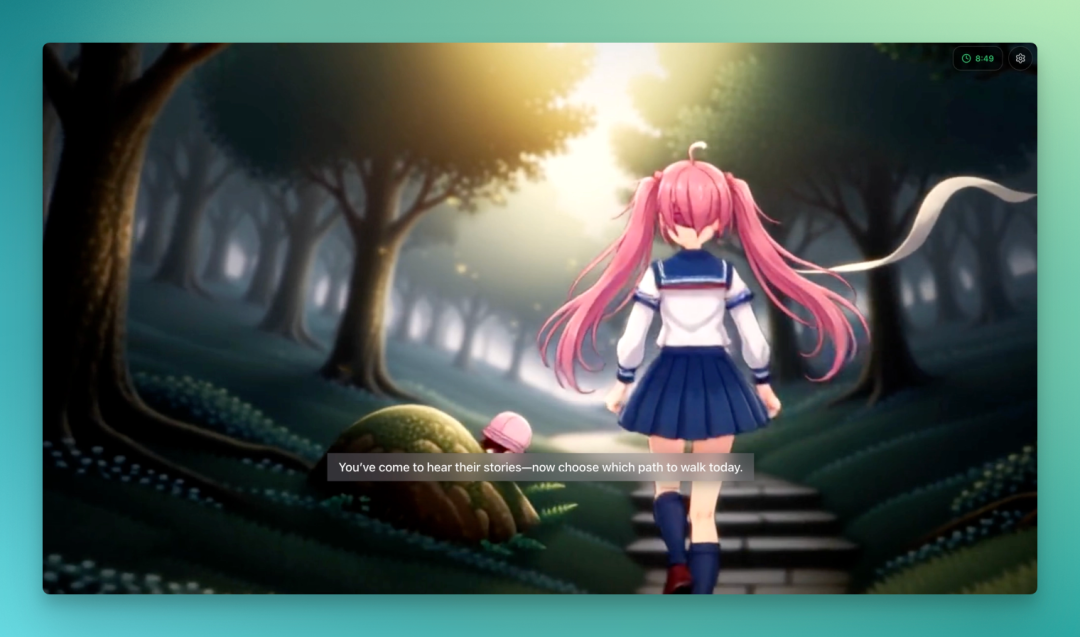
After selecting a character, the screen begins generating in real time. Below is footage of the character moving through a forest scene. The entire game features subtitles and voiceover narration.
Because the visuals are generated in real time by a video model, the visual quality differs noticeably from traditional game engine rendering — overall softer, and still visibly AI-generated:
Below is a complete gameplay recording.
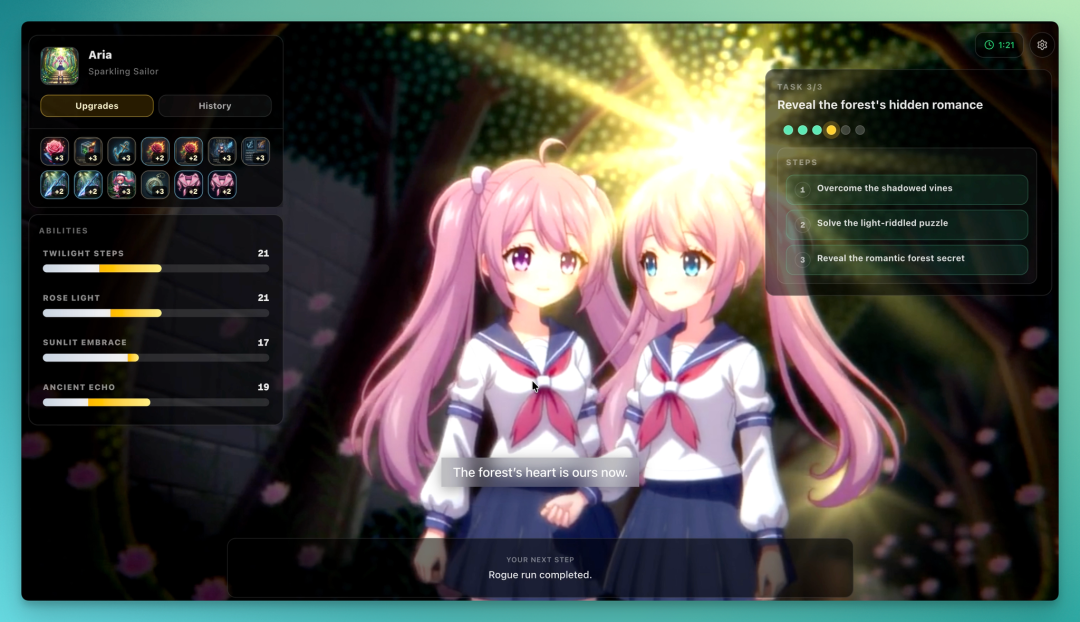
The left side of the interface shows the character's functional modules and attribute panel; the right side displays the quest panel. Item collection notifications pop up continuously during gameplay, guiding the player toward the next objective. Each playthrough has a complete storyline, currently under 10 minutes per session:
We didn't set detailed plot parameters for this session — the system auto-generated a narrative where the character solves puzzles in the forest and ultimately finds a twin sister. After the game ends, there's a full results screen showing collected items, attribute changes, and quest progress:
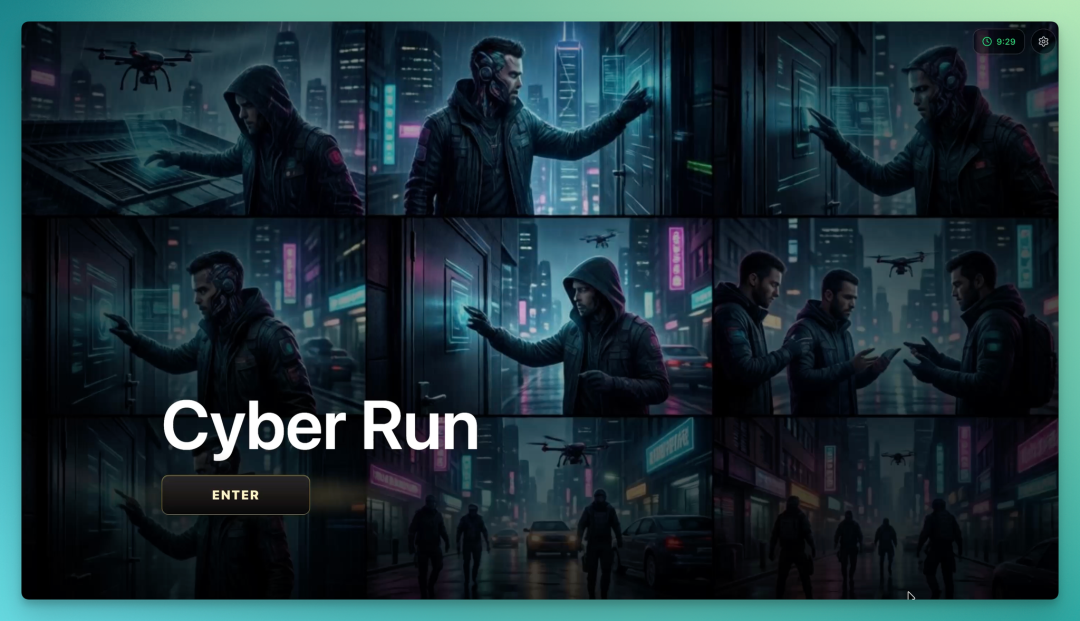
You can also see games made by other players on the platform. Here's CyberRun, in a cyberpunk style:
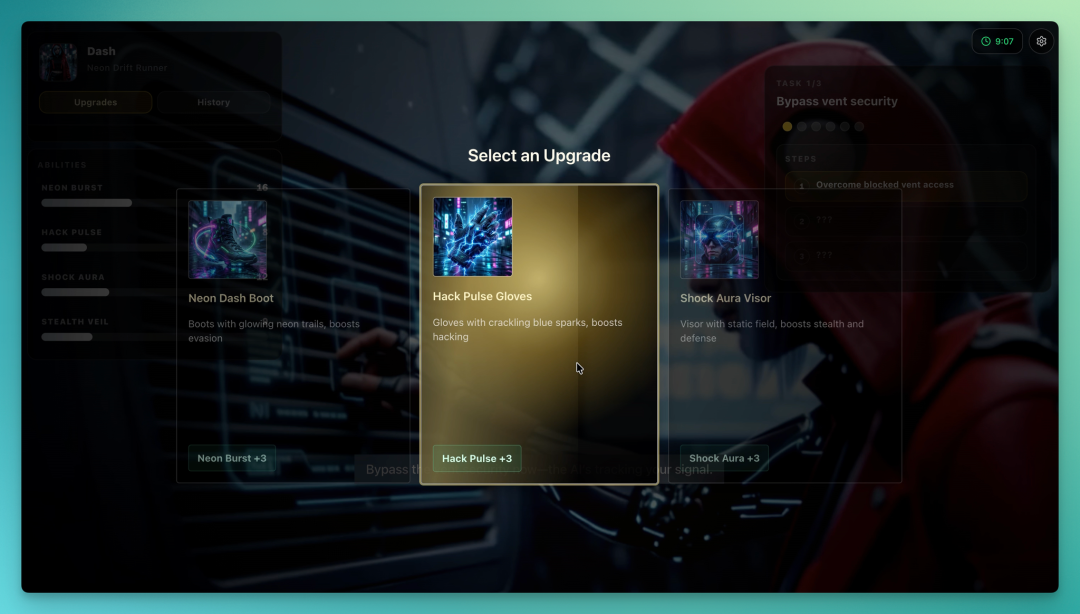
The overall gameplay framework is similar to what we created — the system automatically determines each upgrade direction, plot development, and visual logic based on the storyline and game style:
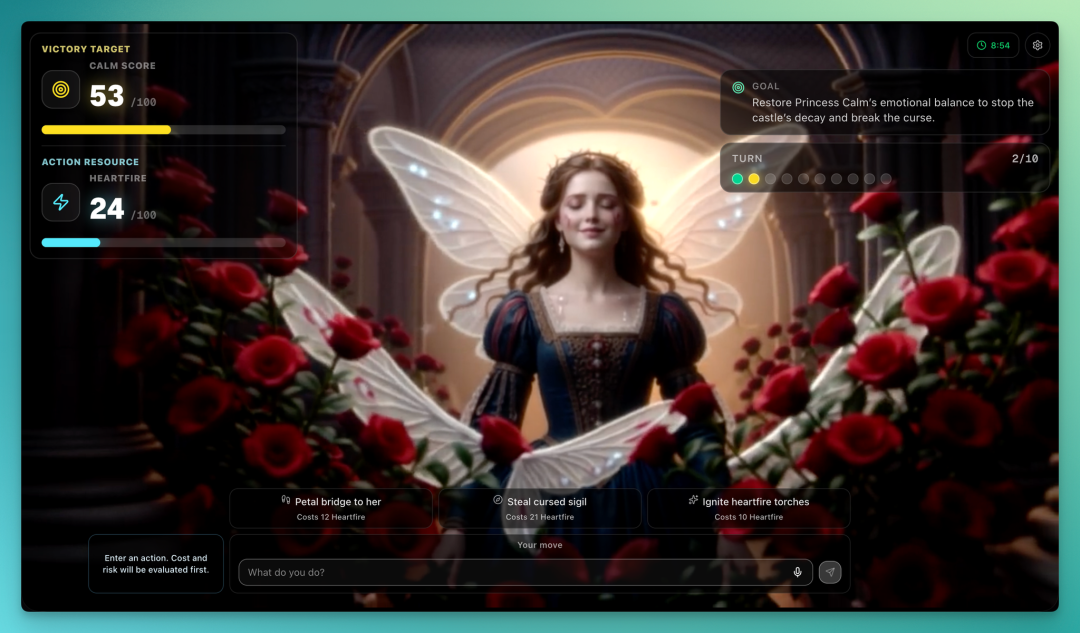
Beyond exploration mode, PixVerse Game also supports strategy games, with different mechanics:
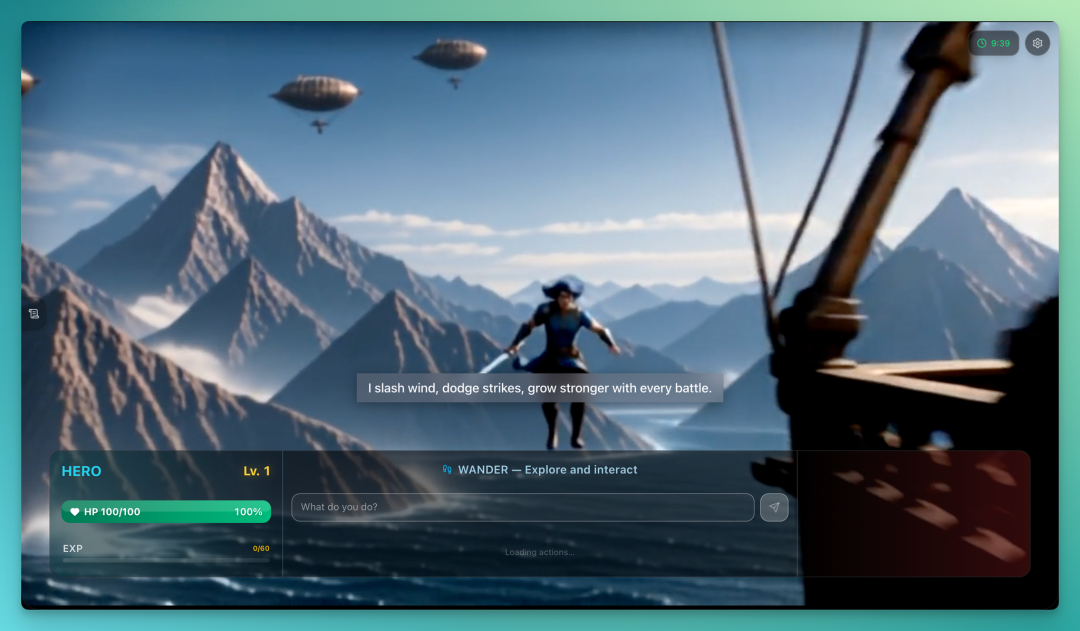
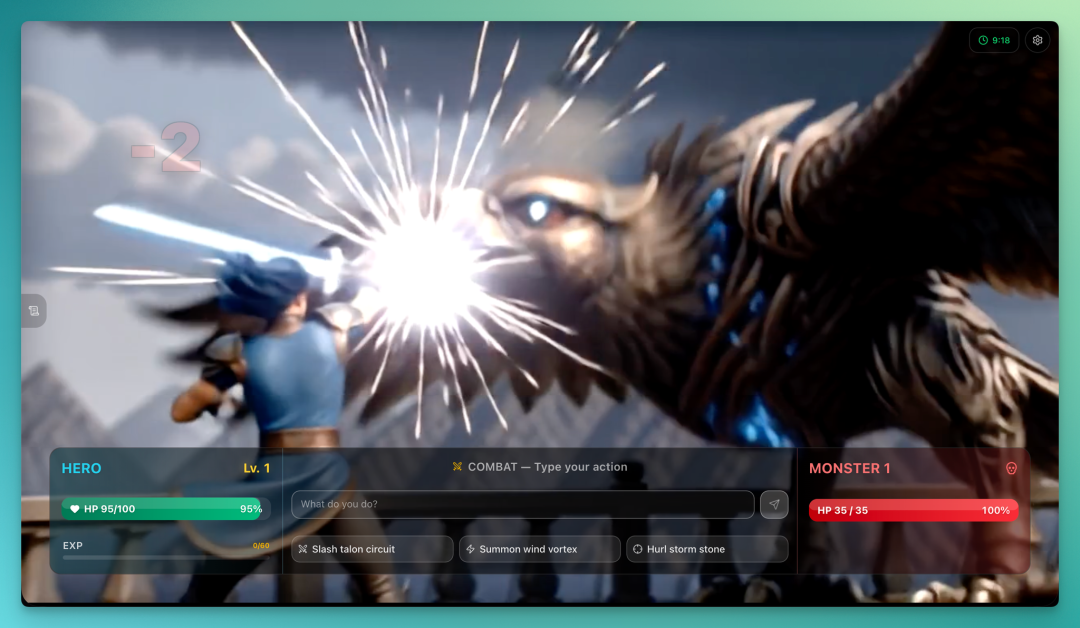
In battle mode, the interface switches to HP bars and combat options, with noticeably different interaction from exploration mode:
The visuals are still in a relatively early state, but the completeness of game elements already has basic coverage:
A game generated in one go inevitably has various issues, and players need to adjust details. PixVerse Game includes a built-in editing tool called Game Composer, which lets you customize parameters and content. Beyond direct manipulation on the stat panel, you can also modify things through natural language in the Agent dialog box on the left:
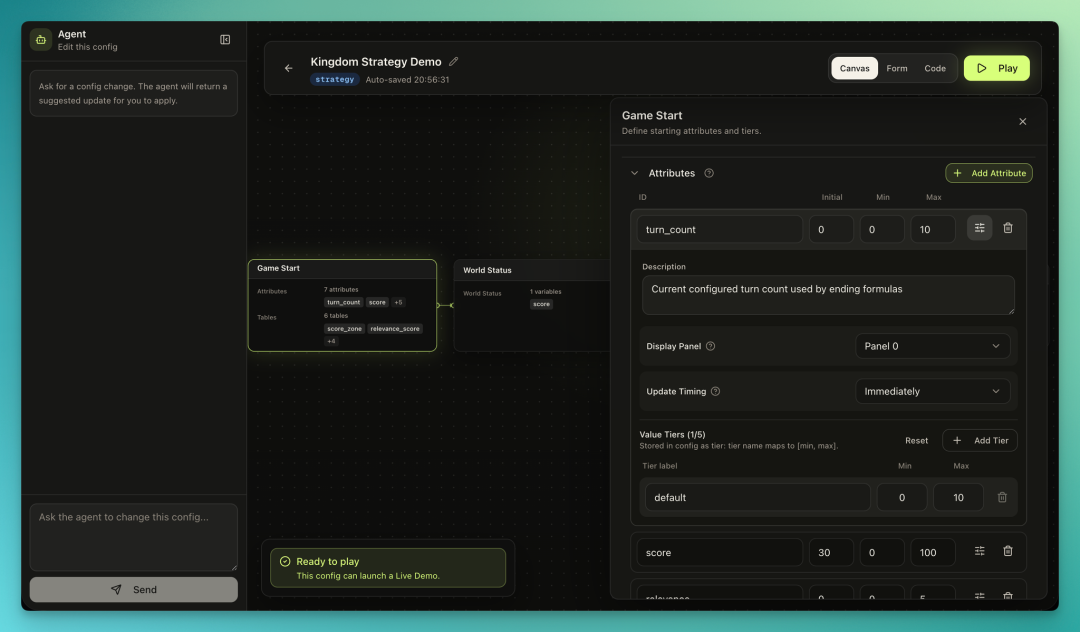
For example, through conversation, you can directly add a new resource system to the game:
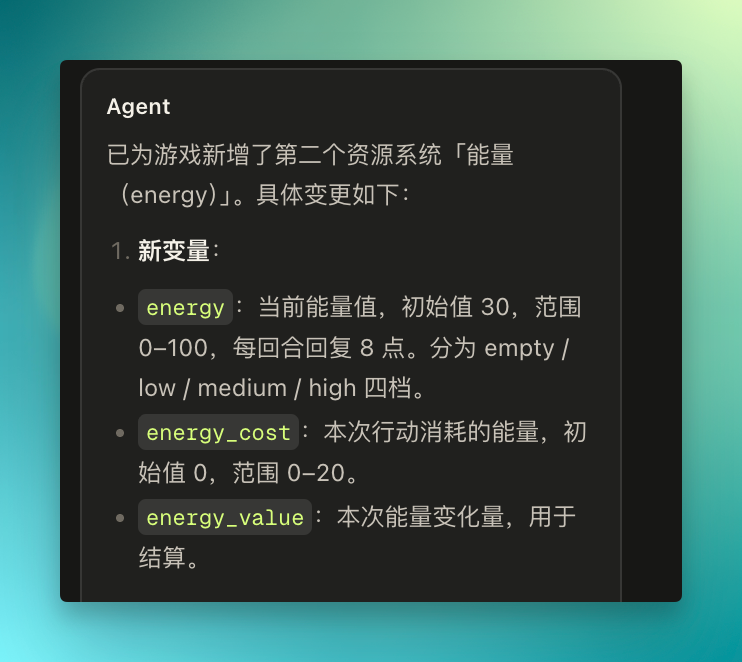
The same workflow can be used to adjust an entirely new project. Below is the game interface of a medieval knight game after editing:
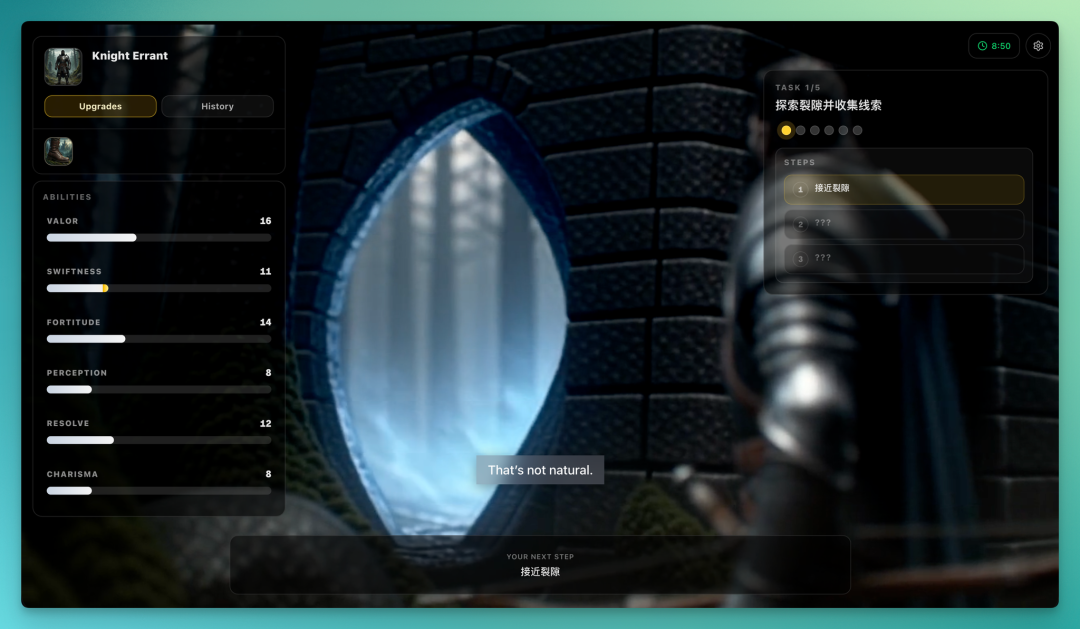
Some immediate impressions from our hands-on time.
The visuals are genuinely real-time generated video streams — you can feel the difference from traditional game rendering.
The interaction model is completely different from conventional games. You can drive character behavior with natural language, meaning what players can theoretically do is open-ended, not limited to preset options.
Of course, PixVerse Game in its current form isn't really a game — it's more of an exploration.
But viewing it merely as an "AI game product" may underestimate what PixVerse is actually trying to do. For PixVerse, gaming is more like a real-world experiment for real-time world models.
For instance: using continuously generated visuals from a real-time world model to replace the heavy rendering and content production pipelines of traditional games, combining real-time video models, game mechanics toolchains, and user-defined worldviews.
Behind this lies the "special positioning" of video models, game engines, and world models.
Video Models, Game Engines, and World Models
What PixVerse Game is doing becomes clearer when placed in the broader arc of technical evolution.
In the early stage, models like Sora, Veo, Keling AI, and Seedance basically took text or an image and generated a fixed-length video. Once generated, that was it — users couldn't alter the visuals. But during training, these models were already learning the laws of the physical world: how light and shadow change, how objects move, how occlusion relationships work.
The models weren't explicitly taught physics, but they learned it themselves from massive video datasets.
The next step was adding interactivity. This gave rise to so-called "neural game engines." Models began generating frame by frame, with each frame referencing the user's current input.
There are several milestone moments in this phase.
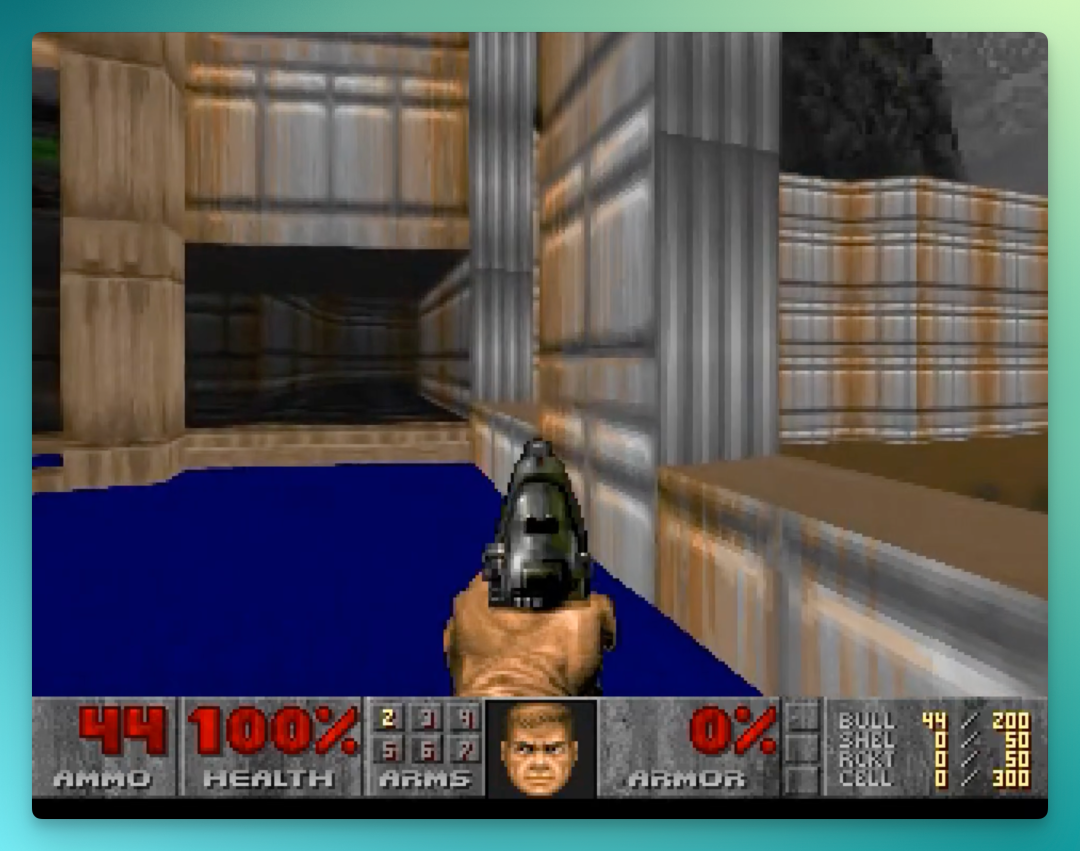
In 2024, Google Research released GameNGen, the first time a diffusion model ran the classic game DOOM in real time, hitting 20fps on a single TPU. The visual quality was high enough that when humans tried to distinguish real gameplay from AI-generated footage, their accuracy was only slightly better than random chance.
Around the same time, Israeli company Decart released Oasis, the first fully AI-generated playable game. It looked like Minecraft, but had no traditional game engine or code behind it — running entirely on "next-frame prediction."
Decart closed its $300 million Series B this May. Investors included Nvidia, Sequoia, former OpenAI co-founder Andrej Karpathy, and a member of Nintendo's founding family.
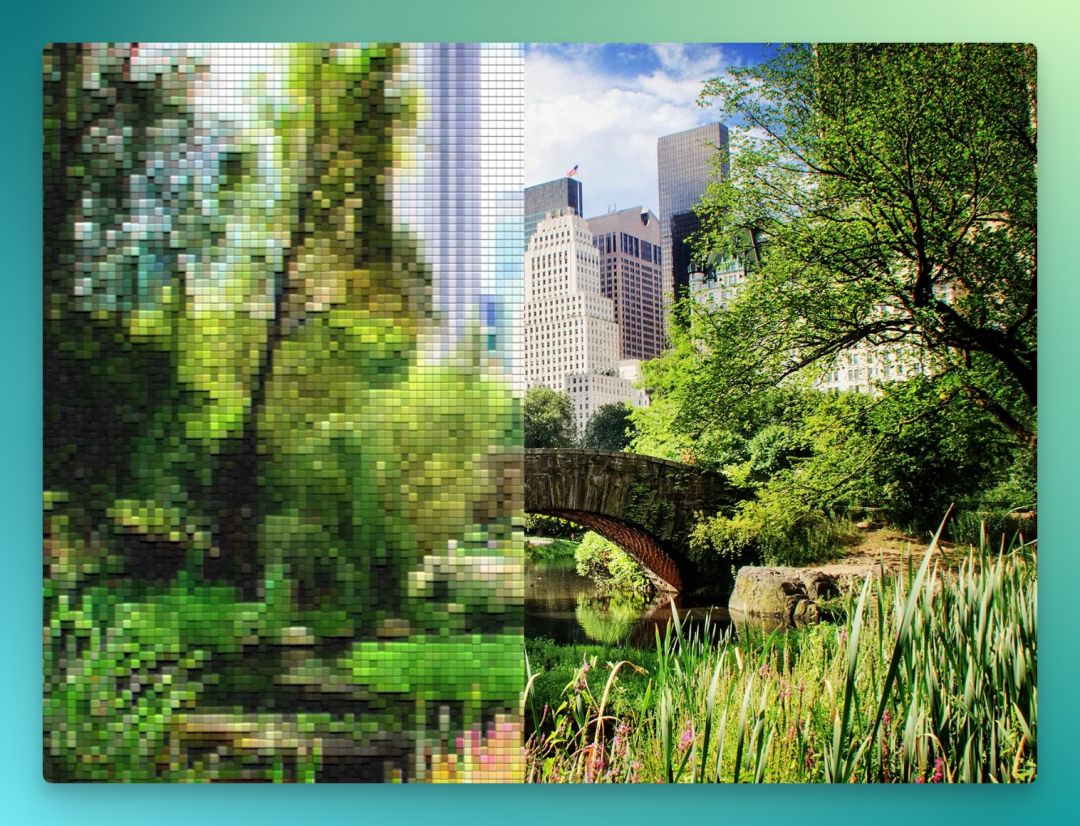
The latest stage is general world models. DeepMind's Genie 3 can generate navigable 3D dynamic worlds from text descriptions at 24fps, 720p. Runway's GWM-1 branches into Worlds (interactive environment generation), Robotics (robot training simulation), and Avatars (digital human behavior simulation).
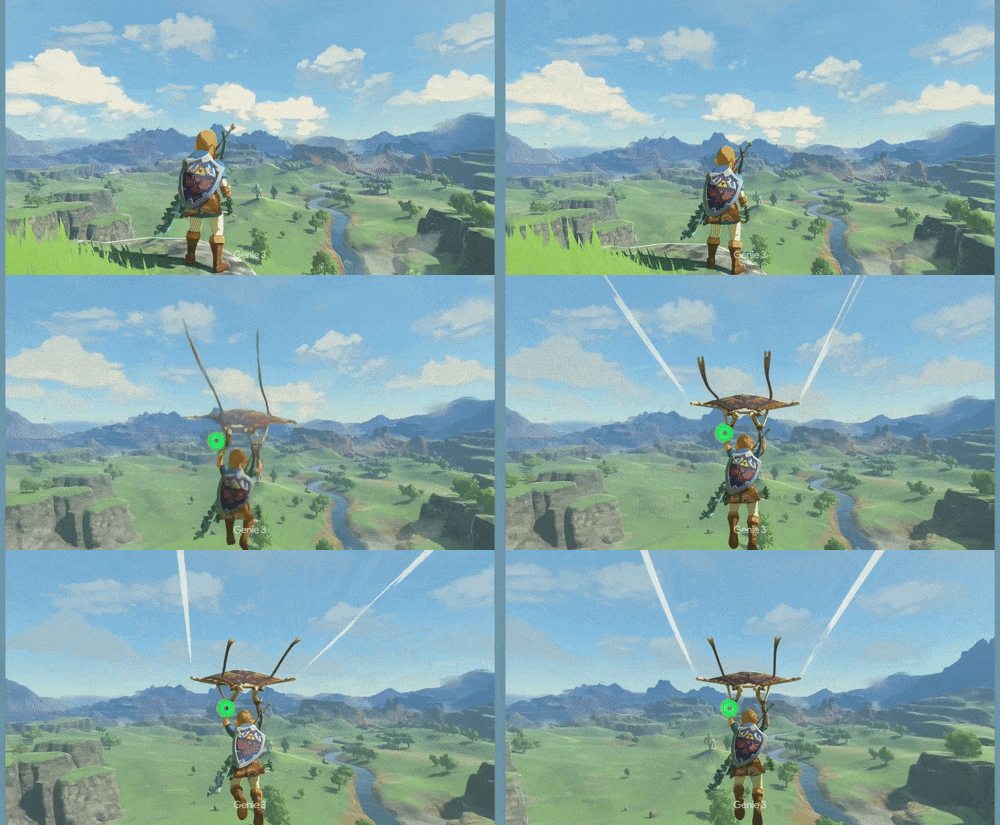
Source: @MinChoi
At this point, a single model handles content generation, behavior modeling, and rendering simultaneously — producing something closer to a world with consistent rules.
On this trajectory, PixVerse's position gradually becomes clearly definable.
Earlier this year, PixVerse released R1, a real-time world model supporting 1080P — the model currently powering PixVerse Game.
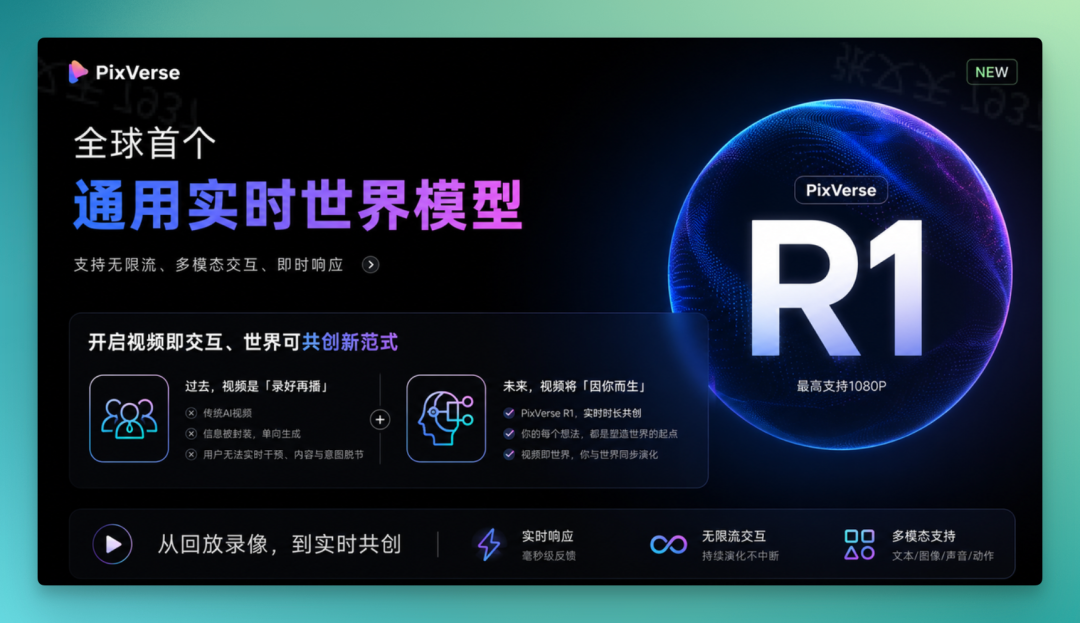
Unlike traditional video models, R1 generates a continuous video stream that responds to user instructions in real time. While the video is being generated, users can alter the visuals with natural language — specifying "make the sky dusk" or "move the character left."
Going further, in the hands-on case above, what PixVerse Game does is connect real-time video generation capability into game creation. Traditional game engines (like Unity, Unreal) build game worlds using pre-made art assets and code.
The PixVerse Game Engine generates game worlds using real-time video models. Creators define rules, objectives, mechanics, and worldviews; characters, scenes, and visuals are produced in real time as players interact.
According to PixVerse's official description, they summarize this philosophy in one sentence:
"To Create is to Play."
Meaning creation itself is part of the gameplay experience — somewhat akin to the creator ecosystems of Roblox or Minecraft, but with AI models replacing engines and code as the underlying driver.
And the fact that this entire path can proceed smoothly, or at least without major obstacles, rests on AI video genuinely having "strong commercial imagination."
The Commercial Imagination of AI Video
XuZhang Xie, co-founder of PixVerse, predicted at the UN AI for Good Summit this June:
"In the past, video was an endpoint; in the future, video is an entry point — into gaming, livestreaming, narrative, social, and the creator economy."
AI video, alongside coding, is one of the two paths in AI that has achieved real commercial validation. This context matters.
China's AI short drama market is projected to reach 30 billion RMB in 2026. The overseas AI short drama market grew from $100 million last year to a projected $650 million this year — a 550% year-over-year increase. On YouTube, AI content already accounts for over 63% of top short drama channels.
Here's how the head of YouTube's Greater China AI business put it:
"In the second half of last year, AI content revenue was only 10% of filmed short dramas; this year it's approaching 40%."
Taking PixVerse itself as an example: by the end of 2025, its annual recurring revenue (ARR) exceeded $40 million, with 150 million global users across 177 countries and regions.
For comparison, OpenAI's Sora was officially shut down this March. The product cost roughly $1 million per day to operate, with total revenue since launch of only $2.1 million.

Sora's exit shows that competition in this track has reached a culling phase — pure tech demos and brand effects are no longer sufficient; real user volume and revenue are required.
By contrast, according to a March interview between LatePost and Xie, PixVerse's app and website retention rates are quite high — users aren't just one-time visitors.

This reflects that AI video has gradually moved from early tech-demo stage into real production and creative scenarios. Users willing to return repeatedly and pay for generated content is what underpins the next phase of development.
AI video's commercial value at the "generate visuals" layer has been validated. But if video model capabilities continue extending — from generating fixed footage to generating an interactive world — the commercial imagination expands dramatically.
Traditional game production requires a complete content pipeline: 3D modeling, animation, art rendering, sound design, narrative scripting. A mid-sized project demands dozens of people working months or even years. AI real-time gaming can compress this pipeline significantly.
Worlds and visuals generated by models in real time; creators need only define rules and worldviews.
This brings several notable changes.
The most direct: each player's experience can be completely different. With visuals generated in real time by the model, the same game can unfold into different visuals and narrative directions for different players.
Simultaneously, creation barriers drop substantially. No 3D modeling skills needed, no programming experience — describe the game world you want in natural language and start creating. And game content can extend continuously. Traditional game content volume depends on team capacity and budget; AI-generated game worlds can theoretically keep producing new scenes and narrative branches.
A notable case: a project that recently gained traction on Xiaohongshu and Bilibili.
A three-person indie studio of women produced a quick-transmigration style otome game PV, with AISphere providing the technical support behind the entire project. The PV received over 10,000 likes across both platforms.

For an AI-generated game PV, this engagement level is already significant. It shows player communities have acceptance for AI-produced game content, provided the content itself has sufficient appeal.
AI gaming capabilities are improving rapidly, but still fall short of fully satisfying players — both things are true simultaneously.
However, note that the creator "Beibei" mentioned that producing a male lead's 3D model used to take 3 to 6 months; using video models, they achieved equivalent cinematic-grade visuals in 3 weeks.
Following film and television, gaming may be the next creative industry dramatically reshaped by AI video technology.
On June 17 this year, Koji had an in-depth conversation with PixVerse co-founder XuZhang Xie, covering PixVerse R1, the real-time world model.

Discussing this model, Xie noted that as real-time world model response time approaches zero, users can control direction, angle, and depth in real time during video generation via keyboard, mouse, or controller — opening the possibility of building an AI-native interactive game engine.
"Creation as consumption" also becomes possible.
Looking further out, general world models are rapidly drawing attention.
A single model handling content generation, behavior modeling, and environment rendering simultaneously — applications extend from gaming to robot simulation (Runway's GWM-Robotics), autonomous driving simulation (Waymo built a dedicated driving scenario simulation model based on Genie 3), and digital human interaction (PixVerse is also using real-time interactive technology for AI virtual streamers).
AI video models validated that "learning the world from data" works; the short drama market proved the first layer of this capability's value — better video visuals. As this capability extends further into interactivity, real-time generation, and participatory environments, the commercial space it can support will far exceed short dramas.
PixVerse went from video generation to 150 million users, from real-time world models to a game engine. Each step on this path has corresponding products and data.
The entire AI video industry is undergoing similar directional choices. Which path ultimately goes far enough will depend on product validation over the next year or two.
Crossing is seeking independent contributors to write AI product and model reviews.
If you've written articles like: Hands-on: PixVerse C1[1], Hands-on: LibTV[2], please contact zeo0811@gmail.com. Your email should include: ① personal introduction, ② AI review articles you've written.
We offer competitive compensation. Looking forward to observing and documenting the AI era with you 🎪

References
[1] Hands-on: PixVerse C1: https://mp.weixin.qq.com/s/cgAzZy2PptdYaWbqywVg7A
[2] Hands-on: LibTV: https://mp.weixin.qq.com/s/aycqnq8wlaaOei1QZmhFHQ