Why Are the Two Founders Who Found PMF Still Anxious? | A Conversation with Jisi Tech and Talk AI

Always feeling the company is growing too slowly, always anxious, always staring into the abyss, chewing glass.
This week on Crossing, we welcome two AI founders who have found PMF:
- Shizun is founder and CEO of Jisi Tech [1]. They use AI to help brands sell direct-to-consumer, with their current product being one-to-many digital human livestreams.
- Mark is founder and CEO of Talk AI [2]. They help users practice spoken English with AI assistance.
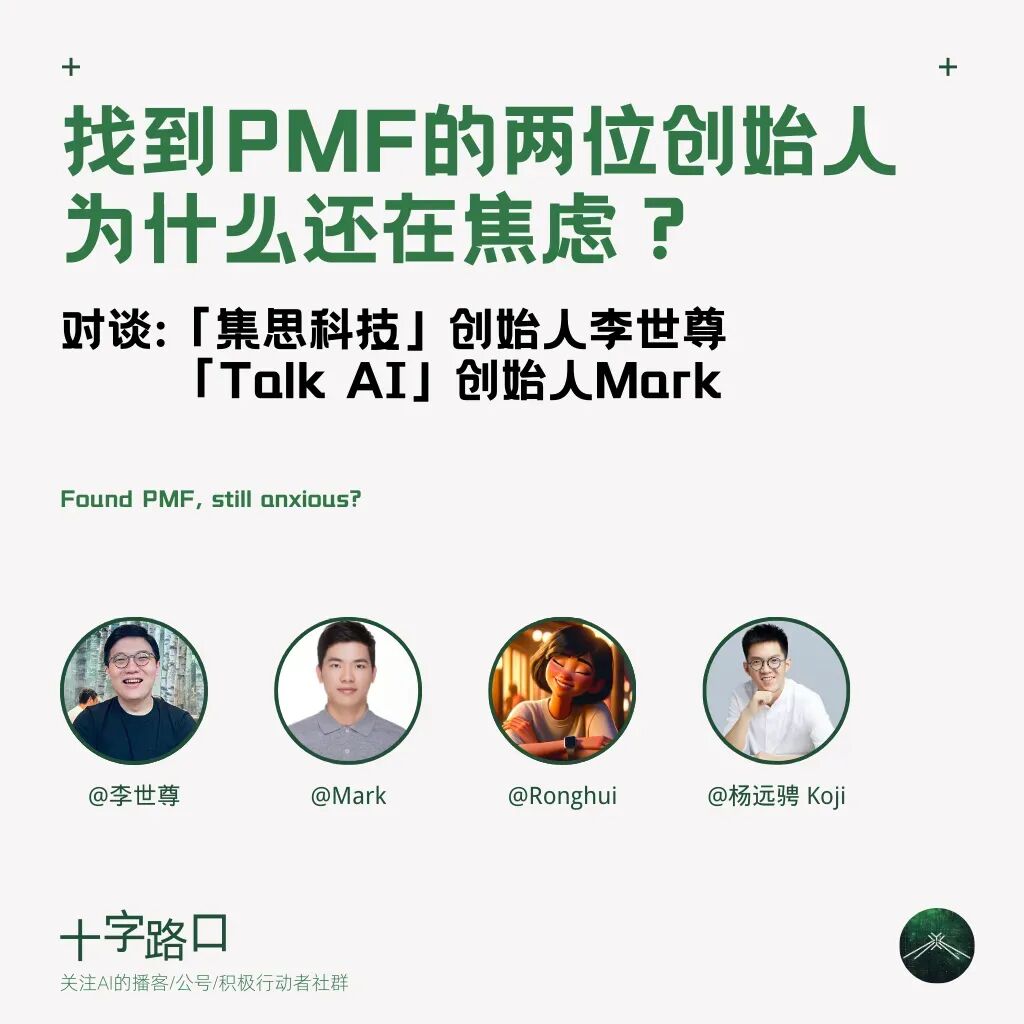
In today's AI startup landscape, finding true PMF and achieving revenue scale remains rare. Shizun and Mark's teams have both done it: Jisi Tech serves over 600 brand clients, Talk AI has 2 million registered users, and both companies have reached tens of millions in revenue.
What's interesting is how different these two founders appear: Shizun comes across as a genuinely conflicted thinker, never shying away from the agony and doubt of the entrepreneurial journey; Mark appears composed and calm, with a relaxed attitude toward competition.
But both have proven one thing with results: in the AI wave, founders who identify the right track and focus on refining their product can always carve out a path through red oceans.
Yet while 0 to 1 is exciting, "you found PMF, then what?" — the journey from 1 to 10 has only just begun. After all, entrepreneurship, like life itself, is an infinite game.
We'll dive deep into how they found PMF in their respective tracks, and the new challenges that followed. For AI founders still searching, their experience may offer some inspiration.
Listen on WeChat:
Listen on Xiaoyuzhou:


Jisi Tech's Path to Breaking Out
🚥 Koji
This week's content begins with our conversation with Shizun.
By now everyone knows e-commerce livestream digital humans exist, but they still seem mysterious — the livestream you're watching may already feature a digital human, not a real person.
Could you start by introducing the current scale of Jisi Tech's e-commerce livestream digital humans and which brands are using them?
👦🏻 Shizun
Sure. Our digital humans at Jisi Tech primarily serve brand clients, not individual sellers. We mainly operate on shelf e-commerce platforms like JD.com, Tmall, Pinduoduo, and VIP.com. Our clients are basically stores with GMV of 20-30 million or above.
Among brand clients, we're LVMH's only generative AI supplier, and also serve international brands like L'Oréal, Estée Lauder, Procter & Gamble, and Nestlé. On the domestic brand side, our clients include Blue Moon, Oettinger, and multiple liquor brands — that's our main user profile. Currently we serve roughly 400+ large brands (SK and K tier), and about 200-300 small-to-medium brands.
🚥 Koji
Everyone's asking right now: can AI companies actually find PMF? I think Jisi Tech has already proven it with results — you've achieved rare PMF in China's B2B space. Can you share specific numbers on your current scale?
👦🏻 Shizun
Our revenue is in the tens of millions now.
🚥 Koji
What year of entrepreneurship is this?
👦🏻 Shizun
Formally speaking, it's already year 3.

A Multiple-Choice Question: Endgame Thinking on the Brand Track
🚥 Koji
You mentioned your clients are mainly brands rather than sellers, and your livestream venues are mainly shelf e-commerce platforms rather than social commerce platforms like Douyin. What led you to choose not to develop seller clients or operate on social commerce platforms?
👦🏻 Shizun
That's a great question. In the second half of 2021, we first made a PPT about 2D e-commerce digital human livestreaming. JD.com thought it was excellent when we showed them, so we began co-creation. This was right when Facebook renamed itself Meta and the metaverse concept was hot, with domestic tech giants all following this direction. JD.com selected our project, and we reached a cooperation worth over two million. Our performance on JD.com was very successful after that.
On February 28, 2022, on the first day of the 38 Goddess Festival, we launched 38 livestream rooms — 24 international luxury brands and 14 domestic brands. From the very beginning, our seed clients were positioned as brands, not individual sellers. We believed AI is better suited to replace scenarios that are more tool-like and standardized. Store livestream hosts are more like offline sales associates — this is work that can be quantified and standardized, so we chose this direction.
We also tried doing influencer livestreams, but later realized a problem:
Consumers were originally coming for Jay Chou. If you replace him with a digital twin, it actually damages consumer trust.
🚥 Koji
But theoretically your clients all have their own brand self-livestream rooms on Douyin too. For brands like LVMH and L'Oréal that you just mentioned, why haven't they used your digital human services on Douyin as well?
👦🏻 Shizun
This can be analyzed from a more fundamental logic. Users have different initial mental states when opening different apps.
When users open shelf e-commerce platforms like JD.com, Tmall, Pinduoduo, and VIP.com, they already come with purchase intent. If we set the critical point for triggering purchase behavior at 80 points, then when entering a shelf e-commerce app, the user's purchase intent may already be at 75 points.
They just need to see the right price, product images, and get the information they want to trigger purchase behavior. This scenario doesn't require excessive emotional mobilization — it doesn't need to make users very impulsive.
On Douyin, the user's purchase intent when entering may only be 5 points. To reach the 80-point threshold for triggering purchase, you need to attract users through powerful content and interesting scenarios, creating purchase impulse — there's a 75-point gap to fill.
This explains why many brands' store livestream rooms on Douyin aren't very profitable. Douyin livestream ROI is generally considered decent at around 2x — meaning for every 1 yuan spent, you only earn back a little over 2 yuan. In comparison, on shelf e-commerce platforms, spending 1 yuan typically earns back 4-5 yuan. So on Douyin, brands are mainly doing brand exposure.
🚥 Koji
When you introduce e-commerce livestream digital humans to brand clients, what concerns do they have? Because I can imagine people might think this seems a bit fake?
👦🏻 Shizun
Interestingly, not many people actually ask this. Because everyone already has an expectation: digital humans definitely can't match real humans. That is, when clients come to learn about it, they've already preset the idea that "this must be very fake."
If their psychological expectation is set at 50 points, and the effect we demonstrate reaches 80 points, they'll think: "This is much better than I imagined! It can actually do product holding displays, close-ups, automatic dialogue — the interactive effects are this good."
🚥 Koji
If people want to see your livestream rooms now, which platform and which brand's livestream room would they have a relatively high probability of finding?
👦🏻 Shizun
Listeners can open the JD.com app right now and go to Helena Rubinstein's livestream room, or Chow Sang Sang's livestream room, or YSL, Giorgio Armani, La Mer, Estée Lauder, Decorté, Pampers, Pigeon, and so on.

Pathfinder's Notes: The Secret Garden Behind PMF
🚥 Ronghui
So do you feel you've found PMF now?
👦🏻 Shizun
We have indeed found PMF. I have my own criteria for understanding PMF:
If 50% of clients continuously renew, constantly raise new demands, and actively refer new clients to us, it means the product has reached PMF.
And our renewal rate is now over 80%. What's even more exciting is that before August this year, all 300+ clients we accumulated came from client referrals — we didn't even have a sales team configured at that time.
🚥 Koji
Do you renew annually or monthly?
👦🏻 Shizun
Annually.
🚥 Koji
After finding PMF, what's the thing that worries you most every day now?
👦🏻 Shizun
What I personally worry about every day now is growth. My other co-founder worries about how to continuously serve clients well at the lowest cost.
🚥 Koji
So what actions are you mainly taking for growth now?
👦🏻 Shizun
In August this year, we internally determined that we had completed the stage from 1 to 10, and next we need to think about how to replicate our success. For this we established five key steps:
- Conduct a comprehensive review of existing business processes.
- Break down the processes to identify which steps can be automated and which require dedicated personnel.
- Made a major marketing push in September — our largest marketing initiative of the year. Previously we had almost no marketing budget; this time we invested several hundred thousand yuan to rebuild our official website, operate our WeChat public account, and secure PR exposure. The results were significant: our website now consistently generates 5–10 qualified leads every day.
- Built a sales system, establishing teams in Hangzhou and Guangzhou. Each salesperson currently generates nearly 100,000 yuan in monthly revenue.
- Secured strategic investment from Kunchi Group, a well-known e-commerce service provider. We established a mutually beneficial cooperation and incentive model with Kunchi — their project managers and BD teams have become an extension of our own business development force.
Through this "five-step playbook," we hope to achieve rapid growth from 10 to 100.

Wild Growth: Wavering Between Doubt and Persistence
🚥 Ronghui
I have a question that might be a bit of a downer. From what I've heard, you seem to be facing three layers of challenges:
The first is the test of entrepreneurship itself. Usually what we see is people brimming with passion in the early stages, but after a few years of being out in the world, their mentality often shifts.
The second is the predicament of the SaaS industry, which is widely considered a tough space.
The third is the overall economic climate of the past couple of years, which hasn't been ideal.
Facing these three challenges, I'm curious — what mindset are you in right now?
👦🏻 Shizun
I'm a rather conflicted person. My other three partners say I "want everything" — I want growth, but I don't want to get deep into the operational details of running the company. Yet without a solid foundation, where does growth come from? Expanding from just over twenty people to more than forty now has been genuinely excruciating.
Since graduating, I've always worked in B2B. Back in my early days at an investment bank, I had to be on call at all times, phone on 24/7. Entrepreneurship is actually pretty similar — working until one or two in the morning is the norm, and customer complaints often come directly to me.
I accept all of this as par for the course, but July and August were the hardest period. At the time we had three to four hundred clients. Even if only 1% of them had issues each day, that meant three or four dissatisfied voices every single day. These complaints put the team on edge, created enormous pressure, and made mistakes more likely.
🚥 Ronghui
During that especially painful time, did you ever want to quit? Did you think about other options?
👦🏻 Shizun
I did think about selling the company, but only as a fleeting thought. More than two institutions approached us, including competitors and major tech companies, so I had to take the question seriously.
In the second half of 2023, we had established a certain advantage in the industry — we won bids at several important conglomerates and successfully completed livestream rehearsals. That was our smoothest period. Competitors and major companies expressed acquisition interest. But at the time we were full of confidence about 2024, feeling unstoppable, because we still had 2,000 potential brand clients waiting to be developed.
From an entrepreneur's perspective, we also kept an eye on peers working on digital humans and computer vision generation, such as the now very successful Viggle[3] and Heygen[4]. One pivoted to B2C; the other has done very well in the creator economy.
Honestly, we both admire and envy them a bit. But that feeling has become motivation for us instead.
Thinking about how they also went through difficult periods, and how our current situation is already much better than their worst times, leads us to ask: how can we do even better on our existing foundation? That's roughly our current mental state.
🚥 Ronghui
When you received acquisition offers from two companies, did you waver at all? For instance, did you think: I could sell the company and retire early?
👦🏻 Shizun
Honestly, the prices they offered weren't attractive enough. Objectively speaking, it was a matter of price expectations. If someone had been willing to throw down several hundred million to acquire us, I might have seriously considered it. But offers in the tens of millions — our value is far beyond that.
🚥 Ronghui
That reminds me of an analogy: it's like running a marathon in a large track and field stadium. At the start, you were all professional runners, but you chose different events. Some people changed strategy midway and switched to sprinting — the 100-meter, 200-meter — finishing quickly and taking the championship. Meanwhile you're still running the marathon, lap after lap, hearing the crowd cheer for those sprint champions.
👦🏻 Shizun
That marathon analogy is indeed very apt.
SaaS is fundamentally a marathon — it's a pragmatic track that requires long-term accumulation. Every year you're building on top of the previous year; it's a process of continuous compounding.
🚥 Ronghui
Have you considered pivoting to B2C? On "Crossing," we've interviewed many entrepreneurs, and when B2B comes up they all shake their heads and sigh — the reactions are either "avoid it if you can" or "get out of this pit as early as possible."
👦🏻 Shizun
We've been exploring extensions toward small-B, prosumer, and B2C directions. But whenever we consider these directions, it's always as an extension of our existing business.
Path dependence may not sound like a particularly positive term, but it might just be human nature. For example, I'm 30 this year; the "dataset" of my past 30 years somewhat determines what I'll do tomorrow.
Unless I encounter someone who can completely overturn my understanding, it's very difficult to fundamentally change my decision-making direction. That's just how people are — "programmed" by their past 30 years of experience.
So when we plan our next steps, we're always looking for extension opportunities on top of our existing business. That's actually inevitable.
🚥 Koji
Because actually a lot of people would be envious — especially AI entrepreneurs would envy that Shizun has found PMF. From your own perspective, how would you define at what point this entrepreneurial journey would earn the label of success?
👦🏻 Shizun
From an emotional perspective, I hope that in the future, whenever customers think of digital human livestreaming, whenever they think of generative AI applications in their scenarios, Jisi Tech is the first name that comes to mind — that would be the greatest success for me.
If we're talking concrete quantitative metrics, it would be reaching revenue at the "small target" scale.

Lessons from Competitors: Same Technology, Different Choices
🚥 Koji
Shizun, do you think there's an essential difference between the technology Heygen has mastered today and what Jisi Tech and other Chinese startup teams have?
👦🏻 Shizun
At the technical level, there's actually no essential gap. When it comes to digital human lip-sync technology, I'd estimate at least ten companies in China can achieve this level.
🚥 Koji
Then would you say Heygen's success is mainly due to aspects beyond having good technology — what else have they done particularly well?
👦🏻 Shizun
I think their product capability is genuinely strong, especially their ability to use data to iterate on the product. They've done well on many details: influencer marketing is excellent, SEO choices are precise, selecting the North American market was very astute, and their early pivot toward the Heygen direction was also very successful.
🚥 Koji
Do you think Heygen's business could work in China?
👦🏻 Shizun
Quite a few startups have tried this direction. I think it's relatively difficult, and the specific challenge is: the short video space is simply too toolified. China has two major short video companies — Kuaishou and Douyin — and their products CapCut and Kuaishou's editing tools are both very capable and completely free.
🚥 Ronghui
If you could travel back in time today and change one decision or choice you made at a particular moment, what would it be?
👦🏻 Shizun
There are more than one critical moments I'd want to go back to.
The first critical point was early 2023, when Ma Li came to our company and advised:
"Actually you could also be high-profile in your approach — capture customer mindshare first, that's very important, be the first to establish presence."
Back then winning customers was genuinely easy. I'd mention it to a client, they'd never heard of it, and they'd place an order right away. But now they've probably heard from many companies; I'm just one of many, and I have to articulate differentiated advantages. At the time he advised us to do extensive marketing so customers would know we were the creators of the digital human livestream commerce industry.
But I didn't listen. If I could go back, even with limited funds, I would have done some PR to capture user mindshare as much as possible.
It was genuinely a lack of awareness at the time. Now our second curve is also an innovative project, so we'll do extensive PR in this direction to make users recognize that we're the earliest, most experienced, and most professional team in the industry.
🚥 Ronghui
And the second?
👦🏻 Shizun
The second critical point was the end of 2023, regarding building a sales team. At the time someone advised me that I should assemble a sales team. But due to my own limitations, I was rather intimidated by and fearful of managing a sales team.
Because I understood that sales teams involve complex human nature management and incentive scheme design. If the scheme isn't designed well, it's easy to bring out the darker side of human nature within sales teams. And I particularly hate seeing that side — it makes me extremely uncomfortable, so I resisted it.
As a result, I didn't build the team at the end of 2023, missed the opportunity, and allowed competitors to emerge this year. If I had started building the sales team then, there might not be competitors this year. So if I could go back to that point, I would have started assembling the team at the end of 2023, rather than waiting until July or August this year. From a tactical perspective, these are the two most critical junctures.
🚥 Ronghui
But I have to give you some feedback — and this isn't really to comfort you. People typically romanticize in hindsight the things they didn't do.
👦🏻 Shizun
Right, I also don't think this is comforting myself or being defeatist. We're analyzing this quite calmly:
A company can't fall into the same pit three times. The first two times are acceptable, but absolutely not a third time, because it truly can't exceed three.
If you keep falling in the same place, the company can easily fail — the attrition is too great.
I always maintain this mentality, and I believe all entrepreneurs do:
Always feeling the company is growing too slowly, always anxious, always staring into the abyss, chewing glass in your mouth.

Another Sky for Talk AI
This week's second guest on Crossing is Mark, founder and CEO of Talk AI.
🚥 Koji
Mark and his team have consistently pursued product innovation in the education sector, building several excellent products along the way.
Talk AI is an app that lets users practice spoken language with AI. It's been live for nearly two years. In the past, if you wanted one-on-one speaking practice with a tutor, you might pay several hundred yuan per hour. Now with AI, not only has the price dropped dramatically, but you also get granular services that human tutors struggle to provide.
I'd like Mark to introduce himself first, especially sharing his entrepreneurial history: what apps have you built? How did you go from zero to one?
👦🏼 Mark
I started my entrepreneurial journey in 2019, initially choosing the direction of educational tools. Our first product was a flashcard-style learning app. After two or three years, it generated enough revenue to sustain the team.
By 2023, AI had arrived, and we began thinking about how AI could combine with education. Through observation, we noticed that a significant portion of users were employing GPT to roleplay as English teachers for conversation. As we continuously learned about user scenarios, we confirmed this was a genuine pain point that could be productized.
From project initiation in March 2023 to launch in April 2023, we've now reached 2 million registered users domestically. I remember posting on Xiaohongshu on launch day — it got over two thousand likes, which strengthened our resolve to invest more energy into this.
Through communication with users, we found that AI speaking practice mainly solves three problems:
- Saving money: Many people can't afford foreign tutors; AI cuts costs by 80%.
- Convenience: Practice anytime, anywhere — at home or on the road.
- Lowering barriers: For socially anxious people, they may not dare to open their mouths to real humans.
From what we've seen, current AI pipelines and products primarily address these issues.
🚥 Koji
From day one of generative AI's emergence, many entrepreneurs realized it could be used for speaking practice products. But you not only started early, you also reached a leading position in this space with solid revenue. What key choices do you think you got right?
👦🏼 Mark
We've maintained a humble posture, feeling there's always room for product improvement, consistently innovating alongside market changes. More importantly, I believe we maintained a product lead throughout 2023.
For example, when we launched in April 2023, GPT didn't have voice capabilities yet, and Doubao hadn't been released. We had high-quality TTS from the start — that advantage was especially pronounced. Afterward we continued innovating and experimenting, constantly optimizing the user experience.
We started optimizing conversation speed very early on. Early TTS generation was slow; we were among the first to artificially truncate TTS generation, significantly boosting conversation speed. On many details, we kept fine-tuning the dialogue experience. At the time, after trying various products, many users felt ours was simply better to use.
🚥 Koji
You just mentioned feeling your product had strong advantages in 2023. Why emphasize 2023 specifically? Because by 2024, had everyone else's product experience converged to the same level? Had competitors caught up?
👦🏼 Mark
By 2024, I feel the user experience gap among all AI speaking practice products isn't that large anymore. The space has bifurcated into two directions: one is daily scenario-based lessons, the other is our approach of free-form practice with different AI characters.
In early 2024, we deliberately slowed product iteration. We realized that at this stage, excessive pursuit of innovative exploration brings high trial-and-error costs. Recognizing this, we decided to ease up on product innovation investment and shift more energy toward marketing and user growth. This was an important strategic adjustment for us in 2024.
But looking back now, as market product experiences have converged, our attention is shifting from marketing back toward product innovation.
When nobody has a clear read on the future, we hope to find our own unique solutions and path. I think this may be where our future opportunity lies.
🚥 Koji
Sounds fascinating — you've made key priority adjustments at different stages. At launch you emphasized product innovation and differentiation; by early this year you shifted focus to growth; and recently, due to market homogenization, you're reinvesting energy into product innovation.
How do you judge the timing for these priority adjustments? Is it mostly intuitive judgment, or are there specific decision criteria?
👦🏼 Mark
Mainly by looking at actual user sentiment and feedback. If users feel our product is about the same as others, that choosing either works fine, it means our competitiveness is declining. But if users say "you're so much better than others," it shows our product still has an edge. So competitiveness is primarily judged through user feedback.
🚥 Koji
Is it convenient to disclose your approximate revenue scale?
👦🏼 Mark
Specific numbers aren't really convenient to share — it's at a level that can sustain the team, a relatively healthy state.
🚥 Koji
How large is your team?
👦🏼 Mark
We have 20 people.
🚥 Koji
That's still quite impressive. Was there a moment when you realized you'd found PMF?
👦🏼 Mark
At the time, by observing how users were employing GPT, we discovered the market pain point.
This direction didn't emerge from our own imaginations, but from market signals and user behavior. This is precisely what good PMF looks like.
🚥 Koji
So actually, before the product was even built, you were confident you'd found PMF.
👦🏼 Mark
I think the logic here is different. If it's an idea that came from my own head, I need to validate it, need to find different people to test it. But if it's a pain point discovered from user behavior, that means this demand genuinely exists.
In this case, you really just need a suitable product solution to bridge the gap between user pain points and commercial product.

Surviving the Red Ocean: Talk AI's Philosophy
🚥 Koji
When you first started, were you already aware that you were heading into an intensely competitive red-ocean赛道?
👦🏼 Mark
Yes, that was foreseeable.
🚥 Koji
How do you view this situation? With such cutthroat competition and intense内卷, how have you responded?
👦🏼 Mark
I think this competitive landscape is unavoidable. We actually don't pay much attention to competitors now, and never attack or report them to cause trouble.
I believe continuous innovation is the most important competitive weapon for all small startups. Without the ability to continuously innovate, it's hard to survive competition.
Because for startups, we don't have abundant capital, large teams, or rich resources. Our only advantage is whether we can provide innovative solutions. So we can only pour our energy into innovation.
🚥 Koji
What innovations in Talk AI do you think have delivered significant value? Could you give two examples?
👦🏼 Mark
Our growth hasn't come from one or two innovation points causing sudden explosion.
We pay close attention to the conversation experience, making users feel fluid and maintaining their desire to communicate. We also discovered a different understanding from peers: practicing speaking itself isn't actually a high-frequency behavior.
So we lean more into tool attributes. For example, we've integrated dictionary lookup, translation, and English email correction functions right in the dialogue box.
Our core strategy is to differentiate and deliver better experience at users' most important usage moments.
Small innovations like "conversational vocabulary memorization" — we've been continuously rolling these out.
🚥 Ronghui
Could you talk about your previous entrepreneurial experience? I feel your current judgments are built on substantial accumulated experience.
If we make a simple comparison, compared to first-time or second-time entrepreneurs, you must differ greatly in accumulated experience and the intuitive judgment capability that later developed.
👦🏼 Mark
We've summarized some small methodologies through our entrepreneurial process that I think are worth sharing.
When choosing projects, the first key judgment point is: is this market still in a niche stage now, but with potential to develop into a mass market in the future?
🚥 Koji
Nowadays the AI entrepreneurship circle keeps debating: who found PMF? How to find PMF? Many probably envy that you've already achieved product-market fit. So after finding PMF, what became your most headache-inducing daily problem?
👦🏼 Mark
We're actually still searching for PMF, just in a different direction — looking for better breakthrough points.
What's most worrying now is how to sustain innovation. This is both what startups must do, and the hardest thing to do.
The Innovator's Dilemma: How to Stay Ahead?
🚥 Koji
Any small techniques or methods for driving innovation internally?
👦🏼 Mark
Our innovations, including finding PMF, are all discovered from user behavior. We focus on demands that have already been validated by user behavior but haven't yet been productized.
🚥 Ronghui
But how do you find that point?
👦🏼 Mark
I think you just have to keep thinking, keep researching — there's no other good way.
🚥 Koji
Talk AI really fought its way out of an extremely red-ocean赛道. Looking back now, what do you think was the choice you got most right?
👦🏼 Mark
It's that there is no single "most right" choice — this really differs from what many people think.
I believe entrepreneurship isn't about getting one choice right, but rather that you'll have many failed choices, and how quickly you can adjust back from them.

Foreseeing the Future: The Unlimited Possibilities of AI Education
🚥 Koji
Talk AI only got its shot because generative AI emerged. It seems like you guys have been aggressively embracing the latest AI breakthroughs and applying them to your product — always a few steps ahead of competitors, letting users experience the newest tech.
If you had to predict, which future AI breakthroughs could take your spoken-language practice experience to the next level?
👦🏼 Mark
I think AI capabilities are already pretty strong right now. For future developments, I mainly see two directions:
First, at the conversational intelligence level, improvements in AI itself will make each chat more precisely calibrated to the user's current proficiency and difficulty level. Second, all AI products will become increasingly human-like — that's an inevitable direction. Our focus probably won't stay limited to AI practice partners; it will evolve into other forms.
🚥 Ronghui
What kind of forms, roughly?
👦🏼 Mark
That's not really something we can talk about yet, not convenient to share.
🚥 Koji
Have there been any competitors who shipped a certain feature, or ran some growth operation, that genuinely shook you — even made you feel a sense of crisis?
👦🏼 Mark
We haven't encountered that so far. On the competitor front, we haven't yet discovered any version or feature that terrified us and demanded immediate follow-up.
🚥 Koji
That really is enviable. It reminds me of when I first became a product manager — I had nightmares that jolted me awake several times. Back then I was working with Xing Wang on Fanfou and Hainei, when out of nowhere a competitor emerged: Kaixin001. They launched a series of features like Parking Wars and Happy Farm that drove DAU and user retention through the roof.
I remember one day, I literally woke up from a nightmare. I dreamed I was biking from Beihang University to Wudaokou for work as usual, and had to pay one yuan to park in the bike shed. After parking, I called for the attendant, but he stood a few meters away, head down in his phone, seemingly deaf to my voice. I thought it was strange — what's with this guy today, not coming to collect? I walked over to look, and he was playing Kaixin001. Then I jolted awake.
👦🏼 Mark
Good thing our赛道 isn't that intense..
Brainstorming: From Bilingual Input Method to AI Entertainment
🚥 Koji
Mark, you mentioned in a previous conversation that besides Talk AI, your idea repository has many unexecuted concepts that you believe could find PMF and have people pay for.
Are you willing to share some ideas here that could inspire product directions for everyone?
👦🏼 Mark
I can be specific about this one, because it's something we might actually build in the next few years.
We found that when learning a foreign language, what's most lacking is language environment. Through observation, we discovered that people use their input method more frequently than they even speak.
So we want to build a bilingual input method: as you type in Chinese, the corresponding English appears alongside it. This not only increases how often users encounter vocabulary, but provides a great language environment. Every time you type Chinese and see the English equivalent, you naturally build familiarity with the foreign language.
🚥 Koji
Yeah, that does sound pretty interesting. Anything else you can share?
👦🏼 Mark
If I say more I'll have nothing left to build, gotta keep some. (laughs)
🚥 Koji
In the past year or two, have you seen any product that made you slap your thigh and exclaim: "If only I'd built that."
👦🏼 Mark
AI entertainment products, like STARFIELD — I think they have a strong direction. They could potentially replace traditional novel and comic markets. For creators, producing illustrated or animated novels would become much simpler.
If it's just chat companions or gray-area conversations, that's not a good direction. But if they can develop toward content creation and produce real results, they might form a valuable new product category.
🚥 Koji
Our final question for Mark: besides Talk AI, what domestic products have you seen that have found PMF?
👦🏼 Mark
I recently heard about an AI gaming companion product called "Doudou" from a review. On PC, it can observe changes in your game screen and provide tutorials and suggestions based on what level you're on.
I think this is a very innovative approach: providing real-time guidance during gameplay, lowering difficulty, helping players get up to speed. That's a great product thinking.
Subscribe to the "Crossing" Podcast
🚦 We follow the industry shifts and entrepreneurial opportunities brought by the new wave of AI technology. "Crossing" is Steve Jobs's metaphor for Apple — standing at the intersection of technology and liberal arts, where great products are born. AI is transforming every industry. We seek out, interview, and gather the "active doers" of the AI era, exploring and embracing new changes and new possibilities together.
👦🏻 Host Koji: Co-founder of The Fair and Tangdao. I believe technology, especially AI, will fundamentally transform society and empower humanity. Welcome to chat with me, bounce ideas, and connect on what's next. Koji's Jike [5], Koji's website [6]
👧🏻 Host Ronghui: Works at a tech VC, former Silicon Valley correspondent for CBNweekly. Ronghui's Jike [7]
Join the "Crossing" Membership Group
☀️ First-hand AI news and insights
👫🏻 We encourage everyone to date/make friends/find future collaborators
🦀 Add our assistant on WeChat to join: Rwkfbcianvd, or scan the QR code below


References
[1] Jisi Tech: https://www.johnsmith.cn/
[2] Talk AI: https://ttalkai.com/
[3] Viggle: https://viggle.ai/
[4] Heygen: https://www.heygen.com/
[5] Koji's Jike: https://okjk.co/0JSUes
[6] Koji's website: https://koji.super.site/
[7] Ronghui's Jike: https://okjk.co/0cbnYV