Diffusion Language Model-Powered Real-Time Interactive Video Model SigmaZ Raises Millions of Dollars in Funding

Pixel excels at expressing appearance, while Code excels at expressing structure; the future will move toward visual expression that combines Pixel and Code.
Pixel excels at expressing appearance; Code excels at expressing structure. The future will enter a visual expression paradigm of Pixel-Code joint generation.

👦🏻 Author: Ms. Yi
🥷 Editor: Koji
🧑🎨 Layout: NCon
In the crowded race for visual AI interaction models, a new path is branching off from the pixel layer (Pixel-based) — the code-based route (Code-based).
Under current mainstream AI video models, changing a single product price in an ad might require regenerating the entire video from scratch; a product briefing that needs only minor tweaks for different clients might need dozens of versions re-output from scratch...
In pure pixel-based video foundation models, video exists in non-encoded form — once generated, it's finished. Any minute change demands a full regeneration. But if the foundation is code, you only need to modify the corresponding text, component, parameter, or data source. This is precisely the opportunity space that the code-based route opens up.
Recently, SigmaZ AI, a real-time interactive video model company built on Diffusion Language Models (DLM), announced it has raised several million dollars in funding. Investors include BlueRun Ventures, Yunqi Capital (a first-batch portfolio company of Y Transformers), Decent Capital, XiaoXiao Fund, and several other well-known individual investors.
Interactive Intelligence Lab SigmaZ AI was co-founded by William Yang Bolin, a Cambridge-born serial entrepreneur born in 2003, and Derek Law, former lead of visual-code training for Amazon AGI Lab (London)'s flagship models.
SigmaZ AI focuses on two things: Diffusion-LM model training, and a vision-guided recursive self-improvement framework (Vision-guided RSI) for models.
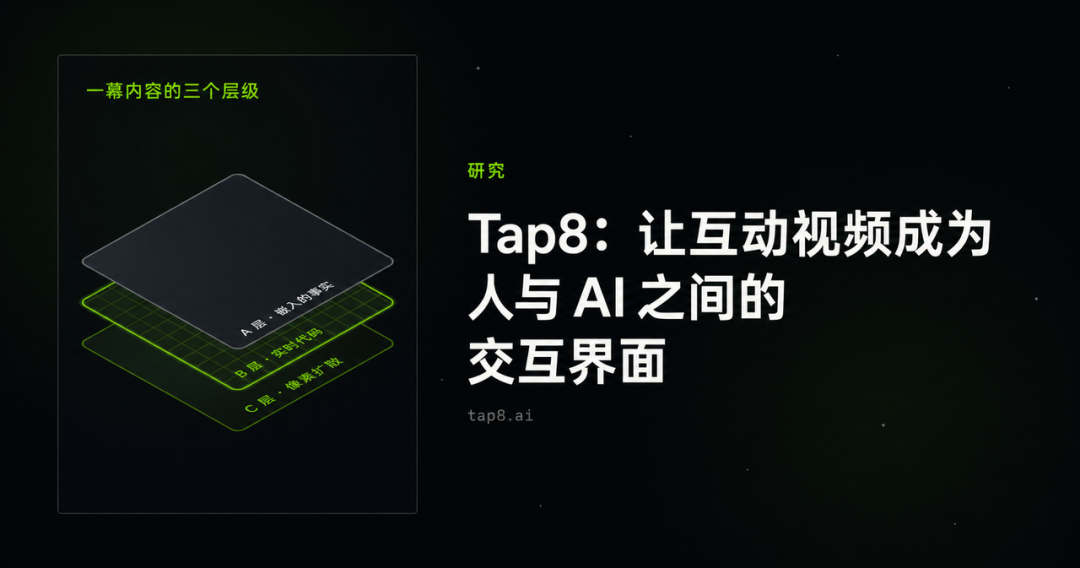
It trains models to directly generate visual code, producing "living images" that are interactable in real time and can be modified on the spot — fundamentally different from traditional pixel-fixed video. Its flagship product, Tap8, is set for official release soon.
On July 22, a visual interaction demo video posted by the company on X hit nearly 80,000 views in 6 hours, topped Today's News that same day, attracted thousands of waitlist signups within 24 hours, and led to preliminary B2B partnership agreements with over 20 companies.
Where's the bottleneck for AI interactive video entering daily life?
Imagine you're on a video call with AI.
You'd want to see a face, of course. Expressions, gestures, gaze, emotion — these high-entropy, fuzzy signals are best expressed through pixels.
But if the AI is explaining a company's financial report, you probably don't want it holding up a piece of paper and reading numbers to the camera.
You want screen sharing. Charts should be charts, numbers should be readable numbers, buttons should be clickable, 3D products should be rotatable, workflows should be expandable, and when something changes, the system should know exactly which object changed.
These two types of information belong to fundamentally different modalities.
Pixel excels at expressing appearance; Code excels at expressing structure. The former handles "what the world looks like"; the latter handles "what's in the world, how things relate to each other, and what I can do to it." Looking back at the past two years, AI's imagination has been constrained by the "chat box." Whether typing or voice, interaction remains the traditional question-and-answer format.
In reality, much human curiosity is difficult to translate into precise text.
For example: when watching headphone reviews, we want to see the internal structure directly, not read a description of it; when following a workout video, we want to intuitively and instantly know if our current form is correct... Content that should naturally be visual is being forced into text by the model. And since information inherently lives in images, forcing it into prompts (text form) before outputting it is itself a detour.
Behind this lies a neglected fundamental problem: the ever-widening gap between humans and AI isn't in intelligence, but in "information bandwidth." One set of numbers illustrates this bandwidth gap more directly: adults read silently at roughly 5 tokens per second, while frontier models today output at 300 tokens per second.
Every incremental gain in model throughput significantly widens the gap between humans and AI.
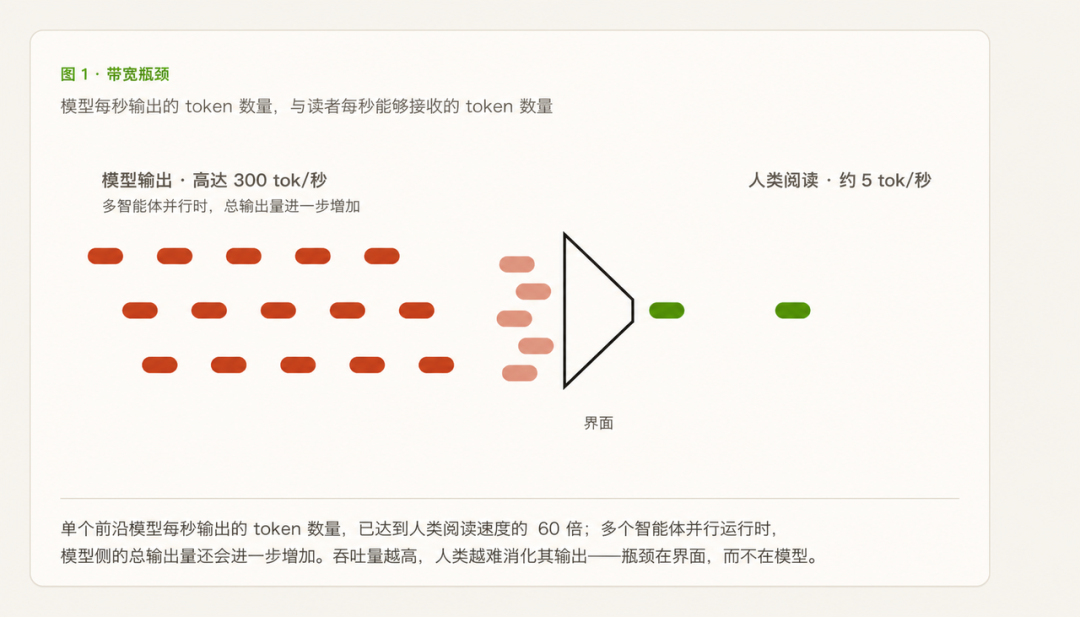
A focused reader is already about 60x behind a single model; with ten agents running in parallel, that gap becomes 600x.
In SigmaZ AI's view, to bridge this gap, what truly needs replacing isn't the model, but the interaction layer between model and human. As early as this May, OpenAI founding member Andrej Karpathy wrote on X: roughly one-third of the brain's compute is devoted to processing vision; vision is a ten-lane superhighway for information entering the brain; the form of AI output will evolve from pure text, to markdown, to HTML, and ultimately to model-generated interactive video.
On this track of AI visual interaction models, rather than the pure Pixel-based approach, SigmaZ AI has chosen the "pixel-code hybrid" route: images are still presented as video, animation, or scenes, but underneath there is no longer just pixels — there is a content organization system that can be understood, modified, and continuously updated.
Currently, there is no shortage of exploration into interactive video and world models, but most of it concentrates in "game engines" and "robot simulation training," serving developers and specific industrial enterprises — far from ordinary people's phone screens.
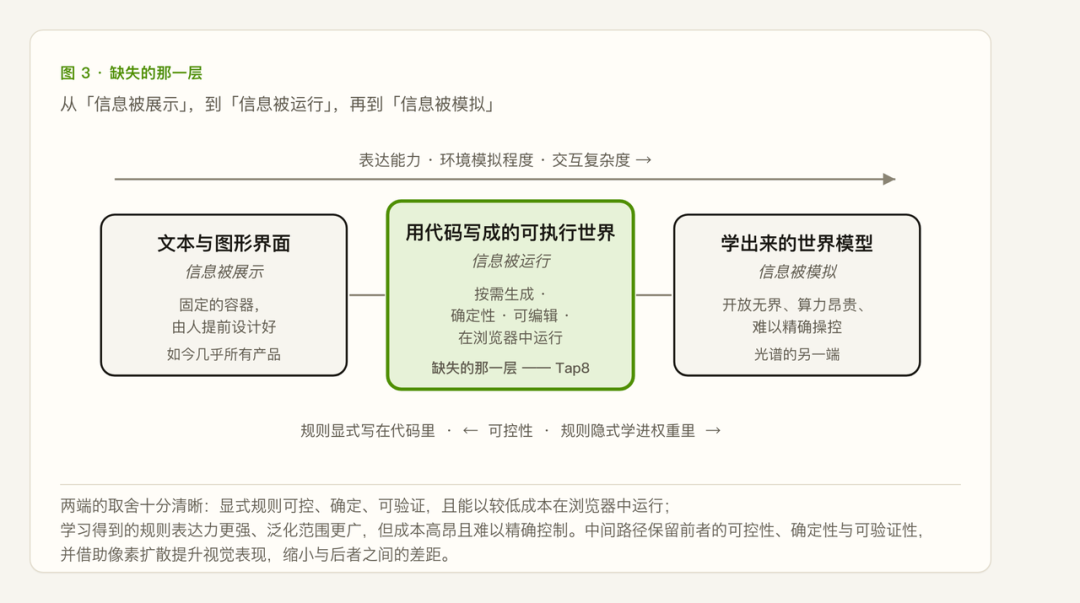
SigmaZ AI's chosen service scenario: bringing interactive video into everyday use cases — building a general-purpose platform. This also means SigmaZ AI's threshold has escalated from "can we build a demo" to the brutally realistic challenge of engineering breakthroughs — feedback must be fast enough, generation quality stable enough, inference costs sustainable enough for high-frequency use.
SigmaZ AI's "Technology Flywheel"
How to achieve such demanding engineering breakthroughs?
The SigmaZ AI team chose to start from infrastructure. It made three core technical bets. These three bets interlock with each other, forming the company's technical moat and its technology flywheel.
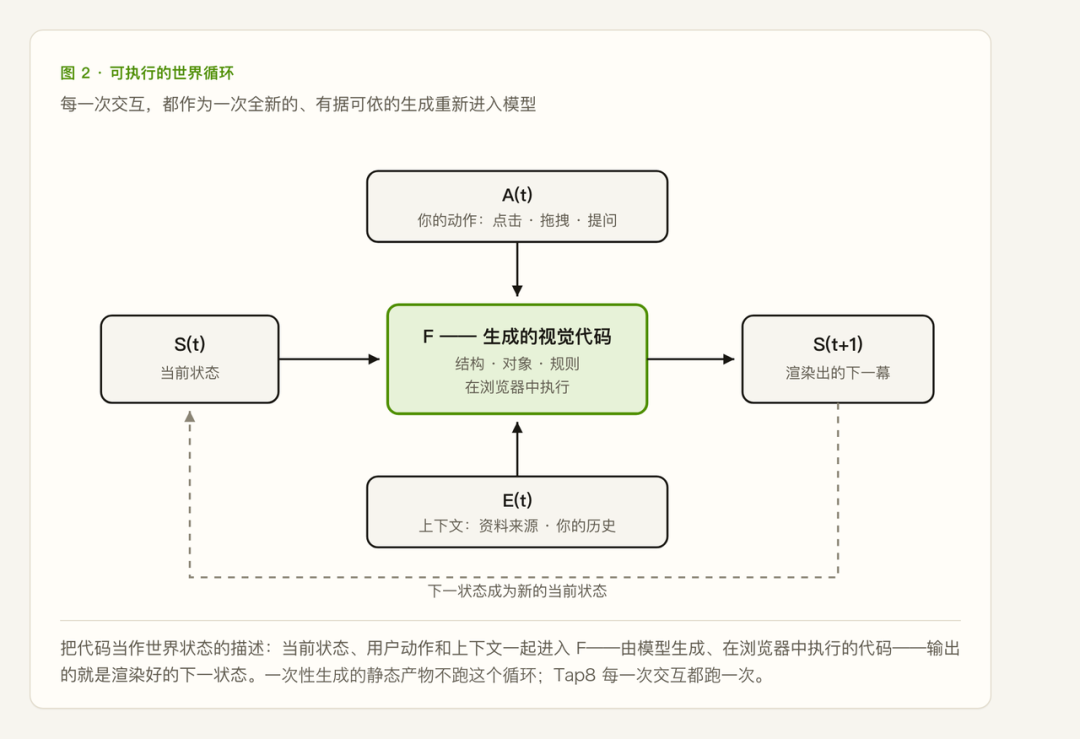
First, shifting the generation medium from "Pixel" to "Code-Pixel Mix" — with clear division of labor. Tasks that should go to "code" go to code; tasks that should go to "pixel" go to pixel diffusion.
Here, Code handles structure, causality, interaction, and state — the low-entropy parts that need "accuracy"; Pixel diffusion handles texture, detail, and high-entropy open-world content — the parts responsible for "aesthetic appeal."
Pure Pixel video models output pixel streams; once generated, the image is fixed. SigmaZ AI, by contrast, can have models output executable frontend code, which renders into images after execution.
Put simply, elements in images generated this way remain "alive"; interaction itself is part of the medium, not an add-on feature grafted onto video.

It's worth noting that for code as a medium, the difficulty lies mainly not in generation, but in training. Because scoring visual code means you must first render it, yet during training, those deliberately adventurous generation attempts often crash the rendering environment outright — animation and 3D especially so.
So SigmaZ AI built its own infrastructure capable of safely rendering, screenshotting, and scoring unstable code, without letting unstable code block the training cluster; meanwhile, it can perform "asynchronous coordination" and "batch processing" across clusters, allowing visual evaluator model scores to rationally flow back into training.
This engineering path is far more difficult than "making models output code" itself, because it contains numerous engineering challenges that the industry has yet to systematically solve.
Second, from Test-Time Scaling to self-evolution: a vision-guided recursive self-improving multimodal model. At the model level, SigmaZ AI enables self-evolution.
"Our DLM model can distill every editing trajectory from the online environment into model weights through the synergy of online learning and offline reinforcement learning, achieving autonomous iteration on a weekly cadence and continuously improving the model's visual expression capabilities," the SigmaZ AI founding team stated. In fact, one long-standing criticism of Diffusion Language Models (DLM) is that the intelligence ceiling of single-generation output remains insufficient: faced with complex visual code tasks, models struggle to get structure, logic, and visual effects right all at once.
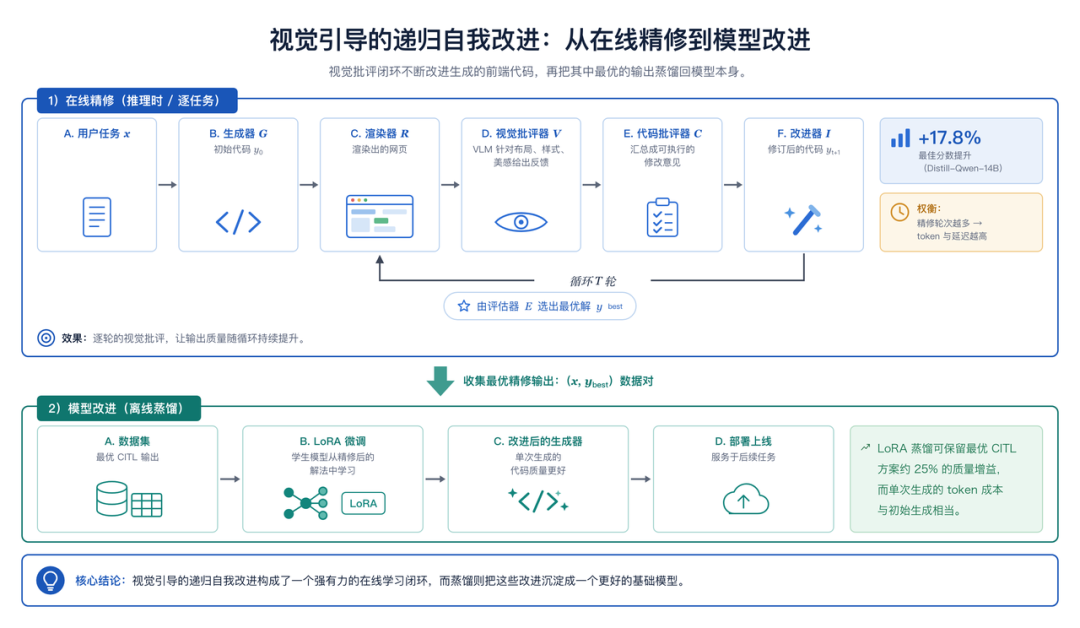
SigmaZ AI's approach isn't to demand the model "get it right the first time," but to first use Test-Time Scaling, letting the model think more and try more on a single task.
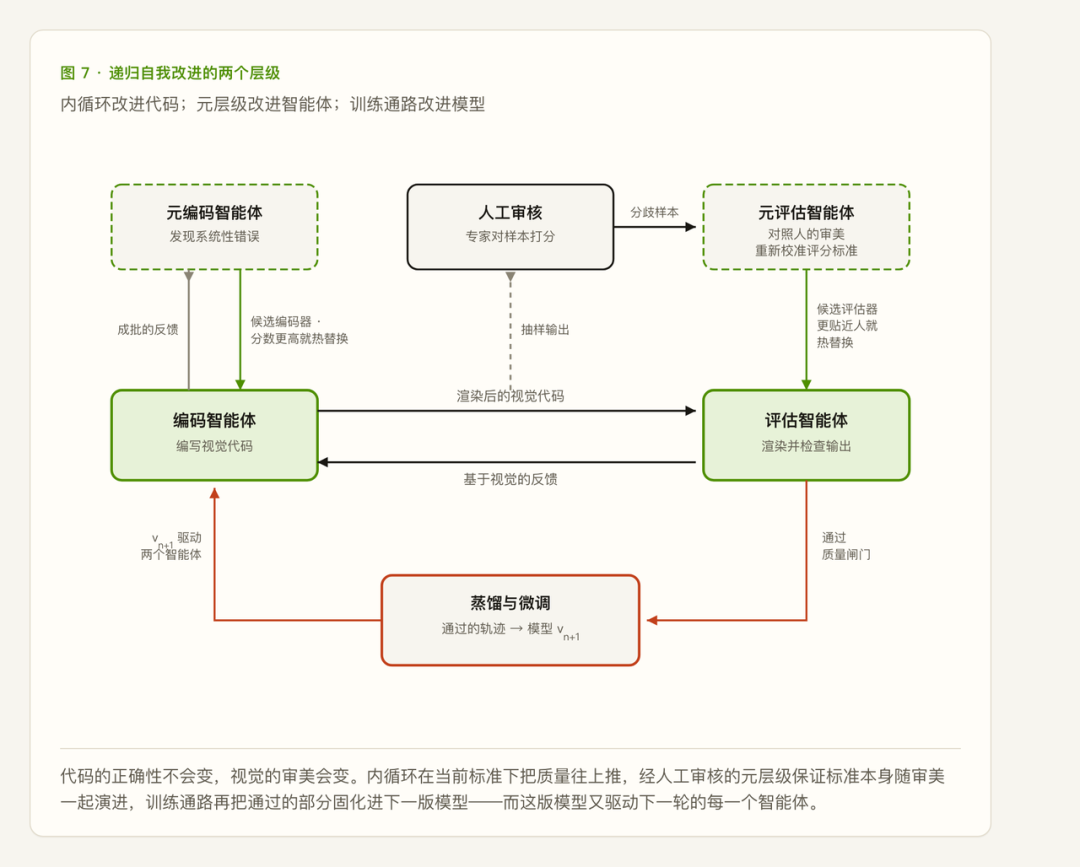
The specific workflow: code is generated, then truly rendered, then a visual evaluator model identifies problems and feeds back to a coding agent for continued revision, through multiple rounds of "generate — render — evaluate — modify," progressively approaching better results.
Previously, the biggest problem with such loops was that they were too slow to enter real-time production environments.
DLM's faster generation speed makes this feasible for the first time: it reinvests saved inference time into multi-round evaluation and correction, trading speed for a higher intelligence ceiling.
SigmaZ AI's real-world tests show that even with the RSI loop added, Time to First Frame can still be controlled within seconds. However, if it starts from scratch every time, the model merely "knows how to revise," not yet "knows how to evolve."
Therefore, SigmaZ AI's second step is Training-Time Internalization.
SigmaZ AI turns the critiques, modifications, and optimal trajectories produced during this inference process back into training signals, distilling them into model weights, so that what this generation learns through five rounds of trial-and-error, the next generation may achieve in its first round.
Finally, SigmaZ AI is also working on Evaluator Evolution.
From a technical perspective, the difficulty of recursive self-improvement for visual code lies not in running one loop successfully, but in the evaluation criteria themselves becoming outdated.
Because in the world of code and math, right is right, but "good-looking or not" is subjective, and human taste constantly changes. The more AI produces and the faster it changes, fixed evaluators only train models toward last year's aesthetic.
The industry's prevalent practice today is to train one evaluator model and freeze it, but this cannot satisfy the demands of real-time visual AI interaction. Evaluators themselves need continuous retraining and evolution.
For this, SigmaZ AI designed continuous calibration through a "meta-evaluator" layer.
A "meta-evaluator" agent specifically monitors discrepancies between the evaluator agent and human expert scoring, automatically running experiments and recalibrating scoring criteria until it aligns more closely with human judgment; meanwhile, another "meta-coding" agent batch-analyzes evaluator feedback, identifying systematic errors that coding agents repeatedly make, proposing fixes, and allowing deployment after passing backtests.
Throughout this process, human experts can sample-check at any time, ensuring the loop optimizes toward human needs rather than agents following their own instincts and drifting further off-course.
These three loops (Test-Time Scaling, Training-Time Internalization, Evaluator Evolution) connected together form true model self-evolution: inference produces experience; experience precipitates into capability; continuously evolving evaluation criteria determine which direction the next-generation model should grow stronger in. Notably, behind SigmaZ AI's evaluation criteria lies an on-demand expert network of roughly 1,000 people accumulated over several years.
These experts all come from QS top-200 universities, covering 9 vertical domains, 75% master's degree holders and 25% PhDs. Moreover, they don't just score — their more important role is "calibrating automated evaluator models." Currently, SigmaZ AI achieves inter-annotator consistency between 0.67 and 0.91.
This methodology was written into a paper by SigmaZ AI CTO Derek Law as core author, Vision-Guided Iterative Refinement for Frontend Code Generation, published at ICLR 2026's RSI Workshop.
However, the paper, for validation considerations, adopts the simplest form of distillation — feeding only task descriptions and final results; SigmaZ AI's internal training goes further than the paper.
"We train on complete improvement trajectories, turning every round of 'what's wrong and how to fix it' into training signals itself. The numbers in the paper represent the lower bound of this method, not the upper bound," said Derek Law, co-founder and CTO of SigmaZ AI.
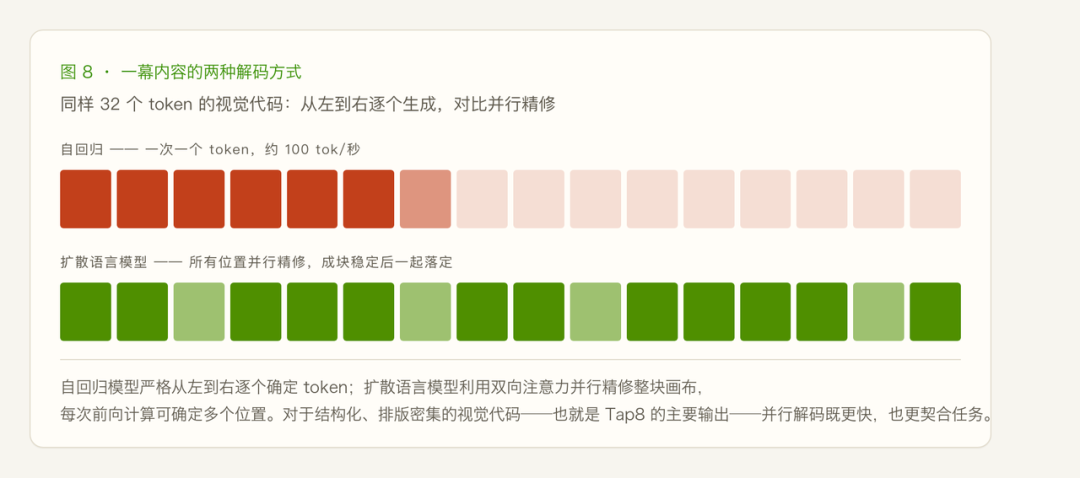
Third, rebuilding the model stack for real-time generation: Diffusion-LM and full-stack post-training. Autoregressive models write excellent code, but their problem is speed — they emit tokens sequentially one by one, at roughly 100 tokens per second.
If you want to generate a content-rich scene, it takes several minutes. This speed suffices for offline rendering, but is a fatal flaw for real-time interaction.
By comparison, "autoregressive model code" and "DLM" are two fundamentally different "ways of writing":
Autoregression is like handwriting, one character at a time, linearly; Diffusion Language Models (DLM) are like laying out a full draft canvas first, then refining the whole thing in very few steps, with modifications at different positions proceeding in parallel. A DLM instantiates a canvas of tokens and iteratively refines every position in parallel.
The SigmaZ AI team was among the earliest to systematically apply DLM to real-time interactive video.
Now, DLM parallel decoding for code generation can reach up to 2,146 tokens per second in the industry, an order of magnitude higher than autoregressive model code's roughly 100 tokens per second. In the future, modifying a scene will no longer require waiting a minute — it will come out in seconds.
SigmaZ AI's advantage lies in timing, not luck. Latency has always been an unavoidable wall for real-time interactive video. The industry's common practice is to make marginal optimizations on autoregressive models through caching and routing; the SigmaZ AI team bet on the paradigm shift before DLM's widespread adoption.
Based on this, SigmaZ AI early on directed engineering efforts toward problems that "remain important after the paradigm switch" — visual quality, evaluation systems, self-evolution infrastructure — and solved them one by one.
Once DLM arrived, SigmaZ AI only needed to fill in the final puzzle piece, rather than starting from scratch. Among those doing DLM, Inception's Mercury and Google's Gemini Diffusion take the general horizontal route, where the model itself is the product. SigmaZ AI's path differs: it post-trains the foundation model into an expert in dynamic graphics code, then layers on its self-developed training framework, evaluation stack, and data flywheel.
The base model is a commodity available on the market, but the vertically integrated system built around it is not — this is SigmaZ AI's true moat.
"Post-training is just the first step," SigmaZ AI stated. "In the next phase, SigmaZ will enter Pixel-Code joint training. Code and Pixel will no longer be two independent model capabilities, but two decoding paths on top of the same world model representation."
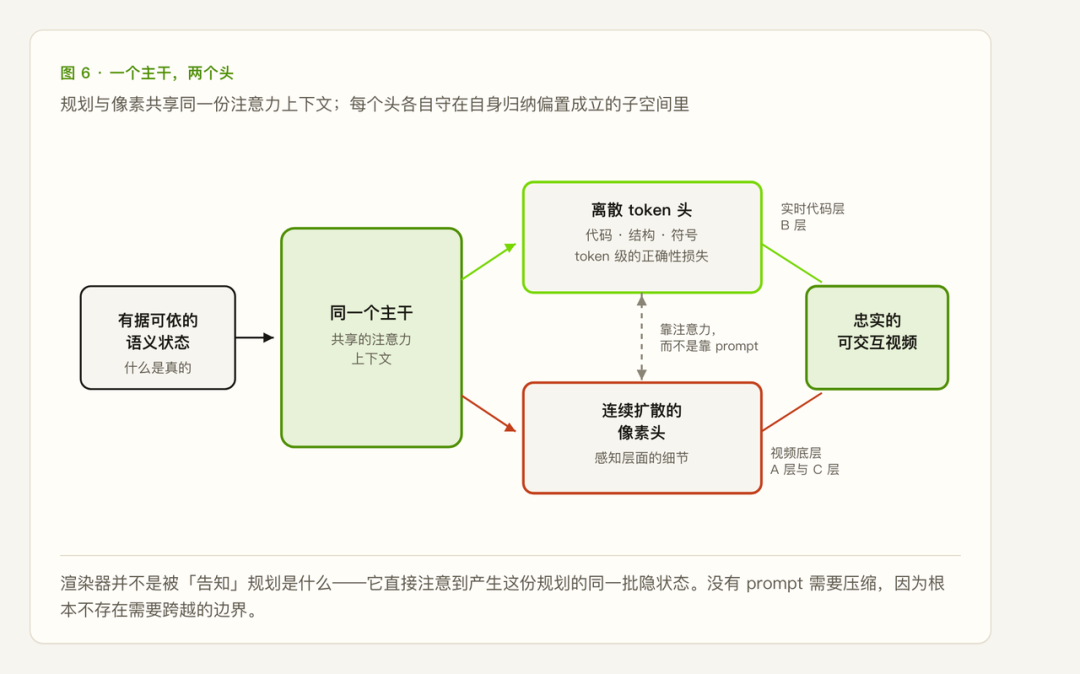
Overall, these three technical bets support each other, together forming SigmaZ AI's technology flywheel: "Code-pixel hybrid" makes interaction possible; recursive self-evolution makes the model better with use; DLM post-training makes it fast enough for truly real-time interaction while raising the quality ceiling. In July this year, SigmaZ AI conducted a horizontal evaluation of its internal generation engine: covering 7 mainstream systems, 5 categories of real-world scenarios, 25 specific scenarios totaling 173 video clips, with independent annotators performing blind evaluations producing 6,760 human annotations.
Evaluation data shows that in information-dense scenarios, SigmaZ AI's engine ranked first in overall quality, factual coverage, and text accuracy, tied for first in content understanding accuracy, outperforming Fable 5, Seedance, and Veo.
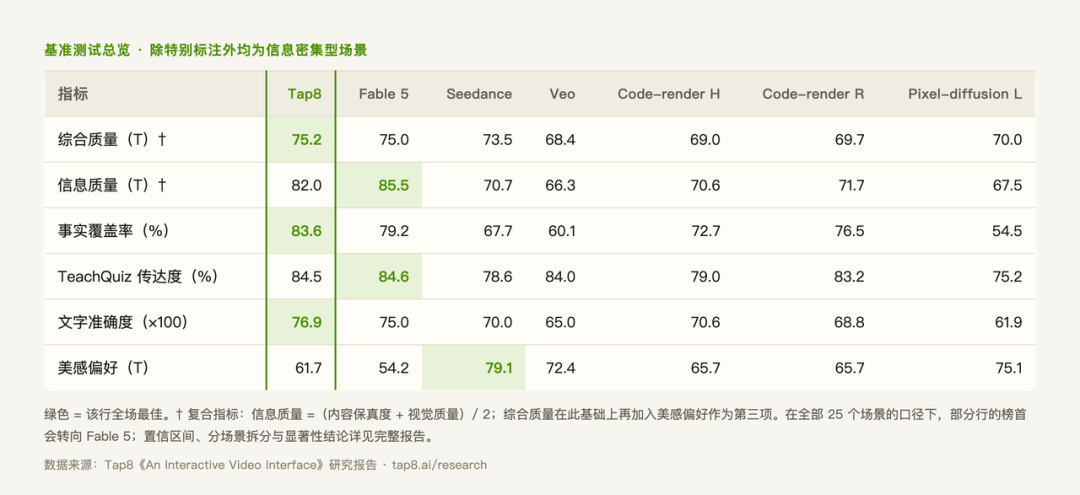
Additionally, the automated evaluation model VBench++, completely unaware of human labels, independently reproduced a highly consistent ranking (Spearman ρ = +0.89). VBench++ is currently one of the most authoritative and comprehensive automated evaluation systems in the video generation field.
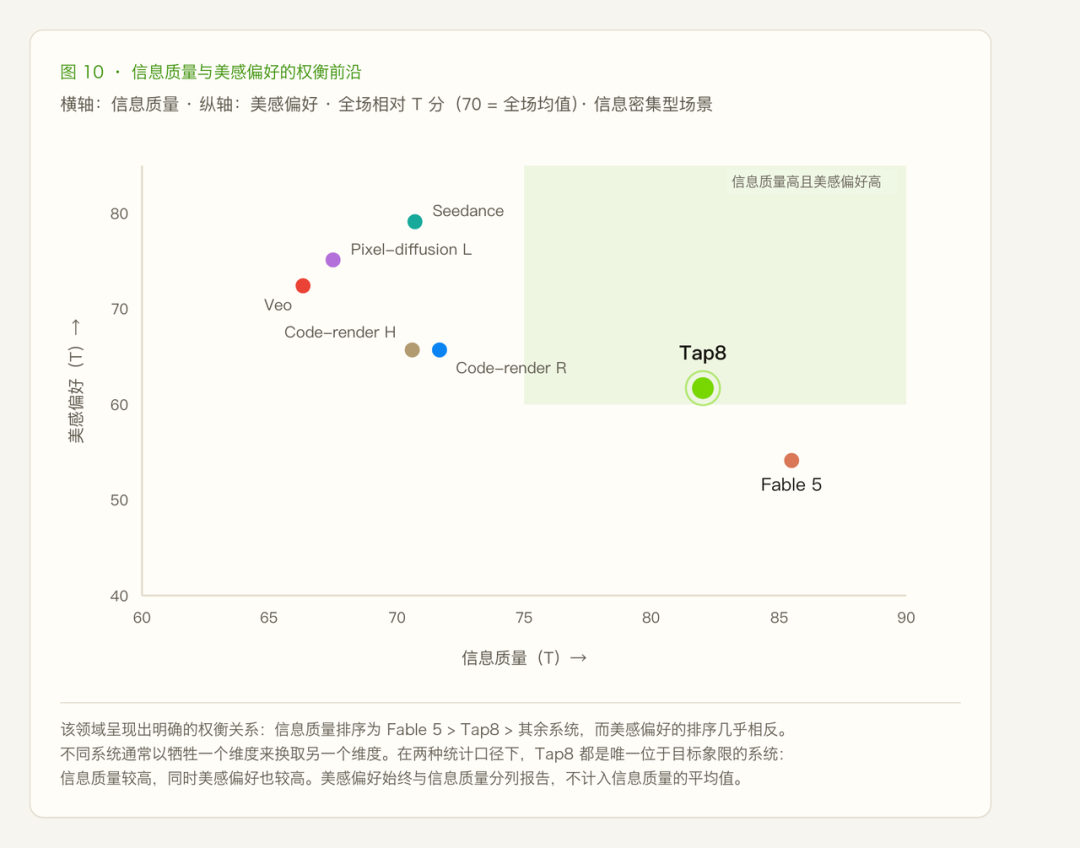
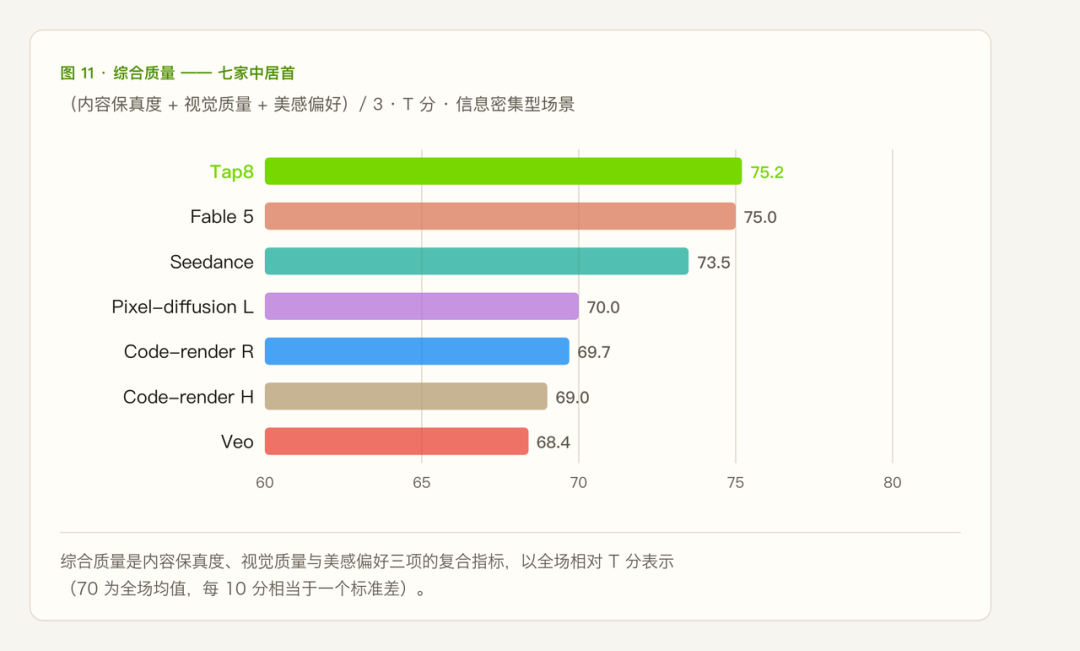
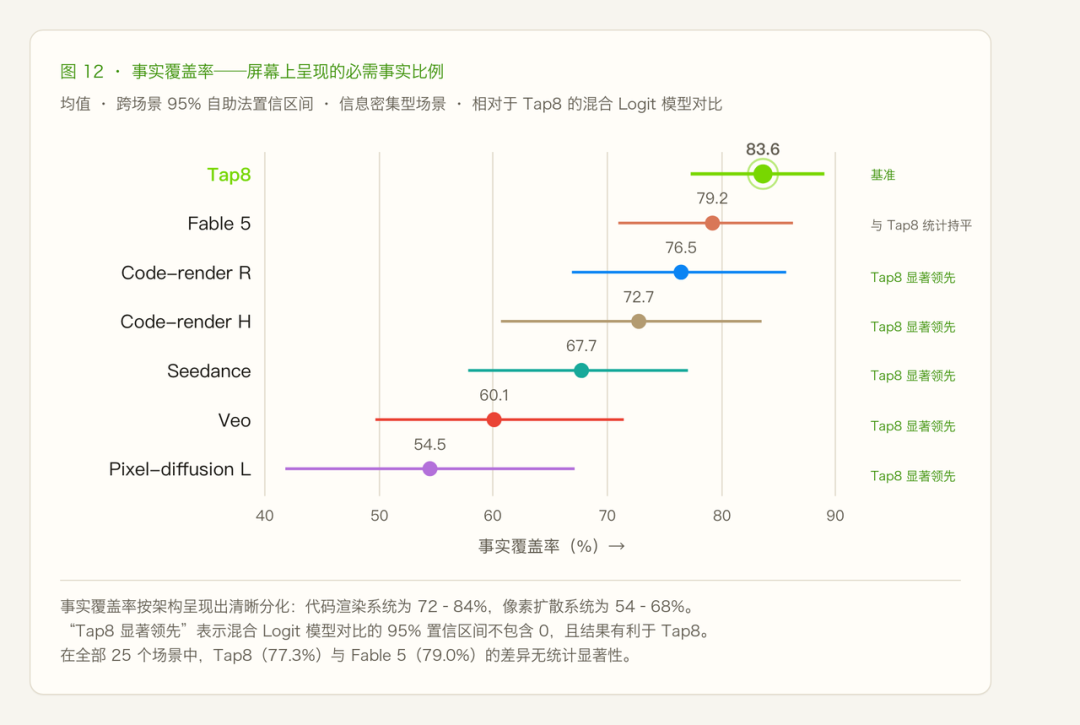
Of course, for SigmaZ AI, this benchmark data is merely a starting point. The upcoming product launch is the true test of this company's capabilities.
The first productization of SigmaZ's model capabilities — Tap8 — is positioned as a "practical and fun real-time interactive content platform," expected to launch in 2026. Why SigmaZ AI?
"General-purpose real-time interactive video is not a competition of single-point algorithms or individual models, but a systems engineering challenge spanning model architecture, training framework and rendering pipeline, product experience, and cost structure. Having these three capabilities closed within the same team is the prerequisite for the three technical bets to advance in parallel," said Han Yi, executive director at Yunqi Capital.
SigmaZ AI's core moat comes from the team's composite know-how across model training, visual generation, and consumer-grade products. In team composition, SigmaZ AI co-founder and CEO William Yang (Yang Bolin) is a serial entrepreneur born in 2003, with academic backgrounds at the University of Warwick and University of Cambridge. He has taken multiple startups from zero to tens of millions in revenue and completed one exit, with first-hand judgment on how to turn a new technology into a product ordinary people want to open every day.
SigmaZ AI co-founder and CTO Derek Law graduated from Imperial College London with a degree in computer science. He has nearly a decade of experience at frontier AI labs, was the first Chinese algorithm researcher at Amazon Alexa, and led technical development from visual code training to launch for Amazon's flagship models.
At Amazon AGI Lab, Derek led a cross-border team across the US, UK, and India working on HTML-based interactive answers; the product launched on Amazon Nova in early 2025, 6 months ahead of Google's comparable product and 11 months ahead of Anthropic's.
The aforementioned paper published at ICLR 2026 RSI — Vision-Guided Iterative Refinement for Frontend Code Generation — he is the core author. Beyond the two founders, SigmaZ AI's core team also brings together senior researchers and product leads from first-tier labs including Amazon AGI, Alibaba AI Lab, ByteDance AI, and Baidu.
Beyond team know-how, SigmaZ AI's other advantage lies in "data." Interactive video is an entirely new category; the industry has neither existing public datasets nor specialized data companies providing annotation services.
Over the past year, SigmaZ has accumulated hundreds of thousands of real-world data points with human preference annotations in actual production environments.
Data comes primarily from three channels:
- First, consumer-facing products.
When the industry was still watching "code-generated interactive video" from the sidelines, SigmaZ AI began laying groundwork from late last year, accumulating first seed data through its initial consumer product.
- Second, B2B pilot partnerships.
With clear direction, the team launched pilot partnerships with numerous B2B users. These users generate high-quality data through real-world and controlled-environment product usage.
- Third, synthetic data.
Building on the first two categories, the SigmaZ AI team further scales data volume through synthetic generation.
These three data types complement each other: consumer data provides real user feedback, B2B data covers structured scenarios, and synthetic data achieves volume amplification. Together they constitute the core material for SigmaZ AI's model post-training, and in turn drive the continuous operation of the RSI self-evolution loop.
"Looking back at every media revolution, the essence has always been an underlying technology rewriting the information carrier once again. The printing press grew newspapers, radio grew broadcasting, video encoding plus streaming grew today's short-video platforms." Speaking of SigmaZ AI's founding moment, Yang Bolin noted.
"Every media revolution starts from the bottom layer changing first; new media and that era's largest platforms grow out of it." This time, SigmaZ AI is betting on the next-generation human-computer interaction interface with visual as the entry point. SigmaZ AI believes that AI is the underlying layer of the next emerging medium, and its true product will be real-time interactive content.
Technically, Diffusion-LM will become a new model paradigm for the real-time interactive era, and Code will become an important native language connecting it to the visual world.
At that point, the same video, accessed by a million people, will spawn a million different videos. And the interface carrying video-layer interaction will be the highest-frequency, most valuable touchpoint between humans and information in the AGI era.
From two-dimensional playback to real-time interaction; from viewer to creator; from AI in a chat box to AI in the image — what SigmaZ AI is opening is a new portal where information is regenerated, re-watched, and re-questioned.
References
[1] In May this year, OpenAI founding member Andrej Karpathy's view on X: https://x.com/karpathy/status/2053872850101285137
[2] William Yang, SigmaZ AI Lab, "Communicating With Less Lost: Interactive Video and the Interface to Intelligence", SigmaZ AI Lab, July 2026.
[3] Vision-Guided Iterative Refinement for Frontend Code Generation. ICLR 2026 Workshop on Recursive Self-Improvement. https://arxiv.org/abs/2604.05839
[4] Brysbaert. How many words do we read per minute? Journal of Memory and Language, 2019.
[5] Artificial Analysis. AI model output speed comparison. https://artificialanalysis.ai/models
[6] ByteDance. Seed Diffusion. arXiv:2508.02193. https://arxiv.org/abs/2508.02193
[7] Google. Gemini Diffusion. https://deepmind.google/models/gemini-diffusion/