"Success Is the Mother of Success" | I Moderated a Roundtable Where the Quotes Kept Coming

Riding the AI Wave
We chose a keyword for this roundtable: "wind."
 👦🏻 Author: Koji
🧑🎨 Layout: NCon
 Since starting "Crossing," I've taken on an additional role: moderator.
Friends have been reaching out to ask me to host roundtables at various tech and AI conferences.
It's one of my favorite types of work, because it gives me the chance to meet and converse with people from remarkably diverse backgrounds.
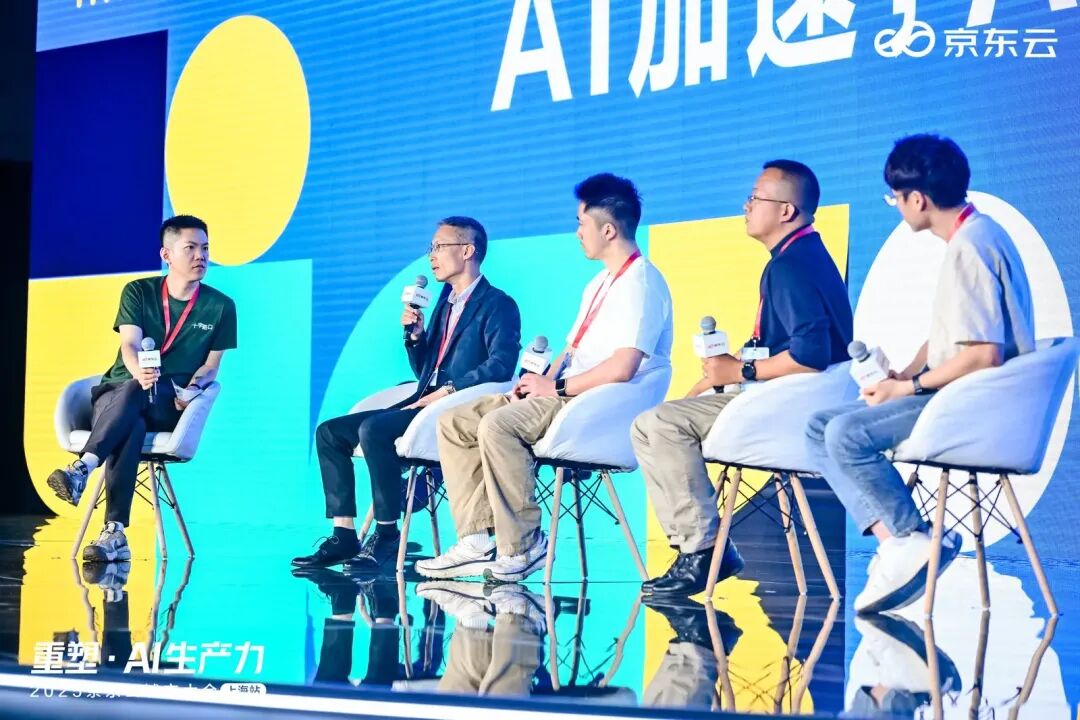
This week, I moderated one such roundtable — something of a "Mars colliding with Earth" affair, packed with memorable one-liners.
The four guests on the panel: a 1970s-born executive at a 50,000-person behemoth; a Gen Z prodigy CEO at a six-person startup; a big-tech architect representing advanced productive forces; and a newly minted VP of Technology at a company that listed on the US stock market just a year ago.
Why bring together four people from what seemed like parallel universes on Mars and Earth? Because as active participants in the AI era, they had all been invited to the roundtable at JD Cloud City Summit · Shanghai.
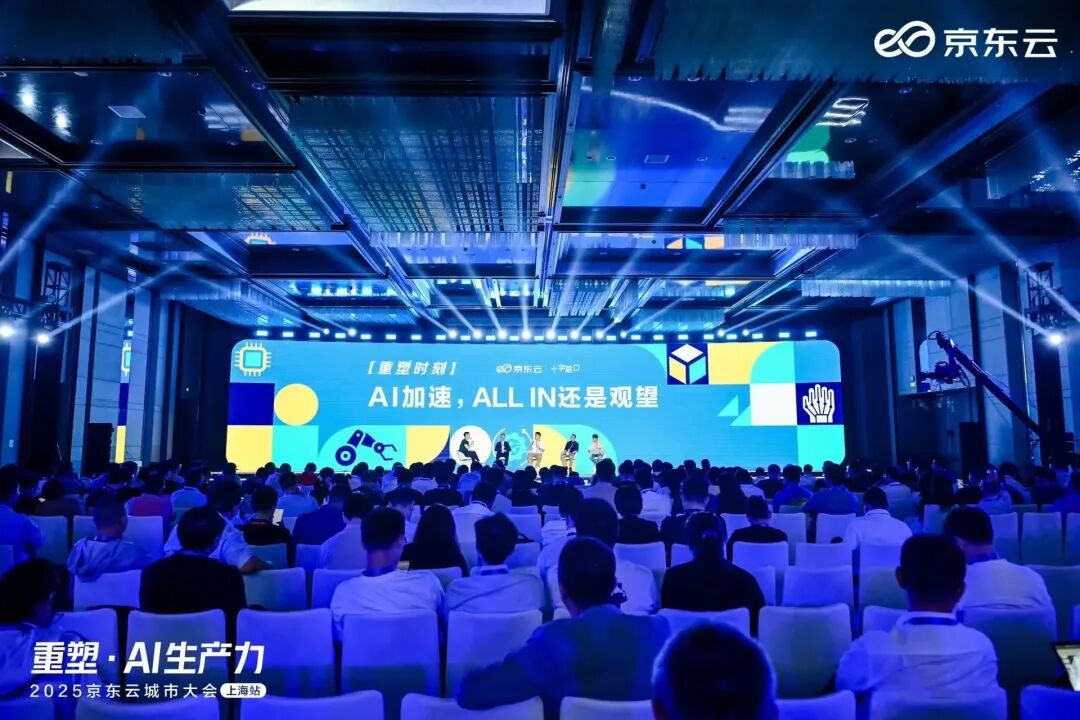
We chose a keyword for this roundtable: "wind."
First, because AI is like a gust of wind sweeping across the world — relevant to everyone, yet felt as a tailwind by some and a headwind by others. Second, because AI breakthroughs keep creating new "eyes of the storm" and "wind tunnels" — from DeepSeek to GPT-4o to GPT-o3/o4, there's basically a new eye or tunnel every week these days.

At this conference, JD Cloud launched nine products, including JoyAgent 2.0, the JoyScale AI computing platform, and the JoyBuild large-model development platform, alongside three vertical-industry all-in-one machines. These offerings will help enterprises rebuild their AI infrastructure, create dedicated digital employees, and accelerate their transition to deep AI adoption.
Today's Crossing dispatch shares the full discussion from this roundtable.
We started with "wind tunnels," and the quotes kept coming:
On how to get AI adopted across a 50,000-person organization with everyone's active cooperation, Shao Yang said:
"Success breeds success."
"AI implementation should be a CEO-level initiative."
On surviving hell-mode domestic B2B entrepreneurship, Zhai Xingji said:
"We absolutely refuse to take any deal over 1 million RMB."
On AI's challenge to existing business, Zhou Liangwei said:
"Either be revolutionized, or revolutionize yourself."
Below, the complete transcript of the roundtable.

🚥 Koji
Hello everyone, I'm Koji. For the past year or so, we've been running a podcast and newsletter called "Crossing," where we interview one entrepreneur or investor in the AI era each week.
After 60-plus episodes, I can say with some confidence: if you want to keep up with what's happening in AI in the Chinese-speaking world, this is one of the best sources out there.
These 60-plus Crossing interviewees are all a new generation of AI entrepreneurs and active participants in the AI era. Speaking with them, I've felt the vitality of innovation on one hand, and glimpsed the possibilities emerging beneath the AI wave on the other.
If you too believe this wave of AI technological transformation will nurture a new generation of entrepreneurs, then the next Richard Liu, Pony Ma, or Yiming Zhang may well have already started their company today. I hope that among the new generation of founders I've interviewed on Crossing, there are such future leaders.
I'm delighted to moderate this roundtable today. We've invited four distinctive guests:
👬🏻
-
Shao Yang, Director of Information Technology Center, Shanghai Pharmaceuticals
-
Ying Zimen, VP of Technology Center, AHS Recycle
-
Zhou Liangwei, Chief Solutions Architect, NetEase Digital Intelligence
-
Zhai Xingji, Founder/CEO, Yuhe Technology
🚥 Koji:
Our keyword for this roundtable is "wind" — partly because AI has generated so many wind tunnels and storm eyes. My first question for everyone: What "wind" have you felt most recently, and how has it changed your work and life?
👦🏻 Zhai Xingji:
The most recent "wind" we've seen is the arrival of "general-purpose Agents."
The "general-purpose" here needs quotation marks, because it's general within specific roles or intelligence domains.
Previously, our Agents were mainly manual workflow-driven. Now products like Manus and flowith can be understood as general-purpose Agents.
As vertical-domain Agent entrepreneurs, we not only see this new wind arriving — more importantly, in building digital employee intelligence, we're exploring how to develop our own general-purpose Agents. Thank you.
👨🏻 Shao Yang:
Our previous informatization and digitalization work had actually hit a bottleneck; we'd been talking about this for years. But now AI has given us an opportunity — this is the "wind" I've felt.
This opportunity lets us use AI to re-examine the informatization, digitalization systems, platforms, and even overall architecture blueprints we'd built before, to see if we can inject new vitality into existing closed loops.
What's interesting is that this wave of transformation has actually been driven by business partners pushing back.
Before, I was the one urging them to use systems. Now that AI has arrived, they're the ones actively asking: "Why aren't we using AI yet?"
— This truly is a rare opportunity.
👨🏻 Ying Zimen:
Technology evolves rapidly, and our company's business has gone through multiple evolutions: from traditional CV-based AI image recognition, to deep learning-based image recognition in recent years, to now using dual encoding of images and text.
These changes have revealed new breakthrough points. Problems that once seemed intractable now have entirely new approaches and methods.
Previous technical bottlenecks now have new directions for breakthrough, which has brought enormous change for us.
👨🏻 Zhou Liangwei:
The biggest wind tunnel right now is of course Agent.
Speaking of personal and professional changes, the biggest impact and feeling this round of AI has given me is that professional boundaries are becoming increasingly blurred.
Many people here work in IT and internet. Take programmers: in the past, the division of labor was extremely fine-grained — frontend, backend, big data, AI, and so on. But with AI coding tools like Cursor and Windsurf, many professions face massive transformation.
Take designers: AI demonstrates higher efficiency in design. In programming, the boundary between frontend and backend is increasingly blurred. As long as you have architectural thinking and product thinking, you can use AI coding tools to rapidly realize ideas and creativity, even building MVP products for market validation.
For future career development, continuously expanding personal boundaries with AI tools will become crucially important.
🚥 Koji:
When preparing for this roundtable last week, I held video calls with each guest to discuss topics of interest in advance — particularly how everyone uses AI in work and life.
Following up on Zhou's point, I want to share an interesting topic from our pre-discussion.
As chief architect, you've written code for over a decade. How have tools like Cursor and Windsurf helped you?
👨🏻 Zhou Liangwei:
I've personally written code for over ten years, then shifted to product and business management, and now I'm responsible for solutions.
Our business (NetEase Digital Intelligence) mainly serves developers. When explaining solutions and specific scenarios to clients, we used to rely on documents or PPTs — but nothing beats a demo for clarity.
Since getting tools like Cursor and Windsurf, including similar products developed in-house at NetEase, we can now rapidly implement demos. When communicating with clients, we can demonstrate tool workflows on the spot, helping them better understand the scenarios.
Now clients also prefer seeing demos directly; they no longer ask to see documents. This approach is genuinely more efficient.
I believe the biggest improvement this wave of AI technology has brought is significantly enhancing our efficiency in solution demonstration and client communication.
🚥 Koji:
What are NetEase Digital Intelligence's most typical AI implementation scenarios?
👨🏻 Zhou Liangwei:
NetEase Digital Intelligence is a first-level business unit of NetEase Group serving enterprise customers, mainly providing SaaS and PaaS products. We have a customer service and marketing product, and this round of AI has posed enormous challenges for our team.
First, we rapidly embraced this new technology by implementing AI in customer service.
Either be revolutionized, or revolutionize yourself.
We quickly achieved the transformation from traditional robotic customer service to AI customer service — this is a typical and important transformation.
Second, we made important organizational changes. To implement AI, you need organizational support, so we internally proposed an AI First strategy. The unified design and implementation from models to Agent platforms has been the core work our team has pushed forward in AI over the past two years.
🚥 Koji:
Many enterprises now want to achieve AI First. Shanghai Pharmaceuticals, as a 50,000-person organization, faces unique challenges in promoting AI. Shao Yang bears this heavy responsibility. Please share with us how you've step by step promoted AI in an organization of this scale.
👨🏻 Shao Yang
Governing a great nation is like cooking a small fish.
We adopted a top-and-bottom simultaneous approach.
First, as a diversified enterprise in the pharmaceutical industry, Shanghai Pharmaceuticals covers the entire industrial chain from drug R&D, manufacturing, marketing to commercial distribution and retail. Although our business formats differ significantly, with six levels of group hierarchy, we still adopted a top-and-bottom simultaneous approach to promoting AI.
Starting from the second half of last year, we launched some pilot projects from the bottom up, such as an AI policy assistant and a pharmacist assistant, allowing employees to build intuitive understanding of AI through hands-on experience — this was our first starting point.
At the same time, external stimulus is also important.
AI implementation is still a "CEO-level initiative" issue.
We released the "AI Work Guidelines" for the entire Shanghai Pharmaceuticals. Meanwhile, we're planning the overall AI architecture. From top to bottom, we need to consider how to build AI platforms in a group enterprise. Similar to what JD colleagues mentioned, we need a complete architectural plan: first establishing an AI foundation that can empower the entire group, on which to build an architecture blueprint, allowing different business formats and scenarios to use AI and large models in a secure, controlled environment. This way we achieve comprehensive top-down advancement.
In the R&D domain, we also have some special AI for Science application scenarios, such as drug target discovery, compound structure analysis, macromolecular structure prediction, and clinical applications. These scenarios require specialized models, not large models, to solve.
At the same time, we need to balance different types of requirements: which domains need controlled security zones, which can use public large models, and how to weigh cost-effectiveness, security, and data security across different modalities and models.
Currently, we're building such a comprehensive framework solution.
🚥 Koji:
Implementing AI is first and foremost a CEO-level initiative requiring leadership attention and support. On the other hand, in a 50,000-person enterprise, it's unavoidable that some will think "AI has nothing to do with me," seeing AI learning as just extra burden.
In our pre-roundtable discussions, Shao Yang shared your initiatives for building an AI culture internally. Could you elaborate for everyone?
I believe many friends here today hold similar roles and responsibilities in your respective enterprises; your experience may offer some inspiration.
👨🏻 Shao Yang
First, promoting AI needs to start with "self-education." For me this is also a new field; I'm not an expert, but I need to learn to a certain degree. To understand it, the most important thing is being able to explain it to others. On Shanghai Pharmaceuticals' online learning platform, I created a one-hour AI popularization course, sharing my understanding of AI.
This isn't a purely technical course, because within an enterprise, you need to speak in "human language," in business language, not technical language.
Beyond this AI course, we also invite relevant colleagues and bring in external resources to jointly build a learning atmosphere.
We're exploring workshops with partners and potential partners. Riding the wave of DeepSeek's popularity, we're also doing internal publicity and exploring future possible cooperation opportunities.
Notably, this internal course wasn't forcibly pushed, and HR didn't make it mandatory. Yet over a month since release, more than 8,000 people have spontaneously taken it, and most have completed it. Our company has many frontline employees, including logistics staff and store salespeople, who can watch this one-hour course in full. Even at double speed it takes half an hour, and to truly understand the content. The course supports interaction, with likes and comments. Over 1,500 people have already commented and liked — the response has been excellent, and seeing everyone's comments has been deeply encouraging for me.
🚥 Koji:
Without official promotion or mandatory requirements, 8,000 people in a 50,000-person enterprise actively took your course. I feel there must be something distinctive about it. What do you think made this course so popular?
👨🏻 Shao Yang:
The latter half mainly collects and showcases various practical application scenarios, including successful cases from other companies and cases we've already implemented ourselves, allowing people to learn from and reference.
For example, we showcased specific applications like medical R&D and policy Q&A, as well as practical cases like the AI assistant we developed for internal pharmacists. This content close to actual work allows employees to intuitively feel AI's value — this is probably why people were willing to take this course.
🚥 Koji:
Interesting in the first half, useful in the second half.
👨🏻 Shao Yang:
Right, having an internal person present creates familiarity itself.
🚥 Koji:
Shows you're also quite popular internally.
🚥 Koji:
When preparing for the roundtable, I specifically visited an AHS Recycle offline store to understand their AI implementation scenarios on the ground.
As a business becoming increasingly diversified, could you introduce AHS Recycle's AI applications and implementation?
👨🏻 Ying Zimen
AHS Recycle focuses on quality inspection of second-hand digital products, luxury goods, and related accessories. We use AI technology to determine product condition and authenticity — this is our core business, directly determining product pricing.
In AI applications, our company has gone through three important stages.
The first stage was mainly based on traditional computer vision (CV) image recognition. Although we adopted some industry-mature solutions, we encountered limitations in second-hand product scenarios — the flaws and usage conditions of second-hand products vary endlessly, making standardized evaluation impossible.
In the second stage, through business iteration, we self-developed deep learning-based image recognition algorithms, establishing a complete second-hand product authentication system.
At the current stage, with large model technology development, we simultaneously use images and text for training, achieving major technical breakthroughs in item classification, model identification, and authenticity verification. This is our current AI application status.
🚥 Koji:
A few years ago, Ying wrote an excellent article exploring how tech executives need to resist the urge to code. Because once immersed in the joy of programming, it's easy to overlook important and urgent management work.
I have a question: today, with AI coding tools available, do you think this view — that tech managers should resist the urge to code — still holds?
👨🏻 Ying Zimen:
That article wasn't related to AI. After my recent phone discussion with Koji, I rethought this question and felt it was worth writing a new article.
Now there are indeed some new thoughts. With AI-assisted programming tools and large model-based code generation becoming widespread, the entire programming mindset and methodology differ from before. Although coding itself can't be completely replaced by AI, programming methods have changed significantly.
Now when we talk "AI First," the primary task isn't immediately fulfilling business requirements, but first getting AI infrastructure and Agents right. Don't rush to develop features, because AI can help us build faster. This is an important shift.
We need to achieve "AI Friendly," ensuring AI can friendly call various components and modules — this is the first priority.
The second major change lies in development philosophy. Previously as developers, we paid great attention to code robustness, scalability, and coding style, needing to invest substantial time in design. But now this mindset has been overturned. Because AI can rapidly build and run programs, we don't even need to care much about traditionally "good code" or architectural design, because the cost of rewriting is low.
We can launch a feature today, and if there are new requirements tomorrow, we can completely rewrite it — no need to iterate on the existing system.
Like the operating system in The Wandering Earth, AI can rewrite the entire system from scratch. If it doesn't work well, tear it down and start over, because costs are low and efficiency is actually higher.
While this remains a vision not fully realized, it already reflects a fundamental shift in thinking.
🚥 Koji:
The participation of executives from mature enterprises is certainly important for this roundtable, but JD also hoped fresh perspectives from cutting-edge AI entrepreneurs. I immediately thought of inviting Xingji to join our roundtable, because his startup has practically implemented an AI Agent in a vertical domain and achieved significant commercial results.
Xingji, please introduce the work you're doing?
👦🏻 Zhai Xingji:
Most people here are tech leaders or CIOs in enterprises, like Director Shao Yang. Now with the AI wave rising, everyone is actively pushing AI application implementation, and naturally encounters many questions. Over the past year, we've collaborated with clients like Shanghai Yidian and COSCO Shipping to explore multiple scenarios together.
Practice has proven that truly doing AI applications well is quite challenging, but our core team has accumulated rich experience in digitalization. As first-batch Agent entrepreneurs, we also have unique perspectives on cutting-edge AI technology and Agent applications.
If an enterprise wants to successfully implement Agent applications and gain business-side recognition, this isn't easy. Over the past year, many enterprises pushed pilot projects, but many fizzled out. The reason is these projects were often non-routine budget items; business departments complied with leadership requirements but didn't genuinely recognize their value.
Our experience is that we must focus on the most critical pain points in core business processes, using Agents to solve problems that traditional methods cannot solve.
Agents now must be business-driven, not IT-driven — only when business departments actively seek IT help to solve difficult problems is the project most valuable.
We have excellent practice in the pre-sales domain. In B2B scenarios, capabilities divide into two major categories: business capability and emotional value, and professional capability. Professional capability further includes technical support, solution customization, POC product demonstration, and quotation. This is a universal model in B2B, especially in software and mid-to-high-end manufacturing.
There are clear pain points in this domain: business personnel generally lack sufficient technical expertise. After receiving requirements, they often need R&D teams to provide technical support and response, while they can only do simple proposals. But R&D manpower is severely insufficient, specialized technical sales positions are also scarce, and overall capability is stretched thin.
Another problem is excessive repetitive work. For example, quotations and proposal preparation are often repetitive, with teams spending substantial time on these relatively low-value tasks, causing many customer needs to go unresponded in time.
For this, we developed an Agent, hoping to achieve end-to-end automation in pre-sales, retaining only product demonstration and POC verification for human involvement. As AI-native entrepreneurs, we believe future Agents shouldn't just patch existing business processes, such as merely using AI for customer service classification and simple dialogue.
We believe the future of Agents is becoming end-to-end digital employees, directly taking over complete workflows originally requiring human completion. Based on this philosophy to select business scenarios and implement Agents, you can create distinctive value. At that point, you'll see business departments proactively recommending Agent use to leadership, rather than struggling as with traditional IT system promotion.
🚥 Koji:
Finally, I'd like each guest to answer a light question.
Director Shao Yang, Xingji and team emphasize finding pain points that are difficult for humans to solve when promoting AI Agents. Could you share your "pick the soft persimmons" theory?
👨🏻 Shao Yang
Business partners' stated needs aren't necessarily true needs, and true needs don't necessarily directly advance continuously.
First, I often say:
"Success breeds success."
We use the four-quadrant analysis method, starting from importance, value magnitude, and difficulty degree, to find balance points among them — don't be greedy or rush. Among many Agents, first choose projects with moderate value and controllable difficulty, make them work, make them solid. Let this success case build momentum internally; when others see success, they'll naturally follow and learn.
Second, this has commonalities with digital transformation. I simply summarize it in four characters: face + substance.
Face must exist, substance must be solid. Without face, others won't come to notice your substance; without substance, face can't stand.
These two complement each other; the key is finding the balance between face and substance.
The "face" here is a positive term, not derogatory. If someone can do face projects well, I'll give them a thumbs-up.
🚥 Koji:
Golden quotes flowing! "Success breeds success," "face + substance, powering through AI transformation."
🚥 Koji:
Now some CTOs set OKRs in their organizations requiring 50% of code to be written by AI next year, using this method to push AI implementation. Ying, what's the proportion of AI-written code in your team? Also, what do you think of this OKR-setting approach?
👨🏻 Ying Zimen:
Cursor's enterprise edition can have a control panel showing how much of your team's code is AI-generated. Although many colleagues on our team use Cursor, we haven't mandated any specific proportion of code that must be written with it.
I believe the overall direction should be letting everyone truly feel efficiency gains, finding good methods, letting team members genuinely feel it's helpful to them. Rather than focusing on exactly how much code is AI-written, guiding the team is more important.
We should invest more time in discovering best practices, letting AI truly help us better fulfill business requirements and elevate the team's technical level. This is more crucial.
🚥 Koji:
Zhou, you're very active in trying new AI products. Could you share a product you've recently used that made your eyes light up and left an impression?
👨🏻 Zhou Liangwei:
I recommend Google's NotebookLM.
First, it can use underlying models to help you conduct research and market analysis, generate analysis reports, and generate structured information and mind maps, systematically breaking down content — this is one important function.
A second important function is that it can convert content into podcast dialogue format. The two speakers' voice tones are almost indistinguishable from real people. Chinese language support was recently added too. You can listen to papers or technical articles like a normal podcast while on the road, helping understand and digest new knowledge. NotebookLM is a very practical product.
🚥 Koji:
Last question for Xingji: What do you think was the single most correct decision you made in the past year?
👦🏻 Zhai Xingji:
I feel that in entrepreneurship, there is no such thing as a "single correct decision." Every decision should be correct; we need to make every choice the most correct one. This is my fundamental view.
But this question does have an answer, which is: strategic focus.
As a startup team, our resources, funding, and connections are all limited. With limited resources, we must do strategic focus well.
We see that future Agents will certainly be intelligent and function-specific. Every function will have a general-purpose Agent, which requires us to accumulate sufficient scenario experience in each specific Agent domain. We need to accumulate enough path data and thinking data to conduct pre-training.
Based on this, the most important thing is focusing on the few Agents we want to build, concentrating all resources there. We established clear criteria:
Single contracts over 1 million RMB are absolutely not accepted, government projects are not done, and projects deviating from our main track are also not done.
These are important trade-offs. Many early-stage companies often find it hard to make such decisive choices. Like when I was chatting with an investor yesterday, we currently have three ready-to-use Agents out of the box. I said if one of these Agents can successfully break through in the future, I won't do the other two.
The investor asked me: "Why not continue these products? They're all ready, you just need to do marketing to get users to buy, and it doesn't require much resource investment."
I replied: "I simply won't do it this way. I'll decisively abandon the other two and focus all energy on the one I believe has the most value."
Koji:
These are indeed very bold decisions.
Today, once again, thank you to the four of you for the stories and perspectives. Our roundtable theme is "wind." I hope that in the coming year, everyone can continue to "ride the wind and break the waves" in the AI era.
I also hope we can gather again next year on the JD Cloud City Summit stage, sharing new stories, new perspectives, and new feelings from this year.
Thank you, everyone.