Ten Years In, DingTalk Sets Its Sights on AI Hardware
What's Behind DingTalk's Reset to Zero?
What's Behind DingTalk's Reset to Zero?
👦🏻 Author: Jingshan
🥷 Editor: Koji
🧑🎨 Layout: NCon

When a market leader announces it's clearing the slate and starting fresh from 1.0, what does that signal?
On August 25, at DingTalk's tenth anniversary, version 8.0 was released. But at the launch event, CEO Hang Chen said:
DingTalk 8.0 is also AI DingTalk 1.0. We are determined to clear the past and, with a reset-to-zero mindset, build a completely new DingTalk for the AI era.
What's behind this reset to zero?
It's DingTalk's ambition: to define AI-powered work.
No one would deny that AI will fundamentally transform how people work. DingTalk is trying to answer a critical question: in the AI era, what should the relationship between people and tools be?
DingTalk believes AI should no longer be a passive window waiting for commands, but an ever-present, proactive intelligent agent that shares your burdens. From "using tools" to "being served by tools," from "managing people" to "helping people" — DingTalk wants tools to return to their purest mission:
To empower people, not add to their load. To let people focus on creation, not waste away in processes.
What's interesting is that DingTalk prepared more than ten products to kick off this grand transformation, attempting to define how people will work in the AI era. The first move wasn't some esoteric algorithm or complex application, but a completed voice AI product built from two pieces:
【1】A significantly upgraded capability — AI Transcription;
【2】A highly specific piece of AI hardware — the DingTalk A1 recording device.
I think DingTalk chose a voice AI product for strategic positioning because it's targeting the vast yet most overlooked "dark matter" zone in enterprise digitalization: everyday verbal communication.
This small AI card, powered by AI Transcription, serves as both the data entry point for DingTalk's AI strategy and the vanguard of its effort to reshape the work experience. How will it define work in the AI era? And how will it carve out a differentiated path for DingTalk in the fierce AI competition? The answers may lie inside this small piece of hardware.
The Most Direct Beneficiary of Generative AI
Where does generative AI create the most value?
The answer is simple: boosting productivity. It automates repetitive labor, structures complex information, and turns tacit experience into explicit knowledge. As a major platform in China's office ecosystem, DingTalk is the most direct beneficiary of this value, and has moved quickly in the AI wave to launch a series of AI products.
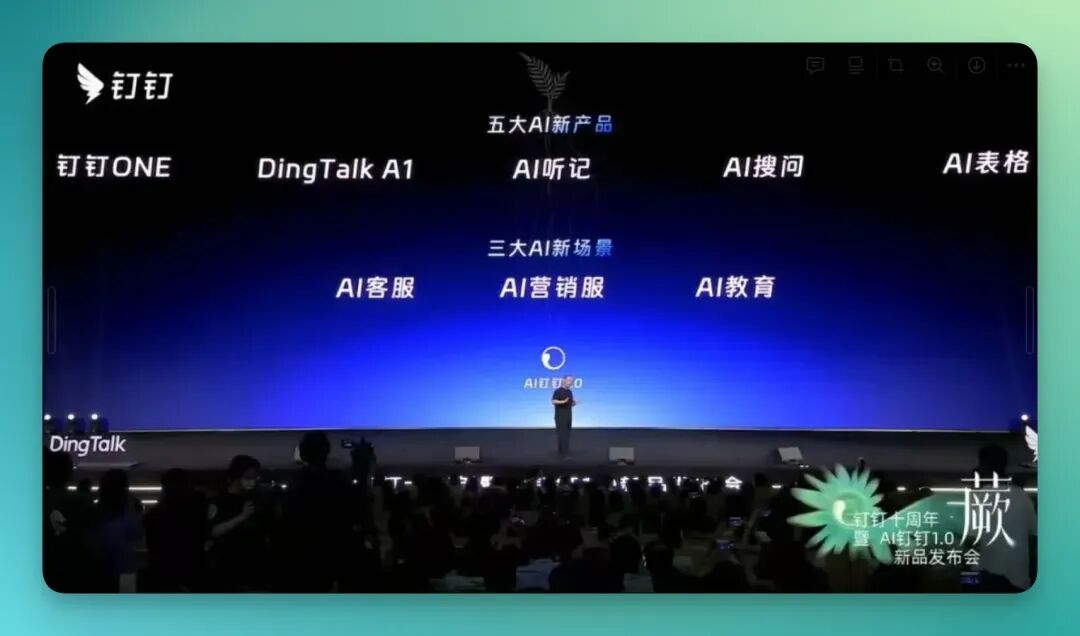
Over the past year, alongside DingTalk, a range of domestic and international office products have made continuous AI moves.
Zoom out to a global view, and you'll find similar logic playing out in Silicon Valley. Overseas office products generally follow three AI evolution paths:
【1】All-In-One AI features:
Microsoft has deeply embedded Copilot across its Office suite, unifying interactions in Word, Excel, and Teams under a single AI interface. Google launched Duet AI in Workspace, attempting to let users call across Gmail, Docs, and Sheets through natural language.
【2】Voice modality data fusion:
The most representative voice-modality products have emerged in meeting scenarios. Zoom AI Companion, Otter.ai, Fathom AI, and Granola are all transforming "sound" — a form of implicit information that used to easily slip away — into searchable, transferable knowledge assets.
【3】AI Agent expansion:
Silicon Valley products no longer focus only on their own turf. Instead, they attract third-party developers through APIs and plugin marketplaces. Atlassian, for example, has opened its AI capabilities to the developer ecosystems of Jira and Confluence, forming an "AI-enhanced collaboration tool cluster."
So whether it's DingTalk or AI startups in Silicon Valley, all roads lead to a shared goal:
Embed AI into workflows, not treat it as an isolated tool.
DingTalk's First Step in Integrating Voice AI Products
Before discussing "the first AI hardware DingTalk released at its tenth anniversary conference — the DingTalk A1 AI recording device," we should note that "AI Transcription," the software that has accompanied countless "DingTalk office workers" and was significantly upgraded, was actually positioned by DingTalk at a higher level for external presentation.
As the core competitive strength behind the DingTalk A1 hardware — AI Transcription — shapes the "software-hardware collaborative workflow" into a complete "voice AI product."
More directly put, many of DingTalk A1's underlying capabilities derive from this, such as 36 scenario-based templates and the speech-to-text accuracy that Tongyi has been working to improve.
So why build DingTalk A1 when AI Transcription already exists?
【1】A more convenient, more direct entry point
For example, AI Transcription in the bottom-right corner can be quickly activated through three entry points: a standalone portal, DingTalk Meetings, and DingTalk A1. The two are already interconnected.
Now I no longer need to first open the DingTalk app and "drill through several layers" of operations to experience AI Transcription. Through DingTalk A1, recording becomes more seamless:
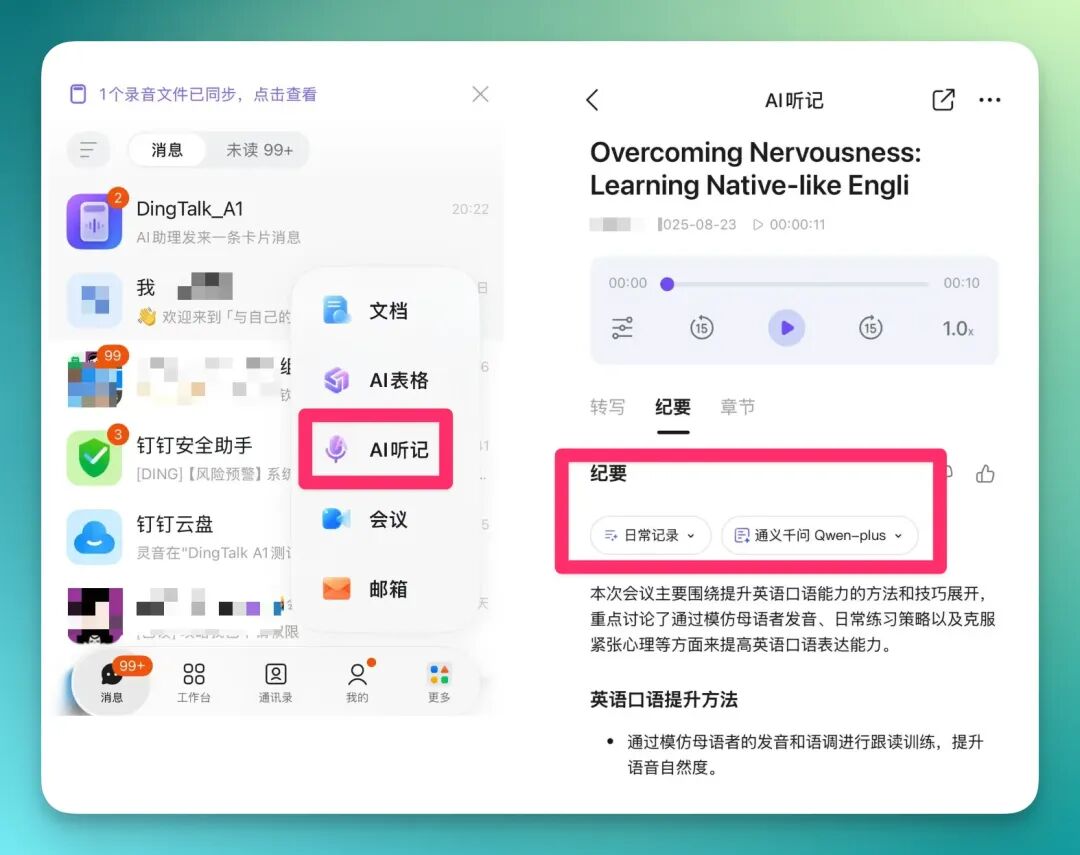
【2】More professional, better audio pickup:
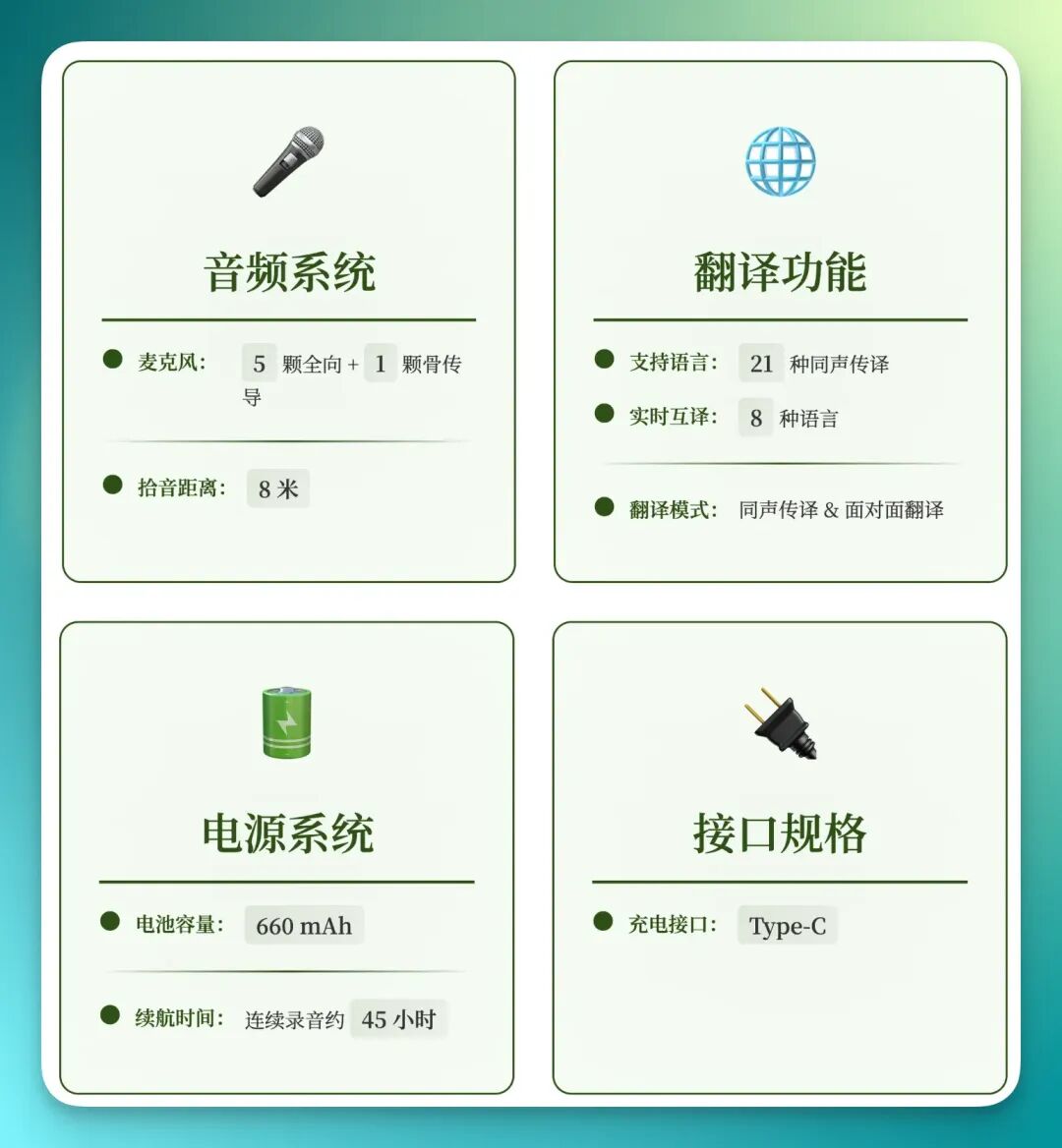
If you want optimal recording experience across various scenarios, clearly software alone can't close the loop. We've visualized DingTalk A1's core hardware specs — this should make it clear.
It now has six microphones for multi-channel noise reduction and de-reverberation, boosting speech-to-text recognition rates. Its bone-conduction microphone supports more dynamic experiences, like seamless recording during noisy phone calls:
Now, let's focus on DingTalk A1.
This type of compact AI recording device, popular worldwide, is arguably the most PMF (Product-Market Fit) hardware in AI's development to date, if you look at sales figures.
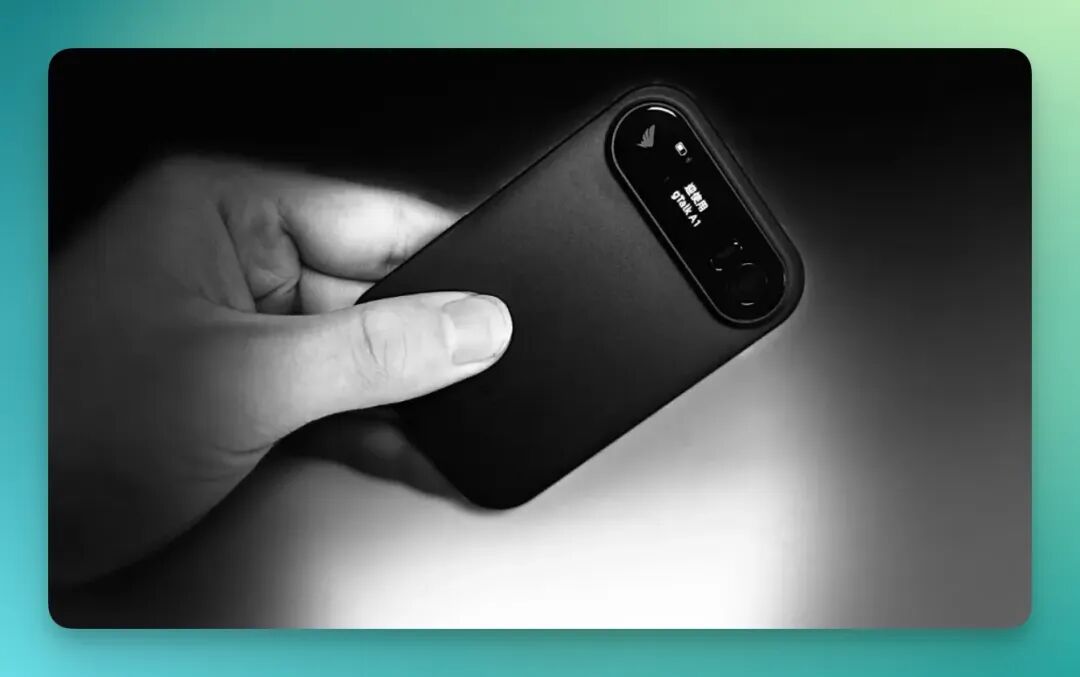
This time, DingTalk A1 comes with a display screen
Why this assessment?
Because AI recording hardware strikes directly at the "hidden costs" of workplace management: that golden quote from a meeting, key information from a client call, temporary instructions, or sudden flashes of inspiration.
This is also why a product called Granola took off quickly overseas.
Founded by Chris Pedregal in 2023, this AI meeting notes tool's core slogan is "keep meeting notes from losing focus." It enables "seamless recording" through interaction, automatically generating summaries after meetings, gradually turning these records into a personal and organizational memory bank available for query at any time.
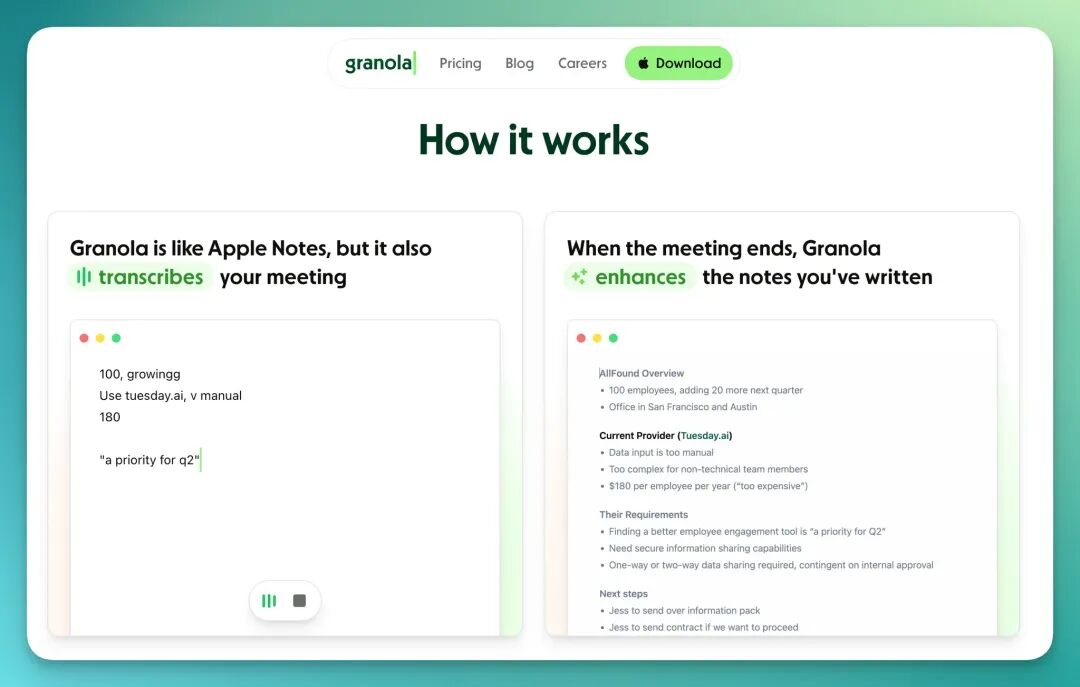
Funding data confirms the value of this demand: at the end of 2024, Granola raised $20 million in Series A; just six months later, in May 2025, it closed $43 million in Series B, with its valuation rapidly climbing to $250 million. User growth even maintained a weekly rate of 10% at one point.
Because of this, our team once produced an issue titled "How Is a Simple AI Meeting Notes App Worth $250 Million? | Deep Dive into Granola's Product Philosophy," carefully analyzing its underlying logic from interaction to growth to philosophy.
Following this logic, you naturally see that Granola and DingTalk are working on the same problem. But their landing points differ: the former "extracts" knowledge from meetings, while the latter "sends it back."
Granola is more like a "meeting harvester." For individual users or small teams, this "seamless recording — automatic summary — anytime retrieval" loop has already greatly improved work experience.
But DingTalk's ambition is larger. It isn't satisfied with mere "harvesting." It wants to "send back" this knowledge, re-embedding audio transcripts, meeting minutes, and key summaries into enterprises' daily collaborative flows: automatically generating to-do items and pushing them to team task lists; automatically identifying to-dos and pinning them to personal calendars; even forming structured archives in knowledge bases.
Re-embedding this knowledge into enterprise collaborative flows, truly closing the loop on action items, to-dos, and knowledge bases.
Ultimately, building a "people-helping" "personal business flywheel."
Why is DingTalk's move in this direction no surprise?
Here, we must mention Plaud Note, which may have been among the first signals to ignite the AI recording hardware market.
In October 2023, this AI recorder launched on Kickstarter and crowdfunded over $1 million in a short time. Achieving this million-dollar crowdfunding milestone "in a short time" after launch validated users' hunger for hardware that "efficiently captures physical-world information."
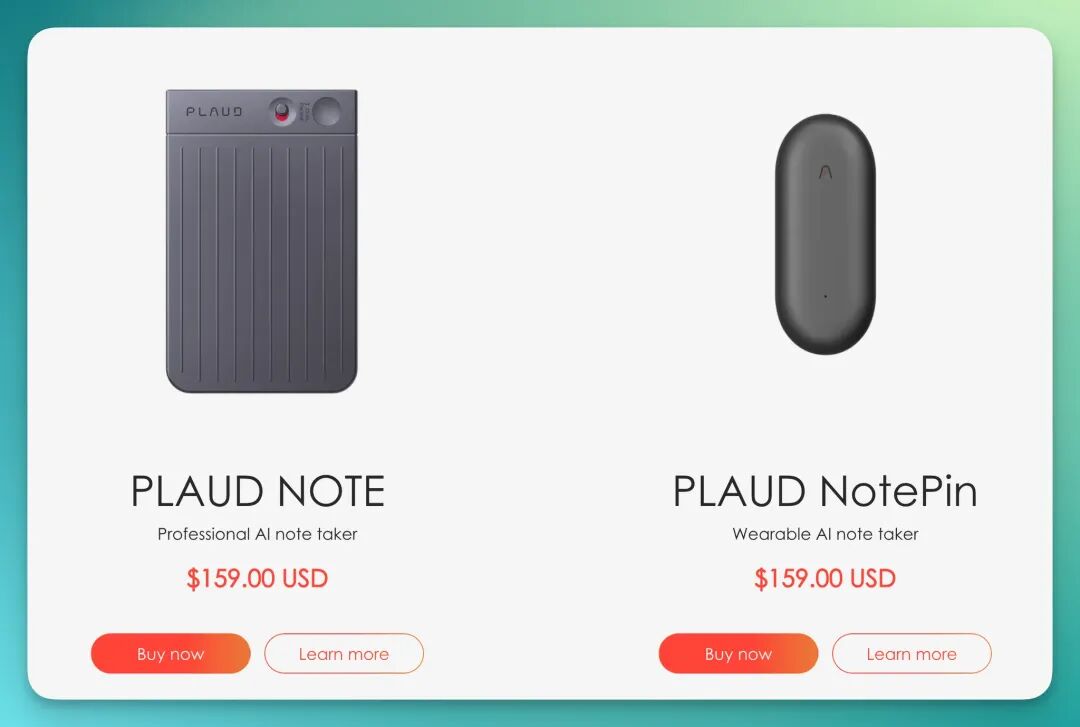
What followed was equally heated discussion. Critics argued it was purely redundant, cumbersome to operate, and overpriced, questioning "Isn't this just phone recording plus transcription?"
However, supportive voices grew rapidly too. Users discovered its "hardware utility is simple but strikes a chord." Its functions are straightforward: record, transcribe, generate summaries. But for users who frequently need to capture large amounts of information in offline meetings, classrooms, interviews, and field research scenarios, it's an extremely valuable tool.
Beyond ordinary individual needs, in the enterprise digitalization process, C-end enterprise users — especially those who have long "relied on" office platforms like DingTalk — often have even stronger, even deeper demand for such products.
Meeting content is just the tip of the iceberg. More knowledge assets exist in "the organic connection between voice data and the DingTalk platform."
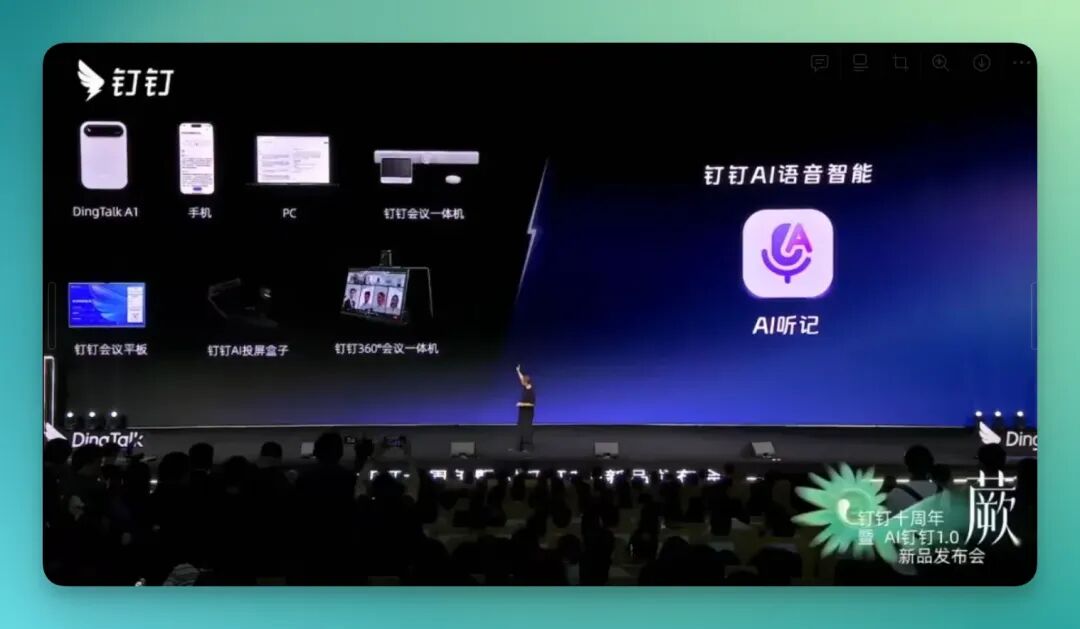 The full AI DingTalk 1.0 suite
What enterprise C-end users need is:
【1】An answer that refutes the question "Isn't this just phone recording plus transcription?";
【2】An "AI Workflow 1.0" that goes "from on-site meeting voice, to automatically transcribed text, to action items in DingTalk's task flow, ultimately settling as enterprise knowledge base."
So DingTalk's entry into this track is no surprise: it's not making "note-taking hardware," but filling in that most easily lost yet highly valuable "verbal information" piece of the enterprise digitalization puzzle.
What strategic significance lies behind DingTalk's move?
The launch of DingTalk A1 means this invisible information is, for the first time, being systematically captured by a major tech company and沉淀ed as enterprise digital assets. As AI iterates, voice data can further generate processes, optimize decisions, and even become "raw material" for organizational internal knowledge.
In other words, DingTalk A1 and AI Transcription are not standalone products.
This time, DingTalk aims to thoroughly penetrate the digitalization of voice information, structurally沉淀ing it as knowledge assets. As AI grows to understand me better, filling in the final gap of work digitalization, each person's "true AI assistant" will become reality. DingTalk A1 and AI Transcription are the entry points for business data generation and acquisition in the AI era, and the foundation for future AI applications. DingTalk is redefining how work happens in the AI era.
So DingTalk's move is no surprise — it's a very important strategic play.
DingTalk AI Is Positioned as an AI Assistant, Not Hardware
Although AI recording hardware was initially "making waves" through startups, this "race" has now entered the major tech companies' arena, with more resources driving AI hardware into more scenarios.
Next, let's examine DingTalk's product features and the product thinking behind them.
To summarize in one sentence: DingTalk A1 is not merely a recording device, but a "recorder + meeting device + translator + AI assistant."
Its functions divide into three layers:
【1】Foundation layer: recording, transcription, translation, summarization — meeting daily documentation needs;
【2】沉淀 layer: all voice content automatically uploads to DingTalk, alongside documents and spreadsheets, forming an enterprise knowledge base;
【3】Collaboration layer: seamless integration with DingTalk workflows, with three points worth noting:
- Automatic to-do identification, pushed to DingTalk's to-do list;
- Voiceprint recognition, precisely binding speakers;
- When a DingTalk calendar event arrives, the device automatically starts recording.
Let's examine each layer:
1) Foundation Layer
Connecting DingTalk A1 to DingTalk is a smooth process. After use, it permanently resides on the home page as a chat window. DingTalk's positioning for it is actually an "AI assistant":
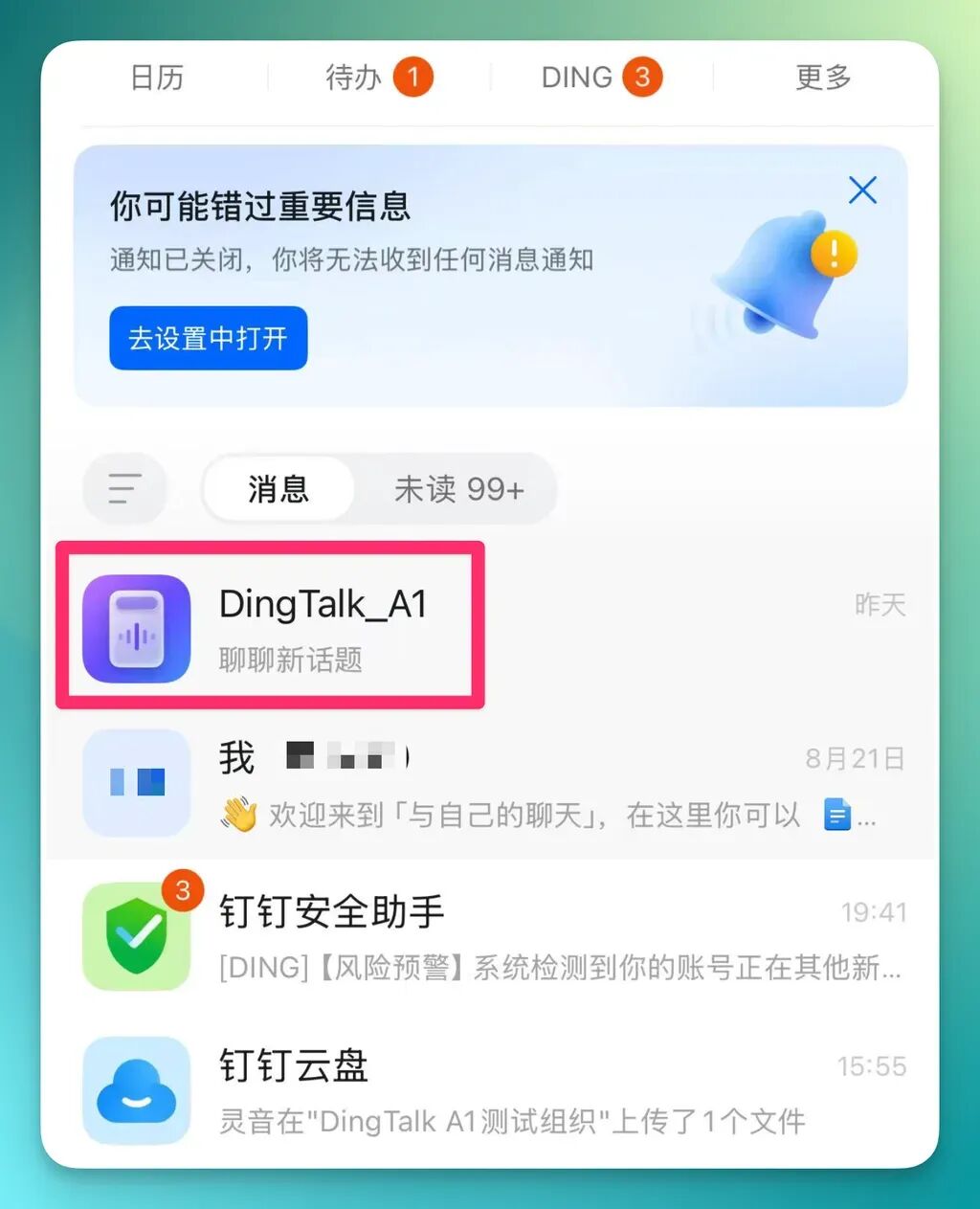
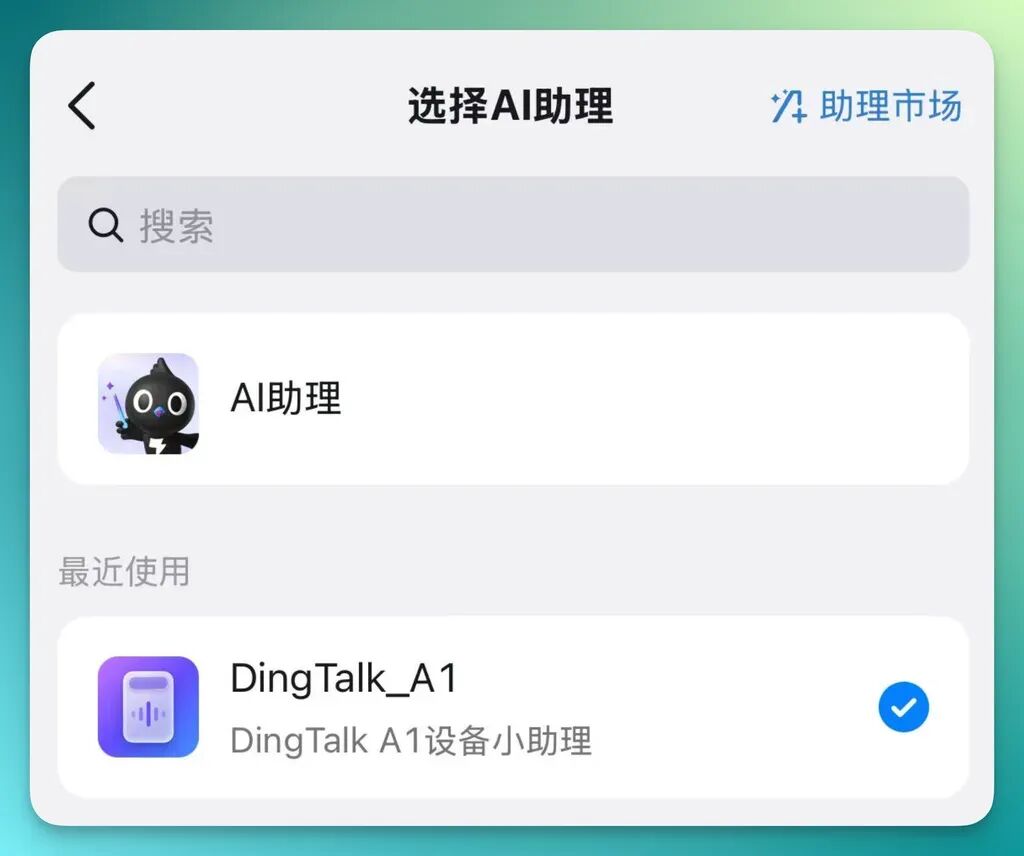
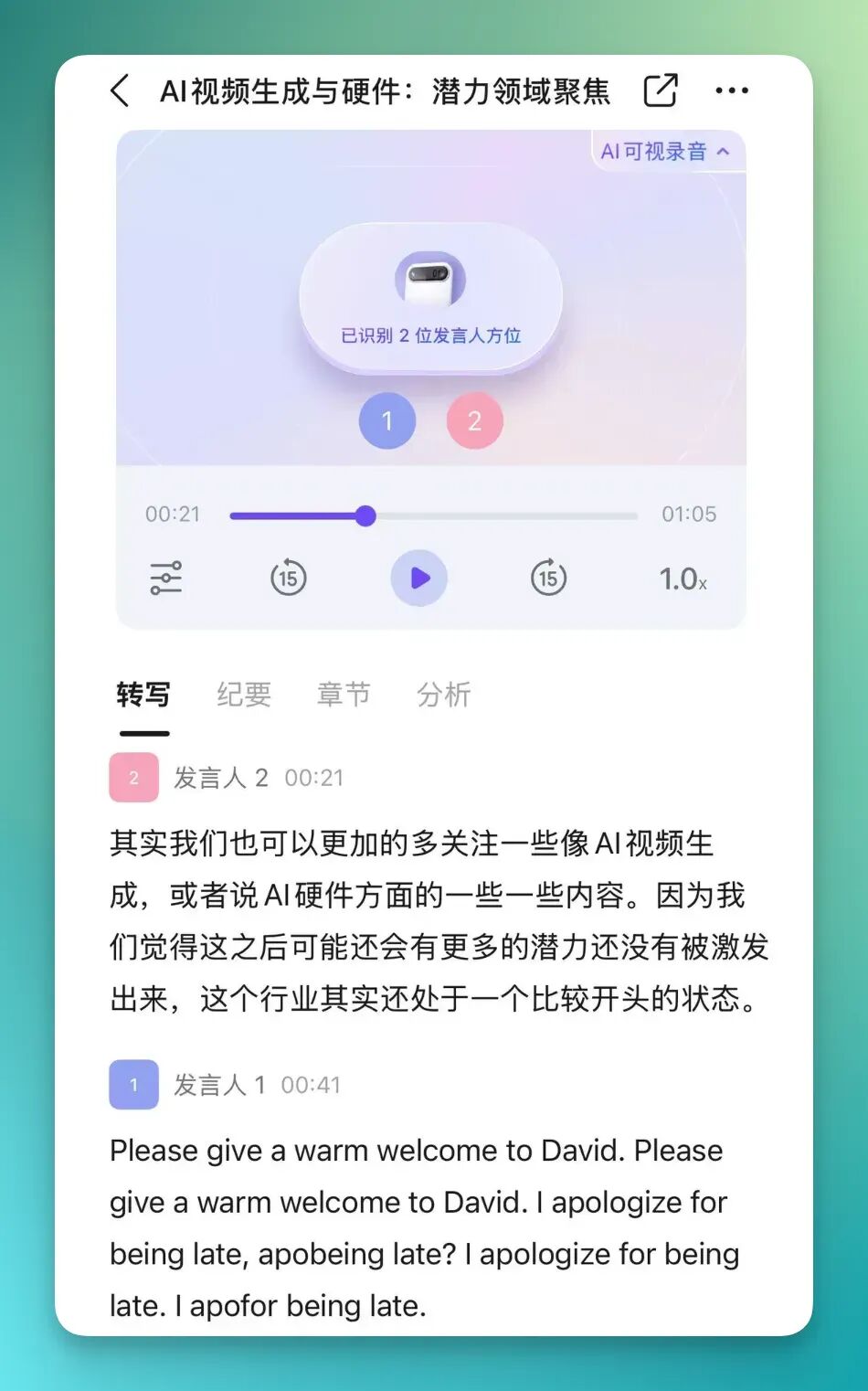
After recording completes, I can directly select various conversation scenario templates for AI generation, and even create an AI visual recording that identifies speaker direction:
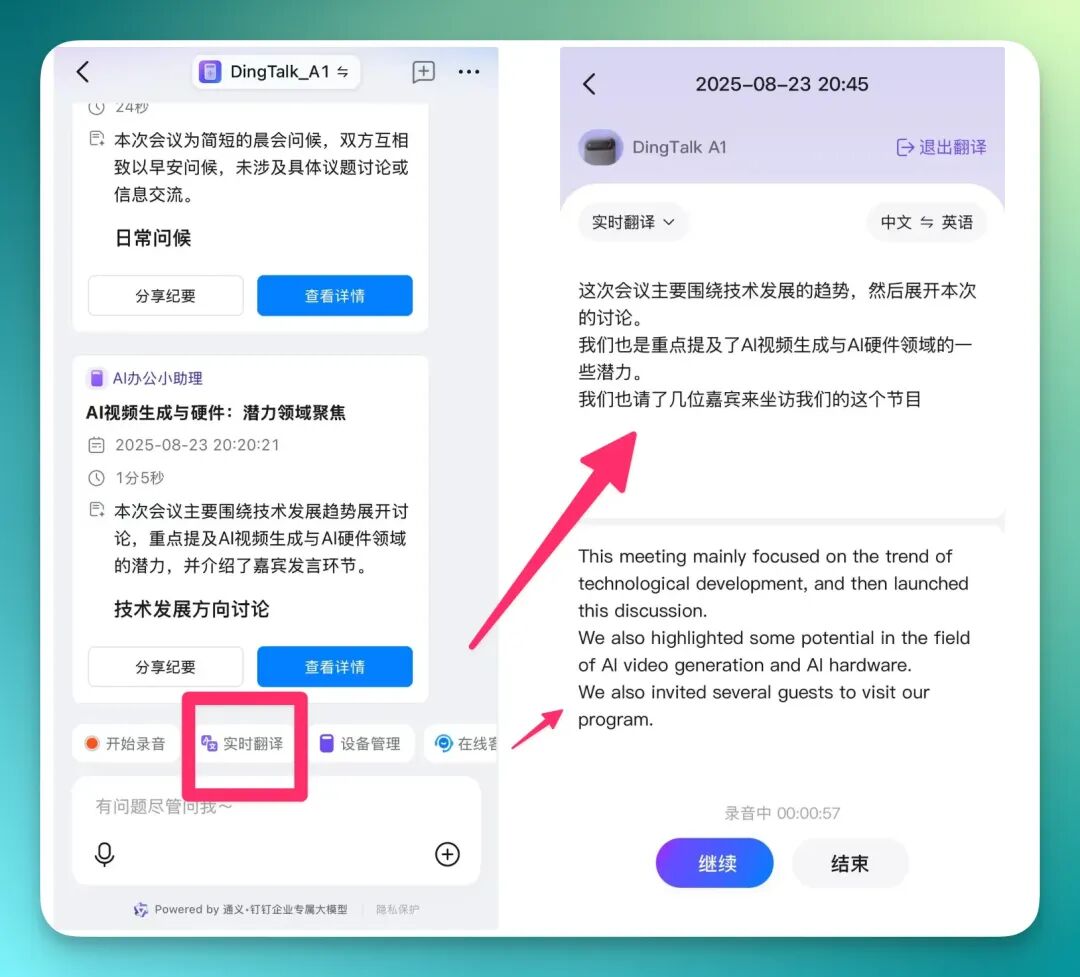
In the DingTalk app, the bottom of the DingTalk A1 page already integrates "real-time translation":
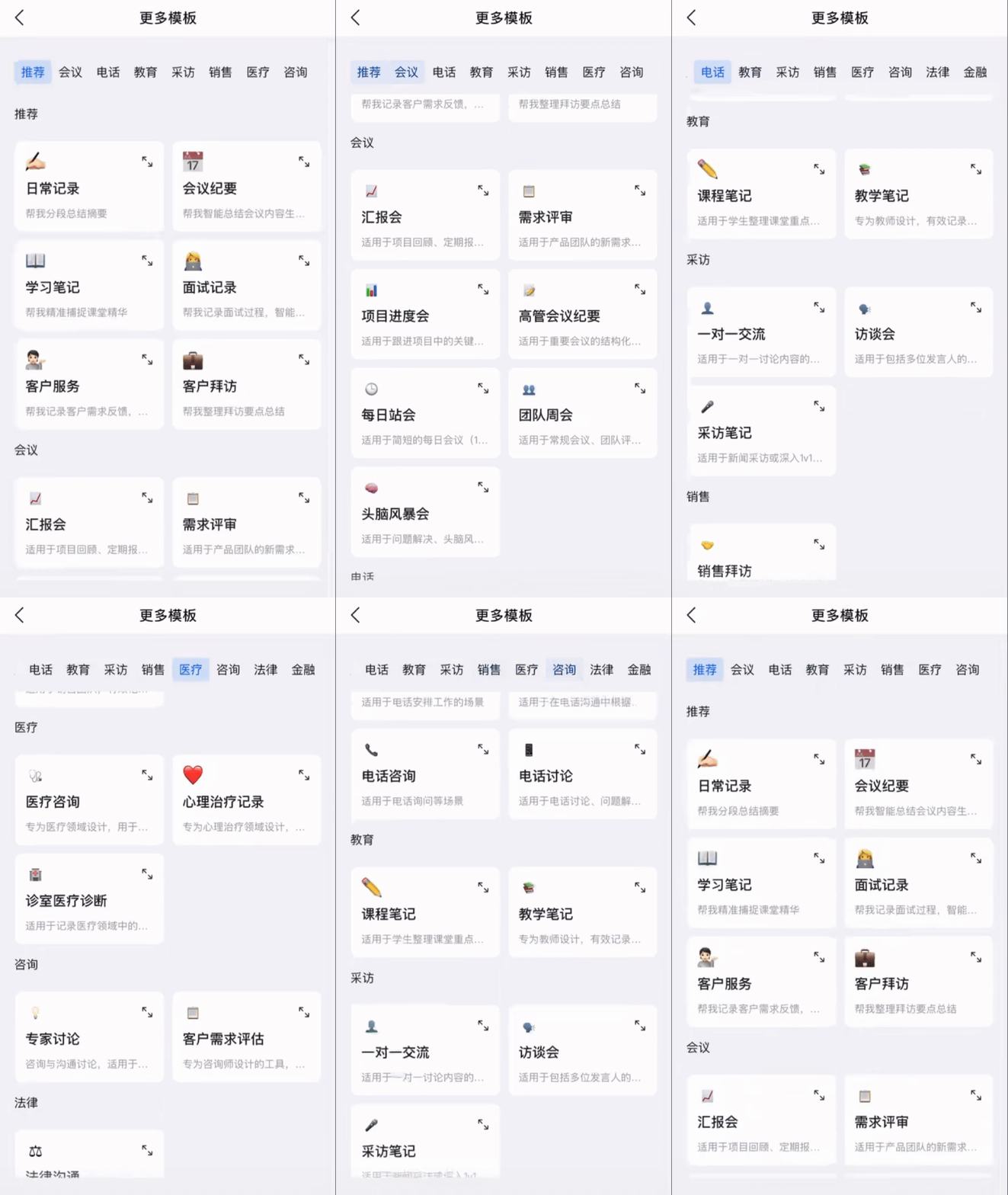
In terms of application experience, there are numerous AI generation templates based on actual scenarios (this is also available in AI Transcription):
After basic hands-on experience, we feel that DingTalk A1 is already quite complete in foundational functions, with good user experience.
2) 沉淀 Layer
All content in DingTalk A1 is embedded within the DingTalk system. I can forward it with one link, and like document forwarding on office platforms, set access permissions:
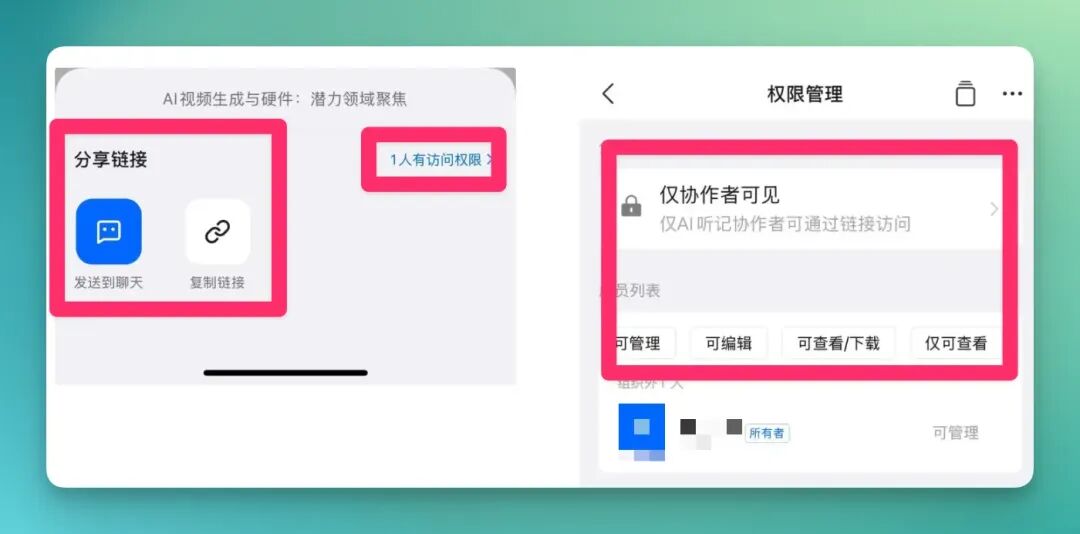
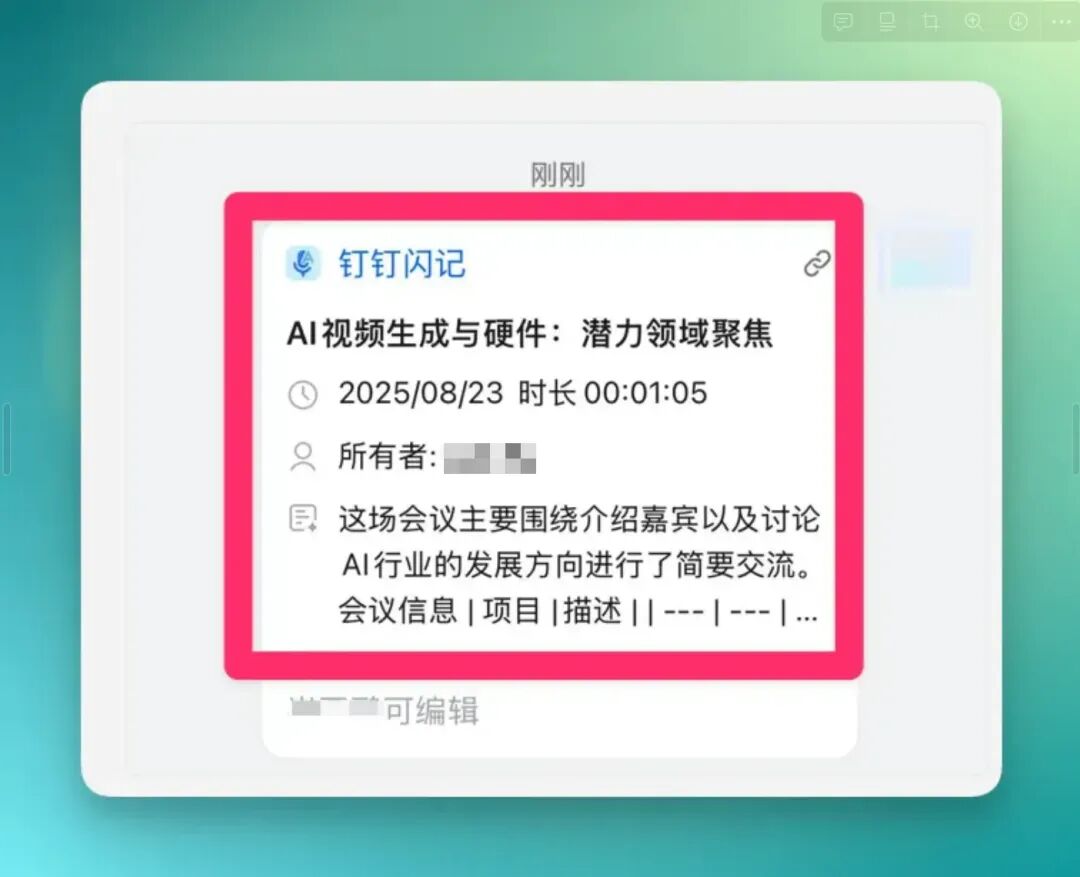 One-click forward, instantly received
All meeting content and DingTalk A1 recordings can be queried on the DingTalk app, within the DingTalk A1 interface.
The built-in AI can quickly回溯 content and find answers:
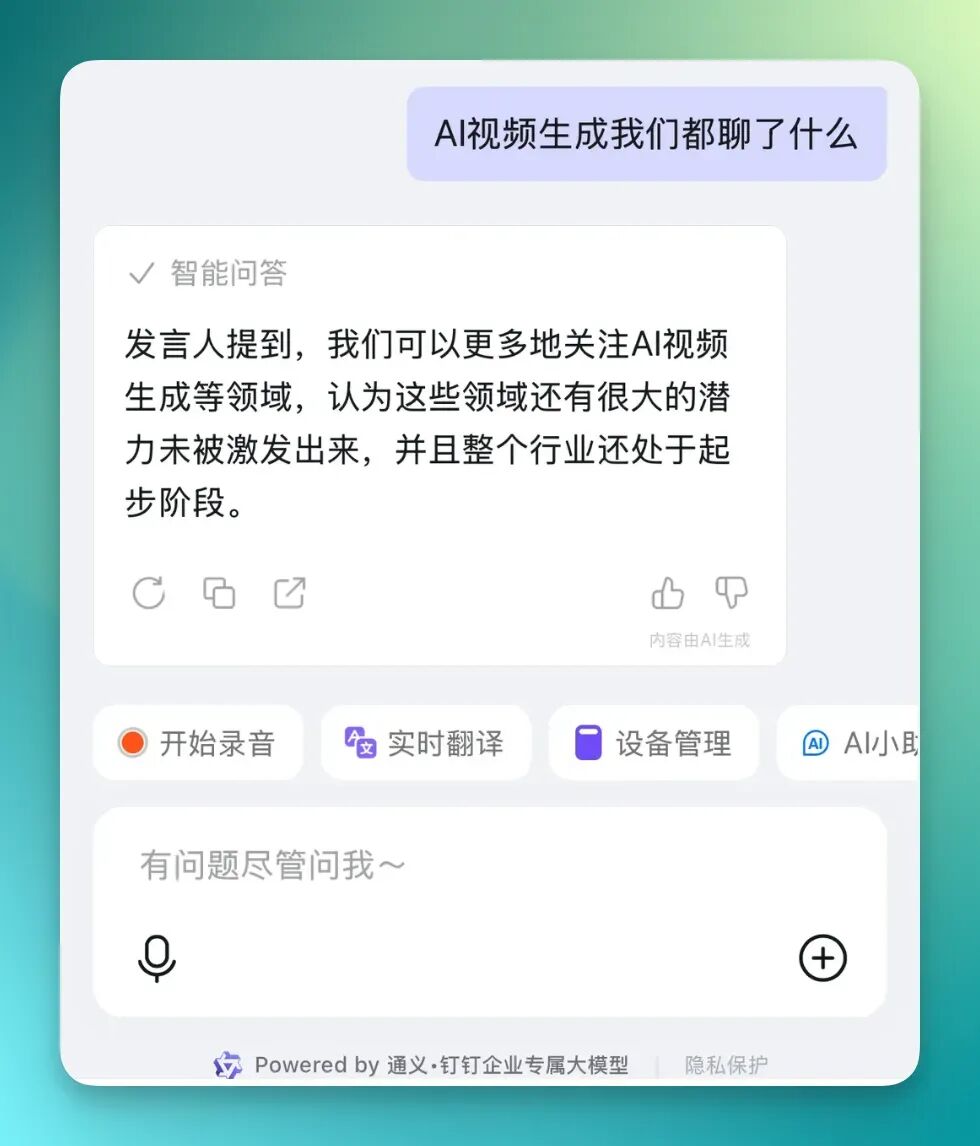
3) Collaboration Layer
In actual use, we found that the chemistry between DingTalk A1, AI Transcription, and the massive "DingTalk software ecosystem" behind them works very well.
Voiceprint Recognition
As a latecomer, DingTalk A1 covers basic functions well. For example, it supports "voiceprint recognition" — by reading text aloud in a quiet environment, it can identify speakers:

Precisely binding "who said what, when they committed to what" to enterprise identity — no more relying on post-meeting manual alignment and memory.
This feature will be highly effective in the rushed office environment of major tech companies, where "you're pulled into a meeting at any moment, sometimes even two meetings at the same time."
Automatic To-Do List Identification, Pushed to DingTalk To-Do Items
In traditional scenarios, meeting notes often end as a document. The DingTalk A1 + AI Transcription combination lets knowledge in meeting scenarios within the office workflow go from "recorded" to "automatically activated."
Now, when the system encounters statements like "I'm responsible for contacting the client" or "submit the proposal by tomorrow afternoon," it automatically extracts them as to-do items.
After DingTalk A1 and AI Transcription identify this information, they generate an internal "to-do" To-Do List, and a long press can directly create a DingTalk to-do:
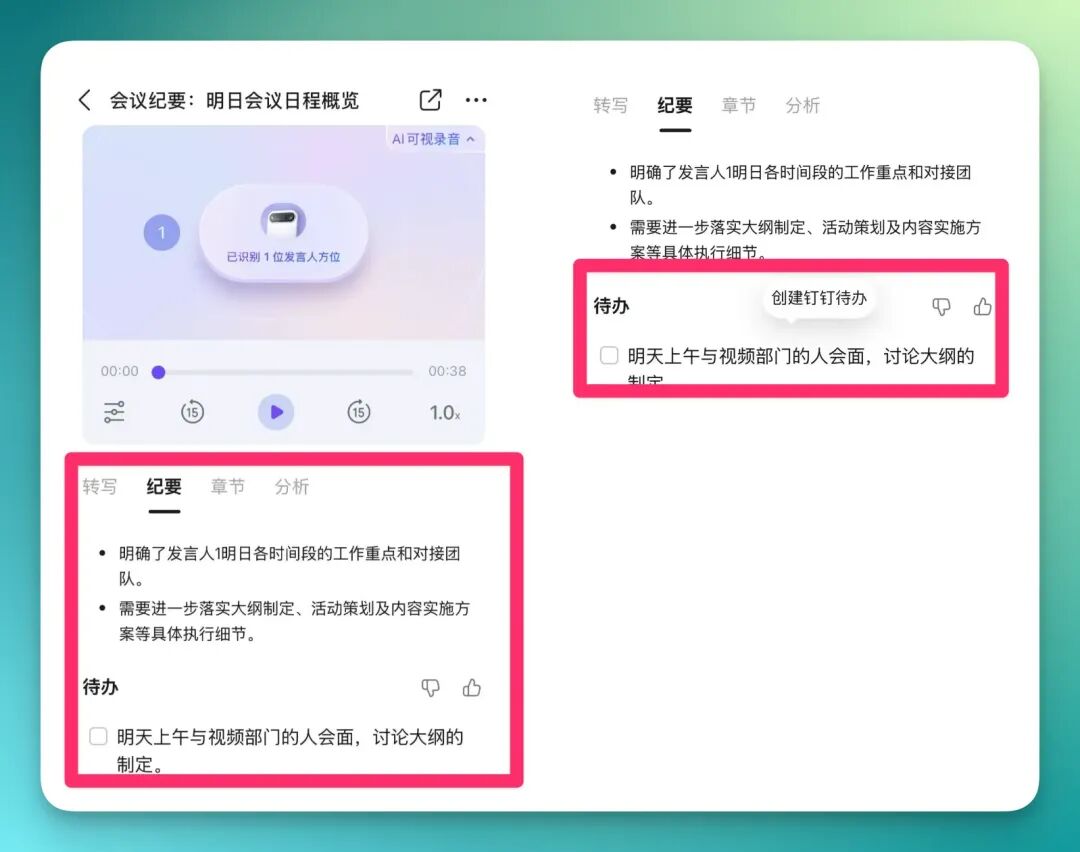
Then, shortly after, the DingTalk A1 AI assistant sends you an information card:
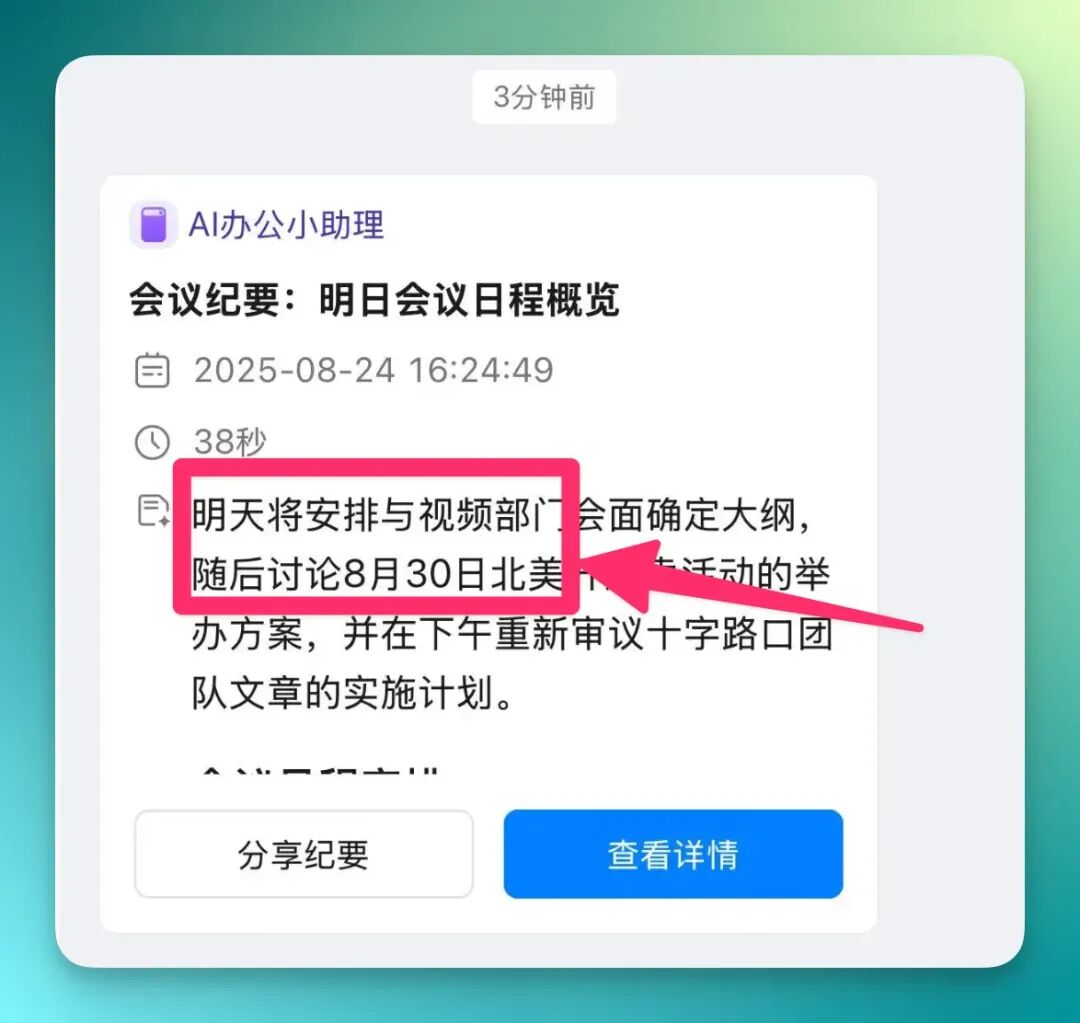
It not only identifies tasks but also assignees, time nodes, and context; finally pushing directly to DingTalk's built-in to-do center, entering the enterprise's existing workflow.
When DingTalk Calendar Events Arrive, Device Automatically Starts Recording
Another operation where DingTalk A1 is "rooted" in the DingTalk system: if you set a DingTalk calendar meeting, the AI assistant automatically sends you an information card, telling you it can help you "pre-set meeting schedule recording."
This is genuinely worry-saving:
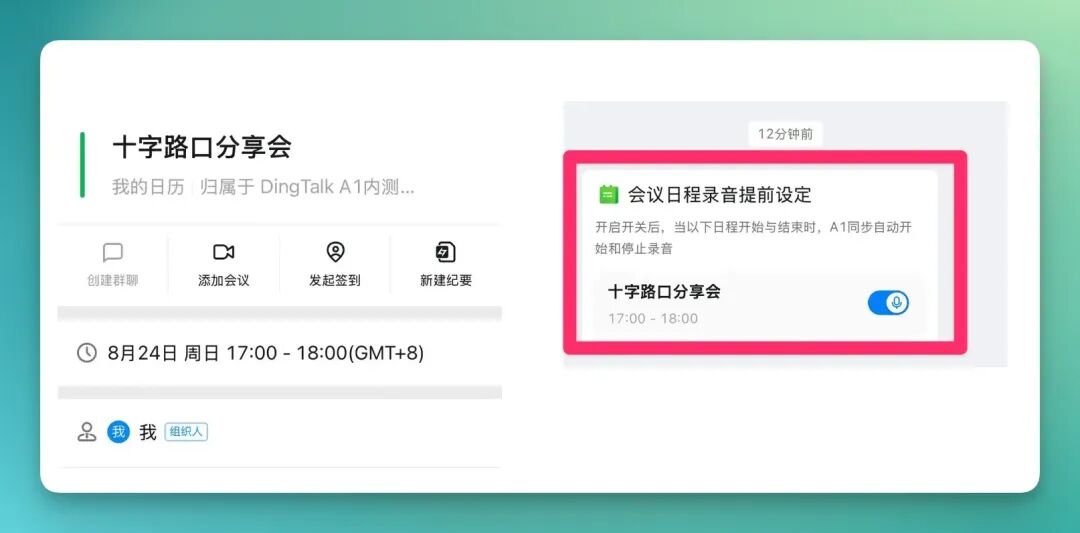
After A1 and DingTalk calendar are linked, recording becomes part of the schedule, no longer relying on manual triggering. Users only need to set the schedule, which equals pre-arranging "information retention insurance."
Seeing this, the answer to why DingTalk is making AI hardware has become "crystal clear."
Simply put, major tech companies have discovered that in the process of workflow AI-ification, the most valuable data and knowledge don't exist solely in "documents" uploaded by users, but in interaction processes. I might describe it with a phrase that major tech company employees love to use:
Granularity isn't aligned, scenario penetration still has gaps.
DingTalk is breaking the "data-era old thinking" that many users, or many enterprises internally, hold: enterprise knowledge lies only in casually uploaded documents. As long as you upload documents and store them, you have an enterprise data knowledge base.
But DingTalk's move tells everyone: there will always be knowledge沉淀 gaps here. Scenarios like "meeting discussions, instant communication" often generate more value but are overlooked in traditional workflows.
Launching with a "Low-Price Strategic Deployment"
"Winning battles is the best team building; life is about finding a way out when you're at a dead end." — DingTalk CEO Hang Chen
Finally, we noticed that DingTalk A1's pricing is remarkably low.
The DingTalk A1 Youth Edition costs only 499 yuan, with the flagship edition at 799 yuan — not reaching the "thousand-yuan device" level. This is a very sincere price.
As is well known, in the current AI recording hardware market, there are two well-known devices:
【1】Plaud Note: positioned as a "portable AI recorder."
【2】Ticnote: positioned as an "intelligent meeting assistant."
We previously dedicated substantial coverage in "98-Hour Deep Test of TicNote: How Is Mobvoi's First Post-IPO Hardware?" to introduce this Agentic AI hardware TicNote that Zhifei Li went all-in on.
We made a comparison chart to compare these two well-known AI recording hardware devices.
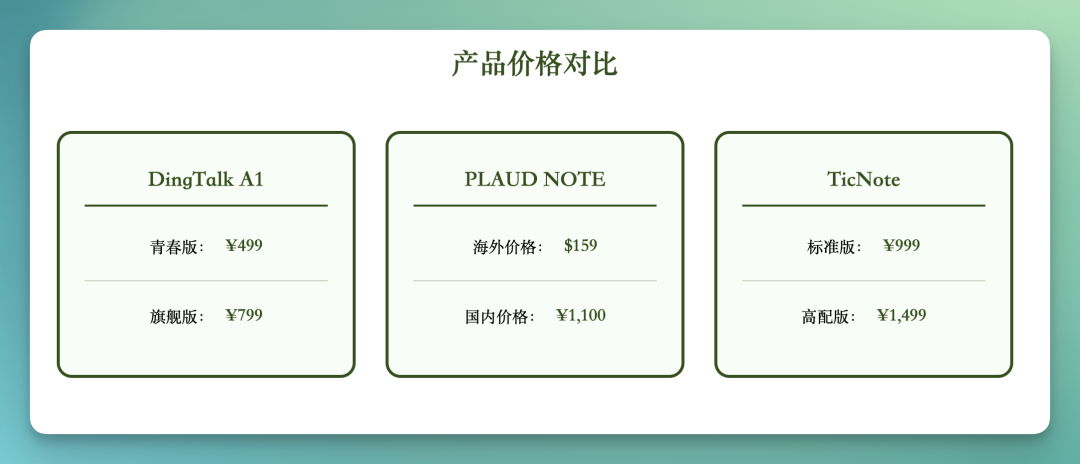
As you can see, DingTalk A1's price is significantly lower, almost using a "mass-market strategy" to drive large-scale adoption of this to-C product. By comparison, this isn't merely a product launch, but a "strategic deployment."
DingTalk built its past decade on software, but in the next decade, it must find its differentiation in "starting up again for AI." This should be the consensus of DingTalk's highly combative team.
The emergence of DingTalk A1 and AI Transcription represents DingTalk's bet on the future:
- It's not competing on single-point features, but seizing the data entry point;
- It's not an isolated device, but the embodiment of enterprise knowledge flow;
- It's not icing on the cake, but the final piece of the workflow AI-ification puzzle.
DingTalk's next move has already been made.