The Reality and Fantasy of Hardware in the AI Era: A Conversation with NuMiao's Li Nan on Hardware, Marketing, Silicon Valley, and Life-Changing Experiences

Misjudgment, failure, bad luck, misfortune, the need to adapt, the possibility of being eliminated — these are the normal state of the world.
Betting wrong, failing, being unlucky, having to adapt, and facing possible obsolescence — these are the normal states of the world.
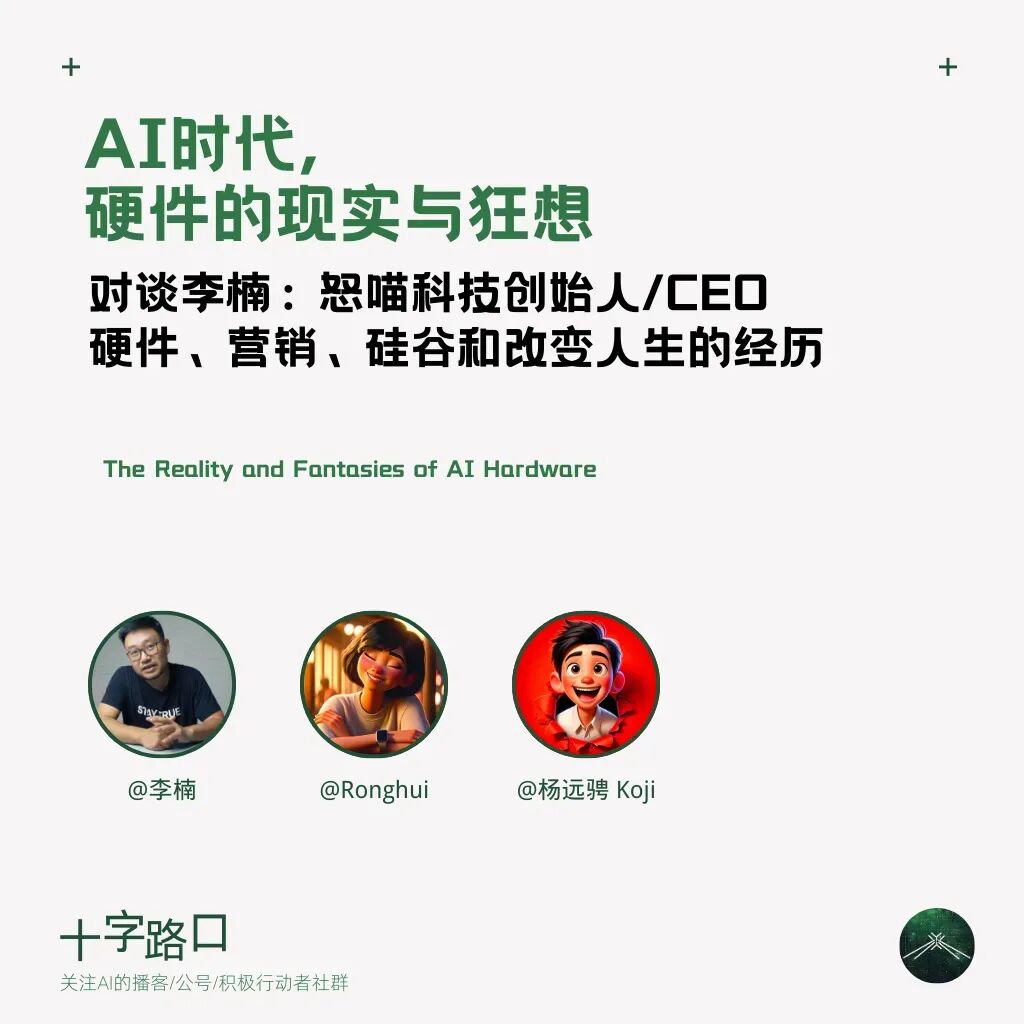
What should hardware look like in the AI era? Meta Ray-Ban smart glasses have sold over two million units, while the AI Pin flopped after launch. What lessons do these hold for entrepreneurs?
In this episode of Crossing, we're joined by Li Nan, founder and CEO of NuMiao, a deeply experienced hardware entrepreneur. Starting from his praise for the Meta Ray-Ban smart glasses, he shares his practical experience and thinking on AI hardware — including a provocative conclusion: Chinese entrepreneurs should be most wary of two role models: Steve Jobs and Lei Jun.
Li Nan also recounts his own attempt at Jobs-style disruptive innovation, and his evolved perspective that 3% innovation holds equal value to disruption. Of course, much of this episode focuses on AI hardware, including his take on marketing today as someone "who's very good at marketing," plus some life experiences that have deeply influenced him.
Listen on WeChat:
Listen on Xiaoyuzhou:

The Success of Meta Glasses & Two Philosophies of AI Hardware Design
🚥 Koji
Today we've invited Li Nan, CEO of NuMiao and former president of Meizu sub-brand魅蓝. We want to chat with him about the latest shifts in the AI hardware track, and his new ideas and evolving perspectives from the front lines of rapidly changing entrepreneurship. We want to understand what changes he's undergone recently, what new realizations have emerged, what past ideas have been disproven, and which previous views have only grown stronger.
Why invite Li Nan to discuss AI hardware? A few reasons:
- Li Nan is actively building in AI hardware. His brand NuMiao is developing an AI earphone product expected to launch by year-end.
- He has extensive experience in consumer electronics hardware, having created single-product online hits with tens of millions in sales. NuMiao's mechanical keyboards, with an average selling price of 4,000 RMB, currently hold the #1 global market share.
- In industrial hardware design, Li Nan and his team have won an iF Design Gold Award — an extremely high honor in hardware design. Even Sony has only won 4 to 5 gold awards.
- Li Nan often proposes creative, forward-looking ideas that are not only interesting but spark industry reflection and wide discussion.
Let's start with the first question: What do you think has been the most successful AI hardware product to date?
👦🏻 Li Nan
Recently I'd say the most successful product is Meta Glasses. Its success doesn't come from wild, sky's-the-limit creativity — rather, it stems from a relatively conservative strategy. Meta Glasses essentially took audio glasses that had already built up a user base over the past two years and added a camera.
🚥 Koji
I remember you've always spoken highly of it. Do you currently use it yourself? What's your usage frequency like?
👦🏻 Li Nan
I bought the first generation of Meta Glasses — those were ordinary audio glasses without a camera. This is the second generation; I buy every generation. I think this product is very restrained in its design, yet it has the best market response of all AI hardware. By contrast, those wildly imaginative designs like the AI Pin actually failed.
This gives us huge inspiration. It reminds me of a figure from street fashion, Virgil. He said something like: **"Good design doesn't actually require disruptive innovation — you only need to change 3%."
🚥 Koji
I remember you discussed this before, talking about two philosophies for building AI hardware products.
- The first is "don't mess around" or "lead by half a step" — adding AI capabilities onto existing hardware. For example, adding AI to a voice recorder created the explosively selling Plaud.
- The other is disruptive innovation, fundamentally redefining hardware from the ground up. Because software has undergone revolutionary change, hardware also has the opportunity to start from zero and be designed anew based on software's new capabilities.
From what I'm hearing, you've chosen the first of these two design philosophies.
👦🏻 Li Nan
I think both innovation paths are valid. We've seen many disruptive innovation products — iPhone, AirPods. We've also seen plenty of products that made only tiny 3% changes. For example, Meta Glasses just added a camera, or Nike shoes simply flipped the swoosh from facing forward to facing backward — yet both succeeded.
These two types of innovation require different capabilities, and both can succeed. But from a probability standpoint, disruptive innovation likely has a lower success rate.
🚥 Koji
Speaking of your own entrepreneurial style, do you lean more toward 3% innovation or disruptive innovation?
👦🏻 Li Nan
When I first entered this game, I thought we should do disruptive innovation. After getting beaten up in here for 15 years, I think we should start by doing 3% well. In my 15-year career, I've seen countless people make countless mistakes. One of the most typical mistakes — and one that costs a lot of tuition, starting from 100 million RMB upward — is thinking you're Steve Jobs.
🚥 Koji
Have you had moments where you thought you were Steve Jobs?
👦🏻 Li Nan
There was a time when I was that stupid (laughter).
🚥 Koji
Can you talk about what product and decisions you made during that "thinking you were Steve Jobs" phase?
👦🏻 Li Nan
Meizu zero won an iF Gold Award, but it actually didn't have good mass production feasibility, and it was very difficult to sell well.
🚥 Koji
Was the creative process itself joyful?
👦🏻 Li Nan
It was joyful. Actually, the reason I say both approaches are valid is because they both have sound logic and reasonable examples. Whether we're talking about disruptive innovation or just doing 3%, they're both logically sound, and they both have successful examples and impressive figures behind them.
I think the logic of disruptive innovation should start from the fundamental transformation of technology. Under traditional computing power, we had to target specific scenarios, problems, and users to provide solutions. But AI has completely overturned traditional computing power. Jensen Huang gave it a new name: "accelerated computing," and the intelligence represented by accelerated computing is general intelligence. If the fundamental nature of computing power has changed, then the basic methodology for designing products may no longer apply. Take Meta Glasses — it didn't target a specific scenario or solve a concrete pain point, yet it inexplicably sold 2 million units. This suggests that in the era of general intelligence and accelerated computing, traditional ways of thinking may already be outdated.
I think this reflects a fundamental mindset of disruptive innovation. Under traditional computing power, we used technological progress to correspond to product solutions — this approach was limited. But in the era of general intelligence and accelerated computing, this way of thinking may already be obsolete. It's like: once we had electricity, we shouldn't have been installing air conditioning on horse carriages — we should have designed an entirely new electric vehicle. That's the mindset of disruptive innovation. Everyone in this situation — whether it was Mr. Huang back in the day, or former OPPO bosses, or people from Xiaomi — they've all gone through a phase of thinking they could do disruptive innovation. They all thought they could discover the true product prototype after a technological transformation. But very few people actually discovered that product prototype.
Those who thought they were Steve Jobs — basically everyone I've seen in the phone industry lost over 100 million.
Another successful path is making only 3% changes. Like when Virgil rotated the Nike swoosh 180 degrees — this seemingly tiny change made a deep impression. This 3% logic made me realize that when you deeply understand the principles behind a product, you may find that not everyone made huge mistakes, but rather that many geniuses, after countless practices, were just slightly off. This might be the true state of product managers.
🚥 Koji
Do you think when Steve Jobs made the iPhone, he approached it through 3% or disruptive innovation?
👦🏻 Li Nan
I don't think Steve Jobs's innovation style is suitable as a reference. When he entered any industry, he always tried to overturn existing models and propose entirely new solutions. It was "you're all completely wrong, let me tell you what the correct answer is." Take the first iPhone launch — Jobs didn't mince words criticizing mainstream products on the market. He pointed out that BlackBerry's full keyboard design ignored the potential of touchscreens, while HTC's use of a trackball to operate the screen failed to leverage humanity's most natural tool: the finger. The Steve Jobs story isn't about making tiny 3% improvements — it's about discovering product prototypes and carrying out disruptive innovation.
🚥 Koji
I'm actually somewhat surprised, because in my mind you're a god-like marketer and product person. Yet today you're saying you no longer pursue disruptive innovation, but instead focus on 3% incremental innovation. This reminds me of something Peter Thiel once said: "We wanted flying cars, instead we got 140 characters of Twitter."
I'm curious how you view this transformation of yours. Do you feel unresigned? Or how do you understand your current state?
👦🏻 Li Nan
I don't think 3% changes and disruptive innovation have any hierarchy of superiority. In my view, both Steve Jobs and Virgil are extremely outstanding figures. Jobs's ability to overturn entire industries, and Virgil's ability to turn something to gold with the lightest touch — both seem like miracles to me.
Actually, Jobs's information reserves were remarkably comprehensive, and his experience extraordinarily broad. On that foundation, he could still generate disruptive innovation ideas — this was likely genuine innovation. But many people I've seen who thought they were doing disruptive innovation — from today's perspective, their ideas were simply the result of insufficient experience.
🚥 Koji
Thinking you're disrupting, when actually you're retracing old paths.
👦🏻 Li Nan
Right. In reality, someone already did this thing or this innovation long ago. And once they've formed their own idea, when I show them what someone else already did, they'll make a bunch of excuses for themselves.
I think the two role models Chinese entrepreneurs should be most wary of are these two. The first is Steve Jobs. I've personally witnessed at least ten well-known industry big shots who paid a price of over 100 million to emulate Steve Jobs.
The second role model to be wary of is Lei Jun. Those who paid the "Lei Jun tuition" are essentially everyone in the Xiaomi ecosystem. You only need to look at their stories now to understand — they all paid a considerable price. In fact, Lei Jun's success lies in his exceptional cost control capabilities, something that is often underestimated by many.
Xiaomi's cost leadership doesn't just stem from its extremely high internal efficiency; it also relies on massive order commitments to suppliers and squeezing their costs. Moreover, under this model, Xiaomi's own profitability is actually relatively weak. So this business model of Lei Jun's must be matched with formidable capital market operation capabilities.
This capability manifests in several aspects: first, the ability to continuously raise large amounts of funding in the private market; second, successfully taking the company public; and third, conducting long-term effective market cap management. Even so, Xiaomi hasn't managed its market cap all that well.
If a company cannot complete this entire set of capital operations — for instance, lacking firm, large-scale capital support in the private market, or being unable to ultimately enter the public market and effectively manage market cap, allowing all investors to get returns and exit opportunities — then this business model becomes difficult to sustain.
In fact, among companies choosing a path similar to Xiaomi's, perhaps 99% cannot reach the public market. And even among those that successfully list, perhaps 90% face the risk of breaking issue.
🚥 Koji
So you currently believe Steve Jobs is not someone to emulate, and Lei Jun is not someone to emulate. Then I'm quite curious — who are you yourself learning from, and who would you encourage AI hardware entrepreneurs to learn from?
👦🏻 Li Nan
In the industry we're in, temptations are everywhere. Someone might make 160 million in just three months from one product, or Elon Musk might launch some revolutionary Robot Taxi that completely transforms human transportation. Faced with these dazzling temptations, the most important thing is that we clearly understand our own origin of capabilities, and clarify the true basis for why we make products. If we cannot sort out these key questions, it's very easy to fall into confusion.
Regrettably, many Chinese entrepreneurs often fall into a state of constant wavering: today they want to learn from Steve Jobs, tomorrow they want to learn from Xiaomi, the day after they want to emulate Huawei.
🚥 Koji
You have an interesting view — that the fact Meta Ray-Ban "wasn't a hardware product built from demand scenarios" is precisely the reason for its success. How do you think they internally developed this product, and what was its workflow like?
👦🏻 Li Nan
In March 2023, the GPT model was released. We quickly established a broad network including US researchers and Chinese startups. By the second half of 2023, we had formed a consensus: large language models will inevitably move toward multimodality, and in the development of multimodality, vision will be the highest priority direction.
If we trace back to when Meta released the Ray-Ban smart glasses, we can see they likely realized earlier than us that AI would possess visual capabilities, and determined that this capability held tremendous value. When AI has powerful visual capabilities, what we're doing with glasses is providing "eyes" for the AI. Looking back at the second half of 2023, other glasses products were mainly developing in the direction of providing display functionality for human eyes. The logic of these display-equipped glasses was how to serve humans and meet specific scenario needs. Glasses with cameras, however, were based on a different logic: since AI already has visual capabilities, it too needs "eyes."
This is a simple and direct explanation — though it's our speculation about Meta's internal situation — but it can clearly explain why, when everyone was developing display functionality and researching waveguide technology, Meta chose to install cameras on glasses. Because we foresaw that AI would inevitably have visual capabilities, and therefore it would need visual sensors, and Meta certainly saw this earlier than we did.
We know some internal information, and know they were indeed researching display technology. Since they already added cameras, then doing waveguide on the lenses is indeed one option. However, our logic for defining products only has two bases; any other company's decisions are irrelevant to us.
Our first basis is consumer insight, and our second is the development trend of technological progress.
We believe that progress in camera and computer vision AI technology will not stop. The truly multimodal GPT-4o now uses natively multimodal data training. Next, the Llama models will certainly improve on this. And GPT-4o's visual capabilities haven't been fully exploited yet — this is our basis for judgment on technological progress.
On the consumer insight side, we gathered feedback from users who purchased Meta Glasses through Discord in the US and QQ in China. The advantages of Meta Glasses have already been discussed by many people; we mainly focused on users' top complaints, and the top three are quite interesting.
- The first has nothing to do with any high-end functionality — it's battery life. User feedback: "When I put it on in the morning it was pretty amazing, an AI glasses, but by dinner time it had become ordinary glasses."
- The second complaint is the inability to use GPT-4o. Because everyone knows the smartest multimodal AI isn't Meta's Llama 3.
- The third complaint is that the device is still a bit heavy.
Based on these consumer insights and our judgment of technological progress direction, we believe we need to further exploit the visual capabilities of large models. At the same time, we need to solve the three most important problems of Meta Glasses:
- First, battery life — we need to find ways to extend it.
- Second, the AI model issue — connecting to GPT-4o for sales in the US market, letting users access the most advanced visual model.
- Third, weight — we're not adding new features, but focusing on reducing device weight.
🚥 Ronghui
Are you referring to what NuMiao is doing?
👦🏻 Li Nan
Yes, I'm referring to what NuMiao is doing. So I believe the next iteration of Meta Glasses might add waveguide, which would make the glasses somewhat heavier, or maintain current weight while adding waveguide. But a lighter product that maintains existing functionality also has a chance to win.
🚥 Ronghui
We've observed many smart glasses-related products emerging in the market. For example, Amazon launched Echo Frame, whose biggest highlight is the integrated Alexa voice assistant. There are also quite a few startups making attempts in this space. Whenever I see these emerging smart glasses products, I wonder: will Google bring Google Glass back from the dead?
👦🏻 Li Nan
Very possibly. In the industry, we have a metric. This metric defines whether a product prototype has emerged. We usually use sales volume to judge whether a product has become a prototype — this is the most objective way. The first-generation iPhone's global sales were between 700,000 and 1.4 million units; we believe products below 700,000 units are insufficient to become a category prototype. Meta Glasses sales have already broken 2 million units, surpassing this threshold. So Meta Glasses very likely could become the product prototype for the next generation of AI-era personal wearable devices.
Once a product breaks through the prototype threshold, what matters isn't what it did, but how the rest of the industry reacts. I've seen a massive number of smart glasses solutions at Huaqiangbei — maybe 20-30, even 40-50. Meta Glasses' success has driven a large number of Huaqiangbei manufacturers to frantically develop various glasses solutions, with costs being driven extremely low. I've seen solutions costing 300 yuan, and some people even use smart ear scoops to make even lower-cost solutions. These smart ear scoops have Bluetooth, cameras, can transmit ear canal images to phones, and are very cheap.
So this means Meta Glasses has not only proven itself as a new category prototype through sales volume, but the entire industry believes in it and is swarming in. It can be foreseen that Chinese brands will likely drive smart glasses prices down to $99, or even lower, in a short time.
Viewing Product Innovation from an Entrepreneur's Perspective
🚥 Koji
So in this situation, what do you think entrepreneurs should do, or what would you yourself choose to do?
👦🏻 Li Nan
I think we first need to look at the overall market size. This is no longer a millions-level problem, but tens of millions level, 30 million level, 50 million level, even hundreds of millions level market size. Because competitors have already driven prices very low.
At the same time, the real question is: "When the Xiaomi model emerges, everyone swarms in, and market size rapidly expands, is our core competitiveness cost leadership?" The answer is clearly no, because competition is too fierce. Although it can't be ruled out that someone could achieve cost leadership, they immediately face a problem: "What if Xiaomi also enters this market?"
During the Meizu Blue Charm phase, we once competed with Xiaomi. In fact, Blue Charm was more like Xiaomi's friend than its enemy. We maintained a 2:1 conversion ratio against Xiaomi. We simply addressed the needs of people who were interested in Xiaomi but dissatisfied with it. They felt Xiaomi lacked aesthetic sensibility, and didn't agree with the notion that "no design is the best design." We offered original design at prices 10% higher — this proved the path was viable.
The same logic applies to the glasses industry. Chinese people are good at making passable (60-point) products at half the price. So, can we make 70-point products at one-third the price? Actually, during the Blue Charm era, we made 70-point products at half the price. And in NuMiao's case, we've proven that Chinese people can make 90-point products at 7 times the price.
🚥 Koji
So in your judgment, it's not about competing on cost, competing on low prices. Rather, it's about using higher cost to make a more premium product to serve vertical market segments.
👦🏻 Li Nan
I think the key is quantification. Anyone can say this direction, but the key is how to quantify it. Let's make an assumption: when the market is rapidly expanded by half-price 60-point products, I hope they can get as many products on shelves as possible, the more brutal the price war the better — ideally reaching 50 million or 100 million base users. What happens then? It's actually the classic consumption upgrade. After users experience these products, they'll discover various problems with these cheap products, and seek better alternatives.
🚥 Ronghui
Then how should this market be quantified?
👦🏻 Li Nan
We have a relatively classic quick calculation formula: assuming your competitor's product is priced at 100 yuan and has created a 50 million market. Then you can roughly assume that at the 200 yuan price point, there will be a market about one-quarter the size, or roughly 12.5 million. And there are actually very few competitors in this market.
🚥 Ronghui
Are there relevant cases for this?
👦🏻 Li Nan
We conducted in-depth research across multiple industries, including electric fans, refrigerators, and the mobile phone industry. The mobile phone industry was once distorted by Apple's formidable capabilities at a certain historical stage — Apple captured nearly 40% market share at extremely high prices. But ultimately, all industries returned to a universal law: mainstream products capture 70%+ of the market at 1x price, premium products capture 20%+ at 2x price, and top-tier products capture less than 10% at 7x price.
From a consumer psychology perspective, this distribution reflects the needs of different groups. Consumers with limited financial means choose cost-effective products — as long as it works, it's fine. Once consumers gain some economic footing, they pursue consumption upgrades, opting for slightly more expensive but higher-quality products. For the very wealthy, they seek differentiation, choosing extremely expensive products to signal status.
Notably, products priced at 3 to 5 times the baseline often lack market space. This is because high-end users can stretch their budgets to afford them, while top-tier users find this price point insufficiently "insane" to satisfy their status-signaling needs. In contrast, products at 7 times the price can meet this psychological demand of top-tier users.
🚥 Koji
So NuMiao's keyboards are positioned from this angle too?
👦🏻 Li Nan
Yes. We researched all-aluminum keyboards — Xiaomi sells them for 500 RMB. We said, OK, we'll sell ours for 3,500 RMB, a sevenfold price gap. So we started at 3,500.
🚥 Ronghui
Do you have any insights about the new generation of consumers? For example, how might people who buy glasses next differ from those who bought iPhones ten years ago?
👦🏻 Li Nan
I think Meta Glasses differ significantly from AI devices because their capabilities are relatively limited. Essentially, Meta Glasses aren't truly AI devices — they don't even have AI functionality. They're more like weakly-connected sensors that give users AI "eyes" and "ears," but the "brain" remains in the cloud. So calling Meta Glasses an AI device is itself misleading.
But we believe sensors are actually one of the most valuable domains in hardware. While we may not be able to train large models, those who do need AI with vision and hearing to receive genuine sensor input in the real physical world. So we cannot be absent from the AI revolution.
One of our important missions is to deploy sensors in the real physical world. This is also one of the fundamental reasons why products like Meta Glasses will inevitably succeed.
From a business model perspective, we can compare companies developing large models (like OpenAI or Anthropic) to "gold miners" — they might strike gold. We're not mining gold; we're not an AI company. We're more like the people "selling jeans."
🚥 Koji
The hottest AI hardware trends right now are glasses, necklaces, and earbuds. We've been talking about glasses — does this mean you favor glasses most among these three directions?
👦🏻 Li Nan
I personally have a different view. I do think glasses are promising. They're currently the best wearable AI sensor, and that's crucial. But they don't have a real model or real accelerated computing power, so they can't be called an AI device. They're just "jeans," not a "gold mine."
I believe a second true edge AI device has already emerged: Tesla's electric vehicles. Tesla FSD V12 has rolled out to millions of users — this is genuine edge AI. It doesn't just drive for you; its reception and performance have been excellent. This is the second edge AI device to reach millions and cross our threshold — it's real AI, it's a robot.
As Elon Musk has said, Tesla isn't just an electric vehicle company. It's different from other Chinese automakers, and doesn't need to be compared to companies like BYD, because Tesla is fundamentally a robotics company. The reason is that FSD V12 gives Tesla vehicles a local edge model. This model may be hybrid, but it has already taken over autonomous driving functions, with perception and decision-making capabilities.
Once Power Consumption Is Solved, True Edge AI Has Already Arrived
🚥 Koji
Since AI hardware inevitably involves edge models, you must be extensively testing various latest edge models. I'd like you to elaborate on the industry progress of edge models based on your testing and observations.
👦🏻 Li Nan
Precisely because we believe glasses aren't essentially AI devices, while Tesla FSD V12 is hardware with a true edge model and portable brain, we have to consider: as glasses get lighter, we can't put edge models on them. Electric vehicles were the first to carry edge models because they face virtually no power or computing constraints — they're large, can fit more chips, and have few space limitations.
So how small can edge models ultimately extend to? This is worth exploring. The biggest challenge for edge models isn't actually space, computing power, or memory — it's power consumption. The smaller the device, the smaller the battery, the shorter the operating time, so power consumption becomes critical. We believe conversational models have no chance on the edge largely because they're too power-hungry.
We calculated that running a GPT-3-level model on a phone would drain the battery after roughly 30 conversational exchanges.
But Tesla FSD V12 gave us significant inspiration. Models don't have to be for conversation. While it has AIGC capabilities and can generate language, it's mainly used to perceive the world and control the car. The "Octopus" model developed by two Chinese students at Stanford also gave us new ideas. This model is only 1B parameters, with certain visual capabilities — it's not for conversation, but for controlling your hardware. It learned all Android APIs, and our testing found its power consumption to be very low.
I spoke with one of the model's co-founders. His point was that when AIGC generates responses with unlimited linguistic variety, it's very power-hungry. But if you effectively constrain its generation scope, requiring it only to choose among a few APIs, it suddenly becomes very power-efficient. This is the most important insight we've found across all edge models:
Once a model is trained and deployed on a device, "understanding" is power-efficient, but "generating" is power-hungry.
So we may not need to wait for edge models to further reduce power consumption, or discover new neural architectures better than Transformer. We just need to adjust the requirements, and edge models could be effectively applied on much smaller devices. If I were to draw a boundary right now, I wouldn't draw it at glasses, because glasses need to get lighter. But I would draw it below phones — devices smaller and less powerful than phones have opportunities to carry edge models.
For example, power banks or slightly smaller lightweight over-ear headphones both have potential. As for glasses, because this position is so weight-sensitive, we'd probably still prioritize making them lighter.
🚥 Koji
Given edge models like "Octopus" that focus on understanding rather than generation, achieving high energy efficiency — what possibilities come to mind in this context?
👦🏻 Li Nan
If we return to the logic of user pain points and scenario needs, products like Plaud are indeed a good choice. This proves that traditional product development methodology can still produce excellent products, and they've achieved considerable financial returns in the short term, estimated to have reached hundreds of millions in scale.
But based on our understanding of edge model capabilities, we believe all hardware will ultimately be redesigned for this essential reason: we finally have the opportunity to control hardware with natural language today. Our focus has shifted from using natural language understanding to generate conversational responses, to using natural language understanding to generate hardware control commands.
This is my greatest expectation for edge models, and also the direction of our future product development.
🚥 Ronghui
When do you expect to release your product? You mentioned in another blog that you were targeting year-end — any updates so far?
👦🏻 Li Nan
Our hardware demo version is about to be released, followed by accompanying software. Our goal is clear — enabling users to control hardware devices with natural language. This means users no longer need to read tedious manuals or figure out confusing buttons and menus.
This change might seem like just a 3% user experience improvement, but it's revolutionary at the technical level. If a device has a built-in edge model that can understand user intent and directly control hardware, it becomes an entirely new product form, truly demonstrating the value of accelerated computing for users.
I can give another example to illustrate this transformation. Imagine air conditioners three years from now — they likely won't need remote controls anymore. Instead, a far-field microphone captures user voice within 3–4 meters of the unit. Users don't need precise commands; simply saying "isn't this wind blowing a bit uncomfortably?" would automatically reduce the fan speed. This future isn't hard to imagine, and could be realized very soon.
🚥 Ronghui
Maybe we'll see many such new prototypes at next year's CES.
👦🏻 Li Nan
I think so. I even feel that the computing power required for a 1B model isn't very high, and the cost isn't very expensive. It's quite possible that some very quirky products will adopt edge models. For example, maybe your desktop power management device, or that kind of power strip thing, could run an edge model.
🚥 Koji
If there are microphones everywhere at home, wouldn't some things sometimes be misinterpreted?
👦🏻 Li Nan
There's some gossip that a certain brand's robot vacuum uses its own microphone to decide whether to serve you condom ads in its brand app.
🚥 Koji
That sounds concerning — it means it's eavesdropping. If it pushes this, it should be pushing lots of other things too.
👦🏻 Li Nan
Users will ultimately actively or passively trade their privacy data for convenience — this trend has never really changed. When researching Meta Glasses, we encountered another group of users whose thinking reminded me of the "Redemptionists" in The Three-Body Problem who believed the Trisolarans would save humanity. These users even made demands beyond our expectations, such as hoping Meta Glasses' cameras could stay on around the clock, continuously recording as long as they're worn, and streaming all video to AI in real-time so AI could help them remember everything that happened during their day.
🚥 Koji
The existence of such users is perhaps unsurprising. I think they might be extremely privacy-insensitive, or have such strong sense of security that they've never experienced related harm.
👦🏻 Li Nan
Yes, so I think in the AI era, users will include both Redemptionists and Rebels.
🚥 Ronghui
So which faction are you?
👦🏻 Li Nan
I don't know. At this moment, all I can see is my mission: first, to fill in the sensor piece. AI already has hearing and vision, but it needs more sensors to perceive the world. At the same time, I hope to deploy on-device models across as many devices as possible, bringing to life all the "dead" 3C electronics we've been producing for so long, creating more value for users. As for what form the future will ultimately take, I don't actually care that much. My focus right now is doing the work in front of me well, laying these foundations solidly.
🚥 Koji
Live in the present, don't dwell on the past, don't be distracted by the future, and move forward with abandon.
👦🏻 Li Nan
Yes, because these two missions are genuinely not easy.
The Evolution of a Startup Methodology: Don't Overestimate Your Odds, Time Matters More Than Money
🚥 Koji
Compared to your previous ventures, whether at MEIZU or doing NuMiao's mechanical keyboards or those earlier products, what methodological upgrades have you made?
👦🏻 Li Nan
In the startup process, I believe 99% of founders overestimate their product-definition success rate. Many people think their first attempt will hit the bullseye, or at least come close.
I see product definition not as a continuous process, but more as a binary outcome: either a massive success (scoring 200 points), or a total failure (scoring only 20 points).
Based on my experience, most founders probably have a success rate below 20%. So I advise founders not to overestimate their odds, but to prepare thoroughly. Even if you get lucky and succeed the first time, that might just be fluke. I recommend preparing funding for at least three attempts, or even five if you have strong fundraising ability. This is an important methodological upgrade for me.
Beyond funding, time is also a critical factor, especially in hardware. Whether it's a complex phone or a relatively simple keyboard, developing a high-quality hardware product typically requires 12 months of grueling effort. Saving time matters more than saving money.
Drawing from my previous experience in software, we believe in the importance of rapid iteration. We've been exploring how to apply software's fast, short-cycle iteration methods to hardware development. We eventually arrived at a relatively simple approach: using mature 3D modeling and rendering technology, we create about 7 highly realistic virtual prototypes for a defined product concept. Then we have skilled marketers create 7 polished promotional posters for these "virtual products," just like a real product launch.
This process can be exhausting, and 6 of those concepts will ultimately be eliminated. But this method can dramatically shorten the hardware R&D cycle. By testing these 7 virtual concepts within our accumulated private community, we're effectively completing 7 product-direction tests within 12 months.
🚥 Koji
Do users know these products are fake?
👦🏻 Li Nan
Users know. When we present these concepts to users, we're transparent that these are just preliminary ideas, asking for their opinions. Some users might criticize directly, while others show tremendous interest. This method lets us complete the equivalent of 7 iterations in 12 months, greatly improving our chances of finding the right product positioning. Through this virtualization approach, combined with strong marketing capabilities, we can vividly present product concepts without an actual product, even making concept videos. This method dramatically improves our efficiency and success rate in hardware development.
🚥 Koji
Actually, this is something everyone doing hardware, or even physical consumer products, hopes to achieve. It doesn't sound like a methodology only a genius would devise. But at NuMiao, what do you think are the main reasons this could actually be executed and implemented? For example, what kind of company culture, or what unseen workflows, made this possible?
👦🏻 Li Nan
I think this method's success largely stems from my previous experience in software—I deeply believe in the power of iteration. For those who don't understand or believe in this approach, investing the corresponding resources would be difficult.
This method does place higher demands on our industrial design team, and has led to expansion of the marketing team—these are additional costs. Many might question why we make those 6 ultimately-eliminated concepts so polished. If they don't understand or believe in the value of this investment, they won't adopt this approach in the end.
Another key factor in our success is that we've gathered a community of imaginative, tech-enthusiastic users in our private domain. These users are always envisioning future products, taking pride in owning products that represent tomorrow's technology. They're very willing to participate in this kind of discussion, and don't see it as meaningless daydreaming.
When our team engages deeply with these users, a kind of magical chemistry occurs. This reaction helps us quickly discover the correct definition of a hardware product. Through this method, we can complete in 12 months what other companies do in 7 iterations, greatly improving our chances of finding the right product positioning.
🚥 Koji
When generative AI first emerged, I believe everyone had many fantasies about AI. As time has passed, we've found some fantasies were indeed unrealistic and have shattered. But some progress is still worth anticipating. So among those shattered dreams in your imagination, what left the deepest impression on you? And of what remains, what do you think is most likely to be realized?
👦🏻 Li Nan
We've been trying to explore the limits of AI capabilities, but our direction may differ from others. For us, the most critical factor is evaluating on-device AI power consumption. As a former software engineer, I clearly understand where the key to the AI revolution lies. It's the first general intelligence in human history, and its defining characteristic is that it makes mistakes. Precisely because it makes mistakes, it brings possibilities completely different from hard-coded logic.
So I have no doubt about the revolutionary nature of AI.
But as someone who works in both software and hardware engineering, I don't overly focus on whether AI can be like characters in sci-fi films. What I truly care about is: when we have this general intelligence acceleration computing power that may make mistakes but can handle broader problems and cover more scenarios, what better things can we do?
We simply summarize this way of thinking in one word: improve. We shouldn't overly focus on what our desires are, nor feel regret about what we currently can't do. What we really need to think about is whether we can take one step forward from today's product. As long as we can move forward, it has value, it's progress.
So we use this improve mindset to explore the boundaries of AI capabilities, to explore its minimum power consumption. This is the engineer's way of thinking.
The Revelation After the 3/11 Earthquake: The Importance of the Present Moment
🚥 Ronghui
Let's talk about personal experience. You mentioned earlier about knowing the origin point of your abilities, knowing the true basis for making products. Can you say when you realized these things?
👦🏻 Li Nan
After Japan's March 11 earthquake, I understood two important things:
First, when you realize that the next second you might be taken by floodwaters, nuclear leakage, or an earthquake, everything you have in this moment—all your abilities, resources, and knowledge—is the best result you can deliver. Don't expect tomorrow, don't expect the next second. When you need to make a decision, make it decisively, as long as you won't regret it.
Second, no matter how strong Steve Jobs's ability to predict the future was, or how excellent Xiaomi's marketing capabilities are, what we essentially possess is only our understanding of the current technology industry and the current consumer market. All our product innovation must be based on these two aspects, rather than paying excessive attention to what rocket Elon Musk has launched, or what astonishing sales Xiaomi has achieved somewhere.
🚥 Ronghui
During the Japan earthquake, what career stage were you at? Did you experience the earthquake yourself?
👦🏻 Li Nan
At that time my wife and child were both in Tokyo. I wanted to return to Shanghai, but tickets were scalped to over 20,000 yuan and still unavailable. Later we got them out, leaving only me in Tokyo. I was working at NEC then, and I found that in this city of 40 million people, the subway still ran normally, convenience stores opened on time every day, shopkeepers calmly collected money as if everything were normal.
In Japanese culture, there has always been a concept called "the present moment." It tells us not to think too much about irrelevant things. The past is what humans cannot change; the future is what only gods know. For humans, all we can grasp is this very moment. I had always understood this culture and logic—Japanese tea ceremony and other traditional arts have always conveyed this idea, including the Japanese saying "ichigo ichie" (emphasizing that people should cherish every encounter, take every moment seriously, because they are all unique and unrepeatable).
Yet only at that moment, when I truly wasn't sure whether I'd survive the next second, did I suddenly deeply understand the true meaning of "the present moment." I realized even more that I couldn't waste a single second of now.
🚥 Koji
After experiencing 3/11, your decisions were no longer based on what might happen tomorrow or in the future, but on what you already had at this moment today. Under this decision-making mindset, looking back at NuMiao's entrepreneurial journey, what decisions were made this way that you feel were done very well, very correctly?
👦🏻 Li Nan
At MEIZU and in my current work, all my decisions follow this principle. Take my first time as VP of Marketing: I had about 700,000 units of inventory to deal with. If not handled quickly, MEIZU might have gone bankrupt in 4 months. Many people were asking me, what if the company goes bankrupt? My answer: that's 4 months from now. Others questioned why we placed such a large order, why not less? I said: that was 6 months ago. What matters is, what do we do right now?
We proposed 3 options. With my abilities and knowledge at the time, I couldn't judge which was optimal. So I went to Beijing, found experts who truly understood sales, and had them analyze the logic behind these 3 options. After hearing their analysis, I returned to Zhuhai and proposed a 4th option. This option would cost 80 million yuan, but could handle all the inventory worth several billion.
Someone asked: what if this option doesn't work? I said: that's next month's problem. Right now, we need to decide whether to execute this option. In the end, everyone agreed to implement it, and we did successfully clear the inventory.
🚥 Koji
How did you find that marketing expert?
👦🏻 Li Nan
I found several sales executives covering different sales channels: a competitor's sales executive, a JD.com sales executive, and sales executives for operator channels and offline channels. These people represented the forms and logic of different channels in China's phone sales.
I first had my team propose 3 options, then took these to Beijing for in-depth discussions with these 4 sales experts. Through this exchange, I truly understood the internal logic of China's full-channel phone sales.
🚥 Koji
That must have been an extremely stressful period for you—on one hand, you were newly appointed facing enormous pressure, and at the same time the clock was constantly ticking down.
👦🏻 Li Nan
I don't suffer from insomnia, and my hair is doing just fine. By contrast, the person on my team in charge of marketing has already gone bald, and the one handling sales has chronic insomnia.
🚥 Koji
What experiences in your past shaped the steady mindset and resilience you have now?
👦🏻 Li Nan
I think there are two reasons I've developed this stable mentality and resilience:
First, when you truly understand the culture of "the present moment" — realizing the future isn't something you should overthink and the past isn't something to regret — your pressure decreases significantly.
Second, it's innate personality traits. Some people react negatively to pressure, while others respond positively. I've found I belong to the latter group; I can maintain a positive attitude under pressure.
So when you're deciding whether to become an entrepreneur, I suggest you first recall your moments of adversity. If you clearly get more excited the more you're against the wind, then OK, you're suited for entrepreneurship. But if you don't have that response, you should be careful.
🚥 Ronghui
So could it be understood that you previously had an affinity for Japanese culture and your own insights into what it teaches? And then at that extreme moment of 3/11, all of that came through?
👦🏻 Li Nan
I think this involves two levels.
- The first is knowing. Some people may not understand what tea ceremony is about at all, or grasp the meaning of ichigo ichie ("one time, one meeting").
- The second level is believing. But to truly believe, I think you must experience that situation where failure is one second away. As we're discussing today, whether doing disruptive innovation or making a 3% change, some people may know the principle and even think they believe it. But when you actually practice it, you discover you don't actually believe it — and instead still think you're Steve Jobs.
Views on Apple
🚥 Ronghui
The iPhone 16 is about to launch. Any new thoughts on it, and what do you think the iPhone 16's improvements will be?
👦🏻 Li Nan
I have a deep impression of Apple's AI architecture: Apple doesn't actually have very strong model capabilities, but is unwilling to admit this. If it were me, I'd just use GPT-4o directly in the cloud, because it currently scores highest across the board and has the most comprehensive capabilities. Consumers have also explicitly stated in market research that they don't want to use other models — they want GPT-4o. But Apple insists on building its own model in the cloud, which shows it can't accept this reality.
Because in the pre-accelerated-computing era, Apple was the core of the entire value chain. It not only made phones and chips, but would soon handle model communications too. Apple made its own systems, whether macOS or iOS — the core of all value. However, in the AI era, if Apple doesn't have its own extremely strong model capabilities, it will actually be reduced to the role of "selling jeans." I think Apple may still need some time to accept this reality.
🚥 Ronghui
Everyone is actually discussing what the next hardware will be. Apple, as a company with tremendous accumulated expertise, people say its innovation space has shrunk, but the phone remains an extremely important device in our lives. So if Apple were to improve, what do you think it would be most urgently trying to improve?
👦🏻 Li Nan
Let me speculate on Apple's model architecture. Based on our current understanding of on-device models, Apple has deployed approximately a 3B parameter on-device model on the iPhone. In the cloud, it has indeed placed its own model, while also forwarding requests to GPT-4o. Under this architecture, I believe Apple's real goldmine is actually the on-device model. Moreover, once deployed, the on-device model is relatively power-efficient for the capability of model "understanding."
I believe Apple's on-device model will substantially improve Siri's ability to understand natural language. To my knowledge, Apple has also been in contact with the "Octopus" team. On top of understanding, they may do the following:
- Better control hardware for you, learning iOS APIs.
- When more complex tasks need to be forwarded to cloud AI, the on-device model — based on solid understanding — can provide better context for the cloud model. Because it has system-level permissions, it can collect more comprehensive scene and environmental data. Apple has an easily overlooked AI-related patent that guesses what the user is doing based on what's displayed on the phone screen. When user needs are sent to the on-device model, this model can help the cloud model better understand the current environment and context. Therefore, this model's prompts will be more effective than other phones'.
- Apple's on-device model will replace all those private models, better managing user data and ensuring privacy.
I believe if Apple can do these 3 things well through the on-device model on iOS 16, that will be where the iPhone's true value lies. As for the cloud, I suggest they honestly hand it over to GPT-4o and stop messing around.
Current Practical Applications of AI Products
🚥 Koji
I had an interesting experience recently that made me marvel at how fast AI is spreading. A few days ago at a restaurant, the server told me I could get a free drink for leaving a review. I handed him my phone, and to my surprise, he started using AI to write the review. Curious, I asked which AI he was using. He told me it was Sogou Input Method — it can quickly generate positive reviews by floating on screen in real-time. This reminded me that I normally use Hailuo AI, which has an auxiliary bubble feature: just tap to screenshot, and AI automatically recognizes it's a Dianping review page, quickly generates content, and I just submit with one click.
👦🏻 Li Nan
I think if Dianping discovers its user reviews starting to become ineffective, it might even put a judgment directly below the review: "98% probability this is an AI-generated review."
🚥 Koji
Recently I noticed an AI product called "Lianxiaoyu" that has attracted some attention. This software's main feature is providing real-time suggestions during romantic conversations. When you're replying to someone's message, if the AI thinks your response isn't quite appropriate, it gives better suggestions beside the input method to achieve more ideal communication. This product made me think: if your partner knew you were using such an AI-assisted tool, how would they react? I found people have two completely different attitudes. One view holds this is an insult or perfunctory gesture that could make someone very angry. A more mature perspective is that communication is inherently a process requiring constant learning and improvement. As long as you believe the other person fundamentally loves you, then their using AI to improve communication skills is actually something to be welcomed.
👦🏻 Li Nan
I believe we can view all technological progress as an extension of human organs. Under this framework, AI can also be seen as an extension of our own capabilities. Today, not using a smartphone could to some extent be considered backward behavior. That said, we have indeed seen people resist smartphones — including in today's United States, where some still choose to use so-called "dumb" phones. But whether smartphones, smart glasses, or other AI devices, they are essentially new "organs" for humanity. So using AI-assisted input methods to help polish replies is simply having an extra "external brain." Technological progress ultimately enhances everyone's organs. This enhancement may to some degree restrict others' freedom. In this process, we need to reflect and weigh. If the convenience ultimately brought to society as a whole surpasses the slight infringement on individual freedom, then after some time, society may accept this situation. Notably, this "infringement" doesn't involve seizing property or restricting personal freedom. I believe as time passes, this issue will ultimately be accepted by society and resolved through technical means.
🚥 Koji
It may ultimately be accepted, or solved by technology, or countered by some new policies or philosophies.
Views on Domestic AI Hardware & Thinking About Common Sense and Misconceptions
🚥 Koji
Let's talk about AI hardware from companies like Huawei, Xiaomi, and even Yonghao Luo.
👦🏻 Li Nan
I roughly know what they're doing. But essentially it has no real relationship with our product logic. However, I can provide some data for everyone's reference. When discussing product development, I think there are several important perspectives worth sharing:
- Product prototypes never emerge from nowhere. Many people, not understanding history, might think the iPhone was a breakthrough invention. But in reality, a large number of touchscreen devices existed before the iPhone — just without capacitive touch. PDAs, Nokia's MIMO devices, Sony's TH series, and so on — these were all precursors to the iPhone.
- The same principle applies to today's AR glasses market. When we see Meta Glasses surpass 2 million in sales, we should review the market conditions before they appeared. Three years before Meta Glasses emerged, the audio glasses category was already developing rapidly. Take Huawei as an example: their sales went from 200,000 to 500,000 to 700,000. This means the industry as a whole may have already reached several million in installed base. So the emergence of a product prototype always has precursors — it won't appear without warning.
- Xiaomi has also entered the audio glasses market, but not because of Meta Glasses. They probably saw Huawei selling well at high prices, so decided to make a passable product at one-tenth the price. Now they may ride this wave by simply adding a camera and claiming to be a Meta Glasses competitor. To some extent this is also a matter of luck.
- Yonghao Luo's product development progress seems a bit slow. I know what he's doing, having gone through multiple teardowns and rebuilds, but going so long without a product launch is not a good sign.
🚥 Koji
In the entire AI hardware field, is there anything you consider common sense today that average people don't know or don't accept?
👦🏻 Li Nan
I think there's an important misconception to clarify: AI glasses are not truly AI devices in the meaningful sense — they don't accelerate computing at all. Many people underestimate the importance of sensors.
In this industry, including insiders and investors, people often ask a rather inappropriate question: "Can't I just install an app on my phone to do what this device does?"
A phone needs to be taken out of your pocket and occupies one hand. This point was hard to get agreement on in the past. Only when Meta glasses sales broke 2 million did people start realizing what I said made sense — we do indeed need a device that doesn't need to be taken out of the pocket yet has all the sensors AI requires.
So actually, knowing and believing are two different things. Many people need to see actual results before they'll believe.
🚥 Koji
What other issues have misconceptions?
👦🏻 Li Nan
I think there's another major misconception. I don't believe AI making mistakes is a bad thing. It genuinely offers a more flexible, general-purpose intelligence than hard-coded software ever could. Understanding this is crucial because it reveals the deep impact that the nature of compute has on software. We often say software determines hardware — like how iOS's capacitive touch algorithms enabled smooth finger control of screens. But at a deeper level, it's the nature of compute that determines software. When we evolved from traditional compute to accelerated compute, the nature of compute itself changed. That's why people say all software needs to be rewritten, and hardware needs to be redesigned. Someone predicted that AI would eat software, just as software once ate the world. That was one of OpenAI's founders. This view wasn't widely accepted just a few years ago. It wasn't until Tesla released FSD V12, an end-to-end perception-and-decision integrated model running successfully in vehicles, that the shift became undeniable. Tesla announced they had reduced their autonomous driving codebase from 300,000 lines to just a few thousand. This marked the true arrival of the era where AI begins to eat software.
🚥 Koji
I find that a fascinating framing — that AI making errors isn't necessarily bad. Could you give a more concrete example of how an error could be turned around and transformed into something positive, even into a feature or source of value?
👦🏻 Li Nan
My experience as a former programmer gave me deep appreciation for an important principle: if the output is wrong, it's usually a human problem, not a machine problem. This stems from the characteristics of the von Neumann architecture, whose near-total determinism makes errors extremely rare.
But this high determinism also means traditional compute is rather rigid. It can only process deterministic situations from deterministic inputs. For example, if you search for "Black Myth: Wukong," you'll find relevant videos. But if you search for "that game about the Monkey King," you might get nothing.
This computational characteristic led us to spend decades training users: you must use the right keywords, you can't search in vague ways. This actually goes against human nature.
Today, large language models have the ability to process ambiguous information. If you ask GPT-4o "What's that recently popular game about Sun Wukong?" it will likely give you the correct answer. This capability is something traditional software and compute fundamentally lack. Of course, this flexibility necessarily comes with some cost.
🚥 Koji
So what I understand is that machines have become more inclusive in how they receive information, rather than more error-prone. The errors happen on the output side — hallucinations, factual inaccuracies. How do we understand those as being good?
👦🏻 Li Nan
It's precisely because OpenAI allowed for the existence of errors that scale effects could truly come into play. This soft, flexible understanding naturally brings the possibility of error — an unavoidable cost. We're no longer relying on nearly infallible if-else logic to produce outputs, but rather generating outputs through a massive neural network that we've trained.
The internal workings of this system are not even fully comprehensible to us ourselves. In this situation, it may produce all kinds of unexpected results. Therefore, if we didn't allow for the existence of errors, we couldn't have AI technology as it exists today.
🚥 Koji
So it's really about accepting a certain degree of fault tolerance in exchange for, as you put it, "boundless possibilities."
👦🏻 Li Nan
In exchange for true general-purpose intelligence.
Differences Between Now and Past Hardware Development, & Some Thoughts on AI Pin
🚥 Koji
When you're developing AI headphones now, comparing it to your past product development experience, what feels different? Which differences come from AI, and which come from different life stages or entrepreneurial experience?
👦🏻 Li Nan
I went through two important phases. The first was based on long-term attention to AI research — the March 2023 release of GPT-4 suddenly made me realize the true power of scaling laws. Though we had known about scaling laws before, GPT-4's performance far exceeded expectations, convincing me that ultra-large neural networks could genuinely understand human natural language. This was a profoundly shocking moment, what you might call an "iPhone moment."
Based on this breakthrough in accelerated compute and general-purpose intelligence capabilities, we began thinking about what real hardware should look like. In this process, we also went through a period of confusion. We were once optimistic about AI Pin, then dismissed Rabbit R1, and didn't have strong conviction about Meta's smart glasses either. It wasn't until Meta glasses sales broke 500,000 units that we realized something unusual might be happening. We began judging whether it would cross the critical threshold of 700,000 units. This became the second "iPhone moment."
From that point on, the path forward became clear. Looking back at iPhone from its 2007 launch to today, no one has truly disrupted the iPhone product prototype in all this time. What we've done on iPhone has mostly been improvements to input methods. I believe the model that Meta glasses established — providing real-time AI assistance to humans externally — will remain stable for a considerable period.
🚥 Koji
You once thought AI Pin was promising, but later revised that judgment. Are there other products, ideas, or views that you believed six months or a year ago but have since overturned?
👦🏻 Li Nan
What we got right about AI Pin was that it did remove sensors from the pocket. But we were highly skeptical about whether its wearing method was natural and convenient. For young people wearing hoodies, for instance, AI Pin might not attach easily and could fall off.
One important reason for AI Pin's poor reception, I believe, was its use of laser projection onto the hand as a display method. Though visually impressive, this created a cascade of problems including higher power consumption and greater heat generation.
Interestingly, before Meta glasses launched, nearly every company making smart glasses was building in display functionality. But we believed that, at least in the short term of 6 to 12 months, display might be an unnecessary feature because the cost is too high. This view may run counter to what many people think. We even have clear information that Meta is likely to iterate toward glasses with display functionality in their next generation.
🚥 Ronghui
As a layperson, I'm curious: given how stellar the AI Pin team was, didn't they consider the power consumption problems that laser projection would bring?
👦🏻 Li Nan
In the process of truly defining products, I discovered a very interesting phenomenon. Because software product development cycles are relatively short, imitation happens frequently. If a design leaks accidentally, it could even lead to competitors launching similar products first and beating you.
But hardware products are quite different. When you describe in words a hardware product planned for launch 12 months later, the listener almost cannot truly understand your intent.
🚥 Koji
You might be discussing the same idea in language, but what gets made could be 1,000 different products.
👦🏻 Li Nan
Over a 12-month hardware product development cycle, we might need to make as many as 1,000 decisions. Among these 1,000 decisions, perhaps 10 are absolutely critical, and it's almost impossible for two people to make identical judgments. Here's an interesting thought experiment: if we gave two teams the same funding and the same initial idea, and had them launch products after 12 months, the final results would be astonishing. Despite starting from the same point, after 12 months the differences between these two products would be so great that you'd doubt whether they really originated from the same idea. I have this understanding because I used to work in the phone industry. Even with rampant commercial espionage, I believe excessive secrecy is unnecessary. Because even if you gave competitors 12 months to assemble a team to copy our product, what they ended up making would be completely different from our product.
The Best Decision Made This Year
🚥 Koji
In this past year of rapid change, what's the best decision you think you've made?
👦🏻 Li Nan
The best decision I made actually had no direct connection to AI. In order to enable us to launch an AI Device product, I first cut 40% of the team, simultaneously doubled sales, and achieved true break-even.
Many people believe that to achieve greater sales scale, you need more people. But this view has been overturned by facts. Take Elon Musk's acquisition of Twitter as an example — he reduced Twitter's staff from nearly 8,000 to about 1,500. Yet at this scale, Twitter achieved record traffic highs in its history, and user experience remained good. Our company's experience confirms this. After cutting 40% of staff, our sales scale actually doubled. Why? Mainly because with leaner staffing, internal friction decreased, decisions became clearer, and efficiency improved. This case challenges the conventional wisdom in organizational theory that "more people means higher effectiveness." AI makes this trend even more extreme. For example, where we originally might have needed about 5 graphic designers, now we only need 1; where we previously needed a relatively large programmer team, now 2 people writing code is sufficient. So AI is truly enabling us to do bigger things with smaller teams.
Including Midjourney, including the code generation capabilities of Claude — these are already genuine productivity tools. People's expectation of AI might be complete elimination of human labor, but the reality is that AI enables a tiny minority of people to take on more work, causing more people to lose their jobs.
The two most correct decisions I made were:
- By optimizing resource allocation, I enabled the company to free up sufficient resources to develop AI Device without relying on external capital. This allowed us to complete the entire development cycle independently, maintaining strategic autonomy.
- We integrated various AI applications into our workflow, forcing ourselves to use AI services at every level to increase output through streamlining and efficiency gains. This not only improved our work efficiency but gave us deeper understanding of AI.
Views on AI Causing Mass Unemployment
🚥 Koji
The replacement of some jobs by AI is already a fact. We're seeing numerous stories around us, and it's coming with unstoppable force. But on the other hand, it is genuinely harming many people's jobs, incomes, even families. How do you view this?
👦🏻 Li Nan
Sam Altman and other tech leaders have proposed the concept of "universal basic income." They believe that as AI dramatically improves the efficiency of a small elite (perhaps by tenfold), large numbers of people may become unemployed. Therefore we should provide basic living security for these unemployed people.
Altman has already put significant funding into an experiment, providing basic income to a group of people for three years. The results ultimately showed that simply giving out money doesn't genuinely improve these unemployed individuals' quality of life or health. This problem is real. While we may not be able to solve it completely, we do need to find ways to address it.
Altman's latest solution is: if giving money doesn't solve these people's problems, then we can give out computing power. For example, let these unemployed people use GPT-4o for free for a certain amount of time, enabling them to generate income. Something like this has happened before in history — the wave of layoffs in Northeast China back in the day.
The truth is, despite all our civilizational progress, we ultimately still live in a world of "adapt or be eliminated." If a person lacks the ability to proactively adapt to the times, then they can only accept the outcome of being eliminated.
Recent Personal Reflections
🚥 Koji
What have you been thinking about lately?
👦🏻 Li Nan
Mostly about how to keep things moving.
🚥 Koji
Where is progress getting stuck right now?
👦🏻 Li Nan
Stuck everywhere. Hardware product development has a distinctive characteristic: before the demo appears, we have to coordinate engineers across electronics, embedded software, industrial design, and structural engineering — getting them to correctly understand and conceptualize the product. This process is usually long and prone to all kinds of errors. We're currently at the stage where the demo isn't finished yet. At this phase, team members still have many disputes about their understanding of the product and its feature definitions. That's because nobody has a concrete physical reference yet. I believe once the demo is done, opinions will quickly converge. Because when you actually see the physical object and start using it, you can rapidly grasp where the product's core definition lies. That's why the demo is so important. My main job right now is constantly pushing each team: is the structural design done? Are the electronics ready? How's the embedded system coming along? We need to make sure every link gets completed on schedule, preparing for the final demo.
🚥 Koji
While you're waiting for this demo, is your mood more excitement, fear, or something else?
👦🏻 Li Nan
I do everything I can, applying all my knowledge, working hard to complete what I want to do, without regrets. If I've done my best, that's the best outcome I can get. So I neither get overly expectant nor fearful — I just focus on doing the work well.
🚥 Ronghui
You just mentioned that what you care about is whether you've done your best to complete what you want to do. What is this thing you want to do? And what is your goal for NuMiao?
👦🏻 Li Nan
I believe the most valuable, most worth-doing thing is whatever matters most right now. This isn't about expecting something that must be completed tomorrow, in three months, or next year. Some might see this as short-sighted, but to me, it's the way to fully apply my capabilities and make the best decisions in the present moment. This way of thinking is good for my physical and mental health — it doesn't make me overly anxious or lose sleep. But it does raise a question: are we being too short-sighted? Can we only see 3 years ahead, not the 3-to-5-year horizon? Amazon's founder said that if you make decisions on a 1-year cycle, you'll face countless competitors. But if you make decisions on a 3-year or even 5-year cycle, your competitors may be few and far between.
When we talk about 3-year or 5-year decisions, are we talking about our wishes, or our predictions of the future? I believe it should be the latter.
We need to cultivate forward-thinking ability. But this ability isn't developed overnight — it requires constant prediction, constant setbacks, and constant learning within the industry.
I believe this ability can be learned to some degree, rather than being innate. Interestingly, this ability shares characteristics with AI large models. If you want to cultivate this forward-thinking ability, to foresee 12 months or further ahead (which is especially crucial for the hardware industry), you must accept one fact: you will definitely make mistakes, and you will pay for those mistakes. Once you get used to this, you'll gradually develop the ability to look six months or a year ahead. When your prediction horizon exceeds 12 months, your success rate in defining hardware products will improve.
For example, right now I can judge the market situation six months from now and predict certain products' pricing strategies. Smart glasses will be pushed to $99 by those guys, and even $29 wouldn't surprise me.
🚥 Ronghui
From reading your previous interviews and chatting with you, I get the impression that you come across as a very calm person. Does this calmness stem from your personality, or is it cultivated by the particular nature of the hardware industry? After all, as you said, in hardware we need the ability to see 12 months ahead, and we need to distinguish between our wishes and what we can actually achieve.
Based on these observations, I'm curious if you could share some experiences and lessons you've learned in your entrepreneurial journey?
👦🏻 Li Nan
When I was young, I used to write things everywhere and often argued with all kinds of people. Looking back, the parts of those arguments that made me most angry were precisely where the other person was right. After three to five years of debate, the iPhone ultimately achieved decisive victory. After that, I had several months of arguments with some people about ARM platforms returning from mobile to desktop, and that prediction also proved correct. These experiences made me realize two things:
- First, if you want to predict the future, you'll inevitably get some things wrong.
- Second, everyone has some validity to their perspective, but when we're swayed by emotion, we tend to overlook the parts where the other person is right. I believe completely seeing through the future is "god's work." If we want to have this ability to some degree, we can't be controlled by human emotions. This is probably why I appear relatively calm in this regard, perhaps even considered somewhat "cold-blooded."
🚥 Ronghui
It feels like being beaten up by life, yet still having passion for it.
👦🏻 Li Nan
I believe failure and setbacks are the norm. In entrepreneurship, we experience many failures. But I'm fortunate because I'm a Michael Jordan fan. Jordan, the basketball god, once said something that deeply impressed me: "You all know I'm great, but I clearly remember missing countless game-winning shots."
He could even state the exact number of failures. This suddenly made me realize that even a legendary figure like Jordan, who won countless honors, had also missed at critical moments throughout his career. Imagine, across hundreds of games, when everyone believed he could deliver the game-winner, he had also failed.
This understanding made me see that failure isn't anything new. Even a "god" like Jordan fails. This way of thinking helps me better face setbacks in entrepreneurship, maintain a positive mindset, and extract lessons from each failure.
So betting wrong, failing, having bad luck, being unlucky — or needing to adapt, or possibly being eliminated — these should be the normal state of this world.
🚥 Ronghui
I feel like the way you speak, and sometimes when you express very sharp views, the views that come out are rather pessimistic.
👦🏻 Li Nan
Yes, I'm very pessimistic.
I believe unlucky things will definitely happen.
But hey, people — aren't people here to deal with these things?
The Most Important Thing in Predicting the Future Is Publishing Any Idea
🚥 Ronghui
I recently browsed your Weibo, which reminded me that I first learned about MEIZU through your Weibo. I noticed you still persist in updating Weibo to this day, which is quite rare in today's social media environment. Apart from those who make their living as bloggers, very few people can express their ideas as consistently as you do on Weibo.
I'm curious, what drives you to persist in sharing your views and experiences on Weibo for so long? Where does this motivation for continuous expression come from? Do you believe this sustained sharing has special significance for your personal or professional development?
👦🏻 Li Nan
Because we're trying to predict the future. Every post I publish is an unedited raw idea — you can see it as a prediction I make using my own influence and credibility. If the prediction is correct, I can prove my insight; if wrong, others can use it to criticize me.
The significance of this practice is that it provides concrete evidence for me to reflect on past judgments. By reviewing these predictions, I can clearly see where my judgments were accurate and where they were wrong. This process not only helps me continuously refine my way of thinking, but also keeps me sharp in the industry.
🚥 Ronghui
Many people would choose to write such predictions in a diary rather than making them public.
👦🏻 Li Nan
I believe that without public expression, there's no real cost or feedback. Actually, I now very much look forward to someone digging up my past statements and pointing out my mistakes. This kind of criticism prompts me to genuinely reflect and analyze why my judgment was off at the time.
So learning from these places is actually a very important ability. I even believe these things bring me real returns.
🚥 Ronghui
What things are you referring to?
👦🏻 Li Nan
The things I got wrong that get dug up to slap me in the face.
I think the way we view mistakes has similarities with AI's development. Before large language models truly became effective, people generally believed computers making mistakes was unacceptable. However, when we began to accept the existence of errors, we truly developed effective general artificial intelligence. This made me realize that our attitude toward mistakes probably shouldn't be so negative. Just as AI improves its capabilities through constant trial and error and learning, we humans should also learn and grow from our mistakes.
Just as everyone overestimates their own win rate, everyone underestimates the value of their own mistakes.
Views on Marketing Today & A Recently Impressive Marketing Case: Diamonds on Gold
🚥 Ronghui
Today I read some articles about you. One evaluation I saw said you're someone who's very good at marketing.
👦🏻 Li Nan
I'm fairly capable in marketing. I've observed two significant changes affecting today's marketing and communication.
- Video content has been widely accepted, causing the importance of text content to drop substantially. I even believe that in the advertising industry, copywriting's importance has greatly diminished. This is because people are now unaccustomed to reading text longer than three lines. This change has had profound effects on content creation and communication.
- Consumer attention spans continue to shorten, which has major implications for marketing strategy. In the past, 30-second or even 60-second commercials were common, and many classic ads were this length. But today, 15-second ads might already seem too long. Now, we may need to get the message across in 7 seconds. This sharp decline in attention brings new challenges. In this situation, online marketing increasingly relies on emotion-driven approaches. With less patience, less available time, and video content's ability to fully mobilize emotions, the relative importance of logic and facts in marketing has decreased.
🚥 Ronghui
Have you seen any particularly good marketing cases recently?
👦🏻 Li Nan
In the marketing industry, the Olympics is a theme that gets recycled over and over. Every four years, countless brands build campaigns around the Games, to the point where the creative approaches all start to feel like clichés. But at the most recent Olympics, I came across an exceptional case that really stuck with me. It was called "Gold Plus Diamond," orchestrated by a diamond ring company. They found a couple who were both Olympic athletes, and after one of them won gold, the company presented them with diamond rings. The idea cleverly combined "gold medal" and "diamond ring" into the concept of "gold plus diamond" — or literally, "adding diamond to gold." I found this genuinely creative, a fresh approach I hadn't seen before. It delivered outstanding reach, and probably didn't cost much.
I think this "Gold Plus Diamond" campaign succeeded for three main reasons:
-
It didn't need top-tier celebrity traffic. Olympic champions are valuable, but compared to A-list entertainment stars, the cost is relatively controllable. This made the overall investment more reasonable.
-
The campaign carried a certain risk, which actually added to its authenticity and appeal. For instance, the athlete might have only won silver, or even no medal at all. This uncertainty created suspense and made the whole thing feel more real, credible, and natural. The risk-driven unpredictability became a highlight that captured public attention.
-
The case relied entirely on emotion. The grade or price of the diamond rings didn't matter — what mattered was that this couple of athletes was about to get married, satisfying people's desire to root for a real-life romance. It skillfully wove together Olympic competitive spirit and a love story, striking an emotional chord with the public.
🚥 Ronghui
In consumer electronics or tech products, are there any marketing cases that left a strong impression on you?
👦🏻 Li Nan
I've observed that in current consumer electronics marketing, the high-traffic model built around "trash talk" and conflict still dominates. As someone who used to participate in this, I have to admit I bear some responsibility for how prevalent this approach has become. But now the culture of mutual attack has intensified, becoming a defining characteristic of the entire industry. Compared to the past, brand fans today behave far more extremely.
In this environment, I think adopting a less "religious" brand posture might be more effective. According to data analysis, we found that while this conflict-driven content looks lively, the actual proportion of people who genuinely engage is very low. Typically, only 1 out of 100 people who see the content will comment, and only about 10% of those are actually participating in the "trash talk." This means, in reality, only about one in ten thousand people are being driven by brands to actively argue online.
While this approach does generate some traffic, it doesn't win much goodwill for the brand. I think many people overlook that 99% "silent majority." How to earn the goodwill and recognition of these people is what brands should be thinking about.
I suggest brands should adopt a relatively moderate posture, not too aggressive, and demonstrate good taste. Such brands may find greater opportunity in the mass consumer electronics market.
Consumer Electronics Brands Worth Praising: DJI, GoPro, Insta360
🚥 Ronghui
Have you seen any specific cases?
👦🏻 Li Nan
DJI is a consumer electronics brand we consider excellent, and notably, DJI doesn't do trash talk.
I particularly admire the brand tonality that GoPro pioneered and that Insta360 has carried forward. This marketing strategy is tightly connected to their product characteristics. These two brands almost never promote product specs or parameters outside of their official websites. Instead, all their promotional content focuses entirely on videos shot with their devices. This content showcases the lifestyle of people using their products — a life you may have never experienced, but one that makes you aspire to it.
🚥 Ronghui
When I used to work as a journalist, I attended quite a few GoPro events. Once they held an event inside a domed building, projecting their footage onto the dome. Those extreme videos of people in the natural world really made you feel how beautiful the world is, and made you want to go explore.
👦🏻 Li Nan
We call this concept FABE, standing for Features, Advantage, Benefit, and Experience.
Chinese brands tend to over-focus on F and A — product features and advantages. When they talk about advantages, they often fall into the "who's better" trash talk cycle. This has continued to the point where it has evolved into the various attack behaviors we see in fandom culture and online today.
But we seem to neglect the two more important elements: Benefit and Experience. We should be asking, what real value do product advantages bring to consumers? And how will this value ultimately make consumers' lives different?
I believe what GoPro pioneered, what Insta360 inherited, and what DJI has also adopted, is truly Experience-level branding. These are China's Experience-level brands.
Silicon Valley Observations: How Will the Landscape of Silicon Valley Companies Change?
🚥 Ronghui
You know quite a bit about Silicon Valley tech companies. How do you see the future landscape and changes for these companies? Recently several major companies have released many AI-related products, and Apple is about to release the iPhone 16. Considering Facebook's lack of an entry point, combined with this information, what developments do you think these companies will have, and how will the overall landscape shift?
👦🏻 Li Nan
I believe ChatGPT and OpenAI have fundamentally shifted the core value landscape of the tech industry. Core value has suddenly transferred — NVIDIA has become the most important company by providing infrastructure for accelerated computing power, while OpenAI has drawn massive attention by delivering new core productivity value. In the past we thought core value might lie in chips or mobile operating systems, but now it may be foundational compute power, AI capability, or AI scale. This change hasn't fully settled in Silicon Valley yet.
Apple faces two choices: either develop a model that can match or surpass OpenAI, reclaiming industry leadership; or accept its role as a hardware provider. Around this, I expect many new developments. For example, Llama must evolve to GPT-4o's level, achieving native multimodal training and true multimodal capability.
Meanwhile we're also watching Cloud's rapid growth — will it become the next OpenAI? And while NVIDIA leads, it's not the only winner. I know of 5-6 companies working to become foundational compute power suppliers.
We're also closely following progress on small models. After edge-side models land in scenarios where power and compute are virtually unrestricted, like automobiles, they will inevitably spread toward phones, and eventually may go beyond phones in application scope. We closely track papers on edge-side models at various scales — 7B, 3B, 1B, etc. — studying their capabilities and characteristics. Some attributes like power consumption, we need to test ourselves.
On edge-side models, we're relatively optimistic about China's development. Against the backdrop of US-China tech confrontation, China may lag significantly on cloud models, but has opportunity on edge-side models to build an entirely new technology stack based on RISC-V, RTOS, and small models. This stack may have advantages in latency and power consumption.
The main companies we're watching include NVIDIA, OpenAI, Meta, Cloud, and several chip companies. Besides NVIDIA, Intel may also be preparing new products. Meanwhile, we no longer pay attention to some issues that used to matter, like whether Apple can develop its own baseband chips — that's no longer the focus.
🚥 Ronghui
Alright, let's wrap up here for today. Thank you Li Nan for joining us at Crossing. We covered a lot today and gained a lot, and we hope to have more opportunities to exchange with Li Nan in the future.
👦🏻 Li Nan
Thanks, talk again soon.