The World's #1 AI Product You've Never Heard Of: How It Quietly Built a Fortune

Chengdu is a city where dragons and tigers hide in plain sight — a place brimming with hidden talent.
The AI image generation space has long been a red ocean.
In this arena, some players prefer the spotlight, plastering the market with ads for their products.
Others choose to keep their heads down and let the product speak for itself.
SeaArt, the hidden unicorn of AI applications.
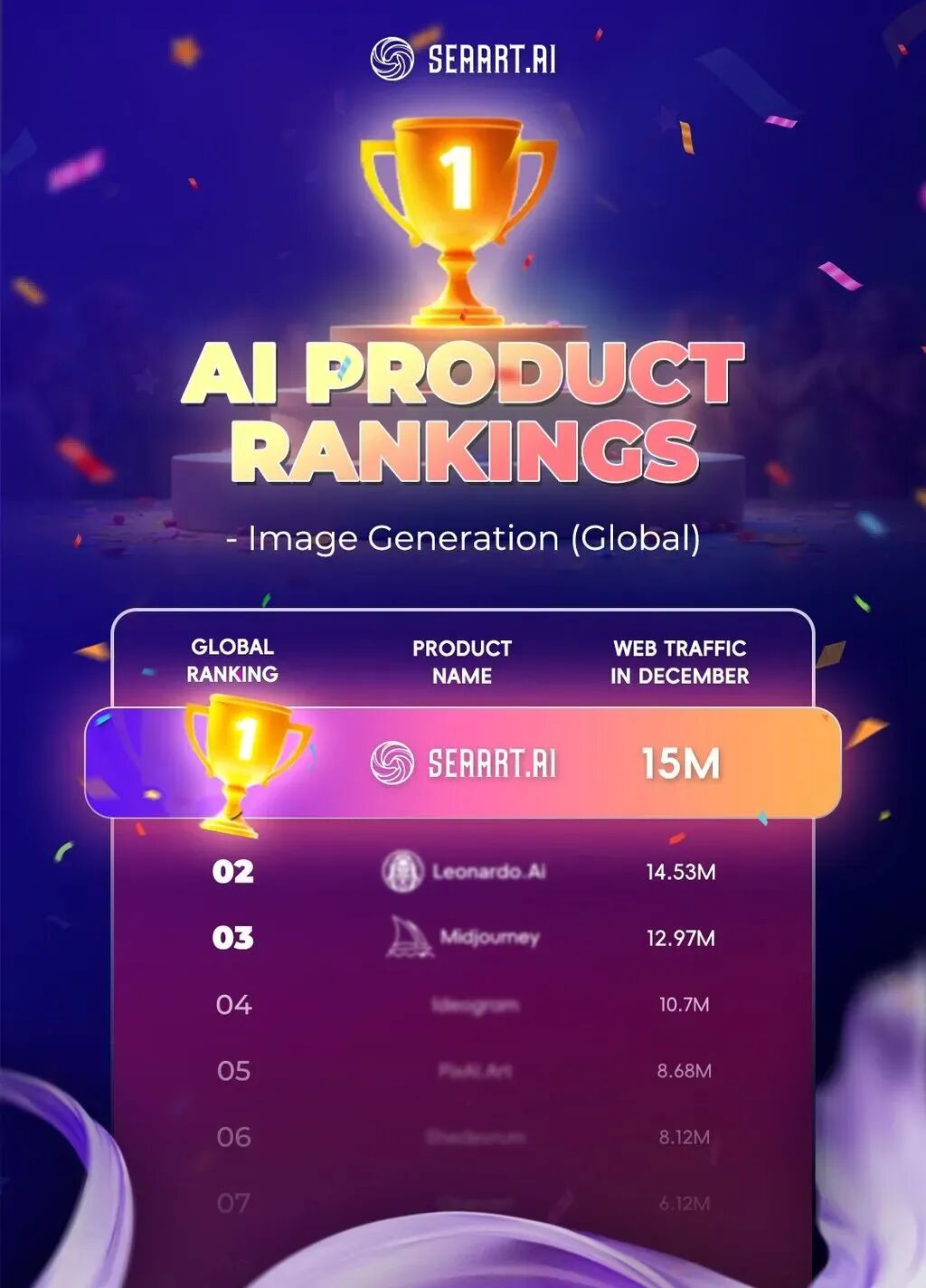
SeaArt, the flagship product of Chengdu-based Haiyi, has twice topped the combined AI product出海 (overseas expansion) leaderboard and image generation leaderboard in joint media rankings.
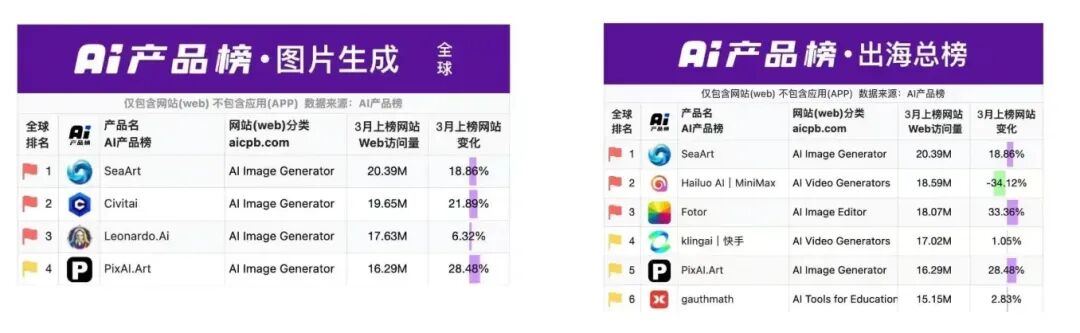 Image source: AI Product Rankings
Just how impressive is SeaArt?
While the AI image generation track slowed overall in 2024, SeaArt charted a course of sustained逆势上扬 (counter-trend growth).
Since its debut in May 2023, SeaArt's user base has grown rapidly. It hit 20,000 daily active users (DAU) in its first two months, and by March 2024, monthly visits had surpassed 10.55 million, a 1.4x increase in just six months.
Though overall visit curves dipped in June, monthly active users (MAU) remained above 3 million, with daily active users holding steady around 150,000.
It not only surpassed international platforms like Midjourney and Leonardo on the year-end AI product image generation rankings, but in January 2025, it once again claimed the top spot with a staggering 18.44 million website visits.
Such remarkable achievements would be worth shouting about at any tech company.
Yet SeaArt has done virtually no large-scale marketing. If not for its chart-topping appearances, few would know it was "making a fortune in silence."
In this article, we'll unpack SeaArt from multiple angles — team, product, community, and marketing.
Gaming Roots
Speaking of SeaArt, one must mention the team behind it — Chengdu Haiyi Interactive Entertainment Technology. This isn't some hastily assembled AI startup, but a team with over 13 years of experience in overseas mobile game entrepreneurship, giving SeaArt a unique product development DNA.
Haiyi founder Fei Ma was among the earliest pioneers in Southwest China to venture into overseas mobile games. The first company he joined after graduating in 2011, Tap4Fun, was ranked among China's top 30出海 brands for two consecutive years.
The game he worked on, Galaxy Empire, climbed to #2 on the US grossing charts in 2012, even surpassing the then-globally popular Angry Birds.
In 2019, Fei Ma teamed up with Li Chen, producer of Mafia City, to found the gaming company Star Union Interactive. Within just two years, the company launched The Ants: Underground Kingdom, which hit $13 million in monthly revenue in August 2021, entering the top 30 overseas revenue rankings, and surpassed 2 billion RMB by early 2023.
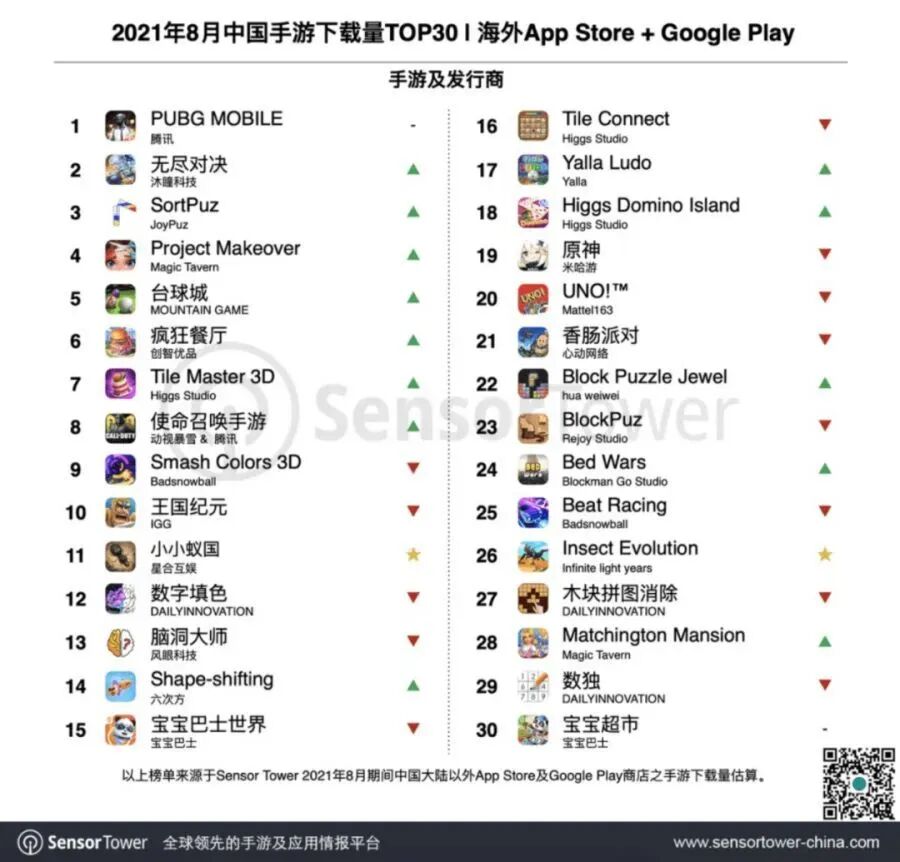 Image source: SensorTower
A gaming background might seem worlds apart from AI image generation at first glance, but it actually became SeaArt's distinctive advantage.
What skills do you acquire from developing a successful mobile game? You need to understand player psychology, design sensible progression curves, build complex resource systems, optimize visual performance, and maintain an active community.
Game development is one of the most industrialized and process-mature fields in the content industry.
Fei Ma's team seamlessly transferred this experience to AI image generation, pushing AI model potential to its limits. When you've used generation tools that constantly freeze up, you understand the real value of SeaArt's performance optimization.
Gaming art standards are no joke. Players will complain endlessly if a pixel is off or a color is slightly wrong. But SeaArt is well-accustomed to梳理 (sorting through) these near-ruthless user demands.
This gaming mindset迁移 (migration) is vividly reflected in SeaArt's product design. For instance, games typically design a "beginner village" to guide players in, then gradually unlock more complex gameplay.
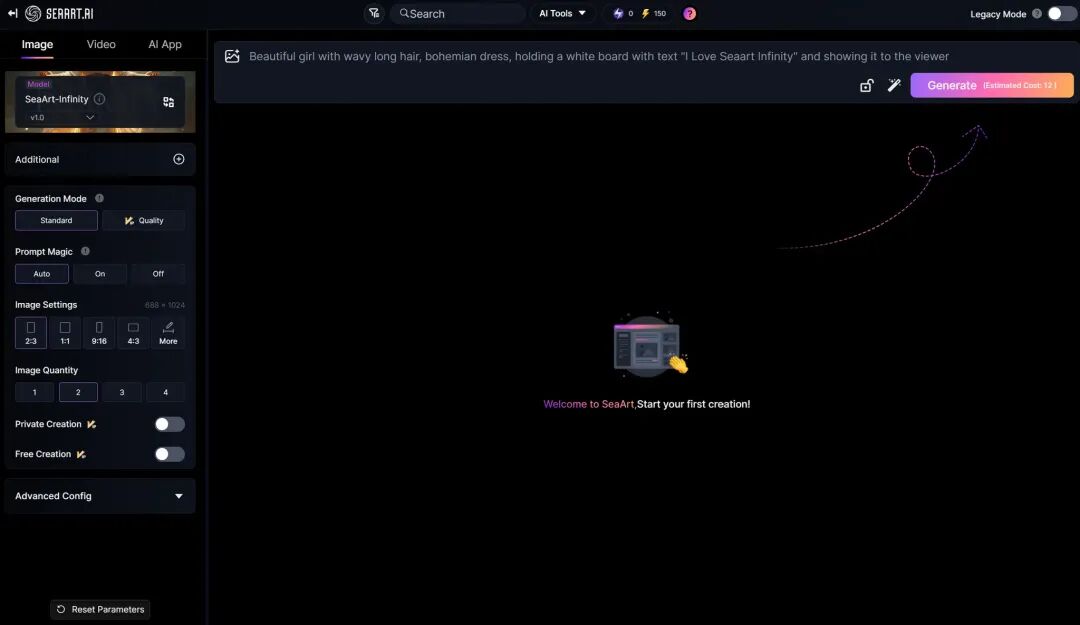
SeaArt follows the same approach. Though the platform's features are numerous, we can still trace a rough主线 (through-line): a progressive path from easy to difficult prepared for users at different stages, from "Easy Mode" to "Generate" to "Canvas," allowing users to steadily level up their AI creation skills along this path.
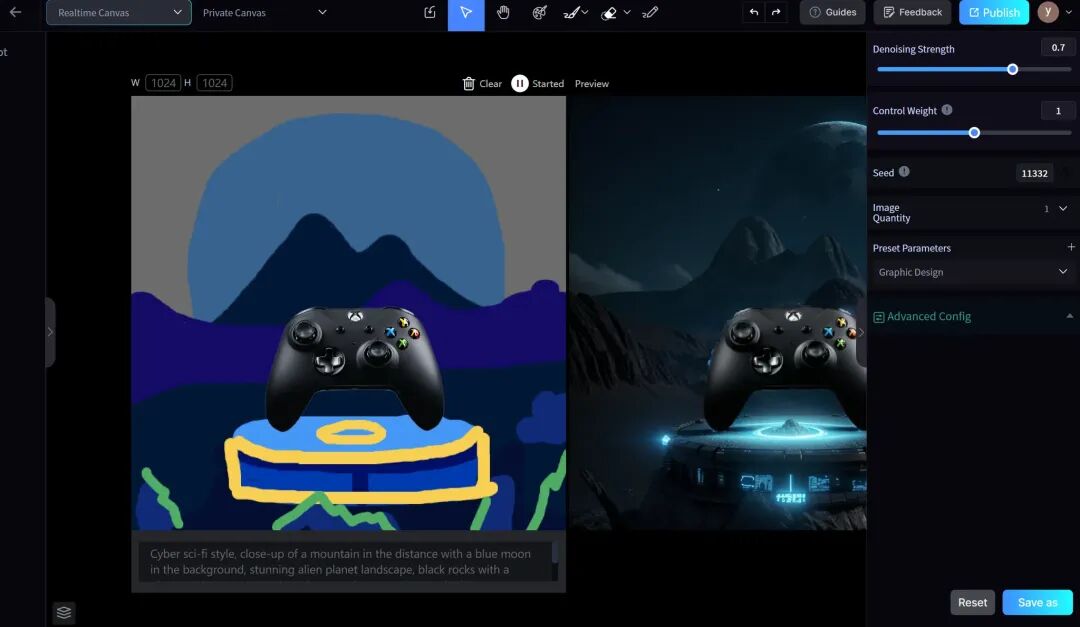
It's this unique perspective that lets SeaArt stand out among countless AI image generation platforms. While many platforms are still wrestling with how to promote their technology, SeaArt is already thinking about how to better serve users' creative needs.
Differentiated Product Strategy — A Comprehensive Platform Serving Multi-Layer User Needs
What truly wins users over with SeaArt is how it packages complex AI technology into simple, usable products.
From the outset, SeaArt positioned itself around "ease of use," encapsulating Stable Diffusion's (SD) various complex functions behind an intuitive web interface.
SeaArt prepares a progressive path from easy to difficult for users at different stages, simultaneously satisfying light to heavy user needs, building a complete product ecosystem.
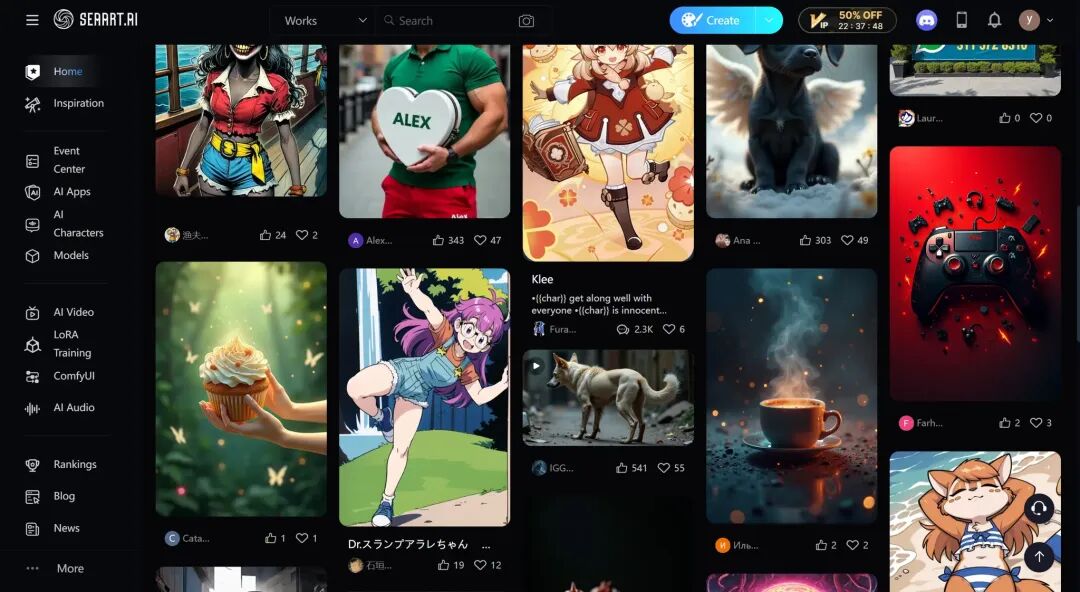
- For light users, SeaArt provides various user-friendly tools such as AI makeup, AI filters, clay-style filters, and Ghibli-style filters. It launched the "Swift AI" quick toolset, packaging commonly used AI image functions into standalone apps. A series of official features (about 10) and community-curated features (7) are displayed together, including AI portrait (intelligent portrait generation), AI filters, background removal, HD restoration, and sketch-to-image (line art coloring), covering nearly all major image processing scenarios. And compared to other products, SeaArt is notably more "unrestricted."
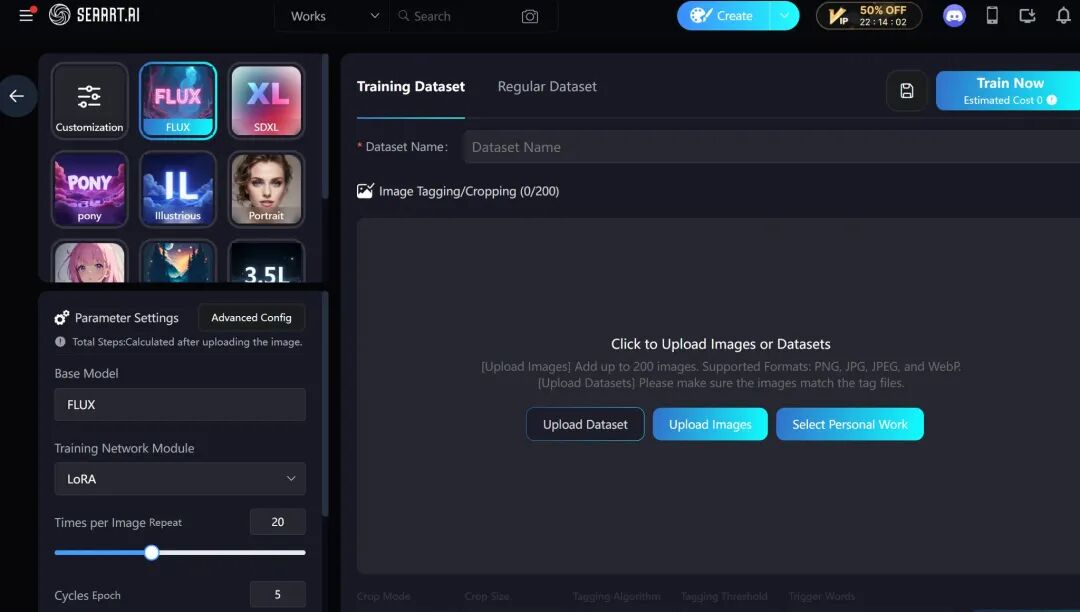
- For medium users, SeaArt developed more professional features like model training and custom LoRA. It packages various parameters and plugins, greatly lowering the training barrier. In advanced mode, SeaArt also retains adjustable parameter options — users familiar with SD can set LoRA save precision, tag algorithms, resolution, and other details, thus achieving "more controllable output than other sites" for refined image generation.
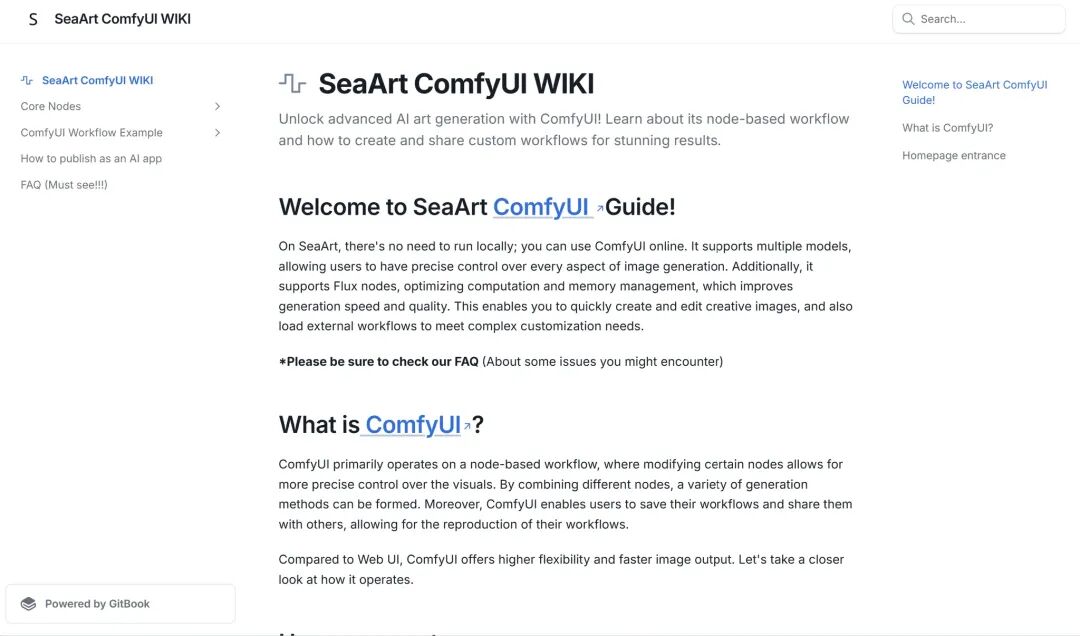
- For heavy users, SeaArt launched ComfyUI node-based workflow functionality in March 2024.
💡
ComfyUI is a visual workflow tool for Stable Diffusion, allowing users to finely control the generation process through node connections, and supporting reuse and sharing of workflow templates.
SeaArt integrated ComfyUI into the cloud, enabling users to use complex workflows without local deployment, while opening up a workflow community.
Users submit workflow templates for various细分 (niche) scenarios (such as auto-makeup, character outfit changes, 3D-to-2D conversion, etc.), paired with example output images for others to browse and try.
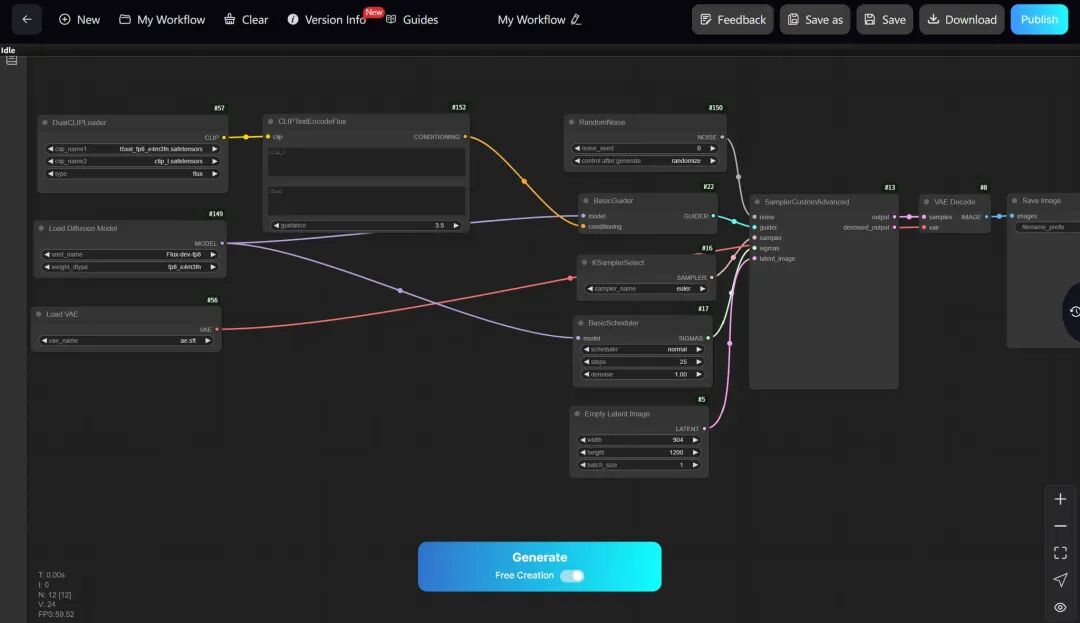
Some popular workflows have been packaged into interactive interfaces, allowing them to function like Swift AI tools where simple parameter inputs complete the entire processing pipeline.
Other workflows without dedicated interfaces require users to adjust node parameters step by step in the ComfyUI interface, input prompts, and then execute.
Every workflow can be rated after use, with the best rising and the worst falling away.
Additionally, SeaArt created CyberPub, where users can chat with AI characters or create personal characters. This further enriches the platform's entertainment and social dimensions.
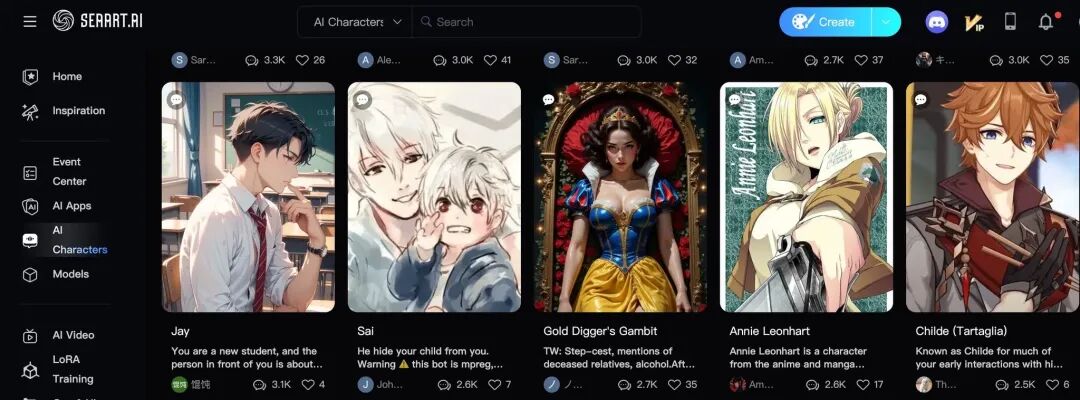
By introducing ComfyUI, SeaArt "filters out" a core group of advanced users, providing a platform for资深 (veteran) players to flex their skills, while also letting beginner users see more professional playstyles in the community, forming a创作生态 (creative ecosystem) with clear gradients.
Community Ecosystem
SeaArt's development can be summarized in two phases: building tools, then building community.
In its initial phase, SeaArt focused on creating easy-to-use AI image generation tools, attracting large numbers of users to try the platform through simplified operations and interface design. The goal of this phase was to rapidly accumulate user base and word-of-mouth.
In its advanced phase, SeaArt began transitioning toward community, focusing on building an active creator ecosystem. This included introducing ComfyUI workflow functionality, launching creator incentive programs, and improving work-sharing mechanisms — all aimed at retaining core creators and forming a virtuous cycle of content production and consumption.
Unlike other platforms, SeaArt doesn't just provide tools — it works to connect users with each other.
In SeaArt's community, an interesting creative ecosystem has formed. Core users (about 5% of total users) provide advanced workflows and training templates; medium users build upon these to learn and create new content; while light users consume and lightly remix this content. This pyramid-shaped user structure ensures continuous content production and circulation.
To incentivize core creators, SeaArt launched a creator incentive program, encouraging users to upload quality models and workflows through point rewards. To date, 5 rounds of creator incentive activities have been conducted, forming a substantial original content library.
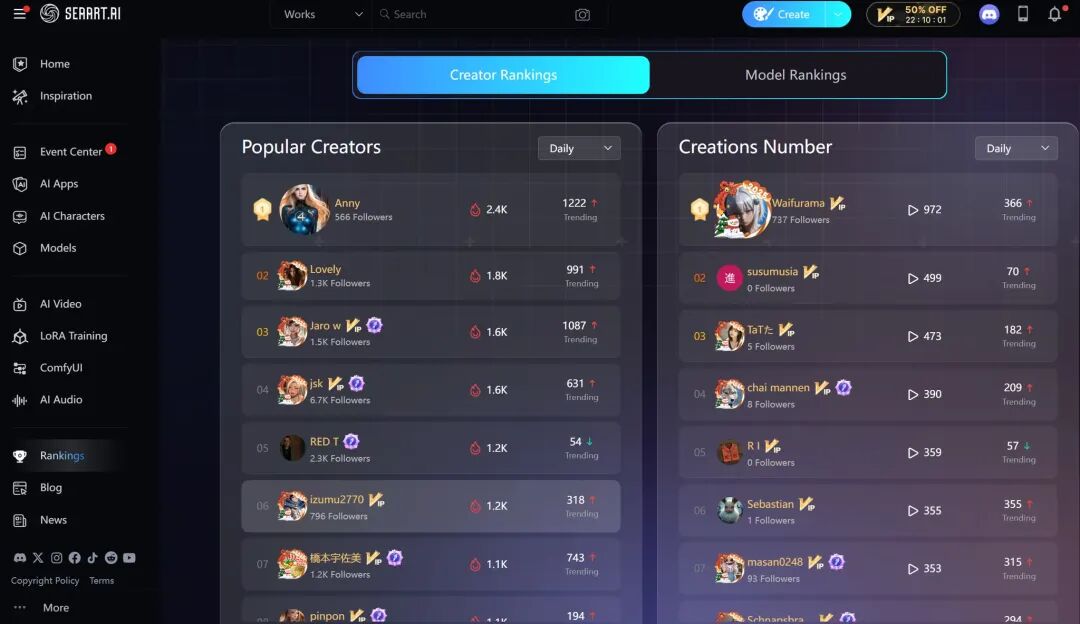
Compared to competitor Leonardo.ai, SeaArt has taken a different path in community building. Leonardo.ai adopts a "semi-closed" model where users can only use featured models in its library; SeaArt, by contrast, is an open C2C model, allowing users to share self-trained models and publish applications, letting the community content ecosystem continuously grow itself.
Fei Ma describes this difference as "B2C versus C2C" — the former is companies providing fixed content to users, while the latter is users providing content and services to each other. In his view, the C2C model better keeps pace with content consumption rhythms and aligns more with the collaborative spirit of the modern internet.
Just building tools is far from enough. We also need to let users connect with each other in the process of using them.
This community strategy has proven effective. As of April 2024, SeaArt's average user session duration reached 10 minutes 20 seconds, surpassing Midjourney's 9 minutes 42 seconds.
This indicates users aren't just coming to use tools, but are exploring and interacting more on the platform, forming emotional connections.
How Does SeaArt Handle NSFW?
In the AI image generation field, NSFW has always been a hot potato.
Globally, countries basically take a strict prohibition stance on such content — Midjourney outright blocks explicit content, and Stable Diffusion's official version has dutifully added safety filters.
SeaArt chose an aggressive posture, leaving considerable room for creators on NSFW content.
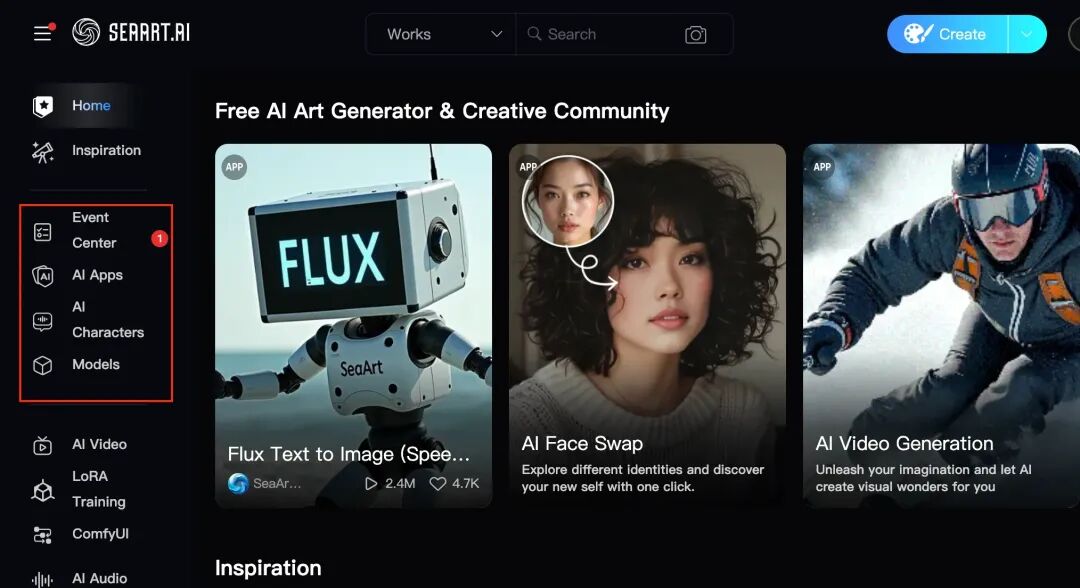
SeaArt's feature matrix gives creation room to breathe
Global Strategy: Regional Segmentation and Language Localization
In global expansion, SeaArt demonstrates a differentiated strategy.
While most AI platforms focus on the English market, SeaArt implemented a multi-language strategy from the start. The platform supports 12 language interfaces including Chinese, English, Japanese, Korean, German, French, Spanish, Portuguese, and Indonesian, with one-click switching.
This multi-language support goes far beyond simple interface translation — it's deep cultural localization. For example, when processing non-English prompts, SeaArt combines large language models for multi-language translation and optimization, letting users worldwide create in their native languages.
This way, even users unfamiliar with English keywords can obtain quality generation results.
This strategy gave SeaArt unexpected market advantages. Data shows that in the first half of 2024, SeaArt's top visit sources included Japan, Indonesia and other Asian countries, as well as the US, Mexico, Brazil and other American and European countries.
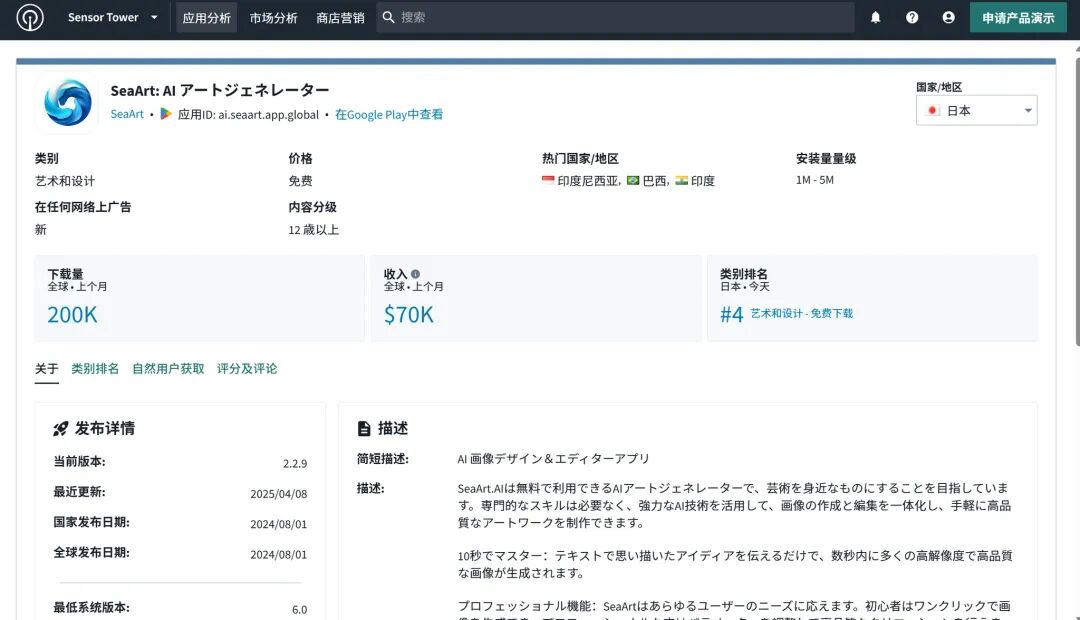
SeaArt has particularly high penetration in emerging markets like Southeast Asia and South America.
Fei Ma once pointedly observed: "Beyond English, there's still 80% of market space," capturing the core of SeaArt's globalization strategy — not fighting giants head-on, but first capturing those overlooked language markets.
If the AI image generation market is a big cake, Midjourney and other giants are fighting over the richest center portion, while SeaArt chooses to cut in from the edges, taking those overlooked small-language markets one by one, eventually accumulating enough strength to march toward the center.
When Leonardo.ai only began building multi-language communities beyond English in the second half of 2023, SeaArt had already completed multi-language localization at its May 2023 launch, seizing first-mover advantage.
Business Model
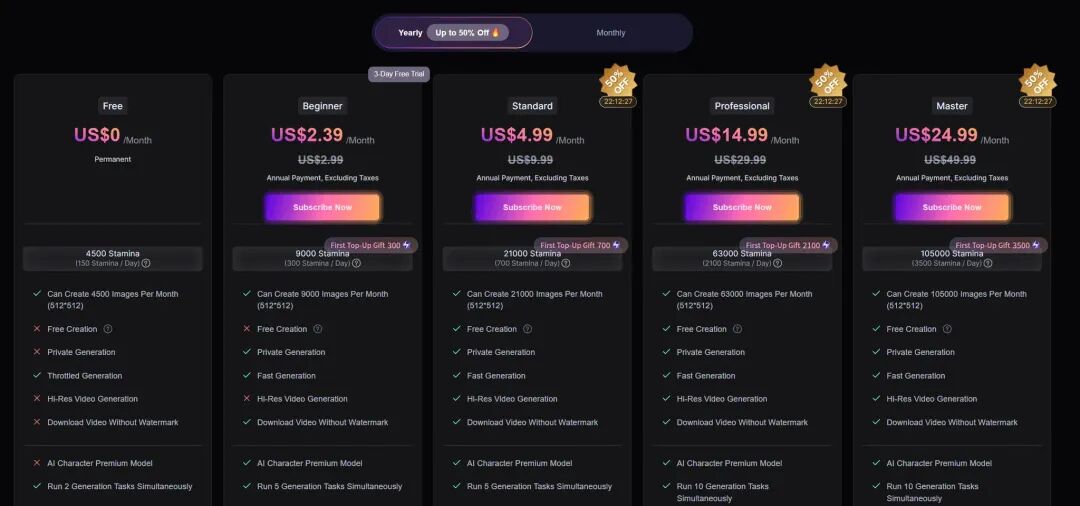
In its business model, SeaArt drew on gaming industry experience, adopting a flexible "free + subscription + in-app purchases" model, pricing around computing power (points). All registered users receive 150 free computing points daily, equivalent to generating approximately 50-70 images.
This free quota satisfies light users' daily needs and also serves to cultivate user habits during the product's cold-start period.
For users with higher demands, SeaArt offers subscription membership plans. Depending on subscription tier, daily computing limits can rise to 300, 1,000, 2,000, or even 3,500 points.
Why Could It Top the Charts Twice?
SeaArt's ability to twice claim the global top spot hinges on its consistently clear strategic vision, deeply understanding the competitive principle of "know yourself and know your enemy," then leveraging strengths and avoiding weaknesses to find market gaps to exploit.
In this market of towering giants, SeaArt didn't blindly benchmark against competitors, but precisely found its differentiated foothold.
- Facing Midjourney, it chose the open ecosystem path;
- Facing Leonardo, it went deep into small-language markets;
- Facing open-source communities, it provided foolproof cloud services;
- Facing domestic tech giants, it focused overseas on C-end consumers.
They aren't trying to steal others' rice bowls — they're looking for tables no one's paying attention to.
This "using four ounces to move a thousand pounds" strategy lets SeaArt quietly capture its own market space without going toe-to-toe with giants.
SeaArt's Future
Leveraging the user "addiction" product models, commercial monetization models, and even the "anything goes within the rules" NSFW content that it mastered long ago from gaming, SeaArt has captured users' hearts, successfully creating a platform ecosystem widely accepted by international users.
Here, users can not only use AI for creation, but also participate in community interaction, share works, and realize value monetization, forming a complete closed loop.
Just as games are no longer just games, but can become social platforms.
SeaArt's future may not stop at being merely a tool.
Author: Yimu
Editor: Koji
🚥