This Mid-Autumn and National Day, Cut Yourself Some Slack, But Don't Let AI Off the Hook

Wishing everyone a happy Mid-Autumn Festival and National Day!
Happy Mid-Autumn Festival and National Day!

👦🏻 Author: GaKi
🥷 Editor: Koji
🧑🎨 Layout: NCon

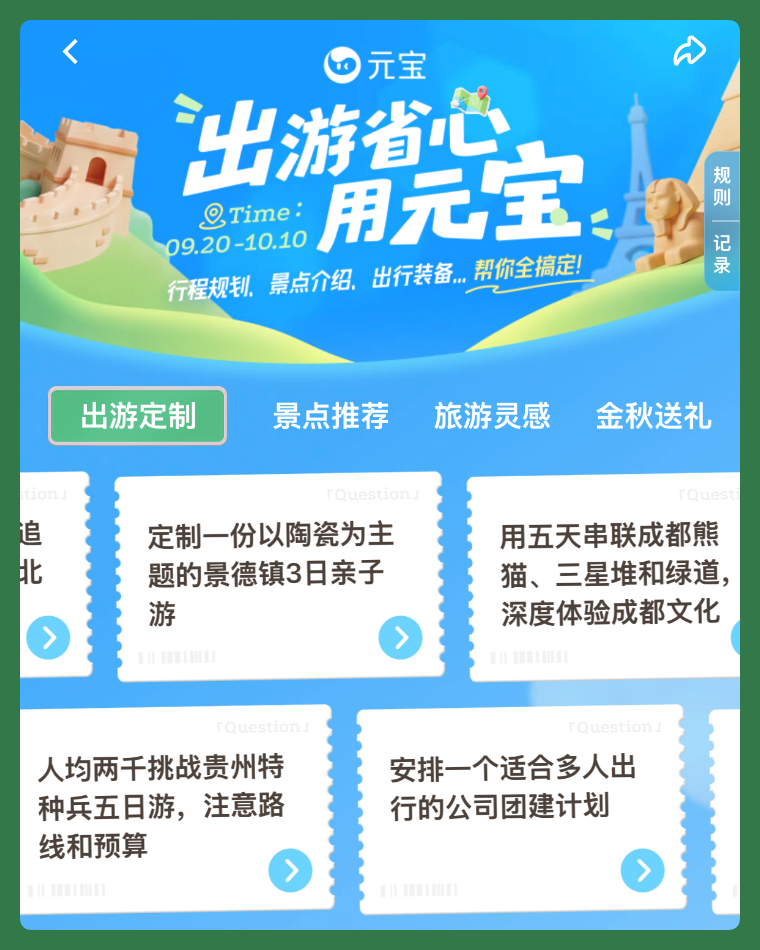
The Mid-Autumn Festival and National Day holiday are right around the corner, and lately a bunch of AI products have been rolling out vacation-related features. Tencent Yuanbao pushed an update just before the break: switching to expert mode to help you plan.
The timing makes sense.
Because going on a trip actually takes a lot of prep — snagging train tickets, figuring out where to go, where to stay (homestay or hotel), how to route each day for maximum payoff, what's good to eat nearby, which spots are actually worth it versus tourist traps, and what to buy before you leave.
Especially now that people are increasingly into niche travel, reverse travel, every kind of travel — so you need even more information.
This happens to be exactly the kind of scenario where agents shine.
🚥
Over at Crossing, someone on the team wants to treat themselves to a "luxury" trip to Xinjiang; someone else wants to quietly hole up in a city with their partner and family for a few days, soaking in the culture.
So we took Tencent Yuanbao for a spin on trip planning and came away with some surprising experiences and little Easter eggs to share.
National Day in Suzhou (Low-Energy Edition)
The new trip-planning feature in Tencent Yuanbao is triggered inside the app's chat interface. But I discovered there's also a bonus way to use it.
Our team has a bunch of travel buddies who regularly coordinate trips in group chats. I found you can multi-select those chat messages, forward them to Tencent Yuanbao, and have it compile everyone's travel preferences into a single itinerary that satisfies all of them.
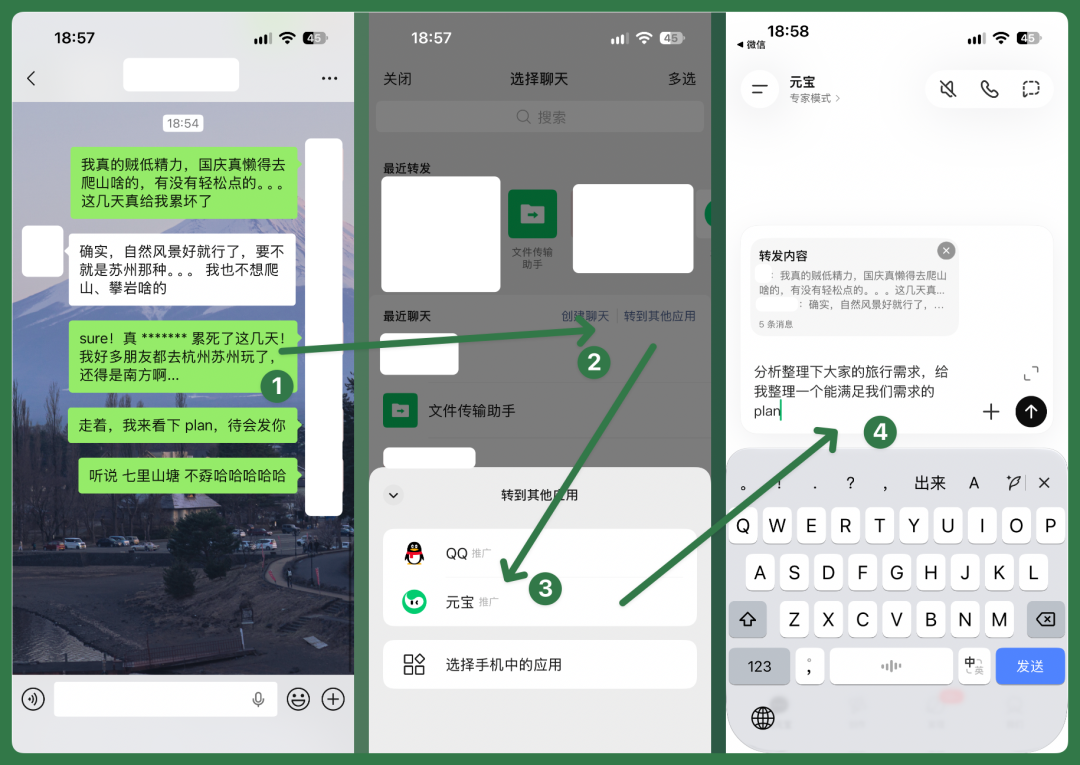
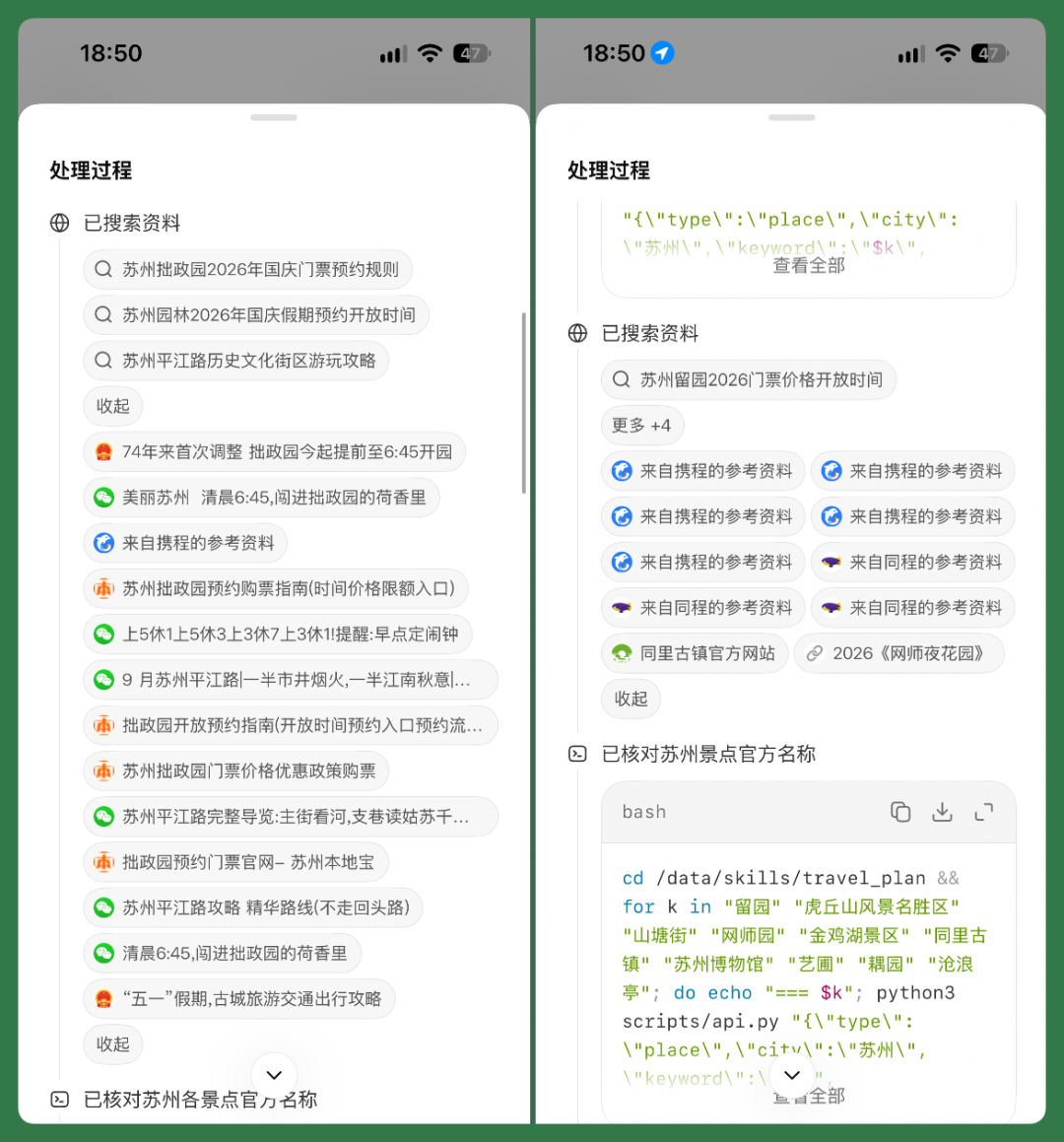
This lets you jump straight from a WeChat conversation into the Tencent Yuanbao app, switch to expert mode, and fire off a question to trigger the trip-planning agent. I checked its thinking process — it does a ton of real-time searches, no stale data.
It also runs extensive queries. When planning for Suzhou, for example, it looked up the 2026 ticket reservation rules, got deep into special neighborhood guides, and pulled loads of material from Trip.com Group.
Then Tencent Yuanbao synthesizes everything into a full itinerary: why Suzhou was chosen, the key logic behind the schedule, potential pitfalls.
This time I was traveling with my parents — all of us low-energy types. The core logic was two sights per day, basically free time after 3pm, and deliberately carving out nap time for my parents.
It even scheduled one full "do nothing" day with minimal walking around.
We'd also told it no price-gouging traps, so it checked that every attraction had transparent, fixed pricing — Humble Administrator's Garden at 80 RMB, Lingering Garden at 55 RMB.
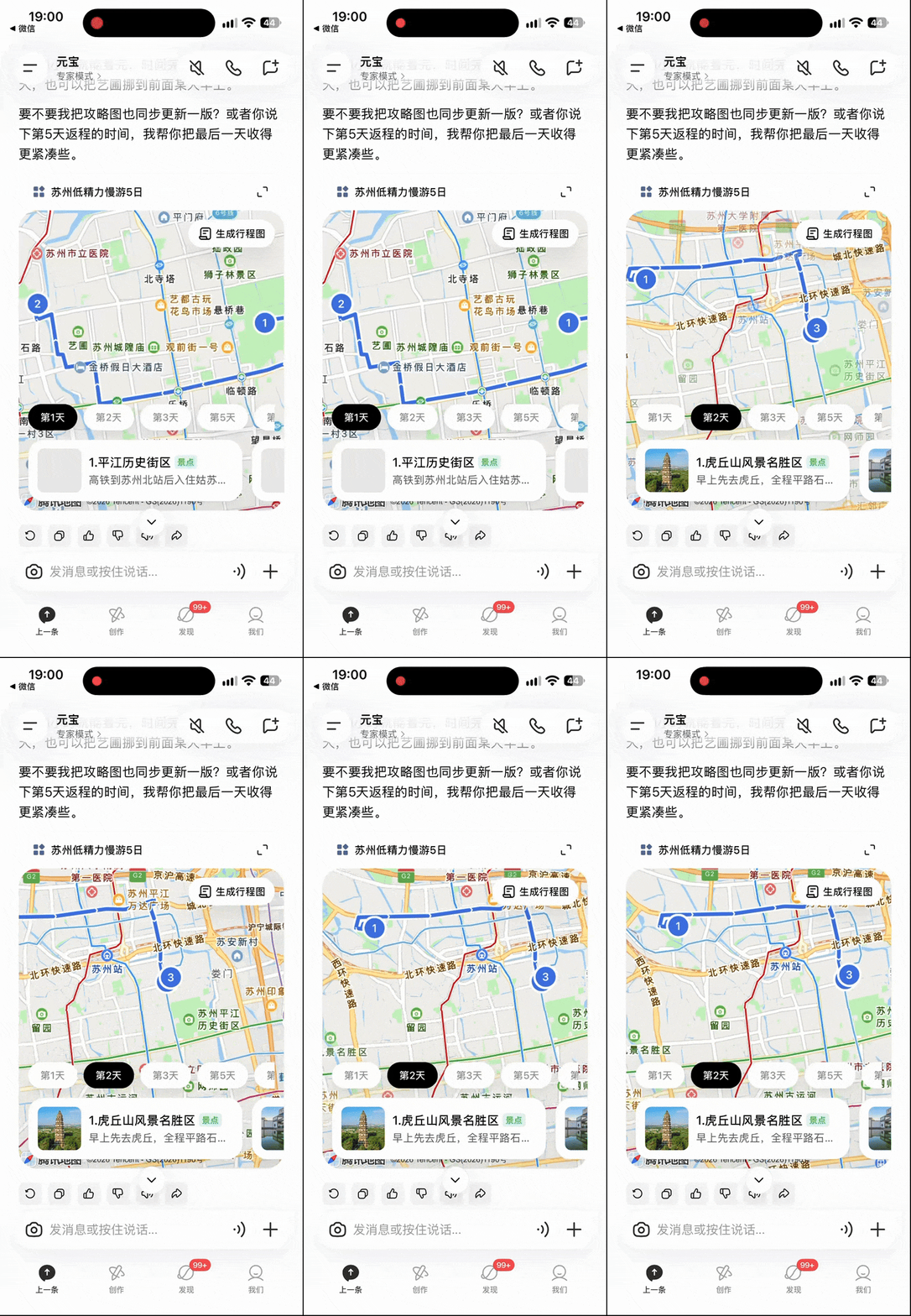
The final output is a visual itinerary card — "Suzhou Low-Energy Wander: 5 Days" — as an interactive page you can swipe through, toggle to map view with pins, and browse day-by-day cards.
Because it pulls fresh data, the results get pretty granular.
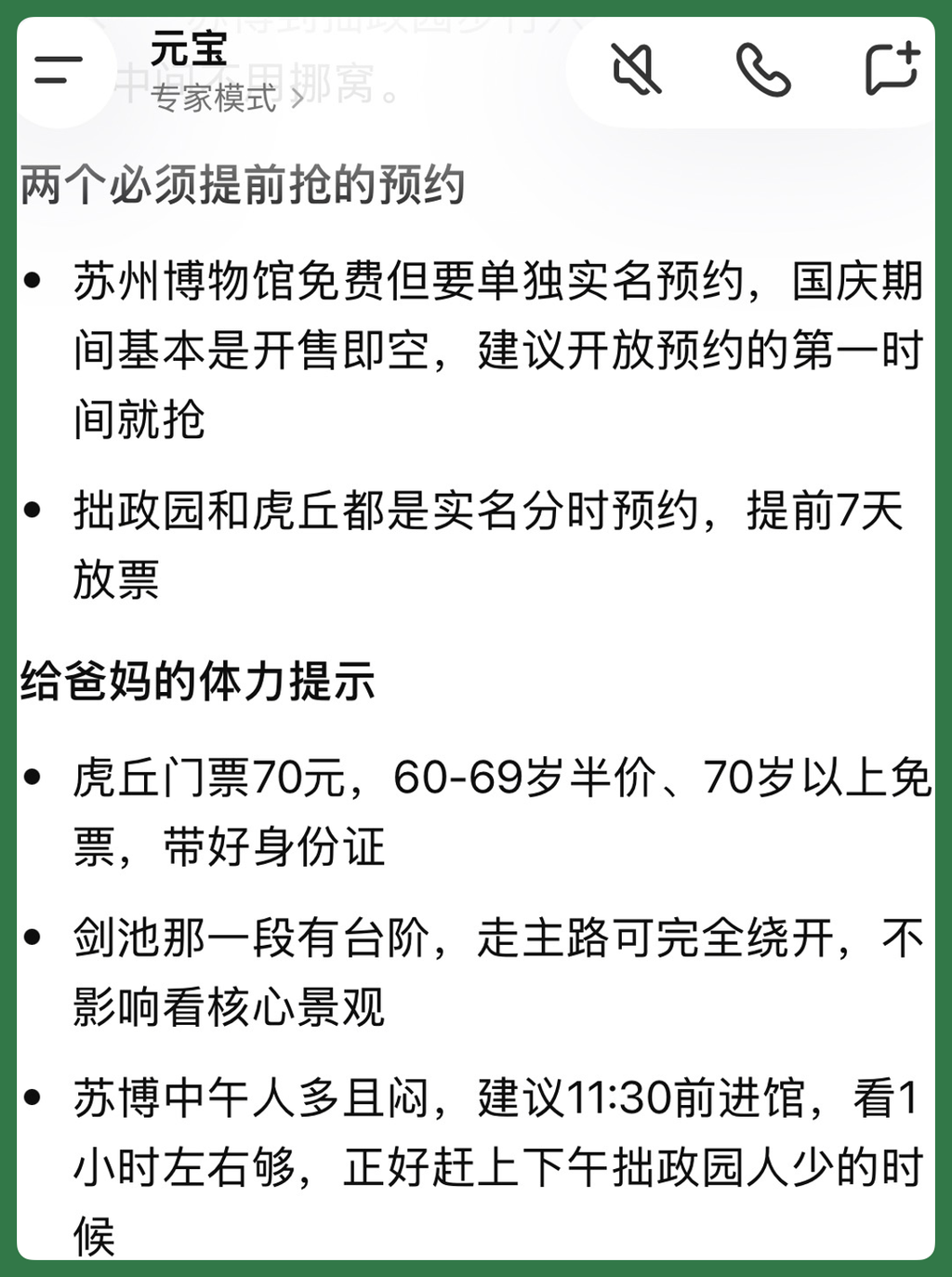
Take Suzhou Museum. I'd never been to Suzhou and had no idea whether the museum or others required reservations, each with different rules — a major potential headache.
Tencent Yuanbao flagged that Suzhou Museum is free but needs separate real-name booking, and advised jumping on it the moment reservations open.
Or Jianchi (Sword Pool), where there's a stretch of stairs you can completely bypass on the main path without missing the core scenery. Non-locals would never know — a real trap avoided.
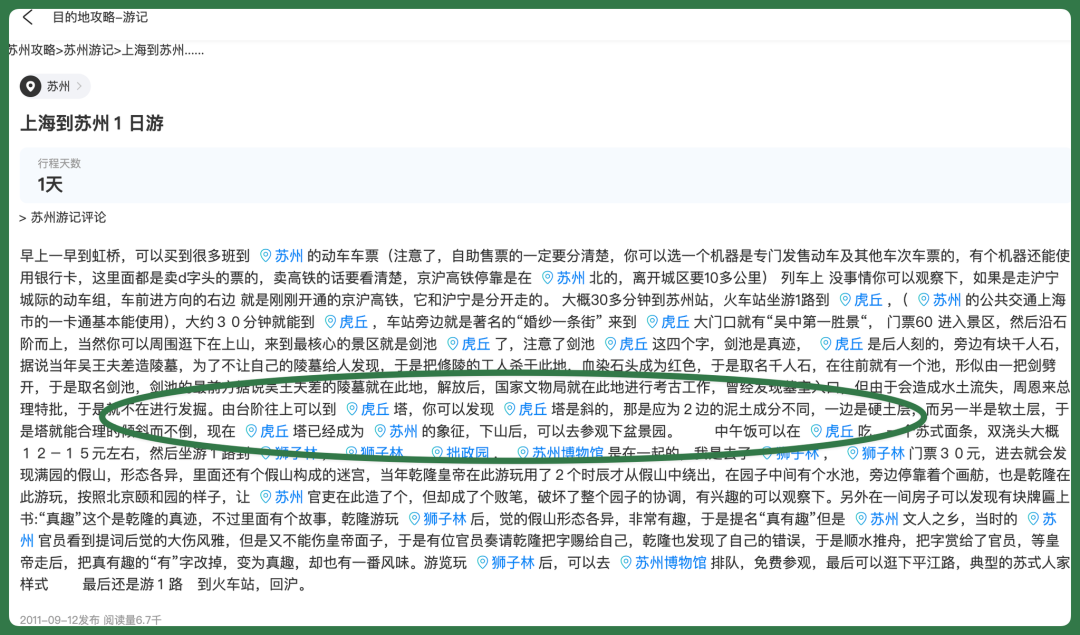
I even cross-checked against some travel blogs myself.
Open the full interactive card and everything's labeled clearly — daily returns, old towns, routes. Beyond the day-by-day breakdown there's an overview you can interact with, so you can see at a glance whether two spots are far apart and what scenery you'll pass along the way.
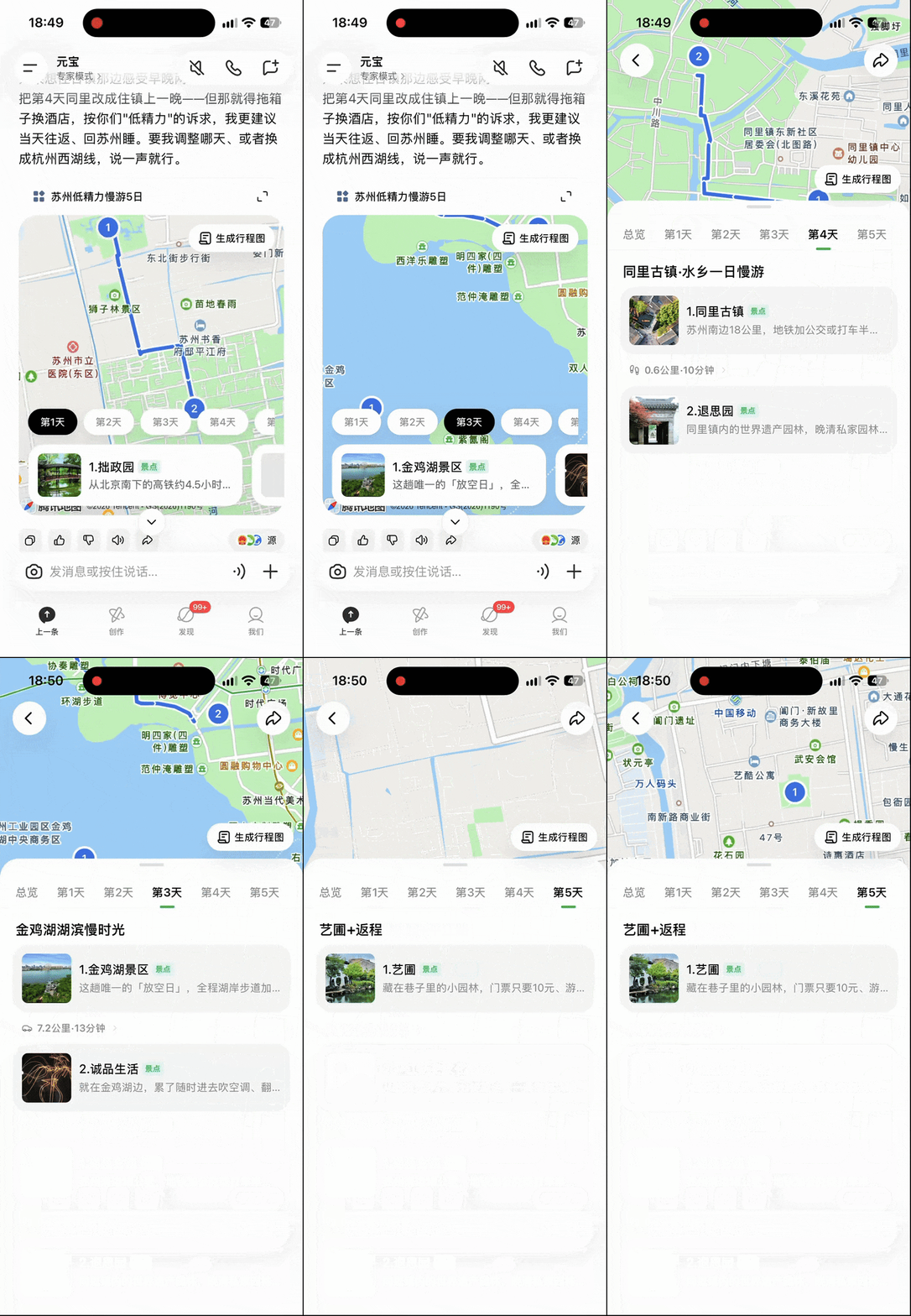
Tencent Yuanbao can also generate a trip poster — hit the button in the top right. It calls Hunyuan's newly launched image generation model, Hy Image3.5 preview, to create a guide poster from all the context.
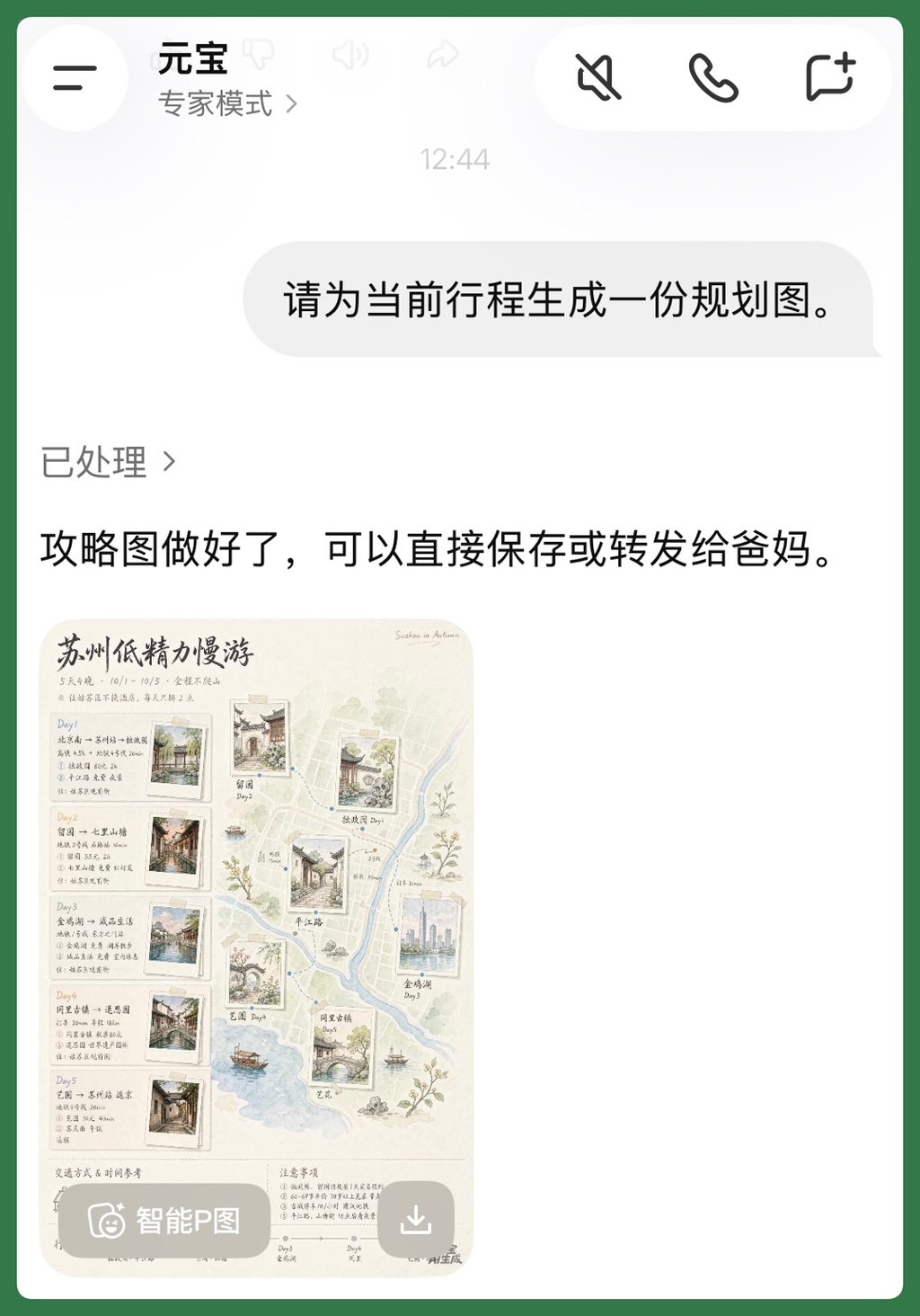
The Suzhou low-energy wander poster is ready to forward to family or friends — pretty convenient.
Once the card is built, if any day feels off or boring, you can just chat with Tencent Yuanbao to revise it, and the card keeps iterating. I felt Day 2 was weak, too much shopping around.
It reworked the day into a heavier itinerary: Tiger Hill in the morning, Suzhou Museum plus Humble Administrator's Garden in the afternoon — more sights packed in.
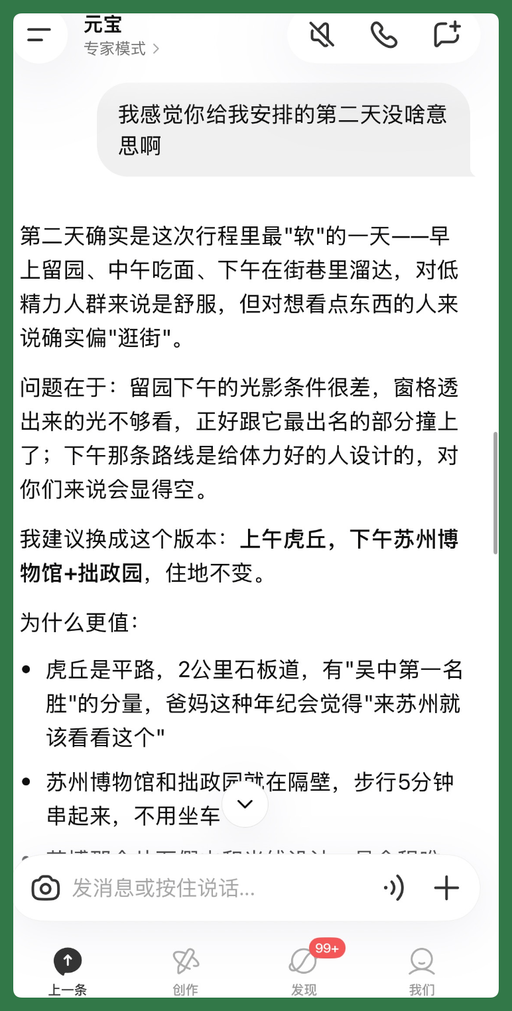
But since the whole trip is one coherent chain, changing one day creates small ripple effects, which Tencent Yuanbao flags for confirmation.
Days 4 and 5 it left untouched. If we wanted to leave early on Day 5 — say, catch an afternoon high-speed train — it confirmed we'd have enough time after that last sight; if we wanted to linger half a day longer, it suggested moving one attraction to an earlier morning.
After confirming all these points, Tencent Yuanbao regenerates the full updated card.
Xinjiang Luxury Trip
Besides me and my travel buddies forwarding chat logs to the Tencent Yuanbao app for the Suzhou itinerary, another teammate is going solo on a Xinjiang luxury trip — a hot style right now.
Most Xinjiang travel you see on Xiaohongshu is group tours. Planning a trip in Southern Xinjiang is tough — tons of micro-decisions, information to gather piece by piece — so group tours win out.
But our teammate is going solo.
His requirements:
Want to hit Southern Xinjiang without burning all my time on the road between sights; no influencer photo spots, no queueing for shuttle buses. Open to homestays, prefer some experiences and chill vibes, plus some moderate short-distance hiking. No filler room types — the room needs to face the scenery directly.
A lot of asks, but standard for solo travelers. Now he can dump all of it on Tencent Yuanbao and have it build the full itinerary.
This time it capped daily drive time at 4 hours max, and served up key alerts — granular stuff like "Panlong Road only allows vehicles under 7 seats." Hard to know without deep research.
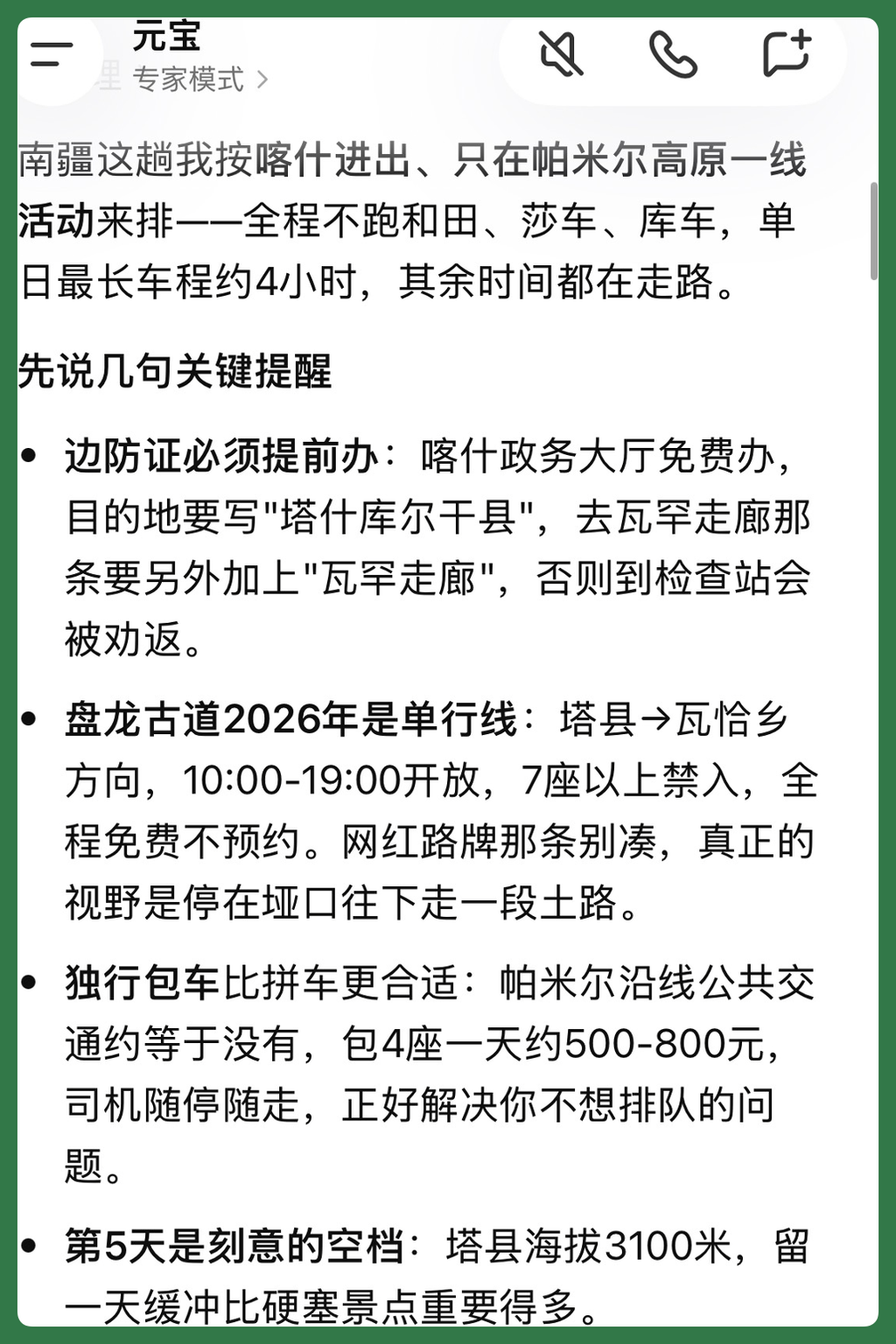
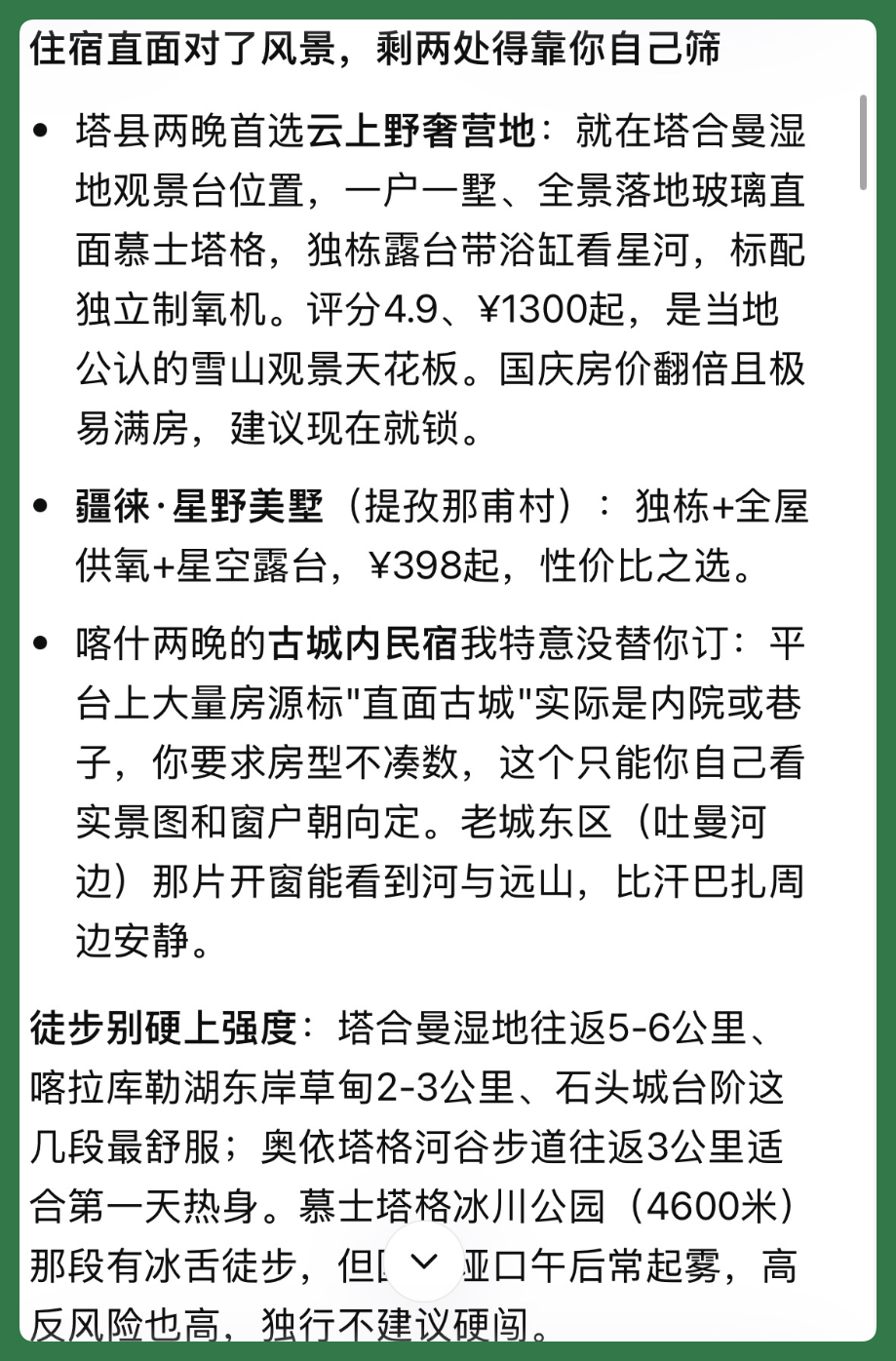
For lodging, it picked spots that mostly hit the brief — facing the scenery. Hiking stays moderate: 2-3 km, 5-6 km easy walks.
The final output is again a full itinerary card, each day mapped out as a route — intuitive, every sight locked in.
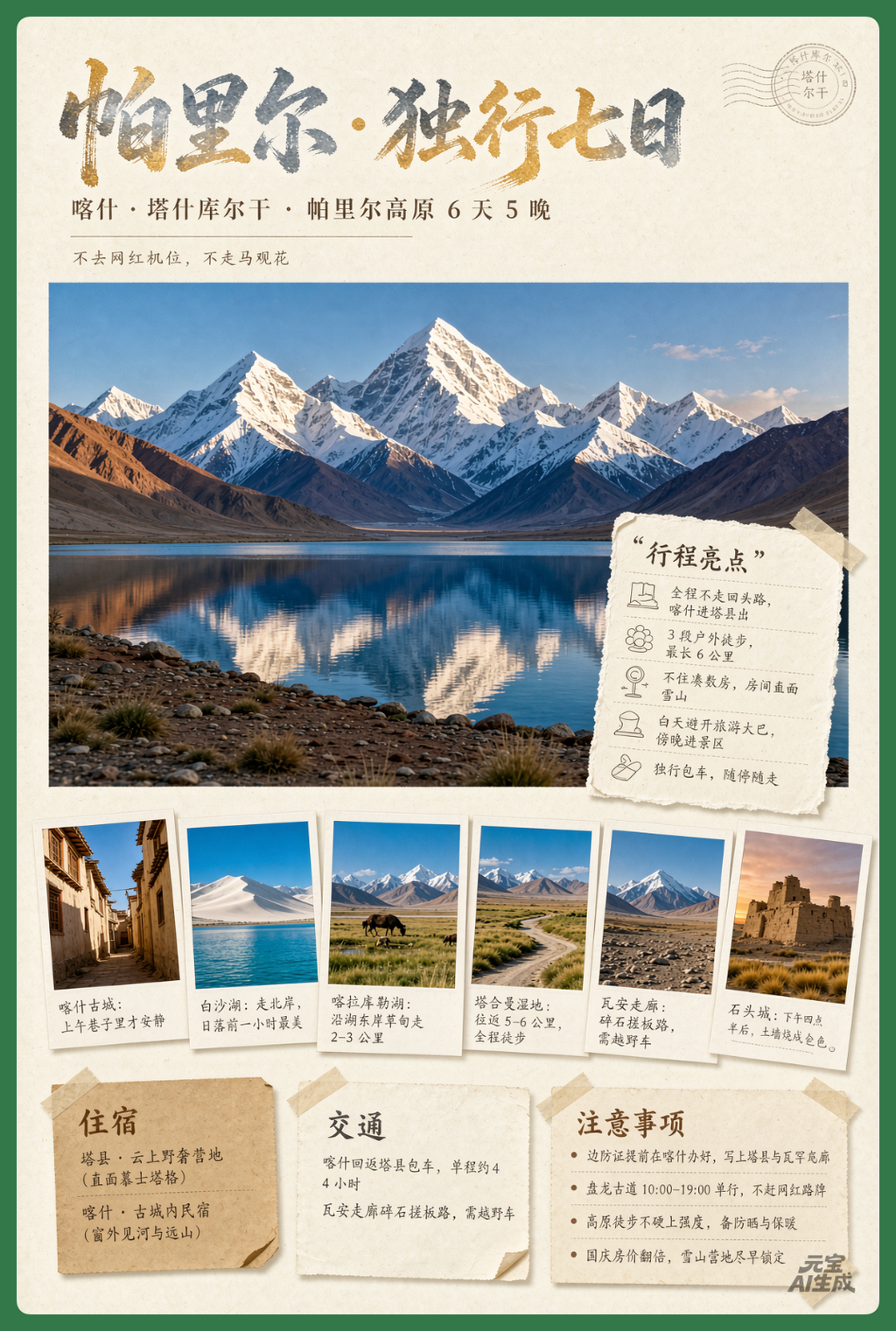
You can generate a trip poster here too, for sharing. This one gets detailed:
【1】In Kashgar Old Town, the morning alleys are quiet.
【2】White Sand Lake: best take the north shore, the hour before sunset hits different.
【3】At Karakul Lake, the east shore meadows offer a solid 2-3 km walk with good views.
【4】Tashkurgan Wetland, Wakhan Corridor — special callouts like "Wakhan Corridor needs an off-road vehicle."
All the caveats are listed.
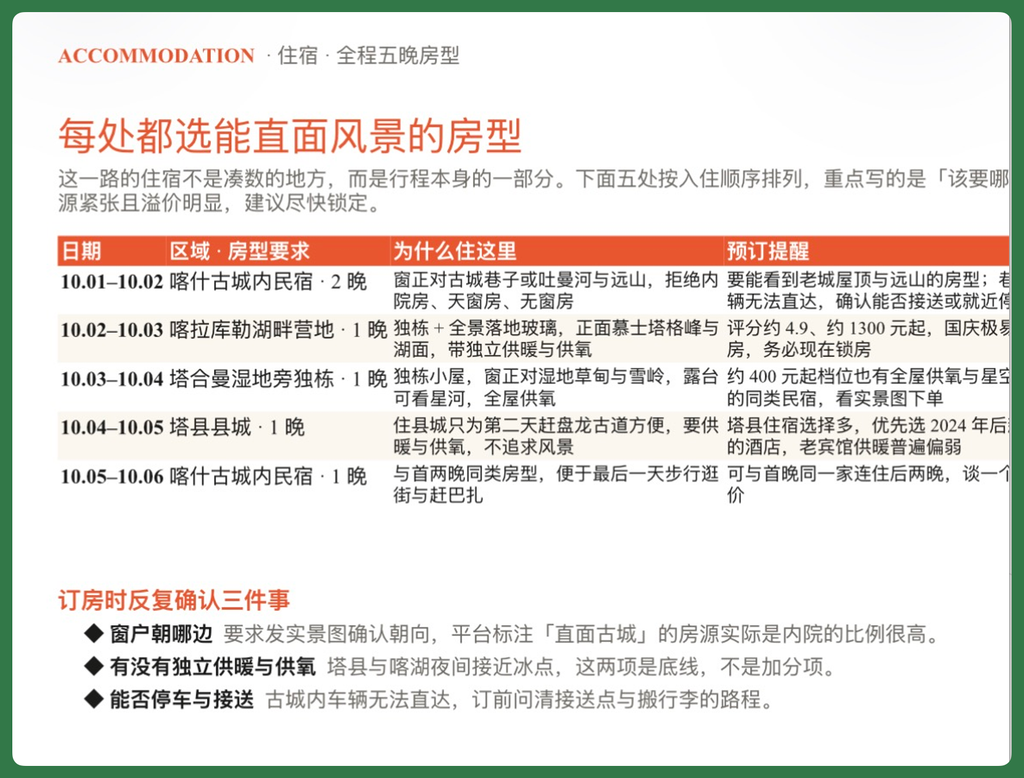
Then it spits out a room type and area table for October 1-6, lodging matched to the route, every pick offering scenery-facing rooms.
One more pre-trip need: I always check what gear to buy after planning.
Solo travel, short hikes, slow treks, even climbing — these need equipment. Plenty of people are gearheads; the stuff just has that vibe.
So I took the Xinjiang hiking context Tencent Yuanbao had compiled, fed it back in, and asked for gear recs.
I had it reference ultrarunning champ Zhao Jiaju's recent viral kit. It surfaced a list of Zhao Jiaju-style hiking products, each with a card that jumps straight to the JD.com mini-program.
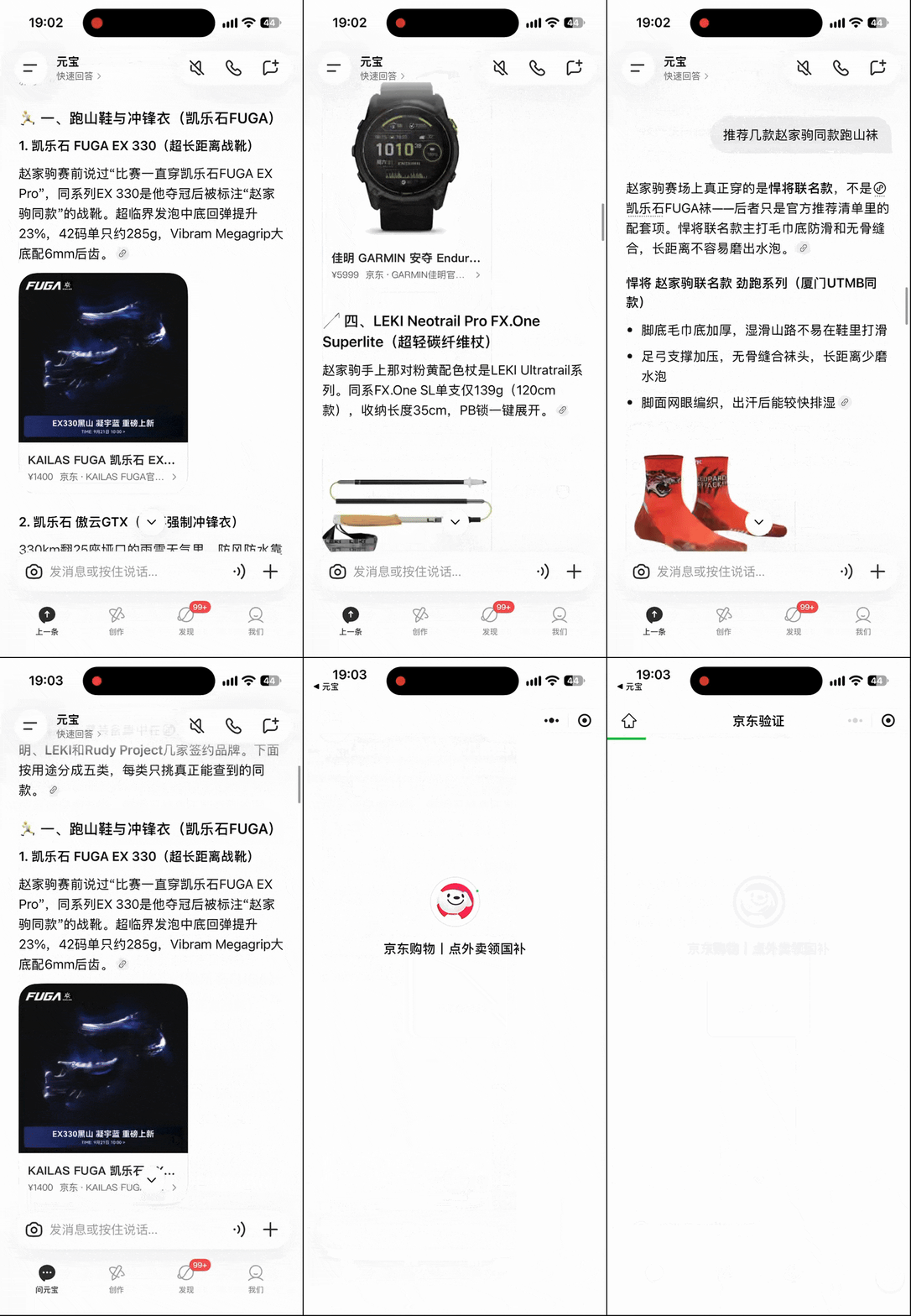
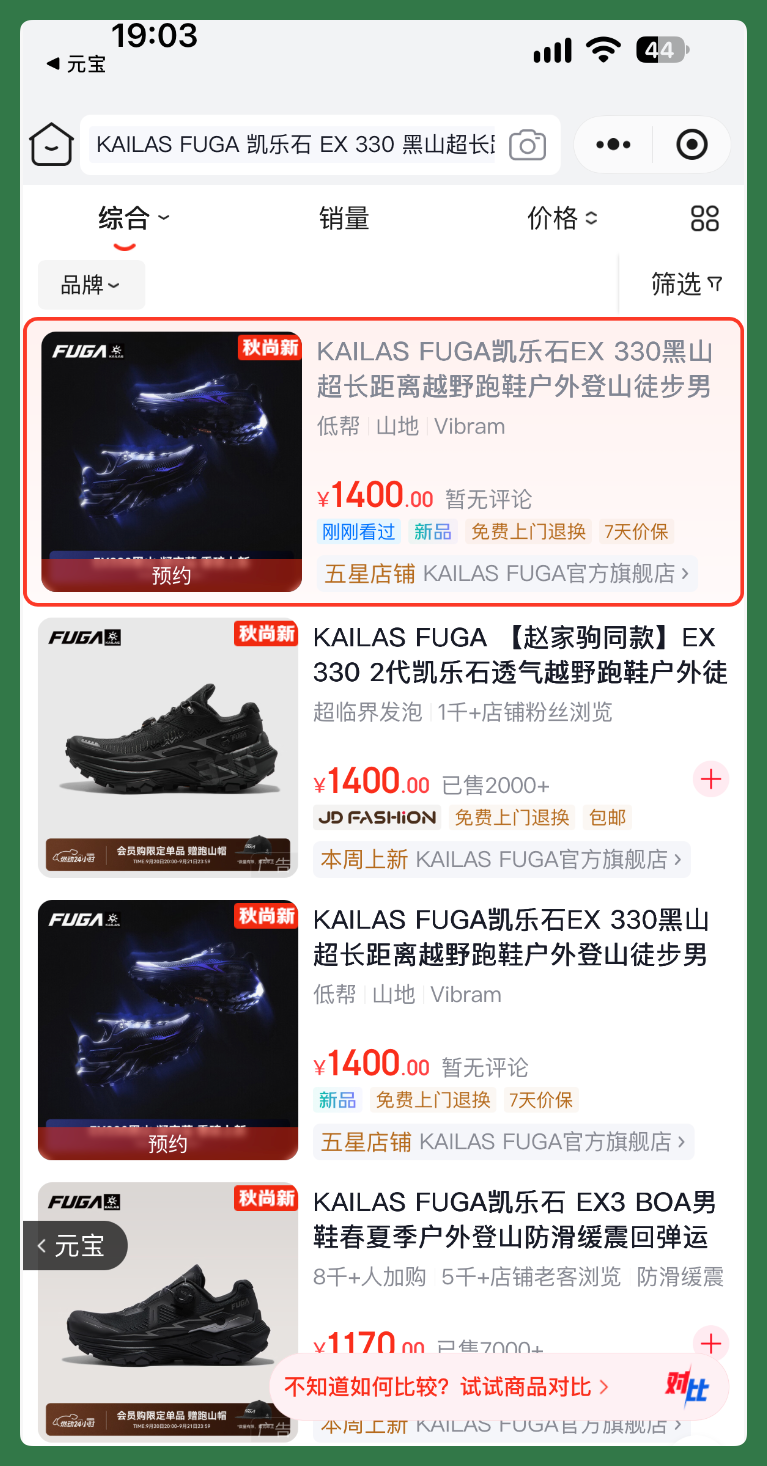
It recommended a pair of Kailas ultra-distance trail runners, plus other Zhao Jiaju-style outdoor hiking gear. Since it links to the JD.com mini-program, you can add to cart right there.
So from the initial WeChat chat, to trip planning, to pre-trip gear — it's basically one continuous flow.
Overall, Tencent Yuanbao's trip-planning agent is a solid fit for someone like me who doesn't want to sink hours into research. From the first spark of travel inspiration through planning, gear shopping, and keeping the vibe right — it all happens through one entry point.
🚥
Not sure if you've felt this lately, but this National Day feels more travel-hungry than usual.
The past six-plus months, AI has moved absurdly fast — models, agents, founder hot takes, the industry seemingly redefining itself daily.
Plenty of friends were anxious earlier this year. By now, most have chilled out.
Can't out-hustle it? Step back for a bit.
In October 2025, Sam Altman was interviewed by Tyler Cowen at the Progress Conference and asked which daily habits AI would change.
His answer:
"Spending time with my family, spending time in nature… my interactions with my friends… I expect to change almost not at all." In natural Chinese:
"陪家人、去大自然里走走、吃东西、和朋友相处,这些事情,我觉得很长时间都不会因为 AI 而改变。" These are things humans should do themselves. Route planning, booking, research, menu translation — let AI handle the rest. Let AI return to its essence; let people return to their lives.
So if you haven't decided where to go this National Day, or you're halfway through planning and already over it, open up Tencent Yuanbao and hand off the drudgery. Save your energy for the views, the conversations, the moments worth sharing.
Finally — happy holidays!