Returning to Dollar-Denominated VC: Is It Like Joining the Nationalist Army in 1949? | A Conversation with Xing Meng, 5Y Capital's New Partner
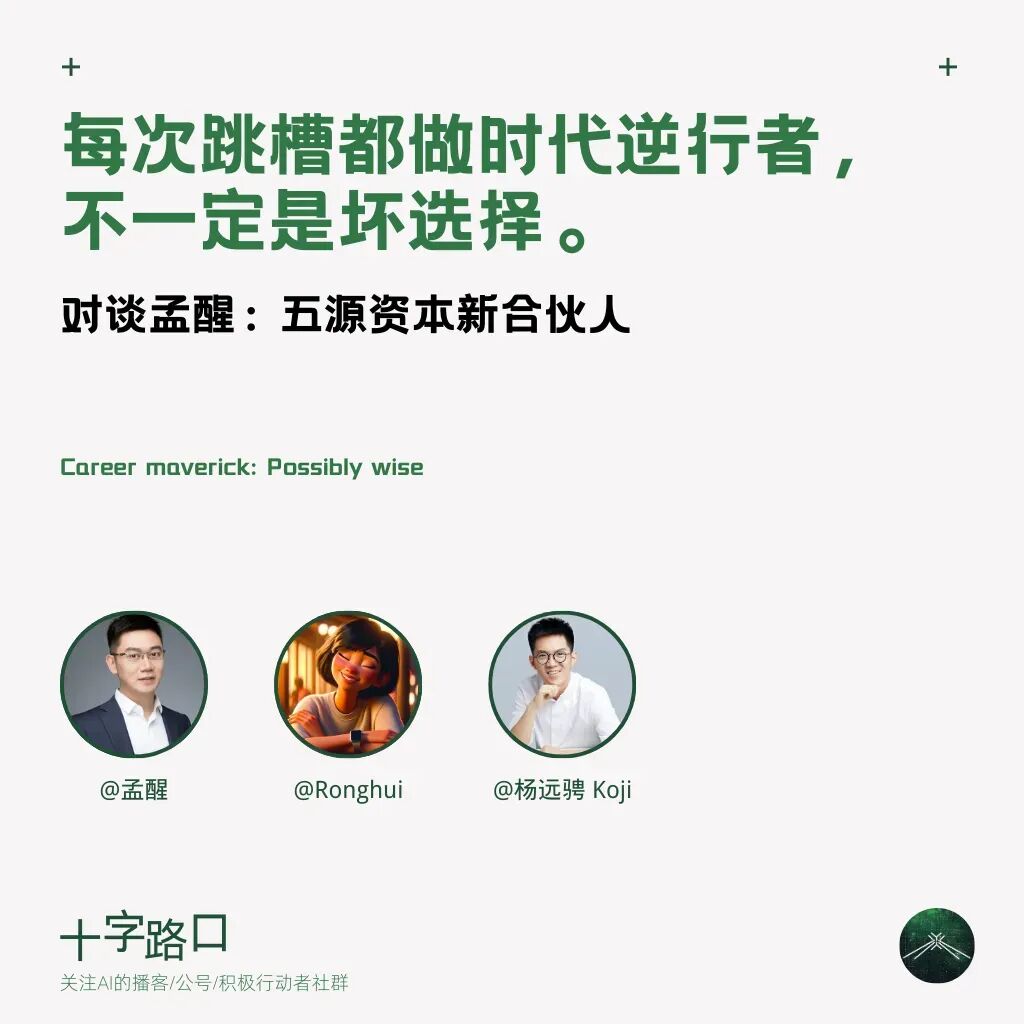
Are those who go against the current naive, or brave?
Xing Meng, this week's guest on Crossing, has been making headlines lately. After five years as COO of DiDi's autonomous driving division, he's returned to the dollar-denominated VC world as a partner at 5Y Capital. In our shared group chat, friends half-jokingly called him the "most beautiful contrarian" in dollar VC — like joining the Nationalists in 1949 — and one journalist even quipped that "Meng joining 5Y shows dollar VC can still attract top talent," which was more cringe than compliment.
Meng's career move caught everyone off guard, and people have been trying to figure out what he's really thinking. Last week, I had a 90-minute call with him. I found he doesn't care about these takes at all. He's calm, self-consistent, he knows what suits him and what he likes. So standing at life's various crossroads, Meng's choices may seem impulsive and任性 on the surface, but they actually follow a pattern.
Meng's choices and the thinking behind them resonated deeply with Koji — even comforted him — so we invited him to record this episode.
Beyond choices, entrepreneurship, and life, Meng also shares where he sees opportunities in dollar VC and AI right now.
Check out Meng's podcast "Tech Is Not Boring."
Listen on WeChat:
Listen on Xiaoyuzhou:
Why Return to Dollar VC in 2024?
🚥 Koji
Returning to 5Y Capital[1] as a new partner — rare for dollar funds this year — feels like joining the Nationalists in '49. What went into this decision?
👦🏻 Meng
You calling it '49 Nationalists — yeah, lots of people have asked similar questions (laughs). I thought about how best to answer. Looking back at my career, basically every job change since graduation wasn't just changing companies, but changing industries or roles.
In retrospect, every choice seems like "joining the Nationalists in 1949."
When I went to DiDi for autonomous driving, it was 2019, right after the first AV bubble burst. From 2016-2017 when the industry emerged to 2019, it was the first time things went beyond VC range, companies couldn't raise money, total bloodbath. When I joined Shunwei in 2016, I was doing tech investing — back then tech investing was super niche, almost nobody was doing it. Even earlier doing AI entrepreneurship, AI was deeply unfashionable or niche.
So now that you mention it, I just realized — looking back, every time was kind of similar. I never joined an industry at its peak.
Why? Thinking about it, I believe when an industry's down, there's actually opportunity to make changes.
When an industry's hot, fundamentally I feel you're just free-riding a macro trend. You can't tell whether things worked because you did something different, or because the industry itself was good — whether it's beta or alpha.
Also, if you want to do something different, when an industry's great, nobody cares. Existing methodologies all work, everyone's just riding the wave. Only when an industry has problems, or hits bottlenecks, do you get to try different things.
I really want chances to try different things. So probably these reasons, plus some historical inertia, led me to return to dollar VC at what seems like an inopportune moment. Of course, I'm also not that pessimistic about dollar VC or VC in general. I remember hearing someone — I think it was Minghao Zhuang or someone else — the other day, and I strongly resonated.
Basically since entering the industry, every single year, VCs say this year is the worst year, right?
In 2016 at Shunwei doing VC, I remember every year David Zhang would publish articles saying winter is coming, lots of warnings. Then every year or two he'd write these warnings again. So there was never a good year for VC. From a practitioner's perspective, negative news just gets amplified. So from that angle, maybe it's not that bad.
🚥 Koji
Choosing to return to VC during industry transformation — less competition now, almost like a blue ocean — is that the main reason?
👦🏻 Meng
My dad taught me this from childhood. He's a pretty legendary guy, done many things. But the core thing is — he's in his seventies now — what makes him happiest is remembering all the stories in his life. Some you make yourself, but many come because the environment gave you that opportunity.
And you just happen to enter a story-worthy industry at a story-worthy moment, so what you see there becomes your story.
🚥 Koji
Your father also did many different things at different life stages. And when you describe your choices, you keep returning to one keyword: "different." This "different" is something many people are actually afraid to pursue.
Especially in 2024, when everyone's seeking stability — civil service exams have become insanely competitive. You see headlines about Ivy League graduates becoming village officials. Everyone's choices are getting conservative, yet you're still actively embracing curiosity and change. Do you think this is also a kind of era-specific dividend for your choices?
👦🏻 Meng
Yeah, I think historically I've gained a lot from change. Change has always been a positive, even righteous word for me — not a negative one.
I don't know how most people see it; at different life stages, change might be good or bad. But in my growth, change has always been an unavoidable state.
As a child, I was constantly in unstable environments, passively facing change. Each change brought discomfort early on, but ultimately brought something different, made me somewhat different from my surroundings, enabled me to make different choices. If I've achieved anything worth mentioning, I'd probably attribute it to this.
In the past, change was forced. Going forward, when I have control, I want to actively pursue change.

From Garage to Elite School: An Unconventional Upbringing
🚥 Ronghui
Hearing all this, you strike me as someone with a strong sense of security. I'm curious what your childhood was like and how it shaped your personality.
👦🏻 Meng
Actually, I think I'm quite the opposite — I'm someone with very little security.
I don't make these choices from a position of strength, but rather I need differentiation to feel secure. When I'm the same as everyone else, I actually feel less safe.
I felt this from childhood. I remember at three and a half, going to America, entering American kindergarten, not speaking any English. Parents couldn't stay at kindergarten, just dropped me there. Even then I felt awkward, standing there not knowing what to do. I wanted to fit in with the other kids, but had to pretend I was aloof, or act busy — actually I couldn't fit in, but had to look occupied. This lasted a long time.
Some might assume we went to America because we were wealthy. The reality: I lived in someone's garage, no heat in winter, never had new clothes, only wore hand-me-downs from the host family. That was the situation.
I went through a lot of self-adjustment. In high school, my English was actually about the same as students from China. Decent accent, but vocabulary like a Chinese kid. Had to read American Nobel Prize literature, learn French in English, learn biology in English. A line might have 20 words, I'd know 7 — conjunctions, prepositions barely, zero specialized vocabulary. I brought an electronic dictionary to exams; others took an hour, I took two. Even after looking up every word, nobody could help me — no other Chinese students at the school. Because I wasn't good at small talk, I didn't dare eat with others. Brought my own lunch, hid in corners eating alone, just to avoid social awkwardness.
This lasted a year or two. But I set a goal: change this before graduation. Not one or two semesters — slowly building language skills, cultivating social interest. None of this parents could help with, because they weren't in this environment.
🚥 Ronghui
I understand now — it seems like constant ups and downs, but there's always an anchor, some source of freshness or confidence. This is still different from many people who pursue四平八稳 [perfect stability].
👦🏻 Meng
I can give another example. Amid all this instability, I made one extremely risky childhood decision: only four years of elementary school, skipped two grades. In middle school, I was always two years younger than everyone. You can imagine what that's like. And I wasn't two years younger in a gifted class where everyone was young — I was two years younger in a normal class.
The biggest difference I felt: during PE practice for the high school entrance exam, I had to train with the girls. Standing long jump — girls at 1.98m got full marks, boys needed 2.31m, and I remember only jumping 1.96m. Massive pressure, having to display your weakness and difference in front of everyone, completely inescapable.
Being two years younger followed me through everything. Academics, sports, dating — every area came with a serious disadvantage. Eventually I just accepted the difference. And gradually, I started to think: maybe this isn't so bad.
I remember an important theory from Outliers: some parents in the United States deliberately delay their child's school entry by half a year or a full year, so the kid can become team captain, so their body develops more.
I was always two years younger, always physically behind. But I had two years to catch up to you. Today I might be 20% behind you, but in two years I could be 100% ahead. Once I internalized that, a lot of things stopped being problems. That mindset mattered enormously to me.
So I'm especially afraid of the day when I finally become just like everyone else — then I'll have no excuse left to comfort myself.
Off the Beaten Path: An Investment Banker's Entrepreneurial Adventure
🚥 Koji
Xing Meng has done many cross-boundary projects. His first startup was an AI computer vision company — a very early attempt at that. Later he became head of Asian operations for a U.S. casino group, then started a social media advertising company, then worked on autonomous driving.
Talking with Xing Meng, I noticed he especially loves the 0-to-1 or 0-to-10 phase. But he was also refreshingly honest: he doesn't enjoy what comes after. I find that candor rare — most people won't face this so openly. In our conventional thinking, a good founder should stay with their company from start to finish. We even treat stubbornness or persistence as some kind of entrepreneurial virtue.
So on this point, I'd like to ask Xing Meng: how did you discover and accept that you prefer 0-to-1? And how did you make choices from that understanding?
👦🏻 Xing Meng
I really hope that when everyone is fighting in red oceans, I can escape and create blue oceans. But blue oceans don't stay blue forever — everything becomes a red ocean at some point. If it succeeds, others will pile in.
For me, when I see signals of a red ocean, I want to go explore a new blue ocean.
What does that mean? It means you'll likely leave at some stage to explore the next thing. That's my natural way of operating. So I prefer 0-to-1 or 0-to-10 work — partly preference, partly capability. Everyone has their own model; the best fit differs for each person. My preference and capabilities probably suit pioneering, early breakthrough work better. I'm willing to take greater risk and do something different.
But I'm probably not the most diligent person, nor the strongest executor on the same track. I took the high school entrance exam, but chose to escape the college entrance exam. When everyone was crossing the single-plank bridge, I chose another route. From then on, I probably took a different path on everything.
I did my undergrad at UC Berkeley, then went into investment banking. At the time, banking was one of the best options. But in my first year, I was already thinking about how to leave. I was considering what level of preparation would be enough. In banking you can see everyone's career trajectory — promoted every three years, MD in 15 years.
I set my goal early: I didn't want to keep walking this path. What interested me most in banking wasn't building financial models, executing IPOs, or doing M&A. It was interviewing those CEOs and founders, especially tech founders. I wanted to understand why they did what they did, what choices they made at the time, how they executed.
I decided to leave banking, determined to become like those CEOs.
🚥 Koji
Why did you want to become them?
👦🏻 Xing Meng
In Hong Kong or New York, especially in that era, almost no one chose to leave finance after entering banking. No other industry could match the pay or career path. But I made my first major life choice then.
When I was promoted from analyst to associate in my third year, I firmly chose to leave — either for further study or into tech. Since I'd decided to switch, I pushed even harder toward tech, eventually choosing to study at MIT. But from day one of enrollment, I didn't focus on coursework — I immediately started building a company with friends.
People were still unfamiliar with entrepreneurship then. I remember an investment manager from GSR Ventures doing recruiting talks at Harvard and MIT, filling a cathedral that held 250 people with PhD students from both schools. A single investment manager could command that kind of draw simply because no one had met an investor before. I was full of longing for entrepreneurship then. I assembled a team and won nearly every business plan competition in the United States.
I remember when ZhenFund was just founded, Bob Xu did a tour of the seven Ivy League schools, with the final competition at Harvard. They selected 40 projects, each with only one minute for an elevator pitch. Our three-person team conceived three projects that night and competed the next day. The top ten projects each received $10,000, unconditionally granted. We ended up with $20,000. For students then, that was serious money. We used it to build a small fund, and we still use that money for regular team dinners to this day.
During my MBA, most classmates focused on courses, networking, or finding professional service jobs like consulting and banking. But I was desperate to start a company. I barely attended classes, didn't really socialize with MBA classmates, and instead spent time with PhD students looking for startup opportunities.
I tried startup projects in completely different fields. In Boston, I worked on a nightclub queueing app. Though I never went to nightclubs, didn't drink, and was actually allergic to alcohol, I was fascinated by what they were doing. I also worked on optimizing Walmart container loading processes, then later did face recognition and scene recognition. All interesting experiments.
It was a complete 180-degree turn. But what excited me was discovering that my banking experience was valuable here too. Founders focused on technology and product were doing great work, but often lacked experience with fundraising, company operations, and future development.
My first startup was founded in Boston with two computer vision classmates, Meng Wang and Tianqiang Liu. I also went on If You Are the One once — the show was huge in 2011, people would recognize me walking down Boston streets in winter. That introduced me to many new friends.
When these two future co-founders approached me about starting a company together, they showed several computer vision projects. Meng Wang had a 2D-to-3D conversion project, plus face recognition and scene recognition. They asked which would be best to pursue. I suggested focusing on face recognition, believing it had more commercial applications. We assembled a small team and started applying to U.S. incubator programs. At the time, Y Combinator and TechStars were barely known in China; in the U.S., I'd mainly heard of them through alumni.
I later learned that Tianqiang Liu and Meng Wang had already worked together for a year and failed to get into these programs. But after I joined and we prepared seriously, we got into TechStars and received a Y Combinator interview. I felt I could genuinely add value there, so we decided to formally establish the company.
This experience thrilled me. Before, in banking, I'd only worked with public companies, helping them prepare prospectuses and complete listings. Now I finally had the chance to participate in a tech company from zero — that feeling was incredible.
The Joys and Sorrows of Two Startups: From Technical Breakthrough to Commercial Trek
🚥 Koji
Xing Meng, what was your second startup? And across these two ventures, what were your highest and lowest moments?
👦🏻 Xing Meng
I did experience two startups. The first was founding Orbeus. Being first-time founders, we didn't have deep strategic designs — we mainly provided face and object/scene recognition APIs, combining image recognition with cloud services, directly commercializing the technology.
For the second startup, I learned from the first experience and didn't want to simply sell technology anymore. We wanted to build a professional product for a specific industry, ultimately choosing advertising, and founded ZhiTu Technology after returning to China.
ZhiTu Technology was also based on computer vision technology, but we applied it to content advertising. Our goal was to identify images on web pages and mobile apps — like images on Weibo — and implant ads in a natural way. Unlike traditional banner ads, we pursued seamless integration, like having a celebrity naturally wear branded clothing, making viewers completely unaware this was a post-production ad placement.
Both companies ultimately had good exits: the first was acquired by Amazon, the second was also acquired.
🚥 Koji
Was the high point when you sold them?
👦🏻 Xing Meng
For me, the highest moments weren't when the companies were acquired. They were when we clarified our direction, assembled the team, and everyone started the journey with shared ideals — or those early small victories. Those were the happiest times.
Selling the company actually became a low point.
The first acquisition went okay, but the second sale was a very unpleasant experience. This story is being told more now, and it still pains me to recall. It was because of major disagreements in values and vision between founders, ultimately forcing a passive sale.
The period before selling was especially difficult. The conflict in values led to investors potentially pulling out. I remember in the final two months, every day I'd calculate how many months of payroll we had left. Many employees I'd recruited personally, and several had joined because of me. The stress was so intense I'd have stress-induced vomiting, suddenly needing to run to the bathroom to throw up.
🚥 Koji
Dry heaving or actually vomiting?
👦🏻 Xing Meng
I'd actually vomit. I often compare being CEO to banking: in banking I worked 15-16 hours daily, longer than as CEO. But being CEO, though the hours were shorter, aged me and caused anxiety far beyond my banking years — even producing strange physical symptoms.
The Myth of Zero to One: Why Some People Excel at Starting, Not Sustaining
🚥 Koji
So, do you still want to be a CEO?
👦🏻 Xing Meng
Looking back at how I chose partners, I focused mainly on complementary skills while neglecting alignment on values. If I were to start over today, I'd make values fit my top priority. Being a CEO isn't inherently difficult — you need certain capabilities and the willingness to step up when things fall apart.
🚥 Koji
Have you ever had to step up like that in the past?
👦🏻 Xing Meng
In theory, anyone in a CEO or number-one position needs that backup mindset. Even in an incubated company with a parent organization, if you're the true owner, you don't fully rely on the parent to catch you — otherwise you're just a professional manager. So in every role, whether or not I was asked to take responsibility, I approached it with an owner's mentality.
Especially after two startups, and particularly the second one, I came to understand more clearly what this position demands and what kind of leader I want to be.
🚥 Ronghui
When did you start having that clear sense of direction in your career? Like you mentioned earlier, maybe you're suited for zero to one, realizing you enjoy that rather than other things. Was there a kind of awakening moment?
👦🏻 Xing Meng
My first realization that I wanted to do something different came while helping Ambow Education and skymobi with their IPO prospectuses. As an investment banker, I had to interview CEOs, understand their founding stories, motivations, and market judgments — this process fascinated me.
I remember Ambow's founder returned to China in 1999 after five years as an engineer in the United States. That year he was invited back for the 50th anniversary of the founding of the PRC, and watched the ceremony at Tiananmen with Robin Li. Seeing China's development, he felt there was nothing worth staying for in America and came back to start a company. Ambow started working on AI+ education very early, developing learning engines for personalized distribution of educational content.
Though these stories were compelling, I understood many were retrospective narratives polished for the IPO. Even so, they excited me. I thought, if just hearing about these journeys was this thrilling, living through them must be even more so.
I'm someone with intense curiosity who doesn't easily dismiss things I haven't tried. Every choice I've made has been based on evaluation through practice.
Throughout my career, I've always wanted each job to be different: first investment banking, then entrepreneurship, then Asia-Pacific head for gaming at a multinational Fortune 500, then various forms of entrepreneurship again — investing, buy-side, internal incubation at an internet company. This makes my career look somewhat scattered, but I've fully experienced each role.
Now I have more courage to say: I love pioneering work, I love different, early-stage projects. This realization comes from having gone full circle. I said similar things at Shunwei or even earlier, but I wasn't as internally certain then because I hadn't yet experienced so many things — it was mostly speculation. Having completed the loop, I'm more confident this is the direction I want.
🚥 Koji
My connection with Xing Meng was actually quite accidental — we met at a film industry friend's birthday party. We were the only two people there connected to tech and venture capital. But within this accident there seems to be inevitability; perhaps it's precisely because we're both rare in the VC world for having intersections with the film circle.
My recent conversations with Xing Meng have given me intense resonance and immense comfort. My own career has also been scattered: founding Jiepang, going to an e-commerce company, doing self-media, advertising and content marketing, consumer goods, and now podcasting and AI. Many people say I lack long-term commitment.
But talking with Xing Meng gave me two especially deep impressions:
- First, I've also only recently begun to truly face myself: I love zero to one, not one to ten. When Xing Meng described vomiting as CEO, I deeply related — in that anxious state, I dry heave too. But in the zero to one phase, I'm always filled with joy. Acknowledging this has let me drop many burdens, become happier, and more clearly know my strengths. Understanding my capability structure has made many choices easier.
- The second thing that struck me was what Xing Meng mentioned, and what Sam Altman of OpenAI has said: the world often overvalues focus and depth while neglecting the meaning of breadth. Though we may not achieve what those who focus on one direction for decades build in vertical domains, it's precisely because we've experienced different things that connecting these experiences creates new chemical reactions. This is where I feel most valuable.
I particularly wanted to have this conversation with Xing Meng today, partly because I felt this resonance and solace, and partly hoping to help those with similar confusion. If they could hear our stories earlier, perhaps they could find their direction faster, with less wandering and less physical and mental torment.
🚥 Ronghui
It's already fortunate when someone can recognize what suits them and what doesn't, and act on it. Many people, myself included, have long remained in confusion. When it comes to crossing boundaries, seeing oneself constantly trying different things — by conventional consensus, this might be considered a less correct choice.
This reminds me of something a senior once said. When I was working, I always felt inadequate here, needing improvement there. He told me: "Ronghui, don't think about work this way. Think of it like holding a sword, making it longer and longer." Meaning to become increasingly specialized in one direction. But seeing your experience, I feel this view is worth sharing with more people:
There are many ways to live life; you don't have to follow the path everyone considers right. You could have stayed in investment banking all the way to partner — that would indeed be a great choice, but absolutely not the only one. Life has many possibilities.
👦🏻 Xing Meng
By traditional standards, persisting in one thing is seen as a virtue. Add to that the compound effect theory that was popular recently, which suggests that deepening in the same industry isn't simple linear growth but exponential growth. Plus Gladwell's 10,000-hour rule, explaining why Tiger Woods is so good at golf, why some people are exceptional at chess. These theories gradually formed a mainstream consensus.
But I recently read Range [2], which presents a different view:
People shouldn't limit themselves too early to one direction. The 10,000-hour rule really only applies to special domains like Go. Even in these fields, slightly change the rules and previous training may become completely invalid. So the better choice is to maintain possibility over a longer period, letting yourself control the convergence process, even starting to converge very late.
I resonate strongly with this view, and would even push it further — perhaps no convergence is needed at all; you can keep trying new directions. What I enjoy isn't becoming an old expert in some industry, letting my knowledge surpass others', but growing through effective boundary-crossing.
So-called effective boundary-crossing means that when you switch domains, you can extract what's valuable from your previous field and bring it to the new direction, finding appropriate application scenarios. Whether in cognition or execution strategy, as long as it can be fully utilized, you may find differentiated opportunities.
🚥 Koji
Can you explain what effective boundary-crossing looks like for you? Taking what's effective from one phase to the next?
👦🏻 Xing Meng
I'll use my 2016 transition to investing as an example. Before joining Shunwei, though I had worked on the sell side in finance, I had never done buy-side or early-stage investing — essentially a blank slate. But fortunately, from 2016 to 2019, I performed quite well in investing. Among tech investors of that period, I stood out not because I was skilled at investing, but thanks to my two prior tech entrepreneurship experiences.
This gave me several unique advantages:
First, I could use my own experience as a benchmark to evaluate founders. Many investors lack entrepreneurial experience and can only rely on external comparison, making it hard to truly understand startup scenarios.
Second, I had extremely rich connections in the tech circle. For example, when China's autonomous driving industry was just starting in 2016, I found many founders were old friends, former colleagues, interns, even people we'd wanted to hire but couldn't, or competitors. These were all people from our circle.
Early-renowned investors mostly invested in mobile internet, e-commerce, or internet finance, because there weren't yet many large tech companies. This created a natural gap between them and tech entrepreneurs, at best maintaining a formal business relationship. Because I was also an entrepreneur and from the same field, I could more easily build deep connections.
I was also fortunate to catch the period after 2016 when tech investing began gaining attention. Before this, tech investing was still a relatively niche field; only afterward did it gradually become mainstream.
I transformed the relationships, founder experience, and shared language I'd accumulated in tech entrepreneurship into important advantages in investing, allowing me to achieve decent results in a relatively short time.
🚥 Ronghui
Could you say that by conventional standards, neither of your two entrepreneurship experiences was a so-called big success? Did that frustrate you? Many people, after two less-than-successful startups, would choose not to try again. How do you view this?
👦🏻 Xing Meng
This is how I evaluate my two entrepreneurship experiences: for someone who had never started a company before, achieving exits in both was already decent. The first exit was fairly good; the second was unsatisfactory, but considering I was in my twenties then with no entrepreneurial experience, the overall performance was acceptable.
And both experiences were historically significant. The first startup happened to catch the very beginning of deep learning; we created many firsts: possibly the first company to productize computer vision, the first to provide face recognition APIs in the United States. These all had historical significance.
Of course, I also acknowledge this wasn't extremely successful. Competitors who started around the same time or slightly later — for example, Megvii later became a company valued in the billions of dollars, and SenseTime, which started two years after us, is now publicly listed. We began at the same starting line, and at times our products may have been even better, but ultimately we didn't achieve their scale and accomplishments.
Because of this, after the second startup ended, I began reflecting on my own problems. I may not yet be a complete entrepreneur. Even if I started again, having two experiences might make starting easier, but without addressing existing problems, I might fall even harder.
So despite many people pushing me to continue entrepreneuring, I didn't do so immediately. I felt I needed to observe how more successful people handle these challenges, how they deal with people problems and industry problems.
Choosing Shunwei had two reasons:
First, the VC position would let me see more entrepreneurs, understanding both invested and non-invested projects more deeply.
Second, Lei Jun is one of the rare people who has reached the top in both entrepreneurship and investing. I hoped to learn from him, which would be very helpful for my growth.
🚥 Koji
Did you find the answer later?
👦🏻 Xing Meng
I'm clear about many of my problems, but some may be very difficult to adjust. For example, my ability to judge and control situations is far stronger than my ability to judge and manage people.
Even later, while working at DiDi and facing the opportunity to manage large teams and a large company, gaining more experience along the way, the gap between these two abilities remained significant: my capacity to handle and judge matters versus my capacity to handle and judge people.
This led to two important realizations. First, I understand myself better now, which allows me to make better judgments about what types of things I'm more suited for. When a company grows from 10 people to 100 to 1,000, the demands on management capabilities keep increasing. So I'm probably better suited to playing a role in a company's early stages, when things are simpler and I can do more.
🚥 Ronghui
After hearing your sharing, I think you're someone who can step outside established evaluation criteria to think. For example, always being two years younger than everyone else at school — some people (like myself) might get stuck obsessing over that age gap. But you were able to step back and see that being younger might bring certain advantages.
Just like your summary of your two entrepreneurial experiences — although they didn't meet conventional definitions of success, you were able to think about and evaluate them from other dimensions. I think this way of thinking allows people to live more freely.
🚥 Koji
The external environment is objective; established facts are what they are. But how a person understands themselves, how they interpret history — that narrative is something they can decide for themselves. And this narrative not only determines a person's state of being, but also how they face various choices and challenges in the future.
I don't think anything is purely black and white. Everything can be interpreted; there can be negative understandings, and there can be positive ones.
👦🏻 Xing Meng
I think everyone probably has their own narrative of what success means — what counts as success on their own terms.
For me, one critical point is whether I'm the first to do something. For example, if I had to choose between two things: being a copycat but doing it the best, or not being a copycat and being the first to do it — between these two, I'd probably see more value in the latter, and the sense of achievement would far exceed the former.
🚥 Koji
So if right now, you were to give advice to yourself during your first startup — which is where many of our listeners are today: good educational background, some work experience, able to pull together top-tier resources to kick off a startup — what advice would you give to your younger self and to these listeners?
👦🏻 Xing Meng
I think entrepreneurship is an experience, and the utilitarian mindset around it should probably be weaker, especially for a first startup. I think there's a high probability you'll fail. You should make all choices and decisions assuming failure as the default.
If, on the basis of assuming failure, you still choose to do it and work hard at it, then what you're probably pursuing is the experience of that period itself. Any success you achieve is a bonus.

New AI Investment Opportunities: What I See in 2024
🚥 Koji
Alright, let's talk about a topic everyone's very interested in. It's 2024 — kind of like joining the Nationalist army in 1948. Returning to the dollar VC industry. Xing Meng, now that you're back in dollar VC, what excites you most about this industry right now?
👦🏻 Xing Meng
I think there are several key characteristics of the industry right now:
AI applications across all levels are driving paradigm-shifting change. This reminds me of 12 years ago when I first started an AI company and personally experienced the transition from scratch to deep learning. Today's transformation may be even greater, because more people are trying its applications across industries faster, and more capital is flowing in. This is a structural, systemic opportunity. I've encountered opportunities in VC before, but never at this scale. This could be a more interesting, comprehensive societal and technical transformation opportunity.
Although we're currently in a counter-cyclical period for financial markets, we're in a pro-cyclical period for technology. This special combination may require new evaluation criteria and investment models.
I look forward to seeing innovative models emerge, whether in investment products — such as earlier-stage investing, more incubation, later-stage investing, or debt-based investment approaches; or in focus areas — not limiting oneself to consensus areas. Although everyone is talking about AI, there are many sub-directions within AI. When everyone is focused on mainstream AI directions, perhaps it's time to start pushing the next important domain forward. There are many interesting opportunities here; if judged correctly, they could become decisions remembered by history.
This is very different from 2021 when the market was exceptionally good. At that time, any achievement could be drowned out by larger market waves. No matter how well you did, there would always be someone with more capital and louder voice to crush competitors. Success or failure then was often not caused by individuals, but determined by the industry's Beta.
So this current period is actually exciting, because everyone's choices will be clearly highlighted, for better or worse.
🚥 Koji
Returning to the VC industry — you're different from when you were at Shunwei, you're many years older, and the era has changed significantly. Do you think there are things you want to do differently this time?
👦🏻 Xing Meng
At this stage, based on the reasons mentioned earlier, from an industry perspective, dollar investing may be more challenging than before. But precisely because this is a paradigm-level transformation that allows more people to participate and creates many structural opportunities, I'm actually more interested.
On the other hand, because I have a deeper understanding of myself and clearer sense of where I fit and what I'm good at, I'm willing to explore more possibilities and try some different product models.
🚥 Koji
Since it's like this, why not start another company yourself?
👦🏻 Xing Meng
I think everyone has different preferences for which stages of the entrepreneurial process they want to participate in. For me, what interests me most is helping a company get founded and survive its first few years. When a company finds product-market fit and gradually moves from a contrarian direction to consensus — that's when I hope someone takes over, and I can go do the next similar thing.
There are also people who are the exact opposite; they prefer to take over from that point and scale the company up. Entrepreneurship is a continuous process that can be divided into many stages; not everyone has to do it from beginning to end. This is like the跨界 (crossing boundaries) discussion earlier — if you don't cross boundaries, you might prefer to focus in one direction and enjoy the compounding returns.
This is perhaps the traditional standard for evaluating good students or good entrepreneurs. But I don't think it matches everyone's actual passion and aptitude for entrepreneurship. Passion alone is one thing, but whether you're actually good at it is a significant difference.
In the past, we expected to cultivate all-around CEOs, demanding they grow the company from small to large: in early stages, they needed personal charisma and appeal, able to do everything; when the company scaled, they also needed strong management capabilities, adept at handling government relations, internationalization, media, and various other matters.
But perhaps a better model is: there exists in the world the possibility of not needing one complete person, or not needing someone interested in all stages to do it from beginning to end.
🚥 Koji
I'm thinking of an analogy: when we're raising a child — assuming a company is also a child — they go through kindergarten, elementary school, middle school, university stages, needing different teachers to guide them. Since AI should be the main direction you invested in after joining Shunwei. When we talk about AI, do you have more specific directions you're interested in?
Because actually today, right now in October 2024, I feel like there's a lot of consensus. But non-consensus seems rare. So do you have any disagreements with consensus, or any non-consensus views of your own, that you'd like to share?
👦🏻 Xing Meng
In the current combination of AI and scenario deployment, I see two core elements: the strategy element and the environment element. This reminds me of AlphaGo's two networks in Go: one responsible for generating playing strategies (policy network), another responsible for judging good or bad (value network). Currently, most of our time, energy, capital, and attention are concentrated on strategy generation — such as GPT's dialogue generation or Agent development.
But I think equally important is environment generation — the system for judging how well AI performs. These environments can be divided into several categories:
- Ready-made environments: Like a game board, already existing with clear rules.
- Constructible environments: Such as autonomous driving simulators, environments that can be artificially built.
- Complex environments: Those that cannot be built with simple rules, possibly requiring another large model to simulate. For example, dialogue systems — early on we used RLHF (Reinforcement Learning from Human Feedback), which essentially had humans play the role of environment to judge good or bad. But human judgment is either costly or limited in scale.
There exists an impossible triangle in this process: accuracy, generality, and cost cannot be simultaneously satisfied. This is why we need machines to simulate environments. For scenarios like dialogue or complex Agents, the key question is: when we put AI in an environment, how do we judge whether its behavior is correct?
Just like what Terence Tao recently discussed regarding mathematical problem-solving: GPT can now generate very good theorem proofs, but how do we verify the correctness of proofs? Manual verification is too costly, so we need theorem proof checkers, and preferably not written by large models but by another rule-based system.
The robotics field may be even more complex — it's difficult to create a sufficiently realistic virtual environment where robots can train and adjust strategies without physical testing. These are research directions I'm quite interested in.
🚥 Koji
Right, I think this does raise a very interesting angle. On this angle, Xing Meng, are you seeing any promising startups, or any specific products you find quite interesting?
👦🏻 Xing Meng
I spend about half my time generating ideas myself, thinking along the directions discussed earlier, and half my time looking at other people's ideas. I can share a specific example.
A question that interests me greatly comes from Andrej Karpathy's thinking: between film and games, does a new media form exist?
This question has sparked many ideas for me. I think film is essentially weak-interaction, short-duration content, while games are strong-interaction, long-duration content. Between these two, there may exist a weak-interaction, long-duration content form. Short video might belong to this category, but it requires massive human effort to produce content, essentially leveraging users' capabilities.
What if AI could produce all this content? For example, using short video format to distribute a machine-generated series. More specifically, can AI simulate drama? Can it distill the core elements of drama? Drama is essentially a simulation of human behavior, a very specific kind of simulation containing climaxes, low points, able to mobilize emotions, combinations that produce dopamine.
Digging deeper into the technical layer, this is essentially about converting human behavior into tokens and training on those tokens. Human behavior is fundamentally a form of action — it can serve as both input and output. Based on certain rules, we can combine these actions to produce dramatically compelling interactions or outcomes. With such an engine, you could generate games or content. This is a development direction I find fascinating.
🚥 Koji
Have you seen anyone working on this? Either domestically or in Silicon Valley?
👦🏻 Xing Meng
There are teams exploring this direction in both Silicon Valley and China — Silicon Valley leans more toward content creation, while China leans more toward game development. I find Fable Studio[3] particularly interesting. Its founders come from the Oculus Story team and have won Emmy Awards. They developed an engine called Storytelling AI and successfully used it to generate two episodes of South Park animation. They chose South Park because its format is relatively simple — mostly talking heads with fixed shot compositions, but the dialogue has real depth. It still requires human adjustment, but it already shows the potential of this direction.
Their user interface resembles Netflix, but with an innovation: you can select genre, duration, and style (drama or horror, etc.). Unlike Netflix, which searches its existing library, their system generates a short film matching your specifications in real time. Each piece is unique. You can even choose specific IPs — for instance, asking it to tell a story in the style of South Park, The Simpsons, or The Big Bang Theory. It's still early stage, but the direction is fascinating.
At the same time, they've created a simplified version of Westworld — a Sweetwater-like environment. Users can explore from a first-person perspective, somewhat like the early Stanford Town but in a fully 3D environment with beautiful graphics.
There are also many teams exploring this in China, though most are still at the demo stage. The key is using AI as the overall orchestrator, managing characters and environments to create authentic open worlds.
Imagine if game environments like GTA or Genshin Impact shifted from pre-programmed scripts to real-time generation, instantly creating content based on what the player did in the previous minute. Not just open-ended dialogue, but more interestingly, chain reactions from behavior: if you insult an NPC, they might run off to gather people to surround you, and you could try to persuade or placate them — handle it well, and these people might end up following you instead.
Take the Peach Garden Oath scene in Romance of the Three Kingdoms — if you showed up as a fourth person trying to join, what story would unfold? This could be narrative content or game interaction. There are so many possibilities still to explore in this direction.
🚥 Koji
This also reminds me of Google's Notebook LM[4] that's been blowing up recently. Their core team has three people: one engineer, one PM, and the third is actually a writer named Steven Johnson, who's written a ton of bestsellers. He joined Google Labs in 2022 as editorial director. So he's participating in various projects from the perspective of a writer or content creator.
I think when Xing Meng was describing this new content form between games and film that represents huge potential, it probably shouldn't be built solely by product managers and engineers. There should also be creative participation from creators and frontline content producers.
So it sounds like something that requires a very hybrid organizational structure to pull off. Once it's built, it would be an extraordinary product that could shape humanity's future of entertainment.
👦🏻 Xing Meng
Right, if we're talking about content creation, the artistic factor carries enormous weight.
Looking at the model's learning process, it's not just learning from corpora and engineering techniques. Take drama — who understands drama best? Creators, screenwriters, artists. These artists' brains are themselves models. They've already performed an abstraction of the dramatic elements that captivate human attention, knowing what kind of plot works.
And when AI models learn, they're essentially performing a second abstraction on content that has already been abstracted through artists' minds, ultimately forming the works we want.
🚥 Koji
Right, actually while talking I could sense Xing Meng's feeling about something new — his tone even got a bit excited, that kind of curiosity-driven passion radiating from within.
Redefining Success: An Investor's Values
🚥 Ronghui
So is there a standard for success in what you're doing now? At what point would you feel satisfied with yourself? Not satisfied compared to others, but satisfied with yourself.
👦🏻 Xing Meng
I'd return to what I said before: if my existence or actions can make something happen sooner, that brings me satisfaction.
I can give a counterexample of what wouldn't satisfy me. For instance, I'm not particularly drawn to things that are already highly consensus-driven. If I invest in a project that many people are already pursuing, from an investment perspective I'm probably just taking someone else's allocation.
Because regardless, they would raise the money — whether I invest or not makes no substantive difference to them. Such an investment might generate some returns for my fund, but it has no real impact on the project's existence or the founder's development. Even if I execute slightly better than others, I wouldn't feel particularly accomplished in that scenario, nor would I consider it success.
🚥 Ronghui
Actually, listening to you, I get the sense that you're quite fortunate. You found something that suits you, that you enjoy, and that you also believe you're suited for.
👦🏻 Xing Meng
I think I did lay some groundwork — doing investment banking in college gave me the confidence to try other things later. So perhaps the fortune comes from having decent early preparation and some margin for error along the way, which made things work out okay.
And I agree with the idea of being fortunate. For example, when I started investing in 2016, I only knew tech investing, not business model investing. At that moment, tech investing happened to be taking off. That timing was genuinely lucky.
🚥 Koji
So do you think your good fortune is purely luck, or do you think there's some methodology behind improving your luck?
👦🏻 Xing Meng
I'd frame it this way: if my luck hadn't been this good, by世俗 standards I might have achieved worse results. But my criteria for judging myself are actually different — I wouldn't necessarily consider myself to have done worse.
I'd probably focus more on the interesting stories and experiences along the way. This focus isn't to console myself — it's because I genuinely enjoy these experiences more.
🚥 Ronghui
Listeners, please don't misunderstand and think everything comes down to luck. I actually have friends who work in investment banking, and that kind of work intensity really isn't something most people can endure.
👦🏻 Xing Meng
All experiences, beyond leaving stories and memories, serve the crucial purpose of helping you understand yourself.
Once you truly know yourself, your probability of success in subsequent attempts becomes higher. Even without success, you gain more other rewards. Because you know what you want, and whether you succeed depends more on how you define your own pursuit.
🚥 Koji
Actually, I think Xing Meng put this beautifully — the most important thing for a person is knowing what they want, then pursuing it. Some may be fortunate enough to achieve it. Most people probably have a little luck but fall just short, feeling stuck halfway up the mountain, neither up nor down.
But regardless, every stage of life has its scenery, and each is more or less helping us understand ourselves.
Rene Liu has a song on her new album called "Today's My Birthday," a message she wrote to herself at this age. I've slightly adapted the lyrics:
Long ago, when you were still young and ambitious You vowed you would achieve fame and success Now, do you remain unwavering, persistent as ever Or have your vows long since faded with the mundane world? Faded with forgotten innocence and courage?
Your restless pursuit of perfection Foolishly proving your sincerity through personal involvement Right, but not entirely right It's nervousness, it's anxiety, desperately trying to keep up with time
Yet amid the nervousness and anxiety, there's something more You finally know what matters What matters less And what doesn't matter at all
This certainty teaches you to conserve your energy To make good use of each day, each moment
Subscribe to the "Crossing" Podcast
🚦 We follow the industry transformations and entrepreneurial opportunities brought by the new wave of AI technology. "Crossing" was Steve Jobs's metaphor for Apple — standing at the intersection of technology and liberal arts, where great products are born. AI is transforming industries across the board. We seek out, interview, and bring together "active actors" of the AI era to explore and embrace new changes and new possibilities.
👦🏻 Host Koji: Co-founder of The Fair and Tangdao. I believe technology, especially AI, will fundamentally transform society and empower humanity. Feel free to reach out to chat, exchange ideas, and connect on what's next. Koji on Jike[5], Koji's website[6]
👧🏻 Host Ronghui: Works at a tech VC, former Silicon Valley correspondent for CBNweekly. Ronghui on Jike[7]
Join the "Crossing" Membership Community
☀️ First-hand AI news and insights
👫🏻 We encourage everyone to date/make friends/find future collaborators
🦀 Add our assistant on WeChat to join: Rwkfbcianvd, or scan the QR code below

🎄 This podcast is supported by the Sound Forest Podcast Plan.
References
[1] 5Y Capital: https://www.5ycap.com/
[2] Range: https://book.douban.com/subject/33423656/
[3] Fable Studio: https://thefablestudio.co/
[4] Notebook LM: https://notebooklm.google/
[5] Koji on Jike: https://okjk.co/0JSUes
[6] Koji's website: https://koji.super.site/
[7] Ronghui on Jike: https://okjk.co/0cbnYV