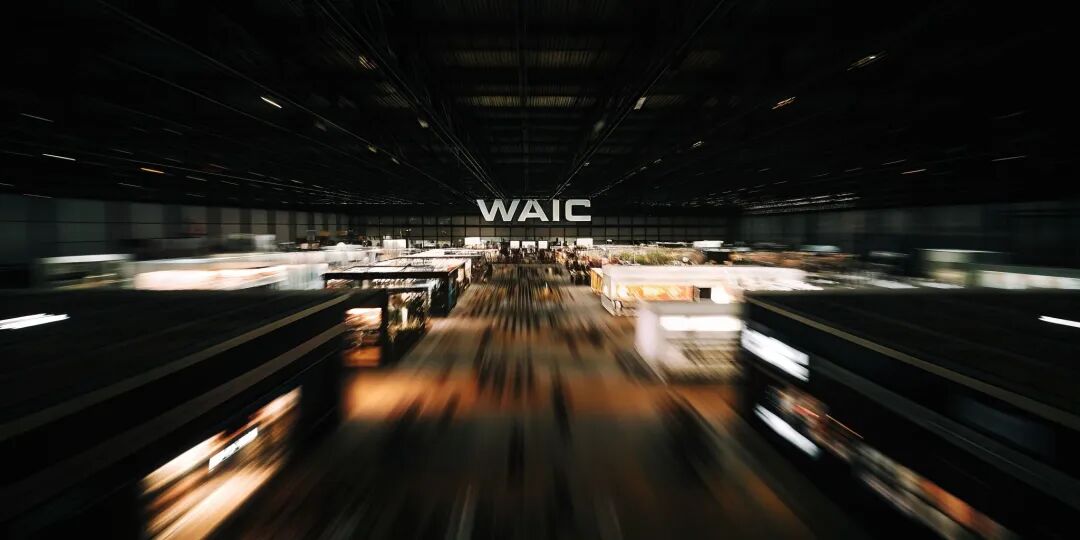
We captured 28 moments at WAIC, piecing together a cyber *ukiyo-e*.
Melting from the heat.
Hot! Melting 🫠
👦🏻 Author: Miss Yi
🥷 Editor: Koji
🧑🎨 Layout: NCon

The entire industry is talking about how AI will change the world. At this year's WAIC, "hot" was everyone's first impression — and sometimes their only one: the atmosphere was hot, the weather even hotter.
July 2026, 38°C Shanghai. The West Bund, Zhangjiang, Expo — three locations, four venues, an unprecedented spectacle. Eleven hundred companies. Over three hundred real machines on display. Nine Turing Award winners in attendance.
For many people, what truly kicked off this year's WAIC wasn't the opening ceremony — it was the jokes and one-liners flying through WeChat groups and Xiaohongshu. Maybe it was a ticket invalidated by a "final review failed" notice from the system. Maybe it was a CEO locked out of his own booth because he forgot to register. Maybe it was a Doubao-faced robot doing the splits mid-stride, or Sutton's line — "It is weak, but it is very useful" — made flesh. Many called this the "hottest WAIC ever," and it happened to stand at a curious inflection point:
AI had become too powerful to ignore.
We captured twenty-eight moments. Pieced together, they form a cyberpunk ukiyo-e.
The people in the painting mostly don't know they're in it.
Donghao Lansheng
On Moments, thousands of posts shared the same location tag: Donghao Lansheng Shanghai World Expo Exhibition & Convention Center.
Nobody knew who Donghao Lansheng was. An events group, the WAIC organizer. But that summer, it became a symbol — tagged repeatedly, never questioned.
People flooded into this space, checked in, dropped a pin, left — who had been there didn't matter.
You came. You posted your location. You left. That was all.
Air Fryer
Orange heat alert. Shanghai's felt temperature pushed 50°C. The entry line snaked from the Expo Exhibition Hall entrance.
Someone stood under the blazing sun for over an hour, shirt shifting from light blue to dark blue, plastered to their back. The organizers later placed giant ice blocks in front of each booth, but the cool couldn't catch up with the crowd's heat. The air carried sweat, disinfectant, and a restless urgency.
Someone posted: "Shanghai has finally solved the problem of humans not fitting inside air fryers."
Inside, a heatstroke victim was helped out by security. The crowd glanced over, then turned back to watch robots dance.
Algorithms can't lower temperatures. Compute can't drive away summer.
Entry QR Code
At the entrance, a man stood before the turnstile, head down, phone in hand. Screen lit up, darkened, lit up again. His team was inside — booth built, machines calibrated. But he couldn't get in. The review system had closed early; he'd forgotten to register.
He pocketed his phone, pulled it out again. Then messaged a colleague: "I can't get in."
A conference about intelligence, where the access system only reads one QR code pattern. Machines learned to recognize before humans did; humans forgot they could forget.
Tickets
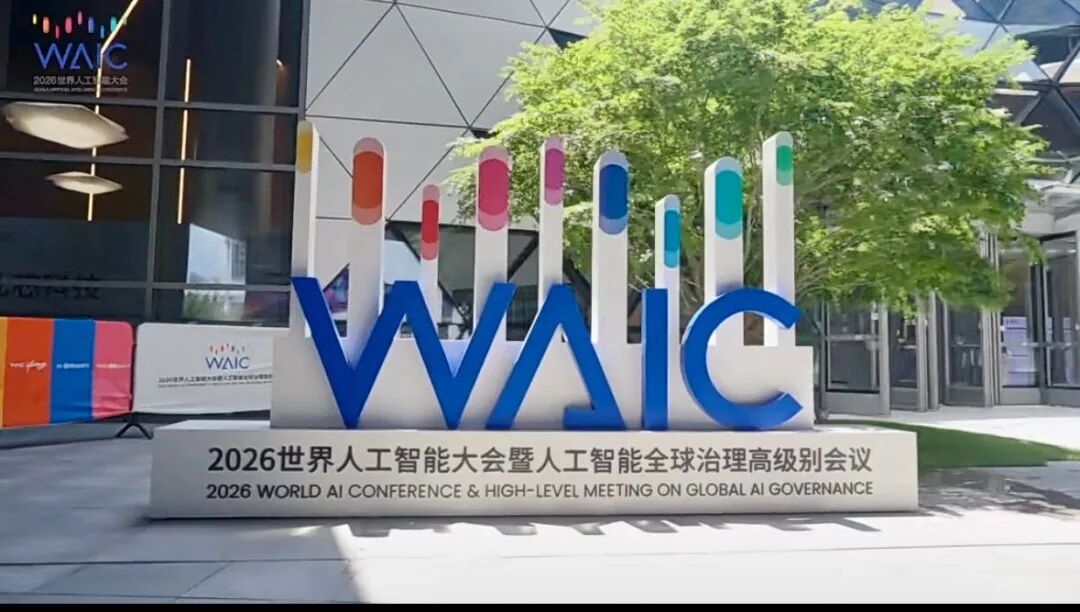
"No ticket, no equality."
Investors' WeChats barely stopped buzzing from Monday. Peers, friends, founders, bosses, LPs — dozens of people asking the same thing. The answer was always the same: tickets gone long ago.
¥168 single-day passes scalped at ¥1,500. Three-day passes at ¥3,000. The ¥9,998 "Premier" membership, limited to 651 slots — sold out. Rumor had someone bidding near ¥10,000.
The absurdity went deeper. On July 18, someone bought a ticket through the official app, payment successful, preliminary review passed. Then the order was flagged "final review failed" and forcibly canceled. Customer service: unable to query, no solution.
Tickets to this cyber feast mirrored the AI industry itself — you think it's yours, it can be taken back anytime. Some things defy explanation.
"WAIC Available"
Flipping through contacts, a string of names had four new characters appended: "WAIC可约" — "WAIC available." Meaning, bluntly: "I'm in Shanghai, free to meet anytime."
Hotel prices more than doubled. Veterans had their schedules packed three events per night two weeks out — "in previous years, you'd only ask a day or two before."
Over ninety percent of investors tracking AI and chips were in Shanghai that week. One industry old-timer even said: "Just confirming who's still in the game and who's already out is worth the trip."
You grab coffee in Pudong; the next table's discussing embodied intelligence. You hail a ride in Zhangjiang; the previous passenger who just got out — also an investor.
"More investors than industry players." The person who said this remembered solar trade shows from years ago.
Another moment when everyone felt "if I don't get in now, it'll be too late." Maybe this time really is different.
After Party
Nighttime, young people's carnival.
After-parties were a major highlight this year. ZhenFund, BlueRun Ventures, 5Y Capital, Yunqi Capital, Source Code Capital — nearly every fund you could name hosted gatherings across Shanghai's summer nights. Hundreds of parties, from July 17 through July 20.
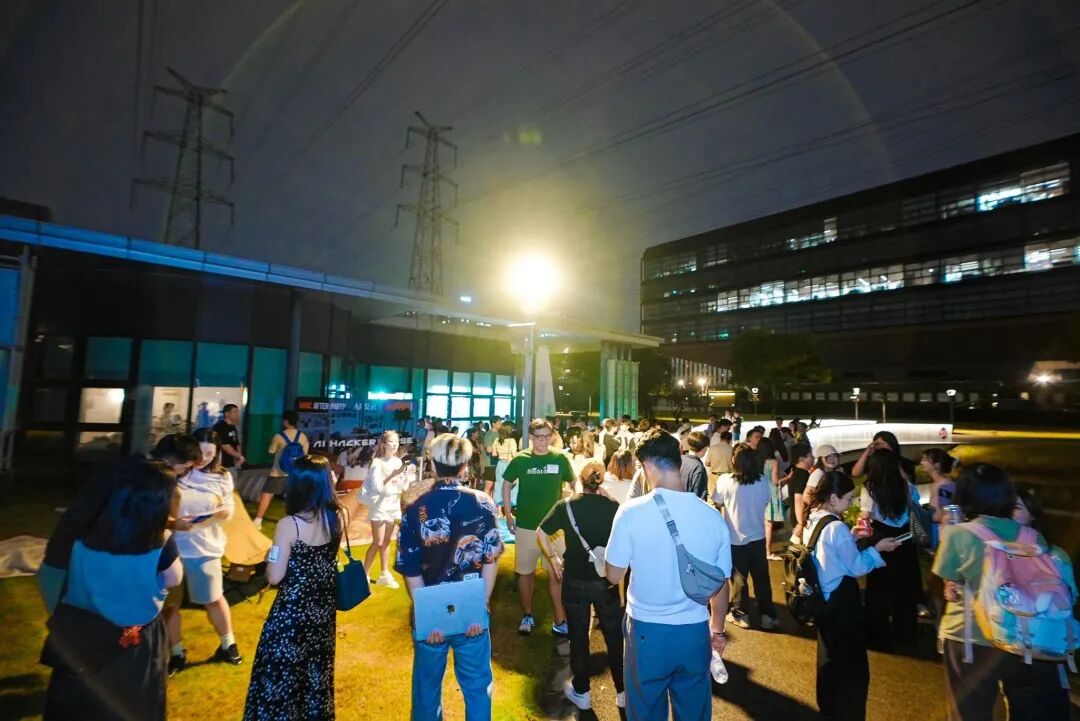
At the AI Hacker House in Caohejing Development Zone, Crossing, Spark Lab, and friends threw an after-party that burst at the seams.
After registration opened, over a thousand applied; three hundred-plus showed. Past midnight, the lakeside cottage and outdoor lawn were still packed — some talking product, some talking funding, some just not wanting the night to end.
I'm Surrounded
"Oh no, I'm surrounded by robots."
Look left: a robot dancing. Look right: a robot brewing tea. Turn around: a robotic dog launches into a 720-degree backflip, landing with four legs slightly bent to absorb impact.
208 models, 300-plus real machines. Someone said the entire H3 hall felt like an opened Robot Encyclopedia.
Here, humans are tourists. Machines are the protagonists. You stand among them, vaguely uncertain who's observing whom.
Top-Tier Lineup
This WAIC, nine Turing Award and Nobel laureates confirmed attendance.
WAIC Academic launched for the first time, chaired by Turing Award winner Andrew Yao. Sutton, Bengio, Brassard, Yaji — names that rang louder and louder.
But you'd notice one detail: the Chinese faces on the main forum stage were mostly industry representatives. Li Xu talking deployment, Qi Yin talking commercialization; they shared practice, not theory.
Top academic voices came from overseas. Industry voices grew from本土.
An industry's peak lineup sometimes precisely reflects what it hasn't yet finished building.
Sutton's Cold Water
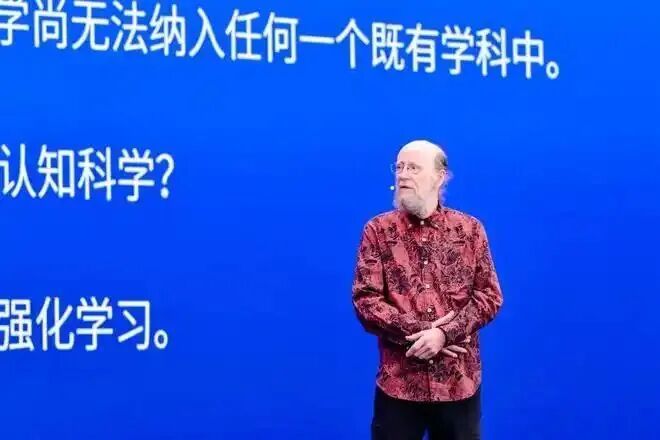
On the main stage, Sutton took the podium. The hall went silent.
He said people confuse intelligence and computation — "most of what's here is computational power." He said current AI "mainly uses the power of human knowledge, delivering it back to us, with no ability to discover knowledge of its own."
He said, "We're still in the 'age of human data.' This approach has reached its limits." His conclusion was blunt enough to make you shift in your seat: "Current AI intelligence is not strong enough. I think it is rather weak and unreliable, because it produces many illusions."
After this, he paused — "but at the same time it is very useful."
The room went quiet for several seconds. An industry spent a year building a dream, then invited a Turing laureate to pop the bubble.
Cyber Drudges
Last year robots were still "things to look at." This year they became "things that work."
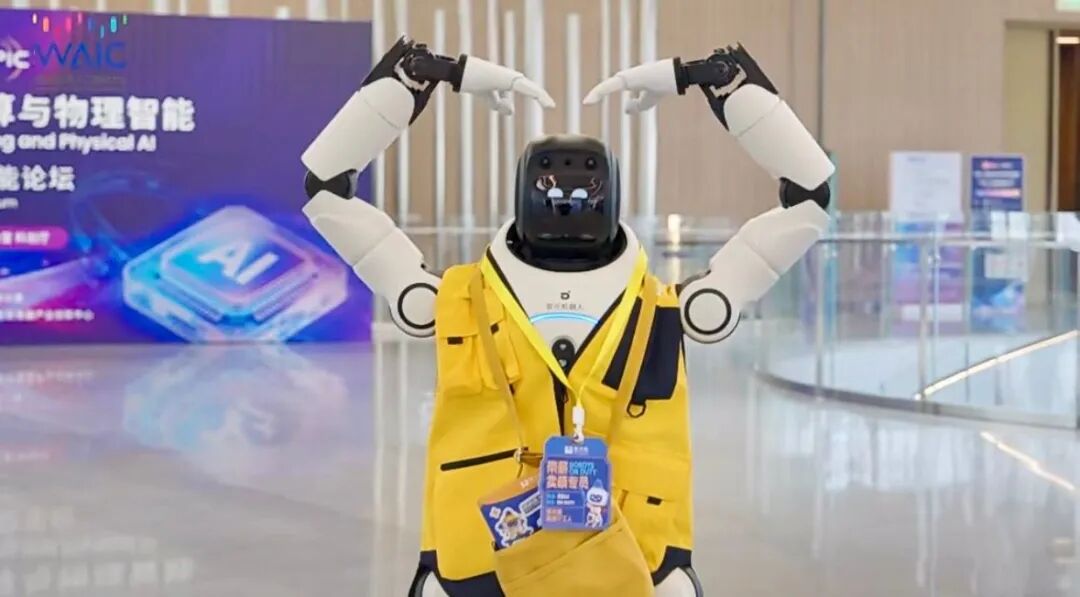
At the main Expo venue, roughly sixty full-size humanoid robots were stationed throughout, each wearing a plastic employee badge: "Guide," "Information," "Retail Assistant."
They worked shifts, did jobs, and after ten hours of battery life would walk themselves to charging stations. Someone passing by remarked: "These robots reek of wage-slave energy."
At the main Expo hall, AgiBot showcased its "working crew" — directly importing a real production line into the venue; the Jiling G2 Max partnered with JD.com logistics, moving and palletizing goods twenty-four hours straight, no shift changes, no night differentials; Ant Group built a pharmacy at center stage, where three robots received orders, divided tasks autonomously, and delivered medication from shelf to hand in ninety seconds flat.
Humans discussed AGI in the exhibition halls; the first batch of robots got a head start as cyber drudges.
Unitree Ring
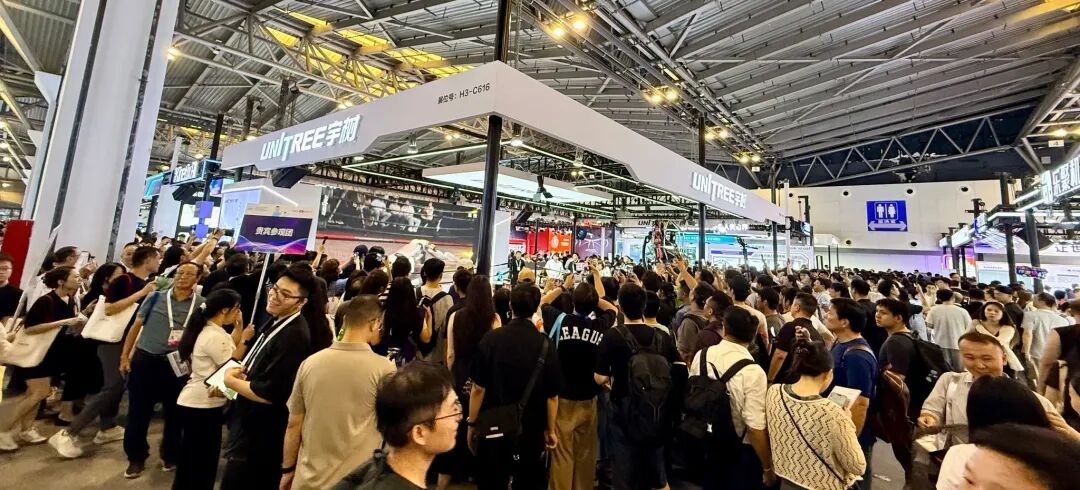
At the Unitree booth, mountains of people, impassable crowds.
Two G1 robots stood face to face, joints emitting faint servo whirs. Unitree brought a new boxing ring "brawl" performance, transforming its booth into a spectacle fusing competitive sport, mecha art, and frontier tech.
Machines imitating humans fighting. Humans watching machines imitate themselves fighting.
Chinese Flavor
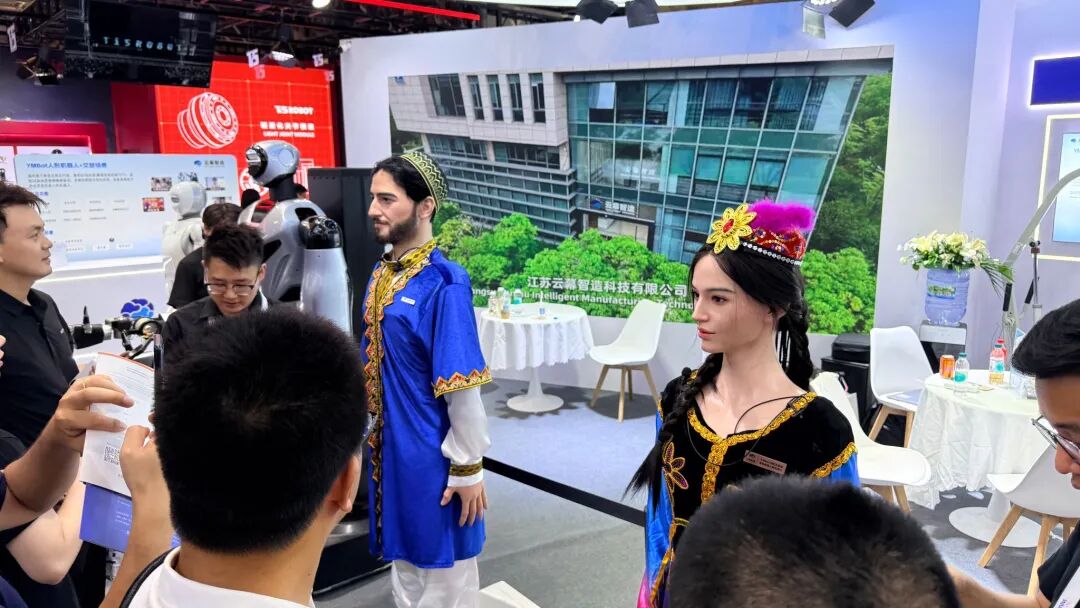
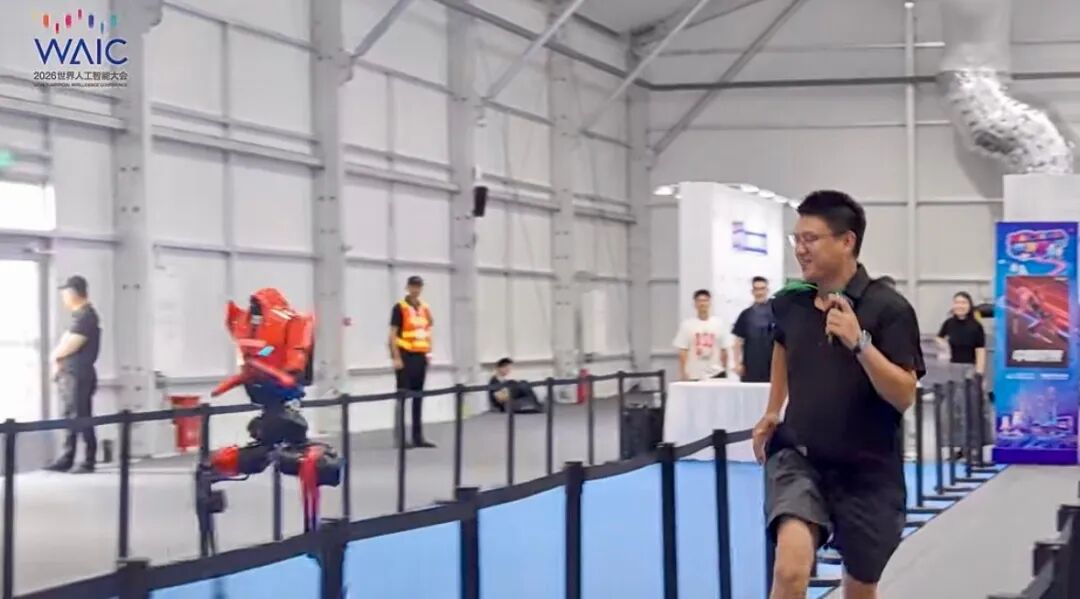
Fifty centimeters tall, topped with an enormous Doubao cartoon head. Below the head: two mechanical legs — no torso. It trotted with tiny steps, then dropped into a full split. The crowd burst out laughing, phones raised. One micro-influencer rode its coattails to millions in traffic.
It's Doujiao. Developer: Zihao Zhang, a Tongji University student. The head was 3D-printed; the base body cost over ¥10,000. He said the product pursues one thing — harmlessness to humans and animals alike.
Not far away, a cosplayer girl walked a robotic dog. A robot with Peking opera face paint moved through slow gestures. Around the music-playing robot, a crowd gathered — the piece rearranged by AI, sounding like electronic music. Someone sat across from a humanoid, staring for ages, unable to tell if the face across was human or machine.
WAIC is no Silicon Valley replica. It has its own distinct Chinese flavor — national heritage, tech, ACG culture, wage-slave spirit, mixed together into something elegantly itself.
Brick Great Wall
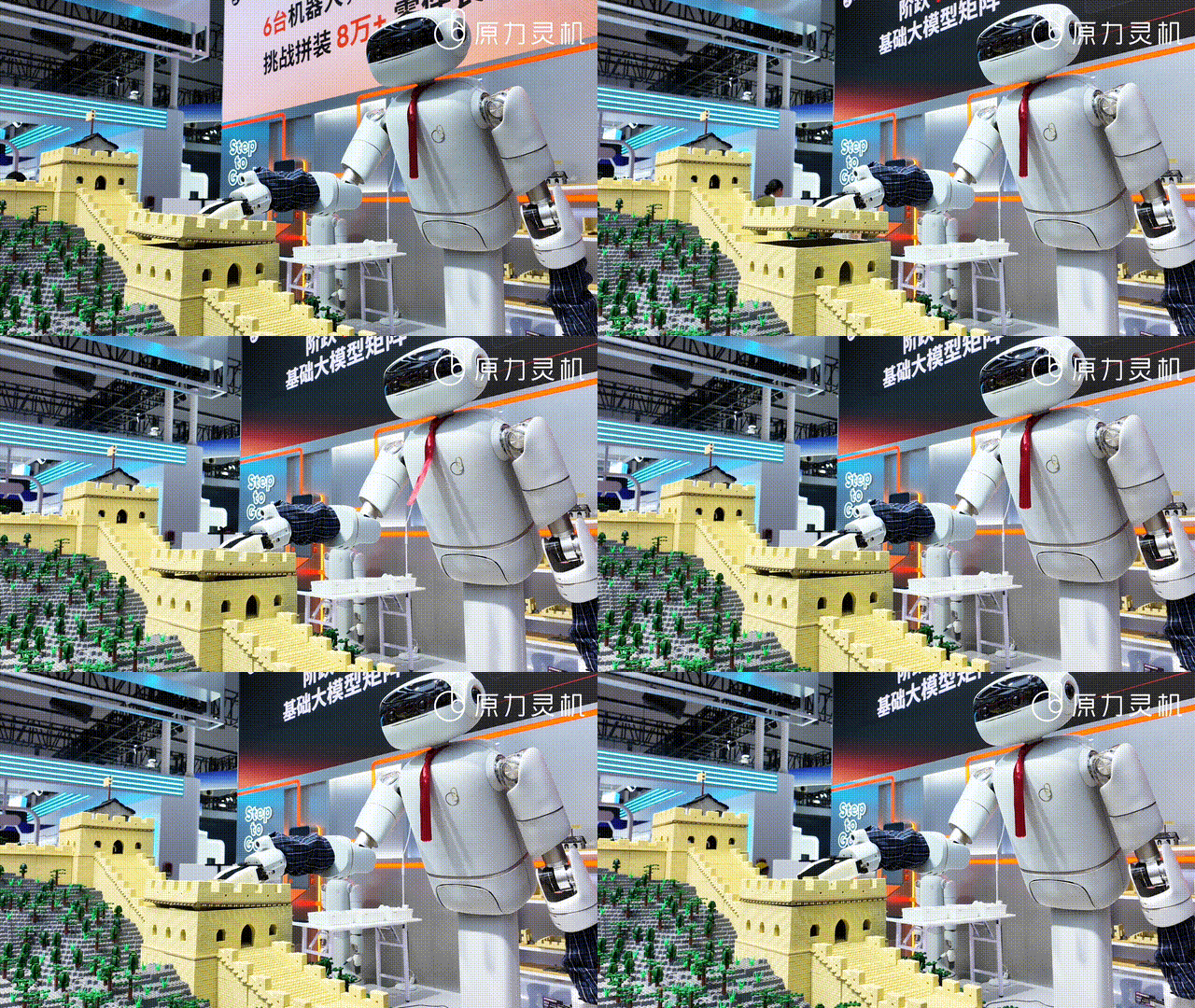
Six robots, 80,000 bricks, 15 hours, a 3.5-meter Great Wall model. No remote control, no script. The smallest components under 1cm wide, fitting precision 0.1-1mm — exceeding natural human hand tremor.
From rehearsals on, the booth was packed three layers deep. People waited to see it succeed, and wondered if it would fail.
Humans built the Great Wall over millennia; robots challenged it in 15 hours.
The robots created this piece across four exhibition days, and it might be seen as a new "milestone."
A Special Band
Guitarist, bassist, keyboardist, drummer — four robots, performing "My Future Is Not a Dream" with millisecond-level synchronization. Below the stage, someone hummed along: "Are you like me, head bowed under the sun..."
Robots don't understand what "future is not a dream" means. They're just playing for those who believe it.
Machines singing human songs. Humans listening to machines sing their songs.
Mechanical Horse
In a corner of H3, a crowd gathered around a "horse."
Four mechanical legs, streamlined body, like something walked straight out of a sci-fi film. It moved unsteadily. It's called Qiji — "fine steed" — a full-terrain intelligent riding robot horse, from Daka Robotics, founded just a year ago. The largest model: 350 kg, capable of carrying one ton.
Can't help but recall a recently viral video: by the shores of Xinjiang's Sayram Lake, a humanoid robot sat astride Qiji, drawing a bow and firing arrows backward, distant mountain peaks crowned with clouds.
This wasn't mere product demo — it was aspiring toward new mythology.
The Only Café
Luckin Coffee set up a booth in the Expo core zone. The sign read: "'Gets Me' AI Coffee Pop-Up." Next door: Yili Group.
Coffee sellers, milk sellers, bubble tea sellers — squeezed into the same exhibition hall as Huawei, Alibaba, Tencent.
Full Mobilization
Day one of WAIC, someone scanned the floor and sent a message: "Feels like 90% of China's tech media peers are here."
They hauled equipment, held gimbals, went live. Before you reached a booth, three or four camera setups were already in place. Someone crouched in a corner charging three devices simultaneously — three power banks, two phones, one camera, lined up in a row.
They entered before investors, left after engineers. No parameters, no valuations — just one word: "traffic."
Instant Noodle Line
A robotic arm lifted a purple clay teapot, wrist turning gently, water arcing into a tea cup. The movement as steady as a master's.
A crowd gathered — "Look, it even knows to appreciate the aroma." At a nearby table, a robot divided tea into three small cups, not a drop spilled.
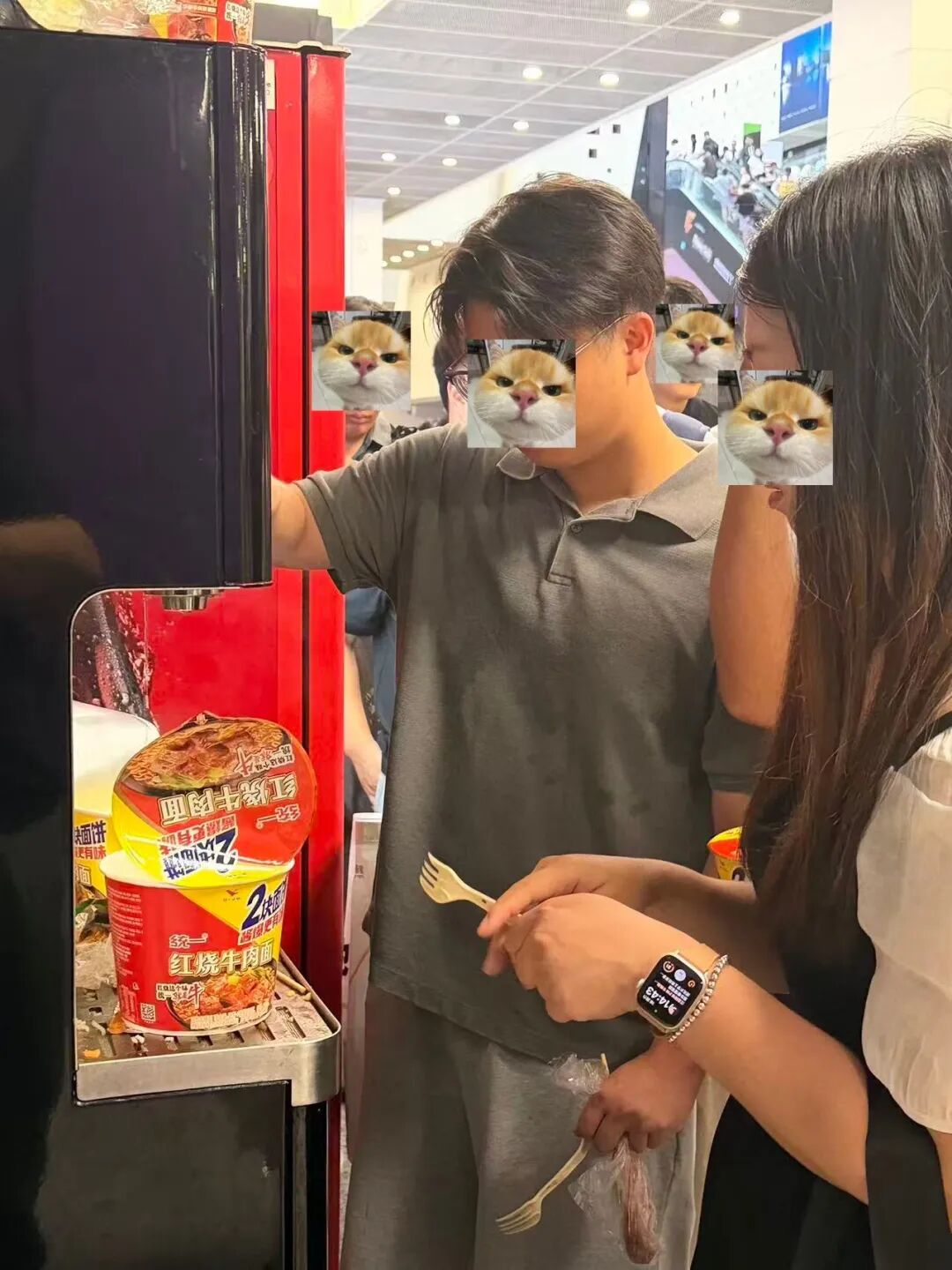
At the other end of the hall, a long line formed, ending at a hot water dispenser. People held instant noodle bowls waiting for water to boil. Robots performed elegant tea ceremony; attendees queued for noodle water.
Robots learned graceful performance, brewing gongfu tea. Humans scrambled to solve basic sustenance.
Handing Out Resumes
In the crowd, someone wore a backpack, clutching a stack of resumes. They moved between booths, handing one out, moving to the next.
An AI summit colliding with fall recruiting season; someone treated the exhibition as a natural filter. Some HR hung job postings right beside their displays.
Years later, they might forget every robot they saw that day, but they'll remember that forty-degree summer, the sweat in their palm as they handed over a resume at a booth.
While everyone talked about AGI, they were just looking for a job.
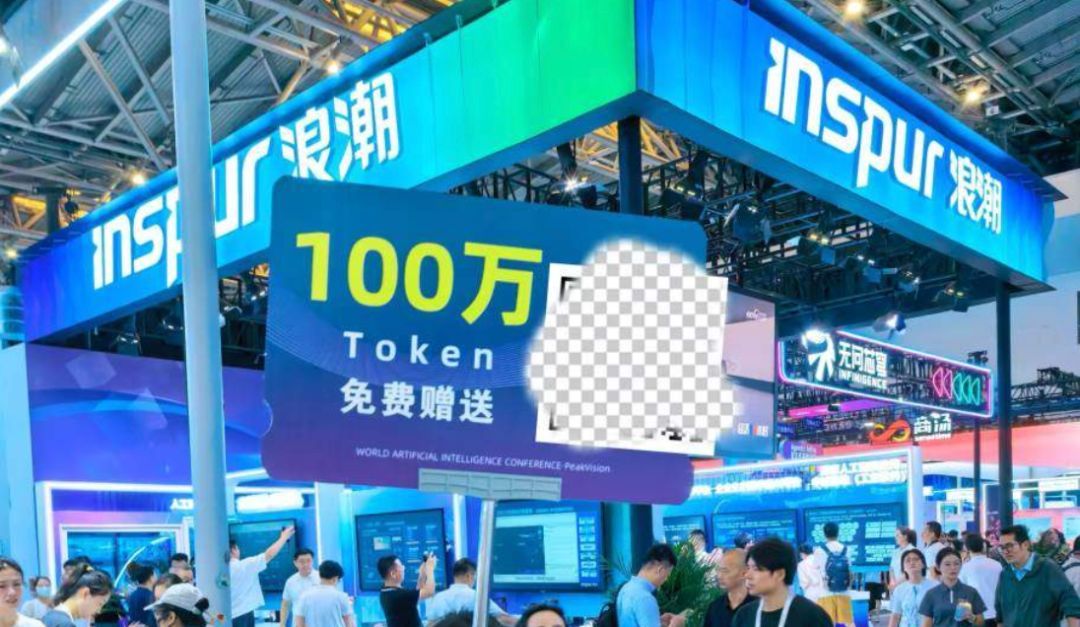
Million Tokens Free
"Scan for a million free tokens." Someone paraded through the halls holding a sign. Someone boldly imagined sticking QR codes on robot backs — you chase and scan, it keeps walking, like it's teasing you.
Token went from technical unit of measurement to convention swag in just one year.
Here's a million tokens, you'll never use them anyway. Like giving you a future, you'll never catch it anyway.
"They're Pretty Weak"
"They're pretty weak." A staffer behind a booth raised their voice. A visitor had just mentioned a competitor's name; the staffer fired back, no sugarcoating.
Another fun fact: apparently the most frequently asked question booth staff faced was: "What's your difference from peers/giants?"
Those answering recited the same script on loop; those asking knew the answers were mostly similar. But everyone maintained the pretense.
H4 Hall
H4 hall, FutureTech venture ecosystem zone, 158 startups, twenty-two one-person companies.
Booths weren't large, no "trillion parameters" banners. Founders stood at their own booths, personally demoing products.
"¥39 monthly membership, two bubble teas' worth, over five million users." The founder said, "The giants think PPT generation is useless — that's precisely our living space."
The "hundred model war" has receded. Survivors don't talk parameters and vision; they talk revenue, customers, where's the next deal.
FAs shuttled between booths, connecting with startup projects one by one. "Compared to funding, what we lack more now are projects that can actually make money."
AI Customer Service
The conference official app's AI customer service flopped on opening day. Some queries got one in four wrong; others defaulted to human handoff.
Someone quipped: "Cyber wage-worker, messing up on day one."
You're teaching machines to get smarter; they're making you look less smart.
Failure
Some robots suddenly lay flat mid-stride. Some froze mid-wave, arm suspended in air. One tried to hand something over, but the gripper loosened, dropping it on its own foot... Every failure, the crowd默契ly raised phones.
People prefer filming failures. Because failure is more real, more like they've finally shown a crack.
In this cyber world, only at moments of failure does everyone smile together. In that instant, robots aren't "them" anymore — they're more like "us."
We don't truly expect them to be perfect. We expect them to make us feel we haven't been replaced yet.
Black Friday
That same day, global tech stocks plummeted collectively.
The Philadelphia Semiconductor Index entered bear market territory; panic spread globally. The Shanghai Composite dropped 3%; ChiNext fell over 7%.
Inside and Outside the Venue
NVIDIA, AMD, Intel — absent. Domestic giants at full strength. Rumor had Apple, Microsoft, Tesla, Amazon each sending a handful of people, staying "invisible" throughout.
ByteDance again had no booth this year, just quietly present at partner Nubia's zone, proving its presence through an AI phone with built-in Doubao large model.
In May, the U.S. Department of Commerce added 7nm chips and HBM3 memory to control lists. Three days before WAIC, they stated: new rounds of AI chip controls were being fast-tracked.
The heat inside the venue and the chill outside coexisted in the same summer.
City-Wide City Walk
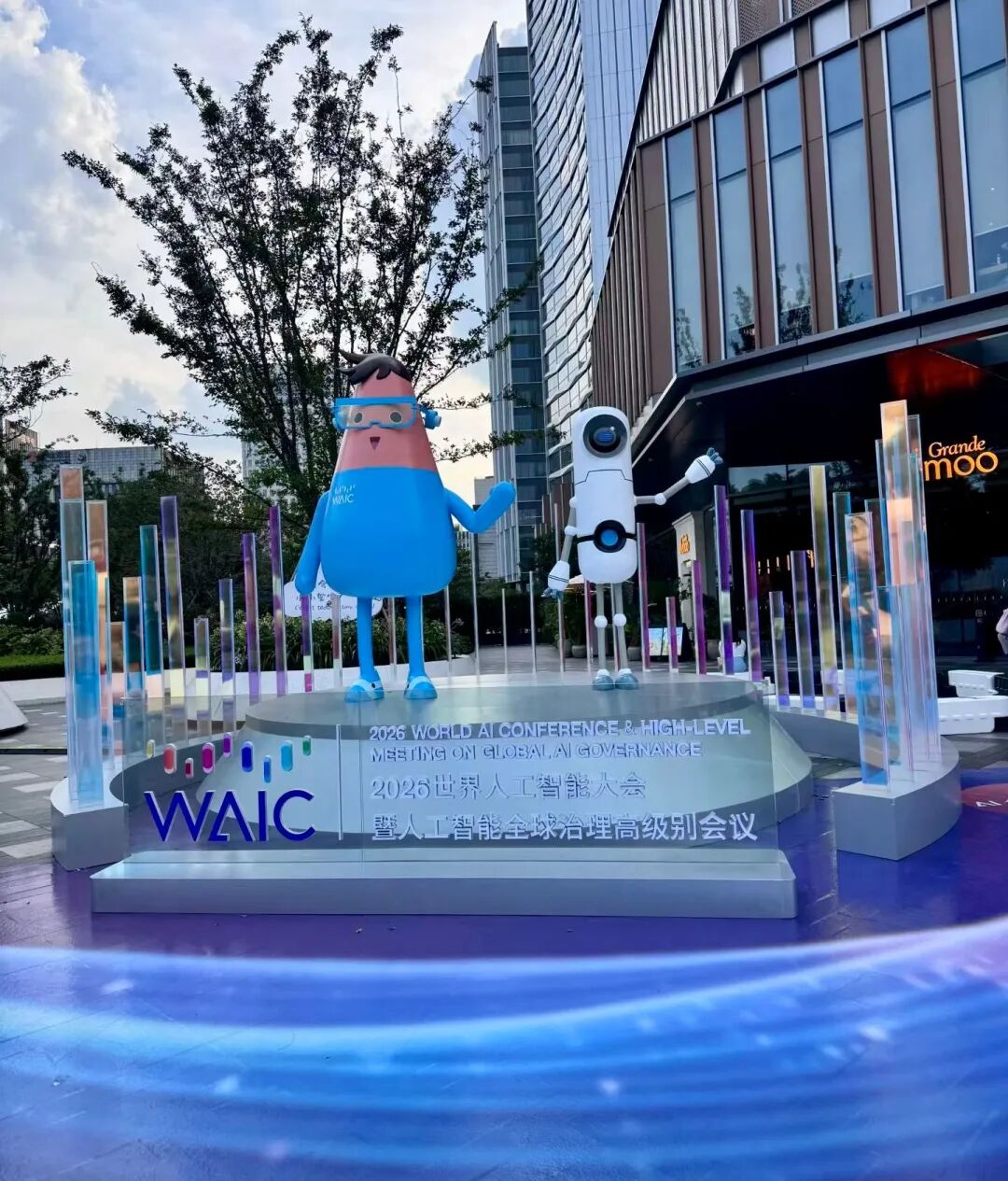
This WAIC was no longer just hall-bound excitement. The conference partnered with 14 city landmarks to launch six AI city walk routes.
From West Bund to Zhangjiang, from Expo to the French Concession, all of Shanghai became a massive AI theme park.
A century-old shikumen houses an AI coffee shop; a historic villa holds an XR immersive experience. Historic architecture and cyber labels pasted together. You're visiting AI; AI is visiting you too.
The city wore a different face for those few days. After the curtain falls, stickers peeled off — what will actually change?
Downpour
Night of the 18th, sudden torrential rain. No warning, like someone twisted open a faucet in the sky.
On traffic-controlled streets, investors in Arc'teryx, anime cosplayers, and robots wearing employee badges huddled under the same eaves.
Minutes before, they'd been at different parties exchanging cards, discussing projects, talking markets. An investor glanced at his watch — 11 p.m., rain showed no sign of stopping.
The venue lights had gone out, screens darkened. Hundreds of robots stood in the lightning of night, like a battalion of powered-down soldiers.
Rain-soaked Shanghai seemed to take a deep breath for this cyber carnival.
Coda
Years from now, when we recall this WAIC, we probably won't remember any parameters or stock prices.
But we'll remember that forty-degree summer. The instant noodle line beside the flowing tea ceremony. The crowd's burst laughter at Doujiao's split. The hurried rush of all kinds of people through the downpour.
Those absurd, clumsy, laugh-out-loud moments — they're not jokes, they're true stories. These unplanned, clumsy, grin-inducing instants come closer to an industry's real body temperature mid-gallop than any meticulously choreographed display ever could.
That was 2026. The hottest summer Chinese AI ever had.