Could AI Slow Down Scientific Progress?

Scientific progress is visibly slowing down.
Scientific progress is visibly slowing down.

👦🏻 Authors: Sayash Kapoor, Arvind Narayanan
🥷 Translated by: Crossing

Editor's Note from Crossing (Koji)
Not long ago, OpenAI announced a proof of the Navier–Stokes existence and smoothness problem, with formal verification in Lean completed by GPT-6 Astra — reigniting the imagination that "AI is accelerating science."
But this 2025 article poses a more counterintuitive and more sobering question: Could AI make papers faster to produce while making genuine scientific progress slower?
I recommend it because the authors don't linger on model capabilities. Instead, they train their attention on the bottlenecks of scientific institutions: attention, incentives, reproducibility, and human understanding.
When AI dramatically lowers the cost of "producing answers," we need even more to re-examine what counts as real progress? AI companies predict that AI will deliver astonishing scientific advances: curing cancer, doubling human lifespan, colonizing space, even compressing a century's progress into the next decade.
To the tech world, this seems like a natural next step: AI can insert itself into every stage of the research pipeline — summarizing literature, generating hypotheses, analyzing data, running experiments, writing papers, and conducting peer review.
But the impact of new technologies on existing institutions often runs counter to initial intuition. The printing press was seen by the Catholic Church as a tool to consolidate authority; social media was briefly hailed as an engine of global democratization after the Arab Spring.
AI's impact on science may similarly yield counterintuitive results: even if every scientist who adopts AI becomes more productive, that doesn't mean the complex system of science as a whole will benefit.
To understand this, we must confront a "production-progress paradox":
The rate of scientific publication has grown exponentially — increasing roughly 500-fold between 1900 and 2015. Yet by virtually any available metric, the pace of genuine scientific progress has not kept pace, and may even be slowing.
AI companies, research funders, and policymakers are currently focused on accelerating "production." But this may be like adding lanes to a highway when the real problem is congestion at the toll booth — only making things worse.
Science Is Slowing Down: The Production-Progress Paradox
Global paper output roughly doubles every 12 years; the number of people engaged in research is growing even faster.
Between 2000 and 2021, R&D investment across seven major research-funding nations — the United States, China, Japan, Germany, South Korea, the United Kingdom, and France — grew approximately fourfold.
The problem is that more papers, more researchers, and more funding do not automatically yield more breakthroughs.
True scientific progress comes from shifts in frameworks of understanding. Plate tectonics, for instance, allowed geologists to correctly understand the formation of continents and mountain ranges for the first time. Before this paradigm shift, no amount of accumulated observations and papers within the old framework could produce equivalent progress.
Metascience — the study of science itself using scientific methods — attempts to measure this gap.
It asks whether research can be reproduced, how academic incentives shape outcomes, which funding models promote breakthroughs, and how fast science is actually advancing.
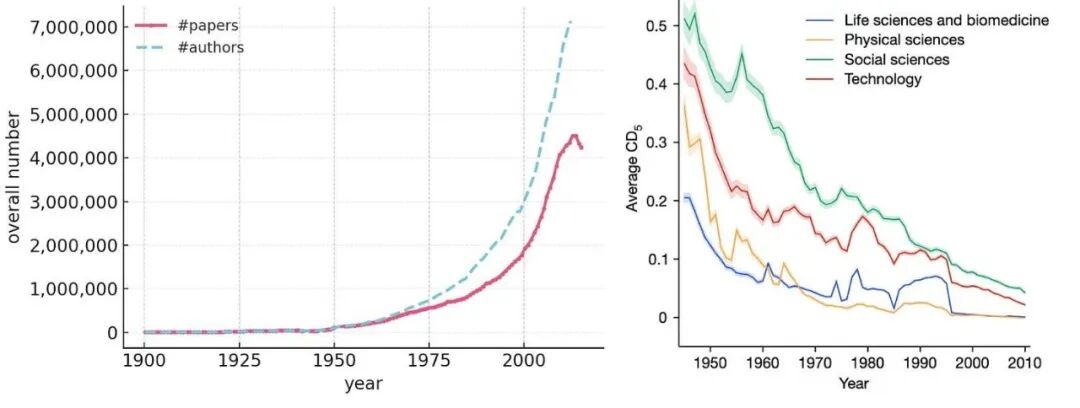
Papers and authors keep increasing, but paper disruptiveness is declining
Multiple lines of evidence point to the same trend:
-
The share of "disruptive" papers in total research output keeps falling. Papers and patents grow exponentially, but the absolute number of genuine breakthroughs stays roughly flat.
-
New theories typically bring new concepts and terminology, yet the number of unique word combinations in paper titles has stagnated or even declined since the early 2000s.
-
Scientists across fields judge Nobel-winning discoveries from the early 20th century to be roughly comparable in importance to more recent Nobel achievements. Massive increased investment has not made the most important breakthroughs more stunning.
-
The share of Nobel Prize-winning discoveries made within the 20 years prior to the award dropped from roughly 90% in 1970 to roughly 50% in 2015. This suggests either that major breakthroughs are occurring more slowly, or that they take longer to be recognized.
-
Looking at indicators from economic growth, Moore's Law, crop yields, and life expectancy, the exponential growth in researcher numbers has been offset by steadily declining productivity per researcher.
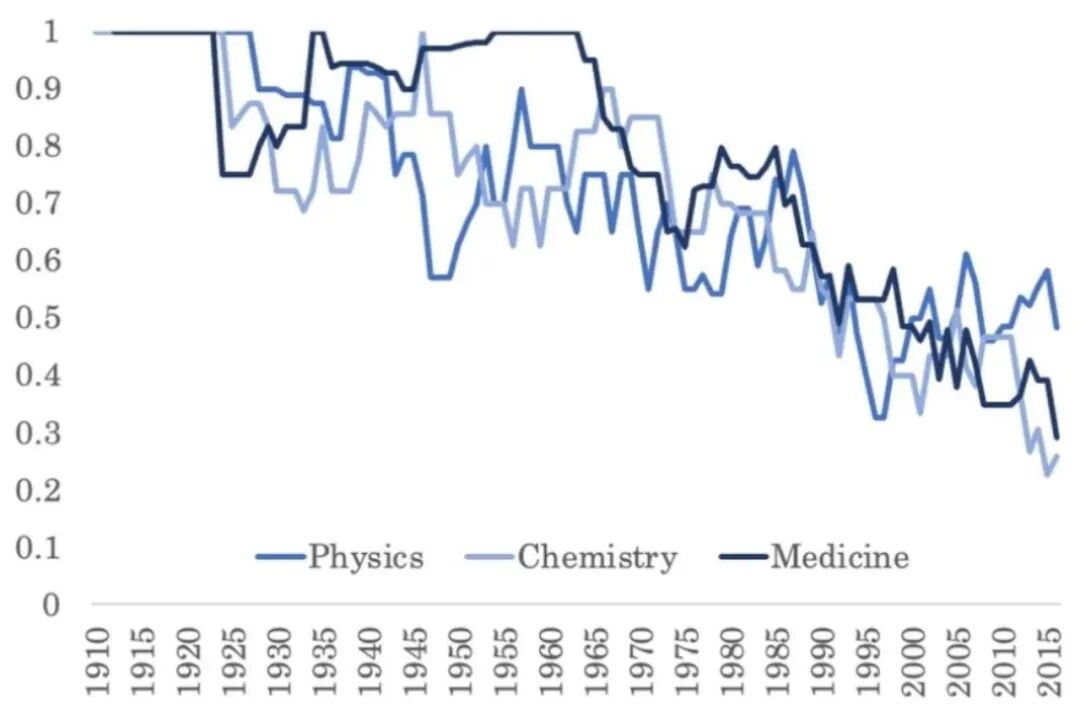
The share of Nobel-winning discoveries made within 20 years of the award keeps declining
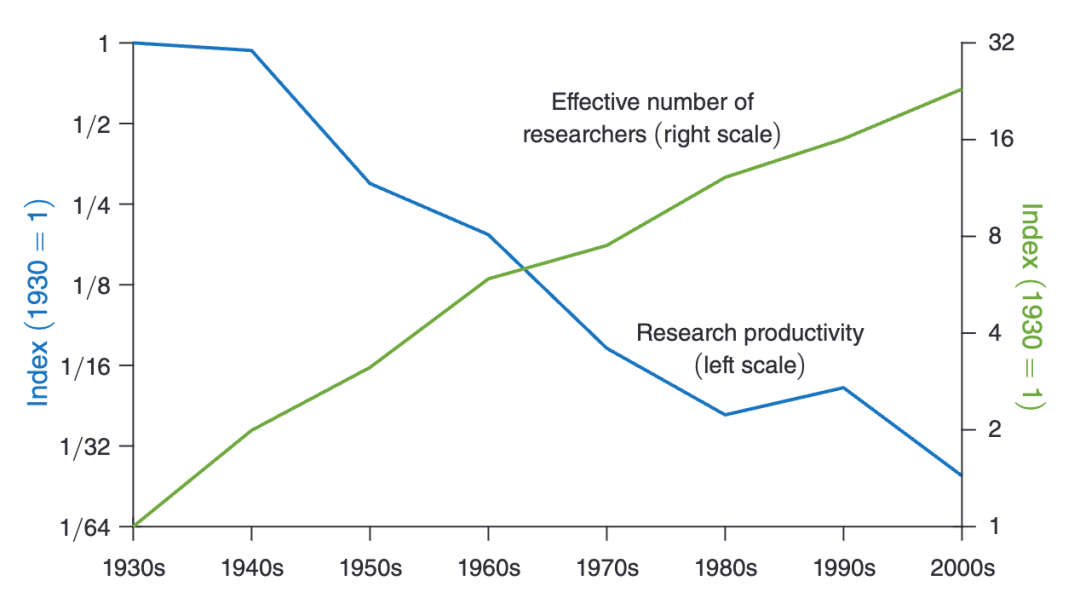
Research productivity continues to decline
These metrics all have limitations. Using citation patterns to judge whether a paper is "disruptive," for example, may be affected by changing citation practices, and a breakthrough like AlphaFold would not register as disruptive by this measure.
But taken together, the evidence at least confirms this: relative to the growth in papers, researchers, and resources, scientific progress is visibly slowing down.
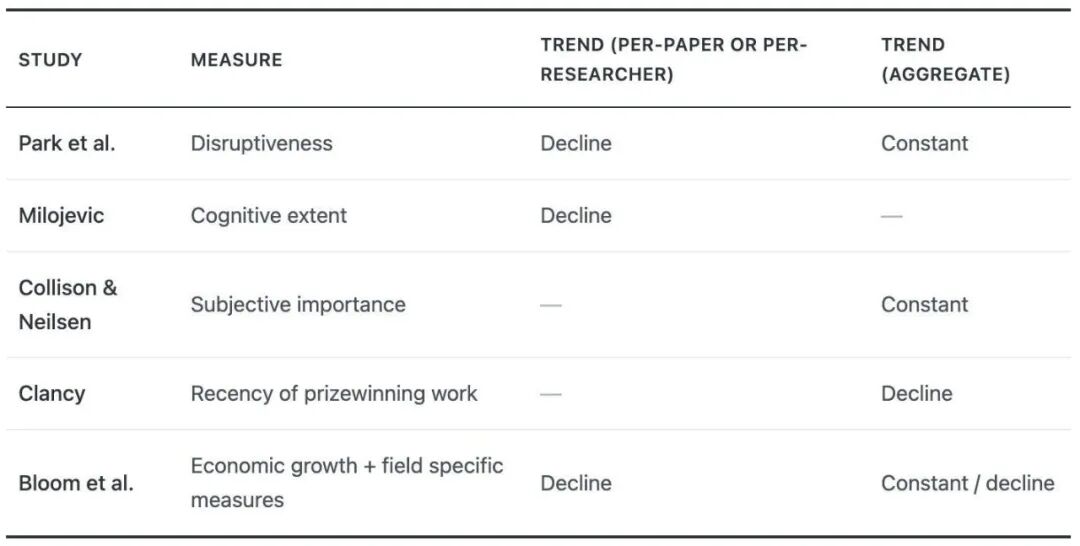
Key evidence that scientific progress is slowing
Why Is Scientific Progress Slowing? Can AI Help?
One common explanation is that "the low-hanging fruit has been picked": easy problems are increasingly scarce, and what remains is harder.
The authors argue this can at best explain part of the slowdown in individual fields. Scientific tools and existing knowledge also keep advancing, continuously creating new fields — computer science, climate science, cognitive neuroscience, network science, genetics, and molecular biology are all new trees that have grown in the last century, with fresh low-hanging fruit still on them.
Another explanation deserves more attention: something has gone wrong with how science is organized, causing the efficiency of converting research input into genuine progress to decline.
It may even be that "production moving too fast" itself is making science slower.
Scientists' attention is finite. The more papers there are, the easier it is for genuinely novel work to drown in noise.
Researchers increasingly rely on papers that are already heavily cited and widely recognized as canonical. So the more papers are added, the more academic attention concentrates on existing paradigms — and the harder it becomes for new ideas to enter mainstream knowledge systems.
The "publish or perish" incentive structure further reinforces this cycle. Paper counts and grant funding are easy to measure; genuine progress is hard to measure in real time. So universities and research institutions naturally gravitate toward quantifiable metrics to evaluate researchers.
For individuals, choosing low-risk, easily publishable research is rational. But for the scientific community as a whole, this suppresses high-risk breakthrough work that might yield only one paper after many years.
If one cause of scientific slowdown is overproduction, then AI will directly amplify the problem.
It makes chasing paper counts, citations, and other surface productivity metrics easier. It may also make individual researchers more creative while the scientific community loses diversity through convergent model outputs.
AI could further exacerbate uneven attention distribution, making it even harder for new ideas to surface.
Science Isn't Even Ready for Software, Let Alone AI
Most AI applications in research are essentially software development: using models to find patterns in data, writing machine learning programs, or having generative AI produce analysis code.
But the research community's software engineering practices lag far behind industry. Automated testing, version control, and design specifications — basic methods — are still missing or haphazardly implemented in research.
More seriously, peer review typically does not examine the actual code and data that perform computations. Many papers don't even make these materials available. A study of 1,800 biomedical papers that had promised to share code and data found that 93% ultimately failed to do so; when researchers requested code and data from authors of 204 papers published in the top journal Science, only 44% responded.
Even when code and data are made public, errors are widespread. A classic case: Excel automatically converting gene names into dates, causing related errors in roughly one-fifth of genetics papers.
It took the scientific community decades to gradually learn responsible use of basic statistical tools. The complexity and hidden errors introduced by AI will only be harder to catch.
Before generative AI, traditional machine learning had already caused methodological errors in over 600 papers across 30 scientific fields. A review of more than 400 papers using AI to diagnose COVID-19 found that not a single one produced a clinically usable tool due to reliable methodology.
AI can also be part of the solution: catching paper flaws, automatically reproducing experiments, helping researchers improve code, providing testing and code review.
But this requires journals, research institutions, and funders to shift incentives from "producing more" toward training, synthesis, reproduction, and error detection.
AI May Let Wrong Theories Persist Longer
Traditional scientific modeling typically begins with a hypothesis about how the world works, then tests it with statistical models.
AI modeling is more like a black box: it doesn't necessarily form an interpretable model of the world, but directly leverages historical data to improve prediction accuracy.
This is often very useful in industry, but in science it may hinder understanding.
The authors use geocentrism as an analogy: by continually adding "epicycles," the geocentric model could predict planetary motion with great accuracy — indeed, some modern planetariums still use similar calculations. Heliocentrism won not because its initial predictive accuracy was far superior, but because it offered a simpler, more profound explanation of planetary motion.
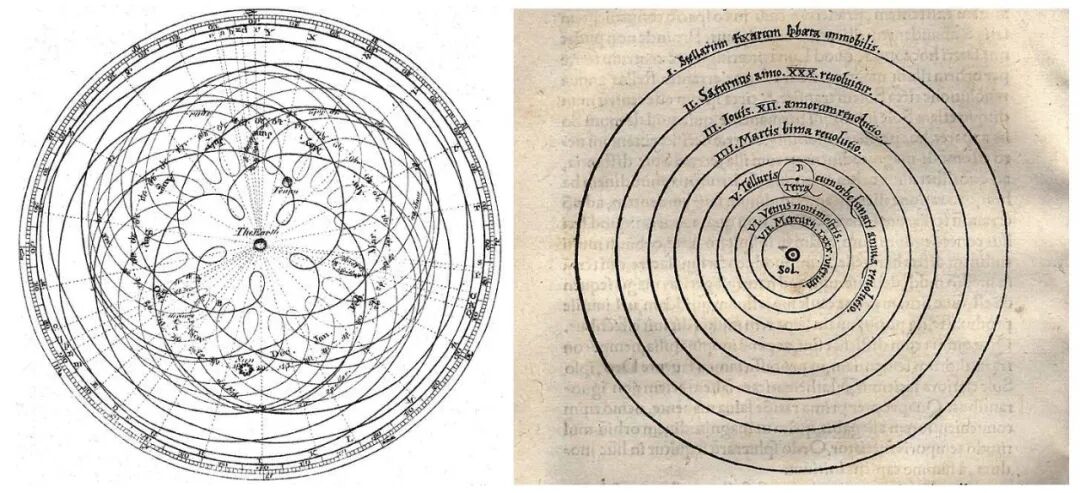
The complex geocentric model versus the simpler heliocentric model
Scientific progress depends on theoretical renewal, not just improved predictive accuracy.
AI may be very good at manufacturing new "epicycles" across fields: layering increasingly precise predictions on top of wrong theories.
If better predictions keep researchers working within flawed theories longer, an entire field may grow ever more precise within an existing paradigm while remaining unable to escape an intellectual dead end.
One experiment showed that a Transformer trained on ten million planetary orbits could predict orbits excellently, yet failed to discover the gravitational laws that produced them.
This is precisely the risk of "prediction without understanding."
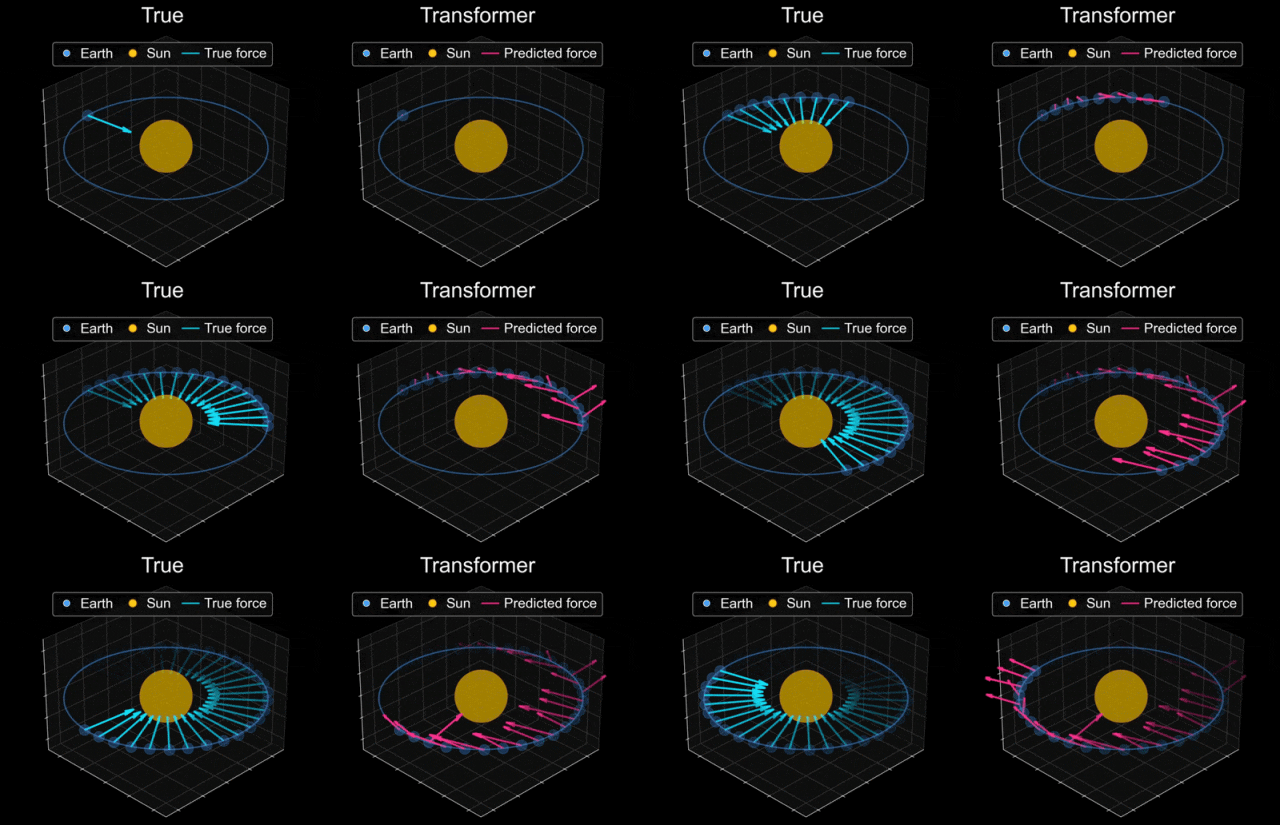
The Transformer can predict orbits, but does not discover the underlying gravitational laws
Human Understanding Remains Irreplaceable
Solving problems and writing papers may look like the ultimate goals of research; but the authors argue these processes are more like rituals leading to the real reward, which is human understanding of phenomena.
Without this understanding, there is no scientific progress.
Fields Medalist William Thurston once emphasized that mathematicians' work is not merely judging mathematical propositions true or false, but finding ways for humans to understand and think about mathematics.
He drew on his own experience researching foliation theory: after he quickly solved important problems in the field, other researchers actually began to leave.
Not because the problems were exhausted, but because his results were difficult to understand, combined with the sense that the major theorems had already been proved. Newcomers found it hard to enter, and hard to gain academic rewards by proving new results. Eventually, the frontier understanding that had existed in the community gradually eroded.
Researchers develop understanding through the process of solving problems because they must personally traverse reasoning and trial-and-error. If AI delivers answers directly without producing corresponding human understanding, it may sever this process.
The authors use a vivid metaphor: using a forklift in a gym, you can certainly lift heavier weights — but lifting weights is not the real purpose of going to the gym.
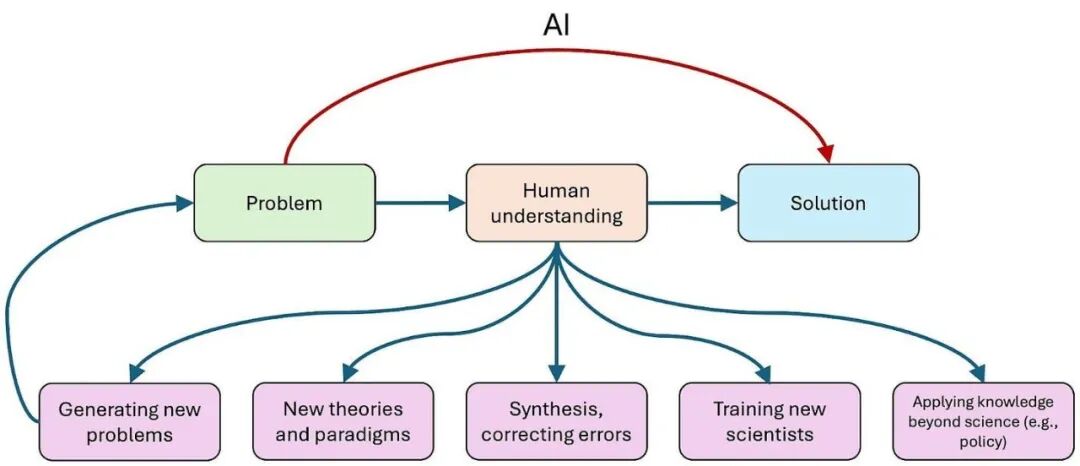
AI may bypass the process of forming understanding
Not all scientific activities treat human understanding as the ultimate goal. Weather forecasting and materials synthesis prioritize real-world outcomes. But most fields lie somewhere between these two extremes.
If AI bypasses understanding, or only creates an "illusion of understanding," the scientific community may gradually lose its capacity to train new scientists, build new theories, synthesize and correct research, transfer knowledge to other fields, and pose genuinely new questions.
Data from six fields already shows that papers adopting AI tend more toward solving known problems and working within existing paradigms, rather than posing new questions.
Of course, AI can also help humans build tacit knowledge — for example, explaining mathematical proofs. The key is that research incentives must begin to reward understanding, not just answers.
Implications for the Future of Science
Over the past decade, science has rapidly adopted AI without simultaneously transforming slowly evolving institutional norms, quality control, and talent cultivation.
This will likely worsen the production-progress paradox: papers published ever faster, without genuine scientific progress necessarily accelerating.
Between 2012 and 2022, before large language models became widespread, AI-using papers across 20 fields had already quadrupled.
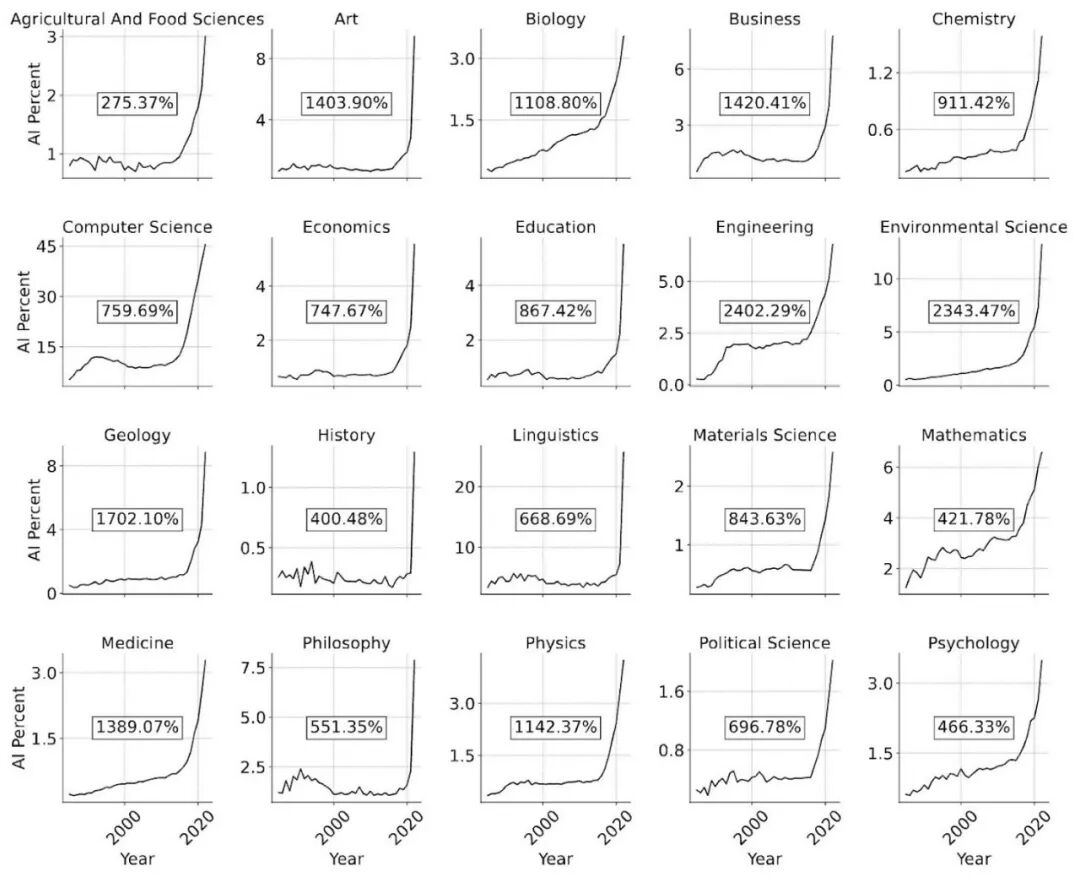
AI-using papers across 20 fields quadrupled
Changing Research Practice
Researchers need to adopt AI more cautiously, shore up software engineering capabilities, understand common pitfalls of AI modeling, and avoid treating AI as either crutch or oracle.
But individual researchers are mostly just rationally responding to existing productivity metrics. What can truly change the system are journals, university hiring and promotion committees, funding agencies, and policymakers.
Investing in Metascience
Metascience has revealed the production-progress paradox, but we still don't clearly know how to define "progress," nor have we reached consensus on what explains the slowdown.
Science cannot have a single "true progress metric," because once a metric becomes a target, it gets rapidly gamed — eventually becoming as useless as paper counts and citations.
Therefore, metascience needs to more deeply understand the causal mechanisms of progress, and validate whether reform proposals actually work.
Currently, metascience receives only a fraction of a percent of total research funding; resources specifically dedicated to studying scientific slowdown are even scarcer.
If the input-output efficiency of the entire research system has really declined by several orders of magnitude, this investment is disproportionately small.
Reforming Incentives
Scientists have long been aware of the "publish or perish" problem, but reform has repeatedly failed due to institutional inertia, metric gaming, and the fact that breakthroughs can only be identified in retrospect.
AI may bring a turning point: when the cost of writing papers drops so low that someone can co-author nearly a hundred in a year, paper counts may finally lose all evaluative value.
Academic career development should reward more what is difficult to automate: new theories, new paradigms, and work that genuinely advances understanding; funding mechanisms need to change in tandem.
The scientific community doesn't need to keep rewarding "AI adoption." AI is already diffusing at extremely rapid speed; adoption rate is not the bottleneck.
Rethinking AI for Science Tools
Large AI companies tend to favor splashy headlines like "AI Discovered X," because this reinforces the narrative that AI will solve humanity's grand challenges.
The public needs to be skeptical of such news: results may not be reproducible, and AI may be just one of many tools yet packaged as the sole protagonist.
Truly valuable AI for Science tools should attack real bottlenecks in research, not build yet another literature review product. For example, helping find errors in research code, strengthening quality control, or helping scientists build understanding.
Mathematicians have repeatedly expressed that they look forward more to tools that promote human understanding, rather than tools that merely automate theorem-proving.
When evaluating a literature review tool, one should at least ask three questions: Does it save time while maintaining quality? How does it affect researchers' understanding of the literature? If widely adopted across the community, how would it change academic attention — would it give already-famous papers even more attention?
These three questions correspond to production, understanding, and progress.
Today's evaluations typically answer only the first question, so they inevitably overestimate benefits and underestimate systemic risks.
Final Thoughts
The authors themselves are active users of AI research tools. The excitement of daily use easily obscures a crucial distinction: AI's help to individual scientists and AI's impact on scientific institutions as a whole are two completely different questions.
We are optimistic that in the long run, the norms and processes of the scientific community will eventually catch up to technological development.
But until then, the road will be bumpy.
Authors: Sayash Kapoor, Arvind Narayanan
Original: https://www.normaltech.ai/p/could-ai-slow-science
Recommended Reading


Join the Membership Group